Student support for higher education in Northern Ireland 2026
Published 26 November 2026
Applies to Northern Ireland

© Crown copyright 2026
This publication is licensed under the terms of the Open Government Licence v3.0 except where otherwise stated. To view this licence, visit nationalarchives.gov.uk/doc/open-government-licence/version/3 or write to the Information Policy Team, The National Archives, Kew, London TW9 4DU, or email: psi@nationalarchives.gov.uk.
Where we have identified any third party copyright information you will need to obtain permission from the copyright holders concerned.
This publication is available at https://www.gov.uk/government/statistics/student-support-for-higher-education-in-northern-ireland-2026/student-support-for-higher-education-in-northern-ireland-2026
Download a pdf version of this document.
If you wish to print the document, we’d suggest printing the pdf.
Introduction
This statistics publication presents figures and analysis on student support awarded to applicants and paid to students or their higher education provider. The publication covers academic years 2013/14 to 2025/26, or from the year in which a particular support product was introduced, where later. The ‘Early in Year’ section provides an initial indication of activity in academic year 2026/27.
The publication covers applicants and students domiciled in Northern Ireland undertaking a designated higher education (HE) course at a UK higher education provider, as well as applicants and students domiciled in the EU (outside UK) undertaking a designated course in Northern Ireland.
7.2% increase in higher education student support in academic year 2025/26, at £440.2 million
Figure 1: Number of students domiciled in Northern Ireland and EU (outside UK) receiving higher education support and amount awarded/paid
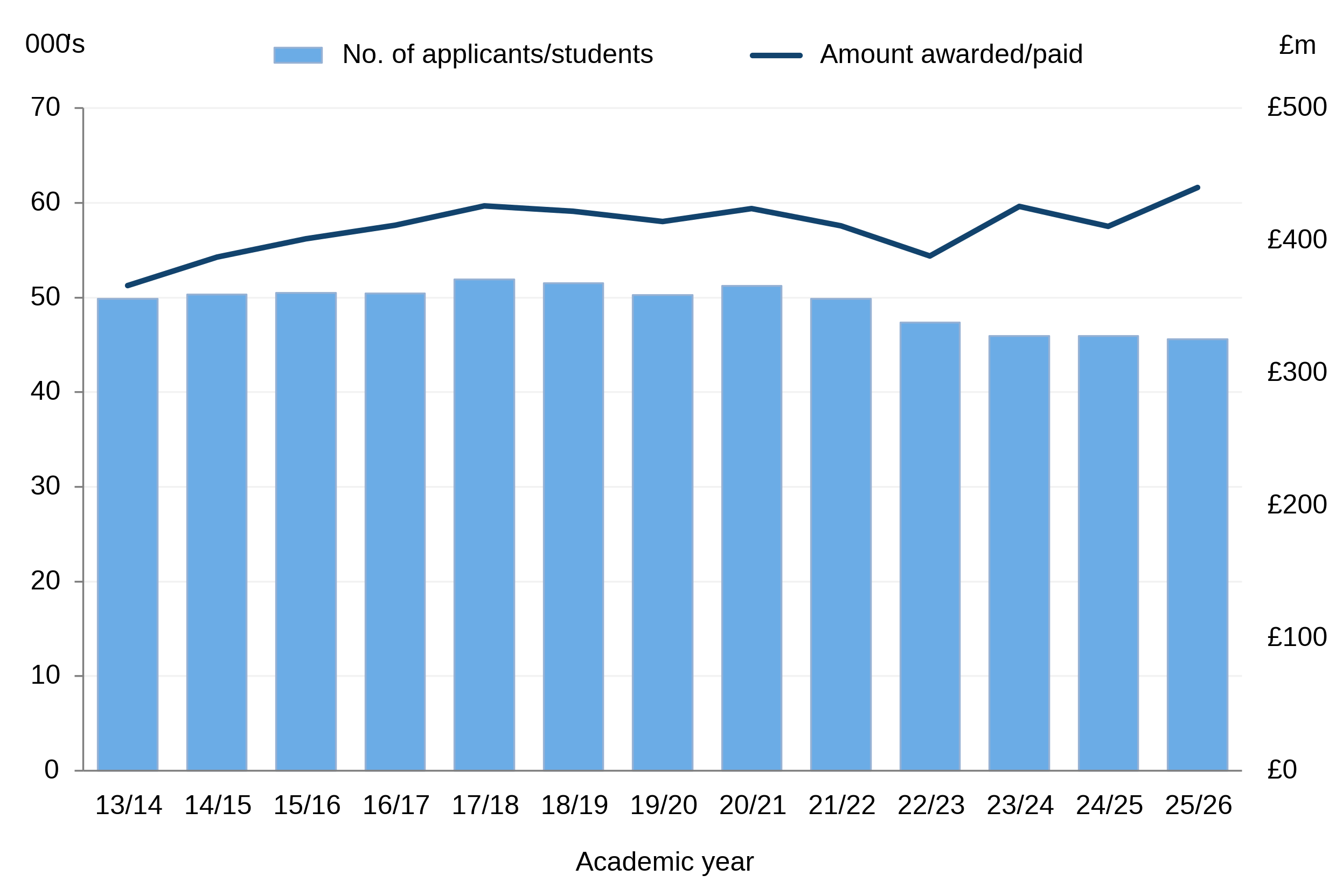
The columns in this chart depict the number of students against the left-hand axis, and the line illustrates the amount awarded/paid against the right-hand axis.
Source: Table 2
Download the data for Figure 1 (ODS, 6KB)
Figure 1 shows that 49,900 full-time, part-time and postgraduate applicants/students were awarded or paid student finance in academic year 2013/14. Numbers averaged at a rounded 50,400 until 2017/18, when they increased by 2.9% to a peak of 51,900. This was followed by two years of decline, with reductions of 0.7% and 2.4%, respectively.
In 2020/21, numbers increased to 51,200. This was likely driven by a perceived reduction in employment opportunities during the COVID-19 pandemic, encouraging prospective students to enter higher education and existing students to continue their studies. The increase was made up of a 0.9% rise in undergraduates receiving funding and a substantial 20.4% increase in postgraduates.
From 2021/22, the downward trend resumed, with the number awarded or paid student finance falling to 45,900 by 2023/24.
Following a year of relative stability in the following year, 2025/26 reported a small decrease of 0.7%, bringing numbers down to 45,600. This is made up of a 0.5% decrease in undergraduates receiving funding and a 4.6% decrease in postgraduates.
Figure 1 also shows that the total amount awarded or paid in student support across full-time, part-time and postgraduate students was £366.1 million in academic year 2013/14. This increased steadily to a first peak of £426.2 million in 2017/18.
Between 2018/19 and 2025/26, the overall trend was downward, although three years of growth were recorded during this period.
The first increase occurred in 2020/21, when total support increased by 2.4% to £424.1 million. This comprised a 1.7% increase in undergraduate funding and a substantial 29.1% rise in postgraduate funding. As noted previously, this could be linked to the COVID-19 pandemic, encouraging greater participation in higher education.
The second increase was reported in 2023/24, when the total amount paid rose by 9.6% to £425.7 million. This was primarily driven by a 40% increase in the maximum Maintenance Loan available, from £4,840 to £6,776 (‘Elsewhere’ rate).
In 2025/26, total support increased by a further 7.2% to £440.2 million. This can largely be attributed to a further 20% increase in the maximum Maintenance Loan available, which rose to £8,132 (‘Elsewhere’ rate) for that academic year.
The average full-time Maintenance Loan paid to a Northern Ireland-domiciled student was £3,120 in academic year 2013/14. This remained broadly stable until 2023/24 when the average increased substantially by 44.7% to £4,530, reflecting the significant increase in the maximum loan available. Following the further increase in the maximum entitlement in 2025/26, the average rose by 23.4% to £5,540.
For more detail on undergraduate Maintenance Loans, please refer to the relevant section later in this publication.
The average full-time Tuition Fee Loan paid on behalf of a Northern Ireland-domiciled student was £3,940 in 2013/14. Following an increase of 10.9% in 2014/15, annual growth generally slowed to a decline of 0.2% by 2024/25.
In 2025/26, the average Tuition Fee Loan increased by 1.8% to £5,610. This is likely attributable to the increases in the maximum loan available.
For more information on undergraduate Tuition Fee Loans, please refer to the relevant section later in this publication.
What can you use these statistics for?
These statistics can be used as a reference to the number of students awarded/paid and the amount awarded/paid out by the Student Loans Company for students studying in higher education between academic years 2013/14 and 2025/26, along with an early view of academic year 2026/27.
The data used in this publication is from Student Loans Company’s administrative systems. These systems only hold information on students who have applied for and/or receive funding. Due to this, these statistics cannot be used to analyse trends or to draw conclusions regarding the full UK student population.
Things you need to know
Payments vs. awards
The primary purpose of this publication is to measure student support paid to students funded by Northern Ireland during each academic year. This includes Maintenance Loans, Tuition Fee Loans (for undergraduates and postgraduates), various grants and targeted support such as Disabled Students’ Allowance (DSA).
Throughout this publication, a distinction is made between awards and payments.
-
Awards represent the amount a student is entitled to receive if they remain in attendance for the full academic year.
-
Payments represent the actual amount paid to, or on behalf of, students. As a result, payment amounts may be lower where a student does not attend, withdraws during the year, or does not draw down their full entitlement.
Due to data reporting limitations, it is not possible to separately identify payments for some grant products. Consequently, expenditure relating to Maintenance Grants and other targeted support products, such as Adult Dependants’ Grant and Travel Grant, is reported as awards rather than payments.
Finalisation of figures
As payments are made to, and on behalf of, students throughout the academic year, and in some cases after it has ended, additional transactions may be recorded after the effective dates used for this publication.
In order to capture these later payments, where indicated, figures for the most recent academic year are revised once in the subsequent edition of this publication. At which point they are considered final and supersede the previously published figures.
These revisions may result in changes to sub-totals and overall totals.
Executive summary – 2025/26 full year and 2026/27 early in year
For more detail, please click on the individual headline….
-
7.2% increase in higher education student support in academic year 2025/26, at £440.2 million
-
In line with the increase in the maximum loan available, 19.5% increase in total paid out in full-time Maintenance Loans in academic year 2025/26, to £183.6 million
-
Decline in full-time Tuition Fee Loan take-up slows in academic year 2025/26, at 36,300
-
Further 5.1% reduction in the number of students taking full-time Tuition Fee Loans to study outside of Northern Ireland in academic year 2025/26, to 9,500
-
Small reduction in the proportion of students taking full-time Tuition Fee Loans to study outside of Northern Ireland, down to 26.9% in 2025/26
-
Average 2.7% increase reported in the average full-time Tuition Fee Loan paid for students studying both within and outside Northern Ireland in 2025/26
-
Sustained increase in the number of full-time Tuition Fee Loans paid on behalf of EU (outside UK) students in 2025/26, to 1,170
-
Take-up of Tuition Fee Loans for part-time students remains static in academic year 2025/26, at 2,200
-
4.6% reduction in take-up of Tuition Fee Loans paid on behalf of postgraduates in 2025/26, to 1,950
-
Finalised figures confirm minimal change in the amount paid out in full-time undergraduate Disabled Students’ Allowance for academic year 2024/25, at £4.4 million
-
By end-October 2026, a total of 39,500 undergraduates and postgraduates have been awarded/paid a total of £123.0 million for academic year 2026/27
-
Early look at academic year 2026/27 shows a 160 reduction in take-up for EU (outside UK) students student support
-
Early view of academic year 2026/27 indicates a 0.8% decrease in ‘new’ students, and a 2.5% decrease in ‘returning’ students
Undergraduate Maintenance Loans
An undergraduate Maintenance Loan is funding to help with day-to-day costs, such as rent or food, whilst studying. These loans are available to those studying an eligible undergraduate, initial teacher training or Postgraduate Certificate of Education course, at an eligible higher education provider on a full-time basis. The amount awarded depends on household income.
In line with the increase in the maximum loan available, 19.5% increase in total paid out in full-time Maintenance Loans in academic year 2025/26, to £183.6 million
Figure 2: Number of students domiciled in Northern Ireland receiving full-time Maintenance Loans and amount paid
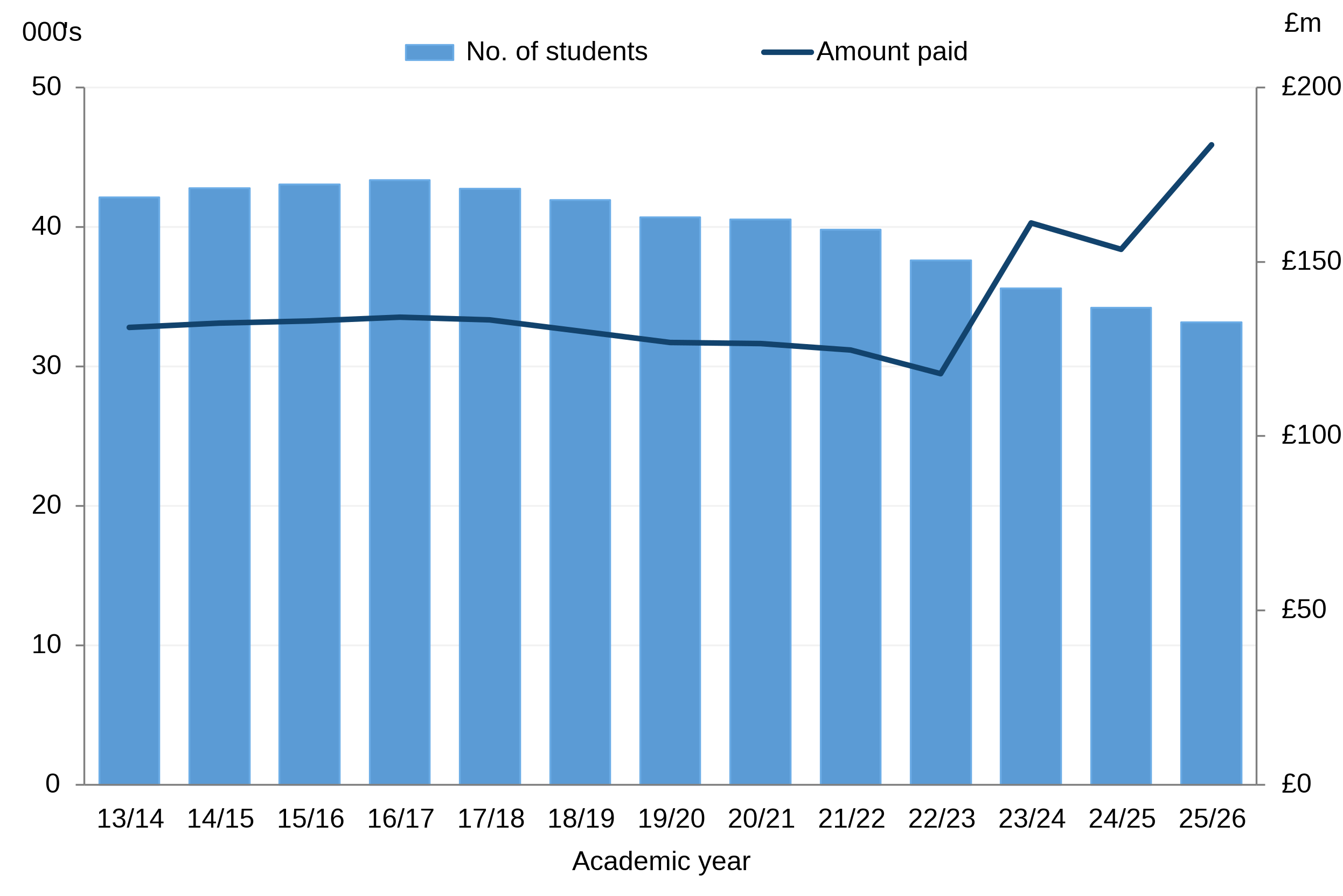
The columns in this chart depict the number of students against the left-hand axis, and the line illustrates the amount paid against the right-hand axis.
Source: Table 3A
Download the data for Figure 2 (ODS, 6KB)
Figure 2 indicates that in academic year 2013/14, Maintenance Loans were paid out to 42,100 full-time students. Since peaking at 43,400 in 2016/17, the numbers have gradually declined.
In the most recent year, 33,200 were paid out to full-time students. This represents a 3.0% decrease compared to the previous year. This was however slightly less pronounced than the 3.9% reduction reported in 2024/25.
Mirroring the trend in borrower numbers, the amount paid out increased gradually from £131.2 million in 2013/14 to an initial peak of £134.2 million in 2016/17. The total then declined to £117.8 million by 2022/23.
Unlike borrower numbers, the amount paid out has increased in recent years. The first increase was reported in 2023/24, when the maximum Maintenance Loan available rose from £4,840 to £6,776 (+ 40%), representing the first increase in the maximum loan amount within the time series shown. A further increase was introduced in the most recent year, with the maximum loan available rising by a further 20% to £8,132.
As a result, despite a continued decline in borrower numbers, in academic year 2025/26 the total amount paid out increased by 19.5% to £183.6 million.
Undergraduate Tuition Fee Loans
An undergraduate Tuition Fee Loan covers the cost of the tuition fees charged by the university or college. These loans are available to those studying an eligible undergraduate, initial teacher training or Postgraduate Certificate of Education course, at an eligible higher education provider on a full or part-time basis. Tuition Fee Loans are not dependent on household income.
Decline in full-time Tuition Fee Loan take-up slows in academic year 2025/26, to 36,300
Figure 3: Number of Tuition Fee Loans paid on behalf of full-time Northern Ireland and EU (outside UK) domiciled undergraduate students and amount paid
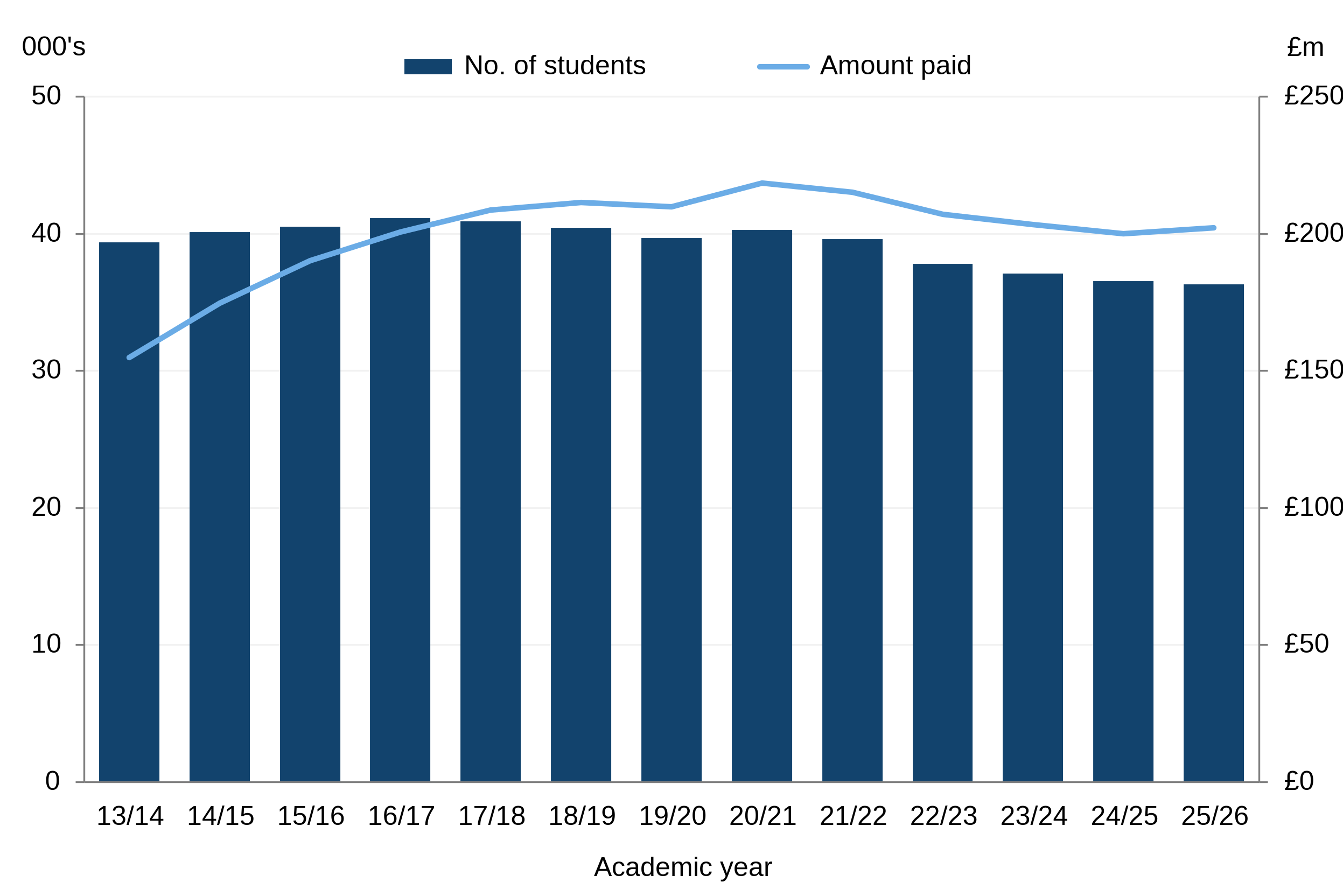
The columns in this chart depict the number of students against the left-hand axis, and the line illustrates the amount paid against the right-hand axis.
Source: Table 3B
Download the data for Figure 3 (ODS, 6KB)
Figure 3 indicates that in academic year 2013/14 Tuition Fee Loans were paid out on behalf of 39,400 full-time undergraduates. Numbers increased gradually to peak at 41,200 in 2016/17. Since decreases have been reported in all but one academic year (a small 1.5% increase in 2020/21).
In 2025/26, 36,300 loans were paid out, a 0.6% decrease on the previous year. This is however the smallest decline reported since 2017/18.
The amount paid out on behalf of full-time undergraduates in 2013/14 was £154.8 million. Somewhat contrary to the trend in borrower numbers, this increased significantly in the following year, up 12.9% to £174.8 million. This can be attributed to a 10.9% increase in the average Tuition Fee Loan paid out, up from £3,940 to £4,370.
Increases continued through to 2018/19, likely a combined effect of the annual rises in the maximum Tuition Fee Loan available for those studying in Northern Ireland, plus the growing proportion of undergraduates who opted to study outside of Northern Ireland where tuition fees are higher.
For context, between 2015/16 and 2018/19, the maximum full-time tuition fee to study at a Northern Ireland provider averaged at £3,980, compared to an average of £9,125 at an England-based provider. For more information on the maximum loans available by academic year, please refer to Table 1A.
Between 2019/20 and 2024/25, the amount paid out decreased overall, down to £200.1 million. However, in the latest year there was a small increase of 1.1%, to £202.2 million. This likely reflects increases in the maximum loan available (+ 2.2% for study within Northern Ireland and + 3.1% for study elsewhere in the UK), with the latter representing the first increase since 2017/18.
Further 5.1% reduction in the number of students taking full-time Tuition Fee Loans to study outside of Northern Ireland in academic year 2025/26, to 9,500
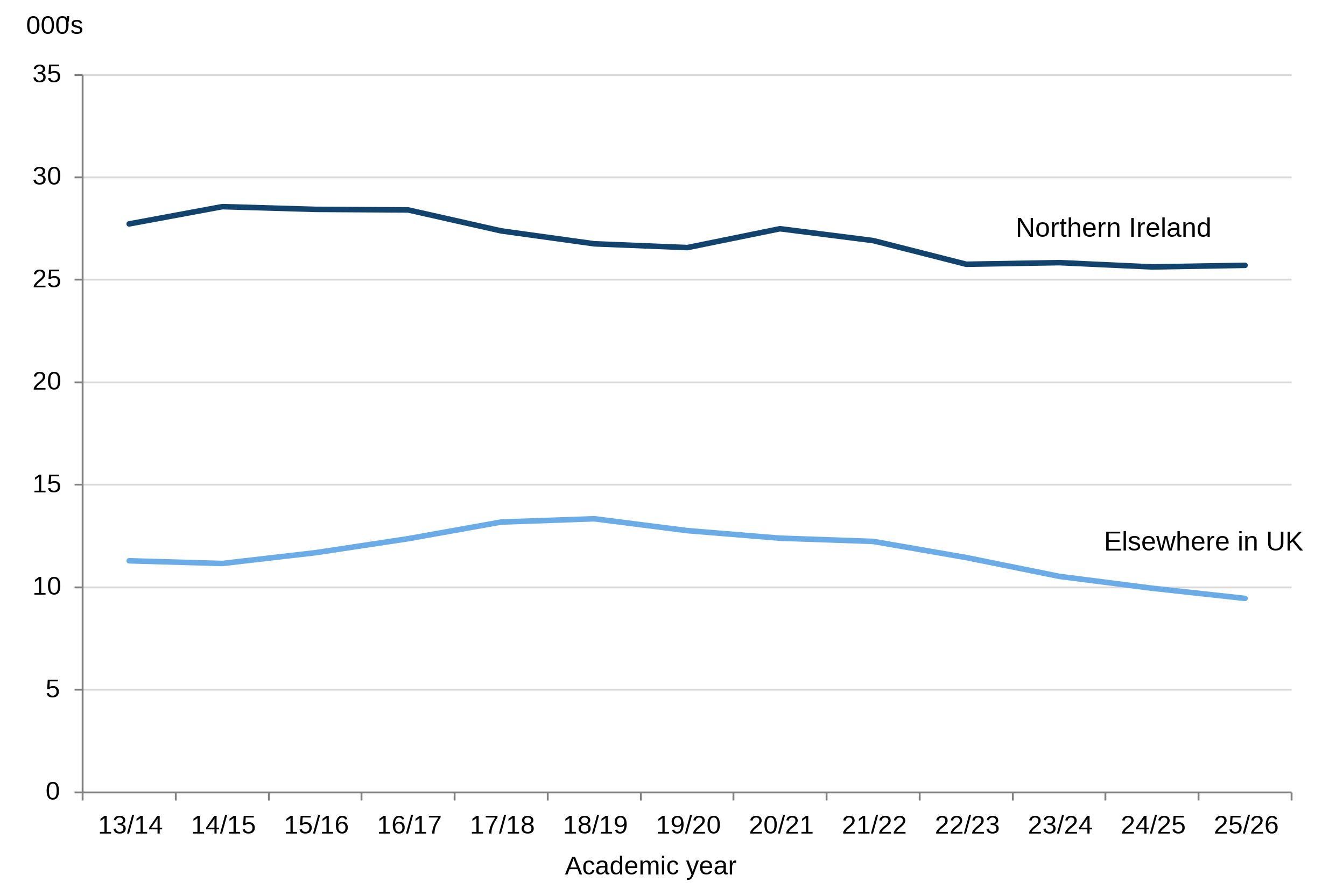
Figure 4: Number of undergraduate students domiciled in Northern Ireland taking full-time Tuition Fee Loans by country of study
Source: Table 3C
Download the data for Figure 4 (ODS, 6KB)
Figure 4 shows that, in academic year 2013/14, 27,700 Northern Ireland-domiciled undergraduate students took out a Tuition Fee Loan to study within Northern Ireland. Following a small increase in the subsequent year, numbers declined annually down to 26,600 by 2019/20.
In 2020/21, an atypical increase of 3.5% was reported, likely reflecting the impact of COVID-19 restrictions which temporarily reduced opportunities for students to study elsewhere in the UK.
The overall downward trend resumed in 2021/22 and continued until 2024/25. In the most recent year, however, borrower numbers increased slightly by 0.3% to 25,700.
In 2013/14 the number of undergraduates opting to take a Tuition Fee Loan to study outside of Northern Ireland equated to 11,300. Following a small decrease in the following academic year, numbers increased to peak at 13,300 in 2018/19.
Since this point numbers have declined, down by a further 5.1% in the most recent year, to 9,500.
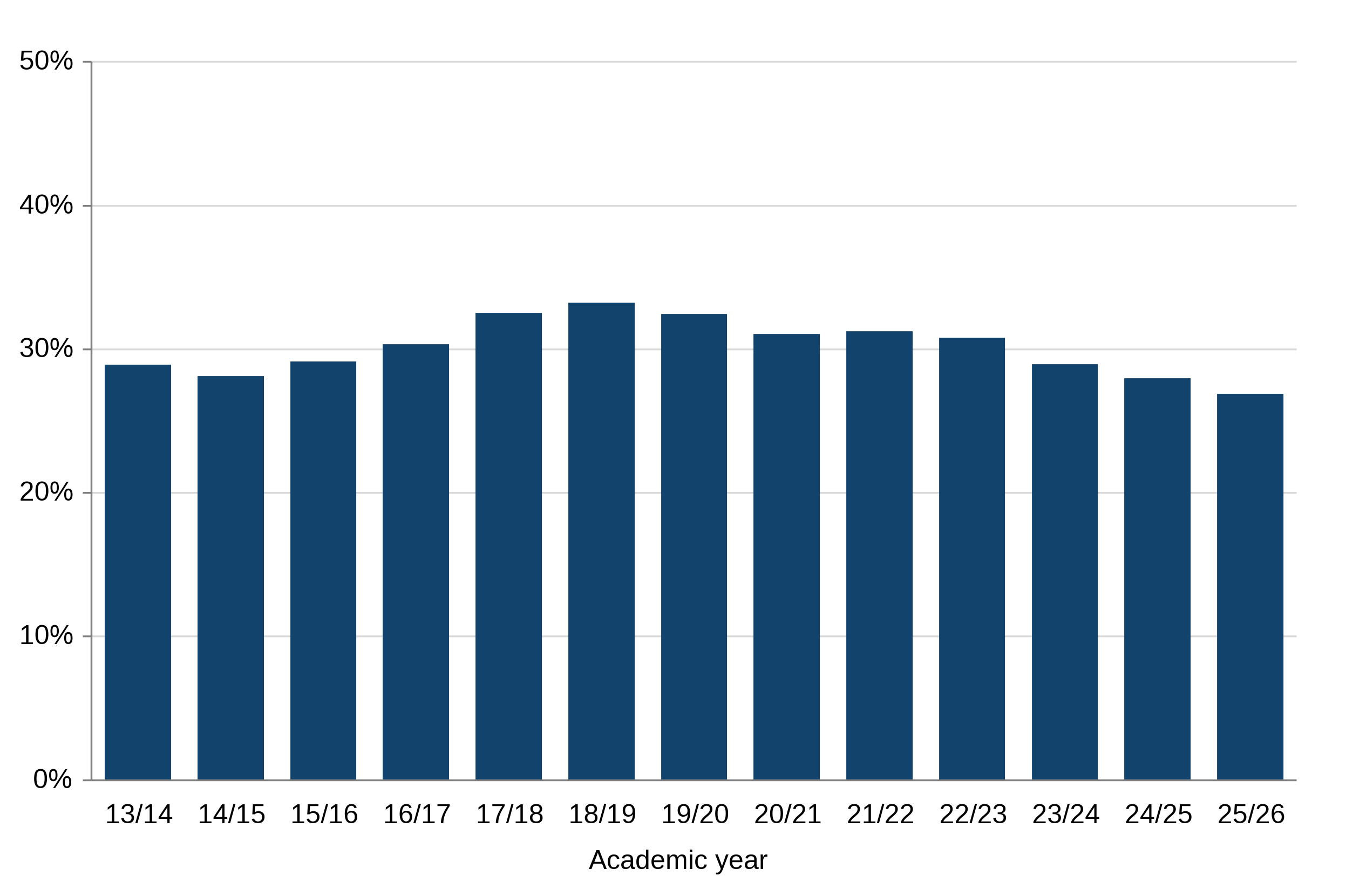
Small reduction in the proportion of students taking full-time Tuition Fee Loans to study outside of Northern Ireland, down to 26.9% in 2025/26
Figure 5: Percentage of undergraduate students domiciled in Northern Ireland taking full-time Tuition Fee Loans to study elsewhere in UK
Source: Table 3C
Download the data for Figure 5 (ODS, 6KB)
Figure 5 shows the proportion of full-time undergraduate Tuition Fee Loan borrowers studying outside Northern Ireland.
In 2013/14, 28.9% of all full-time tuition fee borrowers were enrolled in higher education providers outside Northern Ireland. This proportion increased to a peak of 33.3% in 2018/19 before declining in subsequent years to 26.9% in 2025/26, a decrease of 1.1 percentage points compared to the previous year.
As the proportion studying outside Northern Ireland has fallen since 2018/19, a correspondingly greater share of borrowers have chosen to study within Northern Ireland, 73.1% in 2025/26.
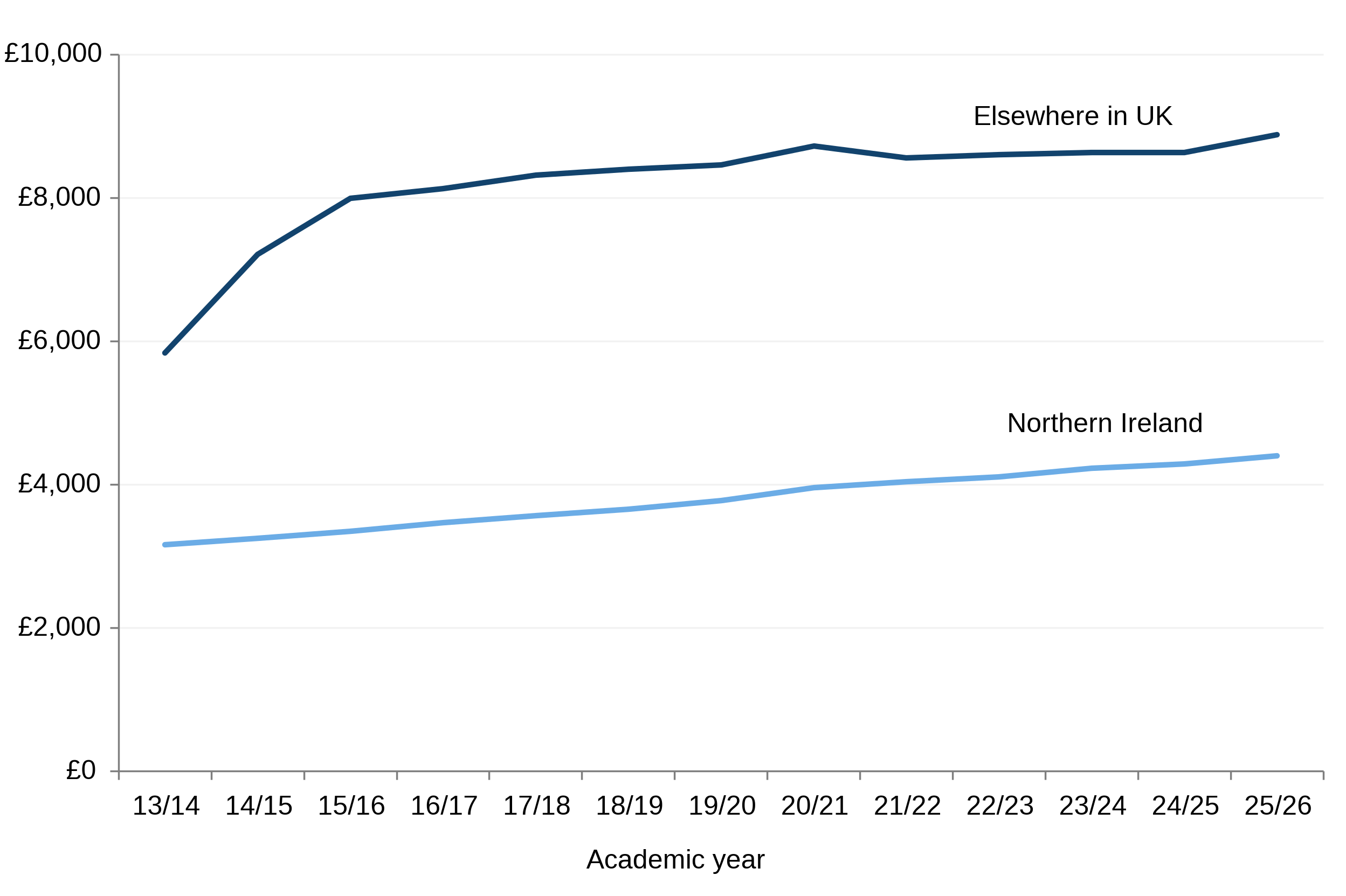
Average 2.7% increase reported in the average full-time Tuition Fee Loan paid out for students studying both within and outside Northern Ireland in 2025/26
Figure 6: Average full-time Tuition Fee Loan paid out for undergraduate students domiciled in Northern Ireland by country of study
Source: Table 3C
Download the data for Figure 6 (ODS, 6KB)
The average Tuition Fee Loan paid out on behalf of a full-time undergraduate student varies according to the tuition fees charged by the provider and country of study.
As tuition fees in Northern Ireland are substantially lower than elsewhere in the UK, since 2014/15 the average loan paid for students studying outside Northern Ireland has consistently been more than double that paid for those studying within Northern Ireland.
The largest gap was reported in 2015/16, when the average loan for study outside Northern Ireland was 139% higher than the average for study within Northern Ireland. By 2025/26, this difference had narrowed to 102%.
Figure 6 shows that in academic year 2013/14, the average loan paid for study elsewhere in the UK was £5,840, compared to £3,160 for students studying within Northern Ireland. By 2025/26, these averages had increased to £8,880 and £4,400 respectively. Compared with the previous year, this represents increases of 2.9% for students studying elsewhere in the UK and 2.6% for those studying within Northern Ireland.
Despite accounting for only 26.9% of borrowers in 2025/26, students studying elsewhere in the UK received 42.6% of the total value of Tuition Fee Loans paid. Consequently, of the £197.1 million paid out on behalf of Northern Ireland-domiciled full-time undergraduates, £83.9 million was paid to higher education providers in England, Wales and Scotland.
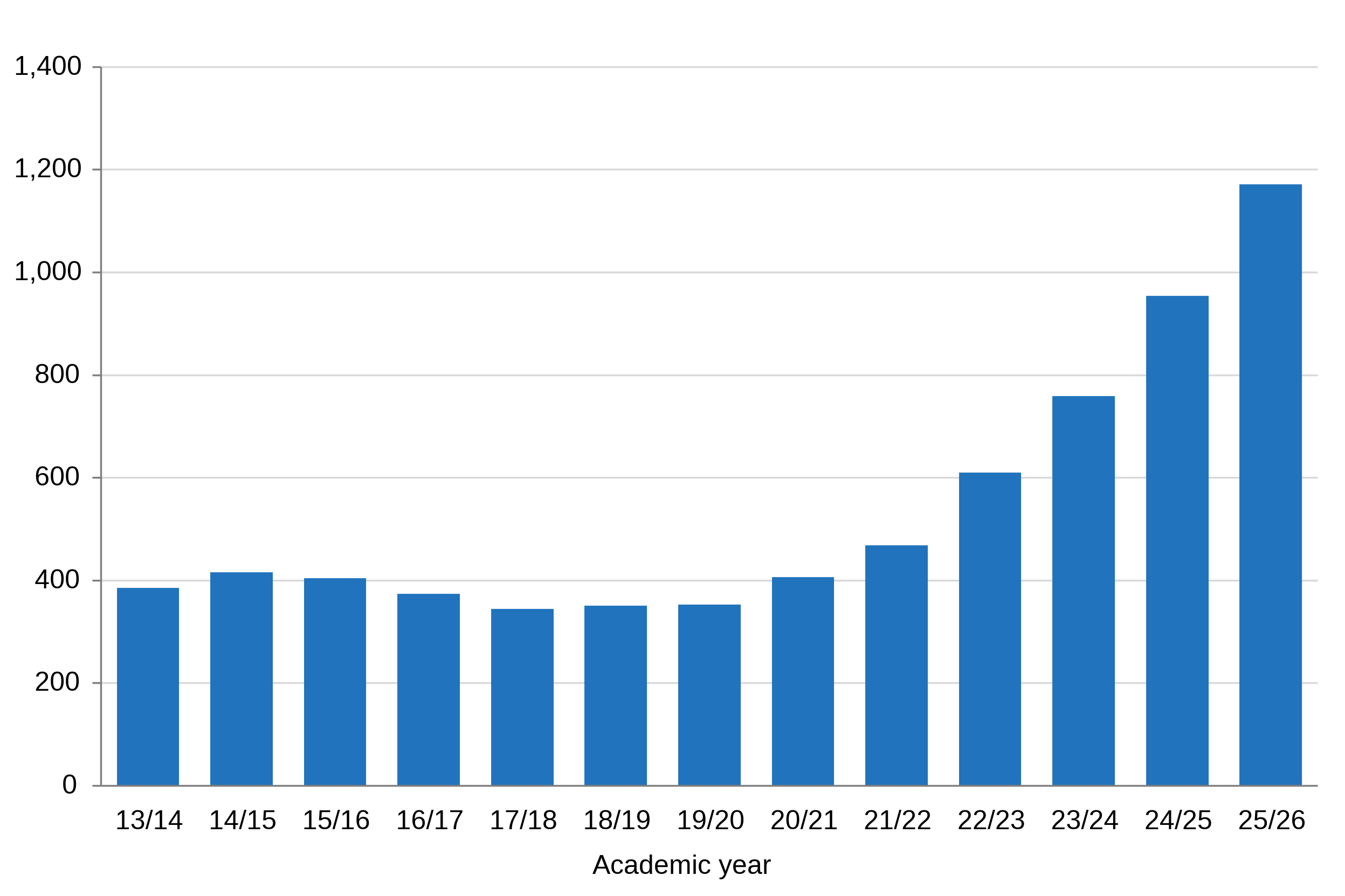
Sustained increase in the number of full-time Tuition Fee Loans paid on behalf of EU (outside UK) students in 2025/26, to 1,170
Figure 7: Number of Tuition Fee Loans paid on behalf of full-time EU (outside UK) domiciled students
Source: Table 3B
Download the data for Figure 7 (ODS, 6KB)
Figure 7 shows that in 2013/14, Tuition Fee Loans were paid on behalf of 390 EU (outside UK) students. Following a 7.8% increase in the subsequent year, numbers decreased gradually to the lowest reported point of 350 in 2017/18. Since 2018/19, increases of varying levels have been reported, becoming more significant since academic year 2020/21.
For academic year 2025/26, loans were paid on behalf of 1,170 EU (outside UK) students. This is a notable 22.7% higher than in the previous year. This follows a 25.7% increase in 2024/25.
Unlike the figures for students domiciled in England and Wales, the 2021/22 policy change which made new EU (outside UK) students ineligible for student finance has had minimal impact on the figures for Northern Ireland-domiciled borrowers. This is largely because the EU (outside UK) category continues to include a growing proportion of students from the Republic of Ireland, whose eligibility for support remains unchanged.
By 2025/26, students from the Republic of Ireland accounted for 98% of those taking EU (outside UK) full-time undergraduate Tuition Fee Loans (unchanged from the previous year).
Non-Irish students, from academic year 2021/22, will only include those who are returning/continuing students who began their studies prior to the policy change. This proportion will decrease year-on-year as they conclude their courses. In the most recent year, this remained at 2%.
Take-up of Tuition Fee Loans for part-time students remains static in academic year 2025/26, at 2,200
Figure 8: Number of students domiciled in Northern Ireland & EU (outside UK) receiving part-time Tuition Fee Loans and amount paid
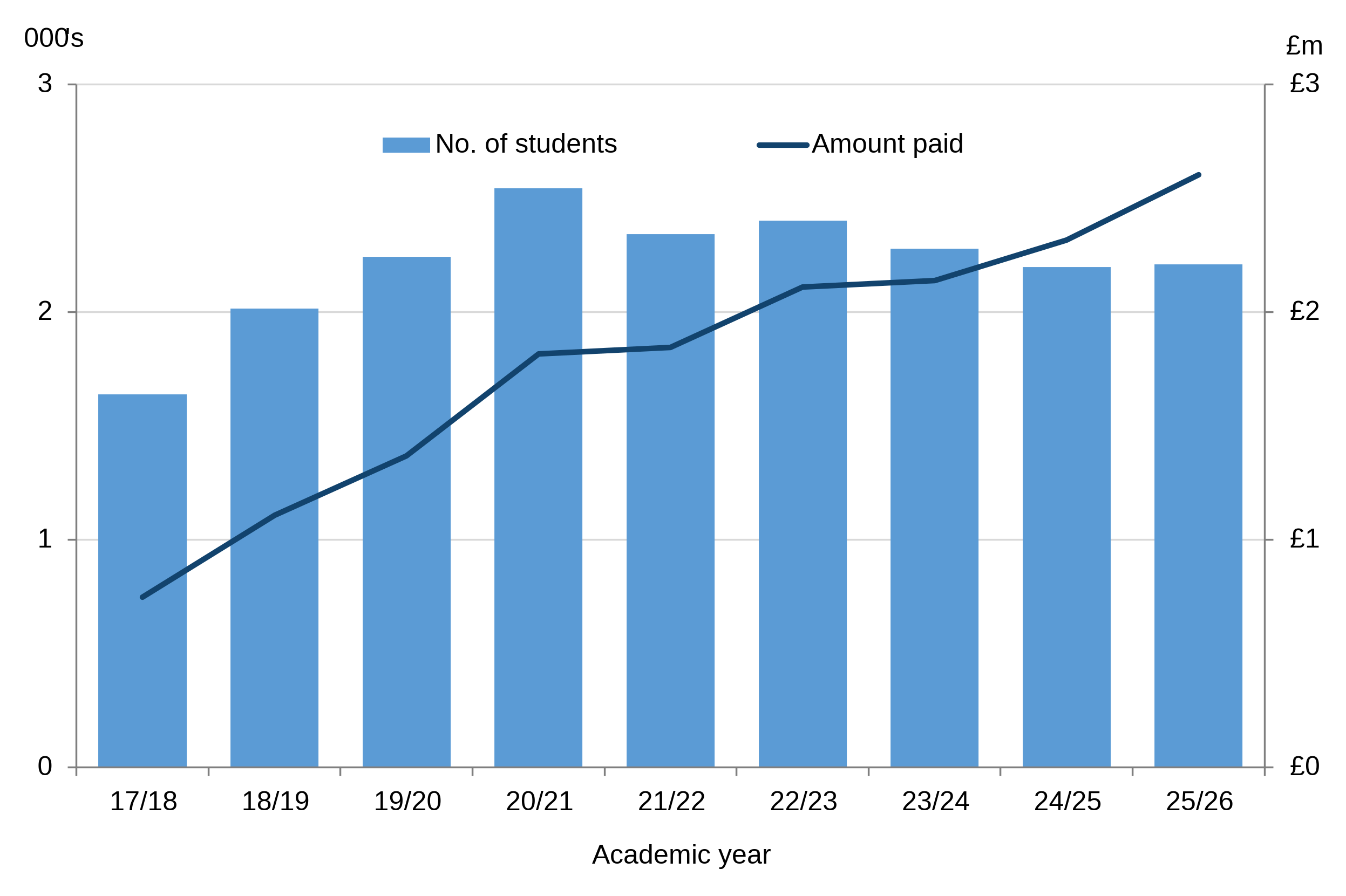
The columns in this chart depict the number of students against the left-hand axis, and the line illustrates the amount paid against the right-hand axis.
Source: Table 5A
Download the data for Figure 8 (ODS, 6KB)
Tuition Fee Loans for part-time study were made available to new students in academic year 2017/18.
Figure 8 shows that in this first year of availability; 1,600 loans were paid out. This notably increased over the following three years to peak at 2,500 in 2020/21. The 13.5% increase in academic year 2020/21 was likely attributed to the COVID-19 pandemic affecting some employment sectors, when an additional 300 entrants enrolled in Open University courses.
2021/22 reported the first decrease, as figures normalised, down 7.9%. This was followed by further decreases in the two subsequent academic years. In 2025/26, take-up has remained relatively unchanged to the previous year, at 2,200 (+ 0.5%).
The trend in the amount paid out on behalf of part-time students differs from that of the number of loans paid. In academic year 2017/18, £0.7 million was paid out on behalf of part-time students. Unlike loan take-up, the amount paid out has increased year-on-year, at varying rates to £2.6 million by 2025/26 (+ 12.4% on the previous year).
These increases are driven by the year-on-year increases in the average loan taken by part-time students, increasing by an average of 11.5% per year since the loan was introduced.
Postgraduate Tuition Fee Loans
A postgraduate Tuition Fee Loan is funding to help with course and living costs whilst studying an eligible postgraduate level course. They are paid directly to the student and are not based on their income or the income of their household. Students studying either a Postgraduate Certificate of Education or an initial teacher training course are not eligible for postgraduate funding, they can alternatively apply for undergraduate finance.
4.6% reduction in take-up of Tuition Fee Loans paid on behalf of postgraduates in 2025/26, to 1,950
Figure 9: Number of postgraduate students domiciled in Northern Ireland and EU (outside UK) receiving Tuition Fee Loans and the amount paid
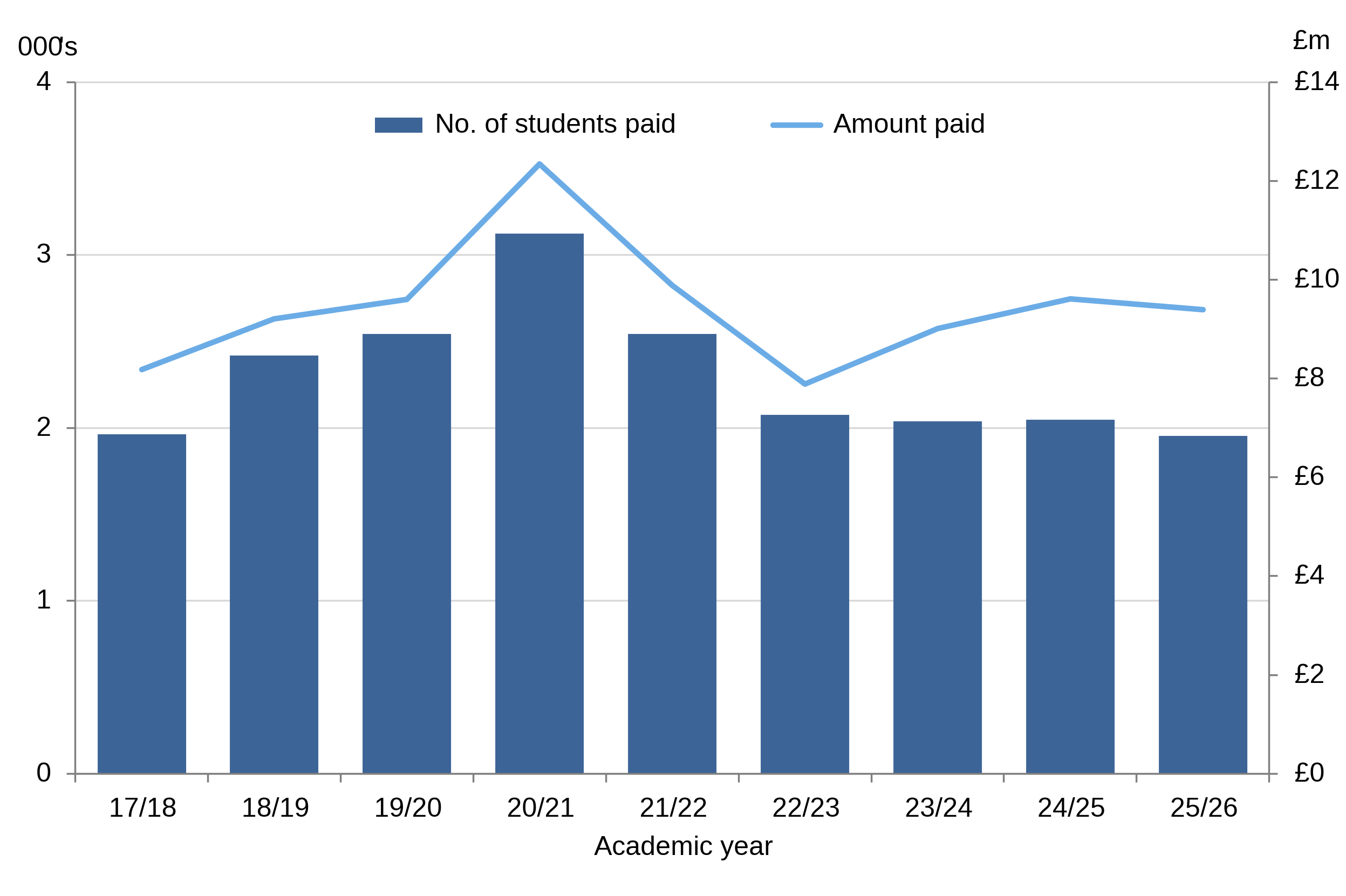
The columns in this chart depict the number of students against the left-hand axis, and the line illustrates the amount paid against the right-hand axis.
Source: Table 6A
Download the data for Figure 9 (ODS, 6KB)
Tuition Fee Loans were made available for postgraduate students in academic year 2017/18.
Figure 9 shows that in the first year of availability, 1,960 Tuition Fee Loans were paid on behalf of postgraduate students. Numbers increased in the following year, typical for a new type of student support (up 23.2% to 2,420).
Following a much smaller increase in 2019/20, numbers rose sharply in 2020/21 to peak at 3,130. This could be attributed to a perceived reduced employment opportunity due to the COVID-19 pandemic, either encouraging undergraduates to continue to postgraduate level, or non-students to return to study. It was therefore reasonable to expect a reduction in the following year when take-up normalised against an outlying year; with numbers reducing by 18.6% down to 2,550.
Academic year 2022/23 saw a further, similar decrease, reducing take-up to 2,080, close to the level reported in the first year of availability. This was followed by a period of relative stability before a further 4.6% decline in 2025/26, bringing take-up down to 1,950.
The amount paid out on behalf of postgraduate students followed a very similar trend, up until 2023/24. In the first year of availability, £8.2 million was paid out, increasing to peak at £12.3 million by 2020/21. This was followed by two consecutive decreases, with the amount paid falling to its lowest point of £7.9 million in 2022/23. In 2023/24, the amount paid increased by 14.3% to £9.0 million, resulting from an 18.2% increase in the maximum loan available (from £5,500 to £6,500). A further, smaller increase of 6.8% was reported in 2024/25. However, in the latest year the amount paid fell by 2.4% to £9.4 million
Disabled Students’ Allowance
Disabled Students’ Allowance (DSA) is an additional part of the student support package and helps pay for extra costs a student might incur in higher education as a direct result of their disability. This includes long-term health conditions, mental health difficulties, specific learning difficulties such as dyslexia or dyspraxia etc. The allowance is non-repayable and does not depend on household income. The individual’s condition must meet the definition of a disability under the Equality Act 2010. Generally, Disabled Students’ Allowance is paid direct to the providers of equipment and services covered by the allowance although students may receive some funding paid directly to them, depending on their circumstances.
Finalised figures confirm minimal change in the amount paid out in full-time undergraduate Disabled Students’ Allowance for academic year 2024/25, at £4.4 million
Figure 10: Amount of DSA paid on behalf of full-time undergraduate students by category and academic year (effective one year later)
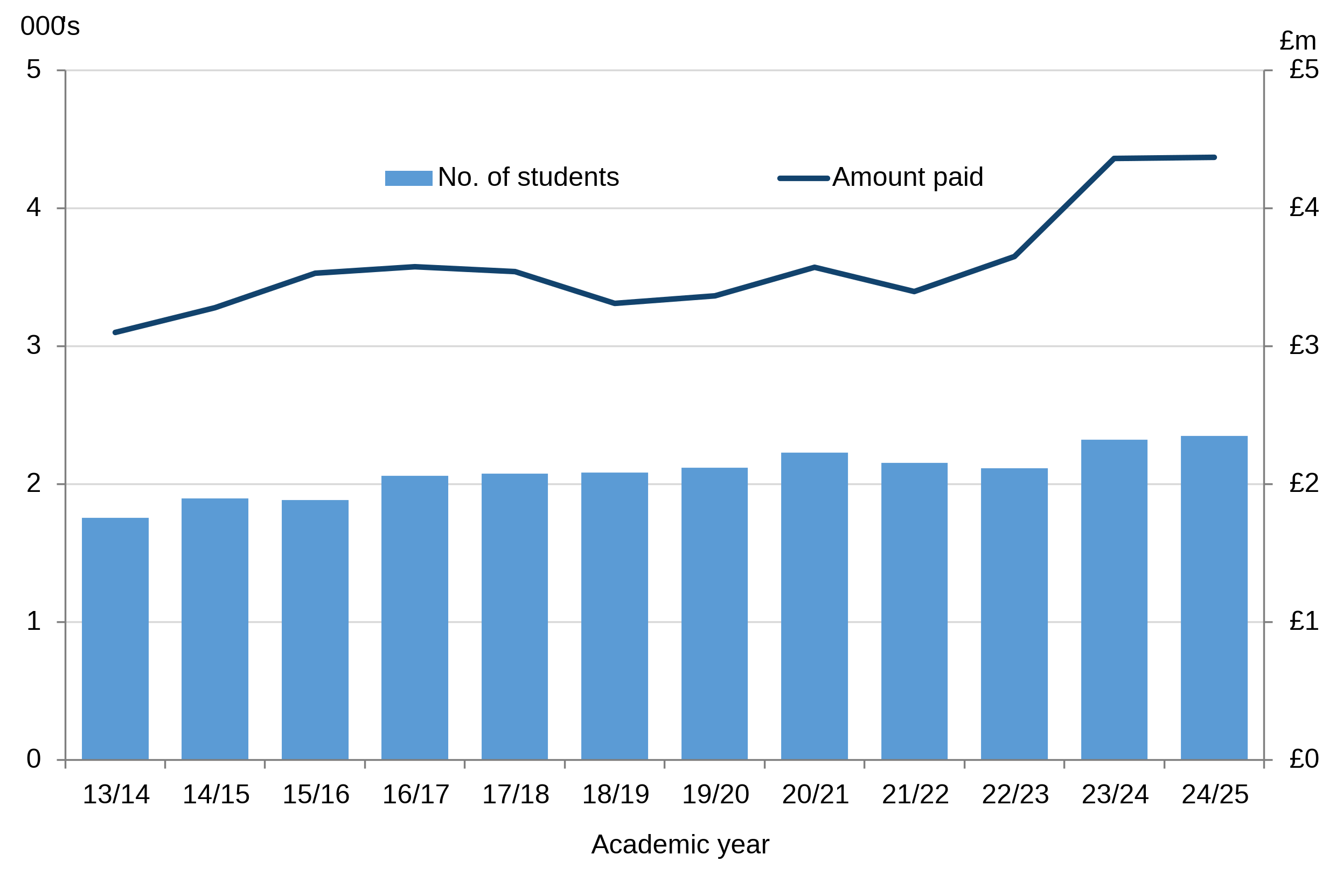
The columns in this chart depict the number of students against the left-hand axis, and the line illustrates the amount paid against the right-hand axis.
Source: Table 4B
Download the data for Figure 10 (ODS, 6KB)
The vast majority of DSA is paid to suppliers once the Student Loans Company receives invoices for equipment or services. As these continue to be received well after the end of the academic year, we also capture a more finalised position by reporting figures one year after the end of the academic year – the following end-August (hence 2024/25 being the most recent figures in Figure 10).
The total number of full-time undergraduates in receipt of Disabled Students’ Allowance (DSA) for the 2013/14 academic year was 1,755. This increased overall to first peak in 2,230 for 2020/21. Numbers then marginally reduced over the two subsequent years. The increasing trend resumed in 2023/24, up by a notable 9.7% to 2,320. In the following year, the increase continued yet slowed to 1.3% to 2,350.
The amount claimed in full-time DSA equated to £3.1 million for the 2013/14 academic year. This has since fluctuated, averaging £3.5 million over the subsequent nine years. 2023/24 reported the most significant increase to date, with an additional 19.4% compared to the previous year. Payments stabilised in 2024/25, at £4.4 million.
As of 31 August 2026, a total of £4.0 million has been paid for academic year 2025/26 for full-time DSA. This is 5.6% less than the amount paid by the same point for the previous year.
Figures regarding part-time undergraduate and postgraduate DSA can be found in the supporting tables (Table 5B and 6B).
Early in year overview – academic year 2026/27
Table 7C (i) shows an early view of academic year 2026/27 at effective date 31 October 2026. This would be approximately two months into a typical academic year. These figures will be near-finalised in Table 2 of the next update of this publication, due to be released in November 2027.
By end-October 2026, a total of 39,500 undergraduates and postgraduates have been awarded/paid a total of £123.0 million for academic year 2026/27
Figure 11: Early-in-year: Number of students domiciled in Northern Ireland and EU (outside UK) receiving higher education support and amount awarded/paid
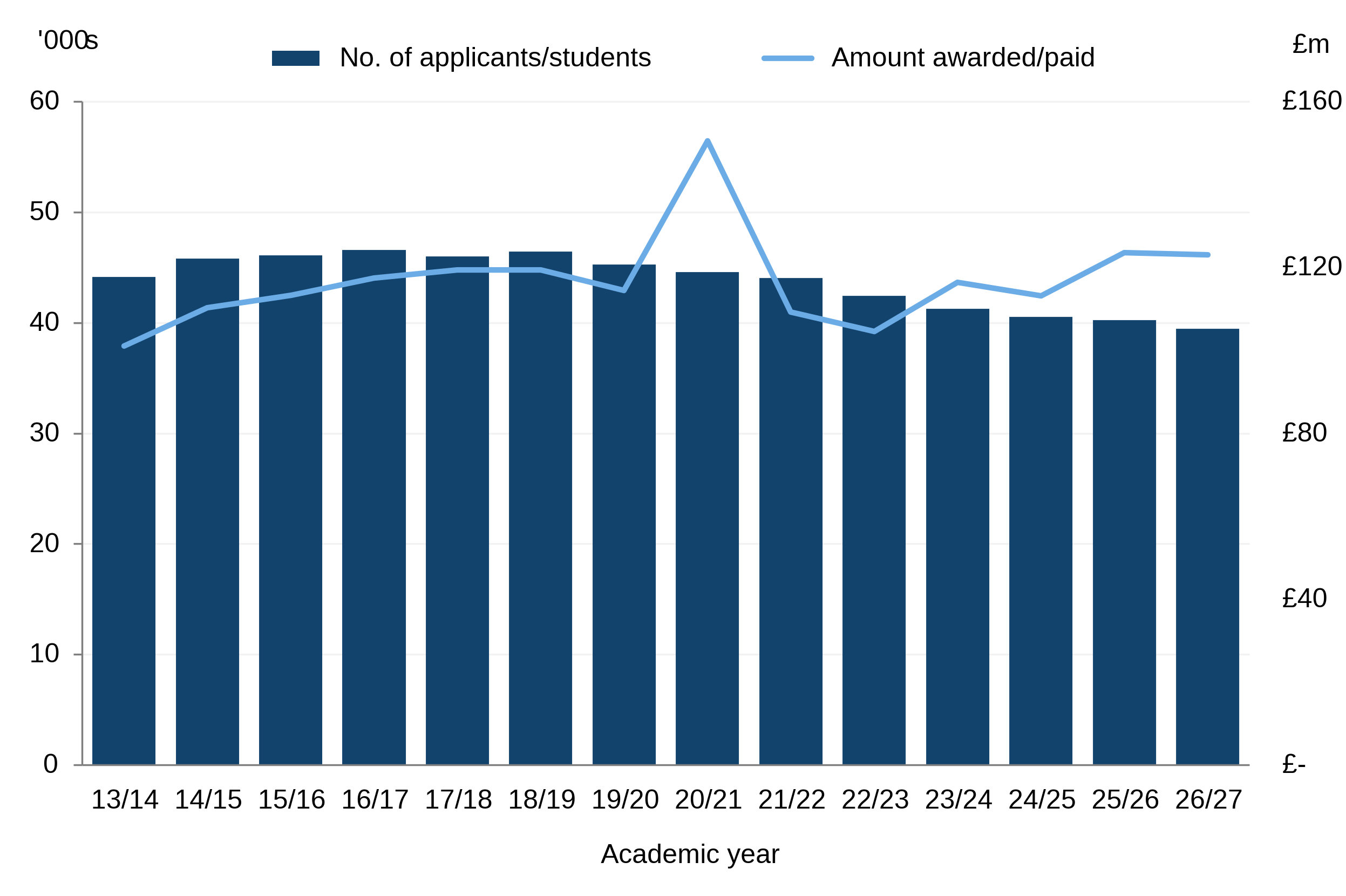
The columns in this chart depict the number of students against the left-hand axis, and the line illustrates the amount paid against the right-hand axis.
Source: Table 7C(i)
Download the data for Figure 11 (ODS, 6KB)
Figure 11 shows that by end-October in the 2013/14 academic year, a total of 44,200 undergraduates and postgraduates had been awarded/paid. This early position increased year-on-year over the subsequent five years to 46,500 by 2018/19. The total amount awarded/paid by this early point of the same academic years followed a similar trend, growing from £101.1 million in 2013/14 to £119.4 million over the same time period. Academic year 2019/20 saw the first reduction in both numbers paid and the amount paid, down by 2.6% and 4.1% respectively.
As at end-October 2020, a total of £150.5 million had been awarded/paid to 44,600 students for the 2020/21 academic year. Despite a 1.4% reduction in the number of students awarded/paid, the amount awarded/paid was 31.4% higher than at the same point in the previous year. This can be predominantly attributed to an early second instalment of undergraduate tuition fee payments made to higher education providers in response to the COVID-19 pandemic (two payments made in October 2020, instead of the typical schedule of one instalment paid in October and one in the following February). For further detail, please refer to our Additional Information section. Figures normalised in the following year with the amount awarded/paid reducing to £109.3 million.
This early-year view indicated that take-up continued to decline in each of the following four academic years, although the rate of decrease varied. A similar pattern was observed in the amount awarded/paid, with the exception of 2023/24 and 2025/26. In both years, notable increases in the maximum Maintenance Loan available (+ 40% and + 20% respectively) more than offset the reduction in take-up, leading to an increase in the total amount awarded/paid compared with the previous year.
As at 31 October 2026, a total of 39,500 applicants/students have been awarded/paid for academic year 2026/27, a further 1.9% reduction. Whereas the amount awarded/paid showed very little movement (- 0.5%) at £123.0 million.
Of this, £121.3 million had been awarded/paid so far to 38,500 undergraduate students. The number awarded/paid is 1.6% lower than the end-October position in the previous year (600 fewer) and the amount awarded/paid is 0.6% lower than at the same point in the previous academic year.
Full-time undergraduate numbers have decreased by 1.8% to 37,200, yet part-time undergraduate numbers have increased by 3.6%, to 1,400.
This early look at the 2026/27 academic year also indicates a total of £1.7 million has been paid to 900 postgraduate students so far. In comparison to the same point in 2025/26, this is a 150 decrease in the number of students, yet a £0.1 million (+ 9.2%) increase in the amount paid.
Early look at academic year 2026/27 shows a 160 reduction in take-up for EU (outside UK) students student support
Figure 12: Early-in-year: Number of students domiciled in EU (outside UK) receiving higher education support and amount awarded/paid
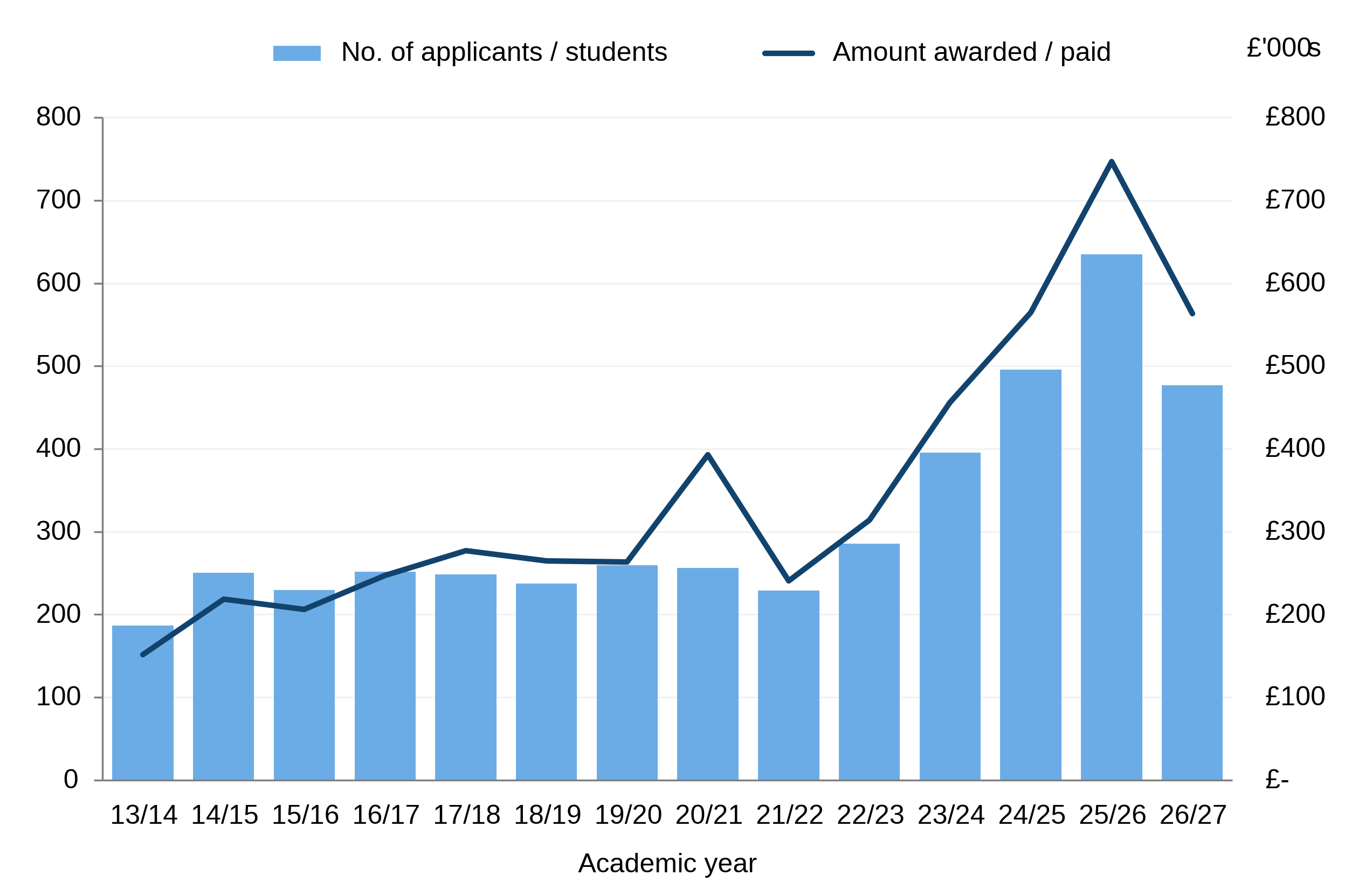
The columns in this chart depict the number of students against the left-hand axis, and the line illustrates the amount paid against the right-hand axis.
Source: Table 7C(i)
Download the data for Figure 12 (ODS, 6KB)
Figure 12 shows that 190 EU (outside UK) undergraduate and postgraduate students had been paid by end-October for academic year 2013/14. This has fluctuated over the years, to 260 by 2019/20. The amount paid out has shown a similar trend over the same period, from £152,100 to £263,500.
The early look at 2020/21 reported a decrease in the number of EU (outside UK) students paid, down 1.4% to 260. However, due to the previously mentioned early second instalment of undergraduate tuition fee payments made to higher education providers, the amount paid out by this point in academic year 2020/21 was 49.3% higher than in the previous year, at £393,300.
In academic year 2021/22, new EU (outside UK) students in Northern Ireland (without a ‘settled’ or ‘pre-settled status’) were no longer eligible for tuition fee support. However, as the vast majority of these students were from the Republic of Ireland, whose eligibility remained unchanged, the impact on student numbers was relatively limited. The number of students paid decreased by 10.7%, while the amount paid fell more substantially, by 38.7% to £241,100. This larger decrease is likely due to figures normalising against an outlying year.
Following this decrease, both the number of students paid, and the amount paid increased in each year through to 2025/26.
As at end-October 2026, 480 EU (outside UK) undergraduate and postgraduate students had received support for academic year 2026/27, 24.9% fewer than at the same point in academic year 2025/26. A total of £563,300 had been paid out so far, 24.6% lower than the amount paid at the equivalent point in the previous academic year.
Early view of academic year 2026/27 indicates a 0.8% decrease in ‘new’ students, and a 2.5% decrease in ‘returning’ students
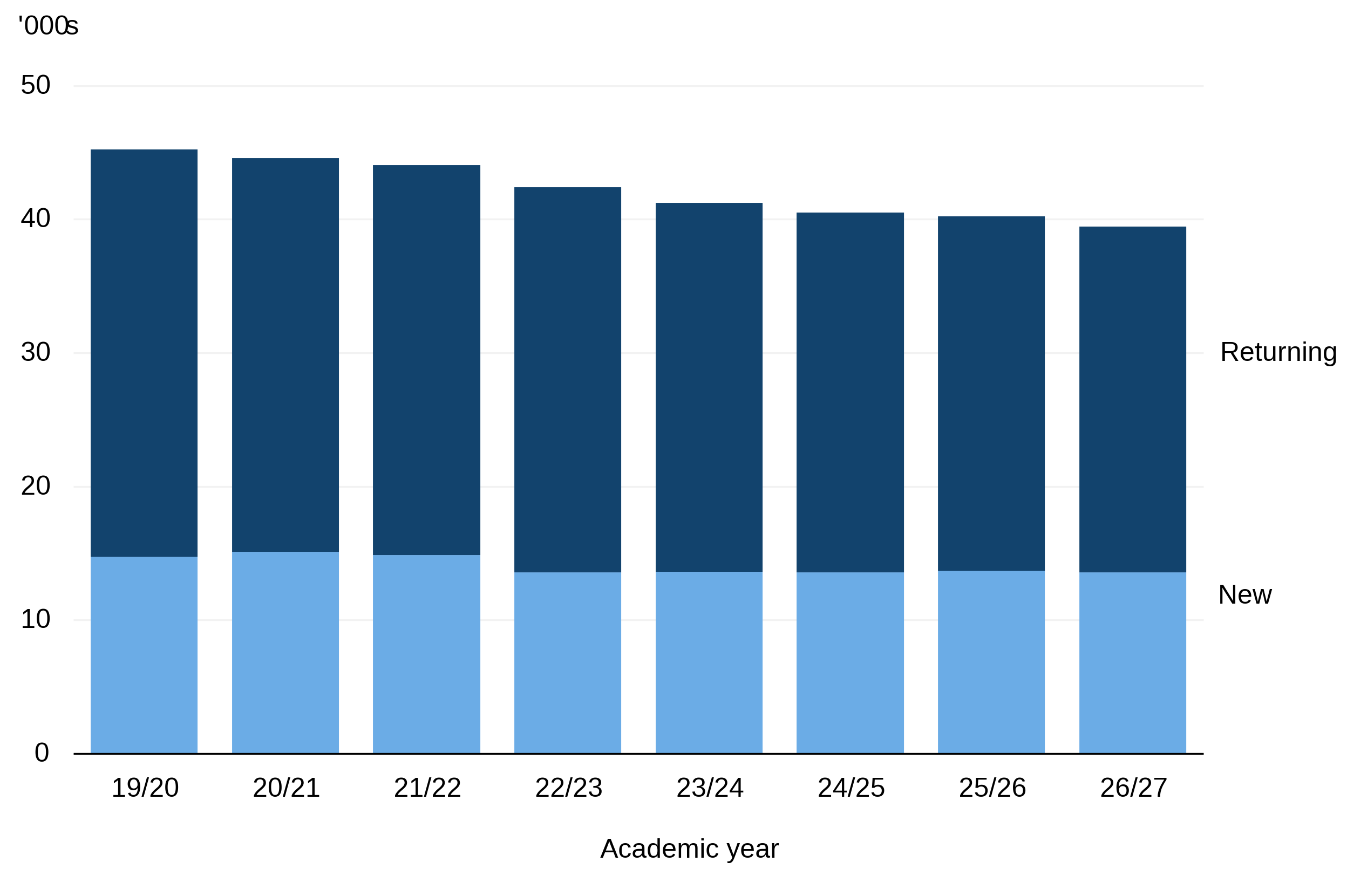
Figure 13: Early-in-year: Number of new and returning students domiciled in Northern Ireland and EU (outside UK) awarded/paid student support
Source: Table 7C(ii)
Download the data for Figure 13 (ODS, 6KB)
Within this publication, ‘new’ students are defined as those who have not previously received student support from the Student Loans Company (SLC). ‘Returning’ students are defined as those who have.
Figure 13 indicates that 14,700 ‘new’ students had been awarded/paid student support by the end-October position for academic year 2019/20. This increased to peak at 15,100 (up 2.5%) at the same point in the following year. Numbers then began to decline, falling by 1.5% in 2021/22, followed by a more substantial decrease of 8.7% in 2022/23. Following this decline, the number of ‘new’ students awarded/paid remained relatively stable through to 2026/27, averaging 13,600 at the end-October position.
The trend in ‘returning’ students differs, with numbers decreasing in every year shown. In 2019/20, there were 30,500 ‘returning’ students awarded/paid student support. By 2026/27, this had fallen to 25,900, a further decrease of 2.5% from the previous year.
As a proportion of all students awarded/paid at this early point in the academic year, ‘new’ students accounted for between 32.0% and 34.4% of the total, with the lowest proportion recorded in 2022/23 and the highest in 2026/27. Conversely, ‘returning’ students accounted for between 68.0% and 65.6% in the same years.
Additional Information
Available student financial support
Details on student support available in academic years 2025/26 and 2026/27 can be found on the Student Finance Northern Ireland website.
Factors affecting early in year figures academic year 2020/21
In response to the COVID-19 pandemic, the Department of Education and devolved administrations of Wales and Northern Ireland requested that the Student Loans Company revised the schedule of undergraduate tuition fee payments to higher education providers for the 2020/21 academic year. This revision enabled providers to access the second instalment of tuition fee payments early (two paid in October 2020, instead of first paid October 2020 and second in February 2021), while ensuring that students were not impacted by the change. This is evident on Table 7C (i) and (ii). The normal schedule resumed in academic year 2021/22.
These early in year figures for academic year 2020/21 may also have been affected by the Ofqual standardisation of grades, allowing students whose exams were cancelled in the summer of 2020 to receive calculated grades enabling them to progress to further study. For more information, please refer to GOV.UK.
Definitions
For definitions of terms used in our publication, please refer to our Definitions page.
Data Sources
This publication uses data from SLC’s administrative systems. For details of the data sources used in our publications please refer to our Statement of Administrative Sources. We also publish details on our data management which can also be found on GOV.UK.
Data Quality
Student Loans Company publishes documentation which outlines our approach to ensuring that our statistics publications are robust, reliable and fit for purpose. As a producer of official statistics, SLC is committed to upholding the principles and standards set out in the UK Statistics Authority’s Code of Practice for Statistics. For more information, please refer to our policies and procedures page on GOV.UK.
Related statistics publications
Student Loans Company publish statistics on higher education funding for England and Wales as part of the same series this publication belongs to. These are published at the same time as part of the series Student Support for Higher Education.
The Student Awards Agency for Scotland publish details of higher education funding in Scotland in their publication ‘Higher Education Student Support in Scotland’. The latest release of this series was published on 27 August 2026 covering academic session 2025/26.
SLC also publish statistics on the repayment of student loans for higher education in the series ‘Student Loans in Northern Ireland’. The latest release of this series, covering financial year 2025-26 was published on 18 June 2026.
Accredited Official Statistics
This is an Accredited Official Statistics publication. Accredited Official Statistics are produced to high professional standards set out in the Code of Practice for Statistics. They undergo regular quality assurance reviews to ensure they meet customer needs. They are produced free from any political interference.
This publication series (publications for England, Wales and Northern Ireland) was awarded Accredited Official Statistics status in October 2011 following a full assessment against the Code of Practice for Statistics. Since that assessment, we have continued to comply with the Code and have made a number of improvements. These are detailed on GOV.UK.
Information detailing our compliance with the Code across all our publications is available on our SLC Statistics: Policies and Procedures page on GOV.UK. This page includes details of improvements that have been implemented, as well as those planned for the future in our Annual Statistical Work Programmes.