Statistics on so called ‘honour-based’ abuse offences, England and Wales, year ending March 2026
Published 5 November 2026
Applies to England and Wales

© Crown copyright 2026
This publication is licensed under the terms of the Open Government Licence v3.0 except where otherwise stated. To view this licence, visit nationalarchives.gov.uk/doc/open-government-licence/version/3 or write to the Information Policy Team, The National Archives, Kew, London TW9 4DU, or email: psi@nationalarchives.gov.uk.
Where we have identified any third party copyright information you will need to obtain permission from the copyright holders concerned.
This publication is available at https://www.gov.uk/government/statistics/so-called-honour-based-abuse-offences-year-ending-march-2026/statistics-on-so-called-honour-based-abuse-offences-england-and-wales-year-ending-march-2026
Frequency of release: Annual
Forthcoming releases: Home Office statistics release calendar
Home Office responsible statistician: John Flatley
Press enquires: pressoffice@homeoffice.gov.uk, telephone: 0300 123 3535
Public enquires: crimeandpolicestats@homeoffice.gov.uk
This release contains statistics about so called ‘honour-based’ abuse (HBA) related offences and incidents recorded by the police in England and Wales.
1. Introduction
1.1 Overview
This publication provides information on the number of police recorded offences which were identified as being so called ‘honour-based’ abuse (HBA)-related. This data has been collected by the Home Office from police forces in England and Wales on a mandatory basis since April 2019.
This data has been published to show the level of these offences dealt with by the police and to encourage other victims to report these crimes.
Following representations from specialist organisations and survivors, the Home Office intends to change the name of this statistical bulletin for the year ending March 2027 edition to ‘Honour-based’ abuse. The term ‘so-called’ will be removed because some survivors felt the qualifier risked being seen as dismissive of the abuse. Omitting the phrase will bring us in line with terminology widely recognised by survivors and professionals.
1.2 Information on police recorded HBA-related figures
The police have improved their identification of what constitutes so-called HBA offences since we began publishing this data, including additional training for officers to recognise the signs of HBA and improving their recording processes. These changes mean police recorded crime figures do not provide reliable trends in these offences.
As with all police recorded crime figures, this data only covers offences that were reported to and recorded by the police. It is recognised that HBA is a hidden crime and victims can be reluctant to bring them to the attention of police or other authorities. This data, therefore, is likely to only represent a fraction of the actual HBA offences committed and therefore should not be seen as a measure of prevalence.
1.3 HBA-related offences definitions
So called HBA-related offences and incidents, for the purposes of this collection, follow the police and Crown Prosecution Service definition of:
” an incident or crime involving violence, threats of violence, intimidation, coercion or abuse (including psychological, physical, sexual, financial or emotional abuse) which has or may have been committed to protect or defend the honour of an individual, family and/or community for alleged or perceived breaches of the family and/or community’s code of behaviour.”
Further information on HBA can be found on the Crown Prosecution Service website.
The collection includes, but is not limited to, crimes of forced marriage and female genital mutilation (FGM). Where a forced marriage or FGM offence is recorded by the police, it should always be tagged on their Record Management System, with an HBA identifier. The collection also identifies the number of FGM offences that have been reported to and recorded by the police following a referral via the FGM Mandatory Reporting Duty. This requires regulated health and social care professionals and teachers in England and Wales to report known cases of FGM in victims aged 17 and under to the police. The FGM duty came into force on 31 October 2015.
Any other notifiable offence can also be marked as being HBA-related by the police. The types of offences identified as being HBA-related are shown in section 2.
Also published are the number of HBA-related incidents that have not resulted in the recording of a notifiable crime. An example of an HBA-related incident could include where a neighbour or other third-party reports suspected HBA, but upon attending the incident (or after investigation), the police could not substantiate the report. In this circumstance, this would remain recorded as an HBA-related incident.
2. Police recorded HBA-related offences
2.1 Latest data and trends
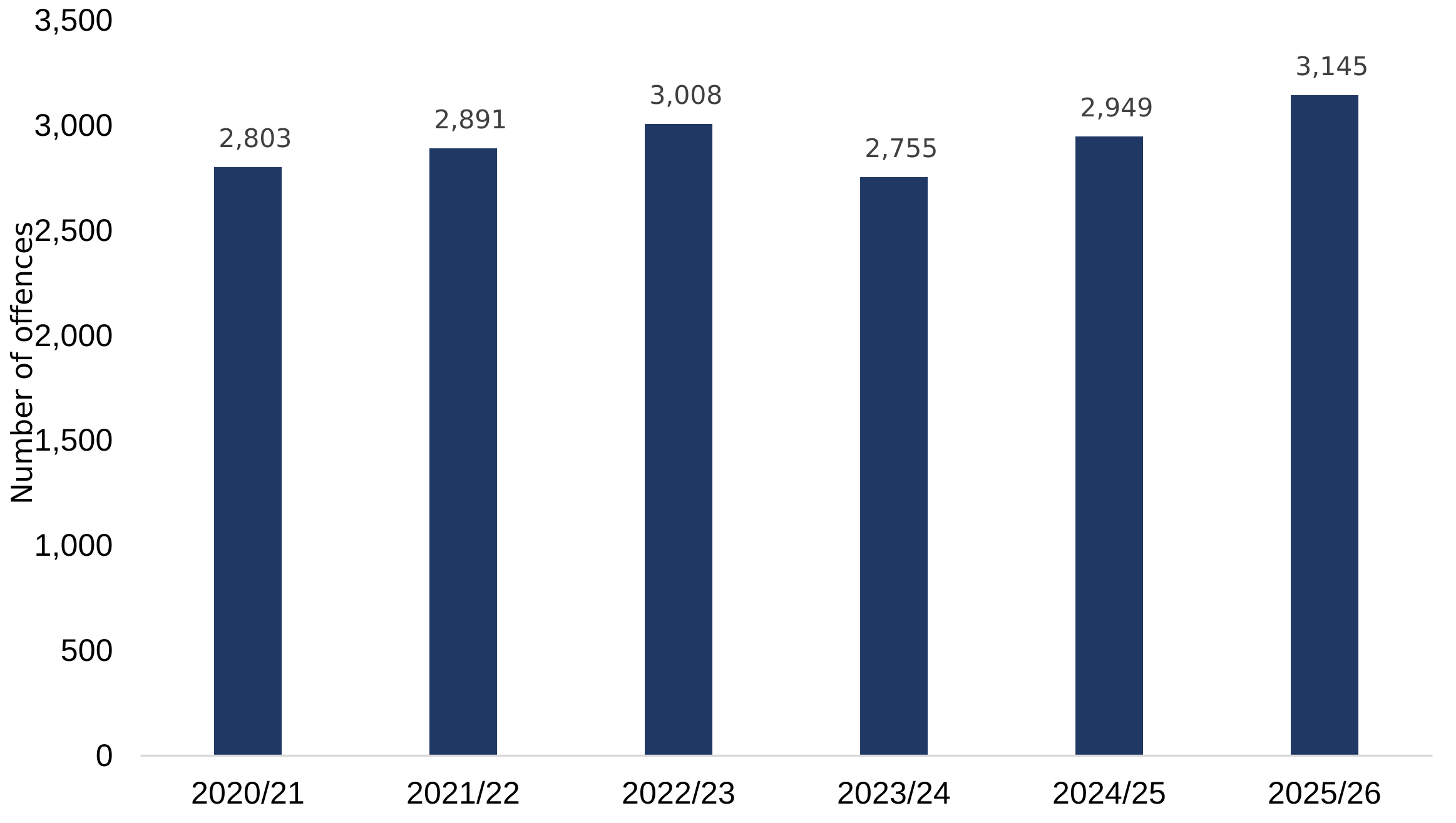
In the year ending (YE) March 2026, there were 3,145 HBA-related offences recorded by the police in England and Wales, a 7% increase compared with the previous year (2,949). This was the highest number recorded since YE March 2021, the earliest year for which comparable data is available (Figure 2.1).
Trends in HBA-related offences recorded by the police will be affected by:
- changes in crime recording practices
- the police improving their identification of what constitutes so-called HBA, including training for officers to recognise the signs of HBA
- the likelihood of victims coming forward to report these offences to the police
- genuine changes in the level of these offences
Figure 2.1: Offences involving so called ‘honour-based’ abuse recorded by the police in England and Wales, YE March 2021 to YE March 2026
Source: Police recorded crime, Home Office
2.2 HBA-related offences by type
Of the 3,145 HBA offences recorded in the latest year, 166 offences were classified as FGM, 57 more than the previous year (109), and the highest annual figure since YE March 2021 (see Statistics on so called ‘honour-based’ abuse offences, England and Wales, year ending March 2026: data tables; Table 2). The relatively low volume of these offences means that these figures are likely to fluctuate from year-to-year and may be affected by improvements in recording practices and the improved identification of these offences. Over half (51%; 85 offences) of the FGM offences recorded by the police came from the mandatory reporting duty for FGM.
The police recorded 129 forced marriage offences in the YE March 2026, an increase of 4 compared with the previous year (see Statistics on so called ‘honour-based’ abuse offences, England and Wales, year ending March 2026: data tables; Table 2).
Table 2.1: Offences involving so called ‘honour-based’ abuse recorded by the police in England and Wales, YE March 2026
| All HBA-related offences | FGM offences | Forced marriage offences | Other HBA-related tagged offences | |
|---|---|---|---|---|
| England and Wales | 3,145 | 166 | 129 | 2,850 |
Source: Police recorded crime, Home Office
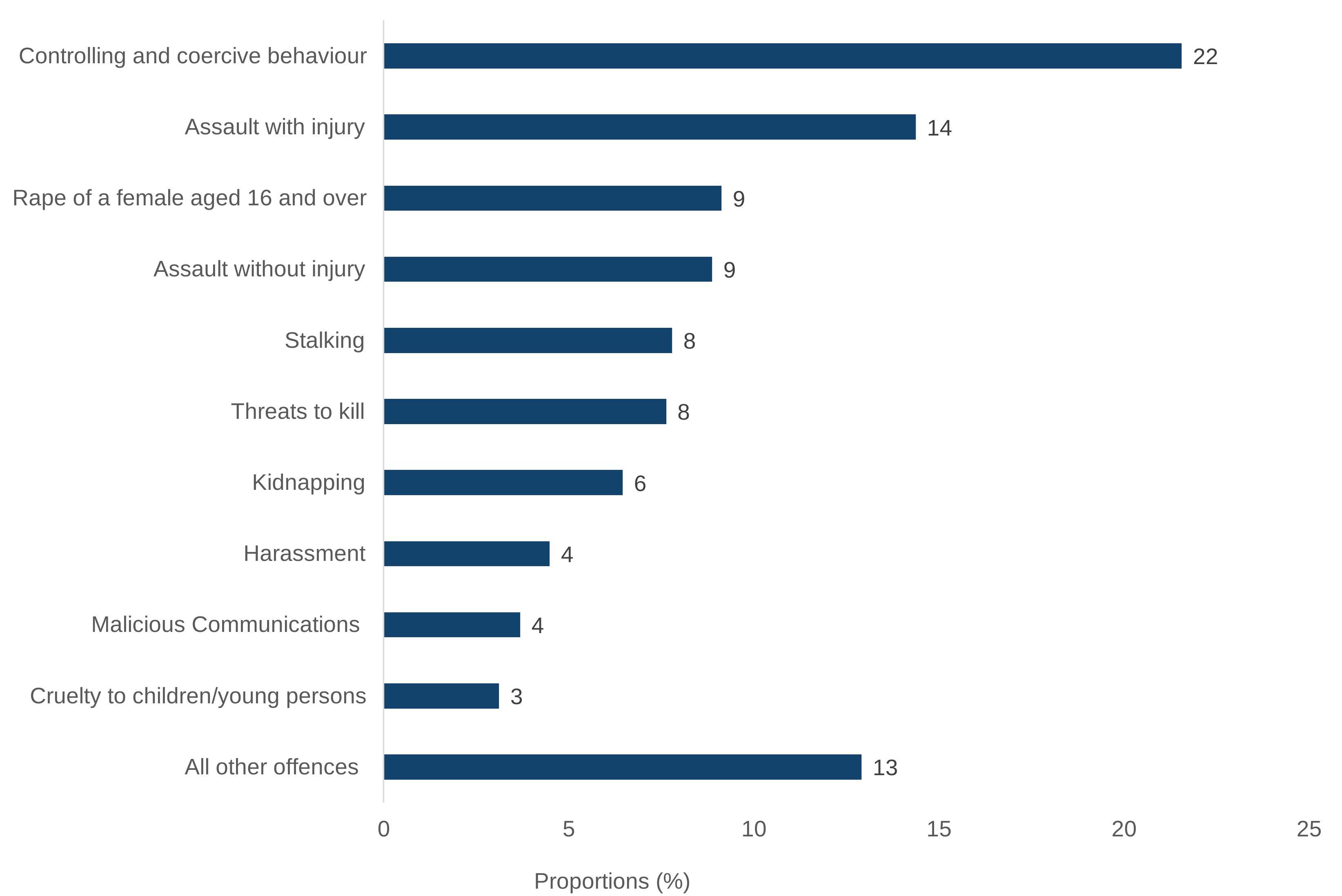
In the YE March 2026, 22% of HBA-related offences were for controlling and coercive behaviour and 14% for assault with injury. Other offences are shown in Figure 2.2.
Figure 2.2: Proportion of offences (%) involving so called ‘honour-based’ abuse recorded by the police, by offence category, England and Wales, YE March 2026
Source: Police recorded crime, Home Office
Notes:
- Numbers may not sum to 100 due to rounding.
2.3 HBA-related incidents
In the YE March 2026, there were 2,001 HBA-related incidents recorded by the police in England and Wales, a decrease of 2% compared with the previous year (2,047 incidents). These cover incidents reported to the police that, following investigation, do not amount to an offence according to the National Crime Recording Standard.
Police recorded incident data may be affected by changes in how incidents are recorded by police forces.
2.4 HBA-related offences by police force area
Data at the police force area (PFA) level need to be interpreted with caution as the volume of these offences was relatively low in some PFAs and, as such, can be subject to a degree of fluctuation from year-to-year. Also, PFAs vary in their population size and demographic composition, which would result in natural variation between forces.
For the YE March 2026, the Metropolitan Police Service (MPS) recorded the highest number of HBA offences; 625 or 20% of all HBA offences. West Midlands Police recorded 395 (13% of the total) and Greater Manchester Police 254 offences (8% of the total).
A breakdown of the number of HBA-related offences and incidents recorded within each PFA are provided in Statistics on so called ‘honour-based’ abuse offences, England and Wales, 2025 to 2026: data tables; table 5 and table 7, published alongside this release.
3. Data quality
HBA-related data is supplied to the Home Office by the 43 territorial police forces of England and Wales, plus the British Transport Police.
While police forces have been asked to confirm the accuracy of the statistics in this release, the Home Office are aware of several potential data quality issues.
It is known that for some police forces, the identification of crimes as HBA-related relies on a police officer or other member of police staff remembering to correctly apply the HBA-related identifier to an offence on their Record Management System. Such identifiers are not always correctly applied. There may be some crimes that forces manage as being HBA-related but have not been identified as such in the data returned to the Home Office.
Forces either supplied record-level data via the Home Office Data Hub (HODH) or an aggregate data manual return. For forces who supplied data to the HODH, the Home Office extracts the number of offences for each force which have been identified by forces as being HBA-related. Therefore, counts of HBA via the HODH are dependent on the identifier being correctly applied for each respective offence.
In the manual return, police forces submit a quarterly spreadsheet containing a count of HBA-related offences and the number of FGM and forced marriage offences.
At the end of the financial year, the Home Office carried out a series of quality assurance checks on the HBA data collected from the police forces (either by the aggregate return or via the HODH).
These include checks:
- for any large or unusual numbers of HBA-related offences across forces
- large numerical changes by force between years
- that FGM and forced marriage offences were identified correctly
- that the type of offences identified as HBA-related seemed plausible
Police forces are then asked to investigate any issues and either provide an explanation or resubmit revised figures. Once these issues are addressed, the data is then tabulated and sent back to forces for them to verify. At this stage, they are asked to confirm in writing that the data they submitted are correct and if they are not, they can then revise their figures accordingly.
Home Office statisticians will continue to work with police forces to improve the data quality of this collection.
3.1 Change in MPS crime recording system
In February 2024, the MPS changed crime recording systems as part of a wider improvement project to replace several legacy IT systems with a single integrated solution.
The new system, CONNECT, is used nationally by several police services and allows more effective and efficient management of data related to intelligence, investigations, custody and other policing functions. As part of the change, the MPS have improved their process for adding markers to both incidents and offences. This change is likely to have led to the increase in the identification of these incidents and offences seen in the MPS in YE March 2025 and March 2026. Due to the size of the MPS, these changes affect the national figures. As stated in the introduction, this data has been published to show the level of so-called HBA dealt with by the police but should not be seen as a providing a reliable trend in these offences.
It should be noted the possible under-identification of offences on the old IT system as being HBA-related would have had no downstream impact on the handling or processing of cases within the Criminal Justice System.