Historical same-sex sexual conviction disregards and pardons, April 2025 to March 2026
Published 14 May 2026
Applies to England and Wales

© Crown copyright 2026
This publication is licensed under the terms of the Open Government Licence v3.0 except where otherwise stated. To view this licence, visit nationalarchives.gov.uk/doc/open-government-licence/version/3 or write to the Information Policy Team, The National Archives, Kew, London TW9 4DU, or email: psi@nationalarchives.gov.uk.
Where we have identified any third party copyright information you will need to obtain permission from the copyright holders concerned.
This publication is available at https://www.gov.uk/government/statistics/same-sex-sexual-conviction-disregards-april-2025-to-march-2026/historical-same-sex-sexual-conviction-disregards-and-pardons-april-2025-to-march-2026
Frequency of release: Annual
Forthcoming release: Research and Statistics
Home Office responsible statistician: John Flatley
Press enquires: pressoffice@homeoffice.gov.uk, Telephone: 0300 123 3535
Public enquires: crimeandpolicestats@homeoffice.gov.uk
1. Introduction
The Disregards and Pardons Scheme was established following the enactment of the Protection of Freedoms Act 2012 to address the historical discrimination faced by individuals who were criminalised for same-sex sexual activity. Initially, the scheme was open to men with specific convictions for homosexual offences that have since been repealed. These individuals could apply to have their convictions and/or cautions ‘disregarded’ by the Secretary of State (meaning deleted from official records). The specific offences were limited to buggery, gross indecency, and equivalent offences under military law (for veterans).
Sections 194 and 195 in the Police, Crime, Sentencing and Courts Act 2022 significantly extended the scope of the scheme. From 13 June 2023, the scheme was extended in the following ways:
-
it is open to any individual applicant
-
the Home Office will consider any repealed or abolished offence that was used to criminalise same-sex sexual activity
If an application is received which does not relate to convictions for same-sex sexual activity; or is outside of the jurisdiction of the Home Office; or is not repealed or abolished, then this is considered outside of the scope of the legislation.
The aim of the extended scheme is to enable more people, including women and those serving in the UK armed forces, who were convicted for same-sex sexual activity in the past, to apply for those convictions to be disregarded. The conditions for a disregard are that it appears to the Secretary of State that the activity giving rise to the offence must have been consensual, that any other person involved in the sexual activity was aged 16 or over, and that the sexual activity would not, if occurring in the same circumstances at the point of the disregard decision, constitute an offence. For example, sexual activity in a public lavatory in England would be ineligible for a disregard or pardon as it remains an offence under section 71 of the Sexual Offences Act (SOA) 2003.
The scheme applies to offences committed in England and Wales, except for services offences which are reserved in the UK. Scotland and Northern Ireland have their own schemes related to disregarding homosexual convictions.
The data from 13 June 2023 (when the scheme was extended) to the year end March 2024, and the data for year ending March 2025, can be found here: Historical same-sex sexual conviction disregards and pardons, June 2023 to March 2025.
This publication provides information on the number of applications for consideration received by the Home Office during 1 April 2025 to 31 March 2026 across England and Wales (and wider services offences). Updates are also provided for data during the year ending March 2025, where applications were still in progress when first published in May 2025.
In addition, due to the extension of the scheme, the data reported in this publication is not directly comparable with the previously published data under the old scheme, which can be found here: Disregard process for convictions for decriminalised sexual offences (consensual gay sex).
2. Key findings
For the year ending March 2026, 22 applications were received, a decrease of 14 compared with the previous year (when there were 36 applications in year ending March 2025).
Of those applications received in the latest year, there were a total number of 42 convictions considered. This compared with 79 in the year ending March 2025.
Table 1: The number of applicants, and number of convictions and cautions
| Year ending March 2025 | Year ending March 2026 | |
|---|---|---|
| Number of applicants | 36 | 22 |
| Number of convictions and cautions | 79 | 42 |
Source: Disregards and Pardons Scheme recorded figures, Home Office
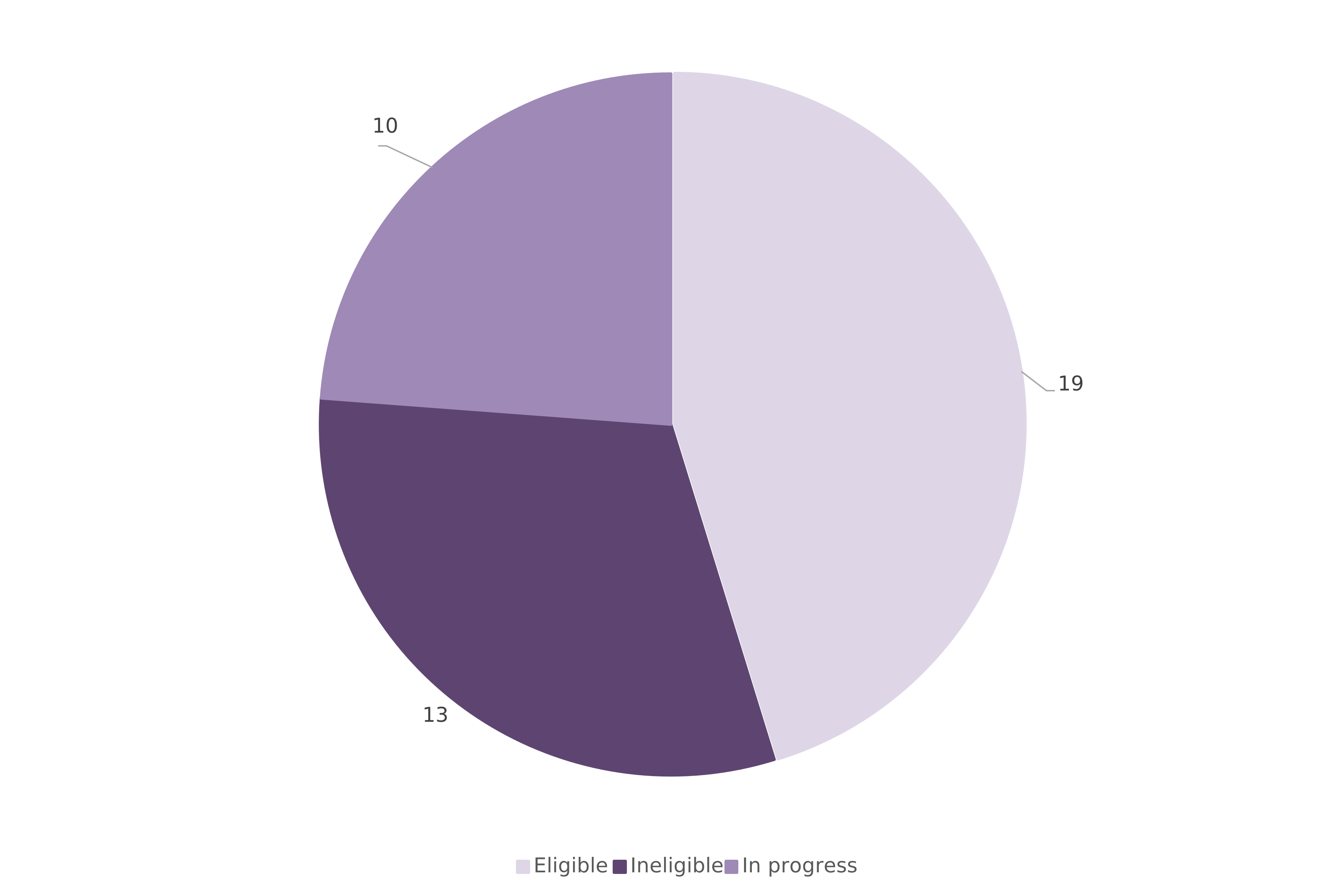
Figure 1: Decision for applications received in the year ending March 2026
Source: Disregards and Pardons Scheme recorded figures, Home Office
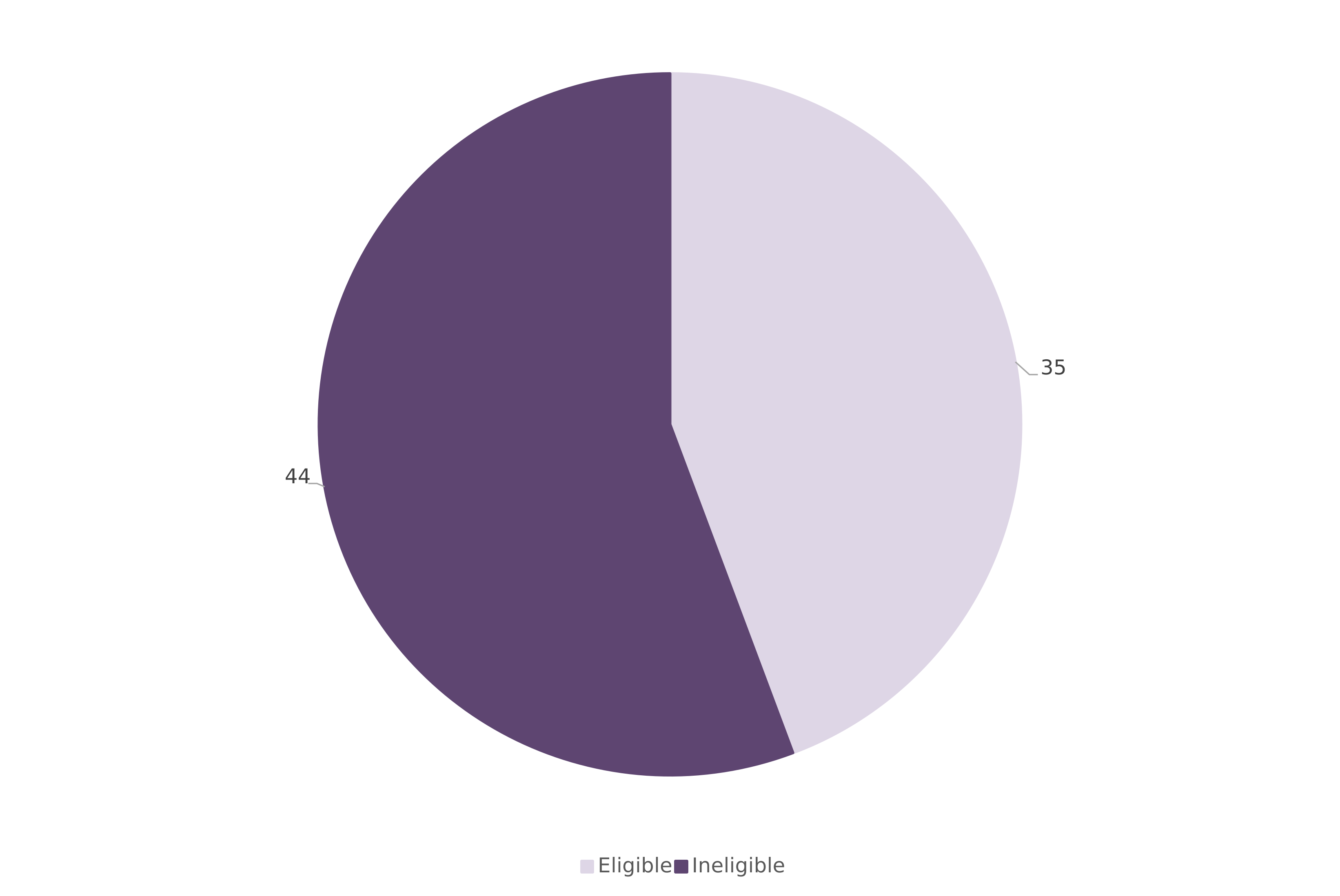
Figure 1 shows there were 19 convictions eligible for a disregard, lower than the 35 convictions in the previous year (Figure 2). There were 13 convictions ineligible for a disregard (compared with 44 ineligible in the year ending March 2025). As of 31 March 2026, 10 applications were still in progress.
Figure 2: Decision for applications received in the year ending March 2025
Source: Disregards and Pardons Scheme recorded figures, Home Office
For both time periods, most disregarded convictions were military offences, with 18 in the year ending March 2026, and 31 in the previous year (Table 2).
Table 2: The number of disregards by conviction type
| Eligibility breakdown | Year ending March 2025 | Year ending March 2026 | Grand Total |
|---|---|---|---|
| Section 12 (buggery) SOA 1956 | 1 | 0 | 1 |
| Section 13 (gross indecency) SOA 1956 | 2 | 1 | 3 |
| Equivalent military offences | 31 | 18 | 49 |
| Other | 1 | 0 | 1 |
| Total | 35 | 19 | 54 |
Source: Disregards and Pardons Scheme recorded figures, Home Office
For the year ending March 2026, most applications that were deemed ineligible for a disregard were refused because the behaviour underlying the conviction would still constitute an offence at the point of decision (7 applications were refused for this reason). This was similar to the year ending March 2025, where the majority of cases (close to half; 21 offences), were also ineligible for the same reason.
Of the remaining applications in the year ending March 2026, 2 were ineligible for a disregard because it was decided that the requirements relating to consent did not appear to be met, and 2 applications were ineligible as the offence was outside the scope of the legislation. The final 2 applications were ineligible as no records pertaining to the offence could be found by the police/court to disregard. Around a third of the applications (13 applications) for the previous year were ineligible as no records pertaining to the offence could be found by the police/court to disregard.
Table 3: The number of convictions ineligible, by ineligibility breakdown
| Ineligibility breakdown | Year ending March 2025 | Year ending March 2026 | Grand Total |
|---|---|---|---|
| Non-consensual | 2 | 2 | 4 |
| Offences outside the scope of legislation | 3 | 2 | 5 |
| No police/court records found; no records to disregard | 13 | 2 | 15 |
| Other party aged 15 and under | 5 | 0 | 5 |
| Considered criminal offence at point of decision | 21 | 7 | 28 |
| Total | 44 | 13 | 57 |
Source: Disregards and Pardons Scheme recorded figures, Home Office
Notes:
- ‘Considered criminal offence at point of decision’ was referred to as ‘considered criminal offence today’ in the previous publication, which can be accessed here: Historical same-sex sexual conviction disregards and pardons, June 2023 to March 2025. This has been amended for transparency as the law can change from the date of a disregard decision and the date of publication – the key period is the date that the decision was made.
3. Appeals
No appeals have been granted during the 2 last financial years (April 2024 to March 2025, and April 2025 to March 2026).