Proven reoffending statistics: April to June 2024
Published 30 April 2026
Applies to England and Wales

© Crown copyright 2026
This publication is licensed under the terms of the Open Government Licence v3.0 except where otherwise stated. To view this licence, visit nationalarchives.gov.uk/doc/open-government-licence/version/3 or write to the Information Policy Team, The National Archives, Kew, London TW9 4DU, or email: psi@nationalarchives.gov.uk.
Where we have identified any third party copyright information you will need to obtain permission from the copyright holders concerned.
This publication is available at https://www.gov.uk/government/statistics/proven-reoffending-statistics-april-to-june-2024/proven-reoffending-statistics-april-to-june-2024
1. Main points
This publication provides proven reoffending statistics for the April to June 2024 offender cohort, alongside historical data from 2013 onwards. This cohort is still affected by the recovery of the court system following the Covid-related lockdowns and operational restrictions[footnote 1] as well as policy changes, such as Probation Reset[footnote 2], End of Custody Supervised Licence (ECSL)[footnote 3] and changes to fixed-term recalls[footnote 4]. It is not possible to separate out the impact of any individual change on the overall rates.
Proven reoffences are measured over a one-year follow-up period and a further six-month waiting period to allow for offences to be proven in court. For more information, technical details and definitions on proven reoffending, please see the accompanying guide to proven reoffending.
| The overall proven reoffending rate was 29.6% for the April to June 2024 offender cohort. | This is an increase of 0.7 percentage points from the last quarter, and an increase of 2.1 percentage points percentage points from the previous year. Across the reported time series, the overall reoffending rate has fluctuated between 23.1% and 31.7%. |
| Adult offenders had a proven reoffending rate of 29.5%. | This is an increase of 0.6 percentage points from the last quarter, and an increase of 2.2 percentage points since the same quarter in the previous year. |
| Child offenders had a proven reoffending rate of 32.8%. | This is an increase of 1.5 percentage points from the last quarter, and an increase of 1.3 percentage points from the same quarter in the previous year. |
| Reoffenders committed on average 5.13 reoffences. | This is the highest in the time series. |
| Adults released from custody or starting court orders had a proven reoffending rate of 37.5%. | This is a small increase of 0.4 percentage points from the last quarter and an increase of 2.3 percentage points from the same quarter in the previous year. |
2. Overall reoffending trends
-
The overall proven reoffending rate was 29.6% for the April to June 2024 cohort.
-
Among adult offenders, the proven reoffending rate was 29.5%, up 0.6 percentage points from the previous quarter. Among child offenders, the proven reoffending rate was 32.8%, an increase of 1.5 percentage points from the previous quarter.
-
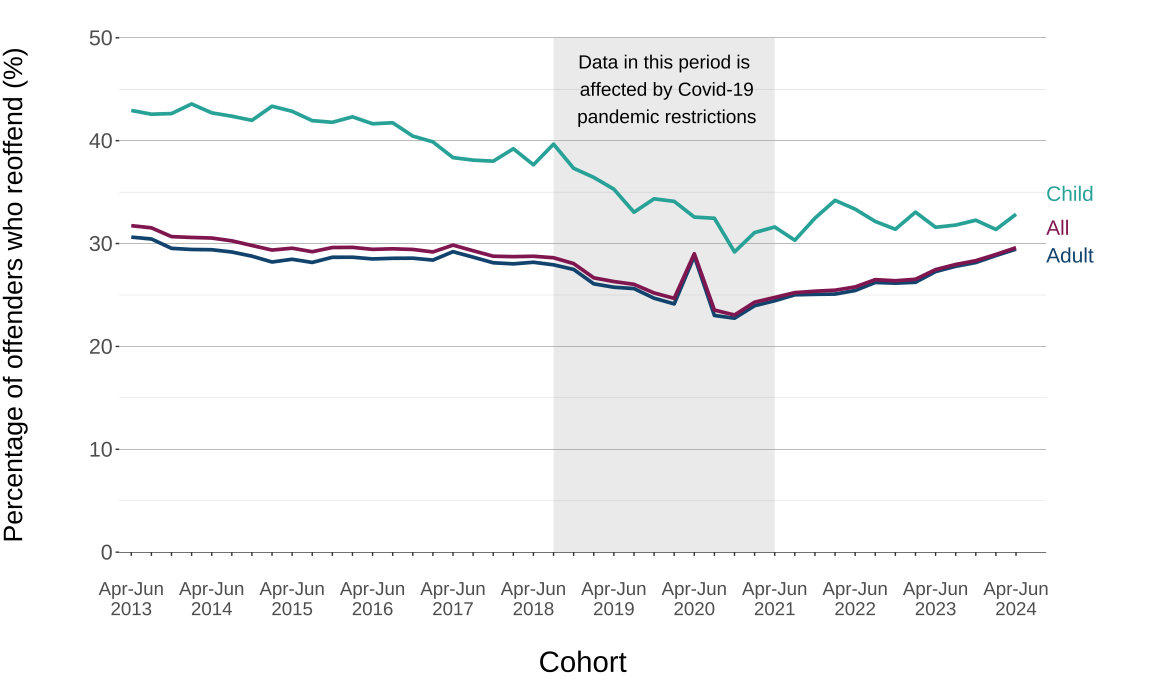
Looking at the longer-term trend shown by Figure 1, up until the end of 2018 the rate of reoffending was slightly declining. The Covid pandemic and associated operational restrictions then resulted in some volatility and marked declines in the reoffending rate for the cohorts between October to December 2018, and October to December 2020. These declines began to reverse as the impact of lockdowns and operational restrictions decreased, and court throughput increased.
-
The overall and adult reoffending rates are now slightly above rates just seen prior to the pandemic, although the child reoffending rate continues to remain below historic levels.
Figure 1: Percentage of adult and child offenders[footnote 5] in England and Wales who commit a proven reoffence, by quarter, April to June 2013 - April to June 2024 (Source: Table A1)
3. Cohort size
-
Approximately 86,000 offenders were released from custody, received a non-custodial conviction at court, or received a caution in the April to June 2024 cohort.
-
Of these, around 25,000 reoffenders committed almost 131,000 proven reoffences across the follow-up period.
-
The size of the cohort declined more rapidly during the pandemic but is increasing as court activity increases. For the April to June 2024 cohort, the size of the cohort increased by 7.3% since the same quarter in the previous year, and the number of reoffenders increased by 15.6% since the same quarter in the previous year.
-
Reoffenders are committing more reoffences on average. For the April to June 2024 cohort, reoffenders committed on average 5.13 reoffences each - the highest in the time series.
4. Reoffending by disposal
Users should exercise caution when comparing the effectiveness of different sentences because the presented rates do not control for differences in offender characteristics receiving those sentences. For further information please consult research from 2019 on the impact of short custodial sentences, community orders and suspended sentence orders on reoffending as well as the guide to proven reoffending statistics[footnote 6].
-
The proven reoffending rate for adults released from custody or starting a court order between April to June 2024 was 37.5%. This is an increase of 0.4 percentage points from the previous quarter, and an increase of 2.3 percentage points from the same quarter in the previous year.
-
The reoffending rate for adults released from custody varies by sentence length:
-
Adults released from custody with sentences of less than 12 months had a reoffending rate of 67.1%.
-
Adults released from custody from sentences of 12 months or more had a reoffending rate of 23.2%
-
-
Child offenders given youth cautions[footnote 7] between April to June 2024 had a proven reoffending rate of 22.7%. Children given a first-tier penalty had a proven reoffending rate of 30.3%. Children released from custody had a proven reoffending rate of 66.0%.
For any feedback on this new reduced bulletin or the content of this publication, please let us know at reoffendingstatistics@justice.gov.uk
5. Further information
5.1 Accompanying files
As well as this bulletin, the following products are published as part of this release:
- A set of overview tables, covering each section of this bulletin, as well as various additional breakdowns including age, sex, ethnicity, index offence and reoffence type, number of previous offences, number of custodial sentences, index disposal, and accommodation and employment status.
- Geographic data tool for England and Wales (for the timeseries July 2013 to June 2024) covering various geographical reoffending breakdowns by age, sex, ethnicity and index offence.
- A technical guide to proven reoffending statistics providing information on how proven reoffending is measured and the data sources used.
- A data quality statement which outlines our policies for producing quality statistical outputs and the information provided to maintain our users’ understanding and trust.
These products are published on a quarterly basis, in January, April, July and October. Next update is 30 July 2026.
5.2 Tables and tools published within other proven reoffending releases
The following tools and tables are published on an annual basis in January (next publication 28 January 2027)
-
Annual average tables provide data up to the 2023/24 performance year, with the next release covering data up to the 2024/25 performance year, including the same breakdowns as the quarterly overview tables above.
-
Index disposal data tool provides index disposal and custodial sentence length breakdowns for both adult and child offenders.
-
Offender management data tool provides breakdowns for adult offenders who are actively supervised, who received a custodial sentence or court order, by probation provider.
- Overview data tool provides combined breakdowns for adult and child offenders of age, ethnicity, sex, number of previous custodial sentences and number of previous offences, by region.
-
Releasing prison data tool provides breakdowns for adult offenders released from custody by prison of release and prison category.
-
Reoffences data tool provides gender and index disposal breakdowns for adult and child offenders by index offence group and reoffence group.
- Youth accommodation data tool provides breakdowns for child offenders by youth accommodation type (youth offender institution, secure training centre and secure children’s home).
The following tools and tables are published on a biennial basis in July (next publication 30 July 2026):
- Restricted patients bulletin and tables provide data on restricted patients who are absolutely or conditionally discharged from detention in high secure or other psychiatric hospitals, by breakdowns of sex, age and number of previous offences.
5.3 Accredited Official Statistics status
National Statistics are accredited official statistics that meet the highest standards of trustworthiness, quality and public value as set out in the Code of Practice for Statistics and should be labelled ‘Accredited Official Statistics’. You are welcome to contact us directly with any comments about how we meet these standards. Alternatively, you can contact OSR by emailing regulation@statistics.gov.uk or via the OSR website .
It is the Ministry of Justice’s responsibility to maintain compliance with the standards expected for National Statistics. If we become concerned about whether these statistics are still meeting the appropriate standards, we will discuss any concerns with OSR promptly. National Statistics status can be removed at any point when the highest standards are not maintained, and reinstated when standards are restored.
5.4 Future publications
Our statisticians regularly review the content of publications. Development of new and improved statistical outputs is usually dependent on reallocating existing resources. Should you have any feedback related to these statistics or any comments on this new reduced bulletin, please contact us at reoffendingstatistics@justice.gov.uk
5.5 Contact
Press enquiries should be directed to the Ministry of Justice press office:
Tel: 020 3334 3536
URL: www.gov.uk/government/organisations/ministry-of-justice/about/media-enquiries
Other enquiries and feedback on these statistics should be directed to the Data and Analysis directorate of the Ministry of Justice:
Liz Whiting, Head of Reducing Reoffending and Probation Statistics
Ministry of Justice, 10th Floor, 102 Petty France, London, SW1H 9AJ
Email: reoffendingstatistics@justice.gov.uk
Next update: 30 July 2026
URL: www.gov.uk/government/collections/proven-reoffending-statistics
© Crown copyright
Produced by the Ministry of Justice
Alternative formats are available on request from reoffendingstatistics@justice.gov.uk
-
The resultant increase in the court backlog means that some reoffence convictions may fall outside the one-year follow-up period and six-month waiting-period. Any offence falling outside of the measurement period will not be counted in the proven reoffending statistics. Conversely, any increase in court throughput may increase the reoffending rate as more cases fall within the measurement period. ↩
-
Probation Reset, introduced in April 2024, is where probation contact is suspended for eligible offenders in the final third of their sentence, although their orders and licences remain active. For more information, please see glossary of terms in the Guide to Proven Reoffending. ↩
-
ECSL allowed certain determinate sentenced prisoners to be released prior to their Conditional Release Date and was in operation from 17 October 2023 until 9 September 2024. For more information, please see the glossary of terms in the Guide to Proven Reoffending. ↩
-
Changes to the recall process mandate the use of fixed term recalls rather than standard recalls for offenders sentenced to less than 12 months of custody, subject to certain exceptions. ↩
-
Children, or child offenders, are defined as those aged between 10 and 17 ↩
-
Proven reoffending rates by disposal should not be compared to assess the effectiveness of sentences, as there is no control for known differences in offender characteristics and the type of sentence given. For further information see Annex D of the October 2016 publication (page 41) and the guide to proven reoffending statistics. ↩
-
Reprimands and warnings for youths were abolished under the Legal Aid Sentencing and Punishment of Offenders Act 2012 with effect from 8 April 2013 and replaced with youth cautions. Youth cautions are a formal out-of-court disposal that can be used as an alternative to prosecution for child offenders in certain circumstances. A youth caution may be given for any offence where the young offender admits an offence and there is sufficient evidence for a realistic prospect of conviction, but it is not in the public interest to prosecute. ↩