Local authority collected waste management – annual results 2024/25
Updated 31 March 2026
Applies to England

© Crown copyright 2026
This publication is licensed under the terms of the Open Government Licence v3.0 except where otherwise stated. To view this licence, visit nationalarchives.gov.uk/doc/open-government-licence/version/3 or write to the Information Policy Team, The National Archives, Kew, London TW9 4DU, or email: psi@nationalarchives.gov.uk.
Where we have identified any third party copyright information you will need to obtain permission from the copyright holders concerned.
This publication is available at https://www.gov.uk/government/statistics/local-authority-collected-waste-management-annual-results/local-authority-collected-waste-management-annual-results-202425
This release relates to the collection and management of waste under the possession or control of local authorities in England. It covers three principal measures as summarised in the table below.
Results presented in this release for 2024/25 are final. Figures for 2023/24 have been revised and are now final.
The next update to this Accredited Official Statistics notice and accompanying datasets is scheduled to be in February/March 2027.
What data is included in this release?
| Measure | Time period |
|---|---|
| Waste from households – This is the official recycling measure that is used as the basis for reporting at a harmonised UK level. | Publication of final figures for the 2024 calendar year and for the 2024/25 financial year. |
| Local authority collected waste – This is all waste within the remit of local authorities. It includes household waste plus other non-household waste collected by local authorities. | Publication of final figures for the 2024/25 financial year. |
| Household waste – This is broader than waste from households, and includes waste from street bins, street sweepings, and parks and grounds. It does not include metals from incinerator bottom ash. | Publication of final figures for the 2024/25 financial year. |
For more information about what data is included in the three measures listed in the table above, please refer to the section on glossary of terms and measures and the separate methodology summary document.
A recycling explainer document giving an explanation of what recycling is and comparing measures across England, Wales, Scotland and Northern Ireland is available.
National, regional and local authority level datasets are available - including the ex-National Indicator measures
Percentage changes and other changes presented in this statistical notice are based on unrounded figures.
1. Key points
England waste from households: 2024 and 2024/25 (Table 1 and Figure 1)
- The official England waste from households recycling rate was 43.8% in 2024, down 0.2 percentage points from 44.0% in 2023.
- Metal recovered and then recycled from waste that has been through incineration (IBA metal) added approximately 1.0 percentage point to the recycling rate in 2024, this has remained unchanged from 2020.
- In 2024, total waste from households increased to 21.9 million tonnes from 2023 when it was 21.7 million tonnes. This is equivalent to 376 kg per person, down 1 kg from 2023.
- The amount of residual waste treated was 12.3 million tonnes, up from 12.1 million tonnes in 2023.
- The total amount of waste recycled increased. In 2024, it was 9.6 million tonnes, up from 9.5 million tonnes in 2023. This was an increase of 0.6%.
- The amount of dry material recycled in 2024 was 5.5 million tonnes up by 0.1 million tonnes from 2023, an increase of 1.9%.
- The tonnage of separately collected food waste sent for recycling was 535 thousand tonnes, an increase of 6.7% from 501 thousand tonnes in 2023.
- ‘Other organic’ waste sent for recycling was 3.5 million tonnes, a decrease of 0.1 million tonnes or 2.3% on 2023.
- The rolling 12-month waste from households recycling rate was 43.7% at the end of March 2025. This is an decrease of 0.3 percentage points compared with the previous 12-month period. This figure includes IBA metal.
England Local Authority and Household Waste: 2024/25 financial year (Table 4 and Figure 7)
- In 2024/25, total local authority managed waste increased by 0.4% to 25.2 million tonnes.
- 5.5% of all local authority waste (1.4 million tonnes) was disposed of via landfill in 2024/25. This was unchanged from 2023/24.
- Waste sent for incineration increased by 0.1 million tonnes (0.5%) to 12.7 million tonnes in 2024/25 compared to 2023/24. It was the disposal method used for 50.3% of all local authority waste.
- There are no changes to definitions or methodology for all local authority and household waste recycling figures; IBA metal is not included.
- 10.4 million tonnes of local authority waste were sent for recycling in 2024/25, this was unchanged from 2023/24.
- Amongst the 321 local authorities in England, there is considerable variation in household waste recycling rates, ranging from 17.0 to 63.9% in 2024/25.
2. Notes and further information
2.1 Data Revisions
Figures in this statistical notice and accompanying datasets for 2023/24 have been updated to include final figures for Bristol City Council, and a correction to dry recyclate reporting by Sheffield City Council. See the Data and Methodology section of this notice for the scale of revisions. The raw dataset CSV files published on GOV.UK have been updated to include this revised data for Bristol and Sheffield City Council.
2.2 Recycling Explainer
A recyling explainer document providing an explanation of what can be counted as recycling, different national recycling measures and summarising how measures across England, Wales, Scotland and Northern Ireland differ is available.
2.3 Give us feedback on this notice
To help us understand your information and data needs, please complete the short user feedback survey consisting of 4 questions. (This link opens in google forms).
3. Waste from households
3.1 Waste from households (Table 1)
Waste from households is the measure introduced by the UK in 2014 to provide a harmonised UK indicator for reporting recycling rates at a UK level. It excludes local authority collected waste not considered to have come directly from households, such as street bins, street sweepings, parks and grounds waste, and compost-like output.
For more information, refer to the Data and Methodology section of this notice.
Table 1: Composition breakdown and recycling rate of waste from households in England, 2020 to 2024, (thousand tonnes)
| Waste type | 2020 | 2021 | 2022 | 2023 | 2024 | % change 2024 over 2023 |
|---|---|---|---|---|---|---|
| Total Recycling of which: | 9,935 | 10,200 | 9,322 | 9,549 | 9,602 | 0.6% |
| — Dry recycling of which: | 5,871 | 5,969 | 5,546 | 5,416 | 5,519 | 1.9% |
| —— IBA Metal | 222 | 228 | 222 | 216 | 221 | 2.3% |
| — Separately collected food waste | 485 | 512 | 499 | 501 | 535 | 6.7% |
| — Other organics recycling | 3,579 | 3,718 | 3,277 | 3,632 | 3,548 | -2.3% |
| Total Residual | 12,616 | 12,901 | 12,125 | 12,149 | 12,324 | 1.4% |
| Total waste from Households | 22,586 | 23,120 | 21,466 | 21,718 | 21,936 | 1.0% |
| Waste from households recycling rate (including IBA metal) | 44.0% | 44.1% | 43.4% | 44.0% | 43.8% | -0.2 percentage points |
| Waste from households recycling rate (excluding IBA metal) | 43.0% | 43.1% | 42.4% | 43.0% | 42.8% | -0.2 percentage points |
Source: WasteDataFlow, Defra
Notes on Table 1:
- Figures for 2023 have been revised.
- Total recycling is calculated from disposal tonnages sent to reprocessors as reported in WasteDataFlow. The processing of collected waste and recycling, stockpiling, process loss and transfer means that there are inevitably differences between collected and disposal tonnages reported by local authorities. For these reasons Total Recycling and Total Residual Waste will not sum to Total waste from households. Subtotals in the table may not add due to rounding.
- Total waste from households is calculated from collection tonnages reported in WasteDataFlow. It includes dry recycling/preparing for reuse and organics, and residual waste (or ‘black bag’ waste) and rejects from recycling.It excludes collected tonnages of plasterboard, rubble, or soil. IBA metal is included in the recycling figures.
- Where information on some secondary waste treatments of smaller waste tonnages is not available and waste has been reported as going to treatment unknown (typically for rejects from the recycling stream), there has been a change to calculation methodology and this waste is now allocated to residual waste. See the Data and Methodology section of this notice for further detail.
- In 2024, the total weight of waste from households in England was 21.9 million tonnes, a 1.0% increase from 21.7 million tonnes in 2023.
- The weight of waste sent for recycling was 9.6 million tonnes in 2024, a 0.6% increase from 9.5 million tonnes in 2023.
- Residual waste was 12.3 million tonnes in 2024, a 1.4% increase from 2023.
- The waste from households recycling rate was 43.8% in 2024, a decrease of 0.2 percentage points from 2023 when the rate was 44.0%.
- Other organics (mostly green garden waste) make a significant contribution to the overall recycling rate. In 2024 the tonnage of ‘other organics’ decreased by 0.1 million tonnes, 2.3% lower than in 2023. This is most likely due to less favourable plant growing conditions.
- Metals recovered from incinerated waste and then recycled (IBA metal) contributed 221 thousand tonnes, up from 216 thousand tonnes in 2023. This was an increase of 2.3%.
- When IBA metal is excluded, the waste from households recycling rate was 42.8% in 2024, a decrease of 0.2 percentage points from the 2023 rate of 43.0%.
3.2 Waste from households: Waste Streams (Figures 1 to 5)
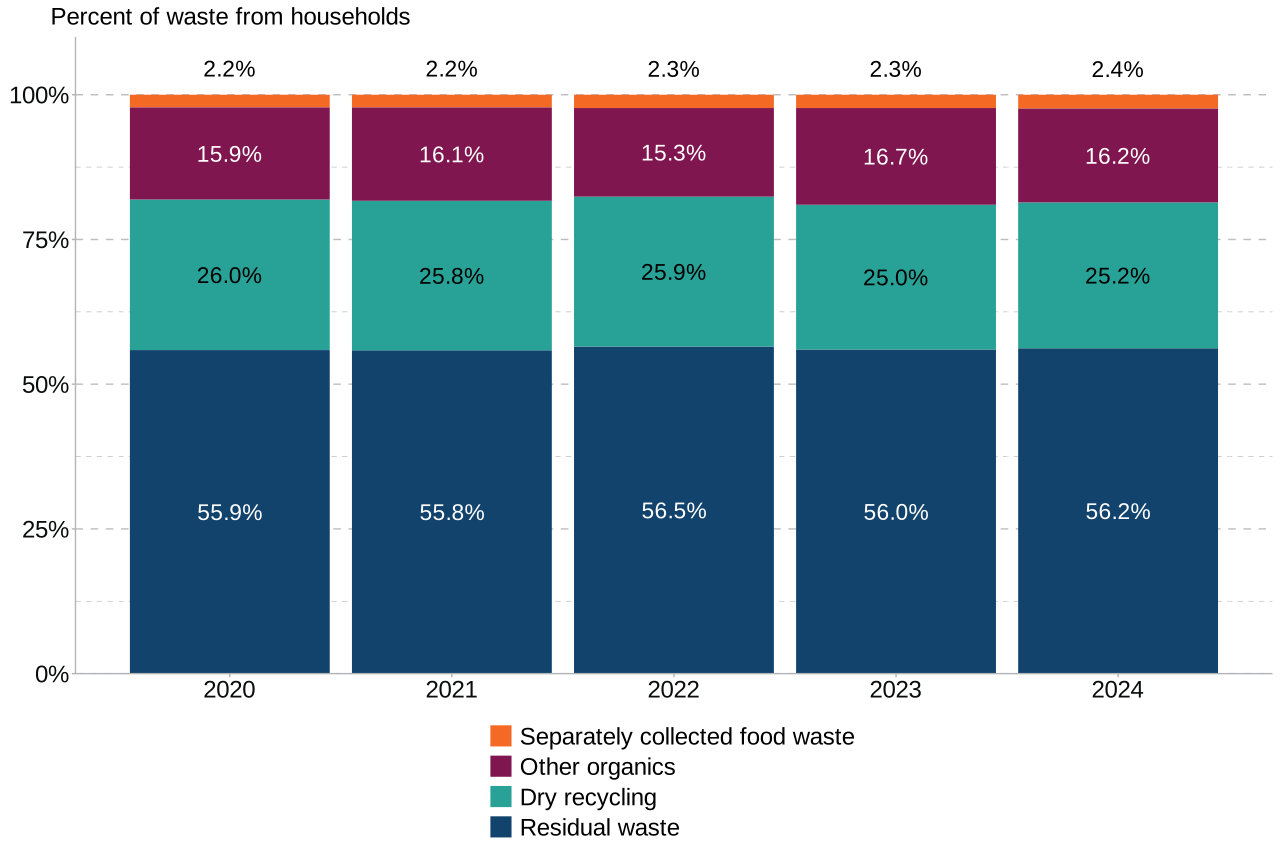
Figure 1: Waste composition: Waste stream proportions as a percentage of total waste from households, 2020 to 2024, England
Source: WasteDataFlow, Defra
Notes on Figure 1:
- Residual waste includes residual waste from households regular collections (black bags), bulky waste, residual waste from civic amenity centres, and rejects from recycling. It excludes waste diverted for recycling from residual waste.
- Dry recycling includes paper and card, glass, plastic, waste electrical and electronic equipment (WEEE), scrap metals including those reclaimed from incinerator bottom ash as well as other materials.
- Other organics includes green garden waste, mixed garden and food waste, wood for composting and other compostable waste.
- Percentages may not add to exactly 100. This is due to rounding.
Download the data for Figure 1
- A total of 21.9 million tonnes of waste from households was treated in England in 2024. Of this, 56.2% was residual waste, 25.2% was dry recycling, 16.2% was ‘other organics’—including green garden waste and mixed garden and food waste—and 2.4% was separately collected food waste.
- The majority (57.5%) of waste from households recycling in 2024 was dry recyclate.
- The tonnage of dry recycling, which includes paper and card, glass, plastic, waste electrical and electronic equipment (WEEE), and scrap metals including those reclaimed from incinerator bottom ash, as well as other materials increased to 5.5 million tonnes in 2024.
- Separately collected food waste increased by 6.7% to 535 thousand tonnes in 2024 from 501 thousand tonnes in 2023. Whilst only a small proportion of total waste from households recycling at 5.6% it has increased from 1.3% in 2010.
- The tonnage of ‘other organic’ waste (including garden waste, mixed garden and food waste, wood for composting and other compostable waste) decreased by 0.1 million tonnes or 2.3% to 3.5 million tonnes in 2024. ‘Other organics’ accounted for 36.9% of total waste from households recycling, 1.1 percentage points lower than in 2023.
- Organic waste tonnages are variable, linked to the season and weather and plant growing conditions. In 2024 there were fewer hours of sunshine in the first half of the year compared to 2023, and the autumn was drier than in 2023. Overall, these conditions are likely to have reduced plant growth.
3.3 Waste from households: quarterly trends (Figure 2)
A quarterly data series for the waste from households measure is available.
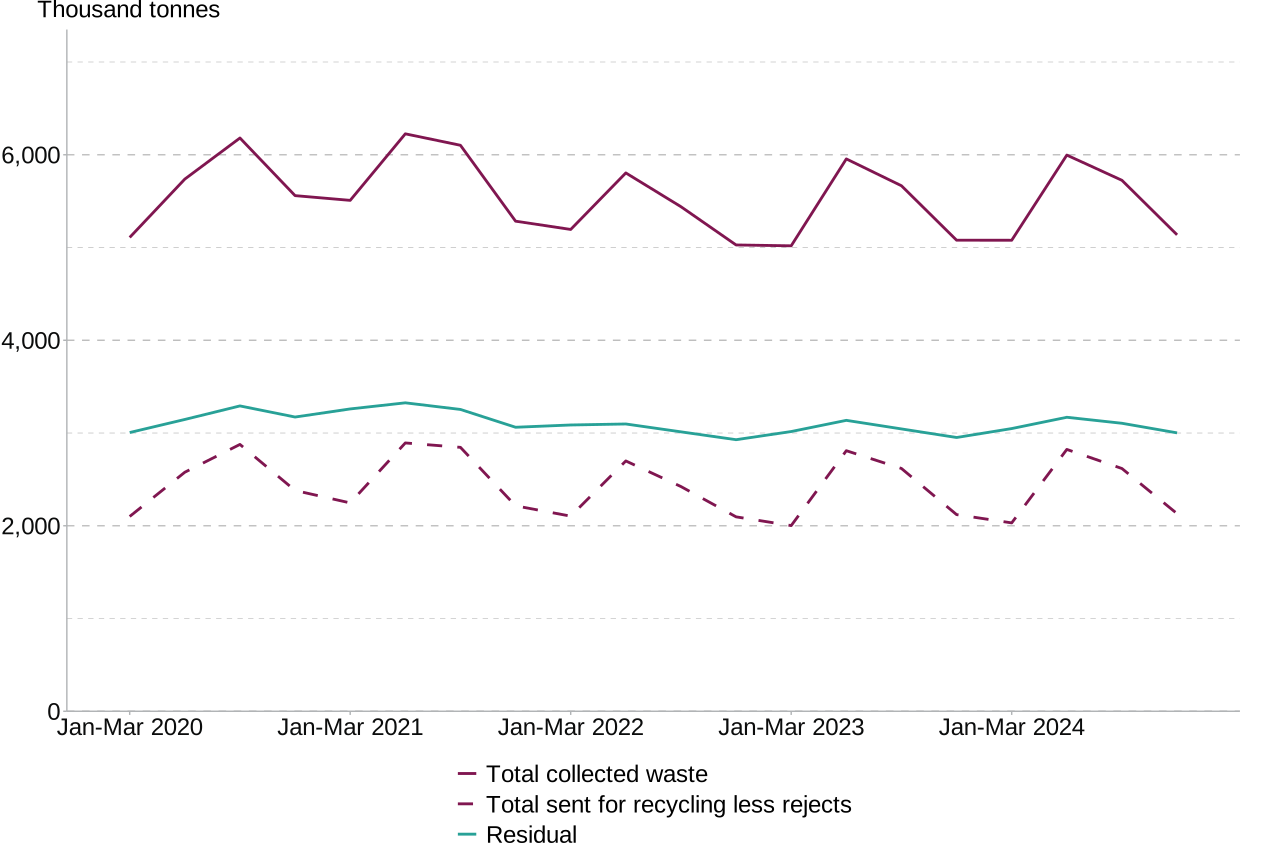
Figure 2: Waste from households: Quarterly trends Jan - Mar 2020 to Oct - Dec 2024
Source: WasteDataFlow, Defra
Download the data for Figure 2
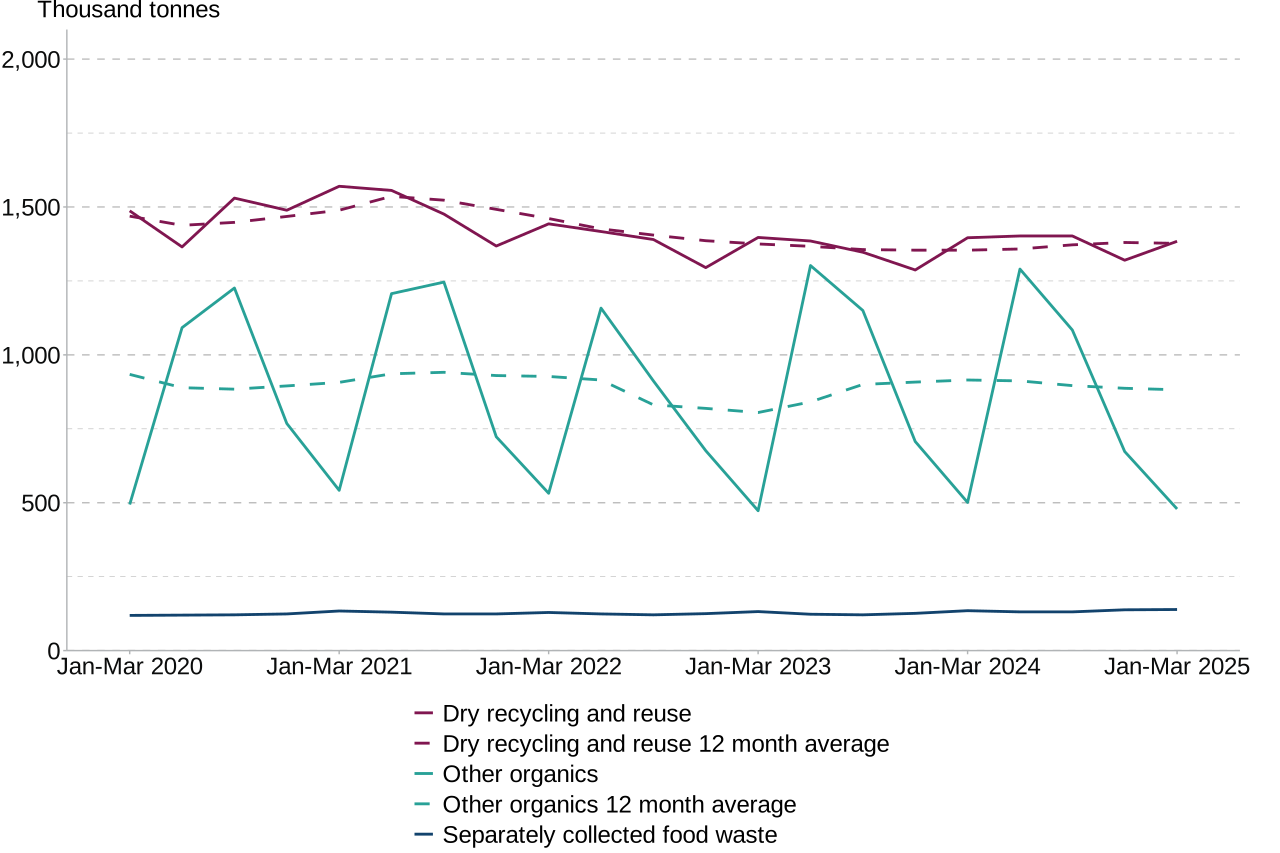
Figure 2 shows quarterly tonnages of total residual, total recycling and total waste from households in the last 5 years. There is seasonal variation in quarterly waste tonnages. This is mostly due to the contribution of organic garden waste. Tonnages of organics are usually at their highest levels in April to June, and lowest in January to March when garden waste collections reduce over the winter period. Variation in organic waste tonnages between years is mainly due to weather conditions affecting plant growth.
Figure 2 shows how trends have changed since 2020 with the impact of the COVID-19 epidemic increasing waste generation in 2020 and 2021. More detail on the impact of the epidemic on local authority waste can be found in the Data and Methodology section of these statistics).
In 2022, total waste from households fell to 21.5 million tonnes. This is the lowest annual tonnage across the 14 years that Waste from household statistics are available for. In 2022 there were large decreases across each of the waste streams. Whilst we can say with some confidence that the bulk of the decrease in the tonnage of organic waste collected in 2022 was primarily due to weather conditions reducing plant growth, there is less certainty about the main drivers for the overall decreases in dry recyclate and residual waste. Residual waste tonnages returned to pre pandemic levels in 2022.
In 2023, total waste from households increased by 0.3 million tonnes to 21.7 million tonnes. This increase was the result of a return to more normal levels of organic waste collected, offsetting further decreases in the tonnage of dry recyclate. Residual waste was unchanged at 12.1 million tonnes.
In 2024, total waste from households increased by 0.2 million tonnes to 21.9 million tonnes. This was the result of an increase 0.2 million tonnes of residual waste, and 0.1 million tonnes of dry recyclate. The tonnage of other organic waste was 0.1 million tonnes lower due to drier weather conditions reducing plant growth.
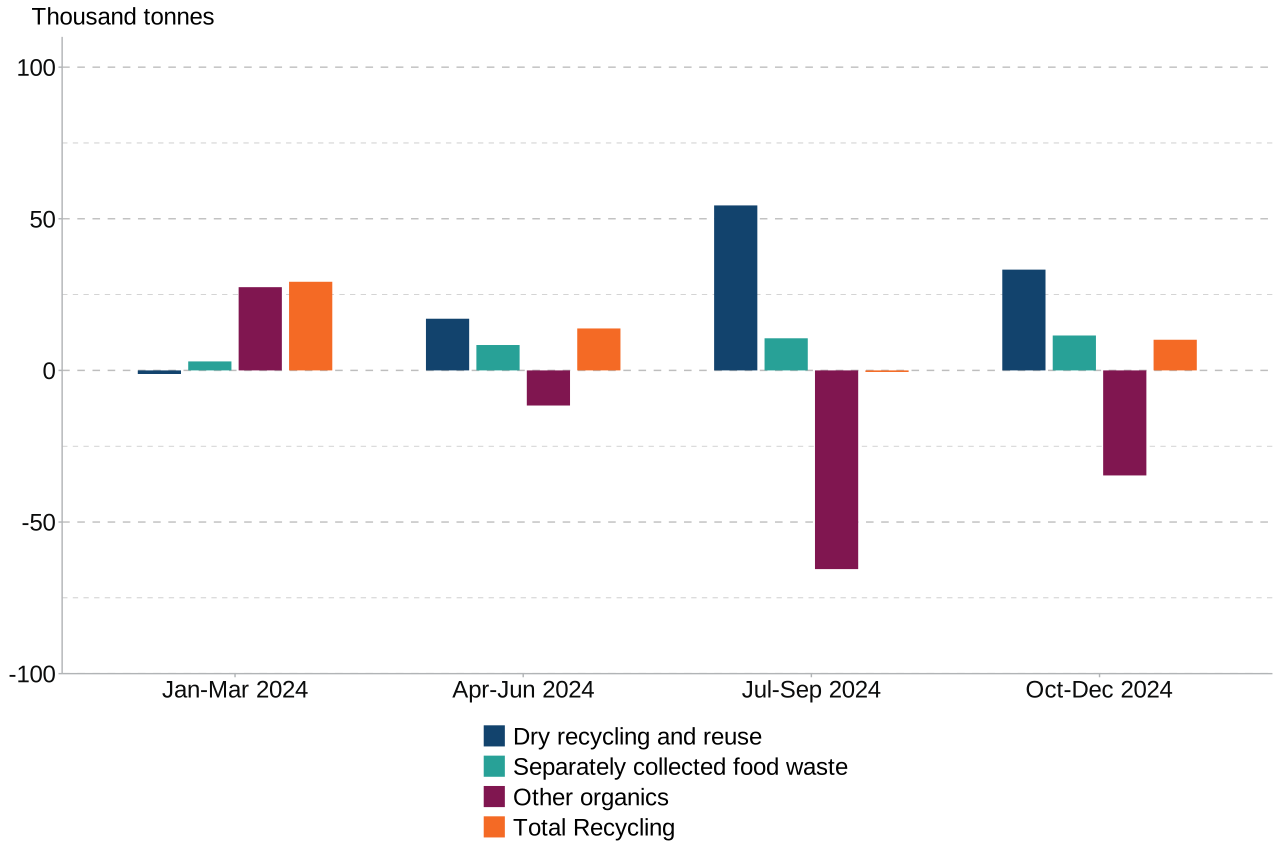
Figure 3 shows quarterly changes in the tonnage of total recycling for waste from households in England between 2023 and 2024.
Figure 3: Quarterly year-on-year change in weight of recycled waste from households, 2024 compared to 2023, England
Source: WasteDataFlow, Defra
Download the data for Figure 3
- Compared to the same periods in 2023, total recycling increased in all quarters except for July to Sept 2024.
- Dry recycling increased in each of the last 3 quarters of 2024, increasing by 0.6% compared to 2023.
- Other organics increased in Jan-March 2024, before decreasing in each of the last 3 quarters of 2024, to finish 2.3% lower than in 2023.
- Separately collected food waste increased in each quarter and by 6.7% across the year as a whole compared to 2023.
3.4 Waste from households: Recycling trends and recycling rates (Figures 4 and 5)
Quarterly trends over a longer time period from January to March 2020, are shown in Figures 4 and 5, which incorporate data for the latest available quarter, January to March 2025, as well.
Figure 4: Waste from households quarterly recycling volumes by waste type, England, Jan-Mar 2020 to Jan-Mar 2025, with 12 month moving averages (thousand tonnes)
Source: WasteDataFlow, Defra
Notes on Figure 4:
- Dry recycling includes paper and card, glass, plastic, waste electrical and electronic equipment (WEEE), scrap metals including those reclaimed from incinerator bottom ash as well as other materials.
- Other organics includes green garden waste, mixed garden and food waste, wood for composting and other compostable waste.
Download the data for Figure 4
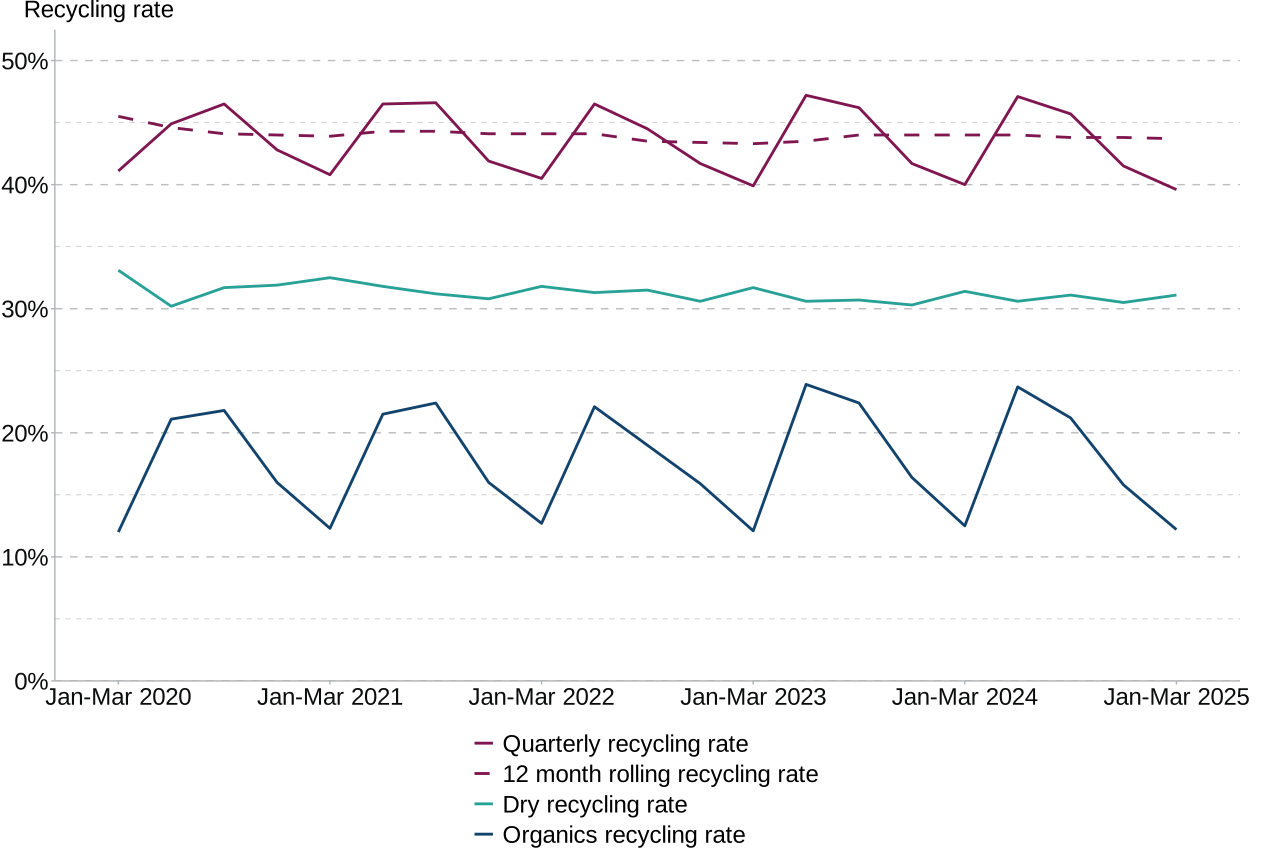
Figure 5 shows quarterly dry and organic recycling as a proportion of total waste from households and a smoothed 12-month rolling average for the overall recycling rate.
The smoothed 12-month rolling average waste from households recycling rate has ranged from 43.5 to 45.5% over this time period.
Figure 5: Waste from households quarterly recycling rate, England, Jan-Mar 2020 to Jan-Mar 2025
Source: WasteDataFlow, Defra
Notes on Figure 5:
Recycling is recycling, composting and anaerobic digestion, and preparing for reuse.
Download the data for Figure 5
3.5 Waste from households: Dry Recycling Composition (Figure 6 and Tables 2 and 3)
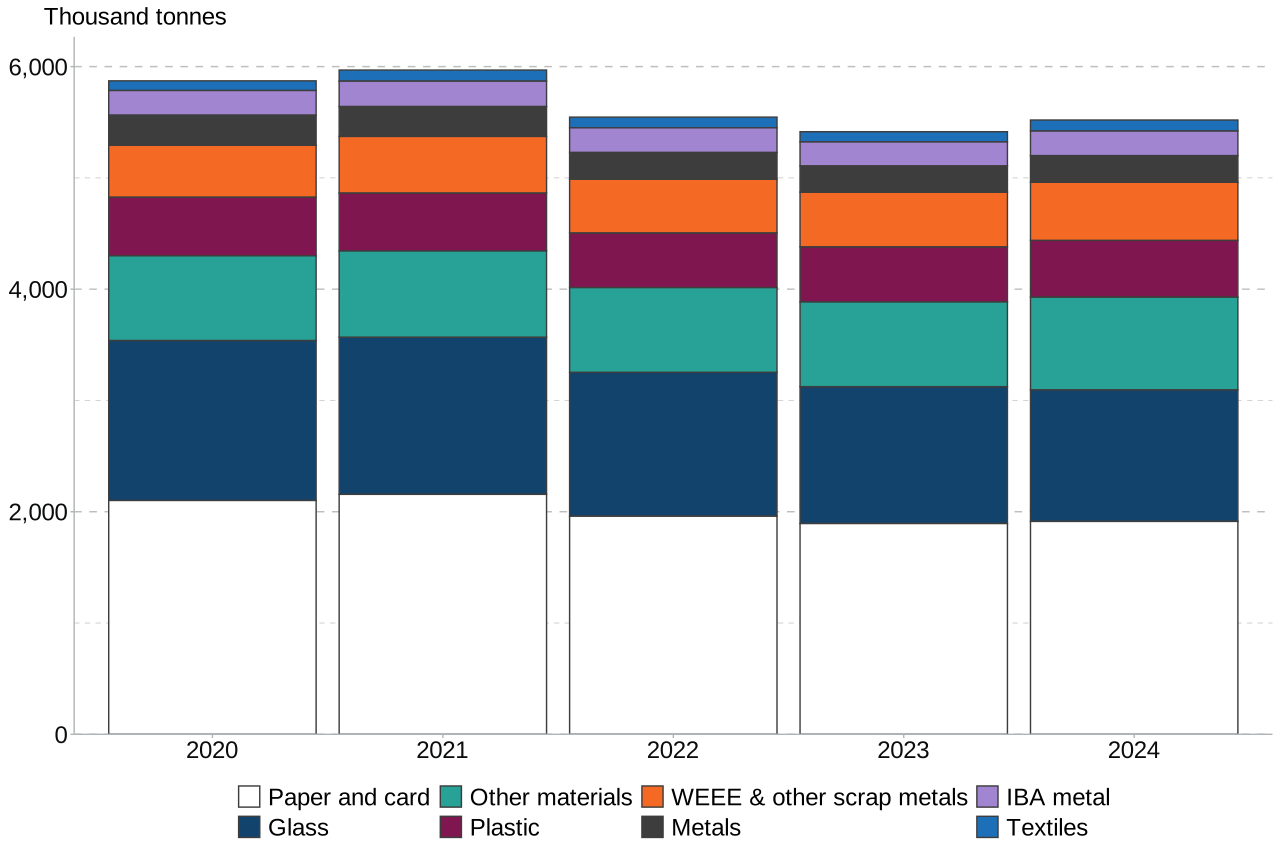
- Dry recycling including IBA metals increased by 0.1 million to 5.5 million tonnes in 2024. It made up 25.2% of total waste from households and 57.5% of all waste from households recycling.
- Paper and card increased by 19 thousand tonnes (1.0%), textiles by 7 thousand tonnes (7.9%), IBA metal by 5 thousand tonnes (2.3%), metals by 4 thousand tonnes (1.7%), other materials by 71 thousand tonnes (9.3%), plastic by 15 thousand tonnes (2.9%) and WEEE & other scrap metals increased by 31 thousand tonnes (6.2%).
- Glass decreased by 48 thousand tonnes (3.9%) in 2024.
Table 2: Waste from households dry recycling composition in England, 2022 to 2024.
| Recyclate | 2022 | 2023 | 2024 | Percentage change 2023 to 2024 |
|---|---|---|---|---|
| Glass | 1,293 | 1,230 | 1,183 | -3.9% |
| Paper and card | 1,960 | 1,894 | 1,913 | 1.0% |
| Textiles | 96 | 92 | 99 | 7.9% |
| Plastic | 492 | 496 | 511 | 2.9% |
| WEEE & other scrap metals | 482 | 491 | 522 | 6.2% |
| IBA metal | 222 | 216 | 221 | 2.3% |
| Metals | 240 | 235 | 239 | 1.7% |
| Other materials | 761 | 761 | 832 | 9.3% |
| Total | 5,546 | 5,416 | 5,519 | 1.9% |
Source: WasteDataFlow, Defra
Notes on Table 2: There are revisions to the figures published for 2023
Figure 6: Waste from households dry recycling composition, England, 2020 to 2024 (thousand tonnes)
Source: WasteDataFlow, Defra
Notes on Figure 6:
Other materials includes batteries (both automotive and post-consumer), bric-a-brac, chipboard and MDF, composite food and beverage cartons, composite wood materials, fire extinguishers, furniture, ink and toner cartridges, mattresses, mineral oil, paint, tyres (car, large vehicle, van and mixed tyres), vegetable oil, video tapes, DVDs and CDs, wood, and other.
Download the data for Figure 6
The relative proportions of the materials that made up dry recycling in 2022, 2023, and 2024, are shown in Table 3
Table 3: Waste from households dry recycling composition by percentage proportion in England, 2022 to 2024.
| Recyclate | 2022 | 2023 | 2024 | Percentage point change 2023 to 2024 |
|---|---|---|---|---|
| Paper and card | 35.3% | 35.0% | 34.7% | -0.3% |
| Glass | 23.3% | 22.7% | 21.4% | -1.3% |
| Other materials | 13.7% | 14.0% | 15.1% | 1.0% |
| WEEE & other scrap metals | 8.7% | 9.1% | 9.5% | 0.4% |
| Plastic | 8.9% | 9.2% | 9.3% | 0.1% |
| Metals | 4.3% | 4.3% | 4.3% | 0.0% |
| IBA metal | 4.0% | 4.0% | 4.0% | 0.0% |
| Textiles | 1.7% | 1.7% | 1.8% | 0.1% |
| Total | 100.0% | 100.0% | 100.0% | 0.0% |
Source: WasteDataFlow, Defra
Notes for Table 3
There are revisions to the figures published for 2023.
- Despite some variations in tonnages, the relative proportions of materials had not substantially changed up to 2020.
- Proportions changed during the COVID-19 pandemic in 2020 chiefly due to increased tonnages of glass, paper and card, and decreases in tonnages of WEEE & Other Scrap Metals, Metals, and Textiles.
- In 2024 tonnages of dry recycling increased by 103 thousand tonnes (1.9%) compared to 2023.
- Changes to the relative proportions of dry recyclates in 2024 were mostly small.
- The relative proportion of glass decreased by 1.3 percentage points and paper and card decreased by 0.3 percentage points, compared to 2023.
- There were increases in the relative proportions of other materials of 1.0 percentage points, and WEEE and other scrap metals by 0.4 percentage points. plastic and textiles both increased by 0.1 percentage points.
- The proportion of Metals, IBA Metals and Textiles did not change in 2024.
4. Waste from households – Financial Year Figures
- In 2024/25, the total weight of waste from households in England increased to 21.9 million tonnes up 0.6% from 21.8 million tonnes in 2023/24.
- The amount of waste from households sent to recycling in 2024/25 was unchanged at 9.6 million tonnes.
- The waste from households recycling rate was 43.7% in 2024/25 a decrease of 0.3 percentage points on the 2023/24 recycling rate, which was 44.0%.
- Dry recycling was 5.5 million tonnes in 2024/25, increasing by 1.7% from 5.4 million in 2023/24. Organic recycling decreased to 4.1 million tonnes in 2024/25 down by 2.4% from 4.2 million tonnes in 2023/24.
- The tonnage of residual waste in 2024/25 was 1.3% higher than in 2023/24, up 0.1 million to 12.3 million tonnes. As a proportion of waste from households, it increased by 0.4 percentage points to 56.3% of the total.
5. Management of All Local Authority Collected Waste, 2024/25 (Table 4 and Figure 7)
Local authority collected waste consists of all waste from households, street sweepings, municipal parks and gardens waste, beach cleansing waste, and waste resulting from the clearance of fly-tipped materials plus some commercial and/or industrial waste. For further detail, see Annex 1 of “Local authority waste statistics – Recycling explainer” on gov.uk.
As a result of changes in reporting through question 100 (Q100), it is not appropriate when referring to the management of waste for landfill, incineration or recovery to compare the data for April 2015 onwards too closely to any of the previous annual data. In particular, Q100 allows for more extensive reporting of refuse derived fuel (RDF), incineration, and outputs from incineration.
- Total local authority managed waste in 2024/25 was 25.2 million tonnes, up by 0.1 million tonnes (0.4%) from 2023/24.
- 5.5% of all local authority collected waste was sent to landfill in 2024/25. This was a total of 1.4 million tonnes, this was unchanged from 2023/24.
- 86.6% (1.2 million tonnes) of waste sent to landfill was sent direct in 2024/25. This is an increase from 2023/24, when 85.4% of all local authority collected waste was sent direct to landfill.
- 50.3% of all local authority waste was incinerated in 2024/25. This was a total of 12.7 million tonnes, and an increase of around 0.1 million tonnes (0.5%) from 2023/24.
- 69.8% (8.8 million tonnes) of waste sent to incineration was sent direct in 2024/25. This proportion is higher than in 2023/24 when 68.1% (8.6 million tonnes) of local authority collected waste was sent direct to incineration.
- The amount of local authority collected waste sent for recycling in 2024/25 was 10.4 million tonnes, unchanged from 2023/24. Waste sent for recycling comprised 41.2% of all local authority waste, a decrease of 0.2 percentage points from 2023/24.
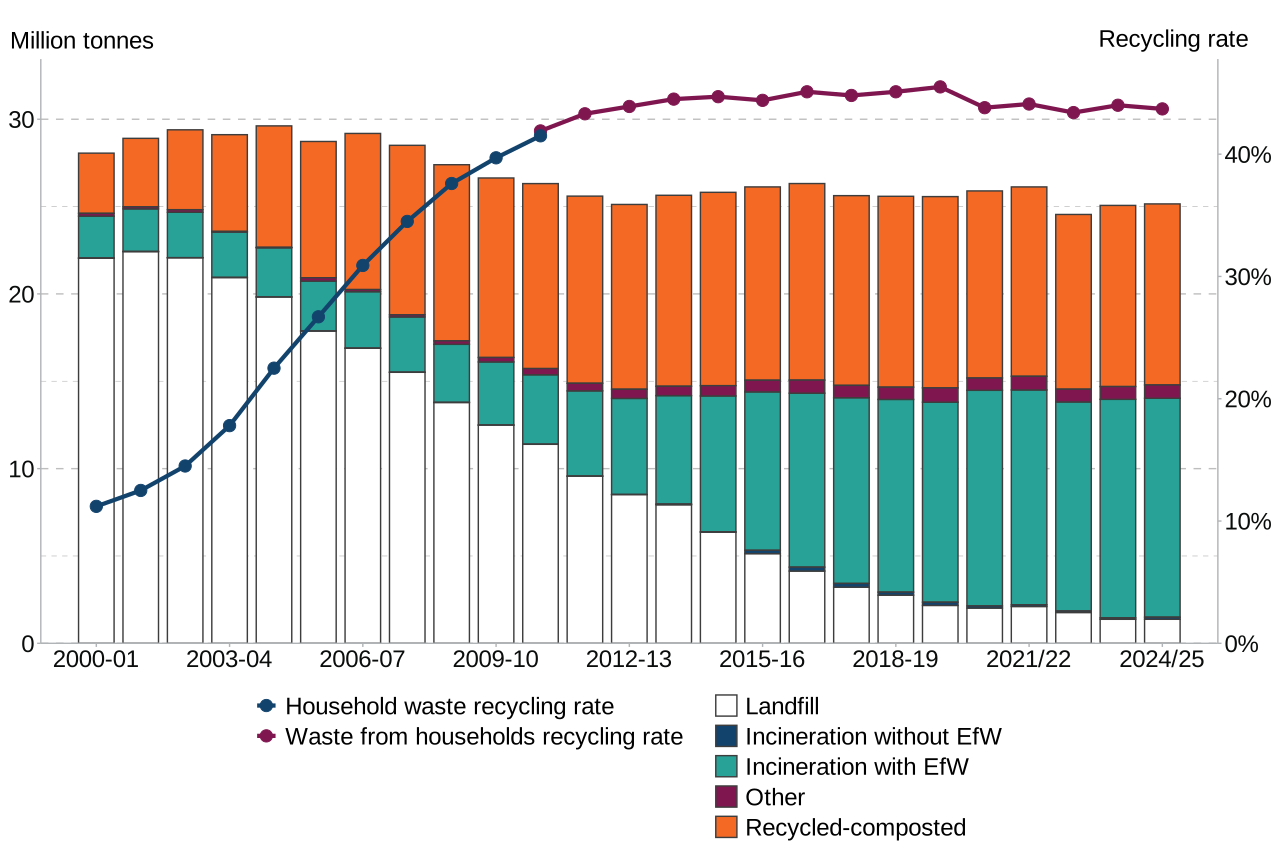
Table 4 shows the tonnage of local authority collected waste sent to landfill, incineration, or recycling for the past five years. Figure 7 shows how local authority collected waste has been managed since 2000/01.
Table 4: Management of all local authority collected waste financial year figures, England, 2020/21 to 2024/25 (thousand tonnes)
| Waste disposal method | 2020/21 | 2021/22 | 2022/23 | 2023/24 | 2024/25 | 2024/25 % change over 2023/24 |
|---|---|---|---|---|---|---|
| Landfill | 2,016 | 2,109 | 1,764 | 1,374 | 1,375 | 0.1% |
| Recycled/composted of which:- | 10,708 | 10,840 | 10,001 | 10,368 | 10,362 | -0.1% |
| — Household waste | 10,080 | 10,064 | 9,237 | 9,597 | 9,556 | -0.4% |
| — Non household waste | 627 | 776 | 764 | 771 | 806 | 4.6% |
| Total incineration of which:- | 12,466 | 12,393 | 12,051 | 12,592 | 12,653 | 0.5% |
| — Incineration with EfW | 12,342 | 12,294 | 11,963 | 12,505 | 12,532 | 0.2% |
| — Incineration without EfW1 | 124 | 99 | 88 | 87 | 121 | 40.0% |
| Other | 713 | 786 | 732 | 720 | 762 | 5.8% |
| Total local authority waste managed | 25,903 | 26,128 | 24,548 | 25,053 | 25,153 | 0.4% |
| Recycled/composted waste as percentage of total | 41.3% | 41.5% | 40.7% | 41.4% | 41.2% | -0.2 percentage points |
Source: WasteDataFlow, Defra
Notes on Table 4:
- Figures for 2023/24 have been revised.
- Incineration with energy recovery and incineration without energy recovery includes incineration bottom ash (IBA) and metals from IBA.
- Recycling figures in this table do not include metals recovered from IBA.
- Numbers may not add to exact totals. This is due to rounding.
Figure 7: Management of all local authority collected waste and recycling rates, England, 2000/01 to 2024/25
Source: WasteDataFlow, Defra
Notes on Figure 7:
- Incineration with energy recover/without energy recovery includes incinerator bottom ash (IBA) and metals from IBA. This is consistent with the existing definition for household waste recycling so is not impacted by the change in waste from households recycling definition.
- Other includes waste treated or disposed of through other unspecified methods as well as process and moisture loss.
- The Household waste recycling rate is based on a broader measure of waste and is not directly comparable to the waste from households recycling rate. For further information on definitions, refer to the glossary.
- IBA metals are included within the waste from households recycling rate shown on this chart from April 2015/16 onwards but are not included in household waste recycling.
Download the data for Figure 7
6. England and the Regions Local Authority Collected Waste Destinations (Table 5 and Figure 8)
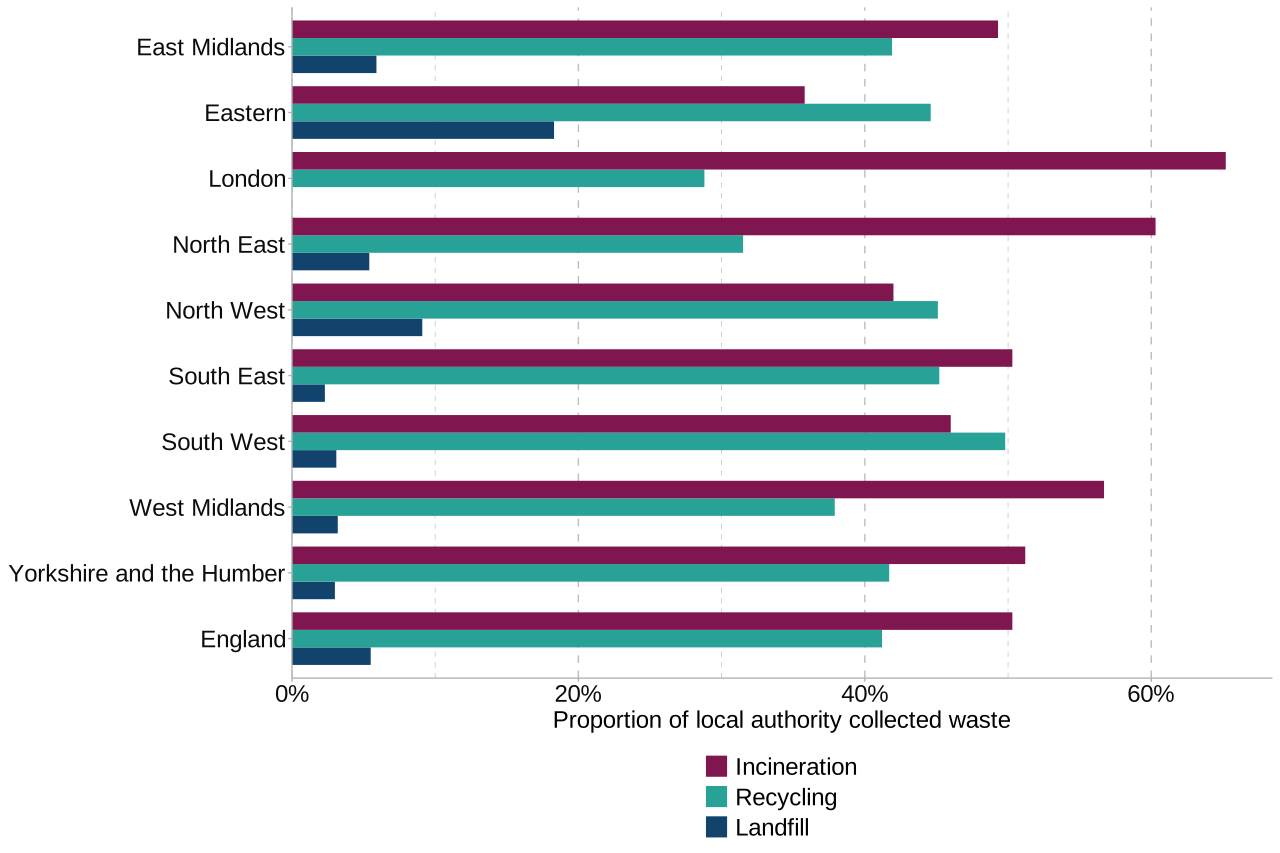
There are regional differences in the management of local authority collected waste, as shown in Table 5 and Figure 8.
Table 5: Management of all local authority collected waste, England by region, 2024/25 (thousand tonnes)
| Region | Landfill (thousand tonnes) | Landfill (% of total) | Incineration (thousand tonnes) | Incineration (% of total) | Recycled/Composted (thousand tonnes) | Recycled/Composted (% of total) | Other (thousand tonnes) | Other (% of total) | Total (thousand tonnes) |
|---|---|---|---|---|---|---|---|---|---|
| East Midlands | 134 | 5.9 | 1,129 | 49.3 | 959 | 41.9 | 68 | 3.0 | 2,290 |
| Eastern | 527 | 18.3 | 1,034 | 35.8 | 1,287 | 44.6 | 41 | 1.4 | 2,889 |
| London | 2 | 0.0 | 2,312 | 65.2 | 1,023 | 28.8 | 210 | 5.9 | 3,548 |
| North East | 68 | 5.4 | 756 | 60.3 | 395 | 31.5 | 35 | 2.8 | 1,254 |
| North West | 315 | 9.1 | 1,455 | 42.0 | 1,564 | 45.1 | 132 | 3.8 | 3,465 |
| South East | 93 | 2.3 | 2,043 | 50.3 | 1,836 | 45.2 | 88 | 2.2 | 4,060 |
| South West | 79 | 3.1 | 1,189 | 46.0 | 1,286 | 49.8 | 30 | 1.2 | 2,584 |
| West Midlands | 85 | 3.2 | 1,492 | 56.7 | 997 | 37.9 | 58 | 2.2 | 2,631 |
| Yorkshire and the Humber | 73 | 3.0 | 1,244 | 51.2 | 1,014 | 41.7 | 100 | 4.1 | 2,432 |
| England | 1,375 | 5.5 | 12,653 | 50.3 | 10,362 | 41.2 | 762 | 3.0 | 25,153 |
Source: WasteDataFlow, Defra
Notes on Table 5:
- Incineration includes incineration with energy recover and incineration without energy recovery.This includes incinerator bottom ash (IBA) and metals from IBA.
- Recycled/Composted refers to the proportion of all local authority collected waste sent for recycling or composting.
- Other includes waste treated/disposed of through other unspecified methods as well as process and moisture loss.
- Numbers may not add to exact totals. This is due to rounding.
- The South East managed the largest tonnage of local authority collected waste in 2024/25 at 4.1 million tonnes. This was 16.1% of all local authority collected waste in England. The North East managed the smallest tonnage in 2024/25 at 1.3 million tonnes, or 5.0% of the total for England.
- The Eastern region sent the largest proportion of their total local authority collected waste to landfill at 18.3% (0.5 million tonnes). London sent the smallest proportion at just 0.1%. At a national level, 5.5% of all local authority collected waste in England was sent to landfill in 2024/25.This was 1.4 million tonnes.
- London sent the largest proportion of their total local authority collected waste to incineration in 2024/25 at 65.2% (2.3 million tonnes). Eastern region sent the smallest proportion at 35.8% (1.0 million tonnes). Overall, 50.3% of all local authority collected waste in England was sent to incineration in 2024/25. This was 12.7 million tonnes.
- In England, 10.4 million tonnes (41.2%) of local authority collected waste was sent for recycling in 2024/25. The region that sent the largest proportion of local authority collected waste to recycling was the South West, which sent 1.3 million tonnes (49.8%). The region that sent the lowest proportion of waste to recycling was London, which sent 1.0 million tonnes (28.8%).
Figure 8: Management of all local authority collected waste, England by region, 2024/25 (proportions of total local authority collected waste)
Source: WasteDataFlow, Defra
Notes on Figure 8:
- Incineration includes incineration with energy recover and incineration without energy recovery. This includes incinerator bottom ash (IBA) and metals from IBA.
- Recycling refers to the proportion of all local authority collected waste sent for recycling, composting, anaerobic digestion or reuse.
Download the data for Figure 8
7. Household Waste Recycling
7.1 Household Waste Recycling Rates for England and the Regions (Figure 9)
The ‘household waste’ (ex-NI 192) measure is a broader definition of waste than the ‘waste from households’ measure. It includes street bins, street sweepings, gully-emptying, parks and grounds waste, soil, and compost-like output, as well as separately collected healthcare waste and asbestos. It does not include IBA metals.
At a regional level, there is considerable variation across authorities, influenced by how heavily populated an area is, the kind of housing present, and the level of other organic or garden waste collected. As an example, in built-up areas with a higher proportion of flats, residents may find it difficult or be unwilling to store waste for recycling; and will not be producing garden waste for collection. This will reduce recycling rates for these authorities. Similarly, authorities with higher recycling rates are likely to be advantaged by good householder response to recycling schemes and a higher tonnage of organic or garden waste being collected.
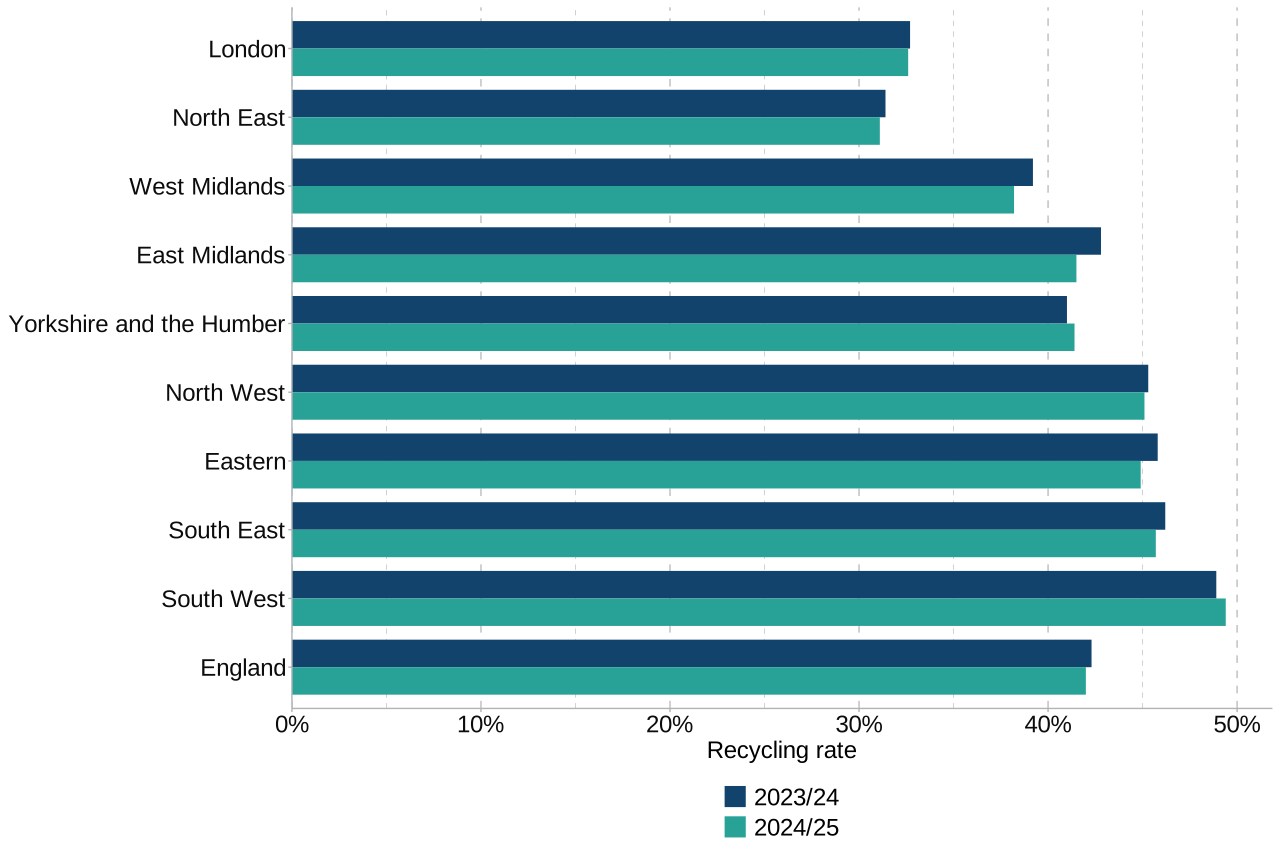
Regional differences are illustrated in Figure 9.
Figure 9: Household waste recycling rates, England and regions, 2023/24 and 2024/25
Source: WasteDataFlow, Defra
Download the data for Figure 9
- The region with the highest household waste recycling rate in 2024/25 was the South West at 49.4%. The North East had the lowest ‘household waste’ recycling rate in 2024/25 at 31.1%.
- All regions had decreases in their recycling rates, except Yorkshire and the Humber which increased by 0.4 percentage points and the South West which increased by 0.5 percentage points.
- East Midlands region had the largest recycling rate decrease of 1.3 percentage points, followed by West Midlands and Eastern 1.0 percentage point lower. South East decreased by 0.5 percentage points, the North West by 0.3, North East by 0.2 and London by 0.1.
7.2 Household Waste Recycling Rates for Individual Local Authorities (Table 6)
A dataset of recycling rates for all local authorities in England can be found in Table 3 of the local authority collected waste generation dataset.
- At an individual local authority level, household waste recycling rates ranged from 17.0% to 63.9% in 2024/25. The overall average rate for England was 42.0%, a 0.3 percentage point decrease from 2023/24.
- Household waste recycling is often similar in adjacent authorities, though there is a wide range between the highest and lowest recycling rates in all regions of England and even within a region. Figure 1 in the local authority collected waste generation dataset accompanying this statistical notice shows the geographic distribution of ‘household waste’ recycling rates in 2024/25.
- Table 6 shows the authorities with the highest and lowest recycling rates in each region as well as the proportion of their total recycling that consists of organic waste. Generally, an authority in which a smaller proportion of their total recycling is accounted for by organic waste will have a lower recycling rate, though this is not always the case.
Table 6: Local authorities with the highest and lowest household recycling rates in each region in 2024/25
| Region | Position | Authority | Recycling rate | Percent of total recycling that is organic |
|---|---|---|---|---|
| East Midlands | Lowest | Nottingham City Council | 25.3% | 33.9% |
| East Midlands | Highest | Rutland County Council | 57.4% | 47.4% |
| Eastern | Lowest | Luton Borough Council | 25.7% | 33.0% |
| Eastern | Highest | Three Rivers District Council | 61.1% | 50.8% |
| London | Lowest | Tower Hamlets LB | 17.0% | 8.4% |
| London | Highest | Bromley LB | 49.9% | 52.2% |
| North East | Lowest | Middlesbrough Borough Council | 21.5% | 43.0% |
| North East | Highest | County Durham | 36.8% | 29.3% |
| North West | Lowest | Liverpool City Council | 17.9% | 31.0% |
| North West | Highest | Stockport MBC | 59.5% | 61.8% |
| South East | Lowest | Dartford Borough Council | 23.7% | 25.1% |
| South East | Highest | Milton Keynes Council | 63.2% | 51.6% |
| South West | Lowest | Exeter City Council | 29.0% | 48.6% |
| South West | Highest | East Devon District Council | 60.1% | 56.1% |
| West Midlands | Lowest | Birmingham City Council | 20.3% | 34.3% |
| West Midlands | Highest | Stratford-on-Avon District Council | 63.9% | 64.0% |
| Yorkshire and Humber | Lowest | Kirklees MBC | 27.0% | 42.7% |
| Yorkshire and Humber | Highest | East Riding of Yorkshire Council | 61.0% | 50.5% |
Source: WasteDataFlow, Defra
- Across the different regions, the range (or difference) in recycling rate between the highest performing local authority and the lowest performing local authority varied between 15.3 and 43.5 percentage points.
- The region with the widest range in its recycling was the West Midlands at 43.6 percentage points, followed by the North West at 41.6 percentage points. South East had a range of 39.5 percentage points followed by Eastern at 35.4 and Yorkshire and Humber at 34.0 percentage points. London had a range of 32.9 percentage points followed by the East Midlands at a range of 32.1 percentage points, then South West at 31.2 percentage points. The region with the smallest range in its recycling rates is the North East at 15.3 percentage points.
- Overall, in England a total of six authorities had household waste recycling rates of 60% or more down from ten in 2023/24. Sixty-six authorities had recycling rates greater than 50%.
- Stratford-on-Avon District Council had the highest household waste recycling rate in England in 2024/25 at 63.9%. Organic waste made up 64.0% of their total household recycling tonnage, the highest for any authority in 2024/25. Milton Keynes Council had the second highest recycling rate at 63.2% and 51.6% of their recycling was organics. South Oxfordshire District Council had the third highest recycling rate in England at 61.3% with 60.3% of their recycling tonnage being organic.
- Over the last 5 years, Stratford-on-Avon District Council had an average household recycling rate of 60.0%. Other authorities with a 5 year average recycling rate of 60% or over are South Oxfordshire District Council (62.4%), Three rivers District Council 62.2%, St Albans City and District Council (61.2%), Vale of the White Horse District Council (61.0%), East riding of Yorkshire Council and East Devon Councils both at 60.1%.
- Tower Hamlets had the lowest overall household waste recycling rate of 17.0% and the lowest proportion of organic/green waste at 8.4%.
- The second lowest household waste recycling rate was Liverpool City Council (17.9%, 31.0% organic), and the third lowest was Birmingham City Council (20.3%, 34.3% organic).
7.3 Household Waste Recycling Rates Local authority performance by region (Tables 7 and 8)
Figure 2 in the local authority collected waste generation dataset accompanying this statistical notice shows the geographic distribution of changes in the recycling rates in 2024/25.
Table 7 shows the number and proportion of authorities in each region showing an overall increase in their recycling rate for 2024/25 compared to 2023/24.
- In total 98 (31%) of 321 local authorities showed an increase in their recycling rate in 2024/25. 223 authorities (69%) showed a decrease.
- All regions had a greater number of decreases in their recycling rates than increases, except for the London where 57% of authorities had an increase in their recycling rate and Yorkshire and Humber where 53% of authorities had an increase.
- The highest proportion of authorities with decreases were in the East Midlands where 85% of authorities had decreases in their recycling rate followed by Eastern at 83% North West at 79%, the West Midlands at 73%, South East at 69%, North East 67%, West Midlands 73% South East 69% and the South West at 59%.
Table 7: Recycling rates- Number of local authorities in each region with an increase in 2024/25 shown by percentage point range
| Region | Total number of authorities in region | Number of authorities with a percentage point increase of 0 to 1 | Number of authorities with a percentage point increase of 1 to 5 | Number of authorities with a percentage point increase of over 5 | Total authorities with an increase | Percentage of authorities with an increase in their recycling rate |
|---|---|---|---|---|---|---|
| East Midlands | 39 | 3 | 3 | 0 | 6 | 15% |
| Eastern | 48 | 4 | 4 | 0 | 8 | 17% |
| London | 37 | 10 | 10 | 1 | 21 | 57% |
| North East | 12 | 3 | 1 | 0 | 4 | 33% |
| North West | 38 | 6 | 2 | 0 | 8 | 21% |
| South East | 70 | 14 | 8 | 0 | 22 | 31% |
| South West | 29 | 6 | 5 | 1 | 12 | 41% |
| West Midlands | 33 | 4 | 5 | 0 | 9 | 27% |
| Yorkshire and Humber | 15 | 4 | 4 | 0 | 8 | 53% |
| Total | 321 | 54 | 42 | 2 | 98 | 31% |
Source: WasteDataFlow, Defra
Table 7 shows that in England in 2024/25, 2 authorities had an increase of over 5 percentage points in their recycling rate, 42 (13%) increased by between 1 and 5 percentage points and that 54 (17%) authorities had an increase in their recycling rate of less than 1 percentage point.
- The authorities with an increase of over 5 percentage points in their recycling rate were Cornwall (South West region) which had a 7.4 percentage point increase to give a recycling rate of 45.1%, and Wandsworth LB (London, 5.1% increase to 27.9%).
- London had 10 authorities (27% of authorities in that region) with an increase of between 1 and 5 percentage points in their recycling rate. This was the most in any region. This was followed by the South East with 8 authorities (11%), South West 5 (17%) and West Midlands with 5 authorities (15%).
- The South East had the most (14) authorities with an increase of up to 1 percentage points (20% of authorities in that region), followed by London with 10 authorities (27%), North West with 6 authorities (16%).
Table 8 shows the number and proportion of authorities in each region showing an overall decrease in their recycling rate for 2024/25 compared to 2023/24.
Table 8: Recycling rates - Number of local authorities in each region with a decrease in 2024/25 shown by percentage point range
| Region | Total number of authorities in region | Number of authorities with a percentage point decrease of 0 to 1 | Number of authorities with a percentage point decrease of 1 to 5 | Number of authorities with a percentage point decrease of over 5 | Total authorities with a decrease | Percentage of authorities with a decrease in their recycling rate |
|---|---|---|---|---|---|---|
| East Midlands | 39 | 3 | 28 | 2 | 33 | 85% |
| Eastern | 48 | 21 | 18 | 1 | 40 | 83% |
| London | 37 | 9 | 7 | 0 | 16 | 43% |
| North East | 12 | 5 | 3 | 0 | 8 | 67% |
| North West | 38 | 9 | 21 | 0 | 30 | 79% |
| South East | 70 | 32 | 15 | 1 | 48 | 69% |
| South West | 29 | 13 | 4 | 0 | 17 | 59% |
| West Midlands | 33 | 9 | 14 | 1 | 24 | 73% |
| Yorkshire and Humber | 15 | 6 | 1 | 0 | 7 | 47% |
| Total | 321 | 107 | 111 | 5 | 223 | 69% |
Source: WasteDataFlow, Defra
Table 8 shows that in England in 2024/25, 5 authorities (2% of the total) had a decrease of over 5 percentage points in their recycling rate, 111 (35%) decreased by between 1 and 5 percentage points and 107 (33%) authorities had a decrease in their recycling rate of less than 1 percentage point.
- There were 5 local authorities with decreases in their recycling rate of over 5 percentage points. East Midlands had 2 authorities in this group, while Eastern, South East and West Midlands each had 1 authority in this group.
- The 5 authorities with the largest decreases were Huntingdonshire District Council (Eastern) with a decrease of 8.0 percentage points to give a recycling rate of 46.0%, Chesterfield Borough Council (East Midlands) 6.8 percentage points lower to give a recycling rate of 35.4%, North Warwickshire Borough Council (West Midlands) 5.9 lower at 41.9%, Maidstone Borough Council (South East) 5.7 lower at 43.9% and Erewash Borough Council (East Midlands) 5.6 lower at 35.7%.
- There were 111 authorities with a decrease of between 1 and 5 percentage points. The regions with the most authorities in this group were East Midlands with 28 authorities (72% of authorities in that region), North West region had 21 authorities (55%), Eastern with 18 authorities (38%), and the South East region had 15 authorities (21%).
- There were 107 authorities with a decrease of up to 1 percentage points. The regions with the most authorities in this group were the South East region with 32 authorities (46%) and Eastern with 21 authorities (44%).
8. Data and Methodology
Including information on data uses, feedback, revisions policy, methodology, glossary of terms and measures, and references. There is an accompanying methodology document for this release.
8.1 Data Uses
Data on waste management is used to monitor policy effectiveness and to support policy development. The underlying data held in WasteDataFlow is also used extensively by local and central government, the waste industry, and the public. Data is reported by all local authorities, often from management information supplied by their waste management contractor.
Factors affecting household waste recycling range from individual household behaviours, the advice and collection services provided by local authorities, the cost of waste treatment and disposal, and to some extent, wider issues such as the state of the economy during the COVID-19 pandemic. Some quarterly waste data shows a clear seasonal fluctuation. For example, the generation of garden waste is highly seasonal, increasing sharply and pushing up recycling rates in the spring and summer months. For this reason, comparisons should be made with the same quarter in previous years or using full 12-month periods. However, it should be remembered that in 2020/21 changes between years are obscured by the effects COVID-19, particularly in the period from April to September.
Prior to 2020/21 about 87% of all waste managed by local authorities is waste from households with the remainder coming from street cleaning, parks and grounds, business and construction. During 2020/21 this proportion rose to 90%. Since 2021/22 this proportion has remained at 88%. Only a small proportion of the total waste from businesses and construction are covered in these statistics, with most being managed privately.
8.2 Feedback
We welcome feedback on the data from all users, including how and why the data is used. This helps us to understand the value of the statistics to external users. Please take a minute to complete this short user feedback survey (this opens in google forms). Alternatively you can email the Waste Statistics team at WasteStatistics@defra.gov.uk
8.3 Revisions Policy
Defra will provide information about any significant revisions made to information published in this statistics release and the associated datasets. Revisions could occur for a variety of reasons, including backdating to reflect methodological improvements or the finalisation of data from third parties that was unavailable or provisional at the time of publishing. Occasionally, local authorities request revisions after this point where it is generally not possible to take the changes into account without risking the delay of publication. These typically do not have a significant impact on the headline figures, particularly at an England level.
The figures in this statistical release were extracted in February 2026 from data reported by local authorities during 2024 and 2025.
8.4 Revisions to 2023/24 figures in these statistics and accompanying datasets
Final data for Bristol City Council has now been included within these aggregated figures and for 2023/24 in accompanying datasets. The inclusion of these figures has resulted in small revisions to 2023/24 for waste from households figures and all local authority collected waste shown in these statistics. See tables 9 and 10 below.
There were minor revisions to Sheffield City Council data. These do not impact overall waste collection or waste disposal figures – see Table 11 below.
Additionally there was an error in Table 2 of these statistics last year where incorrect figures for non-household recycling were presented. See table 10 below.
The actual levels of revisions to waste from Households and total local authority waste are shown in Tables 9 and 10 below.
Table 9: Revisions to Waste from Households (Table 1) 2023 figures, (thousand tonnes)
| Waste type | 2023 |
|---|---|
| Total Recycling of which: | 1.4 |
| Dry recycling of which: | 1.9 |
| IBA Metal | -0.2 |
| Separately collected food waste | 0.4 |
| Other organics recycling | 0.2 |
| Total Residual | 0.5 |
| Total waste from households | 1.1 |
| Waste from households recycling rate (including IBA metal) | 0.0% |
| Waste from households recycling rate (excluding IBA metal) | 0.0% |
Table 10: Revisions to Management of al local authority collected waste (Table 4), (thousand tonnes)
| Waste disposal method | 2020/21 | 2021/22 | 2022/23 | 2023/24 |
|---|---|---|---|---|
| Landfill | 0 | 0 | 0 | 0 |
| Recycling/composed of which: | 0 | 0 | 0 | 2 |
| Household waste | 0 | 8 | 0 | 3 |
| Non household waste | 0 | -8 | 32 | 37 |
| Total incineration of which: | 0 | 0 | 0 | 11 |
| Incineration with EfW | 0 | 0 | 0 | 9 |
| Incineration without EfW | 0 | 0 | 0 | 1 |
| Other | 0 | 0 | 0 | -14 |
| Total local authority waste managed | 0 | 0 | 0 | -2 |
| Recycled/composted waste as percentage of total | 0.0% | 0.0% | 0.0% | 0.0% |
There are some revisions to the dry recycling breakdown by material types shown in these statistics (Tables 3 and 4) resulting from changes to Bristol City Council data and corrections to Sheffield City Council data for 2023/24. These revisions are shown in Table 11 below.
Table 11: Revision to Waste from Households dry recyclate (Tables 3 and 4) (thousand tonnes)
| Material | 2023 (thousand tonnes) |
|---|---|
| Glass | 2 |
| Paper and card | 0 |
| Textiles | 0 |
| Plastic | -3 |
| WEEE & other scrap metals | 0 |
| IBA metal | 0 |
| Metals | 0 |
| Other materials | 2 |
| Total | 2 |
8.5 COVID-19 - The impact of the pandemic on 2020/21 and 2021/22
The 12 months from April 2020 to March 2021, were greatly affected by the COVID-19 pandemic. There were 2 national lockdowns and various levels of COVID-19 restrictions on working practices and individuals.
During the first national lockdown which commenced 23rd March 2020, some local authorities were unable to maintain collections of dry recyclates, there was suspension of garden waste collections and widespread closure of HWRC. This was due to staff shortages and the introduction of changes to working practices.
The national lockdown and rules for the operation of some commercial enterprises had a significant impact on the generation of waste during this period.
The period from April to June 2020 saw the biggest impact to waste collections and commercial waste as local authorities and businesses acclimatised to and became used to working under national lockdown and COVID-19 pandemic conditions. Over the course of 2021/22 waste generation by household sources reduced from the high tonnages seen in 2020/21 but remained above the pre pandemic levels.
Refer to the publications for 2020/21 and 2021/22 for further detail and analysis.
8.6 Methodology
Data from this release comes from a snapshot of the WasteDataFlow database taken in February 2026. WasteDataFlow is a UK-wide system managed by Defra in collaboration with Devolved Administration partners that is used to record the collection, treatment and disposal of local authority waste. First results using this database were produced for 2004/05 with earlier estimates of waste available from the Municipal Waste Management Surveys.
The tonnage of waste ‘sent for reuse, recycling and composting’ is that which is accepted by the re-processor. As such, it excludes any recycling rejects that occur during collection, sorting or further treatment. Waste diverted for recycling from the residual (or ‘black bag waste’) stream by further processing is included in the recycling tonnages.
8.7 Inclusion of Incinerator Bottom Ash Metal (IBA Metal) in waste from households Recycling
In December 2017, a change in how metal recovered and recycled after incineration of waste (IBA metal) is treated and reported for the waste from households dataset only was introduced. The tonnage of IBA metal is now included within recycling rather than being reported as ‘recovery’. The amount varies depending on the amount of residual waste being incinerated and the metal content of the residual waste.
Inclusion of IBA metal has been facilitated through the new question 100 (Q100) reporting structure for waste treatment, which all local authorities have been using since April 2015 (see below). This has provided the opportunity for more complete recording of waste treatment, including outputs from incineration. Therefore, estimates were produced for 2015, but it was not possible to backdate figures in a consistent manner prior to 2015 due to changes in the question structure and reporting that were introduced from April 2015 through Q100.
The majority of local authorities are reporting this information as fully as they are able to. This methodological change for IBA metal has been applied to the waste from households measure only. It has been applied to data from April 2015—it is not possible to apply the change to data before then as the question structure used to report waste treatment was different and, therefore, the reporting of IBA metal was not as consistent or as complete. At an overall England level, this change in methodology raised the recycling rate for 2016 by 0.7 percentage points (equivalent to 143 thousand tonnes). For 2015, the waste from households recycling rate was increased by 0.4 percentage points (equivalent to 97 thousand tonnes). This is a slight underestimate for the impact on 2015 as data for January to March 2015 was collected using the old question structure and, as such, did not fully-capture IBA metal for this quarter; estimated to be around 23 thousand tonnes. Overall, this change in methodology results in ‘waste from household’ recycling rates being slightly higher than where IBA metal would previously have been reported as ‘recovery’.
There are no such methodological changes to the dataset for all local authority waste or household waste recycling. There are no changes to the household (NI 192) household recycling figures that are reported for England, nor at a regional and individual local authority level where existing methodology and definitions have been retained.
8.8 Question Structure for Treatment and Disposal Questions (Q100)
“Question 100” (Q100) was introduced on a voluntary basis from April 2014, and used by all local authorities in England from April 2015.This question replaced a number of treatment questions.
Q100 provides a more flexible structure that has enabled local authorities to report a more complete and transparent representation of the more complex waste treatment practices that occur, which could not be accurately captured under the old question structure. It also provides the opportunity for local authorities to report, in more detail, the further treatment and disposal of certain waste types such as refuse-derived fuel (RDF), which would have previously been a final output. This is highly specific to the local authority and the facilities and practices used for treatment and disposal.
8.9 Data Quality Assurance
All local authorities provide data into WasteDataFlow. Several stages of data validation are carried out by the local authority submitting the data, the WasteDataFlow contractor and Defra.
The WasteDataFlow contractors check each return for completeness and data consistency against key standardised validation checks. Data is checked against appropriate threshold values specified, which take into account the expected level of variance. There is an online validation process that compares the data for the current quarter against the data for the equivalent quarter in the previous year. For 2020/21 validation check thresholds were adjusted to take account of the COVID-19 pandemic, this was to try and reduce the number of queries raised with local authorities, so that they were not overwhelmed by validation queries as tonnages of different waste streams changed dramatically due to suspended waste collections, increased waste arisings at the kerbside, and large reductions in C&I waste streams.
Once the data has been validated by the contractor, further validation checks are carried out by Defra, who may also refer some to the Environment Agency on any specific data queries raised, particularly related to the appropriate recording of treatment and facility sites. The Defra checks include trend and outlier analysis on key measures at an aggregate and individual local authority level. Details of the validation process carried out by the contractor are available on the WasteDataFlow website.
The introduction of Q100 provided scope for local authorities to report more fully on the treatment and final destination of waste. This is particularly the case for incineration of waste and subsequent outputs and their final treatment and disposal. Gathering such information can be challenging, especially where waste goes through multiple different sorting and treatment processes at different facilities. In most cases, local authorities are able to supply this information, but in some cases full final destination treatment is not given or is stated as ‘unknown’. This may have a small impact on the final figures. Defra will continue to monitor this and work with local authorities to enhance data quality assurance, consistency, and completeness of reporting.
8.10 England recycling ambition
The Waste (Circular Economy) (Amendment) Regulations 2020 require Waste Management Plans to include measures to be taken to ensure that the preparing for reuse and the recycling of municipal waste is a minimum of 65% by weight by 2035 and to ensure the amount of municipal waste landfilled is reduced to 10% or less of the total amount of municipal waste generated (by weight) by 2035.
9. Glossary of Terms and Measures
Waste from households
The waste from households measure was introduced to statistical publications by Defra in May 2014. It is used to construct a harmonised UK indicator for reporting recycling rates at a UK level on a calendar year basis, providing comparable calculations across each of the four UK countries. ‘Waste from households’ is a narrower version of the ‘household waste’ measure that was used previously. The difference is that waste from households excludes local authority collected waste types not considered to have come directly from households, such as street bins, street sweepings, parks and grounds waste, and compost-like output (CLO) from Mechanical Biological Treatment (MBT) plants. As explained above under ‘Methodology’ and ‘Data Notes and Development’, we have introduced a change to the ‘waste from households’ recycling calculation to now include metal recovered after incineration (IBA metal). Further information on the calculations and differences between measures has been published on the GOV.UK website and is summarised in table 12.
Table 12: Information on calculation and differences between recycling measures
| Waste stream | Waste from households recycling | Household waste recycling |
|---|---|---|
| Recycling (including composting and reuse): | ||
| from households and other premises similar to households, CA sites, Bring banks | Y | Y |
| from street bins | N | Y |
| from household-related parks and grounds | Community skips only | Y |
| from soil | N | Y |
| from rubble and plasterboard | N | N |
| from compost-like output from MBT plant | N | Y |
| from incineration bottom ash (IBA) | N | N |
| from metal recovered and recycled from incinerator bottom ash | Y [note 1] | N |
| other, from residual streams | Y | Y |
| recycling rejects | N | N |
| Residual waste: | ||
| from regular household collection | Y | Y |
| from civic amenity sites | Y | Y |
| from bulky waste | Y | Y |
| from other household waste | Y | Y |
| from street cleaning/sweeping | N | Y |
| from gully emptying | N | Y |
| from separately collected healthcare waste | N | Y |
| from asbestos waste | N | Y |
Notes on Table 1:
- Revised in 2017 to include IBA metal and applied to data from April 2015 onwards.
We have continued to report the household waste recycling measure in our annual publication on a financial year basis to maintain continuity with the existing data series and in order to meet the wider needs of users. However it is no longer reported in the quarterly releases on recycling, which will report the ‘waste from households’ measure only. Full data on household waste is available and can be downloaded on the gov.uk website.
The local authority recycling rate is based on the NI 192 National Indicator recycling calculation. The National Indicator calculation has been widely used by local authorities for many years for local strategic planning purposes, discussions with contractors and for benchmarking against other authorities and captures a broader scope of household waste than ‘waste from households’, e.g. it includes street sweepings and compost like output. This calculation will be made available as the NI 192 report on the WasteDataFlow portal and also on GOV.UK website. This is reported on a financial year basis to meet the needs of local authorities.
10. Recycling rates across the UK
As detailed above the waste from households recycling rate provides a consistent measure across England, Wales, Scotland and Northern Ireland and allows reporting at UK level. However it should be noted that other National measures for Household recycling or recycling of all local authority collected waste differ across the devolved administrations. A recycling explainer document detailing these differences is available.
11. Useful links
Scottish Government Statistics
Northern Ireland Department of Agriculture, Environment and Rural Affairs Statistics
12. What you need to know about this release
12.1 Contact details
Responsible statisticians: Alex Clothier
Email: WasteStatistics@defra.gov.uk
Media enquiries: 0330 041 6560 (Defra Press Office)
12.2 Accredited official statistics publication
Accredited official statistics are called National Statistics in the Statistics and Registration Service Act 2007. An explanation can be found on the Office for Statistics Regulation website.
Our statistical practice is regulated by the Office for Statistics Regulation (OSR). OSR sets the standards of trustworthiness, quality and value in the Code of Practice for Statistics that all producers of official statistics should adhere to.
These accredited official statistics were independently reviewed by the Office for Statistics Regulation in October 2020. They comply with the standards of trustworthiness, quality and value in the Code of Practice for Statistics and should be labelled ’accredited official statistics.
You are welcome to contact us directly with any comments about how we meet these standards using the contact details above. Alternatively, you can contact OSR by emailing regulation@statistics.gov.uk or via the OSR website.
Since the latest review by the Office for Statistics Regulation, we have continued to comply with the Code of Practice for Statistics, and have made the following improvements:
- Publication of a recycling explainer document, giving background to recycling, the different local authority measures published and how they compare across the UK.
- Improvements have been made to the layout of the waste statistics landing pages.
- User feedback on academic use of these statistics has been sought from Defra Waste & recycling working group.
- Feedback on this statistical notice and datasets is being gathered by a linked Google Forms questionnaire.
- Publication of Official Statistics in Development on the carbon impact of ‘waste from households’ managed by local authorities in England.
Work on remaining points made by the OSR will continue in 2026.