HMPPS Offender Equalities Annual Report 2025-26
Published 26 November 2026
Applies to England and Wales

© Crown copyright 2026
This publication is licensed under the terms of the Open Government Licence v3.0 except where otherwise stated. To view this licence, visit nationalarchives.gov.uk/doc/open-government-licence/version/3 or write to the Information Policy Team, The National Archives, Kew, London TW9 4DU, or email: psi@nationalarchives.gov.uk.
Where we have identified any third party copyright information you will need to obtain permission from the copyright holders concerned.
This publication is available at https://www.gov.uk/government/statistics/hmpps-offender-equalities-annual-report-2025-to-2026/hmpps-offender-equalities-annual-report-2025-26
HMPPS Offender Equalities Annual Report 2025-26
Main Points
Of those prisoners who declared a sexual orientation between January and March 2026, 97% (71,287) stated that they were Heterosexual. This is broadly comparable with trends reported over the past 13 years.
There were 348 transgender prisoners on 31 March 2026 and ten additional prisoners were known to have a Gender Recognition Certificate (GRC). This was an increase on the figure of 339 recorded in 2025. The number of prisoners with a GRC increased from 9 on 31 March 2025.
There was a drop in Mother and Baby Unit applications this year. 43 applications were made in the 12 months ending March 2026, a 44% drop in applications on the previous year (77 applications were made in 2024/25).
There was an increase in the number of self-declared pregnant prisoners. There were 218 self-declared pregnant prisoners during the 12 months ending March 2026, an 11% increase on the year before when there were 196.
A higher proportion of Male prisoners had an Enhanced (initial or extended) status compared with Female prisoners. Compared with 42% of Female prisoners, 50% of Male prisoners had an Enhanced (initial or extended) status.
As age increased, the proportion of prisoners with a Basic status decreased. The proportion of those with a Basic status decreased from 16% of those aged 18-20 years down to 1% of those aged 60+ years.
Accredited Programme starts were most likely to come from prisoners who were Male (97%), prisoners aged 30-39 years (36%), and prisoners from a White (including White ethnic minorities) ethnic background (76%). The wider prison population was 96% Male, 33% aged 30-39 years and 72% White (where ethnicity was recorded). Other groups who were most likely to start or complete Accredited Programmes were prisoners who reported a Christian religion or belief, prisoners who self-reported as Single or Not Married/in a Civil Partnership, and prisoners who reported as Heterosexual.
Introduction
His Majesty’s Prison and Probation Service (HMPPS) is an executive agency of the Ministry of Justice; with the goal of helping prison and probation services work together to manage offenders through their sentences. HMPPS replaced the National Offender Management Service (NOMS) on 1 April 2017.
The HMPPS Offender Equalities Annual Report 2025-26 contains the latest information on progress and achievements pertaining to equalities objectives, as stated in the Equality Act 2010.
The Equality Act 2010 lists nine protected characteristics:
-
Age
-
Disability
-
Gender reassignment
-
Marriage and Civil partnership
-
Pregnancy and maternity
-
Race
-
Religion or Belief
-
Sex
-
Sexual orientation
This report focuses on those protected characteristics where data are collected and are of sufficient quality for statistics to be meaningful. In general, this report is limited to analysis on age, gender reassignment, pregnancy and maternity, race (ethnicity), religion or belief, sex, and sexual orientation for these reasons. Where data are available for other protected characteristics at sufficient quality and with sufficient coverage to be meaningful, they are also presented and considered.
Data presented in this report have been drawn from administrative IT systems and data collections. Although care is taken when processing and analysing the data, the level of detail collected is subject to the inaccuracies inherent in any large-scale recording system.
Products published as part of the HMPPS Offender Equalities Annual Report 2025-26
The following products are published as part of this release:
-
A statistical bulletin, containing commentary on key trends in protected characteristic data.
-
A technical guide, providing further information on how the data are collected and processed; alongside relevant legislative or operational information relating to the topic area.
-
A set of tables for each chapter, providing national trends over time.
All products, including previous editions, can be found at the following link:
Further prison and probation equalities data is routinely published in four other statistical releases:
-
Offender Management Statistics Quarterly
-
Safety in Custody Statistics Bulletin
-
Deaths of Offenders in the Community
-
Proven Reoffending Statistics
Each source includes written commentary and data tables relating to various protected characteristics. A summary of what is covered can be found in the Appendix at the end of this report, with fuller details in the accompanying Technical Guide.
This bulletin presents statistics on a range of aspects of the prison system and population. It includes comparisons across groups with different protected characteristics and aims to support an understanding of these areas from an equalities perspective. It includes chapters covering sexual orientation of the prison population, transgender prisoners, mother and baby units, pregnant prisoners, incentives, accredited programmes and non-accredited prisoner education.
Each chapter focuses on a distinct topic and provides the relevant context for interpreting the statistics presented. Readers should therefore consider trends and changes within each chapter, alongside the associated definitions, data-quality information and methodological notes.
Changes to the publication
Prison Education and Accredited Programmes statistics for 2025-26, previously published as a standalone publication, are now included in this report. During the reporting year, changes to contractual arrangements for prison education meant that a consistent figure would not be possible for the whole prison estate. The statistics are therefore presented for comparable groups of prisons and time periods, reflecting when the changes were introduced. Statistics on mother and baby units, pregnant prisoners and prisoner incentives, previously published in the HMPPS Annual Digest without equalities breakdowns, are also now included with equalities information. Prison population by sexual orientation and transgender prison population chapters are now presented as tables only.
1. Prison Population
Data tables for the sexual orientation of prisoners can be found on the HMPPS Offender Equalities 2025-26 webpage.
2. Transgender prisoners
Data tables for transgender prisoners can be found on the HMPPS Offender Equalities 2025-26 webpage.
3. Mother and Baby Units and Pregnant Prisoners
A Mother and Baby Unit (MBU) is a discrete specialist accommodation unit within a women’s prison which enables mothers, where appropriate, to have their children with them. Women who are pregnant or who have children up to and around the age of 18 months can apply for a place in an MBU. Details of the process are given in the Technical Guide accompanying this publication.
This report provides details of the number of women and their protected characteristics making applications to MBUs and the outcome of the application including approvals and refusals. However, some proportions and totals of MBU board recommendations, in the religion breakdown, cannot be shown due to the risk of disclosure of personal information.
There are six MBUs in operation across the women’s estate in England (there are no women’s prisons in Wales). These provide an overall total capacity of 64 places for mothers and 70 places for babies to allow for twins and multiple births.
It should be noted that:
-
Multiple applications can be submitted by one woman.
-
Not all applications will receive a decision, as the application may not proceed for a number of reasons (e.g. a woman may withdraw her application or leave custody).
-
An application may be refused for several reasons, for example safeguarding risks, offending history, offence, behaviour or concerns from Children’s Services.
-
MBU board decisions on applications may not be made in the same reporting year as the application was received.
-
An approval to an MBU does not mean that a mother and baby/babies will be received into an MBU, as alternative arrangements could be made for care after the application is submitted.
-
Every effort is made to ensure admissions processes are administered in a timely fashion to ensure any anxiety is reduced for applicants, however, unavoidable delays might arise in some cases. For example, where an assessment is being carried out by Children’s Services.
-
All MBU board recommendations are based on evidence of what is in the best interests of the baby/babies in each case, in consultation with the relevant professionals and partner agencies.
The pregnancy data represents women who have self-declared as pregnant and consent to sharing this information, having been made aware why their personal data is being monitored and how it will be used. HMPPS publish these data anonymously as part of aggregate totals, preventing identification of individuals and infringement of the GDPR and Data Protection Act 2018. It does not represent women who have reserved their right not to disclose this personal data to HMPPS, or who might have disclosed this data to healthcare providers in confidence. Self-declared data cannot be quality assured, and therefore accuracy cannot be guaranteed.
There was a drop in Mother and Baby Unit applications this year.
43 applications were made in the 12 months ending March 2026, a 44% drop in applications on the previous year (77 applications were made in 2024/25).
More than half of all applications to MBUs came from women who were aged 18 to 30 years.
Women who were aged 18 to 30 years made 24 applications to MBUs (56% of the total). Women who were aged over 30 made 19 applications (44%).
There were 30 applications (70% of the total) from women from a White (inc. White ethnic minorities) ethnic background. Women from an Ethnic Minority (excluding White ethnic minorities) background made 13 applications (30%). White women make up 83% of the female prison population where ethnicity was recorded[footnote 1].
There were 23 applications (53% of the total) from women reporting a Christian religion or belief. Women who reported no religion or belief made 17 applications (40%) and those reporting another religion or belief made 3 applications (7%). Where recorded, Christian women made up 51% of the female prison population, while 32% reported no faith or belief and 16% reported another religion or faith[footnote 2].
There was an increase in the number of self-declared pregnant prisoners
There were 218 self-declared pregnant prisoners during the 12 months ending March 2026, an 11% increase on the year before when there were 196.
There were 32 births to self-declared pregnant women. All of these happened in hospital.
55% (119) of self-declared pregnant women were aged over 30. 45% (99) were aged 18 to 30 years.
81% (177) of self-declared pregnant women were of White ethnicity, 17% (38) were of an ethnic minority and the remaining 1% (3) were of unknown ethnicity. White women make up 83% of the female prison population where ethnicity was recorded[footnote 3].
The largest proportion (45%) of self-declared pregnant women reported they didn’t follow a religion, closely followed by 43% following the Christian faith, 11% following another religious group. Where recorded, Christian women made up 52% of the female prison population, while 33% reported no faith or belief and 16% reported another religion or faith[footnote 4].
4. Incentives
An incentives scheme (formerly known as Incentives and Earned Privileges - IEP) was introduced in 1995 with the expectation that prisoners would earn additional privileges through demonstrating responsible behaviour and participation in work or other constructive activity. The scheme allows prisoners to earn privileges through good behaviour and engagement in the regime and rehabilitation. Privileges can also be lost through poor behaviour.
The IEP scheme was replaced by the Incentives Policy Framework, which went fully live in January 2020. The current policy has a greater focus on incentivising positive behaviour, providing consistency in key areas. It gives governors greater flexibility to tailor incentives to the local needs and challenges in their prison and to create incentive levels above Enhanced.
There have been five incentive levels overall: Entry, Basic, Standard, Enhanced (initial) and Enhanced (extended) - although these have changed over time as levels have been added and phased out. Entry was introduced in 2013 and abolished in August 2019 while Enhanced (extended) began being measured from 2022.
Prisoners typically start on Standard level, and positive behaviour can be rewarded with progression through incentive levels but can also be lost by moving down an incentive level(s) for poor behaviour with the associated increase or reduction in privileges.
Sex
-
A lower proportion of Female prisoners had an Enhanced (initial) status (42%), compared with Male prisoners (50%).
-
Similarly, 3% of Female prisoners had a Basic status, compared with 7% of Male prisoners.
Age
-
The proportion of prisoners with a Basic or Standard status broadly decreased with age (except for 15-17 year olds). Only 1% of prisoners aged 60+ had a Basic status, compared with 16% of 18-20 year olds. Similarly, 27% of prisoners aged 60+ had a Standard status, compared with 61% of 18-20 year olds.
-
In contrast, the proportion of prisoners with an Enhanced (initial) status broadly increased with age (except for 15-17 year olds). There were 71% of prisoners aged 60+ with an Enhanced (initial) status, compared with 22% of 18-20 year olds.
Ethnicity
-
A lower proportion of prisoners from the ‘other ethnic group’ (41%), mixed ethnic group (44%), and Black or Black British (44%) ethnicity groups had an Enhanced (initial) status compared with White (inc. White ethnic minorities) (51%) and Asian (50%) prisoners.
-
In contrast, a higher proportion of prisoners from the Black or Black British (10%) and Mixed (9%) ethnicity groups had a Basic status compared with White (inc. White ethnic minorities) prisoners (6%), Asian prisoners (7%) and prisoners from the ‘other ethnicity’ group (7%).
Religion or Belief
-
Prisoners who reported their religion or belief as Buddhist had the highest proportion with an Enhanced (initial) status (68%), in contrast with those reporting their religion or belief as Muslim, who had the lowest proportion (44%). For context, Buddhists make up 1% of the overall prison population and Muslims make up 8%[footnote 5].
-
Prisoners who reported their religion or belief as Jewish had the highest proportion of prisoners with a Basic status (11%), followed by those who reported their religion or belief as Muslim (9%) and Christian (6%). For context, Jewish prisoners make up less than 0.5% of the overall prison population, Muslims 8% and Christians 51%.
-
Prisoners who reported their religion or belief as Hindu (3%), Buddhist (3%) or Sikh (5%) had the lowest proportions of prisoners with a Basic status. Hindus make up less than 0.5% of the overall prison population, Buddhists 1% and Sikhs less than 0.5%.
Sexual Orientation
-
Prisoners who reported their sexual orientation as Heterosexual were most likely to have a Basic status (7%), compared with prisoners who reported their sexual orientation as Gay/Lesbian (3%), Bisexual (4%) or ‘other sexual orientation’ (3%).
-
Similarly, prisoners who reported their sexual orientation as Heterosexual were least likely to have an Enhanced status (49%), compared with prisoners who reported their sexual orientation as Gay/Lesbian (63%), Bisexual (58%) or ‘other sexuality’ (66%).
5. Accredited Programmes for Offenders in Custody
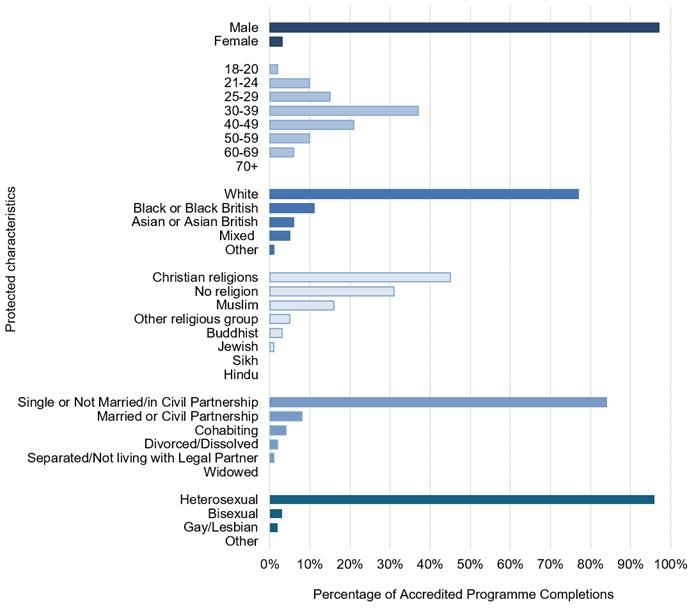
Of all accredited programme starts and completions in the year ending March 2026, 97% were Male and 3% were Female offenders[^7][^8] These proportions for starts and completions were the same as for the previous three reporting years. By comparison, males made up 96% of the prison population and females 4%, indicating that the overall profile of accredited programme starts was similar to that of the prison population.
The 30 to 39 age group accounted for the highest proportion of both starts and completions, accounting for 36% and 37% respectively Offenders aged under 25 made up 13% of programme starts and 11% of completions. Six per cent of both starts and completions were for offenders aged 60 and over.
The majority of accredited programme starts (76%) and completions (77%) were offenders from a White ethnic background (including White ethnic minorities) Offenders from an Ethnic Minority background (excluding White ethnic minorities) comprised 24% and 23% of both programme starts and completions. For context, the corresponding proportions in the prison population were 28% and 72%, respectively. This shows how the ethnic profile of accredited programme starts compared with the wider prison population, although the profile varied considerably between programme types.
Offenders reporting their religion or belief as Christian made up 44% of starts and 45% of completions Offenders reporting no religion or belief comprised 32% of all starts and 31% of completions, and those reporting a Muslim religion or belief accounted for 16% of both starts and completions.
The majority of programme starts (86%) and completions (84%) were for offenders who self-reported as Single or Not Married/in a Civil Partnership Seven per cent of starts and 8% of completions were those reporting as Married or in a Civil Partnership and four per cent were for those who reported Cohabiting.
The majority of programme starts and completions (96%) were by offenders who self-reported as heterosexual The proportion of offenders identifying as Bisexual was 2% of starts and 3% of completions, and 2% of offenders identified as Gay/Lesbian for both starts and completions. By comparison, heterosexual offenders made up 97% of the prison population and gay or lesbian offenders 1%. The sexual orientation profile of accredited programme starts was therefore broadly similar to that of the prison population, although gay or lesbian offenders accounted for a slightly higher proportion of programme starts.
Accreditation is a system for ensuring that intervention programmes offered to offenders, which aim to reduce reoffending, have a proper theoretical basis and are designed in accordance with the ‘What Works’ literature[footnote 9].
HMPPS offers a range of accredited programmes[footnote 10] varying in length, complexity, and mode of delivery, and that have been designed to target the most evidenced risks and needs for offending behaviour. To achieve accreditation, programmes must be assessed to make sure they are targeting the right people, focusing on the right things, and being delivered in a way that evidence shows is most likely to reduce reoffending. All HMPPS accredited programmes are monitored to give programme integrity[footnote 11].
Throughout this chapter, starts and completions for accredited programmes are presented by offender characteristic. Whilst sex and age are routinely recorded for all offenders, other protected characteristics throughout the chapter are self-reported. More information and data about accredited programme volumes for starts and completions are available in the Prison Education and Accredited Programme Statistics report[footnote 12][footnote 13][footnote 14][footnote 15].
During the 12 month period between April 2025 and March 2026, accredited programme starts decreased by 19% and completions fell by 18%. The decrease in accredited programme delivery in 2025/26 coincided with a period of transition in the accredited programme offer. During the year, a number of legacy programmes were progressively phased out as prisons completed training and transitioned to the delivery of Building Choices. No new groups for legacy programmes commenced once a prison reached their Building Choices rollout stage whilst Building Choices delivery was introduced and became embedded across the prison system.
In the 12 months ending March 2026:
Sex
-
Starts: Male offenders[footnote 16] made up 97% (4,275) of all accredited programme starts, while Female offenders made up 3% (119) of all starts. By comparison, males made up 96% of the prison population and females 4%, indicating that the overall profile of accredited programme starts was similar to that of the prison population. Females comprised a higher proportion in General Offending (4%, 47 starts) and Violence programme starts (12%, 10 starts).
-
Completions: Of all completions, Male offenders comprised 97% (3,803) and females made up 3% (127). Female offenders comprised 5% of all General Offending and Violence (53 and 8 completions respectively) programmes and 3% of Next Generation (105 and 65 completions respectively) programmes.
Age Group
-
Starts: The 30 to 39 years age group had the highest proportion of all programme starts (1,597), accounting for 36% of the total number. Twenty per cent (893) of all starts were in the 40 to 49 age group, whilst 16% (689) were in the 25-29 age group. The percentage of starts for offenders aged under 25 was 13% again this year, compared with the same period in 2025, whilst the percentage of starts increased for those aged 50 and above (15%) compared with last year (11%). A higher proportion of starts in the under 25 years age bracket were seen for Extremism programmes (19%), Violence programmes (18%) and General Offending programmes (16%), compared with overall programme starts.
-
Completions: There were 1,449 offenders aged between 30 to 39 years completing accredited programmes, 37% of the total number. This age group accounted for 49% of Substance Misuse programme completions (38), and 46% of Violence (69) programme completions. While offenders aged 60 and over (177) comprised 6% of completions overall, they accounted for 16% (78) of Sexual Offending programme completions. Offenders aged 18 to 20 (73) comprised 2% of the total number of completed accredited programmes, but 3% of completions for General Offending programmes (29).
Ethnic Background
-
Starts: Almost a quarter (24%, 1,049) of all programme starts were by offenders from an Ethnic Minority background (excluding White ethnic minorities). The remaining 76% of starts (3,318) were by offenders from a White (inc. White ethnic minorities) ethnic background. For context, the corresponding proportions in the prison population were 28% and 72%, respectively. This shows how the ethnic profile of accredited programme starts compared with the wider prison population, although the profile varied considerably between programme types. A higher proportion of starts were by White offenders for Substance Misuse (90%) and Sexual Offending programmes (87%), while a higher proportion of starts for Extremism and Violence programmes were by offenders from an Ethnic Minority background (47% and 35%, respectively).
-
Completions: Offenders from a White (including White ethnic minorities) ethnic background accounted for 77% (2,994) of all programme completions, and offenders from an Ethnic Minority background (excluding White ethnic minorities) accounted for 23% (913). White offenders made up 91% of completions for Substance Misuse programmes (70) and 86% of Sexual Offending programmes (403). Offenders from Ethnic Minority backgrounds comprised 42% of Extremism programmes (13) and 32% of Violence programme completions (48).
Religion
-
Starts: Forty-four per cent (1,924) of all accredited programmes starts were by offenders who reported their religion or belief as Christian. Thirty-two per cent (1,397) of starts were by offenders who reported no religion or belief. Offenders reporting a Muslim religion or belief comprised 16% (714) of all starts. Offenders self-reporting a Christian religion or belief made up 46% of Substance Misuse programme starts. Those who reported no religion or belief comprised 40% of Domestic Violence programme and 37% Sexual Offending programme starts. Forty-seven per cent of Extremism programme starts were by offenders self-reporting a Muslim religion or belief.
-
Completions: Offenders reporting a Christian religion or belief comprised 45% (1,764) of all accredited programme completions, while those reporting no religion or belief made up 31% (1,213). Offenders reporting a Muslim religion or belief accounted for 16% of all accredited programme completions (623). Offenders reporting a Christian religion or belief comprised 47% of General Offending programme completions (540), while offenders reporting no religion or belief made up 38% of Substance Misuse programme completions (29) and 37% of Sexual Offending programme completions (175). Forty-two per cent of Extremism programme completions were by offenders self-reporting a Muslim religion or belief.
Marital Status
-
Starts: Eighty-six per cent (3,488) of all starts were by offenders who self-reported they were Single, Not Married/in a Civil Partnership, whilst 7% (290) reported they were Married/in a Civil Partnership. Offenders Cohabiting (living with their partner) made up 4% (150) of all starts. Offenders who reported as Single or Not Married/in a Civil Partnership comprised a higher proportion of starts for Mixed Cohort (100%) Substance Misuse programmes (93%), Domestic Violence and Violence programmes (each 91%) and General Offending programmes (90%) compared with their percentage of starts overall.
-
Completions: The majority of all accredited programme completions (84%, 3,060 completions) were by individuals who were Single or Not Married/in a Civil Partnership. Eight per cent of completions overall were those reporting as Married/in a Civil Partnership (297), while 4% were by offenders who reported as Cohabiting (136). When looking at specific programme types, a higher proportion of Substance Misuse programmes (94%) Mixed Cohort programme completions (92%) and Violence programme completions (90%) were by individuals who were Single or Not Married/in a Civil Partnership, compared with the overall total.
Sexual Orientation
-
Starts: The majority (96%) of starts were by offenders who self-reported their sexual orientation as Heterosexual (3,760). A small proportion of starts were by offenders who self-identified as Bisexual or Gay/Lesbian (each 2%). By comparison, heterosexual offenders made up 97% of the prison population and gay or lesbian offenders 1%. The sexual orientation profile of accredited programme starts was therefore broadly similar to that of the prison population, although gay or lesbian offenders accounted for a slightly higher proportion of programme starts. All offenders starting Violence and Mixed Cohort programmes identified as Heterosexual, and almost all (99%) of starts for Substance Misuse programmes were by offenders who self-identified as Heterosexual. Bisexual offenders made up 7% of Sexual Offending programme starts (22) and Gay/Lesbian offenders made up 5% (17).
-
Completions: Ninety-six per cent (3,340) of completions were for offenders self-reporting their sexual orientation as Heterosexual. Heterosexual offenders accounted for all of completions for Violence programmes. Although offenders identifying as Bisexual or Gay/Lesbian comprised 3% (92) and 2% (55) of overall programme completions, they made up 8% (34) and 4% (17) respectively of Sexual Offending programme completions.
Figure 5.1: Completions for accredited programmes in custody by protected characteristic, 12 months ending March 2026 (Source: Tables 5.11 to 5.17)
6. Prisoner Education
Changes to the prison education data in 2025/26
The 2025/26 reporting year saw significant changes to the delivery and recording of prison education. From October 2025, Core Education provision in most prison regions moved from the Prisoner Education Framework (PEF) to the Prisoner Education Service (PES) contracts, alongside a move from the Curious 1 management information system to Curious 2.
The move to Curious 2 was not solely an administrative system change. It coincided with the introduction of new education contracts, with significant structural changes to both the contracted services and the wider system in which they operate. Although the data structures of Curious 1 and Curious 2 differ, the main data fields required to produce the existing publication tables are available in both systems.
Coverage of the 2025/26 data
As a result of the transition, data for 2025/26 are reported separately for different groups of prisons and periods:
-
April to September 2025: Curious 1 data covering the final six months of PEF for most public prisons.
-
April 2025 to March 2026: Curious 1 data for most privately managed prisons.
-
April 2025 to March 2026: Curious 1 data for prisons in the West Midlands reporting group (also called ‘Lot 10’), which remained under PEF throughout the 2025/26 reporting year.
-
October 2025 to March 2026: Curious 2 data covering the first six months of PES for most public prisons.
Figure 6.1: Table showing time periods covered by CURIOUS 1/CURIOUS 2 and prison type
| CURIOUS 1 | CURIOUS 2 | |
|---|---|---|
| Public prisons | Yes (Apr 25 to Sep 25) | Yes (Oct 25 to Mar 26) |
| Private prisons | Yes (Apr 25 to Mar 26) | No |
| West Midlands reporting group (Lot 10) | Yes (Apr 25 to Mar 26) | No |
These datasets should therefore not be combined to produce a continuous annual time series. Differences between periods may reflect changes in contractual or structural arrangements, education provision, recording systems and supplier behaviour, as well as genuine changes in participation or achievement.
Data quality and comparability
The transition from Curious 1 to Curious 2 may have affected data quality and completeness. As with the introduction of any new administrative system, there is a risk that some learners or learning activities were not recorded consistently during transition and implementation. It is not possible to quantify fully the effect of these issues on the published figures.
There are also several factors that affect comparisons between the PEF and PES periods:
-
Delivery around the transition: Participation and achievement may be weighted towards the first six months of the reporting year due to suppliers bringing PEF activity to a conclusion within that time period. Following the transition, new suppliers were in the early stages of mobilising and establishing delivery, which may have contributed to lower levels of activity in the second half of the year.
-
Learners crossing the PEF/PES boundary: suppliers were instructed to withdraw learners from Curious 1 and re-enrol them in Curious 2 when PES was introduced. Where this process was followed, learning records were closed in Curious 1 and new records created in Curious 2. Variation in how this was implemented may affect the distribution of starts, withdrawals and achievements around October 2025 (when transfer from Curious 1 to Curious 2 happened).
-
Changes to enrolment recording: Curious 2 may show a larger difference between participation and achievement data due to the fact that under this system, as soon as a prisoner attends the initial session, they are then recorded as enrolled.
-
Changes to contractual incentives: the introduction of PES brought a more efficient assessment system which may lead to a reduction in assessments seen in the data.
-
System implementation issues: known issues affecting attendance and allocation (both by way of prisoners attending as well as recording) were identified during the early months of Curious 2. Although these do not directly affect all measures presented in this publication, it is difficult to distinguish fully between changes arising from the implementation of PES and Curious 2, changes in recording practice, and genuine changes in education activity.
-
Level 4 achievements: Level 4 achievement data supplied through the Open University were not available within Curious 2 for the 2025/26 reporting period. Figures based on Curious 2 therefore do not include these achievements, whereas Curious 1 do.
Counting learners across reporting groups
Learners may appear in more than one reporting group within the publication. For example, a learner who received an assessment in a West Midlands (Lot 10) prison and subsequently received another assessment in a PES prison may be counted in both sets of figures. In previous years, where these prisons formed part of the same reporting population, the learner would generally have been counted once.
Figures for separate reporting groups should therefore not be summed to derive a unique total number of learners.
Interpretation of the statistics
Users should not compare 2025/26 figures with previous years or compare the PEF and PES periods within 2025/26. The transition involved simultaneous changes to the contractual framework, education provision, administrative system and recording practices.
Consequently, differences between PEF and PES figures should not be interpreted as changes in prisoner education performance alone. The two periods are not directly comparable, and a continuous time series spanning the PEF/PES transition should not be constructed.
Initial assessments for Maths and English
Curious 1
In the year ending 31 March 2026, 25,253 prisoners completed an initial assessment that was registered on the Curious 1 system[footnote 17]. Initial assessments are taken before prisoners engage in learning. Tables 6.1.1 - 6.1.4 accompanying this publication contain information on these initial assessments.
In the year ending 31 March 2026, 22,825 prisoners took maths initial assessments. In the same year, 23,207 prisoners took English initial assessments.
In total, there were 23,038 maths and 23,447 English initial assessments, across all levels, in the year ending 31 March 2026. A prisoner can take more than one assessment in each subject per year, and these assessments can have the same or a different grade. Only one assessment per prisoner, per grade, is counted in this total. Therefore, it is possible that the total number of initial assessments is higher than the number of prisoners reported, due to prisoners taking multiple assessments with different grades per year. It is also possible that there may be more initial assessments than this due to prisoners taking multiple assessments with the same grade per year. Initial assessments provide an indication of a learner’s levels of English and maths (see table below).
Curious 2
In the period covering October 2025 to March 2026, 15,378 prisoners completed an initial assessment that was registered on the Curious 2 system. Initial assessments are taken before prisoners engage in learning. Tables 6.2.1 to 6.2.3 accompanying this publication contain information on these initial assessments.
In the period covering October 2025 to March 2026, 14,902 prisoners took maths initial assessments. In the same year, 14,933 prisoners took English initial assessments.
In total, there were 15,063 maths and 15,096 English initial assessments, across all levels, in the period covering October 2025 to March 2026. A prisoner can take more than one assessment in each subject per year, and these assessments can have the same or a different grade. Only one assessment per prisoner, per grade, is counted in this total. Therefore, it is possible that the total number of initial assessments is higher than the number of prisoners reported, due to prisoners taking multiple assessments with different grades per year. It is also possible that there may be more initial assessments than this due to prisoners taking multiple assessments with the same grade per year. Initial assessments provide an indication of a learner’s levels of English and maths (see table below).
Figure 6.2: Assessment or course level alongside examples of what each level is equivalent to.
| Initial assessment level | Course level[footnote 18] |
|---|---|
| Entry levels 1 | Entry level functional skills |
| Entry levels 1 | Entry level English for speakers of other languages (ESOL) |
| Level 1 | GCSE (General Certificate of Secondary Education), grades 3, 2, 1 or D, E, F, G |
| Level 1 | Level 1 functional skills |
| Level 1 | Level 1 ESOL |
| Level 2 | GCSE, grades 9, 8, 7, 6, 5, 4 or A*, A, B, C |
| Level 2 | Level 2 functional skills |
| Level 2 | Level 2 ESOL |
| Level 3 | A Level (Advanced Level) |
| Level 3 | Level 3 ESOL |
| Level 3 | Level 3 NVQ (National Vocational Qualification) |
| Levels 4 | All higher-level courses |
Further information on course levels can be found: https://www.gov.uk/what-different-qualification-levels-mean/list-of-qualification-levels
Education participation and achievement
Curious 1
In the tables that accompany this bulletin, Table 6.1.5 contains statistics for prisoner participation in courses and Table 6.1.6 contains statistics for course achievement. These are different to initial assessments.
The total number of prisoners participating across all courses in the year ending March 2026 was 30,928. Course level information is only available for accredited education courses. On average, 76% of accredited courses that prisoners participated in were a course Level 1 or higher (24% were Entry level courses). A prisoner can enrol in more than one course, at more than one level, per year. Only one course per prisoner is counted at each level. Therefore, it is possible that the total number of courses is higher than the number of prisoners, due to prisoners taking multiple courses per year.
Functional skills courses - Curious 1
Table 6.1.7 accompanying this publication shows participation and achievement in all functional skills courses. Functional skills courses are offered as part of the core curriculum. Functional skills courses include accredited English, Maths, Information and Communication Technology (ICT) and English for Speakers of Other Languages (ESOL) courses. These provide the fundamental skills that people need for their working and personal lives. Prisoners can study for the qualifications in practical ways and apply core skills to real-life situations. A functional skills level 2 is equivalent to a General Certificate of Secondary Education (GCSE). Courses are identified based on the funding type, level, accreditation, and subject.
There were 11,007 prisoners participating in at least one functional course recorded on Curious 1.
Curious 2
In the tables that accompany this bulletin, Table 6.2.4 contains statistics for prisoner participation in courses and Table 6.2.5 contains statistics for course achievement. These are different to initial assessments.
The total number of prisoners participating across all courses in the period from October 2025 to March 2026 was 32,325. Course level information is only available for accredited education courses. On average, 70% of accredited courses that prisoners participated in were a course Level 1 or higher (30% were Entry level courses). A prisoner can enrol in more than one course, at more than one level, per year. Only one course per prisoner is counted at each level. Therefore, it is possible that the total number of courses is higher than the number of prisoners, due to prisoners taking multiple courses per year.
Functional skills courses - Curious 2
Table 6.2.6 accompanying this publication shows participation and achievement in all functional skills courses.
There were 14,840 prisoners participating in at least one functional course recorded on Curious 2.
Appendix: Additional Data Sources
Links to equalities data sources formerly included in this report
Much of the equalities data which formed part of previously published editions of this report can be found in four published information sources. Each source includes written commentary and data tables relating to various protected characteristics.
-
The Offender Management Statistics Quarterly, which includes detailed quarterly statistics on offenders in custody (including offence groups, sentence lengths and nationalities), and quarterly statistics on prison receptions, prison releases, adjudications, licence recalls and offenders under probation supervision:
-
The Safety in Custody Statistics Bulletin, which covers deaths, self-harm and assaults in prison custody in England and Wales:
-
Deaths of Offenders in the Community, which covers deaths of offenders supervised in the community by the probation service in England and Wales:
-
Proven Reoffending Statistics, covering offenders who were released from custody, received a non-custodial conviction at court, or received a caution or reprimand:
A full breakdown of metrics and protected characteristic breakdowns included within these publications can be found in the Technical Guide accompanying this publication.
Other sources of equalities information
In addition to data published in this report, HMPPS and the Ministry of Justice (MoJ) publish equalities information in other sources:
-
The HMPPS Staff Equalities Annual Report 2024-25 was published in a separate report on 27 November 2025. This publication includes equalities information for all civil servants employed by HMPPS:
-
The Women and the Criminal Justice System 2023, which specifically focuses on the typical experiences of people who come into contact with the criminal justice system, by sex, was published on 30 January 2025:
-
The Ethnicity and the Criminal Justice System Statistics 2022 report was published as a separate report on 19 March 2024. This collection of reports compiles statistics from data sources across the Criminal Justice System (CJS) in England and Wales, to provide a combined perspective on the typical experiences of different ethnic groups:
Further information
General information about the official statistics system of the UK is available from:
URL: www.statisticsauthority.gov.uk/about-the-authority/uk-statistical-system
Ministry of Justice publishes data relating to offender management in England and Wales. Equivalent statistics for Scotland and Northern Ireland can be found at:
URL: www.scotland.gov.uk/Topics/Statistics/Browse/Crime-Justice
URL: https://www.justice-ni.gov.uk/topics/statistics-and-research-justice
Official Statistics status
Our statistical practice is regulated by the Office for Statistics Regulation (OSR). OSR sets the standards of trustworthiness, quality, and value in the Code of Practice for Statistics that all producers of official statistics should adhere to. You are welcome to contact us directly with any comments about how we meet these standards.
Contact
Press enquiries should be directed as per the Ministry of Justice Press Enquiries webpage:
URL:
Other enquiries about these statistics should be directed to the Service Users Equality Performance Team at the Ministry of Justice:
Responsible Statistician: Andrew Wilson/Danielle House
Email: OffenderEqualitiesStatistics@justice.gov.uk
A copy of this report, the Technical Guide and accompanying tables can be found online:
URL:
© Crown copyright
Produced by the Ministry of Justice
Alternative formats are available on request from OffenderEqualitiesStatistics@justice.gov.uk
-
https://assets.publishing.service.gov.uk/media/6ae1403fee0b648ce360628c/prison-population-30-Sept-2026.ods Table 1.Q.7 ↩
-
https://assets.publishing.service.gov.uk/media/6ae1403fee0b648ce360628c/prison-population-30-Sept-2026.ods Table 1.Q.7 ↩
-
https://assets.publishing.service.gov.uk/media/6ae1403fee0b648ce360628c/prison-population-30-Sept-2026.ods Table 1.Q.8. Percentages shown here may not sum to a hundred due to rounding of figures. ↩
-
https://assets.publishing.service.gov.uk/media/6ae1403fee0b648ce360628c/prison-population-30-Sept-2026.ods Table 1.Q.7 ↩
-
https://assets.publishing.service.gov.uk/media/6ae1403fee0b648ce360628c/prison-population-30-Sept-2026.ods Table 1.Q.8 ↩
-
What Works literature is a broad body of literature, one example of which can be found at https://www.gov.uk/guidance/offending-behaviour-programmes-and-interventions ↩
-
More information about accredited programmes, including a list of accredited programmes and further details about the accreditation process can be found here: https://www.gov.uk/guidance/hmpps-accredited-programmes. ↩
-
Details around the accreditation process can be found at the following link: https://www.gov.uk/guidance/offending-behaviour-programmes-and-interventions#accreditation ↩
-
https://www.gov.uk/government/collections/prison-education-and-accredited-programme-statistics ↩
-
Under exceptional circumstances, offenders can start more than one accredited programme in any financial year. The figures presented in this chapter refer to the number of starts and might not equal the number of offenders who started any given programme during the same financial year. ↩
-
All prison accredited programmes are suitable for males. Thinking Skills Programme (TSP), Building Choices (BC), the Healthy Identity Intervention (HII), Control of Violence for Angry Impulsive Drinkers (COVAID) and Building Skills for Recovery (BSR) are suitable for both males and females. During 2025/26, a number of legacy accredited programmes were being rolled down as sites transitioned to the delivery of Building Choices. ↩
-
For the purposes of this publication, accredited programmes are grouped into eight categories: Domestic Violence, Extremism, General Offending, Mixed Cohort, Next Generation, Sexual Offending, Substance Misuse and Violence. These categories include legacy programmes that were being rolled down during 2025/26. Next Generation refers to the wider change programme under which Building Choices was developed and should not be interpreted as a distinct category of rehabilitative intervention. ↩
-
All cohort-specific programmes relating to domestic violence and sexual offending programmes are for males only. ↩
-
CURIOUS is the system used to record data about prison education, for more information please refer to the technical guide ↩
-
Further information on course levels can be found: https://www.gov.uk/what-different-qualification-levels-mean/list-of-qualification-levels ↩