Employment Allowance take-up statistics: 2025 to 2026 tax year estimate
Published 30 June 2026

© Crown copyright 2026
This publication is licensed under the terms of the Open Government Licence v3.0 except where otherwise stated. To view this licence, visit nationalarchives.gov.uk/doc/open-government-licence/version/3 or write to the Information Policy Team, The National Archives, Kew, London TW9 4DU, or email: psi@nationalarchives.gov.uk.
Where we have identified any third party copyright information you will need to obtain permission from the copyright holders concerned.
This publication is available at https://www.gov.uk/government/statistics/employment-allowance-take-up-2025-to-2026-tax-year-estimate/employment-allowance-take-up-statistics-2025-to-2026-tax-year-estimate
1. Summary
These statistics show Employment Allowance take-up for the 2025 to 2026 tax year, which started on 6 April 2025 and ended on 5 April 2026.
- around 1,418,000 employers benefitted from the Employment Allowance in the 2025 to 2026 tax year. Claimants increased by 16% from the previous year
- in the 2025 to 2026 tax year, all parliamentary constituencies continued to have employers that benefit from the Employment Allowance
Of these employers who benefit:
- the largest three sectors account for 42% of claimants, with ‘Wholesale and retail trade; repair of motor vehicles and motorcycles’ being the largest sector at 16%
- the largest three regions account for 43% of take up, with London having the most employers benefitting at 18%
- 85% of employers claiming the Employment Allowance are ‘Micro’ employers (1-9 employees)
2. Overview
Table 1: Employment Allowance claims by tax year
| Tax Year | Employers |
|---|---|
| 2014 to 2015 | 1,117,000 |
| 2015 to 2016 | 1,290,000 |
| 2016 to 2017 | 1,170,000 |
| 2017 to 2018 | 1,178,000 |
| 2018 to 2019 | 1,175,000 |
| 2019 to 2020 | 1,198,000 |
| 2020 to 2021 | 1,086,000 |
| 2021 to 2022 | 1,153,000 |
| 2022 to 2023 | 1,171,000 |
| 2023 to 2024 | 1,173,000 |
| 2024 to 2025 | 1,223,000 |
| 2025 to 2026 | 1,418,000 |
The total number of employers benefitting from the Employment Allowance has increased by around 195,000 (16%) from 1,223,000 in the 2024 to 2025 tax year to 1,418,000 in the 2025 to 2026 tax year.
In April 2015, eligibility of the relief was extended to domestic employers of care and support workers causing the resulting rise in take-up the following tax year. In April 2016, eligibility of the relief was restricted from sole director only companies causing the resulting decrease in take-up the following tax year.
From April 2020 to April 2025, the relief was restricted to employers with an employer NICs liability below £100,000 in the previous tax year. This resulted in a decrease in take-up in the 2020 to 2021 tax year when compared to the previous tax years.
From April 2025, this relief became available to more employers (those with an employer NICs liability above £100,000). Combined with other changes to employer NICs from April 2025, namely the reduction of the secondary threshold from £9,100 to £5,000 and an increase in rate from 13.8% to 15%, this resulted in an increase in take-up in the 2025 to 2026 tax year.
3. Sector distribution
Table 2: Employment Allowance claims by sector
| Sector | Employers |
|---|---|
| Wholesale and retail trade; repair of motor vehicles and motorcycles | 227,000 |
| Construction | 186,000 |
| Professional, scientific and technical activities | 178,000 |
| Accommodation and food service activities | 134,000 |
| Administrative and support service activities | 113,000 |
| Other service activities | 83,000 |
| Human health and social work activities | 79,000 |
| Information and communication | 71,000 |
| Activities of households as employers… | 70,000 |
| Manufacturing | 70,000 |
| Transportation and storage | 46,000 |
| Real estate activities | 43,000 |
| Arts, entertainment and recreation | 32,000 |
| Education | 29,000 |
| Agriculture, forestry and fishing | 28,000 |
| Financial and insurance activities | 22,000 |
| Other | 7,000 |
The largest proportion of employers benefitting from the relief are in the Wholesale and retail trade; repair of motor vehicles and motorcycles sector at 16% (227,000).
4. Region distribution
Table 3: Employment Allowance claims by region
| Region | Employers |
|---|---|
| London | 258,000 |
| South East | 202,000 |
| North West | 151,000 |
| East of England | 140,000 |
| South West | 118,000 |
| West Midlands | 117,000 |
| Yorkshire and The Humber | 108,000 |
| East Midlands | 96,000 |
| Scotland | 93,000 |
| Wales | 56,000 |
| North East | 43,000 |
| Northern Ireland | 37,000 |
The largest proportion of employers benefitting from the relief are based in London at 18% (258,000). This is followed by the South East at 14% (202,000) and the North West at 11% (151,000).
3% of employers benefitting from the relief (37,000) are based in Northern Ireland.
5. Constituency distribution
Figure 1: Employment Allowance claims by constituency
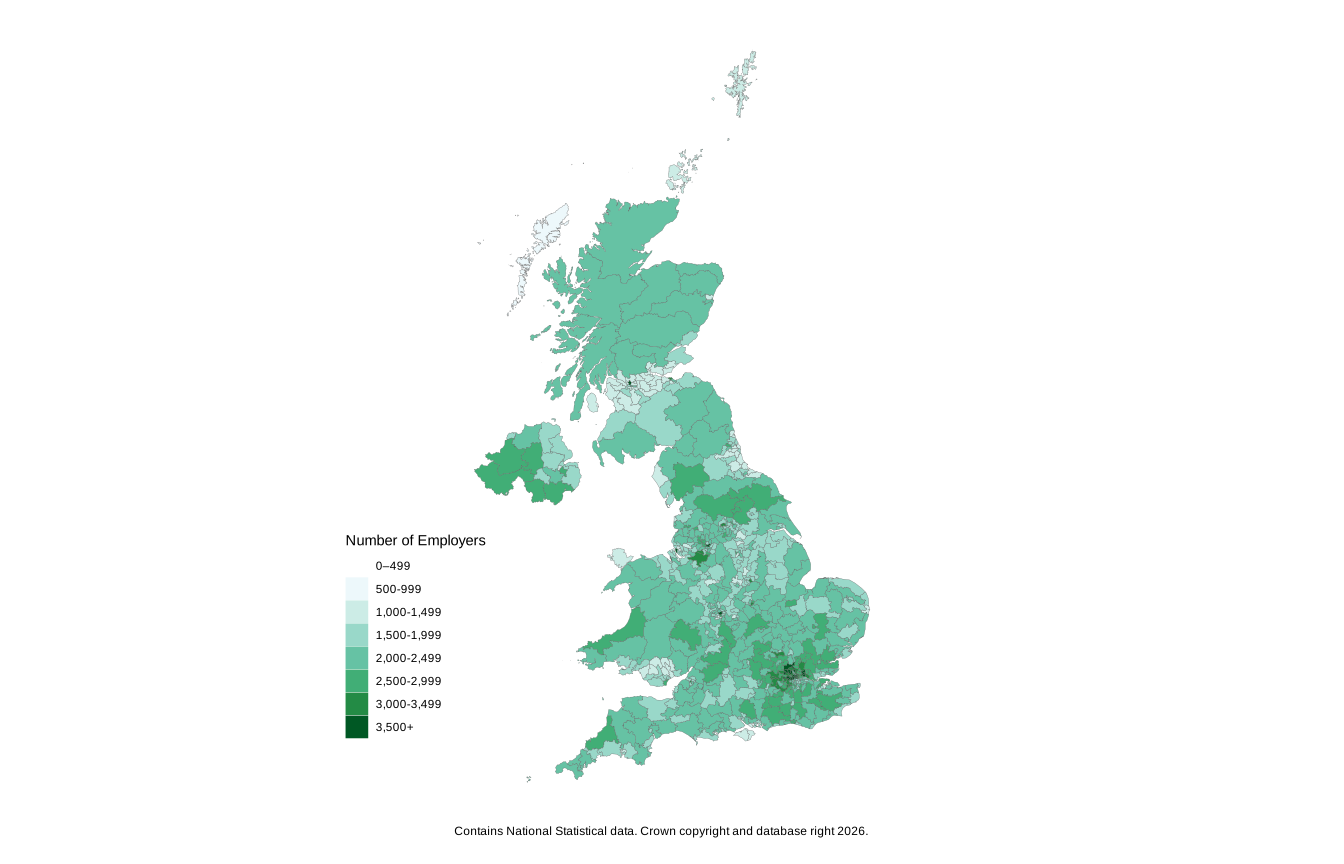
The three constituencies with the highest claimant figures are the Cities of London and Westminster with 26,400 employers benefitting, Holborn and St Pancras with 11,300 employers benefitting and Hackney South and Shoreditch with 7,700 employers benefitting. A full breakdown by constituency can be found in the accompanying Employment Allowance take-up statistics: 2025 to 2026 tax year estimate ODS file.
6. Employer size distribution
Table 4: Employment Allowance claims by employer size
| Employer size | Employers |
|---|---|
| 1-9 | 1,205,000 |
| 10-49 | 188,000 |
| 50-249 | 22,000 |
| 250+ | 4,000 |
Large employers only account for <1% (4,000) of employers benefitting from the relief.
7. Commentary
7.1 Disclaimer
An Official Statistics Publication
These Official Statistics are produced to high professional standards in accordance with the Statistics and Registration Service Act 2007, signifying compliance with the Code of Practice for Official Statistics. They will undergo regular quality assurance reviews to ensure that they meet customer needs and are produced free from any political interference.
8. Further information about the Employment Allowance
These Official Statistics provide users with information on the Employment Allowance for the 2025 to 2026 tax year. In this release, employers are classified as benefitting from the Employment Allowance if they have had an amount of the allowance offset against their Class 1 Secondary National Insurance Contributions (NICs), hereafter referred to as employer NICs, paid to HMRC.
The Employment Allowance came into effect in April 2014 and provided eligible employers with a reduction of up to £2,000 in their employer NICs liabilities. In April 2016, the allowance rose to £3,000. Initially, the allowance was available to business, charities, amateur sports clubs; and as of April 2015, domestic employers of care and support workers are also eligible to claim the allowance. As of April 2016, limited companies where the director is the only employee with paid earnings above the Secondary Threshold for NICs are no longer able to claim the allowance. Other domestic employers and public sector employers where at least 50% of their work is of a public nature are not eligible for the allowance.
As of April 2020, the allowance was targeted to employers with an employer NICs liability below £100,000 in the previous tax year. The value of the allowance was also increased to £4,000 in April 2020 and was further increased to £5,000 in April 2022. In April 2025, the value of the allowance was increased from £5,000 to £10,500 and became available to more employers (those with an employer NICs liability above £100,000), the employer NICs secondary threshold was reduced from £9,100 to £5,000 and the rate was increased from 13.8% to 15%.
The Employment Allowance can be claimed through an employer’s payroll system which is then processed through HMRC’s Pay As You Earn (PAYE) Real Time Information (RTI) system. An employer can claim their eligibility by submitting an Employer Payment Summary. When an employer then sends through their Full Payment Submissions when submitting their payroll, the allowance is offset against their employer NIC liabilities due on their employee(s).
Further guidance on this can be found at the Employment Allowance guidance page.
9. Methodology
9.1 Number of employers
The number of employers benefitting from the Employment Allowance is taken from HMRC’s Enterprise Tax Management Platform data. An employer is defined as benefitting if they have had an amount of the allowance offset against their employer NICs liabilities.
9.2 Sector and location
Sector and location information is taken from the Business Lookup Table (BLT) by matching across the ETMP data. Sectors are defined using Standard Industrial Classification codes and had a match-rate of 91%. Postcode information, used to identify regions and parliamentary constituencies, had a match-rate of 91%. The postcode used corresponds to the enterprise which is claiming the relief. Large enterprises tend to operate from multiple locations, and a single postcode may not necessarily reflect where they carry out their operations.
9.3 Employer size
Employer size information is taken from HMRC’s RTI data. It is a measure of employee count corresponding to the PAYE scheme which is claiming the relief at the end of the tax year, and had a match-rate close to 100%. This may not be entirely representative of actual employer size where businesses have large fluctuations in employment seasonality over the course of the year (such as temporary summer and Christmas positions); employers may also have multiple PAYE schemes.
9.4 Caveats
- figures are rounded to the nearest 1,000 and the nearest % apart from the constituency distribution which is rounded to the nearest 100
- sum of sector/location/employer size may not sum to the total due to rounding and negligible numbers of employers falling into smaller sectors or locations
- cases without sector/location/employer size information have been apportioned across sector/location/employer size based on the distribution of cases where sector/location/employer size information is known
- ‘other sector includes: ‘Mining and quarrying’, ‘Electricity, gas, steam and air conditioning supply’, ‘Water supply; sewerage, waste management and remediation activities’, ‘Activities of extraterritorial organisations and bodies’ and ‘Public administration and defence; compulsory social security’
- ‘activities of households as employers; undifferentiated goods-and services-producing activities of households for own use’ has been shortened to ‘activities of households as employers…’
10. User engagement
HMRC is committed to providing impartial quality statistics that meet our users’ needs. We encourage our users to engage with us so that we can improve our statistics and identify gaps in the statistics that we produce. Please see HMRC Statistics User Engagement Strategy.
If you would like to comment on these statistics or have any enquiries on the statistics please use the statistical contacts named below.
- S Bennett
- W Ahmad
- C McKay
personaltax.statistics@hmrc.gov.uk
For press enquiries, please contact HMRC Press Office: newsdesk@hmrc.gov.uk