Electronic Monitoring Statistics Publication, England and Wales: March 2026
Published 23 April 2026
Applies to England and Wales

© Crown copyright 2026
This publication is licensed under the terms of the Open Government Licence v3.0 except where otherwise stated. To view this licence, visit nationalarchives.gov.uk/doc/open-government-licence/version/3 or write to the Information Policy Team, The National Archives, Kew, London TW9 4DU, or email: psi@nationalarchives.gov.uk.
Where we have identified any third party copyright information you will need to obtain permission from the copyright holders concerned.
This publication is available at https://www.gov.uk/government/statistics/electronic-monitoring-statistics-publication-march-2026/electronic-monitoring-statistics-publication-england-and-wales-march-2026
1. Main points
The Electronic Monitoring Statistics publication covers the use and delivery of electronic monitoring in England and Wales, using four types of devices: curfew monitoring devices (also known as radio frequency or RF devices), location monitoring devices (also known as global positioning system or GPS devices), alcohol monitoring (AM) devices, and non-fitted devices (NFDs). A small number of individuals in the immigration cohort living in Scotland and Northern Ireland are also monitored.
This publication sets out statistics on the use of electronic monitoring as at 31 March 2026 compared to those as at 31 December 2025.
- The total number of individuals assigned with an electronic monitoring device was 28,687, an increase of 2% from 28,111 as at 31 December 2025.
Figure 1: Number of individuals assigned with an electronic monitoring device, by order type, England and Wales, as at month-end, from June 2025 to March 2026 (Source: Table 1.1)
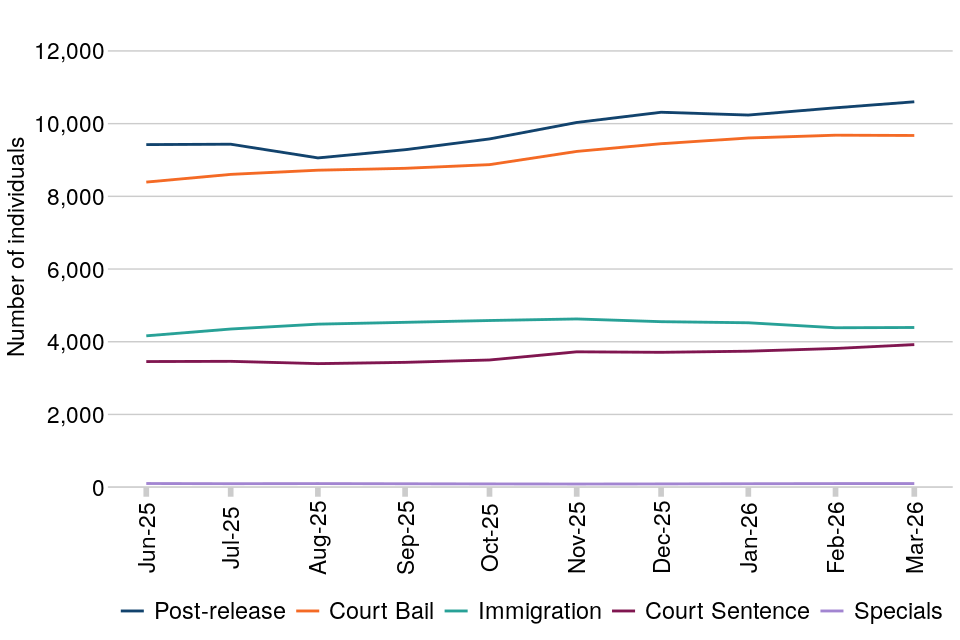
- Post-release orders were the largest group with 10,601 individuals (37% of the caseload). This compares to 10,313 orders as at 31 December 2025, a 3% increase.
- Court bail orders made up the second-largest proportion with 9,674 individuals (34% of the caseload) assigned with an electronic monitoring device. This compares to 9,448 orders as at 31 December 2025, a 2% increase.
- Immigration orders were the third-largest group with 4,392 individuals (15% of the caseload). This compares to 4,552 orders as at 31 December 2025, a 4% decrease.
- Court sentences (community orders and suspended sentence orders) were the fourth-largest group with 3,922 individuals (14% of the caseload). This compares to 3,709 orders as at 31 December 2025, a 6% increase.
- Specials orders were the fifth-largest group with 98 individuals (less than 0.5% of the caseload).
Figure 2: Number of individuals assigned with an electronic monitoring device, by tag type (excluding Specials[footnote 1]), England and Wales, as at month-end, from June 2025 to March 2026 (Source: Table 2.1, 3.1, 4.1)
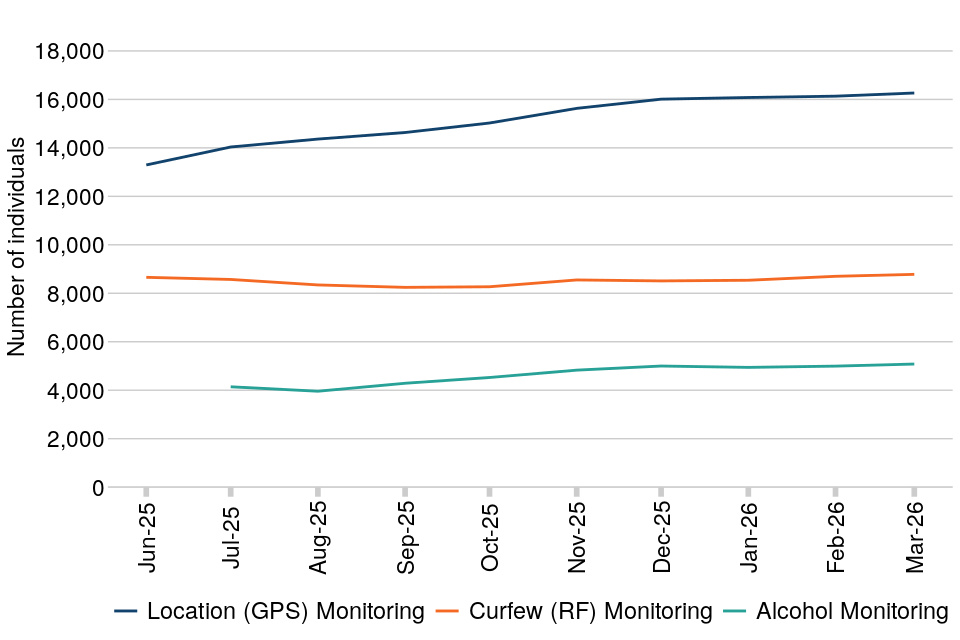
- Location (GPS) devices account for 57% (16,264) of individuals assigned with a device. This compares to 16,010 orders as at 31 December 2025, a 2% increase.
- Curfew (RF) devices account for 31% (8,781) of individuals assigned with a device. This compares to 8,510 orders as at 31 December 2025, a 3% increase.
- AM devices account for 18% (5,080) of individuals assigned with a device. This compares to 4,998 orders as at 31 December 2025, a 2% increase.
Percentages may not sum to 100% as some individuals are assigned with more than one type of device.
2. Statistician’s comment
2.1 Caseload figures
The total number of individuals assigned with an electronic monitoring device increased by 2% between December 2025 and March 2026. Individuals assigned with an RF device saw the greatest increase in this period, with an increase of 271 individuals (3% increase), which was mainly driven by increases in individuals with post-release as their primary order type (7% increase).
Post-release volumes remain the highest across the time series, accounting for 37% of the total EM caseload in March 2026. As of March 2026, court sentence and post-release cohorts have the highest volumes in their respective time series.
Although total volumes have increased, there has been little change in the proportions of each cohort within the caseload from June 2025 to March 2026.
2.2 New order starts and order completions
There was a 14% increase in order completions from December 2025 to March 2026. This was mainly driven by order completions of those assigned with a GPS device (23% increase), with those in the court bail cohort assigned with a GPS device seeing a 44% increase in order completions.
In the same time period, there was no substantial change in the total number of new orders (0.1% increase). However, there was a 10% decrease in new court bail order starts and a 15% increase in new court sentence order starts.
2.3 Data quality and methodology
The statistics presented in this release are not comparable with data published before June 2025 due to changes in the definition and methodology used to classify individuals as “tagged”. These changes also apply to the AM cohort, which transitioned to the revised definition and methodology at the end of July 2025. Further details on these methodological changes are provided in the technical note.
Electronic Monitoring statistics were paused during the 2024–25 transition from Capita to Serco to allow for process changes and data quality checks. The caseload migration finished in October 2025, and publications resumed in June 2025. There continues to be improvements in data quality within the case management systems and operational processes. For more information on this please refer to the publication technical note.
3. Background
Electronic monitoring supports probation services, prisons, courts, the police, the Home Office, and the wider justice system in England and Wales. It is a way of remotely monitoring and recording information on an individual’s whereabouts or alcohol consumption, using an electronic device that is typically fitted to an individual’s ankle. Electronic monitoring may be used:
-
Court bail: as a tool to assist with the monitoring of established bail conditions for individuals on court bail;
-
Court sentence: as a requirement of a court sentence, primarily for individuals on community orders and suspended sentence orders;
-
Post-release: for Home Detention Curfew or as a licence condition following an individual’s release from prison or young offenders institutions;
-
Immigration: as a condition of immigration bail, managed by the Home Office; or
-
Special: to intensively monitor a small number of individuals assessed as high risk, including those managed under Level 3 Multi-Agency Public Protection Arrangements (MAPPA) and other serious or specialist cohorts (further defined in glossary in the technical note).
An individual may be given several orders at the same time and/or over the course of a year. Therefore, it is likely that there will be more active orders at any one time than there are people being monitored and some individuals will be dual-tagged. In this publication series, if an individual has multiple orders:
- when counting order notifications, each notification will be counted separately;
- when counting individuals, the individual will be included in one order cohort once according to a defined formula.
Please see the technical note for more details.
4. Location Monitoring (GPS)
Location monitoring (GPS) devices allow the monitoring of:
- compliance with exclusion zones;
- attendance at a required activity or appointment;
- an offender’s whereabouts, known as trail monitoring;
- multiple conditions or requirements, if necessary, such as a combination of exclusion zones, curfew, monitored attendance and trail monitoring.
Between 31 December 2025 and 31 March 2026, the number of individuals assigned with an electronic monitoring device and whose primary order was a location monitoring (GPS) device increased from 16,010 individuals to 16,264, an increase of 2%.
Figure 3: Number of individuals assigned with a location monitoring (GPS) device, by order type (excluding Specials[footnote 1]), England and Wales, as at month-end, from June 2025 to March 2026 (Source: Table 2.1)
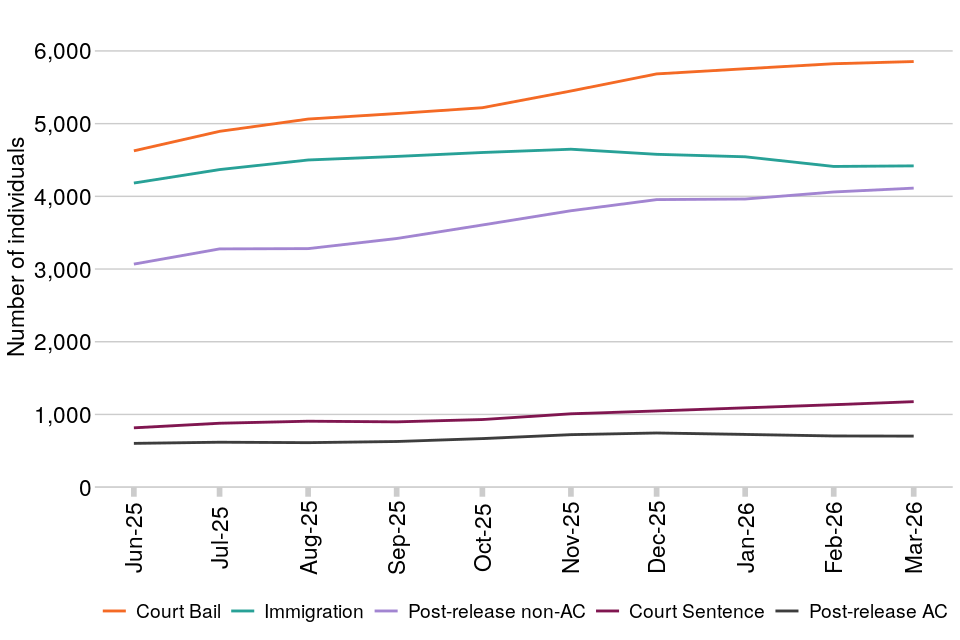
- Court bail orders make up the largest proportion (36%) of location monitored (GPS) individuals. At 31 March 2026, 5,854 individuals had location monitoring (GPS) court bail as their primary order type, an increase of 3% compared to 31 December 2025.
- Post-release orders were the second largest group, made up of acquisitive crime (AC) and non-AC orders (please find the definition for acquisitive crime in the technical note). Non-AC orders made up the majority of the post-release cohort with 4,113 individuals (25% of the location monitoring (GPS) caseload), up by 4% when compared to 31 December 2025. AC orders were made up of 702 individuals (4% of the location monitoring (GPS) caseload), down by 6% when compared to 31 December 2025.
- Immigration orders were the third largest group with 4,419 individuals (27% of the caseload), down by 3% when compared with 31 December 2025.
- Court sentence orders (community orders and suspended sentence orders) were the fourth largest group with 1,176 individuals (7% of the caseload), up by 12% when compared with 31 December 2025.
5. Non-Fitted Devices (NFDs)
Electronic monitoring using a non-fitted device was introduced in November 2022 for the immigration cohort. These devices utilise periodic biometric verification as an alternative to fitted devices. Individuals with a non-fitted device have been included within the location monitoring (GPS) cohort for the purposes of this analysis.
6. Curfew Monitoring (RF)
Curfew (RF) devices allow the monitoring of a curfew, where an offender must be at a specified location at specified times.
Between 31 December 2025 and 31 March 2026 the total number of individuals assigned with an electronic monitoring device and whose primary order was a curfew (RF) electronic monitoring device increased from 8,510 individuals to 8,781, an increase of 3%.
Figure 4: Number of individuals assigned with a curfew (RF) monitoring device, by order type (excluding Specials[footnote 1]), England and Wales, as at month-end, from June 2025 to March 2026 (Source: Table 3.1)
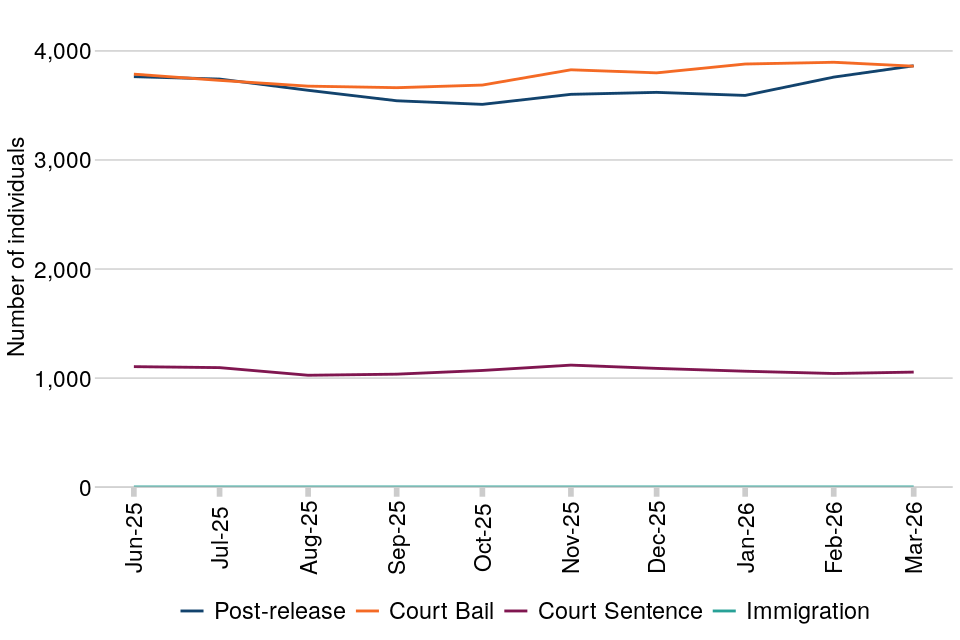
- Post-release orders make up the largest proportion (44%) of curfew (RF) monitored individuals. At 31 March 2026, 3,864 individuals had curfew post-release monitoring as their primary order type, up by 7% when compared with 31 December 2025.
- Court bail were the second largest group with 3,860 individuals (44% of the caseload), an increase of 2% since 31 December 2025.
- Court sentence orders (community orders and suspended sentence orders) were the third largest group with 1,055 individuals (12% of the caseload), down by 3% when compared with 31 December 2025.
- Immigration orders were the fourth largest group with 2 individuals, no change when compared with 31 December 2025.
7. EM new order starts and order completions
Between 1 January 2026 and 31 March 2026, there have been 19,676 new electronic monitoring orders and 21,353 electronic monitoring order completions across England and Wales. Overall, there have been 67,784 new orders and 64,060 order completions since June 2025. The number of new and completed EM orders is not impacted by the change in the definition and methodology used to classify individuals as “tagged”.
Figure 5: Number of new orders and order completions, England and Wales, as at month-end, from June 2025 to March 2026 (Source: Table 1.2, 1.3)
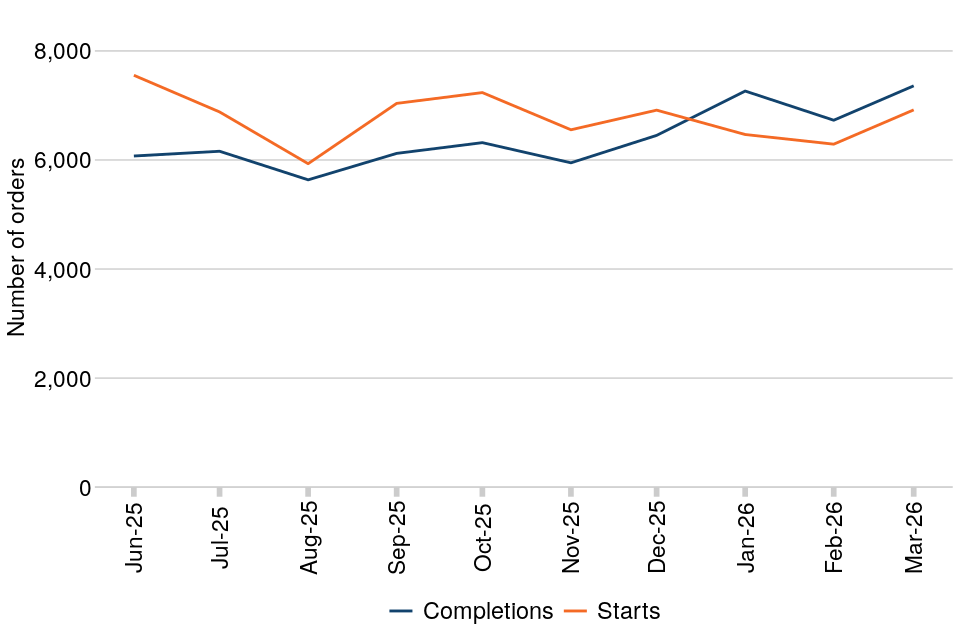
- In March 2026, there were 7,360 completed orders, an increase of 14% compared to 6,451 completed orders in December 2025.
- In March 2026, there were 6,919 new orders. There was no substantial change in the total number of new orders (0.1% increase) compared to 6,914 new orders in December 2025.
8. Alcohol Monitoring (AM)
Migration of AM orders from Capita to Serco began at the end of July 2025. As with RF and GPS monitoring, the definition and methodology for reporting AM caseload statistics have been updated to align with the revised definition used across all electronic monitoring caseloads (as mentioned earlier).
There are two types of AM orders:
- Alcohol Abstinence and Monitoring Requirement (AAMR) – this may only be used when sentencing for alcohol-related criminal behaviour and it imposes a total ban on drinking alcohol for up to 120 days. Compliance with the ban is monitored electronically using an alcohol monitoring device, which monitors for the consumption of alcohol via an offender’s sweat. An AAMR can only be imposed if the individual is not alcohol dependent or has an Alcohol Treatment Requirement (ATR), and the individual is an adult (18 years or over).
- Alcohol Monitoring on Licence (AML) – this is an additional licence condition for offenders released from custody whose offending and risk is alcohol related. There are two licence conditions available, total abstinence from alcohol, or a requirement that the offender complies with requirements specified by their probation practitioner to address their alcohol needs, which will include restricting alcohol use.
Between 31 December 2025 and 31 March 2026 the total number of individuals assigned with an electronic monitoring device and whose primary order was an AM order increased from 4,998 individuals to 5,080, an increase of 2%.
9. AM new order starts and order completions
Figure 6: Number of new alcohol monitoring orders, England and Wales, as at month-end, from January 2022 to March 2026 (Source: Table 4.2)
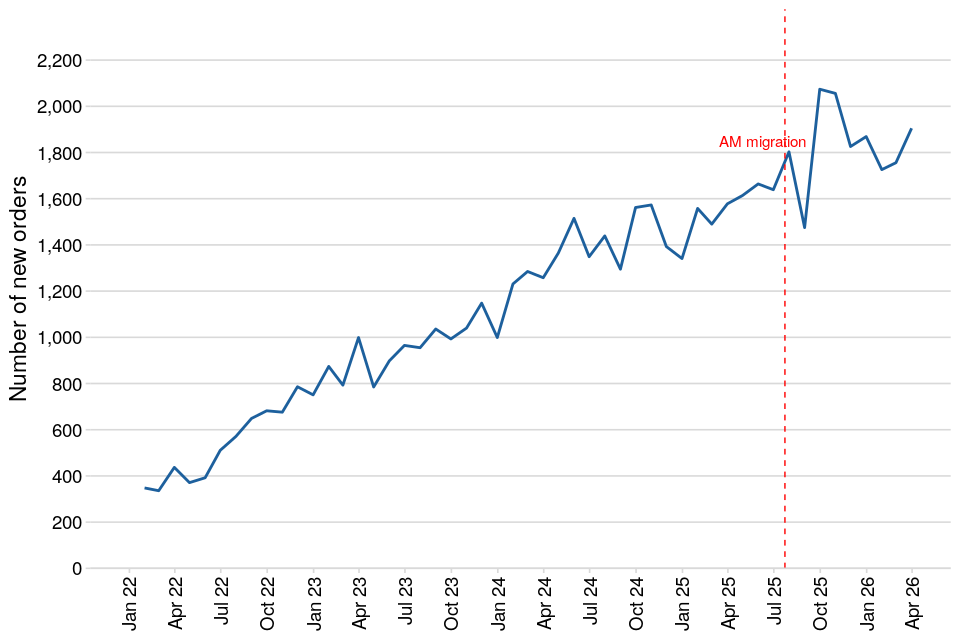
There were 5,387 new alcohol monitoring orders imposed across England and Wales between 1 January 2026 and 31 March 2026. Overall, 63,257 new alcohol monitoring orders have been imposed since their introduction. The number of new and completed AM orders is not impacted by the change in the definition and methodology used to classify individuals as “tagged”.
10. Further information
10.1 Accompanying files
As well as this bulletin, the following products are published as part of this release:
-
Data tables
-
Technical note
10.2 Official Statistics
Our statistical practice is regulated by the Office for Statistics Regulation (OSR). OSR sets the standards of trustworthiness, quality, and value in the Code of Practice for Statistics that all producers of official statistics should adhere to. You are welcome to contact us directly with any comments about how we meet these standards. Alternatively, you can contact the OSR by emailing regulation@statistics.gov.uk or via the OSR website.
This publication has been produced to the high professional standards as set out in the Code of Practice for Statistics. However, the analysis is only as good as the data upon which it is based, and there is inherent uncertainty when the data is derived from diverse administrative data systems.
For further details on the methodology used to compile the report, please refer to the technical note.
10.3 Future publications
Our statisticians regularly review the content of publications. Development of new and improved statistical outputs is usually dependent on reallocating existing resources. As part of our continual review and prioritisation, we welcome user feedback on existing outputs including content, breadth, frequency and methodology. Please send any comments you have on this publication including suggestions for further developments or reductions in content.
10.4 Contact
Press enquiries should be directed to the Ministry of Justice press office.
Other enquiries about these statistics should be directed to Youth Justice and Offender Policy Directorate at the Ministry of Justice:
Electronic Monitoring Performance and Statistics
Youth Justice and Offender Policy
Ministry of Justice
10th Floor
102 Petty France
London SW1H 9AJ
Email: ppas_statistics@justice.gov.uk
Next update: Jul 2026
© Crown copyright Produced by the Ministry of Justice
Alternative formats are available on request from ppas_statistics@justice.gov.uk
-
Please refer to Annex A within the technical note ↩ ↩2 ↩3