Annex: Management Information, Electronic Monitoring Status Statistics: June 2026
Published 23 July 2026
Applies to England and Wales

© Crown copyright 2026
This publication is licensed under the terms of the Open Government Licence v3.0 except where otherwise stated. To view this licence, visit nationalarchives.gov.uk/doc/open-government-licence/version/3 or write to the Information Policy Team, The National Archives, Kew, London TW9 4DU, or email: psi@nationalarchives.gov.uk.
Where we have identified any third party copyright information you will need to obtain permission from the copyright holders concerned.
This publication is available at https://www.gov.uk/government/statistics/electronic-monitoring-statistics-publication-june-2026/annex-management-information-electronic-monitoring-status-statistics-june-2026
1. Statisticians comment
This annex provides management information (MI) on the monitoring status of individuals with an Electronic Monitoring (EM) order and should be read alongside the June 2026 EM quarterly statistical release. It includes information on both individuals who have been assigned equipment [footnote 1] (as reported in the quarterly release) and those who have not. The figures are broken down into four main EM cohorts: court bail, court sentence, post-release and immigration. The Specials cohort is excluded. This MI has been developed in response to user demand for more comprehensive insight into the monitoring status of individuals subject to an EM order and will be published quarterly.
2. Background
Electronic monitoring (EM) is a tool used in England and Wales to support the work of the justice system including probation, prisons, courts and the police. It is also used by the Home Office to monitor immigration orders. EM is a way of remotely monitoring and recording information on an individual’s whereabouts and/or alcohol consumption using an electronic device that is typically fitted to an individual’s ankle.
An individual may be given several orders at the same time. In this report, if an individual has multiple orders, they will be included in one order type cohort once, using the same methodology as the main statistical release.
3. Monitoring Status
New statistics on monitoring status have been developed to provide a more complete picture of individuals subject to an EM order. While the quarterly publication focuses on people who have had EM equipment assigned, this annex provides a broader picture by covering everyone with an EM order, including people who have not yet had equipment assigned.
To support publication of these new statistics, a comprehensive review and data cleansing exercise was undertaken to ensure data quality was sufficient. Specifically, some expired orders were still active on the EM database, affecting the number of orders reported as having no equipment assigned and resulting in an overstatement of these figures. The review consisted of a combination of manual case reviews and a data-driven reconciliation against associated datasets, such as matching EM supplier data against court administrative datasets. This work improved the accuracy and reliability of the underlying data.
Statistics on monitoring status are based on installation outcomes and the communication status of the monitoring equipment. This allows individuals to be grouped into two main categories:
- Individuals without EM equipment: People with an EM order that do not have the minimum equipment installed to be classed as electronically monitored. This is an additional cohort, not covered by the quarterly statistical release.
- Individuals with EM equipment: people with an EM order that have the minimum required EM equipment successfully installed. This is the same cohort addressed by the June 2026 quarterly statistical release, excluding the Specials cohort. This annex splits the cohort by whether the equipment is actively communicating.
3.1 Individuals without EM equipment
There were 5,043 individuals not assigned with equipment as at 30th June 2026 [footnote 2] (source: table 5.1), or 15% of individuals who have an EM order.
Court Bail made up the largest volume of those without equipment, with 2,704 individuals (54% of those without equipment). This was followed by post-release with 1,585 individuals (31%), and Court Sentence with 608 individuals (12%). The immigration cohort had the lowest volume without equipment, with 146 individuals (3%).
Reasons individuals are not assigned equipment can relate to actions of the individual subject to the EM order or issues with service provision, including:
- Not at address: The person was not at the address when installation was attempted. This may be because they were away, had moved, were in hospital, or were in custody.
- Property or access issues: Installation could not take place because there was a problem with the property, access to the property, or the location could not be found.
- Withdrawal of consent: The person no longer agreed to the installation. This may have been stated directly or shown through their actions during the visit.
- Medical reasons: Installation could not be completed because of a medical condition or health-related issue, such as a skin condition, injury, circulatory problem, or medical device.
- No record of install: No information about the installation visit was available in the EM supplier’s records. This may be because the order was created before the current supplier’s contract began.
- Issue with installation or equipment: An installation visit took place, but there has been a problem with the installation or equipment (e.g. faulty, missing, or removed equipment).
- Within 2 days of order start or order end: The order was still within the two-day period allowed for installation, or the order was due to end within two days, and equipment was being removed from the case.
- In custody: Records showed that the person was in custody on 30 June 2026, based on information held in the prison system.
- Other reasons: The installation could not be completed for a reason that does not fit into the categories above. Examples include safety concerns, behaviour-related issues, or situations where a responsible adult was not present for a child.
These reasons are captured by operational staff and are inherently subject to individual judgement and interpretation.
Figure 1: Number of individuals without EM equipment by reason, as at 30 June 2026, England and Wales (Source: Table 5.1)
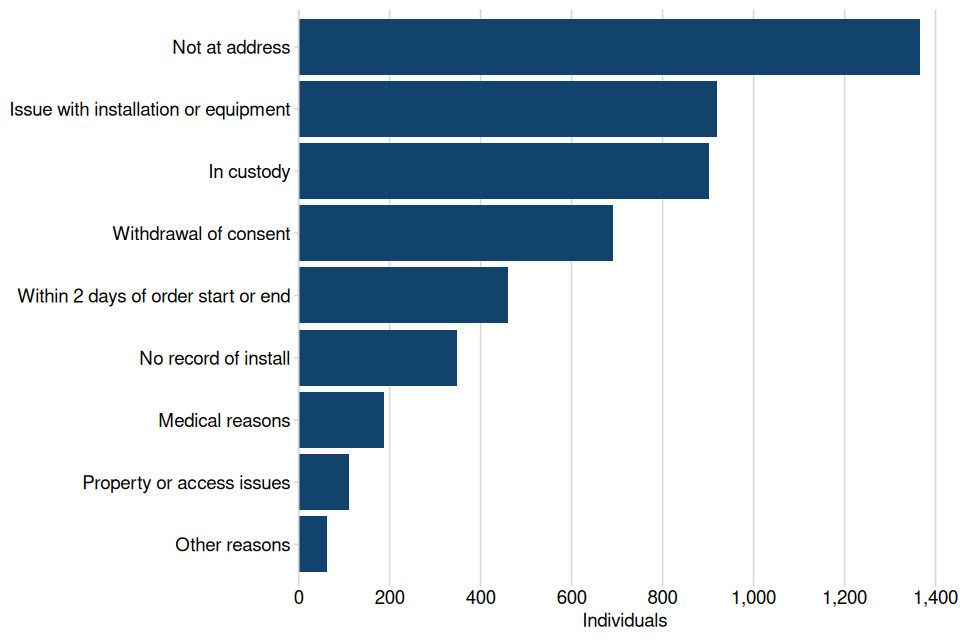
- Reasons equipment is not installed primarily relate to actions of the individual, with ‘not at address’ as the most common reason for being without equipment (27%). This was followed by ‘issue with installation or equipment’ (18%) and ‘in custody’ (18%).
- With the exception of post-release orders, ‘not at address’ was the most common reason for each order type. For post-release, ‘issue with installation or equipment’ was most common (22%).
3.2 Individuals with EM equipment
‘Individuals with EM equipment’ refers to people who have had the required EM equipment successfully installed for their monitoring order (or if they have multiple orders, it is installed for at least one of them). This is the same cohort addressed by the June 2026 EM quarterly statistical release, excluding the Specials cohort [footnote 3]. These cases are split into two groups based on whether equipment is communicating with the central monitoring system:
- ’Actively communicating’ means any of the EM equipment has sent a signal to central monitoring systems within the past 14 days. This can be any one of the following: home monitoring unit, base station, non-fitted device, or tag (where no home monitoring unit is present).
- If no signal has been received within the last 14 days, the equipment is classified as ‘not actively communicating’.
The 14-day period was selected for reporting and analysis purposes. It provides a consistent threshold for cases to be confidently classified as not actively communicating, reducing the likelihood that temporary interruptions in communication are counted as non-communication. This timeframe also allows sufficient time for any related operational activity, such as investigating the issue or breach, to be recorded in the data. It should not be interpreted as a policy requirement or as an indication of when operational action should be taken. Reasons equipment is not actively communicating can be due to non-compliance with the EM order, interference or damage to equipment, technical fault, or power disruption.
Figure 2: Number of individuals with EM equipment by communication status, as at 30 June 2026, England and Wales (Source: Table 5.2)
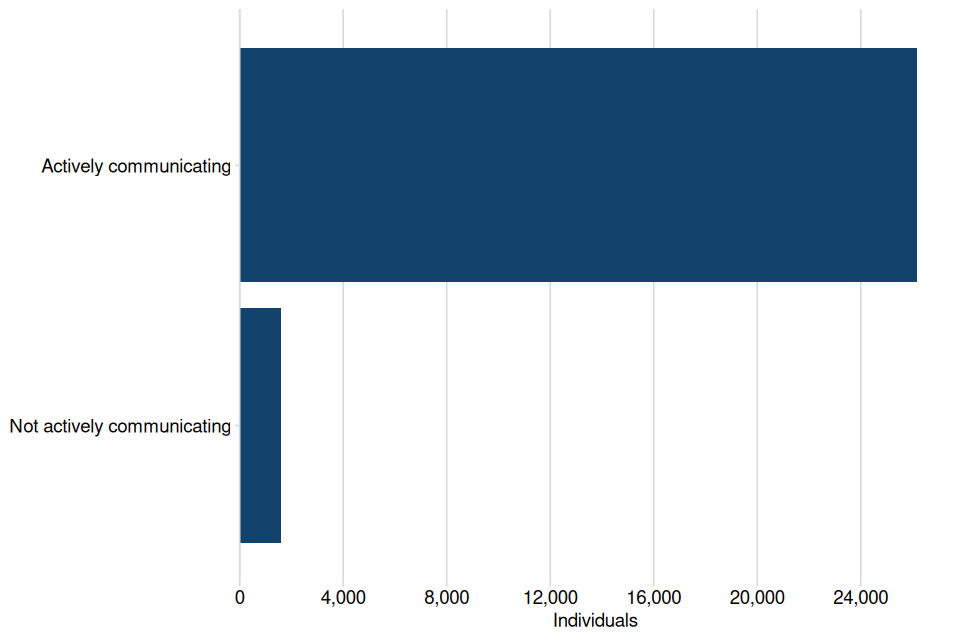
- The number of individuals with equipment actively communicating is 94% (26,165 individuals), substantially higher than the proportion not actively communicating (6%, 1,596 individuals).
- Post-release and Court Sentence EM had the highest proportion with equipment activity communicating, with 97%, followed by Court Bail with 93% communicating.
- The immigration cohort has the lowest proportion actively communicating (3,464 individuals actively communicating and 569 not actively communicating). Unlike equipment provided to other cohorts, the equipment supplied to this cohort requires periodic charging from a mains power supply. This additional requirement may contribute to a slightly higher proportion of individuals becoming out of contact.
4. Further information
4.1 Accompanying files
This Annex bulletin is published alongside the following products as part of this release:
- EM statistics publication bulletin
- EM statistics data tables
- Annex data tables
- Technical note
4.2 Management Information (MI)
MI is data collected primarily for operational and administrative purposes to support the management, monitoring and delivery of services. It provides a timely indication of activity and outcomes and is used internally to inform operational and policy decisions. Unlike official statistics, MI has not necessarily been produced under the full range of statistical quality assurance processes and may be subject to further validation and refinement.
This annex presents MI relating to monitoring status of individuals with an EM order by cohort. The information is published to provide additional transparency and insight into service delivery. It is not classified as official statistics, reflecting ongoing work to assess data quality, completeness and methodological consistency before potential inclusion within the regular EM official statistics publication.
4.3 Future publications
Our statisticians regularly review the content of publications. Development of new and improved statistical outputs is usually dependent on reallocating existing resources. As part of our continual review and prioritisation, we welcome user feedback on existing outputs including content, breadth, frequency and methodology. Please send any comments you have on this publication including suggestions for further developments or reductions in content.
4.4 Contact
Press enquiries should be directed to the Ministry of Justice press office.
Other enquiries about these statistics should be directed to Youth Justice and Offender Policy Directorate at the Ministry of Justice:
Electronic Monitoring Performance and Statistics
Youth Justice and Offender Policy
Ministry of Justice
10th Floor
102 Petty France
London SW1H 9AJ
Email: ppas_statistics@justice.gov.uk
© Crown copyright Produced by the Ministry of Justice
Alternative formats are available on request from ppas_statistics@justice.gov.uk
-
Equipment refers to one or more of the following: a home monitoring unit, base station, non-fitted device, or tag. One or more of these may be installed depending on the circumstances of an order. ↩
-
MoJ published an ad-hoc statistical release (Ad-Hoc Electronic Monitoring Status, March 2026 - GOV.UK) providing figures on the number of individuals with an EM order who had not been assigned equipment as at 31 March 2026. This release was produced to provide updated figures referenced in the National Audit Office (NAO) report on EM (Electronic monitoring: improving resilience to meet increasing demand - NAO report) . Further assurance work explains the continued decline in volume of those not assigned equipment from 31 March 2026 to 30 June 2026. Ongoing improvements to administrative processes are being made to enhance data quality. ↩
-
This group comprises of a small number of individuals who are intensively monitored. See Annex A of the technical note. ↩