Criminal Justice Statistics quarterly: March 2026 (HTML)
Updated 11 September 2026
Applies to England and Wales

© Crown copyright 2026
This publication is licensed under the terms of the Open Government Licence v3.0 except where otherwise stated. To view this licence, visit nationalarchives.gov.uk/doc/open-government-licence/version/3 or write to the Information Policy Team, The National Archives, Kew, London TW9 4DU, or email: psi@nationalarchives.gov.uk.
Where we have identified any third party copyright information you will need to obtain permission from the copyright holders concerned.
This publication is available at https://www.gov.uk/government/statistics/criminal-justice-statistics-quarterly-march-2026/criminal-justice-statistics-quarterly-march-2026-html
Main Points
| 1.59 million individuals were formally dealt with by the Criminal Justice System (CJS) | The number of individuals formally dealt with by the CJS in England and Wales increased by 2% in the latest year. |
| Out of court resolutions increased by 5% from 215,400 to 226,600 | In the latest year, there was a 10% increase in community resolutions from 168,700 to 185,600 driving the increase in out of court resolutions. |
| Overall prosecution and conviction volumes remained stable | Whilst overall figures remain broadly similar, there was a 7% increase in prosecutions and a 6% increase in convictions for indictable offences, the highest since year ending March 2017. |
| Defendants remanded in custody at the Crown Court remained stable | The proportion of defendants remanded in custody at the Crown Court was 54%, similar to the previous year. |
| The overall average custodial sentence length (ACSL) remained similar to the previous year and increased slightly for indictable offences | There were increases across many offence groups, most notably an increase of 2.3 months for violence against the person. |
This publication provides criminal justice statistics for the latest 12-month period, with comparisons made to corresponding periods in previous years where appropriate.
The bulletin is accompanied by overview tables. For technical detail about sources, data quality, and terminology, please refer to the accompanying technical guide to criminal justice statistics.
The publication may include revisions for figures previously published where additional data has become available since those publications.
Introduction
This report presents key statistics on activity in the Criminal Justice System (CJS) for England and Wales. It provides commentary for the 12-month period of April 2025 to March 2026 (referred to as the ‘latest year’). The contents of this bulletin will be of interest to government policy makers in the development of policy and their subsequent monitoring and evaluation. Others will be interested in the way different crimes are dealt with in the CJS and trends in sentencing outcomes.
Changes and revisions in this publication
Magistrates’ data development
Published magistrates’ courts plea data has been successfully reinstated following improvements, and is available within the published magistrates’ data tool. As a result of this, the data is a more accurate and expanded reflection of initial plea entry for defendants at magistrates’ courts, which is demonstrated in a 4% increase in not guilty pleas with the methodology change when compared to the last available published plea figures (2024), an increase of 3% in no plea or unknown plea, and no change in guilty pleas.
One Magistrates’ Project
Following the improvements to data quality and coherence seen as a result of the One Crown project, alongside HMCTS we have commenced the One Magistrates project. This project will review all data we publish concerning the magistrates’ courts and aims to improve quality, coherence and value for users. There is the potential for the magistrates’ courts data series to change as the project develops – we will continue to consult users and outline key areas of change in future releases on this bulletin.
Publication review
As set out in the previous edition, we have reviewed and streamlined published tables in this release to ensure we continue to best meet user needs, reflect changes to the data and focus in on areas of interest. Therefore, the tables published alongside this quarterly release have:
-
consolidated data relating to cautions, penalty notices for disorders and some sentencing outcome statistics within the associated tools
-
removed duplicative tables
-
combined information on out of court resolutions (namely penalty notices for disorders and cannabis/khat warnings) within the tables following a marked decline in volumes in recent years.
We will continue to review published data series in light of user needs and usage. We welcome user feedback on these changes and will continue to communicate in advance of any final decisions. Please contact us should you have any comments or views on this approach.
For feedback related to the content of this publication, please contact us at CJS_Statistics@justice.gov.uk
Statistician’s comment
In year ending March 2026, overall prosecutions and convictions stabilised following a number of years of increases. While there was a fall in summary non-motoring offences, this was counter-balanced by continued increases in indictable offences, and a peak in summary motoring prosecutions.
The number of offenders convicted and sentenced remained stable on the previous year, following increases since year ending March 2022. The volume of offenders receiving a custodial sentence continues to increase with custody rates rising. The overall custody rate has increased to levels seen five years ago.
At magistrates’ courts, the number of offenders receiving an immediate custody sentence increased markedly and is the highest since year ending March 2017, particularly with sentences between 6 and 12 months doubling over the last year following increased magistrates’ sentencing powers since November 2024.
At the Crown Court, whilst the overall number of offenders sentenced slightly decreased, there were still increases in the number of offenders convicted and receiving a custodial sentence, to the highest level since year ending March 2018.
The overall average custodial sentence length slightly increased, and increased in both magistrates’ courts and the Crown Court, with a particular increase seen in the overall average custodial sentence length for violence against the person
1. Overview of the Criminal Justice System
1.59 million individuals were formally dealt with by the Criminal Justice System (CJS)
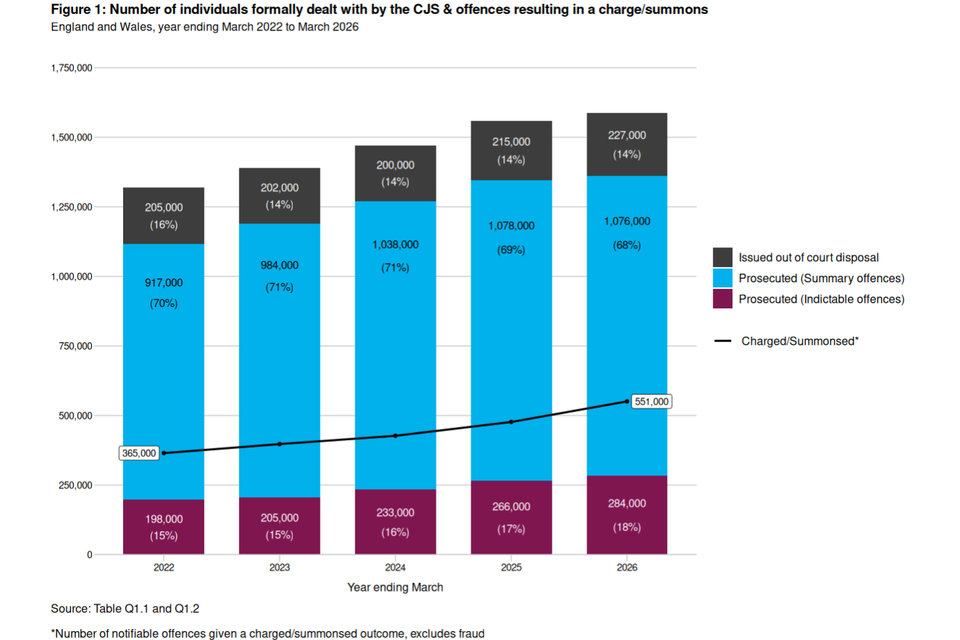
The number of individuals[footnote 1] formally dealt with by the CJS[footnote 2] in England and Wales increased by 2% in the latest year, the highest seen since year ending March 2018.
There were 5.24 million crimes (excluding fraud) recorded by the police in the latest year, this represents a 1% decrease on the previous year but remains well above levels seen a decade ago (3.90 million in year ending March 2016). Levels of police recorded crime are influenced by changes in police activity and recording practices. Recent decreases may reflect a stabilisation in recording practices following earlier improvements for some offence types[footnote 3].
In contrast to the fall in recorded crime, the number of crimes that resulted in a charge has continued to increase. Charge volumes increased by 16% in the latest year to 550,800 – this is the highest volume seen since year ending March 2017. This has driven the rise in the flow of more serious indictable offences into the criminal courts.
The volume of out of court resolutions (OOCRs) increased by 5% in the latest year, to similar levels seen in year ending March 2018 but continued to make up 14% of individuals dealt with. The change is due to continued increases in the use of community resolutions, up 10% on the previous year to a series high of 186,000.
The number of defendants prosecuted increased in the latest year, with prosecutions reaching the highest level seen since year ending March 2018. Prosecutions for the more serious indictable offences continued to increase and account for a larger proportion of individuals dealt with (18%), whilst prosecutions for summary offences stabilised following yearly increases and accounted for a similar proportion of individuals dealt with (68%).
2. Out of Court Resolutions
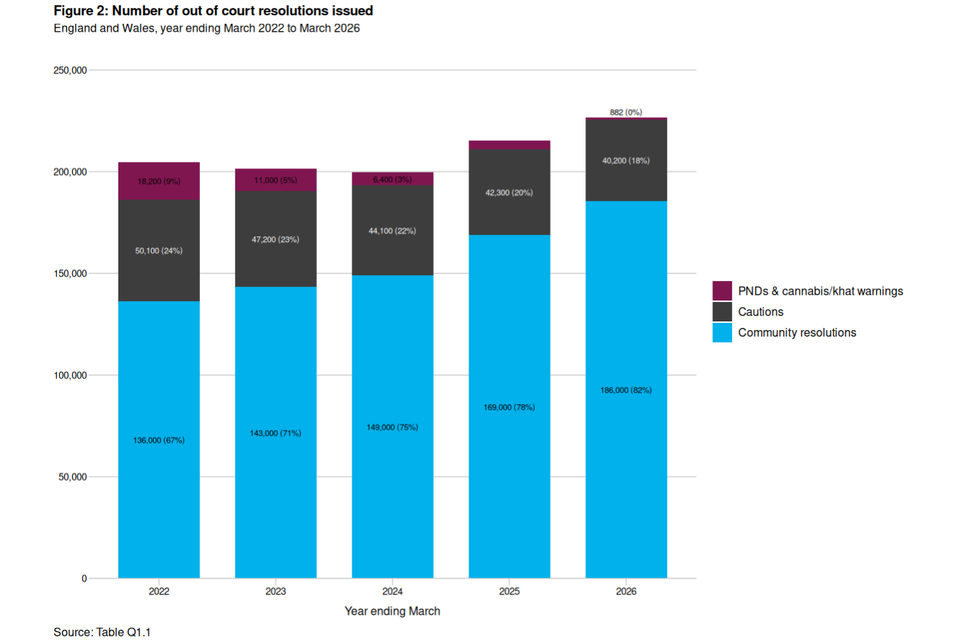
The volume of out of court resolutions (OOCRs) increased on the previous year from 215,400 to 226,600
The total number of OOCRs issued increased by 5% in the latest year. Police are increasing the use of community resolutions, with a 10% increase from 168,700 to 185,600. All other OOCR categories have decreased.
Out of court resolutions (OOCRs) are sanctions used by the police to address offences without the need to be dealt with at court. There were around 226,600 OOCRs issued in year ending March 2026, which represents an increase of 5% when compared to the previous year.
This rise is due to the continued increase in the use of community resolutions[footnote 4] - with 185,600 issued (a 10% increase) in year ending March 2026, representing a series high and accounting for 82% of all OOCRs issued.
There was a decrease of 12% across all other OOCR types combined when compared to the previous year. This consists of a decrease of 5% in cautions and an 80% decrease in other resolutions (cannabis/khat warnings and penalty notices for disorder), the lowest in their series.
Although caution volumes decreased in almost all offence groups there was small increases in those issued for fraud offences. The overall cautioning rate[footnote 5] was largely unchanged on the previous year, around 8%.
3. Prosecutions & Convictions
Overall prosecution and conviction volumes remained stable at similar levels seen in year ending March 2018, following increases over the last four years
Whilst overall figures remain broadly similar, there was a 7% increase in prosecutions and a 6% increase in convictions for indictable offences.
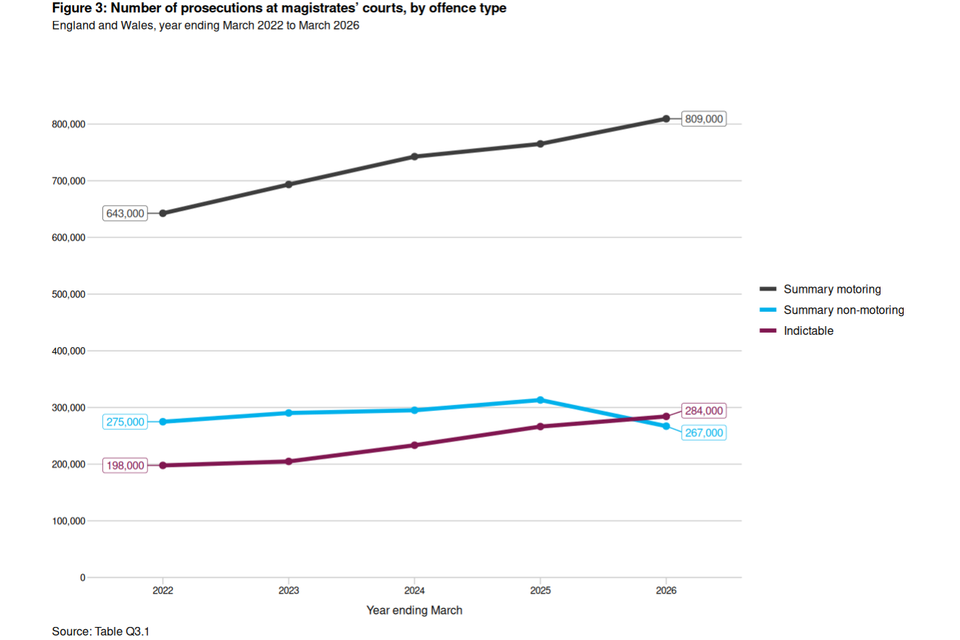
In the year ending March 2026, there were 1.36 million defendants proceeded against at magistrates’ courts (including Single Justice Procedure cases), an increase of 1% compared to the previous year and the highest seen since the year ending March 2017.
The volume of prosecutions for the more serious indictable offences increased by 7%, while the volume of summary offences remained the same. However, there was an increase of 6% in summary motoring offences to 809,000 (a series high) and a decrease of 15% in summary non-motoring offences, driven by decreases in railway and tv licence evasion offences.
Prosecutions increased across almost all indictable offence groups, including an 18% increase for sexual offences (up by 2,500), a 14% increase in public order offences (up by 3,000), and 11% increases for theft offences (up by 7,600) and drug offences (up by 4,800). However, prosecutions for violence against the person decreased by 5% in the latest year (down by 3,000).
In year ending March 2026, a total of 1.20 million offenders were convicted across all criminal courts in England and Wales, similar to the previous year. Convictions for indictable offences increased by 6% on the previous year (from 222,300 to 236,300) - due in part to an increase of over 7,000 defendants convicted for theft offences, up by 12%.
Around 1.14 million offenders were convicted at magistrates’ courts, with little change from the previous year. Convictions for indictable offences increased to 180,000, up by 7% from the previous year.
At the Crown Court, 59,000 offenders were convicted, an increase of 4% from the previous year with 56,300 offenders convicted of indictable offences.
Trends in convictions for indictable offences tend to lag prosecutions because prosecutions are recorded when proceedings are completed in the magistrates’ court, whereas convictions may be recorded later when cases conclude, particularly in the Crown Court[footnote 6].
4. Remands
Defendants remanded in custody at the magistrates’ court and the Crown Court remained stable
The proportion of defendants remanded in custody at the Crown Court was 54%, similar to the previous year.
For most defendants, both before court and at magistrates’ court, remand status is recorded as either not applicable or unknown (80%). This reflects the high volume of Single Justice Procedure cases which are dealt with remotely and do not require a remand decision. At pre-court the proportion of defendants arrested and bailed remained unchanged when compared to the previous year.
At magistrates’ courts, the total volume of those remanded in custody increased by 3% from the previous year and is the highest volume seen in the last decade (67,000). However, the proportion remanded in custody showed little change on the previous year at 5%. The volume of those remanded in custody for more serious indictable and triable either way offences are at a series high, at 13,100 and 47,300 respectively.
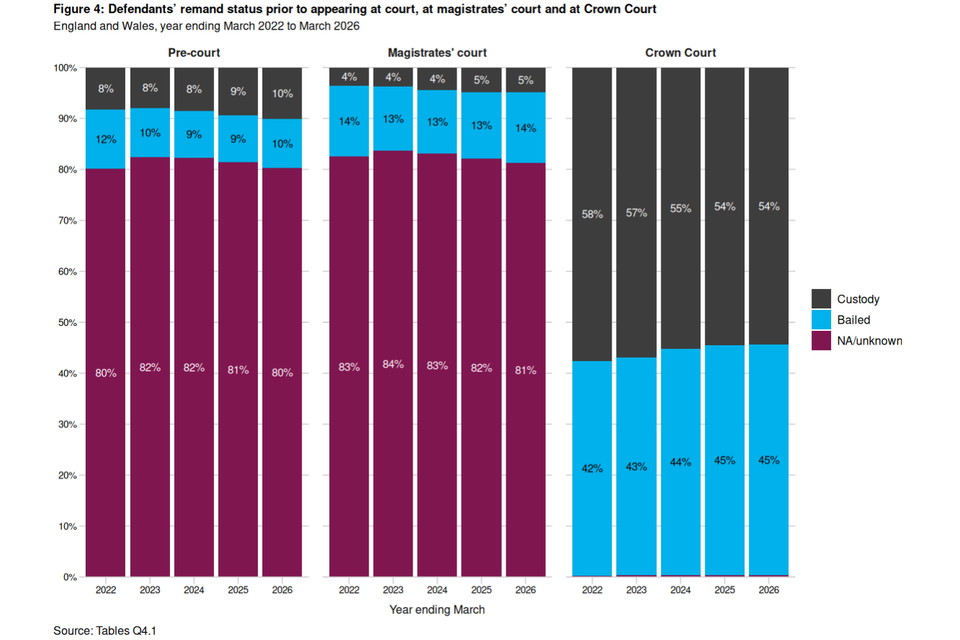
At the Crown Court, the volume of defendants remanded in custody increased slightly to 58,500 compared to the previous year (58,300). The proportion of defendants remanded in custody remained at 54% in year ending March 2026, while bail also remained stable at 45%.
Defendants dealt with for indictable offences are more often remanded in custody for reasons such as the severity of offence, risk of further offending and likelihood of failing to appear at court. Of those remanded in custody at the Crown Court, 79% were sentenced to immediate custody or suspended custodial sentence – compared to 51% of those bailed.
5. Sentencing
The overall average custodial sentence length (ACSL) remained similar to the previous year and increased slightly for indictable offences
There were increases across many offence groups, most notably an increase of 2.3 months for violence against the person.
Sentencing Volumes
Similar to the previous year, there were 1.20 million offenders sentenced in year ending March 2026 at all criminal courts. Most offenders (77%) continued to be sentenced to a fine, with summary motoring offences accounting for 77% of all fines issued.
-
At magistrates’ courts, 1.11 million offenders were sentenced in the year ending March 2026, a slight increase on the previous year. Most offenders (83%) continued to receive a fine, with summary motoring offences accounting for 77% of all fines issued
-
At the Crown Court, 85,700 offenders were sentenced in the year ending March 2026, a 1% decrease on the previous year. This was largely driven by an 11% fall in offenders committed for sentencing from magistrates’ courts, from 30,700 to 27,400.
Custodial sentences
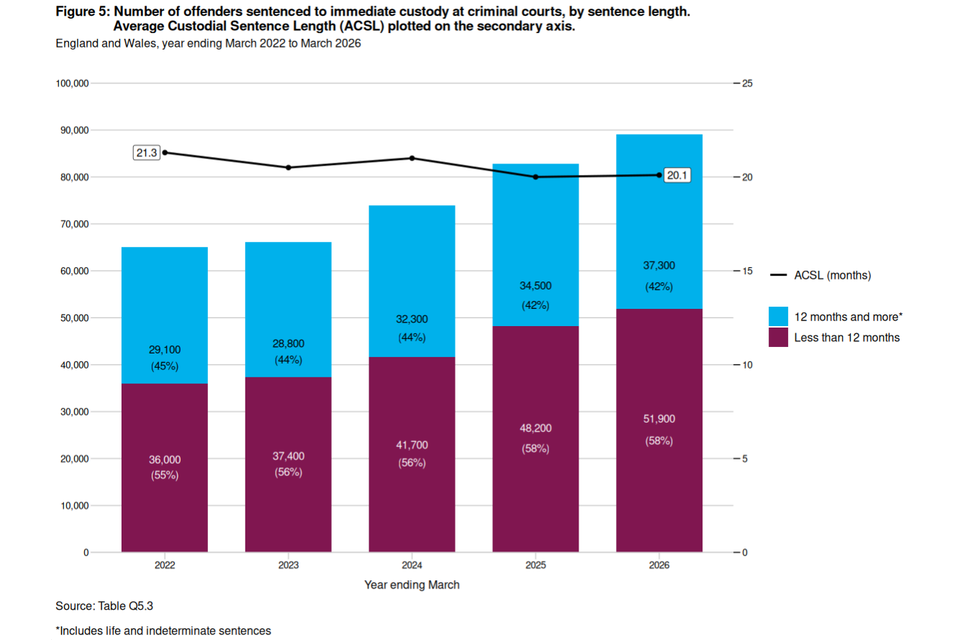
Across all criminal courts, there were 89,200 offenders sentenced to immediate custody – this represents an increase of 8% on the previous year and is the highest level seen since year ending March 2018.
The custody rate[footnote 7] for indictable offences was unchanged on the previous year (33%) but is up from a decade ago (29%). The highest custody rates in the latest year were seen for robbery and sexual offences, at 60% and 55% respectively.
-
At magistrates’ courts, 39,300 offenders received an immediate custodial sentence, up 15% on the previous year and the highest level since the year ending March 2017 (43,100).
-
At the Crown Court, 49,800 offenders received an immediate custodial sentence, up 2% on the previous year and the highest level since the year ending March 2018 (50,100). The custody rate increased from 56% to 58%.
Custodial sentences of less than 12 months continued to account for over half (58%) of all custodial sentences, although the distribution of these sentences across courts has shifted following the increase in magistrates’ sentencing powers.
-
At magistrates’ courts, custodial sentences of over 6 months and up to and including 12 months more than doubled, increasing from 1,200 to 3,800 in year ending March 2026. This increase follows the extension of magistrates’ sentencing powers (MSP) in November 2024, which enabled magistrates to impose custodial sentences of up to 12 months for a single triable either-way offence. The increase in 6 to 12 month custodial sentences suggests that more offenders are being sentenced within magistrates’ courts rather than being committed to the Crown Court for sentencing.
-
At the Crown Court, custodial sentences of over 6 months and up to and including 12 months decreased by 8%, while custodial sentences of over 12 months increased by 7%. The decrease in shorter custodial sentences coincides with the increase in magistrates’ sentencing powers and the 11% reduction in offenders committed from magistrates’ courts for sentencing, indicating that some cases which would previously have been sentenced at the Crown Court are now being sentenced in magistrates’ courts.
Average custodial sentence length (ACSL)
In the latest year, the overall ACSL[footnote 8] was 20.1 months, up 0.1 months from the previous year. The ACSL has been increasing across recent years, rising from 16.7 months in the year ending March 2017 to 20.1 months in the year ending March 2026, representing an increase of 3.4 months over the period.
The ACSL for indictable offences increased by 0.2 months to 22.3 months in the latest year. This included increases in half of indictable offence groups, most notably a 2.3 month rise for violence against the person offences.
-
At magistrates’ courts, the ACSL increased from 2.9 months in the year ending March 2025 to 3.2 months in the year ending March 2026, as a result of an increase in the ACSL for triable either way offences (from 3.0 months to 3.4 months in the latest year).
-
At the Crown Court, the ACSL increased from 32.1 months in the year ending March 2025 to 33.4 months in the year ending March 2026.
Further information
Accompanying files
As well as this bulletin, the following products are published as part of this release:
-
A technical guide providing further information on how the data is collected and processed, as well as information on the revisions policy and legislation relevant to sentencing trends and background on CJS.
-
A user guide listing all products alongside this release; this allows easy navigation of all files accompanying this release.
-
A set of overview tables covering each section of this bulletin.
-
A set of interactive tools data and CSV files underpinning all data tools
-
A machine-readable offence group classification document outlining offence groupings.
Accredited official statistics status
National Statistics are accredited official statistics that meet the highest standards of trustworthiness, quality and public value. These accredited official statistics were independently reviewed by the Office for Statistics Regulation in May 2020[footnote 9]. They comply with the standards of trustworthiness, quality and value in the Code of Practice for Statistics and should be labelled as accredited official statistics. It is the Ministry of Justice’s responsibility to maintain compliance with the standards expected for accredited official statistics. If we become concerned about whether these statistics are still meeting the appropriate standards, we will discuss any concerns with the Authority promptly. Accredited official statistics status can be removed at any point when the highest standards are not maintained and reinstated when standards are restored.
Future publications
Our statisticians regularly review the content of publications. Development of new and improved statistical outputs is dependent on reallocating existing resources. As part of our continual review and prioritisation, we welcome user feedback on existing outputs including content, breadth, frequency, and methodology and in particular on the specific issues identified in the introduction. Please send any comments you have on this publication.
Contact
Press enquiries should be directed to the Ministry of Justice press office:
Tel: 020 3334 3536
URL: https://www.gov.uk/government/organisations/ministry-of-justice/about/media-enquiries
Other enquiries about these statistics should be directed to Criminal Courts & Sentencing Data and Statistics team in the Analysis unit of the Ministry of Justice:
Email: CJS_Statistics@justice.gov.uk
Next update: October 2026
URL: https://www.gov.uk/government/collections/criminal-justice-statistics
© Crown copyright
Produced by the Ministry of Justice
Alternative formats are available on request from CJS_Statistics@justice.gov.uk
-
An individual (includes companies) can be counted more than once in a year if dealt with by the CJS on multiple separate occasions. ↩
-
The number of individuals formally dealt with by the CJS is the sum of all defendants prosecuted at magistrates’ court plus all individuals issued an out of court disposal (including cautions, Penalty Notice for Disorder, cannabis/khat warning and community resolutions). ↩
-
Some police forces have moved to reduce the types of out of court disposals used for adult offenders. In these areas, the only out of court disposals used are community resolutions and conditional cautions. Cannabis/Khat warnings will not be used. ↩
-
Caution figures provided have been drawn from an extract of the Police National Computer (PNC) data held by the MoJ. These are presented on a principal offence basis, reporting information relating to the most serious offence that an offender was cautioned for on a given occasion. ↩
-
The cautioning rate represents the percentage of offenders (those either cautioned or convicted, excluding motoring offences) who received a caution. ↩
-
It is not advised to use this data to calculate conviction rate (the number of convictions as a proportion of total prosecutions). This is due to the Court Proceedings Database counting two separate records at two separate stages (one at magistrates’ court, one at Crown Court). An individual may be convicted in a different year from when they were initially prosecuted, or the principal offence may differ between these stages. As a result, this rate is not an accurate measure of the proportion of prosecutions that result in a conviction. ↩
-
Custody rate reflects the percentage of offenders that received an immediate custodial sentence. It is calculated by dividing the number of offenders issued an immediate custodial sentence, by the total number of offenders sentenced. ↩
-
Average Custodial Sentence Length is calculated by dividing the total combined custodial sentence length imposed (in months), by the number of offenders sentenced to immediate custody. This calculation excludes suspended sentences, life sentences, other indeterminate sentences, custodial sentences recorded as 60 years or more (which are assumed to be administrative errors) and custodial sentences where the sentence length is unknown. ↩
-
Office for Statistics Regulation: Proven re-offending and criminal justice system statistics ↩