Criminal Justice Statistics quarterly: December 2025 (HTML)
Updated 29 June 2026
Applies to England and Wales

© Crown copyright 2026
This publication is licensed under the terms of the Open Government Licence v3.0 except where otherwise stated. To view this licence, visit nationalarchives.gov.uk/doc/open-government-licence/version/3 or write to the Information Policy Team, The National Archives, Kew, London TW9 4DU, or email: psi@nationalarchives.gov.uk.
Where we have identified any third party copyright information you will need to obtain permission from the copyright holders concerned.
This publication is available at https://www.gov.uk/government/statistics/criminal-justice-statistics-quarterly-december-2025/criminal-justice-statistics-quarterly-december-2025-html
Main Points
| 1.59 million individuals were formally dealt with by the Criminal Justice System (CJS) | The number of individuals formally dealt with by the Criminal Justice System in England and Wales increased by 3% in the latest year. |
| Out of court resolutions increased by 7% from 212,000 to 226,300 | In the latest year, there was an 11% increase in community resolutions from 163,700 to 181,700 driving the increase in out of court disposals. |
| Prosecutions and convictions increased by 3% and 1% respectively in the latest year | There was a 9% increase in prosecutions for indictable offences, the highest level seen since 2016. |
| Defendants remanded in custody at magistrates’ courts rose to a decade high | The number of defendants remanded in custody at magistrates’ courts rose to 67,000, a series high, though the proportion of those remained stable at 5%. |
| The average custodial sentence length (ACSL) fell slightly from the previous year for all offence types and indictable offences | The overall decrease in ACSL was partly due to an increase in the proportion of sentences that were for theft offences, which attract shorter sentences and partly due to falls in many other offence groups. |
| Prosecutions for motoring offences reached a ten-year high to 812,000 in 2025, up 5% from the previous year | Vehicle insurance offences, vehicle registration and excise licence offences and speed limit offences collectively accounted for 65% of all motoring prosecutions. |
This publication provides criminal justice statistics for the latest 12-month period, with comparisons made to corresponding periods in previous years where appropriate.
The bulletin is accompanied by overview tables. For technical detail about sources, data quality, and terminology, please refer to the accompanying technical guide to criminal justice statistics.
The publication may include revisions for figures previously published where additional data has become available since those publications.
Introduction
This report presents key statistics on activity in the Criminal Justice System (CJS) for England and Wales. It provides commentary for the 12-month period of January 2025 to December 2025 (referred to as the ‘latest year’). The contents of this bulletin will be of interest to government policy makers in the development of policy and their subsequent monitoring and evaluation. Others will be interested in the way different crimes are dealt with in the CJS and trends in sentencing outcomes.
Changes and revisions in this publication
Crown Court data development (“One Crown”)
MoJ and HMCTS have worked together on the “One Crown” data project to create a single, consistent and flexible dataset that meets both MoJ and HMCTS needs. This has brought greater transparency, clarity and coherence for all users of the published Criminal Court Statistics series.
Historically the two MoJ published series concerning criminal courts have been produced independently from distinct pipelines which is inefficient and risks undermining transparency. Moving to the same data model improves the coherence across MoJ, provides a clear set of shared definitions across the topic for users and ensures the data best reflects operational reality of the underlying administrative systems.
The One Crown pipeline was introduced to Criminal Justice Statistics Quarterly in the last edition, but we were unable to publish remands data. Final work involving remand status at the Crown Court has now been successfully completed and the series has been reinstated.
For further information regarding changes to data definitions and guidance to users on the impact of changes compared to the previously published series please see the “One Crown Consultation”
Magistrates’ data development
Please note work remains ongoing to resolve the previously identified data quality concerns regarding published plea counts at the magistrates’ courts, and as such we have removed the plea data from our published magistrates’ data tool.
Following the improvements to data quality and coherence seen as a result of the One Crown project, alongside HMCTS we have commenced the One Magistrates project. This project will review all data we publish concerning the magistrates’ courts and aims to improve quality, coherence and value for users. There is the potential for the magistrates’ courts data series to change as the project develops – we will continue to consult users and outline key areas of change in future releases on this bulletin.
Publication review
We are currently reviewing the content and structure of all tables used in this statistical release. This work aims to streamline the publication by consolidating data within tools where appropriate, remove duplicative tables and reviewing the balance between the provision of annual and quarterly data in light of user needs and usage.
As part of this wider review, we are considering whether to continue publishing statistics on penalty notices for disorder and cannabis/khat warnings, as volumes have declined substantially in recent years. When counts fall to very low levels, the series becomes less informative, reducing its overall analytical value. This information may not be reported on within the statistical commentary and tables of future releases but will continue to be available within the ‘Out of Courts Resolutions Tool’, ensuring no loss of information for users.
We are seeking user feedback on these potential changes and communicating them in advance of any final decisions. Please contact us should you have any comments or views on the proposed approach.
For feedback related to the content of this publication, please contact us at CJS_Statistics@justice.gov.uk
Statistician’s comment
Prosecutions and convictions continued to increase in 2025 and reached their highest levels seen since 2017 for prosecutions and 2018 for convictions. Indictable offence prosecutions increased in the latest year with notable increases for sexual offences and public order offences. Motoring offence prosecutions increased to a ten-year high, driven by increases in regulatory offences such as vehicle excise and registration offences, with most cases continuing to be dealt with by fines.
The custody rate for indictable offences remained stable and continues to be higher than a decade ago. However, the overall average custodial sentence length fell slightly. This reduction was partly driven by a higher proportion of theft offences typically associated with shorter sentences alongside reductions in sentence lengths for several offence groups.
1. Overview of the Criminal Justice System
1.59 million individuals were formally dealt with by the Criminal Justice System (CJS)
The number of individuals[footnote 1] formally dealt with by the CJS[footnote 2] in England and Wales increased by 3% in the latest year, the highest seen since 2017.
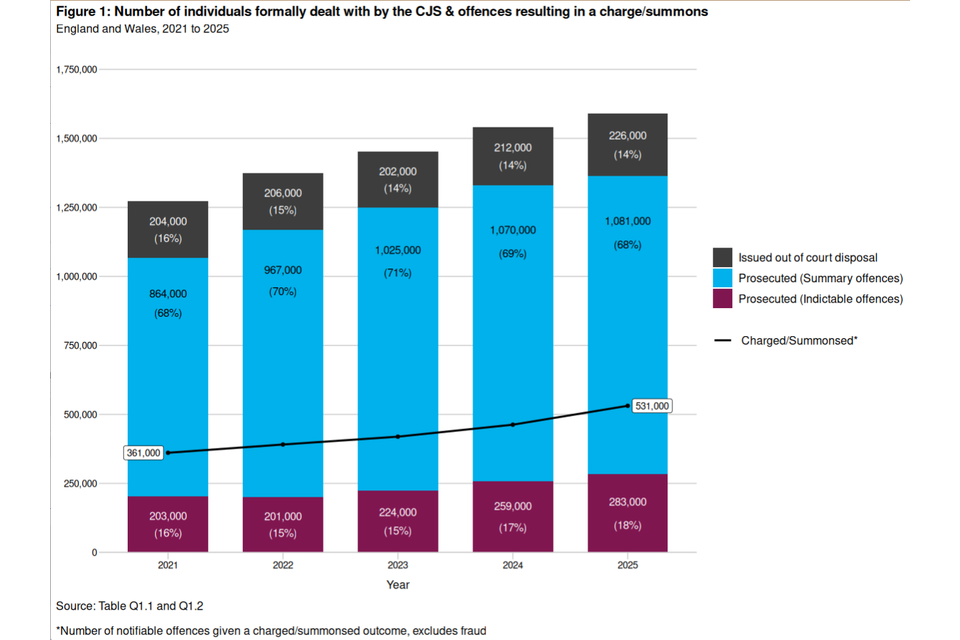
There were 6.38 million crimes recorded by the police in the latest year, this represents a 4% decrease on the previous year but remains well above levels seen a decade ago (4.42 million in 2015). Levels of police recorded crime are influenced by changes in police activity and recording practices. Recent decreases may reflect a stabilisation in recording practices following earlier improvements for some offence types[footnote 3].
In contrast to the fall in recorded crime, the number of crimes that resulted in a charge has continued to increase. Charge volumes increased by 15% in the latest year to 531,200 – this is the highest volume seen since 2015. This has driven the rise in the flow of more serious indictable offences into the courts.
The volume of out of court resolutions (OOCRs) increased by 7% in the latest year, back to similar levels seen in 2017. This is due to continued increases in the use of community resolutions, up 11% on the previous year to a series high at 182,000.
The number of defendants prosecuted and convicted both increased in the latest year, with prosecutions reaching the highest level seen since 2017. Prosecutions for the more serious indictable offences continued to increase and account for a larger proportion of individuals dealt with (18%).
2. Out of Court Resolutions
The volume of out of court resolutions (OOCRs) increased on the previous year from 212,100 to 226,300
The total number of OOCRs issued increased by 7% in the latest year. Police are increasing the use of community resolutions, seen with an 11% increase from 163,700 to 181,700, and a decrease in all other OOCR categories.
Out of court resolutions (OOCRs) are sanctions used by the police to address offences without the need to be dealt with at court. There were around 226,300 OOCRs issued in 2025, which represents an increase of 7% when compared to the previous year.
This rise is due to the continued increase in the use of community resolutions[footnote 4] - with 181,700 issued (an 11% increase) in 2025, representing a series high and accounting for 80% of all OOCRs issued. The largest increases were seen in drug offences (22%) and robbery offences (15%)..
There was a decrease of 8% across all other OOCR types combined when compared to the previous year. Cannabis/khat warnings and penalty notices for disorder (PNDs) decreased by 90% and 15%, respectively, while cautions fell by 6%.
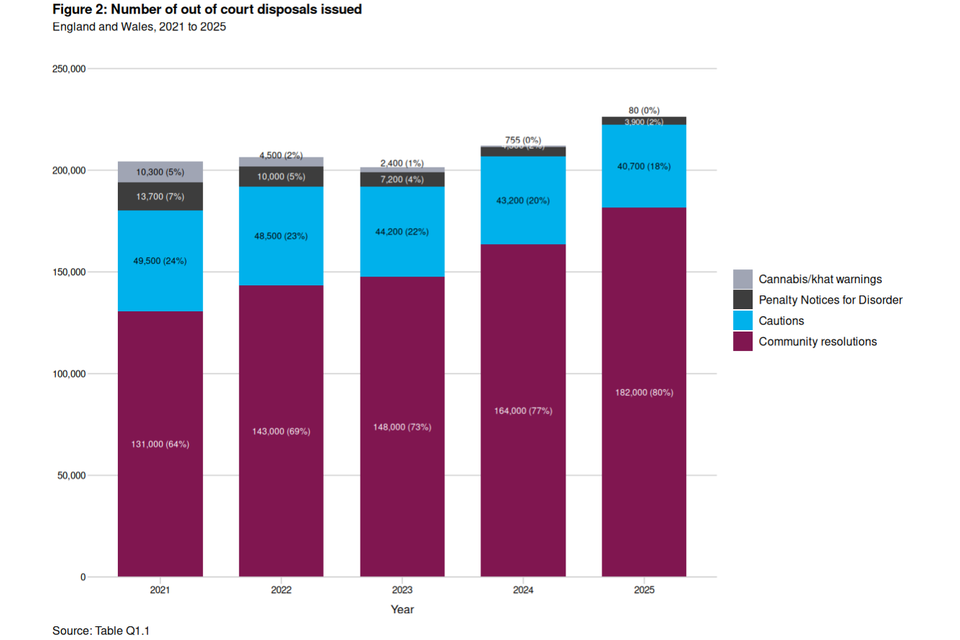
Although caution volumes decreased in most offence groups there were small increases in those issued for Possession of weapons offences (3%) and Public Order offences (7%). The overall cautioning rate[footnote 5] was largely unchanged on the previous year, around 8% which is a series low.
3. Prosecutions & Convictions
Prosecutions increased by 3% and convictions by 1% in the latest year
There was a 9% increase in prosecutions for indictable offences, the highest level seen since 2016.
In 2025, there were 1.36 million defendants proceeded against at magistrates’ courts (including Single Justice Procedure cases), an increase of 3% compared to the previous year and the highest seen since 2017.
The volume of prosecutions for the more serious indictable offences increased by 9%, while the volume of summary offences increased by 1%. The increase in summary offences was driven by a 5% increase in summary motoring offences to 803,000 (a series high).
Prosecutions increased across all indictable offence groups, including 18% increases for sexual offences (up by 2,400) and public order offences (up by 3,500), and 13% increases for drug offences (up by 6,000) and fraud offences (up by 600).
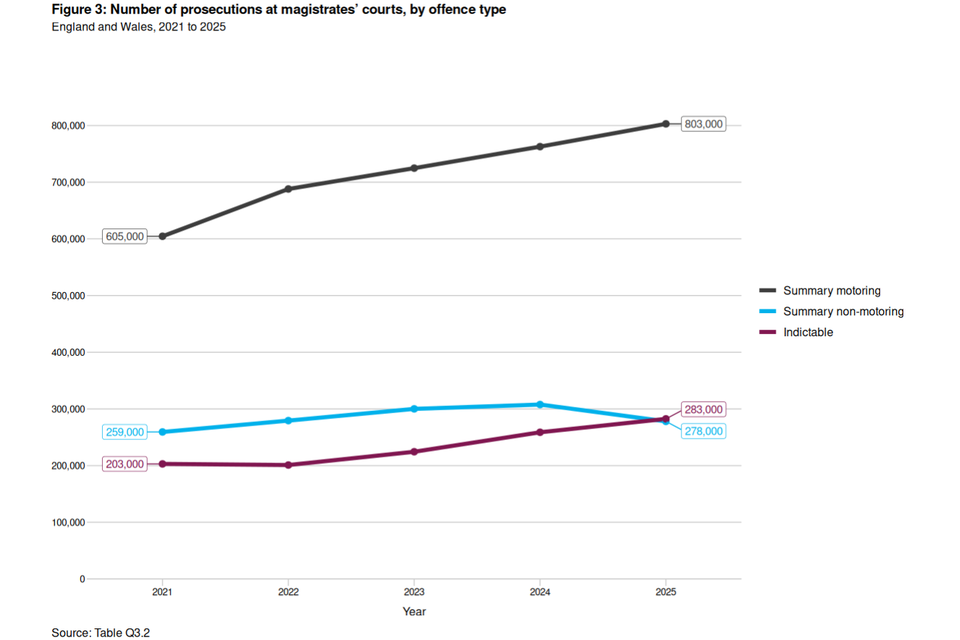
In 2025, 1.20 million offenders were convicted, 1% more than in the previous year. Convictions for indictable offences increased by 8% on the previous year (from 217,200 to 234,200). This is due in part to an increase of over 7,000 defendants convicted for theft offences, up 12%.
Trends in convictions for indictable offences lag prosecutions due to the time taken between completing proceedings in the magistrates’ court (counted as prosecutions) and cases completing at the Crown Court[footnote 6].
4. Remands
Defendants remanded in custody at magistrates’ courts rose to a decade high
The number of defendants remanded in custody at magistrates’ courts rose to 67,000, a series high, though the proportion of those remained stable at 5%.
In most magistrates’ court cases including pre-court the remand decision is either not applicable or unknown (81%), this is reflective of the high volume of Single Justice Procedure cases which are dealt with remotely and where no remand decision is required. At pre-court the proportion of defendants arrested and bailed remained unchanged when compared to the previous year.
At magistrates’ courts, the total volume of those remanded in custody increased 6% from last year and is the highest volume seen in the previous decade (67,000). However, the proportion remanded in custody showed little change on the previous year at 5%. The volume of those remanded in custody for more serious indictable and triable either way offences are at a series high, at 13,100 and 47,500 respectively.
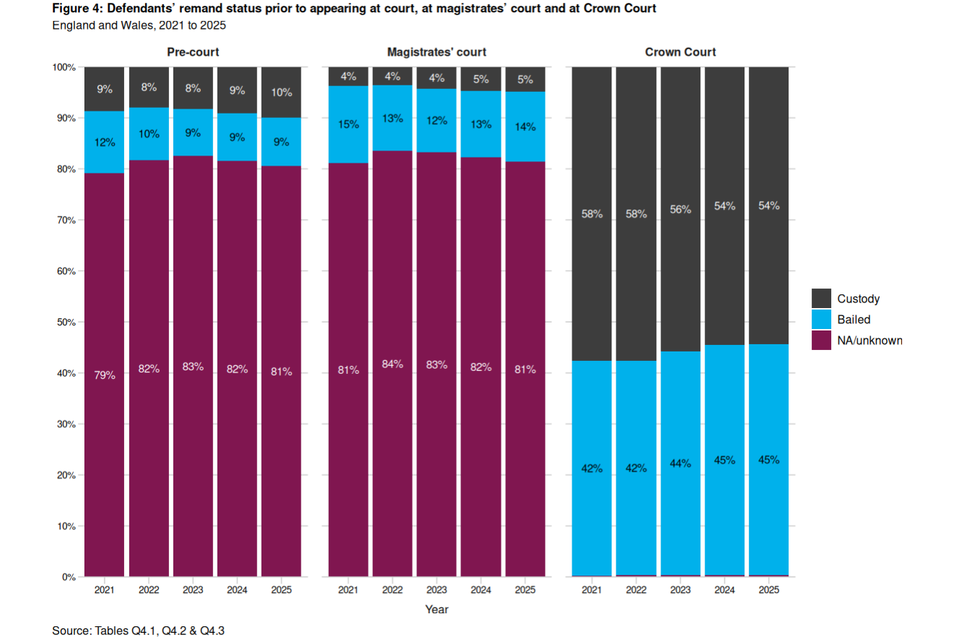
At the Crown Court, the volume of defendants remanded in custody fell slightly to around 57,900 compared to the previous year (58,500). The proportion of defendants remanded in custody remained at 54% in 2025, while bail also remained stable at 45%. Defendants dealt with for indictable offences are more often remanded in custody for reasons such as the severity of offence, risk of further offending and likelihood of failing to appear at court. Of those remanded in custody at the Crown Court, 79% were sentenced to immediate custody or suspended custodial sentence – compared to 52% of those bailed.
5. Sentencing
The average custodial sentence length (ACSL) fell slightly on the previous year for all offence types and indictable offences
The overall decrease in ACSL was partly due to an increase in theft offences, which attract shorter sentences and partly by falls seen across many other offence groups.
There were 1.20 million offenders sentenced in 2025, a 1% increase on the previous year. Most offenders (77%) continued to be sentenced to a fine, with summary motoring offences accounting for 76% of all fines issued.
There were 88,100 offenders sentenced to immediate custody – this represents an increase of 9% on the previous year and is the highest level seen since 2017 (91,400). The custody rate[footnote 7] for indictable offences was unchanged on the previous year (33.3% to 33.5%) but is up more than five percentage points from a decade ago (28%). The highest custody rates in the latest year were seen for robbery and sexual offences, at 60% and 54% respectively.
The proportion of offenders receiving a custodial sentence of less than 12 months remained unchanged at 58%. The volume of custodial sentences of under 12 months increased by 10% and by 8% for sentences of 12 months and over.
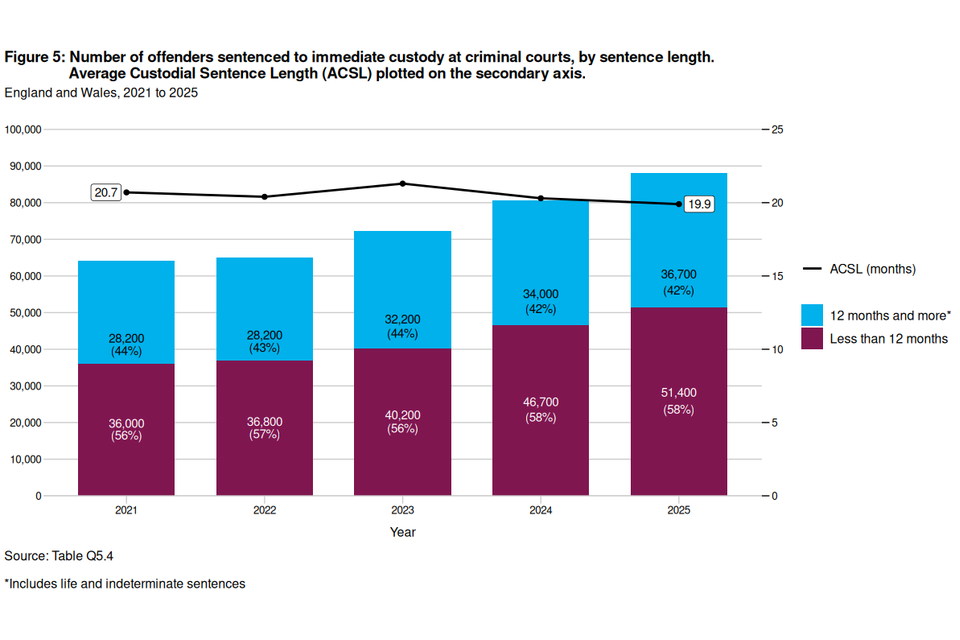
The overall ACSL[footnote 8] was 19.9 months in the latest year, down 0.4 months on the previous year. This is due to the increase in the proportion of theft offences which attract shorter sentence lengths and due to falls seen across other offence groups.
Similarly, the ACSL for indictable offences reduced by 0.4 months to 22.0 months. This included reductions in nearly half of indictable offence groups, most notably a 2 month fall for drug offences. In contrast there has been an increase of nearly 3 months in custodial sentences for criminal damage and arson and over 2 months for both sexual and fraud offences.
6. Motoring
Prosecutions for motoring offences reached a ten-year high to 812,000 in 2025, up 5% from the previous year
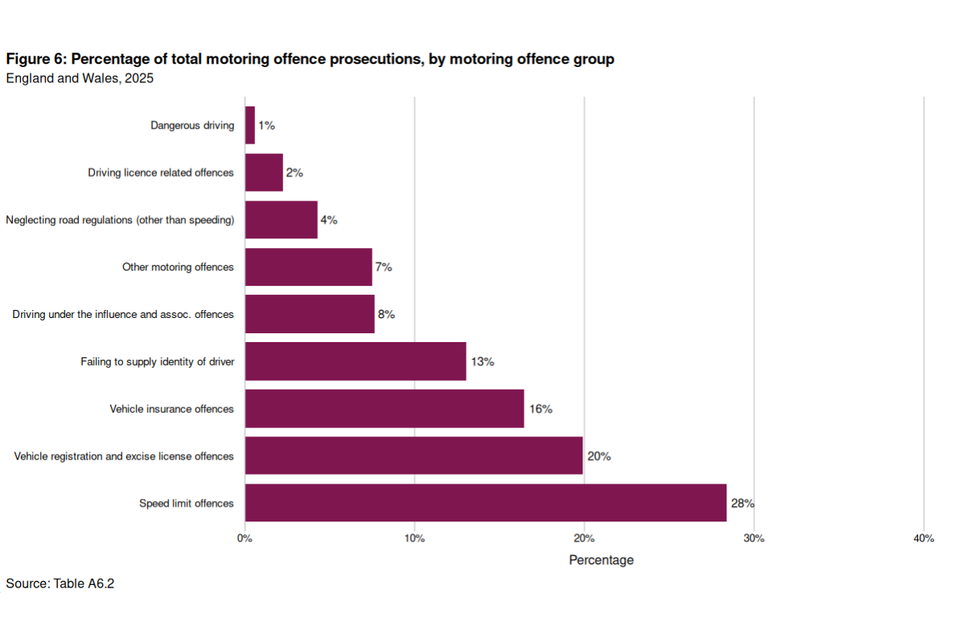
Vehicle insurance offences, vehicle registration and excise licence offences and speed limit offences collectively accounted for 65% of all motoring prosecutions.
In 2025, there were 812,000 prosecutions for motoring offences an increase of 5% compared with 2024 and a 10-year high.
-
The increase in motoring offences prosecutions was due, in part, to a 19% increase in ‘failing to supply information as to identity of driver when required’ (from 88,700 in 2024 to 105,900 in 2025).
-
There was also a 10% increase in vehicle registration and excise licence offences from 147,200 in 2024 to 161,700 in 2025, the highest in its series. This offence includes using or keeping a vehicle without a valid vehicle licence.
-
Prosecutions for dangerous driving increased to a series high of 4,700, up 34% from the previous year.
Vehicle insurance offences, vehicle registration and excise licence offences[footnote 9], and speed limit offences remained the most common motoring offences, collectively accounting for 65% of all motoring prosecutions in 2025 (see Figure 7[footnote 10]). Compared to 2015, vehicle registration and excise licence offences have increased by 98,000, speed limit offences have increased by 51,000, whilst vehicle insurance offences have decreased by 18,500.
Prosecutions for motoring offences which caused death were unchanged on the previous year at 450, 26% above the lowest level seen in 2022. The custody rate for these offences fluctuated between 56% and 68% over the last five years.
Conviction and sentence volumes increased in line with prosecutions. Almost all (95%) sentences for motoring offences were dealt with via a fine. The average fine individuals received for motoring offences increased from £310 in 2024 to £327 in 2025[footnote 11].
The overall custody rate remained unchanged at 1%, with an average custodial sentence length (ACSL) of 10.8 months in 2025, a slight decrease from 11.4 months the previous year. The custody rate has remained broadly stable over the last 10 years, however ACSL has increased over this period from 7.5 months in 2015.
The number of sentenced offenders directly disqualified for motoring offences increased by 29% in the latest year (from 81,000 in 2024 to 104,000 in 2025). In addition, a further 23,800 offenders were disqualified by the penalty points system, a decrease of 33% from the previous year, and 395,000 offenders received points on their licence without a disqualification, an increase of 4% from the previous year.
Further information
Accompanying files
As well as this bulletin, the following products are published as part of this release:
-
A technical guide providing further information on how the data is collected and processed, as well as information on the revisions policy and legislation relevant to sentencing trends and background on CJS.
-
A user guide listing all products alongside this release; this allows easy navigation of all files accompanying this release.
-
A set of overview tables covering each section of this bulletin.
-
A set of interactive tools data and CSV files underpinning all data tools
-
A machine-readable offence group classification document outlining offence groupings.
Accredited official statistics status
National Statistics are accredited official statistics that meet the highest standards of trustworthiness, quality and public value. These accredited official statistics were independently reviewed by the Office for Statistics Regulation in May 2020[footnote 12]. They comply with the standards of trustworthiness, quality and value in the Code of Practice for Statistics and should be labelled as accredited official statistics. It is the Ministry of Justice’s responsibility to maintain compliance with the standards expected for accredited official statistics. If we become concerned about whether these statistics are still meeting the appropriate standards, we will discuss any concerns with the Authority promptly. Accredited official statistics status can be removed at any point when the highest standards are not maintained and reinstated when standards are restored.
Future publications
Our statisticians regularly review the content of publications. Development of new and improved statistical outputs is dependent on reallocating existing resources. As part of our continual review and prioritisation, we welcome user feedback on existing outputs including content, breadth, frequency, and methodology and in particular on the specific issues identified in the introduction. Please send any comments you have on this publication.
Contact
Press enquiries should be directed to the Ministry of Justice press office:
Tel: 020 3334 3536
URL: https://www.gov.uk/government/organisations/ministry-of-justice/about/media-enquiries
Other enquiries about these statistics should be directed to Criminal Courts & Sentencing Data and Statistics team in the Data and Analysis unit of the Ministry of Justice:
Email: CJS_Statistics@justice.gov.uk
Next update: July 2026
URL: https://www.gov.uk/government/collections/criminal-justice-statistics
© Crown copyright
Produced by the Ministry of Justice
Alternative formats are available on request from CJS_Statistics@justice.gov.uk
-
An individual (includes companies) can be counted more than once in a year if dealt with by the CJS on multiple separate occasions. ↩
-
The number of individuals formally dealt with by the CJS is the sum of all defendants prosecuted at magistrates’ court plus all individuals issued an out of court disposal (including cautions, Penalty Notice for Disorder, cannabis/khat warning and community resolutions). ↩
-
For more detail, please see ONS User Guide to crime statistics for England and Wales. ↩
-
Some police forces have moved to reduce the types of out of court disposals used for adult offenders. In these areas, the only out of court disposals used are community resolutions and conditional cautions. Cannabis/Khat warnings will not be used. ↩
-
The cautioning rate represents the percentage of offenders (those either cautioned or convicted, excluding motoring offences) who received a caution. ↩
-
It is not advised to use this data to calculate conviction rate (the number of convictions as a proportion of total prosecutions). This is due to the Court Proceedings Database counting two separate records at two separate stages (one at magistrates’ court, one at Crown Court). An individual may be convicted in a different year from when they were initially prosecuted, or the principal offence may differ between these stages. As a result, this rate is not an accurate measure of the proportion of prosecutions that result in a conviction. ↩
-
Custody rate reflects the percentage of offenders that received an immediate custodial sentence. It is calculated by dividing the number of offenders issued an immediate custodial sentence, by the total number of offenders sentenced. ↩
-
Average Custodial Sentence Length is calculated by dividing the total combined custodial sentence length imposed (in months), by the number of offenders sentenced to immediate custody. This calculation excludes suspended sentences, life sentences, other indeterminate sentences, custodial sentences recorded as 60 years or more (which are assumed to be administrative errors) and custodial sentences where the sentence length is unknown. ↩
-
The Home Office publishes data in relation to motoring offences including fixed penalty notices (FPNs) for speeding in Police powers and procedures England and Wales statistics. FPNs are out of court disposals where the speeding offence is not serious enough to warrant a criminal court proceeding and where the offender does not contest being issued with the FPN. ↩
-
Other motoring offences include: Causing danger by interfering with a vehicle, road or traffic equipment, Using or causing others to use a mobile phone whilst driving, Careless driving offences, Failing to stop or provide information after accident, Theft of a motor vehicle/aggravated vehicle taking, Work record and employment offences, Fraud, forgery etc. associated with vehicle or driver records, Defective vehicle parts, Vehicle test offences, Miscellaneous (other) motoring offences, Causing death by dangerous driving and Causing injury by dangerous driving. ↩
-
Average fine calculation excludes companies, public bodies, etc ↩
-
Office for Statistics Regulation: Proven re-offending and criminal justice system statistics ↩