Criminal court statistics quarterly: October to December 2025
Published 26 March 2026
Applies to England and Wales

© Crown copyright 2026
This publication is licensed under the terms of the Open Government Licence v3.0 except where otherwise stated. To view this licence, visit nationalarchives.gov.uk/doc/open-government-licence/version/3 or write to the Information Policy Team, The National Archives, Kew, London TW9 4DU, or email: psi@nationalarchives.gov.uk.
Where we have identified any third party copyright information you will need to obtain permission from the copyright holders concerned.
This publication is available at https://www.gov.uk/government/statistics/criminal-court-statistics-quarterly-october-to-december-2025/criminal-court-statistics-quarterly-october-to-december-2025
Main Points
| The open caseload in the magistrates’ Court increased to a series peak | Receipts have remained above disposals throughout the year, meaning the open caseload rose by 4% in the latest quarter and by 17% in the latest year, to a series peak of 379,437. |
| The open caseload in the Crown Court increased to a series peak | Receipts have remained above disposals throughout the year, meaning the open caseload rose by 1% in the latest quarter and by 8% in the latest year, to a series peak of 80,203. |
| Crown Court: increase in cases open for a year or more | Median age of open cases continued to increase, up 13 days (7%) on the previous quarter and up 23 days (14%) on the previous year. The number of cases open for a year or more exceeded 21,000 for the first time. |
| Ineffective trial rate stable at higher levels | Ineffective rate remained broadly stable at the magistrates’ courts post-COVID (22%) and at the Crown Court (26%). Both continue to be well above pre-COVID levels. |
| Timeliness increased at the magistrates’ courts | Median time from charge to completion at the magistrates’ courts increased by 16 days (40%) on the previous year, rising from 40 to 56 days. |
| Timeliness increased at the Crown Court | Median time from charge to completion at the Crown Court increased by 9 days (5%) on the previous year, rising from 172 to 181 days. |
The technical guide to ‘Criminal court statistics’ and ‘Language interpreter and translation services in courts and tribunals’ can be found at the links below:
https://www.gov.uk/government/publications/a-guide-to-criminal-court-statistics
Statistician’s comment
This report covers the period to the end of December 2025.
The demand entering the criminal courts remained high and continues to outstrip disposal volumes. As a result, open caseloads continued to grow to series peaks at both the magistrates’ courts and the Crown Court - passing 80,000 for the first time at the Crown Court.
In addition, the age of the open caseload at the Crown Court continues to increase, with a higher proportion of cases open for a year or more.
Trial ineffectiveness remained high at both the magistrates’ courts and the Crown Court, with 22% and 26% of listed trials needing to be rescheduled.
Timeliness from charge to completion continued to rise. At the Crown Court this has returned to levels seen in early 2024. Whereas at the magistrates’ courts timeliness increased considerably for Single Justice Procedure cases, causing overall timeliness to approach levels last seen in 2021.
Changes to note
Developments for both jurisdictions:
1. Addition of vacated trial reasons to the Trial effectiveness at the criminal courts tool
The tool previously contained reasons for ineffective and cracked trials but not for vacated trials. We have added in reasons for trial vacation for both the magistrates’ courts and the Crown Court.
A vacated trial is a trial which has been removed from the trial list before the date of the trial (excluding warned list cases). We have included reasons for trial vacation to show where vacations occur because a trial has been rescheduled ahead of the listed start date and to show instances where a trial is no longer required.
2. Addition of England as a geographic breakdown
Following multiple Parliamentary Questions and Freedom of Information requests asking for data regarding England, we have added this as a breakdown to several of our pivot tables.
Under the ‘Geographic area’ filter, we have added England as a breakdown to differentiate from England & Wales for the Crown Court plea, Crown Court average waiting and hearing time, Crown Court open case duration, Magistrates’ courts timeliness and End-to-end timeliness (Crown Court) tools.
Magistrates’ courts data developments:
3. One Magistrates project
Following the improvements to data quality and coherence seen as a result of the One Crown project, alongside HMCTS we have commenced the One Magistrates project. This project will review all data we publish concerning the magistrates’ courts and aims to improve quality, coherence and value for users. There is the potential for the magistrates’ courts data series to change as the project develops – we will continue to consult users and outline key areas of change in future releases of this bulletin.
4. Unknown location for magistrates courts receipts
There is an increase in the volume of unknown locations for Single Justice Procedure (SJP) receipts in recent quarters. This is because some SJP receipts are initially held in a ‘National Stack’ of cases for 28 days until they are dealt with by a region, unless a plea is entered before then. Cases are allocated a location upon receipt and so these ‘National Stack’ cases appear in the unknown category.
Crown Court data developments:
5. One Crown project
We have carried out two consultations regarding the One Crown project and the resultant changes to the Crown Court data. We received no external concerns at the definitional changes or impacts on published series. The One Crown project has concluded and we are not expecting any further changes to the published measures as part of this work.
Work remains ongoing to consider the reintroduction of data regarding Representation Status and Grounds for Sending and further updates concerning proposed changes to annual measures will be communicated in due course.
1. Criminal cases in the magistrates’ courts
Open caseload at the magistrates’ courts increased to a new series peak
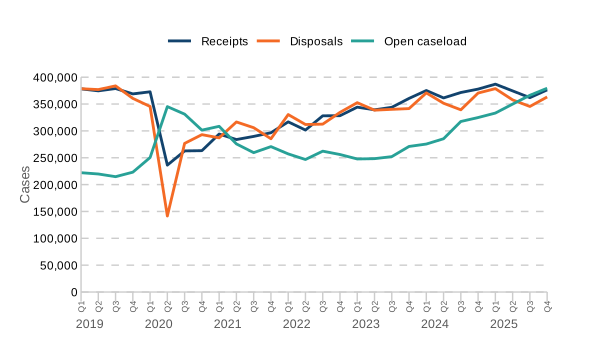
Receipts were unchanged and disposals decreased slightly by 2% on the previous year. Receipts remained above disposals, causing a 17% increase in the open caseload to a series peak of 379,437.
Figure 1: Magistrates’ courts caseload, Q1 2019 – Q4 2025 (Source: Table M1)
Magistrates’ courts caseload
Receipts and disposals have both tended to rise from series lows in Q2 2020 when the initial measures were put in place to manage the immediate risks of the COVID-19 pandemic in courts[footnote 1][footnote 2][footnote 3]. More recently, receipt and disposal levels have maintained higher levels, close to those last seen in 2019.
-
There were 376,339 cases received into the magistrates’ courts in Q4 2025. This is up 4% on the previous quarter (361,898) and stable on the previous year (377,810). Triable-either-way and summary motoring offences saw an increase in receipts by 7% and 9% respectively compared to the previous year, whereas summary non-motoring receipts fell by 17%. When looking at Single Justice Procedure cases, receipts increased by 5% on the previous quarter but fell by 2% on the previous year.
-
There were 363,165 disposals at the magistrates’ court in Q4 2025. This is up 5% on the previous quarter (345,473) but down slightly on the previous year (2% from 370,465). Whilst the volume of trial disposals remained broadly unchanged on the previous year, there was a 13% increase in summary motoring and 22% decrease for summary non-motoring cases. When looking at Single Justice Procedure cases, disposals were up 12% on the previous quarter stable on the previous year.
At the end of December 2025 there were 379,437 open cases at the magistrates’ courts, a peak since the comparable series began in 2019. This represents a 4% increase on the previous quarter (366,315) and a 17% increase on the previous year (324,846). The annual increase was largely due to by a 30% increase in triable-either-way and a 22% increase in open summary motoring cases.
-
The latest open caseload volume roughly equates to around three months of disposals, based on latest disposal levels and not factoring in any receipts during this period.
-
Since the end of 2021, SJP cases have tended to make up around 50% of the open magistrates’ courts caseload. SJP disposals exceeded receipts in the latest quarter by 3,062 however this goes against the general trend seen in recent years. Whilst the open SJP caseload fell by 2% on the previous quarter, it remains 15% above levels seen in Q4 2024.
Trial efficiency at magistrates’ courts
Trial efficiency measures at the magistrates’ courts remained broadly unchanged compared to the previous year - 39% were effective, 39% cracked and 22% ineffective.
Following a step change from 17% to 23% across 2020 and 2021, the ineffective trial rate has stabilised at this higher level, ranging between 22% and 23%.
- The largest contributing ineffective reasons this quarter were overlisting (23%), defendant absence (10%), the defence not being ready (10%) and other cases overrunning (10%).
Figure 2: Magistrates’ courts listed trials and ineffective trial rate (%), Q1 2014 – Q4 2025 (Source: Table M2)
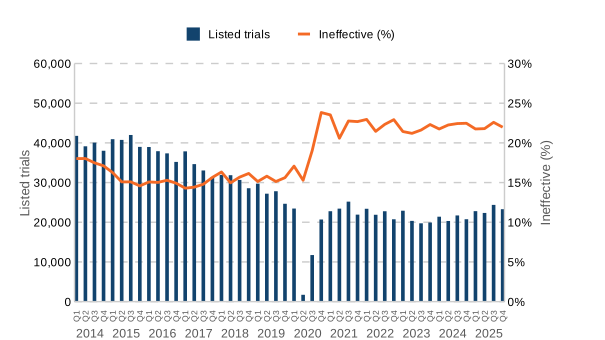
There were 4,863 vacated trials in the latest quarter, unchanged on the previous quarter but 11% higher than the previous year (4,387). Volumes remain well below the peak seen during COVID-19 (13,247 in Q2 2020) and have remained broadly stable since Q3 2024.
Reasons for vacated trials – magistrates’ courts
This is the first release to include vacated trial reasons. A vacated trial is a trial which has been removed from the trial list before the trial date (excluding warned list cases). We have included reasons for trial vacation to help provide a more complete picture of reasons for trial listing outcomes and bring this series in line with existing reporting for cracked and ineffective trials.
Half of vacated trials were due to the prosecution discontinuing the case prior to trial, 21% due to an anticipated lack of court time and 12% due to the defendant changing their plea to guilty.
2. Criminal cases in the Crown Court
Open caseload at the Crown Court increased to a new series peak
Receipts were unchanged and although disposals increased on the previous year they remain below receipts. As a result, the open caseload continued to increase, up 8% on the previous year to a series peak of 80,203 cases.
Crown Court caseload
Increased throughput and a continued increase in demand from the magistrates’ courts saw receipts rise to a quarterly series peak of 31,747 in Q3 2024. This level of demand has persisted across both 2024 and 2025, with quarterly receipts exceeding levels seen prior to COVID.
Figure 3: Crown Court caseload, Q1 2016 – Q4 2025 (Source: Table C1)
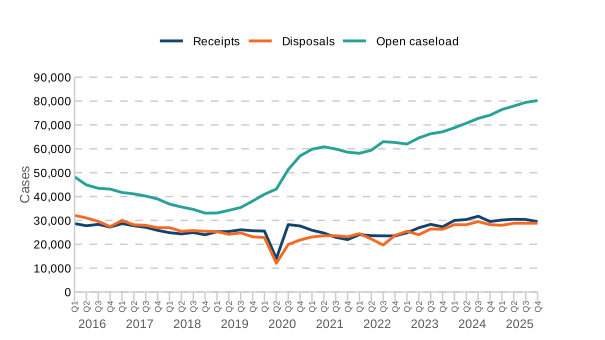
There were 29,482 cases received into the Crown Court in Q4 2025, similar to the same quarter in 2024 (29,527).
-
Whilst receipt levels overall remained broadly similar, there was an increase of 4% in indictable only (4%) and sentence cases (2%) on the previous year. Receipts for triable-either-way cases fell 5% over the same period.
-
Violence against the person offences continue to be the largest contributing offence group with 7,980 receipts in the period accounting for 27% of all cases received. However, the volume of receipts decreased by 5% on the previous year.
-
There were notable proportionate increases in the volume of receipts for sexual offences (19%) and public order offences (10%) compared to Q4 2024. When looking specifically at rape offences, the number of receipts reached 1,280 representing an 18% increase on the previous year, slightly below the series peak seen in the previous quarter (1,373).
There were 28,812 cases disposed of at the Crown Court in Q4 2025, representing a 2% increase on the previous year. Overall annual disposal volumes remained similar in 2024 and 2025.
-
The largest proportionate increase in disposals was seen in appeals cases, which increased by 9% on the previous year, while trial case disposals increased by 5%.
-
The largest proportionate increase in disposals for an offence group was sexual offences, with a 12% increase on the previous year. Robbery offences saw the second largest percentage increase at 8%, followed by violence against the person which rose by 5% - reaching a series peak of 8,244.
The open caseload reflects the workload in the courts at a given time. It will never be zero, as it reflects the volume of cases that are active in the courts at a particular point, including those recently received, those close to being disposed, those which are complex and take time to complete and those that may be delayed. It is useful to consider timeliness and volumes of receipts and disposals alongside the open caseload for important context.
At the end of December 2025 there were 80,203 open cases at the Crown Court. This is a series peak and continues increases seen since Q1 2023. This represents a slight increase on the previous quarter (79,446 cases), 8% on the previous year (74,106 cases) and is more than double the level seen in 2019 (38,108).
The latest open caseload volume broadly compares to around eight months of disposals, based on latest disposal levels and not factoring in any receipts during this period.
-
The open caseload either increased or remained at the same level for each offence group. The largest proportionate increases compared to the previous year were seen for sexual offences (24%). Public order offences and fraud offences both increased by 13% and violence against the person rose by 7%.
-
The increases in open caseload volumes can be seen for almost all regions compared to the previous year. London reported the largest open caseload at 19,339 – this represents a series peak and an increase of 21% on the previous year (15,966). The North West was the only region to see a decrease in open caseload over the last year, with a fall of 2%.
Age of open caseload
The age of an open case is calculated from the date of receipt at Crown Court to the end of the reporting period.
At the end of December 2025, the median age of an open case was 188 days, this represents a 7% increase on the previous quarter (175 days) and a 14% increase on the previous year (165 days). This remains well above pre-COVID levels (90 days in 2019) and is close to the series peak of 190 days seen at the end of December 2021.
Figure 4: Average age of open cases at the Crown Court, Q1 2016 – Q4 2025 (Source: Table O1)

-
There were 21,002 cases that had been open for a year or more, accounting for 28% of all open cases. The volume has increased by 27% on the previous year (16,584) and 5% on the previous quarter (20,052). It is the first time the number of cases open for a year or more has exceeded 21,000.
-
The offence groups with the highest proportion of cases open for a year or more were fraud (38%), sexual offences (32%) and miscellaneous crimes against society (30%).
Figure 5: Proportion of open cases at the Crown Court by grouped age, Q1 2016 – Q4 2025 (Source: Table O3)

Trial effectiveness at Crown Court
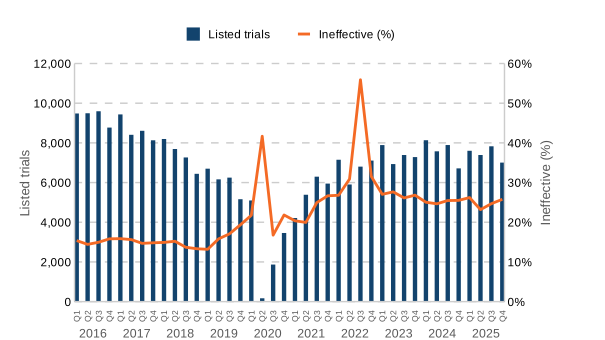
There were 7,006 trials listed to start in Q4 2025 – an increase of 4% on the previous year. The proportion of effective trials which commenced as planned remained stable at 42%. The rate has been fairly consistent since the start of 2023 (ranging between 42% and 46%) but remains below rates seen pre-COVID which averaged around 50%.
The percentage of trials which were not required (cracked) or were rescheduled (ineffective) remained stable at 32% and 26% respectively.
There was a step-change in the ineffective trial rate seen prior to 2020, ranging around 13-19%. Rates have subsequently stabilised at around 23% to 26% since the start of 2024.
When looking at the reasons for trial ineffectiveness, overlisting remained the largest contributor (26%), followed by the defendant being absent (11%) and the prosecution not being ready (10%).
Reasons for vacated trials – Crown Court
This is the first release to include vacated trial reasons. A vacated trial is a trial which has been removed from the trial list before the trial date (excluding warned list cases). We have included reasons for trial vacation to help provide a more holistic picture of reasons for trial listing outcomes and bring this series in line with existing reporting for cracked and ineffective trials.
There were 5,788 vacated trials in the latest quarter, unchanged on the previous quarter but 19% higher than the previous year (4,881). The volume in the latest quarter represents a series peak, with the volume increasing quarter-on-quarter since Q2 2023.
Around a third (33%) of vacations were due to the defendant changing their plea to guilty, 19% due to the prosecution discontinuing the case prior to the trial date and 14% due to an anticipated lack of court time.
Figure 6: Crown Court listed trials and ineffective trial rate (%), Q1 2016 – Q4 2025 (Source: Table C2)
Guilty plea rate
The guilty plea rate is the number of defendants in for trial cases which have been disposed who entered a guilty plea to all counts as a proportion of all those who entered a plea.
In Q4 2025 there were 11,614 defendants dealt with following a guilty plea – this represents a guilty plea rate of 61% and is in line with levels seen since the start of 2023 (60% - 62%).
-
There were 3,935 defendants dealt with via a jury trial following a not guilty plea, accounting for 20% of all defendants entering a plea and is in line with levels seen since 2022 (18% - 22%).
-
Defendants dealt with via a jury trial following a not guilty plea in the Crown Court represented 3% of all trial cases disposed of at the Crown Court and the magistrates’ courts. If all case types are included (appeals, sentence and SJP cases), this proportion drops to 1% of all cases.
-
There were 3,343 defendants whose case was dropped, accounting for 18% of defendants with a known plea. This proportion has remained broadly consistent since 2023 but has increased notable from levels seen pre-COVID (10%).
Average waiting time at the Crown Court
Waiting time is the duration between case receipt and first main hearing for all defendants dealt with at the Crown Court. The waiting time estimates are a ‘lagged’, backwards looking measure counted at the point of disposal.
The median waiting time for all defendants dealt with at the Crown Court was 9.6 weeks in Q4 2025. This is unchanged on the previous year and remains well above pre-COVID levels (7.7 weeks in Q4 2019).
-
For those defendants dealt with via a jury trial following a not guilty plea, the median waiting time was 48.9 weeks. This represents a 9% increase on the previous year and is much higher than the time seen pre-COVID (27.1 weeks in Q4 2019).
-
The median waiting time across case types for defendants remanded into custody was 10.3 weeks compared to 13.0 weeks for those on bail throughout.
Average hearing time at the Crown Court
Hearing time refers to the total duration of all hearings heard in the Crown Court for a case including preliminary, main and sentence hearings. Hearing time estimates are a ‘lagged’, backwards looking measure for completed cases.
Both median and mean hearing time for all cases completed at the Crown Court have increased over the past year, rising by 4% and 5% respectively to 1.0 hours and 3.3 hours.
-
The mean increased to 17.0 weeks for jury trial cases where a not guilty plea was entered – this represents a 3% increase on the previous year (16.4 weeks).
-
The longest average hearing time in jury trial cases where a not guilty plea was entered was for fraud offences, with a median of 18.4 hours and a mean of 58.1 hours.
3. Timeliness
Time from charge to completion has increased in both the magistrates’ courts and the Crown Court
At the magistrates’ courts, the median time from charge to completion increased by 40% on the previous year, rising from 40 to 56 days. At the Crown Court it increased by 5% on the previous year, rising from 172 to 181 days.
The timeliness measures are based on defendants whose cases have completed and as such are ‘backwards’ looking measures of timeliness between offence and completion at the relevant criminal court jurisdiction.
Magistrates’ courts timeliness
Timeliness at the magistrates’ courts measures the time from an offence being committed through key stages of the criminal justice system including charge or laying of the information, first listing and the subsequent completion of a defendant’s case at the magistrates’ court.
We see increases in timeliness across most stages, which is largely due to trends seen for Single Justice Procedure cases. In the latest quarter, almost 216,000 defendants were dealt with via SJP (68% of all defendants dealt with at the magistrates’ courts excluding breaches and those sent to the Crown Court), compared to 115,000 defendants via non-SJP.
The time from offence committed through to completion provides a useful estimate of the total time a victim of crime will have waited to reach a court outcome. This includes time spent prior to an offence being reported to the authorities and time taken for investigation.
-
Timeliness from offence to completion increased by 3% on the previous year from 190 to 196 days, with the level approaching the series peak of 199 days seen in Q1 2022.
-
There was an observed increase for defendants dealt with via SJP (6%) but a decrease of 16% for those not dealt with via SJP compared to the previous year.
The time from charge to completion provides an estimate of the time that criminal justice agencies have spent progressing a case through to reaching an outcome at court.
-
Timeliness from charge to completion increased sharply by 40% from 40 to 56 days. This is well above pre-COVID levels, which stood at around 35 days in 2019. The increase from charge to completion was seen mostly in SJP cases, rising 50% from 38 to 57 days, while non-SJP cases increased by a much smaller 7% from 44 to 47 days.
-
Most of the increase is seen in the time required for Single Justice Procedure (SJP) cases to reach court. The time from charge to first listing for SJP cases increased 60% on the previous year, from 35 to 56 days. Whereas timeliness for non-SJP cases decreased by 16% over the same period, from 159 to 134 days.
-
The observed increase in timeliness for SJP cases follows all police forces migrating SJP casework to the Common Platform system from December 2024. Once the new process has fully embedded, we would expect timeliness to return to previous levels.
Figure 7: Average number of days from offence to completion for defendants dealt with at the magistrates’ courts by stage, Q1 2016 – Q4 2025 (Source: Table T3)
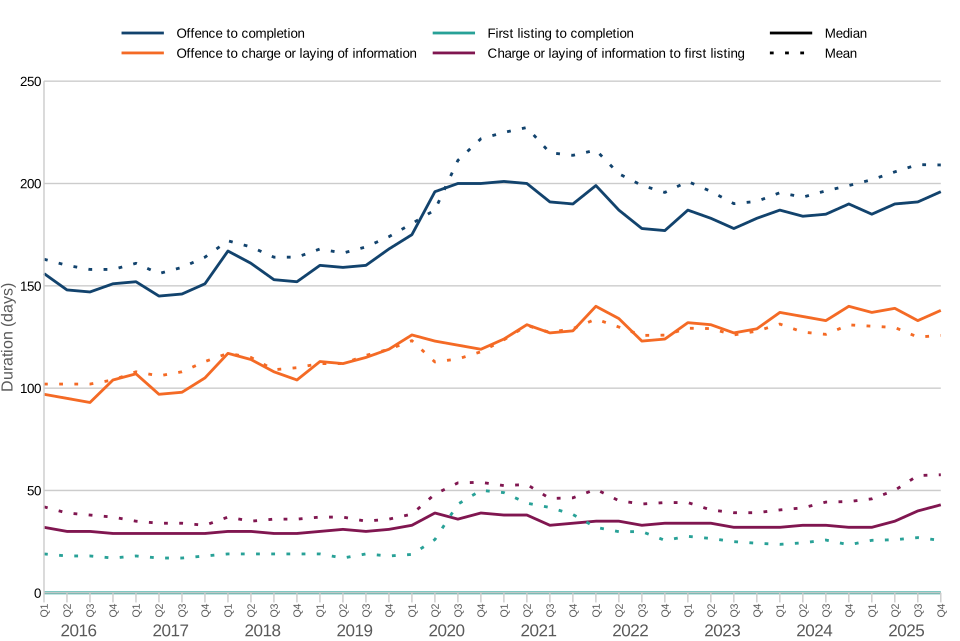
Time spent from first listing to completion (‘At court’) is short with most cases concluding on the same day as the first listing. This is particularly the case for defendants dealt with via the SJP.
- The median time spent ‘At court’ remained at 0 days for SJP cases and 3 days for non-SJP cases. When looking at the mean, ‘At court’ time increases to 8 days for SJP and 63 days for non-SJP cases, reflecting the fact that a small proportion of cases take a lot longer than one day.
Crown Court timeliness (“End-to-end”)
End-to-end timeliness measures the time from an offence being committed through key stages of the criminal justice system including prior to report, investigation, charge, passage through the magistrates’ courts and subsequent completion of a defendant’s case at the Crown Court. The estimates are created by linking magistrates’ courts and Crown Court data outputs from legacy systems to create an ‘end-to-end’ defendant journey across key stages of the criminal justice system.
The time from offence committed through to completion provides a useful estimate of the total time a victim of crime will have waited to reach an outcome at the Crown Court.
- The median duration from offence to completion for defendants dealt with at the Crown Court increased by 11% over the last year, from 313 to 346 days. This is 15% below a series high of 405 days in Q1 2022 but remains above 2019 levels (254 days).
Figure 8: Average number of days from offence to completion for defendants dealt with at the Crown Court, Q1 2016 – Q4 2025 (Source: Table T4)
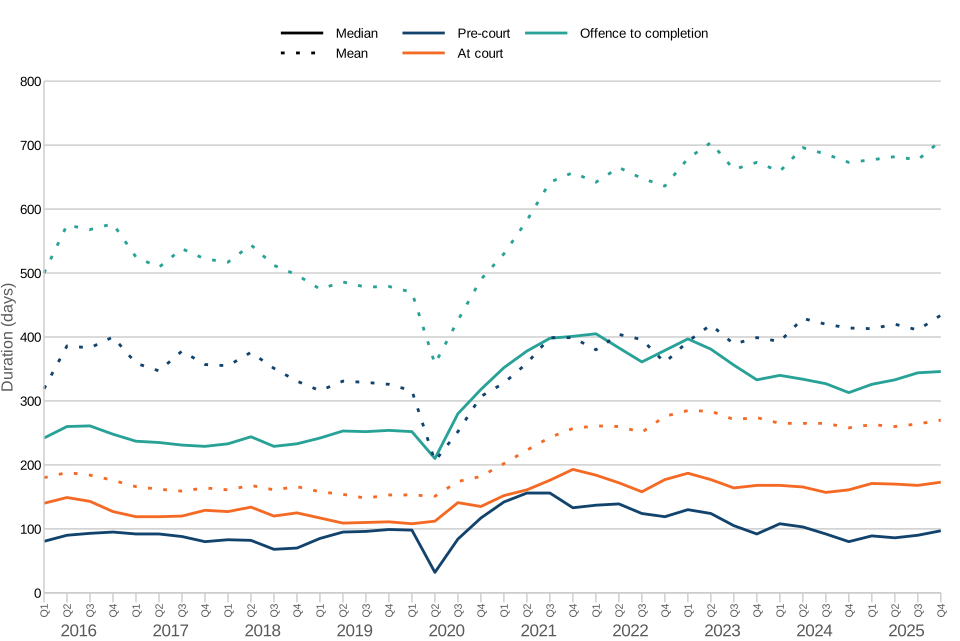
The time from charge to completion provides an estimate of the time that criminal justice agencies have spent progressing a case through to reaching an outcome at court.
The median time from charge to completion for defendants dealt with at the Crown Court in Q4 2025 was 181 days, up 5% on the previous year (9 days). This has fallen from peaks of 222 days (Q4 2022) and has broadly stabilised, ranging between 170 and 181 days since Q3 2023.
For defendants dealt with via a jury trial following a not guilty plea, the median duration from charge to completion was 435 days – this is up 10% on the previous year (397 days) and is nearing the series peak of 448 days seen in Q2 2023. The mean was 530 days, up 5% on the previous year.
The median time from receipt to completion for defendants dealt with at the Crown Court was 164 days, up 9% on the previous year (150 days). This has remained relatively stable since Q3 2021, with some fluctuation between quarters, ranging from 144 to 175 days.
For defendants dealt with via a jury trial following a not guilty plea, the median duration from receipt to completion was 410 days, up 11% on the previous year (370 days) and almost matching the series peak of 411 days seen in Q2 2023. The mean was 494 days, up 6% on the previous year.
4. Language interpreter and translation services
Completed language service requests fell on the previous year
There were 50,007 completed requests in Q4 2025, down 6% on the previous year. The success rate stayed the same as the previous year at 96%. These figures cover the whole of the Ministry of Justice and not just the criminal courts.
As well as the data included in this bulletin, the Cabinet Office also publish Key Performance Indicator (KPI) data on all central government contracts including those delivering the MOJ language interpreter and translation services. There are 12 KPIs covering four contract lots, with the same scope as the published official statistics. The Cabinet Office provide a quarterly snapshot of supplier performance against contract terms and more closely track operational delivery of the contract.
These KPIs are produced using similar underlying data sourced from contract providers but they serve a different purpose to the official statistics. The official statistics provide a broader view of the contracted service and provide longer-term and more granular breakdowns of trends in booking volumes, fulfilment, complaints and off-contract use. Both KPIs and official statistics can be used together to provide a coherent picture of performance under these contracts, albeit some of the measures will not be directly comparable.
Please see A Guide to language interpreter and translation services statistics for further information on the differences between the metrics published.
Key links:
MOJ Language Interpreter and Translation Service statistics (Tables L1-L3): Criminal court statistics- GOV.UK (see Tables document)
- L1 – Request fulfilment
- L2 – Complaints
- L3 – Off contract requests
MOJ Trial Effectiveness Tool: Criminal court statistics - GOV.UK (see Trial effectiveness at the criminal courts tool)
- Reason 29: Ineffective reason: No interpreter available
Cabinet Office KPI data: Key Performance Indicators (KPIs) for government’s most important contracts - GOV.UK
The Cabinet Office publish KPI data quarterly by financial year and it is available from 2020 Q1. To find data relating to interpreters and language services you can search for ‘Translation and Transcription’, ‘Language Services Lot 1’, ‘Language Services Lot 3’ and ‘Language Services Lot 4’ within the ‘Contract title and description’ column. Alternatively, you can search for the individual suppliers under the ‘Supplier’ column: ‘thebigword Group’, ‘Clarion Interpreting Ltd’ and ‘the Language Shop’.
Completed service requests
The volume of completed service requests fell back from the peak seen in Q1 2025 (down 9% to 50,007) and is also below the level seen in the previous year by 6%.
The proportion of requests that were unfulfilled has decreased from a peak of 8% in Q3 2024 to 3% in the most recent quarter. A spike was observed in Q2 and Q3 of 2024, with unfilled requests around 2,000 higher than other quarters. This period was impacted by a booking portal update in June 2024, aimed at resolving responsiveness, which caused unexpected short-term issues. Although resolved quickly, this temporarily impacted fulfilment rates earlier in 2024.
The success rate in Q4 2025 remained stable, falling slightly to 96% when compared to 97% in the previous three quarters.
The number of cancelled requests (11,668) fell by 3% on the previous quarter and by 23% compared to the previous year.
Figure 9: Number of completed language service requests and overall success rate, Q1 2014 – Q4 2025 (Source: Table L1)

Complaints and complaint rate
There were 186 complaints made in Q4 2025. This represents a decrease of 20% on the previous quarter and 59% on Q4 2024 (455). The overall complaint rate was 0.4% in the latest period and has remained below 1% since Q2 2020.
Ineffective trials due to interpreter availability
An ineffective trial is one that does not go ahead on the scheduled trial date, and a further listing is required. This can be due to action or inaction by one or more of the prosecution, the defence or the court.
Statistics regarding the volume of criminal court trials which are rescheduled on the planned start date due to interpreter availability are published as part of the trials efficiency tool covering both magistrates’ courts and the Crown Court. The trials data is collected as part of the quarterly trial efficiency measures and it is not directly connected to the source of interpreters data - as such the two sets of series are not directly comparable.
In Q4 2025, 192 trials were ineffective due to interpreter availability across both magistrates’ courts and the Crown Court. This is 7% higher than the previous year (180) and continues to account for a relatively small volume of all listed trials (0.6%).
‘Off-contract’ requests
‘Off-contract’ requests are those which are procured outside of the contracted services where fulfilment cannot be achieved by the supplier.
There were 3,363 ‘off-contract’ requests in Q4 2025, this represents an increase of 21% on the previous quarter (2,778) but is 6% below levels seen last year (3,589).
The MoJ undertook a review of the off-contract data collection methods, which improved the robustness of the series from Q2 2024 onwards. This change led to a higher baseline of activity than previously reported prior to this quarter.
Further information on criminal court data
The data presented in this publication are from live administrative databases. Therefore, previously published data is liable to be updated in the latest bulletin, following any further data cleaning or the incorporation of additional cases not available in the extracts used to produce previous bulletins.
Accompanying files
As well as the bulletin, the following products are published as part of this release:
-
Technical guides providing background information and standalone quality guide.
-
A set of overview tables, covering each section of this bulletin.
-
Pivot tools and underlying data which feature further breakdowns of published data.
Accredited official statistics status
Accredited Official Statistics are called National Statistics in the Statistics and Registration Service Act 2007. These Accredited Official Statistics were independently reviewed by the Office for Statistics Regulation (OSR) in March 2025[footnote 4]. They comply with the standards of trustworthiness, quality and value in the Code of Practice for Statistics and should be labelled as accredited official statistics.
It is the Ministry of Justice’s responsibility to maintain compliance with the standards expected for Accredited Official Statistics. If we become concerned about whether these statistics are still meeting the appropriate standards, we will discuss any concerns with the Authority promptly. Accredited Official Statistics status can be removed at any point when the highest standards are not maintained and reinstated when standards are restored.
Official statistics in development status
Official statistics in development are official statistics that are undergoing a development; they may be new or existing statistics, and will be tested with users, in line with the standards of trustworthiness, quality, and value in the Code of Practice for Statistics. Until September 2023, they were called ‘experimental statistics’. Official statistics in development are developed under the guidance of the Head of Profession for Statistics (HoP). The goal is to develop statistics that can, in due course, be produced to the standards of the Code.[footnote 5]
Contact
Press enquiries should be directed to the Ministry of Justice press office:
Tel: 0203 334 3536
Website: Media Enquiries
Other enquiries and feedback about these statistics should be directed to:
Email: criminal_court_sta@justice.gov.uk
Next update: 25th June 2026
URL: https://www.gov.uk/government/collections/criminal-court-statistics
© Crown copyright Produced by the Ministry of Justice
Alternative formats are available on request from criminal_court_sta@justice.gov.uk
-
https://www.judiciary.uk/guidance-and-resources/coronavirus-covid-19-message-from-the-lord-chief-justice-to-judges-in-the-civil-and-family-courts/ ↩
-
Review of court arrangements due to COVID-19, message from the Lord Chief Justice - Courts and Tribunals Judiciary ↩
-
https://www.gov.uk/government/news/more-face-to-face-hearings-as-courts-reopen ↩
-
https://osr.statisticsauthority.gov.uk/publication/review-of-the-quality-of-criminal-court-statistics-for-england-and-wales/ ↩