Local authority Council Taxbase in England 2026
Published 18 November 2026
Applies to England

© Crown copyright 2026
This publication is licensed under the terms of the Open Government Licence v3.0 except where otherwise stated. To view this licence, visit nationalarchives.gov.uk/doc/open-government-licence/version/3 or write to the Information Policy Team, The National Archives, Kew, London TW9 4DU, or email: psi@nationalarchives.gov.uk.
Where we have identified any third party copyright information you will need to obtain permission from the copyright holders concerned.
This publication is available at https://www.gov.uk/government/statistics/council-taxbase-2026-in-england/local-authority-council-taxbase-in-england-2026
The release provides details on the number of dwellings liable for council tax and the number of dwellings that receive council tax discounts, are charged premiums, and receive exemptions in England.
1. In this release
-
In England, there were a total of 26.0 million dwellings as of 9 September 2026, an increase of 209,000 (or 0.8%) compared with 10 September 2025. Of these, 25.3 million dwellings were liable for council tax. This was an increase of 194,000 (or 0.8%) compared with 10 September 2025.
-
There were 15.9 million dwellings (61.2% of all dwellings) liable to pay 100% council tax as they were not subject to any exemptions or discounts or charged a premium.
-
There were 9.0 million dwellings (34.5% of all dwellings) that were subject to a discount, an increase of 126,000 (or 1.4%) compared with 2025. Of these, 8.6 million dwellings were receiving a discount because they were occupied by single adults, an increase of 1.5% from the previous year.
-
There were 347,000 dwellings (1.3% of all dwellings) charged a premium on their council tax, with 170,000 dwellings charged an Empty Homes Premium (an increase of 17,000 or 11.4% compared to 2025) and 176,000 dwellings charged the Second Homes Premium, an increase of 6,000 (or 3.6%) compared to 2025.
-
There were 774,000 dwellings exempt from paying council tax, an increase of 16,000 (or 2.1%) compared with 2025. Exempt dwellings account for 3.0% of all dwellings.
-
Excluding exempt properties, there were 578,000 dwellings recorded as empty for council tax purposes, an increase of 35,000 (or 6.5%) compared with 2025. This includes dwellings charged a premium. There were 218,000 dwellings receiving an exemption that were unoccupied, an increase of 6,000 (or 2.9%) compared with 2025.
-
There were 260,000 dwellings recorded as second homes for council tax purposes, a decrease of 7,000 (or 2.8%) compared with 2025. This includes dwellings charged a premium.
Release date: 18 November 2026
Date of next release: November 2027
Contact: ctb.stats@communities.gov.uk (Responsible Statistician: Laura Wishart)
Media enquiries: 0303 444 1209 NewsDesk@communities.gov.uk
2. Introduction
This release provides information relating to the stock of domestic dwellings in local authority areas in England based on council tax records. The total number of dwellings is based on the Valuation Office (VO)’s Council Tax List snapshot as of 9 September 2026. Further information relating to council tax discounts, exemptions and premiums is then derived from this snapshot on 5 October 2026 (the first Monday of October). The data are then provided on the Council Tax Base (CTB) form submitted by all 296 billing authorities in England.
The release provides summary totals at an England level of the total number of dwellings, the number of dwellings that are exempt from council tax, and the number liable for council tax. For dwellings liable for council tax, it also gives summary figures for the number receiving different types of council tax discounts and those charged a premium. Information at a local authority level is published in the associated tables.
The information contained in this release can be used to calculate a tax base for a local authority. A “tax base” is the number of Band D equivalent dwellings in a local authority area. To calculate the tax base for an area, the number of dwellings in each council tax band is adjusted to take account of any discounts, premiums or exemptions. The resulting figure for each band is then multiplied by its proportion relative to Band D (from 6/9 for Band A to 18/9 for Band H) and the total across all 8 bands is calculated. An estimated tax base is used to determine the level of council tax an authority charges each dwelling. This is shown in the local authority level data table available online.
These figures are not directly comparable to the measure of net additional dwellings reported in the indicators of new dwelling supply due to the differences in timing and sources.
2.1 Changes affecting figures in 2026
VO list snapshot
We are aware of discrepancies for some local authorities between the VO data used in this release and information held in local authority records. The total number of dwellings reported in this release is based on the VO’s Council Tax List snapshot as of 9 September 2026. For a small number of local authorities, figures have been updated where revised figures have been agreed with the VO.
Other changes
In 2026, authorities reported the following reasons for changes in their figures compared with last year:
- Increase in dwellings and new housing developments
- Increased promotion, awareness, and take-up of discounts and exemptions
- Changes in the application of the Empty Homes Premium
- Continuing impact of the Second Homes Premium
From 1 April 2024, authorities could charge an Empty Homes Premium of up to 100% for properties that have been empty for between 1 and 2 years. Previously, the premium could only be applied where properties had been empty for 2 or more years. From 1 April 2025, authorities could charge a Second Homes Premium of up to 100% on properties that were reported to be second homes for council tax purposes (these are properties that are furnished but do not have anyone living in them as their main residence).
Following changes to the Empty Homes Premium in 2024-25 and the introduction of the Second Homes Premium in 2025-26, some authorities have continued to review empty properties and second homes, which has affected their figures.
3. Chargeable dwellings, exemptions and discounts
Table 1 provides figures for the total number of dwellings in England in September each year from 2022 to 2026, those liable for council tax, i.e. chargeable dwellings, those exempt from council tax, those that receive a discount on their council tax and those required to pay a premium on their council tax.
-
In England, there were a total of 26.0 million dwellings as of 9 September 2026, an increase of 209,000 (or 0.8%) compared with 10 September 2025. Of these, 25.3 million dwellings were liable for council tax. This was an increase of 194,000 (or 0.8%) compared with 10 September 2025.
-
There were 15.9 million dwellings (61.2% of all dwellings) liable to pay 100% council tax as they were not subject to any exemptions or discounts or charged a premium.
-
There were 9.0 million dwellings (34.5% of all dwellings) that were subject to a discount, an increase of 126,000 (or 1.4%) compared with 2025. Of these, 8.6 million dwellings were receiving a discount because they were occupied by single adults, an increase of 1.5% from the previous year.
-
There were 347,000 dwellings (1.3% of all dwellings) charged a premium on their council tax, with 170,000 dwellings charged an Empty Homes Premium (an increase of 17,000 or 11.4% compared to 2025) and 176,000 dwellings charged the Second Homes Premium (an increase of 6,000 and 3.6% compared to 2025).
-
There were 774,000 dwellings exempt from paying council tax, an increase of 16,000 (or 2.1%) compared with 2025. Exempt dwellings account for 3.0% of all dwellings.
Table 1: Number of chargeable dwellings in thousands, 2022 to 2026
| Year | 2022 | 2023 | 2024 | 2025 | 2026 |
|---|---|---|---|---|---|
| Total number of dwellings on valuation list [note a] | 25,225 | 25,462 | 25,675 | 25,817 | 26,027 |
| less: number of dwellings exempt from council tax | 692 | 741 | 748 | 758 | 774 |
| less: number of demolished dwellings | 2 | 2 | 2 | 3 | 2 |
| Number of dwellings on valuation list liable for council tax | 24,531 | 24,718 | 24,926 | 25,056 | 25,251 |
| of this: number of dwellings subject to a discount | 8,646 | 8,731 | 8,760 | 8,842 | 8,968 |
| of which are empty homes subject to a discount [note b] | 48 | 40 | 36 | 34 | 34 |
| of which are second homes subject to a discount [note c] | 9 | 8 | 8 | 7 | 6 |
| of which are single persons | 8,307 | 8,388 | 8,409 | 8,496 | 8,620 |
| of which are all residents disregarded for council tax purposes | 38 | 43 | 50 | 48 | 48 |
| of which are all but one resident disregarded for council tax purposes | 244 | 253 | 256 | 257 | 260 |
| of this: number of dwellings charged a premium [note d] [note e] [b] | 72 | 76 | 120 | 323 | 347 |
| of which are empty homes charged a premium [note d] [note e] [b] | 72 | 76 | 120 | 153 | 170 |
| of which are second homes charged a premium [note f] | [z] | [z] | [z] | 170 | 176 |
| Number of dwellings not subject to a discount or charged a premium [note d] [note g] [b] | 15,812 | 15,911 | 16,047 | 15,891 | 15,936 |
| of which are empty homes not subject to a discount or charged a premium [note b] [note d] [b] | 358 | 365 | 347 | 355 | 374 |
| of which are second homes not subject to a discount or charged a premium [note c] [note d] [b] | 247 | 255 | 272 | 91 | 78 |
| of which are classed as other | 15,206 | 15,291 | 15,428 | 15,445 | 15,484 |
Footnotes for Table 1
[note a] Data for 2026 are as at 9 September 2026, as provided by the VO.
[note b] Empty homes are dwellings that are unoccupied and substantially unfurnished and, at local authority discretion, can be subject to a discount of between 0% and 100%. A discount of 0% is classified in the table as ‘not subject to a discount’. All other discount rates are classified as ‘subject to a discount’.
[note c] At local authority discretion, second homes can be subject to a discount of between 0% and 50%. A discount of 0% is classified in the table as ‘not subject to a discount’. All other discount rates are classified as ‘subject to a discount’.
[note d] Caution should be taken when comparing the number of dwellings charged, and not charged, a premium from year to year because of changes to the premiums and the number of local authorities applying them. The change between 2023 and 2024 will be affected by the extension of the Empty Homes Premium to dwellings empty for between 1 and 2 years from 1 April 2024; previously, the premium could only be charged on dwellings empty for 2 years or more. The change between 2024 and 2025 will be affected by the introduction of the Second Homes Premium from 1 April 2025.
[note e] Empty homes are dwellings that are unoccupied and substantially unfurnished and, if they have been empty for more than 1 year, may be charged a premium. Not all local authorities charge the Empty Homes Premium. In 2026, 293 out of 296 local authorities applied the premium.
[note f] Second homes are dwellings that are furnished and are not used by anyone as their main home. From 1 April 2025, local authorities have been able to charge these dwellings a premium. Not all local authorities charge the Second Homes Premium. In 2026, 246 out of 296 local authorities applied the premium.
[note g] The number of dwellings not subject to a discount or a premium includes empty homes and second homes with an exception from the relevant premium.
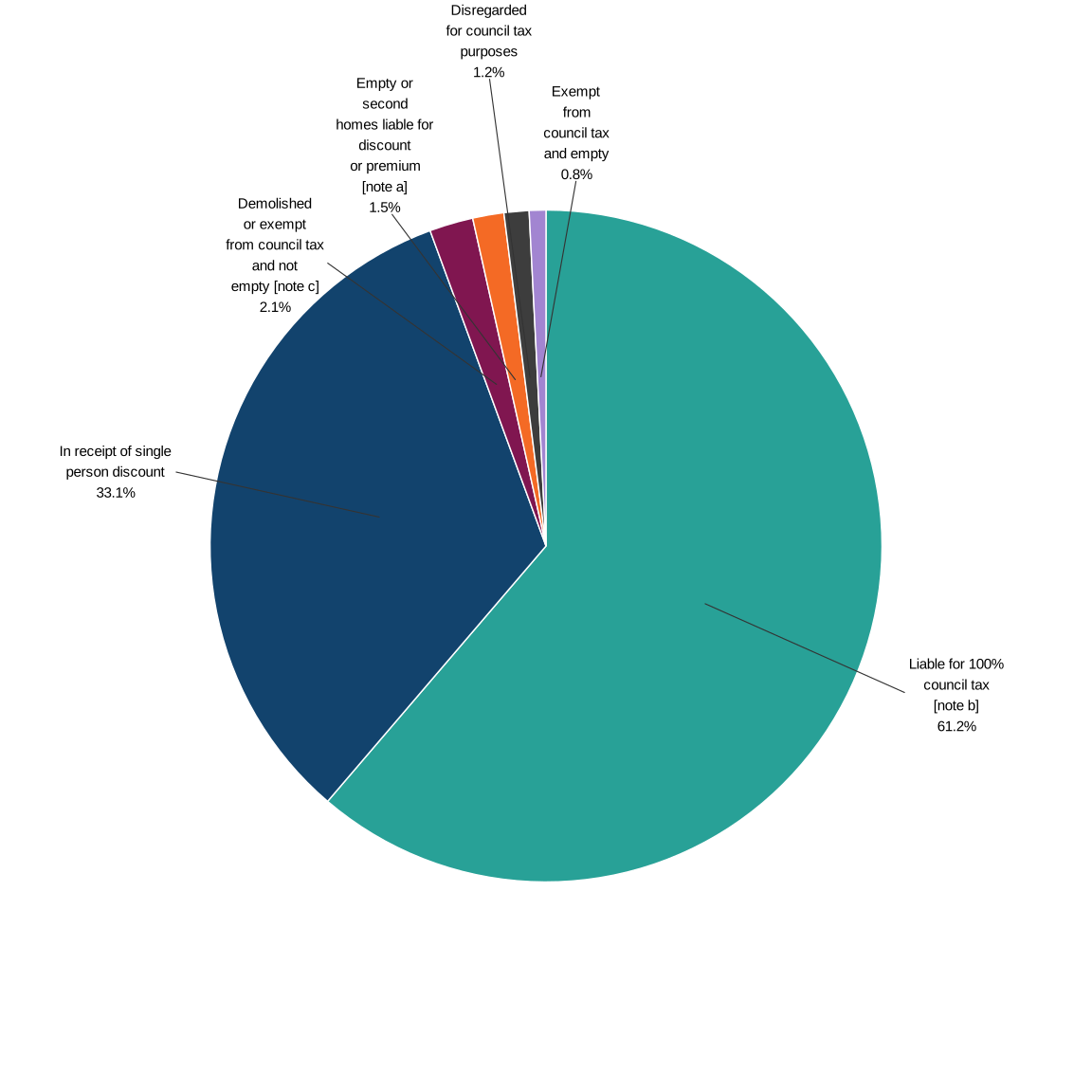
Chart 1 below shows how the total stock of dwellings on the valuation list is split between the various categories of liability for council tax at the snapshot. 61.2% of all dwellings on the valuation list are liable to a 100% charge of council tax, with 33.1% of all dwellings receiving a single person discount. The remaining 5.7% of dwellings receive other discounts, are charged premiums, are exempt from council tax or are being demolished.
Chart 1: Split of dwelling stock by category of liability as at 9 September 2026
Number of dwellings on valuation list as at 9 September 2026 = 26.0 million
Footnotes for Chart 1
[note a] ‘Empty or second homes liable for discount or premium’ includes empty or second homes subject to a discount or charged a premium only. Some empty and second homes will be included in other categories.
[note b] ‘Liable for 100% council tax’ includes empty or second homes receiving no discount.
[note c] ‘Demolished or exempt from council tax and not empty’ includes Class R exemptions (empty caravan pitches and boat moorings).
See accompanying tables and open data to download the chart data.
4. Chargeable dwellings, exemptions, and discounts by council tax band
Table 2 provides figures of the number of dwellings in England by council tax valuation band as at 9 September 2026. It shows those that are liable for council tax, i.e. chargeable dwellings, those that are exempt from council tax, those that receive a discount on their council tax and those that are required to pay a premium on their council tax.
If the occupiers of a dwelling are granted disabled relief for council tax purposes, this reduces the council tax band of the dwelling by one band i.e. if the dwelling would normally be a Band D dwelling, after disabled relief the council tax band would be Band C. However, if the dwelling is in Band A, normally the lowest council tax band available, after disabled relief the band is said to be in council tax Band A-.
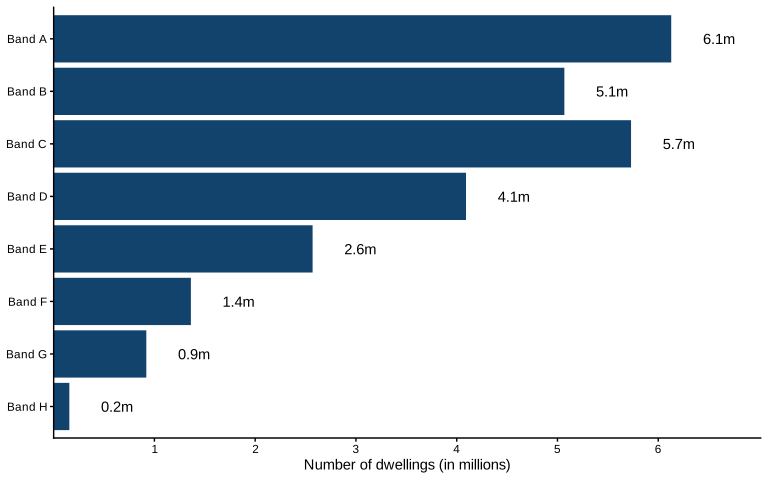
- 43.0% of all dwellings are in Bands A and B, 47.6% of all dwellings are in Bands C to E, and only 9.4% are in the top three bands, Bands F to H.
- 55.8% of dwellings subject to a discount are in Bands A and B.
- Of the 8.6 million dwellings entitled to a single person discount as at 9 September 2026, 33.2% were in Band A and 23.1% were in Band B.
- 55.4% of dwellings being charged the Empty Homes Premium are in Bands A and B, and 34.0% being charged the Second Homes Premium are in Bands A and B.
Table 2: Dwellings, exemptions and discounts by valuation band in thousands as at 9 September 2026
| Band | Band A- | Band A | Band B | Band C | Band D | Band E | Band F | Band G | Band H | Total |
|---|---|---|---|---|---|---|---|---|---|---|
| Number of dwellings on valuation list as at 9 September 2026 | [z] | 6,129 | 5,068 | 5,730 | 4,092 | 2,570 | 1,362 | 920 | 156 | 26,027 |
| less: number of dwellings exempt from council tax | [z] | 292 | 151 | 140 | 92 | 53 | 26 | 16 | 4 | 774 |
| less: number of demolished dwellings [note a] | [z] | 1 | 0 | 0 | 0 | 0 | 0 | 0 | 0 | 2 |
| Number of dwellings on valuation list liable for council tax | [z] | 5,836 | 4,917 | 5,590 | 4,000 | 2,517 | 1,336 | 904 | 152 | 25,251 |
| Number of dwellings moved down one band as a result of disabled relief [note b] | 18 | 23 | 31 | 28 | 22 | 12 | 10 | 5 | [z] | 149 |
| Number of dwellings liable to council tax adjusted for disabled relief [note c] | 18 | 5,840 | 4,925 | 5,587 | 3,994 | 2,507 | 1,333 | 898 | 147 | 25,251 |
| of this: number of dwellings subject to a discount | 6 | 2,946 | 2,058 | 1,890 | 1,081 | 560 | 257 | 151 | 19 | 8,968 |
| of which are empty homes subject to a discount [note d] | [z] | 13 | 8 | 6 | 3 | 2 | 1 | 1 | 0 | 34 |
| of which are second homes subject to a discount [note e] | [z] | 4 | 0 | 1 | 0 | 0 | 0 | 0 | 0 | 6 |
| of which are single persons | 5 | 2,865 | 1,990 | 1,813 | 1,027 | 527 | 238 | 136 | 16 | 8,620 |
| of which are all residents disregarded for council tax purposes | 0 | 10 | 7 | 7 | 6 | 4 | 5 | 6 | 2 | 48 |
| of which are all but one resident disregarded for council tax purposes | 1 | 54 | 52 | 63 | 44 | 26 | 13 | 7 | 1 | 260 |
| of this: number of dwellings charged a premium [note f] | [z] | 95 | 60 | 62 | 48 | 33 | 21 | 20 | 9 | 347 |
| of which are empty homes charged a premium | [z] | 63 | 32 | 30 | 20 | 12 | 7 | 6 | 2 | 170 |
| of which are second homes charged a premium | [z] | 32 | 28 | 32 | 28 | 21 | 14 | 14 | 7 | 176 |
| of this: number of dwellings not subject to a discount or charged a premium [note g] | 12 | 2,799 | 2,807 | 3,635 | 2,865 | 1,914 | 1,055 | 728 | 119 | 15,936 |
| of which are empty homes not subject to a discount or charged a premium | [z] | 126 | 80 | 76 | 46 | 25 | 12 | 8 | 2 | 374 |
| of which are second homes not subject to a discount or charged a premium | [z] | 25 | 13 | 15 | 12 | 7 | 4 | 2 | 1 | 78 |
| of which are classed as other | 12 | 2,648 | 2,715 | 3,545 | 2,808 | 1,883 | 1,040 | 717 | 116 | 15,484 |
Footnotes for Table 2
[note a] Figures for Bands B to H are below 500 and are therefore presented as 0.
[note b] Dwellings subject to disabled relief are charged council tax at the rate for one band lower than the band shown on the valuation list. Council tax for a Band A- dwelling is charged at 5/9 of the council tax for a Band D dwelling.
[note c] Calculated by subtracting the number of dwellings moved down from this band as a result of disabled relief from the number of dwellings on the valuation list liable for council tax, and adding the number of dwellings moved into this band as a result of disabled relief.
[note d] Empty homes are dwellings that are unoccupied and substantially unfurnished and, at local authority discretion, can be subject to a discount of between 0% and 100%. A discount of 0% is classified in the table as ‘not subject to a discount’. All other discount rates are classified as ‘subject to a discount’.
[note e] At local authority discretion, second homes can be subject to a discount of between 0% and 50%. A discount of 0% is classified in the table as ‘not subject to a discount’. All other discount rates are classified as ‘subject to a discount’.
[note f] Not all local authorities charge a premium. In 2026, 293 out of 296 local authorities applied the Empty Homes Premium and 246 out of 296 applied the Second Homes Premium.
[note g] The number of dwellings not subject to a discount or a premium includes empty homes and second homes with an exception from the relevant premium.
Chart 2: Split of dwelling stock by council tax band as at 9 September 2026
Number of dwellings on valuation list as at 9 September 2026 = 26.0 million
See accompanying tables and open data to download the chart data.
5. Empty and second homes
5.1 Empty homes for council tax purposes
Empty homes are dwellings which are unoccupied and substantially unfurnished. At local authority discretion, empty homes can be subject to a discount of between 0% and 100%. If they have been empty for more than one year, they may be charged a premium, which is in addition to the full amount of council tax due. Whether a premium is charged is at local authority discretion. Further details of the premium are described below.
There are also some exempt classes which can be applied to properties that are unoccupied. The total figure of unoccupied dwellings receiving an exemption is included in Table 3a. More details on exemptions are found in Table 5a. The aggregation of the empty properties receiving a discount, empty properties charged a premium and these unoccupied dwellings receiving an exemption is published in this release, as the measure of ‘All vacants’ in the separate Dwelling Stock estimates statistical release and in Live Table 615.
Between 1 April 2013 and 31 March 2024, authorities were able to charge an Empty Homes Premium on properties that had been empty for two or more years. From 1 April 2021 to 31 March 2024, the premium could be up to 100% for dwellings that had been empty for between 2 to 5 years, up to 200% for dwellings that had been empty for between 5 to 10 years, and up to 300% for dwellings that have been empty for 10 years or more. Since 1 April 2024, authorities have been able to charge a premium of up to 100% for dwellings that have been empty for between 1 and 2 years. There are therefore some discontinuities in Tables 3a and 3b below.
In 2026, 293 out of 296 authorities reported they were charging the premium on some of their empty dwellings, up from 291 authorities in 2025. Some caution should be taken when interpreting the split of data as some authorities may only be able to report in one category (particularly where there is no variation in premium), and we do not record whether this is the case. The number of authorities reporting in each category for each year are shown in Table 3b.
There are some exceptions where the premium is not charged to dwellings even though they have been empty for more than 1 year and the premium is in use by the authority. These are included in the total number of empty homes that are not subject to a discount or premium.
Table 3a and Table 3b provide figures for the total number of dwellings in England classed as empty for council tax purposes since 2022 with details of the levels of discounts and premiums applied.
-
Excluding exempt properties, there were 578,000 dwellings recorded as empty for council tax purposes, an increase of 35,000 (or 6.5%) compared with 2025. Some authorities reported that this increase was due to continued reviews of empty properties and second homes following changes to the Empty Homes Premium and the introduction of the Second Homes Premium.
-
Of these, 34,000 empty dwellings were subject to a discount, a decrease of 2.1% from the previous year. Of these, 16,000 dwellings received a 100% discount.
-
170,000 empty dwellings were charged a premium, an increase of 11.4% from the previous year. Of these, 84.1% of dwellings being charged a premium have been empty for 1-5 years, 11.2% of dwellings have been empty for between 5-10 years and 4.7% of dwellings have been empty for more than 10 years.
-
There were also 218,000 unoccupied dwellings receiving an exemption, an increase of 6,000 or 2.9%.
Table 3a: Number of dwellings classed as empty for council tax purposes by level of discount and premium applied, 2022 to 2026
| Year | 2022 | 2023 | 2024 | 2025 | 2026 |
|---|---|---|---|---|---|
| Total number of dwellings classed as empty [note a] | 676,304 | 699,126 | 719,470 | 754,264 | 795,752 |
| Number of exempt dwellings classed as empty | 197,376 | 218,281 | 217,207 | 212,004 | 218,102 |
| Number of chargeable dwellings classed as empty | 478,928 | 480,845 | 502,263 | 542,260 | 577,650 |
| Number of dwellings classed as empty not subject to a discount or charged a premium [note b] | 358,422 | 365,365 | 346,999 | 355,011 | 373,638 |
| of this: empty homes not subject to a discount | 358,422 | 365,365 | 339,039 | 332,099 | 346,160 |
| of this: empty homes (1 year or more) not charged a premium [note c] | [z] | [z] | 7,960 | 22,912 | 27,478 |
| of which empty homes (1 year or more) not charged a premium because of an exception [note d] | [z] | [z] | 1,058 | 7,367 | 10,590 |
| Number of dwellings classed as empty subject to a discount [note e] | 48,165 | 39,677 | 35,658 | 34,321 | 33,586 |
| of which 10% discount | 476 | 523 | 103 | 103 | 58 |
| of which 20% discount | 390 | 30 | 45 | 59 | 48 |
| of which 25% discount | 12,454 | 11,230 | 9,871 | 9,933 | 10,425 |
| of which 40% discount | 798 | 0 | 0 | 0 | 0 |
| of which 50% discount | 8,909 | 7,424 | 8,014 | 6,925 | 6,397 |
| of which 75% discount | 783 | 835 | 547 | 624 | 600 |
| of which 100% discount | 24,355 | 19,635 | 17,078 | 16,677 | 16,058 |
| Number of dwellings classed as empty charged a premium [note f] [note g] [note h] | 72,341 | 75,803 | 119,606 | 152,928 | 170,426 |
| of which 10% premium | 38 | 9 | 0 | 0 | 0 |
| of which 50% premium | 5,420 | 3,508 | 1,750 | 621 | 591 |
| of which 100% premium | 48,097 | 52,142 | 95,237 | 127,860 | 143,542 |
| of which 150% premium | 19 | 35 | 18 | 0 | 0 |
| of which 200% premium | 12,652 | 13,605 | 15,271 | 16,825 | 18,608 |
| of which 300% premium | 6,115 | 6,504 | 7,330 | 7,622 | 7,685 |
Footnotes for Table 3a
[note a] The total number of dwellings classed as empty includes empty dwellings that receive an exemption.
[note b] The number of dwellings not subject to a discount or a premium includes empty dwellings with an exception from the premium.
[note c] The number of empty homes not charged a premium includes dwellings in local authorities that do not charge the premium and dwellings with an exception from the premium.
[note d] Caution should be taken when interpreting the increase in exceptions between 2024 and 2025. Exceptions were collected for the first time in 2024 and are reported on a voluntary basis. Although exceptions are at the local authority’s discretion, further guidance on exceptions to the Empty Homes Premium and the Second Homes Premium was issued after the 2024 data collection.
[note e] Since 1 April 2013, local authorities in England have been able to apply council tax discounts of between 0% and 100% to empty dwellings or charge a premium on top of the normal council tax.
[note f] Not all local authorities charge the Empty Homes Premium. In 2022, 303 out of 309 local authorities applied the premium, compared with 290 out of 296 in 2023, 292 out of 296 in 2024, 291 out of 296 in 2025 and 293 out of 296 in 2026.
[note g] From 1 April 2021 to 31 March 2024, local authorities were able to charge a premium of up to 100% for dwellings empty for between 2 and 5 years, up to 200% for dwellings empty for between 5 and 10 years, and up to 300% for dwellings empty for 10 years or more. Since 1 April 2024, local authorities have also been able to charge a premium for dwellings empty for between 1 and 2 years. The premium categories are shown in Table 3b.
[note h] Caution should be taken when comparing the data between years because of changes to the Empty Homes Premium categories. From 1 April 2024, local authorities have also been able to charge the premium on dwellings empty for between 1 and 2 years.
Table 3b: Number of dwellings classed as empty for council tax purposes by premium applied, 2022 to 2026 [note a]
| Year | 2022 | 2023 | 2024 | 2025 | 2026 |
|---|---|---|---|---|---|
| Number of dwellings classed as empty charged a premium [note b] | 72,341 | 75,803 | 119,606 | 152,928 | 170,426 |
| Number of dwellings classed as empty (1-2 years) charged a premium [note c] [note d] | [z] | [z] | 29,524 | 58,631 | 64,696 |
| of which 50% premium | [z] | [z] | 144 | 0 | 0 |
| of which 100% premium | [z] | [z] | 29,380 | 58,631 | 64,696 |
| Number of dwellings classed as empty (2-5 years) charged a premium [note c] | 50,986 | 53,442 | 66,029 | 68,673 | 78,613 |
| of which 10% premium | 38 | 9 | 0 | 0 | 0 |
| of which 50% premium | 4,323 | 2,509 | 912 | 342 | 323 |
| of which 100% premium | 46,625 | 50,924 | 65,117 | 68,331 | 78,290 |
| Number of dwellings classed as empty (5-10 years) charged a premium | 13,987 | 14,949 | 16,231 | 17,179 | 19,099 |
| of which 50% premium | 862 | 768 | 582 | 197 | 196 |
| of which 100% premium | 958 | 915 | 526 | 497 | 444 |
| of which 150% premium | 19 | 34 | 18 | 0 | 0 |
| of which 200% premium | 12,148 | 13,232 | 15,105 | 16,485 | 18,459 |
| Number of dwellings classed as empty (over 10 years) charged a premium | 7,368 | 7,412 | 7,822 | 8,445 | 8,018 |
| of which 50% premium | 235 | 231 | 112 | 82 | 72 |
| of which 100% premium | 514 | 303 | 214 | 401 | 112 |
| of which 150% premium | 0 | 1 | 0 | 0 | 0 |
| of which 200% premium | 504 | 373 | 166 | 340 | 149 |
| of which 300% premium | 6,115 | 6,504 | 7,330 | 7,622 | 7,685 |
| Total number of authorities in existence | 309 | 296 | 296 | 296 | 296 |
| Number of authorities charging a premium for empty dwellings | 303 | 290 | 292 | 291 | 293 |
| Number of authorities charging a premium for dwellings empty for 1-2 years [note d] | [z] | [z] | 244 | 249 | 255 |
| Number of authorities charging a premium for dwellings empty for 2-5 years | 303 | 289 | 289 | 290 | 293 |
| Number of authorities charging a premium for dwellings empty for 5-10 years | 288 | 280 | 286 | 284 | 288 |
| Number of authorities charging a premium for dwellings empty for over 10 years | 279 | 271 | 279 | 282 | 286 |
Footnotes for Table 3b
[note a] Caution should be taken when comparing the number of dwellings classed as empty by premium charged because of changes in the number of local authorities charging the premium each year and changes to the premium categories. The number of local authorities charging the Empty Homes Premium is shown at the end of the table.
[note b] From 1 April 2021 to 31 March 2024, local authorities were able to charge a premium of up to 100% for dwellings empty for between 2 and 5 years, up to 200% for dwellings empty for between 5 and 10 years, and up to 300% for dwellings empty for 10 years or more. Since 1 April 2024, local authorities have also been able to charge a premium for dwellings empty for between 1 and 2 years.
[note c] Some local authorities were unable to report separately the number of dwellings empty for between 1 and 2 years and between 2 and 5 years. In these cases, they were asked to report the dwellings in the latter category.
[note d] The number of local authorities charging a premium for dwellings empty for between 1 and 2 years includes both local authorities that reported figures in the 1-to-2-year category and those that reported these figures in the 2-to-5-year category. The number of local authorities reporting figures in each category is shown at the end of the table. Differences in reporting between years may therefore partly explain differences in trends between the number of dwellings reported in the 1-to-2-year category as charged a premium and the number of local authorities charging a premium for dwellings empty for between 1 and 2 years.
5.2 Second homes for council tax purposes
Second homes on the council tax list are dwellings which are furnished and do not have anyone living in them as a main residence. These do not include properties that are used as holiday lets or self-catering units that are charged business rates.
Since 1 April 2013, local authorities in England have had the choice to apply council tax discounts of between 0% and 50% for second homes.
Since 1 April 2025, authorities have been able to charge a premium of up to 100% for second homes, and in 2026, 246 out of 296 authorities (83%) reported charging the premium, up from 211 in 2025. There are some exceptions where the premium is not applied to second homes even though the premium is in use by the authority. These properties are included in the total number of second homes that are not subject to a discount or premium.
Table 4 provides figures for the total number of dwellings in England classed as second homes for council tax purposes since 2022 with details of the levels of discount and premium applied.
-
There were 260,000 dwellings recorded as second homes for council tax purposes, a decrease of 7,000 (or 2.8%) compared with 2025. Some authorities reported that this change was due to ongoing reviews of second homes and changes in property circumstances following the introduction of the Second Homes Premium.
-
Of these, 78,000 (29.9% of all recorded second homes) were not subject to a discount or charged a premium.
-
6,000 second homes (2.4% of all recorded second homes) were subject to a discount. Of these, 9.7% received a 5% discount, 42.9% received a 10% discount and 42.7% received a 50% discount.
-
176,000 second homes (67.7% of all recorded second homes) were charged the Second Homes Premium.
Table 4: Number of dwellings classed as second homes for council tax purposes by level of discount and premium applied, 2022 to 2026
| Year | 2022 | 2023 | 2024 | 2025 | 2026 |
|---|---|---|---|---|---|
| Total number of dwellings classed as second homes | 256,913 | 263,318 | 279,870 | 267,894 | 260,446 |
| Number of dwellings classed as second homes not subject to a discount or charged a premium [note b] [b] | 247,443 | 255,367 | 271,964 | 90,734 | 77,827 |
| of which second homes not charged a premium because of an exception | [z] | [z] | [z] | 28,011 | 32,002 |
| Number of dwellings classed as second homes subject to a discount [note a] [note e] | 9,470 | 7,951 | 7,906 | 6,861 | 6,254 |
| of which 5% discount | 2,127 | 934 | 1,011 | 971 | 607 |
| of which 10% discount | 4,474 | 3,993 | 4,102 | 2,726 | 2,685 |
| of which 35% discount | 231 | 230 | 241 | 247 | 259 |
| of which 50% discount | 2,638 | 2,794 | 2,552 | 2,917 | 2,673 |
| Number of dwellings classed as second homes charged a premium [note b] [note c] | [z] | [z] | [z] | 170,299 | 176,365 |
| Total number of authorities in existence | 309 | 296 | 296 | 296 | 296 |
| Number of authorities applying a discount to second homes [note d] | 189 | 190 | 184 | 185 | 194 |
| Number of authorities charging a premium for second homes | [z] | [z] | [z] | 211 | 246 |
Footnotes for Table 4
[note a] Second homes can be subject to a discount of between 0% and 50% at local authority discretion.
[note b] From 1 April 2025, local authorities have been able to charge a premium of up to 100% on dwellings classed as second homes.
[note c] Not all local authorities charge the Second Homes Premium. In 2026, 246 out of 296 local authorities applied the premium. All of these local authorities charged a 100% premium.
[note d] This includes local authorities with at least one dwelling subject to a discount.
[note e] The discount categories do not sum to the number of dwellings classed as second homes subject to a discount due to an outstanding validation query with Camden regarding the breakdown by discount percentage.
6. Exemptions from council tax
There are currently 21 types (class) of exemption from council tax. These include dwellings left empty by deceased persons and dwellings which are occupied only by students, foreign spouses of students, or school and college leavers. Line 2 in both Table 1 and Table 2 showed the total number of dwellings that are exempt from council tax.
Table 5, provided as a separate table, provides details of these exemptions from council tax split by class of exemption, for 2016 to 2026, along with details of each class of exemption as a percentage of the total number of exemptions for 2026. The table also contains definitions of the council tax exemption classes. Table 5a is a subset of Table 5 and it shows the exemptions grouped as unoccupied and occupied dwellings, and the largest contributors to those totals.
-
There were 774,000 dwellings exempt from paying council tax, an increase of 16,000 (or 2.1%) compared with 2025. Exempt dwellings account for 3.0% of all dwellings.
-
Three-quarters of all exemptions can be attributed to four exempt classes. The largest is exempt class N (dwellings occupied solely by students, foreign spouses of students, or school and college leavers) at 33.3%, with class U (properties where all occupants are severely mentally impaired) at 16.8%, class F (an unoccupied property where the liable council taxpayer has died) at 16.2%, and class M (student halls of residence) at 9.5%.
-
Of these four classes, exempt class U saw the largest percentage change compared to 2025, with an increase of 8,000 (or 6.5%) to 130,000 dwellings.
Table 5a: Number of dwellings exempt from council tax that are unoccupied or occupied in thousands, 2022 to 2026
| Description | 2022 | 2023 | 2024 | 2025 | 2026 |
|---|---|---|---|---|---|
| Total exemptions from council tax [note a] | 692.2 | 741.4 | 748.0 | 758.0 | 774.2 |
| Exemptions where the property is unoccupied (classes B, D - L, Q) [note a] | 197.4 | 218.3 | 217.2 | 212.0 | 218.1 |
| of which: Class E - An unoccupied dwelling which was previously the sole or main residence of a person who has moved to hospital or care home | 32.8 | 37.8 | 38.6 | 38.9 | 40.0 |
| of which: Class F - Dwellings left empty by deceased persons | 121.9 | 135.7 | 132.9 | 124.1 | 125.2 |
| Exemptions where the property is occupied (classes M - P, S - W) [note a] | 488.5 | 516.8 | 524.2 | 539.1 | 549.4 |
| of which: Class M - A hall of residence provided predominantly for the accommodation of students | 73.3 | 76.9 | 77.9 | 78.0 | 73.4 |
| of which: Class N - A dwelling which is occupied only by students, the foreign spouses of students, or school and college leavers | 230.2 | 247.4 | 245.9 | 252.8 | 258.1 |
| of which: Class O - Armed forces accommodation (included as exempt dwellings rather than chargeable dwellings because contributions in lieu will be paid in respect of them) | 44.0 | 43.5 | 43.0 | 43.0 | 43.3 |
| of which: Class U - A dwelling occupied only by a person, or persons, who is or are severely mentally impaired who would otherwise be liable to pay the council tax or only by one or more severely mentally impaired persons and one or more students, students foreign spouses and school and college leavers | 101.3 | 107.7 | 114.2 | 121.9 | 129.8 |
Footnotes for Table 5a
[note a] Class R exemptions (empty caravan pitches and boat moorings) are included in the total number of exemptions but are not included in either the occupied or unoccupied subtotal.
See Table 5.
7. Accompanying tables and open data
7.1 Symbols used
[x] = not available
0 = zero or negligible
[z] = not relevant
[b] = series break
7.2 Rounding
Where figures have been rounded, there may be a slight discrepancy between the total and the sum of constituent parts.
7.3 Tables
Accompanying tables are available to download alongside this release. These include Tables 1 to 5 and data for individual local authorities.
These tables can be accessed here.
8. Technical notes
Please see the accompanying technical notes for further details.
Information on Official Statistics is available via the UK Statistics Authority website.
Information about statistics at MHCLG is available via the Department’s website.