Council Tax levels set by local authorities in England 2026 to 2027
Published 25 March 2026
Applies to England

© Crown copyright 2026
This publication is licensed under the terms of the Open Government Licence v3.0 except where otherwise stated. To view this licence, visit nationalarchives.gov.uk/doc/open-government-licence/version/3 or write to the Information Policy Team, The National Archives, Kew, London TW9 4DU, or email: psi@nationalarchives.gov.uk.
Where we have identified any third party copyright information you will need to obtain permission from the copyright holders concerned.
This publication is available at https://www.gov.uk/government/statistics/council-tax-levels-set-by-local-authorities-in-england-2026-to-2027/council-tax-levels-set-by-local-authorities-in-england-2026-to-2027
This release contains information on the council tax levels set by local authorities in England, and associated data.
1. In this release:
-
The average Band D council tax set by local authorities in England for 2026-27 will be £2,392, which is an increase of £111 or 4.9% on the 2025-26 figure. This includes all precepts including adult social care and parish precepts.
-
Of the 384 authorities that were subject to referendum principles, 274 authorities used the maximum flexibility available to them, which is a decrease of 21 on the 2025-26 figure. 50 were close to the maximum. 21 authorities either made no change or decreased their average Band D council tax.
-
For 2026-27, 142 adult social care authorities have utilised all, and the remaining 11 some, of their adult social care precept flexibility when setting their council tax. The maximum flexibility is 2%. This additional flexibility accounts for £35 of the average Band D council tax bill.
-
The average area Band D council tax will be £2,068 across London (an increase of £87 or 4.4% when compared to 2025-26), £2,409 in metropolitan areas (+£120 or 5.2%), £2,490 (+£124 or 5.3%) in unitary areas and £2,452 (+£108 or 4.6%) in shire areas.
-
The council tax requirement in 2026-27 is £46.8 billion, of which £688 million (1.5% of the total) will be raised through the adult social care precept flexibility, and £942 million (2.0%) will be raised through parish precepts.
-
For those areas where parishes charge a precept, there has been an average Band D parish precept increase of 8.2% (or £8) in 2026-27.
-
The average council tax per dwelling will be £1,868 in 2026-27.
Release date: 25 March 2026
Date of next release: March 2027
Contact: ctr.statistics@communities.gov.uk (Responsible Statistician: Felicia Rankl)
Media enquiries: 0303 444 1209 NewsDesk@communities.gov.uk
2. Introduction
This release has been compiled by the Ministry of Housing, Communities and Local Government (MHCLG) and presents Accredited Official Statistics (previously known as National Statistics) on council tax levels set by local authorities in England and associated information for the financial year 2026-27. This information is derived from the council tax requirement (CTR) returns submitted during February and March 2026 by all 296 billing authorities and all 96 major precepting authorities in England.
Council tax is the main source of locally raised income for many local authorities. It was introduced in April 1993 and the amount of council tax payable on a property depends in part on the council tax band to which it is allocated (see Technical Notes document).
Band D council tax is the standard measure of council tax (all other bands are set as a proportion of the Band D) and is the council tax payable on a Band D dwelling occupied as a main residence by at least two adults. The average Band D council tax in this release is determined by dividing the council tax requirement by the tax base for council tax setting purposes, which accounts for any reductions due to discounts, exemptions or local council tax support schemes and any increases due to premiums. Council tax can also be measured in average council tax per dwelling terms (see Section 5).
The council tax bill may be made up of several elements. In addition to the council tax for the billing authority responsible for the area, it may include council tax that is collected for some or all of the following categories of authority; county council (the Greater London Authority in London), fire and rescue authority, police and crime commissioner, combined authority, and parish or other local precepting council. The area average Band D council tax will reflect these amounts.
3. Special Factors in 2026-27
There are several special factors which may have affected the decisions of local authorities when setting their council tax levels for 2026-27. These special factors are:
3.1 Adult social care
In 2026-27 adult social care authorities are able to increase council tax by an additional 2 per cent. This is in addition to the usual funding of adult social care through council tax. This applies to London boroughs (including the City of London), county councils, metropolitan districts, and unitary authorities.
3.2 Local Government reorganisation
There are no local government reorganisations coming into effect from 1 April 2026 that affect council tax. There is also no equalising across predecessor authorities relating to previous reorganisations.
However, precepts could be set for the first time by Greater Lincolnshire Combined County Authority, and Hull and East Yorkshire Combined Authority.
3.3 Referendum principles
Authorities are required to hold a referendum if their relevant basic amount of council tax (i.e. the average Band D figure having excluded local precepts) for 2026-27 is in excess of the council tax referendum principles which apply to them.
The referendum principles are:
-
5% or more than 5% (comprising up to a maximum of 2% for expenditure on adult social care and 3% on other expenditure) for authorities with responsibility for adult social care services, except for:
-
Bournemouth, Christchurch and Poole Council who have a maximum of 6.75% (comprising of 2% on adult social care, and 4.75% on other expenditure),
-
Trafford Council, Warrington Borough Council, and Royal Borough of Windsor and Maidenhead Council who have a maximum of 7.5% (comprising of 2% on adult social care, and 5.5% on other expenditure),
-
North Somerset Council, Shropshire Council, and Worcestershire County Council who have a maximum of 9% (comprising of 2% on adult social care, and 7% on other expenditure).
-
More than £5, or 3% or more than 3%, (the greater of the two) for district councils in two tier areas.
-
More than £15 for Police and Crime Commissioners, except for:
-
The Police and Crime Commissioners for Bedfordshire, Cheshire, Durham, Gloucestershire, Humberside, and Northumbria who have a maximum of £18.50.
-
More than £15 for the police component of the Greater Manchester Combined Authority, South Yorkshire Mayoral Combined Authority, West Yorkshire Combined Authority, and York and North Yorkshire Combined Authority precepts.
-
More than £5 for fire and rescue authorities, except for:
-
Northamptonshire Commissioner Fire and Rescue Authority who have a maximum of £10.
-
More than £20.13 for the adjusted relevant basic amount of council tax of the GLA.
-
More than £5.13 for the unadjusted relevant basic amount of council tax of the GLA.
No referendum principles were set for mayoral combined authorities or local precepting authorities (parish or town councils, chairmen of parish meetings, charter trustees and the treasurers of the Inner and Middle Temples of London).
3.4 Localisation of council tax support
The localisation of council tax support introduced in 2013-14 allows authorities to amend their scheme each year if they wish, which may have affected their council tax requirement for 2026-27 (see Definitions section in the accompanying Technical Notes document).
4. Calculation of council tax in England, 2026-27
Council tax levels are calculated by dividing the council tax requirement by the tax base for tax setting purposes. The council tax requirement represents how much revenue councils have agreed is needed to be met through council tax. The tax base is the number of Band D equivalent dwellings in the authority determined for tax setting purposes for the year ahead. There are several factors affecting comparability of some figures from year to year, including the referendum principles that are set each year. See the Introduction section for more information.
Table 1 gives a breakdown of the council tax level for England for 2026-27.
-
The average Band D council tax set by local authorities in England for 2026-27 is £2,392, which is an increase of £111 or 4.9% on the 2025-26 figure. This includes adult social care and parish precepts.
-
The council tax requirement (including adult social care and parish precepts) in 2026-27 is £46.8 billion, £2.7 billion (6.1%) higher when compared with 2025-26.
-
Parish precepts in 2026-27 will total £942 million which is £83 million higher than in 2025-26.
-
The total tax base used for setting council tax for 2026-27 was 19.6 million Band D equivalent dwellings, 224,000 (1.2%) higher than in 2025-26.
Table 1: Calculating council tax levels: England summary 2022-23 to 2026-27
| Year | 2022 to 2023 | 2023 to 2024 [r] | 2024 to 2025 [r] | 2025 to 2026 [r] | 2026 to 2027 |
|---|---|---|---|---|---|
| Council tax requirement including adult social care precept, excluding parish precepts (£ millions) [note a] | 35,658 | 38,011 | 40,440 | 43,260 | 45,865 |
| Parish precepts (£ millions) | 655 | 708 | 783 | 859 | 942 |
| Council tax requirement including adult social care and parish precepts (£ millions) | 36,313 | 38,718 | 41,222 | 44,118 | 46,806 |
| Tax base for council tax-setting purposes (millions) | 18.473 | 18.749 | 18.988 | 19.348 | 19.572 |
| Average Band D council tax including adult social care, excluding parish precepts (£) | 1,930 | 2,027 | 2,130 | 2,236 | 2,343 |
| Average Band D council tax including adult social care and parish precepts (£) | 1,966 | 2,065 | 2,171 | 2,280 | 2,392 |
Footnotes for Table 1
[note a] Since 2016-17 social care authorities have been able to increase council tax under the adult social care precept flexibility, as well as under the core council tax referendum principle. For 2021-22 and 2022-23, the increase was originally announced as 3 per cent over the two years, with no limitation as to how this was split. In 2022-23, this was updated to a 1 per cent increase plus any amount of the 3 per cent that had not been used in 2021-22. From 2023-24, the increase has been set at 2 per cent in each year.
[r] The 2023-24 and 2024-25 figures have been revised since the previous publication as a result of corrected data from North Kesteven District Council, and the 2025-26 figures have been revised since the previous publication as a result of corrected data from Medway Council and North Kesteven District Council.
Table 2 shows average Band D council tax levels for England as a whole and by class of authority, along with the percentage change over the corresponding figure for 2025-26. This is shown including adult social care precept only (column 1 and 2) and including both adult social care and parish precepts (column 3 and 4). The increases to Band D levels largely reflect the different referendum principles.
Table 2: Council tax (average Band D) in England 2026-27, and percentage change from 2025-26: by class of authority
| Class of Authority | Average council tax for the authority including adult social care precept, excluding parish precepts (Band D) £ | Percentage change of average council tax for the authority including adult social care precept, excluding parish precepts (Band D) % | Average council tax for the authority including adult social care and including parish precepts (Band D) £ | Percentage change of average council tax for the authority including adult social care and including parish precepts (Band D) % |
|---|---|---|---|---|
| England | 2,343 | 4.8 | 2,392 | 4.9 |
| Inner London Boroughs including City | 1,239 | 4.0 | 1,240 | 4.0 |
| Outer London Boroughs | 1,769 | 4.8 | 1,769 | 4.8 |
| London Boroughs | 1,559 | 4.5 | 1,559 | 4.5 |
| Greater London Authority [note a] | 511 | 4.1 | 511 | 4.1 |
| of which The Mayor’s Office for Policing and Crime | 334 | 4.7 | 334 | 4.7 |
| of which Other Services | 176 | 3.0 | 176 | 3.0 |
| Combined Authorities [note b] | 89 | 3.8 | 89 | 3.8 |
| Metropolitan Districts | 2,020 | 4.9 | 2,030 | 4.9 |
| Metropolitan Fire and Rescue Authorities | 93 | 5.7 | 93 | 5.7 |
| Shire Unitary Authorities | 2,010 | 5.1 | 2,087 | 5.2 |
| Shire Counties | 1,802 | 4.6 | 1,802 | 4.6 |
| Shire Districts | 222 | 2.5 | 286 | 3.7 |
| Shire Fire and Rescue Authorities | 100 | 5.4 | 100 | 5.4 |
| Police and Crime Commissioners [note c] | 297 | 5.5 | 297 | 5.5 |
| Fire and Rescue Authorities [note d] | 98 | 5.5 | 98 | 5.5 |
Footnotes for Table 2
[note a] This includes core GLA, Transport for London (TfL), The London Legacy Development Corporation, the London Fire and Emergency Planning Authority (LFEPA); and The Mayor’s Office for Policing and Crime.
[note b] Four (Cambridgeshire and Peterborough, Liverpool City Region, Greater Manchester, and York and North Yorkshire) out of the twelve combined authorities set a precept in 2026-27. For Greater Manchester Combined Authority and York and North Yorkshire Combined Authority, this reflects only the precept for their general functions which includes their responsibility for fire and rescue services. It does not include the precept for police functions, which are included in the Police and Crime Commissioners figures.
[note c] Does not include the Mayor’s Office for Policing and Crime element from GLA and excludes City of London Police (as this element is not distinguishable from the council tax charged by the City of London). Greater Manchester Combined Authority’s, South Yorkshire Mayoral Combined Authority’s, West Yorkshire Combined Authority’s, and York and North Yorkshire Combined Authority’s police function are included.
[note d] Covers both metropolitan and shire and fire rescue authorities. It excludes fire and rescue services provided by counties, unitaries, GLA, Greater Manchester Combined Authority and York and North Yorkshire Combined Authority.
Table 3 and Chart A give figures for, levels of, and changes in, the average Band D council tax (including parish precepts) for England for the last 15 years.
Table 3: Average Band D council tax (including parish and adult social care precepts) in England and the annual percentage change 2012-13 to 2026-27 [note a] [note b]
| Year | Pounds £ | Percentage Change % |
|---|---|---|
| 2012 to 2013 [note c] | 1,444 | 0.3 |
| 2013 to 2014 [note c] | 1,456 | 0.8 |
| 2014 to 2015 [note c] | 1,468 | 0.8 |
| 2015 to 2016 [note c] | 1,484 | 1.1 |
| 2016 to 2017 | 1,530 | 3.1 |
| 2017 to 2018 | 1,591 | 4.0 |
| 2018 to 2019 | 1,671 | 5.1 |
| 2019 to 2020 | 1,750 | 4.7 |
| 2020 to 2021 | 1,818 | 3.9 |
| 2021 to 2022 | 1,898 | 4.4 |
| 2022 to 2023 [note d] | 1,966 | 3.5 |
| 2023 to 2024 | 2,065 | 5.1 |
| 2024 to 2025 | 2,171 | 5.1 |
| 2025 to 2026 [r] | 2,280 | 5.0 |
| 2026 to 2027 | 2,392 | 4.9 |
Footnotes for Table 3
[note a] Referendum principles vary year to year which will affect the annual change. Please see the introduction section of the statistical release for further information.
[note b] Local authorities have been given flexibility to increase council tax by an additional amount to fund adult social care since 2016-17. The amount of flexibility has varied from year to year.
[note c] Freeze grant was paid to local authorities that froze or reduced council tax between 2011-12 to 2015-16.
[note d] In 2022-23, the Government provided a £150 one-off Energy Bills Rebate for most households in council tax bands A-D. This did not affect these figures.
[r] The 2025-26 figures have been revised since the previous publication as a result of corrected data from Medway Council and North Kesteven District Council.
Chart A: Average Band D council tax in England percentage change 2012-13 to 2026-27 (including parish and adult social care precepts) [note a] [note b]
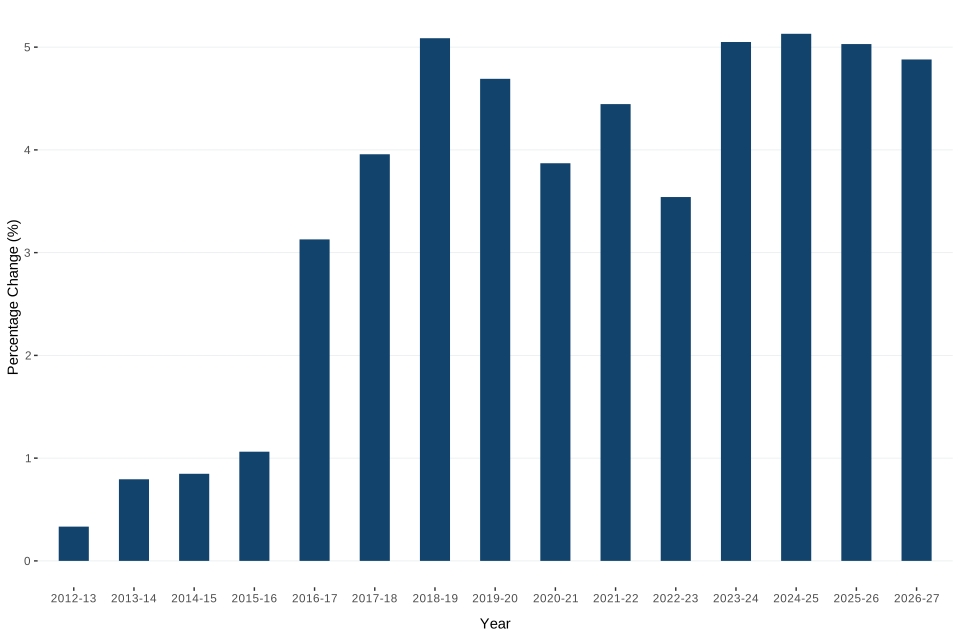
See Accompanying Tables and Open Data to download the chart data.
Footnotes for Chart A
[note a] Referendum principles vary year to year which will affect the annual change. Please see the introduction section of the statistical release for further information.
[note b] Freeze grants were paid to local authorities that froze or reduced council tax between 2011-12 and 2015-16.
Table 4 shows how authorities have set their average Band D council tax (excluding parish precepts) in relation to the referendum principles in 2026-27. Authorities may increase by up to a maximum without having to hold a referendum. These referendums are different depending on type of authority and are set out in the Introduction. No authority exceeded the referendum principles in 2026-27. Combined authorities’ general functions and parish councils are excluded from the table as no referendums are set. Police functions within combined authorities have been included in the Police and Crime Commissioners category, as these are subject to the same referendum principles.
Of the 384 authorities that were subject to referendum principles:
-
274 authorities used the maximum flexibility available to them. This is a decrease of 21 on the 2025-26 figure of 295 authorities.
-
50 authorities were close to the maximum. This is a decrease of six on the 2025-26 figure of 56 authorities.
-
39 authorities increased their average Band D council tax by any other amount. This is an increase of 14 on the 2025-26 figure of 25 authorities.
-
21 authorities either made no change or decreased their average Band D council tax. This is an increase of 13 on the 2025-26 figure of 8 authorities.
-
No authority has set an increase above their referendum principle.
Table 4: Use of referendum principles flexibility in 2026-27: by class of authority
| Class | Maximum Increase [note a] | Increase Close to Maximum [note b] | Other Increase [note c] | No Change | Decrease | Total |
|---|---|---|---|---|---|---|
| London Boroughs | 29 | 1 | 3 | 0 | 0 | 33 |
| Greater London Authority | 1 | 0 | 0 | 0 | 0 | 1 |
| Metropolitan Districts | 30 | 1 | 5 | 0 | 0 | 36 |
| Unitary Authorities | 51 | 5 | 7 | 0 | 0 | 63 |
| Shire Counties | 11 | 2 | 8 | 0 | 0 | 21 |
| Shire Districts | 99 | 28 | 16 | 17 | 4 | 164 |
| Police and Crime Commissioners | 30 | 7 | 0 | 0 | 0 | 37 |
| Fire and Rescue Authorities | 23 | 6 | 0 | 0 | 0 | 29 |
| Total (excludes Combined Authorities) | 274 | 50 | 39 | 17 | 4 | 384 |
Footnotes in Table 4
[note a] A “maximum increase” is defined by reference to the relevant statutory limit. For adult social care authorities (London boroughs, metropolitan district councils, unitary authorities and shire county councils), this includes increases of 4.985% or above. For shire district councils, it includes increases of 2.985% or above, or £5 (whichever is higher). A maximum increase is £15 for police and crime commissioners and £5 for fire and rescue authorities. A corresponding approach has been applied for authorities in receipt of exceptional financial support.
[note b] An “increase close to the maximum” applies where the increase falls just below the maximum threshold. For authorities without exceptional financial support, this includes increases between 4.90% and 4.984% for adult social care authorities; between 2.90% and 2.984% or £4.90 and £4.99 for shire districts; between £14.90 and £14.99 for police and crime commissioners; and between £4.90 and £4.99 for fire and rescue authorities. A corresponding approach has been applied for authorities in receipt of exceptional financial support.
[note c] An “other increase” covers all other increases. This includes increases below 4.90% for adult social care authorities, below 2.90% or £4.90 for shire districts, below £14.90 for police and crime commissioners, and below £4.90 for fire and rescue authorities.
[note d] Includes the police element set by Greater Manchester Combined Authority, South Yorkshire Mayoral Combined Authority, West Yorkshire Combined Authority and York and North Yorkshire Combined Authority.
5. Adult Social Care Precept
Local authorities with adult social care responsibilities are able to increase council tax by up to an additional 2% in 2026-27. This precept applies to London boroughs (including the City of London), county councils, metropolitan districts, and unitary authorities.
Table 5 shows the number of authorities using some, or all, of this year’s adult social care precept flexibility and how much additional council tax will be raised through it.
-
The additional adult social care precept flexibility in 2026-27 will generate £688 million.
-
Of 153 authorities with adult social care responsibilities, 142 have utilised all of their precept flexibility and the remaining 11 have utilised some of their precept flexibility for 2026-27.
-
The adult social care precept flexibility in 2026-27 accounts for £35, or 1.5%, of the average Band D council tax bill.
Table 5: Average Band D council tax precept for adult social care in 2026-27 [note a]
| Year | 2022 to 2023 | 2023 to 2024 | 2024 to 2025 | 2025 to 2026 | 2026 to 2027 |
|---|---|---|---|---|---|
| Number of authorities with adult social care responsibilities | 152 | 153 | 153 | 153 | 153 |
| Number of authorities utilising some or all of the adult social care precept | 150 | 151 | 153 | 153 | 153 |
| of which: number of authorities utilising some of the adult social care precept | 5 | 10 | 9 | 6 | 11 |
| of which: number of authorities utilising all of the adult social care precept | 145 | 141 | 144 | 147 | 142 |
| Total amount raised through the adult social care precept (£ million) [note b] | 408 | 561 | 609 | 654 | 688 |
| Tax base for council tax setting purposes (millions) | 18.473 | 18.749 | 18.988 | 19.348 | 19.572 |
| Average Band D council tax attributable to adult social care precept (£) [note b] | 22.08 | 29.94 | 32.08 | 33.78 | 35.14 |
Footnotes in Table 5
[note a] Since 2016-17 social care authorities have been able to increase council tax under the adult social care precept flexibility, as well as under the core council tax referendum principle. For 2021-22 and 2022-23, the increase was originally announced as 3 per cent over the two years, with no limitation as to how this was split. In 2022-23, this was updated to a 1 per cent increase plus any amount of the 3 per cent that had not been used in 2021-22. From 2023-24, the increase has been set to 2 per cent in each year.
[note b] All increases to council tax, whether or not attributable to the adult social care precept, become the new baseline for increases for the following year. As a result, these figures do not reflect the full amounts in 2026-27 that follow from increases to council tax levels as a result of the adult social care precept. This is because full extent of the element within both i) council tax bills and ii) council tax receipts in 2026-27 that is attributable to the adult social care precept requires a cumulative calculation of each local authority’s decisions on the use of the adult social care precept in each year since its inception in 2016-17.
6. Parishes and other local precepting authorities in England
Table 6 shows information relating to parishes and other local precepting authorities and the precepts they raise. Not all areas have parishes and therefore, the tax base in this table is lower than in Table 1. The table below shows the number and tax base of town and parish councils and charter trustees charging precepts and the average parish precept on an average Band D property in a precepting area. It also shows comparisons with previous years. This table may be revised once data on individual parish level data has been validated and published in May 2026.
- The average Band D precept charged by a parish or charter trustee for 2026-27 will be £100, an increase of £8, or 8.2% from 2025-26.
Table 6: Average Band D parish precepts for England 2022-23 to 2026-27
| Year | 2022 to 2023 [r] | 2023 to 2024 [r] | 2024 to 2025 [r] | 2025 to 2026 [r] | 2026 to 2027 |
|---|---|---|---|---|---|
| Total number of precepting parishes | 8,869 | 8,875 | 8,899 | 8,905 | 8,902 |
| Tax base (thousands) [note a] | 8,757.4 | 8,943.5 | 9,115.8 | 9,312.7 | 9,436.4 |
| Aggregate of local precepts (£000) [note b] | 654,966 | 707,620 | 782,818 | 858,597 | 941,644 |
| Average parish precept per Band D (£) | 74.79 | 79.12 | 85.87 | 92.20 | 99.79 |
| Change (£) | 2.95 | 4.33 | 6.75 | 6.33 | 7.59 |
| Percentage change (%) | 4.1 | 5.8 | 8.5 | 7.4 | 8.2 |
Footnotes for Table 6
[note a] Council tax payers in the Charter Trustees for the City of Durham have only been included once here, although they are actually spread across multiple parishes in Durham.
[note b] The aggregate of local precepts presented here may be different to the Local Authority total due to rounding.
[r] The 2022-23, 2023-24, and 2024-25 figures have been revised since the previous publication as a result of corrected data from North Kesteven District Council, and the 2025-26 figures have been revised since the previous publication as a result of corrected data from Medway Council and North Kesteven District Council.
Individual parish data for 2026-27 will be published in May 2026.
7. Council tax levels set by local authorities by area type
As well as adult social care and parish precepts, the average area Band D council tax is made up of several elements. In addition to the council tax for the local authority responsible for billing in the area, it will include council tax that will be redistributed to some, or all, of the following (depending on the authority area): county council (the Greater London Authority in London), fire and rescue authority, police and crime commissioner and combined authority.
Table 7 gives both the average Band D council tax levels and the annual percentage change for the last five years both for England and for London, metropolitan, unitary and shire areas within England. In order to calculate year-on-year changes that reflect local government re-organisation, 2022-23 and 2023-24 figures have been adjusted for the percentage change calculation, but the adjusted figures are not shown in the table.
- In 2026-27, the average area Band D council tax will be £2,068 across London (an increase of 4.4% when compared to 2025-26), £2,409 in metropolitan areas (+5.2%), £2,490 (+5.3%) in unitary areas and £2,452 (+4.6%) in shire areas.
Table 7: Average area Band D council tax and the annual percentage change by area of authority, 2022-23 to 2026-27 [note a] [note b]
| Year | England £ | England change % | London area £ | London area change % | Metropolitan areas £ | Metropolitan areas change % | Unitary areas £ | Unitary areas change % | Shire areas £ | Shire areas change % |
|---|---|---|---|---|---|---|---|---|---|---|
| 2022 to 2023 | 1,966 | 3.5 | 1,684 | 3.8 | 1,960 | 3.6 | 2,034 | 3.3 | 2,041 | 3.6 |
| 2023 to 2024 | 2,065 | 5.1 | 1,789 | 6.2 | 2,059 | 5.1 | 2,139 | 5.0 | 2,134 | 5.0 |
| 2024 to 2025 | 2,171 | 5.1 | 1,893 | 5.8 | 2,169 | 5.3 | 2,248 | 5.1 | 2,237 | 4.8 |
| 2025 to 2026 [r] | 2,280 | 5.0 | 1,982 | 4.7 | 2,289 | 5.6 | 2,366 | 5.2 | 2,344 | 4.8 |
| 2026 to 2027 | 2,392 | 4.9 | 2,068 | 4.4 | 2,409 | 5.2 | 2,490 | 5.3 | 2,452 | 4.6 |
Footnotes for Table 7
[note a] Figures include parish precepts and adult social care precepts.
[note b] The year-on-year percentage change has been calculated to reflect local government restructuring to allow for like-for-like comparisons at class level in 2023-24.
[r] The 2025-26 figures have been revised since the previous publication as a result of corrected data from Medway Council and North Kesteven District Council.
Chart B shows the distribution of average area Band D council tax in England. Average area Band D council tax ranges from £1,028 (Wandsworth) to £2,765 (Dorset). 206 (70%) of authorities have an area average Band D council tax between £2,300 and £2,600.
Chart B: Distribution of authorities charging Band D area council tax in 2026-27 [note a]
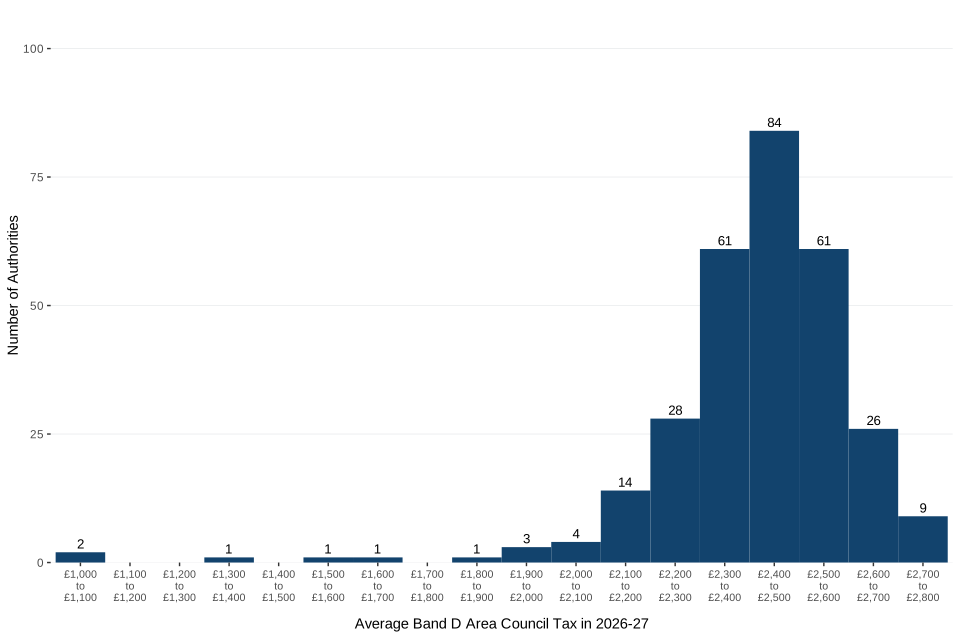
Map 1 shows how the average area Band D council tax in 2026-27 differs across England. Authorities have been split into seven range categories similar to Chart B. London is shown with more clarity in Map 2.
Map 1: Average area Band D Council Tax in England in 2026-27

London is an area of relatively low council tax compared to the rest of the country. There are 13 authorities with an average area Band D council tax of less than £2,100, and 11 of these are in London.
Map 2 shows how the average area Band D council tax in 2026-27 differs between local authorities in London. Authorities have been split into the same seven range categories as Map 1.
Map 2: Average area Band D Council Tax in London in 2026-27
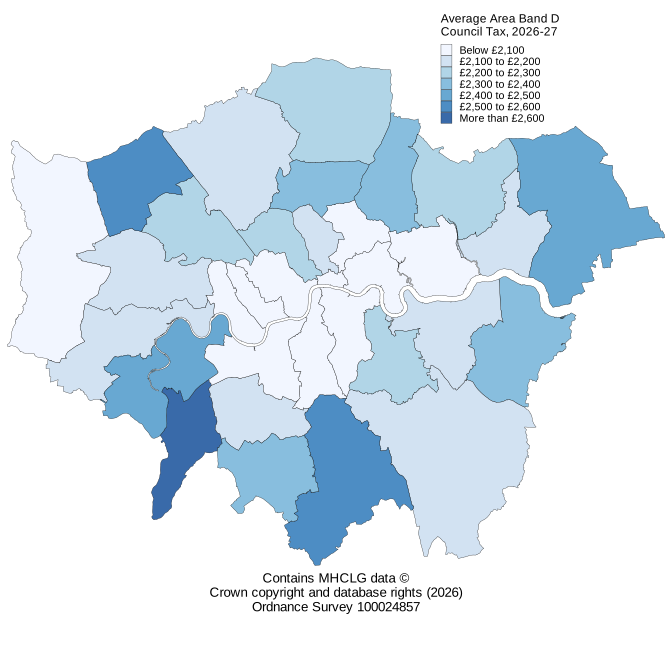
See the accompanying Table 9 for the data used in Chart B, Map 1 and Map 2.
8. Average council tax per dwelling
As mentioned in the introduction, council tax can be measured in one of two ways - by Band D or in per dwelling terms. The number of Band D equivalent dwellings reported is determined for use when the council tax levels are set by the local authority and so reflects changes that are being made by the council for the year ahead (for example with changes to local council tax support, premiums and discounts), whilst the per dwelling calculation uses the number of chargeable dwellings figures that are captured some five months in advance of setting council tax levels on the Council Tax Base (CTB) return. Consequently, the Band D measure better reflects the latest position and Band D has historically been used as the standard for comparing council tax levels between and across local authorities. The average council tax per dwelling is lower than the average Band D council tax. This is because, in England, council tax bands A to C account for nearly two thirds of all dwellings.
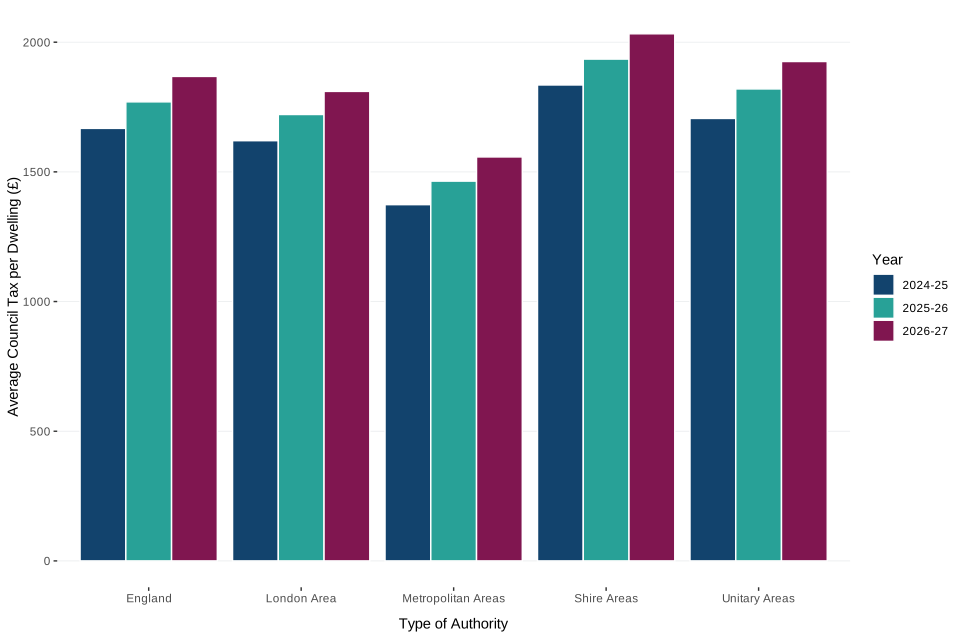
- The average council tax per dwelling will be £1,868 in 2026-27, an increase of 5.5% over 2025-26.
The average council tax per dwelling figure is a useful measure for comparing the amount of council tax paid by the average taxpayer in each local authority. Different local authorities often have very different tax bases because of the types of dwellings in their area and the discounts that they provide. This means that the average council tax per dwelling measure has more variation than the average per Band D equivalent measure.
Chart C shows the average council tax per dwelling for the last three years by type of authority:
Chart C: Average Council Tax per Dwelling in England by type of authority 2024-25 to 2026-27 [note a]
Footnote for Chart C
[note a] Figures include parish and adult social care precepts.
9. Accompanying Tables and Open Data
9.1 Symbols used
[x] = not available
0 = zero or negligible
[z] = not relevant
[r] = Revised since the previous release of this data
9.2 Rounding
Where figures have been rounded, there may be a slight discrepancy between the total and the sum of constituent parts. In particular, figures in this release are shown in pounds whilst the percentage changes are calculated on figures expressed to the nearest penny.
9.3 Tables
There are a number of additional tables produced for all authorities that are not included in the printed version of this release owing to their size. These are available on the Department’s website and are available to download alongside this release. These include accessible versions of the tables in this document (Tables 1 to 7) and data for individual local authorities (Tables 8, 9 and 10) in .ods files.
Below is a brief description of the data contained in the tables:
Table 8 2026-27 Council tax (average Band D) and % change on 2025-26: individual local authorities.
Table 9 Area council tax for a dwelling occupied by 2 adults by band 2026-27: individual local authorities.
Table 10 Data as reported by billing and major precepting authorities on their Council Tax Requirement (CTR) form, that have been used in calculating their council tax level for 2026-27.
Live tables on Band D council tax and Average council tax per dwelling from 1993 can be found here.
10. Technical Notes
Please see the accompanying Technical Notes document for further details.
Information on Official Statistics is available via the UK Statistics Authority website.
Information about statistics at MHCLG is available via the Department’s website.