Blue Badge scheme statistics: April 2024 to March 2025
Published 19 March 2026
Applies to England

© Crown copyright 2026
This publication is licensed under the terms of the Open Government Licence v3.0 except where otherwise stated. To view this licence, visit nationalarchives.gov.uk/doc/open-government-licence/version/3 or write to the Information Policy Team, The National Archives, Kew, London TW9 4DU, or email: psi@nationalarchives.gov.uk.
Where we have identified any third party copyright information you will need to obtain permission from the copyright holders concerned.
This publication is available at https://www.gov.uk/government/statistics/blue-badge-scheme-statistics-april-2024-to-march-2025/blue-badge-scheme-statistics-april-2024-to-march-2025
About this release
This release presents statistics on parking badges for disabled people (‘Blue Badges’) in England for April 2024 to March 2025.
Blue Badges are disabled parking cards issued by local authorities to help people with mobility issues park closer to the goods and services they need to use.
Statistics on parking badges for disabled people that are held and issued are obtained from the Blue Badge Digital Service (BBDS) database.
Blue Badges are issued according to need of the applicant and are not related to any specific condition. Anyone may be awarded a Blue Badge if they meet the scheme’s eligibility criteria. There are two main categories for eligibility for a Blue Badge, those that are “eligible without further assessment” and those that are “eligible subject to further assessment”.
Badges can also be issued to organisations who transport disabled people.
Upon issue, a Blue Badge is valid for a period of up to 3 years.
In August 2019, Blue Badge scheme eligibility criteria were extended to include more people with non-visible and neurological disabilities that may affect their ability to access goods and services.
Please refer to the quality report for more details.
To note, some of the figures in this release may not sum due to rounding.
This publication includes both accredited official statistics and official statistics. For more details about these statistics, see the ‘About these statistics’ section.
Headline statistics
As at 31 March 2025:
- 3.07 million Blue Badges were held, an increase of 228,000 (8.0%) compared to 31 March 2024
- Of these:
- 39% were held by those that are eligible without further assessment
- 60% were held by those that are eligible subject to further assessment
- 1% were held by organisations
- 5.2% of the population held a Blue Badge
Between 1 April 2024 and 31 March 2025:
- 1.27 million badges were issued, an increase of 140,000 (12.3%) compared to last year
- Of these:
- 42% were issued to those that are eligible without further assessment
- 58% were issued to those that are eligible subject to further assessment
- 1% were issued to organisations
- 6,600 badges were reported to be lost or stolen
Blue badges issued in the year ending March 2025
The number of badges issued includes those issued to people who did not previously hold a badge, and those resulting from reapplications from existing badge holders (badges usually last 3 years).
Chart 1: Blue Badges issued annually: England, since the year ending March 2020 - DIS0111
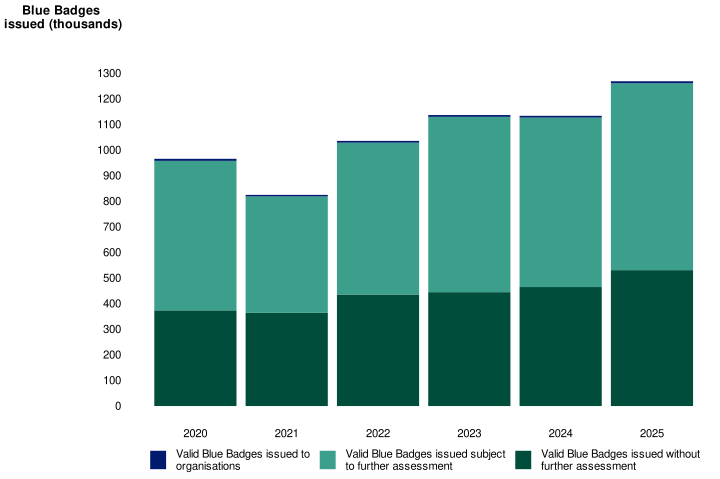
Chart 1 is a stacked bar chart that shows an overall increase in the number of badges issued per year since 2020. There were 1.27 million Blue Badges issued in the year ending March 2025. This is an increase of 140,000 (12.3%) compared to the previous year.
Out of the 1.27 million Blue Badges issued in the year ending March 2025, 531,000 (42%) were issued without further assessment.
Out of the badges issued without further assessment:
- 94.8% were issued to those who met the relevant criteria under Disability Living Allowance (DLA) or Personal Independence Payment (PIP)
- 4.7% were issued to those registered blind
- 0.5% were issued to those on War Pensioner’s Mobility Supplement or Armed Forces and Reserved Forces Compensation scheme
Out of the 1.27 million Blue Badges issued in the year ending March 2025, 730,000 (58%) were issued subject to further assessment and 8,000 (1%) were issued to organisations.
People with non-visible disabilities became eligible to apply for Blue Badges subject to further assessment in August 2019.
Chart 2: Blue Badges issued for people with non-visible disabilities annually: England, since the year ending March 2021 - DIS0111
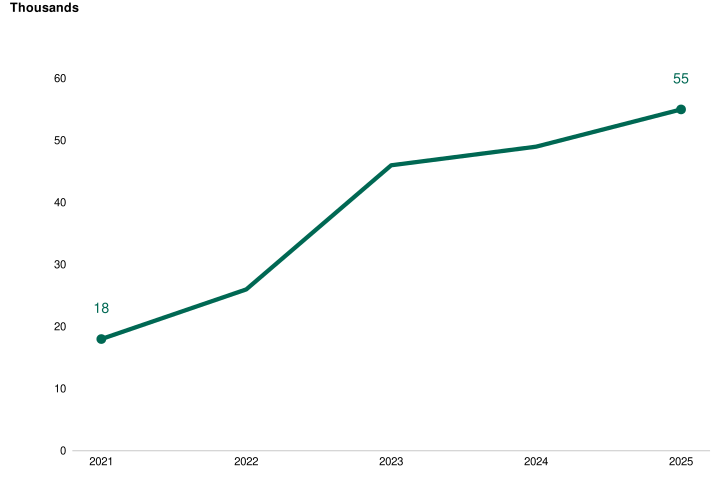
Chart 2 is a line graph that shows that the number of Blue Badges issued each year for people with non-visible disabilities has increased since eligibility was introduced.
Out of all badges issued in the year ending 31 March 2021, 2.2% (18,000) were issued under the eligibility criteria for people with non-visible disabilities. In the year ending 31 March 2025, 4.3% (55,000) of all badges issued were for people with non-visible disabilities. This is similar to the year ending 31 March 2024, when 4.3% (49,000) of all badges issued were for people with non-visible disabilities.
Blue badges held as at 31 March 2025
Chart 3: Blue Badges held: England, annually since March 2020 - DIS0101
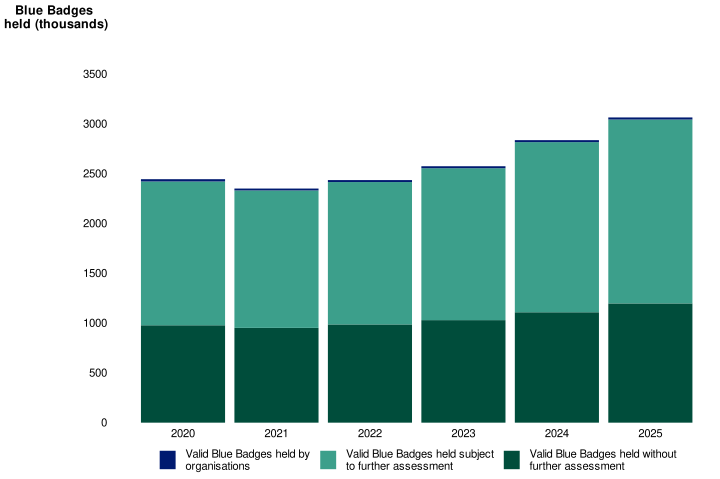
Chart 3 is a stacked bar chart that shows an overall increase in the number of Blue Badges held in England since 2020. There were 3.07 million valid Blue Badges held as at 31 March 2025, an increase of 228,000 (8.0%) compared to 31 March 2024.
Chart 4: Percentage of population entitled to a Blue Badge without further assessment, and the percentage of those that hold a badge: England, annually since March 2020 - DIS0103
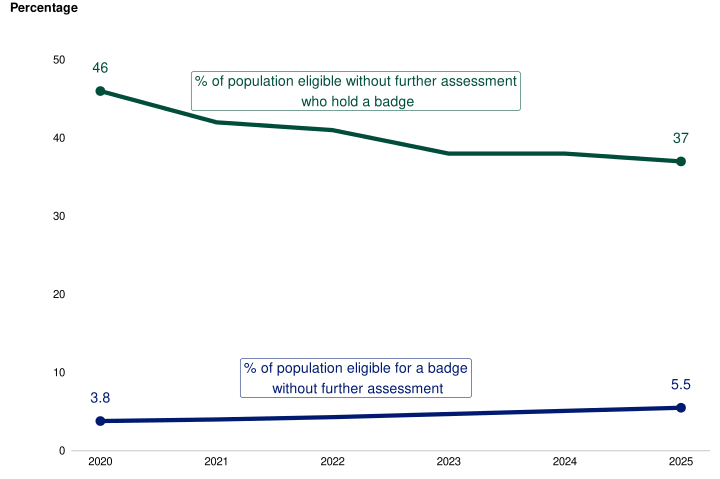
Chart 4 is a line graph showing that:
- the percentage of the population that is entitled to a Blue Badge without further assessment has been increasing since 2020
- of this population, the percentage that hold a Blue Badge has been decreasing since 2020
As at 31 March 2025, 3.22 million people (5.5% of the population in England) were entitled to a Blue Badge without further assessment. Of these people, 1.20 million (37% of those eligible without further assessment) held a Blue Badge.
The number and proportion of people entitled to a Blue Badge without further assessment who hold a Blue Badge has been falling since 2020. In 2020, 46% of people entitled to a Blue Badge without further assessment held a Blue Badge.
Blue Badges held and issued by region
On 31 March 2025, 5.2% of the population in England held a valid Blue Badge. The region with the most Blue Badge holders as a proportion of their population was the North East (6.1%). The region with the lowest proportion was London (3.5%).
More detail on the number of Blue Badges held at regional and local authority level can be found in the associated tables.
Lost and stolen badges in the year ending 31 March 2025
In England, 6,600 badges in the year ending 31 March 2025 were reported to be lost or stolen. Of these, 78% (5,200) were reported to be lost, and 22% (1,400) were stolen.
These figures reflect cases that have been recorded in the BBDS database. It is possible that not all instances of loss or theft will be reported and recorded, and therefore will not be included in these figures.
About these statistics
Annual data on Blue Badges that are held and issued are obtained from the BBDS database. Population statistics in this publication are based on the latest data available from various sources. More information on the data sources used can be found in the Background Quality Report.
This publication contains Accredited Official Statistics and Official Statistics. The type of statistics presented is detailed in Table 1 below.
Table 1: Categories of statistics presented in this publication
| Name of category of statistics | Label | Description |
|---|---|---|
| Blue Badge statistics (national level) | Accredited Official Statistics | These official statistics were independently reviewed by the Office for Statistics Regulation in June 2012. They comply with the standards of trustworthiness, quality and value in the Code of Practice for Statistics and should be labelled ‘accredited official statistics’. |
| Blue Badge statistics (regional and local authority level, lost and stolen badges) | Official Statistics | These statistics are official statistics. They comply with the standards of trustworthiness, quality, and value in the Code of Practice for Statistics. |
Details of ministers and officials who receive pre-release access to these statistics up to 24 hours before release can be found in the pre-release access list.
To hear more about Department for Transport (DfT) statistical publications as they are released, follow us on X at DfTstats.
Next release
The next Blue Badge scheme statistics release is due to be published in winter 2026 to 2027.
Instructions for printing and saving
Depending on which browser you use and the type of device you use (such as a mobile or laptop), these instructions may vary.
You will find your print and save options in your browser’s menu. You may also have other options available on your device. Tablets and mobile device instructions will be specific to the make and model of the device.
How to search
Select Ctrl and F on a Windows laptop or Command and F on a Mac
This will open a search box in the top right-hand corner of the page. Type the word you are looking for in the search bar and press enter.
Your browser will highlight the word, usually in yellow, wherever it appears on the page. Press enter to move to the next place it appears.
Contact details
Transport: disability, accessibility and blue badge statistics
Email localtransport.statistics@dft.gov.uk
Media enquiries 0300 7777 878