Agricultural facts: North East region
Updated 29 October 2026
Applies to England

© Crown copyright 2026
This publication is licensed under the terms of the Open Government Licence v3.0 except where otherwise stated. To view this licence, visit nationalarchives.gov.uk/doc/open-government-licence/version/3 or write to the Information Policy Team, The National Archives, Kew, London TW9 4DU, or email: psi@nationalarchives.gov.uk.
Where we have identified any third party copyright information you will need to obtain permission from the copyright holders concerned.
This publication is available at https://www.gov.uk/government/statistics/agricultural-facts-england-regional-profiles/agricultural-facts-north-east-region
Section 1: Key statistics
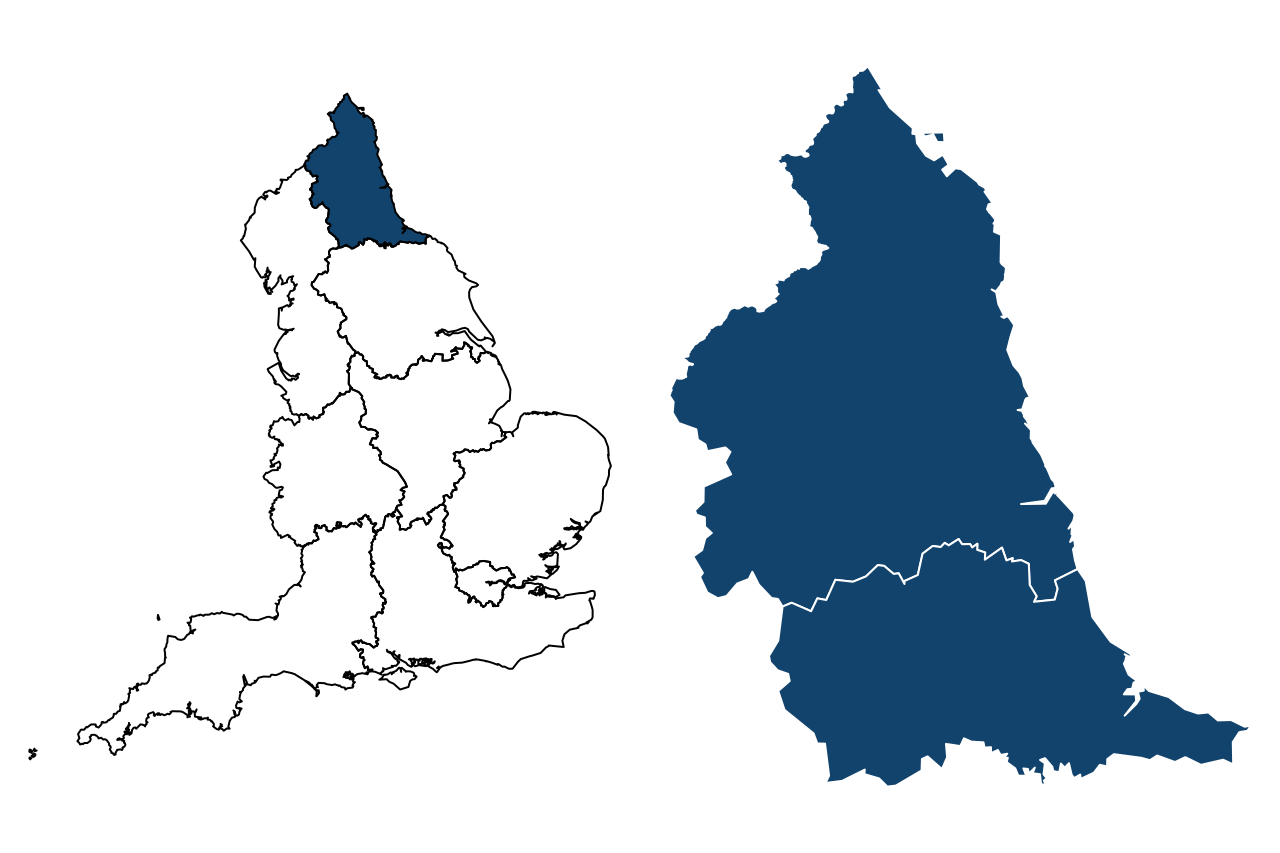
Figure 1.1: A map of England with the North East region highlighted
Source: Office for National Statistics, Open Geography Portal
The North East region comprises Northumberland, Tyne & Wear, Tees Valley and Durham.
Key statistics for the North East region
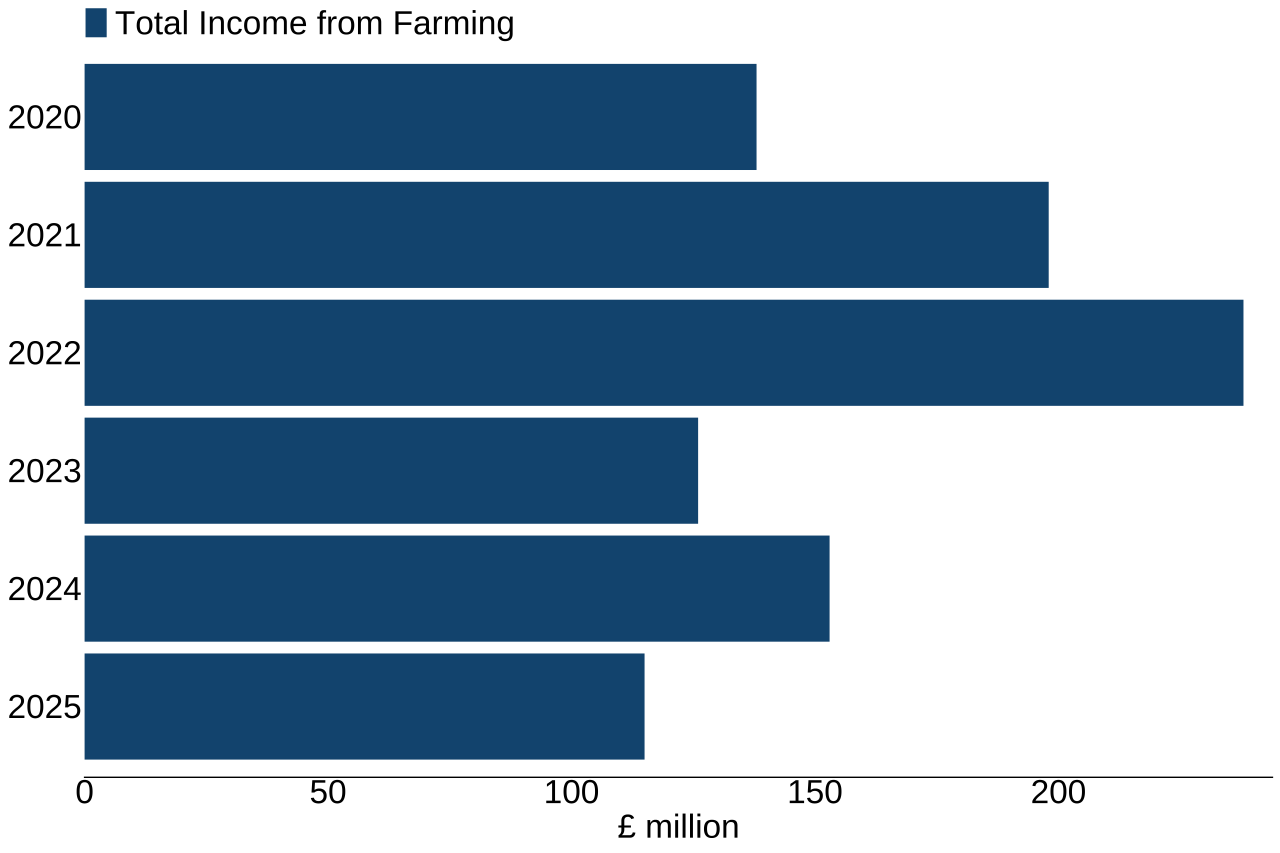
- Total Income from Farming[footnote 1] in 2025 was £115 million, a decrease of 24% since 2024 (Source: Total Income from Farming for the regions of England).
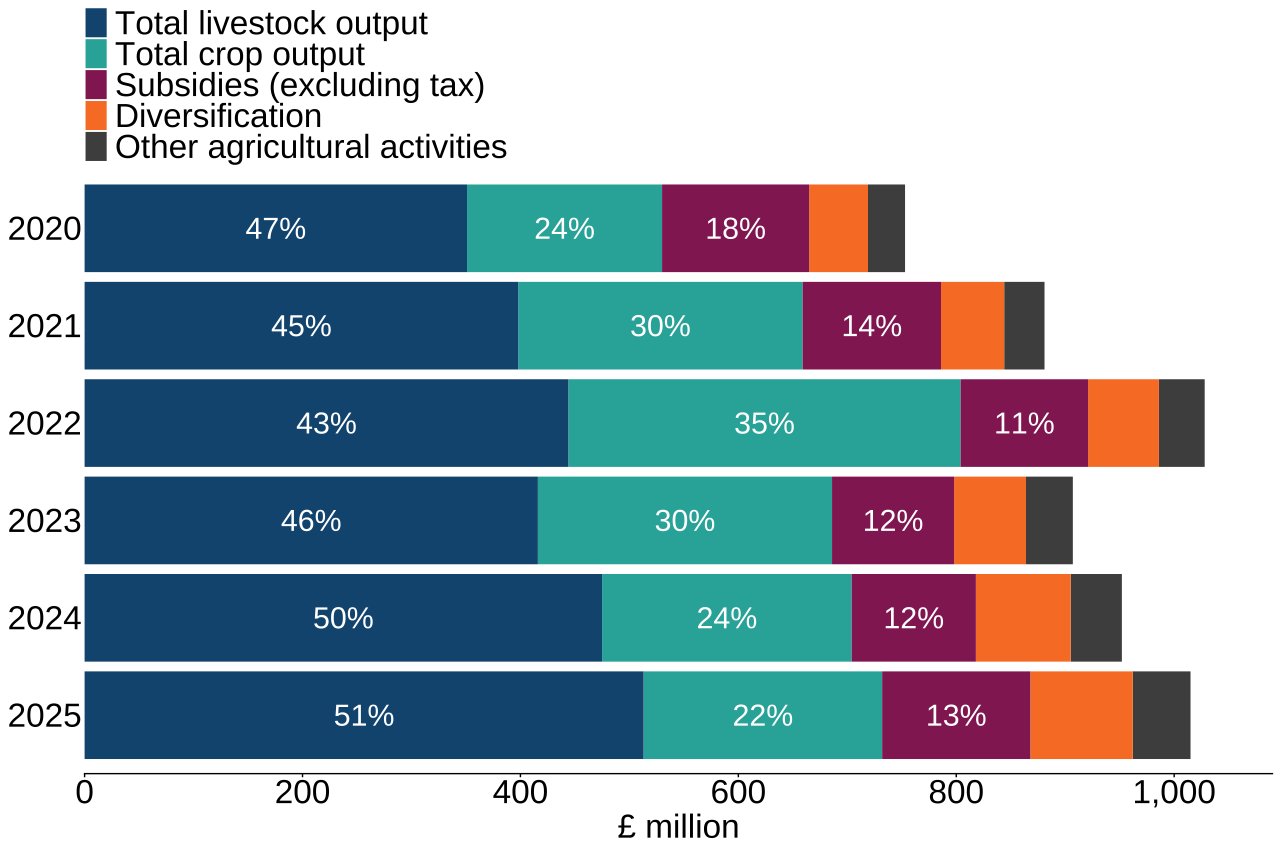
- In 2025, the largest contributors to the output[footnote 2] value (£879 million) were beef (£170 million), mutton, lamb and goat (£128 million), wheat (£78 million) and milk (£53 million). These commodities accounted for 49% of the output (Source: Total Income from Farming for the regions of England).
- The average farm size in 2025 was 142 hectares (Table 1.1). This is the largest average farm size of all the English regions and larger than the English average of 90 hectares.
- The predominant farm types in 2025 were grazing livestock (53% of the region’s holdings) and cereal (17% of the region’s holdings) farms (Figure 1.7).
- In 2024/25 (covering the 2024 harvest), the average Farm Business Income[footnote 3] across all farm types was £74,400 per farm, which was an increase of 9.6% from 2023/24 (Figure 1.9).
Figure 1.2: Total Income from Farming from 2020 to 2025 in current prices (£ million)
| Year | Total Income from Farming |
|---|---|
| 2020 | 138 |
| 2021 | 198 |
| 2022 | 238 |
| 2023 | 126 |
| 2024 | 153 |
| 2025 | 115 |
Source: Total Income from Farming for the regions of England
Figure 1.3: Outputs and subsidies split by percentage from 2020 to 2025 (£ million)
| Year | Total livestock output | Total crop output | Subsidies (excluding tax) | Diversification | Other agricultural activities |
|---|---|---|---|---|---|
| 2020 | 351 (47%) |
179 (24%) |
135 (18%) |
54 (7.1%) |
34 (4.5%) |
| 2021 | 398 (45%) |
261 (30%) |
127 (14%) |
58 (6.6%) |
37 (4.2%) |
| 2022 | 444 (43%) |
360 (35%) |
117 (11%) |
65 (6.4%) |
42 (4.1%) |
| 2023 | 416 (46%) |
270 (30%) |
112 (12%) |
66 (7.2%) |
43 (4.7%) |
| 2024 | 475 (50%) |
229 (24%) |
114 (12%) |
87 (9.1%) |
47 (5.0%) |
| 2025 | 513 (51%) |
219 (22%) |
136 (13%) |
94 (9.3%) |
53 (5.2%) |
Source: Total Income from Farming for the regions of England
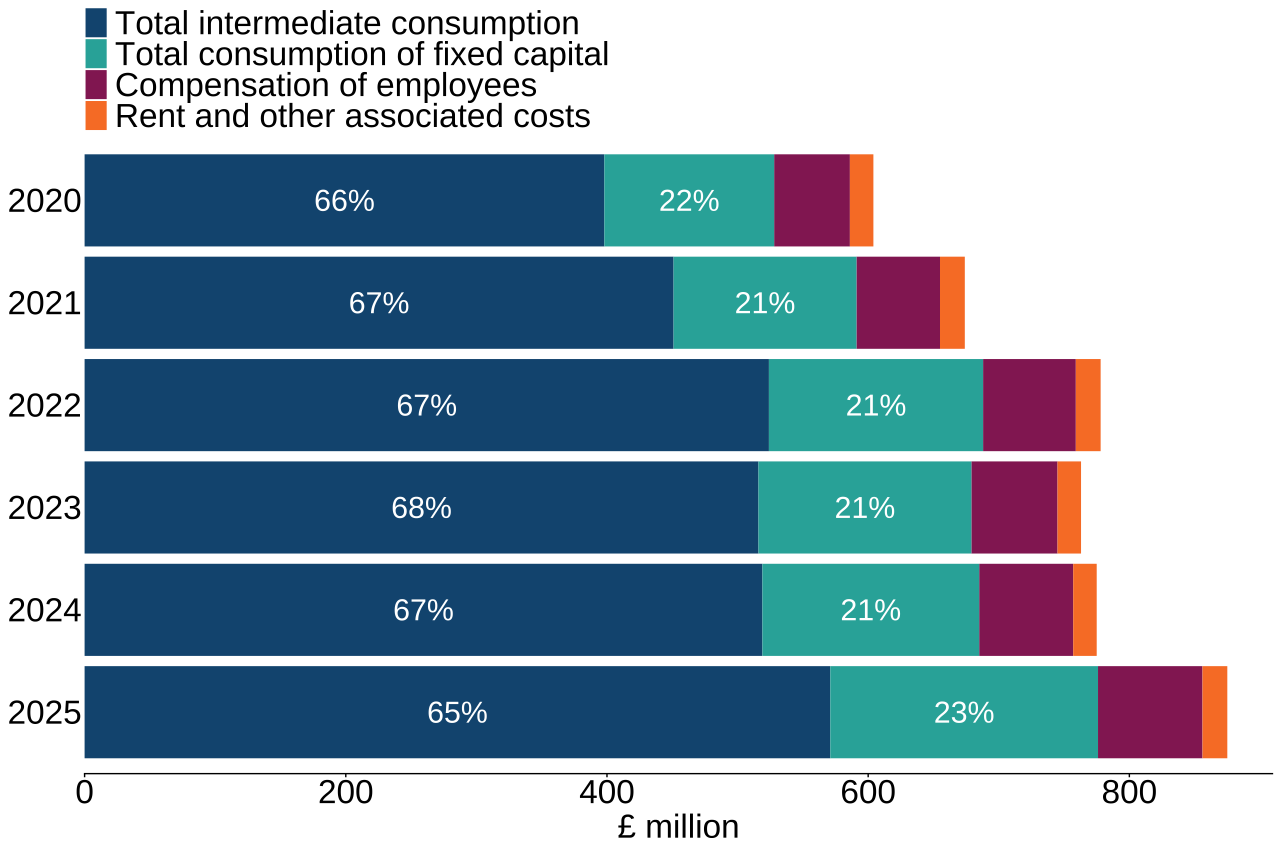
Figure 1.4: Inputs and costs split by percentage from 2020 to 2025 (£ million)
| Year | Total intermediate consumption | Total consumption of fixed capital | Compensation of employees | Rent and other associated costs |
|---|---|---|---|---|
| 2020 | 398 (66%) |
130 (22%) |
58 (9.6%) |
18 (3.1%) |
| 2021 | 451 (67%) |
140 (21%) |
64 (9.5%) |
19 (2.9%) |
| 2022 | 524 (67%) |
164 (21%) |
71 (9.1%) |
19 (2.5%) |
| 2023 | 516 (68%) |
163 (21%) |
66 (8.6%) |
18 (2.4%) |
| 2024 | 519 (67%) |
166 (21%) |
72 (9.3%) |
18 (2.4%) |
| 2025 | 571 (65%) |
205 (23%) |
80 (9.2%) |
19 (2.2%) |
Source: Total Income from Farming for the regions of England
Figure 1.5: Distribution of farms by size in 2025 (percentage of farm holdings)
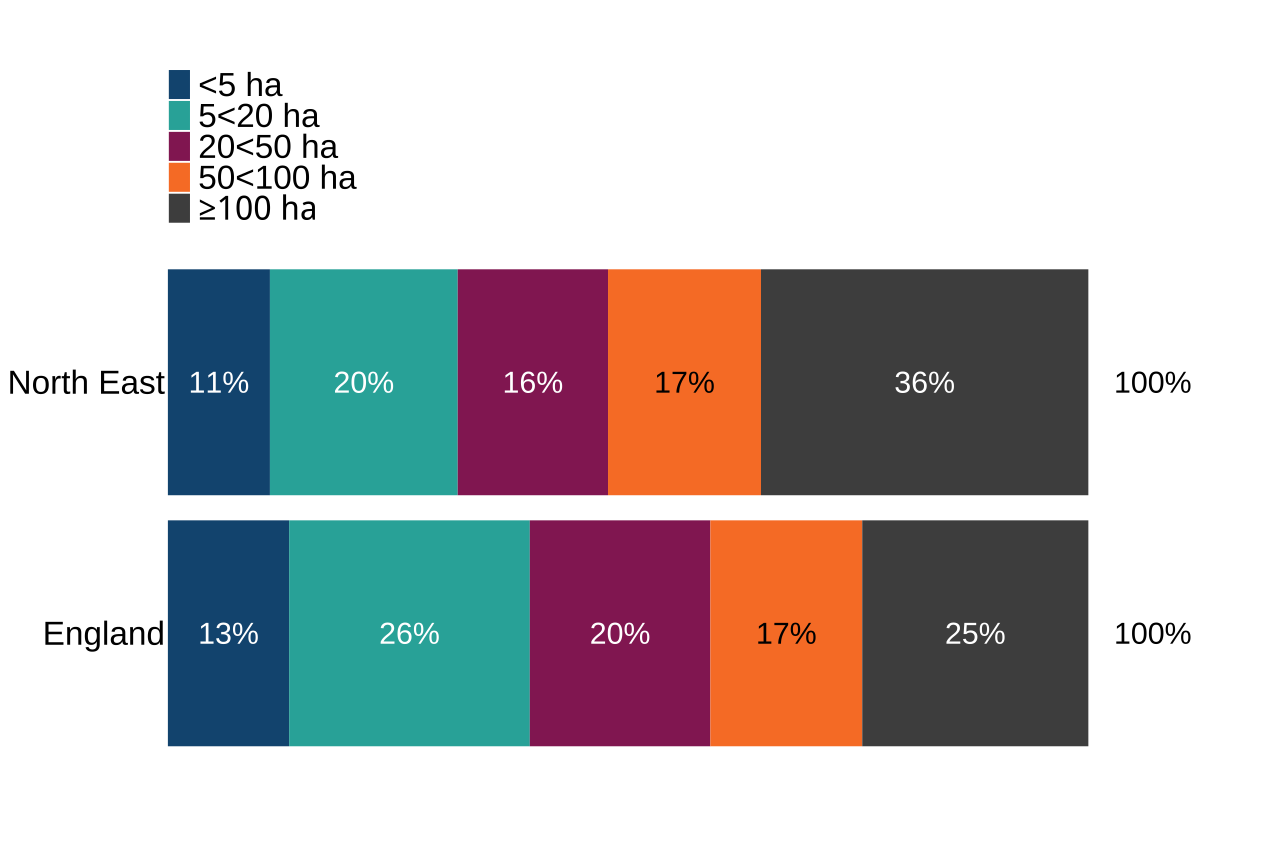
| Region | <5 ha | 5<20 ha | 20<50 ha | 50<100 ha | ≥100 ha | Total |
|---|---|---|---|---|---|---|
| North East | 11% | 20% | 16% | 17% | 36% | 100% |
| England | 13% | 26% | 20% | 17% | 25% | 100% |
Source: Defra, June Survey
Notes:
-
“ha” means “hectares”.
-
Proportions may not sum to 100% due to rounding.
Figure 1.6: Distribution of farms by size in 2025 (percentage of farmed area)
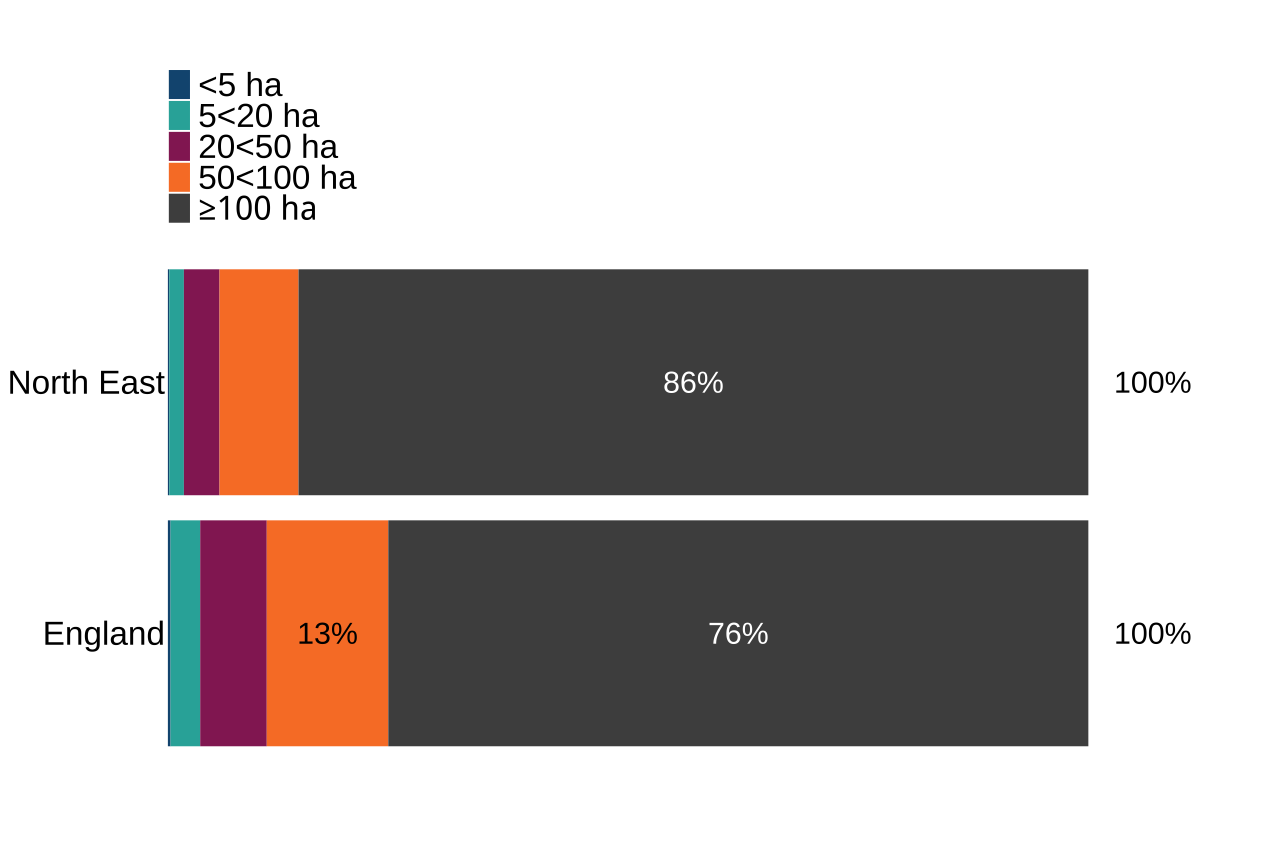
| Region | <5 ha | 5<20 ha | 20<50 ha | 50<100 ha | ≥100 ha | Total |
|---|---|---|---|---|---|---|
| North East | 0.2% | 1.6% | 3.9% | 8.6% | 86% | 100% |
| England | 0.3% | 3.2% | 7.2% | 13% | 76% | 100% |
Source: Defra, June Survey
Notes:
-
“ha” means “hectares”.
-
Proportions may not sum to 100% due to rounding.
Table 1.1: Land use in 2025
| Measure | North East | England |
|---|---|---|
| Total farmed area (thousand hectares) | 585 | 8,946 |
| Average farm size (hectares) | 142 | 90 |
| Rented (% of farmed area) | 41% | 32% |
| Arable (% of farmed area) | 33% | 54% |
| Permanent pasture (% of farmed area) | 45% | 34% |
Source: Defra, June Survey
Notes:
-
Arable includes arable crops, uncropped arable land and temporary grass.
-
Rented land must be rented for at least one year.
Table 1.2: Crop areas in 2025 (thousand hectares)
| Crop | North East | England | North East as % of England |
|---|---|---|---|
| Wheat | 61 | 1,525 | 4.0% |
| Barley | 34 | 742 | 4.5% |
| Oilseed rape | 13 | 204 | 6.3% |
| Oats | 9.9 | 162 | 6.1% |
| Potatoes | 1.2 | 90 | 1.4% |
| Field veg | 1.3 | 79 | 1.6% |
Source: Defra, June Survey
Notes:
-
Crops displayed are those more predominant in the area.
-
Further data notes on crops can be found below the relevant tables in the statistical dataset for England’s regional breakdown of the structure of the agricultural industry at June.
Table 1.3: Livestock numbers in 2025 (thousand head)
| Livestock | North East | England | North East as % of England |
|---|---|---|---|
| Cattle | 223 | 4,661 | 4.8% |
| Dairy herd | 13 | 1,040 | 1.2% |
| Beef herd | 58 | 544 | 11% |
| Pigs | 127 | 3,654 | 3.5% |
| Sheep | 1,677 | 13,312 | 13% |
| Poultry | 1,982 | 133,036 | 1.5% |
| Laying flock | 561 | 22,193 | 2.5% |
| Table chickens | 1,395 | 95,132 | 1.5% |
Source: Defra, June Survey
Notes:
-
Livestock displayed are those more predominant in the area.
-
Cattle numbers relate to commercial holdings only.
-
Sheep numbers include lambs.
Figure 1.7: Distribution of farms by type in 2025 (percentage of farm holdings)
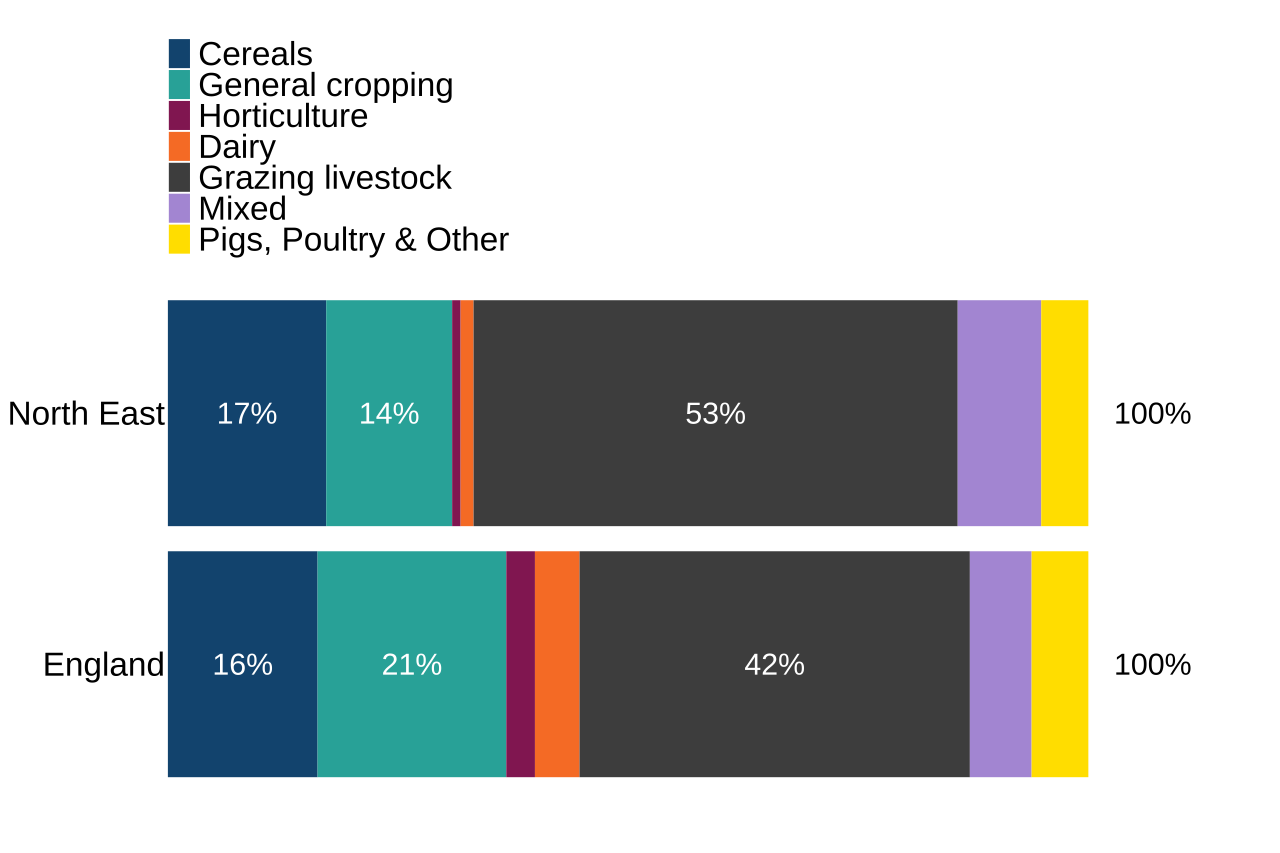
| Region | Cereals | General cropping | Horticulture | Dairy | Grazing livestock | Mixed | Pigs, Poultry & Other | Total |
|---|---|---|---|---|---|---|---|---|
| North East | 17% | 14% | 0.9% | 1.4% | 53% | 9.1% | 5.1% | 100% |
| England | 16% | 21% | 3.1% | 4.8% | 42% | 6.7% | 6.2% | 100% |
Source: Defra, June Survey
Notes:
-
Proportions may not sum to 100% due to rounding.
-
“Other” refers to unclassified farm types.
Figure 1.8: Distribution of farms by type in 2025 (percentage of farmed area)
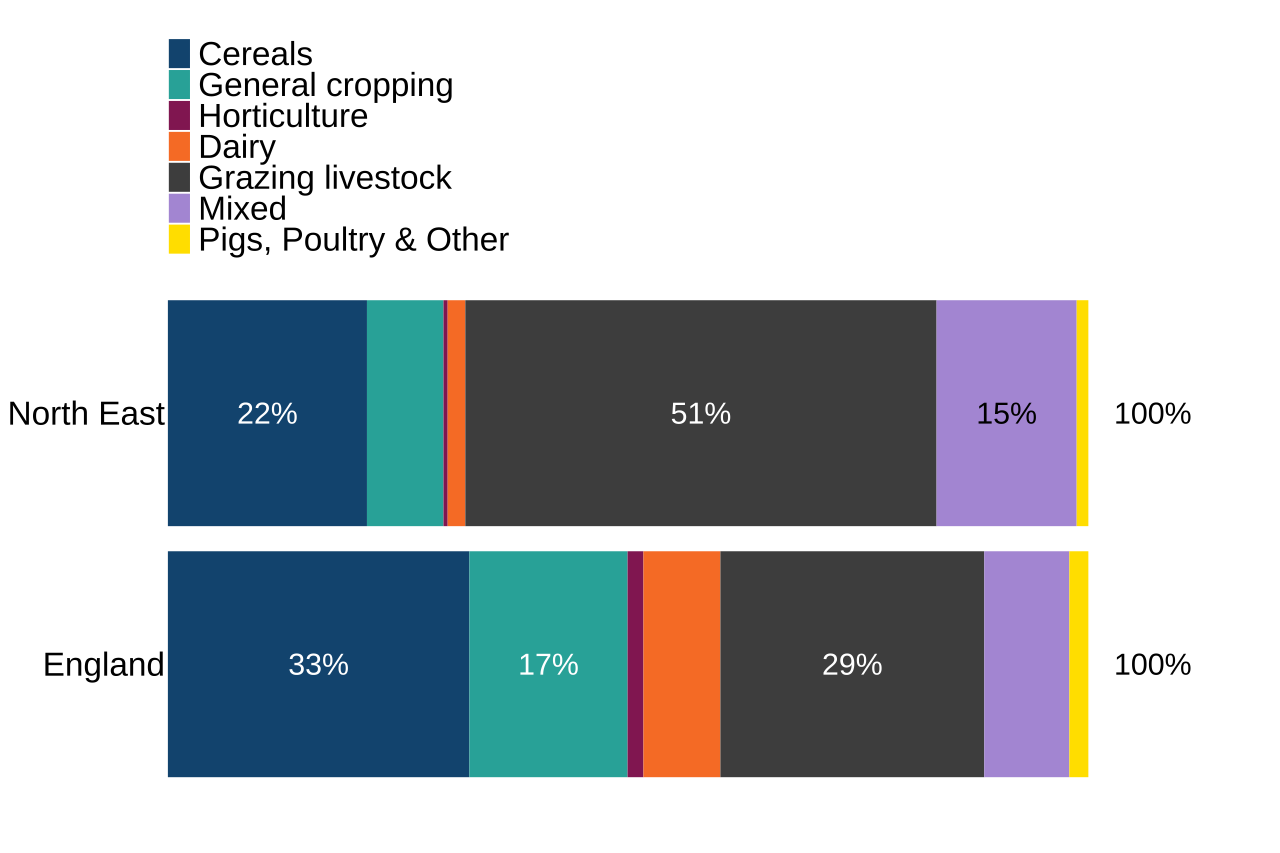
| Region | Cereals | General cropping | Horticulture | Dairy | Grazing livestock | Mixed | Pigs, Poultry & Other | Total |
|---|---|---|---|---|---|---|---|---|
| North East | 22% | 8.3% | 0.5% | 1.9% | 51% | 15% | 1.3% | 100% |
| England | 33% | 17% | 1.7% | 8.4% | 29% | 9.2% | 2.1% | 100% |
Source: Defra, June Survey
Notes:
-
Proportions may not sum to 100% due to rounding.
-
“Other” refers to unclassified farm types.
Figure 1.9: Average Farm Business Income in 2023/24 and 2024/25 (£ per farm)
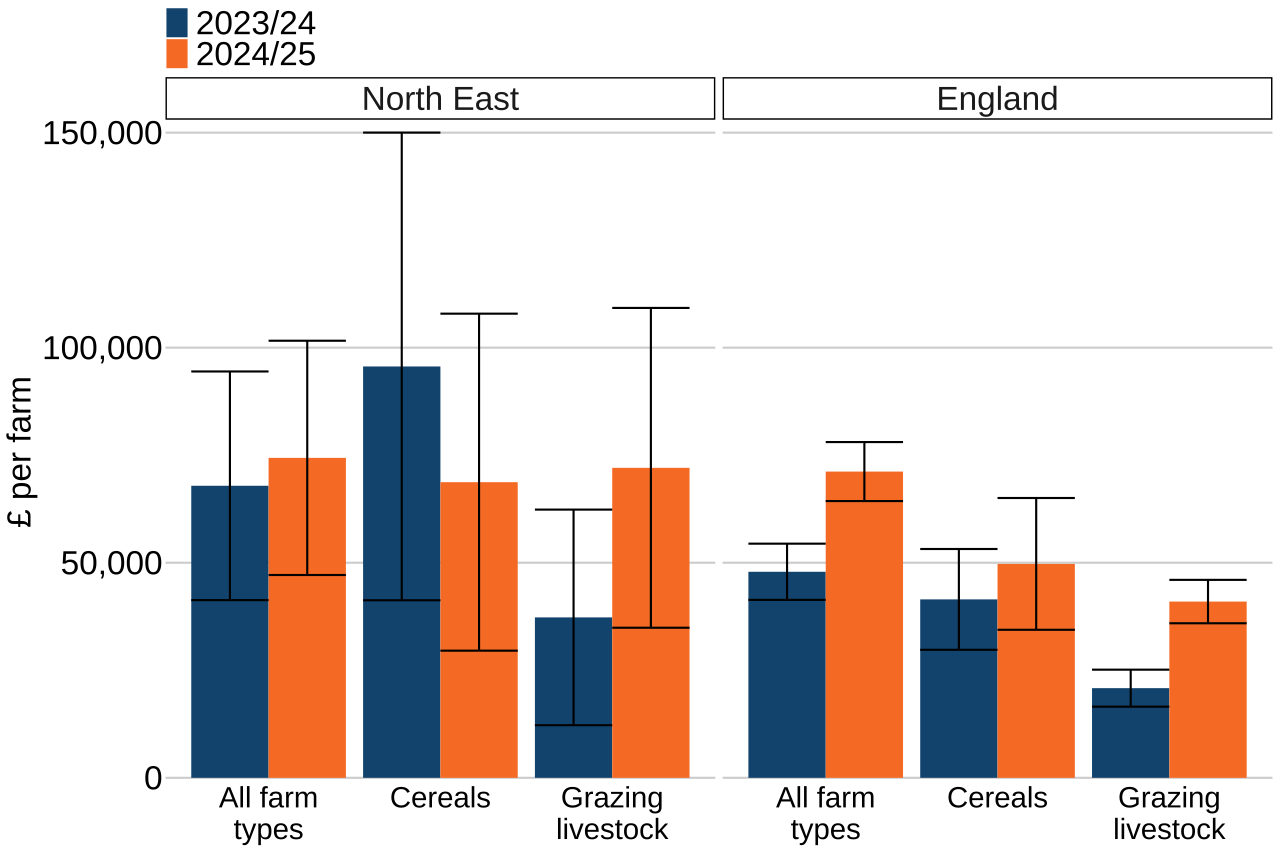
| Farm type | North East | England |
|---|---|---|
| All farm types (2024/25) |
74,400 (±27,200) |
71,200 (±6,900) |
| Cereals (2024/25) |
68,700 (±39,200) |
49,700 (±15,300) |
| Grazing livestock (2024/25) |
72,100 (±37,200) |
41,000 (±5,000) |
| All farm types (2023/24) |
67,900 (±26,600) |
47,900 (±6,500) |
| Cereals (2023/24) |
95,600 (±54,400) |
41,500 (±11,700) |
| Grazing livestock (2023/24) |
37,300 (±25,100) |
20,800 (±4,300) |
Source: Defra, Farm Business Survey (regional breakdown not published elsewhere)
Notes:
-
The Farm Business Survey year runs, on average, from March to February.
-
Excludes farms with less than £21,000 of standard output.
-
Farm types displayed are those more predominant in the area.
-
Lines or values in parentheses indicate the 95% confidence intervals.
-
In a given Farm Business Survey year, the sample size for some farm types can be relatively small. This means that individual farms can have a large influence on the results, and the results should be treated with caution. See the Farm Business Income by type of farm in England publication for more information.
-
Values are rounded to the nearest £100.
-
Data correct as at October 2026.
Table 1.4: Labour force in 2025 (number of people)
| Measure | North East | England | North East as % of England |
|---|---|---|---|
| Total labour | 9,542 | 279,493 | 3.4% |
| Total labour per farm | 2.3 | 2.8 | [z] |
| Regular workers | 1,749 | 64,840 | 2.7% |
| Regular workers per farm | 0.4 | 0.6 | [z] |
| Casual workers | 541 | 34,953 | 1.5% |
| Casual workers per farm | 0.1 | 0.3 | [z] |
| % full time | 55% | 47% | [z] |
| % part time | 36% | 36% | [z] |
| % casual | 5.7% | 13% | [z] |
Source: Defra, June Survey
Notes:
-
“[z]” means “not applicable”.
-
Total labour includes farmers, partners, directors, spouses, salaried managers, regular and casual workers.
-
Casual workers are those usually employed for less than 20 weeks of the year.
-
Number of workers per farm calculations are averages based on the total number of farm holdings in the region.
-
Part time workers are those employed for less than 39 hours a week.
-
Percentage calculations for full and part time workers do not include salaried managers.
Section 2: Data notes
Figures are for commercial holdings as at June 2025 (unless stated otherwise). Commercial holdings are those with levels of farming activity above a specified threshold as detailed in this publication’s guidance note. For further information about the June Survey of Agriculture and Horticulture please visit our survey notes and guidance page on GOV.UK.
“Region” in this statistical notice refers to International Territorial Level 1 (ITL1) for England. The ITL1 regions for Greater London and the South East have been combined in this statistical notice due to the fact that London has such a small farming infrastructure.
This release contains the latest data available at the time of publishing. As a result, reference periods may vary. TIFF and FBI represent data from distinct time periods: TIFF covers January to December 2025, while FBI spans March 2024 to February 2025. As these metrics reflect different reporting periods, direct comparisons between the two should be avoided.
Section 3: Other geographical breakdowns
Defra June Survey data aggregated at other geographical classifications can be found in the Structure of the agricultural industry in England and the UK at June statistical data set on GOV.UK.
England regional data for aggregate agricultural accounts (including data at ITL2 and ITL3) can be found in the Total Income from Farming for the regions of England publication on GOV.UK.
Section 4: Contact details
Team: Farming Statistics - Department for Environment, Food and Rural Affairs
Email: AUK_stats_team@defra.gov.uk
For media queries between 9am and 5pm on weekdays:
Telephone: 0330 041 6560
Email: newsdesk@defra.gov.uk
-
Total Income from Farming (TIFF) is the net income to farms once costs have been accounted for, so is calculated as “outputs & subsidies” minus “inputs & costs”. More information on aggregate agricultural accounts can be found on GOV.UK. ↩
-
Output is the total value (at market prices) of commodities produced without considering production costs or any additional income received through subsidies. More information on aggregate agricultural accounts can be found on GOV.UK. ↩
-
In simple terms, Farm Business Income (FBI) is the output generated by the farm business minus total farm costs. More information on Farm Business Income can be found on GOV.UK. ↩