Technical background: Access to green and blue space in England
Published 4 March 2026
Applies to England

© Crown copyright 2026
This publication is licensed under the terms of the Open Government Licence v3.0 except where otherwise stated. To view this licence, visit nationalarchives.gov.uk/doc/open-government-licence/version/3 or write to the Information Policy Team, The National Archives, Kew, London TW9 4DU, or email: psi@nationalarchives.gov.uk.
Where we have identified any third party copyright information you will need to obtain permission from the copyright holders concerned.
This publication is available at https://www.gov.uk/government/statistics/access-to-green-and-blue-space-in-england/technical-background-access-to-green-and-blue-space-in-england
This document provides technical details about the data and methodology used to produce the Access to green and blue space in England official statistic in development.
Overview
A shortest path algorithm was used to find the closest green or blue space access point to each household, given the walkable routes available. This type of model has three major components:
Network – consisting of links and nodes. Links represent transport infrastructure in line form, e.g. roads and paths, and nodes show the locations at which they interconnect. Together they form a traversable network, where each link has a length and two associated nodes. The path with the smallest sum of lengths between source and destination locations forms the shortest path.
Source locations – the places where the shortest path calculation begins. For this analysis, source locations are households.
Destination locations – the places where the model finds the shortest path to. For this analysis, destination locations are green and blue space access points.
More detail for each of these components is provided below.
Figure 1 : The components used in the shortest path analysis.
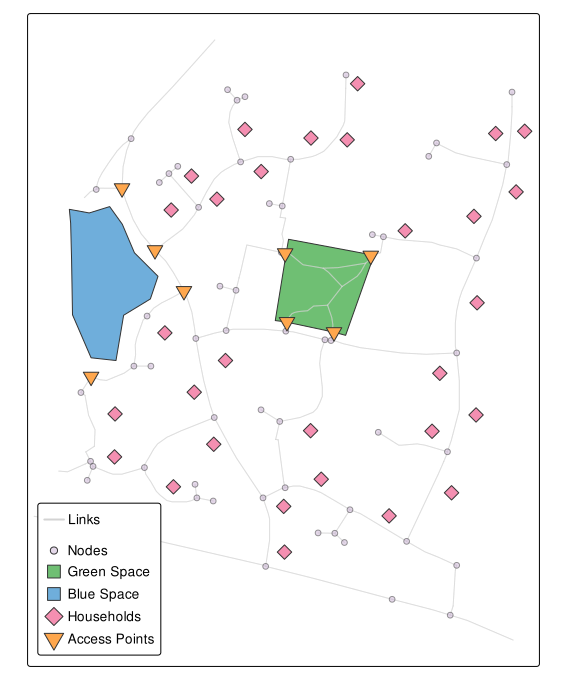
Notes for Figure 1
- Networks are formed of connected nodes and links. Households are spread out alongside links. Green and blue spaces are separate to the network but have access points which show how they can be reached.
Network
A network consisting of nodes and links was constructed using the pandana package in Python. Figure 1 shows an example network. Each link in the network has an associated length (in metres), as well as a start and end node. Nodes are used to connect links and represent start and end points for the shortest path analysis. Ordnance Survey Multi-Modal Routing Network (MRN) data were used to construct the network. These data are provided in a network ready format. Roads, paths and connecting links (which indicate when roads can be accessed from paths and vice versa) are provided with corresponding start and end node identifiers. The MRN is designed to be useable for modelling multiple transport methods, including car, public transport and pedestrian. A ‘foot’ field indicates where links are useable by pedestrians, and a filter selecting links with ‘foot’ values of ‘yes’ or ‘designated’, and their associated nodes, was used to build the network from the MRN. This removed all routes along motorways, and all links along A-roads which did not have full pavement coverage (these have a ‘foot’ value of no). Ferry and railway routes were also removed, as although they are accessible on foot, they are not appropriate to include for walking distance calculation. Links to modal change reference points were removed, as these are used to enable integration with other transport methods which was not required.
Source locations – households
A subset of AddressBase Premium data was used to define residential properties (households). Using a set of criteria defined by the Office for National Statistics (ONS), Unique Property Reference Numbers (UPRNs) identified as “residential from classification code and signs of life indicators” were subset from the main dataset. Filtering logic is described in UPRN logic speadsheet.
Each UPRN has an associated geometric point which was used to integrate them as source points in the network model. See Households and node relationships for more information on integrating households into the network. Approximately 25,800,000 residential UPRNs were identified and used in the modelling.
Household and node relationships
To calculate the shortest path from a household using the network, we needed to know where someone leaving the household would join the network. OS AddressBase Premium point geometries are not directly represented by nodes in the network. This means that there is a discrepancy in the distances calculated in the shortest path analysis, and the actual distance from the ‘front door’ of the household to a green or blue space. OS Linked Identifiers were used to link UPRNs with Unique Street Reference Numbers (USRNs). USRNs are collections of edges that form a street. The number of edges associated with a USRN are >=1.
For UPRNs with an associated USRN the following procedure was followed.
Stage 1:
- Nodes associated with the USRN were identified.
- The closest node to the UPRN was selected.
- If the distance between them was <=200 m, then that node was assigned as the ‘source node’.
- Otherwise, the nearest node (considering all nodes in the network) was chosen as the ‘source node’.
For most households, a UPRN/USRN relationship was established, where a node was <= 200m from the UPRN. In these cases, a further calculation was undertaken.
Stage 2:
- The distance from the UPRN to the closest edge (within the USRN group) was calculated.
- The distance from that point to the node assigned in the previous procedure was calculated.
- The two distances calculated in steps 1 and 2 were combined and used to adjust shortest path calculations accordingly.
Figure 2 shows diagrammatically how these calculations were made. For households where a UPRN/USRN was not established, a straight line distance from UPRN to the start node identified in stage 1 was calculated and used to adjust shortest path calculations accordingly.
Figure 2 : Household to node relationships. Firstly, the nearest associated node is identified (left – Stage 1), and then the distance from the household to that node calculated (right – Stage 2).
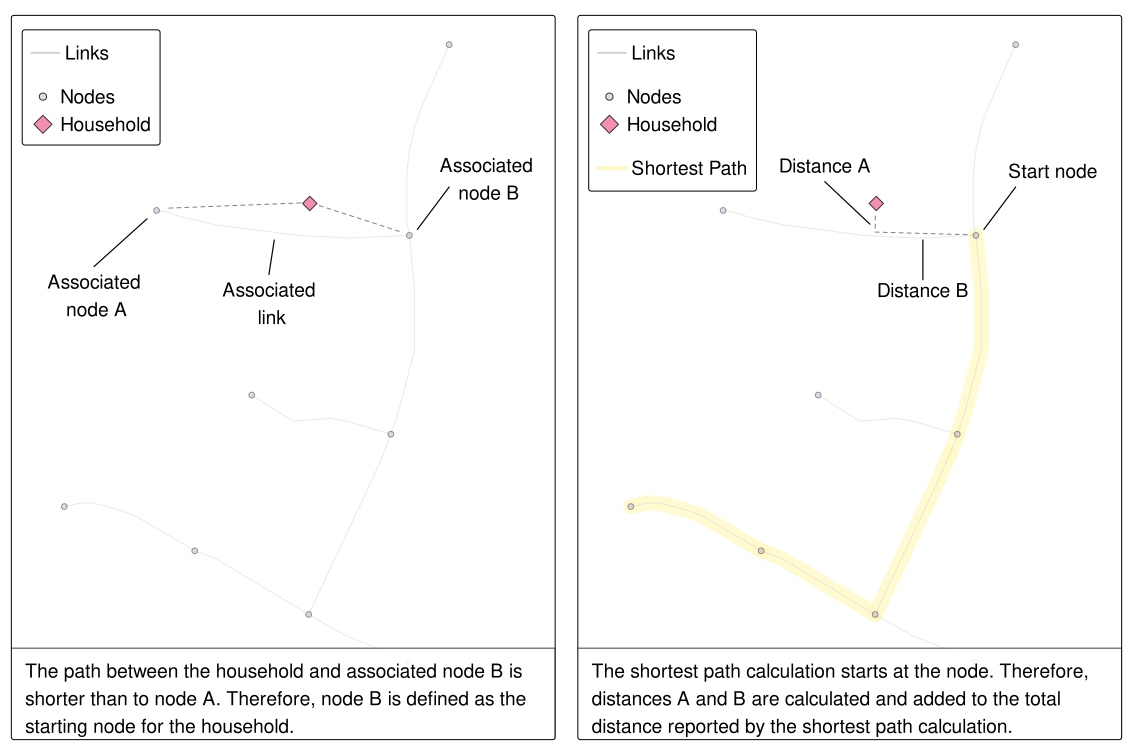
Notes for Figure 2
- There is currently a known issue with OS UPRN/USRN lookup tables which meaning some UPRNs are assigned the incorrect link. OS are working on fixing this. To help mitigate this issue, where the nearest node to a household was substantially closer to a household than the assigned link, the nearest node was used instead.
Destination locations - access points
Access points are point locations that show where a person is likely to access a particular type of green or blue space. We acknowledge that the data we have compiled is not exhaustive and that, for some green or blue spaces, we have not acquired or created data. A combination of pre-existing data and data created specifically for these statistics were used to represent access points to different types of green or blue space. For some of the access points created for these analyses, a modified version of compiled public rights of way data were used. Details on the different types of access points and how they are created are provided below. See Access point and node relationships for more information on integrating access points into the network.
Types of green and blue space
Ordnance Survey Open Greenspace
Green space locations and access points were acquired from the Ordnance Survey Open Greenspace data product. These data show the location and extent of green spaces, such as public parks, playing fields, sports facilities, play areas and allotments, which are likely to be accessible to the public. Each access point is linked to an associated green space, inheriting its attributes (such as size and type).
Millenium Greens
The Millennium Greens initiative set out to provide new areas of public open space close to people’s homes that can be enjoyed permanently by the local community, in time to mark the start of the third millennium in 2000. They could be small or large, and in urban or rural locations. Access points were created where public rights of way, roads where a footpath is present (as attributed by OS), or paths, enter or cross (intersect) millennium greens. Public rights of way data were acquired from Natural England’s Green Infrastructure mapping dataset.
Doorstep Greens
The Doorstep Greens initiative provides new or renovated areas of public open space close to people’s homes that can be enjoyed permanently by the local community. The initiative is aimed at targeting communities who experience disadvantage and where regeneration of the local environment and outdoor recreation provision is most needed. They could be small or large, and in urban or rural locations. Access points were created where public rights of way, roads where a footpath is present (as attributed by OS), or paths, enter or cross (intersect) doorstep greens.
Country Parks
Country Parks are accredited by Natural England. They are public green spaces often at the edge of urban areas which provide places to enjoy the outdoors and experience nature in an informal semi-rural park setting. Country Parks are not by default open access land. Therefore, considering where public rights of way enter and traverse them is an appropriate way to gauge access opportunities. Access points were generated where rights of way or OS paths intersected country park boundaries.
Local Nature Reserves
Local Nature Reserves (LNRs) are a statutory designation made under Section 21 of the National Parks and Access to the Countryside Act 1949, usually designated by principal local authorities. They are places with wildlife or geological features that are of special interest locally and offer people opportunities to study or learn about nature or simply to enjoy it. Access points were created where public rights of way, roads where a footpath is present (as attributed by OS), or paths, enter or cross (intersect) local nature reserves.
Open access land
The Countryside and Rights of Way Act 2000 (CRoW Act) normally gives public right of access to land mapped as ‘open country’ (mountain, moor, heath and down) or registered common land. Additionally, some land is subject to pre-existing access rights which predate the CRoW Act; this is known as Section 15 land. Collectively this ‘open access land’ is free to access in its entirety and can be accessed on foot by any available route. Open access land data was created by combining polygon datasets for CRoW access land and Section 15 land as published by Natural England. Access points were created where public rights of way, roads where a footpath is present (as attributed by OS), or paths, likely provided access to open access land.
Woodlands
The Woods for All dataset indicates woodlands, or parts of woodlands, to which the public has access. This includes areas designated for statutory public access or with permissive access, as well as 20-metre-wide woodland linear corridors along Public Rights of Way (PRoW). The Woods for All dataset is derived from a wide range of datasets and data sources, based primarily on the National Forest Inventory England 2022. As per the recommendation in the dataset user guide, features are filtered based on woodland type and access attributes to select relevant publicly accessible woodland locations. Access points were then created where public rights of way, roads where a footpath is present (as attributed by OS), or paths, likely provide access to woodland at these locations.
National Nature Reserves
National Nature Reserves (NNRs) were established to protect some of our most important habitats, species and geology, and to provide opportunities to the public to experience wildlife first hand and to learn more about nature conservation. There are currently 224 NNRs in England with a total area of over 116,000 hectares - approximately 0.8% of the country’s land surface. NNRs are not by default open access land. Therefore, considering where public rights of way enter and traverse them is an appropriate way to gauge access opportunities. Access points were generated where rights of way intersected national nature reserve boundaries and the rights of way within the NNR parcel were a minimum continuous distance.
Golf Courses
Similarly to National Nature Reserves, golf courses are typically not openly accessible to the public. Golf course boundaries were extracted from the OS Open Greenspace data product. Access points were generated where rights of way intersected golf course boundaries and the rights of way within the golf course were a minimum continuous distance.
Public Rights of Way (PRoW)
In non-built-up areas, there are fewer municipal green spaces, and the rights of way network provides people with an opportunity to access more natural green spaces.
Public rights of way data provide a spatial representation of footpaths, bridleways and byways. Highways authorities are responsible for maintaining spatial data detailing their location.
An access point dataset was generated representing the locations where the OS MRN network likely provide access to parts of the public rights of way network that are of a minimum continuous distance in non-built-up areas.
Blue space
Blue space access points are point locations that show where a person is likely able to access a particular type of blue space. Importantly, access in this context is defined as being able to see and experience blue space; not to enter it for recreational activities. There was no pre-existing England-wide blue space access point dataset to use for this analysis and associated statistics. Therefore, one was created: Blue space access points in England. Access points were created by identifying where walkable routes entered a defined proximity to blue space features such as lakes, rivers, canals and the sea.
Methods for creating access points
Access points used were a combination of both existing data (already published) and those created specifically for these analyses.
Pre-created access points
Ordnance Survey Open Greenspace
Greenspace access points were acquired from the Ordnance Survey Open Greenspace data product. This data product provides data representing the location and extent of green spaces, such as public parks, playing fields, sports facilities, play areas and allotments, which are likely to be accessible to the public. The point dataset joins to the polygon dataset allowing each point to be associated with a particular green space.
Access points created for these analyses
Woodlands / Open Access Land / Doorstep Greens / Millennium Greens / Local Nature Reserves
It was assumed that once accessed, the above green space types are free to access in their entirety. The extent of these green spaces are provided as polygon data by the relevant authority. To generate the access points, the Multi-Modal Routing Network (MRN) is combined with public rights of way data (available from Natural England’s Green Infrastructure project) to create a comprehensive path and road network. The following methodology was followed to create access points for these types of green space individually:
- Polygons representing the green space feature were buffered by 10 m. This was to account for the poor topological representation of some rights of way. Buffering was used to link very close types of the green space feature, where a minor road/path may provide a barrier in the data but provide minimal disruption to the green space experience in reality.
- The buffered polygons were dissolved to ensure the removal of internal overlapping boundaries. Internal polygon boundaries were removed to create a single polygon for neighbouring (within 10 m) green space parcels.
- The original polygons representing green space features were then erased from the buffered polygons created in the previous steps. This resulted in polygons representing the buffer zone (area between the original green space boundary and the buffered green space boundary) for each green space network.
- Sections of public rights of way falling within the green space buffer zones were extracted.
- Access points were generated from the start and end points of the extracted public rights of way sections.
The rationale for the buffer zone approach was to make sure that rights of way that fell within the buffer zone (i.e. within 10 m of the original green space polygon boundaries) but did not cross the buffered green space polygon boundary (usually because they met a path or road within the buffer zone) were captured as likely access points (Figure 3). This did result in the production of a greater number of access points, but it did not impact the shortest path calculations, as the destination is only ever one location per household.
Country Parks
The previously described buffer zone approach was also used to generate access points for Country Parks. However, due to the potential for Country Parks to have restricted access to the public, a further subset of the MRN routing network is made prior to access point generation. As well as the previously described filters, the product is filtered on the ‘highway’ attribute for features classed as footway. The intention is to include any official entrances to country parks, whilst removing any potential roadside access that may be applicable for other types of green space.
Figure 3 : The approach to generating access points, where a minimum length of contiguous rights of way is present within the green space.
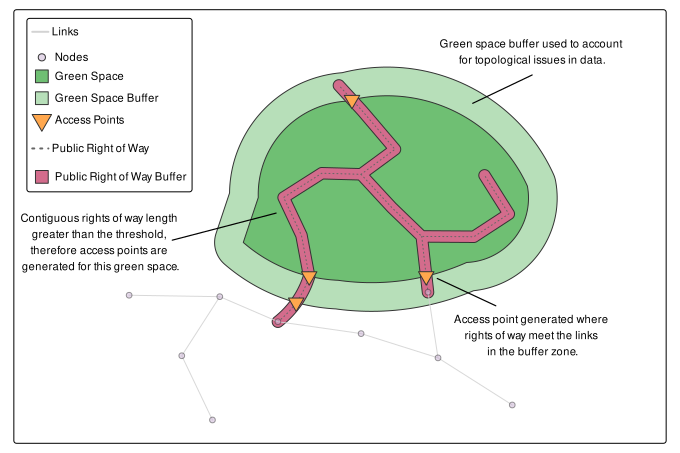
Notes for Figure 3
- Green space polygons and rights of way lines are buffered.
- The locations where the rights of way meet either the inner or outer edge of the buffer are defined as access points to that green space (if the minimum contiguous distance threshold of rights of way is met).
Golf courses / National Nature Reserves
Golf Courses and National Nature Reserves are not by default fully accessible. Therefore, access points were generated for these green space types where public rights of way intersect them and the public right(s) of way are continuous within the green space for at least 250 m. Golf courses were extracted from the OS Open Greenspace data product and National Nature Reserve polygons are produced by Natural England. Rights of way data from the Natural England Green Infrastructure dataset were also used. The following methodology was used to create access points for these types of green space (Figure 3):
- Polygons representing the green space feature were buffered by 10 m. This was to account for the poor topological representation of some rights of way. Buffering was used to link very close types of that green space feature, where a minor road/path may provide a barrier in the data but provide minimal disruption to the green space experience in reality.
- A subset of rights of way was created by intersecting them with the polygons created in step 1.
- Rights of way lines were buffered by 5 m, combined and dissolved to create polygons representing continuous rights of way.
- The rights of way lines that fell within the polygons created in the previous step were identified. These were joined to the green space polygons from step 1, allowing selection of polygons that contained at least 250 m of continuous rights of way within them.
- The subset of green space polygons from the previous step were altered, erasing the original green space polygons from them. This resulted in polygons representing the buffer zone (area between the original green space boundary and the buffered green space boundary).
- Sections of rights of way falling within the green space buffer zones were extracted.
- Access points were generated from the start and end points of the extracted right of way sections.
The same buffer zone approach was used as described in Woodlands / Open Access Land / Doorstep Greens / Millennium Greens / Local Nature Reserves.
Public Rights of Way
In non-built-up areas, there are fewer municipal green spaces, and the rights of way network provides people with an opportunity to access green spaces. An access point dataset was generated representing the locations where the Ordnance Survey Multi-Modal Routing Network (MRN) likely provides access to parts of the public rights of way network that are of a minimum continuous distance in non-built-up areas. Along with the MRN data, public rights of way and built-up areas datasets were used to achieve this (Figure 4). The following procedure was undertaken:
- Rights of way lines were extended by 10 m in both directions (to account for differences in the accuracy of connections between datasets).
- Extended rights of way lines were intersected with the MRN network data, forming a rights of way access point dataset.
- Rights of way lines were buffered by 5 m, combined where overlapping and dissolved to create polygons representing continuous rights of way.
- The continuous polygons were intersected with the Built-Up Areas data, and the proportion of the polygon in a built-up area calculated.
- The total perimeter of each continuous polygon was calculated.
- The continuous polygons were subset firstly by selecting those with a perimeter of at least 500 m and then those that have a proportion of built-up area coverage less than or equal to 25%.
- The subset of continuous polygons was intersected with access points created in step 2 to create a subset of access points.
- Built-up areas were negatively buffered by 250 m, creating a ‘core built-up area’ polygon dataset.
- The subset of access points created in step 7 were further subset, removing those that intersected the ‘core built-up area’ polygons.
The rationale for the filtering criteria in step 6 is that a perimeter of 500 m would equate to approximately 250 m of right of way, a substantial amount of continuous accessible path/road. The built-up area coverage of less than or equal to 25% was used to capture parts of the rights of way network that begin or end in built-up areas but provide access to rural areas. From an examination of the data, 25% provided a good balance to screen out majorly built-up parts of the rights of way network, while keeping those that were majority non-built-up with a relatively small built-up component. The second pass spatial filtering using ‘core built-up areas’ (step 8) is used to exclude access points that are deep within urban areas, despite the overall connected network being majority non-built-up.
Figure 4 : The approach to producing rights of way access points using two criteria.
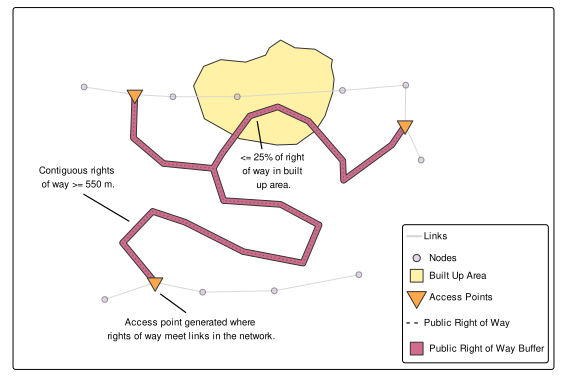
Notes for Figure 4
- Contiguous rights of way are buffered. When the contiguous length is greater than a set threshold, access points are defined where they meet links in the road/path network.
- If more than or equal to 25% of the contiguous rights of way is in a built up area, access points are not generated.
Blue Space Access Points
To generate blue space access points, the first step was identifying blue space of interest and preparing the blue space datasets. Two blue space datasets were used:
-
Ordnance Survey water features – water
-
Ordnance Survey water features – tidal boundary
The ‘water’ dataset was used to represent non-coastal inland blue space, and the ‘tidal boundary’ to represent coastal blue space. Both datasets were filtered to remove non-relevant features and features from the ‘water’ dataset under 0.005 ha (no size filter was applied to the ‘tidal boundary’ dataset).
To identify where access to the above blue spaces is likely possible, four route datasets were used:
-
Ordnance Survey (OS), Paths
-
Ordnance Survey (OS), Roads
-
Natural England, Public Rights of Way (PRoW)
-
Natural England, England Coast Path
The paths, roads and PRoW datasets were combined to form a single general routes dataset and the England Coast Path was kept separate as a coast only route dataset.
Figure 5 : Approach used to generate blue space access points.
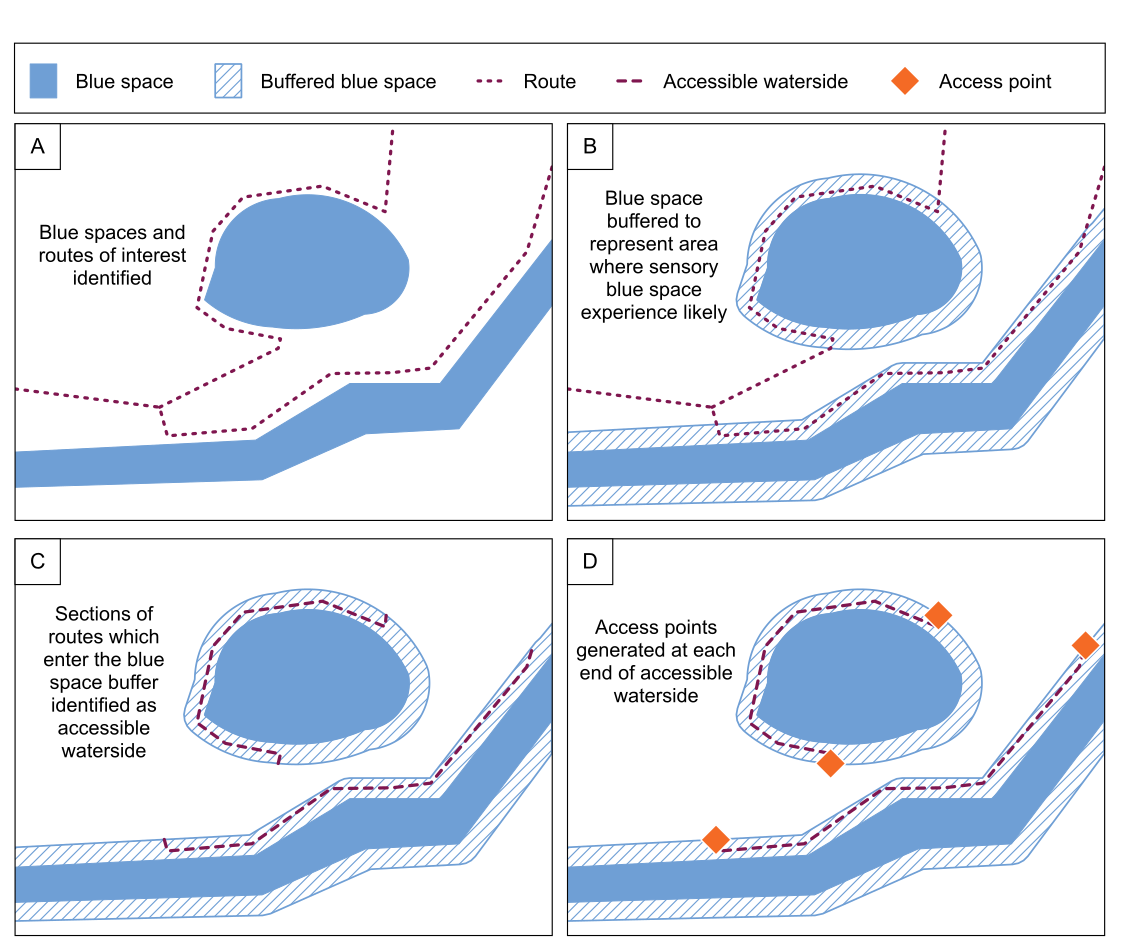
Notes for Figure 5
- Blue spaces are buffered to create a zone around them. This can be thought of as the waterside area. Sections of walkable routes which pass within this waterside area are selected; these can be thought of as accessible waterside and are represented by lines. At each end of the lines representing accessible waterside an access point is generated.
To locate accessible waterside, sections of routes which passed within a defined proximity of blue space were identified (Figure 5). The threshold proximity used was changed depending on the type of blue space and route. These different thresholds were applied by buffering the blue space by different amounts:
-
Inland blue spaces were buffered by 10 m. General routes (OS paths, OS roads and PRoW) which intersected this 10 m buffer were identified as inland accessible waterside.
-
Coastal blue spaces were buffered by 50 m. Sections of the England Coast Path which intersected this 50 m buffer were identified as coastal accessible waterside. The rationale for this is that as the purpose of England Coast Path is accessing the coast, we can assume that in general along this path you are accessing coastal blue space. This justifies the 50 m buffer zone.
-
Coastal blue spaces were also buffered by 20 m. General routes (OS paths, OS roads and PRoW) which intersected this 20 m buffer were identified as coastal accessible waterside. The rationale for using a 20 m buffer rather than the 10 m buffer as used for inland blue spaces, is because the coast is an expansive blue space which provides visual access from a greater distance. It is also likely that coastal routes, such as those along clifftops or promenades, are further than 10 m from the tidal boundary, although they arguably provide access to the coast. Desk-based validation found using a 20 m buffer worked well to limit issues with barriers to visual access such as walls and buildings caused by larger buffer distances but still capture the majority of route sections providing an actual blue space experience.
The created inland and coastal accessible watersides were combined into a single accessible waterside dataset, which was used to calculate accessible waterside length (see accessible waterside length section below) and to produce blue space access points. Access points were produced by generating a point at each end of a section of accessible waterside. The produced access points were refined (see blue space access point refinement section below for details) to produce the final blue space access point dataset.
Blue space access point refinement
Due to the nature of the input data the outlined access point generation method results in an excess number of access points. Three methods were used to reduce the number of access points.
Firstly, for sections of accessible waterside shorter than 20 m, access points were generated only at a single randomly selected end. 20 m can be walked in less than 20 seconds at a typical walking speed, and therefore not generating multiple access points for these smaller sections of accessible watersides will not have a significant impact on walking distances from households.
The second method used was weaving correction. Where a route weaves into and out of the buffered blue space zone, the weaving generates access points at each entry and exit to the buffer zone. Along a single route with no branching, these are surplus access points. Instead, it is better to have just the ‘first’ and ‘last’ access points along the route. For each access point a location on the route line was calculated. The access points with the maximum and minimum line locations for each blue space ID – route ID combination were then selected and kept; all other access points along the route were removed.
The third method used was clustering of access points. Excess access points were generated where multiple routes meet or occur in proximity to blue space, as each route will generate separate access points. Similarly, excess access points were generated where multiple blue spaces occur in proximity to a route, as each will generate separate access points. In combination these factors result in an overly busy access point dataset, particularly in more built-up areas. To remedy this clustering of access points was done using density-based spatial clustering of applications with noise (DBSCAN) to partition the access points into clusters based their distance to other access points. Points within 20 m of each other which provided access to the same accessible waterside collection (see below) were considered for clustering, and clusters were formed where 2 or more points were involved. For points identified to be part of a cluster, the middle geometry of all access points in a cluster was used to form a ‘clustered access point’. For each cluster, this clustered access point was used to represent all points in the cluster, and the original ‘raw’ access points were removed. Attributes associated with the original ‘raw’ access points were preserved as array values in the new clustered access point. Not all access points were identified as part of a cluster and for these the original ‘raw’ access point geometries were kept. This resulted in a refined blue space access point dataset which was used in the network analysis.
Accessible waterside length
Accessible waterside length was one method used to filter the blue space access point dataset. This was calculated using the accessible waterside dataset which was created during the blue space access point generation. The accessible waterside dataset consists of linestring representations of sections of routes in proximity to blue space. To simply calculate accessible waterside length, the length of each linestring can be calculated. However, the aim of filtering on accessible waterside length was to select for accessible waterside which provide a reasonable length of blue space experience, which could be provided by multiple connected or nearby sections of accessible waterside. To account for this, an accessible waterside collection length was used instead of simply using accessible waterside length.
To calculate collection length, accessible waterside collections were first identified:
- Accessible waterside was buffered by 10 m and then flattened into a single layer for each type of blue space (for example, still water or water course). This creates a flat accessible waterside collection layer for each type of blue space, where pieces of blue space within 10 m of each other are represented by a single large polygon (an accessible waterside collection).
- Each accessible waterside collection was given a unique collection ID.
- A spatial intersection was done between the original accessible waterside lines and the created accessible waterside collection polygons. Based on this intersection an accessible waterside collection ID is assigned to each original accessible waterside line.
- The original accessible waterside lines are then grouped by their assigned collection IDs and the sum of the accessible waterside lines is calculated for each collection ID group. This is the accessible waterside collection length
- Using the collection ID this accessible waterside collection length was linked back to each individual accessible waterside that forms the collection.
Figure 6 : Method used to calculate accessible waterside length from sections of accessible waterside (waterside which can be walked along on foot).
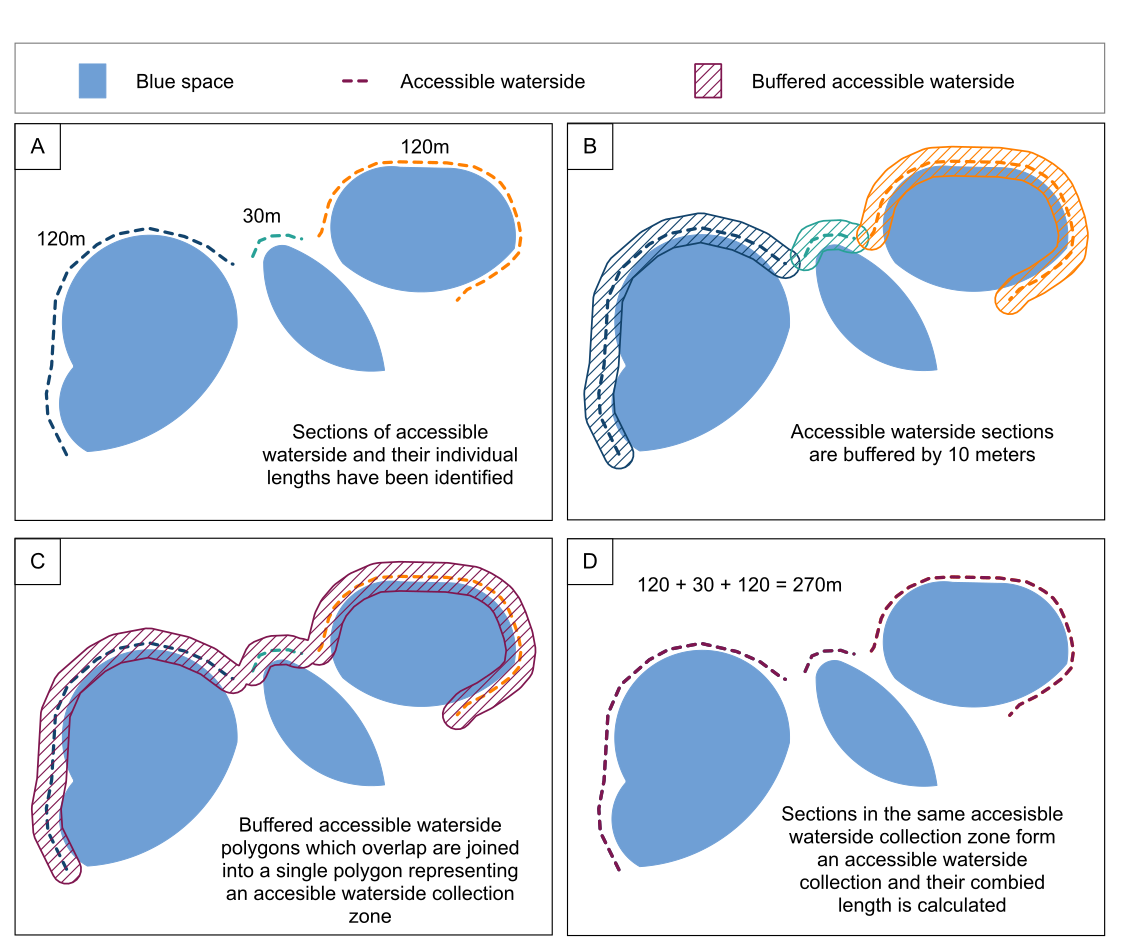
Notes for Figure 6
- To calculate accessible waterside length, processing is done to group nearby sections of accessible waterside into collections, for which the total length is calculated. First sections of accessible waterside are buffered by 10 m to form a hatched area around the accessible waterside. Where these hatched areas overlap, they are combined to form an accessible waterside collection zone. The lengths of all accessible waterside sections in the same collection zone are added together to give a combined length for the collection of nearby accessible waterside sections.
Following this we have an accessible waterside dataset with accessible waterside collection lengths included. When the blue space access points are created from the accessible waterside data, this accessible waterside collection length is included in (and can be used to filter) the final blue space access point dataset.
Access point and node relationships
To calculate the shortest path to a green or blue space access point using the network, we need to know where someone would leave the network to get to the access point. Unlike source points, access points do not have corresponding links/nodes as they are derived from a variety of sources. Therefore, the nearest node (straight line distance) in the network was assigned as the destination node in the shortest path calculation. Access points greater than 200 m from their nearest node in the network were discarded from the analysis. 200 m was chosen as a threshold as this matches the shortest distance threshold in the green infrastructure standards.
Method for creating the statistics
Data Preparation
OS MRN transport nodes and links were reprojected to the British National Grid (EPSG:27700). Then, links were filtered, selecting those that were deemed walkable (see Network for details). Nodes which were unrelated to the selected links were removed. Pavement presence attributes from OS NGD road links data was joined to the filtered MRN data. Where left and right pavement presence was absent, overall pavement presence was used. Links and nodes data were formatted ready for use with the Network function in the pandana package.
Walking times accounting for elevation (see Accounting for elevation gain) and pavements (see Accounting for pavements) were calculated for each link, ready to be used in the network model.
Once the nodes and links were ready for modelling, source points were filtered, selecting households from all addresses (see procedure here). Relationships between source points and nodes were then established (see Household and node relationships).
Access points from various sources (green and blue) were combined, fitting a common schema. Relationships between destination points and nodes were then established (see Access point and node relationships).
Running the Model
Given the large amount of computing resource required for the shortest path calculations (due to the density of roads and paths in some parts of England), a tiling approach was used (Figure 7). The OS 5 km grid for England was acquired, then clipped to the boundary of England (buffered by 10 km) to identify and retain only the terrestrial grid squares. The 10 km buffer was used to remove any ambiguity in coastal areas, retaining grid cells with any likely household locations.
For each grid cell, the following was undertaken:
- Extract the source points (households) that intersect the grid cell.
- Extract the destination (green and blue space access) points that intersect the grid cell and any of the 8 neighbouring grid cells. For coastal grid cells, there will be fewer than 8 neighbouring grid cells.
- Extract the network data that intersect the grid cell and any of the 8 neighbouring cells.
- Create a network with the extracted network data using the python package pandana.
- Identify the nodes in the network that relate to the households. These are now referred to as source nodes. See section on household and node relationships.
- Identify the nodes in the network that relate to the green and blue space access points. These are now referred to as destination nodes. See section on access points and node relationships.
- Calculate every unique pair of source nodes and destination nodes.
- Run the shortest path algorithm for every unique pair of source and destination nodes. This algorithm sums the length attribute of each link in the network that it traverses when calculating a path, resulting in a total length (in meters) for each shortest path.
- For each source node, select the shortest distance recorded to each of the destination nodes.
- Join the shortest distances back to the household data, so that every household has an associated shortest distance.
- For each household and green or blue space pair, only the shortest route was kept (as some spaces have multiple access points). Routes over 20 minutes in walking time were discarded.
Figure 7: The tiling approach taken to run the network model.
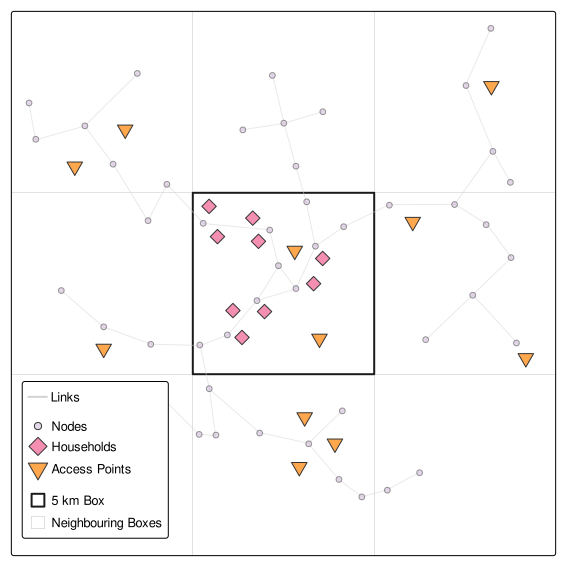
Notes for Figure 7
- All spatial modelling data is split into 5 km tiles. The shortest path model was run for households within a single 5 km tile at a time, while also considering the data in the neighbouring tiles.
Walking time
We used a walking speed of 4 km/h to calculate a predicted walking time from the distance along each link in the Multi-modal routing network. This walking speed was taken from a Department for Transport publication and matches the walking speeds used in the existing access to green space and access to blue space official statistics in development. This means for a kilometer walked, the predicted walking time is 15 minutes.
Accounting for elevation gain
Walking uphill takes more time than walking on a flat surface. The links data from the Multi-modal routing network is provided with an elevation gained attribute. This attribute was used to adjust the predicted walking time for each link in the network for walking uphill. The formula used to calculate the adjustment was a simplified version of Naismiths rule which states: “Allow an additional hour for every 2000 feet of ascent”. Reflecting this in our model, 6 seconds is added to the predicted walking time for each meter of ascent along the route.
Note: There is a similar but slightly more complex element of Naismith’s rule which can be applied to walking downhill. No adjustment has been made in the model for walking downhill as it relies on more detailed information on slope gradient which was not readily available.
Accounting for pavements
On busier roads, it is safer to walk along pavements. However, pavements are not always present. Matching the ‘safe routes to school’ guidelines, we have excluded A-roads which do not have full pavement coverage from the network model. Additionally, we have penalised B-roads which have less than 75 percent pavement coverage on both sides of the road by doubling the time it takes for the model to walk down them. This disincentivises the model from routing along these roads but does not prevent it completely.
Model routing adjustment based on pavement presence does not have an accepted set of standard methods. We have applied the method described in the previous paragraph to provide some incentive for the model to use safer routes. We welcome feedback on this approach.
Note: the walking time figures supplied in the data published on the Defra Data Services Platform are not affected by this adjustment. They reflect the ‘pure’ walking time, accounting for distance travelled and elevation gain.
Linking outputs to spatial ONS data
UPRNs were assigned to Output Areas using a spatial join. The full resolution (BFE) boundaries were used to ensure precise assignment. Despite only English UPRNs being selected during the AddressBase processing, 5 UPRNs spatially intersect Welsh, rather than English output areas. These 5 UPRNs were removed from the statistics.
Caveats and Limitations
- Eleven output areas did not contain any residential UPRNs and are therefore not present in the data. The ‘OA21CD’ codes for these output areas are - E00060977, E00183508, E00172745, E00189099, E00001507, E00190444, E00178992, E00016787, E00017435, E00021235, E00184085.
- We have used the best method available to identify UPRNs that are likely residential and show signs of life. We appreciate that there may be some UPRNs included that aren’t households or households whose UPRNs have been excluded from this analysis.
- We have collated and produced a large number of access points representing both green and blue space. This collection is non-exhaustive and therefore some spaces may not be represented in the modelling.
- Attribution in the network data does not allow us to identify roads and paths that are restricted to foot traffic. Therefore some of the shortest paths in the model may traverse roads and paths that are inaccessible in reality.
- We have used UPRN/USRN lookups to better understand access to properties from the road and path network. In some cases we have used a nearest neighbour approach which doesn’t account for physical barriers such as rivers and railway lines. Therefore, the actual distance from source or destination to nodes in the network may be longer than reported.
Datasets
This section describes the datasets that were used in the analyses and how they were transformed.
Ordnance Survey AddressBase Premium
Release version Epoch 121.
These data consist of point geometries with a variety of attributes allowing users to classify and subset addresses and link the data to other Ordnance Survey products. More information can be found at https://docs.os.uk/os-downloads/addressing-and-location/addressbase-premium.
The Office for National Statistics (ONS) Geospatial Division were consulted regarding an ‘Extract Number’ methodology developed in-house at ONS, to more accurately determine the residential status of properties, by considering a range of variables in the AddressBase Premium data source, in addition to the Classification Code.
The origin of the ‘Extract Number’ method goes back a number of years, with a requirement for ONS to identify residential properties with as much accuracy as possible for the Census 2021 address frame. A significant amount of clerical resolution was conducted in this context (hundreds of thousands of addresses manually checked and researched), which informed the development of the original method. Subsequently, the method was revisited for further development and revised into its current form, utilising lessons learned from Census 2021 and supported by further clerical resolution work to test proposed amendments. For more information on this methodology please contact ONS.geography@ons.gov.uk.
Pyspark code used to determine the residential status of properties and extract them from AddressBase Premium data can be requested by contacting access.statistics.feedback@defra.gov.uk.
This dataset was used under the Public Sector Geospatial Agreement.
© Crown copyright and database rights [2025] OS [AC0000805307]
© Improvement and Development Agency for Local Government copyright and database rights [2025]
Ordnance Survey Open Linked Identifiers
Release Version Epoch 46.
These data provide cross-referenced identifiers between Ordnance Survey data products. The BLPU_UPRN_Street_USRN table was used to link UPRNs to Unique Street Reference Numbers (USRNs). More information can be found at https://docs.os.uk/os-downloads/identifiers/os-open-linked-identifiers.
This dataset is provided under the Open Government Licence.
Contains OS data © Crown copyright [and database right] [2025].
Ordnance Survey NGD Transport Collection
Release Version October 2025.
These data provide links (linestring geometries) and nodes (point geometries) representing several transport features, such as roads, paths, railways and ferry routes. They also include lookup tables to associate individual links with USRNs. These lookup tables were used in the process to associate UPRNs with individual links. More information can be found at - https://docs.os.uk/osngd/data-structure/transport.
This dataset was used under the Public Sector Geospatial Agreement.
© Crown copyright and database rights [2025] OS [AC0000805307]
Ordnance Survey Multi-modal Routing Network
Release version October 2025.
These data are a unified network consisting of links (linestring geometries) and nodes (point geometries). The constituent parts come from the Ordnance Survey National Geographic Database Transport theme. Roads and paths were subset as modes of transport and used to construct the network. More information can be found at https://docs.os.uk/os-downloads/networks/os-multi-modal-routing-network/os-mrn-overview.
This dataset was used under the Public Sector Geospatial Agreement.
© Crown copyright and database rights [2025] OS [AC0000805307]
Ordnance Survey NGD Water Features
Release version October 2025
These data represent topographic water area features such as watercourses, lakes, drains, springs and intertidal watercourses across Great Britain. Both the water and tidal boundary component datasets were used. More information can be found at https://docs.os.uk/osngd/data-structure/water/water-features.
This dataset was used under the Public Sector Geospatial Agreement.
© Crown copyright and database rights [2025] OS [AC0000805307]
Ordnance Survey Open Greenspace
Release version October 2025.
These data contain both polygon geometries representing green spaces such as public parks, playing fields, sports facilities and others, along with a set of access point geometries, More information can be found at https://docs.os.uk/os-downloads/topography/os-open-greenspace.
This dataset is provided under the Open Government Licence.
Contains OS data © Crown copyright [and database right] [2025].
Natural England Green Infrastructure - Public Rights of Way (PRoW)
Release version - 2.2 (August 2025)
This dataset is a compilation of rights of way (linestring geometries) from highway authorities across England. Data for some highway authorities was not included in the data, but available from other sources. These extra datasets were combined with NEs published data to provide a more complete collection of PRoW data across England. Data from the following local authorities was added or updated: Barnsley, Bath, Bedford, Bexley, Birmingham, Blackburn and Darwen, Bolton, Bournemouth, Hounslow, Liverpool, Sutton, Swindon, Telford and Wrekin and Wolverhampton. Note: data for several authorities are not included. More information can be found at in the dedicated user guide
This dataset is provided under the Open Government Licence.
King Charles III England Coast Path Route
Release Version - November 2025
A dataset detailing the King Charles III England Coast Path route. This is a new National Trail being created by Natural England under the Marine and Coastal Access Act 2009.
This dataset is provided under the Open Government Licence.
National Nature Reserves
Release Version – April 2025
A dataset containing polygon geometries showing the boundaries of National Nature Reserves in England. More information can be found at https://www.data.gov.uk/dataset/726484b0-d14e-44a3-9621-29e79fc47bfc/national-nature-reserves-england.
This dataset is provided under the Open Government Licence.
Local Nature Reserves
Release Version – April 2025
A dataset containing polygon geometries showing the boundaries of Local Nature Reserves in England. More information can be found at https://www.data.gov.uk/dataset/acdf4a9e-a115-41fb-bbe9-603c819aa7f7/local-nature-reserves-england.
This dataset is provided under the Open Government Licence.
Millennium Greens
Release Version – January 2010
A dataset containing polygon geometries showing the boundaries of Millenium Greens in England. More information can be found at https://www.data.gov.uk/dataset/2aee95fc-80aa-4c5b-9377-74971fdc31c6/millennium-greens-england-polygons.
This dataset is provided under the Open Government Licence.
Doorstep Greens
Release Version – January 2024
A dataset containing polygon geometries showing the boundaries of Doorstep Greens in England. More information can be found at https://www.data.gov.uk/dataset/6a80e5a7-017e-49ba-a981-5cd0c727086f/doorstep-greens-england-polygons.
This dataset is provided under the Open Government Licence.
Country Parks
Release Version – November 2022
A dataset containing polygon geometries showing the boundaries of Country Parks in England. More information can be found at https://www.data.gov.uk/dataset/e729abb9-aa6c-42c5-baec-b6673e2b3a62/country-parks-england.
This dataset is provided under the Open Government Licence.
CRoW Act 2000 - Access Layer
Release Version – May 2025
A dataset containing polygon geometries showing the boundaries of Access Land as mapped under the CRoW Act.
More information can be found at https://www.data.gov.uk/dataset/05fa192a-06ba-4b2b-b98c-5b6bec5ff638/crow-act-2000-access-layer.
This dataset is provided under the Open Government Licence.
CRoW Act 2000 - Section 15 Land
Release Version – December 2024
A dataset containing polygon geometries for land subject to pre-existing public access rights that on CRoW access land apply instead of the CRoW rights.
More information can be found at https://www.data.gov.uk/dataset/f7255820-97d1-4891-aa7c-b6a2baa1e2b6/crow-act-2000-section-15-land.
This dataset is provided under the Open Government Licence.
Woods For All
Release Version – April 2025
A dataset containing polygon geometries indicating woodlands or parts of woodlands to which the public has access.
More information can be found at https://www.data.gov.uk/dataset/04d50ad1-3371-4d1e-9d88-5c56cc7a8ee6/woods-for-all.
This dataset is provided under the Open Government Licence.
Ordnance Survey Open Built Up Areas
Release Version – April 2024
A dataset containing polygon geometries representing built up areas in Great Britain. These data were used to determine the inclusion/exclusion of green spaces representing contiguous public rights of way. More information can be found at https://docs.os.uk/os-downloads/addressing-and-location/os-open-built-up-areas.
This dataset is provided under the Open Government Licence.
Contains OS data © Crown copyright [and database right] [2025].
Office for National Statistics Countries (December 2023) Boundaries UK BFE
Release Version – March 2024
This dataset was used to define the areas in which the network model was run, in this case, England. More information can be found at https://geoportal.statistics.gov.uk/datasets/ons::countries-december-2023-boundaries-uk-bfe/about.
This dataset is provided under the Open Government Licence.
Contains OS data © Crown copyright [and database right] [2025].
Office for National Statistics Output Areas (December 2021) Boundaries EW BFE
Release Version – July 2023
This dataset was used to aggregate the results from UPRN to Output Area level. More information can be found at https://geoportal.statistics.gov.uk/datasets/ons::output-areas-december-2021-boundaries-ew-bfe-v9/about.
This dataset is provided under the Open Government Licence.
Contains OS data © Crown copyright and database right [2025]
Acknowledgements
Thank you to the many people and organisations who have contributed by providing data and useful insights which contributed to developing the method behind these statistics.