Sir Martyn Oliver's speech at the ASCL Annual Conference 2026
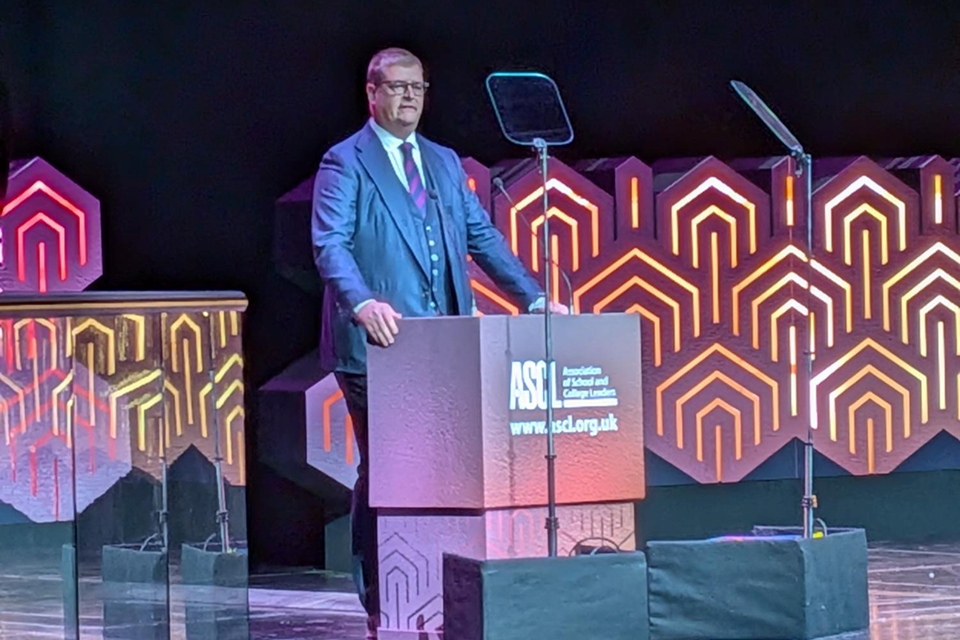
Martyn Oliver, Ofsted’s Chief Inspector, spoke at the 2026 Association of School and College Leaders (ASCL) Annual Conference in Liverpool.
Good morning, everyone.
When I spoke to you last spring, we were consulting on our proposed changes to education inspection – talking through our ideas for report cards and grading.
I want to thank everyone who took the time to provide constructive feedback, which helped to shape and improve our toolkits. And I especially want to thank those of you who offered your schools for trial visits, and who volunteered for an early inspection under the renewed framework.
It is a mark of your professionalism and dedication to delivering high standards that you took the time to engage with and support this transformative work. Thank you.
The ‘why’ of our work
As I reflect on the past 12 months, I can see what a long way we’ve come. And, speaking personally, I reflect on the fact that I’ve spent an awful lot of time talking about the detail, about how we do things: the mechanics of how the toolkits work, the consistency processes built into how we work, and the determination to make inspection feel ‘done with’ rather than ‘done to’.
That’s ‘how’ we do inspection. But standing here this morning, in front of people who have dedicated their careers to education, I don’t want to talk about the ‘how’. I’ve done enough of that.
I want to talk about the ‘why’.
I want to reflect on the priorities I set for Ofsted and be honest with you about why now is the right time for our profession to set its sights higher than ever.
Our purpose – like yours – is serving children, their parents and carers.
Doing right by them, and doing right by the communities we all work in, must be our north star.
Every decision we make, every grade we award and every conversation we have is in their service.
Ofsted is an acronym. We are the Office for Standards in Education, Children’s Services and Skills. Our aim is always to raise standards and improve lives.
That improvement comes from you and your work.
It comes from your dedicated staff, perhaps also from your trusts and partnerships, and sometimes it comes from intervention or investment from government.
But it begins, often, with an inspection. An honest assessment of strengths and areas for improvement that’s always focused on the needs of pupils.
The ‘why’ of our work is there in that honest assessment.
We want our inspections to recognise the great work that you do, but also to be the catalyst for positive change.
Appreciating context and focusing on disadvantage
Two years ago, at this very conference, I set out 2 big priorities for my tenure as Chief Inspector in support of that positive change.
At the time, as you’ll remember, we were launching the Big Listen to hear how we should improve our work. Lots of focus – rightly – was on those mechanics of inspection: the ‘how’.
But I set out those 2 priorities to look beyond the important and necessary changes to how we work. To look beyond the ‘how’ and towards the ‘why’ it happens and ‘why’ it matters.
The first priority was to ensure that understanding and appreciating context sits at the heart of what we do.
Because inspection is more than an assessment of data. It cannot be useful if it is simply a cold aggregation of information.
The power of inspection and its usefulness to parents, politicians and professionals is its contextualised assessment of school performance across a sweep of areas. The validity of our assessment is intimately tied to that appreciation of context. And the rich detail of assessments, now contained within our report cards, is central to the ‘why’ of Ofsted’s work.
My second priority was to always focus on the most disadvantaged and vulnerable children.
I know for many – if not most – of the people in this hall, serving these children is the reason you became a teacher, the reason you became a leader and the reason you work in the communities you serve.
It is the ‘why’ of your career.
It is the ‘why’ of my career.
And that is why I am so proud that our inspections highlight, up and down the country, that we see teachers making a real difference for disadvantaged pupils. Day in and day out, in all different types of schools.
Teachers taking the time to explain a complex piece of mathematics to the student who really needs it. Pushing a class just that little bit further in their thinking. Making interventions at the right time, in the right way. Good, solid, committed work, backed by the very best of intentions.
We see it, we value it, and we rightly recognise it.
The quiet curse of low expectations
It is in this work that those 2 big priorities interact so importantly: recognising context while championing the outcomes of the most disadvantaged and vulnerable.
That’s why inclusion is rightly and proudly at the heart of Ofsted’s work.
Our report card, with its recognition of areas of strength, its presentation of contextual data, and its greater precision in identifying areas for improvement allows for a fair presentation of a school’s work.
But, equally – and I know this has been challenging for some – the report card does not mask issues beneath a blunt overall grade.
And this is as true for the outcomes of disadvantaged and vulnerable children as any other area.
We see thousands of schools working in challenging contexts, bucking the odds again and again to give children a life-changing education.
But we sometimes see disadvantaged and vulnerable children who are not making the strides that they should.
Some would have this be a dilemma for Ofsted. They argue we should recognise the work and the effort – and downplay disappointing outcomes.
But this is no dilemma.
Of course we will recognise the work, celebrate where that school is doing well and identify the contextual challenges being faced.
But we can never downplay the disappointing outcomes.
We will never acquiesce to the quiet curse of low expectations that would see Ofsted prioritise context over outcomes for the most disadvantaged and vulnerable children.
That isn’t why I became a teacher, leader and Chief Inspector. And it isn’t why you joined our great profession either.
But I recognise where this pernicious – even if well-intentioned – thread of thinking comes from.
People point out that the achievement grade is intertwined with outcomes data and that therefore those working in difficult circumstances are at a disadvantage.
It is true that I believe that outcomes matter.
And it’s true I will not expect less because of geography or socio-economic status.
But it is not true, it is not true, that we ignore context entirely and automatically grade 49% of schools ‘needs attention’ for achievement.
Neither do we ignore the outcomes children achieve.
Children don’t take good intentions into their next phase of education. They take exam grades, reading proficiency and, importantly, the character you imbue in them.
We can never – and will never – ignore these outcomes. But we do know it is harder for schools working in challenging communities.
I know because I spent much of my career working in those communities.
Those who would lower the bar are right that Ofsted must appreciate the context in which these schools are working. We must consider starting points and recognise where great work is taking place.
Their misplaced desire for Ofsted to lower the bar stems from a deep empathy with the professionals working in the most challenging contexts.
But that lowering of the bar masks an ultimately damaging belief that some children ‘just won’t get there’.
I don’t believe we can ever afford to accept that.
So when I am challenged that schools with weaker outcomes are more likely to see their achievement grade below the expected standard, I say: ‘yes, would you have it any other way?’
‘Would you have Ofsted pretend everything is fine when children aren’t achieving as they should?’
Of course you wouldn’t.
Because when we expect less of certain children, whether because of where they live, what they need, or what’s happening at home, what we are telling them is: ‘We expect less of you. Society expects less of you.’
So my commitment to you is this:
I will make sure our report cards recognise where schools deliver against the odds. I will ensure context is seen as a core part of the assessment.
And I make this commitment as someone who ran schools where well over half of the children were eligible for free school meals.
I know raising standards is hard. Relentlessly focusing on what is not working well, turning unacceptable standards into good standards, then pushing from good to great.
And as the great leaders in this room will know, achievement can be the last thing to change: the culmination of all the effort to make a difference.
But we will never succumb to the quiet curse of low expectations.
In this, we are emulating the best of you: the great leaders in this room.
Using insight for change
That brings me to what I mentioned before about making the most of our insights. Because when we gather the evidence that help is needed in certain areas, we can push for change.
We can and will say to government, ‘there is good leadership here, good things are happening, but achievement in this borough, this town, this region, is not where it needs to be. How are you going to change that?’.
We can connect the dots between poor access to childcare in a certain area and the effect that has locally on school readiness.
We can see areas where there are lots of young people not in education, employment or training and push for strong further education that gives them a pathway into work.
We will make the case to government that these children, these communities – and these schools – need targeted support to raise standards, not just good intentions and hard work from teachers.
It is not right that a postcode should set the ceiling for a child’s ambitions.
And equally, it is not right that the professionals working, striving, in those postcodes should be left without the resources, the support, and the help they need, including support that reaches well beyond the school gates.
We are coming from a place where more than 90% of schools were previously judged good or outstanding at their most recent inspection. That suggests less than 10% of schools in the country need any improvement.
But our job is to point out where expectations can and should be raised. The new report cards do this.
Take the ‘needs attention’ grade.
We are seeing more schools receive this grade than the old ‘requires improvement’ because we are raising standards.
We are being more exacting.
I make no apologies for that.
I am proud that we, as a school system, have raised standards in this country over recent decades. Children here are realising some of the best results in the world – from primary reading to secondary mathematics.
We did that! The hard work of great people in this room.
And it is because of the progress we have made that Ofsted can raise expectations higher still.
What the grades mean
So we use the needs attention grade to flag an issue before it becomes a serious problem.
It’s not a fail. It’s a chance for you to work on areas for improvement. To seek help and to intervene before children’s outcomes are affected.
For astute and reflective leaders, the things we grade as needing attention shouldn’t be a surprise. I want to be sure that leaders know their schools and are accurately identifying where their attention should be.
And the ‘expected standard’, in the middle of the scale and the starting point for inspection, means we don’t have concerns. It means you’re doing right by the children in your care – all of them.
So far, we are seeing a spread of grades. There are schools with areas that need improvement, that we expect them to address. Most are doing well, with some areas of practice that are exceptional.
But the days of 9-in-10 schools being told by Ofsted that there are no issues to address are behind us. We are a stronger school system and we must embrace the higher expectations that come with progress.
To those who have received ‘exceptional’ grades: be open about your practice. Share what you’re doing. Building a self-improving system depends on good work being talked about, not gatekept.
That self-improving system is a core part of my vision. A system where everyone is pulling in the same direction to get better outcomes for children.
Ofsted Inspectors pilot
That is why we have been piloting a new way of bringing more serving practitioners into the inspectorate and engaging with them.
Our inspections already benefit from the blend of our HMIs’ expertise and the real-time sector knowledge of our ‘Ofsted inspectors’ or OIs.
And this pilot allows us to build on that blend with more two-way reflection and shared insight that shapes inspection at all levels.
Most OIs currently join Ofsted as individuals. Outside of inspections, their contact with one another is limited. The time and engagement they get with link inspectors can depend on inspection schedules.
This has worked well. But it can also limit the opportunities for sharing learning and having professional reflection that goes two ways.
So, in our pilot, OIs join Ofsted not as individuals, but as groups of professionals drawn from the networks they are already part of.
That might be multi-academy trusts, local authorities, dioceses, local school networks, independent learning providers and general further education colleges.
OIs come in as groups and form a professional community with each other and also with Senior HMI, HMI and RI colleagues. They share feedback and reflect together on what they’re seeing and learning. Their experiences then feed into how we continuously improve inspection as a whole.
I want to be really clear that the new OIs in the pilot are trained to exactly the same high standard as our existing OIs, and they carry out exactly the same inspection work alongside them.
The difference is not the role: it is the route into the role, and the opportunities for structured professional engagement.
It means we can bring in current sector insight in a more systemic way. It means more people in the sector, inspecting the sector. Even more colleagues who understand what it means to lead a school through challenges, to make the difficult calls you all make every day, being on your inspection team.
The first participants began their inspector training in January this year. They’re taking part in shadow inspections as we speak and are beginning to be signed off to inspect later this term.
I know there are thousands of you who want to be inspectors. And I want to bring in as many people from the sector as possible!
It is a chance for you to give back to the system, to shape how inspection works, to carry your expertise into schools and providers across the country.
I believe this should be part of every leader’s journey. So join us.
A system for all children
When I started in this job, I wanted to make inspection more collaborative than ever before. We should work together to challenge each other in the interests of children and learners and to keep raising standards.
We must accurately diagnose, together, what every child, every school, every region needs to help it reach its potential.
It is how all of us create a system where every child is able to achieve, belong and thrive.
A system that improves life chances and opens doors for all children, in all communities, in all corners of the country.
That is our vision and that is our mission and I want to thank every single one of you for taking part in it.
Thank you.