Chief of Defence Intelligence speech at Cambridge Intelligence Seminar: 20 November 2026
Chief of Defence Intelligence, Matthew Jones speech at Cambridge Intelligence Seminar.
Good afternoon and it is both a great privilege and pleasure to return to Corpus Christi College and speak at the Cambridge Intelligence Seminar. I have been an admirer of the seminar for many years and am grateful for you giving me the opportunity to address you on contemporary issues, conscious that your normal focus is understandably on the past. I am also pleased that there are members of Corpus’ newly formed Security and Risk Society here this afternoon, and look forward to meeting you afterwards. I wonder if some of you might be the next generation of national security professionals.
I am particularly thankful to Professor Chris Andrew as the convener. Thirty years after you supervised me in intelligence history here at Corpus, I hope I can demonstrate I did pay attention to you at least occasionally. You of course remain one of the world’s pre-eminent intelligence historians, and your impact on this historical discipline and on the intelligence community has been profound.
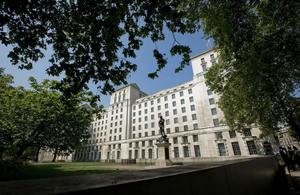
Your most famous collaboration was of course with Oleg Gordievsky, the KGB rezident in London who worked as an agent for MI6 and was exfiltrated out of the Soviet Union in 1985. My favourite tale is how, as part of Operation RYAN in the early 1980s, Gordievsky and his colleagues were responsible for counting how many lights remained on late in the evening at the Ministry of Defence’s Main Building in Whitehall. This was based on the theory that the more lights were left on, the more likely it was that senior officers and officials were planning a strike on the Soviet Union.
Now, from my intelligence training, I am not sure that was ever a particularly good indicator or warning of British military intentions in the early 1980s, and it certainly isn’t now… However, as I now find myself often working late into the evening in MOD Main Building, I cannot help see some similarities with that era. None of us want war, but we must both remain watchful and vigilant for that eventuality and must do all we can to prevent it.
There is a real contrast between the view of peaceful everyday London when I look out of my window down the Thames, and the concerning papers I read at my desk.
The threats are manifest whether that be the ongoing war in Ukraine; the wider risk of escalation in Europe; the arc of conflict across the Horn of Africa, Arabian Peninsula, and Middle East; the mind-boggling scale and pace of the military capability build-up in East Asia; the exponential rise in AI driven offensive cyber-attacks; or the seemingly daily reality of sub-threshold adversary operations impacting the UK and our allies. The global security environment is definitely deteriorating.
That is why Defence Intelligence – DI - and the wider Military Intelligence Services are so important to protecting the country today. In an era of volatility, uncertainty, technological and climate change, and heightened threats, it is more important than ever that the MOD and the nation has the ability to understand and respond to the challenges. Since July, I have been proud to lead this organisation of nearly 4000 tri-service and civil service specialists.
The range of expertise we have within the team never ceases to amaze me: We have national experts at cutting edge military capabilities, talented linguists in a range of interesting languages, skilled geospatial imagery analysts, cunning and brave agent handlers, determined counter intelligence investigators, and ingenious data scientists. I could keep going but the key of course is working collaboratively to ensure the sum of the DI whole is much greater than the individual efforts of the team. An inclusive and collegiate approach is at the core of everything we do. Something Robert Pattinson could only ever dream of emulating!
And, although he was not serving in DI at the time of his death, it is appropriate to remember Major Paul Wilks of the Army Intelligence Corps who was tragically killed in a road collision in Ukraine in September. Paul served for many years within DI and was a highly talented and committed officer who had huge operational impact.
DI has three missions. The first is to deliver on operations today. Wherever members of the UK armed forces are deployed, members of DI are alongside them. In eastern Europe, the Middle East, and with partners in a range of fascinating locations, as well as at all our overseas bases. And at our intelligence centre at Wyton, not too far away from where we are gathered now, there are teams working 24/7 to monitor threats and coordinate Defence’s intelligence response to emerging crises.
We also work closely with partners in the UK, and the recent threats at RAF Fairford and last week’s arrest of an officer assigned to the NATO Allied Rapid Reaction Corps demonstrate we need to respond to challenges at home as well as overseas. Developing our approach to homeland and national defence is one of my top priorities, and DI is working with the Standing Joint Command and a range of partner organisations to ensure our people and bases are protected.
The second mission is to conduct vigilant deterrence. As Mr. Streeting, the Secretary of State for Defence, himself of course also a Cambridge historian, said in Oslo last week, the more ready we are to fight and win, the less likely war becomes.
DI’s mission as part of the deterrence effort is to provide vigilance. Working with partners, we gain insight into adversary capabilities and developments, and their intent to use those against us. We cannot predict the future, but we can provide foresight to reduce uncertainty. In a murky world of cyber-attacks, drone incursions which may or may not be an accident and, as last weekend’s attempted attack in Estonia showed, increasing sabotage, DI’s role is to find the signal in the noise.
War-fighting readiness cannot only be achieved through boosting conventional forces, it must also be done by staying at the cutting edge in the intelligence world. More equipment which glistens in the sun, but also highly advanced operators and intelligence capabilities are active in the shadows.
Our third mission is to prepare for war. Alongside our maritime, land, air, cyber, and space forces, DI needs to be ready to fight in the Sixth-Generation Battlespace. This means playing our part in being ready to find, fix, track, and target our adversaries. In DI we are at the forefront of transforming Defence’s targeting efforts.
The Digital Targeting Web is the underpinning capability of the SDR and Defence Investment Plan, and DI is already benefiting from the resources that are flowing from that. Our aim is to help connect an array of sensors with the armed forces’ weapons systems with a ‘single pane of glass’, a common intelligence picture providing clarity on an ever-foggier battlefield.
We also need to play our role protecting the armed forces from attacks and deception. The money allocated to the Targeting Web in the SDR is already having an impact and enabling us to improve collaboration with our allies and partners. Later this month the Cyber and Specialist Operations Command, of which DI is a part, will bring into operation a new sensitive capability that will greatly enhance our ability to acquire targets and provide more precise data to frontline forces – this represents a key stepping stone to equip our forces for the modern battlefield.
It will not surprise you we are spending a lot of time looking at how the wars in Ukraine and the Middle East are being fought, taking advantages of those lessons, and helping to ensure the UK could fight and win in this environment if required. Warfare is being transformed seemingly daily through the combination of artificial intelligence and uncrewed systems, and DI is helping our Armed Forces adapt to the opportunities and challenges this poses.
We achieve these missions by enabling effective decisions, protecting the force and the nation, driving targeting, and executing a range of overt and covert effects. We do all this in a legal and policy compliant manner, and I welcome the robust oversight of Parliament’s Intelligence and Security Committee.
You will appreciate there are limits in what I can say in an open seminar, but I would like to give a flavour of our activities.
Enabling effective decisions sounds straightforward but is vital to effective military strategy and operations. Just as in life, all of us weigh up options constantly and make choices based on varying sources of sometimes conflicting data, so we must in Defence too. Within DI, we cannot predict the future but can reduce the uncertainty, to enable the best choices, often in time pressurised and constrained situations:
- What is the likelihood of an adversary conducting a surprise attack against an ally and what would they do if they did?
- Will there be a coup in that country and what is the threat to the British nationals located there if there is?
- Do those terrorists really have the capability to attack that British base and how can we neutralise that threat?
- When will that adversary achieve success with its new surface to air missile system and how can we ensure British countermeasures are able to protect against it?
This gives a flavour of the types of questions we in DI are routinely called upon to answer.
We do this by fusing together a range of sources from the most sensitive intelligence to openly accessible information. At the core of this work is the judgment of highly trained and skilled analysts operating across a range of high-tech systems, providing assessment in an objective and dispassionate manner. The so-called Butler principles, established in the wake of the 2003 Iraq War, underpin our work and I am constantly proud to see junior colleagues having the moral courage to speak truth to power, and senior colleagues being ready to listen and accept this. Unlike our adversaries, we will never skew our assessments to satisfy a pre-conceived decision.
As a much younger officer I learned the importance of intelligence to force protection as Task Force Helmand’s Brigade Intelligence Officer in southern Afghanistan. My team and I were constantly seeking to ensure we had the best intelligence picture possible of where the Taleban were laying IEDs, preparing ambushes, or planning mortar and missile attacks. And once we had that intelligence, it was critical to ensure it got to the frontline in time for the battle groups to act to avoid and neutralise those threats.
Today the adversary and geography might be different, but the intelligence force protection mission remains vital. Whenever a British warship, aircraft, or Army unit heads into harm’s way, we play our role in ensuring it is prepared and protected. Whether this is a Royal Fleet Auxiliary ship in the Arabian Sea, an RAF Rivet Joint reconnaissance plane heading towards the High North, or the Army battle group in Estonia, we take this duty incredibly seriously.
And we also ensure the whole of Defence is protected from hostile intelligence and espionage. The arrest in Gloucestershire earlier this month demonstrates this threat is very real. We can never be complacent as we know our enemies are actively seeking to steal our secrets.
However, the formation of the Defence Counter Intelligence Unit – the DCIU - earlier this year, delivering an SDR commitment, marked a considerable step forward. The DCIU is already proving its worth both at home and overseas. Defence Counter Intelligence, working alongside many partners, played a considerable role in that arrest of the US service person. Like our conventional forces, this shows how Defence Intelligence is at the front line of tackling and deterring threats.
We also execute a range of effects in conjunction with partner organisations. Most of these are covert and need to stay in the shadows for reasons I am sure you understand, but I look forward to future historians combing the archives to discover the feats we were up to. I am sure it will be a topic ripe for consideration at this Seminar during the Michaelmas term of 2056. I look forward to being invited back to participate.
But in the meantime, I am pleased to talk about some of the overt effects we achieve as, although much of our work is at secret, not all of it is. The most conspicuous example is our Tweets, now Xs of the day, on Russia’s illegal war with Ukraine. Since February 2022, these have achieved a remarkable readership of nearly half a billion impressions, by some margin the UK’s most read national security communication. Through a carefully controlled declassification mechanism, our aim is to undermine the legitimacy of Putin’s war and provide objective facts and assessment on what is really happening on the ground.
All this work is achieved in conjunction with the intelligence agencies, with whom we collaborate very closely, and a range of partners, both within Defence and wider government.
Within DI we are active players in all of the ‘ints’ – HUMINT for human intelligence, SIGINT and ELINT for signals and electronic intelligence, GEOINT and IMINT for geospatial and imagery intelligence, MASINT for Measurements and Signals Intelligence, and OSINT for Open Source Intelligence. DI is a key component of the Cyber and Specialist Operations Command, at the leading edge of the drive to be ready for the 6th Generation Battlespace. The power of combinations that comes from working alongside the Defence and National Cyber Forces, Special Forces, and the Permanent Joint Headquarters is manifest.
Not only does the UK retain some of the world’s most potent intelligence agencies, but it also obtains unique value from its intelligence alliances. Foremost among these is our membership of the Five Eyes, the most powerful intelligence alliance in human history. This year the original UK-US SIGINT agreement celebrates its 80th birthday and the full Five Eyes reaches the ripe - and I very much hope still youthful - age of 70 after Australia, Canada, and New Zealand joined too in 1956. It is true to say not a day goes by when I am not grateful for it, and our national security is much stronger as a result of our membership of the Five Eyes. The UK is also of course a member of the most powerful collective security alliance in human history too, NATO.
Earlier this week I spent two days in Brussels meeting with my fellow intelligence chiefs from across the Alliance. There were 83 military and civilian agencies represented, and I was struck by the incredible power of intelligence combinations this represented.
I came away with an absolute resolve that the UK, as the European member of the Five Eyes and a leading NATO contributor, must do all it can to further assist the Alliance. Within DI we have a range of projects underway to invigorate our intelligence collaboration with NATO colleagues, including a focus on the ten-member Joint Expeditionary Force of northern NATO nations of which the UK is the framework lead. This complements our work to ensure we have a sharpened focus on both national and homeland defence.
This focus is unfortunately required because the threat to the nation is real and growing. I am not the first official, officer, or Minister to state that, and will definitely not be the last. The Russian Ground Forces may currently be fixed in Ukraine and experiencing huge casualties – often over 2000 men a day in recent weeks, over 50,000 a month – but it is adapting rapidly and we are very watchful about the prospects of further developments. Meanwhile, their long-range aviation, sub-surface, underwater reconnaissance, cyber, special, military intelligence, ballistic missile and nuclear forces all continue to pose a substantial threat.
With some confidence I can say Russia does not actively seek war with NATO. However, my greatest fear is the risk of a significant miscalculation. Putin is under pressure and that is leading to a more assertive and aggressive approach as he seeks to challenge us. There are too many recent examples of reckless Russian behaviour where, if the incident had been slightly different, the results could have been extremely serious.
The drone attack at Leipzig in Germany carried out by Russian proxies in August is the most egregious recent example. At the moment within DI, we are closely following the spate of sinkings or merchant ships in the territorial waters of our NATO ally Romania. From a British perspective, I look to the Russia-backed arson attack on a Ukrainian owned business in East London, the near shootdown of a RIVET JOINT aircraft over the Black Sea in September 2022, or further back the Salisbury Novichok attacks that claimed one life but could have been so much worse. I want to be clear that the UK’s position is that we do not seek conflict or confrontation with Russia. But we will robustly defend our national security and that of our allies, when it is threatened.
That is why DI’s role providing vigilant deterrence is so important, seeking to join the dots between seemingly disparate events to inform judgements on how to respond, always seeking to adopt an objective, rather than an alarmist approach. Just as we did ahead of Russia’s invasion of Ukraine in 2022, our purpose is to piece together the warning signs early, denying our adversaries freedom of action, maintaining our advantage, and giving our leaders the opportunity to act. Our adversaries may seek surprise – our job is to deny them that – and we will do out utmost to ensure this.
So, given these challenges to our security, it is very welcome that the Secretary of State has set us on the mission of getting Britain and its allies more ready to fight and win a war in Europe by 2030. I stress this is not a prediction of when Britain and its allies will come under military attack, but the threats make such an approach eminently sensible.
DI is absolutely playing its part in the transformation necessary to achieve this. In addition to our role on the intelligence frontline now and playing a vital role within the Digital Targeting Web, we are embracing the SDR’s intelligence focussed recommendations. I have my dog-eared copy of the SDR here with me and know them well. These are at the forefront of ours and CSOC’s efforts.
We are taking measures to invest more in our people to ensure we attract, retain, and train the best military and civil service workforce for future challenges.
We have established Military Intelligence Services, which I am proud to lead, providing a lead command for Intelligence, Surveillance, and Reconnaissance, across the armed forces, bringing greater coherence and prioritisation to the whole of Defence’s intelligence enterprise. In this endeavour, we are grateful for the support of Ms Louise Sander-Jones, the Minister for the Armed Forces and herself a proud veteran of the Army’s Intelligence Corps.
And we are also working actively with the intelligence agencies to ensure our linkages are both strong and seamless. Central to this is improving the connectivity between our systems to ensure a rapid flow of data between us. The system works well now, but we must work harder and faster to ensure mechanisms designed for the age of Counter Terrorism and Counter Insurgency are ready for the much more intense challenges of war with a hostile state.
In this journey I see huge opportunities in Artificial Intelligence, and know my agency colleagues and international partners agree. Every area of intelligence across collection, assessment, targeting, and force protection will be transformed because of this. We are already making progress but need to accelerate the pace of adoption. Now we are using AI to do existing tasks better, but the time will soon come when AI allows us to operate in entirely new ways. We need to be ready to grapple with the policy, legal, and ethical dilemmas that will come with that, and DI is already preparing for that.
So thank you for your attention. I hope I have demonstrated the threats are real, the MOD is doing its utmost to rise to the challenge, and DI and Military Intelligence Services are playing their part within that.
It has been an honour to have been able to outline DI’s role in the national security ecosystem to such an august group. We do not wish to be boastful, but are immensely proud of the role we play within Defence and beyond.
As an intelligence officer, I am used to and encourage challenge, questions, and debate, and very much look forward to the discussion that will follow now. It is great to have been able to return to Corpus Christi, thank you again to Professor Chris, and thank you very much for your attention.