Challenges to media freedom in the OSCE region: UK statement to the OSCE, April 2026
Ambassador Neil Holland recalls the vital contribution of media freedom to security in the OSCE region, and calls on Russia, Belarus and others to live up to their OSCE commitments.
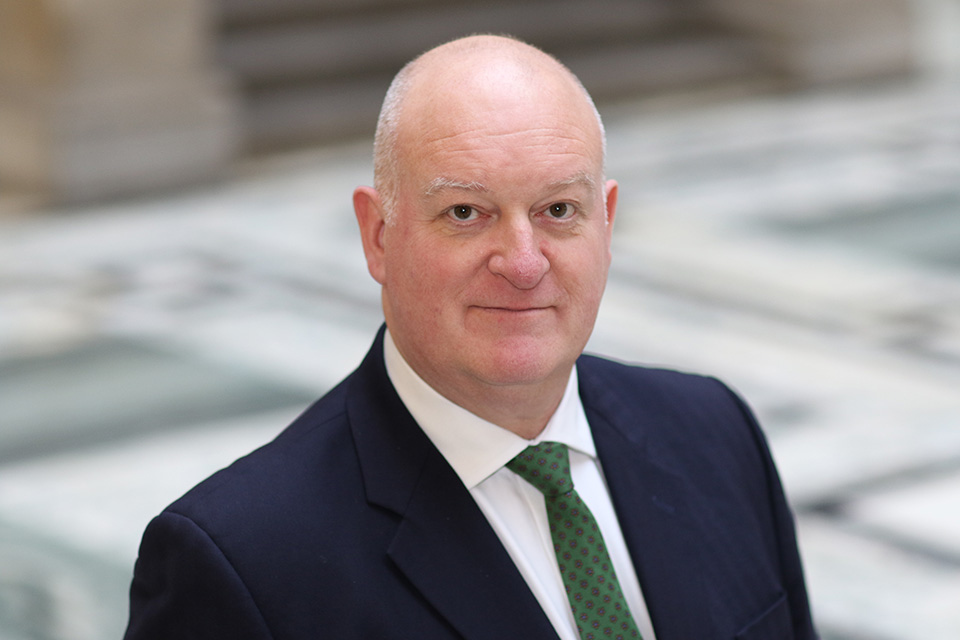
Thank you, Chair. Welcome back to the Permanent Council Jan and thank you for your report.
The United Kingdom remains steadfast in its commitment to media freedom around the world, recognising the vital role that journalists play in upholding human rights, supporting accountable governance, and protecting democracy. As the Moldovan President Maia Sandu put it, “Peace cannot survive without information integrity, and democracies cannot survive without those who protect it.”
No one country has all the answers in the face of a rapidly changing media landscape. That is why the UK remains a strong supporter of your mandate here at the OSCE. The UK is convinced that a well-informed global public is more resilient to disinformation and information manipulation, and better equipped to hold power to account. That is as true in 2026 as it was in 1975, when our predecessors agreed to improve cross-border access to information and journalists’ working conditions as part of the negotiations on the Third Basket.
I fully agree with your assessment that media freedom is thus a necessary condition for peace and security, not a peripheral or second order issue. This is particularly evident in the context of the Russian Federation’s aggression against Ukraine, where the information environment – including the safety of journalists – has become a central dimension of the conflict.
The UK remains deeply concerned by the impact of Russia’s invasion of Ukraine. UN and ODIHR reporting documents killings, injuries, arbitrary detention and other serious violations against journalists, as well as sustained attacks on civilian infrastructure essential to the work of independent media.
Inside both Russia and Belarus, systematic and deliberate repression aims to silence dissenting voices, criminalise journalism and shut down independent media outlets. Such internal repression enables external aggression by hollowing out domestic accountability, distorting the information environment and undermining regional security. It therefore stands in absolute contradiction to the principles and commitments agreed by all 57 OSCE participating States.
The UK is also concerned by developments in Azerbaijan, Turkey, Georgia and Serbia. We call on all OSCE participating States to engage with your office and to safeguard freedom of expression as well as free and independent media.
Representative, dear Jan, earlier this year the UK joined Finland as Co-Chair of the Media Freedom Coalition. Our priorities as Co-Chair include supporting public interest media, technology and media freedom, and the safety of journalists including the specific risks faced by women journalists. We are grateful to you and your team for your longstanding work on these areas and look forward to working closely with you and your office to advance media freedom and hence the shared security of the OSCE region.
Thank you Chair.