What works in supporting people to retrain at the local level: technical report
Published 17 November 2026

© Crown copyright 2026
This publication is licensed under the terms of the Open Government Licence v3.0 except where otherwise stated. To view this licence, visit nationalarchives.gov.uk/doc/open-government-licence/version/3 or write to the Information Policy Team, The National Archives, Kew, London TW9 4DU, or email: psi@nationalarchives.gov.uk.
Where we have identified any third party copyright information you will need to obtain permission from the copyright holders concerned.
This publication is available at https://www.gov.uk/government/publications/what-works-in-supporting-people-to-retrain-at-the-local-level/what-works-in-supporting-people-to-retrain-at-the-local-level-technical-report
The Department for Work and Pensions (DWP) research report no. 1161.
A report of research carried out by the Institute of Employment Studies on behalf of DWP. Views expressed in this report are not necessarily those of DWP or any other government department.
Crown copyright 2026. You may re-use this information (not including logos) free of charge in any format or medium, under the terms of the Open Government Licence. To view this licence, visit Open Government Licence or write to:
The Information Policy Team,
The National Archives,
Kew,
London
TW9 4DU
or email psi@nationalarchives.gov.uk.
If you would like to know more about DWP research, email socialresearch@dwp.gov.uk.
First published November 2026.
ISBN 978-1-80786-076-9
Introduction
This technical report explains the methodology for the rapid evidence assessment (REA) on what works to support people to retrain locally. It covers the inclusion and exclusion criteria, scope, searches, sifting and review process.
Criteria for inclusion and exclusion
The parameters for the evidence review were specified in a PICOS (population, intervention, comparison, outcome, study design) framework as set out below.
Population
Age
Basis for inclusion: people aged 16 to State Pension age.
Basis for exclusion: people aged under 16 or over state retirement age.
Country
Basis for inclusion: Organisation for Economic Co-operation and Development (OECD) countries.
Basis for exclusion: countries outside the OECD.
Employment status
Basis for inclusion: in work; unemployed; economically inactive.
Programmes or interventions under initial consideration
Adult skills training pilots and interventions focusing on training and retraining at the local level including evaluations of government-funded programmes:
- career development interventions
- upskilling and reskilling interventions
- retraining interventions in specific growth sectors
- courses on soft skills, such as teamwork or communication
- job search advice
- classroom training
- on-the-job training, internships and apprenticeships
- short-term intensive courses
- long-term retraining leading to a recognised qualification
Study design
Type of study to include:
- process evaluations
- impact evaluations
- evidence reviews
- systematic reviews
- meta-analytic reviews
- studies highlighting specific ‘what works’ elements from a programme or intervention
Basis for exclusion: studies with a very low confidence rating.
Comparator group
Basis for inclusion: studies will be included even if a relevant comparator is not available.
Basis for exclusion: not applicable.
Date of delivery
Basis for inclusion: 1997 to present.
Basis for exclusion: studies published before 1997.
Outcome
Individual outcomes
Basis for inclusion: study explores individual outcomes, such as:
- employment
- increased wages
Basis for exclusion: studies that do not explore one or more of these types of outcomes resulting from the programme or intervention under consideration.
Scope
The review covered local retraining programmes and interventions in OECD countries, including:
-
adult skills training pilots and interventions including evaluations of government-funded programmes
-
career development interventions
-
upskilling and reskilling interventions
-
retraining interventions in specific sectors
The review included process evaluations, impact evaluations, evidence reviews, systematic reviews, meta-analytic reviews and studies that identified specific elements of programmes or interventions that worked.
Studies also had to meet the following criteria:
-
a target population of people aged 16 to State Pension age
-
a focus on individual outcomes such as employment and increased wages
-
published between 1997 and August 2026
These criteria were selected to ensure that findings were directly relevant to the design and delivery of effective retraining programmes in the current UK context.
Evidence standards
The intention of this REA was to synthesise and disseminate the best quality and most relevant evidence to meet stakeholder needs, within the programme resources, and to provide an indication of the strength of each element of the evidence for readers.
There was a trade-off between being able to apply high to moderate standards in rating the strength of evidence, and ability to answer research questions. A pragmatic approach was taken to the application of evidence standards.
Assessing primary research
The Youth Endowment Fund Evidence Quality Assessment (YEF-EQA) tool was used to assess primary research. This tool enables the inclusion of qualitative and mixed methods evaluations, that other quality assessment tools do not. It is used by other What Works centres such as the Youth Futures Foundation allowing for consistent assessment.
The overall quality of evidence was assessed, resulting in a high, moderate, low, or very low score.
The evidence assessment process used the following standards to assess each study against the following criteria (where applicable to study types):
-
quality of the study, including its design, evaluation questions, methodology, assessment of potential bias and use of administrative data
-
quality of recruitment and sampling, including whether the strategy was clear and appropriate for the evaluation questions
-
researcher position, assumptions and possible biases, including whether the study explained these clearly
-
clarity of outcomes, including whether the study defined and measured outcomes clearly, used a validated tool where appropriate, adequately controlled for confounding factors, gave outcomes equal emphasis and considered factors such as whether a trial ended early
-
robustness of data analysis, including whether the study described the approach adequately and applied it rigorously
-
validity of implications and recommendations, including whether they were clearly based on the evidence from the study
-
treatment and comparison groups, including whether the study assigned participants at the appropriate level and used sufficiently rigorous methods
Each item was rated as high (3 points), moderate (2 points) or low quality (1 point). The final score was then calculated as a percentage of the applicable maximum points. This percentage score was then used to determine the overall quality of the study as high (90% to 100%), moderate (70% to 89%), low (50% to 69%), or very low (below 50%).
The studies selected for inclusion were scored independently by 2 researchers. Quality of evidence ratings for included studies are in Appendix 1.
Assessing evidence reviews
The Critical Appraisal Skills Programme (CASP) systematic review checklist was used to assess the quality of systematic reviews and REAs. This checklist was chosen for its applicability to reviews that may contain both qualitative and quantitative studies and the range of elements it includes. The CASP systematic review checklist appraises reviews on 10 elements:
Section A: Are the results of the review valid?
-
Did the review address a clearly focused question?
-
Did the authors look for the right type of papers? (For example, to address the review question with an appropriate study design)
-
Do you think all the important, relevant studies were included?
-
Did the review’s authors do enough to assess quality of the included studies?
-
If the results of the review have been combined, was it reasonable to do so? (For example, were the results of included studies clearly displayed if combined, and were variations discussed)
Section B: What are the results?
-
What are the overall results of the review?
-
How precise are the results?
Section C: Will the results help locally?
-
Can the results be applied to the local population?
-
Were all important outcomes considered?
-
Are the benefits worth the harms and costs?
The CASP checklist does not provide fixed rating categories. To remain consistent with the YEF-EQA framework for primary research, the research team developed the following approach for rating review quality as high, moderate, low or very low:
-
high: answers ‘yes’ to questions 1, 2, 3 and 4
-
moderate: answers ‘yes’ to screening questions 1 and 2, but ‘no’ or ‘can’t tell’ to question 3 or 4
-
low: answers ‘no’ or ‘can’t tell’ to question 1 or 2, or gives 3 or more of these answers across the checklist
-
very low: gives more than 5 ‘no’ or ‘can’t tell’ answers across the checklist
Strength of evidence assessment
The review assessed both the quality of individual studies and the type and strength of evidence supporting key findings. The standard reflects the range of evidence available by stating the evidence type and methods used. It combines the Maryland Scientific Methods Scale (SMS), YEF-EQA standards and the CASP systematic review checklist.
Evidence type and strength
Causation
This type of evidence demonstrates that the activity directly produced the outcome, such as X directly causes Y.
Causation can only be stated if strong causal research methods were used in evaluations, such as randomised controlled trials (RCT) or quasi-experimental designs.
Strength of evidence: high (SMS level 5 to 3).
Influence on outcome
Evidence that shows the intervention helped to achieve the outcome, alongside other factors, and explains how, why and for whom.
Influence on an outcome can only be stated if the evidence used quantitative, qualitative or mixed methods, and the evaluation or evidence set out a clear programme logic, theory of change, or both.
Strength of evidence:
- high: quantitative designs will be SMS level 1 to 2 with YEF-EQA rating of high, or a CASP systematic review rating of high
- moderate: quantitative designs will be SMS level 1 to 2 with YEF-EQA rating of moderate, or a CASP systematic review rating of moderate
- low: YEF-EQA or CASP systematic review rating low
Indicative or promising
Evidence that suggests or signals potential to influence an outcome.
This type of evidence will be less developed, for example in a test and learn phase, or developing hypothesis. It might have used methods such as descriptive analysis and case studies.
Strength of evidence: YEF-EQA or CASP systematic review ratings high, moderate, low.
Source: Institute for Employment Studies (IES) and Learning and Work (L&W) Institute, 2026.
Evidence sources
The initial evidence searches were conducted between February and April 2026.
Searches were conducted across a range of sources, including sources of ‘grey literature’ (such as websites of research organisations and charities) and academic databases. These were:
-
GOV.UK Evaluation Registry
-
Nuffield Foundation
-
Joseph Rowntree Foundation
-
Local Government Association
-
Cochrane reviews
-
Campbell Systematic Reviews
-
Mayoral Strategic Authority websites
-
National Institute for Health and Care Excellence
-
Institute of Labor Economics
-
International Labor Organization research repository
-
relevant What Works centres, including What Works Growth and the Youth Futures Foundation
-
Centre for Ageing Better
-
Institute for Public Policy Research
-
Policy Exchange
-
EU websites containing European Social Fund material
-
Clearinghouse for Labor Evaluation and Research
-
generic search engines, including Google and Google Scholar
-
Scopus
-
JSTOR
-
Education Resources Information Center
-
British Education Index
In addition to these searches, a call for evidence was issued. This asked for published or unpublished evaluations of adult skills training pilots and interventions focusing on training and retraining adults.
The call for evidence was open from 20 May to 10 June 2026 and publicised by the LMEP website, LinkedIn social media posts, and IES and L&W mailing lists. This generated 2 studies. Recommendations of papers were also obtained from expert advisers from IES and partner organisations.
Search terms
The following provides a summary of the search terms used to identify relevant evaluation reports. Numbers are used to show priority level.
All search terms used wildcards to ensure maximum relevant retrieval (for example employ* to encompass employment, employer, employee).
Summary of search terms
| Priority | Search terms |
|---|---|
| 1 | (re)training; sector-focused; labour market; adult; evaluation |
| 2 | upskilling; sector-based; employment; older workers; impact assessment |
| 3 | reskilling; local; workforce; in-work; effectiveness |
| 4 | new; on-the-job; jobs; over 40; benefits |
| 5 | intervention; retain; skills progression; review |
| 6 | trial; process |
Sifting process
A 4-stage sifting process using the inclusion and exclusion criteria outlined above was applied:
-
First sift: title and abstract or summary.
-
Second sift: full paper or report.
-
Third sift: detailed review of the methodology and application of the evidence standards.
-
Review stage.
Review extractions were quality assured by regular cross-checking across the research team in review meetings to discuss any outliers or edge cases. Following the sifting process, 20 studies were identified for full review and extraction.
Alongside the strength of evidence assessment, the 20 reports were reviewed by subject-matter experts who suggested that additional studies relating to WorkAdvance and Employment Retention and Advancement (ERA) be considered. This led to 9 further reports being assessed for strength of evidence and added to the full-text review and extraction stage. To avoid evaluations of WorkAdvance and ERA skewing the evidence review findings, each suite of reports was considered as a unit.
Figure 1 summarises the process using the Preferred Reporting Items for Systematic Reviews and Meta-Analyses (PRISMA) approach.
Figure 1: PRISMA flow diagram
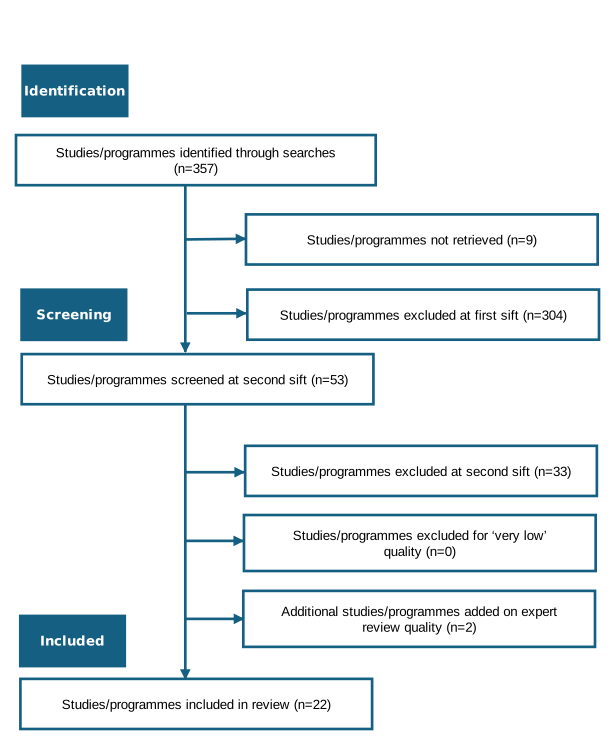
The PRISMA figure shows:
-
studies and programmes identified through searches: 357
-
studies and programmes not retrieved: 9
-
studies and programmes excluded at first sift: 304
-
studies and programmes screened at second sift: 53
-
studies and programmes excluded at second sift: 33
-
studies and programmes excluded for ‘very low’ quality: 0
-
additional studies and programmes added on expert review: 2
-
studies and programmes included in review: 22
Use of AI tools
Copilot was used to generate summaries of all papers selected for the second sift. These summaries were used to support the development of a human-generated summary and not as a substitute for the researcher reading the paper in full.
The AI summaries were a useful additional tool for the human research team to cross-check understanding and particularly inference. However, they were consistently unreliable, for example by hallucinating additional details that were not included in the research studies.
Extraction of evidence
The review identified 22 studies for inclusion and were extracted using a grid framework outlining how each study relates to the PICOS information, and how they address the research questions.
The relevant columns for each research question were:
-
features of effective retraining interventions
- how these vary for people with different characteristics and across different areas
-
features of less effective retraining interventions
- how these vary for people with different characteristics and across different areas
-
features that are enablers of an effective local system to support retraining
-
types of organisations
-
roles
-
mechanisms
-
-
how context interacts with the effectiveness of interventions
-
sector
-
demand
-
-
how other programme elements impact on the success of programmes
-
who is best placed to deliver retraining interventions
Appendix 1: details of included studies
The 2021 net impact and cost-benefit evaluation of Washington state’s workforce development programs
Report title and type
The 2021 net impact and cost-benefit evaluation of Washington state’s workforce development programs (causal impact analysis using a quasi-experimental design)
Funder
US Department of Labor
Details of programme or intervention
The workforce development programmes provide support and services to unemployed, dislocated, displaced, and transitioning workers. The programmes aim to help retrain these workers to start a new career.
Evidence standard rating
High
Employment training: evidence review
Report title and type
Employment training: evidence review (systematic review)
Funder
What Works Centre for Local Economic Growth
Details of programme or intervention
A review of evaluations of employment training programmes aimed at improving labour market outcomes.
Evidence standard rating
High
Employment Retention and Advancement (ERA) studies
Report title and type
Breaking the low-pay, no-pay cycle: Final evidence from the UK Employment Retention and Advancement (ERA) demonstration (RCT combined with elements of process evaluation)
Employment Retention and Advancement (ERA) demonstration: Delivery, take-up, and outcomes of in-work training support for lone parents (impact evaluation combined with elements of implementation and process evaluation)
Employment Retention and Advancement (ERA) demonstration: The Impact on Workers’ Outcomes (impact evaluation)
The Employment Retention and Advancement Project Paths to Advancement for Single Parents (descriptive outcome analysis)
How Effective Are Different Approaches Aiming to Increase Employment Retention and Advancement? (RCT)
Human Well-being and In-Work Benefits: A Randomized Controlled Trial (RCT)
Funder
Various (DWP, Institute for the Study of Labor, MDRC)
Details of programme or intervention
ERA ran in the UK and US. The programme aimed to improve the labour market prospects of low-paid workers and the long-term unemployed.
Evidence standard rating
High
Effectiveness of Screened, Demand-Driven Job Training Programs for Disadvantaged Workers: An Evaluation of the New Orleans Career Pathway Training
Report title and type
Effectiveness of Screened, Demand-Driven Job Training Programs for Disadvantaged Workers: An Evaluation of the New Orleans Career Pathway Training (RCT combined with process evaluation elements)
Funder
US Department of Labor
Details of programme or intervention
New Orleans Career Pathway Training aimed to help low-skilled, unemployed, and underemployed individuals train for and find skilled jobs in the fields of advanced manufacturing and energy, medical care, and information technology.
Evidence standard rating
High
Estimating the Effect of a Retraining Program on the Re-Employment Rate of Displaced Workers
Report title and type
Estimating the Effect of a Retraining Program on the Re-Employment Rate of Displaced Workers (quasi-experimental impact evaluation)
Funder
Institute of Labor Economics (IZA)
Details of programme or intervention
The programme (Conventions de conversion) aimed to improve reemployment prospects of displaced workers by supporting them to retrain and provided job seeking assistance.
Evidence standard rating
High
The Relative Effectiveness of Selected Active Labour Market Programmes and the Common Support Problem
Report title and type
The Relative Effectiveness of Selected Active Labour Market Programmes and the Common Support Problem (quasi-experimental impact evaluation)
Funder
Institute of Labor Economics (IZA)
Details of programme or intervention
Examines the effects of participation in several active labour market programmes on the employment prospects of participants.
Evidence standard rating
High
Retaining Employment and Talent After Injury/Illness Network (RETAIN) Evaluation
Report title and type
Retaining Employment and Talent After Injury/Illness Network (RETAIN) Evaluation (impact evaluation combined with process evaluation and cost-benefit elements)
Funder
US Social Security Administration
Details of programme or intervention
RETAIN aimed to enhance labour market participation and retention among disabled people and those with new injuries.
Evidence standard rating
High
Which training leads to employment? The effectiveness of varying types of training programmes for unemployed jobseekers in Flanders
Report title and type
Which training leads to employment? The effectiveness of varying types of training programmes for unemployed jobseekers in Flanders (quasi-experimental impact evaluation)
Details of programme or intervention
Study evaluates 4 types of training for unemployed jobseekers in Flanders. It compares general classroom training, occupation-specific classroom training, non-contractual workplace training and contractual workplace training.
Evidence standard rating
High
WorkAdvance studies
Report title and type
Effects of Sector-Focused Training After 10 Years: Findings from the WorkAdvance Evaluation (RCT)
Employment and Earnings Effects of the WorkAdvance Demonstration After Seven Years (RCT)
Why Do Sectoral Employment Programs Work? Lessons from WorkAdvance (secondary analysis of RCT evidence)
Funder
Various (Harvard University, MDRC)
Details of programme or intervention
WorkAdvance is a US workforce development programme that provides unemployed, low-income adults with occupational skills training aimed at gaining employment in high-demand sectors.
Evidence standard rating
High
Adult Education Budget Evaluation
Report title and type
Adult Education Budget Evaluation (process and outcomes evaluation)
Funder
Greater London Authority (GLA)
Details of programme or intervention
Evaluates the London Adult Education Budget and its impact on supporting progression into work, further learning, wellbeing and social inclusion among disadvantaged Londoners.
Evidence standard rating
Moderate
Cost and outreach pilots evaluation
Report title and type
Cost and outreach pilots evaluation (impact evaluation combined with process evaluation elements)
Funder
Department for Education (DfE)
Details of programme or intervention
The cost and outreach pilots tested innovative approaches to lifelong learning and informed the design of the National Retraining Scheme.
Evidence standard rating
Moderate
Effects of Vocational Re-training on Employment Outcomes Among Persons with Disabilities in Germany: A Quasi-Experiment
Report title and type
Effects of Vocational Re-training on Employment Outcomes Among Persons with Disabilities in Germany: A Quasi-Experiment (quasi-experimental impact evaluation)
Details of programme or intervention
Vocational training that supports working-age disabled people whose health condition prevents continuation in their previous occupation.
Evidence standard rating
Moderate
The Effectiveness of Adult Retraining: Evidence from a Meta-Analytic Review
Report title and type
The Effectiveness of Adult Retraining: Evidence from a Meta-Analytic Review (systematic review with meta-analysis)
Funder
Inter-American Development Bank
Details of programme or intervention
Review of the effectiveness of programmes designed to retrain workers.
Evidence standard rating
Moderate
Evaluation of the GLA Skills for Londoners Innovation Fund
Report title and type
Evaluation of the GLA Skills for Londoners Innovation Fund (process and outcomes evaluation)
Funder
GLA
Details of programme or intervention
Skills for Londoners Innovation Fund funded innovative adult skills initiatives aligned with London skills priorities.
Evidence standard rating
Moderate
New Futures pilots evaluation report
Report title and type
New Futures pilots evaluation report (process and outcomes evaluation)
Funder
COVID-19 Support Fund
Details of programme or intervention
New Futures aimed to support career changers who needed to reskill as a result of the COVID-19 pandemic.
Evidence standard rating
Moderate
Skills Bootcamps process evaluation
Report title and type
Skills Bootcamps process evaluation (process evaluation)
Funder
DfE
Details of programme or intervention
Skills Bootcamps are employer-led, flexible courses designed to provide practical learning and prepare individuals for the labour market.
Evidence standard rating
Moderate
Upskill in Cyber Pilot Evaluation
Report title and type
Upskill in Cyber Pilot Evaluation (process and outcomes evaluation)
Funder
Department for Science, Innovation and Technology
Details of programme or intervention
The Upskill in Cyber pilot aimed to rapidly train adults, especially from underrepresented groups, for cyber security roles.
Evidence standard rating
Moderate
What Works for Adult Learners: Lessons from Career Pathway Evaluations
Report title and type
What Works for Adult Learners: Lessons from Career Pathway Evaluations (systematic review)
Funder
Jobs for the Future
Details of programme or intervention
Review examined the impact of career pathways on adults seeking to attain a living-wage career.
Evidence standard rating
Moderate
Workforce Programs Serving Older Workers and Other Populations with Employment Barriers: Older workers implementation and descriptive study
Report title and type
Workforce Programs Serving Older Workers and Other Populations with Employment Barriers: Older workers implementation and descriptive study (meta-analysis)
Funder
US Department of Labor
Details of programme or intervention
Reviews the literature on workforce programmes, including those that serve older workers and populations with similar employment barriers.
Evidence standard rating
Moderate
Evaluation of Elevate pilot
Report title and type
Evaluation of Elevate pilot (process and impact evaluation)
Funder
Centre for Ageing Better
Details of programme or intervention
Elevate was a pilot employment support programme that targeted those at risk of redundancy and people recently made redundant who were aged 50 years or over.
Evidence standard rating
Low
Evaluation of the Sector Hub Action Research Project
Report title and type
Evaluation of the Sector Hub Action Research Project (process and outcomes evaluation)
Funder
Community Renewal Fund
Details of programme or intervention
The Sector Hub Action Research Project (SHARP) was a pilot programme that aimed to establish how providers could work together to address skills shortages in the adult, child and domiciliary care sectors.
Evidence standard rating
Low
Evaluation of the Skills Escalator Pilot
Report title and type
Evaluation of the Skills Escalator Pilot (process and outcomes evaluation)
Funder
European Social Fund
Details of programme or intervention
The Skills Escalator pilot aimed to support working people living in low household incomes in West London to gain better-paid and more stable employment.
Evidence standard rating
Low