Unpaid work management information - Summary
Published 14 May 2026
Applies to England and Wales

© Crown copyright 2026
This publication is licensed under the terms of the Open Government Licence v3.0 except where otherwise stated. To view this licence, visit nationalarchives.gov.uk/doc/open-government-licence/version/3 or write to the Information Policy Team, The National Archives, Kew, London TW9 4DU, or email: psi@nationalarchives.gov.uk.
Where we have identified any third party copyright information you will need to obtain permission from the copyright holders concerned.
This publication is available at https://www.gov.uk/government/publications/unpaid-work-management-information-update-to-december-2025/unpaid-work-management-information-summary
1. Introduction
Unpaid work, also known as community payback, is one of the options available to sentencers at court. The purpose of unpaid work is to provide punishment and reparation, with individuals carrying out work on projects which benefit their local communities.
A person can receive an unpaid work requirement when they receive one of the following types of court order:
- community orders
- suspended sentence orders
- youth rehabilitation orders
- enforcement orders
- supervision default orders
- orders made in other UK jurisdictions where the case has transferred
This release provides data on the delivery of unpaid work from 1 April 2022 to 31 December 2025. The comparison of periods takes into consideration the latest quarter of data (1 October 2025 to 31 December 2025) and the matching period of the previous year (1 October 2024 to 31 December 2024). By analysing the same quarter of both years, the key points and comparisons are not impacted by the seasonal nature of unpaid work delivery.
2. Individuals with unpaid work
Where a person has been sentenced to an order with a regular unpaid work requirement, the start date is usually the sentence date. In the context of this release, a termination is recorded where a person, order or unpaid work requirement has ended, and there is no more active involvement.
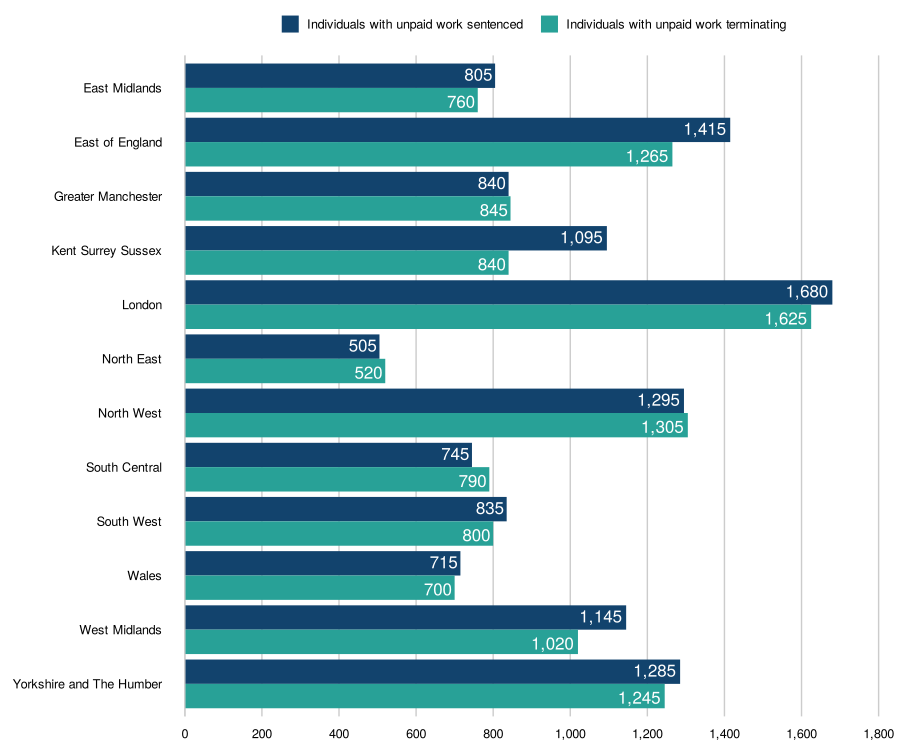
- In the quarter to December 2025, 12,380 individuals were sentenced to unpaid work, an increase of 3.9 percent from 11,915 in the same period in 2024.
- In the quarter to December 2025, there were 11,720 individuals with unpaid work terminating, representing a decrease of 1.8 percent from 11,930 for the same period in the previous year.
- In the quarter to December 2025, 9 of the 12 probation regions across England and Wales saw an increase in the number of individuals sentenced to unpaid work when compared to the same period in 2024.
Figure 1: Individuals with unpaid work sentenced and individuals with unpaid work terminating, by region, 1 October 2025 to 31 December 2025
(Source: Unpaid work management information data tables; Table 2 and Table 6)
3. Hours of unpaid work
Individuals can be sentenced to undertake between 40 hours and 300 hours of unpaid work which should be completed in 12 months from sentencing.
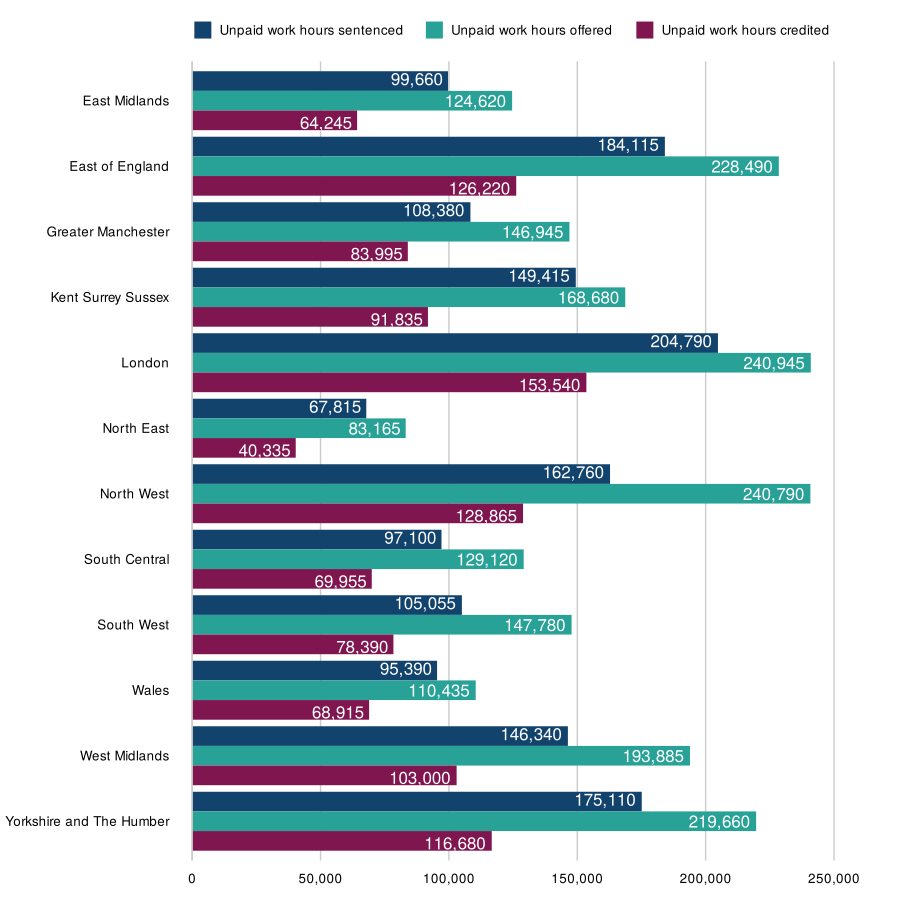
- 1,596,910 hours of unpaid work were sentenced in the quarter to December 2025, an increase of 4.6 percent from 1,525,980 in the same period in 2024.
- In the quarter to December 2025, 2,034,515 hours of unpaid work were offered, representing an increase of 3.1 percent from 1,972,845 hours of unpaid work offered over the same period in the previous year.
- 1,125,975 hours of unpaid work were credited in the quarter to December 2025, an increase of 5.2 percent from 1,070,185 hours of unpaid work credited in the same period in 2024.
Figure 2: Unpaid work hours sentenced, hours offered and hours credited, by region, 1 October 2025 to 31 December 2025
(Source: Unpaid work management information data tables; Table 5, Table 11 and Table 12)
4. Further insights
- 388,515 sessions of unpaid work were offered between 1 October and 31 December 2025 representing an increase of 4.2 percent on the 372,845 sessions offered between 1 October and 31 December 2024.
- 244,440 sessions of unpaid work completed between 1 October and 31 December 2025 representing an increase of 6.3 percent on the 229,925 sessions completed over the same period in 2024.
- At 31 December 2025, there were a total of 36,255 individuals with active unpaid work, an increase of 5.2 percent from 34,455 at 31 December 2024.
- Of the 12 probation regions across England and Wales, 9 regions saw an increase in the number of individuals with active unpaid work at 31 December 2025 compared to 31 December 2024.
5. Project Clean Streets
Note regarding Project Clean Streets
To date, the unpaid work management information publication has included a subset of data tables for Rapid Deployment Projects - Project Clean Streets. Our intention is to remove these data tables from future publications. This means that this is the final set of data tables which will be available for Project Clean Streets, with data up to December 2025.
The decision to remove the Project Clean Streets data tables is driven by the following rationale:
-
Project Clean Streets data form a subset of the main data tables
-
Rapid deployment work is delivered as business as usual in all probation regions and is not managed under a separate performance target.
The contents and structure of the main publication summary and data tables will not change.
If the changes announced are likely to cause significant inconvenience, please contact the production team at crosscuttingperformanceenquiries@justice.gov.uk
Through Rapid Deployment Projects – Project Clean Streets, Probation Community Payback teams work in partnership with local authorities to rapidly clean up instances of antisocial behaviour. The work includes clearance of fly tipping sites, litter picking and graffiti removal within 48 hours of notification.
- 455 individuals attended a Project Clean Streets session in the quarter to December 2025, delivering 12,230 of hours of unpaid work.
Since its launch in 2023, the Rapid Deployment Project has been rolled out in all 12 probation regions across England and Wales.
As Project Clean Streets is not managed under a performance target, and regions have implemented the project at different times since 2023 (see 2.10 Rapid Deployment Project – Project Clean Streets in the Guidance document), a comparison against the quarter to December 2024 is not available.
6. Further information
As well as this bulletin, the following products are published as part of this release:
- Unpaid work management information – Guidance
- Unpaid work management information – Data tables
- Unpaid work management information – Project Clean Streets data tables
Enquiries about these management information should be directed to:
E Stradling
HMPPS Performance Unit, Analysis Directorate
Ministry of Justice
102 Petty France
London
SW1H 9AJ
Email: crosscuttingperformanceenquiries@justice.gov.uk