UKEF Financed Emissions Report 2025
Updated 17 July 2026

© Crown copyright 2026
This publication is licensed under the terms of the Open Government Licence v3.0 except where otherwise stated. To view this licence, visit nationalarchives.gov.uk/doc/open-government-licence/version/3 or write to the Information Policy Team, The National Archives, Kew, London TW9 4DU, or email: psi@nationalarchives.gov.uk.
Where we have identified any third party copyright information you will need to obtain permission from the copyright holders concerned.
This publication is available at https://www.gov.uk/government/publications/uk-export-finance-annual-report-and-accounts-2025-to-2026/ukef-financed-emissions-report-2025
Financed Emissions Report 2025
1. Net Zero Roadmap
2021
- UKEF’s first TCFD disclosure
- UKEF’s first Climate Change Strategy
- HMG ends support for fossil fuel energy sector overseas
2022
- UKEF TCFD includes financed emissions disclosure, interim oil & gas and power sector targets
- Sustainability added to UKEF’s mission statement
2023
- UKEF issues first Sustainability Policy Statement
- UKEF TCFD includes aviation sector target
2024
- UKEF’s first Sustainability Strategy published
2025
- Continued strong progress against our clean growth and decarbonisation ambitions
2030
- Aim to deliver UKEF’s 2030 decarbonisation targets for the oil and gas and power sectors
2035
- Aim to deliver UKEF’s 2035 aviation sector decarbonisation target
2050
- Aim to reduce financed emissions to net zero
2. Financed Emissions Results
Financed emissions are a metric used by UKEF to understand and manage the emissions associated with transactions we support. We estimate our financed emissions to track progress towards our net zero ambition and sector decarbonisation targets.
UKEF’s financed emissions have decreased over the past year and in 2025 were below the 2021 baseline for our portfolio. Overall, we have increased support for clean growth deals and reduced exposure to more emissions-intensive deals over time. The level of progress against sector targets has varied, reflecting the different dynamics within each sector.
We do not expect progress against our decarbonisation targets to be linear. Financed emissions estimates are influenced by factors beyond the underlying emissions of supported activities, including market demand, project lifecycles and changes in financial or risk parameters. As a result, short-term changes may not fully reflect underlying trends, and performance is best assessed over the medium to long term.
2.1 Approach to financed emissions:
Since 2022, UKEF has published annually its portfolio-wide financed emissions estimates. As the first ECA to publish its financed emissions, and in the absence of a Partnership for Carbon Accounting Financials (PCAF) methodology applicable to all ECA products, UKEF developed a bespoke approach, disclosing on two accounting bases.
Amount at risk approach:
UKEF discloses an amount at risk (AAR) estimate, based on the ‘follow the money’ principle. This helps us to understand the economic carbon intensity of transactions we support. The limitation of the amount at risk estimate is that it represents ‘double counting’ of emissions between UKEF and other financiers for guarantee and insurance facilities, reducing clarity over how emissions are financed globally.
Under the amount at risk approach:
- Emissions from all products are attributed based on the amount at risk outstanding. This approach does not make any distinction between loans, insurance and guarantees.
Expected loss approach:
UKEF also discloses an expected loss (EL) estimate, based on the ‘follow the risk’ principle. This approach better reflects the role that export credit insurance and guarantees play in transactions. The limitation of this approach is that because it is risk-based, changes in expected loss estimates can be influenced more by a transaction’s risk profile and financial performance than by its emissions.
Under the expected loss approach:
- Emissions for guarantees and insurance are attributed on an expected loss basis.
- Emissions for direct lending are attributed based on the amount at risk outstanding on a loan.
UKEF uses both measures to provide a more complete and transparent view of financed emissions, recognising that each approach has different strengths and limitations.
The difference in these two approaches highlights the uncertainty that exists in the field of financed emissions accounting. Through the Net Zero Export Credit Agencies (NZECA) Alliance, UKEF is working with peers internationally to harmonise carbon accounting methodologies for ECAs.
This report should be read alongside the Basis of Reporting, which contains further detail on methodologies[footnote 1].
2.2 Decarbonisation targets
Portfolio-level progress
Tables 1 and 2 present portfolio-wide financed emissions, using both the amount at risk and expected loss methodologies.
Table 1: Portfolio Scope 1 and 2 absolute financed emissions (AAR basis)[footnote 2]
| UKEF estimate | Target | Metric | Baseline year | 2024 | 2025 | Change 2024/25 | Change from baseline | |
|---|---|---|---|---|---|---|---|---|
| Portfolio Scope 1 & 2 absolute emissions | Amount at risk | Net zero by 2050 | tCO2e | 2021 | 7,221,572[footnote 3] | 4,798,822 | -34% | -8% |
Table 2: Portfolio Scope 1 and 2 absolute financed emissions (EL basis)
| UKEF estimate | Target | Metric | Baseline year | 2024 | 2025 | Change 2024/25 | Change from baseline | |
|---|---|---|---|---|---|---|---|---|
| Portfolio Scope 1 & 2 absolute emissions | Expected loss | Net zero by 2050 | tCO2e | 2021 | 1,272,748[footnote 4] | 876,603 | -31% | -15%[footnote 5] |
Under the amount at risk methodology, our total Scope 1 and 2 financed emissions are now 8% below the 2021 baseline. This has been driven chiefly by policy-led shifts in sector support, including ending support for new fossil fuel projects and increasing our support for clean growth. Emissions decreased by 34% from 2024. This year-on-year reduction was driven mainly by the expiry of corporate airline support and the amortisation of emissions-intensive transactions in the power sector.
On an expected loss basis, our total Scope 1 and 2 financed emissions are now 15% below our 2021 baseline. Progress has been driven by similar influences as in the amount at risk estimate, though the difference in the degree of changes between the two estimates is caused by the difference in attribution factors between products in each methodology. Even though direct lending represents a small proportion of UKEF’s exposure, under the expected loss methodology it is weighted more heavily than insurance and guarantees (see Table 3). Emissions decreased by 31% from 2024. This year-on-year decrease was driven mainly by the amortisation of emissions-intensive transactions in the power sector.
Table 3: Portfolio Scope 1 and 2 absolute financed emissions by product type
| Absolute emissions (tCO2e) (AAR) | % of AAR portfolio emissions | Absolute emissions (tCO2e) (EL) | % of EL portfolio emissions | |
|---|---|---|---|---|
| Direct lending | 630,460 | 13% | 630,460 | 72% |
| Guarantees | 4,068,441 | 85% | 245,987 | 28% |
| Insurance | 99,922 | 2% | 156 | 0.02% |
| Total | 4,798,822 | 876,603 |
Since 2024, UKEF has disclosed modelled estimates of our customers’ upstream Scope 3 emissions for all sectors, see Table 4. These estimates are produced using the PCAF Database, which applies environmentally extended input-output modelling to produce sector- and region-level emissions factors.
Scope 3 estimates should be understood as high-level approximations associated with broad economic activity, rather than precise representations of the specific activity or operations that UKEF has supported. Given current data limitations and limited consistency in market practice, Scope 3 emissions remain outside of UKEF’s financed emissions reduction targets for sectors other than oil and gas. We will continue to explore opportunities to improve Scope 3 data quality and consistency over time.
Table 4: Portfolio Scope 3 absolute financed emissions
| 2024 (AAR) | 2025 (AAR) | 2024 (EL) | 2025 (EL) | |
|---|---|---|---|---|
| Scope 3 emissions (upstream only) (tCO2e) | 10,499,225[footnote 6] | 10,319,820 | 1,368,567[footnote 7] | 1,388,895 |
2.3 Sector-level progress
Table 5 sets out progress against UKEF’s three interim decarbonisation targets, covering the oil and gas, power and aviation sectors.
Table 5: Progress against UKEF’s sector decarbonisation targets
| UKEF estimate | Target | Metric | Baseline year | 2024 | 2025 | Change 2024/25 | Change from baseline | |
|---|---|---|---|---|---|---|---|---|
| Oil & gas Scope 1, 2 & 3 absolute emissions | Amount at risk | Reduce 75% by 2030 | tCO2e | 2021 | 3,087,671 | 2,795,342 | -9% | 49% |
| Power, including renewables, emissions intensity | Amount at risk | Reduce 58% by 2030 | tCO2e/ million | 2021 | 408.04 | 276.75 | -32% | -73% |
| Aviation emissions intensity | Amount at risk | Reduce 35% by 2035 | tCO2e/ million | 2022 | 752.79 | 673.75 | -10% | 25% |
Oil and gas:
Target: Reduce Oil and Gas scope 1, 2 & 3 absolute emissions by 75% tCO2e by 2030, from 2021 baseline (AAR basis).
Oil and gas sector absolute financed emissions remain above the 2021 baseline (49% higher) due to a legacy transaction moving into its operational phase last year, as expected. Over the last year, UKEF’s oil and gas absolute emissions decreased by 9%, driven by a reduction in exposure.
As oil and gas transactions amortise in the medium to long term, the associated financed emissions should decrease. Restructurings or project development delays in existing oil and gas exposure will affect the decarbonisation pathway. We will need to keep our targets under review as our portfolio evolves. Change will continue to be driven by UKEF’s implementation of the government’s policy on aligning UK international support for the clean energy transition, which prohibits new support for transactions in the fossil fuel energy sector overseas, outside of certain specified exemptions.
Power:
Target: Reduce Power emissions intensity (tCO2e/ ) 58% by 2030, from 2021 baseline (AAR basis)
Economic emissions intensity of our power sector exposure is now 73% below the 2021 baseline. This is mainly driven by an increase in financing for renewables, led by our ambition on clean growth financing, guided by UKEF’s Business Plan and Sustainability Strategy. In addition, we have seen decreases in emissions intensity due to reductions in our exposure to more emissions intensive power sector deals, which has been the main driver of this year’s 32% decrease.
While we are making good progress against our power sector target, financed emissions intensity may increase in future years, as and when we support non-renewables projects within the power sector value chain for example, financing for transmission and distribution which may be higher in emissions intensity but critical for global decarbonisation efforts.
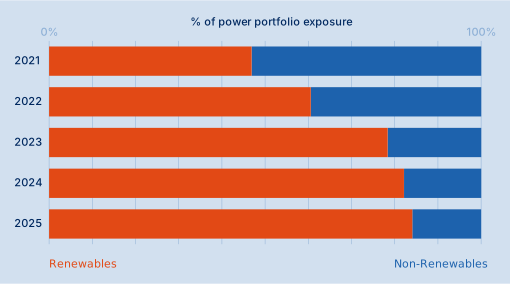
Caption: UKEF’s power sector exposure split by Renewables and Non-Renewables
Aviation:
Target: Reduce Aviation emissions intensity (tCO2e/ ) 35% by 2035, from 2022 baseline (AAR basis)
Economic emissions intensity of our aviation sector exposure remains above the 2022 baseline (25% higher) due to the increases in aviation activity seen as part of the recovery from the COVID-19 pandemic. This year, sector economic emissions intensity reduced by 10%, driven by the expiry of corporate airline support and a reduction in overall exposure to the sector.
Continued support for the aviation industry is core to delivering UKEF’s statutory role and purpose, and the Government’s Modern Industrial Strategy. Achieving UKEF’s decarbonisation ambitions in this sector will depend on progress towards decarbonising aviation activity in the real world, not on reducing UKEF’s own aviation sector exposure. The use of sustainable aviation fuel, efficiency improvements and zero emissions technologies will play a key role.
UKEF is focusing efforts to support the decarbonisation of real-world aviation activity around 3 pillars:
- Supporting the development of a low-carbon UK aviation sector for exporting
- Engaging our customers to accelerate the transition and managing our portfolio
- Driving partnerships within our portfolio and beyond to collaborate on solutions
-
UK Export Finance Financed Emissions 2025 Report: Basis of Report ↩
-
Since 2023, UKEF has obtained a limited assurance under the International Standard on Assurance Engagements (ISAE) 3000 for its financed emissions estimates. ↩
-
Restated to reflect a correction to the reported project phase for a small number of transactions. It is now 7,221,572 tCO2e versus 7,452,436 tCO2e reported in the Annual Report and Accounts 2024/25. ↩
-
Restated to reflect a correction to the reported project phase for a small number of transactions. It is now 1,272,748 tCO2e versus 1,425,635 tCO2e reported in the Annual Report and Accounts 2024/25. ↩
-
Calculation reflects UKEF’s rebaselined portfolio-level estimate, as set out in the 2022-23 Annual Report and Accounts. ↩
-
Restated to reflect a correction to the reported project phase for a small number of transactions. It is now 10,499,225 tCO2e versus 11,020,662 tCO2e reported in the Annual Report and Accounts 2024/25. ↩
-
Restated to reflect a correction to the reported project phase for a small number of transactions. It is now 1,368,567 tCO2e versus 1,421,333 tCO2e reported in the Annual Report and Accounts 2024/25. ↩