Executive summary: UK design protection review
Published 9 March 2026

© Crown copyright 2026
This publication is licensed under the terms of the Open Government Licence v3.0 except where otherwise stated. To view this licence, visit nationalarchives.gov.uk/doc/open-government-licence/version/3 or write to the Information Policy Team, The National Archives, Kew, London TW9 4DU, or email: psi@nationalarchives.gov.uk.
Where we have identified any third party copyright information you will need to obtain permission from the copyright holders concerned.
This publication is available at https://www.gov.uk/government/publications/uk-design-protection-review-with-policy-considerations/executive-summary-uk-design-protection-review
About the authors
Estelle Derclaye
School of Law, University of Nottingham
Estelle.Derclaye@nottingham.ac.uk
Estelle Derclaye is Professor of Intellectual Property Law at the University of Nottingham. She is the author and editor of 8 books and over 100 articles in the field of IP law and has done expert work for the UK IPO, the European Commission, and national and foreign law firms. Her main areas of research are copyright and designs, database protection, and IP overlaps. She was a senior visiting scholar at the University of California, Berkeley, and Melbourne Law School and a visiting professor at the National University of Singapore. She is a member and former president of the European Copyright Society, member of the Research Expert Advisory Group of the UK IPO and president-elect of ATRIP.
Bruce Tether
Alliance Manchester Business School, University of Manchester
Bruce Tether is Professor of Innovation Management and Strategy at the Alliance Manchester Business School within the University of Manchester, where he teaches innovation management, innovation economics, and design. Previously, he was Professor of Design and Innovation at Imperial College Business School. He was also the first research director of the AHRC funded Creative Industries Policy and Evidence Centre (2018 to 2023). Bruce has a longstanding interest in design, particularly in relation to innovation and as a strategic differentiator. He previously advised the UK government, especially the then DTI and BEIS, on design and had undertaken a previous study on design for the UK IPO. He has also given talks on design internationally, including in Japan.
Acknowledgements
We would like to thank the AHRC funded Creative Industries Policy and Evidence Centre (‘the PEC’) and the Intellectual Property Office (IPO) for sponsoring this research. We are especially grateful to David Humphries and colleagues on the IPO’s research experts advisory group (REAG) for their support, encouragement, and critical feedback, and to Hasan Bakhshi and Giorgio Fazio, respectively executive director and research director of the PEC, for their support, and to Giorgio for comments on the report. We also gratefully acknowledge the support of Paul Evans at the IPO for providing the raw data on design registrations analysed in Chapter 4, and of James Murray and Michael Farrer of OMB Research for their contributions to developing and undertaking the survey of design-active firms, which is analysed in Chapter 5. We would also like to thank REAG colleagues for commenting on the final draft of the survey instrument, and Sandra Walker for diligently proofreading and copyediting the report. Any factual or errors of interpretation are the responsibility of the authors.
The views expressed in this report are those of the authors and are not necessarily shared by any other person or organisation, including by the study’s organisational sponsors.
Introduction, summary and suggestions
The following is the “Introduction, Summary and Suggestion” section of the full report, which is available on request in PDF from research@ipo.gov.uk.
This report is written from two perspectives - that of a legal scholar specialised in intellectual property (Derclaye) and that of a business economics scholar specialised in design and innovation (Tether). This report aims to take stock of design protection in the UK, considering how the available design protections are being used, and to make some suggestions for reform.
Design refers both to the processes (“to design”) and to the outcomes or outputs of those processes (“the design”). In the UK, design protection relates only to the outputs. No account is taken of how designs are produced. Furthermore, in this report, we limit our attention to the design of ‘products’, and parts thereof, including their visual appearance. This includes both three-dimensional (3D) objects as well as two-dimensional (2D) graphic (for example logos) and digital designs.
These designs may never be produced, produced once or in small batches, or mass produced.
We do not concern ourselves with other ‘products’ that may be ‘designed’, such as smells and noises, but to which design production does not (yet) apply. Nor do we concern ourselves with other domains in which design processes may be applied and that lead to designed outcomes, such as ‘organisational design’, ‘process design’, ‘service design’, or ‘strategic design’.
In essence, the scope of this report encompasses the types of designs that can be protected by registered and unregistered design protection. We will shortly clarify the forms of intellectual property protection that can be applied to designs.
Designs, particularly in the form of products and objects, are typically both functional and visual. A teacup, for instance, is both a vessel from which to drink tea and a visual artefact that ‘says’ something about the owner’s taste or style (Such as traditional, modern, humorous). A Christmas jumper similarly not only provides warmth but displays (possibly questionable) ‘taste’. A designed logo can also convey meaning and values.
Designs are everywhere, in almost every object we use, from the clothes we wear to the crockery and cutlery we use to eat. From the computer icons and hardware we use at work to the furniture and furnishings in which we relax, to the toys we play with, to the beds we sleep on. And we buy, use and display designed things throughout our lives. Many companies compete ‘by design’, meaning that they differentiate their products not by their functionality, but by their design properties. And many people buy one company’s products, rather than another’s, at least in part because of their design properties.
From a policy perspective, design poses some interesting challenges, including (among others):
-
encouraging creativity (in design), including the right of an individual or company to be recognised as the originator of a new or distinctive design
-
cultural production, which involves the circulation of ideas, values, and memes, and which calls for inclusivity in access to and participation in cultural production and consumption
-
investment, very often, an idea is not sufficient to make and sell a design, particularly one on which a product is based or that is incorporated into a product. The commercialisation of designs in the form of products often involves investment, which can pertain to more than money (such as commitments of time, emotional energy, and relational capital)
-
competition. ‘Healthy competition’ drives down prices, refines and builds upon ideas, encourages efficiency, and speeds up the diffusion of new products, enhancing social welfare
This leads to classic tensions between, on the one side, the recognition, protection, and encouragement of individual designers and investors in design. On the other, the encouragement of ‘creative spillovers’ and the free circulation of ideas, which benefits competitors and speeds up diffusion. But also risks ‘market failure’ because creative designers may under-produce and investors in original designs may decline to take the risks inherent in first-mover commercialisation.
Almost every country has sought to address these tensions by granting some forms of protection for designs - in the form of outputs. Greece was an interesting exception, having no specific design law prior to its adoption of EU design law as an EU Member State - shown in Derclaye (2018).
However, the extent, duration, and enforceability of these protections vary widely and, for over a century, different countries have wrestled with different solutions - seeking to neither over- nor under-protect designs.
In the UK, two forms of intellectual property protection are intended to protect designs: registered and unregistered design rights. We will discuss these in more detail shortly.
The EU also has registered and unregistered design rights, which it first introduced in 2003. These were enforceable in the UK while it was a member of the EU.
Since the end of January 2020, when the UK left the EU, registered protection of new designs can only be attained directly with the UK’s Intellectual Property Office (IPO). Otherwise by designating the UK as a country in which an ‘international design’ channelled through the World Intellectual Property Organization’s (WIPO) ‘Hague system’ should apply (Chapter 4 for further details). The UK became a member of the ‘Hague system’ in 2018. The EU’s unregistered design right has a duration of three years and differs from the UK’s unregistered design right. It has been retained in the UK, becoming the ‘supplementary unregistered design’ (SUD) right. The UK therefore currently has two unregistered design rights.
Besides registered and unregistered design rights, a ‘design’ can be protected by other intellectual property rights, which include patents for technological inventions. In fact, design rights do not protect functionality, which is deemed the province of patents. Patents may apply to designs in which form follows function, and design protection may be considered invalid if the form of a design is determined by function.
Copyright can also apply to designs that are considered ‘artistic’. The question is: what does artistic mean? Whereas copyright is particularly applicable to 2D graphic designs, the extent to which it applies to 3D objects is more open to debate. In this regard, a notable court case was Ainsworth vs. Lucasfilm, in which Lucasfilm sued a prop designer (Andrew Ainsworth) for manufacturing and selling Stormtrooper helmets from the Star Wars firms. Lucasfilm asserted that the helmets were sculptures or works of artistic craftsmanship. This falls under copyright law and are thereby protectable for up to 70 years after the death of the author. whereas Ainsworth held that the helmets were designs, which, being unregistered, were protected for a maximum of 15 years. The UK Supreme Court found that helmets could not be considered sculptures as defined by the UK’s Copyright, Designs and Patents Act of 1988. However, since then, there has been a movement - particularly in the EU - to extend copyright to the world of designs, partly by dismantling, as arbitrary, the distinction between ‘artistic’ and ‘non-artistic’ works. Following the Cofemel decision, the European Court of Justice (CJEU) now disregards any ‘artistic’ aspects and considers only originality (i.e., the outcome of free and creative choices). Companies such as Birkenstock and Brompton - the respective makers of ‘iconic’ sandals and bicycles - have been seeking to have copyright extended to designs, including those introduced long ago. If these moves are successful, both new and old designs could be protectable by copyright. The UK has yet to reconcile the ‘artistic’ requirement in its copyright law. These matters are discussed further in Chapters 2 and 3.
Trade marks can also be used to protect designs in two ways. First, many trade marks are themselves designs - the Nike swoosh, for example, or the British Airways ribbon. This is particularly the case with 2D graphic designs, especially in the form of logos. Much less common, although possible, is the trade marking of 3D products, particularly as ‘shape marks’, of which the classic Coca Cola bottle is an example. It was granted a trade mark in 1977, having been first introduced in 1916. Another example is Toblerone, the iconic triangular shape of which was first registered as a trade mark in 1998.
However, the purpose of trade marks is to provide consumers with information as to the origin of products or services. Hence, trade marks - as recognisable insignia, phrases, words, or symbols that denote products or suppliers. These are intended to legally differentiate them from all others of their kind and to exclusively identify products as belonging to, or being provided by, particular companies and not by others. Makers of 3D products have generally struggled to persuade the intellectual property offices and the Courts to extend trade mark protection to shapes. Recent cases involving applications aimed at obtaining or upholding the trade mark protection of 3D products have included the four fingered shape of KitKat bars (2018) and the London Taxi (2017). The second way in which trade marks can protect designs is indirectly, by providing indications of the sources of origin of large numbers of designs/designed products, rather than of any specific one.
The overlaps that certainly occur between these forms of protection are a source of confusion for design owners. Note that, like registered design rights, patents and trade marks must be obtained through applications, whereas copyrights are ‘automatic’ and, in that regard, are akin to unregistered design rights.
We now introduce more fully the two main forms of design protection in the UK - registered and unregistered design rights.
Unregistered and registered design rights in the UK - A summary of the protections
As mentioned, the UK currently recognises two types of design protection, unregistered and registered design rights, the former of which can take two forms. Table 1 provides a summary of the characteristics of these three types of protection. The UK Unregistered Design Rights (from 1988). The UK Supplementary Design Rights - formerly the EU Unregistered Design Rights (from 2003). As well as the UK Registered Design Rights (RDRs) (from 1839). Although new designs cannot be protected in the UK through the EU RDRs, existing EU RDRs have been cloned into UK RDRs . The two being essentially the same, except in relation to geographical coverage. In the table, the differences between these rights are highlighted in bold.
Table 1: Summary of the three types of design rights currently recognised in the UK
| IP Right | UK Unregistered Design Right | UK Supplementary Unregistered Design Right | UK Registered Design Right |
|---|---|---|---|
| Subject matter | The shape or configuration of the whole or a part of an article => not surface decoration, be it 2D or 3D | The appearance of the whole or a part of a product => 2D and 3D. Appearance can include: shape, colours, texture, materials, ornamentation | The appearance of the whole or a part of a product => 2D and 3D. Appearance can include: shape, colours, texture, materials, ornamentation |
| Excluded subject-matter | Method or principle of construction Must-fit (‘article’ = anything, broad interpretation possible) Must-match features Ideas |
Solely dictated by technical function ‘Must-fit’ (‘product’, stricter wording and interpretation + exception for modular systems) Must-match features Ideas Immoral designs Additional grounds of invalidity/refusal |
Solely dictated by technical function ‘Must-fit’ (‘product’, stricter wording and interpretation + exception for modular systems) Must-match features Ideas Immoral designs Additional grounds of invalidity/refusal |
| Protection requirements | Fixation Not copied Original (sufficient skill judgment or labour or author’s own intellectual creation) Not commonplace in the field (UK) UK residency qualification |
Novelty (reasonable knowledge in sector concerned in UK) Individual character (different overall impression) Visibility for component parts |
Novelty (reasonable knowledge in sector concerned in EU) Individual character (different overall impression) Visibility for component parts |
| Ownership | Designer is owner of right Commissioned design = designer If design made by employee = employer |
Designer is owner of right Commissioned design = designer If design made by employee = employer |
Designer is owner of right Commissioned design = designer If design made by employee = employer |
| Scope of protection / infringement | Substantially copy article to the design for commercial purposes Extends to secondary infringement |
Copy produce a similar overall impression, taking into account the designer’s degree of freedom |
Use produce a similar overall impression, taking into account the designer’s degree of freedom |
| IP Right | UK Unregistered Design Right | UK Supplementary Unregistered Design Right | UK Registered Design Right |
|---|---|---|---|
| Infringement as assessed by? (i.e., view point of …) | Person to whom the design is directed (but some cases use average user or consumer) | Informed user (not average consumer nor expert) | Informed user (not average consumer nor expert) |
| Rights | Anti-copying | Anti-copying | Using/Making |
| Exceptions | Private and non-commercial use Experimental use Reproduction for teaching and citation (under certain conditions) Exception to facilitate foreign transport Licences of right during last five years |
Private and non-commercial use Experimental use Reproduction for teaching and citation (under certain conditions) Exception to facilitate foreign transport |
Private and non-commercial use Experimental use Reproduction for teaching and citation (under certain conditions) Exception to facilitate foreign transport |
| Duration | 10 to 15 years from making/first marketing (but licences or right possible as above) | Three years from disclosure | Five years from filing, renewable up to 25 years |
Further information on how your unregistered designs are protected.
Readers may notice that that the UK RDRs and Supplementary Unregistered Design Rights (SUDs) are very similar. The main differences being that that SUDs protect against copying. Whereas RDRs extend to using and/or making, and RDRs have a first instance five year duration, extendable to 25, whereas SUDs are only valid for three years. The EU RDR provides the same protection on the same basis, but across all of the EU Member States, whereas the UK RDR only provides protection within the UK.
The UK RDRs and its (original) unregistered design rights have different histories, which we summarise briefly in the following section.
Registered designs in the UK (and Europe): a brief recent history
Our aim here is to provide the context - rather than a full history - of design protection in the UK. Readers interested in a fuller history are referred Carter-Silk & Lewiston (2011). Also, Bently (2018) provides a lengthy discussion of the design-copyright interface in the UK, and Johnson (2023) an insightful account of the introduction of the UK’s unregistered design right.
The UK introduced a register of designs following the passing of the Designs Registration Act (1839) and has maintained one ever since. The current register is based on the Registered Designs Act of 1949 and the Copyright, Designs and Patents Act of 1988, which made several significant amendments to the 1949 Act, with a view to making the registration of designs more attractive to users.
According to the IPO:
A registered design protects the visual appearance of a product, part of a product, or its ornamentation. This can also apply to an industrial or handicraft item. This intellectual property (IP) right gives no protection for how a product works but merely for its appearance. That appearance can be affected by a number of contributory features including: lines; contours; colours; shape; texture; material.
(IPO website)
To be valid, a registered design needs to be both novel and to have ‘individual character’. Novel means that the registered design cannot be identical to any existing design (‘the prior art’). ‘Individual character’ means that the registered design must, in the view of the ‘informed user’, make a different overall impression from those of all existing designs (in the prior art). The ‘informed user’ is not an expert, the designer, or an average consumer, but a person who is well-aware of the trends in the sector of the design in question. An ‘overall impression’ is not a point-by-point comparison of every feature, but rather a more wholistic concept of the design and of how it compares with others.
In the UK, designs are submitted for registration but, since 2006, they are not examined for novelty and individual character; they are essentially assumed - rather than found - to be valid. If a submitted design meets the pertinent criteria, it will almost certainly be registered. The validity of a registered design can be challenged. For designs registered with the UK IPO, any such challenges are most commonly addressed through the IPO’s Tribunal (Chapter 4). However, only small numbers of registered designs are challenged.
From a legal standpoint, the registration of a design provides monopoly protection for five years in the first instance (Chapter 2 for fuller discussion). This protection can be renewed for four subsequent five-year periods. Thereby encompassing a period of up to 25 years before the design enters the public domain. From which point it may be legally used by third parties (provided other protections do not apply). If the registration of a design is not renewed and is allowed to lapse, is cancelled, or the design is found to be invalid, it is removed from the register and may be legally used by third parties (so long as it is not otherwise protected).
In 1998, the law on registered designs was harmonised across Europe. Johnson (2023) states that, in effect, this amounted to the recreation of the UK’s Registered Design Act of 1949 in a European image. In 2003 - as part of its efforts to harmonise its constituents into a single market or, in other words, to level the playing field - the European Union introduced the Community Registered Design right (CRDR). The EU right is essentially the same as its UK equivalent, the only difference being its geographical coverage. At the same time, the EU also introduced an unregistered design right. Which is also essentially the same as the UK registered design right except that the latter is a right against copying. Rather than against using/making, and has a duration of only three years. Since Brexit, the EU unregistered design right has been incorporated into UK law as the Supplementary Unregistered Design Right.
In the years prior to the introduction of EU registered designs (CRDRs) a little under 10,000 applications were submitted each year to register designs with the UK IPO. More than half of which originated from outside the UK. This was far below the peak of over 40,000 design registrations made in the UK around the year 1910 (Figure 1 as follows).
Until 2007, an application had to be made for each single design. After 2007, a single application could involve any number of new designs, with an amended fee structure introduced to provide financial inducements for multiple filings rather than single applications DPN 2/06: Allowing multiple applications.
Figure 1: UK Design Registrations, 1839-2015
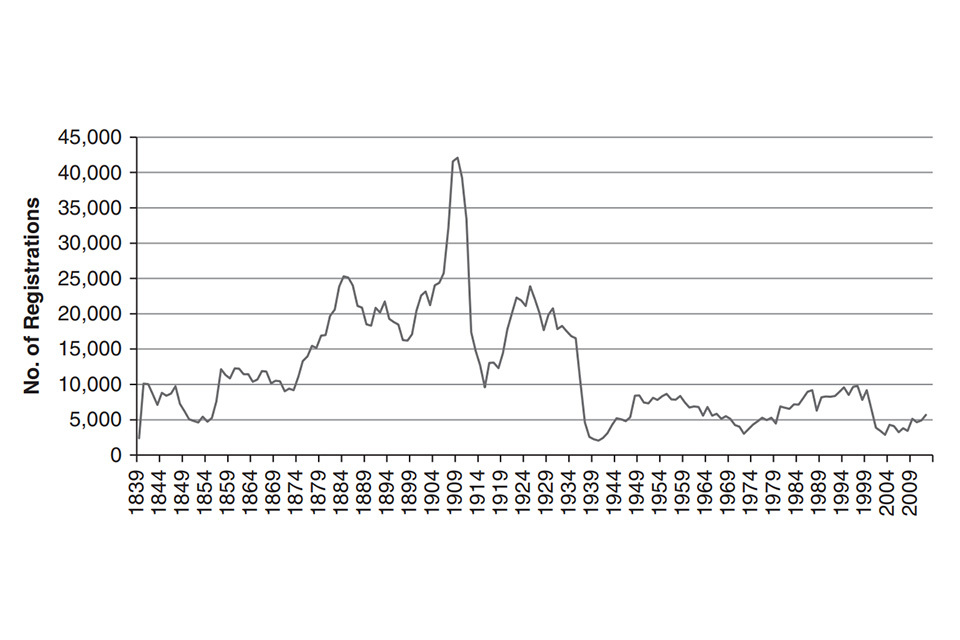
An image of a line graph representing the rise and fall of the number of UK applications to register designs, peaking at 1909. Source: Bently, 2018, Figure 6.2, page 205
After the introduction of CRDRs, applications to the UK register fell by more than half, to around 4,000 a year. This was due mainly to foreign applicants and UK-based multinationals switching to CRDRs despite their higher costs (shown in the following section), which provided EU-wide protection. The number of applications made by non-UK based owners to register designs in the UK with the IPO fell to under 200 each year between 2010 to 2015, having exceeded 5,000 annually prior to 2003.
After the introduction of CRDRs, the UK retained its national design register primarily to provide ‘UK-only’ protection for design owners (especially individuals and small businesses). These design owners were primarily or only interested in UK - rather than EU-wide - market protection. As well as involving lower fees, UK RDRs were less vulnerable to challenges. Whereas an EU-wide right might inhibit a competitor active in any of the EU member states, a UK-only right would only do so if such competitor were active in the UK.
Over the years following the 2003 introduction of the EU CRDRs, the number of annual registrations of UK-only designs by UK-based owners with the UK-IPO remained roughly at the same level (i.e., 3,000 to 5,000 annually). Showing some sustained demand for these rights.
Combined with the approximately 5,000 to 6,000 European CRDRs also registered annually by UK based owners provides a total of approximately 10,000 designs of UK origin being registered annually either in the UK or as CRDRs. Although difficult to gauge, this is almost certainly a small share of the potentially registerable designs originating in the UK during this period.
Following the publication of the Hargreaves review in 2011, the UK IPO undertook a consultation on the UK Designs Legal Framework. While maintaining both registered and unregistered protection within the UK, this led to several changes, including the criminalisation of the intentional copying of registered designs (implemented through the IP Act of 2014).
2016 brought four significant events:
In March, the UK’s Supreme Court handed down its judgment in the PMS International Group vs. Magmatic Ltd. (Trunki) case, in which PMS was found to not have infringed Magmatic’s CRDR. Although Magmatic’s design had been registered in Europe (as a CRDR) the ruling had implications for how the images submitted for designs registered in the UK are interpreted by judges (Chapter 2). This judgment arguably narrowed the scope of an individual registered design. However it also provided greater clarity about how registered designs should be interpreted by the courts. As well as the images design owners should submit, and how they can use them depending on the protection they seek.
Following the case, the UK IPO issued DPN 1/16: Guidance on use of representations when filing Registered Design Applications (1 June 2016).
The second significant event of 2016 was the June Brexit referendum, in which the UK electorate voted to leave the European Union. Since the end of the transition period, European design rights (CRDRs and CUDRs) have ceased to have validity in the UK. Since the 1st of January 2021, anyone wishing to protect a new design in the UK through registration has had to either register the design directly with the UK’s Intellectual Property Office (IPO). Otherwise to designate the UK as a territory in a multi-country application made through the World Intellectual Property Office (WIPO). The UK having become a member of the Hague Agreement for the International Registration of Industrial Designs in May 2018.
Table 2: Fees for registering designs in the UK and Europe
| Number of designs submitted in the application | EUIPO fees | UK IPO fees Prior to 2016 |
UK IPO fees From 2016 paper filing |
UK IPO fees From 2016 electronic filing |
|---|---|---|---|---|
| 1 application | €350 (£293) | £60 | £60 | £50 |
| 3 applications | €700 (£586) | £140 | £140 | £70 |
| 10 applications | €1,929 (£1,615) | £420 | £420 | £70 |
| 30 applications | €3,525 (£2,950) | £1,220 | £1,220 | £110 |
| 100 applications | €9,125 (£7,640) | £3,960 | £3,960 | £250 |
| Effective application fees on a ‘per design’ basis | ||||
| 1 application | €350.00 (£293) | £60.00 | £60.00 | £40.00 |
| 3 applications | €233.33 (£195.32) | £46.67 | £46.67 | £23.33 |
| 10 applications | €192.90 (£161.48) | £42.00 | £42.00 | £7.00 |
| 30 applications | €117.50 (£98.36) | £40.67 | £40.67 | £3.67 |
| 100 applications | €91.25 (£76.38) | £39.60 | £39.60 | £2.50 |
| Deferred publication fees per design | 1st design €40 (£33.50) 2 – 10 €20 (£16.75) each 11th+ €10 (£8.37) each |
In effect, £20 per design | £40 per design | £40 per design |
| 1st renewal (yrs 6-10) | €90 (£75) | £130 | £70 | £70 |
| 2nd renewal (yrs 11-15) | €120 (£100) | £210 | £90 | £90 |
| 3rd renewal (yrs 16-20) | €150 (£125) | £310 | £110 | £110 |
| 4th renewal (yrs 21-25) | €180 (£150) | £450 | £140 | £140 |
Table 2 Notes: In both the UK and EU, renewal fees are per design. Unlike first applications, there are no discounts for renewing multiple designs at once. The EUIPO charges registration and publication fees. For a single design, these are €230 (£193) and €110 (£92), respectively. An additional fee is chargeable if the publication of the designs is deferred. Our understanding is that these registration and publication fees have remained unchanged since the 2003 inception of RCDs. EUIPO fees for designs
Meanwhile, applications made via the Hague system involve basic and publication fees, with designation fees also being charged for registering in different territories. As shown on the WIPO website.
The basic fee for one design is CHF397 (£347) plus CHF19 (£16.60) for each reproduction to be published, plus designation fees ranging from CHF42 (£37) (level 1) to CHF90 (£79) (level 3). A single design with one reproduction designated to one level 1 territory therefore costs CHF458 (£401) to register. The cost of registering additional designs is much lower than that for the first design. However at approximately £34 per design for a level 1 territory, it is still far higher than filing direct with the UK IPO. Renewal fees start at over CHF200 (£175) for the first design, but are lower for subsequent ones.
Prior to 2016, the UK IPO reduced the application fee by £20 for those seeking deferred publication, while a deferred publication cost £40; so, in effect, £20 was charged for deferred publication.
The maximum publication deferral allowed in the UK and via the Hague system is 12 months after the filing date. Publication of EU registered designs may be deferred for up to 30 months from the earliest priority date.
The third significant event of 2016 was the repeal of Section 52 of the 1988 Act, which took effect on 31 July 2016 following the European Court of Justice’s ruling on the Flos case. This removed the restriction (detailed in the following section) on the availability of copyright for mass-produced articles after 25 years of production. So that the full copyright term (70 years after the creator’s death) now applies to all artistic works. However, the question of whether (and when) designs can be considered artistic works has yet to be clarified in UK courts.
The fourth major event in 2016 was the introduction of a new filing and fee structure for registering designs in the UK, especially if designs are filed electronically (rather than on paper). Following a consultation, a new fee structure was introduced with the aim of encouraging electronic filing, especially in relation to the filing of multiple designs in a single (electronic) application. For example, whereas, previously, a fee of £420 was charged for filing ten designs in one application, this was dropped to just £70 for electronic filings (i.e., £7 each for 5 years of protection). By contrast, the fee for registering a single design in an application was reduced by just £10, from £60 to £50, if filed electronically (shown in Table 2 for other examples). While the aim of the changes was to encourage a more widespread use of design registrations. The fee changes were especially advantageous to those able to file larger numbers of designs in single electronic applications. This favoured prolific design originators and large companies that, all else being equal, tend to generate more designs than small firms and independent designers.
The IPO’s patents, trade marks, and designs: monthly statistics shows the upsurge in the registration of designs in the UK. Both directly with the IPO and through the Hague system, occurring between January 2017 and December 2024.
We discuss these and legal changes in greater detail in Chapter 2, and the uptake of design registration particularly in the UK in Chapter 4.
Table 3: Cost per design of protection for up to 25 years, including per year costs
UK fees prior to 2016 (with paper filing), per design costs, given the number of designs in the application, rounded to the nearest £1
| One | 10 | 20 | 50 | |
|---|---|---|---|---|
| 5 years only | £60 | £42 | £41 | £40 |
| 10 years | £190 | £172 | £171 | £170 |
| 15 years | £400 | £382 | £381 | £380 |
| 20 years | £710 | £692 | £691 | £690 |
| 25 years | £1,160 | £1,142 | £1,141 | £1,140 |
| 5 years per year | £12.00 | £8.40 | £8.20 | £8.08 |
| 10 years per year | £19.00 | £17.20 | £17.10 | £17.04 |
| 15 years per year | £26.67 | £25.47 | £25.40 | £25.36 |
| 20 years per year | £35.50 | £34.60 | £34.55 | £34.52 |
| 25 years per year | £46.40 | £45.68 | £45.64 | £45.62 |
UK fees from 2016 onwards with electronic filing, per design costs, given the number of designs in the application
| One | 10 | 20 | 50 | |
|---|---|---|---|---|
| 5 years only | £50 | £7 | £5 | £3 |
| 10 years | £120 | £77 | £75 | £73 |
| 15 years | £210 | £167 | £165 | £163 |
| 20 years | £320 | £277 | £275 | £273 |
| 25 years | £460 | £417 | £415 | £413 |
| 5 years per year | £10.00 | £1.40 | £0.90 | £0.60 |
| 10 years per year | £12.00 | £7.70 | £7.45 | £7.30 |
| 15 years per year | £14.00 | £11.13 | £10.97 | £10.87 |
| 20 years per year | £16.00 | £13.85 | £13.73 | £13.65 |
| 25 years per year | £18.40 | £16.68 | £16.58 | £16.52 |
The UK’s unregistered design right
The UK’s Unregistered Design Right, which was introduced in 1988, is unique in the world.
Phillip Johnson (2023) considers that it was created “on a tightrope between protecting investment in design and the restriction of competition”. Also involving the coming together of two lineages: “On its father’s side, there was the granting of copyright to design drawings along with a broad reproduction right”. While on its mother’s side are restrictions to the use of copyright to protect industrial designs. The registration of designs was intended to protect industrial designs with aesthetic qualities. Or “eye appeal”; indeed, designs that did not have aesthetic qualities were not registerable.
The 1949 registered design act states that:
A design shall not be registered in respect of an article if the appearance of the article is not material, that is, if aesthetic considerations are not normally taken into account to a material extent by persons acquiring or using articles of that description and would not be so taken into account if the design were to be applied to the article.
A problem was that, if design drawings were protected by copyright, then not only would anyone making a design using those drawings be infringing copyright. Anyone copying a functional article would be indirectly copying the design drawing. Thereby infringing the copyright of the design. The matter came to a head in a case (British Leyland v Armstrong, 1986). In which a spare parts manufacturer (Armstrong) had refused to pay a licence to British Leyland to make spare parts for Leyland’s cars based on BL’s designs. All sides recognised that the law had got into a mess over industrial designs; it fell upon Parliament to act.
The unregistered design right (UDR) was introduced by the Copyright, Designs and Patents Act 1988 (CDPA 1988) . It protected “any aspect of the shape or configuration (whether internal or external) of the whole or part of an article”. However, not the methods of construction, any features that enabled the article to be connected to, or which were dependent upon, another article, or surface decoration. Copyright is applicable to surface decoration, and the introduction of the right split industrial design protection into two.
Carter Silk and Lewiston (2011) explain that:
The problem with this bifurcated approach was highlighted in a number of cases but is well demonstrated by the case of Lambretta Clothing Co Ltd v Teddy Smith (UK) Ltd, which concerned the design of a jacket, the visual appearance of which was dictated by stitching together coloured panels. Counsel for the claimant (Lambretta) submitted that the twin rights of copyright and design right should essentially combine to protect the whole of the article. Jacobs LJ, giving the lead judgment, did not agree and interpreted section 213 CDPA 1988 as excluding the visual effect created by the ‘configuration’ of the panels and simultaneously excluded copyright by the application of section 51. This judgment left a hole between unregistered design right and copyright.
(Carter Silk and Lewiston, 2011, p.51)
This ‘hole’ has been filled by the EU Unregistered Design Right, now the UK SUD, and protection of the jacket could have been achieved by registering the design.
The UK’s UDR was primarily intended to provide protection to functional (rather than aesthetic) designs and to incentivise investments in time, money, and effort in developing these. However, although the aim was also to avoid giving protection to mundane, routine, or unoriginal designs. Which are commonplace in their particular fields. The reach of the right extended beyond wholly functional designs. The new law also restricted copyright protection in design drawings and models, so that it did not extend to any change made to them unless they were ‘artistic’. The protection term was set at ten years from when first marketed, or 15 years from when created, whichever expires earlier, subject to a licence of right in the last five years.
Johnson (2023) reports that, while the intention of parliament was for the UK UDR to encourage and protect investment in design. The courts saw the right as protecting original functional designs without regard to investment. In little over a decade, it had become widely acknowledged as a conceptual cocktail of copyright and registered designs. Although, in contrast to registered designs (and the SUD), it is intended to protect functional designs, including those that are hidden from view, it began to be used to as a copyright intended to protect both functional and aesthetic designs.
The very nature of unregistered design protection makes it impossible to know the number of designs it does or could protect. All that can be observed is the frequency with which these rights are litigated, particularly in court; this is not often, as we discuss in Chapter 2. Also, it is not easy to find out whether the owners of unregistered designs even know about the UK UDR (whereas the owners of registered designs must obviously know of that instrument’s existence). We shed light on the extent to which unregistered design rights are known about and understood among design-active firms in Chapter 5.
Post Brexit
The UK is now in an interesting position. Having left the EU, it has the opportunity to diverge from it in relation to its design protection laws. The UK government recognised this opportunity in its consultation on designs, stating:
Following the UK’s departure from the European Union (EU), we have new flexibilities to define the domestic designs regime. As we negotiate trade deals with international partners, we want to ensure the UK system supports designers and encourages overseas investment. This will give the UK a competitive edge and allow designers to get the most from new opportunities.
The UK has a substantial ‘Design economy’ (shown in Chapter 1) and, if it is to take advantage of these freedoms, then the question of what success looks like arises. No doubt there is no single answer. Some will want to preserve the status quo and as little divergence from Europe as possible. Whereas others will want more radical change, including greater protection for designers and the stronger enforcement of design rights.
Within this context, this report examines the protection of designs in the UK from two perspectives. That of the law and legal developments, and that of the businesses and users of design protection. Following Chapter 1, which aims to provide an outline of the size and shape of the ‘design sector’ in the UK. In Chapters 2 and 3 of the report, we focus on how the law on design protection has developed. Both through legislation and through case law, both for the UK (Chapter 2) and for the EU (Chapter 3). We consider the latter because, until Brexit, EU designs law applied to the UK, and because the UK is most likely to want to either adopt or diverge from any developments taking place in the EU.
Then, in Chapters 4 and 5 of the report, we focus on the use of design protections, particularly by firms. In Chapter 4, we examine the registration of designs, especially within the UK and by UK based entities. In Chapter 5, we then seek to gain insights into the knowledge held and behaviours engaged in by design active firm. Including the extent to which they are knowledgeable about design and other intellectual property protections. Whether they use them, and their perceived effectiveness. This chapter is based on data drawn from 501 responses to a survey administered to design active firms in the UK. The survey also sought to understand the extent of infringement experiences, and to explore proposals intended to improve design protection in the UK.
The report concludes with Chapter 6, in which we offer suggestions for policy development with a view to encouraging design activities and supporting the design ecosystem within the UK. An abridged version of these suggestions is provided in the following section, after the summaries of Chapters 1 to 5.
Chapter summaries
Chapter 1 seeks to provide an outline the size and shape of the ‘design economy’ in the UK. Despite not being officially defined, it is evident that the design economy is substantial and, in regard to some measures, roughly the same size of the patenting-intensive technology-based economy. Firms in design-intensive industries tend to achieve relatively high value added. Both in aggregate and on a per employee basis, which is also reflected in typically higher wages. Design-intensive industries, which are dominated by micro and small firms, also generate considerable exports. Yet, design protection, and especially the registration of designs, appears to be little used even among firms in the most design-intensive sectors. This Chapter shows how the design economy is substantial, as is design-based competitiveness. As such, both scholars and policymakers should give it greater attention than it has hitherto received.
In Chapter 2, we review the legal and judicial developments introduced in the UK during the last decade. In 2014, some legislative changes were made in the direction of increasing the alignment between different design rights and copyright. Other legislative adaptations were made because of Brexit. The case law on the UK’s unregistered design right (UK UDR) has been relatively constant and many aspects are now well-settled. However, an important issue is the increasing use of the EU’s originality requirement instead of the UK one. There is uncertainty as to which of the two applies. In relation to registered design rights, the most significant case involved the ‘Trunki’ ride-on suitcase for children. The Supreme Court found that the registered design had not been infringed, thereby arguably upheld the Court of Appeal’s strict and narrow interpretation of the right. This has (arguably) left right holders less able to protect their designs, especially particularly novel and distinctive ones, through registration. Otherwise, as with the unregistered right, the case law has settled the main issues, including those pertaining to the ‘informed user test’ and ‘overall impression’, which are crucial to both validity and infringement. Chapter 2 also provides a descriptive numerical analysis of the decisions made on the objects in dispute (2D or 3D). As well as rights in dispute, number of types of design rights in dispute, outcomes of disputes. This includes those occurring up to and after Trunki. This shows that, overall, there has not been a major change in outcomes.
In Chapter 3, we provide a brief summary of the main legal developments at the EU level. We do so for three reasons. First, prior to Brexit, the UK’s regime for design protection was very largely (but not entirely) determined at the EU level, with the aim of harmonising design protection as part of efforts to develop a single market in Europe. Second, the UK has retained the provisions of EU design law and still follows EU case law, subject to the courts’ willingness to deviate, according to the Retained EU law Act 2023. And third, the EU remains the UK’s largest trading partner. This implies that, while the UK may seek to deviate from the EU through new legislation. This deviation is likely to be partially informed by the policy developments taking place in the EU.
The major legislative development taking place in the EU pertains to the reform of the design directive and design regulation which were adopted in 2024. Overall, the changes are mostly cosmetic or clarificatory. The biggest change is the introduction in the directive of a repair clause that allows, under certain conditions, spare parts to be manufactured without the design owner’s consent. By contrast, the Court of Justice of the European Union’s (CJEU) case law in the field of design has mushroomed in the last decade (and is not fully reviewed in this report). The CJEU’s rulings are, in the main, clear and satisfactory, with the exception of:
-
parts of the Grupo Promer decision, which leaves the possibility of having more than one informed user in a dispute
-
the Murphy decision, which denies giving a greater scope to more innovative designs
-
the Nintendo decision, which incorporates trade mark notions into the interpretation of the teaching and citation exception
In the last part of the chapter, to give further insights into the state of the law and nourish our reflections in the conclusions, we summarise the main empirical research conducted on designs over the last decade in the EU. We also include a discussion of the academic literature in relation to the UK and EU law, presented in Chapters 2 and 3.
In Chapter 4, we focus on who registers designs, especially in the UK. Until the mid-2010s, the registration of designs in the UK was something of a backwater, attracting only around 5,000 registrations per annum. Since then, the introduction of electronic filing, changes to the fee structure and Brexit have greatly increased the attractiveness of registering designs in the UK (both directly with the IPO and through the WIPO under the Hague agreement). Around 70,000 designs were submitted for registration in 2021 and 2022, c. 80,000 in 2023, and c. 75,000 in 2024. This upsurge has been the outcome of applications filed by both domestic and overseas applicants exhibiting a high degree of diversity, including large numbers of individuals as well as companies of all sizes. UK based individuals are especially likely to file directly with the UK IPO without the support of representatives such as law firms. A major trend has been linked to the increased filing of designs by trading companies, especially those operating on internet platforms. The designs submitted are also highly diverse, not being confined to a few sectors or classes. Yet, despite such a huge upsurge, the registration of designs still appears to be relatively under-utilised. For example, our analysis shows that cutlery manufacturing is the only industry in which more than one in ten firms active in the UK registered at least one design in the two years 2021 to 2022. Moreover, among the firms that do register designs most register very few (typically one or two). At the same time, there is evidence of the registration of designs being abused, with designs being registered to block rivals, especially on internet-based trading sites. While the Tribunal system for challenging the validity of registered designs is, in our view, fair. It does not have (and is unlikely to ever have) the capacity to act as a means to ‘clean’ the register. In the following text, we suggest that policymakers will be required to come up with some creative solutions to discourage the abuse of design registrations.
In Chapter 5, we also focus on the use of design protections. We present empirical evidence drawn from a survey of 501 design active firms in the UK. We found that only half our respondents were aware of unregistered design rights; a particularly low proportion. We also found that familiarity with unregistered design rights was poor even among those who were aware of them. This is somewhat alarming because this right is specifically intended to support design and the investments in design that these businesses are making. We found that the perceived effectiveness of unregistered design rights is also low. Further, we found that, although around 90% of our respondents knew about the ability to register designs, most had not done so (which is in line with the findings of Chapter 4). Those who had registered had typically registered very few designs, only a subset of their portfolios, and had been primarily interested in gaining a property right through registration. Further, large numbers of those who had not registered any designs considered the protection provided by registration to be ‘not worthwhile’. Our respondents were universally aware of copyright, trade marks, and patents, and tended to regard them as effective for the protection of designs. Notably, however, a large proportion had not made any use of these protections. Including those who had introduced high-value and long-lived designs. Quite a gap appears to divide the perceptions pertaining to the effectiveness of the available protections and their uptake. We argue that IP protections can be considered a form of insurance, and that the un- and underinsured are less well positioned than they might otherwise be in regard to countering any infringements and may also be more exposed to costly disputes. Notably, we found the most widely used protections to be internal secrecy and non-disclosure and confidentiality agreements (within the firm and with business partners). However, on their own, these protections are ineffective once a design has been made public.
We found instances of (alleged) infringements to be quite widespread, with a quarter of our participating firms reporting that one or more of their designs had been copied over the previous two years. On the positive side, many had been able to resolve these disputes without significant expenditures of time or money. However, many more had not taken action. We found a widespread perception that “copying and close imitation is a fact of life in design”. Others appear to have adopted a ‘hard-headed’, cost-benefit approach, considering disputes to be often not worth pursuing in terms of time and money. Overall, most respondents considered the UK to be a favourable place to create designs and/or manufacture products that incorporate new designs. A significant minority though, did not share this view. An unfavourable view was more widely held among those who had been embroiled in expensive and time-consuming infringement disputes.
Chapter 5 ends with a review of some proposals, aimed at improving design protection in the UK, which our respondents had considered, and with a report on the respondents’ own suggestions. We found general support for the strengthening of design protection, although any specific proposals would involve costs as well as benefits. The respondents themselves offered a large number of diverse suggestions for what they would like improved, including but not confined to faster, cheaper, and more effective enforcement.
Summary of policy suggestions
In Chapter 6, we offer our conclusions and suggestions for improving design protection in the UK. What follows is an abridged version of that chapter.
Explicit design protection has existed in the UK for nearly 200 years. During that time, debates have addressed what should be protected, for how long, the scope of protection. As well as other matters, such as fees and whether there should be an examination prior to a grant. Other countries, which have also grappled with these challenges, have come up with a variety of solutions. None of which is perfect for all (bona fide) participants and interest groups. The great variety found among designs also makes it extremely difficult to find a perfect solution that satisfies everyone. While some designs are very short lived - making instant, automatic, and short-lived protection desirable. Others remain valuable for decades - making a slower, careful procedure for granting protection more reasonable. Particularly if the granting of effective monopoly rights is involved. Some designs are of low commercial but possibly high emotional value, and some are hugely valuable from a commercial perspective. There are also very substantial differences in the resources available to design owners to secure protection, pursue infringers, and enforce or challenge rights.
An effective IP system should lead to bona fide creative activity that would not have happened in its absence, but also to balancing the interests of creators or originators vs. those of followers and consumers. The system should also be adaptable, in order to provide protection and incentives to new areas of creativity (such as digital designs). Also to take advantage of any advances in technology, such as low-cost digital storage, and in the use of artificial intelligence to search and compare images.
What are we suggesting?
1. Encouraging the registration of designs
In the past, the registration of low value and short-lived designs was discouraged, in part because of the costs of dealing with and storing paper filings. Today, the vast majority of filings are electronic, enabling very low submission and data storage costs. Electronic filing should also enable operators to rapidly find existing designs within the register.
By encouraging registration, the Intellectual Property Office, and others such as the Design Council, could send a clear message to the design community - “if you want to protect your designs (for up to 25 years), register them”.
The provision of multiple alternatives - including unregistered design protection, copyright, trade marks and passing off - causes confusion about how to protect designs. The extension of copyright (following Flos, Cofemel) to cover ‘original’ works that are not ‘artistic’ has arguably added to this confusion. Which can also be further heightened if claimants are permitted to engage in ‘IPR-shopping’ in litigation. That is, using design rights instead of copyright, or vice versa. We suggest that the UK design framework follow the one used in the EU and add exceptions to counter such ‘IPR-shopping’. Also that the UK go further and incorporate most, if not all, exceptions from the copyright framework into its design laws. Furthermore, we suggest that some trade mark law concepts, such as honest practices, should not be used in interpreting exceptions.
For a modest fee, the registration of designs provides protection for up to 25 years. This seems a reasonable period for the protection of creative work and likely sufficient to enable the designer/design-owner to recoup any investment required to commercialise the design.
In our view, the fee structure should be revised to encourage the registration of designs. Currently, the fee structure is very favourable to those filing large numbers of designs in single applications. Those registering single designs pay a considerably higher fee on a per-design basis, but it is not clear why. We suggest that a more modest fee should be charged for the filing of single design (say £30), and perhaps a lower fee also for the filing of any subsequent closely related designs in the same application (say £20 per design). The ‘closely related’ criterion could be pragmatically, if imperfectly, defined as those within the same Locarno sub-class.
The Locarno Classification is an international categorisation used in the registration of industrial designs. It was established by the Locarno Agreement of 1968. It comprises 32 classes, most of which are further divided into sub-classes.
The requirement to periodically renew design rights (subject to payment of the pertinent fees) every five years until the maximum of 25 should help focus the mind of every design owner. This focus is as to whether or not protection should be maintained or whether it should be allowed to lapse. Which would cause the design to enter into the public domain. This should be an informed choice, made in the knowledge that failure to renew would allow others to legally make products to that design. We suggest that, having decided to let a registered design lapse, its owner should not be allowed to fall back on copyright. Some will of course argue that longer protection periods should be available, but 25 years, albeit being an arbitrary duration, has become the established norm in Europe.
The benefits of design registration could also be advertised through information campaigns. For example, the proven intentional and unauthorised copying of a registered design is a criminal offence. This implies that anyone who has had his or her registered design illegally copied in the UK has the option of bringing the matter to the attention of the authorities, who may decide to prosecute. This is not therefore just a civil matter. If nobody does get prosecuted, this ‘benefit’ remains doubtful; the intentional and unauthorised copying of registered designs should thus be prosecuted.
Registration also arguably provides a form of insurance because it provides a property right, which makes it easier to enforce protection against unauthorised copyists. While the courts have tended to interpret the scope of the registered designs rather narrowly and rigidly (shown in the following section). Registered designs can be ‘enforced’ in distribution channels. For example, by getting retailers and internet platforms to not stock or delist any product the design of which is identical or very similar to a protected one. Indeed, there is evidence that the registration of designs is being abused for this purpose. In one sense, designers/design owners should be encouraged to register their designs. This is because if they fail to do so, then someone else might. Leading to costly and drawn-out challenges regarding ownership and validity.
It has been suggested, and we support this notion, that the registration of designs might be linked to other benefits, such as the right to a ‘designed in Britain’ logo, if applicable. We also consider that associating a symbol, such as a D in a circle, with registered designs would increase awareness and foster the understanding that designs are protected intellectual properties. Of course, there is always the risk of these symbols being abused, or misused, and consideration would need to be given to what sanctions should be imposed on abusers.
Many of the respondents to our survey expressed the desire to be given better guidance on the information that needs to be filed when registering a design. Although such guidance is provided by the IPO and others, it could be made more accessible and more widely disseminated.
In our view, consideration should be given to broadening the scope afforded to particularly novel or innovative designs. The Court of Appeal’s arguably rather narrow and strict interpretation of the “Trunki” registered design. Which was upheld by Supreme Court. Has led to the perception that the protection provided by registration is essentially (and at best) against copying and that, as such, registration is ‘not worthwhile’. This is unfortunate and may also have encouraged behaviours such as the filing of several never to be produced ‘guard designs’. Intended to extend the protection of a primary design that, by contrast, is produced and marketed. This practice, while clever, leads to the register becoming unduly cluttered and would be redundant were the scope of the protection afforded to the original primary design be wider. We note that, in the past, case law has supported greater protection being afforded to particularly innovative or novel designs. (for example Birss J stated this in his judgment in Samsung v Apple (2012) which refers to Arnold J in Dyson [2010]). In brief, the more novel a design is, the greater the scope of its protection should be.
The ‘informed user’ concept is central to design law. It is used to evaluate whether a new design is valid and/or whether it infringes on the scope of the protection of existing designs. The informed user is not an average user, or average consumer - which is the concept applicable in trade mark law
We also suggest the UK consider following the EU in adopting new, broader, clarificatory definitions of design and of exclusive rights. As developed in the EU’s new Design Directive and Design Regulation.
2. Addressing registration abuse in order to effectively discourage it
If design registration is to be encouraged as the main way in which designers and design owners can gain protection, it becomes more important than ever that such registration is not abused.
Although the extent of this phenomenon is not known, there is evidence (reported in Chapter 4) that registration abuse is occurring by means of the registration of existing products (or ‘old designs’). For which the owner is motivated to obtain a property right in order to ‘enforce’ it, notably on internet trading platforms. Here, ‘enforcement’ involves the use of the property right to force the internet platform to delist the products of rivals, which reduces competition and likely increases prices. The delisted rivals, meanwhile, are unable to trade their product until the validity of the registered design is overturned, which involves costs and time. This practice is facilitated by the relatively low fee charged to register a design and by the omission of a substantive search process aimed at establishing novelty and individual character. The absence of such process means that designs can be registered with minimal delays, which is welcomed by bona fide design owners but does open registration to abuse.
To some extent, the Tribunal system provides an opportunity to remove such designs from the registry. While it is very fair in its assessment of each contested design, its effectiveness as a means to ‘clean’ the register is limited. First, as any challenger needs to pay a fee, gather evidence and risks having to pay some of the costs of the design owner if the challenge fails. For example if the design is held to be valid. There is no incentive for ‘good citizens’ to identify any possibly invalid designs and have them assessed. Second, the capacity of the Tribunal system is likely limited and has probably become strained by the rapid expansion of registrations in the UK in recent years, a state of affairs that will likely persist.
To address this issue, policymakers will likely have to engage in creative thinking. One option could be to adopt the hybrid system implemented in Australia. In which designs are first registered and then certified, with the rights of certified designs being the only ones legally enforceable. However, this distinction would need to be clearly communicated, as research conducted in Australia indicates that the difference is not well understood and that holders of registered but uncertified designs often seek to enforce their rights. Another option could involve exploring the use of artificial intelligence tools to search for any existing designs against those submitted for registration. Some progress has been made in this regard, and future technological progress is likely to be rapid. Although the IPO could develop this capability in-house, an alternative measure could involve encouraging third parties to search for comparable designs themselves. A bold idea would involve the requirement to put up a returnable deposit when registering a design, a deposit that would be forfeited (and paid to the finder) were the design be found to be invalid. Clearly the deposit (or ‘bounty’) would need to be large enough to act as a deterrent (and as an incentive to the bounty hunter), but not so large as to inhibit the registration of designs by bona fide owners.
3. Simplification and improved communication of unregistered design rights
Prior to Brexit, UK designers and design owners were faced with a somewhat bewildering set of choices in regard to how protect their designs. Including registration in the EU and the UK, unregistered protection in the EU and the UK, copyright, trade marks, and passing off. The UK’s departure from the EU has provided an opportunity for simplification. However, the EU’s unregistered design right has been retained, becoming the UK’s ‘supplementary unregistered design right’. This has resulted in two forms of unregistered design protection, which are surely (at least) one too many.
The obvious option might be to abolish the ‘supplementary unregistered design’ (SUD); however, it is our understanding that this would require a renegotiation of the Trade and Cooperation Treaty between the UK and the EU (paragraph 1 of article 247). An alternative could be to abolish the UK unregistered design right (UK UDR). This could encourage more designers/design owners to register their designs in order to gain a protection duration longer than three years, as provided by the SUD. However, unless the interpretation of registered designs were to become more flexible, this could risk losing the interpretive flexibility that the courts have tended to apply to UK UDRs. A third option could involve a careful blend of the two rights - the UK UDR and SUD. This would retain the more positive aspects of each. Should the UK UDR be abolished, then s 51 of the CDPA would also need to be carefully addressed as the UK UDR protection for functional items is the stopgap to the lack of copyright protection provided by s 51. Should a blend of the SUD and UK UDR be chosen, it would be still possible to accommodate s 51.
We also consider that, in the Act, it should be made clear that the UK UDRs protection requirement is not that a design be the designer’s own intellectual creation (the EU’s originality requirement). Rather the ‘old’ UK one pertaining to sufficient skill judgment or labour (Chapter 2 holds a fuller discussion on our reasoning in relation to this). This is currently unclear in the case law, creating uncertainty in relation to validity.
An important matter highlighted by the survey and reported on in Chapter 5 is that unregistered design rights are very poorly understood within the design community. This poor awareness and familiarity contrasts with the other intellectual property rights. Including registered designs, copyright, trade marks, and patents. This is concerning because lack of knowledge of the right makes its effective use more difficult and increases the chances of designers unknowingly infringing on the rights of others. We would encourage the IPO and other agencies, such as the Design Council, to improve the understanding of design protections within and beyond the design community.
4. Infringement and enforcement
The survey conducted as part of this study and reported on in Chapter 5 indicates that (alleged) infringement is widespread and that, over a period of a decade or so, a designer/design owner can ‘expect’ to be infringed. While we do not know how many of these (alleged) infringements would be confirmed in a court. It is a concerning situation, and it is evident that the damage or cost, both financial and emotional, tied to some infringements is high.
A high level of infringement is perhaps to be expected, which does not mean condoned, as a result of the development of ‘cut and paste’ and mash-up cultures, which give little if any heed to intellectual property rights. Furthermore, if, as reported above, even design/creative directors and managers are not aware of design protections. There is little hope of knowledge of them being widely diffused in business circles, let alone among the general public.
The UK is well-known for having a relatively expensive, but high quality legal system. In recent years most of the design cases that have reached court have been heard in the relatively low-cost Intellectual Property Enterprise Court (IPEC). All recent cases have been heard before specialist judges, both of which are very welcome developments. However, the cost of these cases still far outweighs the economic or commercial value of some of the designs in dispute; therefore, only a fraction of the alleged infringements is worth taking to court.
The survey evidence presented in Chapter 5 indicates that many design owners decide to refrain from taking action against infringers. The evidence hints at such decisions being partly informed by who the infringers are and by whether or not the infringements present credible threats, but it also by an informal cost-benefit analysis. On the positive side, the survey found that a substantial share of those claiming to have experienced infringement had been able to resolve the matter with relatively little expenditure of time and money, without involving lawyers. This suggests many of these (alleged) infringement had not been intentional and could and had been resolved amicably.
Of course, this is not the case across the board and some infringements are certainly deliberate, with the unwillingness of some perpetrators to settle resulting in cases getting bogged down in legal wrangling between lawyers. This escalates costs, favouring those with the deepest pockets for legal disputes. Especially given that the design community comprises a very high number of individual designers and micro enterprises with limited financial means. We are sympathetic to the need for lower cost forums for dispute resolution. Such as arbitration and the use of the small claims court - avenues for dispute resolution that, where available, could be better publicised. Lessons could also be learned from other countries that provide lower cost access to justice, such as the Netherlands.
This report presents the findings of independently commissioned academic research commissioned ahead of the government’s 2025 consultation on proposed design protection reforms. It provides a broad overview of how the UK design system was being used at that time.
This research informed the development of consultation proposals, and provides a baseline context against which any future changes can be assessed. Readers should note that this research preceded consultation responses. The report does not reflect stakeholder views gathered during the consultation and does not necessarily reflect the views of the UK Government and the Intellectual Property Office.
The government’s response to the 2025 consultation will be published later this year.