Tree canopy and woodland cover Environment Act target delivery plan
Published 1 December 2025
Applies to England

© Crown copyright 2025
This publication is licensed under the terms of the Open Government Licence v3.0 except where otherwise stated. To view this licence, visit nationalarchives.gov.uk/doc/open-government-licence/version/3 or write to the Information Policy Team, The National Archives, Kew, London TW9 4DU, or email: psi@nationalarchives.gov.uk.
Where we have identified any third party copyright information you will need to obtain permission from the copyright holders concerned.
This publication is available at https://www.gov.uk/government/publications/tree-canopy-and-woodland-cover-environment-act-target-delivery-plan/tree-canopy-and-woodland-cover-environment-act-target-delivery-plan
Statutory Environment Act target
- increase England’s tree canopy and woodland cover to at least 16.5% of all land in England by 31 December 2050
Interim target
- increase England’s tree canopy and woodland cover by 0.33% of land area by December 2030 from the 2022 baseline of 14.9% equivalent to a net increase of 43,000 hectares
The statutory target was originally set in the context of a provisional reference baseline of canopy cover. The reference baseline was updated in the 2023 Official Forestry Statistics to 14.9% of land area. The new interim target has been set against the amended reference baseline.
Rationale for the interim target: why and how it will progress delivery of the Environment Act target
Achieving the 2030 interim target requires a net increase of 43,000ha of tree canopy and woodland cover between 2022 and 2030.
The following section explains what the target is based on and how it supports delivery of the Environment Act target.
Land availability
Forestry Commission mapping identifies around 2.9 million ha of low sensitivity land suitable for woodland creation. This mapping excludes areas that are less appropriate for afforestation, such as best and most versatile agricultural land, designated landscapes (including all National Parks and National Landscapes) and land with other environmental sensitivities. This suggests that sufficient suitable land exists to achieve the interim target, with target delivery dependent on scheme uptake and demand.
The Land Use Framework will build on this to illustrate the areas suitable for tree planting to meet a balance of the EIP and Carbon Budget and Growth Delivery Plan targets without compromising food production or constraining renewable energy and housing development.
Woodland creation planting forecasts to 2030
Delivery forecasts indicate that there is sufficient anticipated demand to deliver the 43,000ha net increase in canopy cover required by the interim target. This takes into account anticipated woodland loss over the same time period, as well as delivery risks, such as extreme weather events or shifts in land manager behaviour, although there will be some residual uncertainty in the projections.
The majority of planting contributing towards the target will be government funded, through schemes such as the England Woodland Creation Offer (EWCO) and regional Woodland Creation Partnerships. Planting associated with the roll-out of Landscape Recovery projects from 2025 onwards is also expected to deliver high levels of woodland creation in future years.
The forecasts assume that non-government funded tree planting will make a low to medium contribution towards the interim target, although it will likely make a greater contribution in the longer-term as actions to support private investment into woodland creation take effect. To support this, we have committed in the EIP to exploring the development of a financial transactions mechanism, the Woodland Carbon Purchase Fund, to support woodland developers and investors by purchasing woodland carbon up front.
Planting of Trees Outside Woodland
The interim target assumes the net increase in tree canopy and woodland cover comes solely from woodland. New planting of trees outside woodland is expected only to offset losses of trees outside woodland to pests, diseases, development and natural mortality. This is due to limited data on how the canopy cover of trees outside woodland is changing over time and uncertainty about how quickly newly planted trees outside woodland will appear in target monitoring data. (Individual trees or small clusters of trees that are newly planted may not appear in remote sensing images until they are larger, creating a time lag between planting and detection.) We will reassess these assumptions as improved monitoring data become available.
Planting after 2030
To meet the 16.5% target, we must increase tree canopy and woodland cover by a further 1.27% of England’s land area beyond the 2030 interim target. This is equivalent to a net increase of approximately 167,000ha. We consider this achievable based on assessment of realistic, long-term delivery by the target delivery levers, although some uncertainty remains in the forecasts due to the long timeframe involved.
Delivery measures
The target will be delivered by a range of levers which are summarised in Table 1.
Table 1. Summary of delivery measures and supporting evidence for tree planting under the tree canopy and woodland cover delivery plan
| Delivery measure | Description | Estimated contribution to the interim targets | Evidence of impact | Responsible | Status |
|---|---|---|---|---|---|
| National grants for woodland creation | The England Woodland Creation Offer (EWCO) is the national woodland creation grant for England, providing funding to land managers for woodland creation. | High | Annual planting rates funded through EWCO have increased year on year, reaching 2,098ha in 2024 to 2025. A strong pipeline of potential future woodland creation projects exists, including via the Woodland Creation Planning Grant. | Defra, Forestry Commission (FC), Natural England (NE) | In delivery |
| Regional woodland creation initiatives | We have funded a range of regionally led woodland creation offers, designed to support local priorities. The largest of these is the Community Forest Network Trees for Climate Programme. | High | The regional woodland creation initiatives funded by the Nature for Climate Fund (NCF) Trees Programme delivered a combined total of 2,621ha of woodland creation between 2024 and 2025. Evaluation evidence has shown that the tailored support offered by the schemes is effective in maintaining demand. | Defra and the regional woodland creation initiatives | In delivery |
| Landscape Recovery | The Landscape Recovery scheme supports groups of farmers and land managers to co-design bespoke landscape-scale habitat and ecosystem recovery projects. The large scale and contiguous nature of the schemes maximise environmental and climate benefits. | Medium high | Landscape Recovery is a new delivery mechanism expected to significantly increase in scale over the next 5 years. The first schemes moved into implementation in 2025. Projects undertake a 2 year development stage prior to implementation to ensure that delivery plans are robust. | Defra, FC, NE | In delivery |
| Privately funded planting | We are developing policy to encourage more private sector investment into woodland creation via timber, wood product, carbon and nature markets. This will play an important role in ensuring tree planting is economically viable for more land managers. | Low–medium (with the potential to increase further post-2030, depending on development of nature and carbon markets). | Impact of individual measures will be assessed as they mature. | Defra, forestry sector, land managers | In development |
| Planting by government departments and by other agencies and public bodies | Tree planting is carried out on government land where it aligns with wider estate strategy and management plans. Most significant in scale is planting by Forestry England to enhance the nation’s forests. To strengthen ambition and align departments’ existing nature recovery strategies with the EIP, we will publish a Cross-Government Nature Strategy for the government estate by March 2026. This aligns with the proposed ambition of the National Estate for Nature group, under which government, private, institutional and third sector bodies will agree contributions to tree planting and wider targets for nature. The Protected Landscapes (National Parks and National Landscapes) have already set a target to increase their tree canopy and woodland cover by 3% by 2050. | Low | Forestry England delivered 433ha of woodland creation between 2024 and 2025 through the NCF Trees Programme. Some government departments, agencies and public bodies also undertake or facilitate tree planting activity outside the NCF Trees Programme, although there is scope to increase planting through this route. | Forestry England, Environment Agency and other government departments, agencies and public bodies | In delivery |
| Planting of trees outside woodland | We are supporting planting of trees outside woodland through a range of offers, including support for in-field agroforestry and urban trees. Trees outside woodland are also planted by eNGOs and community groups. | Planting of trees outside woodland is not assumed to make a net contribution to the interim target, with planting assumed to offset losses to pests and diseases, development and natural mortality. This assumption will be reassessed as a longer time series of monitoring data on trees outside woodland becomes available. |
The grant landscape has generated significant increase in recent years – in 2024 to 2025, 0.9 million trees outside woodland were planted (equivalent to around 1,400ha), making up nearly 20% of tree canopy established. [As noted in previous column, at this point in time, there is expected to be no net contribution to the tree canopy and woodland cover target.] |
Defra, FC, NE, Rural Payments Agency (RPA), local authorities, eNGOs and community groups | In delivery |
Enabling measures
The enabling measures are not quantified, as they support delivery indirectly, rather than through measurable contributions.
Table 2. Summary of enabling measures and supporting evidence for tree planting under the tree canopy and woodland cover delivery plan
| Delivery measure | Description | Evidence of impact | Responsible | Status |
|---|---|---|---|---|
| Building sector capacity (workforce and tree supply) | Defra and the Forestry Commission are working with the forestry sector to implement a range of measures to increase sector capacity at pace. This includes innovation funding to support tree nursery capacity and resilience, as well as support for forestry apprenticeships and short courses. | Delivery of the statutory target will require further policy intervention to encourage the required growth and skills development in the workforce and support increased workforce diversity. Similarly, investment in nursery capacity is required to ensure adequate diversity of species and provenance of tree seed. | Defra, FC, tree nurseries, forestry sector, tertiary education colleges | In delivery |
| Facilitating behaviour change through advice and guidance | We are working to promote tree planting to land managers through a variety of initiatives. These include national and local communications campaigns, as well as targeted support to land managers through 1:1 engagement, advice and site visits. Environmental NGOs and membership organisations within the forestry sector also play an important role in promoting tree planting to a range of audiences. | Evaluation data has consistently highlighted that support, advice, guidance and early stakeholder involvement should be embedded into tree planting schemes. | Defra, FC, NE, regional woodland creation partnerships, local authorities, forestry sector, eNGOs, community and volunteer groups | In delivery |
| Increasing tree and woodland resilience | Target delivery will be dependent not only on increasing planting rates but also on increasing the resilience of existing canopy cover and ensuring new trees planted survive to maturity. Tree and woodland resilience is supported through a range of government grants, as well as through targeted advice and guidance to land managers. | The Interim Evaluation of the NCF Trees Programme identified that interventions to promote, measure and monitor woodland management and resilience are vital to ensure the successful establishment of woodlands long term. | Defra, FC, NE | In delivery |
| Streamlining the processes required to sustainably plant trees at scale | We are exploring measures to streamline the tree planting approval process, while still maintaining appropriate environmental safeguards. | Evaluation evidence has found that the complexity of regulatory and grant-giving processes act as a barrier and cause delays to planting. The impact of measures to streamline the planting process will be assessed as they are implemented. | Defra, FC | In development |
Key milestones
Most tree planting occurs during the tree planting season, which runs between November and March. At the end of each planting season, lessons learned exercises are held to assess progress and identify opportunities to increase uptake further. Alongside publication of annual planting statistics, this allows for regular review of target delivery progress.
We will also publish a Trees Action Plan in 2026 to set out further detail of the action we will take to deliver the tree canopy and woodland cover target. The action plan will also set out how we will improve the resilience and condition of our trees and woodland, ensuring they bring multiple benefits for nature, climate mitigation, flood resilience, people and the economy for generations to come.
Illustrative trajectory
Figure 1 provides an illustrative trajectory for delivering the interim and statutory tree canopy and woodland cover targets. It shows the net gain in tree canopy cover from the 2022 reference baseline of 14.9% of England’s land area, rising to the statutory target of 16.5% by 2050. The trajectory starts with a gentler slope before 2025, then increases in a near linear profile through to 2050.
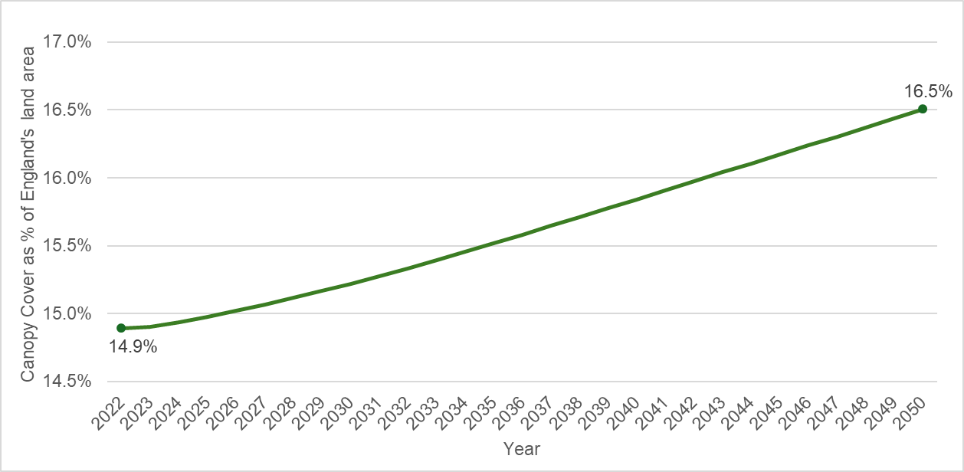
Figure 1. Illustrative trajectory to the 16.5% tree canopy and woodland cover target – 2022 to 2050
Monitoring and evaluation summary
This section summarises the monitoring methodology and approach to evaluation of delivery mechanisms.
Monitoring
Tree canopy and woodland cover is an aggregate metric which includes woodland cover (including integral open space and land temporarily cleared of trees as part of sustainable management) and tree canopy cover outside woodland. Woodland is defined as an area of trees of at least 0.5ha, a minimum width of 20 metres and at least 20% tree canopy cover (or having the potential to achieve this). It does not include planting with the sole purpose of energy forestry.
The metric captures both canopy gains, from planting and natural colonisation, and losses due to natural mortality, development, pests and diseases or conversion of woodland to open ground habitat.
We will formally assess progress against the statutory target when we report on whether interim targets have been achieved. Progress assessments will be made by reconciling and calibrating satellite and aerial images of tree cover with administrative datasets on new planting and woodland loss. In the intervening years, administrative datasets can be used to provide a partial assessment of progress, with annual assessments of woodland area and new planting contained in the annual Forestry Statistics, available on the Forestry Research website.
Evaluation
Over the past 5 years, the largest delivery mechanism for tree planting and woodland creation in England has been the Nature for Climate Fund Trees Programme. It is being evaluated using a 3-stage evaluation process, conducted in line with Magenta Book principles.
We are developing evaluation plans for delivery between 2025 and 2030, including project-level evaluation of offers delivered by the Farming and Countryside Programme. These will further strengthen our understanding of delivery effectiveness and support continuous improvement.