The Procurement of Innovation Playbook (HTML)
Updated 5 November 2026

© Crown copyright 2026
This publication is licensed under the terms of the Open Government Licence v3.0 except where otherwise stated. To view this licence, visit nationalarchives.gov.uk/doc/open-government-licence/version/3 or write to the Information Policy Team, The National Archives, Kew, London TW9 4DU, or email: psi@nationalarchives.gov.uk.
Where we have identified any third party copyright information you will need to obtain permission from the copyright holders concerned.
This publication is available at https://www.gov.uk/government/publications/the-sourcing-and-consultancy-playbooks/the-procurement-for-innovation-playbook-html
Foreword by: Dr David Smith, National Technology Adviser
I am delighted to introduce this Procurement of Innovation Playbook. It is a practical guide for commercial leads and programme delivery teams who want to get better solutions for the country and use procurement to unlock innovation, and to do so while staying firmly grounded in value for money, good governance and deliverable outcomes.
Since joining government from the private sector over two years ago, I have seen first‑hand how powerful procurement can be when we use it intentionally: backing new ideas, giving emerging technologies a route to real users, and helping UK companies to grow. I’m grateful too for the strong support of Lord Vallance in championing this agenda.
Government spends over four hundred billion pounds a year. For those leading major programmes, that’s not an abstract figure—it is one of the strongest levers we have to shape markets, create early demand and accelerate delivery of mission‑critical outcomes. Used well, this purchasing power reduces uncertainty, brings more capable suppliers to the table, and gives SMEs and scaleups the confidence to invest.
The evidence is clear: when government acts as a credible early customer, businesses innovate more, grow faster, and bring solutions to market that might otherwise never reach real‑world adoption. It also helps build stronger domestic supply chains and capability in the UK.
Across public services, commercial and programme leaders should be able to pursue innovation with confidence: setting clear outcomes, building proportionate controls, and taking well‑judged, well‑governed risks that stand up to scrutiny. Avoiding all risk has a cost too—missed opportunities, over‑reliance on a small number of dominant suppliers and losing great firms and solutions to other countries.
Recent work with the National Audit Office and the Public Accounts Committee signals a shift toward a more balanced portfolio approach—recognising that failure to innovate is itself a risk to productivity and service quality.
This playbook is designed to help you turn that ambition into action on real programmes. It offers a clear route from defining the challenge through to delivery—showing how to frame problems so the market can bring forward better options, and how early market engagement can broaden participation, including from SMEs and new entrants. It sets out practical ways to use proportionate governance, agile methods and multidisciplinary teams, so projects can adapt as learning emerges without losing control of scope, cost and risk. And it explains how the new Competitive Flexible Procedure under the Procurement Act can support iterative testing, prototyping, phased development and scaled commercial contracts—giving you the freedom to refine requirements as solutions mature, while maintaining a strong audit trail and clear decision points.
My encouragement is simple: use this playbook. Pick a live procurement in your portfolio—especially where the programme outcomes are clear but the route to delivery isn’t—and apply the steps, tools and questions in here. Then share what you learn with your commercial, digital and delivery colleagues so the next team starts further ahead. If we make innovation procurement a default—not an exception—we can build a more open and collaborative relationship between the public sector and suppliers, rooted in shared goals and long‑term public value.
1. Introduction
1.1 What do we mean by innovation?
1. For the purpose of this playbook, innovation is the creation or application of a new or improved product, process, or method that solves a public sector challenge. This can range from finding solutions where none currently exist to addressing established problems in entirely novel ways.
2. Innovation is not limited to developing something from scratch. It also includes adopting mature technologies or applying existing processes in new contexts to deliver enhanced value and effectiveness. An innovative approach can unlock significant improvements even when an adequate solution is already available.
3. Innovation is driven by two complementary approaches:
- Demand-side “pull”: Where the public sector defines a challenge and invites the market to propose tailored solutions. This is the primary focus of this playbook.
- Supply-side “push”: Where suppliers propose novel ideas or technologies, which can be used to improve public services or address government challenges.
4. The maturity of an innovation is assessed using standardised metrics such as Technology Readiness Levels (TRLs), which measure a technology’s maturity on a scale from initial idea (TRL 1) to full production and deployment (TRL 9). Understanding a solution’s TRL is crucial for selecting the right procurement strategy, as different tools are designed for different maturity stages. This playbook links the choice of funding or sourcing mechanism directly to these TRLs (in Section 3). TRLs are discussed in more detail in the DDaT Playbook
Technology Readiness Level (TRL)
| Stage | Number | Category |
|---|---|---|
| Deployment | 9 | Actual system proven in operational environment |
| Deployment | 8 | System complete and qualified |
| Deployment | 7 | System prototype demonstration in operational environment |
| Development | 6 | Technology demonstrated in relevant environment |
| Development | 5 | Technology validated in relevant environment |
| Development | 4 | Technology validated in lab |
| Research | 3 | Experimental proof of concept |
| Research | 2 | Technology concept formulated |
| Research | 1 | Basic principles observed |
5. This playbook provides guidance on procuring innovation to improve public services. Case studies illustrating successful innovation procurement are set out in Annex C.
1.2 Key Messages
1. Identify Opportunities: Early identification of innovation opportunities offers the best chance of success by informing your processes, risk appetite and routes to market. Engage with commercial team and subject matter experts early to identify and test innovation opportunities at the earliest opportunity.
2. Leadership and Sponsorship are Essential. Strong senior sponsorship is essential to drive innovation, champion a culture that embraces experimentation, and maintain momentum when routine operations take precedence. Innovation projects must have an appropriately qualified Senior Responsible Owner (SRO) who is accountable for delivery.
3. Adopt a Proportionate and Agile Approach. Innovation procurement need not be long or expensive. Governance structures, commercial strategies, and resource allocation should be proportionate to the project’s scale, complexity, and risk. Governance should enable agile decision-making, delegating authority where possible to empower multi-disciplinary teams to learn fast and pivot quickly.
4. Embrace Risk and Iterative Learning. Innovation inherently carries greater uncertainty. Stopping a project at a milestone gate is a responsible management decision, not a failure, and provides valuable organisational learning. An organisational culture that tolerates uncertainty is a prerequisite for success; this playbook provides practical support for overcoming cultural barriers in themes of agile procurement (Section 6) and iterative learning (Section 4.1) which more directly address cultural change.
5. Engage the Market Early and Continuously. Early and ongoing market engagement is fundamental to promoting broad supplier participation, especially from Small and Medium-sized Enterprises (SMEs) and scale-ups. It informs the project scope, helps refine the challenge statement, and supports the design of a procurement which is proportionate and uses appropriate contract terms, including liabilities and payment mechanisms.
6. Appropriate Ownership of Intellectual Property. Unless there is a good reason to do otherwise the presumption should be that the supplier retains ownership of the IP for innovation opportunities, while the government acquires a licence for its use. This approach is detailed in the contracting guidance in Section 7 and is designed to attract innovative suppliers and support commercialisation. Make best use of your early market engagement and pro-innovation contract terms and conditions to enable this.
7. Balance Risk and Reward Holistically. Deciding to pursue an innovative solution requires a proactive assessment that balances the inherent risks against the potential benefits. This includes considering the risks of not innovating, especially where current services are failing. The case for innovation should be considered early, holistically, accounting for whole-life value, wider public benefit and the drive for economic growth.
8. Compliance with Procurement Law: This guidance is not intended to cover the application or requirements of the Procurement Act 2023 in detail, which will turn on the particular facts of the innovation project being undertaken and its structure. Early engagement with commercial and legal teams to consider such issues is strongly recommended.
Figure1:
- Innovation acquisition is about working with the market to find an as yet unknown solution to a problem
- It is not about buying a solution you have already identified
Programme set up
1. A clear mandate: ministerial and senior official sponsorship to do something different (and difficult) to achieve a clear outcome
2. A challenge Sponsor: business owner accountable for the innovation project, who will foster a culture that embraces managed risk-taking and an entrepreneurial mind-set
3. Adequate Funding: Ensure budget allocations fully support the full range of innovation efforts (headcount and resources but also cost of testing, betting on more than one option, dual running, pilots etc)
Teaming
4. Cross-functional collaboration: Core team of domain expertise (policy, operational, technical) and commercial working together from the start
5. Innovation delivery expertise: to lead user-centric and evidence-based approach to map end-to-end process, drivers for change and the impact of innovation
6. Clear Challenge Statement: Co-develop specific, actionable and solution-agnostic challenge statements for the market to consider
Delivery
7. Market Engagement: Structured engagement with potential suppliers for ideas and solutions
8. Ability to evaluate proposals: clear success criteria and technical capability to evaluate market responses, POCs, prototypes etc
9. Flexibility in Procurement Processes: Adapt procurement processes to be conductive t innovation
10. Suitably scaled project management with clear stop / pass gates and feedback loops for lessons learned
2. About this Playbook
1. This playbook provides guidance for public sector professionals on how to successfully procure innovative solutions to improve public services. It sets out a consistent framework to address common challenges, drive best practice, and maximise the benefits of innovation. It should be used in conjunction with the wider suite of government commercial guidance, including guidance on the Procurement Act 2023 the Sourcing Playbook, DDaT Playbook, Construction Playbook and Consultancy Playbook.
2. This playbook is for all public sector contracting authorities. The principles and policies set out should be applied by central government departments and their arm’s-length bodies on a ‘comply or explain’ basis. The wider public sector should also take this guidance into account, applying it proportionately to the scale, scope, and complexity of their projects.
3. Delivering innovation is a cross-functional endeavour. This guidance is for professionals across commercial, project delivery, policy, finance, and legal roles as well as subject matter experts in the category of spend. Success depends on creating joined-up, multi-disciplinary teams with the right expertise from the very start of a project.
4. This playbook supports wider government reforms, including the Procurement Act 2023 and the National Procurement Policy Statement (NPPS). The NPPS guides public bodies on maximising the impact of public spending by driving innovation and supporting small businesses, scale ups and delivering.
5. The government innovation ecosystem includes many expert bodies, such as Innovate UK, the Catapult Network, and departmental accelerators. This playbook provides a unifying framework to complement their work. Contracting authorities are encouraged to leverage these networks to access specialist expertise and coordinate efforts to solve public sector challenges through innovative supply chain engagement.
6. The Commercial Innovation Hub (CIH), email CIH@dsit.gov.uk, can provide further support to departments on the procurement of innovation.
3. Types of Innovation Funding
Contracting authorities can use several mechanisms to stimulate innovation. The key to success is choosing the right tool based on the maturity of the required solution, measured by Technology Readiness Levels (TRLs) as well as consideration of the intervention’s desired outcome. Each tool is designed to support a different stage of the innovation lifecycle:
3.1 R&D Grants
- R&D Grants: A grant is not a contract for goods or services; deploying any resulting technology into public services would require a separate procurement. R&D grants are a supply-side stimulus to support organisations (such as SMEs, academia, start-ups and scale-ups) in developing new knowledge, technologies, or capabilities. They are best suited for the development of technologies which are not near to market (predominantly falling into the categories of fundamental research and experimental development) and where there is no immediate public sector application or challenge, and no guarantee of market uptake.
- The Procurement Act 2023 is not intended to capture purely compensatory or supportive arrangements such as grants. Additionally, there are implications under the Subsidy Control Act 2022 which would need to be considered with any form of grant arrangement[footnote 2].
3.2 Procurement
- Pre-Commercial Procurement (PCP): PCP is used for outcome-based challenges across a range of maturities (TLR 2-8) for the R&D phase only and does not cover large-scale commercial deployment, which likely requires a subsequent procurement. PCP is a demand-side stimulus used to enable R&D to solve a specific public sector challenge where no suitable commercial solution exists. It involves the contracting authority acting as a ‘first customer’ and typically uses a phased approach to develop and test competing solutions, sharing the R&D risk between the buyer and suppliers. It is most relevant during Discovery and Alpha, where the emphasis is on understanding user needs and exploring feasibility. The Contracts for Innovation (CfI) template is a key mechanism for PCP. Contracts for PCP will be exempt from the majority of the requirements of the Procurement Act 2023 where they fall within the R&D exemption described in Section 5.3, but there may well be considerations under the Subsidy Control Act 2022, particularly if a benefit arises to the supplier beyond the goods and services procured for Government use.
- Public Procurement of Innovation (PPI): PPI are generally ‘covered procurements’ under the Procurement Act 2023. PPI is the procurement route where a public body acts as a ‘launch’ customer for an innovative solution. PPI should not be viewed as limited to high maturity solutions and can be applied flexibly across TRL 1-9:
- Early TRLs (1-3): PPI can incorporate PCP-style exploratory activity within a Competitive Flexible Procedure (CFP), as defined by the Procurement Act 2023, enabling suppliers to investigate feasibility before committing to development.
- Mid TRLs (4-7): PPI can support iterative prototyping and refinement during Alpha and Beta, with transparent down-selection and learning-based milestones.
- High TRLs (8-9): PPI enables piloting and full commercial deployment during Beta and live, where solutions are close to market-ready and require validation in operational settings.
- Further advice and key process steps for procurement of innovation under the Procurement Act is provided in Annex A.
3.3 Pro bono offers
1. While seemingly attractive, pro bono services and free trials should be approached with caution to safeguard the government’s commercial position and ensure fairness and transparency.
2. The Boardman Review of government procurement emphasised the need for caution, considering potential conflicts of interest and barriers for SMEs. Pro bono contracts should be reserved for exceptional circumstances and require sign-off by a senior official. They should also adhere to standard commercial principles and controls, including clear definitions of scope, duration, and performance indicators, assurances of open competition for subsequent work, and comprehensive records. In all cases, the rules laid down in Managing Public Money should be followed.
3. Contracting authorities should also exercise thorough due diligence when evaluating proposals that may present existing ideas dressed up as innovative approaches. Thoroughly assess the underlying substance of proposals to ensure they genuinely offer material advancements beyond current offerings, rather than simply repackaging existing concepts.
4. Where a free trial is used, contracting authorities must make clear that any continued use of the solution beyond the trial period will require a compliant procurement.
3.4 Other forms of funding
Other forms of government financial support, such as British Business Bank loans or export finance, are not the subject of this guidance.
3.5 Whether to Fund Suppliers
While unusual in standard procurement, providing funding to suppliers for R&D can be essential for successful innovation, especially to support SMEs, start ups and scale ups that may struggle with the upfront investment required to develop and test prototypes.
The need for and level of funding should be informed by preliminary market engagement and justified in the business case.
Where suppliers are offered funding as part of a competitive flexible procedure under the Procurement Act 2023 (as anticipated by Section 19 of the Act):
a. Funding should be offered to suppliers on an equal basis. Most likely all suppliers will be offered funding up to a set financial cap.
b. Suppliers should be required to sign a funding agreement at the commencement of the procedure and, at the latest, before any work associated with the funding commences. This agreement could be an extended Condition of Procurement Agreement.
c. The requirement to sign the funding agreement should be set out as a procedural requirement in the tender notice or associated tender documents (as anticipated by section 19 of the Act).
d. The tender notice (or associated tender documents) should make it clear that, being a procedural requirement, failure to sign the funding agreement will result in the supplier’s tender being disregarded.
e. The funding agreement should set out any conditions that must be satisfied for funding to be paid e.g. against milestones achieved.
f. Payments should be met by the contracting authority on a reimbursement-only basis (i.e. no profit element or fixed costs should be paid) and the funding agreement should not place any positive obligation on suppliers to carry out any services (or provide goods or works). This is important on the basis that the contracting authority should not create a contract for services (or goods or works) unless it is awarded in accordance with the Act.
g. The funding agreement should also cover any associated IP conditions.
If it has been decided that a supplier will not participate further in the procedure because it has refused to sign the funding agreement, it should be notified in a timely manner that it will not be progressing further in the procurement, including an explanation of that decision (which should refer to the failure to meet a procedural requirement).
Any decision to provide funding requires consideration of the Subsidy Control Act 2022. Likewise, contracting authorities should be satisfied that they have the necessary vires (powers) to provide funding.
4. Preparation and Planning
Successful innovation procurement depends on robust preparation and planning. Before commencing a project, it is vital that teams define their strategic objectives, secure appropriate resource, and establish a proportionate governance framework.
4.1 Establishing Governance, Leadership, and Teams
1. The principle of proportionate and agile governance should underpin all activities. The scale of planning and oversight should be tailored not only to the project’s size and risk but also to its stage of development. Early exploratory phases may benefit from streamlined governance to foster rapid learning, with scrutiny increasing as the project progresses towards full-scale implementation.
2. Effective governance is crucial and should include:
a) Senior Responsible Owner (SRO): An SRO should be appointed to be accountable for overall project delivery. A sponsorship culture that accepts risk and supports iterative decision-making is essential to overcome uncertainty
b) Multi-Disciplinary Team: Assemble a core team from project inception with expertise spanning commercial, policy, technical, financial, and operational domains.
c) Iterative Business Cases and Funding: Business cases should evolve progressively, aligning with agile procurement stages. Early stages can focus on problem definition and feasibility, with cost-benefit analyses refined as evidence emerges. Funding approvals should be staged and tied to clear milestones and decision gates (e.g., discovery, alpha, beta), allowing projects to ‘end, scale, or pivot’ based on iterative learning.
d) Differentiated Risk Management: The governance framework should differentiate between types of risk, accepting higher financial and timeline risks during early exploration while maintaining a lower appetite for safety or reputational risk.
e) IP Strategy: Establish a clear IP strategy from the outset. The default position is that the supplier retains IP ownership where there is no clear benefit to the Crown in ownership of IP. This approach, detailed in Section 7.4, is more attractive to innovative suppliers and supports commercialisation and economic growth.
f) Iterative Learning: Systematically capture learnings from all project phases, not just at the end. This ‘learning log’ creates organisational intelligence and ensures value is generated even from projects that do not proceed to full scale.
4.2 Framing the Challenge
1. Innovation can arise through two complementary approaches: a supply-side “push,” where suppliers propose novel ideas, and a demand-side “pull,” where the government defines a challenge and invites tailored solutions. Evidence suggests that innovation procurement is most successful when driven by well-articulated, outcome-focused challenges that allow the market to propose a wide range of solutions, i.e. the Pull approach. A well-crafted challenge statement encourages suppliers to solve actual needs rather than offering pre-defined products.
2. Early market engagement (section 4.3) can help to refine the challenge, identify existing innovations, and clarify the need for new solutions, aligning with government initiatives to embed outcome-based problem statements within procurement.
3. A good challenge statement should be framed as a problem to solve and the desired outcomes, leaving the ‘what’ (the solution) and the ‘how’ (the method) undefined. It must articulate a specific issue, explain why it matters, and clarify what needs to change, ideally tied to a success metric. To develop a robust problem statement, it helps to ask:
- What is the problem?
- Why does it matter (e.g., what will happen if the problem is not solved)?
- What is the background to this problem?
- What are the success criteria and desired outcome?
4. Crucially, the language used should not identify a specific solution or create a bias towards a particular solution. However, the statement should not be so vague that it is impossible to identify a potential solution.
5. Where a project supports a complex or novel policy outcome, developing a Theory of Change (The Theory of Change Process – Government Analysis Function) is strongly recommended to ensure all stakeholders are aligned on the causal chain connecting project activities to the desired benefits and organisational priorities.
6. Examples of [fictional] challenge statements
The following examples illustrate how to refine a broad problem into an effective, outcome-focused challenge statement.
Example 1: Healthcare Outcomes
- Too Broad: “There are too many deaths due to cardio-vascular disease and stroke.”
- This identifies a problem but lacks focus, making it difficult for innovators to target a specific area for improvement.
- Better: “The NHS lacks effective ways to prevent cardio-vascular diseases in those at risk because adherence to preventative treatment regimens is poor among those most at risk after their initial interaction with primary care services.”
- This provides useful context but risks biasing suppliers towards solutions that focus only on treatment adherence.
- Even Better: “Each year, preventable cardiovascular diseases in adults from less well-off communities lead to X thousand excess deaths and cost the NHS £Xm in secondary care. Our primary challenge is to reduce the rate of preventable cardiovascular events in this group by Y% by 2030. Solutions should demonstrate how they will achieve this outcome in a cost-effective and scalable way.”
Example 2: Environmental Impact
- Too Vague: “Transport emissions are too high and contribute to global warming.”
- This is a global problem, not a focused, actionable challenge for a specific procurement.
- Better: “Maritime transport emissions are too high, contributing to nearly 20% of the UK’s greenhouse gas emissions from transport. This is an urgent problem to address because greenhouse gases contribute to climate change which will negatively affect the environment, human health, and the economy.”
- This correctly narrows the scope to a specific sector and explains why it matters.
- Even Better: “Industrial maritime transport contributes nearly 20% of the UK’s transport-related greenhouse gas emissions. We need a portfolio of innovations to accelerate the transition to a net-zero fleet. We are seeking solutions that can deliver the most significant reduction in emissions per pound of investment (£/tonne of CO2e reduced). Our mission is to reduce overall emissions from current levels by Y% by 2034.”
4.3 Choosing the Right Delivery Model
1. A Delivery Model Assessment (DMA)—formerly a ‘make versus buy’ assessment—is an evidence-based approach to determine whether to deliver a service in-house, procure from the market, or use a hybrid solution. A DMA is considered good practice to decide on the best route. If a challenge is identified that innovation could address, consider how a Delivery Model Assessment (DMA) could help decide the best route conducting without limiting the opportunity for suppliers to put forward the best solution. This assessment should be informed by preliminary market engagement and helps shape the procurement strategy. For comprehensive guidance, contracting authorities should refer to the Sourcing Playbook.
4.4 Engaging the Market Early
1. Preliminary Market Engagement (PME) is fundamental to the delivery of a successful innovation procurement and for enabling suppliers to innovate. PME will enable you to:
- Test the wording of your challenge statement to ensure it is clear and pitched at the right level;
- Gauge the likelihood that a solution can be produced as a result of supplier innovation;
- Understand market maturity and capability, including and any barriers to innovation, for example, cost of participating, how the public sector procurement process works, Intellectual property or other commercial concerns;
- Test the design of your commercial strategy, associated timelines and risks.
- Inform your sourcing strategy and funding routes.
2. Engagement should be interpreted broadly to include diverse suppliers, including SMEs, new entrants, and research entities like university spin-outs who may not have a traditional market presence. The Procurement Act 2023 allows for Preliminary Market Engagement (PME) to take place through publications on Find a Tender. PME Notices are used to invite suppliers to participate or notify the market that engagement has taken place. Notices can help to ensure a level playing field and serve to attract new market entrants.
3. To attract a diverse range of innovative suppliers, particularly SMEs, academia, and new entrants, contracting authorities should proactively identify and mitigate barriers to entry. Barriers vary for different types of organisations; for example, short bid timelines can suit agile SMEs but challenge larger organisations, while academia may require longer engagement periods to align with their decision-making processes.
4. Before engaging the market, contracting authorities should implement a robust internal process to identify and protect nascent IP. This process should require staff to:
- Disclose innovations internally at the earliest possible opportunity to the designated IP or innovation lead.
- Avoid any external disclosure (e.g., through publications, presentations, or non-confidential discussions) until an internal IP review has been completed.
- Maintain confidentiality, using Non-Disclosure Agreements (NDAs) where appropriate for any necessary early discussions with external parties
Further advice on managing IP strategically is detailed in Section 7.4 of this playbook.
Further guidance on PME can be found here: Procurement pathway.
4.5 Managing the Innovation Pipeline
1. Best practices include establishing clear screening criteria, using multi-disciplinary expert panels for review, and exploring AI-based systems for rapid filtering of high-volume proposals.
2. A process should be implemented to identify and track IP associated with all proposals, using confidentiality measures like NDAs where appropriate. This ensures that valuable IP is recorded and can be leveraged in the future, even if a proposal is not successful.
5. Procurement Routes
5.1 The Competitive Flexible Procedure (CFP)
1. Under the Procurement Act 2023 a new flexible procedure, the Competitive Flexible Procedure (CFP) was introduced. The Competitive Flexible Procedure allows contracting authorities to design and run a process which can cover some or all of the TRL stages described above, offering a way to combine PCP and PPI under one procurement procedure. The CFP is inherently flexible, allowing contracting authorities to design a process that aligns with requirements, risk, complexity, and market characteristics for innovative solutions. Maximising these freedoms, commercial teams can design a procurement process that can foster innovation by removing unnecessary barriers whilst ensuring the process remains well controlled and risks well managed.
2. For the procurement of innovation, the Competitive Flexible Procedure can include iterative stages such as:
a. Conditions of participation relating to a supplier’s legal and financial capacity or technical ability to ensure only suitably capable suppliers can participate in and/or progress through the procurement process.
b. Solution design where suppliers develop innovative approaches to the challenge.
c. Feasibility, development, and prototyping stages.
d. Piloting/trialling in controlled or limited roll-out environments.
e. Contracting one or more chosen solutions.
3. By using the Competitive Flexible Procedure a contracting authority can design their procurement in stages, including the opportunity for intermediate feedback and potential filtering down of suppliers at each stage. The Competitive Flexible Procedure also allows for the award criteria to be refined, for example, to focus greater attention on important aspects of the challenge.
4. When designing your Competitive Flexible Procedure particular consideration should be given to:
a. Whether or not funding will be required and how funding will be managed (see above).
b. Minimising burdens to SMEs, start ups and scale ups.
c. Ensuring sufficient time is given to each stage of the procurement, avoiding crunches.
d. Proportionate requirements, particularly around security and wider policy measures implemented via Procurement Policy Notes (PPN).
e. How many supplier assessments (stage evaluations) will be required during the procurement to balance time, cost and solution risk. Is an assessment required after each TRL stage or can several TRL stages be completed rapidly, without a formal assessment with risks and costs managed?
f. When to formally assess suppliers in order to reduce the level of competition.
g. The level of dialogue needed during each stage of the procurement.
h. The need for presentations/demonstrations and whether/how presentations/demonstrations will be assessed.
i. How draft contracts will be developed and kept proportionate to the risk profile.
j. Whether supplier partnerships or supply chains need to form during the procurement process, for example, where SMEs need upfront capital in order to manufacture and mobilise their proposed solutions.
k. The social value that will result and how this will be evaluated and monitored over the life of the contract.
l. The content of the procurement pack. Does it provide the flexibility needed to manage an innovative procurement, including the ability to stop without incurring the risk of paying costs? Does the procurement pack enable modifications during the CFP and risks to be managed in compliance with the Procurement Act 2023?
m. Contract Management. Are the necessary contract management resources secured. Does the contract include the necessary provisions to modify the contract and manage in-contract risk. 5. Further guidance on how to use the competitive flexible procedure can be found [here: Competitive tendering procedures (PDF, 1,017KB)
5.2 Contracting for Innovation through other means
1. To maximise innovation’s reach, consider other sourcing approaches that enable broad access to novel solutions. Contracting Authorities should ensure that these vehicles are appropriate to the ask and facilitate - rather than limit - market adoption, the spread of benefits, and accelerated impact. Examples include:
a. Direct Award for Scaling Competitively Developed Innovation: Under the Procurement Act (Schedule 5, Paras 7-9), Contracting Authorities can provide a “runway to scale” by citing the potential for a future direct award within the original tender notice for an R&D competition.
b. Innovation Frameworks: Establish frameworks dedicated to innovative solutions, enabling participating authorities to run mini-competitions, direct awards, or call-offs.
c. Collaborative Access: Open framework access to a consortium, ensuring successful pilots can be rapidly adopted elsewhere.
d. Dynamic Markets for Innovation: Use dynamic markets with light-touch criteria and ongoing market engagement to source emerging solutions from a constantly open supplier base.
e. Innovation Consortia: Create consortia or hubs where contracting authorities pool budgets and jointly procure solutions.
f. Licensing, Sharing, and Replicability Clauses: Include terms that allow other authorities to license or replicate solutions at low cost, require similar terms to other authorities, and mandate documentation, training, and support.
g. Be ambitious in using procurement as a platform to lead and spread innovation. This will help create a wider network of beneficiaries, de-risk investment, and deliver better outcomes.
5.3 R&D -v- Procurement under the Procurement Act
1. Research and development (R&D) services are exempt from the majority of obligations in the Procurement Act 2023 meaning that contracting authorities are not required to run a competitive procedure as set out under the Procurement Act 2023. Further advice on exemptions can be found on the Procurement Pathway Tool.
2. These contracts may fall into the scope of the Subsidy Control Act 2022. Innovate UK provides advice on how R&D can be procured or funded. They also have a well-established methodology which can be used to obtain R&D services and manage any resulting IP..
3. Where possible, R&D should be conducted by UK based suppliers in order to maximise the opportunity for UK job creation and economic growth.
6. Adopting an Agile Approach
1. Innovation projects, particularly those addressing complex challenges, benefit from an agile approach in line with the DDaT Playbook (PDF, 4.2MB). An agile approach enables progress through an ongoing series of short, iterative cycles or ‘sprints’, allowing for rapid learning and adaptation with clear stop/go gates.
2. This iterative methodology is structured around distinct development phases, which allows potential solutions to be tested and eliminated as necessary:
- Discovery: Conducting user research to understand needs and explore the problem space. The key question at this stage is: ‘do we need to build something?’.
- Alpha: Developing and testing multiple prototypes with small user groups to identify the most viable options
- Beta: Building a working test version of the chosen solution and making it available to a limited user group, then scaling to the public once confidence is established.
- Live: Continuing to iterate and improve the service based on user feedback to ensure it remains effective and addresses evolving needs.
- Learning and adaptation: At the end of each stage, the contracting authority can assess progress, validate outcomes, and determine the requirements for the next phase, ensuring the final solution meets user needs.
- Flexible decision-making: The process includes clear decision points (or gates), allowing a procurement to be terminated if it is unlikely to deliver the expected benefits, thereby managing risk and investment effectively.
- Collaborative working: It fosters a close, collaborative relationship between the contracting authority and suppliers, with clear roles and responsibilities to solve the challenge together. This contrasts with traditional procurement where the relationship can be more transactional.
4. This approach is particularly suitable for innovation because it embraces uncertainty and allows the solution to evolve as more is learned. Continuous engagement with suppliers throughout the procurement lifecycle is essential, building confidence and fostering rich, competitive bids. The Competitive Flexible Procedure is well-suited to implementing an agile procurement methodology, as outlined in Section 5.1 of this guidance.
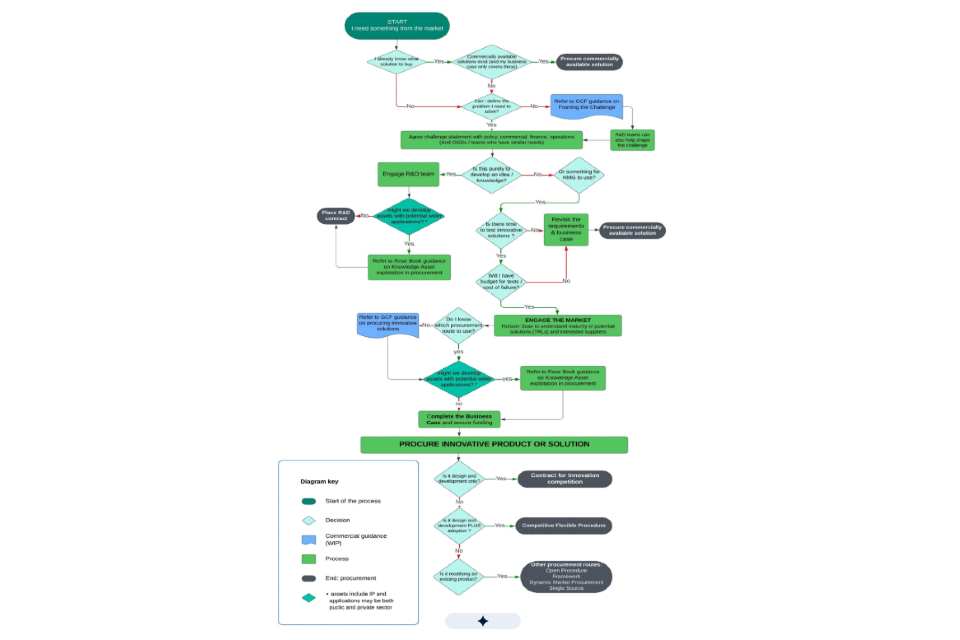
5. Annex D is an innovate route map that provides a simple guide to working out how a policy issue can be addressed by existing procurement routes to support innovation.
6.1 Piloting a Service
1. Given the inherent uncertainty of innovation, running a pilot is a highly effective way to test a new product or service before committing to a full-scale rollout. A pilot is typically the final testing stage and provides critical evidence on a solution’s viability, user acceptance, and scalability. For comprehensive guidance, contracting authorities should refer to the Sourcing Playbook.
2. Piloting can be incorporated as a formal stage within a Competitive Flexible Procedure. This allows contracting authorities to test solutions from one or more shortlisted suppliers in a controlled, live environment before making a final award decision. This approach is invaluable for:
- Validating performance against the defined challenge statement.
- Understanding integration challenges with existing systems and processes.
- Gathering user feedback to refine requirements and ensure the solution is fit for purpose.
3. A significant challenge in innovation procurement is ensuring a successful pilot can be scaled to full commercial adoption. A pilot that does not lead to broader deployment represents a poor outcome for both the contracting authority and the supplier. To create a clear “runway to scale,” contracting authorities should:
- Plan for full-scale rollout from the outset. The potential route to deployment, and where possible a financial commitment, should be established and communicated to the market before the pilot begins.
- Design a CFP to provide a seamless path to deployment.
4. Multidisciplinary team involvement is crucial during the pilot phase to ensure that technical, commercial, operational, and user perspectives are captured, enabling a holistic assessment of the solution’s viability before major investment is committed.
7. The Contract
1. The contract is a critical tool for managing risk and driving success in innovation procurement. Contracting authorities should ensure that the contract form is proportionate to the project’s phase, complexity, and risk, avoiding terms that could be a barrier to innovation.
7.1 General Principles for Contracting
1. The draft contract should be developed in parallel with the procurement process, especially when using agile methods like the Competitive Flexible Procedure. It may be appropriate to test key commercial principles as part of preliminary market engagement and refine the draft contract through dialogue and negotiation where appropriate.
2. Key commercial principles that require careful consideration may include:
- Payment Mechanisms: Payments should be linked to the achievement of clear milestones or the delivery of agreed outputs, supporting supplier cash flow while controlling expenditure against progress.
- Intellectual Property Rights: Ensuring innovation results in the greatest opportunity for economic growth whilst ensuring public services are not placed at risk.
- Liabilities and Indemnities: These should be proportionate to the contract value and risk profile, avoiding the transfer of unbounded risk, which can deter SMEs and stifle innovation.
- Mobilisation: Ensuring a clear plan for how an innovative solution will be scaled, including the financial implications associated with scaling a solution and the people and systems involved.
- Performance Management: While formal Key Performance Indicators (KPIs) may not be suitable for early-stage R&D, the contract should include clear mechanisms for monitoring progress, providing feedback, and managing performance.
- Exit and Transition: The contract should provide for an orderly exit, including the handover of data, assets, and knowledge to ensure that value is retained at the end of the contract term.
7.2 Contracting for Public Procurement of Innovation (PPI)
1. For PPI, contracting authorities should start with a standard government contract and tailor it to the specific requirements. The terms shall be scaled to be proportionate to the contract, ensuring they do not create unnecessary barriers for innovative suppliers, particularly SMEs.
7.3 Contracting for Pre-Commercial Procurement (PCP) and R&D contracts
1. For PCP, which involves procuring R&D services to develop a solution that does not yet exist, a specialist contract form is required. The Contracts for Innovation (CfI) template, supported by Innovate UK, is the recommended model. The CfI is specifically designed to manage the risks and complexities of R&D procurement, with a phased structure and clear provisions for IP and supplier funding.
7.4 Strategic Management of Intellectual Property (IP)
1. Effective management of Intellectual Property (IP) is fundamental to maximising the opportunity innovation provides for economic growth and supporting the UK’s innovation ecosystem. The IP strategy must treat IP as a strategic asset that supports innovation, collaboration, and long-term public benefit. It shall be considered from the outset, including any Subsidy Control Act 2022 considerations, and clearly communicated to the market in the tender notice.
2. To attract the right suppliers, particularly universities spin-outs and early-stage companies, the contract authority should clearly state the anticipated approach to IP whilst recognising that fair value can be achieved through various routes, not just ownership.
3. To develop a robust IP strategy, it is essential to distinguish between three distinct concepts:
- Legal Ownership of IP: Who legally holds the rights to the IP. While clarity of ownership is vital, owning IP does not automatically equate to achieving public benefit.
- Assignment of IP Rights: This involves transferring ownership to another party, such as a spin-out company or commercial partner, that is better placed to develop and scale the innovation.
- Commercial Return: The financial or strategic benefit gained from the IP. Crucially, a commercial return can be secured through mechanisms like royalties or equity, even when the government does not own the IP
4. The default government position, particularly for PCP and as embedded in the CfI contract, is that the supplier retains ownership of the foreground IP (Intellectual Property developed during the contract period) they develop, while the government receives a royalty-free, non-exclusive licence to use it for public sector purposes.
5. This approach is designed to:
- Attract Innovative Suppliers: Allowing suppliers, especially SMEs and university spin-outs, to own and commercialise their IP is a powerful incentive to participate in public sector challenges.
- Drive Wider Economic Growth: The supplier is usually best placed to commercialise the IP, ensuring broader market exploitation and economic growth beyond the specific public sector application.
- Ensure Value for Money and Avoid Lock-In: The government’s licence rights ensure it can use the innovation, share it across the public sector (via sub-licences), and run competitive future procurements without being locked into a single supplier.
6. The CfI contract contains specific clauses to enact this IP strategy, including provisions that allow the government to grant sub-licences to third parties under fair market conditions and to publish data and results to build public knowledge. The contract also includes safeguards to ensure the supplier makes best endeavours to commercialise the for the benefit of the UK.
Further guidance: Government Commercial Function has published a detailed briefing note (PDF, 268KB) offering further guidance on selecting the most appropriate IP approach to contracts.
7.5 Mitigating Financial and Contractual Barriers
Contracting authorities should ensure that commercial and contractual terms are proportionate and do not unnecessarily exclude innovative suppliers.
a. Financial Viability: Apply proportionate financial tests that avoid overly stringent thresholds that may exclude fast-growing, early-stage companies. Financial requirements should be proportionate to the size and risk of the contract, not a barrier to entry. Consider a broader range of evidence to assess capacity, acknowledging that innovative start-ups may not possess three year years
b. Cash Flow and Funding: Contracting authorities may consider suppliers’ financial capacity where permitted by the Procurement Act 2023. For covered procurements, any financial requirements must be proportionate to the risk, value, and phase of the contract and should not unnecessarily exclude SMEs or early stage suppliers. Authorities should note that for regulated below threshold contracts, the Act prohibits restricting participation by reference to financial capacity, and financial considerations may only be assessed, if at all, at award stage.
c. Proportionate Contract Terms: Ensure terms for liabilities, indemnities, and Intellectual Property (IP) are appropriate for the phase of development and do not disproportionately burden SMEs. Standard contracts may require tailoring for innovation projects.
d. Sharing Risk: Assess where compliance testing costs or other risks can be appropriately shared with, or borne by, the contracting authority to reduce the financial burden on suppliers.
e. Insurance Requirements: Contracting authorities should ensure that insurance requirements are proportionate to the nature, value and risk profile of the contract and do not unnecessarily exclude innovative suppliers, particularly SMEs, start-ups and university spin-outs.
f. Viability and Scaling Strategy: Contracting authorities shall consider the long-term viability and pathway to scaling up successful innovative solutions
- For critical contracts—as determined by the Contract Tiering Tool—the authority shall require suppliers to provide Resolution Planning information. This ensures the government is prepared for risks to service continuity posed by supplier financial distress or insolvency.
- Financial strategies should incorporate how to support suppliers, particularly SMEs, in scaling their solutions appropriately to meet public sector demand, thereby preserving the competitive “runway to scale” established during the R&D phase.
Further Guidance: For detailed guidance on assessing and monitoring the economic and financial standing of suppliers, contracting authorities shall refer to the Sourcing Playbook, PA23 guidance and associated guidance notes
Annex A: Innovation procurement: Key process steps and involved parties
Below is an example of a RACI of the typical key process steps of a public sector procurement project of innovation under the Procurement Act 2023 framework.
This is intended to provide guidance noting that your own project may differ based on requirements.
A. Typical Parties involved
| Role/Party | Description/Responsibility Examples |
|---|---|
| Senior Responsible Owner (SRO) | Accountable for overall project success and governance |
| Project Manager | Responsible for day-to-day delivery and coordination |
| Procurement/Commercial Team | Lead the commercial modelling (delivery assessment), procurement process, supplier engagement, contract negotiation |
| Domain Experts | Provide technical and subject-matter expertise |
| Technical Team | Assess technical feasibility, support evaluation and development |
| Finance Team | Budget approval, financial assessments, cost tracking |
| Legal Team | Ensure compliance with procurement law, IP advice and contract drafting |
| Governance/Assurance | Oversee compliance, conduct gate reviews, risk and issue management |
| Suppliers | Participate in market engagement, design, development and testing phases, and tender submissions |
| Communications | Manage stakeholder communications and publication of notices |
| End Users/Stakeholders | Provide requirements input and feedback |
B. RACI Matrix Template for Innovation Procurement (Procurement Act 2023)
This example of a RACI matrix set out a comprehensive framework to assign and clarify responsibilities across all critical activities in an innovation procurement project.
R (Responsible): Who performs the work.
A (Accountable): Who owns the outcome and decision.
C (Consulted): Who provides input or expertise.
I (Informed): Who needs to be kept updated.
- The technical development and prototyping steps are positioned early in the process, following problem identification and preliminary market engagement, but before finalising the procurement strategy and publishing the tender. This ordering reflects the phased and flexible approach enabled by the Competitive Flexible Procedure under the Procurement Act 2023.
- This phased approach allows for iterative development, feasibility studies, prototyping, and testing of innovative solutions without committing upfront to a final solution, thereby reducing risk and encouraging supplier innovation.
- Throughout these innovation phases, Domain Experts, Technical Teams, and End Users play a critical role in defining requirements, validating technical feasibility, providing feedback during prototyping, and ensuring that solutions meet actual user needs.
- Procurement, Legal, Finance, and Governance teams maintain continuous oversight to ensure that the process complies with public sector procurement regulations, manages risks effectively, and aligns with strategic and financial controls.
- Suppliers are engaged iteratively, starting from initial calls for ideas or expressions of interest, through feasibility and prototyping stages, and culminating in final tender submissions, fostering a collaborative and transparent innovation environment.
- The Senior Responsible Owner (SRO) is accountable for overall project success and governance, and the Project Manager responsible for day-to-day project delivery and coordination.
- The matrix supports a robust governance framework, including internal approvals and gate reviews, which are critical for maintaining accountability and compliance with government standards.
- Intellectual property management and contract terms are carefully handled during the prototyping and refinement phases to protect innovation outcomes and enable future commercialisation.
- The contract management phase ensures ongoing monitoring of delivery, risk management, and benefits realisation, closing the loop on the procurement lifecycle and supporting continuous improvement.
| Process Step / Activity | SRO | Project Mana-ger | Proc / Commercial | Domain Experts | Tech Team | Finance | Legal | Gov / Assurance | Suppliers | Comms | End Users / Stake-holders |
|---|---|---|---|---|---|---|---|---|---|---|---|
| 1. Problem Identification and Needs Assessment | A | R | C | C | C | C | I | I | I | I | C |
| Define problem and objectives | A | R | C | C | C | C | I | I | I | I | C |
| Assess strategic alignment and risks | A | R | C | C | C | C | I | C | I | I | C |
| 2. Define Challenge Statement & Innovation Requirements | A | R | C | C | C | I | I | I | I | I | C |
| 3. Preliminary Market Engagement | I | R | R | C | C | I | C | I | C | C | I |
| Conduct market sounding and supplier engagement | A | R | R | C | I | I | C | I | C | I | I |
| Identify SME barriers and opportunities | I | R | R | C | C | I | C | I | R | R | I |
| 4. Issue Call for Initial Ideas / Expressions of Interest (EoI) | I | R | C | C | R | I | C | I | R | I | C |
| 5. Conduct Feasibility Studies and Early-Stage R&D | I | R | C | C | R | I | I | I | R | I | C |
| 6. Prototype Development and Testing | I | R | C | C | R | I | I | I | R | I | C |
| Arrange testing environments and pilot projects | I | R | C | C | R | I | I | I | R | I | C |
| Collect feedback and evaluate prototypes | I | R | C | C | R | I | I | I | R | I | C |
| 7. Iterative Solution Refinement | I | R | C | C | R | I | R | I | R | I | I |
| Manage IP and update procurement documentation | A | R | R | C | C | C | C | C | I | I | I |
| 8. Develop Procurement Strategy and Documentation | A | R | R | C | C | C | C | C | I | I | I |
| Define sourcing strategy and procedure | A | R | R | C | C | C | C | C | I | I | I |
| Draft requirements, award criteria, evaluation plan | A | R | C | C | C | R | C | C | I | I | I |
| Prepare business case and risk assessment | A | R | C | I | I | C | C | A | I | I | I |
| 9. Approval and Governance Gate Reviews | A | R | C | I | I | C | C | A | I | I | I |
| Obtain internal approvals (SRO, Accounting Officer) | I | R | C | I | I | C | C | A | I | I | I |
| Conduct governance and compliance reviews | I | R | R | I | I | I | C | I | I | R | I |
| 10. Publish Tender and Manage Queries | I | R | R | I | I | I | C | I | I | R | I |
| Publish contract notice and tender documents | I | R | R | C | I | I | C | I | C | I | I |
| Manage supplier queries and clarifications | I | R | R | C | C | C | C | C | I | I | I |
| 11. Supplier Selection and Evaluation | I | R | R | C | C | C | C | C | I | I | I |
| Evaluate supplier submissions | I | R | R | C | C | C | C | C | I | I | I |
| Conduct evaluation panels | I | R | R | C | C | C | C | C | I | I | I |
| Shortlist suppliers | A | R | R | C | C | C | C | A | I | I | I |
| 12. Final Tender Invitation and Contract Award | I | R | R | I | I | I | C | I | I | I | I |
| Invite final tenders | A | R | R | C | C | C | C | A | I | I | I |
| Evaluate final tenders and select preferred supplier | A | R | C | I | I | C | C | A | I | I | I |
| Obtain contract award approvals | A | R | R | I | I | C | R | I | I | I | I |
| 13. Contract Finalisation and Signing | I | R | R | I | I | C | R | I | I | I | I |
| Negotiate contract terms | I | R | R | I | I | C | R | I | I | R | I |
| Sign contract and communicate award | A | R | R | C | C | C | I | C | R | I | C |
| 14. Contract Management and Supplier Relationship | I | R | R | C | C | C | I | C | R | I | C |
| Monitor delivery and compliance | A | R | R | C | C | C | I | C | R | I | C |
| Manage risks, issues, and changes | A | R | R | C | C | C | I | C | R | I | C |
| Ensure benefits realisation | A | R | R | C | C | C | I | C | R | I | C |
Annex B: Innovation Procurement Case Studies
Case Study #1 MHCLG Augmented Planning Decision Tool
Background and Challenge
England’s planning system faces sustained pressure from high application volumes and limited local authority capacity. Analysis by the DSIT i.AI team identified an opportunity within high‑volume, lower‑complexity household cases which account for ~69% of all planning submissions. These applications follow well‑understood processes, making them suitable for digital augmentation rather than wholesale process redesign.
The challenge was to deploy digital tools that could reduce administrative effort, improve throughput and consistency, and release professional capacity to focus on more complex or sensitive cases.
Preparation and Stakeholder Engagement
Preparation and stakeholder engagement were led by a cross‑departmental team comprising the Cabinet Office i.AI team, DSIT’s Commercial Innovation Hub (CIH), and subject‑matter experts from MHCLG. The ambition was to deliver a national online service accessible to all 317 Local Planning Authorities (LPAs).
Given tight timescales, MHCLG planning specialists provided consolidated expertise to ensure the challenge definition, outcomes and non‑functional requirements reflected operational needs. Particular emphasis was placed on alignment with the MHCLG digital estate, including the Open Digital Planning (ODP) platform through which the Augmented Planning Decision (APD) tool would be accessed. Early alignment ensured a focus on interoperable, scalable solutions.
Framing the Challenge and Market Engagement
Extensive pre‑market engagement was undertaken by the Cabinet Office i.AI team with MHCLG planning experts. Discussions with frontier AI suppliers explored how AI could accelerate planning assessment while maintaining decision quality.
The challenge statement was framed around the problem rather than a prescribed solution, focusing on accelerating processes while retaining transparency, integrity and sound reasoning. Policy and operational needs, desired outcomes, constraints and success measures were clearly defined, alongside explicit assumptions and uncertainties. Boundaries around users, infrastructure, scale, affordability and risk appetite were set to enable innovation within operational limits.
Early market soundings, supplier briefings and exploratory discussions tested feasibility, market maturity and delivery approaches. This informed commercial assumptions and led to the selection of the accelerated competitive flexible procedure, balancing speed with robustness.
Supporting Suppliers and Funding
Throughout the procurement, the buying team provided sustained support, including guidance on the accelerated procedure, assurance expectations, evaluation methodology and governance requirements.
Prototyping and discovery were undertaken at suppliers’ own cost and positioned as capability demonstrations rather than unfunded speculative work. Prime contractors were encouraged to collaborate with SMEs offering specialist planning or AI expertise, supporting innovation and market diversity. Clear documentation on intellectual property, milestones and delivery expectations reinforced trust and fair competition.
Procurement Strategy
The procurement was delivered by the CIH on behalf of MHCLG, demonstrating that outcome‑focused innovation procurements can be delivered in full compliance with the Procurement Act 2023. It showcased the practical value of the accelerated competitive flexible procedure for complex digital and AI‑enabled services.
The approach reduced the typical procurement timeline from around 48 weeks to 18 weeks, while enabling an adaptive contract aligned to Agile delivery. Rather than fixing the solution at award, the contract allowed it to evolve in response to user, policy and operational needs.
Market interest was strong, with 125 suppliers expressing interest and 65 submitting a PSQ, from which five were shortlisted. Shortlisted suppliers submitted written responses and demonstrator prototypes assessed against 65 live planning applications, testing decision quality, transparency and reasoning.
Piloting and Deployment
Suppliers demonstrated pilot solutions using 60 real planning applications across four jurisdictions, with a further 20 introduced shortly before demonstration to test speed and responsiveness. Evaluators assessed 31 specified aspects, including architecture, KPIs, output quality and delivery approach.
Deployment followed an Agile lifecycle, with Alpha involving two LPAs and Beta a further ten, ahead of national rollout. This phased approach managed risk, incorporated learning and built confidence prior to full deployment.
Output and Benefits
The accelerated competitive flexible procedure delivered significant time savings and early evidence of solution viability through working demonstrators. Discovery was effectively completed through prototyping, enabling rapid progression to Beta.
Deployment to live service is expected within one year, with testing across 12 LPAs supporting scalability and assurance. The approach delivers an augmented planning decision tool with transparent, auditable reasoning and a clear human‑in‑the‑loop model, improving efficiency, consistency and performance across the planning system.
Early Lessons Learned
The following insights have been gained:
- Target the “volume segment” first: focusing on a high‑frequency use case (householders) maximises early impact and learning.
- Be explicit about what AI cannot change: excluding statutory steps from time‑savings claims creates credible, defensible benefits.
- Prototype‑based evaluation de‑risks novelty: a time‑boxed demo build tests real delivery and usability, not just paper claims.
- Auditability is a first‑order requirement: “reasoned, verifiable recommendations” anticipates scrutiny, appeal risk, and the need to maintain trust.
- Integration with existing planning systems supports adoption at scale.
- Commercial boundaries for Intellectual Property have been clarified permitting MHCLG to host the solution in any way and compete for alternative LLM if appropriate.
Case Study #2 - The Digital Education Platform Innovation Challenge
Background and Challenge
In 2024, the Department for Education (DfE) identified a pressing need to improve access to personalised learning resources across schools, particularly in underserved regions. The challenge was to procure an innovative digital education platform that could adapt to individual student needs, support remote learning, and integrate seamlessly with existing systems. The objective was to source a solution that was proven, reliable, and quickly deployable to ensure minimal disruption to ongoing education.
Preparation and Stakeholder Engagement
The department adopted a cross-functional approach, engaging education policy teams, IT specialists, and end-user representatives from early on. A delivery model assessment was undertaken to evaluate whether to build, buy, or adopt a hybrid approach, which identified market-ready solutions with potential for customisation. Early market engagement was conducted through preliminary market discussions, which confirmed that several solutions were at an advanced stage of development and capable of meeting the department’s needs.
Framing the Challenge and Market Engagement
The challenge statement was carefully crafted as a question: “How can we provide personalised, accessible digital learning solutions that support teachers and students effectively?” This framing avoided technical or solution-specific language, leaving the space open for market innovation. Market engagement revealed strong interest from suppliers, particularly EdTech companies with proven track records, and helped refine the procurement approach to focus on solutions ready for deployment.
Supporting Suppliers and Funding
To encourage supplier participation, the department provided clear and ongoing support throughout the process, including guidance on procurement procedures and expectations. Funding was considered necessary to facilitate engagement from SMEs and to enable prototyping by shortlisted suppliers, ensuring a level playing field. Clear conditions around intellectual property rights, milestones, and fair treatment were incorporated into procurement documentation.
Procurement Strategy
An agile procurement approach was adopted, breaking the process into iterative stages: initial expression of interest, shortlisting, prototype testing, and final selected solution deployment. This staged approach enabled continuous assessment of progress and flexibility to stop or pivot if solutions did not meet expectations. The department utilised a tailored version of the competitive flexible procedure, aligning with risk management and market conditions.
Piloting and Deployment
A pilot phase tested the shortlisted solutions in live, controlled environments within several schools. The pilot provided valuable insights into usability, integration, and impact on teaching and learning. Based on positive feedback and demonstrable benefits during the pilot, the department proceeded with rapid deployment at scale.
Outcome and Benefits
The strategic use of innovation procurement delivered a proven, customisable platform within six months—earlier than traditional procurement timelines. The chosen solution enriched the learning experience, improved engagement, and demonstrated cost-effectiveness, saving approximately 25% compared to initial market estimates. This success reinforced the value of early market engagement, clear framing of challenges, and flexible procurement methods.
Lessons Learned
- Challenge statements should be open and outcome-focused to inspire market innovation.
- Early engagement and clear communication are crucial for building supplier confidence.
- An agile, staged approach reduces risks and supports timely delivery.
- Piloting solutions before full deployment ensures operational readiness and stakeholder buy-in.
This case exemplifies how a well-structured innovation procurement process can deliver impactful, scalable solutions that meet immediate public needs, whilst fostering a collaborative relationship with suppliers and the market.
Case Study #3 – The Ventilator Challenge
Background and Challenge
In March 2020, faced with an urgent need for ventilators during the COVID-19 pandemic, the government identified that approximately 90,000 ventilators were required within a short timeframe. Standard manufacturing processes would take three to five years to develop and approve such medical devices. The challenge was to rapidly scale up production and supply, ensuring safety, quality, and timely delivery, while managing unprecedented levels of risk and uncertainty.
Preparation and Stakeholder Engagement
A dedicated, multidisciplinary team was assembled in just 48 hours, led by the Cabinet Office, with staff from Defence, Justice, Work and Pensions, FCDO, plus external experts in medical devices, supply chain logistics, and project management. The team was authorised to operate with high levels of autonomy and redundancy, facilitating quick decision-making. Early funding was secured from the Treasury, with £500 million allocated to cover rapid development and procurement costs.
Framing the Challenge and Market Engagement
The core challenge was sharply framed: “How can we deliver safe, effective ventilators at scale, within a four-and-a-half-month window?” The team designed a “call to arms” for suppliers and issued a technical specification that attracted over 5,000 responses. Through a rigorous shortlisting process, 17 designs were identified, allowing for competition based on speed and viability rather than cost alone.
Supporting Suppliers and Funding
Potential manufacturers received early funding for design, prototype development, and production line setup, with the understanding that many models might not meet the final criteria. Funding was based on milestones, with indemnities and risk-sharing measures in place to protect private sector partners from specific risks. This approach fostered innovation and enabled suppliers to take on high-risk, high-reward initiatives rapidly.
Procurement Strategy
An agile approach was adopted, involving ongoing iterative testing and decision points that allowed the team to stop non-viable models early. The procurement process was structured into stages—initial response, prototype testing, and full-scale manufacturing—providing flexibility to adapt as new information emerged. Strong governance, daily reporting, and rapid approval mechanisms supported swift progress.
Piloting and Deployment
Selected ventilator models underwent thorough clinical and safety testing, with a Technical Design Authority responsible for oversight. The real-time refinement of specifications ensured designs adapted to evolving medical insights. The extensive pilot and testing phase, combined with early start-up of manufacturing, enabled the department to scale production dramatically, delivering over 15,000 ventilators in just 4.5 months, alongside additional procurement from international sources.
Outcome and Benefits
The project delivered a proven, safe, and effective ventilator supply ahead of schedule and within budget. The streamlined process prioritised speed and success, not cost, resulting in ventilators built at 20% lower cost than the open market. The initiative also demonstrated the value of early market engagement, flexible contracting, and staged procurement, producing a robust supply chain solution at an unprecedented pace.
Lessons Learned
- Clear, outcome-focused challenge statements are essential for inspiring innovation under tight deadlines.
- High-level governance, strong leadership, and decision-making mechanisms are critical for rapid success.
- Flexibility, staged testing, and iterative review reduce risks and accelerate delivery.
- Embracing high risk at the outset is justified when the goal is urgent and high impact, but must be balanced with safety and quality controls.
- Celebrating small wins and maintaining team resilience are vital under extreme time pressure.
This case exemplifies how a structured, high-risk innovation procurement process—characterised by agility, decisive governance, and market engagement—can produce life-saving results against significant operational and technical challenges.
Annex C: Innovation Route Map
Annex C is an innovate route map that provides a simple guide to working out how a policy issue can be addressed by existing procurement routes to support innovation.
-
Where a project includes Northern Ireland, consideration also needs to be given to any State Aid implications as laid out in the Windsor Framework. ↩