The HMRC tax debt strategy — update
Published 26 November 2025

© Crown copyright 2025
This publication is licensed under the terms of the Open Government Licence v3.0 except where otherwise stated. To view this licence, visit nationalarchives.gov.uk/doc/open-government-licence/version/3 or write to the Information Policy Team, The National Archives, Kew, London TW9 4DU, or email: psi@nationalarchives.gov.uk.
Where we have identified any third party copyright information you will need to obtain permission from the copyright holders concerned.
This publication is available at https://www.gov.uk/government/publications/the-hmrc-tax-debt-strategy-update/the-hmrc-tax-debt-strategy-update
Introduction
HMRC plays a vital role in maintaining the government’s wider economic and fiscal objectives by collecting the taxes that fund public services. Our Transformation Roadmap shows how we are building a modern tax system that efficiently collects revenue, reduces the administrative burden on taxpayers and enables businesses to focus on growth.
Most customers meet their tax responsibilities, with 90% paying in full and on time. Unpaid tax undermines the integrity of the system making efficient recovery of outstanding tax liabilities essential to fairness and supporting public finances.
Supported by government investment, we are resolving more debt than ever before – helping customers to pay what they owe and taking enforcement action where necessary. This investment is delivering results. In the first two quarters of this year, we resolved £48.7 billion of tax debt, compared to £21.8 billion in the same period of 2019- to 2020.
We have made good progress in reducing the debt balance as a percentage of tax receipts. At the end of March 2025, the tax debt balance stood at £42.8 billion, 5% of total tax receipts. This is a 0.2 percentage point reduction in tax debt as a proportion of receipts since last year, reflecting improved performance in the context of a growing tax base.
We are transforming the way tax debt is administered – making it more automated, self-service focused, and easier for customers to get things right first time. This includes using technology to give customers greater control over their tax affairs, implementing system-wide changes to policy and practice, and building secure, adaptable and future-ready IT to support operations.
Our approach remains clear: make it easy for those who can pay, support those who need help and take firm action against those who choose not to engage in line with our Charter standards.
This Tax Debt Strategy Roadmap outlines how recent investment in debt management is helping to close the tax gap and reduce tax debt year-on-year as a percentage of receipts. It sets out the actions we are taking during the 2025 Spending Review period to deliver sustained reductions in tax debt.
Tax debt strategy
In our Tax Debt Strategy, published in October 2023, we set out 4 strategic pillars to guide our approach to improving how we manage and resolve tax debt.
These pillars provide the framework for reducing tax debt as a percentage of receipts. This section sets out the initiatives we are delivering under each pillar.
1. Preventing Tax Debt
The objective of this pillar is to minimise the volume of tax liabilities that become a debt by supporting customers to understand their liabilities, improving their ability to budget and encouraging payment before liabilities become overdue.
We are redesigning processes to support this goal. This includes targeted pre-emptive letters to business and Self Assessment customers with a history of late payment sent ahead of filing and payment deadlines.
We are expanding this approach and writing to selected Simple Assessment customers before payment deadlines. In November 2024,we trialled sending reminder letters to a small group of Simple Assessment customers, resulting in an increase in on-time payments from customers in the trial group.This year, we are intending to expand the reminder trial to 75,000 customers to assess whether regular reminders to Simple Assessment customers should become standard.
We are also improving payment options and embedding debt prevention into tax policy design. This includes making the Budget Payment Plan service easier to use and, as announced in Autumn Budget 2024, enhancing the HMRC app to help Self Assessment customers forecast, track and pay their liability in-year.
We have adopted the use of Open Banking and expanded the use of Direct Debit to reduce the risk of payment errors and misallocation. Where customers make errors or omissions in the information needed to allocate their payments these can arise as a debt. We are increasingly using data to direct them quickly to the right place reducing the administrative burden for both customers and HMRC.
Customer communications are regularly reviewed to ensure they provide clear, timely information that supports on-time payment and prevents debt.
2. Tailoring interventions
This strategic pillar is concentrated on making greater use of data to better understand our customers and improve how we manage tax debt.
Debt can be owed to HMRC for a variety of reasons. The best payment solution is different for each individual and business. Being aware of how personal circumstances can impact this, we provide extra, bespoke support to those facing financial hardship or who have personal difficulties. Support can range from an extended time to pay arrangement to receiving one-to-one dedicated extra support.
Our approach helps us to tailor our communications and debt collection activity to better help customers resolve their debt in line with our Charter standards.
We have started using Credit Reference Agency (CRA) data to provide greater insights into customer behaviour and financial circumstances. This allows us to improve segmentation, target interventions more effectively and tailor our collection activity in line with our published tax debt strategy. It will also help us identify debts that may be uneconomical to pursue.
At the same time, we are improving our letters to customers about their debt to encourage prompt payment where appropriate. Trials have shown that clearer, firmer messaging leads to improved customer engagement and higher payment rates.
We have also resumed the use of Direct Recovery of Debt (DRD), a power that enables us to recover outstanding debts from the bank accounts of customers who are able to pay but refuse to engage. We have strict safeguards in place to prevent financial hardship and protect vulnerable customers. DRD is currently operating in a ‘test and learn’ phase, with a broader rollout planned for April 2026.
3. Effective and efficient resolution
Our objective for this pillar is to make sure our process for resolving tax debts is as efficient and effective as possible in line with our Charter standards. This will help by increasing our capacity and the effectiveness of our interventions so we can resolve more tax debts.
Expanding our digital services and enhancing customer engagement is at the heart of expanding our capacity to resolve more debt. Customers now have greater flexibility to manage their payments online, including the ability to set up payment plans independently. Alongside this, we are improving how we communicate with customers through tools like Webchat and our Digital Assistant, making it easier for them to get the support they need.
To increase efficiency, we have expanded our use of private sector debt collection agencies (DCA). This frees up internal resources, allowing HMRC to concentrate on more complex cases that require specialist attention. DCAs carry out desk-based recovery activity only. This includes contacting customers by phone, sending letters and SMS text messages, and agreeing Time to Pay arrangements. All DCAs we work with are regulated by the Financial Conduct Authority and must follow HMRC’s processes and guidance.
To maintain our operational capacity, we are retaining and recruiting 2,400 tax debt officers. This includes 1,200 existing HMRC staff whose roles have been extended, ensuring we remain equipped to manage and recover tax debt effectively.
4. Being adaptable
The objective for this pillar is to adapt to fluctuations in debt volume and changing priorities. This will help by ensuring we are flexible enough to respond to external volatility and changes to the tax system.
At the heart of our work in this pillar is the modernising of our debt case management system to better support customers and respond to changing economic conditions. By the end of 2029 to 2030, all tax debts will be managed through this platform, helping us operate more efficiently and effectively. Key benefits include:
- automated processes and improved case handling
- data-driven decision making to provide the right help at the right time to customers
- a single view of a customer’s debt to streamline interactions and resolution
- digital communications to align with HMRC’s Net Zero Strategy and reduce cost
- cloud-based for enhanced scalability and flexibility
The graph below shows the trajectory of tax debt as a percentage of receipts since its peak at the end of 2020 to 2021. This peak was during the Covid-19 pandemic and reflects government decisions to support customers by deferring payments and pausing debt collection to prioritise COVID-19 support schemes. It shows the impact of changes in HMRC’s debt resolution function by comparing the actual reduction in tax debt as a percentage of receipts with what we expected to happen without those interventions.
Figure 1: Tax debt as a percentage of receipts
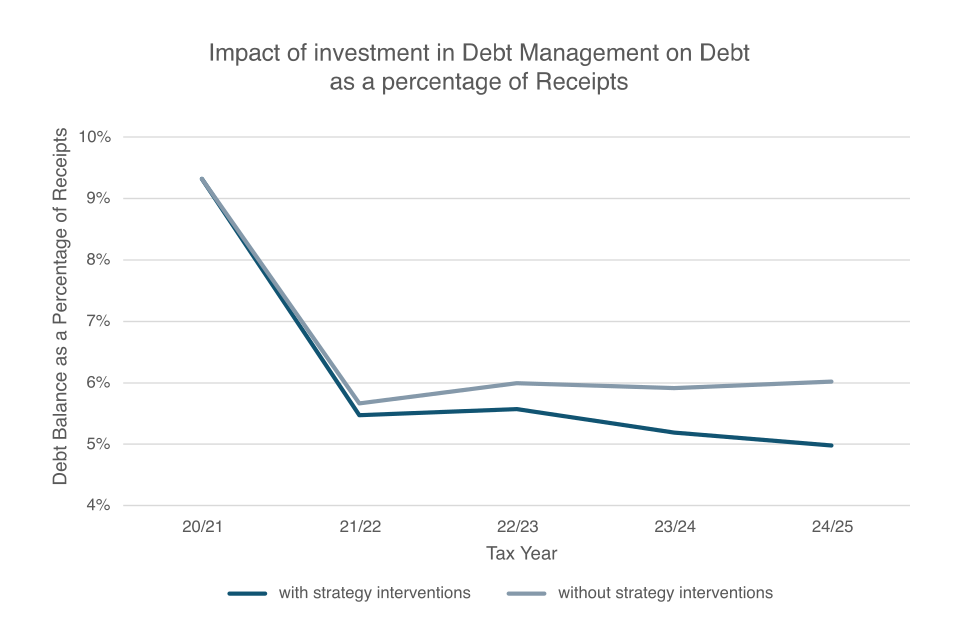
Note: The tax debt balance in 2020 to 2021 was particularly high due to Covid-19 support schemes such as the VAT deferral scheme.
Tax receipts have grown year-on-year because of changes in the tax system and the wider economy. We have transitioned to ‘tax debt as a percentage of receipts’ as the lead performance metric. This metric puts tax debt in the context of a changing tax system and the wider economy and so allows for more consistent comparison across fiscal environments. This will be reported annually in the Annual Report and accounts.
Maintaining this level of performance through our current activity will mean we reduce debt year-on-year as a percentage of receipts.
Tax debt strategy – future activity
We are confident that the steps we are taking will reduce debt year-on-year as a percentage of receipts. We have ambitions to go further and recover more debt, faster.
We are seeing more customers paying their liabilities, but missing payment deadlines. Around 45% of debt is resolved within one month of becoming due. While this debt clears quickly, it is largely preventable and places pressure on our operational capacity. It diverts resources away from supporting customers who need help and from tackling more complex debt.
To address this, we are working on a range of additional initiatives focused on preventing debt before it arises. These include:
- consulting on mandating Direct Debit for payments of PAYE and VAT, intended to prevent mistakes and misallocations which result in short term debt
- requiring income tax Self Assessment taxpayers with Pay as You Earn (PAYE) income to pay more of their Self Assessment liabilities in-year via PAYE from 6 April 2029. The government will publish a consultation in early 2026 on delivering this change, and on timelier tax payment for those with only Self Assessment income
This is in addition to introducing Making Tax Digital (MTD) for Income Tax from April 2026 for sole traders and landlords with income over £50,000. Customers will benefit from in-year tax estimates and improved cash flow visibility, reducing the risk of under paying or overpaying tax.
At Budget the government announced that from 2029 businesses will be required to issue all VAT invoices as e-invoices. E-invoicing will benefit businesses by increasing efficiency and could help reduce late payments between businesses, supporting their cashflow. Together with strong late payments legislative reforms, we are doing more to ensure businesses are paid on time. We will work closely with a wide range of stakeholders to drive effective digital transformation that delivers the full suite of benefits for businesses.
We are also working to improve guidance available to new businesses to help them understand their tax obligations and looking at how we can work together with Companies House to engage companies earlier. Alongside this we are developing an approach to the future administration of Corporation Tax that is suited to the varying needs of the diverse Corporation Tax population.
Debt owed by customers who do not engage with us, despite repeated contact attempts, has increased. Debt that is over a year old and not in a managed payment arrangement has risen from £5.3 billion in 2020 to £18.8 billion in 2025. This type of debt could be resolved more swiftly by increasing our capacity to take the necessary enforcement action.
To tackle this challenge, we are taking further steps at Budget 2025. As part of the Closing the Tax Gap package, we will:
- enhance the plan announced at Spring Statement 2025 to recruit additional debt management staff, so that we can go further and faster in tackling older, more difficult debts and take firm action against those who refuse to pay. This will also directly help tackle the population of customers choosing not to engage with us
- increase our use of debt collection agencies to collect older debts. Previously we have only placed newer debts with debt collection agencies. The increase follows a successful trial launched after Spring Statement 2025. This escalation supports us in addressing the volume of debt for which enforcement action is uneconomic
These measures directly help to increase our capacity to tackle debt owed by customers who do not engage with us, however there is scope to go further. There are a proportion of these debts that can be uneconomic to pursue using existing enforcement methods. Work is underway to consider what options are available, including automating payment for debts.
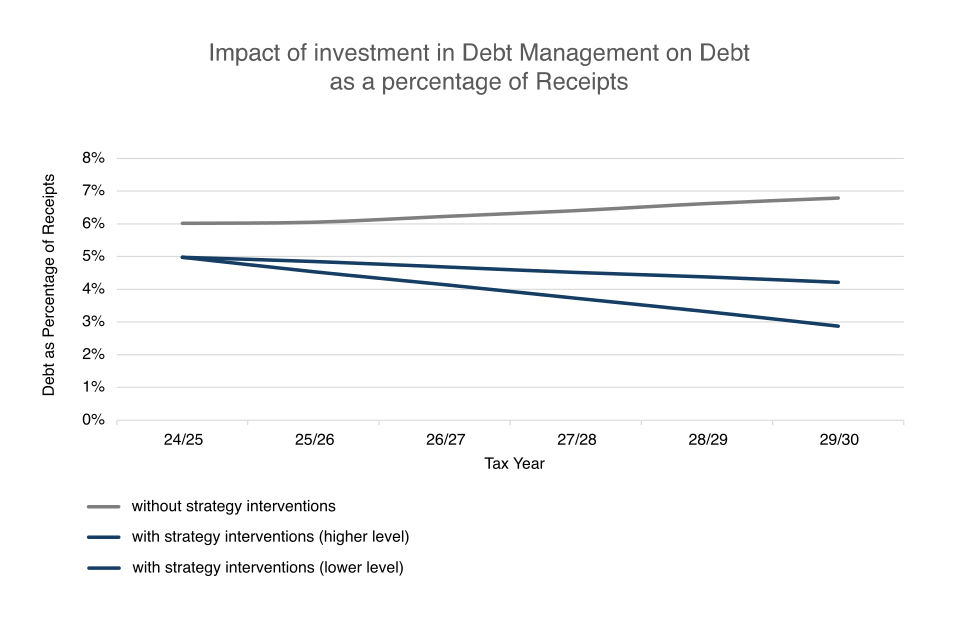
The graph below illustrates the trajectory of tax debt as a proportion of total receipts, from 2024 to 2025 through to the end of the Spending Review period in 2029 to 2030. It highlights the impact of the current and planned changes to our debt resolution function. The chart compares the tax debt trajectory with and without these interventions, demonstrating the effectiveness of our approach in reducing tax debt over time.
Figure 2: Tax debt as a proportion of total receipts
Reporting and monitoring
To achieve our aim of reducing the debt balance year on year as a percentage of receipts, we will continue to monitor the delivery and impact of our planned interventions.
The HMRC Board and its subcommittees include non-executive directors and independent advisers who bring a breadth of external experience and expertise. The department has 3 subcommittees aligned to the Exchequer Secretary’s priorities, including the Closing the Tax Gap subcommittee.
This subcommittee oversees HMRC’s performance in managing compliance, tackling non-compliance, and addressing the customer debt balance. We will report quarterly to this subcommittee on progress against the deliverables set out in this roadmap.
We remain committed to transparent reporting. Progress against our ambition to reduce debt balance as a percentage of receipts will be published annually in HMRC’s Annual Report and Accounts.
Our commitment to fair and responsible debt management
Underpinning our strategy is a clear commitment to being a responsible creditor, ensuring our approach is fair, proportionate, and aligned with government standards.
We follow the principles set out in the HMRC Charter and the Debt Fairness Charter, which guide how we treat customers in debt. These frameworks promote fairness, transparency, and support. They ensure customers are treated with respect, receive help when needed, and are clearly informed about their obligations. They also set out expectations for customers to engage with us, respond to communications, and provide accurate information to help resolve their debt. We have a well-established extra support service for those struggling to meet these expectations. Guidance and training are in place for all customer advisors in identifying customers who need extra support and then providing reasonable adjustments to meet their needs. Where appropriate, we will signpost taxpayers to voluntary and community organisations where people can talk through their concerns and worries.
In addition, we operate in line with the Government Debt Functional Standard which sets expectations for consistent, effective, and ethical debt management across government. To ensure continued alignment, we carry out an annual assessment against the Standard. Beyond meeting these requirements, we are progressing initiatives that further strengthen our approach and demonstrate our commitment to leading practice in debt management.
If a customer feels they have not been treated in line with these standards, they can raise a complaint through our formal complaints process. We operate an internal two-tier complaints process and if a customer remains dissatisfied with our second tier response they can escalate their complaint to the independent Adjudicator. The Adjudicator’s office resolve complaints by providing an accessible and flexible service and make fair, trusted and impartial decisions. When conducting their independent review of complaints, they use insight and expertise to support us to learn from complaints and improve services to customers in line with the Charter commitments. A customer can also ask their Member of Parliament to refer their complaint to the Parliamentary and Health Service Ombudsman if they are not satisfied with the Adjudicator’s response to their complaint.
In 2024 to 2025, we received fewer than 5,000 new complaints related to debt management, compared to around 14 million debt related customer contacts.