Support in domestic abuse safe accommodation, 2025 to 2026 - technical notes
Published 15 October 2026
Applies to England

© Crown copyright 2026
This publication is licensed under the terms of the Open Government Licence v3.0 except where otherwise stated. To view this licence, visit nationalarchives.gov.uk/doc/open-government-licence/version/3 or write to the Information Policy Team, The National Archives, Kew, London TW9 4DU, or email: psi@nationalarchives.gov.uk.
Where we have identified any third party copyright information you will need to obtain permission from the copyright holders concerned.
This publication is available at https://www.gov.uk/government/publications/support-in-domestic-abuse-safe-accommodation-2025-to-2026/support-in-domestic-abuse-safe-accommodation-2025-to-2026-technical-notes
1. About the collection
The support in domestic abuse safe accommodation collection includes returns submitted by local authorities in England under the statutory duty set out in Part 4 of the Domestic Abuse Act 2021. It provides detailed data on the provision of support in safe accommodation for victims of domestic abuse, including the number and characteristics of individuals supported, the types of accommodation used, and the services and support provided, and the availability of bedspaces across different safe accommodation. It also records information on households unable to access support and reasons why support could not be offered or needs could not be met. Additionally, the dataset includes data on how and why households stopped receiving support. While the data collection is mandatory, some elements are voluntary, resulting in varying levels of completeness across different areas of reporting.
The collection provides data at both the household and individual level. In this collection, the number of adults supported is the same as the number of households supported because one adult is recorded for each household receiving support. Children are defined as those under 18 who arrive with a parent or guardian. Victims under 18 who arrive alone are recorded as adults for data collection purposes.
Changes to the collection
Following engagement with local authorities, a voluntary new question was introduced to the 2025–26 support collection to separately identify individuals receiving Part 4-funded support outside domestic abuse safe accommodation settings.
The question was introduced in response to increased reporting of individuals supported in ‘other’ forms of safe accommodation in recent years. Local authorities told us that, in some cases, they had commissioned advocacy, outreach, housing-related or other support for victims who were unable to access safe accommodation immediately, often due to capacity constraints. These individuals may have been included in broader counts of individuals supported and referrals to domestic abuse safe accommodation services in previous years. Collecting this information separately improves reporting consistency and provides a clearer distinction between support delivered within domestic abuse safe accommodation and support delivered outside those settings.
As some local authorities may have included these individuals within broader counts in previous years, the 2025–26 figures for the number of individuals supported and referrals to domestic abuse safe accommodation services are not directly comparable with earlier years.
Datatables
Nine accompanying tables are available alongside this release. These provide individual-level data on the number and characteristics of people supported, accommodation type, length of stay, support services provided, and support provided to victims with specialist characteristics. They also provide household-level data on households unable to be supported, the reasons support could not be offered or needs could not be met, and how and why households stopped receiving support.
2. Voluntary compliance with the Code of Practice for Statistics
The Code of Practice for Statistics was published in February 2018 to set standards for organisations in producing and publishing official statistics and ensure that statistics serve the public good. The Code of Practice for Statistics 3.0 was published in October 2025, it strides to improve clarity and has introduced an updated ten principles covering, trustworthiness, quality and value.
The Domestic Abuse Safe Accommodation publication is published as management information because the data are primarily collected and used by officials for operational purposes, including monitoring, accountability and service planning under Part 4 of the Domestic Abuse Act 2021. Officials require regular and timely access to the information to support these functions. For this reason, the publication is designated as management information rather than official statistics. The information is also published to support transparency and accountability by making data on the provision of support in safe accommodation publicly available.
Although the Domestic Abuse Safe Accommodation publication does not contain official or accredited official statistics, MHCLG voluntarily applies the principles of Trustworthiness, Quality and Value (TQV) from the Code of Practice for Statistics. This statement outlines how these principles are applied to ensure that the information is trustworthy, of high quality and provides public value.
Trustworthiness
Trusted people, processes and analysis
| Standards | How this framework aligns with this standard |
|---|---|
| 1: Show integrity | The Domestic Abuse Safe Accommodation MI is produced by MHCLG statisticians in accordance with the Civil Service Code and the principles of professional integrity, honesty, objectivity and impartiality. Decisions relating to data processing, quality assurance, methodology and presentation are made independently by MHCLG analysts based on evidence provided by local authorities and are subject to review and challenge by MHCLG analysts through established quality assurance processes. Findings are presented impartially, regardless of policy or operational outcomes, to support transparency and informed decision-making. |
| 2: Lead responsibly | Responsibility for the collection, management and publication of the data sits within MHCLG’s analysis and data directorate. The collection operates within established governance arrangements, with appropriate professional oversight from senior analysts and statisticians. Staff involved in delivering the collection receive the necessary support and training to carry out their roles effectively. |
| 3: Be transparent | The information is published according to an established annual timetable and is typically released each October. Stakeholders are informed of planned publication dates through internal correspondence and publication timetables shared in advance, providing users with a clear expectation of when data will be available. Any significant changes to publication arrangements, scope or content are communicated transparently. Information on the purpose and intended use of the publication is provided to support appropriate interpretation of the data. |
| 4: Manage data responsibly | Data are collected through MHCLG’s DELTA data collection system and are processed in accordance with the UK General Data Protection Regulation (UK GDPR), the Data Protection Act 2018 and departmental information management policies. Access to data is restricted to authorised personnel, and safeguards are in place support the secure management of information throughout the collection and publication process. To protect the confidentiality of vulnerable individuals, statistical disclosure controls are applied to specific metrics where the disclosure of small numbers could create a risk of identification and potential harm. Disclosure control arrangements have been developed in line with guidance from the Office for National Statistics and are regularly reviewed to ensure sensitive information remains protected. |
High quality
Robust data, methods and processes
| Standards | How this framework aligns with this standard |
|---|---|
| 5: Prioritise quality | Quality considerations are embedded throughout the collection, processing and publication cycle. Guidance is reviewed and updated annually in response to local authority feedback, with Q&A sessions and workshops delivered ahead of each collection to support consistent reporting and improve data quality over time. Lessons learned through quality assurance activities and stakeholder engagement are used to inform ongoing improvements to the collection and guidance. |
| 6: Be rigorous | Data submitted by local authorities are subject to rigorous quality assurance, including automated validation checks, analyst review and follow-up with local authorities to resolve identified issues. Validation rules are applied through the DELTA system, and analysts undertake additional checks to identify unusual values, inconsistencies and potential reporting errors. Where necessary, queries are raised with local authorities to confirm or amend submitted information before publication. |
| 7: Be open about quality | Information on data quality, coverage, completeness and known limitations is provided alongside the publication to help users interpret the statistics appropriately. Where data are unavailable, incomplete or not directly comparable over time, this is clearly explained. MHCLG is committed to continually improving the quality of the collection and welcomes feedback from users on data quality and usability. |
Public value
Supporting society’s need for information and accessible to all
| Standards | How this framework aligns with this standard |
|---|---|
| 8: Be relevant | The publication provides information on local authorities’ delivery of support within safe accommodation for victims and survivors of domestic abuse The data support policy development, monitoring, accountability, research and operational decision-making. Information needs are considered through engagement with data suppliers, policy colleagues and wider users of the data. |
| 9: Be clear | Data are presented through a range of formats, including tables, charts, geographical visualisations and infographics, supported by commentary, definitions and metadata to help users understand the information and draw appropriate conclusions. Accompanying guidance explains key concepts and measures used within the collection. Contextual information is provided where necessary to support interpretation and avoid misrepresentation. |
| 10: Be accessible | The data are published in accessible, open and reusable formats to maximise their value to a wide range of users. Supporting documentation, contact details and guidance are provided to help stakeholders access and understand the information. Users can provide feedback or raise queries through DAMonitoringData@communities.gov.uk, and this feedback is used alongside wider stakeholder engagement to identify opportunities for improving the accessibility and usefulness of future releases. |
Continuous improvement
MHCLG views the application of Trustworthiness, Quality and Value as an ongoing commitment rather than a one-off exercise. We regularly review our collection processes, guidance and outputs to ensure they continue to meet user needs. Collection guidance is reviewed and updated annually in response to feedback from local authorities to support consistent data collection and reporting. Over the coming year, MHCLG also intends to establish a more formal process for reviewing information needs and engaging with users to help ensure the collection remains relevant, proportionate and valuable over time. Feedback from local authorities, policy colleagues, researchers and other users plays an important role in the continuous improvement of the collection.
3. Data quality
This management information provides detailed data on domestic abuse support services across a full range of safe accommodation types commissioned by Tier 1 local authorities in England for the 2024-25 financial year. The management information is primarily designed to help monitor progress and implementation of local authorities’ duties under Part 4 of the Domestic Abuse Act 2021 across England, which requires them to provide support within safe accommodation to victims of domestic abuse and their children. For 2025-26, all Tier 1 local authorities submitted their data for this collection.
Local authorities submit their management information via MHCLG’s DELTA online data collection system. The DELTA online data collection system includes in-built rules and validation checks to ensure, in so far as is possible, the data provided is complete and accurate. Further, key questions in this collection are mandatory to secure a consistent and complete data return from all local authorities where possible.
As well as the in-built validations via DELTA, MHCLG analysts also carry out a series of quality assurance checks including checks against historical data.
To assess the quality of the management information data submitted in 2025-26, we have compared this data against the data submitted by local authorities for 2024-25. When substantial differences have been identified, we discuss these with local authorities to investigate and understand the underlying reasons behind the discrepancies.
The data is not independently verified. It has been provided by local authorities.
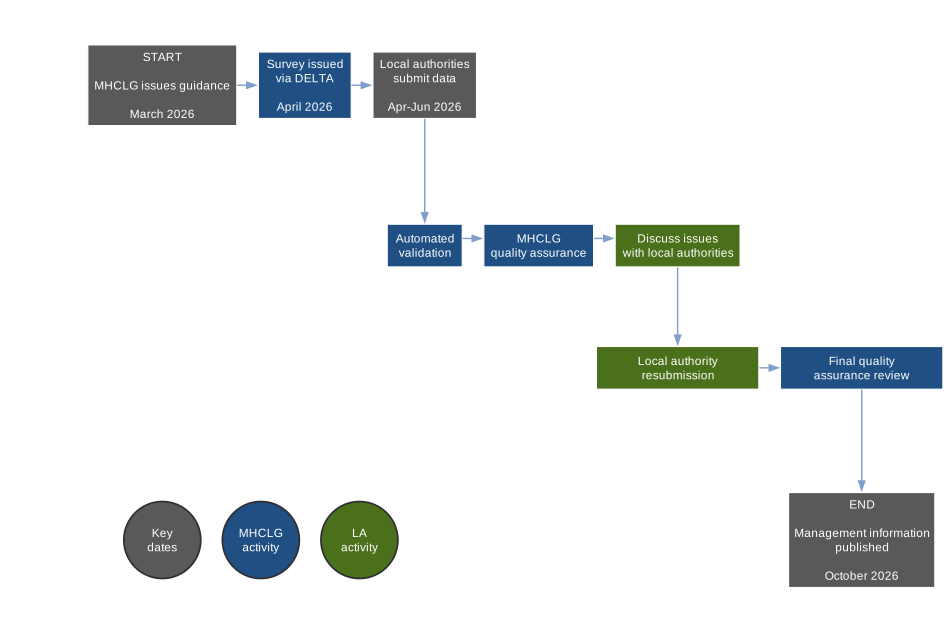
3.1 Quality assurance process flowchart
An outline of the production process and quality assurance carried out prior to the publication of the Support in Domestic Abuse Safe Accommodation management information is set out in the flowchart below.
3.2 Data limitations
Missing data
It should be noted that there are missing data in this collection, particularly for voluntary questions such as those relating to length of stay. As a result, there is a higher degree of uncertainty around the interpretation of data for these types of questions. Users should exercise caution when drawing conclusions from figures that are based on voluntary responses.
4. Other information
4.1 Related statistics
ONS statistics
The Office of National Statistics (ONS) publishes information on domestic abuse in England and Wales. The data is mainly compiled using information from police recorded crimes and the Crime Survey for England and Wales (CSEW). The dataset includes information on prevalence and trends, victim characteristics and usage of domestic abuse services (e.g. the National Domestic Abuse Helpline) and is published on an annual basis.
Homelessness Case Level Collection (H-CLIC)
The quarterly Homelessness Case Level Information Collection (H-CLIC) provides information on homelessness duties owed to households experiencing domestic abuse. This includes households owed a prevention or relief duty due to domestic abuse, households with identified support needs related to domestic abuse, and households owed a main duty where a household member is assessed as vulnerable because of domestic abuse.
4.2 Revision policy
This policy has been developed in accordance with the UK Statistics Authority Code of Practice for statistics and the Ministry of Housing, Communities and Local Government revisions policy. There are two types of revisions that the policy covers:
Non-scheduled revisions
Where a substantial error has occurred as a result of the compilation, imputation or dissemination process the statistical release, live tables and other accompanying releases will be updated with a correction notice as soon as is practical.
If a local authority notifies MHCLG of an error in the information they have submitted after publication of the release, a decision on whether to revise will be made based upon the impact of any change and the effect it has on the interpretation of the data.
Scheduled revisions
There are no scheduled revisions for this release.
4.3 User engagement
Users are encouraged to provide feedback on how these statistics are used and how well they meet user needs. Comments on any issues relating to this release are welcomed and encouraged. Please contact DAMonitoringData@communities.gov.uk if you have any feedback or comments.
See the department’s engagement strategy to meet the needs of statistics users.