
Keeping Pace? Reviewing benefits, thresholds and caps in a changing economy
Published 11 November 2026

© Crown copyright 2026
This publication is licensed under the terms of the Open Government Licence v3.0 except where otherwise stated. To view this licence, visit nationalarchives.gov.uk/doc/open-government-licence/version/3 or write to the Information Policy Team, The National Archives, Kew, London TW9 4DU, or email: psi@nationalarchives.gov.uk.
Where we have identified any third party copyright information you will need to obtain permission from the copyright holders concerned.
This publication is available at https://www.gov.uk/government/publications/ssac-occasional-paper-28-keeping-pace-reviewing-benefits-thresholds-and-caps-in-a-changing-economy/keeping-pace-reviewing-benefits-thresholds-and-caps-in-a-changing-economy
About this report
This project was conducted as part of the Social Security Advisory Committee’s independent work programme, under which the Committee investigates pertinent issues relating to the operation of the benefits system.
We are grateful to Indica Francis, who is currently conducting a PhD at the University of Nottingham, and who joined us on a three-month secondment to undertake this research. We are also grateful to our extensive stakeholder community for their engagement with this project, and to policy officials from the Department for Work and Pensions, HM Revenue and Customs and the Department for Communities in Northern Ireland who provided factual information and insight.
The views expressed and recommendations presented in the report are solely those of the Committee.
Chair’s foreword
Ministers must make difficult decisions each year about benefit levels in the context of wider fiscal, economic and policy priorities. Such uprating decisions are one of the ways in which governments determine the ongoing value and coherence of the social security system. It is right that elected governments retain discretion over those decisions. That discretion should, however, be exercised deliberately, consistently and transparently, with a clear understanding of the purpose of each provision and the consequences of the decision being taken.
Most of the main social security benefits are reviewed each year and many are protected, either by legislation or established practice, from losing value over time. Other benefits, thresholds and caps have much weaker protection. Some have remained unchanged for many years, while others have been increased only intermittently. The result is an uneven system in which inflation and earnings growth can alter the practical effects of policy without an explicit decision that this should happen.
This report does not present an argument for automatic uprating or a uniform method of changing benefit levels, thresholds or caps, nor does it seek to prescribe a single uprating measure. Different provisions perform different functions, and governments may reasonably conclude that different approaches are appropriate. In some cases, maintaining a nominal value may be entirely consistent with the government’s objectives; in others an increase, a reduction, a change in structure or a different index may be justified. Our concern is more foundational: where a monetary value is retained within the social security system, there should be a clear understanding of the purpose it is intended to serve, regular consideration of whether its level and design continues to fulfil that purpose, and a transparent explanation of the basis on which decisions about it are made.
A prolonged freeze is not necessarily a neutral act. A payment intended to help meet a particular cost may cover progressively less of that cost. A frozen threshold can change who qualifies for support, even where their circumstances have not materially improved. A fixed cap can affect a growing number of households as other benefit rates and living costs rise. Over time, these effects can alter the reach, operation and sometimes the purpose of policy without the same visibility or scrutiny that would accompany an explicit legislative change. The relevant question is therefore not simply whether a value has risen, but whether the provision continues to operate in the way Parliament and government intend - and, where it does not, whether that outcome is deliberate and justified.
The evidence considered by the Committee shows that departments may undertake substantial analysis before these decisions are made. The weakness is therefore not necessarily an absence of internal consideration. It is that statutory protection is uneven and the reasoning behind decisions, particularly decisions to leave nominal values unchanged, is not routinely visible to Parliament or the public. Nor is there always a sufficiently explicit line from the purpose of a provision, through the relevant evidence, to the decision ultimately taken. A stronger framework would improve the quality and coherence of decision-making as well as its transparency.
We recommend a more comprehensive annual review, covering all social security benefits, thresholds and caps, with the outcome published. Each provision should have a clearly articulated purpose and a transparent policy for how its monetary value should be reviewed over time. Long-frozen values should be examined systematically, and decisions to maintain a freeze should be explicit and supported by an up-to-date rationale. The same principle should apply where government decides to increase a value, change the basis on which it is uprated, or otherwise alter its operation: the decision should follow from the purpose of the provision, the available evidence and the government’s wider fiscal and policy objectives. In the longer term, all such provisions should be brought within a common statutory review framework. This would not require automatic uprating, create a presumption in favour of higher expenditure, or remove ministerial discretion. It would ensure that decisions are coherent, evidence-based, informed, visible and capable of proper parliamentary scrutiny.
The Committee is grateful to the officials and stakeholder organisations who contributed evidence to this study. I am particularly grateful to those who shared the experiences of people directly affected by long-standing freezes. Their evidence illustrates that what may appear to be a technical question about monetary values can have significant and deeply personal consequences. It also underlines why the practical consequences of these decisions should be understood alongside their fiscal effects and their underlying policy rationale.
The central proposition of this report is a simple one. Governments should remain free to decide whether and how provisions are uprated, but inflation or earnings growth should not be allowed to reshape social security policy by default. Equally, there should be no presumption that preserving the real value of every provision is necessarily the correct policy. Where policy changes, that change should be understood, rational, evidence-based, aligned with the provision’s purpose, explained and accountable.
Dr Stephen Brien
Executive summary
Most social security benefits are increased annually. Some are not. This includes benefit rates, thresholds and caps which have important functions within the social security system. But uneven protection against changes in prices or earnings may result in these changes reshaping parts of the system by default, sometimes radically. This Committee recommends a comprehensive, transparent annual review of all benefit rates, thresholds and caps, whilst maintaining ministerial discretion over the resulting decisions. The purpose of such a review would not be to create a presumption in favour of uprating, but to ensure that decisions are coherent, evidence-based and aligned with the intended purpose of each provision.
This report examines the benefit rates, thresholds and caps that have not been uprated regularly in recent years. It explores:
- whether they continue to fulfil their stated policy purpose and the impact of permanent or irregular freezes on the design and structure of the social security system as a whole
- how such irregular uprating changes their value or reach
- the effects that this has had on people’s lives
This report does not discuss policy changes relating to the structure of benefits or eligibility outside the scope of those affected by uprating decisions. Nor does it comment on the adequacy of the main benefit rates or advise the government on the precise methodology for uprating social security benefits generally. Governments are not short of advice on this subject,[footnote 1] and the pensions triple lock (to give one example) is currently the subject of an active debate. Nor do we argue that all monetary values should retain their real value automatically. Governments may reasonably decide to freeze, increase or otherwise change a provision where this reflects its purpose, the evidence and wider fiscal and policy priorities.
In summary, the reasons why governments may uprate benefit rates (such as the amounts that benefits pay people if they meet qualifying conditions) boil down to:
- preserving purchasing power or the contribution of benefits to meeting specific costs
- maintaining the value of benefits in relation to changing living standards
- deliberately changing benefit generosity, distribution or incentives
Conversely, a government may decide not to uprate where allowing the value or reach of a provision to change is itself consistent with its policy objectives. The important point is that the intended effect should be understood and the decision made consciously.
Similarly, increasing the value of benefit thresholds and caps may serve a range of purposes. These include the below.
Maintaining consistency in eligibility over time
Thresholds determine who qualifies for support and/or how much benefit they can receive. If these are not uprated, more people can be affected by these restrictions if wages and/or prices have risen.
Preserving the original policy intent
Uprating can help to ensure that a similarly broad group of people remains eligible as when the threshold was introduced. As noted above, without uprating, people can be pushed above fixed thresholds for benefit eligibility even though their living standards have not improved – a phenomenon known as “fiscal drag” when applied to the tax system.
Preventing caps becoming progressively more restrictive
Similarly, caps can become more restrictive as prices/earnings and benefits rise if not increased regularly. Regular uprating can also help to ensure that people are not increasingly constrained by a cap that was originally set using economic conditions as they were at that time.
Maintaining stable work and savings incentives
Regular uprating of earnings thresholds may help to maintain consistent incentives to work within the benefits system by preserving the relationship between benefit entitlement, amounts of benefit and earnings from paid employment as wages and living costs change over time. It may also maintain incentives to declare earnings from casual, informal employment. Similarly, regular uprating of capital thresholds maintains consistent incentives to save.
They illustrate why the consequences of changing, or not changing, a monetary value should be considered against the purpose it is intended to serve.
The cost of uprating is an important factor that governments consider. So, whilst primary legislation ensures annual uprating for some benefits, the government has discretion not to uprate others. This discretion applies to the main rates of some benefits, as well as thresholds and caps which, as noted, are also important aspects of the social security system. This discretion can apply even to certain aspects of those benefits which are statutorily uprated, for example the 25p age addition to the State Pension. It is these benefit rates, thresholds and caps which are the subject of this report.
Scope and approach
The benefits, thresholds and caps we examined include all benefits which are currently the responsibility of the Department for Work and Pensions (DWP), and HM Revenue and Customs (HMRC).[footnote 2] This means that some benefits, thresholds and caps within the remit of other departments were not included in our analysis.
The Committee mapped irregularly uprated values,[footnote 3] examined legislation and historical patterns, has spoken to DWP and HMRC officials as well as key stakeholder organisations, and illustrated the effects of irregular increases through selected case studies.
A note on terminology
In legislation and departmental practice, the term “uprating” has a specific meaning, particularly in relation to the statutory review and uprating provisions of the Social Security Administration Act (SSAA) 1992. This report also examines benefits, thresholds and caps outside those provisions. For simplicity, we use “uprating” in a broader sense to describe the periodic adjustment of monetary values to reflect changes in prices, earnings or other relevant measures. Where the distinction is material, we refer specifically to statutory uprating, discretionary increases or other review arrangements.
Our findings
Governments have the responsibility for deciding how much to spend on social security within their overall fiscal policies, and their annual review of benefit levels is one of their major decision points. However, their political and legislative room for manoeuvre is limited. It tends to be restricted to decisions on a number of specific benefits, thresholds and caps that are not protected by legislation or custom. The overall effect of this is distortionary. Frozen payments lose part of their value in real terms. Frozen thresholds change who qualifies. Frozen caps affect progressively more people. Many of these effects treat people differently even if their circumstances are the same as those of others and do not obviously follow from the original policy design. These effects are not decided by Parliament or even necessarily by government. They are determined by what happens to prices (or earnings). Over time, the reduction in real value or change in reach can cause the benefit to lose its connection to the government’s original policy intent.
The issue is therefore not that a freeze is necessarily wrong. It is that the consequences of maintaining a nominal value should be understood and assessed against the purpose of the provision, rather than being allowed to emerge by default. The following paragraphs explore this in more detail.
Unequal protection
The current statutory uprating requirements are primarily set out in the SSAA 1992 (by which certain benefits are uprated).[footnote 4] This lists the benefit rates which must be reviewed annually for the Secretary of State to decide whether they have kept their value. It also lists which of those benefit rates must be uprated, and which are uprated at the government’s discretion. Effectively there is a 3-fold hierarchy of protection:
- mandatory uprating - for example, for State Pension
- customary uprating - for example, the main Universal Credit rates, which are uprated by discretionary decisions after a mandatory review
- irregularly uprated benefits, thresholds and caps - protected neither by statute nor by custom
In this third category is a range of different benefits, thresholds and caps which have not been uprated for significant periods of time, meaning that their value has not been increased in line with inflation, earnings growth or wider economic changes. These include some:
- capital and earnings thresholds that determine eligibility for support and the amount that can be received
- benefit caps that place limits on overall entitlement
- fixed-amount annual or one-off payments, whose real value has eroded over time
- benefits for specific costs such as rent or funeral expenses, as well as some short-term benefits that provide temporary financial assistance
In general, those not included in the 1992 SSAA’s mandatory uprating procedure are much more likely to be a target for long-term freezes or upratings which do not fully match increases in prices or earnings. Without mandatory requirements for uprating, it becomes easier for governments to decide to freeze these benefits or not fully uprate them as cost-saving measures. Such decisions may be justified, but the rationale and resulting effect on the provision are not always equally visible.
This report identifies 3 broad patterns of irregular uprating. The first is explicit freezes, usually for a specified period, whereby a deliberate policy decision is taken to hold a value constant. The second is episodic uprating with long gaps, whereby values are increased intermittently but may remain unchanged for many years between uprating exercises. The third we call overlooked uprating, whereby values remain unchanged for extended periods without any clear rationale, regular review or structured uprating mechanism. Some freezes are so longstanding that they have become effectively normalised. The £10 Christmas Bonus,[footnote 5] the 25p age addition,[footnote 6] the frozen earnings disregards such as £5 per week for a single claimant in means tested benefits,[footnote 7] all introduced in the second half of the last century, have never been uprated.
Policy altered by default
Freezes to, or partial uprating of, benefits can be particularly problematic when benefits designed to pay for certain goods and services do not keep pace with the rising prices of the items that they are meant to pay for. Whether this represents a policy problem depends on the purpose of the provision and whether the resulting change in its contribution is intended. Two examples are the payment for funerals and help with the cost of private renting (both means-tested).
When originally introduced, the Funeral Expenses Payment (FEP) was intended to meet the essential costs of a simple, low-cost funeral. The scheme was subsequently reformed, and the £1,000 payment for ‘other funeral expenses’ now forms part of a broader package intended to help eligible claimants with the costs of arranging a funeral, while the scheme continues to meet specified necessary burial or cremation costs.[footnote 8][footnote 9] However, the £1,000 contribution towards other funeral expenses has remained unchanged since 2020, having previously been frozen at £700 between 2003 and 2020. Had the £1,000 amount been increased in line with the Consumer Prices Index (CPI), it would now be worth around £1,300. Funeral directors’ charges and other funeral-related costs have risen faster still over this period. As a result, although the scheme continues to provide support towards funeral costs, the contribution made by the £1,000 payment has declined significantly in real terms and now covers a much smaller share of the costs it is intended to help meet.
When the Local Housing Allowance (LHA) for people in the private rental sector was implemented it was set at the 50th percentile of local rents and reviewed monthly. When it was later decreased to the 30th percentile it was followed variously by uprating by CPI, a one per cent uplift, and years when it was frozen. Since last being uprated in 2024, the real value of the LHA due to the rising cost of renting has now fallen on average to the lowest 12 per cent of local market rates. This means that many people whose rents are actually at or below 30 per cent of local market rents do not have the cost covered by UC. And because this is an average, the cap in areas with high rent inflation is in effect much lower.[footnote 10] Shortfalls between LHA rates and the cost of renting at the cheaper end of the private sector can lead to renters having no choice but to cut back on everyday essentials and even turn to food banks.[footnote 11] These shortfalls have also been shown to increase the likelihood of homelessness or the use of temporary accommodation, which can be costly to the taxpayer.[footnote 12]
Cumulative and arbitrary effects
When thresholds that govern eligibility for certain benefits are subject to long-term freezes or modest uprating, this can lead to changes in who is eligible to receive these benefits. This can mean that individuals or families receive less support, or lose entitlement altogether, even though their circumstances may be little different from those of people who qualified when the threshold was last set.
Similarly, freezes or partial uprating of caps can result in a growing number of people being affected by them over time.
For example, the Institute for Fiscal Studies (IFS) found in 2022 that the freezing of the earnings threshold for the High-Income Child Benefit Charge had led to 26 per cent of families with children losing some or all of their Child Benefit, double the proportion when the policy was introduced.[footnote 13] As benefits are uprated each year to reflect inflation or in line with other policy decisions, a cap that remains fixed captures an increasing number of claimants. Frozen caps can interact with other changes in the system, potentially vitiating their effects. For example, when the LHA was increased in 2024, the Benefit Cap remained at the same rate. From February to May 2024, the number of capped households increased by 61 per cent, probably due to a combination of general annual uprating and the increased LHA rate.[footnote 14] Outcomes like these do not necessarily reflect explicit policy decisions about who should receive support. Instead, when thresholds, caps or rates are not uprated, inflation and earnings growth can gradually alter eligibility and entitlement in ways that may not be explicitly intended or thought through. In practice, the LHA can increase the likely shortfall claimants face depending on where they live. This does not make it easy to move closer to work.
The subsequent LHA freeze has very different effects in different parts of the country, solely because of the variation in rates of rental inflation. So, a family in an area where rents have been fairly stable might have their rent covered in full by housing support, while another family in identical circumstances will be treated very differently – not because of anything they have done, just because they live in an area where rents have gone up faster.
Overall, due to the variety of different benefits that have been subject to long-term freezes, the impact is wide-ranging and affects a large number of different groups. These distributional effects often appear arbitrary - or at least insufficiently transparent. There is not an obvious justification for making people poorer because they live in the Southeast of England, or because they live in private rented accommodation, or because they are responsible for arranging a funeral. But these can be some of the consequences of the approach taken by successive governments, even where those distributional effects were not themselves the focus of an explicit policy decision.
Stronger internal than public review
Where review is required by the SSAA 1992, the processes in both DWP and HMRC generally follow the same overall timeline. Planning and preparatory work starts in the summer, typically from July or August, and the formal uprating review begins in earnest in October, following publication of the September CPI figure.
Our understanding is that, in many cases, those benefits with no mandatory requirement to be reviewed are also subject to a yearly review process. The approach to these reviews can vary between benefits but can involve calculating the value of these benefits, an equality analysis of the impact of uprating decisions on particular groups with protected characteristics, how uprating may interact with other values in the system such as the Benefit Cap, and a discussion of whether to uprate these benefits, and if so by how much. They also involve analysis relevant to the specific benefit, threshold or cap under consideration - for example, analysis of the rental housing market for the LHA, as well as the impact of LHA rates on homelessness. In effect, therefore, decisions not to uprate can be supported by active internal analysis, in the same way as decisions to uprate.
However, most non-uprating decisions do not require a discrete legislative instrument or vote, and internal analysis is not publicly visible. This means that their cumulative effects can have less parliamentary visibility than equivalent explicit changes to eligibility or entitlement. The work that goes into a decision not to uprate is often therefore less visible and less debated, even though its impact can be far-reaching. The case for reform is therefore not simply that more analysis is required, but that the purpose of the provision, the evidence considered, the decision taken and its expected consequences should be connected more clearly and made more visible.
Provisions no longer fulfilling their purpose
Long-term freezing of benefits, thresholds and caps can have a serious impact on the shape and size of the social security system, as well as on the individual value of certain benefits and on claimants themselves. As noted, these effects are often determined partly by changes in inflation or earnings, rather than by explicit reconsideration of the policy itself. They are generally not presented to Parliament as policy changes on which Parliament can vote, so their cumulative effects can occur with relatively little visibility or scrutiny.[footnote 15] The passive nature of freezes to benefits, thresholds and the benefit cap does not just mean that benefits change in value over time. It also means that governments allow policies to be mutated by inflation or earnings growth to the point at which they no longer fulfil their purpose.
The Christmas Bonus was introduced at a time of high inflation to ameliorate high seasonal spending pressures.[footnote 16] It is hard to argue that it does this now - or indeed that it has done so for many decades past. This does not in itself imply that the appropriate response is to uprate it: it may instead raise the question of whether the provision remains the right policy instrument at all. In principle, LHA rates allow people in the private rented sector to pay for rents in the bottom 30 per cent of their local housing market, without having to eat into their budgets for food, fuel, clothes and other essentials. In practice, they do not. Successive governments have justified using the CPI, which excludes housing costs, to uprate most working age benefits, as payments to cover reasonable rents for people on low incomes are paid on top of the basic benefit. But as that statement is becoming untrue for more and more people, the justification for excluding housing costs from the general uprating calculation is increasingly tenuous.
Recommendations
Principles
It is for governments to decide how much they want to spend on social security benefits and for whom. The annual uprating cycle represents one key decision point. We recommend that governments carry out their decision making on uprating benefits, thresholds and caps in a consistent, transparent and rational way and that in doing so, they consider explicitly the policy intent of these instruments - or, if they depart from this, do so explicitly. The consequences of each decision should be understood and justified against the purpose of the provision and the government’s wider fiscal and policy objectives, without assuming that existing levels or real values should necessarily be preserved. The first stage in achieving this is to adopt some principles.
We believe that the following principles should guide any government’s uprating decisions:
-
Consistency: All benefits, thresholds and caps should be subject to a consistent and systematic review process. Decisions about whether to uprate, freeze, redesign or remove a measure should be taken within a common framework, rather than depending solely on historical legislative arrangements.
-
Transparency: The government should be transparent about how uprating decisions are made. It should clearly explain the principles that underpin its approach, the rationale for individual decisions and the consequences of freezing or uprating particular benefits, thresholds and caps.
-
Alignment with policy objectives: Every benefit, threshold and cap should have clearly articulated purposes. Decisions about uprating should be taken with reference to those purposes, using an appropriate measure of value where relevant, and should take account of whether and how the provision should continue to meet those policy objectives over time.
-
Deliberate policy choices: If a government concludes that a policy is no longer affordable, appropriate or aligned with its priorities, it should make an explicit policy decision and explain its reasoning. Inflation should not be allowed to alter the value, reach or effect of a policy by default.
The following recommendations set out in more detail how we think these principles should be implemented in practice and over what timescales.
Recommendations
By the time of the 2027 uprating statement, we recommend that:
1. Annual review and reporting
The government’s annual uprating review should be comprehensive, covering all social security benefits, thresholds and caps, and it should publish the outcome of that review, including the effects of any decisions not to uprate.
2. Clear policy objectives
The government should clearly define the purpose of each benefit, threshold and cap and ensure that its approach to uprating or maintaining its value unchanged is consistent with that purpose.
3. Transparent uprating principles
The government should publish a clear uprating policy for all benefits, thresholds and caps, including the measure against which their value is assessed.
4. Explicit decisions on freezes
If the government decides not to uprate a benefit, threshold or cap, it should explain to Parliament the reasons for that decision as well as its likely consequences and the extent to which the original policy purpose may no longer be met.
5. Review long-frozen values
The government should undertake a systematic review of benefits, thresholds and caps that have been frozen for extended periods, considering whether their present level and operation remain consistent with their purpose and, where not, whether they should be uprated, redesigned or discontinued.
In the longer term we recommend:
6. Legislation
The government should amend the SSAA 1992 to bring all benefits, thresholds and caps within a common statutory review framework, which embodies the principles we have articulated.
Taken together, these recommendations are intended to improve the consistency, transparency and accountability of uprating decisions, while preserving ministerial discretion and strengthening evidence-based decision-making. They are also intended to support effective public and parliamentary scrutiny by making clearer the purpose, evidence and rationale underpinning those decisions.
Chapter 1: background - uprating
This report examines how irregular uprating can affect the design, operation and outcomes of the social security system. It begins by setting out the statutory framework for annual uprating and identifying those provisions most susceptible to freezes or partial uprating. It then explores how these decisions can alter the policy purpose, coverage and interaction of benefits, drawing on a series of case studies to illustrate their practical effects. Finally, it considers how greater consistency, transparency and accountability might be achieved through a more systematic framework for reviewing and uprating social security provisions.
This first chapter explains what uprating is and the different functions it performs across the social security system. It considers why benefit rates, thresholds and caps may be uprated using different measures or being subject to different rules, before outlining how the present statutory framework has developed over time.
What uprating is
Uprating refers to the practice of increasing the amounts of certain values within the social security system to keep pace with inflation, average wage growth, or another metric. This customarily takes place on an annual basis, and most commonly now uses the Consumer Prices Index (CPI) to uprate in line with inflation. Uprating practices are normally focused on increasing the main rates of benefits where the policy maintain their value against a particular measure, but uprating can also involve increasing thresholds and caps within the social security system. Thresholds are usually specific limits on earnings or savings that trigger particular benefit rules - including reducing or ending benefit entitlement. Caps usually consist of limits on the amount of benefits that a person can claim. These can be caps on the amount of a specific benefit, or an overall cap on the total amount that a household or individual can receive.
For simplicity, references throughout this report to thresholds include earnings disregards, capital disregards and similar monetary limits that affect entitlement, the amount of support received or the operation of benefit rules. While these provisions operate in different ways, they share the common function of setting monetary boundaries within the social security system.
The statutory development of uprating
A clear statutory framework for benefits paid out of the National Insurance Fund and for Attendance Allowance[footnote 17] was first introduced in the Social Security Act 1973. While benefits had been uprated at irregular intervals prior to this, this Act required governments to review benefit levels annually and consider ‘whether any rates ought to be increased having regard to the general level of prices and earnings’, as well as the national economic situation as a whole, the general standard of living, and such other matters as the Secretary of State deemed relevant.[footnote 18] While the Secretary of State had to review the value of benefits against several criteria the Act only required that these benefits be uprated by at least the increase in prices. Moreover, this statutory framework only applied to non-means-tested benefits.
The Social Security Act 1975 went further. It required the government to uprate long-term benefits such as retirement pensions and disability and invalidity benefits by the higher of prices and earnings as measured at the time by the Retail Prices Index (RPI) and Average Earnings Index respectively[footnote 19] (though it also disapplied the requirement to review the 25p age addition[footnote 20]).
For the purposes of any such review the Secretary of State shall estimate the general level of earnings and prices in such manner as he thinks fit and shall have regard either to earnings or prices according to which he considers more advantageous to beneficiaries.[footnote 21]
The 1975 Act proved something of a high-water mark in uprating terms. And in 1980 the government amended it to link long-term social security benefits only to changes in prices.[footnote 22]
Current uprating practices are subject to the SSAA 1992, which consolidated and systematised earlier legislation, introducing shifts in how uprating worked in practice. It formalised the process for the annual review of benefit levels, distinguishing between benefits that must be uprated at least in line with inflation and benefits that had no legal requirement to be uprated. It introduced the yearly statutory instruments in the form of the yearly uprating orders and legislation. The Act also consolidated earlier changes to uprating, including the introduction of the Rossi index in 1983,[footnote 23] and a shift from 1987 in the annual benefit uprating date to April to align it with the tax year.
Recent changes to uprating policy
Since 1992, the uprating review has taken place on a yearly basis. However, there have been some specific changes to uprating.
The Pensions Act 2007
The Act introduced the legal requirement for the government to review earnings annually, and that the Basic State Pension would eventually be uprated at least in line with average earnings. (The Act required restoration of the earnings link by 2015 at the latest.)
Switch from RPI/Rossi to CPI (April 2011)
This change was made as the then Government argued that the CPI was a better measure of inflation and was the international standard used by many countries, and that it ensured consistency with the Bank of England’s measure of inflation.[footnote 24] Because the CPI is generally slightly lower than the RPI, the change also saved the then government an estimated £1.2 billion in 2011/12 when the change was made.[footnote 25]
Introduction of Triple Lock (2011)
This is a government commitment which guarantees an increase to the basic and new State Pension by the highest of the past year’s increase in earnings, prices (measured by the CPI) or 2.5 per cent. It has been implemented every year since its introduction in 2011, apart from a one-year temporary suspension in 2022/23.[footnote 26]
The Welfare Benefits Uprating Act 2013
As part of the austerity programme initiated by the Conservative-Liberal Democrat Coalition Government, this Act overrode the SSAA 1992 to limit working-age benefit uprating to one per cent from 2013/14 to 2015/16 regardless of inflation.
The Welfare Reform and Work Act 2016
Also overrode the 1992 Act to introduce a 4-year freeze to all working-age benefits, lasting from 2016/17 to 2019/20, regardless of inflation.
Since the end of the 4-year freeze, benefit uprating for those benefits included in the SSAA 1992 has continued as normal, barring a few exceptions including the below.
The Universal Credit Act 2025
For 4 tax years, from 2026/27 to 2029/30, this Act has removed from the uprating review certain rates in Universal Credit (UC) and income-related Employment and Support Allowance (ESA).[footnote 27] This was done, according to the government, to tackle perverse incentives and rebalance the social security system to encourage more people into employment. To do this, UC health and disability elements have been frozen, and the UC standard allowance is uprated with an above-inflation increase.
Pensions Triple Lock
As described above.
Uprating measures
Historically, governments have used a variety of different uprating measures to determine the amount by which a benefit, threshold or cap is uprated. These have included uprating in line with inflation measures such as the CPI or RPI, average earnings growth, changes in the price of specific goods or services (for example, rents) or fixed-percentage increases. These mechanisms determine how values are changed over time and reflect different policy objectives, such as preserving purchasing power or keeping pace with general changes in living standards.
The principal measure currently used by government for price-linked uprating is the Consumer Prices Index (CPI). The CPI is a statistical estimate of the rate at which the prices of goods and services that households buy rise and fall. It uses a representative ‘basket’ of different goods and services on which people typically spend their money, such as food and drink, goods and services and transport, but not housing.
We have therefore used the CPI to estimate how the general purchasing power of irregularly uprated values has changed. This does not imply that CPI uprating would necessarily be the appropriate policy for each provision. Other price-inflation measures exist and have been argued by some to be more accurate and/or to provide a more comprehensive picture of the cost of living. In addition, a general measure of inflation may not reflect changes in the particular cost that a provision is intended to meet. For provisions such as the Local Housing Allowance (LHA) and the Funeral Expenses Payment (FEP), we also consider changes in rents and funeral costs. We also acknowledge that other measures may be appropriate, including average earnings growth. Further information on inflation measures and our approach to calculation is provided in Annex G.
It is outside the scope of this report to comment on the exact mechanism that should be used to uprate each value within the social security system. Nor do we presume that every value should necessarily be uprated. The merits and drawbacks of different uprating approaches have already been explored extensively elsewhere.[footnote 28][footnote 29][footnote 30]
There are a number of outdated measures of inflation that we have chosen not to use. The Retail Prices Index (RPI) is the measure of price inflation used by governments before the change to the CPI in 2010. The RPI tends to estimate price growth as higher than measured by the CPI, meaning that the change to the CPI did result in a cost saving for governments. However, in general, the RPI is not seen as a good quality measure of inflation, and various bodies including the Office for National Statistics (ONS)[footnote 31] and the House of Lords Economic Affairs Committee discourage its use over other alternatives.[footnote 32] The Rossi Index was also an inflation measure that was used to uprate benefits in the past - introduced in 1983 by the UK government for income-related benefits.[footnote 33] The Rossi index was an early version of the CPI that specifically excluded housing costs, including rent, mortgage interest payments and council tax. It was used for uprating from its introduction in 1983, before being replaced by the New Rossi Index (all-items RPI minus rent, local taxes and mortgage interest payments) in 1992. This was phased out alongside the RPI when the then government switched to using the CPI in 2010.[footnote 34]
Some benefits are uprated in line with earnings rather than prices. In practice, this means that payments are increased in line with average wage growth, which is historically a higher percentage than inflation measures such as the CPI. A government’s decision to uprate using prices or earnings is a continuous debate - while some argue that benefits should increase in line with wages if the government wants to tackle inequality,[footnote 35] others point out that wage growth is often volatile.[footnote 36] Consistently applying the higher of multiple inflation measures, such as earnings growth or price inflation, could lead to significant compounded increases in certain benefit values, potentially resulting in higher long-term rates of income growth for claimants than for the population as a whole. Likewise, the use of the lower of 2 measures would result in a long-term compounding reduction in purchasing power.
Uprating in Northern Ireland and Scotland
Social security is a transferred power in Northern Ireland. Uprating of social security benefits is governed by a range of legislation including the SSAA (NI) Act 1992 and Northern Ireland’s own annual Uprating Order which is presented to the Northern Ireland Assembly for approval after consultation with the Assembly’s Communities Committee. Northern Ireland generally applies the principle of parity with Great Britain in social security. Social security benefit rates are uprated in line with GB each year and although the Department for Communities has powers to set different rates through the annual uprating process it does not do so. In practice, any increase above the rates set in Great Britain would have to be funded by the Northern Ireland Executive while if lower rates were set then the retention of any savings would have to be negotiated with HM Treasury. Moreover, Northern Ireland relies substantially on the IT systems operated by the Department for Work and Pensions (DWP) to deliver most benefits and any divergence in rates would be likely to involve incurring additional IT costs which would have to be paid for from Northern Ireland’s own budget. This means that core benefits, pensions and allowances increase by the same amounts and at the same time as in Great Britain.
A key difference in Northern Ireland is the use of Welfare Supplementary Payments (WSPs). These are linked to specific benefits or welfare reforms and are intended to mitigate losses arising from particular policy changes. As a result, the Benefit Cap and the ‘bedroom tax’ in Housing Benefit and Universal Credit have effectively not been applied in Northern Ireland in practice, because households affected by the cap or the ‘bedroom tax’ receive a Welfare Supplementary Payment offsetting these losses. The Benefit Cap mitigation payments have been extended to March 2028, meaning that affected households will continue to be protected from the financial impact of the cap at least until then. Protection from the ‘bedroom tax’ has no end date so will continue until the Assembly legislates to end this support.
Scotland has used its devolved powers to create a number of replacement benefits. For example, it has replaced the Sure Start Maternity Grant scheme, which had not been uprated since 2002, with its own Best Start Grant Pregnancy and Baby Payment. The FEP has also been replaced with Scotland’s own Funeral Support Payment. Both of these payments are paid at higher levels than in England, Wales and Northern Ireland, and are uprated yearly in line with the CPI. Scotland’s Social Security (Scotland) Act 2018 also introduced a statutory duty for Scottish Ministers to annually review and uprate all devolved benefit values in line with the CPI. This duty applies to benefits whose Westminster equivalents are not statutorily uprated.[footnote 37]
Chapter 2: the annual uprating review
This chapter explains how the annual uprating process operates in practice, the different duties applying to different provisions, and the evidence considered by departments and ministers. It also distinguishes between internal review, a formal decision to uprate or freeze and public explanation of that decision.
Types of uprating rules
Benefits, thresholds and caps fall into several different statutory and administrative categories which provide different levels of protection against long-term freezes or partial uprating.
| Regime | Ministerial discretion | Examples |
|---|---|---|
| Mandatory review and uprating | Limited | State Pension, disability benefits (PIP/DLA/AA) |
| Mandatory review only | Uprating discretionary | UC and other main working age benefits |
| No statutory annual review | Broad | FEP element and other values |
| Separate review framework | Varies | LHA |
These different frameworks work as follows:
Requirement for annual review and uprating
These benefits have the strongest protections against irregular/partial uprating or freezes. They are required by the SSAA 1992 to be reviewed and uprated on a yearly basis. There are 2 types:
-
Mandatory earnings-linked benefits: these benefits must be increased at least in line with earnings. Examples include the basic State Pension, new State Pension (up to the full rate),[footnote 38] the Pension Credit Standard Minimum Guarantee, and widow’s/widower’s benefits in Industrial Death Benefit.
-
Mandatory price-linked benefits: these benefits must be increased at least in line with prices, as measured by the CPI. In general, these are benefits which contribute to the extra costs arising from a disability, health condition or caring responsibilities. Examples include Attendance Allowance, Disability Living Allowance, and Personal Independence Payment.
Requirement to review
For some benefit rates, there is a requirement that they are reviewed each year, but the Secretary of State is given discretion as to whether they are uprated. In practice, there are 2 general outcomes for values governed by this framework:
-
Uprating is not required but is nonetheless carried out on a yearly basis: some benefits do not have a statutory requirement to be uprated as part of the SSAA 1992, yet they are still uprated annually in practice. These benefits are shown in Annex D.
-
Uprating is not carried out: for benefits for which there is only a requirement to review, the Secretary of State has discretion to choose not to uprate these values.
No requirement for review
Not every benefit, threshold or cap within the social security system is subject to the uprating regulations in the SSAA 1992, so there is no requirement for the Secretary of State to review let alone uprate them. While many are reviewed annually by the DWP or HMRC in practice, the absence of a statutory review or uprating requirement means that there is less formal protection against values remaining unchanged for extended periods. Funeral Expenses Payments, and the earnings threshold above which Child Benefit is taxed back (the High-Income Child Benefit Charge) are examples of these. The absence of a requirement to review can lead to long-term freezes in some values.
The uprating review: departmental procedure
For DWP-administered benefits, the Secretary of State for Work and Pensions is required to review annually the level of all state pensions and benefits included in the SSAA 1992 to see whether they have retained their value in relation to the general level of prices or earnings. If they have not retained their value, legislation provides for the Secretary of State to uprate them, on either a mandatory or discretionary basis.[footnote 39] The internal DWP review and uprating process is broadly as follows:
-
summer: preliminary advice is given to the Secretary of State on the uprating process
-
early autumn: once CPI (for the year to September) and Average Weekly Earnings growth (measured over the 3 months of May to July) are published, the Secretary of State is sent advice to begin his/her annual uprating review - the Secretary of State considers all of the evidence, completes the uprating review and finalises decisions on uprating
-
by late November: the Secretary of State informs Parliament of the outcome of his uprating review - key rates may be referenced as part of the Autumn Budget
-
January: uprating order is laid before both Houses of Parliament
-
January to March: uprating order is debated and approved by both the House of Commons and the House of Lords
-
April: uprating is implemented
For HMRC-administered benefits, the role of the Secretary of State in the uprating review is delegated to Treasury Ministers. The annual uprating review by HMRC and HM Treasury is similar to that conducted by the DWP, but they focus on just 2 benefits which remain in the remit of HMRC - Child Benefit and Guardian’s Allowance. Both benefits are reviewed each year in line with prices, but they have different uprating requirements. While Child Benefit is only required to be reviewed, Guardian’s Allowance has a statutory requirement to be uprated each year in line with prices. Because it has no requirement to be uprated, Child Benefit has been subject to several deliberate freezes - it was frozen from 2011/12 to 2013/14, followed by a one per cent increase in 2014/15 and 2015/16 and frozen again for 4 years from 2016/17 to April 2020.
The HMRC review process varies for each benefit but usually involves calculating the level if the value were uprated using the CPI. The process usually also involves an equality impact analysis of different potential uprating decisions, including the impact of uprating to above or below the calculated CPI amount. Teams who are in charge of certain benefits, thresholds or caps normally also undertake impact analysis specific to their area of expertise. For example, HMRC’s uprating review of Child Benefit and Guardian’s Allowance involves an analysis of the impact on child poverty of the relevant uprating decisions.
What is made public?
The main uprating decisions are normally announced by government and implemented through legislation considered by Parliament. Parliamentary scrutiny therefore focuses primarily on the increases and other changes contained in those instruments.
Decisions to leave a benefit, threshold or cap unchanged may be less visible. Where no legislative change is required, a continuing freeze may not be separately announced or presented to Parliament. Even if the provision has been actively reviewed, the reasons for the decision, the alternatives considered and its likely consequences are not routinely published.
There is therefore an important distinction between a provision being reviewed internally and the outcome of that review being publicly explained. This can make it difficult to determine whether a freeze reflects a current policy judgement, a fiscal decision or simply the continuation of an inherited value.
The annual review process is often more extensive than is visible publicly. The principal weakness is therefore not always an absence of analysis, but uneven statutory coverage and limited transparency about the reasons and consequences of decisions not to uprate. This can also make it difficult to assess how those decisions relate to the stated purpose of the provision and to the government’s wider fiscal and policy objectives.
Chapter 3: irregular uprating
This chapter examines which benefits, thresholds and caps have been irregularly uprated, the forms those freezes or partial upratings take, and the fiscal, policy and institutional questions that arise.
The previous chapter demonstrated that the annual uprating review process for many benefits is thorough and guided by clear legislation. However, for many benefits, thresholds and caps, the yearly review does not result in any adjustment to their value, meaning that they can remain frozen for extended periods. That may reflect a deliberate policy or fiscal judgement. This includes a number of values that have a statutory requirement to be reviewed annually, but which are not required to be uprated as a result of that review. Other values are not subject to an annual review requirement at all, which can also be a reason for long-term freezes.
Annex A provides an extensive overview of irregularly uprated benefits. It identifies 17 benefits, rates of benefit, thresholds, caps and related provisions currently in operation that have been irregularly uprated. Of these, 10 have remained unchanged for more than 10 years. None is protected by a mandatory annual uprating requirement: 16 sit outside the relevant provisions of the SSAA 1992.
Types of irregular uprating
From our analysis, we have identified 3 different types of irregular uprating/freezing of benefits, thresholds and/or caps. They are:
Episodic uprating with long gaps
This refers to any benefit, threshold or cap that is uprated occasionally but often remains frozen for extended periods of time. This normally occurs when benefits have no mandatory requirement to be uprated under the SSAA 1992. A clear example of this type of irregular uprating is the LHA, which has been subjected to a number of long-term freezes since its introduction in 2008. Other examples include the Benefit Cap, the earnings threshold for the High-Income Child Benefit Charge (HICBC) and the other funeral expenses element of the FEP.
Explicit time-limited freezes or partial upratings
This occurs when a government makes a conscious decision to freeze the benefit value or to freeze the rate of increase and clearly states how long this freeze will last, thereby establishing an end date for the freeze. A similar procedure may instead involve partial rather than full upratings. In the past, governments have justified time-limited freezes with the need to reduce costs, such as the 2016 to 2020 freeze of many working-age benefits. They can also be justified by governments citing a need to ‘rebalance’ the social security system, as is the case with the freezing of certain elements of UC from 2026/27 to 2029/30 (combined with above inflation increases in the standard allowance).
Overlooked uprating
This occurs when benefits do not have a mandatory requirement to be uprated when they are first introduced and so remain frozen (sometimes for extremely long periods of time), but without declarations of deliberate intent. In the cases of the longest freezes, this often results in the amount becoming so small that the benefit may no longer serve its original purpose in the same way as when the policy was designed. Examples include the £10 Christmas bonus, which has not been uprated since 1972, and the 25p age addition to State Pensions for the over 80s, which has not been uprated since 1971. Newer benefits can also be subject to this kind of irregular uprating - as is the case with Bereavement Support Payment (BSP), which was introduced in 2017 without a requirement for yearly uprating and has remained frozen since its introduction.
What types of benefits, thresholds and caps have not been uprated regularly?
As the database shows, a variety of different benefits, thresholds and caps have been subject to irregular uprating. Benefits that have no requirement to be reviewed as part of the SSAA 1992 have no legislative protection and are more likely to be subject to long-term freezes. Low-profile benefits that must be reviewed are also vulnerable.
Because the benefits, thresholds and caps that are subject to irregular uprating cover a wide range of cases and purposes, the groups affected by these freezes are wide-ranging across users of the social security system. Examples include:
-
private sector tenants: affected by the repeated freezing of the LHA
-
certain groups of bereaved individuals: affected by the freezing of the other funeral expenses element of FEP, as well as BSP - BSP is designed to support working age people whose spouse, civil partner or cohabiting partner [footnote 40] has died, and a higher rate is paid for those with dependent children
-
families with young children: affected by freezes to the Sure Start Maternity Grant, the HICBC taper earnings threshold and often the Benefit Cap
-
families who live in London and the South-East: this group is more likely to have a higher-than-average LHA, meaning that they are more likely to reach the Benefit Cap
Why do governments freeze benefits?
Freezing or partially uprating certain benefit values, or uprating them irregularly, can serve a number of different functions. These may reflect fiscal and policy choices as well as the effects of institutional arrangements or inertia.
Fiscal reasons
First, and most obviously, is cost. When governments wish to limit social security spending, they have a number of options. They can:
- change benefit rules to reduce the number of people who are entitled
- can cut benefit rates
- decide not to implement a whole uprating
But all of these require legislation and may be politically contentious. Where legislation is not required, governments can freeze the main benefit rates which they are not required to uprate, although this can also be highly contentious and has been a feature of fiscal control measures in the recent past. Simply not uprating some of the specific rates, thresholds and caps in the social security system can also help governments to meet their fiscal objectives while attracting less public and parliamentary scrutiny than an explicit change to the policy – particularly where those values have already been frozen for long periods.
Policy reasons
Secondly, irregular uprating or long-term freezes might occur for policy reasons. For example, the below.
Keeping certain thresholds and caps stable at round numbers may help make the system easier to understand. This applies to several of the frozen values - for example, weekly earnings disregards in legacy means-tested benefits are all expressed in multiples of £5s (currently in HB, £5, £10, £20, and £25), and the capital thresholds for Universal Credit, Pension Credit and Housing Benefit are expressed in £1,000s (the lower limit is £6,000, the upper limit £16,000). However, this aim could still be achieved while periodically uprating to specific round numbers, where the government judged that changes in the value or reach of the threshold justified doing so.
The benefit in question may have been introduced at a specific time for a specific purpose, but once introduced has proved impossible to abolish but never a priority to uprate. For example, the Christmas Bonus, which has been one of the benefits frozen for the longest time, was introduced to provide extra help for pensioners with the cost of living at a time of high inflation.[footnote 41]
The government may feel that a benefit is too generous or that increasing it in line with prices risks fuelling inflation. For example, one of the worries expressed about the LHA is that increases might fuel rent rises, so should lag behind rent inflation rather than keeping pace with it.[footnote 42]
These examples illustrate why there is no single appropriate rule for all provisions. The relevant question is whether the approach adopted remains coherent with the provision’s purpose and the government’s wider objectives, and whether the consequences of that approach are understood.
Institutional inertia
If a value is not subject to an annual review and remains frozen for a long period of time, it becomes harder for governments to uprate it because the cost of restoring some or all of its previous real or relative value increases over time. Successive governments may therefore continue to leave such values unchanged, particularly where any subsequent increase would either be expensive or still leave the provision well below its earlier value. When the values of benefits, thresholds and caps are reduced significantly due to long-term freezes, this may also contribute to policy drift whereby the value of that instrument no longer supports or delivers its original policy intent. Examples of this policy drift are explored in the next chapter.
Political factors
The duration of a freeze may also be influenced by the prevailing political opinion about the provision and the groups affected. Public opinion and campaigning are more likely to challenge freezes affecting some groups of claimants than others. As a result, some freezes may persist because they attract little attention, while others end after sustained criticism or political pressure. This can make the pattern and duration of irregular uprating reflect political salience as well as fiscal or policy judgements.
Irregular uprating arises through different routes, from explicit time-limited freezes to prolonged periods without a clear published uprating rule. Whatever the route, its effects accumulate and may alter the purpose, reach or operation of policy without a fresh decision about those consequences. A systematic review would make it easier to distinguish deliberate choices about the future operation of a provision from changes that arise simply through the interaction of a fixed monetary value with prices, earnings or other parts of the social security system.
Chapter 4: the impact of irregular uprating
This chapter starts from the simple observation that when a benefit, threshold or cap remains fixed while prices, earnings or the costs it is intended to meet rise, its real value falls. The more important question is what follows from that decline. Irregular uprating does more than change the real value of individual provisions. Depending on the type and purpose of the provision, it can change what the policy delivers, who is affected by it, how they are affected, and how it operates alongside the rest of the social security system. All this can happen without explicit policy ownership, public explanation or parliamentary scrutiny.
Change in what the measure delivers
The first issue is whether a benefit, threshold or cap continues to perform the policy function for which it is retained.
The monetary value of a benefit, threshold or cap is usually part of its design rather than an incidental administrative detail. A payment intended to meet or contribute towards a cost will normally need to bear some meaningful relationship to that cost. A limit intended to embody a judgement about fairness, need or incentives needs to be considered in relation to the circumstances in which that judgement is meant to apply. A disregard intended to permit a small amount of work needs to exempt an amount of earnings that remains meaningful if it is to continue performing that function.
Irregular uprating can weaken these relationships. A provision may continue to meet the same need, but to a materially lesser extent. Its practical function may change from meeting a need to making only a partial contribution. Its original stated policy objective may cease to be achieved. The provision may remain formally in place even after its substantive function has largely disappeared.
Government may legitimately decide to change the purpose or generosity of a provision. The concern is not that every original policy intention must be preserved indefinitely. It is that prolonged non-uprating can alter a provision’s purpose or effect without that change being explicitly identified and explained as a policy choice. Sometimes the freeze lasts so long that the provision can cease to perform the function for which it is still retained.
Reduced or altered fulfilment of purpose
In many cases, irregular uprating does not make a measure wholly ineffective. Instead, as described above, it reduces the extent to which the provision fulfils its purpose or changes the nature of the support it provides.
BSP, for example, continues to provide immediate, short-term assistance following the death of a partner.[footnote 43] Its formal design remains unchanged. However, as its rates remain fixed, it provides less assistance in real terms with the financial adjustment that follows a bereavement. The payment continues to serve the same broad purpose but does so to a diminishing extent.
The ‘other funeral expenses’ element of the FEP illustrates a more substantial alteration in practical effect. Historically, the scheme was designed to meet the essential costs of a simple and respectful funeral. More recently, the scheme has been framed as helping eligible claimants with the costs of arranging a funeral, while continuing to meet specified necessary burial and cremation costs. The ‘other funeral expenses’ element of FEP provides an example of a payment whose contribution towards the costs it is intended to help meet diminishes over time when its value remains fixed. As a result, the contribution made by this element of the scheme now meets a progressively smaller share of the costs it is intended to help with. The underlying need has not changed, but the extent of social security support towards that need has shrunk without any explicit decision about the level of contribution that the government considers appropriate.
The LHA provides a further example. Its formal purpose is to support access to the lower-cost portion of the local private rented market. Yet during periods in which LHA rates are frozen while rents rise, the proportion of the market that is affordable at those rates falls. The provision continues to contribute towards housing costs, but it no longer reliably delivers the degree of access to the rental market around which the policy was designed.
The Benefit Cap also illustrates how a fixed value can become detached from the judgement it was originally intended to embody. The cap remains a limit on the total amount of certain benefits a household or individual can receive. But its level was intended to reflect a particular balance between expenditure control, perceived fairness between households with one or more workers and others containing adults who do not work but are deemed capable of working and incentives to enter employment. If the cap remains fixed for a prolonged period while earnings, rents and underlying benefit rates change, its current value no longer embodies that original balance. It therefore becomes progressively more restrictive without a fresh judgement about whether the limit remains appropriate.
In each case, the relevant question is not merely whether the payment or limit has lost value. It is whether its current value still enables it to perform an identifiable and intended policy role.
Functional obsolescence
Some provisions reach a point at which they have not simply become less effective but are too small to perform a meaningful function.
The £10 Christmas Bonus is an example. It was introduced at a time when £10 represented a reasonably significant addition to a pensioner’s weekly income, nearly 15 per cent of a single person’s pension. Although it remains payable, its present value is too low to perform any substantial version of its original seasonal income-support function. Uprated in line with CPI it would now be worth £121.60.[footnote 44]
The 25p age addition to State Pension for people aged 80 or over is an even clearer case. It continues to exist as a formal entitlement, but the amount is now economically negligible. Its continued administration is difficult to connect to a meaningful contemporary policy purpose.
The £5 weekly earnings disregard used in parts of the social security system, including New Style Jobseeker’s Allowance (JSA), provide a similar example in a different context. They were originally intended to allow a claimant to undertake a small amount of work without triggering a reduction in benefit and without requiring disproportionate reporting and consequent administrative adjustments. After decades without uprating, they protect only a very small amount of earnings and can no longer fulfil that function in any substantial way.
These cases raise questions that go beyond adequacy. Does the provision still make a material difference? Does its administration serve a current policy purpose? Or has it become symbolic, residual and/or administratively obsolete?
Transfer of unmet need, risk and cost
If a provision no longer meets the need for which it exists, the unmet need does not disappear. The resulting cost or risk is transferred elsewhere.
If the FEP ‘other funeral expenses’ element meets a smaller share of funeral costs, bereaved families must find the balance through their own income, borrowing, the sale of possessions, charitable help or, in some cases, the postponement or cancellation of the funeral.
If BSP provides less effective transitional assistance, more of the immediate financial shock following a death is borne by the surviving partner/household.
If the Local Housing Allowance falls behind local rents, claimants may meet the shortfall from benefit income intended for food, heating, clothing and other essentials. In cases in which they cannot do so, the consequences may include rent arrears, homelessness and greater use of temporary accommodation. Costs initially contained within the social security budget can therefore be displaced to households, local authorities, charities and/or other public services.
Irregular uprating can consequently alter not only the amount of support provided by the state but also the allocation of responsibility for meeting the underlying need.
Change in whom the policy affects
The second principal effect of irregular uprating is to move the practical boundary of a policy even though its nominal level remains unchanged.
This is especially important for thresholds and caps. A frozen payment generally provides less support to the same eligible group (at least in non-means-tested benefits). A frozen threshold or cap can change which people are affected, how many are affected and the severity of the effect on those who then fall the wrong side of the boundary.
The concern is not simply that irregular uprating has unequal effects. Social security policies routinely distinguish between groups. The concern is that the resulting pattern of gains and losses may be determined by historical values, local market movements and unequal statutory protection, rather than by a current policy decision about which groups should receive more or less support.
Threshold and cap drift
Thresholds and caps both establish monetary boundaries. A threshold determines when entitlement begins, changes or ends. A cap limits entitlement that would otherwise arise under the ordinary benefit rules. Although they operate differently, a prolonged freeze produces similar practical effects.
A frozen boundary can bring more people within a restriction, cause entitlement to be reduced or cease at a lower real level of earnings or savings, increase the reduction experienced by those already affected and alter the population subject to the policy without any relevant change in their circumstances.
The capital limits in Universal Credit, Pension Credit and Housing Benefit illustrate threshold drift. As the limits remain fixed, a progressively lower real level of savings triggers reduced entitlement or brings entitlement to an end. More claimants cross the lower or upper capital boundary, even when their savings represent no greater degree of financial security than the savings held by claimants when the thresholds were last set. The means test therefore becomes stricter without the government taking a new decision about the amount of savings it is reasonable for a claimant to retain.
Earnings disregards operate in a similar way. A progressively smaller amount of work can be undertaken before benefit is withdrawn. For example, in New Style JSA, a benefit for unemployed people working less than 16 hours a week, the interaction between the frozen £5 weekly disregard, pound-for-pound withdrawal and the Minimum Wage invalidates the 16 hours per week rule for anyone earning the Minimum Wage. In practice they do not qualify if they work for around half those hours. A fixed monetary threshold has therefore nullified the practical operation of the wider eligibility rule. This does not have to be the case - the Carer’s Allowance earnings limit, for example, is explicitly linked to 16 hours work at the National Living Wage.[footnote 45]
The Benefit Cap illustrates drift in the value of a cap. As underlying benefits are uprated while the cap remains fixed, more households become subject to it. Households already subject to the cap may lose a larger amount of their calculated entitlement. The policy therefore expands in both reach and intensity, even if the affected households have experienced no meaningful change in their circumstances.
Two dimensions should be distinguished. The first is the extensive effect: how many people cross the threshold or become subject to the cap. The second is the intensive effect: how much entitlement is lost once the boundary applies. A prolonged freeze may affect either or both.
In 2022 the IFS calculated that freezing the £50,000 threshold per year earnings at which Child Benefit begins to be withdrawn led to 26 per cent of families with children (2 million) losing some or all of their Child Benefit - double the proportion when the policy was originally introduced a decade previously. Meanwhile, the frozen Benefit Cap meant the number of families with capped benefits could hit around a quarter of a million in 2025 - 3-and-a-half times as many as when the cap was last actively reformed in 2016.[footnote 46]
Uneven drift across place and time
The effect of a fixed value can also vary according to external conditions that change differently across locations or over time.
The Local Housing Allowance provides the clearest example of spatial variation. Rent levels do not rise uniformly across Broad Rental Market Areas. During a national freeze, the proportion of properties affordable at LHA rates therefore falls by different amounts in different places. This means that similar households face substantially different rent shortfalls because local rents have changed at different rates, rather than because government has explicitly decided that they should receive different levels of support.
Irregular uprating also creates temporal variation. Claimants can be treated differently according to when they encounter a provision within a cycle of long freezes and occasional resets.
The capital limits provide one example. A claimant with a given real level of savings may be treated more generously shortly after a substantial increase in the thresholds than a claimant with equivalent resources many years later.
The same pattern occurs with the LHA. Claimants may fare relatively well immediately after rates are re-pegged to current rents, but progressively worse as rents rise during a subsequent freeze.
The ‘other funeral expenses’ element of the Funeral Expenses Payment also changes in practical generosity according to how long has passed since its last increase. A claimant arranging a funeral soon after the amount is reset receives support covering a larger share of the cost than a claimant in otherwise similar circumstances several years later.
The unifying point is that the policy’s effective generosity or boundary varies according to when (and sometimes where) a person encounters it, rather than through an explicit decision to differentiate between those people.
These forms of drift also produce distributional consequences. The Benefit Cap falls particularly heavily on larger families[footnote 47] and households in high-rent areas.[footnote 48] LHA freezes have the greatest effect on private renters in markets in which rents are rising most rapidly.[footnote 49] Frozen capital limits affect people with modest savings, including disabled people saving for adaptations, and self-employed people retaining savings separate from working capital used wholly or mainly for business purposes. Frozen earnings disregards affect people undertaking small amounts of work.[footnote 50]
The issue is not that these groups are necessarily identical or should always be treated in the same way. It is that the pattern of differential treatment emerges from the operation of inflation and market change on inherited monetary values, rather than from a deliberate conscious judgement.
Change in how the wider system operates
The third effect of irregular uprating is to alter the operation of the social security system beyond the provision that has been frozen.
Benefits, thresholds and caps do not operate independently. They shape behaviour, interact with other rules and determine whether reforms elsewhere have their intended effect. When connected parts of the system are uprated differently, they can move out of alignment.
Work and savings incentives
Earnings disregards are intended partly to preserve an incentive to undertake a limited amount of paid work. As the amount disregarded becomes negligible, earnings begin to reduce benefit almost immediately. The claimant retains little or no meaningful protected gain from undertaking a small amount of work.
In New Style JSA, the frozen £5 weekly earnings disregard has created a practical earnings limit that is substantially lower than the formal 16-hour rule. The problem is therefore not simply that £5 is worth less. The frozen disregard changes the operation of the work rule as well.
It may also retain administrative burdens that the original disregard was intended to avoid. Small amounts of earnings must still be reported and reflected in benefit calculations even when the sums involved are trivial.
Capital limits similarly affect behaviour as well as eligibility. A progressively tighter real limit may weaken incentives to save and build financial resilience. Claimants may be encouraged to reduce their savings before becoming entitled to support. Disabled people may find it harder to save enough for mobility aids or adaptations.
The effects are potentially counterproductive. A system intended to provide support during financial difficulty may at the same time discourage the precautionary savings that could make households less vulnerable to future shocks.
The Benefit Cap was intended in part to strengthen incentives to work. But a prolonged freeze alters both the size of the financial loss associated with being capped and the range of households exposed to that loss. An increasingly restrictive cap does not necessarily produce a correspondingly effective work incentive. For households facing high rents, childcare responsibilities, or limited realistic employment options, the additional reduction may instead deepen hardship without materially changing behaviour. [footnote 51]
The relevant question is therefore whether the current value remains calibrated to the conduct the policy is intended to encourage.
Interaction and offset between policies
Irregular uprating can cause one part of the social security system to offset or undermine another.
The interaction between the Local Housing Allowance and the Benefit Cap provides a clear example. An increase in the LHA may raise the housing support to which a household is nominally entitled. But if that household is subject to the Benefit Cap, some or all of this increase may be removed. The resulting increase in housing entitlement may therefore not translate into an equivalent increase in the household’s overall benefit income.
The same issue may arise when wider reforms increase underlying entitlement. For example, some families receive only part, or none, of the intended gain from the abolition of the 2-child limit on means-tested benefit entitlement if the resulting increase brings them within the Benefit Cap or increases the amount by which they are capped.[footnote 52]
Frozen earnings disregards can similarly alter the practical meaning of other rules. In New Style JSA, the interaction between the £5 weekly earnings disregard, pound-for-pound withdrawal and the 16-hour rule means that the nominal hours rule does not describe the claimant’s real earnings boundary in practice.
More generally, uprating the main benefit rates while leaving earnings thresholds, capital limits or caps fixed can make the system internally inconsistent. A decision to increase one form of support can simultaneously bring more people within a restriction elsewhere, meaning the overall impact on claimants cannot be understood by examining either decision in isolation.
These interactions can also alter the fiscal effect of reform. Expenditure approved through the uprating or expansion of one benefit may not reach the intended households because it is absorbed by another frozen cap or threshold, while savings achieved through freezing one provision may generate pressures elsewhere, including on discretionary support, homelessness services and temporary accommodation.
Irregular uprating therefore has effects beyond the individual value concerned, influencing incentives, the effectiveness of reforms and the distribution of costs across different parts of the system.
Systemic consequences of irregular uprating
Long-term freezes can reshape the social security system as a whole as well as individual entitlements. They may weaken transparency and accountability, produce uneven or regressive effects and allow significant policy changes to occur without equally explicit decisions or scrutiny. The main systemic problems are set out below:
The lack of transparency. Ending a freeze requires a positive decision by government. Continuing it may not, and therefore there is no equivalent requirement to explain the freeze. Even when there is a deliberate decision not to uprate, the rationale is rarely explained publicly. The freezes themselves may go unnoticed until their effects have grown substantially.
The lack of accountability. Because the government does not need to explain its rationale or make public its decisions surrounding benefits (or thresholds or caps) if there is no mandatory requirement for these to be reviewed or uprated, major changes in the social security system caused by these freezes can go effectively untested by Parliament and are not subject to the same scrutiny as changes brought about by specific regulations.
The arbitrary changes produced. Rather than the changes to the social security system being measured and deliberate, using long-term freezes with no end in sight means that the values in the social security system change based solely on inflation, and are unpredictable - even in the short term.
The apparent arbitrariness of the benefits targeted, based largely on the level of protection from long-term freezes they enjoy, which is usually determined by their presence (or not) in the SSAA 1992 and whether they have a requirement for mandatory uprating and review. This means that the groups who are affected (listed and described in Chapter 3 above) are also arbitrary and include various types of claimants from across the social security system. There is not always an obvious policy reason why these groups should be made worse off than other people – although governments may have reasons for treating them differently.
Freezes can also have an adverse effect in terms of poverty. When the amounts concerned are intended to meet specific costs, freezing can force claimants into poverty or into deeper poverty. This will be detailed further in the sections below focusing on specific benefits, thresholds and caps that have been subject to long-term freezes. When combined with these poverty repercussions - and taking into account in addition similar freezes in the tax system - the overall effect on people’s incomes can be regressive. The IFS in 2022 estimated that, by 2030-31, the highest-income tenth will see a 1.3 per cent fall in income and the lowest income tenth a 4.7 per cent fall.[footnote 53].
It can be counter-productive. Occasionally the political pressure built up in response to a sustained freeze can be such that a government has to respond with a reform which is much more expensive than uprating it regularly would have been. Rather than generating savings, prolonged freezes can therefore create pressure for larger and more costly corrective interventions, while exposing claimants to hardship in the intervening period.
Irregular uprating can therefore reshape social security policy without any formal change to its rules. It can weaken the connection between individual provisions and their stated purpose, alter who is affected, distort incentives and interactions across the system and shift costs elsewhere. These effects may emerge unevenly and with limited transparency or scrutiny. The central concern is not simply that values fall but that policy changes by default rather than through deliberate, evidence-based and accountable decisions.
Chapter 5: The impact of irregular uprating on specific benefits
The previous chapters have explored a number of general themes. This chapter, in a number of case studies, looks in greater detail at specific frozen or irregularly uprated values, to examine their effects over time and their impact on people’s lives. We have selected them either because they are likely to have the most significant impact on people or illustrate different problems.
They are as follows:
- bereavement benefits: BSP and other funeral expenses element of the FEP
- the LHA
- the Benefit Cap
- the Earnings Disregards in Housing Benefit, Pension Credit, and New Style JSA
- Capital Limits in UC and Housing Benefit
Bereavement benefits
The 2 main benefits that offer support following a bereavement are the FEP and BSP. The Committee previously examined bereavement benefits in 2015, in response to the proposed reforms which resulted in the introduction of BSP in 2017.[footnote 54] The concerns and recommendations set out in that work remain relevant, and this report does not seek to revisit these conclusions. We want to highlight a related issue: the extent to which the value of payments can erode over time when they are not regularly uprated.
Funeral Expenses Payment
FEP provides financial assistance towards funeral costs for eligible recipients of certain benefits. The scheme contains 2 distinct elements.
First, it meets the reasonable necessary costs of a burial or cremation. These broadly include the cost of purchasing a grave with exclusive burial rights, crematorium or burial fees, the cost of necessary documentation and, in some cases, the transportation of the deceased’s body. It can also cover certain travel and administrative costs associated with arranging or attending the funeral.
Secondly, claimants may receive a capped contribution of up to £1,000 towards other funeral expenses, including funeral director’s fees, flowers and the coffin.
The Committee’s concern relates primarily to this second element. While the components of the FEP designed to meet necessary burial and cremation costs remain linked to the costs incurred, the £1,000 contribution towards other funeral expenses has not been increased since 2020. In contrast, the Scottish equivalent, the Funeral Support Payment, currently provides £1,327.75 towards these costs and has been uprated since its introduction.
Bereavement Support Payment
BSP is a tax-free, non-means-tested benefit paid to the surviving spouse, civil partner or cohabiting partner where there are dependent children. It cannot be paid to those over pension age, nor to cohabiting partners without dependent children. It was introduced in 2017 to replace the 3 previous benefits available for bereaved partners: Bereavement Allowance, Widowed Parent’s Allowance and the Bereavement Payment. Unlike the previous system that provided long-term support to families with dependent children, BSP focuses on immediate, short-term non-means-tested support. To receive the maximum financial support, a claimant must be under State Pension age and apply within 3 months of their spouse’s or partner’s death. The higher rate of BSP is available to claimants including cohabiting partners with dependent children (or who were pregnant when their partner died), while the standard rate is paid to other eligible claimants. The higher rate comprises a £3,500 lump sum and up to 18 monthly payments of £350, compared with a £2,500 lump sum and up to 18 monthly payments of £100 for the standard rate. It has not been uprated since its introduction.
Uprating process for FEP and BSP
The 2 bereavement benefits have different internal review processes within the DWP. The ‘other funeral expenses’ element of the FEP is not included in the statutory uprating process. It is therefore not subject to routine annual review or uprating. Instead, it may be considered periodically, typically in advance of fiscal events. It is accounted for differently from the rest of social security, which is demand led Annually Managed Expenditure (AME). The Funeral Expenses Payment is part of the DWP’s ring-fenced capital budget and governed by the rules applying to Departmental Expenditure Limits (DEL), so decisions to increase this are subject to internal prioritisation and often considered as part of the Spending Review process.[footnote 55]
BSP, by contrast, counts as AME expenditure, and is subject to annual statutory review under provisions in the SSAA 1992. There is, however, no requirement for it to be uprated. Decisions not to uprate BSP may therefore have primarily reflected fiscal constraints and the intention to preserve its distinct role within the system. In response to calls to uprate BSP, governments have stressed that it was designed to provide short-term support following bereavement,[footnote 56] including helping people to adjust, to move into employment where appropriate and/or to transition to longer-term benefits such as UC.[footnote 57]
The diminishing value of bereavement benefits
Long-term freezes to the values of the FEP and BSP have led to substantial real terms falls in their value.[footnote 58] Figure 1 illustrates the diminishing value of BSP higher rate since its introduction in 2017. Currently, BSP higher rate is a £3,500 lump sum followed by 18 monthly payments of £350, totalling £9,800. If uprated with the CPI, it would be worth a total of £13,448.28, so that currently the BSP package is worth approximately 37 per cent less than it would be if it had kept pace with the CPI.
Figure 1: Comparison of frozen Bereavement Support Payment higher rate and value if uprated using the CPI, 2017 to 2026[footnote 59]
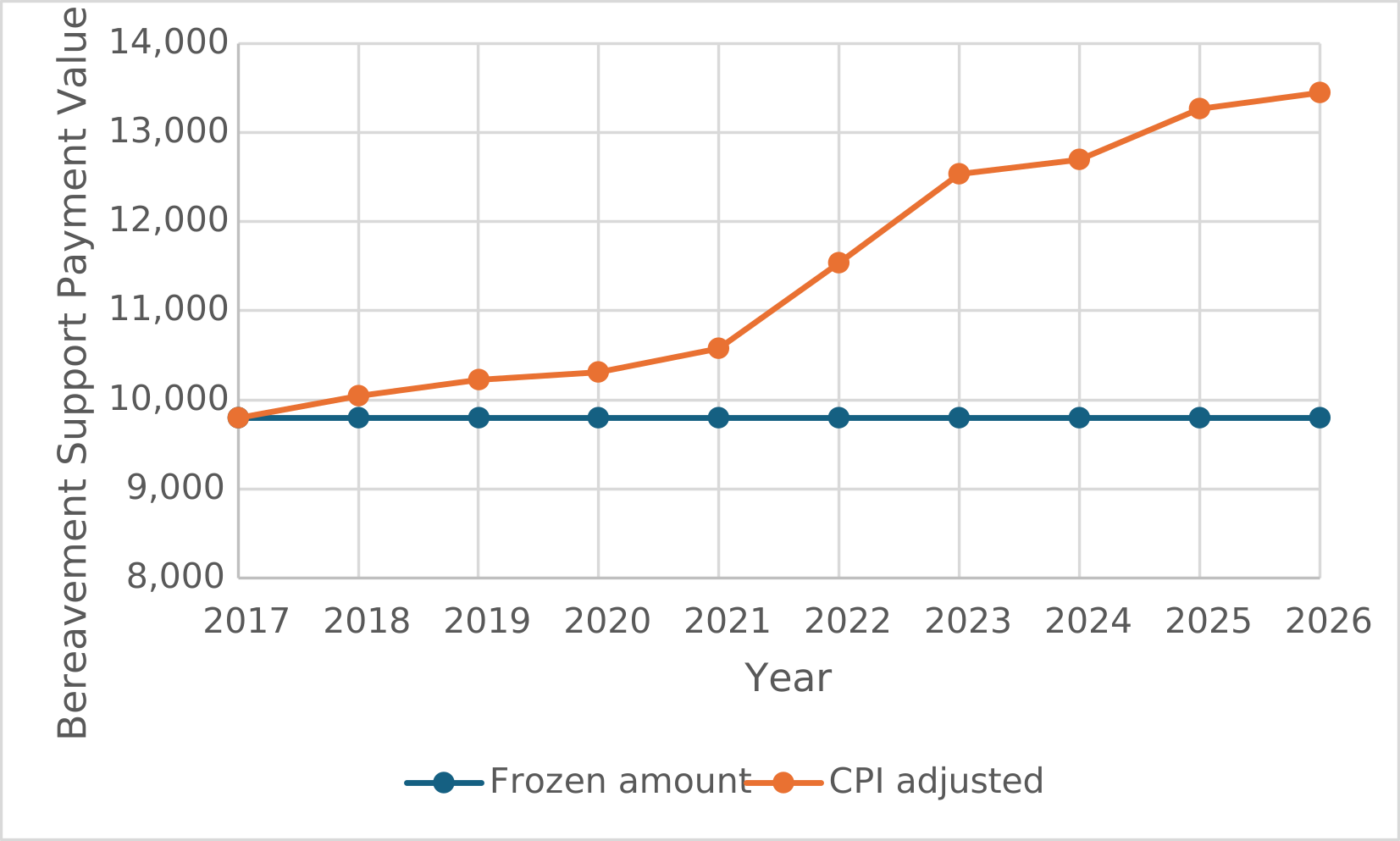
In the case of the FEP, the drop in value of the ‘other expenses element’ has led to the benefit departing from its original policy intent. Originally introduced through the Social Fund Maternity and Funeral Expenses Regulations 1987, the FEP was intended to meet the essential costs of a funeral. These essential expenses included:
- (a) the cost of any necessary documentation
- (b) the cost of an ordinary coffin
- (c) the cost of transport for the coffin and bearers and one additional car
- (d) the reasonable cost of flowers from the responsible member
- (e) undertaker’s fees and gratuities, chaplain’s, organist’s and cemetery or crematorium fees for a simple funeral
- (f) the cost of any additional expenses arising from a requirement of the religious faith of the deceased, not in excess of £75
- (g) where the death occurred away from the deceased’s home, the costs of transporting the body within the United Kingdom to that home or to the undertaker’s premises or to a chapel of rest
- (h) the reasonable travelling costs of one return journey within the United Kingdom by the responsible member in connection with either the arrangement of or attendance at the funeral[footnote 60]
In 2007, the government continued to describe the FEP as a payment ‘to cover the costs of a simple, respectful and low-cost funeral within the United Kingdom’, including all necessary burial or cremation charges and a capped amount for other expenses.[footnote 61]
Figure 2: Comparison of average cost of a traditional attended funeral to the Funeral Expenses Payment “other funeral expenses” capped amount, 2010 to 2025[footnote 62]
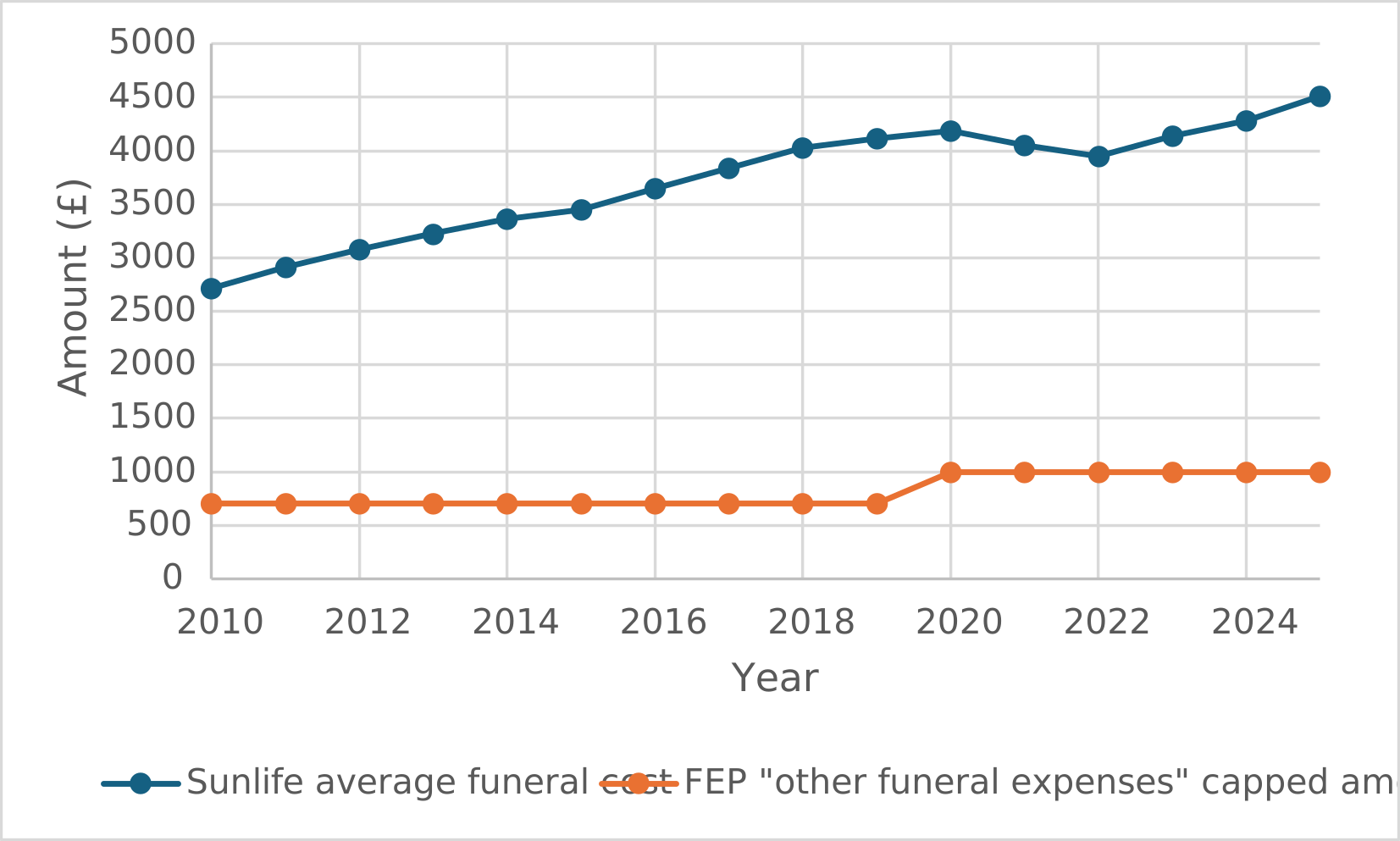
Figure 2 compares the FEP ‘other funeral expenses’ amount, which is capped, to the average rising cost of a traditional funeral as calculated by Sunlife.[footnote 63]
The cap on the ‘other funeral expenses’ element was last increased in 2020 and has remained frozen at £1000 despite significant increases in funeral costs. Prior to 2020, the payment had been frozen from 2003 onwards. Funeral director fees are one of the principal costs that this capped amount is intended to help to meet. However, funeral director charges have risen substantially over time and now account for more than half the cost of an average funeral. Pure Cremation estimates that funeral directors’ fees currently average £2,605.[footnote 64] As a result, the £1,000 capped amount now covers less than 40 per cent of average funeral director fees so would not generally meet even this single element of funeral costs in most cases. Whereas it must be acknowledged that the SunLife report does specify a type of funeral that is not the most cost-effective option the figure demonstrates the general upward trend of funeral costs that has not been reflected within FEP.
The effect of not increasing the cap is that the contribution made by the £1,000 payment has been progressively eroded by rising funeral costs. The scheme continues to provide support towards funeral costs, but the contribution made by this element now covers a smaller share of those costs than when it was last increased. This is reflected in current guidance for claimants, which states that ‘the payment will not usually cover all of the costs of the funeral’.[footnote 65]
How the irregular uprating of bereavement benefits has affected claimants[footnote 66]
There are 2 distinct factors which can contribute to shortfalls in Funeral Expenses Payment awards. First, support is limited to specified funeral costs, meaning that some expenses may fall outside the scope of the scheme. Second, as noted, the £1,000 payment for ‘other funeral expenses’ has remained frozen despite increases in funeral costs. While this section focuses on the impact of the frozen £1,000 payment, the evidence presented on claimants’ experiences may be driven by either or both of these factors.
Clients often face large shortfalls which they must make up themselves in order for funerals to go ahead. Research from Sunlife found that 15 per cent of families experience notable financial concerns when paying for a funeral.[footnote 67] Stakeholders emphasised that financial hardship in relation to funeral costs is particularly distressing, as individuals are already going through a period of grief and hardship. To make up the difference in cost, many people are forced to make difficult decisions, including selling the valuables of their deceased loved ones or turning to illegal money lenders.
Graeme was his husband’s full-time carer. When Conor died, Graeme arranged a simple cremation, which cost £3,500. Quaker Social Action predicted that the FEP would pay £2,100, leaving a £1,400 shortfall. It also took 6 weeks to come through, and the funeral director required £1,500 within 48 hours of making the arrangements. So Graeme pawned both wedding rings to raise the bulk of the deposit. He mentioned feeling shame at not being able to make the funeral arrangements.
Sunlife’s research found that 8 per cent of their respondents who reported notable financial concern turned to illegal money lenders to make up the funeral cost.
Shortfalls between the FEP ‘other funeral expenses’ payment and the cost of funerals can also result in delays or cancellations to funerals, as funeral directors may refuse to carry out the service until the full amount is paid.
Niall chose a funeral director that offered low-cost options when his daughter died in 2021. The total was £2,800 but the FEP only paid £1,800, leaving a balance of £1,000. The funeral director wouldn’t collect Niall’s daughter’s body until the full costs were paid, but Niall couldn’t afford the balance. As a result, the funeral had still not happened nearly 2 months after the death, and he was advised not to view his daughter’s body. This was very upsetting for him, particularly as her death was unexpected.
The £1,000 ‘other funeral expenses’ element has been described by Ministers in the past as a mechanism to give people more choice in the type of funeral they choose for their loved ones. For example, in April 2003 the Baroness Hollis of Heigham, the then DWP Parliamentary Under-Secretary in the House of Lords, described the then £700 ‘other funeral expenses’ sum as:
An additional sum is also allowed for other funeral expenses which gives the person arranging the funeral the freedom to select the items or services they consider appropriate.[footnote 68]
However, the freeze to the ‘other funeral expenses’ element now means that the contribution it makes towards those choices has diminished substantially, limiting the choices available to bereaved families regarding the type of funeral that their loved ones can receive.
Particularly at a time when individuals are struggling through grief, stakeholders described that the financial pressure could have a severe impact on a bereaved person’s mental health and wellbeing.
Overall, while shortfalls can arise for a range of reasons, the frozen £1,000 payment for ‘other funeral expenses’ has contributed to a growing gap between funeral costs and the support available through the FEP, with severe consequences for claimants who are unable to make up the difference.
Local Housing Allowance
Households on low incomes can get support with their rent from the UC housing element, or from Housing Benefit if they are of pension age.[footnote 69] In both benefits the LHA is the main way in which the DWP calculates the maximum amount of money that a household can receive for support with the cost of renting in the private sector.
From the beginning of the post-War creation of the social security system, payments for housing costs were additional to the main means-tested benefit scale rates, which were intended to cover normal day-to-day expenses excluding housing. There have always been limits on the rent which can be claimed in private accommodation The LHA is the latest of these. It was first introduced in 2008 and significantly changed the way in which (then) Housing Benefit levels were calculated. The LHA capped payments to the level of the lower end of local market rents. Rates are linked to rent levels in Broad Rental Market Areas (BRMAs), which are calculated by Valuation Office rent officers[footnote 70] based on data collected from letting agents, landlords, tenants and other sources.[footnote 71] The intention was to ensure that the cheaper properties in a local area were affordable for people on low incomes, without needing to use their main benefit amounts to pay their rent.
When first introduced in 2008, the LHA was set at the median (or 50th percentile) of rent costs in each BRMA and was reviewed monthly. In April 2011, it was lowered to the 30th percentile of privately rented properties. Subsequent uprating policy increasingly allowed rates to fall behind market rents. This included 1 per cent increases between 2014 and 2016, a 4-year freeze from 2016 to 2020,[footnote 72] and further periods of freezing between re-pegging exercises in 2020 and 2024. DWP recognised and attempted to counteract this shortfall by providing targeted affordable funding during the 2016 to 2020 freeze, aimed at areas moving furthest from the 30th percentile. The LHA is once again currently frozen in this benefit year. During these extended freezes, the shortfall between LHA rates and the actual market costs of renting in the private sector continues to grow.
There is no requirement for the LHA to be reviewed or uprated under the SSAA 1992. However, there is a separate legal framework requiring rent officers to calculate local housing allowance rates for each BRMA throughout the year. Data are provided to DWP for analysis and consideration by Ministers. Ministers review the LHA annually around the time of the Autumn Budget. Because of the timing, decisions about LHA rates are considered alongside the wider fiscal situation. The DWP also considers the interaction between LHA rates and wider outcomes, including homelessness and poverty.
In years in which rates have been frozen, the government has generally relied on specific Modification Orders to alter the normal determination process.[footnote 73] So, while periodic review is required by separate regulations, the absence of the LHA from the SSAA 1992 means that these reviews do not necessarily lead to the LHA being uprated.
It is estimated to cost around £8bn to reattach the LHA to the 30th percentile of market rates of private rents between 2024 and 2029.[footnote 74] There may also be concern within the government that uprating the LHA can lead to rent inflation because local LHA rates are published so landlords can see the level of rent that may qualify for 100 per cent housing payments. The extent of such an effect is disputed. The supposition stems in part from anecdotal evidence, for example from MPs’ constituents who have said that landlords have raised their rents to the LHA rate. However, substantial empirical evidence to support this claim is in short supply. Research from the Chartered Institute of Housing found that LHA rates broadly reflect the wider non-housing benefit market and do not cause rent inflation themselves,[footnote 75] and research from Shelter found that private landlords’ rent-setting behaviour is mainly affected by changes to their own costs rather than by external factors such as LHA rates, which was also the finding of the government’s own survey of English private landlords.[footnote 76][footnote 77][footnote 78]
The diminishing value of the Local Housing Allowance since 2024
Whereas many of the earlier freezes occurred during periods of relatively modest rent inflation, rental growth since 2022 has been considerably stronger, meaning that the gap between LHA rates and market rents has reopened much more quickly.[footnote 79]
Figure 3 shows how the gaps between the average LHA rate and the average 30th percentile of market rates have grown during freezes.[footnote 80] Today, the average weekly LHA rate in England is £184.40, around 8 per cent below the weekly £200.54 average rate that would apply if the LHA were uprated to the VOA’s 2025/26 30th percentile.[footnote 81] While the LHA has been frozen for just 2 years, rents have been increasing rapidly during this time and have only recently begun to slow down. Citizens Advice reported that rents increased by around 14 per cent in the 2 years after the current LHA rates were set, causing the gap between housing costs and support to widen once more.[footnote 82]
This means that the gap between the current LHA rate and market rates is close to reaching record highs, raising the question of whether a prolonged freeze remains consistent with the purpose the LHA is intended to serve.
Figure 3: Comparison of Average VOA 30th Percentile Rents and LHA Rates (Category C) by year[footnote 83]
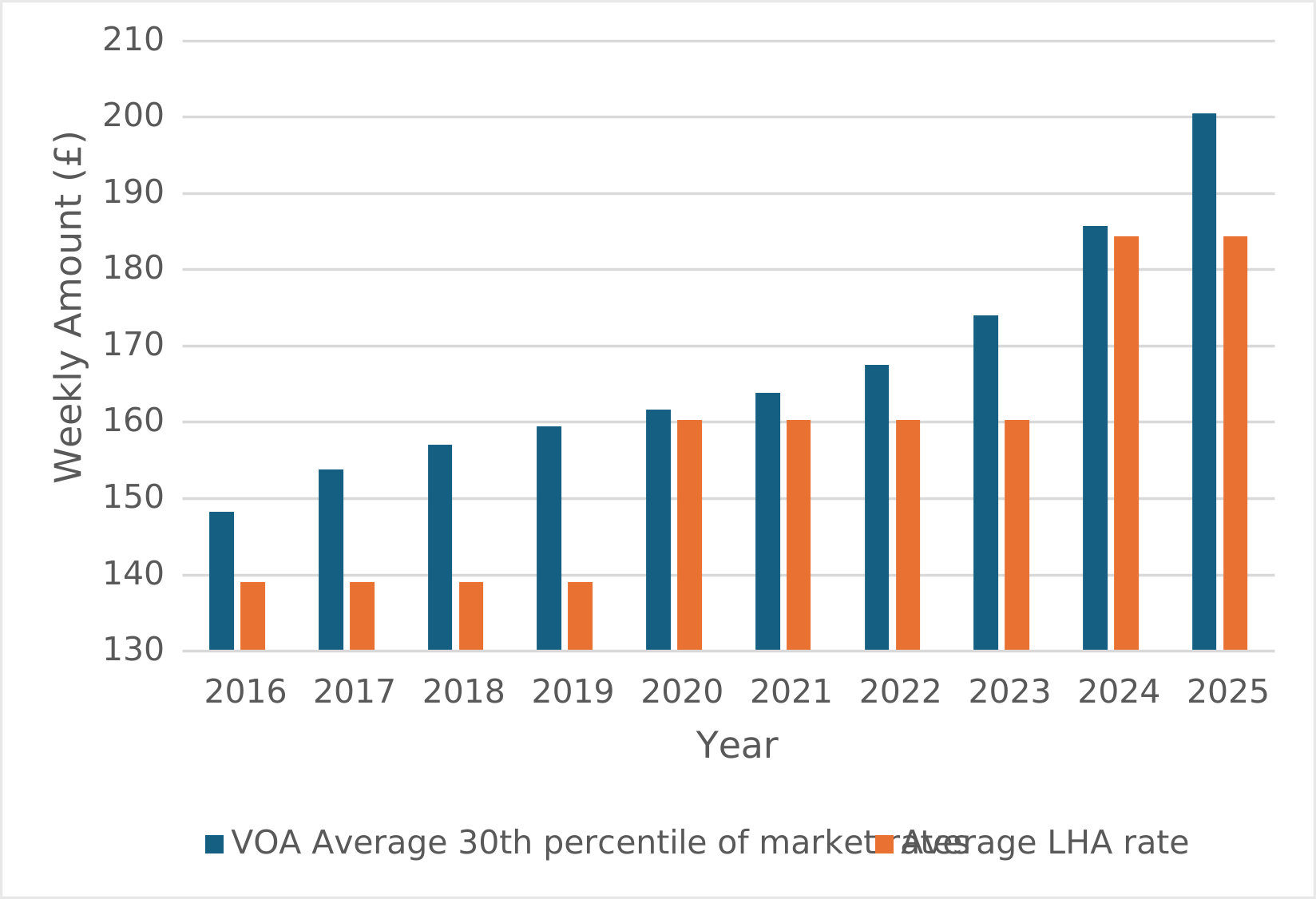
The impact of freezing the Local Housing Allowance[footnote 84]
When the LHA was first introduced, it was intended to make the lowest 50 per cent of the private rental market, and latterly the lowest 30 per cent, affordable for private renters on low incomes. Today there is a growing body of evidence to suggest a lack of rented accommodation available at the LHA rate. In September 2025, Crisis found that only 2.7 per cent of properties were affordable at LHA rates across Great Britain.[footnote 85]
Both the lack of available properties and the growing shortfalls between average rents and LHA rates have a significant impact on renters in the private sector. To make up for these shortfalls, stakeholders told us that many renters are forced to pay the difference from other social security income and therefore cut back on daily living essentials, including food and drink and utilities such as heating. These shortfalls can also cause renters to rely on food banks, with Citizens Advice reporting that one in 4 people whom they helped with low LHA rates also needed referrals to charitable support and food banks.[footnote 86]
Stakeholders also highlighted the link between LHA freezes and rising homelessness and use of temporary accommodation. When tenants cannot keep pace with rapidly increasing private rents, many low-income households cannot afford available housing and may lose their homes or not be able to move on from temporary accommodation. Temporary accommodation has significant impacts on mental and physical wellbeing due to poor living conditions.[footnote 87]
[Shelter’s] Greater Manchester Hub is working with a family with 3 children. The mother works as a nurse and the father studies full-time to improve their prospects. Due to their low income they’re entitled to top-up LHA. Before the Renters’ Rights Act came into effect in May, they were no-fault evicted from the home where they’d been settled for over 10 years. They tried very hard to find a suitable alternative but were unable to find anything decent and affordable within LHA rates. Consequently, they are now stuck homeless in damaging temporary accommodation in the northern outskirts of the city-region, facing long commutes to get to work and school.
There has also been data showing that re-linking the LHA to the lowest 30 per cent of current market rates of private rents could reduce the use of temporary accommodation (TA) by 23 per cent, and of unsuitable TA by 30 per cent, by 2041.[footnote 88] It could lead to a reduction in homelessness of 3.8 per cent in 2031.
The Benefit Cap
The Benefit Cap is a limit set by government on the total amount of certain benefits that working-age households in certain categories can receive. If a household’s total calculated benefits exceed this limit, their UC payments are reduced to bring them below the capped amount. A household’s exact threshold depends on their household status (such as couples and lone parents or single adults) and location (such as based inside or outside Greater London). It does not apply to anyone over State Pension age, or anyone in receipt of benefits related to a disability or health condition or those with caring responsibilities for young children which places them in a group who are not required to work.[footnote 89]
[Shelter’s] Merseyside Hub is working with a lone mother who has a disabled, primary age child. She works part-time as a cleaner, even though her child is sometimes hospitalised due to their disability. The rent for their 2-bedroom home is £875 per calendar month. But the LHA for a 2-bedroom home in the area is £595. So, to avoid falling into arrears, she’s topping up from her low earnings and UC standard allowance, leaving them without money for other essentials. Her child’s disability and health problems are exacerbated by the damp, mould and other disrepair in their home, such as a leaking roof in one of the bedrooms. The mother is worried sick and feels stuck, despite juggling work and caring for her disabled child. She tries to undertake repairs herself. She’s in the top band on the waiting list for a social home but is facing a wait of years. She’s been looking for an alternative private rental she can afford but can find nothing more affordable or in any better condition than their current home.
The Benefit Cap was introduced in 2013 under the Coalition Government. According to that government, the aims of the policy were to:
- reduce overall spending on benefits
- maintain public confidence in the social security system by imposing a reasonable limit on the total amount a household can receive
- incentivise work[footnote 90]
The level of the Benefit Cap was subsequently lowered in 2016 and remained frozen at this level until 2023. The cap was increased in 2023 for the first time since being introduced by 10.1 per cent in line with the CPI. It has not subsequently been uprated.
The Benefit Cap is required to be formally reviewed once every 5 years (following the repeal of the Fixed Parliament Act). Although formal uprating and review are infrequent, our understanding is that the cap is effectively considered on an annual basis. This reflects the need to account for changes in other benefits, particularly UC. The DWP has a number of policy considerations regarding whether to review the cap, including its impact on household poverty, particularly for families with children, households in high-cost areas and people with health conditions or disabilities. It is also considered alongside wider policy measures such as the LHA. Factors that may weigh in the balance against uprating include concerns about fairness between working and (certain groups of) non-working households and the need to manage public expenditure based on the wider economic situation.
Figure 4 compares the actual level of the Benefit Cap[footnote 91] with the value it would have had if it had been uprated with the CPI. Since the Benefit Cap was reduced in 2016, it has remained below its 2013 value even after being uprated in 2023 and currently sits at £22,020 per year for a family (couple with or without children, or single parent) living outside London who are subject to work conditionality. If it had been consistently uprated using the CPI since 2013, the Benefit Cap would now be £37,431.91 per year, representing a 70 per cent increase in its current value.
Figure 4: Comparison of the Benefit Cap, its value if increased with the CPI from 2013 onwards, and its value if increased with the CPI from 2016 onwards[footnote 92]
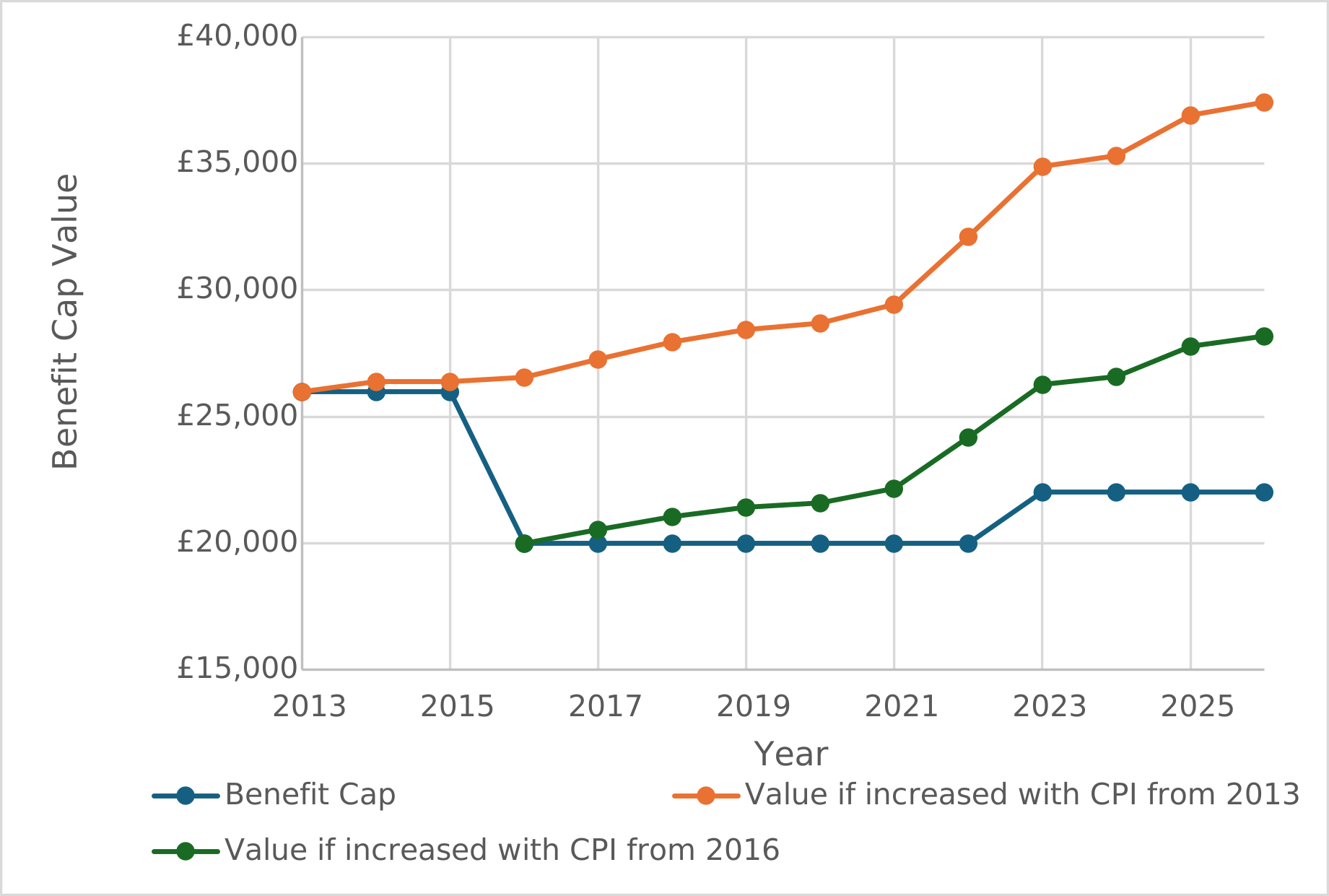
The freezing of the Benefit Cap has contributed to an increase in the number of households subject to it, as shown in Figure 5. Since it was last uprated, in 2023, the yearly average number of capped households has increased from 78,000 to 112,000 in 2025/26.[footnote 93] A prolonged freeze changes the profile of those affected. As benefit rates are uprated while the cap remains fixed, households can become subject to the cap despite experiencing no meaningful change in their circumstances. This can result in growing numbers of families being affected, including groups whose circumstances differ from those of the population affected when the policy was first introduced.
Figure 5: Average number of households subject to the Benefit Cap, 2016 to 2025[footnote 94]
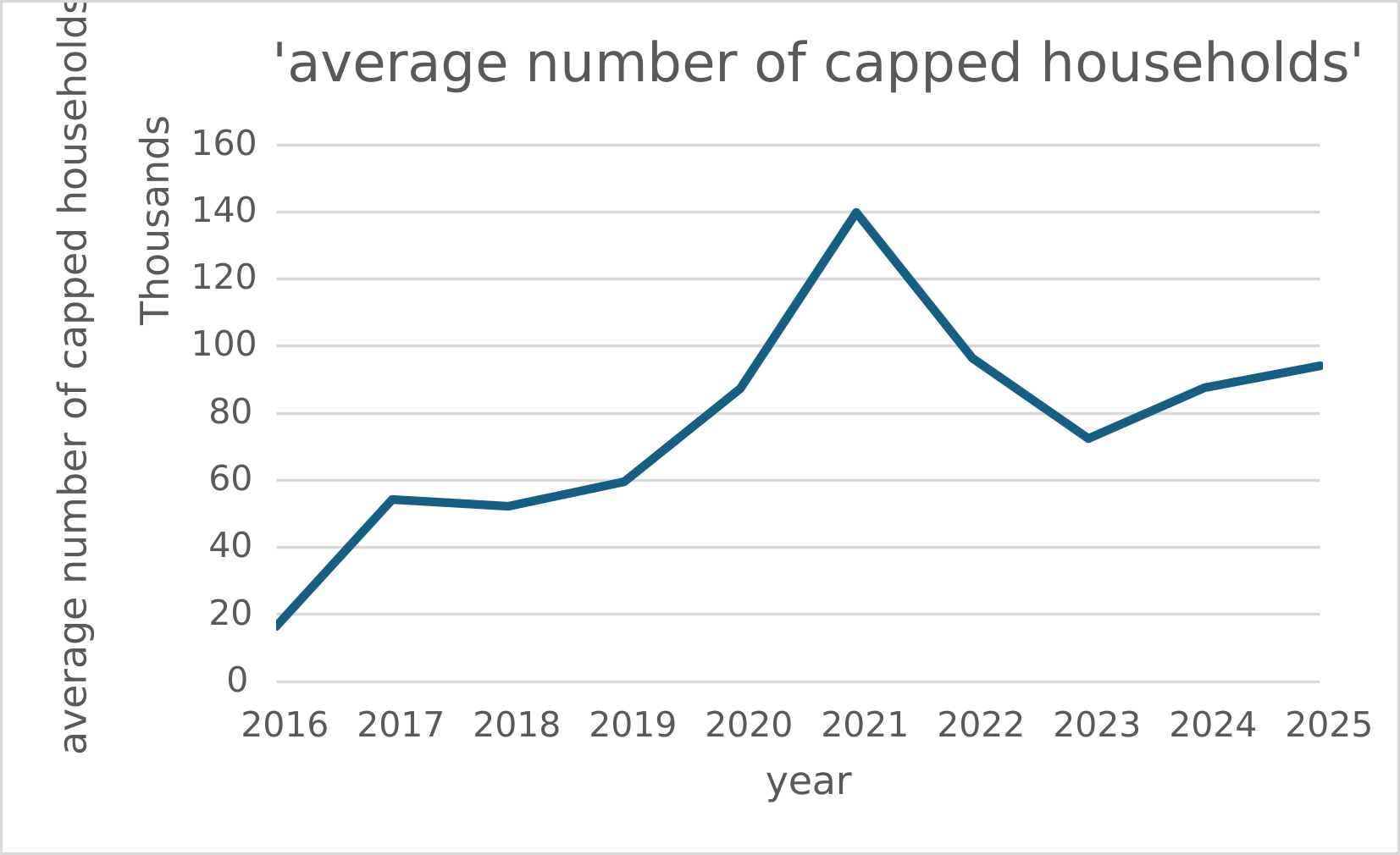
Research shows that the Benefit Cap, and its long-term freezes, are significantly more likely to affect large families with more children[footnote 95] and households living in areas with high LHA rates. Larger families were highlighted as being particularly affected because they are often entitled to higher housing support and more likely to breach the Benefit Cap. As a result, additional housing support can be offset by the cap.
The cap interacts with the social security system as a whole and can mean that the effects on household entitlement of the uprating of certain benefits or lifting of certain caps would be reduced if the Benefit Cap did not also increase. For example, research from Policy in Practice suggests that 1 in 10 households hit by the 2-child limit will not benefit from its abolition, and a further 1 in 10 will only benefit partially, since families will instead be subject to the Benefit Cap.[footnote 96],[footnote 97]
In addition, long-term freezes raise questions about how the current level of the Benefit Cap relates to the policy judgement it is intended to embody. The cap was initially introduced in part to maintain public confidence in the social security system by imposing a reasonable limit on the total amount that certain households can receive.[footnote 98] But that ‘reasonable limit’ was set at a level which reflected the policy priorities and economic conditions at that time. Over time, however, as the real value of the cap has changed the balance embodied in its current level has also changed. Both the value of the cap and the number and circumstances of people affected by it have moved away from those prevailing when the policy was last explicitly set.
Earnings disregards in ‘legacy’ benefits and New Style JSA
The earnings disregards in legacy means-tested benefits illustrate how long-term freezes can undermine an original policy intent - and ultimately frustrate its utility. When the current Housing Benefit (HB) scheme was introduced in 1988 alongside Income Support, the £5 per week disregards for a single person in both benefits meant that they could do a small amount of paid work without needing to report it to the local authority which administered Housing Benefit or the Department of Social Security which administered Income Support, and without these organisations needing to incur a cost in making a small adjustment to the benefit.[footnote 99] But the £5 weekly earning disregard has remained frozen since it was introduced - for 38 years - and, was inherited by the panoply of means tested benefits that replaced Income Support, though it has not been replicated in UC.[footnote 100]
In April 1988, £5 per week represented:
- 10 per cent of the weekly rate of Income Support for a single unemployed person
- 1.5 hours of work for someone on average part-time wages
Thirty-eight years later, it is worth just over 5 per cent of the equivalent rate of UC, and 24 minutes’ work at the National Living Wage. In short, by April 2026, it has become too small to perform much of its original function. Had it kept its value against the CPI, it would now be worth £14.30 per week, which is equivalent to a little over an hour’s work on the National Living Wage of £12.71 per hour. Uprated in line with average earnings, it would be worth over £23 per week instead. In means-tested benefits this disregard, and the £10 disregard for couples, survives only in Housing Benefit and in Pension Credit, so affects mainly pensioners, although it also applies to working age people in sheltered and temporary accommodation (where for this group the government is planning a significant change because of the perverse interactions between HB and UC).
However, the £5 weekly earnings disregard was inherited from Income Support by Jobseekers Allowance and continues to be used for New Style (previously ‘contributory’) Jobseekers Allowance (JSA). JSA is an earnings replacement benefit for people working fewer than 16 hours per week. However, any earnings over £5 per week reduce the benefit payment pound for pound. As the rate of New Style JSA is £95.55 per week, JSA stops when earnings go over £100.55 per week. But this amount of money represents just over 8.5 hours’ work at the National Living Wage. In practice, therefore, for employees the JSA hours rule is closer to 8 hours’ work per week, rather than 16. The 16 hours rule only really applies to self-employed people earning half the minimum wage. So, the £5 per week earnings disregard has not only lost its much of its original function in the remaining legacy means-tested benefits it’s having perverse effects in a contributory, non-means-tested, benefit.
Capital limits in Universal Credit and Housing Benefit
The history of capital limits in means-tested benefits is characterised by long freezes punctuated by sudden very large jumps, after which the value of the capital limit is left to erode again. For example, the capital thresholds in working-age means-tested benefits doubled in 2006 having largely been frozen since 1990, going from £3,000 to £6,000 for the lower threshold and £8,000 to £16,000 for the upper limit (at which point entitlement stops). These thresholds have stayed at the same level since then, with UC inheriting the same rules. It is arguable that changing disregards every year could be confusing for claimants, and that stable values mean it’s easier for them to know where they stand. However, had the values kept pace with inflation they would now be worth considerably more - £10,600 and £28,400 respectively.
Figure 6: Comparison of the lower and upper capital thresholds, and the values if increased with the CPI from 2006 onwards
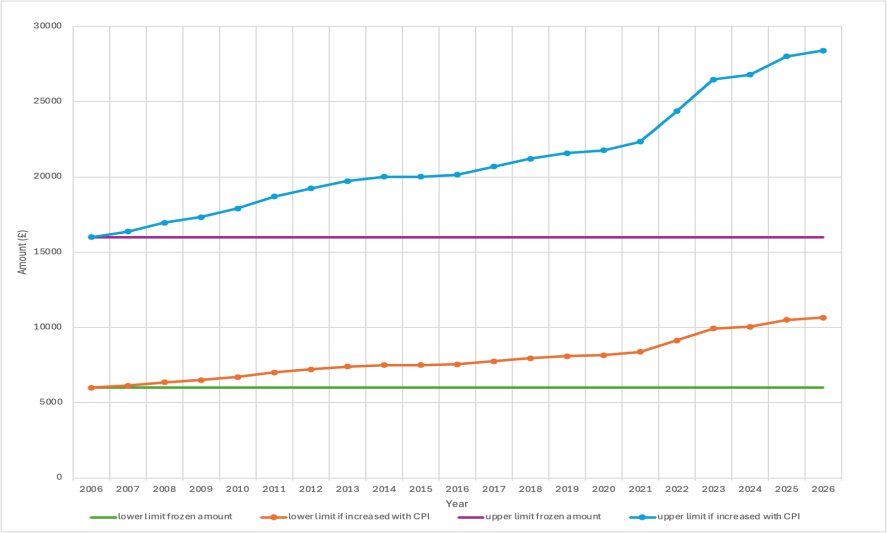
There are several problems with this stop-start approach. First, it means that there is no consistent policy on the appropriate level of savings for people on means-tested benefits. Instead, values are set extremely rarely, after which they are decided by the rate of inflation as they remain frozen for extended periods of time. It also means that people in similar circumstances are treated very differently depending on when they make their claim. The long periods of freeze erode people’s ability to save as the value of these capital limits decreases over time. For a wide variety of individuals, including disabled people saving up for adaptations or mobility aids, the negative impact of these freezes increases steadily over time.
Chapter 6: Recommendations
Decisions about uprating are properly matters for governments, taking account of fiscal, policy and operational considerations. We are, however, of the strong view that decisions about the value of benefits, thresholds and caps should be considered, transparent and capable of proper scrutiny. When a government decides that a rate should not increase, that decision should be deliberate and clearly explained. Price or wage inflation should not be allowed to reshape the social security system by default.
We believe that this can be achieved through a set of principles and practical actions which governments should adopt as part of the uprating process.
Recommended Principles
1. Consistency
All benefits, thresholds and caps should be subject to a consistent and systematic review process. Decisions about whether to uprate, freeze, redesign or remove a measure should be taken within a common framework, rather than depending solely on historical legislative arrangements.
2. Transparency
The government should be transparent about how uprating decisions are made. It should clearly explain the principles that underpin its approach, the rationale for individual decisions and the consequences of freezing or uprating particular benefits, thresholds and caps.
3. Alignment with policy objectives
Every benefit, threshold and cap should have clearly articulated purposes. Decisions about uprating should be taken with reference to those purposes, using an appropriate measure of value where relevant, and should take account of whether and how the provision should continue to meet those policy objectives over time.
4. Deliberate policy choices
If a government concludes that a policy is no longer affordable, appropriate or aligned with its priorities, it should make an explicit policy decision and explain its reasoning. Inflation should not be allowed to alter the value, reach or effect of a policy by default.
The following recommendations set out in more detail how we think these principles should be implemented in practice and over what timescales.
Recommendations
By the time of the 2027 uprating statement, we recommend the below.
1. Annual review and reporting
The government’s annual uprating review should be comprehensive, covering all social security benefits, thresholds and caps, and it should publish the outcome of that review, including the effects of any decisions not to uprate.
The annual publication should identify which values have been uprated, which have been frozen, the measure chosen for uprating, the value if uprated using the relevant measure, the rationale for those decisions and the estimated impact on claimants and public expenditure. This would ensure that decisions affecting the value of support are transparent and subject to appropriate scrutiny.
2. Clear policy objectives
The government should clearly define the purpose of each benefit, threshold and cap and ensure that its approach to uprating or maintaining its value unchanged is consistent with that purpose.
Where a benefit is intended to meet a particular cost, protect living standards, support work incentives and/or achieve another policy objective, the government should periodically assess whether the current value remains sufficient to fulfil that objective, including whether the method used for uprating is suitable.
3. Transparent uprating principles
The government should publish a clear uprating policy for all benefits, thresholds and caps, including the measure against which their value is assessed.
Different elements of the social security system serve different purposes and therefore may require different uprating approaches. The government should explain which measure is used in each case and why, and periodically review whether that measure remains appropriate.
4. Explicit decisions on freezes
If the government decides not to uprate a benefit, threshold or cap, it should explain to Parliament the reasons for that decision as well as its likely consequences and the extent to which the original policy purpose may no longer be met.
This explanation should include the effect on the real-terms value of the measure, the groups affected, any equality implications and the extent to which the original policy purpose may be affected. Fiscal considerations are a legitimate part of decision-making, but their implications should be transparent.
5. Review long-frozen values
The government should undertake a systematic review of benefits, thresholds and caps that have been frozen for extended periods, considering whether their present level and operation remain consistent with their purpose and, where not, whether they should be uprated, redesigned or discontinued.
The review should consider whether:
- these continue to serve a useful policy purpose
- their current value remains appropriate
- they should be uprated, redesigned, replaced or abolished
Particular attention should be given to cases in which prolonged freezes have substantially altered the effect or purpose of the original policy.
In the longer term we recommend the below.
6. Legislation
- The government should amend the SSAA 1992 to bring all benefits, thresholds and caps within a common statutory review framework, which embodies the principles we have articulated.
This would not require all benefits, thresholds and caps to be uprated automatically. Rather, it would ensure that decisions affecting their value are reviewed consistently, reported transparently and made subject to parliamentary scrutiny.
Collectively, these recommendations are intended to improve the consistency, transparency and accountability of uprating decisions. They would not remove ministerial discretion over whether individual benefits, thresholds or caps should be uprated. They are also intended to support effective public and parliamentary scrutiny by making clearer the purpose, evidence and rationale underpinning those decisions.
Chapter 7: Conclusion
Our research has highlighted that a wide range of benefits, thresholds, and caps across the UK social security system are subject to irregular uprating and, in many cases, prolonged freezes. In particular, we found that those benefits, thresholds, and caps that fall outside the mandatory review and uprating requirements set out in the SSAA 1992 are significantly more likely to remain frozen.
When they are not increased in line with an appropriate measure - whether this be the CPI, earnings growth or another index - their real-terms value declines over time, reducing the overall adequacy of the social security system in meeting people’s needs. This is especially concerning for benefits to meet specific costs such as the LHA, intended to meet the costs of the lowest 30th percentile of local rents, and the ‘other funeral costs’ element of the FEP, intended to help pay for a simple low-cost funeral. Long-term freezes can create or widen gaps between the amount claimants receive and the actual cost of the goods or services the benefit is intended to cover. In many cases, claimants are forced to bridge these shortfalls using income from other sources, including from other benefits. When this is not possible, the consequences can be severe, contributing to increased hardship, poverty and inequality.
Irregular uprating of thresholds and caps can also have significant consequences. Freezes to eligibility thresholds can affect both entitlement and access to support, meaning that individuals may become less eligible for assistance despite experiencing no improvement in their financial circumstances. They can also result in fewer people qualifying for support over time, as incomes and other financial thresholds change while eligibility criteria remain fixed. Similarly, when the Benefit Cap (for example) is not uprated, it gradually affects a larger number of people as other benefits increase over time. These changes may be consistent with a government’s policy objectives, but where they are, that should be the result of an explicit and evidenced judgement rather than simply the passage of time.
Even when internal uprating reviews and decision-making processes are thorough, extensive and evidence-based, they have less impact if the rationale for the resulting decisions and their consequences are not visible outside government. When governments prioritise fiscal savings and view social security spending as an area for expenditure reductions, it is often those benefits with the weakest statutory protections - those not subject to mandatory uprating requirements - that are most vulnerable to freezes, even where the adverse impacts of such actions are well understood. Such freezes may reflect legitimate fiscal or policy choices, but the relationship between the purpose of the provision, the evidence considered and the decision taken should be clear and transparent.
We therefore believe that the government should prioritise the establishment of consistent legal requirements for the regular review of all benefits, thresholds, and caps, ensuring that no part of the social security system is excluded from systematic consideration as economic conditions and policy priorities change. Each benefit, threshold and cap should have a clearly articulated purpose and a transparent policy for reviewing its monetary value over time. Decisions about whether and how to uprate should be informed by that purpose, the available evidence and the government’s wider fiscal and policy objectives. Uprating policy across the social security system should be clear and transparent. If the government chooses not to uprate a benefit, threshold or cap, it should publish its rationale and assess the likely impact of that decision on affected households and on the extent to which the provision continues to fulfil its intended purpose. We also recommend a systematic review of benefits, thresholds and caps that have been frozen for extended periods. Finally, all benefits, thresholds and caps should be brought within the statutory review framework set out in the SSAA 1992, ensuring ongoing scrutiny while preserving ministerial discretion over the resulting decisions.
Taken together, these reforms would strengthen the consistency, transparency and accountability of uprating decisions. They would help ensure that changes in the value or reach of social security provisions reflect reasoned, evidence-based choices, rather than the unexamined effects of inflation, earnings growth or the passage of time.
Annex A
Overview of irregularly uprated benefits
Information was gathered from internal information available from the DWP and HMRC, along with an investigation of the history of certain benefits. The table only shows irregularly uprated benefits/thresholds/caps which are within the remit of DWP, HMRC and HMT. It does not include information on tax thresholds that have not been uprated, except where they relate to specific benefits such as Child Benefit.
The table includes a calculation of estimated value if uprated with inflation (CPI). To calculate this, we used the Bank of England’s Inflation calculator, which uses CPI values acquired from the ONS annual CPI rates. For years before 1988, before the CPI was calculated, the ONS’ historical CPI estimates were used.[footnote 101]
| Name | Type | Uprating rules | First Introduced | Last Uprated | Uprating Pattern | Current Value | Estimated Price if uprated with inflation (CPI) (APR-26) |
|---|---|---|---|---|---|---|---|
| 25p addition to state pension for over 80s | Fixed Amount | Part of SSAA but not mandatory to uprate | 1971 | 1971 | Never uprated | 25p | £3.24 |
| Benefit Cap | Cap | Not part of SSAA | 2013 | 2023 | Uprated and downrated. The level of the Benefit Cap must be reviewed at least once every 5 years. | Couples and lone parents: £25,323 (London), £22,020 (rest of GB) per year Single adults without children: £16,967 (London), £14,753 (rest of GB) | Couples and lone parents: £27,855.30 (London), £23,625.53 (rest of GB) Single adults without children: £18,204.10 (London), £15,828.67 (rest of GB) |
| Bereavement Support Payment | Short-term benefit | Part of SSAA but not mandatory to uprate | 2017 | N/A | Not uprated since inception. | Higher rate: £3,500 lump sum and 18 monthly payments of £350 Standard rate: £2,500 lump sums and 18 monthly payments of £100 | Higher rate: £4,802.96 lump sum and 18 monthly payments of £480.32 Lower rate: £3,430.68 lump sums and 18 monthly payments of £137.23 |
| Capital limits for means-tested benefits (Income Support, income-related ESA, income based JSA, Universal Credit, and Housing Benefit) | Capital Threshold | Not part of SSAA | 1988 | 2006 | Rarely uprated | Lower capital limit: £6,000 Upper capital limit: £16,000 | Lower capital limit: £10,647.13 Upper capital limit: £28,392.35 |
| Capital limits for Pension Credit | Capital disregard / tariff income threshold | ‘Kept under continual review they can be increased only when priorities and resources allow’ [footnote 102] | 1999 | 2009 | Rarely uprated | First £10,000 of capital disregarded. No upper capital limit. Capital above £10,000 is treated as tariff income at £1 per week for every £500 (or part of £500) of capital above £10,000. | £17,745.22 |
| High Income Child Benefit Charge (HICBC) threshold | Earnings threshold | Not part of SSAA (HMRC-led) | 2013 | 2024 | Rarely uprated | Child benefit tapered away via tax system for incomes of £60,000 to £80,000 | CPI: £63,579.75 to £84,773 Earnings: £65,760 to £87,680 since 2024 or £94,620 to £126,160 since 2013 |
| Christmas bonus | Fixed amount | Not part of SSAA | 1972 | Not applicable | Never uprated | £10 | £121.61 |
| Cold Weather Payment | Fixed amount | Not part of SSAA | 1986 | 2008 | Rarely uprated | £25 per week of very cold weather | £76.67 per week of very cold weather |
| Earnings disregards for Housing Benefit. There are multiple HB disregards. This report focusses on only 2 – the ‘simple’ disregards for single people and couples. | Earnings disregards | Generally not part of SSAA | 1988 | N/A | Never uprated | Single: £5 per week Couple: £10 per week Disabled/Carers and certain jobs: £20 per week Lone parent: £25 per week | Single: £14.29 per week Couple: £28.59 per week Disabled/Carers: £57.17 per week Lone parent: £71.47 per week |
| Funeral Expenses Payment: £1000 “extra costs” | One-time payment with a fixed maximum spend. | Not part of SSAA, part of internal Departmental Expenditure Limits budget | 1987 | 2020 | Rarely uprated | £1000 | £1,303.43 |
| Local Housing Allowance rates | Cap | Not part of SSAA | 2008 | 2024 | Episodic uprating | 30th Percentile of 2024 rents in “Broad Rental Market Area” | 30th Percentile of 2026 rents in “Broad Rental Market Area”[footnote 103] |
| Occupational pension threshold for new style ESA | Threshold | Not part of SSAA | 2008[footnote 104] | 2008 | Never uprated | ESA is reduced by 50p for every £1 of pension income above £85 per week | Threshold of £142.29 |
| Occupational pension threshold for new style JSA | Threshold | Not part of SSAA | 1996[footnote 105] | 1996 | Never uprated | Pension income above £50 per week reduces JSA entitlement | Threshold of £103.05 |
| Sure Start maternity Grant[footnote 106] | One-time payment | Not part of SSAA | 2000 | 2002 | Rarely uprated | £500 | £951.83 |
| Winter fuel payment | Regular payment | Not part of SSAA, tax thresholds are a matter for HMT | 1997 | 2011 | Rarely uprated | £200-300 per year | £303.68 to £455.51 |
| Winter fuel payment earnings threshold[footnote 107] | Threshold | Not part of SSAA | June 2025 | 2025 | Never uprated | £35,000 | £35,862.43 |
Annex B
List of mandatorily uprated benefits[footnote 108]
Benefits that have a statutory requirement to be uprated at least in line with average earnings include:
- Pension Credit standard minimum guarantee
- Basic State Pension
- New State Pension (up to the full rate)
- Industrial death benefit – high and lower rate
Benefits that have a statutory requirement to be uprated at least in line with prices include:
- Widow’s benefit – basic component
- Bereavement benefit – basic component
- Attendance allowance – higher and lower rate
- Carer’s Allowance
- Disability Living Allowance – both components and all rates
- Industrial Injuries Disablement Benefit – all components and rates
- Personal Independence Payment
- Severe Disablement Allowance
- Adult Dependency Increases payable with Incapacity Benefit, Severe Disablement Allowance, Carer’s Allowance, Maternity Allowance and State Pension
- Additional State Pension
- Protected Payments of new State Pension
- Widow’s and Bereavement Benefits, guaranteed minimum pension and contracted-out deductions
- Graduated retirement Benefit
- Increase of State Pension for long-term incapacity (carried over age additions and invalidity allowances)
- Increments to State Pension
- Child Dependency Increases (all benefits)
- Incapacity Benefit overall increase with abatement of invalidity allowances and age additions
Annex C
List of benefits uprated on a discretionary basis[footnote 109]
- Universal Credit
- Income Support – all components
- Jobseeker’s Allowance – all components (abolished from 2027/28)
- Employment and Support Allowance
- Housing and Council Tax benefits – all components
- Pension Credit – savings credit thresholds / maximum, additional amounts for carers and severe disability, children rates including disabled child higher/lower and amounts relating to polygamous marriage
- Statutory Adoption Pay (Department for Business and Trade (DBT) lead)
- Statutory Maternity Pay (DWP lead)
- Statutory Neonatal Care Pay (DBT lead)
- Statutory Paternity Pay (DBT lead)
- Statutory Shared Parental Pay (DBT lead)
- Statutory Parental Bereavement Pay (DBT lead)
- Statutory Sick Pay (DWP lead)
- Bereavement Support Payment (not up-rated since 2017)
Annex D
Benefits that are not required to be uprated but are still uprated in practice
| Name | Type | First Introduced | Uprating Pattern | Current Value |
|---|---|---|---|---|
| Carers Allowance Earnings Limit | Earnings threshold | 1976 | While this historically has been uprated irregularly and fell behind the living wage, from 2025/26 the government linked it to the National Living Wage. | £204 per week |
| Child Benefit | Benefit | 1977 | Interrupted (frozen from 2011-2014, 1% increase cap 2014-2016, frozen from 2016 to 2020), increased yearly with CPI since then. | Eldest or only child: £27.05 per week Additional children: £17.90 per week |
| Employment and Support Allowance Permitted Work earnings limit | - | - | No formal method for uprating, but historically the permitted work earnings limit has tended to be adjusted in a way that tracks increase in wage levels more closely than it tracks CPI inflation. | £203.50 per week |
| Statutory maternity Pay | Income replacement | 1987 | Follows annual uprating applied to working-age benefits based on CPI inflation. | 90% of average weekly earnings for first 6 weeks, £194.32 or 90% of your average weekly earnings (whichever is lower) for the next 33 weeks |
| Statutory Sick Pay | Income replacement | 1983 | Follows annual uprating applied to working-age benefits based on CPI inflation. | 80% of average weekly earnings or £123.25 (whichever is lower) |
| Non-dependant deductions income thresholds | Threshold | - | From 2015/16 to 2022/23, Housing Benefit non-dependent deductions and income bands were frozen. From 2023/24 onwards, the government resumed uprating the income bands and deduction amounts, and since then the thresholds have been adjusted more regularly. | Weekly gross income of non-dependant: less than £192, amount deducted per week: £20.40. Weekly gross income of non-dependant: £192 to £278.99, amount deducted per week: £46.85. Weekly gross income of non-dependant: £279 to £364.99, amount deducted per week: £64.35. Weekly gross income of non-dependant: £365 to £484.99, amount deducted per week: £105.20. Weekly gross income of non-dependant: £485 to £604.99, amount deducted per week: £119.85. Weekly gross income of non-dependant: £605 and above, amount deducted per week: £131.45. |
| Universal credit work allowance (for people with children, or with limited capability for work) | - | 2013 | Despite no set rule a check is carried out on an annual basis. In general, this is uprated in-line with the CPI. | If claiming housing costs through UC or live in temporary accommodation arranged by the council: £427 a month, otherwise, £710 a month |
Annex E
Published research: sources consulted
‘The impact of freezing Local Housing Allowance’ - Citizens Advice (2023)
‘Uprating Local Housing Allowance: Briefing Note’ - Citizens Advice (2024)
‘The homelessness monitor: England 2025’ - Crisis
‘Benefit and pension rates 2026 to 2027’ - Department for Work and Pensions
‘Capped and trapped (in the UK’s housing market): how the benefit cap makes it almost impossible to find affordable housing’ - Fransham, M., Andersen K., Patrick, R., Reeves, A. and Stewart, K. (2024)
‘Uprating of Social Security Benefits’ - House of Commons Library (2011)
‘State pension: 25 pence age addition’ - House of Commons Library (2013)
‘Social Fund Funeral Payments’ - House of Commons Library (2018a)
‘Funeral Poverty’ - House of Commons Library (2028b)
‘Winter Fuel Payment Update’ - House of Commons Library (2019).
‘Benefits Uprating 2026/27’ - House of Commons Library (2026)
‘Fifty years of benefit uprating’ - Joseph Rowntree Foundation (2022)
‘The Cost of Funerals Index 2026’ - Pure Cremation (2026)
‘Private rent and house prices, UK: July 2026’ - Office for National Statistics (2026)
‘Grief is hard enough: Fix the Funeral Expenses Payment’ - Quaker Social Action (2025)(PDF, 255KB)
‘Housing Outlook Q2 2026’ - Resolution Foundation (2026)
‘The relationship between Local Housing Allowance rates and rents’ - Shelter (2019)
‘Still Living in Limbo: Why the use of temporary accommodation must end’ - Shelter (2023)
‘SSAC Occasional Paper 16: Bereavement benefit reform’ - Social Security Advisory Committee (2015)
‘Sunlife Cost of Dying Report 2026’ - Sunlife (2026)
Annex F
Stakeholders who provided evidence
The Committee thanks the following individuals and organisations who contributed their time and knowledge to this project:
- Chartered Institute of Housing
- Childhood Bereavement Network
- Citizens Advice
- Child Poverty Action Group
- Institute for Fiscal Studies
- Marie Curie
- Policy in Practice
- Quakers Social Action
- Shelter
- Widowed and Young
Annex G
Methodological approach
The research took place between May and July 2026. The following research questions guided our approach to the research:
- Which UK benefits, thresholds and caps are not uprated automatically or regularly?
- What institutional, legal, and equality-related considerations shape uprating decisions?
- To what extent have irregularly uprated benefits kept pace with inflation, especially those designed to cover specific costs?
- What have been the distributional and equality implications of uprating in the UK?
- How can current uprating practices be redesigned to produce a more coherent, transparent and sustainable system?
To address these questions, we took the following methodological approach:
- conversations with policy officials from the DWP and HMRC - these included officials in charge of uprating across the Department as well as teams focused on specific benefits, thresholds and caps
- roundtable discussions and other meetings with stakeholder organisations and policy experts (a full list of representation is included in Annex F), some of whom also provided written evidence
- a review of relevant published research
The project had 3 main aims:
- to produce a comprehensive understanding of the benefits, thresholds and caps that were subject to irregular uprating
- to explore the departmental decision-making process surrounding uprating
- to identify the impact that irregular uprating has had on the social security system as a whole, as well as the impact on individual claimants.
Our review of published research and meetings with policy officials allowed us to achieve the first 2 aims, while the meeting with stakeholders and written evidence allowed us to achieve the final aim.
As part of Annex A, Figure 1 and Figure 4, we have calculated the value of certain benefits, thresholds and cap if they had been uprated using CPI since the last time they were uprated. To do this, we used the Bank of England’s inflation calculator. Annex A also includes calculations for these values if uprated using earnings. Earnings-uprated values were estimated using the Office for National Statistics.
All data collection adhered to Government Social Research guidance.
Annex H
Membership of the Social Security Advisory Committee:
- Dr Stephen Brien (Chair)
- Les Allamby
- Fran Bennett
- Joanne Cairns
- Bruce Calderwood
- Rachel Chiu
- Tom Clark
- Daphne Hall
- Richard Machin
- Owen McCloskey
- Jacob Meagher
- Dr Sam Royston
- Dr Suzy Walton
- Professor Sharon Wright
Secretariat:
- Denise Whitehead (Committee Secretary)
- Indica Francis (Committee Analyst)
- Alice Perkins (Committee Analyst)
- Kenneth Ashworth (Secretariat)
- Robert Cooper (Secretariat)
- Edward Munn (Secretariat)
Social Security Advisory Committee
Ground Floor
Caxton House
Tothill Street
London
SW1H 9NA
Telephone: 0300 046 0323
E-mail: ssac@ssac.gov.uk
Website: Social Security Advisory Committee - GOV.UK
Twitter: @The_SSAC
-
See, for example, Joseph Rowntree Foundation (2026) ‘Independent process to ensure Universal Credit covers essential costs’ and Social Security Advisory Committee and Institute for Government (2021), Jobs and benefits: the COVID-19 challenge. ↩
-
While HM Treasury does not administer benefits directly, it sets the overall fiscal framework and public spending limits, approves significant welfare spending decisions, shares responsibility for tax-based welfare measures administered by HMRC, and oversees expenditure on annually managed expenditure, which includes most welfare spending. ↩
-
An overview of irregularly uprated benefits, thresholds and caps is provided at Annex A. ↩
-
Other primary legislation has introduced requirements for other specific benefits, thresholds and caps. Some legislation increases the amount certain benefits are uprated by (for example the Pensions Act 2007 which introduced the requirement for pensions to be uprated at least in line with earnings), while others limit uprating (for example the Welfare Benefits Uprating Act 2013 and the Welfare Reform and Work Act 2016 introduced limits and freezes to uprating respectively for all working-age benefits). ↩
-
The Christmas Bonus is a one-off tax-free £10 payment made before Christmas, paid to people who get certain benefits: Christmas Bonus: Eligibility - GOV.UK. ↩
-
The State pension age addition is a weekly 25 pence extra payment added to the state pension for people aged 80 and over. ↩
-
And which now lingers on in Housing Benefit, Pension Credit and (contributory) New Style Jobseekers Allowance. ↩
-
The Social Fund Maternity and Funeral Expenses (General) Regulations 1987, regulation 7(1), which set out the categories of funeral expenses that may be met under the scheme. ↩
-
House of Commons Work and Pensions Committee (2007), The Social Fund, Sixth Report of Session 2006-07, HC 464, Ev 30, para 4.3, describes the Funeral Expenses Payment as covering the costs of a ‘simple, respectful and low-cost funeral’ including necessary burial or cremation charges and a capped amount for other expenses. ↩
-
Data is acquired from VOA list of rents and analysis is provided by the Chartered Institute of Housing. ↩
-
‘Falling Behind: The government is failing private renters by freezing Local Housing Allowance’ - Food banks: Citizens Advice (2025). ↩
-
‘Frozen Out of a Home: Why the government must unfreeze local housing allowance, to help a record number of families out of homelessness in damaging temporary accommodation’ - Homelessness and TA: Shelter (2025). ↩
-
‘Reforms, roll-outs and freezes in the tax and benefit system Green Budget 2022 - Chapter 5’. ↩
-
‘Benefit cap: number of households capped to May 2024’ - GOV UK (2026). ↩
-
There are exceptions, for example Bereavement Support Payment forms part of the uprating review and the Uprating Order is debated in both Houses of Parliament. ↩
-
House of Commons Debates, Pensioners and Family Income Supplement Payments Bill, 20 November 1972, vol. 846, cols 1043–1106. ↩
-
These benefits included Unemployment Benefit Retirement Pension, for example. ↩
-
Social Security Act 1973, s 39(3)(b). ↩
-
‘Uprating of Social Security Benefits - House of Commons Library (2011)’. ↩
-
Which had in any case never been uprated as there was no requirement to increase benefits by a value which was ‘inconsiderable’ or less than one pence. ↩
-
Social Security Act 1975 s 125(2). ↩
-
Social Security Act 1980 s1. ↩
-
The Rossi index was a version of the Retail Prices Index that specifically excluded housing costs including rent, mortgage interest payments and council tax. ↩
-
Equality impact assessment Social Security Benefits uprating 2011. ↩
-
‘The distributional effect of tax and benefit reforms to be introduced between June 2010 and April 2014: a revised assessment’. ↩
-
‘State Pensions and the Triple Lock’ - House of Commons Library (2023). ↩
-
Income-Related ESA is being phased out and replaced by Universal Credit. ↩
-
‘Reforms, roll-outs and freezes in the tax and benefit system: Green Budget 2022 - Chapter 5’ - IFS (2022) (page 23). ↩
-
‘Independent process to ensure Universal Credit covers essential costs’ - JRF (2026). ↩
-
The CPI including owner-occupiers’ housing costs (CPIH) is argued by the Office for National Statistics (ONS) to be the most comprehensive measure of inflation. While the CPI excludes all costs associated with owning, maintaining and living in a home, these are included in CPIH. This measure is not used by the government for uprating. Consumer price indices, a brief guide - Office for National Statistics. ↩
-
Shortcomings of the Retail Prices Index as a measure of inflation - Office for National Statistics. ↩
-
Retail Price Index must be fixed, says Lords Committee - Committees - UK Parliament. ↩
-
Social Security Benefits (Uprating) (Hansard, 23 June 1983). ↩
-
‘Uprating of social security benefits’ - House of Commons Library (2011). ↩
-
Benefits need to rise in line with wages and the cost of housing - LSE Inequalities. ↩
-
Volatile labour market delivers real wage falls in the private sector since October - Resolution Foundation. ↩
-
Social Security (Scotland) Act 2018 (s86A). ↩
-
For the Basic and New State Pensions, the legislative requirement is that they are uprated at least in line with earnings. However, these values are subject to the Triple Lock political commitment, so have in practice been uprated following the highest of the growth in average earnings, price inflation or 2.5 per cent. ↩
-
Annex B sets out the full list of benefits which have a mandatory requirement to be uprated in line with earnings or prices. ↩
-
BSP is only paid to cohabiting partners if there are dependent children. ↩
-
Pensioners and Family Income Supplement Payments Bill, 20 November 1972, vol. 846, cols 1043–1106 - House of Commons Debates. ↩
-
For example, Lord Freud’s speech to the National Landlords Association, 31 October 2012. This is discussed more in the section ‘Local Housing Allowance’. ↩
-
Spouse, civil partner or cohabiting partner with children. ↩
-
Value calculated using the Bank of England’s Inflation Calculator. ↩
-
Reforms, roll-outs and freezes in the tax and benefit system: Green Budget 2022 - Chapter 5 - Institute for Fiscal Studies. ↩
-
‘Needs and entitlements: Welfare reform and larger families’ - Patrick, R., Andersen, K., Reader, M., Reeves, A. and Stewart, K. (2023). ↩
-
‘Capped and trapped (in the UK’s housing market): how the benefit cap makes it almost impossible to find affordable housing’ - Fransham, M., Andersen K., Patrick, R., Reeves, A. and Stewart, K. (2024). ↩
-
‘Freezes in housing support widen geographic disparities for low-income renters’(2023) - IFS. ↩
-
Saving penalties: Reforming the capital rules in Universal Credit - Resolution Foundation. ↩
-
‘Needs and entitlements: Welfare reform and larger families’, Chapter 5 - Patrick, R., Andersen, K., Reader, M., Reeves, A. and Stewart, K. (2023). ↩
-
The government estimates in the Final stage impact assessment (PDF, 563KB) that the Benefit Cap will prevent around 50,000 families gaining from the change, and a further 10,000 will not gain in full as their award would otherwise be above the cap amount. The operation of many local Council Tax Reduction schemes could also increase Council Tax liability for families who gain :Universal Credit (Removal of Two Child Limit) Bill (2026) - House of Commons Library. ↩
-
Reforms, roll-outs and freezes in the tax and benefit system: Green Budget 2022 - Chapter 5 - Institute for Fiscal Studies. ↩
-
SSAC Occasional Paper 16: Bereavement benefit reform - GOV.UK. ↩
-
Bereavement Support Payment (Briefing Paper 7887) - House of Commons Library. ↩
-
Raise Bereavement Support Payment and extend beyond 18 months - Petitions. ↩
-
The figures illustrate the scale of those changes. They should not be read as implying that CPI uprating is necessarily the appropriate policy for either benefit. ↩
-
Bank of England inflation calculator. ↩
-
The Social Fund Maternity and Funeral Expenses (General) Regulations 1987, s 7(1). ↩
-
House of Commons Work and Pensions Committee, The Social Fund, Sixth Report of Session 2006-07, 464, ev 30, 4.3. ↩
-
Data on average cost of a funeral from the Sunlife Cost of Dying Series. ↩
-
Based on data provided by Sunlife’s Cost of Dying Report 2026. ↩
-
Pure Cremation (2026) ‘Cost of Funerals Index 2026’. ↩
-
Get help with funeral costs (Funeral Expenses Payment): How it works’ - GOV.UK. ↩
-
Case study evidence provided by Quaker Social Action. Names and some details have been changed for anonymity. ↩
-
Funeral Services: Costs (HL2562) - Hansard, House of Lords, 28 April 2003. ↩
-
HB also supports working age people living in supported accommodation and temporary accommodation. ↩
-
In England only. Similar functions are carried out by Rent Officers Wales and Rent Services Scotland. ↩
-
‘Local Housing Allowance (LHA) rates’, HMRC and VOA, 2026 - GOV.UK. ↩
-
Targeted affordable funding was also implemented during this freeze to target areas that had moved furthest from the 30th percentile. ↩
-
For example, the Rent Officers (Housing Benefit and Universal Credit Functions) (Modification) Order 2025 instructed rent officers to use the rates that applied on 31 January 2024 instead of carrying out the normal determination process. ↩
-
‘Leading the market? A research report into whether Local Housing Allowance (LHA) lettings are feeding rent inflation’ - Chartered Institute of Housing (2011). ↩
-
Figure 4.6 English Private Landlord Survey 2024: main report - GOV.UK. ↩
-
‘The relationship between Local Housing Allowance rates and rents’ - Shelter (2019). ↩
-
See figure 4.6 of English Private Landlord Survey 2024: main report - GOV.UK. ↩
-
Office for National Statistics (2026), Private rent and house prices, UK: July 2026. See also Citizens Advice (2024), Uprating Local Housing Allowance: Briefing Note. ↩
-
Data uses category C (2-bedroom rate) LHA and 30th percentile rates. ↩
-
HM Revenue and Customs and Valuation Office Agency (2025) ‘Local Housing Allowance (LHA) rates applicable from April 2025 to March 2026’. ↩
-
‘Falling Behind: The Government is failing private renters by freezing Local Housing Allowance’ - Citizens Advice (2025). ↩
-
Data acquired from HMRC and VOA (2026) ‘Local Housing Allowance (LHA) rates’ series. ↩
-
Thank you to Shelter for providing case study evidence from their clients for this section. ↩
-
‘Policy Briefing on the Local Housing Allowance (LHA) Freeze’ - Crisis (2025). Based on analysis of affordability by Crisis using Zoopla listings data and Local Housing Allowance rates (p. 6). ↩
-
‘Falling Behind: The government is failing private renters by freezing Local Housing Allowance’ - Citizens Advice (2025). ↩
-
A full list of exemptions to the Benefit Cap can be found at: ‘Benefit Cap - When you’re not affected - GOV UK (2026)’. ↩
-
‘Written evidence from Department for Work and Pensions (BEC0023)’ - DWP (2017). ↩
-
Benefit cap values vary depending on where a person lives and their household status. All values discussed and shown in Figure 4 use the Benefit Cap for a family (couple with or without children, or single parent) living outside London. ↩
-
CPI values calculated using the Bank of England’s Inflation Calculator. ↩
-
‘Benefit Cap Statistics’ - Data acquired from DWP (2026) collection. ↩
-
‘Needs and entitlements: Welfare reform and larger families’. - Patrick, R., Andersen, K., Reader, M., Reeves, A. and Stewart, K. (2023). ↩
-
‘New analysis: Benefit cap blocks support for 1 in 5 families hit by two child limit.’ - Policy in Practice (2025). ↩
-
Households where means-tested benefits are in payment, subject to conditionality but without an earner. ↩
-
The weekly £5 earnings disregard applies to a single person. There are separate weekly amounts for couples (£10), lone parents (£25), and disabled people and carers (£20). ↩
-
There is also a £20 per week disregard in JSA for part-time firefighters, auxiliary coastguards, lifeboat crew members or members of the reserve army forces. This has also not been uprated since 1988. ↩
-
Annex G provides a full breakdown of these calculations. ↩
-
House of Commons Library (2011) ‘Pension credit: background’. ↩
-
LHA rates are intended to reflect local rental market rents rather than general inflation. Accordingly, the comparator shown is the current 30th percentile of rents, not a CPI-adjusted estimate. ↩
-
Same rules carried forward from contributory ESA to New Style ESA. ↩
-
Same rules carried from contributory JSA to New Style JSA. ↩
-
The Scottish equivalent, Best Start Grant Pregnancy and Baby Payment (worth £796.65) is annually uprated. ↩
-
The Winter Fuel Payment earnings threshold was first introduced in June 2025 so has not yet been frozen for a particularly long period of time. It is, however, not required to be reviewed or uprated as part of the 1992 Social Security Administration Act, so may be in danger of remaining frozen for longer periods of time in the future. ↩
-
Provided by the Department for Work and Pensions. Some of these benefits have been, or are being, phased out. ↩
-
Provided by the Department for Work and Pensions. ↩