School attendance: annual and one-off events driving short-term absences
Published 9 June 2026
Applies to England

© Crown copyright 2026
This publication is licensed under the terms of the Open Government Licence v3.0 except where otherwise stated. To view this licence, visit nationalarchives.gov.uk/doc/open-government-licence/version/3 or write to the Information Policy Team, The National Archives, Kew, London TW9 4DU, or email: psi@nationalarchives.gov.uk.
Where we have identified any third party copyright information you will need to obtain permission from the copyright holders concerned.
This publication is available at https://www.gov.uk/government/publications/school-attendance-annual-and-one-off-events-driving-short-term-absences/school-attendance-annual-and-one-off-events-driving-short-term-absences
Introduction
The submission of pupils’ daily attendance data to the Department for Education (DfE) by participating schools was introduced in 2020. Official statistics on pupil attendance derived from these data are published on a fortnightly basis.
Due to the timeliness of the data and the fact that they are based on a subset of schools, figures are estimates that we expect to change as registers are adjusted. They should be viewed as an early indicator for the more detailed but less frequent accredited official statistics on pupil absence.
However, the additional granularity of this data has made possible more complex and detailed analysis than can be carried out with the termly school census collections.
This report showcases a number of different scenarios and their association with pupils’ school attendance. These are illustrative examples: we know each local community will have its own unique circumstances and that there are similar annual and occasional events all across the country taking a variety of forms.
Some are cases where absence would normally be unauthorised, such as birthdays, concerts and broken weeks. Others concern authorised absence categories, such as medical or dental appointments, or religious observance.
These examples can help schools and responsible bodies to better understand attendance patterns and support the attendance of their pupils by targeting occasional absences, avoiding additional sessions of absence next to authorised ones and considering the shape of school calendars.
Absence in schools rose sharply after the COVID-19 pandemic in the 2020 to 2021 academic year and absence rates have not returned to pre-pandemic levels.
The government set out in Every child achieving and thriving the aim that the attendance rate will rise to over 94% – equivalent to children attending 20 million more days of school each year from the 2028 to 2029 academic year compared to the 2023 to 2024 academic year.
Medical or dental appointments
Medical or dental appointment was recorded as the reason for absence for more than 8 million sessions (attendance code M).
Attendance codes are recorded separately for morning and afternoon sessions.
Figure 1: Percentage of pupils by number of sessions absent due to medical or dental appointments
| Number of sessions missed | Percentage of pupils |
|---|---|
| 0 | 62.7% |
| 1 | 14.9% |
| 2 | 9.3% |
| 3 | 4.3% |
| 4 | 3.0% |
| 5 | 1.6% |
| 6+ | 4.2% |
Where pupils have a morning absence for a medical or dental appointment, in the afternoon session:
- 53.9% are present
- 38.7% have another medical or dental appointment absence
- 3.2% have an illness absence
- 2.1% have an unauthorised absence session
- 0.7% are late, arriving back at school after the register has closed
- 1.4% miss the session for any other reason
Where pupils have an afternoon absence for a medical or dental appointment, in the morning session:
- 51.1% also have a medical or dental appointment absence
- 44.0% are present
- 2.5% are late
- 0.7% have an illness absence
- 0.7% have an unauthorised absence
- 0.9% miss the session for any other reason
Where a session is missed due to a medical appointment, around half of pupils also miss the other session that day, meaning they are likely to be absent for a full school day.
Broken weeks
Broken weeks are weeks in the school year that do not consist of 5 whole days. These are generally found at the beginning or end of term. Some broken weeks are unavoidable – for example, weeks with a bank holiday or weeks where a school must close for a polling day. But other broken weeks, such as the start and end of each term, can be prevented through careful scheduling.
For a number of schools, the last day of the 2024 to 2025 academic year was a Tuesday. Some schools used inset (in-school training) days to prevent this broken week.
Figure 2: Overall absence rate in the last 2 weeks of the academic year for full and broken weeks
| Week of academic year | Full week | Broken week |
|---|---|---|
| Penultimate week | 7.3% | 7.4% |
| Last week | 9.6% | 12.2% |
Figure 2 compares the overall absence rate of those schools with a broken last week to those with a full last week. The overall absence rate increases towards the end of the academic year, but this was similar for the penultimate week for both groups. The absence rate in the final week of the academic year was higher again but those schools with a broken week had an average absence rate of 12.2%. This is a 27% increase compared to those schools with a full last week and represents 130,000 missed days of school.
Religious observances
A child is not considered to have failed to attend school regularly if absent on a day exclusively set apart for religious observance by the religious body to which their parent or carer belongs. Absence for this purpose is recorded under code R.
More than 6.9 million pupils (90.1%) did not have a single religious observance absence session.
Figure 3: Religious observance absence sessions recorded by selected week
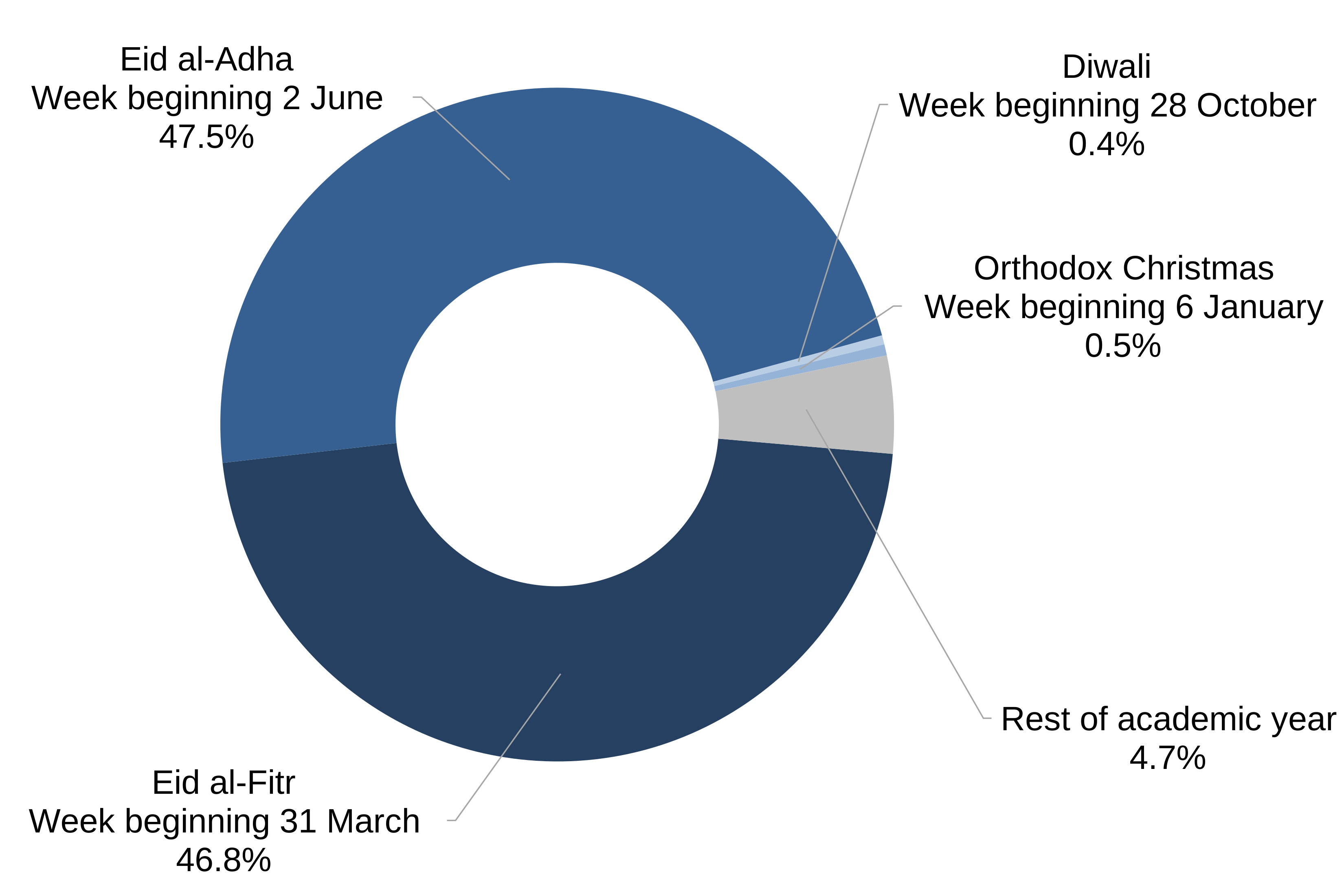
Figure 3 shows the 4 weeks with the highest incidence of code R and the proportion of all code R sessions recorded in those weeks. The highest proportion, 47.5%, is recorded in the week beginning 2 June 2025 (Eid al-Adha), closely followed by the week beginning 31 March 2025 (Eid al-Fitr), at 46.8%.
The 2 weeks with the next highest proportions of code R (both around 0.5% of sessions) are the weeks beginning 6 January 2025 and 28 October 2024. Orthodox Christmas and Diwali, respectively, took place in these weeks, although Diwali coincided with half-term for most schools, so the impact was likely to have been lower than it might otherwise have been.
Birthdays
Around half of all children’s birthdays fall on a school day.
Figure 4: Birthday overall absence rate by national curriculum year group
| Year group | Non-birthday | Birthday |
|---|---|---|
| Year 1 | 5.8% | 7.1% |
| Year 2 | 5.3% | 6.8% |
| Year 3 | 5.1% | 6.9% |
| Year 4 | 5.1% | 7.0% |
| Year 5 | 5.3% | 7.5% |
| Year 6 | 5.5% | 7.6% |
| Year 7 | 6.5% | 9.5% |
| Year 8 | 8.3% | 12.8% |
| Year 9 | 9.3% | 13.7% |
| Year 10 | 9.8% | 13.7% |
| Year 11 | 10.4% | 14.2% |
| All pupils | 6.9% | 9.6% |
Figure 4 shows the average overall absence rate for sessions that fall on a pupil’s birthday compared to rates on all other days, by national curriculum year group.
Across all pupils, overall absence rates are on average 2.7 percentage points higher on birthdays. This gap peaks in year 8, when pupils are almost 55% more likely to be absent on their birthday.
Agricultural shows
Agricultural or county shows take place across the country every year and are important events for rural communities. One such show, the Royal Norfolk Show, takes place annually on the last Wednesday and Thursday in June.
Figure 5 compares attendance rates in primary, secondary and special schools in Norfolk local authority, East of England region and nationally on the last 6 weeks of the 2025 summer term.
Figure 5: Attendance rate in Norfolk local authority, East of England and England (selected dates)
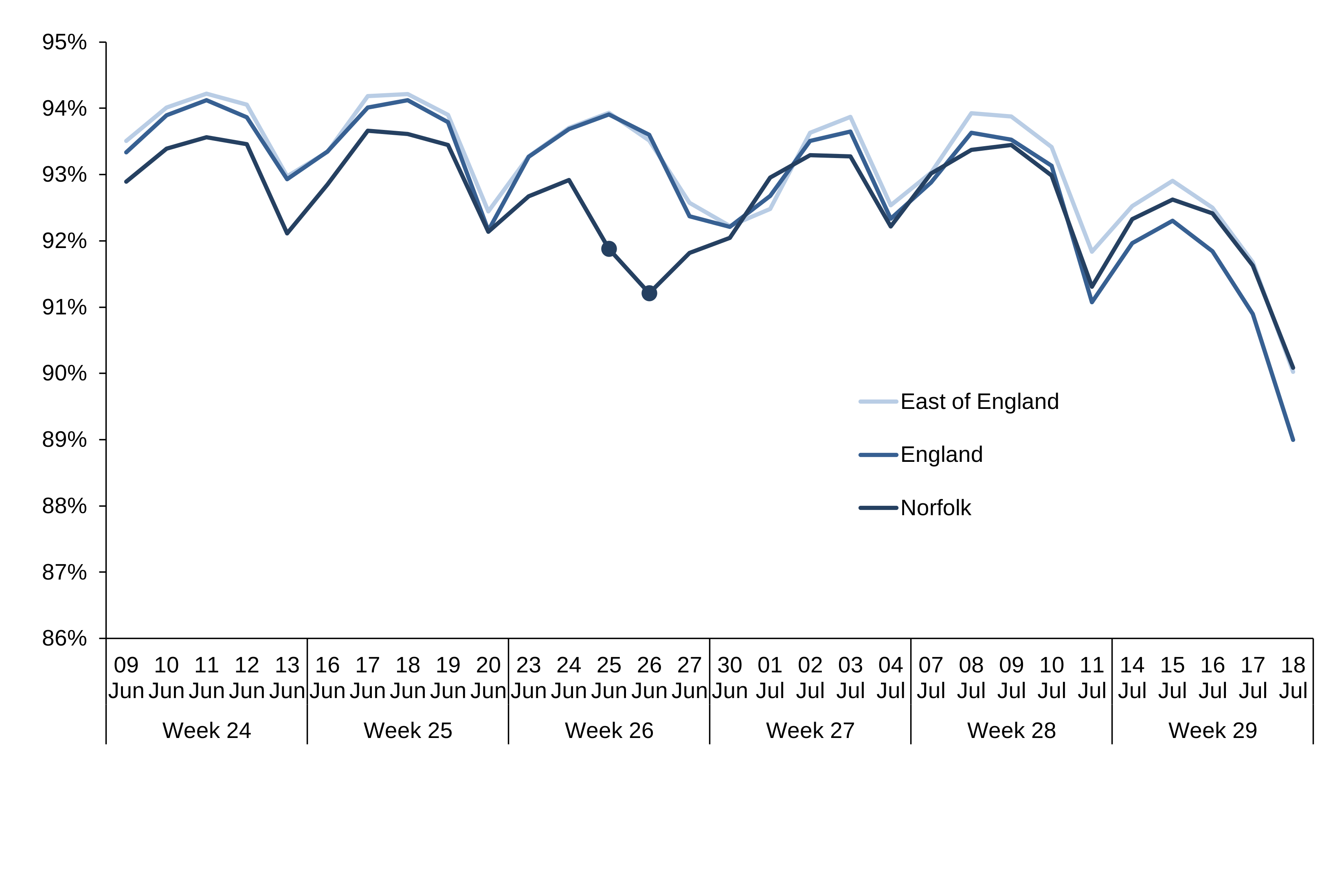
There is a clear pattern of lower attendance every Friday, over this period, but on the 2 dates of the show attendance in Norfolk local authority (highlighted with dots) is much lower than other Wednesdays and Thursdays. The lower attendance on the show days is not replicated in the region or nationally.
Figure 6: Percentage point change in overall absence rate between 19 June 2025 and 26 June 2025 in Norfolk local authority and in England
| Year group | Norfolk local authority | England |
|---|---|---|
| Year 1 girls | 1.5 | 0.1 |
| Year 2 girls | 1.0 | 0.0 |
| Year 3 girls | 0.9 | 0.1 |
| Year 4 girls | 1.9 | 0.0 |
| Year 5 girls | 1.0 | 0.0 |
| Year 6 girls | 3.1 | -0.1 |
| Year 7 girls | 3.1 | 0.1 |
| Year 8 girls | 4.0 | 0.1 |
| Year 9 girls | 3.9 | 0.0 |
| Year 10 girls | 2.9 | 0.0 |
| Year group | Norfolk local authority | England |
|---|---|---|
| Year 1 boys | 1.1 | 0.3 |
| Year 2 boys | 1.4 | 0.1 |
| Year 3 boys | 0.6 | 0.4 |
| Year 4 boys | 1.2 | 0.0 |
| Year 5 boys | 0.4 | 0.3 |
| Year 6 boys | 3.1 | 0.1 |
| Year 7 boys | 2.2 | 0.5 |
| Year 8 boys | 2.1 | 0.4 |
| Year 9 boys | 5.1 | 0.8 |
| Year 10 boys | 4.5 | 0.7 |
Figure 6 shows the percentage point increase in absence on Thursday 26 June (the second day of the show) compared to Thursday 19 June (the Thursday before) broken down by sex and year group, along with the corresponding change in absence nationally on those 2 dates.
All year groups have a higher increase in absence than is seen nationally, with the biggest increases in both boys and girls in year 6 and above. The biggest increase, of 5.1 percentage points (compared to less than 1 percentage point nationally) is in year 9 boys.
Concerts
Taylor Swift played in Liverpool in June 2024. The following analysis looks at overall absence rates in Liverpool local authority on the dates of her concerts (13 and 14 June) compared to the Thursday and Friday of the week before and the week following.
Figure 7: Girls’ overall absence rate in Liverpool local authority by national curriculum year group (selected dates in June 2024)
| Year group | 6 June | 7 June | 13 June | 14 June | 20 June | 21 June |
|---|---|---|---|---|---|---|
| Year 1 | 5.2% | 6.5% | 5.2% | 6.4% | 5.2% | 6.7% |
| Year 2 | 4.5% | 5.8% | 5.2% | 6.6% | 4.6% | 5.7% |
| Year 3 | 5.3% | 6.1% | 5.1% | 7.0% | 5.4% | 5.8% |
| Year 4 | 4.9% | 5.2% | 4.8% | 7.1% | 5.7% | 7.0% |
| Year 5 | 5.8% | 6.9% | 5.7% | 7.3% | 5.6% | 6.7% |
| Year 6 | 6.4% | 7.5% | 7.2% | 9.6% | 6.9% | 8.2% |
| Year 7 | 8.7% | 10.6% | 9.4% | 11.9% | 9.1% | 9.9% |
| Year 8 | 10.3% | 11.7% | 9.7% | 12.3% | 9.6% | 11.1% |
| Year 9 | 11.6% | 12.9% | 12.2% | 14.9% | 11.5% | 12.4% |
| Year 10 | 11.8% | 12.6% | 12.5% | 16.4% | 11.5% | 12.4% |
Figure 7 shows the overall absence rate for girls by year group on the concert and comparator dates.
There was a large increase (between 2 and 4 percentage points) in absence for year 9 and year 10 girls on Friday 14 June compared to the previous and following Fridays.
For year 10 girls, this represents around 30% higher absence on 14 June.
No increase was seen on Thursday 13 June or in other year groups. A corresponding increase was not seen for boys in Liverpool local authority.
Methodology
For details on the data submitted and methodologies applied, refer to the methodology page for the Pupil attendance in schools official statistics releases. For this report, absence rates have been calculated using this methodology.
Weighting has not been applied to the figures provided here. In addition, schools update their registers continually and there is a reporting lag. For these reasons, absence rates may not agree with the published totals.
Expected national curriculum year group based on age has been presented in these analyses, where year 1 is academic age 5 and year 11 is academic age 15.
In line with the official statistics methodology, attendance sessions for 15-year-olds are not included in the half-term following the spring bank holiday. This means that year 11 is not shown in some charts.
Figures relate to totals from all primary, secondary and special schools in the 2024 to 2025 academic year unless otherwise stated.