Releases in error: policy overview
Published 15 April 2026

© Crown copyright 2026
This publication is licensed under the terms of the Open Government Licence v3.0 except where otherwise stated. To view this licence, visit nationalarchives.gov.uk/doc/open-government-licence/version/3 or write to the Information Policy Team, The National Archives, Kew, London TW9 4DU, or email: psi@nationalarchives.gov.uk.
Where we have identified any third party copyright information you will need to obtain permission from the copyright holders concerned.
This publication is available at https://www.gov.uk/government/publications/response-to-the-independent-review-into-releases-in-error/releases-in-error-policy-overview
Introduction
1. On 27 February 2026, Dame Lynne Owens submitted to the Ministry of Justice her Independent Review into Releases in Error. The Government welcomes this review, and places on the record its thanks to Dame Lynne for the thoroughness of her findings and recommendations. The immediate Government response to this review is set out below.
2. This Government made a commitment to Parliament to be transparent on this issue. That commitment has been met through the publication in full of Dame Lynne’s review and the confirmation that recommendations for any changes covered by this Spending Review period will be accepted, with further action to be taken in several areas, and a commitment to all remaining recommendations, subject to future funding decisions.
3. Whilst the overwhelming majority of offenders are released correctly, the number of errors is unacceptably high, and recent cases have exposed deep-rooted issues across the criminal justice system. The Government recognises the profound impact such mistakes have on the victims of those prisoners who are released in error, along with their families and the public.
4. As Dame Lynne notes in her review, releases in error are a symptom of broader systemic challenges. This is a complex issue, and while human error cannot be eliminated entirely, this Government is committed to reducing the risk of such errors and will work to return the number of releases in error to pre prison capacity crisis levels.
5. This Government doesn’t cover up failure; it addresses it. We took immediate action to stabilise our prisons back from the brink. The number of releases in error recorded under this government is now falling. The ad hoc data release published alongside Dame Lynne’s review and this response shows that from April 2025 to March 2026, there have been 179 recorded releases in error from prison. Compared with last year, this represents a 32% reduction.
6. Whilst these errors are still unacceptably high, the numbers are coming down. More must be done and this department is accepting in principle all of Dame Lynne Owen’s recommendations and going further to bring the number of errors as close to zero as possible over the medium term. We will work to drive down the numbers year-on-year, with a plan to reduce releases in errors down to pre-prison capacity crisis levels.
Number of releases in error - 1st January 2012 to 31st December 2025 - England and Wales
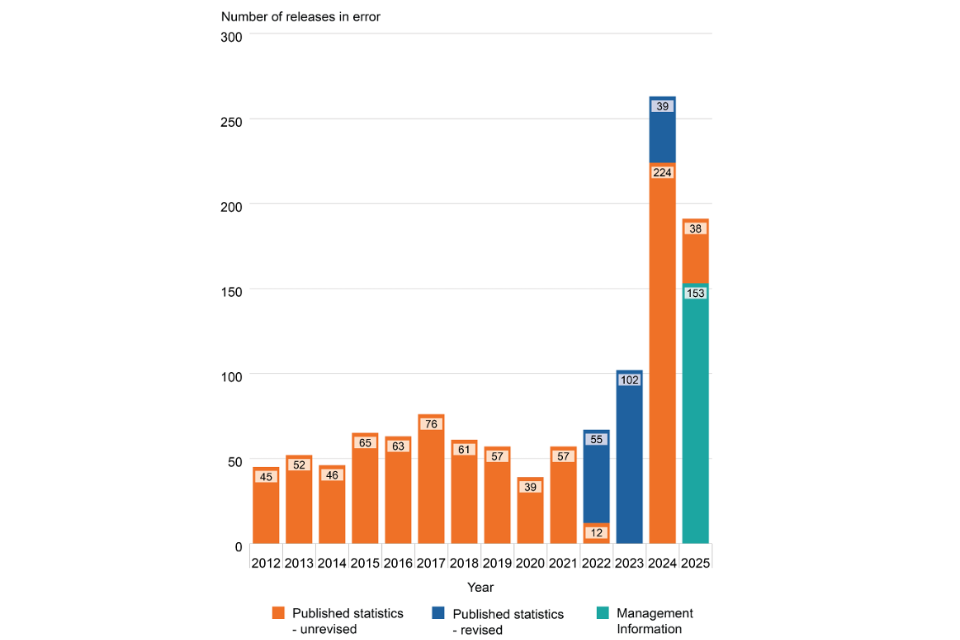
Source: HMPPS Incident Reporting System
-
(1) A prisoner is released in error if they are released when they should otherwise have remained in HMPPS custody and the prisoner or a third party has not deliberately played a part in the error. This data is inclusive of releases in error from HMPPS establishments and Prisoner Escort Custody Services, but does not include any incidents where HMPPS carried out the terms of an order but the order did not reflect the lawful order made by the court due to a HMCTS administrative error, or where the individual did not enter HMPPS custody.
-
(2) Some releases in error incidents are only identified when a prisoner returns to custody at a later date. Consequently, figures for more recent years may increase over time.
-
(3) The Management Information is not fully comparable to the published Official Statistics, because releases in error have had less time to be identified and reported before the data was extracted.
Progress on the five-point national action plan
7. On 11 November 2025, the Government announced a national five-point action plan to address these errors. As part of this, Dame Lynne Owens, former Deputy Commissioner of the Metropolitan Police and former Director General of the National Crime Agency, was commissioned to undertake an independent review and make recommendations to prevent similar mistakes in the future.
8. Whilst this review was underway, this Government has made substantial progress against this five-point plan:
-
The Justice Performance Board first met in November and most recently on 4 March. Chaired by the Deputy Prime Minister, it brings together ministers and the most senior officials within the Ministry of Justice to ensure greater oversight of the system and drive improvements in prisons and criminal courts, laser focussed on addressing key metrics including releases in error.
-
To improve human processes and checks, an urgent query process with a dedicated unit and court experts was introduced, allowing prisons to quickly escalate warrant-related queries and reduce release errors. Since 2 December 2025, this unit supported prisons with over 1,000 warrant matters. In March, we introduced new hourly checks in the Crown Court to flag all cases where custodial status has changed. As of 13 April, this has already prevented ten releases in error since 13 March.
-
The Ministry of Justice announced £10 million to the delivery of AI-based solutions. The Digital Rapid Response Unit has been established and is developing digital and AI products to reduce the main causes of releases in error. Following successful prototyping and testing in selected prisons, we have begun deploying new tools across the estate. This includes harnessing AI enabled data extraction to ensure that key information reaches the right prison at the right time, and embedding advanced data-linking tools to prevent offenders from concealing information through the use of multiple aliases. These tools have been built by forward-deployed engineers at an unprecedent pace. 6 Releases in Error: Government Response to Dame Lynne Owens’ Independent Review
-
The Ministry of Justice is working closely with partners to simplify the release process to reduce the scope for errors through the implementation of the Sentencing Act, which secured Royal Assent on 22 January.
The reviews findings and recommendations
9. Dame Lynne Owen’s independent review was commissioned to examine the mistaken release of Hadush Kebatu from HMP Chelmsford, to consider the wider causes of releases in error, to identify any systemic factors, to assess whether current discharge protocols are robust, and to consider whether the data collected and published is adequate.
10. The review makes 33 recommendations aimed at reducing releases in error. These recommendations span across data and digital, governance, system and process improvements, policy and procedural, training and culture.
11. Dame Lynne rightly warns that these systemic problems cannot be fixed overnight noting that ‘it would be foolhardy to suggest that all risk in a highly challenging operational environment can be mitigated or negated’. Nonetheless, the Government’s ambition is clear: to drive down the number of errors as close to zero as possible. The following sets out how the Government will deliver this work in the immediate, short and medium to long term, guided by the key themes underpinning these recommendations.
Immediate term
12. In the immediate term, we will simplify complex processes across the system. The Ministry of Justice has committed £8m to bolster manual checks across both the Crown and magistrates’ courts. This will include the recruitment and training of 90 additional Crown Court clerks and 75 extra administrative staff in magistrates’ courts. This is in addition to a joint HM Courts and Tribunal Service and Ministry of Justice digital delivery team, established in November, to improve information sharing between court and prison systems. This has enabled early progress against the review’s recommendations, with the team on track to begin transmitting court documents directly to the appropriate prison record this month.
13. We have already revised the Early Removal Scheme operational guidance to improve clarity for staff, and this updated guidance has been published. In addition, we are extending the use of born worn cameras to all uniformed prison personnel working with 8 Releases in Error: Government Response to Dame Lynne Owens’ Independent Review prisoners and in the discharge process, and have invested heavily in increased training. Since the beginning of this year, over 6,000 key staff have received foreign national offender training, including instruction on Home Office protocols.
Short-term
14. In the short term, we are improving communication with victims in the event of a mistaken release, alongside increased digitalisation, and strengthening system-wide data collection and information-sharing.
15. Ensuring victims of crime have the information and support they need remains a government priority. We continue to invest in vital victim and witness support services, providing a record £550 million over the next three years to help these specialist services meet the rising cost pressures of delivery facing services.
16. Last year, we introduced the Victims and Courts Bill to Parliament. The measures in this Bill will help victims get the justice they deserve and ensure victims are better protected than ever. They will also give victims greater confidence about the routes available to receive information about their offender’s release.
17. The Government also fully recognises and shares the emphasis Dame Lynne placed on the importance of victim notification. Reflecting this shared priority, we will accelerate our work to talk with the victims sector and ensure that victims’ views are heard as we clarify our policies on victim contact.
18. Our digital transformation programme is already delivering substantial progress. Several of Dame Lynne’s recommendations build on this and recognise that ‘technology is essential’, not only to reducing releases in error, but to the effective function of a modern criminal justice system. In total, we have already allocated up to £20m for the financial year 2026/2027 for the digitalisation of processes that underpin manual sentence calculations. This includes accelerating staff-facing tools and increasing digital and AI investment in prisons. For instance, a “smart inbox”, which automatically triages misdirected offender information emails, has now been introduced in every reception prison.
19. We are also investing a up to £4 million to accelerate the expansion of the Calculate Release Dates Service, which automates complex sentence calculation and already covers 98.5% of sentence types with exceptional accuracy. Within two years, this 9 Releases in Error: Government Response to Dame Lynne Owens’ Independent Review acceleration will deliver a fully end-to-end system, with court data flowing straight into the correct prison record, including where aliases or spelling variations exist.
Medium to long term
20. In the medium to long term, we will build on the foundations created through increased digitalisation to drive reform across the criminal justice system. This work will be driven forward by a new Digital Justice Board, which will be established shortly. Dame Lynne’s recommendations underline the importance of a joined-up approach, including consideration of how biometrics could support accurate identification across the whole system.
21. The Ministry of Justice is already working closely with the Home Office to develop Justice ID, which will provide a set of building blocks that enable staff to consistently identify and track the same individual from arrest, through the courts and custody, and into the community.
22. This will be supported by up to £50 million of investment in data foundations and developing Justice ID, with initial uses to be rolled out this year. This represents a major step forward, as this goes significantly beyond issuing a new single ID number.
23. Justice ID will allow agencies to share trusted data that is complete, consistent and up to date. It will reduce duplicated data entries and minimise the risk of information being lost as cases progress through the system.
24. We are also actively exploring how biometrics, such as fingerprints and facial scans, could further strengthen Justice ID. This work will also underpin plans to phase out paper records in prisons, reducing omissions, inconsistent record-keeping, and the need for staff to navigate both physical and digital records. We will begin rolling out biometric fingerprint and facial recognition trials within the next six months, and we expect full rollout of biometrics across prisons within 18 months.
25. Taken together, these reforms will support a system in which individuals can reliably track individuals end-to-end, core data flows are automated, and there is measurable improvement in public protection, timeliness and productivity.
26. The Government has already accepted the blueprint set out in Sir Brian Leveson’s Independent Review of the Criminal Courts for bold, structural reform in our criminal courts. It is our intention to rebuild the system through investment, structural reform and modernisation. 10 Releases in Error: Government Response to Dame Lynne Owens’ Independent Review
27. A number of Dame Lynne’s recommendations build on this and recognise that ‘technology is essential’, not only to reducing releases in error, but to the effective function of a modern criminal justice system. In total, we have already allocated up to £20m for the financial year 2026/2027 for the digitalisation of processes that underpin manual sentence calculations. This includes accelerating staff-facing tools and increasing digital and AI investment in prisons.
28. Several of the broader recommendations in Dame Lynne’s review are reflected in cross- criminal justice system reform underway following the reviews led by David Gauke and Sir Brian Leveson. The Ministry of Justice is driving this programme forward, and will ensure that Dame Lynne’s recommendations are part of a coherent, phased approach to wider system transformation, recognising both current financial pressures and the need for alignment across the system.
29. To support delivery, a new second Permanent Secretary has been appointed with responsibility for providing leadership across the whole criminal justice system. The Ministry of Justice will continue to work closely with other government departments and these recommendations.
Conclusion
30. Public safety remains the Government’s foremost duty. The Government is committed to reducing releases in error, and the actions already taken – and those planned in response to Dame Lynne Owens’ review – reflect that commitment. We are backing this up with up to £82m investment over this Spending Review. Through a combination of reform, modernisation and strengthened operational practice, we will reduce releases in error to pre-prison capacity crisis levels, and drive them down year on year, with the ultimate ambition to get as close to zero as possible in the coming years.