Residual waste reduction Environment Act target delivery plan
Published 1 December 2025
Applies to England

© Crown copyright 2025
This publication is licensed under the terms of the Open Government Licence v3.0 except where otherwise stated. To view this licence, visit nationalarchives.gov.uk/doc/open-government-licence/version/3 or write to the Information Policy Team, The National Archives, Kew, London TW9 4DU, or email: psi@nationalarchives.gov.uk.
Where we have identified any third party copyright information you will need to obtain permission from the copyright holders concerned.
This publication is available at https://www.gov.uk/government/publications/residual-waste-reduction-environment-act-target-delivery-plan/residual-waste-reduction-environment-act-target-delivery-plan
Statutory Environment Act target
- by 31 December 2042, the total mass of residual waste excluding major mineral wastes in a calendar year does not exceed 287kg per capita in England.
This is roughly the same as a 50% reduction from 2019 levels.
Interim targets
By December 2030:
- the total mass of residual waste excluding major mineral wastes in the most recent full calendar year does not exceed 437kg per capita
- the total mass of residual waste excluding major mineral wastes in the most recent full calendar year does not exceed 25.5 million tonnes
- the total mass of residual municipal waste in the most recent full calendar year does not exceed 333kg per capita
- the total mass of residual municipal food waste in the most recent full calendar year does not exceed 64kg per capita
- the total mass of residual municipal plastic waste in the most recent full calendar year does not exceed 42kg per capita
- the total mass of residual municipal paper and card waste in the most recent full calendar year does not exceed 74kg per capita
- the total mass of residual municipal metal waste in the most recent full calendar year does not exceed 10kg per capita
- the total mass of residual municipal glass waste in the most recent full calendar year does not exceed 7kg per capita
Rationale for the interim targets: why and how they will progress delivery of the Environment Act target
The interim targets will be mainly achieved through the delivery of our collection and packaging reforms.
The government has convened a circular economy taskforce of experts to help map a transition towards a circular economy. In the new year we will publish a circular economy growth plan that sets out how government will deliver a more circular and more prosperous economy. This will inform the work of the ensuing circular economy programme and will drive our work to go beyond these reforms to repair, reuse and recycle more of what we have and reduce residual waste. After publication we will be able to assess the anticipated impacts of further policies on reducing residual waste and review the interim target ambition when appropriate.
Achieving the interim target to ensure that residual waste excluding major mineral waste in 2029 is no greater than 437kg per capita is approximately a 24% reduction from 2019 levels. This is just under half of the approximately 50% reduction needed to meet the statutory Environment Act target in 2042. Achieving these interim targets will mean that we will be just under halfway to achieving the statutory target in 7 years from when it was set in legislation in January 2023.
Taken as a package, the interim targets take a holistic perspective of waste by incorporating a broad range of materials, including food and plastics. This approach guards against the risk that a target could be reached by switching from one material to another environmentally harmful material type. The targets ensure that residual waste is reduced overall.
Delivery measures
Collection and packaging reforms should achieve over a third of the reduction in residual waste needed to meet the statutory target and most (82% to 100%) of the reduction needed to meet the interim targets. The reforms are:
- simpler recycling
- extended producer responsibility for packaging (pEPR)
- Deposit Return Scheme (DRS) for drinks containers
Estimated contribution to the interim target
Collectively the measures in Table 1 are estimated to make a high contribution to the interim target.
Evidence of impact
After implementation of the collection and packaging reforms, we expect residual waste excluding major mineral wastes per capita to be 23% lower than 2019 levels by the end of 2029. There is strong evidence that the reforms will substantially contribute to achieving the interim targets, contributing between 82% to 100% of the reduction in residual waste needed to meet the interim targets.
The estimated impacts of the collection and packaging reforms on achieving the residual waste reduction interim targets are based on quantitative modelling of future residual waste arisings and anticipated policy impacts.
Table 1. Summary of delivery measures supporting the residual waste reduction delivery plan
| Delivery measure | Description | Responsible | Status |
|---|---|---|---|
| Simpler recycling | Simpler recycling introduces consistent waste collections across England, including free separate food waste collections for all households. Simpler recycling helps ensure that the correct materials are captured for recycling, improving recycling rates and reducing contamination. | Defra, local authorities, businesses | In delivery |
| Extended producer responsibility for packaging | pEPR places the full financial cost of managing household packaging waste onto producers, in line with the ‘polluter pays’ principle. This helps maximise value from resources and minimise waste through the circular use of materials and better incentivises producers to manage resources more efficiently. pEPR was phased in from April 2025. |
Defra, PackUK, Environment Agency (EA) | In delivery |
| Deposit return scheme for drinks containers | The DRS for England, Wales and Northern Ireland aims to increase recycling rates of plastic and metal drinks containers, collect higher quality recycling and reduce litter by placing a refundable deposit paid by consumers at the point of purchase, redeemable when the container is returned to a return point. This will include single-use drinks containers from 150ml to 3 litres made of polyethylene terephthalate plastic, steel, and aluminium. DRS legislates for collection targets, from the baseline of 2022 collections rates, of 76% for PET and 71% for aluminium and steel cans, to 90% for both once DRS is fully operational, by its third year in 2030. |
Defra, Deposit Management Organisation, EA | In delivery |
Key milestones
Key milestones for 2025 include:
- March 2025: Simpler Recycling for businesses (excluding micro businesses) introduced
- April 2025: Extended producer responsibility for packaging phased in
Key milestones for 2026 include:
- Early 2026: publish a circular economy growth plan for England
- March 2026: Simpler Recycling for households introduced by this date
Key milestones for 2027 include:
- March 2027: Simpler Recycling for micro businesses, as well as collection of plastic films introduced by this date
- October 2027: Deposit return scheme for drinks containers introduced
We will determine milestones for additional policies to achieve the statutory Environment Act target as they develop.
Illustrative trajectory
Figure 1 shows historical residual waste arisings from 2010 to 2023 and a forecast of arisings to 2042 in the absence of any intervention based on internal Defra models. This is our business as usual (BAU) forecast. The chart also shows the modelled contribution of the collection and packaging reforms on reducing residual waste, and the required contribution from additional policies beyond the reforms to meet both the interim targets and the statutory Environment Act target. The circular economy growth plan and the wider circular economy programme will inform these policies.
Our BAU forecast is based on outputs from the Future Waste Arisings model, which applies drivers such as economic growth and increases in the population to historical waste data to estimate residual waste arisings into the future.
To calculate the modelled contribution of the collection and packaging reforms, we apply the estimated impacts of the interventions as tonnages removed or added to total waste arisings or residual waste, as well as changes to the waste from households or non-household municipal waste recycling rates. Required contributions from additional policies beyond the reforms are then calculated as the gap between the reduction that is estimated to be achievable through the reforms and the reduction required to be on track to meet the targets.
Our ambition level modelling does not precisely match our reporting metric. This is because whilst the most robust way of estimating residual waste using currently available waste data is to take tonnages of waste sent to residual end-of-life treatment (such as landfill and incineration) and sum these together, as we do for the reporting metric, this has limited options for applying policy impacts. We would only be able to apply impacts to residual waste arisings. To apply policy impacts to total waste arisings and recycling rates, we calculate residual waste using a bottom-up approach that takes total waste arisings and applies recycling rates to arrive at an estimate of residual waste. Due to limitations in waste data that make calculating total waste arisings challenging, this is less robust. This method is more appropriate for the ambition level modelling, and the end-of-life treatment method is more appropriate for robust reporting against whether we have achieved the targets.
Visual analysis of the 2 methods has shown that they trend together well and that it would be appropriate to compare them. Although the chart shows markers at 437 kilograms per capita and 287 kilograms per capita (the target ambition levels), the chart is derived from the ambition level modelling, which is different to the reporting metric used to set the target figures. Therefore, the markers are positioned at the corresponding level in the ambition level modelling to match the target figures.
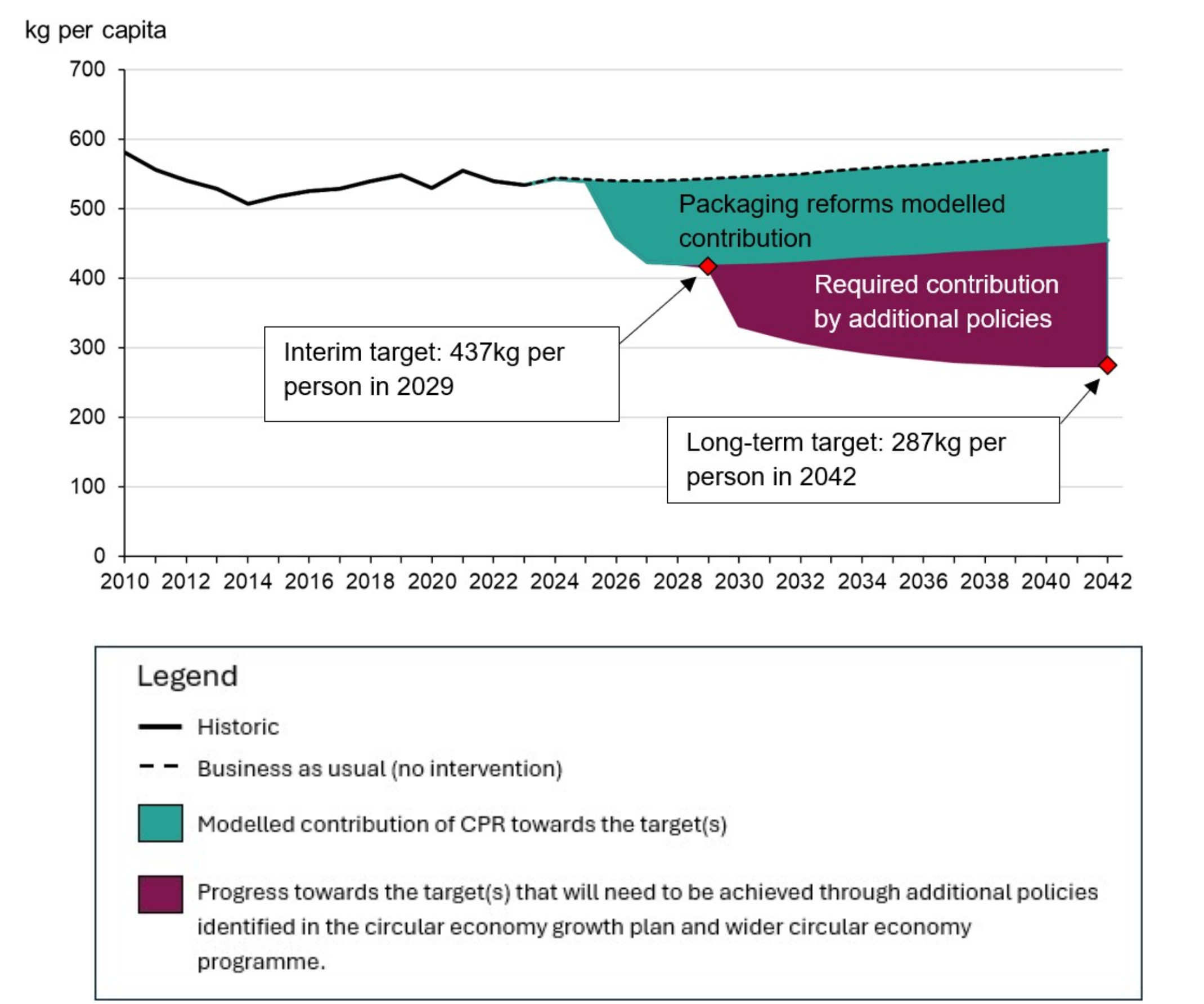
Figure 1. Residual waste excluding major mineral waste after potential future policies, England, kilograms (kg) per capita
The line graph in Figure 1 shows a time series of estimated residual waste excluding major mineral wastes in England (in kg per capita) from 2010 to 2042.
The interim target of no more than 437kg per capita and the statutory Environment Act target of no more than 287kg per capita are shown with markers on the chart in 2029 and 2042, respectively.
The chart includes a black line for historical data up to 2023, a dotted line for the BAU projections from 2023 to 2042, and a green shaded area showing the modelled contribution of the collection and packaging reforms towards the residual waste reduction targets.
Green and purple shaded areas represent the estimated impact of the reforms, and the additional reductions required from future policies, respectively. Without intervention, residual waste per capita is expected to remain at similar levels to the historical data. In 2019, residual waste per capita was approximately 575kg per capita. In 2023, the latest available historical data was 559kg.
Monitoring and evaluation summary
The target metric is reported on an annual basis in the Estimates of Residual Waste and Municipal Residual Waste in England statistical notice. The most recent year with available data is 2023. Figures are reported with an approximately 15-month lag due to the time taken to receive and quality assure data.
Full detail on the method and data underlying the metric is in the methodology document published alongside the statistical notice.