
Reservoir safety research strategy
Published 4 September 2026

© Crown copyright 2026
This publication is licensed under the terms of the Open Government Licence v3.0 except where otherwise stated. To view this licence, visit nationalarchives.gov.uk/doc/open-government-licence/version/3 or write to the Information Policy Team, The National Archives, Kew, London TW9 4DU, or email: psi@nationalarchives.gov.uk.
Where we have identified any third party copyright information you will need to obtain permission from the copyright holders concerned.
This publication is available at https://www.gov.uk/government/publications/reservoir-safety-research-strategy-2026/reservoir-safety-research-strategy
The purpose of this document is to set out a refreshed reservoir safety research strategy.
The strategy will:
- guide research priorities and investment in the coming years
- improve coordination across the sector to ensure research outputs will be useful to practitioners, regulators, reservoir owners and the wider research community
- identify research priorities and areas of interest
We have written it so that any organisation undertaking reservoir safety research may also use it. You can adopt the identified priority research themes to justify and carry out research. This means completed research will meet the needs of the industry now, and in the future.
We have developed this strategy through:
- an evidence-based review of progress against the 2016 Reservoir Safety Research Strategy
- analysis of reservoir incidents and statutory safety measures between 2016 and 2024
- an updated review of climate change research relevant to the reservoir sector
- consultation with a wide range of stakeholders across industry, academia and government
Throughout the production of the report, we have consulted many representatives of the UK and international dams and reservoirs sector. They have provided valuable comments and input.
Representatives include:
- the British Dam Society
- the reservoir safety enforcement authorities in England, Wales, Scotland and Northern Ireland
- members of the Reservoir Engineer Panels for England and Wales
- reservoir owners and undertakers
- members of the Reservoir Safety Research Advisory Group (ReSRAG)
- academic researchers and practitioners working in dam engineering, hydrology, geotechnics and infrastructure resilience
1. Introduction
Reservoirs play a critical role across England in supporting:
- water supply
- flood risk management
- energy generation
- agriculture
- amenity
At the same time, they represent one of the highest-consequence forms of infrastructure if they fail. Around 2.6 million people live or work in areas that could be affected by a major reservoir failure in England. While the UK has a strong safety record, with no loss of life from reservoir failure since 1925, the continued safety of reservoirs cannot be taken for granted.
England and Wales have an ageing reservoir stock, with an average age of over 130 years. Many historical reservoirs were designed and constructed to standards and assumptions that differ from those used today. New demands are being placed on the reservoir safety system by:
- climate change
- evolving land use
- new patterns of development downstream of reservoirs
- advances in engineering and data science
- changes to regulation
These pressures create a clear need to refresh and strengthen the evidence base that underpins reservoir safety management.
This report sets out a new reservoir safety research strategy for the Environment Agency. We carry out research through the flood and coastal erosion risk management (FCERM) research and development (R&D) joint partnership.
The strategy:
- replaces the previous (2016) strategy
- provides a framework to guide research investment and activity over the coming years
- identifies research priorities and areas of interest
It does not commit the Environment Agency or its partners to undertake, fund or complete specific projects. Future research programmes will be subject to:
- governance
- prioritisation
- funding and resource availability
1.1 Why a new strategy is needed
A review of progress against the 2016 strategy shows that important research outputs have been completed by the Environment Agency and its partners. However, many priority topics were only partially addressed or not progressed at all. There has also been limited visibility across the sector of:
- what research has been completed
- what is underway
- how research findings are being used in practice
At the same time, several significant developments have occurred.
Since 2016 there have been 114 dam failures reported to the International Commission on Large Dams (ICOLD, 2026). In the UK, the most notable incident was at the Toddbrook Reservoir in 2019. Subsequent independent reviews led to the establishment of the reservoir safety reform programme.
An expansion of incident reporting has provided a stronger evidence base for identifying trends and learning lessons.
Climate change impacts have become more pronounced. Additional pressure is being put on existing dams from:
- increasing frequency and intensity of extreme rainfall
- drought
- temperature extremes
In some cases, these are changing how and how often dams operate. These factors have contributed to the need for additional water storage and resilience.
Major infrastructure projects are underway to construct new reservoirs. Climate science has advanced, resulting in required updates to methodologies used to manage dams safely. New technologies for monitoring, data analysis and modelling are now emerging. There is growing interest in the use of artificial intelligence. Many European countries are updating their regulations. Research outputs from these can provide benefit to the UK in some cases. It is not always applicable where physical or commercial characteristics are not aligned with UK practice.
Together, these factors make a case for updating the research strategy to make sure it remains relevant, targeted and effective.
1.2 Evidence used to inform the strategy
We have updated the strategy by using a wide-ranging review of evidence, including:
- analysis of reported reservoir incidents and statutory safety measures over the period 2016 to 2024
- a detailed review of progress against the research priorities set out in the 2016 strategy
- an updated literature review on the impacts of climate change on reservoir safety
- engagement and consultation with reservoir owners and undertakers, supervising and inspecting engineers, regulators, academics and industry bodies
This evidence highlights clear and consistent trends. Reservoir incidents are usually associated with design and construction shortcomings in older reservoirs, particularly those built before 1900. Internal and external erosion remain the dominant failure mechanisms. Older embankment dams are repeatedly represented in incident data and statutory safety interventions. Climate change is increasingly acting as a risk multiplier, intensifying existing vulnerabilities rather than creating entirely new ones.
The supplementary report ‘Evidence base for the reservoir safety research strategy’ contains the research completed to inform this strategy.
1.3 Important findings from the consultations
Consultation responses showed strong support for a refreshed research strategy. It also revealed gaps in awareness of previous strategies and research outputs. Stakeholders recognised that research has provided valuable guidance in some areas. However, many felt that findings are not always well communicated or easily accessible. This was particularly the case for smaller reservoir owners.
Stakeholders consistently identified important themes:
- climate change
- learning from incidents
- ageing infrastructure
- resource constraints
- the need for proportionate and risk-based approaches
Barriers to effective research include:
- limited funding and resource to progress projects
- shortages of specialist expertise
- a lack of coordination across organisations
There is, however, a strong willingness across the sector to engage more actively in shaping and carrying out research. To do this, we need a clearer process. It must be more transparent and better aligned with practical needs.
1.4 Strategic focus and priorities
The new strategy proposes a clearer and more structured approach to reservoir safety research. It identifies a set of high-level strategic themes that reflect the most pressing risks and uncertainties facing the sector.
These themes are:
- climate change – understanding how changing rainfall, temperature and extreme weather affect reservoir safety, design assumptions and long‑term risk
- reliability and resilience – improving knowledge of deterioration, ageing assets and system behaviour to ensure reservoirs perform reliably under future conditions
- risk assessment – strengthening methods for estimating probability of failure and consequences, enabling proportionate, evidence‑based decisions
- engineering – advancing guidance, materials, design methods and understanding of erosion, spillways, foundations and other technical components
- regulation and guidance – enhancing inspection, surveillance, reporting and regulatory coherence to support effective, consistent safety practice
- integration of smart monitoring and AI – using sensors, remote monitoring, data science and AI to improve detection, diagnostics and early warning
- environment, social and sustainability – considering biodiversity, environmental impacts, societal risks and opportunities for repurposing or adapting reservoir assets
- resources, relationships and communication – addressing workforce capacity, owner capability, stakeholder engagement and improving communication across the sector
The strategy recognises that not all research needs are purely technical. Social, economic, regulatory and behavioural factors are also critical to ensuring reservoir safety outcomes.
1.5 Improving project process and impact
A key lesson from previous strategies is that identifying research topics alone is not sufficient. Equal emphasis is placed in this strategy on how research ideas are developed, carried out and translated into practice.
The Environment Agency has set out improved processes for:
- turning research needs into well-scoped projects
- selecting appropriate routes to complete research, including collaboration with academia and industry
- monitoring progress against the strategy and reviewing priorities over time
- communicating research outputs clearly and consistently to end users in a timely manner
The strategy promotes flexibility. It recognises that new risks, incidents or policy changes may require priorities to be adjusted.
1.6 Summary
This document sets out our strategic framework for reservoir safety research in England.
We will use the strategy as follows:
- short term (0 to 5 years): to identify well scoped research actions that are ready for commissioning, subject to funding availability
- medium term (5 to 10 years): to maintain visibility of important evidence gaps requiring further development or enabling research
- long term (10+ years): to provide a flexible strategic direction that can respond to emerging risks, incidents, policy changes and technological developments
The evidence base for the reservoir safety research strategy provides the underpinning research.
We will use these documents to identify, prioritise and shape our research. We will seek advice from ReSRAG and work in partnership with other organisations and devolved authorities where appropriate.
The successful implementation of the strategy will depend on continued collaboration across:
- government
- regulators
- industry
- academia
- reservoir owners
With clear priorities, improved coordination and a stronger focus on outcomes, the strategy provides a platform to support safe reservoirs now and into the future.
We encourage other organisations to use the evidence gathered in this strategy to shape, justify and support their own research.
2. Priority themes
2.1 Outputs from supporting research, assessment and consultation
The development of the priority themes builds on the significant amount of research, assessment and consultation carried out to support this strategy.
We undertook a detailed review of the previous strategy and its performance to inform this strategy. While the 2016 strategy triggered very useful outputs and awareness, measurable reporting was limited. Many priority topics remain unaddressed. Research priorities have shifted as result of new and strengthened reasons, such as:
- ageing assets
- lessons from recent incidents
- climate change
- nature-based solutions
- advances in technology
Persistent barriers (limited funding, scarce specialist time and weak coordination) still constrain progress. Industry feedback calls for more practical, accessible outputs for smaller reservoir owners and better sharing of active research. The review identified the requirement for a more robust implementation approach, in which there:
- are clearer roles
- is secure resource
- is regular monitoring and reporting
- is improved dissemination
- is flexible prioritisation
- are sustainable funding mechanisms
Although the UK has had no fatalities because of reservoir failure since 1925, incidents and some failures continue. Analysis shows more incidents happen at older, impounding and embankment dams, in particular, those built before 1900. Design and construction shortcomings are the most common attributed causes across all incidents. Internal erosion is the single most frequent failure mechanism (in ~46% of incidents). Erosion, (including external erosion), features in about 75% of reports. Reporting is improving year on year but trends in the data suggest some incidents go unreported. Measures in the Interest of Safety (MIOS) data mirror incident trends. Older reservoirs require more and longer physical remediation works (median implementation ~18 months). Major systemic pressures shaping risk and research include:
- ageing infrastructure
- panel engineer shortages
- legislative reform
- evolving probable maximum flood (PMF) and flood mapping methods
- rapid advances in monitoring technology
We carried out a literature review to consider UK and international evidence (2013 to 2025) on climate change affecting reservoir safety. This covered:
- embankment dams
- flood storage
- operational aspects
It identified what progress has been made since Atkins (2013) Impact of Climate Change on Dams and Reservoirs (report FD2628). Using a targeted search and systematic mapping of 19 relevant documents, the review finds meaningful advances.
These include:
- high resolution UKCP local convection permitting model outputs
- AquaCAT and role of changing spatial structure on flood flows (Sayers et al., 2023)
- the FUTUREFLOOD project
These improve understanding of extreme rainfall and storm sequencing. Artificial intelligence and machine learning offer new tools for hazard analysis and asset monitoring.
However major gaps remain, notably:
- how climate change should inform PMF/ probable maximum precipitation (PMP) estimation
- how uplifts vary with event severity, duration, seasonality and sequencing,
- translation of meteorological signals into hydrological inflows (including snowmelt)
- wave overtopping
- uncertainty characterisation, alongside limitations in United Kingdom Climate Projections (UKCP) local (single high emissions pathway and some artefacts)
The review concludes that targeted research and clear guidance on uncertainty are still required to make reservoir safety practice robust to climate change.
We consulted reservoir industry stakeholders to define research priorities and improve collaboration. These stakeholders included:
- academics
- panel engineers
- owners
- undertakers
- ReSRAG
Common themes from this consultation were:
- funding constraints
- project resource constraints
- climate change
- monitoring and measurement
- grass embankments and erosion
- asset health and design life management
- skills shortages
- communication
- technology
- policy
- regulation
- calculation of risk and risk management
Short-term research priorities focus on:
- ageing assets
- improved consequence assessment, including non-life impacts
- better monitoring
- targeted technology development
Medium-term priorities include:
- machine learning
- refining threshold triggers and monitoring to predict asset condition
- deterioration
- erodibility
- breach impacts and costs
- sustained industry upskilling
Long-term priorities emphasise:
- climate adaptation
- policy and standards review
- options for reoperation or removal
Crosscutting challenges are
- underfunding
- lack of resource to progress the work
- inconsistent data sharing
- translating research into usable guidance
- limited inspection capacity and declining engineer supply, with disproportionate burdens on small or single site owners
ReSRAG recommended:
- greater transparency and industry engagement
- closer links to funders and owner groups
- targeted scoping to speed up project completion
They noted that securing timely funding and PhD capacity is the principal barrier to implementing the strategy.
2.2 Vision for priority themes
The vision for the identification of the priority strategic themes is to:
- provide a coherent, forward-looking evidence base
- enable proportionate, risk-based and climate-resilient reservoir safety management
- support effective regulation, engineering practice and decision-making across England
Underpinning all these themes is the importance of:
- surveillance and monitoring
- understanding risk
- understanding performance
These principles will continue to push the need for research. They encompass the vision for how research outputs will help our industry.
2.3 Strategic themes and high-level problem statements
The 2016 strategy identified 8 topics for research. These were:
- threats
- mechanisms of deterioration
- operations, monitoring and surveillance
- investigations
- repairs and improvements
- planning design and construction
- risk and hazard assessment/tolerability
- emergency planning
In implementing that strategy, ReSRAG used 8 themes to group together potential projects. These were:
- hydrology and hydraulics
- geotechnics
- structures
- operations
- monitoring and surveillance
- risk and hazard management
- environmental, social and welfare
- dam breach, emergency planning and incident response
- miscellaneous, including seismicity, hydro and mechanical
We have reviewed these previous themes following the research and consultation carried out to inform the update of the strategy. Our new themes group areas where we know there are research problems. They contain sub-themes which suggest areas for work based around the research problems. Each theme and sub-theme:
- is expressed as a high-level problem statement
- is deliberately framed to allow individual projects flexibility in definition, scope and methods
- enables cumulative contribution to the evidence base
The new themes this strategy introduces are displayed in Figure 2-1, and explained in full in sections 2.3.1 to 2.3.8 below. Each main theme has sub-themes listed within the relevant section.
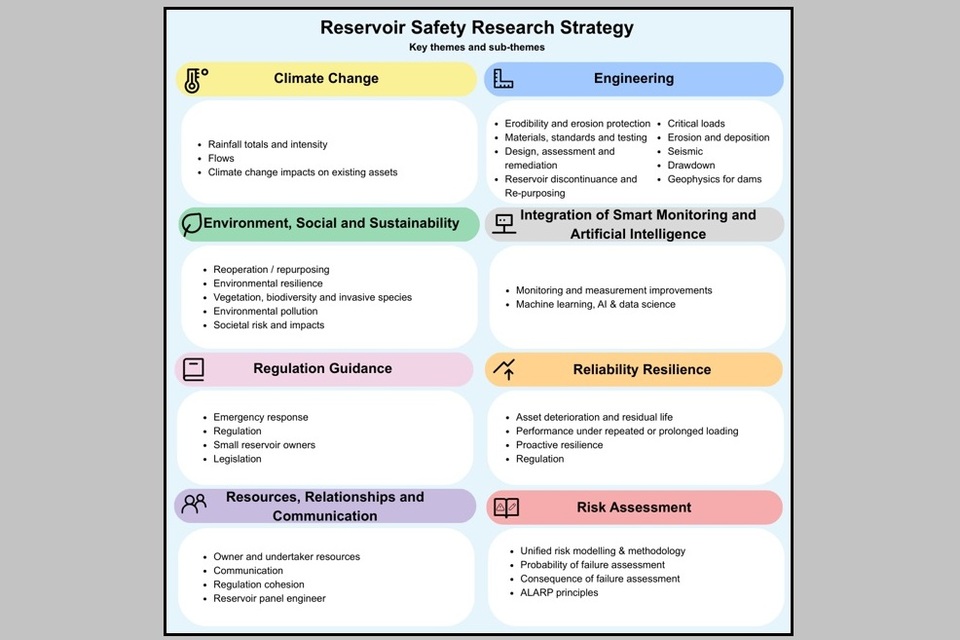
Figure 2-1, summary of priority themes.
2.3.1 Climate change
Climate change is acting as a risk multiplier for reservoir safety. It:
- amplifies existing vulnerabilities in ageing infrastructure
- introduces deep uncertainty into hydrological, geotechnical and operational assumptions
The current evidence base does not yet provide sufficient, proportionate or practical guidance to consistently account for climate change in reservoir safety decision-making.
Rainfall totals and intensity
The way in which extreme rainfall characteristics like magnitude, duration and seasonality are changing is not fully understood. This includes the implications for PMP/PMF estimation, spillway performance and overtopping risk.
Flows
Translating changing rainfall and catchment processes into reservoir inflows, including compound and clustered events and implications for flood storage reservoirs.
Climate change impacts on existing assets
The way in which temperature, drought and increased frequency of extreme events impact on embankment behaviour, material deterioration, vegetation, operational reliability and asset longevity needs to be better understood.
2.3.2 Reliability and resilience
The reliability of reservoirs and associated safety-critical components is increasingly challenged. This is by:
- ageing assets
- legacy design and construction practices
- changing loading and operating regimes
There is incomplete understanding of:
- deterioration mechanisms
- failure precursors
- system dependencies
This limits the ability to predict performance and target interventions effectively. The resilience of the UK reservoir stock needs to be better understood. This will help provide the required existing and future water resource needs.
Asset deterioration and residual life
Aging and long-term deterioration of dams, spillways, valves, pipework and ancillary structures. Residual life, degradation rates and the effectiveness of maintenance and remedial measures.
Performance under repeated or prolonged loading
Reviewing performance of assets under compound, sequences, life cycle and frequency of event. For example, frequent spilling or drawdown impacts on embankments or compiling past spillway incidents.
Proactive resilience
Balancing reactive and preventive maintenance strategies, and investigating how to bolster resilience against external threats such as cyber-attacks, security breaches, terrorism, and vandalism.
Regulation
Investigate long term strategy to manage non-operational reservoirs, for example discontinue, lower water levels to reduce risk or change of use. (Re-)use of existing and creation of new reservoir assets to provide a resilient water storage system for UK industries.
2.3.3 Risk assessment
Current reservoir safety management is constrained by uncertainty. This is in both probability of failure and consequence assessment. Existing tools and metrics can be:
- overly conservative
- insufficiently transparent
- difficult to apply proportionately
This is particularly the case for small reservoirs, older dams and atypical structures.
Unified risk modelling and methodology
Unifying risk models and assessment techniques across the industry, clarifying guidance for flood storage reservoirs, updating breach modelling (including those under 15m), reviewing reservoir flood mapping standards, and integrating public and societal concerns into ALARP guidance. It also covers research on large-scale floods, cross-industry risk assessment commonalities, and international comparisons of predictive breach modelling with real case studies.
Probability of failure assessment
Improving understanding and estimation of probability of failure, including use of indicators, fragility concepts and learning from incidents and MIOS, developing risk assessment guidance for ageing assets not designed to modern standards, analysing high erodibility in relation to risk designations, hazard classification for compound events, and guidance on systems and process failure mechanisms.
Consequence of failure assessment
Improving methods for assessing dam breach consequences, such as ASLL calculations and fragility curves, including considerations for emergency planning and lessons from tsunamis, evaluating non-life loss impacts (environmental, heritage), the value of reservoirs in offsetting costs, human behaviour during failures (for example flood warnings, awareness, demographics), and assigning risk to critical infrastructure like roads and playing fields.
As low as reasonably practicable (ALARP) principles
How to support proportionate, risk-based decision-making aligned with ALARP principles and emerging regulatory reforms.
2.3.4 Engineering
Many reservoirs were designed and constructed to different standards from those applied today. There is a continuing need to adapt modern engineering understanding, methods and materials to legacy infrastructure. We must also ensure that new and modified reservoirs are designed efficiently, sustainably and safely under future conditions.
Erodibility and erosion protection
This sub-theme involves updating industry guidance and standards for embankment and spillway protection, including the revision of CIRIA 116 and grass cover standards. It explores alternative grass mixes and advice on maintenance practices. This includes:
- the use of animals
- temporary protection measures
- performance of reinforced grass under extreme hydraulic conditions
This subtheme also includes the development of guidance and a testing database for internal erosion, and Hole Erosion Testing (HET) for UK soils, leading to breach mechanism assessments
Materials, standards and testing
This sub-theme covers the standardisation of testing for new products and the development of new British Standards. It also includes:
- a review of geotechnical testing methods to assess their suitability for dam engineering
- bespoke materials specifications tailored specifically for dam construction, moving beyond the Specification for Highways Works (SHW)
- the development of new guidance on the use of modified fill materials such as lime treatment
- the application of large inspection pits for identifying shear planes
- the adoption of innovative construction methods drawn from other industries to enhance efficiency and reduce costs
- research into advances in soil-water content testing and instrumentation to support improved monitoring and management practices
Geophysics for dams
Developing geophysics guidance for dams and incorporating it into BRE and other relevant guidance.
Erosion and deposition
The understanding of how hydrology and land use can affect internal and external erosion mechanisms, sedimentation, escapable volume and long-term performance needs to be explored further.
Seismic
Updating seismic guidance for modern practices including updates to reflect seismic hazard assessment advances.
Drawdown
Updating drawdown capacity guidance covering all dam types and control systems and research into risks and impacts of rapid drawdown and proportionality of the existing guidance.
Critical loads
Creating a unified approach to critical load determination and updating wave wall loading and overtopping methodologies.
Design, assessment and remediation
For embankments, spillways and foundations.
Reservoir discontinuance and re-purposing
Engineering guidance for reservoir discontinuance, re-purposing and maintaining empty reservoirs, together with associated issues such as environmental and flood risk.
2.3.5 Regulation and Guidance
The effectiveness of reservoir safety regulation depends on consistent inspection, surveillance, reporting and enforcement. This must be supported by clear guidance and high-quality data. Variability in practice, data quality and interpretation currently limits systematic learning.
Emergency response
Development of a best practice guidance for emergency plan test requirements across all dam types, especially flood retention reservoirs and non-impounding reservoirs, as well as investigating methods for inspection during flood events.
Regulation
Cohesive guidance across planning, consenting, MIOS processes and regulatory coherence for construction works on new and existing reservoirs.
Small reservoir owners
Supporting regulatory reform through evidence that informs roles, responsibilities, thresholds and compliance approaches.
Legislation
Guidance supporting new legislation and explaining stakeholder roles.
2.3.6 Integration of smart monitoring and artificial intelligence
There are significant opportunities to enhance reservoir safety due to rapid advances in:
- sensing
- remote monitoring
- data analytics
- artificial intelligence (AI)
Their adoption is constrained by uncertainty over reliability, governance, explainability and appropriate use in safety-critical contexts.
This theme includes sub-themes to address the following areas where improvements have been noted to be required:
Monitoring and measurement improvements
Integration of smart monitoring technologies such as remote sensing, IoT, geophysics and telemetry into routine surveillance and inspection.
Machine learning, AI and data science
Use of data analytics and AI/ML to detect anomalies, trends and early warning signals. Development of frameworks for assurance, validation, explainability and cyber security. Ensuring technology augments, rather than replaces, professional judgement.
2.3.7 Environment, social and sustainability
The interaction between reservoir safety, environmental factors and the impact on society needs to be better understood. This includes both people living downstream of reservoirs and benefiting from reservoirs. How reservoirs can be managed to ensure a sustainable future is also a priority.
Reoperation / repurposing
UK environmental opportunities for reoperating or repurposing dams and reservoirs, as well as renewable energy potential at new and existing sites
Environmental resilience
Ensuring the environmental benefits and impacts of dams can be understood and maximised
Vegetation, biodiversity and invasive species
Creating and improving guidance on permitted vegetation and biodiversity opportunities on dams, managing species such as crayfish, ruff fish, mussels and beavers and balancing ecological value with safety requirements, resilience in the context of changing environmental, ecological and biodiversity pressures and targets (for example Biodiversity Net Gain, carbon calculations, Nature Based Solutions).
Environmental pollution
Updated pollution categories and implications for scour testing
Societal risk and impacts
Public awareness and learning from reservoir safety incidents
2.3.8 Resources, relationships and communication
We need a better understanding of the resources available for the management of reservoirs for different types of owners. Also, the effects of likely changes in the industry on resource availability. This will make sure that any potential deficits can be identified and mitigated. Improvements could be made in communication and relationships across the sector both nationally and internationally. This could facilitate research and ensure the long-term safety of UK reservoirs.
Owner and undertaker resources
- Education on research benefits, dialogue on on‑site plans and exercises, guidance on legal and data requirements, practical self‑help and international best practice, support for owners with limited resources
Communication
- Public education about reservoir safety and risk, communicating technical matters to non‑technical owners, improving connections within the reservoir industry, improving external industry connections, for example nuclear, agriculture, energy, aerospace
Regulation cohesion
- Across institutions should be improved, for example communicating necessity of scour tests within new environmental regulations
Reservoir panel engineers
Resource availability, career progression and diversity.
3. Conclusion
The new strategy points to a consistent set of technical and systemic priorities which have been informed by:
- reviews of safety incidents
- statutory measures
- updated scientific evidence about climate change
- stakeholder engagement
Underpinning all of this is the ongoing value of evidence. Core requirements in enabling safe dams and reservoirs include:
- surveillance and monitoring
- understanding performance
- understanding risk
Future research to enhance our knowledge in these areas across all the identified themes above will be vital. This will help our assets perform safely and resiliently. Management should be able to change and allow flexibility and adaptation to the varied pressures affecting them.
Implementing the strategy will require sustained collaboration across regulators, owners, practitioners and academia. Improved coordination, clear communication of outputs and progress is vital. We will also focus on turning research into usable guidance and tools.