Public Procurement: Common Framework (HTML)
Updated 26 November 2026

© Crown copyright 2026
This publication is licensed under the terms of the Open Government Licence v3.0 except where otherwise stated. To view this licence, visit nationalarchives.gov.uk/doc/open-government-licence/version/3 or write to the Information Policy Team, The National Archives, Kew, London TW9 4DU, or email: psi@nationalarchives.gov.uk.
Where we have identified any third party copyright information you will need to obtain permission from the copyright holders concerned.
This publication is available at https://www.gov.uk/government/publications/public-procurement-common-framework/public-procurement-common-framework-html
1. What we are talking about
1.1. Policy area
1.1.1. Public Procurement
1.2. Preamble
1.2.1. The UK Government, Scottish Government, Welsh Government and Northern Ireland Executive have agreed to work together to establish Common Frameworks, in some areas that have historically been governed by EU law, but which otherwise fall within areas of devolved competence.[footnote 1] The establishment and content of Common Frameworks are guided by the principles (‘the Frameworks Principles’) set out in the Joint Ministerial Committee (EU Negotiations) (JMC(EN)) communique of 16 October 2017.
1.2.2. This Common Framework for Public Procurement is being established because it is considered necessary to achieve the following outcomes set out in the Frameworks Principles:
- enable the functioning of the UK internal market, while acknowledging policy divergence
- ensure compliance with international obligations, and
- ensure that the UK can negotiate, enter into and implement new trade agreements and international treaties.
1.2.3. The management of common resources is not part of the rationale for this Common Framework.
1.2.4. This Common Framework is to be read in conjunction with the following:
a. Devolution Memorandum of Understanding and supplementary agreements (‘the MoU’) dated October 2013 between the UK Government and the Scottish Ministers, the Welsh Ministers, and the Northern Ireland Executive, taking into account any future amendments to the MoU, and the conclusions of the Intergovernmental Relations Review
b. Devolution settlements for Scotland, Wales, and Northern Ireland.[footnote 2]
1.2.5. References to devolved competence, devolved matters, and reserved matters are to be construed in accordance with the relevant devolution settlement.
1.2.6. This Common Framework between the UK Government, the Scottish Government, the Welsh Government, and the Northern Ireland Executive (‘the Parties’, also referred to as ‘the Parties to the Common Framework’), is not intended to confer any rights or obligations that are legally enforceable.
1.3. Scope
1.3.1. This Common Framework (see definitions in Section 1.4) will establish agreed working practices between the Parties in relation to domestic and international public procurement policy and legislation. Specifically, it will cover the following:
- consultation and exchange of information
- development of policies and legislation
- engagement between the Parties on the World Trade Organisation Government Procurement Agreement (WTO GPA) business
- international agreements, for example, the EU-UK Trade and Cooperation Agreement.
1.3.2. It is intended to guide the actions of the Parties in respect to these matters, in particular the actions of officials working on procurement policy.
1.3.3. The relevant legislation for this Common Framework, as may be amended from time to time, is as follows:
- the Procurement Act 2023
- the Procurement Regulations 2024
- the Procurement (Wales) Regulations 2024
- the Social Partnerships and Public Procurement (Wales) Act 2023 and
- the Social Partnership and Public Procurement (Wales) Regulations 2026
- the Health Service Procurement (Wales) Act 2024 and
- the Health Services (Provider Selection Regime) (Wales) Regulations 2025
- the Public Contracts (Scotland) Regulations 2015
- the Concession Contracts (Scotland) 2016 and
- the Utilities Contracts (Scotland) Regulations 2016
The following legislation, although revoked by the Procurement Act 2023, continues to have transitional effect by virtue of the Procurement Act 2023 (Commencement No.3 and Transitional and Saving Provisions) Regulations 2024:
- the Public Contracts Regulations 2015
- the Concession Contracts Regulations 2016
- the Utilities Contracts Regulations 2016
The 2015 and 2016 regulations referred to above were transposed from a series of EU Directives (‘the Directives’):
- 2014/23/EU Concession Contracts Directive 2014
- 2014/24/EU Public Contracts Directive 2014
- 2014/25/EU Utilities Contracts Directive 2014
- 89/665/EEC Remedies Directive as amended by 2007/66/EC
1.3.4. The EU Commission and Member States negotiated the contents of the Directives.
1.3.5. The Directives provided a framework based around the EU Treaty principles of equal treatment, non-discrimination, proportionality, and transparency.
1.3.6. The Public Procurement (Amendment etc.) (EU Exit) Regulations 2020 and the Public Procurement etc. (EU Exit) (Scotland) (Amendment) Regulations 2020[footnote 3] were laid to amend the EU-derived Procurement Regulations at the end of the transition period to ensure they continued to work. These statutory instruments implemented the Withdrawal Agreement and fixed deficiencies caused by the UK leaving the EU.
1.3.7. There was considerable flexibility within the rules for different parts of the UK to transpose Directives differently. However, the Parties did not diverge significantly when transposing the Directives. The Procurement Act 2023 implements a distinct regime for all contracting authorities other than devolved Scottish contracting authorities, which remain subject to the rules derived from EU Directives. The Act will take effect from February 2025.
1.3.8. The Procurement Act 2023 represents a shift away from the EU Directives for the UK Government, the Welsh Government and the Northern Ireland Executive. The purpose of the Procurement Act 2023 is to reform the United Kingdom’s public procurement regime following its exit from the European Union (EU).
1.3.9. The reforms are guided by the following “principles of public procurement” set out in the Transforming Public Procurement Green Paper: value for money, public good, transparency, integrity, equal treatment and non-discrimination.
1.3.10. The UK participated in the WTO GPA under EU membership since its inception and continued to participate as if it were an EU member during the transition period. The UK joined the WTO GPA in its own right on 1 January 2021 and consequently has continued to comply with the WTO GPA rules.
1.3.11. Each of the Parties will develop and publish its own policies for procurement.
1.3.12. Public procurement is governed by legislation and seeks to align itself with other policies/principles where appropriate and proportionate, including, but not limited to:
- anti-corruption strategy[footnote 4]
- value for public money principles (see HMT Managing Public Money[footnote 5], WG Managing Welsh public money[footnote 6], Scottish Public Finance Manual[footnote 7], Managing Public Money NI [footnote 8])
- transparency policy[footnote 9], Welsh Government Publication Scheme[footnote 10], Scottish Procurement Open Contracting Strategy[footnote 11], NI Publication Scheme[footnote 12]
- public sector duties/code of conduct/Corporate Governance Code/Open government[footnote 13]
- social value/well-being legislation, for example Well-Being of Future Generations (Wales) Act 2015[footnote 14], Social Partnership and Public Procurement (Wales) Act 2023[footnote 15], Northern Ireland Public Procurement Policy[footnote 16], UKG Public Procurement Policy[footnote 17], Scottish Government’s National Performance Framework,[footnote 18] Welsh Government Public Procurement Policy[footnote 19].
- Scottish Procurement Policy Notes[footnote 20]
- government funding policies
1.3.13. The outcomes of the Review of Intergovernmental Relations are reflected in this Common Framework.
1.3.14. The policy area covered by this Common Framework intersects with the EU-UK Trade and Cooperation Agreement, and therefore topics relevant to the Framework may be considered from time to time by relevant TCA Specialised Committees or the Partnership Council. Where a UK–EU meeting agenda includes an item concerning implementation in an area of devolved competence, the UK Government should facilitate the attendance of the Scottish Government, Welsh Government and Northern Ireland Executive of a similar level to that of the UK Government representatives, with final discretion as to the UK delegation a matter for the UK co-chair. The UK Government should engage the Scottish Government, Welsh Government and Northern Ireland Executive as fully as possible in preparation for these meetings regardless of attendance, and on all relevant implementation matters.
1.3.15. There is no intersection between procurement policy as relevant to this framework and the Northern Ireland Protocol including the Windsor Framework.
1.3.16. Not in scope. The following are out of the scope of this Common Framework:
- contract award procedures that are:
- covered by the Defence and Security contracts in Section 7 of the Procurement Act 2023.
- worth less than the relevant WTO GPA thresholds or
- otherwise excluded from the scope of:
- the Procurement Act 2023
- the Procurement Regulations 2024
- the Public Contracts (Scotland) Regulations 2015
- the Concession Contracts (Scotland) 2016 and
- the Utilities Contracts (Scotland) Regulations 2016
- The Procurement Reform (Scotland) Act 2014 and Procurement (Scotland) Regulations 2016
1.4. Definitions
1.4.1. ‘UKG’ refers to the UK Government, while ‘SG’ refers to the Scottish Government, ‘WG’ refers to the Welsh Government and ‘NIE’ refers to the Northern Ireland Executive.
1.4.2. The ‘Parties’ means the UK Government, the Scottish Government, the Welsh Government, and the Northern Ireland Executive.
1.4.3. A ‘Common Framework’ sets out a common approach to certain policy areas that fall under devolved competence, which were previously governed by means of EU legislation, where it has been recognised that a particular level of continued cooperation is required. This Common Framework proposes to formalise agreed-upon approaches through an exchange of ministerial letters.
1.4.4. References to ‘devolved competence’, ‘devolved matters’, and ‘reserved matters’ are to be construed in accordance with the relevant devolution settlement.[footnote 21]
1.4.5. The ‘Frameworks Principles’ refers to principles set out for the development of Common Frameworks in the JMC(EN) communique of October 2017.
1.4.6. The Common Framework Working Group (also referred to here as ‘the Working Group’) and the Common Framework Liaison Group (also referred to here as ‘the Liaison Group’) are the two official-level working groups operating as part of this Common Framework. Terms of Reference are set out at Annex A.
2. Proposed breakdown of policy area and framework
2.1. Summary
2.1.1. With due regard to the democratic accountability of the UK Parliament and the devolved legislatures, in a way that respects the devolution settlements, the Common Framework ensures that decision making in relation to public procurement is carried out consistently with the Common Framework Principles agreed at JMC (EN).
2.1.2. Each of the Parties will continue to develop and publish its own policies for procurement, and the Common Framework provides the vehicle to discuss those policies. The Parties will ensure that they give full and proper consideration to each other’s views and will endeavour to achieve consensus in areas of mutual interest without prejudice to the respective competence of each of the Parties. Ministers and officials of each of the Parties will maintain close working relationships and will inform each other at an early stage of any relevant proposals or other developments at the domestic level on, or which may affect, public procurement, including any proposals to legislate or significant litigation of potentially wider significance. The Parties undertake to conduct their relationship on a “no surprises” basis. The Parties also agree on the need for confidentiality of discussions, without which it would be impossible to maintain such close working relationships.
2.1.3. The Frameworks Principles agreed at JMC (EN) state that Frameworks will be established where necessary to ensure the UK can negotiate, enter into, and implement new trade agreements and international treaties, and ensure compliance with international obligations. These principles were established in the context of an ambition for close working between the UK Government and the devolved governments on reserved matters that significantly impact devolved responsibilities in Common Frameworks.
2.1.4. Common Frameworks will allow the Parties, in a timely manner, to ascertain the impact of international trade on managing UK policy divergence. All Parties to the Framework will consider any impact in a way that meets the requirements of the Frameworks Principles. Common Frameworks will afford an opportunity to consider any implications stemming from international trade that have a direct bearing on the operation of a Common Framework. The scope of this consideration will not extend beyond Common Frameworks.
2.1.5. International policy formulation will be developed in line with the current Devolution MoU and its accompanying International Relations Concordat. International obligations will be implemented in line with these agreements. In this respect, the Parties will automatically use any updated IR Concordat, and the wider outcomes of the Joint IGR Review, as the basis for such international considerations.
2.2. Overview of the proposed framework: legislation
2.2.1. Legislation will not be required to implement this Common Framework.
2.3. Overview of the proposed framework: non-legislative arrangements
2.3.1. Ministers in the UK Government and devolved governments will concurrently agree to adopt the Common Framework, at which point the final version of the Framework will be published.
3. Proposed breakdown of policy area and framework
3.1. Decision making: general
3.1.1. In considering any new policies relating to public procurement, and any proposals to legislate, the Parties commit to working consistently with the Frameworks Principles. The Parties will also maintain principles of non-discrimination, equal treatment, and transparency with respect to economic operators from the UK.
3.1.2. The Parties acknowledge that contracting authorities and UK businesses can benefit from consistent approaches to public procurement policy and regulation and will therefore, where it is deemed advantageous, seek to identify common approaches in these areas. Any common approach will be subject to agreement between the Parties. The Parties reserve the right to develop policies and regulate independently in accordance with their respective competences, where they consider it appropriate.
3.1.3. Where one or more of the Parties does identify an area in which they wish to take a policy or regulatory approach that is different in substance from that taken by the other Parties, they should assess the impact of that approach on the other Parties and its compatibility with the Frameworks Principles. In accordance with the mechanisms set out in this Common Framework, where such an approach is likely to impact upon another of the Parties, the Party or Parties will notify and consult the other Parties with respect to their intended action at a monthly official-level Common Framework Working Group. Should any of the Parties object to the action in question on the grounds that it is contrary to the provisions set out in the Common Framework, the Parties will endeavour to identify a mutually acceptable approach that would achieve an equivalent, or preferably identical, outcome. If no mutually acceptable resolution is found, the objecting Party or Parties may initiate the formal dispute avoidance and resolution procedure set out in the Common Framework.
3.1.4. In addition to the monthly official-level Common Framework Working Group, a twice-yearly Common Framework Liaison Group meeting will be held between officials. This will provide the Parties with the opportunity to consult on any matters relating to the operation of this Common Framework or the furtherance of its objectives. The Parties will share the chairing of this meeting on a rotating basis.
3.1.5. Decisions will be tracked through the minutes of the official-level monthly Common Framework Working Group and twice-yearly Common Framework Liaison Group, which will include representatives from each of the Parties. Individual Parties will clear any amendments/updates to the Common Framework through their own processes.
3.1.6. No decisions will need to be taken by third parties.
3.1.7. The following roles will apply in the context of decision making and dispute avoidance:
| Role | Description |
|---|---|
| Officials | Advise ministers, with rationale for UK-wide approach or why divergence is appropriate. If officials do not agree, escalate to senior officials. |
| Senior officials | Senior officials may review an issue if officials are not able to agree on an approach, or if ministers have remitted the advice back to officials, in another attempt to reach consensus. |
| Ministers | Advice from officials is submitted to ministers for decision. Ministers will serve as the primary actors in the joint decision-making process. If an issue is remitted to senior officials and remains unresolved, it may be escalated to ministers via the dispute avoidance process. |
| Senior ministers | Where required on a case-by-case basis, ministers may need to seek the approval of senior ministers. |
| Intergovernmental Relations dispute resolution mechanism. | If ministers and senior ministers cannot resolve an issue, escalation to the Intergovernmental Relations Secretariat to consider the overarching process for dispute avoidance and resolution through the Inter-Ministerial Standing Committee takes place. |
3.2 Decision making: roles and responsibilities of Common Framework parties on WTO GPA business
3.2.1. Interests of all Common Framework parties will be represented on the WTO GPA Committee by UKG.
3.2.2. Agenda items on areas of devolved competence (or areas that may impact devolved competence) will be shared by UKG policy leads with other Common Framework parties for comment as soon as practicable once received from the WTO. The UKG lead will consult with SG, WG, and NIE officials on the most appropriate involvement of SG, WG, and NIE officials related to issues relevant to their devolved responsibilities.
3.2.3. For interventions in an area of devolved competence, the UKG GPA lead will involve relevant officials of the other Common Framework parties as fully as possible in the intervention process and seek to agree on the approach and wording prior to the GPA Committee meeting. This is to ensure consistency of the UK’s membership ‘voice’. SG, WG, and NIE commit to providing timely information to support UK interventions, engagement, and notifications as needed.
3.2.4. UKG leads are responsible for the final clearance and distribution of any GPA Committee materials, and sharing updates and information with other Common Framework parties following GPA Committee meetings.
3.3 Roles and responsibilities of each Party to the Common Framework
3.3.1. The Parties confirm their commitment to consult and exchange information on matters that will impact upon another of the Parties in relation to the handling of policy issues on public procurement, including any proposals to legislate, in a timely and cooperative manner, and to give appropriate consideration to the views of each other. There will be regular consultation between public procurement officials from the Parties to ensure that there is effective cooperation between the Parties and that the business of all operates effectively and efficiently in relation to these matters. To this end, unless agreed otherwise, there will be a monthly Common Framework Working Group meeting between officials of the Parties, normally by teleconference, to discuss general operational matters (as summarised above and set out in the Annex below).
3.3.2. In accordance with the coordination mechanisms set out in the MoU, advance notification of and consultation on policy initiatives and associated announcements likely to impact one or more of the Parties, as well as all legislative proposals relating to public procurement (including subordinate legislation), will normally take place between officials not less than one month prior to the announcement. In the case of legislative proposals, including subordinate legislation, advance notification and consultation will normally take place at least three months prior to the introduction of primary legislation and the making of secondary legislation.
3.3.3. In addition to official-level engagement, ministers from the Parties will continue to correspond in writing as appropriate.
3.3.4. In accordance with the MoU, all Parties will also encourage joint working by, for example, inviting officials of the other Parties to joint working groups, which may be of interest to them.
3.3.5. The monthly Working Group and twice-yearly Liaison Group described in sections 3.1.4 and 3.1.5 above and the Annex below will provide Parties with the opportunity to consult on any matters relating to the operation of this Common Framework or the furtherance of its objectives.
3.4 Roles and responsibilities of existing or new bodies
3.4.1. External bodies do not currently have any role, and a future role is not anticipated except as engaged in the Review and Amendment mechanism (see below).
3.4.2. Each of the Parties will continue to consult existing third parties/groups on matters of procurement policy, and significant policy changes will be subject to engagement with key stakeholders, including representative sector groups. There is also an option to consult such parties/groups on amendments to the Common Framework.
3.5 Monitoring and enforcement
3.5.1. The twice-yearly Common Framework Liaison Group meeting will provide for full proper consultation and cooperation between the Parties and assess:
- intergovernmental cooperation and collaboration as a result of the Common Framework
- whether Parties are implementing and complying with the Common Framework
- whether divergence has taken place in contravention of the Framework principles
- the impact of divergence across the UK
- whether a change is required to the Common Framework as a result of any dispute.
3.5.2. The outcome of this meeting will be used to inform joint decision-making going forward and the next review and amendment process. If there is an unresolved disagreement, the dispute avoidance and resolution mechanisms may be used.
3.6 Review and Amendment mechanism
3.6.1. The Common Framework, and the functioning of intergovernmental relations generally, will be reviewed after one year of its coming into operation, and every three years thereafter. Any of the Parties may request an additional (‘exceptional’) review if they consider it necessary (for example, to propose new provisions as the relationship develops).
3.6.2. This Review and Amendment mechanism (RAM) ensures that the Common Framework can adapt to changing policy and governance environments in the future. There are two types of reviews, which are outlined below. The process for agreeing amendments should be identical regardless of the type of review.
3.6.3. The RAM relies on consensus at each stage of the process from the ministers responsible for the policy areas covered by the Common Framework.
3.6.4. At the outset of the review stage, the Parties to the Common Framework must agree on timelines for the process, including the possible amendment stage.
3.6.5. If an agreement is not reached in either the review or amendment stage, Parties to the Common Framework can raise it as a dispute through the Common Framework’s dispute avoidance and resolution mechanism.
3.6.6. Review stage:
- After the initial review following the first year of operation, a periodic review of the Common Framework will take place every three years, in line with official or ministerial-level meetings.
- The period of three years starts from the conclusion of a periodic review and any amendment stages that follow.
- During the periodic review, Parties to the Common Framework will discuss whether the governance and operational aspects of the Common Framework are working effectively, and whether decisions made over the previous three years suggest the Common Framework needs to be updated.
- An exceptional review of the Common Framework is triggered by a ‘significant issue’.
- A ‘significant issue’ could be time sensitive or fundamentally impact the operation and/or the scope of the Common Framework.
- The exceptional review may include a review of governance structures if all Parties agree that it is required. Otherwise, these issues are handled in the periodic review.
- The same significant issue cannot be discussed again within six months of the closing of that issue.
- The amendment stage can only be triggered through a unanimous agreement by ministers. If Parties agree that no amendment is required, the relevant time period begins again from the date of that agreement for both review types (for example, it will be three years until the next periodic review and at least six months until the same significant issue can trigger an exceptional review).
3.6.7. Amendment stage:
- Following an agreement that all Parties wish to enter the amendment stage, Parties will enter into discussion around the exact nature of the amendment. This can either be led by one Party to the Common Framework or all.
- If an amendment is deemed necessary during either type of review, the existing Common Framework will remain in place until a final amendment has been agreed upon.
- All amendments to the Common Framework must be agreed upon by all Parties and a new non-legislative agreement signed by all Parties.
- If Parties cannot agree whether or how the Common Framework should be amended, this may become a disagreement, and as such could be raised through the Common Framework’s dispute avoidance and resolution mechanism.
- Any changes to this Common Framework must be agreed upon unanimously by ministers in writing.
3.7 Dispute resolution
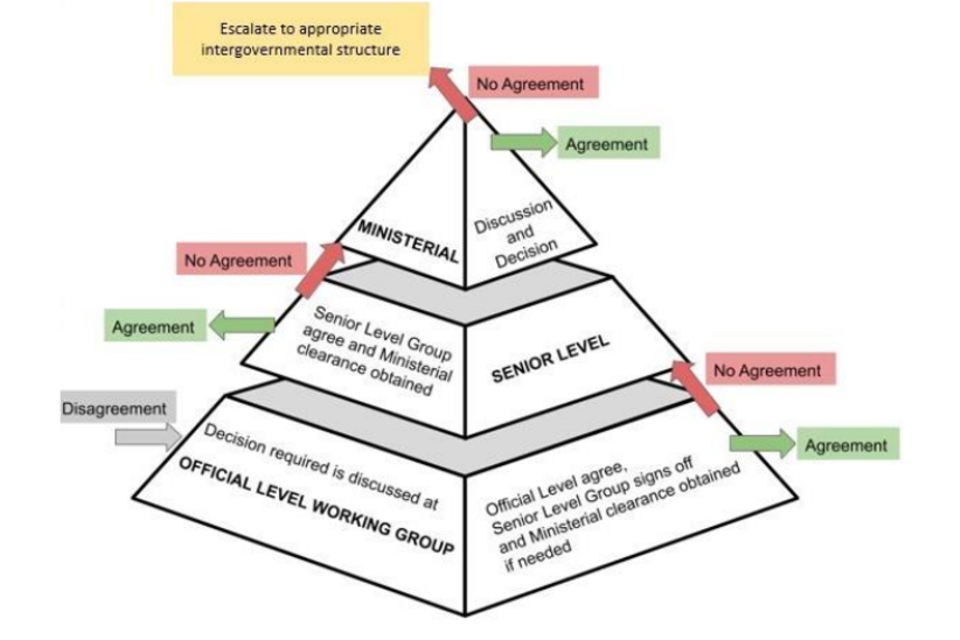
3.7.1. A difference may arise in cases where one or more of the Parties consider that another of the Parties has taken or intends to take an action that does not adhere to the provisions set out in the Common Framework. This is termed a ‘disagreement’. A disagreement between Parties of this Common Framework becomes a ‘dispute’ when it enters the formal dispute avoidance and resolution process set out in the Review of Intergovernmental Relations.
3.7.2. The main intention of the Common Framework is to provide a framework for full and proper consultation and cooperation. The Parties intend that this will minimise the chances of disagreements and disputes occurring. Where differences do arise, the Parties should endeavour in good faith to resolve them at the earliest and lowest possible level, through the general framework for consultation set out in the Common Framework, the monthly official-level Working Group meetings, and with the involvement of senior officials if necessary, to avoid unnecessary escalation and the invoking of the dispute resolution mechanism in the Intergovernmental Relations Review.
3.7.3. If a change is required to the Common Framework as a result of any dispute, it will be referred to the twice-yearly Common Framework Liaison Group meeting, or if necessary, an extraordinary Liaison Group meeting will be called.
3.7.4. If it is not possible to resolve a difference at the lowest level, a disagreement may be triggered by one or more of the Parties. In such a case, the complaining Party or Parties will notify the other Parties in writing, detailing the disagreement and establishing the reasons for invoking the Common Framework’s formal dispute avoidance and resolution process. This mechanism will be utilised only when genuine agreement cannot be reached, and divergence would impact the ability to meet the Frameworks Principles.
3.7.5. In the first instance, a meeting will be convened involving officials from each of the Parties and, if appropriate, the Parties’ respective legal departments. The purpose of such a meeting will be to identify a course of action acceptable to all parties, in accordance with the mechanisms and principles set out in the Common Framework and the MoU. If no mutually acceptable resolution is identified during this meeting, a further meeting of senior officials, at the deputy director or director level, will be convened with a view to identifying a mutually acceptable resolution.
3.7.6. In the event that senior officials are unable to find a mutually acceptable resolution, the disagreement may be escalated to the Parties’ respective ministers, who may provide a steer to their officials for further engagement. At this point or subsequent to this, ministers may also, subject to mutual agreement, choose to engage informally at the relevant Inter-Ministerial Group or convene a formal quadrilateral meeting.
3.7.7. When no satisfactory resolution to a disagreement is found, despite the best endeavours of the Parties to do so via the procedures set out in the Common Framework, a dispute may be referred to the Intergovernmental Relations Secretariat, who will consider whether it meets the criteria for escalation to the Inter-Ministerial Standing Committee.
3.7.8. The diagram below shows the levels of escalation of a disagreement to a dispute and the interaction between each level:
4. Annexes
4.1 Annex A: Common Framework for Public Procurement Officials Groups – Terms of Reference
| Category | Common Framework Working Group | Common Framework Liaison Group |
|---|---|---|
| Purpose | The Public Procurement Common Framework Working Group (‘the Working Group’) provides a vehicle for the Parties to the Common Framework to discuss matters affecting public procurement at an early stage of any relevant proposals or other developments at international and domestic level. | The Public Procurement Common Framework Liaison Group (‘the Liaison Group’) provides for full proper consultation and cooperation between the Parties, to facilitate decision-making, monitoring, enforcement, and review and amendment of the Common Framework. |
| Timing | Monthly | Twice yearly, or by exception |
| Role of Group | General The Working Group will provide a monthly forum for: - discussion of the development of policies and legislation - consultation and exchange of information on public procurement where there may be an impact with other Parties - procurement-related proceedings Decision-making Parties will discuss any planned approaches that are likely to impact other parties and track any decisions in Working Group minutes, in line with the decision-making processes outlined in the Common Framework. Not within the scope of this Group are: Review and amendment After the first year of operation, a periodic review of the Common Framework by the Common Framework Liaison Group will take place every three years, in line with official or ministerial-level meetings. Dispute avoidance and resolution If the Common Framework Working Group recognises that a change is required to the Common Framework as a result of any dispute, it will be referred to the twice-yearly Common Framework Liaison Group meeting, or if necessary, an extraordinary Common Framework Liaison Group meeting will be called. |
Monitoring and enforcement The Liaison Group will provide a biannual forum to assess: - intergovernmental cooperation and collaboration as a result of the Common Framework - whether Parties are implementing and complying with the Common Framework - whether divergence has taken place in contravention of the Common Framework principles - the impact of divergence across the UK - whether a change is required to the Common Framework as a result of any dispute Decision making The outcome of this meeting will be used to inform joint decision-making going forward and the next review. If there is an unresolved disagreement, the dispute avoidance and resolution mechanisms should be used. Any substantial changes to the Common Framework will be subject to ministerial clearance and scrutiny by the relevant legislature committees. Review and amendment After the initial review following the first year of operation, a periodic review of the Common Framework will take place every three years, in line with official or ministerial-level meetings. Any substantial changes to the Common Framework will be subject to ministerial clearance and scrutiny of the relevant administration’s legislative committees. |
| Membership | Officials from public procurement policy teams in Northern Ireland, Welsh Government, Scottish Government, and UK Government. Officials attending may vary depending on the topics being discussed. Parties may invite other relevant colleagues and legal teams, if needed. Prior notice should be given to other parties when responding to the chair’s invitation. |
Officials and where appropriate, senior officials, from public procurement policy teams in Northern Ireland, Welsh Government, Scottish Government, UK Government, and other relevant colleagues as appropriate. Parties may invite other relevant colleagues and legal teams, if needed. Prior notice should be given to other parties when responding to the chair’s invitation. |
| Roles and Responsibilities of Parties | The membership of the Working Group will commit to: - undertaking the role of chair (on a rotating basis) - representatives attending all scheduled meetings - disseminating the role of the Working Group within their administrations - sharing topics of discussion and, where necessary, accompanying papers in advance of meetings to allow subject matter experts to attend and enable an informed discussion - sharing all communications and information across all the Working Group members - where possible making timely decisions and taking action to enable policy development to move forward. - providing members with reasonable notification and input into any communications regarding procurement policies and the Common Framework - notifying members of the Working Group, as soon as practical, if any matter arises which may be deemed to affect the Common Framework Members of the Working Group will expect: - that each member will be provided with complete, accurate, and meaningful information in a timely manner - to be given reasonable time to make key decisions to allow policy development to move forward - to be alerted to potential risks and issues that could impact the Common Framework, as they arise - open and honest discussions in the spirit of transparency |
The membership of the Liaison Group will commit to: - undertaking the role of chair (on a rotating basis) - representatives attending all scheduled meetings - disseminating the role of the Liaison Group within their administrations - sharing all communications and information, including any accompanying papers, across all the Liaison Group members in advance of the meeting to allow subject matter experts to attend and to enable an informed discussion - where possible, making decisions and taking action in a timely manner so as not to hold up policy development - notifying members of the Liaison Group, as soon as practical, if any matter arises which may be deemed to affect the Common Framework Members of the Liaison Group will expect: - to be provided with complete, accurate, and meaningful information in a timely manner - to be given reasonable time to make key decisions and to allow for proper discussion and consideration - to be alerted to potential risks and issues that could impact the Common Framework, as they arise - open and honest discussions in the spirit of transparency - outcomes from the ongoing ‘health checks’ of the overall status and ‘health’ of the Common Framework to be discussed and properly addressed |
| Meetings | Meetings will: - be chaired on a rotating basis between the Parties to the Common Framework - for a quorum include at least one member from each of the Parties to the Common Framework - have venues and times will be organised by the Party responsible for chairing the meeting - have agendas will be provided by the Party responsible for chairing at least one week in advance of the meeting - have minutes provided within one week of the subject meeting by the Party that chaired the meeting and will focus on collective decisions and action points, not contributions - be held monthly - (if required) provide for subgroup meetings to be convened outside of these times at a time convenient to subgroup members |
Meetings will: - be chaired on a rotating basis between the Parties to the Common Framework - for a quorum include at least one member from each of the Parties to the Common Framework - have venues and times will be organised by the Party responsible for chairing the meeting - have agendas will be provided by the Party responsible for chairing at least one week in advance of the meeting - have minutes will be provided within one week of the subject meeting by the Party that chaired the meeting and will focus on collective decisions and action points, not contributions - be held twice a year, or by exception - (if required) provide for subgroup meetings to be convened outside of these times at a time convenient to subgroup members |
| Amendment, Modification or Variation | These Terms of Reference may be amended, varied or modified in writing after consultation and agreement by ministers of the Parties to the Common Framework. | These Terms of Reference may be amended, varied or modified in writing after consultation and agreement by ministers of the Parties to the Common Framework. |
| Term | These Terms of Reference are effective from 27 January 2022 and will be ongoing until terminated by agreement between the Parties. | These Terms of Reference are effective from 27 January 2022 and will be ongoing until terminated by agreement between the Parties. |
-
JOINT MINISTERIAL COMMITTEE (EU NEGOTIATIONS) COMMUNIQUE (PDF, 71.8KB) ↩
-
The Acts of Parliament dealing with devolution: the Scotland Acts 1998, 2012 and 2016, the Government of Wales Act 1998 and 2006 and Wales Act 2014 and 2017, and the Northern Ireland Act 1998. ↩
-
The Public Procurement (Amendment etc.) (EU Exit) Regulations 2020 and The Public Procurement etc. (EU Exit) (Scotland) (Amendment) Regulations 2020 ↩
-
https://www.gov.uk/government/publications/uk-anti-corruption-strategy-2017-to-2022 ↩
-
Scottish procurement: open contracting strategy - gov.scot ↩
-
Corporate governance in central government departments: code of good practice (PDF, 514KB) ↩
-
Social Partnership and Public Procurement (Wales) Act 2023 ↩
-
The Acts of Parliament dealing with devolution: the Scotland Acts 1998, 2012 and 2016, the Government of Wales Act 1998 and 2006 and Wales Act 2014 and 2017, and the Northern Ireland Act 1998. ↩