Protection from Sex-based Harassment in Public Act 2023 statutory guidance for the police (accessible)
Updated 2 April 2026
Applies to England and Wales

© Crown copyright 2026
This publication is licensed under the terms of the Open Government Licence v3.0 except where otherwise stated. To view this licence, visit nationalarchives.gov.uk/doc/open-government-licence/version/3 or write to the Information Policy Team, The National Archives, Kew, London TW9 4DU, or email: psi@nationalarchives.gov.uk.
Where we have identified any third party copyright information you will need to obtain permission from the copyright holders concerned.
This publication is available at https://www.gov.uk/government/publications/protection-from-sex-based-harassment-in-public-act-2023/protection-from-sex-based-harassment-in-public-act-2023-statutory-guidance-for-the-police-accessible
1 April 2026
1. Purpose of guidance
Introduction
1. The Protection from Sex-based Harassment in Public Act 2023 (“the 2023 Act”) received Royal Assent on 18 September 2023. The 2023 Act builds on the existing offence of causing intentional harassment, alarm or distress provided for in section 4A of the Public Order Act 1986 (“the 1986 Act”) to insert a new section 4B offence of causing intentional harassment, alarm or distress to a person because of their sex, or presumed sex. It does not criminalise new behaviours but instead has a higher maximum available sentence than the section 4A offence. The offence carries a sentence of up to two years’ imprisonment.
2. This guidance is issued in compliance with section 2 of the 2023 Act which requires the Secretary of State to issue guidance to the police about the offence.
3. The introduction of the new section 4B offence aligns with the Government’s mission to halve violence against women and girls (VAWG) in the next decade. Public sexual harassment is prevalent, and women are disproportionately more likely to be victims than men. This makes the 2023 Act an important part of the protection of women in public places.
Audience
4. The guidance is for the police in the exercise of their functions in relation to section 4B of the1986 Act. It applies to chief officers of police, the chief constable of the British Transport Police Force, the chief constable of the Ministry of Defence Police and the chief constable of the Civil Nuclear Constabulary. The information within this guidance may also be relevant to assist the work of other criminal justice agencies and statutory bodies, as well as non-governmental and voluntary organisations who may be associated with victims or others affected by the offence.
5. The relevant chief officers of police or chief constables are required to have due regard to this guidance. This in effect means they must act in accordance with the guidance, unless there is good reason not to. In the event of a legal challenge, they would need to show they had regard to the guidance and had robust reasons for failing to adhere to it.
6. As the section 4B offence extends to England and Wales only, this guidance applies in England and Wales. The new section 4B offence also has implications for disclosure on criminal records certificates in Scotland.
2. Details of the offence
Interaction between Section 4A and Section 4B of the Public Order Act 1986
7. The 2023 Act builds on existing harassment legislation within section 4A of the Public Order Act 1986 (“the 1986 Act”) by introducing an aggravated offence. Section 4A provides that a person is guilty of an offence if, with intent to cause a person harassment, alarm or distress, they use threatening, abusive or insulting words or behaviour or display any visual representation which is threatening, abusive or insulting, thereby causing a person harassment, alarm or distress.
8. Section 4B builds on the above-mentioned section 4A offence providing a higher sentence if the offence was committed because of someone’s sex or presumed sex. Individuals found guilty of the aggravated section 4B offence can receive a maximum sentence of two years’ imprisonment (as opposed to six months for section 4A).
9. An individual (A) is therefore guilty of the section 4B offence if the two-part legal test has been met:
i. They have committed the section 4A offence – i.e. by intending to cause a person (B) harassment, alarm or distress, they-
- a. use threatening, abusive or insulting words or behaviour, or disorderly behaviour, or
- b. display writing, a sign or other visible representation which is threatening, abusive or insulting,
thereby causing that person (B) harassment, alarm or distress.
ii. and they (A) carried out the conduct because of that person’s (B) sex or presumed sex.
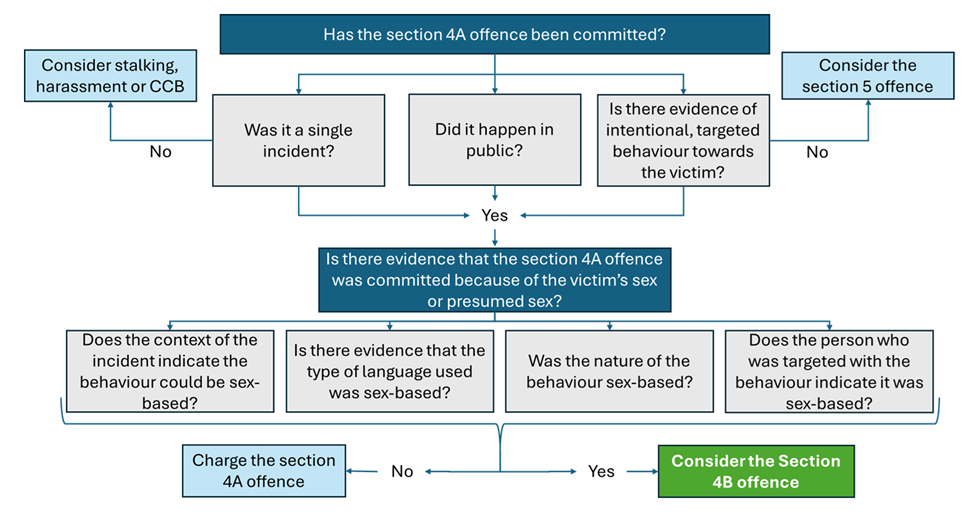
Annex A provides a flow chart to support officers in determining if these elements have been met.
10. As set out above, officers must first consider evidence that the section 4A offence has occurred. It requires the intention to cause harassment, alarm or distress. This can usually be proved where there is evidence of specific, directed abuse. However, proving the defendant’s intent is not enough: there must also be evidence of somebody suffering harassment, alarm or distress as a result.
11. This offence is appropriate for single incidents involving threatening, abusive, or insulting words or behaviour directed towards an individual in public. Crown Prosecution Service (CPS) guidance on this offence can be found here.
12. However, where the behaviour is part of a course of conduct (i.e. occurred on two or more occasions) involving the same victim, this may constitute stalking or harassment, and therefore charging under the Protection from Harassment Act 1997 is likely more appropriate. Where the behaviour occurs within an intimate or personal relationship, consideration should also be given to domestic abuse-related offences. For example, Crown Prosecution Service guidance on the selection of charges in the context of controlling or coercive behaviour can be found here.
13. To determine whether the section 4A or 4B offence has taken place, officers must take into consideration the circumstances of each individual case and engage with the victim to understand the impact on them and gather sufficient evidence.
‘In public’ Definition
14. The ‘in public’ aspect covers behaviour in all public locations and can be committed in a private place except no offence is committed where the perpetrator is inside a dwelling and the person who is harassed, alarmed or distressed is also inside a dwelling (whether that is the same dwelling or a different one). Examples of public places are streets, open spaces, public transport (including taxis and private hire vehicles), and public buildings (including buildings open to the public such as cinemas and shops).
15. This offence may also apply to online behaviour where the above definition of ‘in public’ has been met. However, other offences which specifically tackle online behaviour should also be considered, for example, section 1 of the Malicious Communications Act 1988 and section 66A in the Sexual Offences Act 2003 of sending a photograph or film of genitals. This is often referred to as “cyber flashing” or virtual exposure.
Intention
16. As with section 4A, the offence under section 4B requires proof that the person (A) intended to cause harassment, alarm or distress. Intent is inferred from the evidence, including the words used, the nature and persistence of the conduct, whether it was directed at a particular person, and the surrounding circumstances. In addition, for an offence under section 4B, the evidence must also demonstrate that the conduct was carried out because of the victim’s sex or presumed sex. A person’s intent does not depend on their own characterisation of their language or behaviour. It may also be inferred from the conduct itself and the surrounding circumstances.
Determining the Sex-Based Requirement of the Section 4B Offence
17. An essential element of the section 4B offence is that the behaviour must have taken place because of the victim’s sex or presumed sex as at least one of the motivating factors. Where behaviour has taken place which meets the elements of the section 4A offence and there is evidence that that offence took place because of the victim’s sex (or presumed sex), the section 4B offence should always be considered.
18. ‘Presumed sex’ means where individual A presumes that individual B is a certain sex and this is the reason for the behaviour. In such cases, it does not matter whether individual A was mistaken as to individual B’s sex so long as A intentionally carried out the conduct with a view to causing harassment, alarm or distress to B because of B’s presumed sex. While behaviour based on hostility towards a transgender identity is covered in hate crime legislation (see para 33), there will be instances where someone who identifies as transgender has experienced harassment based on their sex or presumed sex which is in scope of the 4B offence.
19. An individual officer’s personal assessment may not be sufficient to determine whether a section 4B offence has been committed because an essential element to prove is the impact on the victim (B). As the offence requires proof that harassment, alarm or distress was in fact caused, officers should take all reasonable steps to obtain evidence demonstrating the impact of the alleged conduct on the victim directly. Alongside this, there may be available evidence from witnesses who observed the effect of the behaviour.
20. For the purposes of this offence, it is not necessary for the conduct to have been motivated solely or primarily on the victim’s sex. The offence may be committed where sex was one of a number of motivating factors. It is also immaterial whether the conduct was carried out for the purposes of sexual gratification. The key issue is whether there is evidence that the conduct was carried out because of the victim’s sex (or presumed sex).
21. To support officers in determining the sex-based element, see this non-exhaustive guide on behaviours that might indicate the criteria of the offence has been met when considered alongside the specific factors in each case: Example behaviours and sex-based factors to consider. This asks officers to explore the context of the incident, the type of language used, the nature of the behaviour and the target of the behaviour as these could all indicate that the sex-based requirement has, or has not, been met. However, officers shouldn’t limit their consideration to this list but rather use it as a guide to inform decision-making and support evidence-gathering.
Charging and Crime Recording
22. With a maximum sentence of two years’ imprisonment, the section 4B offence is triable either way. This means that proceedings can either be tried in the magistrates’ court, or the Crown Court, subject to the usual provisions governing mode of trial.
23. For the latest guidance on the approach to charging the section 4B offence, please consult the Director of Public Prosecutions’ Guidance on Charging published by the Crown Prosecution Service.
24. This offence should be recorded in line with the Home Office Counting Rules.
Example Behaviours and Sex-based Factors to Consider
Example behaviours
This is not an exhaustive list:
- making a persistent, obscene, sexual or aggressive comment or gesture towards a person;
- obstructing a person making a journey, for example, cornering someone/preventing them leaving;
- uninvited deliberate touching, kissing, or unnecessarily invading personal space in a threatening manner (for sexual assault, consider section 3 of the Sexual Offences Act 2003);
- a threat to commit a sexual offence (consider also section 181 of the Online Safety Act 2023);
- deliberately watching or looking at obscene material in public within the sight and/or hearing of someone with the purpose of causing harassment, alarm or distress; and
- deliberate and persistent intimidation by a group (for example chanting at a lone individual).
Factors
Context of the incident
Did A’s behaviour occur after A’s sexual, intimate or romantic advances were not reciprocated by B, or did it occur after a rejection that could be linked to B’s sex?
Were there other people present, and if so, were they treated differently based on their sex?
Type of language used
Was it derogatory and based on harmful stereotypes of a particular sex?
Does it reference sex-specific genitalia or comment on either B or A’s own physical features in a sexual manner?
Did A make any explicit or implicit references to B’s body or appearance?
Nature of the behaviour
Were there bodily gestures such as A mimicking sexual acts directed at B?
Was there reference to sex-specific genitalia or physical features? This could include, for example:
- A touching their genitalia;
- Mimicking oral or penetrative sex;
- Making sounds that imitate kissing.
Was the behaviour more aggressive, demeaning, or persistent towards B compared to others of a different sex?
Did A attempt to justify their actions with stereotypes or misconceptions about B’s sex?
Target of behaviour
Is there evidence to suggest A would not have demonstrated the behaviour towards someone of a different sex, or presumed sex, to B?
Supporting Victims
25. Behaviours associated with public harassment on account of a person’s sex can have serious and devastating impacts on victims’ lives. It is important that officers consider this when supporting the victim right from the initial report. These behaviours are underreported, making it even more important that officers bear in mind that when victims report, it has taken courage for them to do so. Officers should also be mindful that a victim may find discussing the incident distressing.
26. These behaviours can make victims feel threatened or fearful, and this can make them reluctant to report for fear of escalation. This can have long-lasting and devastating consequences on their sense of safety. Under the Victims’ Code, all victims are entitled to be given information about and be referred to victim support services by the police to help them cope and recover from the impact of a crime.
27. Officers should refer victims to support within 2 working days of a crime being reported, this may involve a referral to a local support service and/or to a national support service, such as:
- Victim Support National Helpline: 08 08 16 89 111 (including their Children and Young People Service)
- 24/7 Rape and Sexual Abuse Support Line: 0808 500 2222
- Rights of Women Sexual Harassment at Work Advice Line: 020 7490 0152
- Live Fear Free Helpline (Wales): 0808 80 10 800
28. Where a safeguarding risk has been identified in relation to the victim, a relevant protective order should be considered. The College of Policing’s Authorised Professional Practice provides advice for officers on various protective orders that could be relevant in cases of public harassment on the account of sex:
- Sexual Risk Orders
- Stalking Protection Orders (if there is evidence of acts associated with stalking)
- Other protective orders available for public protection
3. Reasonable Conduct Defence
Reasonable Person Test
29. The reasonable conduct defence is an objective assessment of whether the conduct would be regarded as reasonable by the ordinary reasonable person in the same set of circumstances. Officers must avoid relying on personal views; the ultimate determination of reasonableness is a matter for the court.
30. To assess whether behaviour was reasonable, the Court will consider all the facts in the case and compare the actions of A to that of a “reasonable person” in the situation and determine what a reasonable person in the same circumstances would have done. This is an objective test, and the defendant cannot point to their own standards or beliefs, or those of their social or other group. The legal burden rests on the defendant to establish the defence on the balance of probabilities.
31. Conduct directed at a person because of their sex will be highly unlikely to be regarded as reasonable when assessed objectively, and in most cases will not satisfy the reasonable conduct defence. However, examples of where the court may consider someone’s behaviour as reasonable include:
a. Where the defendant is acting in a professional or official capacity, the court may consider whether the conduct met the standard expected of a reasonable person performing that role.
b. Where the defendant is a child, the court may take account of age and maturity as part of the overall circumstances, but the test remains objective.
32. Section 4A(3) states that it is a defence for person A to prove that they were inside a dwelling and had no reason to believe that the words or behaviour used, or the writing, sign or other visible representation displayed, would be heard or seen by a person outside that or any other dwelling, or that their conduct was reasonable.
4. Interaction with Relevant Legislation
Interaction with Hate Crime Legislation (Crime and Disorder Act 1998) and Sentencing Act 2020)
33. The section 4B offence does not form part of the hate crime legislative framework. If an individual is targeted because of their transgender identity, race, religion, sexual orientation or disability, this may fall under hate crime legislation. Guidance from the Crown Prosecution Service on hate crime can be found here. Criminal offences can be prosecuted as hate crimes when either:
a. immediately, before, during or after the offence was committed the offender demonstrated hostility towards the victim based upon the victim’s actual or presumed race, religion, sexual orientation, disability, or transgender identity;
b. there is evidence that the offence was motivated wholly or partly by hostility towards members of a group based upon race, religion, sexual orientation, transgender identity, or disability.
34. Where conduct engages both the sex-based element of the section 4B offence and hostility related to a protected characteristic for the purposes hate crime both aspects can and should be reflected. Where a section 4B offence is charged and where there is also evidence of hostility on the grounds of transgender identity, race, religion, sexual orientation or disability there can be an uplift in the sentence under section 66 of the Sentencing Act 2020 to reflect that hostility. Officers should consider which offence best reflects the seriousness and the extent of the offending and provides the court with adequate powers to sentence.
Football Banning Orders (Football Spectators Act 1989)
35. If an individual is convicted of a section 4B offence and the offence is committed at, or in connection with, a regulated football match, the court must make a football banning order against the offender unless the court considers that there are particular circumstances relating to the offence or to the offender which would make it unjust to do so. A football banning order is a behavioural order, imposed by a court, that prevents a person from attending regulated football matches in the UK and overseas for three to five years (six to ten years if a custodial sentence).
Hostility towards a political candidate (Elections Act 2022)
36. Where a person aged 18 or over is convicted of an offence listed in Schedule 9 (including the new section 4B offence Public Order Act 1986), and the court is satisfied beyond reasonable doubt that the offence was aggravated by hostility related to a candidate, holder of relevant elective office, or campaigner (or a person presumed by the offender to be such), the court must make a disqualification order unless it would be unjust in all the circumstances to do so.
37. An offence is aggravated by hostility if the offender (a) demonstrated hostility towards the victim at the time of the offence (or immediately before/after), or (b) the offence was motivated, wholly or partly, by hostility toward persons in that capacity. The order disqualifies the offender for 5 years from the date of the order from being nominated for, being elected to, or holding a relevant elective office.
Criminal Records Implications in Scotland (Police Act 1997)
38. This applies to Scotland only. Section 4B is on the list of offences for which spent convictions will generally be disclosed on Scotland’s Level 2 disclosures (formerly known as criminal record certificates, enhanced criminal record certificates or PVG scheme records), unless a) the sentence was an admonition or absolute discharge, b) the person was a minor when convicted and at least five and half years have elapsed since the date of conviction or, c) the person was an adult when convicted and at least 11 years have elapsed since the date of conviction. [footnote 1]
39. A person can also apply to Disclosure Scotland to have a spent conviction removed earlier than 11 years from the date of conviction if they can show it is no longer relevant for the purposes of the disclosure. Spent childhood convictions for this offence will automatically be reviewed and inclusion can be appealed with the Scottish independent reviewer.
Annex A – Flow Chart on deciding the most appropriate offence
It is not definitive guide and officers will need to consider the facts and circumstances of each individual case before making a decision.
-
Despite the territorial extent of the Protection from Sex-based Harassment in Public Act 2023 being England and Wales, this consequential amendment stipulates that if an individual has a conviction in England and Wales for the section 4B offence, then it would be disclosed on criminal records certificates in Scotland. ↩