Protected sites Environment Act target delivery plan
Published 1 December 2025
Applies to England

© Crown copyright 2025
This publication is licensed under the terms of the Open Government Licence v3.0 except where otherwise stated. To view this licence, visit nationalarchives.gov.uk/doc/open-government-licence/version/3 or write to the Information Policy Team, The National Archives, Kew, London TW9 4DU, or email: psi@nationalarchives.gov.uk.
Where we have identified any third party copyright information you will need to obtain permission from the copyright holders concerned.
This publication is available at https://www.gov.uk/government/publications/protected-sites-environment-act-target-delivery-plan/protected-sites-environment-act-target-delivery-plan
Statutory Environment Act targets
-
halt the decline in species abundance by 2030
-
increase species abundance so that by 2042 it is greater than in 2022 and at least 10% greater than in 2030
-
reduce the risk of species extinction by 2042 compared to 2022 levels
Interim target
- by December 2030, 50% of Sites of Special Scientific Interest (SSSI) features to have actions on track to achieve favourable condition
Rationale for interim target: why and how it will progress delivery of the Environment Act target
The Sites of Special Scientific Interest (SSSI) interim target contributes to the statutory species targets because many of the species at risk of extinction rely on a small number of places, including the SSSIs where they are designated features. Improving the condition of SSSIs contributes to the abundance of these species and wider species in the abundance target.
The 50% of actions on track interim target will actively help improve the condition of SSSIs and contribute, alongside other mechanisms, towards increasing the abundance of species in the extinction risk statutory target and the species abundance statutory target.
Natural England (NE) carries out condition assessments of SSSI features to inform these actions. For the actions to count as being ‘on track’, the feature needs to have an up-to-date assessment and needs an agreed action plan to be underway.
Although we have not set a separate interim target for condition assessments, we have a clear ambition for all SSSIs to have an up-to-date condition assessment by 2032.
Delivery measures
We expect to deliver the interim target through a mix of government schemes, partnership working and action from landowners, Environmental non-governmental organisations (eNGOs), and farmers.
The largest share of delivery is expected through NE’s SSSI Improvement Programme and the Environmental Land Management schemes. However, a wide range of actions will be needed.
Table 1 sets out the key measures that will deliver the target.
Table 1. Summary of key actions needed on SSSI features to support the protected sites delivery plan
| Delivery measure | Description | Estimated contribution to the interim targets | Evidence of impact | Responsible | Status |
|---|---|---|---|---|---|
| SSSI Improvement Programme | The programme provides monitoring, advice, incentives and regulation of SSSIs, and direct management of the NE owned National Nature Reserve (NNRs) SSSIs (approximately 5%). | High | Increased funding since 2020, has improved NE’s understanding of SSSI condition, pressures, and actions required to restore them. Continued monitoring, regulation and advisory support will drive further improvements. |
NE | In delivery |
| Environmental Stewardship and Countryside Stewardship Higher Tier (CSHT) | We will support farmers and land managers through our agri-environment schemes to take actions that improve the condition of SSSIs, such as addressing water pollution, changing grazing regimes, tackling invasive species and restoring rivers and lakes. | High | Environmental Land Management scheme agreements running from 2024 are expected to support bringing or maintaining 370,000ha to 480,000ha of eligible SSSI habitat in England under favourable management by 2042. | Defra | In delivery |
| SSSI Maintenance and improvement | Forestry England (FE) manages over 6% of SSSIs and NNRs. FE are working to bring their FE-managed SSSI estate into favourable condition. | Medium high | The Forestry Commission Key Performance Indicators Report for 2024 to 2025 states that as of April 2025, 69.5% of the listed woodland features are assessed as in favourable or recovering condition and 39.6% as in a favourable condition. FE will continue to manage sites to increase favourable condition. |
FE | In delivery |
| SSSI programme | We will deliver SSSI improvement through projects to maintain or improve SSSIs, and through the Local SSSI priority actions project work. This work is delivered through operational teams carrying out actions EA is responsible for on other landowners’ land (permitting, enforcement, flood and coastal management). | Medium high | Water pollution is a key pressure on SSSIs and work to address this pressure has the potential to improve the condition of around 60% of SSSIs which have water-dependent features. | Environment Agency (EA) | In delivery |
| SSSI Major Landowners Group (MLG) | A group of organisations who own and manage significant parts of the SSSI ‘estate’ in England and are taking action to restore their SSSIs to favourable condition. | Medium high | Defra is working closely with the SSSI MLG (the large environmental organisations, such as the RSPB, National Trust and The Wildlife Trusts, utility companies and public bodies who collectively manage over 50% of SSSI land), to develop and implement solutions to recover the features that make their sites special. Defra will ensure close working for mutual benefit between this group and the wider National Estate for Nature group (NEN). | SSSI MLG (chaired by Defra) |
In delivery |
| Protected Landscapes | Around 50% of SSSI land is within Protected Landscapes. The Protected Landscape Targets and Outcomes Framework sets out how National Parks and national landscapes contribute to environmental targets. Targets will be embedded into their statutory management plans. Protected Landscapes have a target for 60% of SSSIs within Protected Landscapes to have actions on track by 2030 to support the recovery of SSSIs to favourable condition. | Medium | As stated in the Protected Landscape Targets and Outcomes Framework progress report, in national landscapes, the percentage of SSSIs with actions on track increased from 15% in 2024 to 21% in 2025. National Parks also showed improvement, rising from 11% to 18% over the same period. When combined, the total for Protected Landscapes rose from 13% in 2024 to 19% in 2025. The percentage of SSSIs with actions on track across England increased from 14% to 21%. | Defra | In delivery |
| Conservation Enhancement Scheme (CES) | CES provides funding to landowners who are ineligible for agri-environment grants to carry out restorative work on their SSSIs. | Medium | Through the CES we are supporting the number of SSSIs features to reach favourable condition. Examples of actions funded through CES include scrub removal and rotational cutting on reed beds, management of urban meadows, research on geological sites, and weir removals to improve access for fish. | NE | In delivery |
| Peat Programme | The Nature for Climate Peatland Grant Scheme (NCPGS) is a competitive grant scheme being delivered by NE and was open to a range of environmental groups and organisations. The scheme offered 2 types of grants: restoration grants, focused on capital works on the ground, for projects for which the preparatory work had mostly been completed; and discovery grants, focused on unlocking barriers to peat restoration and enabling projects to be in a position to apply for restoration grants. | Medium | Peat Capital Grant Scheme covers approximately 63 sites and aims to restore approximately 15,000ha by 2025. | Defra | In delivery |
| Landscape Recovery scheme | The Landscape Recovery scheme is for landowners and managers who want to take a large-scale, collaborative, long-term approach to producing positive environmental and climate outcomes on their land. It will facilitate and fund ambitious projects through bespoke, 20 year, or longer, agreements. | Medium | Supports approximately 60,000ha of SSSI land (180 sites) for improvement with long-term conservation and restoration work. Round one projects were agreed in 2022, and round 2 projects in 2023. | Defra | In delivery |
| Protected Sites Strategies (PSS) | The 5 pilots which ran between 2022 and 2025 tested a partnership approach to resolving a range of issues affecting SSSIs at a landscape scale. We will begin delivery for up to 10 Protected Sites Strategies - including the 5 current pilots - by March 2026 to restore and improve their condition. This will address upstream environmental pressures, such as pollution and habitat degradation and will also gather evidence to inform the rollout to other protected sites, including by updating relevant site condition assessments. NE will begin delivery on an additional 3 sites every year until the financial year 2029 to 2030 in priority areas, resulting in at least 20 PSS over 5 years. | Medium | Evaluations of the pilots will be produced by autumn 2025. Defra also expects to publish SoS guidance, outlining the duty to co-operate with PSS in future. Site restoration and sustainable growth were used as key criteria to identify where PSS will be most effectively located to support programme objectives. | Defra | In delivery |
Key milestones
Defra receives regular progress updates from NE which are used to assess progress towards the interim target. Progress can be seen on the NE Designated Sites View website, and annual updates will be reflected in Environmental Improvement Plan (EIP) annual progress reports.
Illustrative trajectory
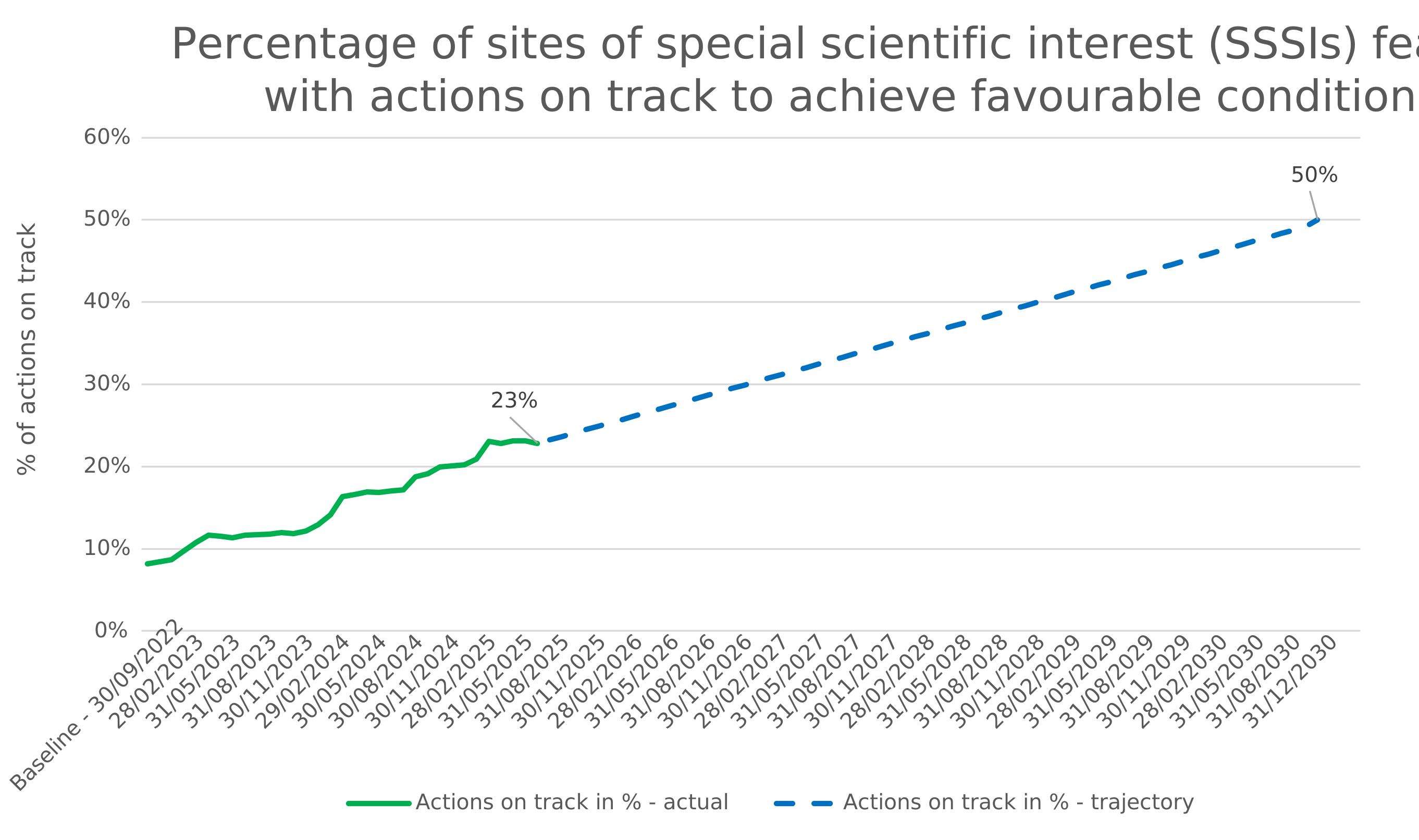
Figure 1. SSSI actions on track mathematical trajectory. Note: from August 2025, actuals will track against trajectory
The interim trajectory assumes linear improvement, based on assumptions around funding, expected efficiencies in NE’s feature monitoring programme and delivery of strategic interventions, such as Protected Sites Strategies.
As of November 2025, data from NE’s report on SSSI feature status, on the Designated Sites View website, shows that:
-
32% of SSSI features have an up-to-date condition assessment
-
24% of SSSI features have actions on track to reach favourable condition
We have a clear ambition for all SSSIs to have an up-to-date condition assessment by 2032. Actions to improve the condition of SSSI features will only count as ‘on track’ if an up-to-date condition assessment is in place.
Based on funding secured in the spending review, expected future delivery and the impact of NE’s citation updates, NE projects that it is achievable to reach a target of 50% of features with actions on track by 2030.
Progress is expected to continue beyond 2030. The long-term ambition is that these actions will result in more features moving into favourable condition, contributing to the ambition that 75% of SSSI features will be in favourable condition by 2042.
Monitoring and evaluation summary
The metric for the SSSI interim target is based on the proportion of notified SSSI features with a condition assessment and actions on track to become favourable.
Condition assessments follow the Common Standards Monitoring (CSM) guidance and are reported through NE’s Designated Sites View website.
The actions-on-track indicator reflects features that have evidence of active management in place. This includes things like grazing regimes, scrub clearance and actions to address water pollution.
Metrics will be updated annually in the EIP annual progress report. NE is also incorporating climate change risk assessments for all SSSIs in its monitoring programme.
NE is working with delivery partners, including major landowners of SSSIs, to improve monitoring and to deliver actions to improve SSSI condition.