Project PANOPTES: Competition Document
Updated 7 October 2026

© Crown copyright 2026
This publication is licensed under the terms of the Open Government Licence v3.0 except where otherwise stated. To view this licence, visit nationalarchives.gov.uk/doc/open-government-licence/version/3 or write to the Information Policy Team, The National Archives, Kew, London TW9 4DU, or email: psi@nationalarchives.gov.uk.
Where we have identified any third party copyright information you will need to obtain permission from the copyright holders concerned.
This publication is available at https://www.gov.uk/government/publications/project-panoptes-protecting-the-force-enabling-manoeuvre/project-panoptes-competition-document
1. Introduction
The Competition deadline has been extended to 30 September 2026 due to an update to the Competition Key Requirements table.
Applicants are advised to review the revised Competition Key Requirements table again before submitting.
The competition team will contact anyone who has already submitted a proposal, or who has a proposal in draft, to advise on next steps.
This UK Defence Innovation (UKDI) Procurement is run on behalf of the Ministry of Defence (Authority), using the Commercial X Dynamic Market, as a regulated procurement under the Procurement Act 2023.
This competition, seeking to deliver an integrated Counter-Uncrewed Aerial System (C-UAS) force-protection capability, capable of autonomous operation, forms the first phase of a planned multi-phase capability development and acquisition pathway leading to a future Programme of Record, subject to future approvals and contractual arrangements.
The scope of Phase 1 is to identify and support organisations to accelerate development of their existing technology towards the final deployable system. It is not intended for the Phase 1 competition to seek delivery of a complete operational C-UAS system.
Over later Phases, the Authority’s intent, aligned with its Integrated Procurement Model, is to identify and rapidly mature promising technologies as demonstrable Minimum Viable Products (MVPs). The Authority may then, at its discretion, select projects to be iteratively developed, integrated and proven as Minimum Deployable Capabilities (MDCs) for an initial operational user group. Capabilities that demonstrate operational benefit may subsequently be developed further for wider adoption as part of a future Programme of Record. Suppliers will be notified of the criteria, selection processes, and competition format as these Phases arise.
2. Problem Statement
Defence seeks additional capability to detect, track, identify, decide and defeat mass and low-cost threats in a cost-effective manner and without being overwhelmed or exhausting stockpiles. This is particularly acute for deployed land forces, but the problem is applicable to the protection of defence fixed infrastructure.
Current approaches are constrained by limited magazine depth, high cost-per-engagement, limited manoeuvrability, workforce intensity and the difficulty of adapting capabilities at pace as UAS threats evolve.
Based on experience from its earlier Market Engagements and other research, the Authority is particularly interested in capabilities centred on Laser Directed Energy Weapon (LDEW) effectors but is open to submissions relating to credible alternative novel approaches.
3. Operational Context and Future Capability Requirements
To address the challenge described in the Introduction we are looking to deliver an integrated C-UAS force-protection capability, capable of autonomous operation, mounted on an Army vehicle.
The capability should protect deployed troops against complex and saturation attacks designed to overwhelm existing defences or deplete conventional munition stocks. It should deliver more affordable combat mass against emerging air threats than legacy systems, and should exploit open architectures, platform-generated power, modular design and autonomous operation.
The initial threat focus is representative Class 1 UAS and related small aerial threats, including single, repeated, sequential and simultaneous threat profiles. This includes threats intended to disrupt operations, conduct surveillance, target fixed or mobile assets, overwhelm local defences or force the disproportionate use of high-cost munitions.
Integration of the capability onto a future uncrewed ground vehicle (UGV) is a planned objective. The solution should provide a scalable pathway towards future Army and Joint Ground-Based Air Defence (GBAD) capabilities as well as considering possible export opportunities.
4. Competition Process
Selection for Phase 1 will comprise a two-stage down-selection process.
At Stage 1, suppliers will submit a brief technology review and outline proposal for a technology demonstration and development plan.
These outline proposals will be assessed under the criteria detailed below, and some suppliers will be invited to Stage 2.
At Stage 2 selected suppliers will be invited to submit a more detailed proposal for further evaluation and down-selection.
The deliverable from Phase 1 of the competition is an evidence-based Programme Plan which includes appropriate demonstrations of components as required to provide that evidence.
The Authority encourages suppliers to see UKDI funding as a catalyst which, combined with their own investment, will enable the rapid development and selection of cutting-edge capabilities which can be accelerated into operations in under 2 years and contribute to a future Programme of Record, subject to future approvals and contractual arrangements.
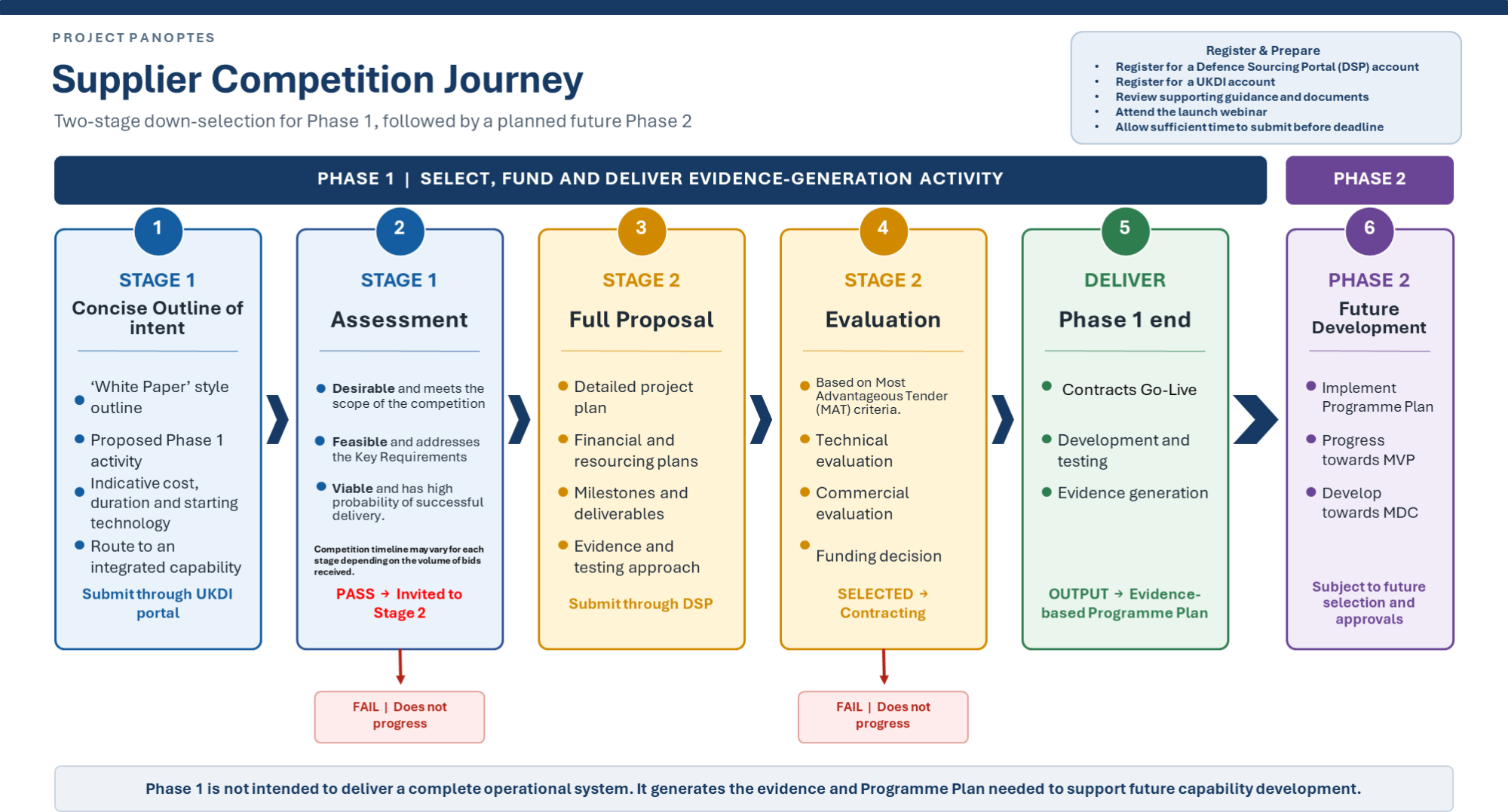
Schematic of competition process
5. Competition Information
Your Stage 1 submission is to be submitted via the UKDI Online Submission Service where you will need to register for an account if you don’t already have one. Only proposals submitted through the UKDI Online Submission Service will be accepted.
Prior to submission of any proposal, a supplier must request to join the Commercial X Dynamic Market, as detailed below.
Suppliers are strongly advised to submit their proposal at least one hour before the specified deadline. Proposals submitted close to the deadline risk encountering issues that cannot be resolved in time.
Responsibility for timely submission rests entirely with the supplier, no extensions will be made. If you are having problems submitting your proposal, email us prior to the deadline on accelerator@dstl.gov.uk or call 01980 950000 option 3 Monday to Friday 0900-1200 only).
No funding is provided for bidding costs or proposal preparation.
5.1 Dynamic Market Registration
Registration is simple. Firstly, you will need to ensure you have created a company profile on the Central Digital Platform or gov.uk One (Paste this URL into your browser - https://signin.account.gov.uk/sign-in-or-create) You may need to then click the ‘Go to GOV.UK One Login’ hyperlink
Your application to the Dynamic Market needs to be completed on the Defence Sourcing Portal
If you are not registered, click Supplier Registration and follow the instructions provided. Then, to join the Dynamic Market:
- On the home page, click ‘view DSP opportunities’
- make sure you’re in the ‘current opportunities tab’
- click the ‘filters’ drop down and select ‘project info’
- in the ‘value’ field type ‘Commercial X’ and click ‘search’
You should be able to access the ‘PQQ’ event that we are using for the applications. There is also downloadable content available in the opportunity listing providing further information about the Dynamic Market.
For any problems signing up to DSP or the Dynamic Marketplace, contact NAVY-CommX-DYNAMIC-MARKET@mod.gov.uk
5.2 Stage 1
Competition Key Information
| Key Information | Market Assessment Details |
|---|---|
| Requirement | A completed high-level ‘white paper’-style outline programme plan to meet the challenges and requirements detailed below. |
| Submission Stage 1 deadline | 12:00 Midday on 30 September 2026 (BST) |
| Submission Stage 1 Feedback | 28 October 2026[footnote 1] |
Key Capability Requirements

Desirable Capability Requirements

Capability Assessment
Suppliers are requested to provide a concise outline of intent showing a planned route towards meeting the Key Capability Requirements detailed above.
Stage 1 submissions must provide responses to questions addressing the following areas:
- A description of your starting technology position
- A description of what development work you would undertake during this project phase
- Rough Order of Magnitude costs (not binding) for the work required for the proposed Phase 1 project activity
- Very Rough Order of Magnitude costs (not binding) for implementation of the programme described in your deliverable under Phase 1 to achieve MVP
- Overview of the expected final programme, focusing on how you intend to deliver an integrated system and ability to scale up and put into production
As this competition is looking in the longer term to deliver capability it is important for us to understand your exploitation potential and intentions.
Include the following information within your proposal to help the assessors understand your exploitation intentions:
- expected additional work required beyond the end of the contract to develop an operationally deployable commercial product (for example, “scaling up” for manufacture, cyber security, integration with existing technologies, environmental operating conditions)
- additional future applications and wider markets for exploitation
- wider collaborations and networks you have already developed or any additional relationships you see as a requirement to support exploitation
- how your product could be tested in a representative environment in later phases
- any specific legal, ethical, commercial or regulatory considerations for exploitation
The purpose of this activity is to:
- Assess the maturity and viability of existing technologies.
- Generate evidence through focused technical activities.
- Produce an evidence-based programme plan for delivery of a complete capability.
- Inform future follow-on activity, which, whilst subject to change, is a <6 month development piece, followed by development work.
Submissions will be reviewed with the following criteria:
| Criteria | Measure - Within Interest (Pass) / Not of Interest (Fail) |
|---|---|
| Desirable and meets the scope of the competition | Pass / Fail |
| Feasible and addresses the Key Requirements | Pass / Fail |
| Viable and has high probability of successful delivery | Pass / Fail |
The Authority reserves the right not to provide detailed feedback on submissions. Should you receive feedback notifying you of a Pass in all three criteria, you are considered eligible for Stage 2. If you wish to appeal the results, you must do so within 5 days of receipt.
Specific Requirements
Please note that this competition has specific requirements as part of its pre-sift criteria.
- to be eligible to submit a proposal into this competition you must be a UK organisation registered at Companies House, a sole trader or academic institute, currently based in the UK, and plan to carry out the work in the UK. Your organisation does not need to be UK-owned
- Organisations are only permitted to submit one proposal into this competition; we ask potential bidders to self-prioritise their best offer
- Proposals should come without Trade Control Restrictions where possible.
- For Phase 1 you must not submit any information classified above Official Sensitive.
5.3 Stage 2
Competition Key Information
For Stage 2 eligible suppliers, you will develop your high-level Programme Plan into a detailed programme plan, with expected outcomes, milestones, and pricing.
The exact details of this Stage will be released once Stage 1 has been completed.
| Key Information | Competition Details |
|---|---|
| Submission Stage 2 open | 12:00 Midday 29 October (GMT) |
| Submission Stage 2 deadline | 12:00 Midday on 26 November 2026 (GMT) |
| Total funding available | A share of up to £5 million is available immediately, the Authority anticipates an award of multiple contracts, subject to availability and quality of the proposals. |
| Expected contract start | Aim to start February 2027. This is subject to change. |
| Project duration | Equal to or less than 6 months. |
| Feedback release date | Mid January 2027 |
The dates above are subject to change
Eligibility for Stage 2 is not a guarantee that your proposal will be taken forward. A review process will take place to make a decision on fundings. The Authority does not commit to fund any one or number of projects as part of this Competition. Should no projects be considered suitable, no projects will be funded.
Stage 2 Submission
Your Stage 2 submission needs to be completed on the Defence Sourcing Portal
Instructions
- On the home page, click ‘view DSP opportunities’
- make sure you’re in the ‘current opportunities tab’
- click the ‘filters’ drop down and select ‘project info’
- in the ‘value’ field type ‘Commercial X’ and click ‘search’
You should be able to access the ‘PQQ’ event that we are using for the applications. There is also downloadable content available in the opportunity listing providing further information about the Dynamic Market.
At this point submissions may be made through the PANOPTES DSP Opportunity.
Only those submitted through the DSP will be accepted. Suppliers who do not already have a DSP account will need to register for one prior to submission.
Suppliers are strongly advised to submit their proposal at least one hour before the specified deadline. Proposals submitted close to the deadline risk encountering issues that cannot be resolved in time. No late entries will be permitted.
No funding is provided for bidding costs or proposal preparation.
Any queries or concerns should be communicated through the Defence Sourcing Portal Messaging Service.
For any problems signing up to DSP or the Dynamic Marketplace, contact NAVY-CommX-DYNAMIC-MARKET@mod.gov.uk
Tender Submission Compliance for Stage 2
Before your Tender Submission for Stage 2 is assessed, all proposals will be checked for compliance with the criteria below. Proposals will be considered non-compliant if they do not meet these criteria.
Project PANOPTES pre-sift criteria are as follows:
| Criteria | Measure - Within scope (Pass) / Out of scope (Fail) |
|---|---|
| The supplier has passed Stage 1 and is eligible to enter Stage 2 | Pass/Fail |
| The proposal must contain a financial plan, a project plan and a resourcing plan which demonstrate how the work proposed will be completed | Pass / Fail |
| The delivery schedule within your proposal includes evidence of a written final report and in person presentation | Pass / Fail |
| The proposal does not contain attachments that have been used for additional text data over the stated word counts | Pass / Fail |
Stage 2 Evaluation
The Stage 2 proposal evaluation will be based on the Most Advantageous Tender (MAT) against Technical, and Commercial Level 1 criteria, with the following weightings:
- Technical 60 – 80%
- Commercial 20 – 40%
Under Section 24 of the Procurement Act 2023, the Authority has the right to refine these evaluation criteria, including their relative importance. The Authority will publish refinements to the criteria within the notice and associated tender documents.
Projects will be awarded based on score and budget availability within the £5m limit. Detailed instructions regarding the submission of tenders and evaluation of Stage 2 will be publicised prior to the commencement of Stage 2.
6. Public Facing Information
Stage 1
Information supplied in this stage will be retained in confidence within UK government for 12 months and then destroyed. No information from Stage 1 shall be shared with any third party.
Stage 2
Work will be undertaken to standard Innovation Standard Contract (ISC) Terms and Conditions. Information on the relevant DEFCONs can be found by registering on the Knowledge in Defence site.
We require unqualified acceptance of the Terms and Conditions.
We will use deliverables from UKDI contracts in accordance with our rights detailed in the contract Terms and Conditions.
All proposals will be held in confidence for 12 months and then destroyed, unless agreed with the individual suppliers. Further details may be supplied to suppliers invited to Stage 2.
All Intellectual Property will remain the property of the Supplier.
7. Supporting Activities
7.1 Launch webinar
On 9 September 2026, UKDI hosted a launch webinar providing further detail on the problem space. You can watch it below:
Cyber Security Model
The Cyber Security Model (CSM) is how Defence builds cyber security into its supply chain.
Prior to any Project being funded, the supplier will need to undergo the Cyber Security Model Process to verify its adherence to cyber security requirements. Details will be provided as part of Stage 2.
8. Glossary of Terms in this Document
| Term | Meaning |
|---|---|
| Phase 1 | Activity required to obtain evidence to support preparation of Programme Plan |
| Stage 1 | Submission of a brief technology review and outline proposal |
| Stage 2 | Submission of a full proposal for a <6 month development project |
| Proposal | A full description of the Project, containing work packages, project planning, detailed financial breakdown etc. to deliver Phase 1 |
| Programme Plan | Description of the work required to deliver a Minimum Viable Product meeting the Key Capability Requirements, leading to a Minimum Deployable Capability |
| Phase 2 | Planned next phase of this competition, comprising activity required to deliver the Programme Plan |
| Programme of Record | A future development programme to deliver a future full capability |
Points of Contact
During the competition phase technical queries should be raised through DSP Messaging Function NAVY-CommX-DYNAMIC-MARKET@mod.gov.uk
9. Clarifications
TECHNICAL REQUIREMENTS
Q: What target count/scenario should applicants use when interpreting “mass” or saturation for Phase 1 evidence?
A: Any vignettes will be of interest in which, without the proposed system, the protected asset will be overwhelmed by the number of attacking drones
Q: Is autonomous sensing, fusion, tracking, threat prioritisation and cue generation acceptable where physical engagement authority remains outside our subsystem, or is autonomous engagement expected?
A: Either; as long as the asset can be protected.
Q: Must the published Key Capability Requirements be physically demonstrated by the end of the six-month Phase 1, or can Phase 1 demonstrate a credible evidence-backed route toward MVP / Minimum Deployable Capability as part of the required evidence-based Programme Plan?
A: The Phase 1 requirement is to deliver an evidence based plan of how you would deliver a capability that meets the Key Requirements following further tasking.
Q: Must an effector partner be formally committed at Stage 1, or can a lead applicant propose sensing/fusion/C2 integration with a prospective authorised-effector integration route?
A: At Stage 1 suppliers are not required to be formally committed to a partner. Prior to contract award at Stage 2 suppliers will be expected to provide formal commitment.
Q: The requirement describes a passive RF capability but also requires it to “detect and defeat signals” between 20 MHz and 6 GHz. Is the secondary RF subsystem itself required to provide an RF defeat/electronic-attack capability across this range, or may it passively detect, identify and cue targets for defeat by the system’s primary or other effectors?
A: Defeating RF signals should not be the intent of the proposed equipment therefore the KR wording has been updated to reflect this.
Q: Does KR04 require the complete C-UAS capability, including effectors, to be physically contained on the host vehicle during operation, or could a vehicle-deployable UAV system using off-board effectors meet the threshold requirement, given that DR01 does not require defeat while moving at threshold? Additionally, does the 463L dimensional constraint apply to the system in its stowed/transport configuration or its deployed operational configuration?
A: KR04 is intended to apply to a complete end-to-end C-UAS capability hosted on a single platform. Solutions relying on sensing and defeat functions hosted on separate vehicles are not within scope. Defeat whilst moving is not a threshold requirement (DR01), however the capability should support a shoot-and-scoot concept of employment. The 463L dimensional constraint applies to the system in its stowed/transport configuration
Q: Would a proposal be disbarred on the basis that it does not provide the full detect, track, identify, decide defeat sequence?
A: A full end to end system is preferred. A route to achieving a full capability will be required.
Q: Could you clarify what functions the future capability is expected to perform autonomously, and where human authorisation or supervision is expected to remain in the loop?
A: To prevent operator overload, defeat of multiple threats is likely to require “man-on-the-loop” rather than “man-in-the-loop” control.
Q: What is the definition being used to describe UAS swarming
A: Any threat engagement where the mass, timing, mix or dispersion of the attacking elements will make it difficult or impossible to pick off individual drones one by one.
Q: What is the number of UAS expected to be swarming - the trial size
A: Any threat engagement where the mass, timing, mix or dispersion of the attacking elements will make it difficult or impossible to pick off individual drones one by one.
Q: What is the size range of UAS being used to make up a swarm ie is it uniformed, a mix, etc
A: Any threat engagement where the mass, timing, mix or dispersion of the attacking elements will make it difficult or impossible to pick off individual drones one by one.
Q: Is there a preferred or mandated open architecture (e.g. MOD C-UAS reference architecture, Generic Vehicle Architecture/Def Stan 23-009, or Joint GBAD C2 standard) that Phase 1 plans should demonstrate compatibility with, to de-risk UGV (Uncrewed Ground Vehicle) and Joint GBAD integration?
A: At this stage of the competition we are not going to specify which standards/open architecture you must adhere to. Further details may be provided before Stage 2.
Q: Does the Authority have specific requirements for software integration with UK defence networks (data formats, cyber accreditation, C2 protocols)? Also, is there a defined AI/autonomy expectation (threat classification, sensor fusion, decision-support) viewed as differentiating at Stage 1?
A: At this stage of the competition we are not going to specify which standards/open architecture you must adhere to. Further details may be provided before Stage 2.
Q: What interfaces, standards or integration evidence would UKDI expect a Stage 1 proposal to demonstrate to show an additional observation or information layer could integrate with existing and future C-UAS systems rather than become another standalone system?
A: At this stage of the competition we are not going to specify which standards/open architecture you must adhere to. Further details may be provided before Stage 2.
Q: KR01 talks about compliance with MIPS, SAPIENT, AIM and STICS. Given all these dependencies, surely prioritising AIM can be an enabler for integrating with the others?
A: At this stage of the competition we are not going to specify which standards/open architecture you must adhere to. Further details may be provided before Stage 2.
Q: From the Key Requirements section, KR-01 requires a 500 m range threshold. However, our device does not meet this requirement because it destroys, damages, or unbalances the drone near the vehicle. Does this exclude our device?
A: The Key Requirements are given in the competition document. Suppliers must judge if their technology meets the requirements. Provided this threshold is met kills at shorter ranges are acceptable. By the end of Phase 1 a realistic plan to meet the given thresholds must be developed.
Q: KR-02 specifies RF sending; our device uses passive acoustic, video, and ultrasonic sensing; it does not require RF sensing. Does this exclude our device?
A: Other sensing methods may contribute to a layered solution. RF provides important detection/cueing capability.
Q: Does KR-02 require both continuous detection and defeat across 20MHz-6GHz? If so, can this be delivered via two separate systems, or must one system do both detect and defeat.
A: Defeating RF signals should not be the intent of the proposed equipment therefore the KR wording has been updated to reflect this.
Q: When must full KR-02 compliance be achieved: end of Phase 1, MVP or MCD?
A: By the end of Phase 1 a realistic plan to meet the given thresholds must be developed.
Q: With regard to KR-02, are you looking for a detect, track, and identify capability only? The threshold text references defeat, but the key requirement text only references detection and cueing.
A: Defeating RF signals should not be the intent of the proposed equipment therefore the KR wording has been updated to reflect this.
Q: If submitting a Stage 1 response which is based on an LDEW solution, will I need to explain how I intend to develop a secondary passive RF defeat element in my submission?
A: Defeating RF signals should not be the intent of the proposed equipment therefore the KR wording has been updated to reflect this.
Q: Do we know the host platform details in order to comply to KR03 & KR04?
A: Not specified at this stage.
Q: How much weight is provided towards KR-08 (UK Sovereignty) and what are your expectations on a roadmap to increase UK sovereignty?
A: No additional weighting is applied to this KR. Please refer to the criteria in Section 5.2.
Q: Our concept is an automated C-UAS device using a pyrotechnic-based effector at very close range. It is suitable for small vehicles, such as UGVs, for which more complex systems are either too expensive, too large, or require power. Please advise whether this is within the scope of the call?
A: The Key Requirements are given in the competition document. Suppliers must judge if their technology meets the requirements. Provided this threshold is met kills at shorter ranges are acceptable. By the end of Phase 1 a realistic plan to meet the given thresholds must be developed.
Q: Given the emphasis on “adapting capabilities at pace as UAS threats evolve”, how does the Authority weigh a modular sensor/effector roadmap (RF detection, passive RF, radar, EO/IR fused) against a single mature effector demonstration in Stage 1 assessment?
A: The proposals will be considered on their merits during Stage 1 review.
Q: For LDEW (Laser Directed Energy Weapon) solutions, is the Authority interested primarily in the effector itself, or equally in enabling subsystems high-power RF/EO sensing, beam-director tracking, thermal/power management where the UK semiconductor and microwave supply chain can be strengthened?
A: A full end to end system is preferred.
Q: Do you require a radar as part of the solution to cue the LDEW?
A: No explicit requirement for radar was stated.
Q: Given that this competition is about passive counters to UAS, but field fortification does not seem to be listed as an accepted option, is there scope for field fortifications to be included in this competition or in future parts of this project?
A: The competition is not about passive counters to UAS.
Q: Are you interested in a range of LTR level tech?
A: The proposals will be considered on their merits during stage 1 review.
Q: Is the competition limited to terrestrial capability, or would a CUAV capability in the maritime domain be considered in this competition?
A: The focus is a ground-based capability. If the maritime solution is readily adaptable to a ground-based solution and this modification is described, it can be considered
Q: This appears to be aimed at LDEWS and other directed energy weapons, but the doc states that other proposals will be considered. Are airborne capabilities that can target swarms multiple kilometres out considered in scope for this? We see this as being an outer layer in a defence-in-depth solution.
A: The proposals will be considered on their merits during stage 1 review.
Q: What is meant specifically in terms of short medium and long in terms of tangible ranges?
A: A threshold range of 500m is the only defined term.
Q: Is every solution needing to be integrated fully into vehicles or is it that the system needs to be easily movable?
A: It must be able to be integrated onto a vehicle.
Q: Is the authority genuinely open to a layered, effector-agnostic solution - including LDEW, high-power microwave, electronic attack and kinetic effects - or will proposals centred on alternatives to LDEW be assessed less favourably?
A: The proposals will be considered on their merits during Stage 1 review.
Q: Is the intent really for a DEW rather than kinetic effector, shifting the burden to power supply and management as opposed to ammunition management?
A: The intent is described in the Problem Statement and defined in the KRs.
Q: Can anyone comment about decoy or false target proposals or is this about shoot down / disable proposals?
A: Please refer to the KRs
Q: What are the required arrival-to-launch and launch-to-displacement (shoot-and-scoot) times for the complete system?
A: Not specified at this stage.
Q: What reaction-time and simultaneous/rapid-sequential engagement capability is required?
A: Not specified at this stage.
Q: What degree of software integration and launcher-state feedback is expected between the launcher and fire-control system?
A: Not specified at this stage.
Q: Are there any SWaP constraints for the envisaged system?
A: Please refer to the KRs.
Q: Regarding UGV. Is the aspiration of this project to have a fully integrated, autonomous, UGV and CUAS solution?
A: The intent is described in the Problem Statement and defined in the KRs.
Q: Effector preference was listed as LDEW, can you expand on that decision and also what effector choices are off the table or not being considered priority?
A: The intent is described in the Problem Statement and defined in the KRs. The proposals will be considered on their merits during Stage 1 review.
Q: The battlefield slide only showed LDEW. Will RFDEW proposals be given equal consideration?
A: Yes, provided they achieve the required operational effect.
Q: Is the ability to defeat autonomous or fiber optic UAS an essential requirement?
A: Yes, the required capability must address relevant UAS threats.
Q: Is a full hardware solution required, or is a hardware agnostic software solution permissible?
A: Not specified at this stage. The proposals will be considered on their merits during Stage 1 review.
Q: Is the laser effector a mandatory requirement for PANOPTES or would alternative kinetic effector such as a remote weapon station using NATO standard ammunition also be considered if they meet the required C-UAS performance?
A: Other effectors will be considered if they meet the KRs.
Q: Will you be considering a HK CUAS effector that has the detect, track, identify, destroy targeting array and can be fully autonomous with or without a person on the loop?
A: We interpret HK to mean Hard-Kill. Hard-kill options may be considered, though human engagement oversight remains important.
Q: You mention lasers in the initial information but are you also looking for electric motor interceptors or jet powered? Which specific threat are you most focused on?
A: The intent is described in the Problem Statement and defined in the KRs.
Q: Is the focus here the effector or are you really after a fully integrated system through this programme?
A: A full end to end system is preferred.
Q: What are the required arrival-to-launch and launch-to-displacement (shoot-and-scoot) times for the complete system?
A: Not specified at this stage.
Q: How are you thinking about the sensor-AI-C2-effector architecture, and are you looking for a common intelligence or orchestration layer across different systems?
A: Not specified at this stage.
Q: Would a self-powered solution focused on RF detection and jamming, rather than physical destruction, be considered in scope for the competition?
A: If it can meet all the KRs, then yes.
Q: Do you have any preference on laser power scaling, i.e coherent beam combining or amplitude combining?
A: Not specified at this stage.
Q: Could it be an autonomous C-UAS system using many cost-effective kinetic effectors?
A: The intent is described in the Problem Statement and defined in the KRs.
Q: Is this intended to be used from static or moving ground vehicle?
A: Please refer to DR-01
Q: Will hard kill based options not be considered?
A: The intent is described in the Problem Statement and defined in the KRs.
Q: Is this intended to be deployed on one specific vehicle or retrofit to extant/future fleet?
A: Not specified at this stage.
Q: Are the terms hardkill and kinetic effectors used interchangeably here?
A: These terms are not used in the Competition Document
Q: Would a fully integrated autonomous precision gun turret be out of scope?
A: Provided it meets the KRs it will be considered.
Q: Our device is a self-contained, self-powered last resort device, is this acceptable in the context of layered defence?
A: The Key Requirements are given in the competition document. Suppliers must judge if their technology meets the requirements. Provided this threshold is met kills at shorter ranges are acceptable. By the end of Phase 1 a realistic plan to meet the given thresholds must be developed.
Q: Hard kill / kinetic end effectors appear to be in scope in the document but are these are in or out of scope?
A: The intent is described in the Problem Statement and defined in the KRs.
Q: Is a Phase 1 without a high-energy laser or laser development acceptable within this competition, and whether you’d see that structure as addressing KR-01?
A: The intent is described in the Problem Statement and defined in the KRs.
Q: The Authority states a particular interest in LDEW effectors and openness to credible alternatives. Is an EW-centred, effector layer designed to operate alongside other precision effectors within the Authority’s interest for this competition?
A: The intent is described in the Problem Statement and defined in the KRs.
Q: Subsystem versus complete C-UAS solution - Would the Authority consider a proposal centred on a novel subsystem or enabling architecture which addresses one or more significant limitations of the future integrated C-UAS system, where the Phase 1 Programme Plan demonstrates how that subsystem would subsequently integrate with third-party sensors, C2 and/or effectors? Or is the expectation that a supplier should ultimately propose responsibility for the complete detect-track-identify-decide-defeat chain?
A: Preference is for a complete end-to-end C-UAS solution. However, proposals centred on novel subsystems, enabling technologies or architectural approaches are not excluded, provided they demonstrate a credible route to integration within a complete detect-track-identify-decide-defeat capability.
Q: Stationary operation following deployment - For a distributed UGV architecture, is there a requirement for the complete C-UAS capability to remain operational while the host vehicles are manoeuvring? Alternatively, would an architecture in which autonomous/UGV nodes manoeuvre into position and subsequently operate as stationary distributed nodes be considered within scope?
A: Please refer to DR-01
Q: Resilience in a contested electromagnetic environment - Would reducing reliance upon RF communications through physical optical interconnection between distributed nodes be regarded as an operationally valuable characteristic for PANOPTES, particularly in a contested electromagnetic environment? Does the Authority have any preference or requirement for wireless rather than physically connected inter-node communications?
A: The intent is described in the Problem Statement and defined in the KRs.
**Q: Representative distributed-system geometry - Is there a representative protected area, spacing between cooperating platforms, or number of distributed vehicles/nodes that bidders should assume when developing distributed architectures?
Alternatively, should suppliers define and justify their own operational geometry within the proposal?**
A: The intent is described in the Problem Statement and defined in the KRs.
Q: Novel physical interception/denial effectors - The competition documentation states that the Authority is particularly interested in LDEW-based approaches but is also open to credible alternative novel approaches. Would a reusable or very-low-cost physical interception/denial mechanism, intended to disrupt or defeat Class 1 UAS without conventional ammunition or electronic warfare, fall within the intended scope of such alternative approaches?
A: The intent is described in the Problem Statement and defined in the KRs.
Q: Saturation and magazine-depth design assumptions - For an alternative physical effector, is there a quantitative expectation or representative scenario that suppliers should use for:
- number of consecutive threats;
- number of simultaneous threats;
- engagement rate;
- reset/recovery time; or
- effective magazine depth?
If not, should bidders define and justify their own representative saturation scenario?
A: Not specified at this stage
Q: Representative Class 1 UAS design threat - Can the Authority provide any additional guidance regarding the representative Class 1 UAS envelope that should be used when assessing novel effectors, for example in terms of mass, dimensions, speed, approach altitude and multirotor/fixed-wing configurations? Alternatively, should bidders establish and justify representative threat characteristics themselves?
A: At this stage all Class 1 UAS are in scope.
Q: Deployment and operation while manoeuvring - While the competition documentation identifies the required operating environments, is there an expectation at this stage regarding deployment and recovery time for a novel physical system? In particular, does the capability need to provide its protective effect while the host vehicle is moving, or is deployment from a vehicle followed by stationary operation an acceptable concept of employment?
A: These requirements have not been specified for this stage of the competition. See DR-01 - defeat whilst moving is not a threshold requirement.
Q: Safety and integration assumptions - For novel physical effectors, what level of consideration of safety, fratricide, friendly UAS operations, civilian airspace and collateral effects is expected during Stage 1? Is the intention at this stage for suppliers to identify these hazards and establish a credible route to mitigation, or are there specific standards or quantitative criteria that proposals should apply?
A: At this stage the supplier should identify significant credible hazards and describe a route to mitigation.
Q: Are you able to provide more clarity on the power requirement. Is this the maximum power available, or the target power of the LDEW system?
A: The power figures are indicative of the power available to the system from the platform. Lower power requirement may be acceptable if the required effect is achieved.
Q: KR03 mentions average, continuous and peak power parameters. Are these figures indicative of the laser power the authority is seeking, or would lower figures be acceptable assuming the stated effect can be met?
A: Power specifications refer to available power from the host platform and are seen as a minimum power available. Lower power requirement may be acceptable if the required effect is achieved.
Q: Can you please clarify the power requirements within KR-03 and KR-04 (they seem incompatible with the associated stated size and weight thresholds)?
A: Power specifications refer to available power from the host platform and are seen as a minimum power available. Lower power requirement may be acceptable if the required effect is achieved.
Q: Physical fibre connection between distributed nodes. Would a self-deploying physical fibre-optic communications architecture connecting distributed ground or UGV nodes be considered compatible with the requirement for an autonomous, open-architecture C-UAS system, provided that the network is deployable with the force and does not rely upon fixed external infrastructure?
A: The competition does not specify how components of integrated systems are to be connected. Requirements for integration of the system architecture are defined in the KRs. The requirement is agnostic to the communications technology. The overall capability must be hosted on a single platform. Distributed architectures comprising sensing, C2 and defeat functions hosted across multiple networked vehicles are not within the scope of the requirement. The 1,200 kg limit therefore applies to the complete system hosted on that vehicle.
Q: Does the requirement for the capability to be mounted on an Army vehicle mean that the complete detect-track-identify-decide-defeat capability is expected to reside on a single vehicle? Alternatively, would the Authority consider a distributed architecture comprising multiple cooperating ground vehicles or nodes?
A: The overall capability must be hosted on a single platform. Distributed architectures comprising sensing, C2 and defeat functions hosted across multiple networked vehicles are not within the scope of the requirement. The 1,200 kg limit therefore applies to the complete system hosted on that vehicle.
GOVERNMENT FURNISHED ASSETS
Q: Are preferred Army / Joint GBAD interface profiles or Government Furnished Assets expected to be made available during Phase 1?
A: It is not expected that GFA would be required during Phase 1. If you think you would need any please describe in your Stage 1 submission
Q: What level of representative-environment testing is expected during Phase 1, and could Government test/range/sensor assets be available?
A: It is not expected that testing would be required during Phase 1. If you think you would need any please describe in your Stage 1 submission
Q: What Government Furnished Information or Equipment, if any, is expected to be available to successful Phase 1 projects — particularly representative threat scenarios, vehicle dynamics/interfaces, platform power characteristics, sensor data or access to representative test environments?
A: It is not expected that GFA would be required during Phase 1. If you think you would need any please describe in your Stage 1 submission
Q: What MOD architecture/Integration environment and interfaces would be made available during Phase 1?
A: It is not expected that MOD architecture / integration interfaces would be required during Phase 1. If you think you would need any please describe in your Stage 1 submission
Q: We believe the Army has already procured a swarm DTI capability, could this be GFA to the effector supplier?
A: It is not expected that GFA would be required during Phase 1. If you think you would need any please describe in your Stage 1 submission
Q: Will trials ranges be provided?
A: Not expected for Phase 1. State any range requirements in the proposal.
Q: What is the target UGV platform, will it be provided as GFX and if so, will it be provided within the 6 month contract period at Stage 2.
A: Not specified at this stage
APPLICATIONS / SUBMISSIONS
Q: We are also working through Commercial X / Defence Sourcing Portal onboarding. Please confirm whether Commercial X admission must be complete before the 30 September Stage 1 submission, or whether an application/request to join is sufficient at that stage.
A: As long as an application has been sent before the due date your proposal will be considered
Q: On page 2 of the attached document it refers to Annex A for a response template. I can’t see an Annex A that contains the template, is it possible to point me in the right direction or provide a copy of Annex A please?
A: Annex A is now one of the forms on the ECS UKDI Submission Portal, and will be found there
Q: “Organisations are only permitted to submit one proposal into this competition; we ask potential bidders to self-prioritise their best offer” are XXX able to submit two proposals that are for completely different solutions to the problem statement, that are technologies from different manufacturers?
A: Each tenderer may only put forward one proposal. If more than one proposal is put forward then only the first proposal received will be reviewed.
Q: Are we able to provide two submissions, one as the prime contractor and one as the bid writer via the manufacturer?
A: If the manufacturer leads or a JV is proposed as a separate entity, this would be allowed.
Q: If we have part of a solution can we submit an application around that part, with the intention that in the future that we would link to other parts of the layered defence network?
A: Part solutions are acceptable but you will need to describe your plans to deliver the fully integrated solution by the end of phase 1
Q: Is there a word limit and can we add attachments to the Stage 1 submissions?
A: Attachments are limited to images only. For Stage 1 submissions only an overview of the proposed work is expected. There is a word limit applied to each question which is indicated during the submission process. Use of attachments to get around this limit will result in submissions being ineligible
Q: Please clarify that you are happy to receive phase 1 proposals for capabilities that may not yet meet the key requirements in the table.
A: By the end of Phase 1 a realistic plan to meet the given thresholds must be developed.
Q: Are consortium bids permitted, and does the one-proposal rule apply to the consortium or to each member individually?
A: Yes. The one-proposal rule applies to each member individually.
Q: Can the same subsystem supplier support two or more bids led by different prime contractors?
A: Yes
Q: Regarding the one bid per organisation, would a subsidiary entity of a larger corporation be permitted to submit its own proposal which has no overlap with that of its parent entity’s?
A: Yes
Q: Does a consortium have to be in place before stage 1 application? Or could a consortium be put in place by stage 2
A: At Stage 1 suppliers are not required to be formally committed to a partner. Prior to contract award at Stage 2 suppliers will be expected to provide formal commitment.
Q: Would Stage 1 consider a genuinely novel system concept where the underlying component technologies are mature and proven, but the integrated capability itself is currently at proof-of-concept stage?
A: Yes, this is in scope if it credibly addresses the requirement.
Q: For PANOPTES, should autonomy software businesses position themselves as the system integrator, whereby their C-UAS solution is integrated with either a hardware OEM of their choosing or UK MOD’s choosing?
A: It would be up to you how to form the consortium. We don’t mind whether the software house is the actual consortium lead or part of a consortium. Contacting your Regional Defence and Security Cluster may prove beneficial. We are not providing a collaboration questionnaire on this competition.
Q: Would the Authority view substantial civil critical-infrastructure applications as a positive exploitation pathway, provided the defence variant meets the PANOPTES requirements and defence-specific IP and integration are appropriately controlled?
A: The proposals will be considered on their merits during Stage 1 review.
Q: For Stage 1, would you welcome a proposal centred on a novel LDEW effector architecture, provided the submission presents a credible integration route to the full detect–track–identify–decide–defeat system, or is there an expectation that the lead bidder already controls all major subsystems?
A: Novel solutions, providing they provide a credible route to meeting the KRs are encouraged.
Q: Although the competition documentation is heavily biased toward laser-directed energy weapons, could the Authority confirm whether credible alternative effector technologies will be assessed on an equal basis, provided they meet the key capability requirements?
A: Other solutions will be considered if they meet the KRs.
Q: Our proposal will focus just on the effector with 3rd party integration for the full system, is this ok?
A: Provided it meets the KRs it will be considered. You will need to provide a credible route to deliver a complete solution.
**Q: Combining complementary innovations within one proposal
Where two innovations contribute to the same proposed C-UAS architecture — for example a resilient distributed communications architecture combined with a novel low-cost physical effector — would the Authority welcome these being presented as components of a single integrated technology proposition?
Alternatively, would the Authority prefer a Stage 1 submission to concentrate on one principal innovation, with the complementary technology described only as part of its potential future integration pathway?**
A: Bidders are only permitted one proposal so it is each company’s commercial decision to propose the solution they think best meets the KRs.
TRADE CONTROLS
Q: Would we qualify out of scope if we have any ITAR technology in our capability?
A: At Stage 1 we will not be differentiating based on trade-control restrictions. This is likely to be a factor in Stage 2, whereby restrictions are likely to impact the cost and deliverability of the project.
Q: Could you clarify how strongly proposals will be differentiated on trade-control restrictions? For example, would an architecture based on UK-owned IP and non-ITAR core subsystems be regarded as materially advantageous?
A: At Stage 1 we will not be differentiating based on trade-control restrictions. This is likely to be a factor in Stage 2, whereby restrictions are likely to impact the cost and deliverability of the project.
Q: The competition document says proposals should come without Trade Control Restrictions where possible. Would Ukrainian export permits on demonstration hardware for Phase 1, with UK-origin production thereafter, count as a restriction that weighs against a proposal, or is that the kind of case the words “where possible” are intended to allow?
A: This is what the wording ‘where possible’ is intended to allow.
STAGE 1
Q: Will Stage 1 bids led by an open, standards-conformant (MIPS/SAPIENT/AIM/STICS) sensor-decision-power integration layer orchestrating third-party effectors be scored on equal footing with effector-led point solutions, and how should bidders evidence host-platform power/thermal envelope now?
A: Proposals are assessed against the published requirements and evaluation criteria. There is no stated bias toward effector-led solutions. Open architectures and standards compliance are viewed positively where they support the required effect and integration pathway.
Q: How many responses are likely to be downselected at each stage?
A: At stage 1 we will take through all who achieve the criteria. Stage 2 details will be provided in due course.
Q: Will you be providing the associated referenced materials e.g. environmental configurations, security requirements etc. as these can require different considerations in approach?
A: Necessary information will be provided at stage 2. It would be beneficial in your Stage 1 submission to mention any limitations your technology has.
Q: For Stage 1, will bids led by an SME acting as the system integrator (owning the open decision and power plane, orchestrating third-party sensors and effectors) be scored on equal footing with prime-led or established-SI-led consortia? Is a named prime or SI partner expected at this stage?
A: All suppliers will be treated equally.
Q: Are UKDI expecting each Stage 1 submission to be compliant with ALL stated KRs? The inference is that, if so, the proposed solution should include both a primary detect, track and identify capability AND a secondary passive RF capability which can detect and defeat.
A: No. A credible route to meeting them is required.
Q: To clarify, the stage 1 ask is to evidence what will be conducted in the following 6 months stage 2 proposal, not in the following 2 year development?
A: Correct.
COSTS / FUNDING
Q: Are any costs ineligible (beyond bidding and proposal prep as already stated)? For example, can we charge overheads and is the financial award 100% full economic cost?
A: Cost profile for Stage 2 has not yet been determined. We do not anticipate other costs will be ineligible.
Q: What price category of interceptors are you looking for?
A: We are not specifying price categories for solutions
Q: Is price a factor, it isn’t mentioned in the requirements?
A: For Stage 1 we are not assessing on price. Value for money will be a consideration for Stage 2. Documentation to be released later
Q: Will there be measures in place to bridge/minimise the gap in funding between Phases 1 & 2?
A: We are not sure at this stage
Q: The document encourages UKDI funding as a catalyst alongside supplier investment. Is there guidance on the proportion of co-investment, or on how IRAD (Independent Research and Development) already committed is treated in the “viable and high probability of successful delivery” test?
A: For Phase 1 we are not expecting the need for supplier investment.
Q: Given the detect-track-identify-decide-defeat requirement against saturation Class 1 attacks, does the Authority have a target cost-per-engagement and simultaneous-track benchmark that represents a step-change over legacy GBAD (Ground-Based Air Defence), to anchor Stage 1 plans?
A: No, costs should be as low as possible. We expect suppliers to tell us what your systems’ costs
INTELLECTUAL PROPERTY
Q: The document states that IP remains with the supplier. In a JV or subcontract arrangement, does the Authority require that IP generated under the contract vests in the UK bidding entity, or is jointly held IP with a non-UK partner acceptable, provided the Authority’s ISC rights are preserved?
A: For this project, IP shall remain with the supplier. Where JVs /subcontracting, then it is up to the members of the bidding parties to determine and to ensure that the MOD retains any relevant rights to the IP. We cannot specify where IP is held within a bidding community.
Q: What are the planned differences for deliverables and IP to the ISC?
A: It is likely that we will include DEFCON 705 to the ISC. This will be confirmed when documentation is shared for Stage 2.
Q: The competition site states all intellectual property remains owned by supplier. But it isn’t clear whether this is only referring exclusively to proposals or would include deliverables?
A: This will be confirmed at a later date. It is possible that the Authority may require the IP for specific deliverables delivered under any future contract.
STAGE 2
Q: What is the Competition Budget and how many contracts will be awarded?
A: The competition budget of £5 million budget for Stage 2 is mentioned in the Competition Document. We expect to award multiple contracts. Details of how contract will be awarded will be provided in subsequent Stage 2 documentation. Submissions into Stage 1 should indicate expected costs for the Phase 1 work to be undertaken and provide justification.
Q: Do you know the total length of the initial contract?
A: 6 months.
Q: Is the expectation that any Phase 1 package of work be completed in financial year 2026 (i.e. by end of March 2027) or can it be 6months long starting in December as stated (thus crossing financial year but remaining within expected duration)?
A: Contracts may cross into the next financial year.
Q: Will there be a live System Vs System evaluation phase before down selection and contract award? During the 6-month project phase, how many live testing events will there be, and how and where are they being planned and executed, and by whom?
A: Details for Stage 2 will be released in due course.
Q: Can you provide some more clarity on the expected deliverable for Phase 1 of the project?
A: Evidence and plan that demonstrates a credible route to delivering the capability.
Q: Phase 1 is described as the first step of a route to a Programme of Record within two years. What evidence of production scalability and UK-sovereign supply of critical components (RF front-ends, GaN power amplifiers, sensor ASICs) would most strengthen a Programme Plan in the Authority’s eyes?
A: The proposals will be considered on their merits during stage 1 review.
Q: For a current frequency gap, what must be demonstrated during Phase 1: a prototype, test data or a credible development plan?
A: Evidence and plan that demonstrates a credible route to delivering the capability.
GENERAL
Q: What does success look like for this programme ?
A: As described in Competition Document “to deliver capability by 2030”
Q: Can you provide more information on what is expected as an ‘exploitation route’ and give examples?
A: The Authority encourages suppliers to see UKDI funding as a catalyst which, combined with their own investment, will enable the rapid development and selection of cutting-edge capabilities which can be accelerated into operations in under 2 years and contribute to a future Programme of Record, subject to future approvals and contractual arrangements.
Q: Do you have examples of Class I UAS that the system is expected to defeat?
A: Use NATO Class 1 UAS as the reference point.
Q: As Class 1 UAS is quite a broad category, is the preference for the capability to defeat swarms of mini and micro drones, or larger 20-150kg UAS?
A: It includes all NATO Class I UAS
Q: Are you able to provide illustrative metrics (range, time to destroy etc.) for the close, mid and deep layers?
A: No additional metrics are provided. Bidders should describe the performance their solution can achieve.
Q: Should we use existing radar EO/IR or acoustic systems that the MoD uses or partner with radar developers.
A: It is your choice which systems you use
Q: This UKDI competition is for UK based companies, does that exclude the use of C-UAS sensors and effectors from overseas suppliers as part of our submission. Is there an overall percentage UK content requirement?
A: Proposals must be submitted by a UK registered organisation or UK based academic institute or sole trader. UK based subsidiaries of overseas organisations may act as the lead. Sourcing of components or subsystems, or support from overseas suppliers is permitted but the intent should be to undertake the majority of the work in the UK
Q: Under KR-08, is UK based engineering and integration sufficient, or must the core IP and R&D also be UK-controlled?
A: Proposals must be submitted by a UK registered organisation or UK based academic institute or sole trader. UK based subsidiaries of overseas organisations may act as the lead. The intent should be to undertake the majority of the work in the UK
Q: Can you share what the potential future phases will look like? Is there any ambition to procure multiple units from successful bidders or is this purely an innovation opportunity ?
A: The intent is progression toward a Programme of Record and operational capability.
Q: How does this competition relate to the CUAS Exploration tender, the £150M one?
A: This is the same. The £150m notice allows us to scale in future phases.
Q: How does PANOPTES fit into other programmes like SDE and the digital targeting web?
A: PANOPTES supports wider defence initiatives through open architectures such as SAPIENT, enabling interoperability and reduced latency across sensors, C2 and effectors.
Q: Is there any relationship between project Hersa and project PANOPTES?
A: Suppliers should consider this as a stand-alone competition
Q: PANOPTES is focused on detecting, tracking, identifying, deciding & defeating mass & low-cost UAS threats. Does UKDI see value in a human-machine corroboration layer between technical detection & the decision point — for example, personnel providing visual confirmation to reduce false cues
A: The proposals will be considered on their merits during Stage 1 review.
Q: What evidence or metrics would convince Defence that human corroboration improves the quality of information entering the C-UAS decision chain?
A: The proposals will be considered on their merits during Stage 1 review.
Q: Is there a minimum or advisable minimum TRL?
A: No formal minimum TRL is specified, but capability should be deliverable within the programme timescales.
Q: What TRL are you expecting at the end of the phase 2 project
A: Phase 2 project details have not yet been released.
Q: Will TRL9 capability be considered?
A: No formal minimum TRL is specified, but capability should be deliverable within the programme timescales.
Q: Is this project only looking at LDEW or are other hard kill based solutions of interest?
A: The intent is described in the Problem Statement and defined in the KRs.
Q: What is the intended scaling route for this out of defence innovation. Is it being deployed with the army land GBAD team for example?
A: The intention is that capabilities which demonstrate operational benefit may subsequently be developed further for wider adoption as part of a full Programme of Record.
Q: As the Army moves towards AI enabled and mesh networked C-UxS architectures, is the greater capability gap currently sensors, effectors or data fusion and the decision layer that connects, in this case SAPIENT compliance in support of Land C-UxS, but IAMD within G-BAD and Bastion Defence at range
A: The proposals will be considered on their merits during Stage 1 review.
Q: Does the 2 year timeframe for meeting the capability have to include the time required for safety case, certifications and licensing?
A: Detailed requirements for future Phases of this competition have not yet been released.
Q: Who is the end user ultimately?
A: At this stage the Land Domain represents the most likely use case.
Q: Is the Authority content with a solution whose design authority is a Ukrainian company, provided the UK prime holds the contract, carries out the work in the UK, and delivers a UK manufacturing pathway? Or does the Authority expect the core technology to be UK-originated?
A: Proposals must be submitted by a UK registered organisation or UK based academic institute or sole trader. UK based subsidiaries of overseas organisations may act as the lead. Sourcing of components or subsystems, or support from overseas suppliers is permitted but the intent should be to undertake the majority of the work in the UK
-
Subject to the number of proposals received. Should an unexpectedly large number of proposals be submitted the Authority may require more time to review; Suppliers will be notified of any delay. ↩