Summary business case
Published 14 July 2026

© Crown copyright 2026
This publication is licensed under the terms of the Open Government Licence v3.0 except where otherwise stated. To view this licence, visit nationalarchives.gov.uk/doc/open-government-licence/version/3 or write to the Information Policy Team, The National Archives, Kew, London TW9 4DU, or email: psi@nationalarchives.gov.uk.
Where we have identified any third party copyright information you will need to obtain permission from the copyright holders concerned.
This publication is available at https://www.gov.uk/government/publications/post-office-strategic-transformation-plan-summary-business-case/summary-business-case
1. Executive Summary
Post Office Limited’s (POL) strategic transformation plan (STP) and future technology portfolio (FTP) programme business cases (PBCs) sought approval to launch a business transformation programme over 5 years worth approximately £1.4 billion, from financial year 2025 to 2026 to financial year 2029 to 2030. This is a summary of the STP PBC which sought spending approval of £193.4 million for financial year 2026 to 2027 and 2027 to 2028, with an estimated total Department for Business and Trade (DBT) funding of £294.1 million over from the financial years 2025 to 2026 to the financial year of 2029 to 2030.
The POL transformation plan was launched in response to the findings of the strategic review, conducted in 2024, that identified critical financial and organisational challenges. It is a 5-year strategic initiative designed to secure the future of the Post Office at the heart of communities across the UK. It aims to deliver substantial benefits to DBT, POL, postmasters, retail and small and medium-sized enterprise (SME) customers, and their communities. The transformation plan addresses the challenges facing POL and sets a clear trajectory toward a more sustainable, efficient, and community-focused business.
The transformation plan will be delivered through 5 pillars of change. Four are covered in STP PBC:
- strengthen the commercial offer
- ensure the network is fit for purpose
- deliver a new operating model
- reset stakeholder relationships
One is covered in FTP PBC (transform technology and data).
Figure 1: Scope of POL’s transformation plan
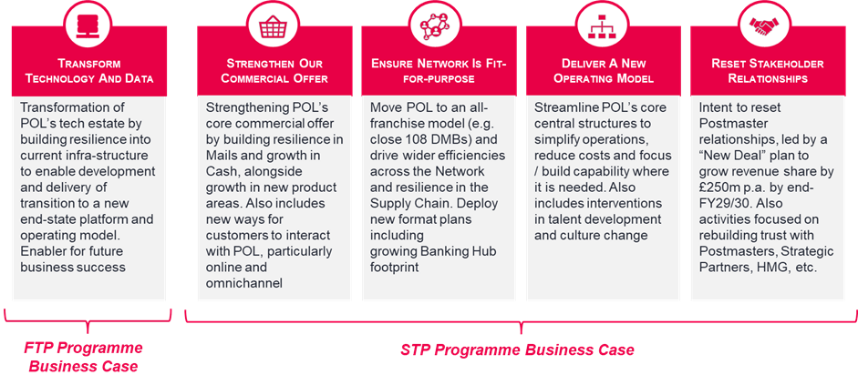
Text description of figure 1:
FTP programme business case:
- transform technology and data: transformation of POL’s estate by building resilience into current infrastructure to enable development and delivery of transition to a new end-state platform and operating model. Enabler for future business success
STP programme business case:
- strengthen our commercial offer: strengthening POL’s core commercial offer by building resilience in mails and growth in cash, alongside growth in new product areas. Also includes new ways for customers to interact with POL, particularly online and omnichannel
- ensure network is fit for purpose: move POL to an all-franchise model (for example, close 108 DMBs) and drive wider efficiencies across the network and resilience in the supply chain. Deploy new format plans including growing Banking Hub footprint
- deliver a new operating model: streamline POL’s core central structures to simplify operations, reduce costs and focus, and build capability where it is needed. Also includes interventions in talent development and culture change
- reset stakeholder relationships: intent to reset postmaster relationships, led by a “New Deal” plan to grow revenue share by £250 million per annum by end of the financial year 2029 to 2030. Also activities focused on rebuilding trust with postmasters, strategic partners, and the UK government
The transformation plan is also closely aligned with government priorities and delivery of government policy (for example, access to cash). It supports high street regeneration, SME growth, and financial inclusion – all of which are underpinned by the Post Office network’s unique national footprint and social value. It also responds where possible to the Post Office Horizon IT (POHIT) Inquiry and the government’s commitment to justice and redress for affected postmasters.
2. Strategic case
2.1 Case for change and strategic fit
STP is designed to address the precarity of POL’s financial and policy position, driven primarily by the following 3 factors:
- trading position: POL’s trading performance, having improved from a peak trading loss in the financial year 2012 to 2013 to a profit of £82 million in the financial year 2019 to 2020, has declined. It is forecast to decline further to a £24 million loss by financial year 2029 to 2030 (including revenue uplifts from Banking Framework 4), driven by weak revenue performance and cost inflation
- funding position: consistent losses over a long period of time mean POL is unable to fund its operations or any transformation activity. A lack of reserves also means POL is financially vulnerable to risks, impacting DBT (as POL’s only source of external funding)
- position of postmasters: postmasters have seen remuneration, from running a branch, decline by 30 to 40% in real terms in recent years. POL estimates that around 35% of branches are loss-making for their operator. The fragile position of postmasters makes running the business, attracting clients and operators and securing DBT policy very challenging
STP aims to transform POL to address these financial aspects as well as more effective delivery of the government’s policy objectives. Without funding, POL’s trading losses would likely increase, requiring greater network subsidy funding. Policy outcomes would be both lower quality and more fragile.
2.2 Objectives
The Transformation Plan adopts 3 spending objectives:
- improved community service: secure POL’s role at the core of communities across the UK, delivering against customers’ evolving needs and protecting the significant social and economic value the Post Office network delivers each year
- new deal for postmasters: postmasters can generate a fair living from running a Post Office branch, that compares acceptably to independent retail benchmarks of profitability and return
- lasting financial stability: streamline and simplify POL’s corporate centre to reduce costs, minimise financial and operational risk and lower the long-term funding requirement from the UK government
STP comprises 4 pillars:
- strengthen the commercial offer: diversify POL’s products and services to better serve customers, including new financial services, omni-channel propositions, and targeted marketing to drive awareness
- ensure the network is fit for purpose: transition to an independently-operated model, exit directly managed branches, expand Banking Hubs, modernise the supply chain, and introduce a postmaster-centred revenue share model to increase postmaster remuneration by £250 million per annum by financial year 2029 to 2030
- deliver a new operating model: streamline head office and back-office functions through organisation redesign, automation and a cultural shift toward efficiency and customer focus. This also includes a range of capability building activities
- reset stakeholder relationships: implement a ‘New Deal for Postmasters’, rebuild trust with government, partners, and communities, and reposition the Post Office brand as a trusted, modern institution
3. Economic case
The economic rationale for STP is driven by two key market failures.
First, the Post Office network generates significant positive externalities. Research commissioned by DBT on the value of the Post Office Network has highlighted the significant positive externalities provided by POL and its network, in the form of wider economic and social value. The research found that households and SMEs valued the network at £5.2 billion and £1.3 billion per annum respectively, with the highest rated qualities being that the Post Office network is “nearby and convenient to get to, and available when you need it”. Investment through STP will help to protect this significant social value by enabling POL to deliver an improved service to customers across the UK.
Second, co-ordination failures are prevented by the Post Office acting as central delivery point for wide-ranging services, avoiding duplication of infrastructure and mitigating the risk of key services not being offered in some areas due to lack of commercial incentive.
STP addresses both by protecting social value through delivering improved services to customers, and ensuring POL can maintain and enhance its role as central co-ordinator of key services.
The specific benefits include:
- increased revenue
- reduced investment and operating costs
- reduced branch churn rates
- increased postmaster satisfaction
- increased customer satisfaction
- increased POL staff satisfaction
- increased POL staff productivity
- increased stakeholder satisfaction
3.1 Shortlist of opinions
A structured appraisal considered the following scope options:
- option 1: BAU/counterfactual: maintains current service arrangements with minimal investment, restricted to activities already underway or deemed essential
- option 2: do the minimum: includes the delivery of some of POL’s Transformation Plan over the spending period. It is jointly funded by DBT and POL, projected to result in a postmaster remuneration uplift of £200 million by 2029 to 2030
- option 3: Preferred Way Forward (PWF): the delivery of POL’s Transformation Plan over the spending period, covering the entirety of the transformation plan outlined in the strategic case. Includes a postmaster remuneration uplift of £250 million
- option 4: more ambitious: covers all elements of the PWF as well as a larger investment in marketing and branch modernisation. While it delivers additional remuneration, this option diminishes POL’s long-term financial sustainability, in direct opposition to the transformation plan’s spending objective 3
3.2 Appraisal methods used
Appraisal methods used include:
- a value for money (VfM) appraisal of costs, risks and benefits under each option
- a qualitative appraisal of benefits and risks not captured by the VfM appraisal
- an appraisal of the place-based impacts of each option
- an appraisal of the environmental sustainability impacts of each option
3.3 Rationale for the choice of the preferred option
The appraisal of the transformation plan shows that it provides a net present social value of £156 million and a benefit-cost ratio of 1.34 under the PWF. This includes the cost of the FTP activities, which are a key enabler of POL’s transformation. Overall, this option offers the best value for money for the public purse compared with the alternatives.
The transformation plan delivers approximately £403 million in additional nominal benefits than a counterfactual scenario of doing nothing up to the financial year 2029 to 2030. These benefits will be used predominantly on increased investment in POL and increasing postmaster remuneration.
This option strikes the best balance of cost, risk, and benefit, delivering high strategic alignment and strong qualitative benefits.
4. Commercial case
4.1 Procurement strategy
A robust commercial governance framework has been established for STP, underpinned by the POL’s Contract Management Framework.
Contracts are segmented by strategic importance and risk, with tailored oversight and performance management mechanisms. Key procurements which meet the necessary value and complexity threshold are subject to DBT’s Commercial Approvals and Assurance Group (CAAG) governance, with approval to award scheduled following final tender evaluations.
Performance management, including the use of key performance indicators, is decided at contract level in line with the strategic importance and complexity of each project. POL’s contract management team regularly reviews contracts to ensure they meet evolving business needs, using 4 primary areas of review: (i) cost control; (ii) timeline control; (iii) compliance with specifications, quality assurance and/or service levels; and (iv) compliance with terms and conditions.
4.2 Ensuring value for money
Value for money is driven through STP’s commercial strategy, including:
- leveraging economies of scale and spend volumes to reduce unit costs
- utilising competitive tender processes where suitable
- performance-linked payments and service credits
5. Financial case
5.1 Financial costs of the preferred option
Across financial year 2026 to 2027 to financial year 2029 to 2030, DBT funding for STP is projected at £326.5 million under the 4 pillars that make up the scope of this PBC (set out in section 1.2). This spend totals £193.4 million in the PBC drawdown period covering financial year 2026 to 27 and financial year 2027 to 2028. No DBT funding is currently assumed for phase 3, as STP activity in these years is expected to be fully funded by POL.
Table 1: DBT funding for STP
| Phase 1: 2025 to 2026, approved | Phase 2: 2026 to 2027, drawdown | Phase 3: 2028 to 2029 to 2029 to 2030 | Total | |
|---|---|---|---|---|
| Total | £133.1 million | £193.4 million | £0 | £326.5 million |
5.2 Financial assumptions and key risks
POL faces a risk relating to the classification of spend between resource departmental expenditure limits (RDEL) and capital departmental expenditure limits (CDEL). Since a final determination on spend type can only be made at the point of expenditure, forecasts prepared today may not be accurate. This creates a risk to POL in relation to accessing funding. This is mitigated through regular engagement and reporting between POL and DBT.
In addition, POL has made assumptions for the phasing of activity in the PWF, meaning that if activity is delayed spend would take place later and total spend and POL’s funding requirement may be higher. The impact on funding would be greater if funds allocated to one year cannot be carried forward.
Each of the programmes within STP have been subject to an optimism bias assessment. POL estimates a total contingency of £163 million across the forecast period from the financial year 2026 to 2027 to financial year 2029 to 2030 and £103 million in the drawdown period.
6. Management case
6.1 Programme structure and governance
The Shareholder Relationship Framework Document sets out the broad governance framework within which POL operates. DBT is the shareholder of Post Office Limited and UK Government Investments (UKGI) is the shareholder representative with a shareholder director on the POL Board.
Governance for the transformation plan (STP and FTP) is structured across 3 levels: board, executive, and pillar.
- the board level and its Transformation Subcommittee provide strategic oversight and approve spend between £15 million and £50 million
- the executive level and its subcommittees oversee delivery and risk management as well as spend below £15 million. They provide external reporting to relevant government departments
- the pillar level has a pillar board, programme and project boards, which manage day-to-day delivery
DBT, UKGI, and HM Treasury are fully embedded into relevant governance forums across transformation plan delivery, ensuring transparency and alignment with shareholder expectations.
6.2 Risk management
POL employs a structured 3 lines of defence model in relation to risk management.
- First-line assurance is embedded within delivery teams and supported by the transformation project management office (PMO), which ensures conformance with the Change Excellence Framework (CEF) and provides quality of compliance oversight.
- Second-line assurance is provided by POL’s corporate functions and internal audit, with stakeholder gating at key lifecycle stages and independent reviews conducted by Deloitte.
- Third-line assurance is externally led and includes National Infrastructure and Service Transformation Authority (NISTA) Gateway Reviews, Cabinet Office functional support (for example, Complex Transactions Team), and specialist reviews such as the Horizon Integrity Review by Kroll.
STP and FTP are part of the Government Major Project Portfolio (GMPP), and therefore the programme benefits from the added assurance provided by the National Infrastructure and Service Transformation Authority.
6.3 Evaluation plan
The POL Monitoring and Evaluation plan sets out a clear framework for systematically measuring the progress of the Transformation Plan (STP and FTP). It assesses the effectiveness of the programmes’ delivery processes, the extent to which the programme is delivering the desired impacts, and determines the programme’s value for money.