Patent Cooperation Treaty (PCT) for Private Applicants
Updated 1 April 2026

© Crown copyright 2026
This publication is licensed under the terms of the Open Government Licence v3.0 except where otherwise stated. To view this licence, visit nationalarchives.gov.uk/doc/open-government-licence/version/3 or write to the Information Policy Team, The National Archives, Kew, London TW9 4DU, or email: psi@nationalarchives.gov.uk.
Where we have identified any third party copyright information you will need to obtain permission from the copyright holders concerned.
This publication is available at https://www.gov.uk/government/publications/patent-cooperation-treaty-for-private-applicants/patent-cooperation-treaty-pct-for-private-applicants
Patent Cooperation Treaty (PCT)
GB receiving office notes for private applicants
This note is intended to serve as a basic introduction to filing International patent applications under the Patent Cooperation Treaty (PCT) with the GB Receiving Office at the Intellectual Property Office.
Whilst we have made every effort to cover important aspects, this note is not comprehensive and you are advised to read the various PCT guides issued by WIPO (World Intellectual Property Organisation) and to seek advice when in doubt.
The PCT system is complex. You are strongly advised to seek the help of a chartered patent attorney.
Deadlines
A chart showing the timelines for action on your application is attached at Annex B.
Reminders will not be issued at any stage during the processing of your application and failure to meet deadlines may mean you incurring surcharges or even losing your application.
Introduction
The Patent Cooperation Treaty (PCT) system allows applicants seeking patent protection, in a number of countries, to file a single international application in English with the Intellectual Property Office. The International Unit at the Intellectual Property Office acts as the GB Receiving Office under the PCT. A PCT application has the same effect as a regular filing in each of the national or regional Offices of the PCT Contracting States that you select or designate when you complete the PCT Request Form PCT/RO/101.
Your PCT application is processed through two basic stages, the ‘International Phase’ and the ‘National’ (for example: seeking a national UK patent) or ‘Regional Phase’ (for example: seeking a regional European patent).
Remember the international phase is only a preliminary process of search and publication with the option of a non - binding preliminary examination. To obtain a granted patent in any country, including the United Kingdom you will need to process the application with each country or region according to national/regional laws.
International Phase
The ‘International Phase’ covers the period up to the point at which your application enters the ‘National’ or ‘Regional Phase’.
Initially you should file one copy of your International application with one request form. The GB Receiving Office will check the international application to ensure that the formal requirements of the PCT have been met. They will retain a copy on your file in the International Unit at the Intellectual Property Office and forward a copy to the International Bureau of WIPO in Geneva, and a copy to the European Patent Office at The Hague, who are the International Searching Authority for applications filed at the GB Receiving Office.
Within approximately 7 to 10 working days from receipt of the application, you will receive notification of the PCT application number and the international filing date given. You will be informed of any outstanding formal requirements, and you will be given a time period, usually two months, in which to respond from the initial filing date of your PCT application.
Within 16 months of the earliest priority date claimed see question 11 (or 9 months where no priority has been claimed), you should receive the International Search Report (form ISA/210) along with a written opinion and information on time limits for filing amended claims.
Publication
Promptly after 18 months from the earliest priority date, WIPO will publish your application. The International Bureau will advise you using form IB/308 that a copy has been sent to each of the designated offices.
Withdrawal of an International application
If you do not want your application to be published you must request its withdrawal in writing direct to either the GB Receiving Office or to the International Bureau. However even though under PCT rule 90b is notices of withdrawal of international applications, designations or priority claims may be submitted to the Receiving Office, and notices of withdrawal of demands or elections may be submitted to the International Preliminary Examining Authority for onward transmission to the International Bureau, applicants are strongly advised to send all notices of withdrawal direct to the International Bureau.
This will prevent any possible delay that may occur as a result of the extra administrative step that is required when such a notice is sent via another Office. The request must reach the International Bureau no later than 17 months and 2 weeks from the earliest priority date to prevent publication.
Sending notices of withdrawal to the International Bureau
To avoid any problems caused by delays in the mail, applicants are advised to submit all notices of withdrawal directly to the International Bureau by using ePCT (WIPO IP Portal), or in cases where ePCT is unavailable, the Contingency Upload Service (as shown in details of the PCT Newsletter 11/2019, pages 1-2).
International preliminary examination
You may decide that you require an International Preliminary Examination and this can be requested by filing a PCT Demand form (PCT/IPEA/401).
The time limits are 3 months from the date of the transmittal of the International Search Report and written Opinion (this will give you an initial and non-binding opinion as to whether your invention is novel, non-obvious, and industrially applicable), of the International Searching Authority (ISA) or 22 months from the priority date, the time limit of 19 months still applies in respect of a few offices, (please see The International Patent System).
The handling fee for the International Preliminary Examination is due one month from filing the Demand Form and has to be submitted directly to the International Preliminary Examination Authority (IPEA).
National/Regional Phase
If you opt for an International Preliminary Examination by filing a demand form. You may then enter the National or Regional Phase, of the countries designated, after you have received your international preliminary examination report. Entering each national or regional phase must, however, be done within the time limit for each of the countries you wish to enter. The Intellectual Property Office has an entry time of 31 months from the earliest priority date. The documents (national forms, translations etc.) and fees must be received by the Offices you have designated in your application within the time limit of each Office.
If you do not opt for an International Preliminary Examination you will need to make similar arrangements to enter the National or Regional Phase at 31 months from the earliest priority date.
The time limits specified by each designated office must be checked with each individual Office or can be found in the PCT Applicants Guide National Chapters or on the World Intellectual Property Organisation Internet site, the International PCT System.
In both instances you are strongly advised to contact the national or regional Offices of each state or region designated, identify their local requirements and prepare for entry well in advance (please see the following questions and answers). The GB Pre - Grant formalities divisions can help with entry into the UK National Phase; information can be obtained by telephoning the Intellectual Property Office on 01633-814619.
Common questions
The following Question and Answer items deal with the most common questions that have been asked by applicants under the PCT.
Q1. What do I need to file when making an international application?
To apply you must file the following:
- request form RO/101
- description
- one or more Claim(s)
- abstract
- drawings (if referred to in description)
- fees (these may be filed later, see Question 5
One copy of the description, claims and drawings is required. If other documents are necessary the GB Receiving Office will request them. If a priority is claimed from an earlier application, you will need to file a copy of the priority application. This needs to be received by this office no later than 16 months after the earliest priority date.
Q2. Can anyone file a PCT Application with the GB Receiving Office?
No. At least one of the applicants must be a national or resident in the United Kingdom, Isle of Man, Guernsey or Gibraltar.
Q3. Where do I file?
The application must be sent to:
Intellectual Property Office
Patents International Unit
Room 1G05
Concept House
Cardiff Road
Newport
South Wales
NP10 8QQ
Q4. When do I file?
The PCT works on strict deadlines, but you have two choices of when to file.
-
If you are claiming a priority from a national application for your international application, you have 12 months from the earliest priority date in which to file the application to make sure you keep the priority date of the earlier application.
-
If you do not have a priority case, you can file for an international application whenever you are ready to do so.
You are advised to file the international application no later than 11 months from the priority date and, if you are posting your application, you are advised to use registered post.
The International Filing date will be the date of receipt at this office, providing certain minimum requirements of the PCT are met. If you are claiming priority from an earlier application, you should allow sufficient time for any required corrections to be made before the 12 months priority period expires; otherwise you will lose your priority date.
Q5. What will it cost?
Fees can be found in Annex E.
Q6. Are these the only costs?
No, these are only the minimum initial fees.
A fee for the International Preliminary Examination, and further substantial fees must be paid in each state or region when your application enters the National or Regional Phase. After this you will pay renewal fees to maintain your patent protection in each of those National states or region(s). (This information can be found on the WIPO website.
Q7. Can anyone say what the whole cost will be?
Not at the outset.
Other fees may be payable, depending on the precise nature of your application. The fees charged under the PCT may change reflecting currency exchange rates and the payments required for entry into the ‘National’/’Regional’ Phase may vary from state to state.
Q8. Where must I pay?
The PCT application filing fees should be paid to the Intellectual Property Office at the address given in question 3.
The fee for international preliminary examination should be paid directly to the European Patent Office in Munich (known as the EPO) and the ‘National’ or ‘Regional’ phase fees should be paid directly to the Patent Offices of the individual states or regions concerned.
Q9. Can the costs be reduced?
No, PCT fees must be paid in full.
However, you could get a feel as to whether a PCT application is worthwhile by first filing a UK national application with a Patents Form 1 - Request for grant of a patent and proceeding as far as the search stage. The application fee is £75 if e-filed and paid at the time of filing the application (the fee is higher if filed on paper or if paid later) and a Form 9A - Request for search) is £200 if e-filed, or £240 if filed on paper.
If you still wish to continue with an international filing, your UK application could then be used as a priority claim for a PCT application, provided the PCT application was filed within 12 months. This time could be used in identifying potential markets or backers to fund the development of your idea. Annex E provides information on e-filed applications, forms for PCT-SAFE can be found on the WIPO Website.
Q10. ePCT
ePCT is the World Intellectual Property Office’s secure online service for filing
- International PCT patent applications
You can join the service by creating a WIPO account, setup strong authentication and file via a web browser-based system, from the World Intellectual Property Office (WIPO).
There is a fee reduction for e-filing which can be found in Annex E.
Q11. Can I claim priority from an earlier application?
Yes, in fact you can claim priority from more than one earlier application.
However you must file your PCT application within 12 months of the earliest application. This time limit is very important. However, if you file your PCT application between the 12-14 months from the earliest application, you may request Restoration of Priority if you can provide evidence that the failure to file within the 12 month time limit was unintentional. There will be a fee of £200, See Annex E.
If you claim priority from an earlier application, you should ensure that a copy of that application (certified by the office that issued it) reaches the International Bureau or the GB Receiving Office within 16 months of the earliest priority date. Failure to do this may result in loss of priority.
The International Bureau will confirm receipt of the priority document.
You should ask the issuing office to prepare any certified copy that you need and pay any fee that they require. If the priority document is a UK application, you may ask the GB Receiving Office to prepare a copy and send it to the International Bureau for you, the fee for this is £27 per document.
If a copy of the earlier application is held in a digital library under the Digital Access Service (DAS) you may authorise the International Bureau to obtain a copy to use as a priority document.
Q12. What if I am filing an international application based on an earlier application and the 12 month period for claiming priority has expired? (and Restoration of Priority is not available)
This is allowable but you must ensure that your new application is filed before your earlier application is published. If you do not file your new application until after your earlier application is published then your later application is likely to be ineffective. Even if you file your new application before your earlier application is published then the earlier application is likely to be listed as a potentially relevant document on the International Search Report. As this may affect the progress of your international application at a later stage, you should consider seeking professional advice from a chartered patent attorney before filing an international application under these circumstances.
Q13. What basic standards must my application meet?
Because of uniform publication requirements, your application must be typed and have minimum sized margins for the text and any drawings.
These and other requirements are shown in Annex A. Other requirements can be found in the booklet Basic Facts about the Patent Cooperation Treaty (PCT), the world wide system for simplified multiple filing of patent applications (available from both the Intellectual Property Office and the World Intellectual Property Organisation (WIPO).
Q14. How do I prepare claims?
Advice on the preparation of claims can be found in Annex D.
Unlike the UK Patents Act, the PCT does not allow a filing date to be accorded if no claims are present. It is, therefore essential that you file a claim or claims otherwise it will not be possible for the Receiving Office to accord a filing date to the application. Claims must be clearly identifiable and headed up as ‘claims’ and included on a separate sheet.
Where the application claims priority see Q11 and you file it without claims close to the end of the 12 months priority period, the subsequent correction of this defect may well result in loss of the priority date.
Q15. What happens if there are errors in my application or if I wish to change my application?
Opportunities to amend the claims and description arise at various stages of the PCT procedure (see Q14 and Q15).
Other than this, there is relatively limited scope under the PCT to make changes to your application after filing. Even where it is possible strict time limits and other conditions may apply. You should therefore take great care in the preparation of your application, and if possible seek the professional help of a Patent Attorney (a list of these can be found in a telephone directory).
If you do want to make changes, you should write as soon as possible to the GB Receiving Office. As a general rule, it will not be possible to add to the technical content of the application or to correct errors where it is not immediately obvious what the required correction is.
It is however possible to change some details of applicants, or withdraw priority claims.
Q16. Will I have the chance to amend claims after filing my application?
When the International search report has been received you will have the opportunity to amend claims, although a time limit is applied and this is normally within 2 months of the date of the Search Report.
Q17. How do I request an International Preliminary Examination?
The Demand Form (PCT/IPEA/401) and the fee must be sent to:
European Patent Office
PCT Chapter II (IPEA)
D-80298 Munich
Telephone: 0049 89 2399 2700
For time limits see International Preliminary Examination Guidelines. The fees can be paid into the EPO bank account:
Account no: 333880000
Currency: EUR
Bank Code: 70080000
Bank Name: Commerzbank AG
IBAN: DE20700800000333880000
BIC/SWIFT: DRESDEFFXXX
Account holder: Europäische Patentorganisation
Bob-van-Benthem-Platz 1
80469 München
Deutschland
However, the cost can vary due to changes in the currency exchange rates and you should contact the EPO Munich, in advance, to confirm the current charge.
Q18. When can I file a demand?
A demand for international preliminary examination may be filed at any time prior to the expiration of 3 months from the date of transmittal of the International Search Report and Written Opinion of the International Searching Authority, or 22 months from the priority date, whichever time limit expires later (Rule 54bis.1(a)).
Q19. I understand that a demand does not have to be filed before the expiration of 19 months from the priority date in order to get the benefit of 30 months from the priority date to enter the national phase (in a state in which the modified chapter I time limit applies). If I want to file a demand so that I can ensure that I obtain an International Preliminary Examination Report (IPER) in sufficient time to be able to use it in my national phase filing decisions, when should I file it?
You should file your demand form as early as possible.
In order to increase the likelihood that the IPEA will be able to establish the IPER within a time frame that will enable you to make national phase entry decisions based on it, it is our recommendation that you continue to file your demand as early as possible, as the time limit for establishing International preliminary examination report is 28 months from the earliest priority date.
Q20. What if I wish to withdraw my application?
The International application can be withdrawn at anytime before it enters the national or regional phase. To avoid any problems caused by delays in the mail, applicants are advised to submit all notices of withdrawal to the International Bureau by using ePCT or in cases where ePCT is unavailable, the Contingency Upload Service (see details in the PCT Newsletter 11/2019 pages 1 - 2. Please also look at ‘Sending Notices of Withdrawal to the International Bureau’ section for further information.
Q21. Where can I get help?
It is strongly recommended that you seek advice from a Chartered Patent Attorney.
A Chartered Patent Attorney will help you draft and process your application. This includes the difficult stage of National Phase Entry, where translations and an address for service are likely to be needed for each state or region in which you wish to proceed.
Some patent attorneys may be able to suggest ideas for funding and marketing your invention, but this depends on the individual attorney concerned. In certain parts of the country, Patent Clinics are available for inventors. This service is run free of charge, and for more information you should contact CIPA.
The Intellectual Property Office cannot recommend individual attorneys but you can contact the Chartered Institute of Patent Attorneys (CIPA), at the address below for further advice:
The Chartered Institute of Patent Attorneys
2nd Floor Viaro House
20-23 Holborn
London
EC1N 2JD
Email: mail@cipa.org.uk
CIPA Website
We are not qualified to advise you on any technical matters. However, if you have any specific questions regarding your application or questions about procedures during the International Phase before publication you may call the Intellectual Property Office International Unit enquiry number on: Newport (01633) 814586.
To further assist you, we have included the following notes and we recommend you study them closely before preparing your application:
- WIPO Publications
- BASIC FACTS about the Patent Cooperation Treaty, The Worldwide Filing System for simplified multiple filing of Patent Applications
- PCT Request Form PCT/RO/101 and notes
- PCT Chapter II Demand Form PCT/IPEA/401
- CIPA Directory of Patent Attorneys
It is further recommended that you consult a copy of the WIPO publication “The PCT Applicants Guide” for more detailed information before proceeding with your application.
Annex A(a)
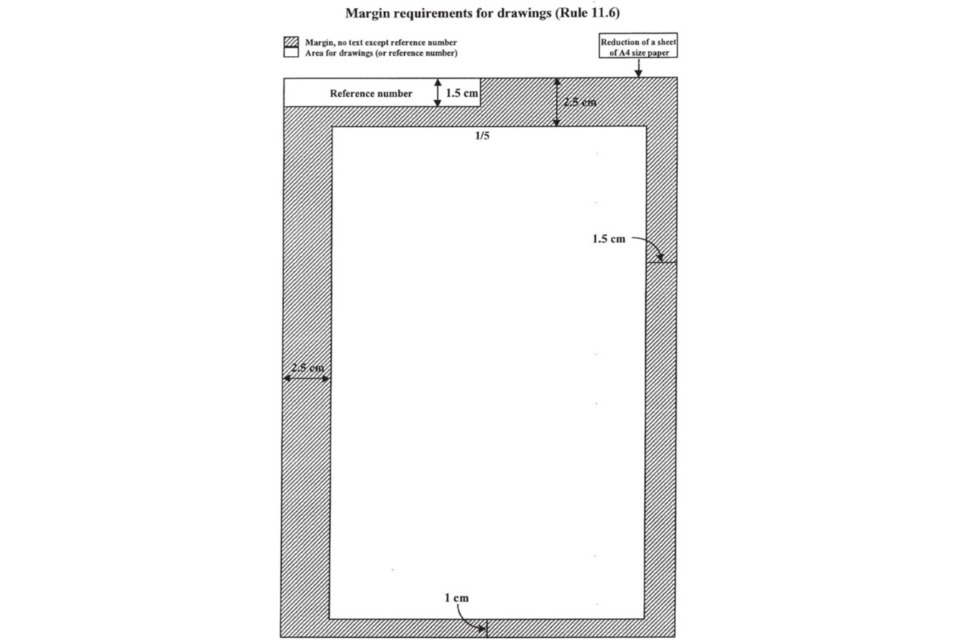
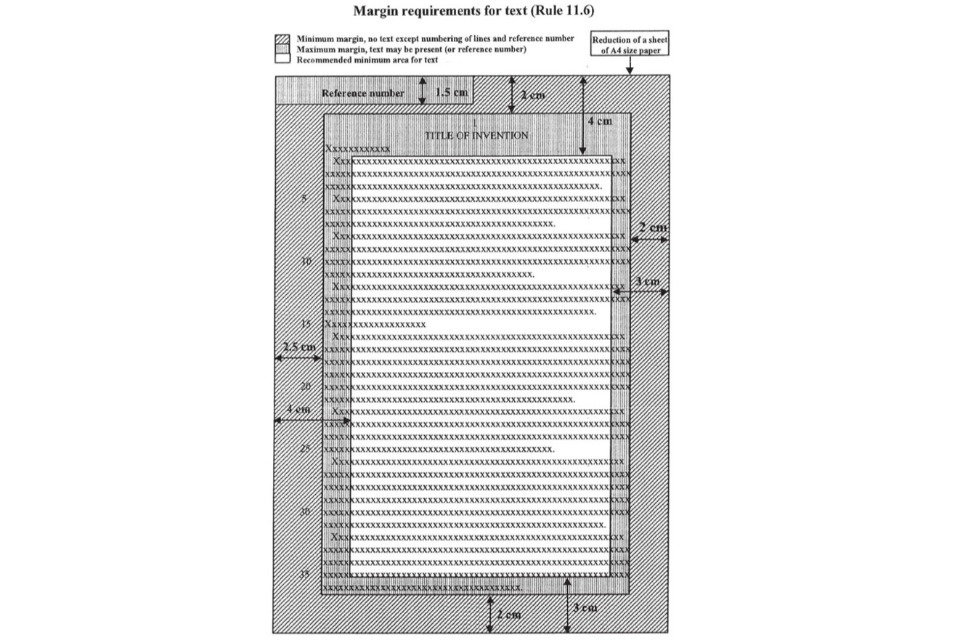
Margin requirements for drawings and text Rule 11.6
Margins
(a) The minimum margins of the sheets containing the description, the claims, and the abstract, shall be as follows:
- top: 2cm
- left side: 2.5cm
- right side: 2cm
- bottom: 2cm
(b) The recommended maximum, for the margins provided for in paragraph (a), is as follows:
- top: 4cm
- left side: 4cm
- right side: 3cm
- bottom: 3cm
(c) On sheets containing drawings, the surface usable shall not exceed 26.2cm x 17.0cm. The sheets shall not contain frames around the usable or used surface. The minimum margins shall be as follows:
- top: 2.5cm
- left side: 2.5cm
- right side: 1.5cm
- bottom: 1cm
(d) The margins referred to in paragraphs (a) to (c) apply to A4-size sheets, so that, even if the receiving office accepts other sizes, the A4-size record copy and, when so required, the A4-size search copy shall leave the aforesaid margins.
(e) Subject to paragraph (f) and to Rule 11.8(b), the margins of the international application, when submitted, must be completely blank.
(f) The top margin may contain in the left-hand corner an indication of the applicant’s file reference, provided that the reference appears within 1.5cm from the top of the sheet. The number of characters in the applicant’s file reference shall not exceed the maximum fixed by the Administrative Instructions.
Margin requirements for drawings (Rule 11.6)
Margin requirements for text (Rule 11.6)
Patent Factsheets: Drawings
The basis of a PCT patent application is a legal document called a specification. Its contents determine whether a patent can be granted. You would be well advised to seek professional assistance when preparing your patent application. A patent specification includes:
- a full description of your invention, plus any drawings referred to
- one or more claims
This factsheet tells you about the drawings. An example is shown below. Other factsheets in this series explain how to prepare a description, claims, and an abstract (which is another essential part of an application).
Content
An application should preferably include a set of good quality drawings which illustrate one or more embodiments of your invention. The drawings may, for example, illustrate different views of your product, or provide a flow chart of the steps taken to perform your method.
The drawings offer valuable support for the invention that is described and claimed in your application. It is therefore important that you illustrate all examples of your invention.
You should consider illustrating the invention from a number of different angles and, if appropriate, use cross-sectional views. You should also include figures of any important features that would be hidden in use.
Style and presentation
Your drawings must consist of black, well defined lines so that good quality photocopies may be made of them as seen in this example. Photographs may be included providing they are black and white, clear and capable of direct reproduction.
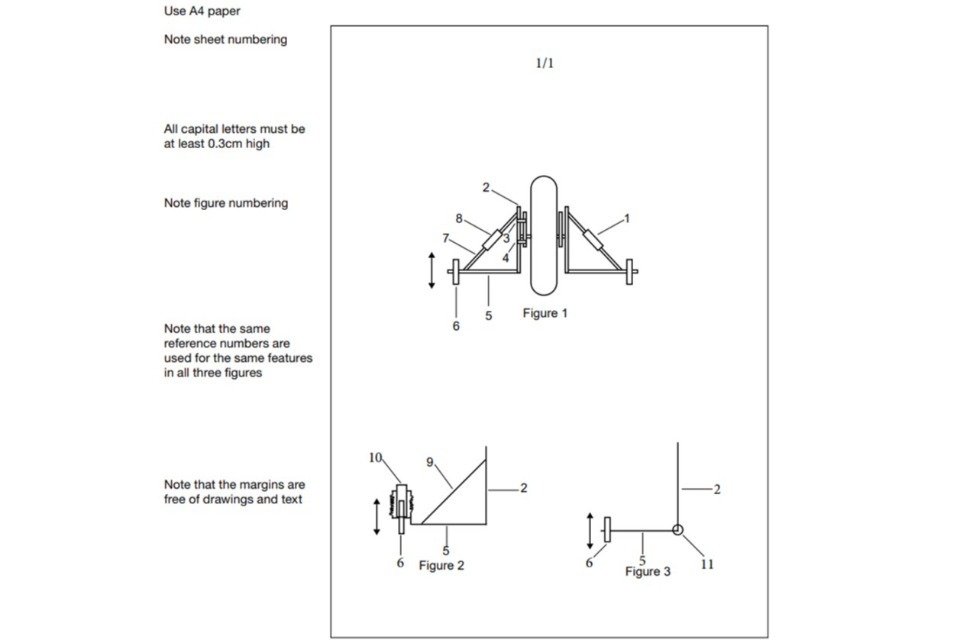
You may have more than one drawing sheet. Each drawing sheet may contain several figures. If you have more than one figure on a page, label each figure clearly as ‘Figure 1’, ‘Figure 2’ and so on.
Number the drawing sheets in order at the top middle (but not in the top margin), preferably also indicating the total number of sheets of drawings. If you have one sheet, number it as ‘1/1’; if you have, for example, three sheets of drawings, then number them as ‘1/3’, ‘2/3’, ‘3/3’.
Specific features are indicated in the drawings using reference numbers and/or letters, joined to the corresponding feature by means of a clear, continuous line. These references are then used in the description to refer to those features.
The same reference number or letter must refer to the same feature in all figures that show it.
Capital letters used in any drawings must be at least 0.3cm high.
Prepare your drawings on one side only of separate sheets of white A4 paper. Leave margins of at least 2.0cm at the top and left-hand side, and 1.5cm on the right-hand side and 1.0cm at the bottom.
Any essential words (for example: ‘plan’, ‘elevation’) must be in English or Welsh. (The office will provide a translation of any material filed in Welsh).
Do not:
- use coloured or lined paper or coloured inks or pencil
- draw a frame to indicate the margins
- put anything in the margins or use ‘engineering’ borders
- write descriptive text in the drawings
- use excessive shading which obscures other elements of the drawing
- fold your drawings
- submit ‘engineering’-type drawings showing materials and/or dimensions, these are not normally suitable for use with patent specifications
Drawings: Typical example
Annex B: PCT Timeline
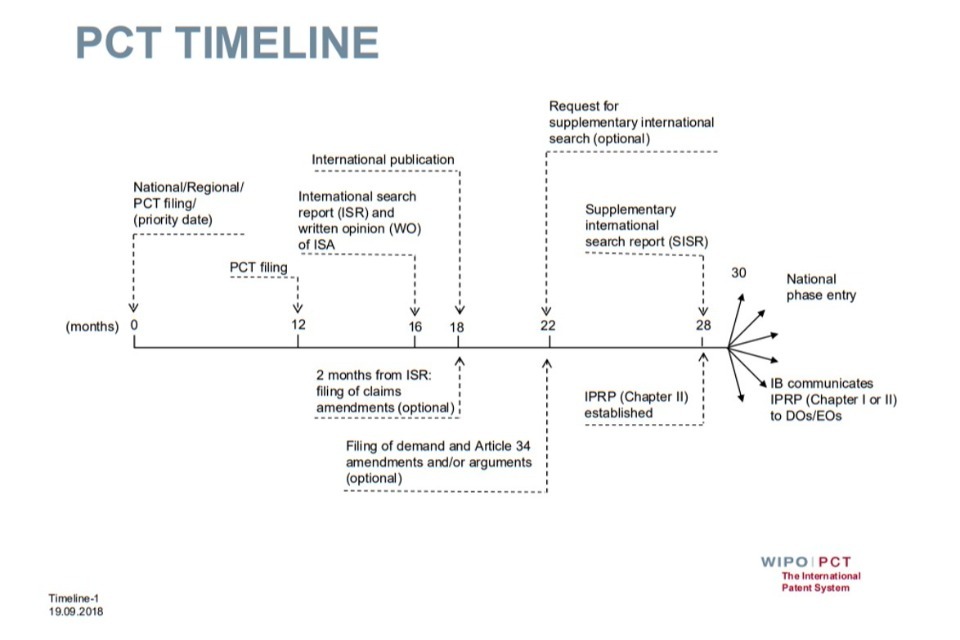
The above diagram shows the PCT timeline from filing to national phase entry. The horizontal timeline runs from 0 to 30 months. Key milestones include:
- month 0: National/Regional or PCT filing (priority date)
- month 12: PCT filing
- month 16: International search report (ISR) and written opinion (WO) of ISA
- month 18: International publication
- month 22: Request for supplementary international search (optional)
- month 28: Supplementary international search report (SISR)
- month 30: National phase entry and IB communicates IPRP (Chapter I or II) to DOs/EOs
- optional steps include filing claim amendments two months after ISR and filing demand and Article 34 amendments or arguments. IPRP (Chapter II) is established before national phase entry
Selection of acts and rules forms used and extensions (table 1)
| Selection of acts/actions/payments | Rule/Article | Prescribed time limit | Forms used for invitation/reminder | Extension |
|---|---|---|---|---|
| Omitted sheets at time of filing Late filing with RO |
Rule 20.2 | 2 months from date of filing but filing date may be changed. If sheets are in priority document, there may be a provision under new rules to keep original filing date. Attention: priority right may be lost | PCT/RO/103 if whole description or claims is missing. PCT/RO/107 if part of description or claims is missing. | None |
| Formal defects Corrections to be filed with RO |
Article 14(1) Rule 11 Rule 26.2 | Time limit fixed by RO in invitation: 2 months from date of invitation | PCT/RO/106 | Under Rule 26.2 at any time before a decision is taken by RO but corrections should reach IB before technical preparations for publication are completed |
| Priority Document To be filed with RO or IB |
Rule 17.1(a) Rule 26bis |
16 months from priority date or, if early entry into national phase, before entering the national phase | Reminder in PCT/IB/301 | Possibility to submit the priority document to a designated or elected Office within a time limit prescribed by that Office |
| Fees to be paid to ISA Additional search fee Protest fee |
Rule 40.3 Rule 40.2(e) |
Maximum of 45 days from date of invitation by ISA 1 month from date of invitation by ISA |
PCT/ISA/206 PCT/ISA/228 |
None None |
| Amended claims To be filed with IB |
Article 19 Rule 46 | 2 months from the date of transmittal of the international search report or 16 months from priority date, whichever date expires later | PCT/ISA/220 | Accepted after expiration of the time limit technical preparations for publication have not yet been completed |
Selection of acts and rules forms used and extensions (table 2)
| Selection of acts/actions/payments | Rule/Article | Prescribed time limit | Forms used for invitation/reminder | Extension | |||||
|---|---|---|---|---|---|---|---|---|---|
| Demand for international preliminary examination To be filed with competent IPEA |
Article 39(1) Rule 54bis.1(a) | Whichever of the following time limits expires later: 3 months from date of transmittal of ISR and Written Opinion of ISA or 22 months from priority date; the time limit of 19 months still applies in respect of a few Offices (see the PCT website | No invitation Reminders in PCT/IB/301, PCT/IB/308 and PCT/ISA/220 |
Time limit not extendable. If filed after applicable time limit under Rule 54bis.1(a), demand will be considered as if it had not been submitted. | # Correction of defects in demand | Rule 60.1 | At lease 1 month from date of invitation | IPEA/404 | Can be extended until a decision is taken by IPEA |
| Fees to be paid to IPEA Preliminary examination fee |
Rule 58.1(b) Rule 57.3 |
1 month from date on which demand was submitted (or received by IPEA if transmitted) | PCT/IPEA/403 | Rule 58bis: Invitation (PCT/IPEA/440) one month from date of invitation by IPEA with surcharge | |||||
| #Handling fee | Rule 57.3 | 1 month from date on which demand was submitted (or received by IPEA if transmitted) | PCT/IPEA/403 | Rule 58bis: Invitation (PCT/IPEA/440) one month from date of invitation by IPEA with surcharge | |||||
| #Additional examination fee | Rule 68.2 | Minimum 1 month, maximum 2 months, from date of invitation by IPEA | PCT/IPEA/405 | None | |||||
| Protest fee | Rule 68.3(e) | One month from date of invitation by IPEA | PCT/IPEA/437 | None |
Selection of acts and rules, forms used and extensions (table 3)
| Selection of acts/actions/payments | Rule/Article | Prescribed time limit | Forms used for invitation/reminder | Extension |
|---|---|---|---|---|
| Declarations | Rule 4.17 Rule 26ter |
On filing or before the International Bureau within a 16-month time limit from the priority date |
PCT/RO/156 PCT/IB/370 PCT/IB/371 |
Fulfilment of requirements when entering the national phase |
| Entry national phase Before designated offices |
Article 22 | 30 months from priority date (20 months in a few Offices; as shown on the PCT website) | No Invitation-reminders in PCT/IB/301, PCT/IB/308 and PCT/IB/332 | Rule 49.6: see Applicant’s Guide, Volume II, National Chapters for possible extension of time limit. |
| Entry national phase Before elected office |
Article 39(1) | 30 months from priority date | No invitation-reminders in PCT/IB/301, PCT/IB/308, PCT/IB/332 and PCT/IPEA/416 | Rule 49.6: see Applicant’s Guide, Volume II, National Chapters for possible extension of time limit. |
| Obvious errors Request for rectification just be filed with competent authority (as seen below) and authorization must be given by that authority |
Rule 91.1(g) | Authorisation should reach 1B within 17 months from priority date | N/A | Authorization must reach IB before the completion of the technical preparations for international publication, i.e., 15 days before the actual publication date (Rule 91.1(g-bis)) |
| Competent Authority | For Errors In | Exceptions |
|---|---|---|
| RO ISA |
Request PCT/RO/108 Any part of international application other than request and demand PCT/ISA/216 |
If early publication requested, before the completion of the technical preparations for early publication (Rule 91.1 (g-ter)) |
| IPEA | Any part of international application other than request PCT/IPEA/411 | If no publication at 19 months, before Article 20 communication (Rule 91.1g-quarter)) |
| IB | Any paper other than international application, submitted to IB PCT/IB/314 | If authorisation by IPEA: must be given before issuance of international preliminary examination report |
Annex C: Communication and Documents
Selection of communications and documents received during the international phase and corresponding actions to be taken by the applicant, (for international applications filed on or after 1 January 2004).
| Forms: | Issued By: |
|---|---|
| PCT/RO/I.. | PCT/RO/I.. |
| PCT/lSA/2.. | the International Searching Authority |
| PCT/lB/3.. | the International Bureau |
| PCT/lPEA/4.. | the International Preliminary Examining Authority |
| Chapter I | |
| PCT/RO/102 | Notification concerning Payment of Prescribed Fees. If a balance is due, the missing amount must be paid within one month from the date of receipt of the international application. Rules 14, 15 and 16 |
| PCT/RO/105 | Notification of the International Application Number and of the International Filing Date. Also indicates whether or not the record copy has been transmitted to the International Bureau. The International Bureau will monitor the receipt of the record copy. No action required. Rule 20.5(c) |
| PCT/RO/106 | Invitation to Correct Defects in the International Application. The applicant must submit the required corrections within the time limit fixed in the invitation. Extensions of time may be obtained. Failure to comply with the invitation may result in the international application being considered withdrawn. [Articles 3(4)(i) and 14(1) and Rule 26] Invitation to Correct Priority Claim |
| PCT/RO/IIO | The applicant must respond to the invitation within 16 months from the (earliest) priority date or, if the (earliest) priority date is changed as a result of the correction or addition of the (earliest) priority claim, within 16 months from the (earliest) priority date so changed, whichever expires first. In any event, a response may be submitted until the expiration of 4 months from the international filing date. Failure to respond may result in the priority claim concerned to be considered, for the purposes of the procedure under the PCT, not to have been made. [Rules 4.10, 26bis.1 and 26bis.2(a) and(b)] |
| PCT/RO/111 | Notification Relating to Priority Claim. If a priority claim is considered not to have been made, the applicant may, before the technical preparations for international publication have been completed and subject to the payment of a fee, request the International Bureau to publish, together with the international application, information concerning that priority claim. [Rules 26bis.1 and 26bis.2 and Administrative Instructions, Sections 302 and 314] |
| PCT/RO/133 | Invitation to Pay Prescribed Fees Together with Late Payment Fee. The applicant must pay the missing amount of fees together with any late payment fee within one month from the date of the invitation. Failure to comply with the invitation may result in the international application or designations being considered withdrawn. [Rule 16bis] |
| PCT/lSA/202 | Notification of Receipt of Search Copy. The receipt of the search copy by the International Searching Authority is monitored by the International Bureau which will send a reminder to the ISA in case of non-receipt of this notification. No action required. [Rule 25.1] |
| PCT/lB/301 | Notification of Receipt of Record Copy Contains an annex giving information on time limits concerning the entry into the national phase and priority documents. The applicant should, in particular, carefully check the indications concerning the applicant, the priority date and the designations. The information given on this form will be used for the international publication and for the communication to the designated Offices under Article 20. [Rule 24.2(a)] |
| PCT/lB/304 | Notification concerning Submission of Priority Document. Before the expiration of 16 months from the priority date, the applicant should check whether all the priority documents have been received by the International Bureau. If the corresponding checkbox in the request has been marked and the required fee paid no further action is required by the applicant. Any priority document received by the International. Bureau after the expiration of 16 months but before the date of international publication of the international application shall be considered to have been received by the International Bureau on the last day of that time limit. [Rule 17.1 and Administrative Instructions, Section 41 1] |
| PCT/lSA/210 | International Search Report Contains: list of documents relevant to the claims; observations regarding claims being unsearchable and lack of unity of invention; observations regarding the title, the abstract, the drawings (for publication purposes only) and nucleotide and/or amino acid sequence listings. The applicant should review the references cited, decide whether to proceed further or withdraw the application to prevent publication and/or file a demand for international preliminary examination as soon as possible. [Article 18 and Rules 43 and 44] |
| PCT/lSA/220 | Invitation to Pay Prescribed Fees Together with Late Payment Fee. The Notes to this form contain information on amendments of claims under Article 19 (when, where, how, what), possibility to file informal comments on the written opinion of the ISA (if no demand for international preliminary examination is filed), a reminder that if a demand for international preliminary examination is filed, the IPEA will in the majority of cases use the written opinion of the ISA as its written opinion under the Chapter Il procedure and reminders as to other further actions. [Rule 44. l] |
| PCT/lSA/237 | Written Opinion of the ISA Contains: Preliminary and non-binding written opinion on the questions whether the claimed invention appears to be novel, to involve and inventive step and to be industrially applicable; observations regarding non establishment of the written opinion and unity of invention. The applicant should review the findings of the examiner of the ISA, decide whether to proceed further or withdraw the application to prevent publication, whether to file a demand for international preliminary examination (possibly together with any amendments under Article 34 and/or arguments against the findings of the examiner), or whether to proceed to the national phase under Chapter l. [Rule 43bis] |
| PCT/lB/308 (First Notice) | Notice informing the applicant of the Communication of (First notice) the international application to the designated Offices which do not apply Article 22(1) as in force from 1 April 2002 This form is sent at 19 months covering all those designated Offices which do not apply Article 22(1) as in force from 1 April 2002. The applicant can use this form as evidence that the international application as published has been or, if so requested by the Offices, could have been communicated to the designated Offices concerned. No Office may therefore require that the applicant furnish another copy of the international application as published to any designated Office listed on this form in the national phase. [Rule 47.1 (c) and Decision of the PCT Assembly Relating to Entry into Force and Transitional Arrangements (see document PCT/A/31/10)] |
| PCT/lB/308 (Secondary and Supplementary Notice) | Notice informing the applicant of the Communication of the international application to the designated Offices which apply Article 22(1) as in force from 1 April 2002. This form is sent at 28 months covering all those designated Offices which apply Article 22(1) as in force from 1 April 2002. The applicant can use this form as evidence that the international application as published has been or, if so requested by the Offices, could have been communicated to the designated Offices concerned. No Office may therefore require that the applicant furnish another copy of the international application as published to any designated Office listed on this form in the national phase. [Rule 47.1 (c) ] |
| PCT/lB/311 | Notification concerning Transmittal of copy of international application as published or republished. This form is sent together with a copy of the published international application (“pamphlet”) and, where applicable, any subsequent republication. The applicant should check whether all the indications in the publication are correct. If an error was made by the International Bureau, that Bureau should be informed. A corrected version of the pamphlet will then be published and communicated to all designated Offices. |
| Chapter II | |
| PCT/lPEA/402 | Notification of Receipt of Demand by Competent International Preliminary Examining Authority The applicant should carefully check the date of receipt of the demand by the IPEA If that date is after the expiration of 19 months from the priority date, the entry into the national phase will not be postponed until 30 months from the priority date; for those States which have notified the International Bureau, that modified Article 22(1) is not compatible with the applicable national law. [Rules 59.3(e) and 61 .1 (b), first sentence, and Administrative Instructions, Section 601 (a)] |
| PCT/lPEA/403 | Notification concerning Payment of the Preliminary Examination and Handling Fees If a balance is due, the missing amount must be paid within one month from the date of submittal of the demand with the competent International Preliminary Examining Authority. [Rules 57 and 58 and Administrative Instructions, Section 61 5] |
| PCT/lPEA/404 | Invitation to Correct Defects in Demand The applicant must submit any correction within the time limit prescribed in the invitation (at least one month from the date of mailing of the invitation). Failure to correct results in the demand being considered as not having been submitted. If the applicant corrects the defect within the prescribed time limit, the demand will be considered as if it had been received on the actual filing date, provided that the demand as submitted and permitted the international application to be identified; otherwise, the demand will be considered as if it had been received on the date on which the correction was received. [Rule 60.1] |
| PCT/lB/332 | Information Concerning Elected Offices Notified of their Election List of elected States: all Contracting States which are designated, and which are bound by Chapter ll. [Rule 61.3] |
| PCT/lPEA/440 | Invitation to Pay Prescribed Fees Together with Late Payment Fee The applicant must pay the missing amount of fees together with any late payment fee within one month from the date of the invitation. Failure to pay the total amount due within the prescribed time limit shall result in the demand being considered as if it had not been submitted. [Rule 58bis] |
| PCT/lPEA/408 | Written Opinion Unless the IPEA has notified the International Bureau that it will not rely on a written opinion of an ISA established by a different Authority, the IPEA will consider the written opinion of the ISA (Form PCT/lSA/237) to be the written opinion of the IPEA. Lists comments on the international application (description, claims, drawings, abstract) and invites the applicant to submit a written reply within a time limit fixed in the invitation. The applicant may submit amendments or arguments, or both, directly to the IPEA. If no response to the written opinion is filed, the examiner will establish the international preliminary examination report only on the basis of the written opinion. [Rule 66] |
| PCT/lPEA/409 | International Preliminary Report on Patentability (Chapter Il of the PCT) Opinion on compliance with the criteria of novelty, inventive step and industrial applicability. The report may be accompanied by annexes, i.e. the replacement pages of description, drawings or claims containing the amendments on the basis of which the IPEA established the report. The International Bureau translates only the report itself into English and sends a copy of that translation to the Offices which require such translation. No action required. [Article 36 and Rule 70] |
| PCT/lPEA/416 | Notification of Transmittal of International Preliminary Examination Report. Contains reminders concerning the entry into the national phase before the elected Offices and the translation of the annexes to the international preliminary examination report. When entering the national phase, the applicant must furnish to the elected Offices a translation of any annexes to the international preliminary examination report. [Rules 71.1, 74 and 76.5] |
Annex D: Preparation of Claims
You should draft one or more claims which define clearly the invention for which you seek patent protection by setting out its distinctive technical features. The claim(s) should not contain any technical feature that is not contained in the description, or be inconsistent with it in any other way. You must not claim more than one invention.
When drafting a claim, you should aim to define an area of technology which is to become your, ”property” and which is distinguished from other, known areas. Once a patent has been granted, anyone who enters your “property” without your permission would be infringing the patent. It is in your interest to draft your claim as widely as possible, provided it is properly based on what you have described and does not amount to something which is already known.
Claims should include at least a main claim that defines only those features, which are essential to the invention, for example:
- A demountable box trailer comprising a wheeled chassis, a body in the form of a box, means for releasably securing the body on the chassis, the body being adapted to slide on and off the chassis from the rear end thereof, and adjustable legs provided on the body at or adjacent the end thereof which is adjacent the rear end of the chassis when the body is mounted on the chassis’.
Strictly only this is necessary. However, as a safeguard in case the main claim is shown to be invalid, it is conventional to protect features that are desirable but not essential by means of dependant claims, e.g.
-
A demountable box trailer as claimed in claim1 wherein guide means are provided on the body co-operable with the chassis to control sliding movement of the body on the chassis.
-
A demountable box trailer as claimed in claim 2 wherein the guide means is provided at the end of the body remote from the adjustable legs.
-
A demountable box trailer as claimed in any preceding claim, wherein the body is provided with at least one hinged lid’.
You should not file claims of the following types, which refer to advantages, merits, desired rewards or inventor ship:
- ‘my box trailer enables the trailer part to be kept in use’
- ‘my box trailer is cheaper and more easily convertible than other box trailers’
- ‘I claim £250 for my box trailer’
- ‘I claim to be the inventor of the demountable box trailer’
Annex E: Patent Cooperation Treaty (PCT) Fees
Changes in fees payable under the Patent Cooperation Treaty (PCT)
Notice is given that the fees (chapter I) payable in connection with applications filed under the Patent Cooperation Treaty at the UK Intellectual Property Office (RO/GB) are changed with effect from 1 April 2026.
| Type of fee | Cost | |
|---|---|---|
| Transmittal fee | £100 | |
| Search fee | £1,632 | |
| International fee for the first 30 sheets for each sheet over 30 |
£1,242 £14 |
|
| Restoration for restoration of priority | £200 | |
| Reductions for e-filing: Electronic filing (not being in character coded format) Electronic filing (being in character coded format) |
Electronic filing (being in character coded format) |
£187 £280 |
| Fees for preparation of priority document | £27 |
Thus using current rates, as of 1 April 2026, an application of 30 sheets or less with all available states designated would cost £2,974. Please remember this is the initial filing.
You will need to use a PCT fee sheet, which is available on to pay for your PCT application.
The transmittal, search, and International Fee should be paid within one month of filing.
Please note no reminders will be issued and late payment fees will incur a surcharge.
If you require the GB receiving Office to prepare and transmit copies of UK priority applications, you will need to pay £27 for each priority claimed See Q11.
For information on other fees and costs, see Q5 - Q9 and Q11.
Other Sources of Information
| Organisation | Contact Information | |
|---|---|---|
| WIPO | 004122 3389111 (General Information) 004122 3388338 (Helpdesk) |
|
| EPO - The Hague | (General Information) | 003170 3404500 |
| EPO - Munich | (General Information concerning Demands) | 004989 2399 4538 |
| [IPO] | General Information | 0300 300 2000 |
| UK PCT Receiving Office | Information Line pct@ipo.gov.uk |
01633 814586 |
Please also see information on:
IPO Manual of Patent Practice
PCT Fee Sheet