OPG annual report and accounts 2024 to 2025 - web version
Published 17 July 2025
Applies to England and Wales

© Crown copyright 2025
This publication is licensed under the terms of the Open Government Licence v3.0 except where otherwise stated. To view this licence, visit nationalarchives.gov.uk/doc/open-government-licence/version/3 or write to the Information Policy Team, The National Archives, Kew, London TW9 4DU, or email: psi@nationalarchives.gov.uk.
Where we have identified any third party copyright information you will need to obtain permission from the copyright holders concerned.
This publication is available at https://www.gov.uk/government/publications/opg-annual-report-and-accounts-2024-to-2025/opg-annual-report-and-accounts-2024-to-2025-web-version
Overview
The purpose of the overview is to give a summary of the work of the Office of the Public Guardian (OPG), our purpose, the main risks we face, and how we have performed during the year.
The overview includes:
-
the Public Guardian’s statement, giving her perspective on our performance in 2024 to 2025
-
a description of OPG’s purpose, what we do, our customers and stakeholders, our relationship with the Ministry of Justice (MoJ), and the key risks and issues we managed during the year
-
a performance summary, outlining how we performed against our service delivery aims
Our performance and accountability are explained in greater detail in the remaining pages of this report.
The main risks managed within OPG during 2024 to 2025 included:
-
delivering the expected level of service to our customers
-
supporting the longer-term delivery of cost recovery
-
delivery of our transformation portfolio to enable the achievement of our strategic objectives
Further detail on these and other risks managed during the year can be found from the Key risks section onwards.
Statement from the Public Guardian and Chief Executive
As Public Guardian and Chief Executive throughout 2024 to 2025, I am pleased to present the OPG annual report and accounts. On 22 April 2025, Ruth Duffin stepped into this role on an interim basis and consequently takes responsibility for signing off the remainder of this report.
Every day at OPG, I witness the extraordinary work our teams do to support some of the most vulnerable in society, and I am proud to lead this determined and hardworking group of people.
The past year has marked a turning point – after navigating through a challenging period we have successfully cleared the lasting power of attorney (LPA) backlog. This was a major priority for us this financial year, and reaching this incredible milestone has taken sustained effort, hard work and creative thinking. I would like to thank everyone who worked to hit this target, and I’m proud we’ve got back to ‘business as usual’ for LPA applications.
By focusing efforts on the fundamental principles of putting customers first, minimising disruption, and embracing innovation we have not only cleared the LPA applications backlog but made a measurable change to the customer experience. We have seen the customer satisfaction score increase to 84% for Power of Attorney Services (above our target of 80%), and we have also made strong progress in our contact centre performance, with 57% of calls answered within 5 minutes, up from 31%, and average wait times consistently below 5 minutes since November 2024.
We have continued to promote the value and control that can come with having an LPA through our ‘Your Voice, Your Decision’ campaign – which again targeted underrepresented areas across England and Wales – to encourage more diverse communities to start the LPA conversation with their loved ones. At OPG, we know the importance of having an LPA and the peace of mind it can bring. Which is why I’m proud we have on the registry 9,340,910 LPAs and EPAs, an increase of 1,301,364 from the previous financial year.
We do, however, face significant challenges in investigations. The number of cases continues to grow, and this year we were unable to meet the 70 working days target for completing investigations. While this is not a position we want to be in, the team have worked hard to ensure we are still meeting our targets on safeguarding – consistently responding to 99% of calls within the 3-minute window and triaging 98% of acute cases within two days to protect those who need it most. To work to reduce the backlog in investigations the team have implemented several creative solutions to intercept cases earlier and pre-empt investigations. This is an organisation wide priority for 2025 to 2026 as we remain committed to taking consistent and timely action to ensure we enact our responsibility to intervene when our clients’ best interests are not being upheld.
This year there were big changes in our OPG leadership team, welcoming two new non-executive board members and a new non-executive board chair. We welcome their external perspective and extensive expertise into OPG – which will help to strengthen governance while promoting long-term sustainability and accountability. By reinforcing our organisational resilience, we have created a robust platform from which to embrace the transformation agenda.
We are making real progress to deliver a modernised service. The successful roll out of new contact centre technology has enhanced our customer-facing operations. The new system is more efficient and will give us more insights, as well as being more reliable for customers. In addition, the implementation of new scanners allows us to process documents faster and more reliably, leading to better response times.
Looking ahead, we are well-positioned to enter a new chapter of transformation. The groundwork we have laid this year at OPG – in clearing the backlog, strengthening our governance, updating our systems, and investing in our people – provides us with the solid foundation needed to implement ambitious changes in the coming years as we move towards a modernised lasting power of attorney and embrace innovation across the board.
While there are still challenges to address, I am confident we face them from a position of renewed stability and clarity of purpose. I’m grateful to my colleagues, the OPG board and the Ministry of Justice for all their invaluable contributions and support this year. Thank you.
Amy Holmes
Public Guardian and Chief Executive
Statement from the Non-Executive Board Chair
I am delighted to have joined the OPG Board as Non-Executive Board Chair in January 2025. Having previously served as a Non-Executive Board Member at OPG, I understand the critical services OPG provides to protect those who have lost the capacity to make decisions for themselves and to enable people to take the required steps to safeguard their future interests. The significance of these services is underscored by the sustained growth in registration of lasting power of attorneys and enduring power of attorneys.
In my early months in the role of Board Chair, I have been extremely impressed by the hard work and dedication of everyone at OPG to clear the outstanding LPA backlog, meet demand and prioritise excellent customer service, especially for our most vulnerable customers.
I am proud of the work of the Board this year in providing oversight and direction to OPG. The members of the Board bring diverse expertise, and their diligence helps to ensure that OPG has robust governance, accountability and strategic vision.
The Board met formally six times this year and during these meetings provided direction on steps OPG can take to manage and improve performance, approved new KPIs and reviewed customer insight data. The Board also facilitated improvements to OPG’s approach to risk management.
In addition, we have provided strategic direction on OPG’s transformation portfolio and wider change activity to support the delivery of services into the future. I am grateful to my fellow Board members for their continued commitment, and particularly to Amy Holmes for skilfully holding the role of Chair of the Board until December.
I welcome the progress OPG has made this year to modernise services and ensure they meet the needs of customers now and in the future. While there is much more work to be delivered in the transformation space and a need to address the current challenges in investigation timescales, I am confident that the Board will continue to work to support OPG in forging ahead on its transformation and improvement journey in the coming year. I look forward to leading the Board and continuing the excellent working relationship with the OPG leadership team, jointly keeping customers at the heart of all we do.
Alison Sansome
Non-Executive Board Chair
About the Office of the Public Guardian
Introduction
The Public Guardian is appointed by the Lord Chancellor under section 57 of the Mental Capacity Act (MCA) 2005. As the Chief Executive and Accounting Officer of OPG, the Public Guardian is personally responsible to the Lord Chancellor and Secretary of State for Justice for the effective operation of the agency, including the way the agency spends public money and manages its assets.
The Public Guardian is supported by OPG in the delivery of their statutory functions under the Mental Capacity Act 2005 and the additional functions from the Guardianship (Missing Persons) Act 2017. The Public Guardian’s responsibilities extend throughout England and Wales. Separate arrangements exist for Scotland and for Northern Ireland.
The government ministers responsible for OPG during this reporting period (1 April 2024 to 31 March 2025) have been:
- the Right Honourable Alex Chalk KC MP, Lord Chancellor and Secretary of State for Justice (until 4 July 2024)
- the Right Honourable Shabana Mahmood MP, Lord Chancellor and Secretary of State for Justice (from 5 July 2024)
- Mike Freer MP, Parliamentary Under Secretary of State for Justice (until 4 July 2024)
- the Right Honourable Heidi Alexander MP, Parliamentary Under Secretary of State for Justice (from 5 July 2024 until 1 December 2024)
- Sarah Sackman MP, Parliamentary Under Secretary of State for Justice (from 2 December 2024)
As an executive agency, OPG is part of the MoJ departmental group, and our results are consolidated into the MoJ group annual report and accounts.
What does OPG do?
OPG was established in October 2007. We support and enable people to plan ahead for both their health and finances to be looked after should they lose capacity. We also safeguard the interests of people who may lack the mental capacity to make certain decisions for themselves.
Our principal responsibilities are:
- registering lasting and enduring powers of attorney (LPAs and EPAs)
- supervising deputies appointed by the Court of Protection (CoP)
- supervising guardians appointed by the High Court
- maintaining the public registers of deputies, guardians, LPAs and EPAs, and responding to requests to search the registers
- investigating representations (including complaints) about the way in which attorneys, deputies and guardians are exercising their powers
Our customers and stakeholders
Our customers are those who request or require our support under the Mental Capacity Act 2005 (MCA) or the Guardianship (Missing Persons) Act 2017, including:
Donors
People who are making or have made an LPA or EPA to arrange for decisions to be made about their welfare, property or finances should they lose mental capacity in the future.
Clients (known as ‘P’)
People who have lost mental capacity and whose welfare, property or financial affairs are the subject of proceedings before the CoP.
Missing persons
People who have been reported missing or are absent and whose affairs are being managed by a guardian appointed by the High Court.
We recognise that our purpose is also to support others involved in the primary purpose of EPAs, LPAs, deputyships and guardianships, including:
Attorneys
People who have been appointed by donors to manage their welfare, property or financial affairs should they lose capacity in the future.
Deputies
Lay or professional individuals or authorities (such as solicitors or local authorities) who have been appointed by the CoP to manage the welfare or finances of a client.
Guardians
Individuals who have been appointed by the High Court to manage the property and financial affairs of a person who is absent or has gone missing.
Other stakeholders
Relatives of a client or donor, GPs or other health professionals, charities, and members of the legal and financial sectors.
Performance analysis
How did we perform during 2024 to 2025?
Our performance against our targets is set out below, along with the most significant workload levels for the past financial year. More detail on the full range of targets, performance and how they are measured can be found in the annex.
This financial year, our major priority was clearing the backlog of LPA applications. The backlog was caused by pressures created by the COVID-19 pandemic. There was a higher demand for LPAs which affected the speed of recovery. In March 2024, the backlog stood at 149,400 applications and was cleared in November 2024 as the result of the successful delivery of our recovery plan. During this financial year, 1.37 million LPA applications were received, unchanged from the previous year.
The plan to clear the backlog included recruiting additional resource, improving shift working patterns and overtime working and staff training. There has also been a continued focus on productivity and making processes more efficient. This meant the average time our customers waited to receive their registered LPAs & EPAs decreased, and since November 2024 (except for March 2025 due to an unforeseen power-outage) we have been achieving our in-month target of 40 days to register an LPA. The 40-day target includes a mandatory notice period consisting of four weeks, this notice is given to attorneys and donors alike should they wish to object to the registration of the LPA. This objection period is required by law.
Improving the customer experience throughout the year has remained a high priority for us. Our customer contact centre answered the highest number of calls in any one year at 325,330, up from 240,000 during 2023 to 2024. We have improved our service for customers by reducing the average length of calls and reducing average waiting times to speak to an advisor. The positive impact on the customer experience is reflected in our improving customer satisfaction score to 84% for Power of Attorney Services, up from 76% last year. This year we experienced higher demand for investigations, linked to increased numbers of LPAs on the register. This meant we did not meet our target to complete investigations within an average of 70 working days, with our final performance being an average of 138 working days. In response to this, we have:
-
reviewed and enhanced processes focused on improving investigation completion times
-
a rolling recruitment campaign in place to provide additional resource
-
reviewed our investigation service, focusing on identifying policy and process improvements to bring efficiencies
-
reviewed our obligations in accordance with the MCA for providing an investigation service to determine additional efficiencies we can make within our legal powers
-
put recovery plans in place to make sure we can continue to support vulnerable customers when concerns are raised. Please see the investigations section for more details
Whilst delivering our operational responsibilities, we have also continued to look to the future. We have been progressing our transformation portfolio to deliver and develop accessible, modern, and trusted services, all focused on what our customers need. This year we have delivered two main projects; launching a new contact centre platform and introducing new scanning equipment and software. The delivery of these projects contributes to important improvements to the customer and staff experience. Continued planning and preparation has been completed to support the design and delivery of further projects, including our Modernising Lasting Powers of Attorney (MLPA) project that will introduce a new digital service and an improved paper process for LPAs. Our progress relating to MLPA and other transformation projects is highlighted throughout this performance report.
Our overall performance against our targets is set out below and more detail can be found in the annex.
Performance indicators and workload
As at 31 March 2025 we were supervising 61,038 deputyship orders and we had 9,340,910 current LPAs and EPAs on register. During 2024 to 2025 we received 1,367,053 power of attorney applications.
|
61,038 Supervision caseload |
|
1,367,053 Power of attorney applications received (LPAs and EPAs) |
|
9,340,910 LPAs and EPAs currently on the register |
How we performed
Average and target times for OPG processes, 2024 to 2025 (working days)
| Process | Actual average | Target |
|---|---|---|
| Clearance for power of attorney applications | 49 | 40 |
| To obtain annual reports from deputies we supervise | 33 | 40 |
| To review deputies’ annual reports | 11 | 15 |
| Time to conclude investigations | 138 | 70 |
Percentage of OPG processes achieved on target, 2024 to 2025
| Process | Achieved | Target |
|---|---|---|
| Safeguarding risk assessments carried out within 2 days | 98 | 95 |
| Calls answered were within 5 minutes during 2024 to 2025 | 57 | 90 |
| Customers satisfied with power of attorney services | 84 | 80 |
| Customers satisfied with deputyship services | 74 | 80 |
| Complaints fully responded to within 10 working days | 90 | 90 |
| Satisfaction rate for ‘use an LPA’ digital service | 87 | 80 |
| Satisfaction rate for ‘make an LPA’ digital service | 87 | 80 |
| Satisfaction rate for ‘complete a deputy report’ | 80 | 80 |
Powers of Attorney
LPAs and EPAs allow individuals to choose who they wish to make decisions on their behalf if there comes a time when they cannot make those decisions themselves. Registering LPAs and EPAs is one of OPG’s main services.
The main customer service targets in this area are:
- registering and dispatching powers of attorney in an average of 40 working days
- answering 90% of calls within five minutes
- responding to 90% of complaints within 10 working days
This year, we received 1,367,053 power of attorney applications (LPAs and EPAs), very close to the 2023 to 2024 figure. The graph below shows the rising trend in demand to register powers of attorney:
Yearly power of attorney applications received
| Applications received | |
|---|---|
| 2018 to 2019 | 835,950 |
| 2019 to 2020 | 917,550 |
| 2020 to 2021 | 691,746 |
| 2021 to 2022 | 975,557 |
| 2022 to 2023 | 1,073,302 |
| 2023 to 2024 | 1,370,546 |
| 2024 to 2025 | 1,367,053 |
We welcome the continuing high demand for LPAs as we believe that LPAs should be for everyone and a greater part of everyday life.
Our main priorities for the year were clearing the backlog of LPA applications and sustaining performance, and to deliver on our commitment to provide excellent customer service. The clearance of the backlog has meant a reduction in the average time taken to register and dispatch powers of attorney. During 2023 to 2024, LPAs and EPAs were registered and dispatched in an average of 76 working days. During 2024 to 2025, this average improved to 49 working days.
The benefits of our focused efforts to run our services, minimise disruption and introduce new ways of working to clear the backlog can also be seen in the increase of our customer satisfaction score for Power of Attorney Services; from 76% last year to above our 80% target, at 84%. Customer satisfaction with our ‘Make an LPA’ service is also above the target, at 87% for the year, the same as in 2023 to 2024.
In the next financial year, we will continue to focus on maintaining a high performance against our Key Performance Indicators (KPIs) to make sure we deliver efficient services and excellent customer service.
Service Improvements
We have made significant customer service improvements this year to our Power of Attorney Services.
Optical Character Recognition Scanners
All LPAs received are scanned so a digital record can be created. This year, we have invested in both new scanners and new software. After a period of testing and integration, the new scanners were brought into use in March 2025. The introduction of new scanners improves the quality of scanned images, with the new software allowing for optical character recognition so both written and typed text can be better recognised.
Use & View Services
To increase awareness and usage of our Use and View an LPA service, which allows donors and attorneys to share their registered LPA with third parties, we have used customer feedback to improve our content on GOV.UK. We have also engaged with external stakeholders to improve their understanding and uptake of the service. We have transferred all Use and View accounts onto the GOV.UK One Login platform to reduce the number of individual accounts and passwords that the customer needs to access a government service. This has resulted in an improvement in customer satisfaction with this service, up to 87% from 85% in 2023 to 2024.
Applications for remissions and exemptions
We have moved our application process for remissions and exemptions (the process where a customer can apply to be exempt or pay a reduced application fee for an LPA within six months of the fee being due) to our standard case management solution. Due to these system enhancements, we are now able to process applications digitally and no longer need to return the application to customers by post where further information is required to process the fee change request. This has improved the speed in which we can process remissions and exemptions. As all activities related to remissions and exemptions are now on our case management system, this provides a consolidated centralised view of the application for audit purposes
Your Voice, Your Decision campaign
We have continued our Your Voice, Your Decision campaign to raise public awareness of the importance of LPAs. This localised and targeted campaign is aimed at increasing uptake of LPAs. In the last year the campaign has been delivered in parts of north Wales, Lancashire, South Yorkshire, East Midlands, the North East and West Yorkshire. We continue to evaluate the impact and use this insight to inform future campaigns.
Supervision
If an individual has lost mental capacity and does not have an EPA or LPA in place, the Court of Protection can appoint a deputy to make decisions about that individual’s finances or health. OPG supervises all deputies appointed by the Court.
Our supervision caseload is the total number of individuals for whom deputies have been appointed. These individuals are referred to as ‘P’ by the Mental Capacity Act 2005.
The number of deputyship orders OPG supervises has increased from 60,516 at the end of 2023 to 2024 to 61,038 at the end of 2024 to 2025.
Professional and public authority (PA) deputies are authorised to charge for the work they carry out while acting as deputy for P. Professional deputies may be a named accountant, solicitor or unregulated professional, or they could be a trust corporation or legal firm. Professional and PA deputies often act for multiple protected people. Various individuals within a professional firm or PA can carry out tasks for different orders within the organisation’s deputyship caseload. This year we have launched the Deputy Hub, a new internal portal that manages this information in one place.
Lay deputies are non-professionals who were known to P prior to them losing capacity. They are not authorised to charge for the time they spend acting as a deputy. A lay deputy may be the spouse, parent, relative or friend of P. They are often appointed with no prior experience of the role and little knowledge of what being a deputy means. We make every effort to visit all new lay deputies in the first year of their appointment to make sure they understand their court order, and are well placed to meet the terms of their order and act in the best interest of P.
In addition, the continuation of virtual visits makes sure we can visit all lay deputies for the first time, as we have previously been unable to visit deputies who reside outside of England and Wales. The approach of using virtual visits and supporting lay deputies in their first year has been a core factor in reducing non-compliance over the last 4 years. The non-compliance rates for lay deputies failing to submit their annual report has reduced to 1.88% during the 2024 to 2025 financial year, down 0.39% from the previous year.
On our digital reporting platform, ‘Complete the deputy report online’, we have made it possible for deputies with multiple clients to access all their client reports on a single account. We have also improved the process to allow different deputies with different orders for the same client (i.e. both property and financial affairs and personal welfare deputyships) to report digitally. This change will mean that during the coming year, all deputies will be able to report digitally. The satisfaction rate for this service remains at the same level as in 2023 to 2024, at 80%.
We aim to obtain annual reports from deputies we supervise within 40 working days at the end of their reporting period, and we have met this target by achieving less than 33 working days, the same as in 2023 to 2024. We aim to review deputies’ annual reports in 15 working days, and we have met this target by achieving 11 working days which is the same as in 2023 to 2024. This has resulted in quicker supervision of P’s assets, and it helps us put suitable measures in place to protect P if needed.
Outstanding debt on deputyship cases has reduced from £4.3 million at the end of 2023 to 2024 to £3.1 million at the end of this financial year. The reduction in debt follows the introduction of an improved debt management process and an increase in debt chases from two to three during 2024 to 2025. This reduction is part of continual improvement to debt recovery processes over the last few years following an internal restructure that has aligned debt chase processes with supervision processes to improve effectiveness and efficiency.
Overall, for the year, we achieved a 74% customer satisfaction rating regarding our deputyship services, compared to 72% last year. We will continue to work to improve our services to achieve our target of an 80% satisfaction rating by:
- increasing digital reporting capabilities
- visiting lay deputies earlier
- continuing to use the new deputy standards
- improving oversight of deputies with multiple cases through the Deputy Hub
Service improvements
We continuously make every effort to achieve positive service improvements that have P at the heart of our decision making and change.
Deputy Reports
We are in the process of making improvements to the OPG102 annual report form, the way which in court-appointed deputies report actions taken on behalf of P. Changes will be made to the report form to improve how OPG checks that deputies are keeping to the required standards.
Panel Deputies
The Public Guardian appoints and oversees a panel of reserve deputies to serve when no other party or person is prepared or determined to have the necessary skills and expertise, to act as a deputy under a deputyship order. There are currently 53 panel deputies.
The current panel of deputies were appointed in 2015 for a period of 10 years and their appointments end on 31 December 2025. In March we launched a recruitment process to appoint, and reappoint, panel deputies. The recruitment campaign closed for applications in May 2025.
This recruitment campaign is open to solicitors regulated by the Solicitors Regulation Authority, along with regulated accountants, financial advisors and charities. Applicants must have been a professional deputy for property and finance deputyships for at least two consecutive years and to have started that role in the last five years.
This recruitment campaign reflects a new approach where OPG will regularly run campaigns to recruit panel deputies, to make sure that there continues to be enough panel deputies for the Court of Protection to support P.
Alongside this campaign, we have also introduced a Panel Deputy Commitment document, as well as putting in place improved processes to review panel deputy suitability, suspension and removal from the panel when required.
Supervision debt management
We continue to focus on making sure that we gain payment for the supervision work that we do. We have created an automated debt chase process, which is in place for closed deputyship cases to support debt recovery and continued focus on our debt position. This replaces a manual process to generate a fee request when a case is closed.
Supervision billing
We have built a new process that brings supervision billing in-house to support invoicing and debt management. The new process is planned to be rolled out for the billing period in 2025 to 2026 and means we will be able to bill our customers directly. The benefits of having in-house supervision billing are financial efficiencies, better control over quality, and a quicker and more responsive customer service, including how quickly we will be able to action requests for recalculations and refunds.
Missing Persons
This year we supervised 6 guardianship orders, in comparison to 9 in 2023 to 2024. While the numbers are still low, orders received from the High Court continue to play an essential role for families who have a missing loved one and help them to deal with financial affairs during what is already a traumatic time.
Work is ongoing with the charity Missing People to build insight into why applications for guardianship orders are much lower than anticipated.
Investigations
The Public Guardian is authorised to investigate allegations of abuse by attorneys or court appointed deputies, where there is a registered power of attorney or a court order, appointing a deputy, in place. We carry out an investigation if there are grounds to suggest that the best interests of the donor or P are not being met. If the donor or P dies, or if the power of attorney or court order are cancelled, then the Public Guardian’s power to investigate ends.
The continued growth in LPA demand has been the primary contributing factor to the proportional increase in the number of investigations. This year, concerns raised with OPG increased to 11,266 from 10,577 last year, representing a 6.5% increase. This increase corresponds with the increase in the number of LPAs registered, which has risen by 1,301,364. In response to the increasing number of investigations and to support our long-term approach to managing investigations we are proactively exploring the main causes, identifying process improvements, and using data to predict future trends.
OPG is committed to assisting our partner agencies with safeguarding vulnerable people. OPG has a target to review all safeguarding concerns. We review them by assessing threat to harm, immediate risk to eviction or any other immediate safeguarding concerns within 48 hours, ensuring that these are referred to the police or social services as appropriate. During 2024 to 2025, against a 95% target, we risk assessed 98% of all concerns within two working days, a slight reduction from 99% in 2023 to 2024. Against a 95% target, 96% of those concerns received a decision within five working days on whether OPG could investigate the concern or signpost to the appropriate authority.
Of the 11,266 concerns raised, 3,823 were accepted as investigations (34%) with 7,443 (66%) being signposted appropriately. Each investigation leads to a report that summarises the investigation and provides any recommended actions. The reports are agreed and approved by the Public Guardian, or by those within OPG who have the responsibility to sign on the Public Guardian’s behalf. OPG’s target for finalising and achieving either Public Guardian approval for investigation reports or a legal case review is within 70 working days of the concern being raised.
During 2024 to 2025, we were unable to meet the 70 working days target. Investigations were concluded in an average of 138 working days, compared to 93 working days during 2023 to 2024. In response, and to reduce the size of the investigations caseload and make sure that investigations can conclude more quickly, we have reviewed our recruitment and delivery and carried out a number of service improvements. We remain dedicated and focused on bringing our investigations back in target.
Overall, we closed 3,465 investigations in 2024 to 2025 compared to 2,884 in 2023 to 2024. We had 2,566 active investigations as of 31 March 2025 compared to 1,778 at the same time last year.
During 2024 to 2025, in 73% of investigations undertaken, no further action was required, compared to 77% last year. Additionally, 24% of investigations resulted in Court of Protection action, compared to 15% last year. For 3% of investigations, we used alternative methods to making applications to court. These included asking attorneys to provide a revised account in a few months to demonstrate how they are adhering to the code of practice.
Service improvements
Investigation caseload
We are focusing our efforts on reducing the investigations caseload and have taken steps to review our processes, allowing us to identify and make service improvements and maximise our productivity to support demand. We are implementing resource management best practices to reallocate activities, previously handled during the investigation phase, to the administration team. This redistribution of tasks increases the capacity of investigators and improves efficiency.
Additionally, we are using data to anticipate the demand for investigations over the next five years. This will support us to manage both future demand and backlog recovery.
Non-payment of care fees
We have made changes to when and how investigations into failure to pay for care home fees are actioned. Rather than start a full investigation, our approach now encourages the attorney to fix the issue in the first instance, followed by an investigation if the attorney fails to do this. This change saves time and associated costs and achieves a quicker resolution for P, resolving the safeguarding concern and protecting their residence in the care home more quickly than investigating.
Safeguarding changes
We have introduced changes to assess the complexity of incoming safeguarding concerns and implemented new workflow handling processes, based on the required level and complexity of investigation. This allows quicker resolution for less complex safeguarding concerns, freeing up resource for more complex cases.
Policy changes
Dependent on the needs of the investigation, we have introduced policy and operational guidance to determine when a visit is required. This has led to improvements in progressing investigations by using both General and Special visitors and by making informed decisions on the type of visit to commission. Our focus for the next financial year will be on reducing our investigations caseload to support achievement of the 70-day target for an investigation outcome. We will complete a comprehensive review of the investigation process which will allow us to determine the best ways to make efficient improvements. In addition, we will continue our rolling recruitment to support the demands on the service.
An example of a case that required OPG to pursue court action
Concerns were raised regarding an attorney. It was alleged the donor was in residential care and the attorney had moved into the donor’s property, claiming it was now their property and using the donor’s funds to renovate it. An investigation by OPG included a visit to the donor by a Court of Protection visitor to confirm their mental capacity, both current and previously. The visit confirmed the donor no longer had mental capacity to manage their own affairs, and that the donor would not have had capacity to agree to either the attorney living in the property or to paying for any renovations. Therefore, the donor was deprived of any potential rental income from the property that could have gone towards paying for their ongoing care needs.
OPG worked with other agencies to confirm that the property was still registered in the donor’s name. There was another attorney who had not taken appropriate steps to safeguard the donor. Therefore, neither attorney was acting in the donor’s best interests. The attorneys were invited to address these issues but chose not to.
Consequently, an application was made by OPG to the Court of Protection to remove both attorneys from the donor’s LPA. This would allow for a deputy to be appointed by the court to prevent further mismanagement, protecting the donor and their assets.
An example of a case that required no further action
Concerns were raised by one of the donor’s attorneys in relation to alleged financial abuse involving the donor’s funds and property by the other registered attorney. An investigation was launched that involved communicating with the registered attorneys for the donor and carrying out a visit to the donor to assess their mental capacity in relation to managing their own property and financial affairs.
From the visit, it was confirmed that the donor had lost capacity to manage their property and financial affairs. A financial analysis revealed some transactions of concern that did not appear to have been made in the donor’s best interests. The attorney who had made these transactions was contacted by OPG regarding this and then returned these funds to the donor’s finances. The attorney was provided with advice and guidance on keeping financial accounts and what was permitted expenditure in relation to giving gifts from the donor’s finances and expenses, as these were the cause of the concerning transactions.
Based on the information obtained throughout the investigation, a report was written, and the investigation concluded no further action was required. The investigation had shown through evidence that no intentional wrongdoing had occurred, and the attorney had returned the funds in question.
OPG provided further guidance to help the attorneys manage the donor’s affairs in their best interests in the future.
Visits
We work with our Court of Protection visitors to carry out visits to clients, donors, attorneys and deputies. When necessary, visits are undertaken by a specialist medical visitor.
Visits allow us to:
- make sure people understand and are carrying out their duties effectively
- make sure those who need support are receiving it
- seek information as part of investigations
During 2024 to 2025, our visits team commissioned 12,388 visits compared to 12,603 visits in 2023 to 2024. We also conducted two Court of Protection visitor recruitment campaigns resulting in the appointment of 21 new Court of Protection general visitors and 18 new special visitors.
During 2024 to 2025 we:
- allocated 92% of standard visit commissions within five working days
- allocated 96% of urgent visit commissions within two working days
- processed 99% of all completed visit reports within five working days
Legal
Our Legal team provides a range of specialist legal services to support the Public Guardian to carry out their statutory functions. The team manages a large number of litigation cases brought to the Court of Protection whilst also dealing with any litigation brought against OPG. In addition, the team provides the organisation with legal advice and guidance for business-as-usual delivery and strategic initiatives.
We conducted litigation on behalf of the Public Guardian throughout the year, with most of the litigation involving the Public Guardian as the applicant. These applications typically seek the removal of attorneys or deputies on the grounds they are not acting in accordance with their MCA responsibilities. During 2024 to 2025, we filed 509 supervision and investigation applications in the Court of Protection compared to 577 during 2023 to 2024.
We also conducted litigation to resolve uncertainties in the legal effectiveness of some LPAs by seeking a determination on the lawfulness of certain provisions (instructions and preferences within LPAs) and removing the unlawful sections.
This action makes sure the donor’s best interests and intentions are protected. During 2024 to 2025 OPG filed 1,220 applications to the Court of Protection to seek resolution in these circumstances, compared to 1,387 applications during 2023 to 2024.
We have a target of an average of 35 working days for all the Court applications that we file. This is measured from the point of formally accepting that a case requires Court action to then issuing the application in the Court of Protection. This year we issued court proceedings in an average of 46 days, up from 44 working days in 2023 to 2024. As we have been unable to improve against or meet that target this year, the Legal team are evaluating options to improve performance to help us meet our 35-day target.
An important activity this year has included supporting OPG with the legal aspects of the MLPA project. This makes sure that draft legislation, service design and OPG policy positions align with our legal obligations. OPG’s Legal team also continues to support the Policy team on a wide range of advice, including special visitor reporting, certificate provider external guidance, severance applications, fees on the death of P, and unpaid supervision fees.
Service improvements
New legal case management system (LCMS)
Last year we implemented a new legal case management system (LCMS), which was designed to increase our digital capabilities and meet our requirements for managing all cases digitally and replace all former legacy processes. This has been the first full year with our LCMS in operation for the team. Efforts have focused on introducing the system and beginning to achieve the anticipated benefits. This has included managing cases securely from a single database, replacing manual processes and providing the ability to run improved management reports. We continue to explore the functionality of LCMS to take advantage of greater improvements and are taking forward actions identified in a recent Government Internal Audit Agency (GIAA) audit which awarded the system the second highest rating of moderate.
Review of our processes
In the next financial year, we will carry out a Case Allocation Review that will consider how different cases can be managed by the Legal team in different ways rather than the current sole route of issuing all applications to Court at the earliest opportunity. There are positive opportunities to work closer with relevant parties to explore alternative ways of achieving the same outcome without going straight to Court in every case. We will then seek to trial this throughout the next 12 months.
We will also seek to increase electronic service of Court applications. This will be more cost and time effective as well as being more secure and consistent with our wider organisational digital aims.
We will assess the need for more detailed LPA guidelines on instructions and preferences added by the donor within LPAs. The aim is to make sure our public-facing guidance minimises the need for applications to be made to Court to remove certain provisions in some LPAs, so that donor intentions are preserved as far as possible.
Information Assurance
Our Information Assurance (IA) team works closely with our Legal team to ensure OPG’s compliance with statutory data protection requirements. The IA team works with OPG’s Senior Information Risk Owner (SIRO) and MoJ Data Protection and Disclosure colleagues to manage risk following approved processes and in cross-organisational meetings.
We handle all Freedom of Information (FOI) requests on behalf of the Public Guardian. In this reporting period, we responded to 68, compared to 77 during 2023 to 2024. FOI requests require a response within 20 working days, and we have a 90% target for compliance. This year, we have responded to 96% FOI requests within 20 working days, compared to 86% during 2023 to 2024.
In addition, we handle all Subject Access Requests (SARs) on behalf of the Public Guardian. In this reporting period, we responded to 96 compared to 119 during 2023 to 2024. SARs require a response within one calendar month, and we have a 90% target for compliance. In this financial year, our response rate against this statutory period was 97%, unchanged from 2023 to 2024.
We also handle non-statutory information requests Business As Usual (BAU) that are received by OPG. These include, but are not limited to, requests for information made by the police, local authorities, NHS trusts, MPs and their offices and the Solicitors Regulation Authority. In this reporting period, we managed 3,066 BAU requests compared to 2,997 during 2023 to 2024.
Information breach management continues to be an important function for the team, using an improved incident reporting process. OPG processes high volumes of personal data, with the potential for that data to be sent to the wrong recipient in error. Some of this personal data is sensitive (health and financial information) and has a higher impact if inappropriately disclosed.
OPG was responsible for 2,281 information losses and/or breaches of information security, of which one was deemed to be ‘high harm’. No information losses were deemed high enough to warrant notification by OPG to the Information Commissioner’s Office.
To ensure we are taking steps to reduce information losses, the team continues to work across the organisation to deliver training, education and awareness to staff in data protection and information security.
Service improvements
Supporting transformation
The team has supported the development of the new MLPA service over the past 12 months to ensure that when launched, the new service will be compliant with data protection requirements. In the next financial year, we will continue to build on our achievements from the 2024 audit conducted by the Government Internal Audit Agency. The team will take ownership of the action plan resulting from this audit, with a central priority being the establishment of the records management audit programme across the organisation.
Customer contact
At OPG we want the service our customers experience to be supportive, efficient and positive. The Contact Centre is the most used route to contact OPG. Our telephone advisors answer a range of queries about the services OPG provides, from support with completion of documents through to safeguarding concerns, and we ensure all calls are responded to appropriately.
In 2024 to 2025 we have made significant strides forward in improving the level of service for customers needing to contact us via our contact centre. We have increased the proportion of calls answered in under 5 minutes to 57% compared to 31% in 2023 to 2024, and since November 2024 the average call wait time for our customers has been below 5 minutes.
Our contact centre e-mail correspondence is also responding to all emails in 5 working days or less.
Service improvements
We have built on the benefits of initiatives introduced last year, which included opening a new contact centre in Birmingham, extending our phone line operating hours, and introducing a new phone line for customers making card payments.
We have continued to increase recruitment and provide increased training and support for all staff. We have also provided a range of digital resources such as frequently asked questions (FAQs), blogs and video guides to allow customers to find the answers they are looking for online. Our customer research allows us to identify the FAQs our customers perceive to be most and least useful and we use their feedback to make further changes.
New customer contact centre platform
In March 2025, we introduced a new telephone platform to most of our customer-facing teams. This has enabled us to provide a better service for our customers by improving our ability to direct, manage and report on our customer contact. The new platform introduces new functionality, including an option for customers to request a call back and includes enhanced security measures for secure payments. Importantly, the new platform is much more stable, meaning it is far less likely that calls will drop out. We know that this has previously been a concern for customers, which we have shared.
Alongside this, we have introduced improvements to the customer experience. These include improving our contact centre call routing to allow customers to get through to the correct team more quickly and introducing changes to our phone lines to prioritise our most vulnerable customers and ensure we answer their calls within 3 minutes.
We are proud to have implemented a new platform that will make the customer experience better and provide better functionality for our staff, with improved management information about how our service is working. In the next financial year, we will continue to gather customer feedback through surveys and use this insight to improve our service further. We will also move on to maximising the benefits of the new platform including more accurately forecasting demand and the resource required to meet that.
Improved customer guidance
The policy team have developed and published improved external guidance materials for our users, including on the Use an LPA and View an LPA services, how attorneys and deputies should act regarding the giving of gifts, and how to request a search of the Public Guardian’s registers.
Stakeholder Engagement
We have strengthened our Stakeholder Engagement team by increasing resources and expanding its scope to enhance our customer service. This engagement builds trust and confidence in OPG, helping stakeholders understand our role in registering LPAs and enabling us to use feedback to improve our services.
This year, we held 59 meetings with key stakeholders representing organisations across the legal, finance, charity and health and social care sectors and included regulators, networks and membership bodies. We presented at 23 conferences and events to highlight the importance of LPAs, improve understanding of deputyships and outline our service improvements and modernisation plans. At a single event, we reached 664 health sector workers. Our evaluation of the effectiveness of these outreach events has shown significant increases in the average knowledge of attendees. The effectiveness of our outreach events is continually evaluated.
In the next financial year, we will continue to improve the visibility of opportunities for our stakeholders to engage with us and maintain quality relationships with existing stakeholders. This will include seeking out opportunities to strengthen relationships with key sectors to ultimately improve the service we offer.
Complaints
OPG customer complaints are managed through a tiered complaints process. Initial complaints are considered and responded to by the relevant business area at tier 1. If a customer is unhappy with the response they receive, the complaint can be escalated to the tier 2 team. At tier 2, the complaint and its handling are reviewed by the Public Guardian, or a member of the senior leadership team on behalf of the Public Guardian. Correspondence we receive from parliamentarians is also handled by our tier 2 team. Overall, we received 3,926 complaints this year, an increase from 3,889 in 2023 to 2024. 87 pieces of correspondence were received from parliamentarians this year, a decrease from 225 in 2023 to 2024.
If a customer remains unhappy following our tier 2 response, they can ask their MP to refer their complaint to the Parliamentary and Health Service Ombudsman (PHSO) for an independent review. During its review, the PHSO may then make further enquiries with OPG, before deciding whether to pursue a formal investigation. The PHSO accepted one case for investigation during 2024 to 2025. We assisted with the investigation, which closed in October 2024 with the complaint being partially upheld. The recommendations that we received following this outcome were implemented and confirmation of such was passed on to the PHSO. In 2023 to 2024 we had one case accepted for investigation by the Ombudsman – a decision was returned to us in the same year and the complaint was not upheld.
The speed of our complaint responses has significantly improved this year. Against a target of responding to 90% of complaints within 10 working days, during the year we responded to 90% of complaints within this time. This is a substantial improvement from 69% during the previous financial year.
Service improvements
Following the implementation of our complaints action plan, which we developed last year in response to the updated Cross-Government Complaints Standards, we identified areas of focus and have taken several actions to improve our complaints handling processes.
Training
We have delivered further training for our complaints staff, including providing access to CPD certified complaints training through the PHSO.
Cross-government complaints forum
OPG participates in a cross-government complaints forum to share lessons and best practice with other government departments.
In the next financial year, we will continue rolling out the PHSO complaint standards ensuring all complaints handling staff complete the PHSOs online complaint handling training by 2025 to 2026. This will provide consistency across our complaints teams and improve the way we respond to complaints. We will also implement cross-team training to maximise our resilience to respond during busy periods. Refreshes of our complaints page on GOV.UK will ensure our customers have access to the right information about how to make a complaint.
An example of a complaint
A customer was dissatisfied with the service they had received from OPG while applying for their property and financial affairs (PFA) LPA. The LPA contained an error that should have been identified during our processing checks, rendering the document invalid. The customer should have been contacted at that stage and given the opportunity to complete a new LPA at a reduced fee, if received within three months.
The error was only identified by the customer when they received their copy of the (incorrectly) registered instrument. They contacted OPG to ask how it could be amended. They were advised that their LPA was invalid, and a new one was required with the full fee being due.
The customer wrote to us to express their dissatisfaction about this. We investigated what had happened and it became clear that the service had fallen short of our expected standard in this case. We wrote to the customer to address our errors and confirm they had been incorrectly advised regarding full payment of the registration fee being required.
In recognition of the delays and inconvenience we had caused, we honoured the reduced fee for the new LPA, as should have been the case if the LPA had been recognised as imperfect during processing. We also provided support with required wording for the necessary deed of revocation (DoR) to cancel the incorrectly registered LPA. The customer was given a direct point of contact to send all the documents to, for each to be thoroughly checked and fast-tracked through our system.
Feedback on this case was shared with relevant team managers, to ensure that valuable lessons were learnt and shared, with the aim of improving the customer experience moving forward.
| OPG received 3,926 complaints in 2024 to 2025 compared to 3,889 complaints in 2023 to 2024 |
| Proportion of complaints responded to in 10 working days 90% Target: 90% |
The two highest areas of complaints were:
|
3,013 Power of attorney services |
|
171 Deputyship services |
The top three power of attorney services complaints were about:
- delays
- power of attorney decisions
- lost or mislaid documents
The top three deputyship services complaints were about:
- the deputy
- fees
- contact with OPG
Our People
We want OPG to be a great place to work. Our people are central to delivering our services, supporting our customers, and preparing OPG for our future. Our People Promise sets out our commitment to our staff and comprises five themes across the experience our people receive:
-
Belonging
-
Feeling good
-
Developing ourselves
-
Great leaders at all levels
-
Fit for the future
The initiatives below were delivered to enable us to meet our commitment to our People Promise.
OPG People Plan
Annually we produce and deliver an action plan setting out our commitments to our people. Crafted from staff feedback, the 2024 to 2025 plan focused on actions relating to leadership and change, learning and development and inclusion including a focus on tackling Bullying, Harassment and Discrimination (BHD).
Supporting transformation
Ensuring our people are ready for the delivery of wider transformation and change is very important to OPG. The critical part of this is about engagement to bring staff on the change journey, which in turn will support successful implementation and maximise the benefits of transformation.
We have provided regular updates on our main projects through all staff and departmental calls, with opportunities to challenge and ask questions. We have also delivered change training to over 1,000 members of staff, embedded the MoJ coaching and mentoring platform and completed a BHD readiness reassessment.
Elevate
Last year also saw the development and roll out of the OPG Elevate program, aimed at addressing career progression barriers experienced by staff with disabilities and those from ethnic minority groups. Building on the success of the first cohort in January 2024, a second cohort launched in October 2024. With experiential job shadowing, mentoring circles and reflective journals forming part of the programme, feedback from participants has been excellent. Increased confidence and feeling more connected with OPG has been reported amongst those on the programme.
People Survey
Our 2024 People Survey had a response rate of 74% (1,446 responses). This was 2% less than the 76% achieved in 2023 (1,341 responses) and reflects a 10% increase in headcount. Overall, OPG’s engagement score was 64%, the same as reported in 2023. We identified the top three priorities from our People Survey results as leadership and change, tackling bullying harassment and discrimination and learning and development. We held ‘Your Say’ sessions with our staff to obtain feedback on how best we can improve their OPG experience, receiving feedback from 116 teams. The results and feedback have been used to create our 2025 to 2026 People Plan, which will again focus on leadership and change, and inclusion, with a focus on bullying, harassment and discrimination.
Progress has been made in relation to learning and development through the delivery of our capability and career commitments and we will continue to develop and promote our offer through business-as-usual activity.
Tackling bullying, harassment and discrimination
We want everyone at OPG to feel respected, valued, and that they belong at OPG. Any bullying, harassment and discrimination experienced at OPG is not acceptable.
| Inclusion and fair treatment score: | Experienced bullying and harassment: | Experienced discrimination: | |
| 2024 | 78% | 9% | 9% |
| 2023 | 77% | 10% | 10% |
We have delivered a comprehensive action plan to reduce BHD in OPG that has been supported in delivery by Loughborough University. We achieved a decrease of 1%, from 10% in 2023, in the number of staff reporting BHD in this year’s People Survey. Addressing this remains a high priority for OPG and we have taken action this year to create the diverse, inclusive and welcoming environment our people deserve. This includes setting up a BHD investigator forum and increasing the number of BHD investigators and delivery of specialist training including ‘resolving workplace disputes’, ‘respectful workplace’ and workplace conflict training. We have worked closely with Loughborough University to ensure our actions are both measurable and will deliver improvements. A second BHD change readiness assessment was delivered in November 2024 that highlighted positive improvements in how ready OPG is to implement change in relation to BHD.
Diversity and inclusion
At OPG, we strive to build and maintain an organisation that is open, inclusive, and truly values and celebrates the diversity of our workforce.
Our data shows OPG to be a diverse organisation. Reflecting the diverse cities that OPG is based in, 51.8% of our workforce are from ethnic minority backgrounds, 57.1% are female, 22.7% have a disability, and 6.1% identify as LGBT.
In addition to our various staff networks that champion diversity and inclusion, we have a dedicated network of 40 mental health first aiders and allies in OPG, who continue to provide support to employees who experience mental ill health at work.
During the year, we raised awareness of protected characteristics including through the national day for people with disabilities, Black History Month, National Carers Week, mental health Time to Talk Day, and National Inclusion Week. We delivered OPG’s ‘Thriving at work’ guidance that brings together all current guidance and information on workplace adjustments to help us understand the importance of good workplace adjustments and how we can support our teams and colleagues to thrive at OPG. A major achievement was obtaining reaccreditation as a Disability Confident Leader.
OPG benefits from wider social mobility initiatives in MoJ that strive to attract, recruit and develop a diverse population of talented staff from under-represented groups. OPG has a senior champion for social mobility to raise awareness about and support the breakdown of the barriers faced by people from a lower socio-economic background and drive forward the increase in staff declaration rates about socio-economic backgrounds and any caring responsibilities so that we can understand our workforce better.
OPG continues to participate in the Support of Care Leavers internship scheme and Sector Based Work Academy when recruiting staff to support individuals whose circumstances and previous life chances make it difficult for them to compete for appointments.
Workforce
We conducted 130 recruitment campaigns during 2024 to 2025, a significant achievement that involved cross departmental collaboration and supported operational teams in both reducing work in progress and delivering to target. In addition, our average time to recruit was 43 against a target of 52 days. The figures below show the number of new staff we recruited and the number of leavers.
| New recruits | Leavers | |
| Civil servants – OPG employees | 153 (146.7 FTE) | 158 (142.4 FTE) |
| Agency workers | 90 (86.2 FTE) | 98 (94.9 FTE) |
Including Civil Servants and agency workers, our workforce was 2,026 in April 2024, with a headcount of 2,051 in April 2025. As of the end of March 2025, the total turnover rate for OPG has decreased to 8.5%, from 10.2% in March 2024.
Learning and development
Supporting the learning and development of our staff is central to OPG’s People Promise theme of ‘developing ourselves’. All new recruits receive induction training, and we have taken steps such as delivering bitesize learning and development sessions to increase the accessibility of training.
A comprehensive L&D offer
Our offer includes our career commitment and the OPG Academy, our online learning hub. We also provide mentoring and coaching and deliver programmes of line manager and change training to increase manager capability and confidence. The 2024 Civil Service People Survey results indicated a 5% increase in development activities supporting our people to improve their performance.
Leadership
We have focused on strengthening the capability of our leaders by delivering L&D activities including a focused leadership development month, and modules of the Management Development Programme.
Scores for L&D increased overall by 2% in the 2024 People Survey. Through quarterly senior leader events, regular all staff calls and directorate level events we ensure our people can ask questions and receive updates from senior leadership. We have achieved a 2% increase in Leadership and Managing Change scores in the People Survey, since 2019 we have seen a positive culture shift increasing scores by 5%.
OPG’s Capability Commitment
We implemented our Capability Commitment to ensure our people have access to the learning they need to succeed in their current roles or to develop themselves and flourish in future roles. During the year we:
- delivered 317 learning sessions
- trained 3,720 delegates, and of the delegates who provided feedback, 93% rated the delivery as good or excellent
- inducted 287 new starters
- received 17,381 page views for OPG Academy
In the next financial year, we will drive our success through our people by continuing to enhance their skills, ensure a safe and efficient workplace, and foster a culture that values diversity and inclusion. Our focus will be to continue to tackle BHD, using the feedback from the People Survey and from our BHD readiness assessment to build on our progress in this area. We will continue to strengthen our position in relation to leadership capability and how we deliver change, continuing the delivery of change learning and ensuring that both existing and future managers have access to the learning they need to develop.
Financial performance
Demand and income forecasting
We have continued to work with MoJ finance colleagues in relation to our demand and income forecasting and this work has been vital in developing the recovery plan for the LPA backlog. Cost recovery in 2024 to 2025 has achieved 104.3%, compared to 106.9% last year. This is within the 5% tolerance.
Financial performance
This section provides commentary to support the financial statements and our performance during the past year. The financial statements are set out on pages 90-119. Note 2 on the financial statements on page 104 details the fees and charges for the income below and Note 3 provides further details on the expenditure across OPG. Below are the highlights of OPG’s financial performance in 2024 to 2025.
| Cost recovery 104.3% | Down from 106.9% |
|
Power of attorney income Improved performance in registering powers of attorney and clearance of backlog |
£114.6 million increase (10%) |
|
Supervision income Due to an increase in supervision caseload |
£1.6 million increase (2%) |
|
Staff costs Increase due to extra permanent and agency and agency staff being recruited to manage demand and implementation of pay awards |
£77.9 million increase (11%) |
|
Professional visitor reports Increased fees for visits and an increase in the volume of court order visits |
£2.8 million increase (20%) |
|
Postage Increase due to growth in power of attorney applications received and registered, and also above inflation price increase |
£9.3 million increase (23%) |
Sustainability report
We are committed to reducing our impact on the natural world. To do this, we measure our impact on the environment and work to reduce our consumption of limited resources, emissions of greenhouse gases and unnecessary travel.
We have carefully considered HM Treasury’s guidance on applying the Task Force on Climate‑related Financial Disclosure (TCFD) recommendations. OPG is required to follow this guidance, having met the criteria of employing more than 500 FTE staff across the 2024 to 2025 reporting period. Annex B of the guidance states that, “Reporting entities shall provide a TCFD Compliance Statement and the recommended disclosures for: Governance; Risk Management; Metrics and Targets”. This paragraph should be considered as our Compliance Statement, and below we have outlined how we are complying with the recommended disclosures.
In line with the phased implementation of the disclosures, as outlined in Annex B of the guidance, from 2025 to 2026 onwards, we will additionally respond with regards to recommended disclosures on Strategy.
Governance
As stated in the guidance, the recommended disclosures are to:
a) describe the board’s oversight of climate-related risks and opportunities
b) describe management’s role in assessing and managing climate-related risks and opportunities
The impact of our portfolio projects on sustainability and the environment is considered in the development of business cases, which undergo Portfolio and Change Board scrutiny. Sustainability is also considered in the prioritisation of projects within the portfolio. Formal gateway reviews are administered by MoJ and consider sustainability, although no such reviews were required during 2024 to 2025.
Metrics and Targets
The recommended disclosures are to:
a) disclose the metrics used by the organisation to assess climate-related risks and opportunities in line with its strategy and risk management process
b) disclose Scope 1, Scope 2, and, if appropriate, Scope 3 greenhouse gas emissions, and the related risks
c) describe the targets used by the organisation to manage climate-related risks and opportunities and performance against targets
We report on utilities used, travel undertaken, and waste generated. These are measured against previous years and in conjunction with targets from the Greening Government Commitments, which set out actions that government departments and agencies will take to reduce their impact on the environment. These were revised in 2021 and are applicable until 2025.
Our data is taken directly from utility meters, suppliers, and waste disposal contractors. Where we share buildings and utility supplies, we base our consumption figures on the space occupied.
We do not have fleet vehicles, and mileage of personal vehicles used for business travel is recorded in expenses claims.
We are only required to report on back-office paper use. However, the issuing of LPA packs to customers is a significant use of paper and in the spirit of transparency we report on these as well. In 2020, off-site printing and direct posting was introduced, which has replaced a large part of in-office printing. Figures for this service are included in the paper use reporting.
Our data is also collated into MoJ’s departmental annual report and accounts. MoJ also has a Climate Change Adaptation Strategy which sets a framework for OPG to align with.
Risk Management
The recommended disclosures are to:
a) describe the organisation’s processes for identifying and assessing climate-related risks
b) describe the organisation’s processes for managing climate-related risks
c) describe how processes for identifying, assessing, and managing climate-related risks are integrated into the organisation’s overall risk management
At the current time, OPG does not have a specific process in place for identifying, assessing and managing climate-related risk. However, within our overall risk management approach, risk owners are asked to consider all potential causes that could affect the likelihood or impact of a risk and this would include any climate-related factors.
Climate-related risk was raised at an OPG Board workshop on risk and it was agreed that OPG considers its exposure and vulnerability to climate-related issues and risk to be very low. However, we are committed to improving our management of climate-related risk. A full materiality assessment will be conducted in 2025 to 2026, with a particular focus on the potential impact of climate change on the OPG estate, OPG suppliers (in particular our paper suppliers), and OPG staff health & safety.
Our estates information
OPG’s main offices are in Birmingham and Nottingham. Figures for the year 2017 to 2018 set the previous baseline against which future years have been measured internally. At the end of financial year 2021 to 2022, OPG moved offices in Birmingham into a more modern, smaller site using a hybrid working model. In 2024 a further floor was occupied in our Birmingham building. Comparisons with previous years must take this into account, and changes in building performance in future years will use a baseline of financial year 2024 to 2025.
OPG has a small number of staff who work from other MoJ buildings which are not included in this report as figures for these sites are reported by MoJ.
Our targets
The Greening Government Commitments and our performance against those are set out in the tables below.
As in previous years, OPG has not met the paper use reduction target due to the ongoing increase in workload and headcount since the baseline years. These areas are discussed in detail below.
Modernising LPAs and the increased use of digital innovation present opportunities for OPG to improve performance against our sustainability targets.
Carbon dioxide emissions were on track to meet the Greening Government Commitments until 2022 when emissions increased again. This is discussed below.
Comparison of the tables below to previous years should consider changes of baseline years.
| Greening Government Commitment |
MoJ target to 2025 | Our position 31 March 2025 |
Outcome | ||
| Greenhouse gas emissions | 41% reduction from 2017 to 2018 | 23% reduction in direct emissions since 2017 to 2018 | Not Met | ||
| 23% reduction in direct emissions | 223% increase | Not Met | |||
| Domestic flights | Reduce domestic flights by 30% vs 2017 to 2018 | Nine reported | Not Met | ||
| Waste | Total 15% waste reduction against 2017 to 2018 | 69% increase | Not Met | ||
| less than 5% to landfill | 0% | Met | |||
| Recycle 70% of our annual waste and exceed 2017 to 2018 recycling levels | 70% | Met | |||
| Water | 8% reduction in water use compared to 2017 to 2018 levels | 29% reduction | Met | ||
| Paper | 50% reduction in paper usage compared to 2017 to 2018 levels | 93% increase | Not Met |
Total consumptions and emissions figures, along with expenditures where available are shown below
| 2023 to 2024 | 2024 to 2025 | |||||
|---|---|---|---|---|---|---|
| CO2e sources | Amounts |
Tonnes CO2e |
Expenditure | Amounts |
Tonnes CO2e |
Expenditure |
| Gas (scope 1) |
2,295,240 kWh |
413.1 | Unknown, as part of service charge for buildings | 2,062,500 kWh |
371 | Unknown, as part of service charge for buildings |
| Electricity (scope 2) |
734,827 kWh |
138.9 | Unknown, as part of service charge for buildings | 777,500 kWh |
149 | Unknown, as part of service charge for buildings |
|
Travel (scope 3) Rail (including London Underground) |
295,740 km | 10.5 | £113,247 | 484,100 km |
17.2 | £127,000 |
| Grey fleet (cars) | 49,726 km |
8.4 | £22,590 | 48,743 km |
7.9 | £21,000 |
| Air | 0 flights | N/A | N/A | 4,974 km | 0.74 | £712 |
| 2023 to 2024 | 2024 to 2025 | ||||||
| Finite resources | Amounts | Expenditure | Amounts | Expenditure | |||
| Waste | Total | 85 tonnes | Unknown as part of the service charge for the building | Total | 124 tonnes | Unknown as part of the service charge for the building | |
| Recycled | 72 tonnes (85%) | Unknown as part of the service charge for the building | Recycled | 87 tonnes (70%) |
Unknown as part of the service charge for the building | ||
| Energy from waste | 13 tonnes (15%) | Unknown as part of the service charge for the building | Energy from waste | 37 tonnes (30%) | Unknown as part of the service charge for the building | ||
| Water | 5,266 m3 | Unknown as part of the service charge for the building | 5,477 m3 | Unknown as part of the service charge for the building | |||
| Paper | 15,025 reams (back office) | £5.9 million | 15,545 reams (back office) | £5.7 million | |||
| 53,750 reams outsourced | £5.9 million | 50,512 reams outsourced | £5.7 million | ||||
| 8,470 reams as LPA packs | £5.9 million | 10,895 reams as LPA packs | £5.7 million |
Waste
We have ‘zero to landfill’ waste disposal contracts for our Birmingham and Nottingham offices. All our waste during 2024 to 2025 was recycled or reused by conversion to fuel oil and 100% of our paper and cardboard waste was recycled in a closed loop, meaning it was reprocessed into new paper products by our suppliers.
In 2024 to 2025, overall waste generated within both offices grew by 53% compared to 2023 to 2024, primarily due to increased office occupancy and increase in workload, both new cases and backlogs being cleared. A significant amount of the paper waste is from LPA packs and redundant documentation received from applicants. All of this is recycled.
OPG’s office in Nottingham has fully separated waste streams of glass, card and paper, dry mixed recycling, and food and non-recyclables. Due to our Birmingham site being a proprietor building, OPG was unable to implement fully separate waste streams on site – waste is separated at the recycling & recovery facility.
In 2025 to 2026 we will be implementing food waste collections at both midlands offices and instituting separated waste streams in Victoria Square House as the Landlord is providing separated waste streams from April 2025.
Applicants can request an LPA pack from OPG. These are dispatched in biodegradable mailing bags made from sugar cane waste to reduce use of petrochemicals and prevent non‑degrading waste going to landfill.
Water
The previous targets for water use were set on a ‘per full-time equivalent’ basis. The new targets are for an absolute reduction. Since the baseline year of 2017 to 2018, OPG’s water use has fallen by 29% to 5,477 cubic metres, slightly up on last year due to increase in office occupation in Victoria Square House.
Paper usage
As in previous years, OPG has missed the target of 50% reduction in back-office paper use, due to the growth in demand for our services. Paper use has increased by 93% compared to the 2017 to 2018 baseline. There was a 4% decrease in paper use year on year. The amount of paper used per case has remained the same as 2023 to 2024 at 24 sheets per LPA and our ambition is to reduce this.
There was a further increase (28%) in the number of LPA packs sent directly to applicants this year, although overall LPA numbers did not rise.
Travel
Overall, our travel is up 23% from 2023 to 2024, but still at 44% of the baseline year. There were nine domestic flights recorded this year emitting 736kg of carbon dioxide. No international flights have been recorded. As there were no recorded flights in 2017 to 2018 this means the target is not met but is it impossible to reduce flights below the baseline.
We work closely with local councils and transport operators to enable staff to take advantage of discounted bus travel and park and ride facilities. The cycle to work scheme is promoted, with changing facilities and a secure cycle store provided. Active travel options are also promoted as part of OPG’s wellbeing agenda to encourage exercise and healthy lifestyles.
Other utilities
Despite an increase in office space and staff attendance, electricity usage remained effectively constant during 2024 to 2025, compared to 2023 to 2024, up just 7%. Against the baseline year of 2017 to 2018, electricity emissions have fallen by 32%. However, gas use in Birmingham for heating has increased by 231% compared to 2017 to 2018. This is because, to tackle the backlog of LPA applications, we have recruited additional staff, and staff are also working overtime and across multiple shift patterns. Therefore, gas for heating and hot water in our Birmingham office is run for much longer hours and used by more staff. Compared to 2023 to 2024 gas use is significantly down by 10%.
Installation of solar panels at our Nottingham office was completed in early 2022, and they generated 57, 244 kWh during 2024 to 2025. This was 13% of OPG Nottingham’s electricity usage (8% of OPG’s total) and saved 11.8 tonnes of CO2 emissions. Our Birmingham office does not have a suitable roof for installing solar panels.
Biodiversity
In partnership with the landlord at our Nottingham office, a large area of the grounds is left un-mown between April and September to encourage wildflowers to grow and support pollinators and other insects and birds. A bug hotel was built, and some trimmed timber in the woody areas is left for invertebrates to colonise.
An investigation was made into the suitability of installing beehives onto the roof of our Birmingham office but this was determined to be not feasible due to the office location.
Embedding sustainability in our future
New targets are being drawn up for the period after April 2025. We will work towards meeting these once they are released. We will continue to work closely with our landlords and Government Property Agency partners to reduce our utilities use and will ensure that sustainability is considered in all relevant projects delivered by OPG.
Ruth Duffin
Public Guardian and Chief Executive (Interim)
11 July 2025
Corporate governance report
Introduction
The purpose of the corporate governance report is to explain the composition and organisation of our governance structures and how they support the achievement of our objectives.
Our framework document sets out the arrangements for governance, accountability, financing, staffing and operations. The document can be read in full on GOV.UK at www.gov.uk/government/publications/opg-corporate-framework
As Accounting Officer of OPG, I am responsible for OPG’s use of resources in carrying out its functions as set out in the framework document. Managing Public Money, issued by HM Treasury, also sets out the responsibilities of an accounting officer.
I am personally responsible for safeguarding the public funds for which I have charge, ensuring propriety and regularity in the handling of public funds, and day-to-day operations and management of OPG. In addition, I must ensure that OPG as a whole is run in accordance with standards, in terms of governance, decision making and financial management.
My report outlines the governance arrangements in place to manage risks to the achievement of OPG’s agreed objectives and targets. It also provides effective oversight and control over OPG’s resources and assets. It includes a:
-
directors’ report
-
statement of Accounting Officer’s responsibilities
-
governance statement
Directors’ report
Introduction
The structures of the OPG board, the audit and risk assurance committee and the executive committee are given below. They are responsible for setting OPG’s strategic direction and monitoring performance against agreed objectives.
Board membership
The membership of the OPG board during 2024 to 2025 consisted of:
Chair
-
Amy Holmes – Chair until 5th January 2025
-
Alison Sansome – Chair from 6th January 2025
Members (non-executive board members)
-
Greig Early
-
Martyn Burke
-
Karin Woodley – until 30th September 2024
-
Veronika Neyer – from 18th October 2024
MoJ finance representative
-
Caroline Patterson until 7th March 2025
-
Adrian Hannell from 10th March 2025
Non-Executive Board Members are appointed after a fair and open competition, and for a period of three years. All new Board members receive an induction and further training opportunities are provided to develop Board members’ understanding of OPG, our fees model and our statutory functions.
Statement of interests
Non-executive board members are required to declare any directorships and conflicts of interest on appointment. All board members are also required to declare any conflicts of interest before the start of each meeting. The below is the full list of declarations of interest recorded for OPG’s Board Members for 2024 to 2025:
Amy Holmes:
- Governor at local high school
Alison Sansome:
-
Vice Chair of the Fire Standards Board
-
Board Member for the Office of Legal Complaints
-
Lay Tribunal Member for the Royal Institution of Chartered Surveyors
-
Lay Panel Member for the Association of Chartered Certified Accountants
-
Non-Legal Member of the Employment Tribunal (E&W)
-
Advisory Board Member for the General Optical Council
-
Governor at local primary school
Greig Early:
- Director for Alvarez and Marsal
Martyn Burke:
-
NED and Audit Chair, Wiltshire Health and Care NHS LLP Trust
-
Chair of the Board, Town and Country Housing
-
NED on Town and Country’s owning group Board – the Peabody Trust
-
NED on Town & Country’s subsidiary Rosebery Housing
-
Independent Audit & Risk committee member – St Paul’s Cathedral, London
-
Chair of the Audit & Standards Committee, Warwickshire County Council
Karin Woodley
-
Chief Executive of Cambridge House, providing independent advocacy services, specialist housing advice and law centre services; the organisation receives some funding from LAA
-
Vice Chair of Trustees, Community Southwark
-
Member – Chartered Institute of Fund Raising
-
Member – Better Way Network
-
Non-executive director of the National Lottery Community Fund’s England Committee
-
Chair – Race Equality Foundation
Veronika Neyer
-
Zimba Services Limited – Director
-
Young Minds – Trustee
-
Sussex Community NHS Foundation Trust – non-executive director
-
Sussex Police – Chair Ethics Committee
Caroline Patterson
- Nil
Adrian Hannell
- Nil
Personal data incidents
Consideration was given to whether any incident involving personal data was so serious that it should be reported to the Information Commissioner’s Office. There have been no such incidents.
Health and safety
OPG acknowledges our legal responsibilities in relation to the health, safety and welfare of our employees and for all people using our premises.
Statement of Accounting Officer’s responsibilities
Under section 7(2) of the Government Resources and Accounts Act 2000, HM Treasury has directed OPG to prepare for each financial year a statement of accounts in the form and on the basis set out in the Accounts Direction. The accounts are prepared on an accruals basis and must give a true and fair view of the state of affairs of OPG and of its income and expenditure, statement of financial position, and cash flows for the financial year.
In preparing the accounts, the accounting officer is required to comply with the requirements of the Government Financial Reporting Manual and in particular to:
• observe the Accounts Direction issued by HM Treasury, including the relevant accounting and disclosure requirements, and apply suitable accounting policies on a consistent basis • make judgements and estimates on a reasonable basis • state whether applicable accounting standards as set out in the Government Financial Reporting Manual have been followed, and disclose and explain any material departures in the financial statements • prepare the financial statements on a going concern basis • confirm that the annual report and accounts as a whole is fair, balanced and understandable, and take personal responsibility for the annual report and accounts and the judgements required for determining that it is fair, balanced and understandable
The Principal Accounting Officer of MOJ has designated the Public Guardian as Accounting Officer of OPG. The responsibilities of an accounting officer, including responsibility for the propriety and regularity of the public finances for which the accounting officer is answerable, for keeping proper records and for safeguarding OPG’s assets, are set out in Managing Public Money published by HM Treasury. As the Accounting Officer of OPG, I confirm that:
• there is no relevant information of which OPG’s auditors are unaware, and I have taken all the steps I ought to make myself aware of relevant audit information and to establish that OPG’s auditors are aware of that information • the annual report and accounts as a whole is fair, balanced and understandable, and I take personal responsibility for the annual report and accounts and the judgements required for determining that it is fair, balanced and understandable
Ruth Duffin
Public Guardian and Chief Executive (Interim)
11 July 2025
Governance statement
This statement explains how the Accounting Officer and Public Guardian of OPG has discharged their responsibility to manage and control OPG’s resources during 2024 to 2025.
I, Ruth Duffin, as current Accounting Officer and Public Guardian on the date of signing, assumed this role on an interim basis from 22 April 2025. Amy Holmes, the substantive Public Guardian and Accounting officer throughout 2024 to 2025, has provided me with assurances that her accounting officer responsibilities were appropriately discharged throughout the year and governance arrangements have been in place throughout the period as described below.
This report fulfils my responsibility to provide the Lord Chancellor with an annual report about the discharge of the Public Guardian’s functions, as per section 60 of the Mental Capacity Act 2005.
Introduction
The MoJ Permanent Secretary is the department’s Principal Accounting Officer. The responsibilities of an accounting officer are set out in chapter three of Managing Public Money, issued by HM Treasury. The Principal Accounting Officer designated me as the Accounting Officer for OPG’s administrative expenditure and defined my responsibilities and the relationship between OPG’s Accounting Officer and the Principal Accounting Officer.
The Public Guardian is a statutory role, with the holder appointed by the Lord Chancellor under section 57 of the Mental Capacity Act 2005. It is combined with the role of accounting officer, and usually with the administrative role of chief executive officer.
The Public Guardian must assure themselves that the processes and controls over the activities of all business areas are robust and effective and can be evidenced. Specifically, they regularly monitor financials and risk and performance of the agency, implementing opportunities for improved customer service. The board membership can also provide assurance for this period of time.
Governance framework
The effectiveness of OPG’s governance arrangements, risk management and the system of internal control are set out in this governance statement. This governance framework was reviewed during the year against the relevant codes, such as ‘Corporate governance in central government departments: code of best practice’, to ensure it is fit for purpose.
The statement includes the required assessment of compliance with HM Treasury’s corporate governance code. While the focus of the code is on ministerial departments, where applicable OPG applies the principles it feels are appropriate for its size, status and legal framework.
The current board and committee structure is as follows:
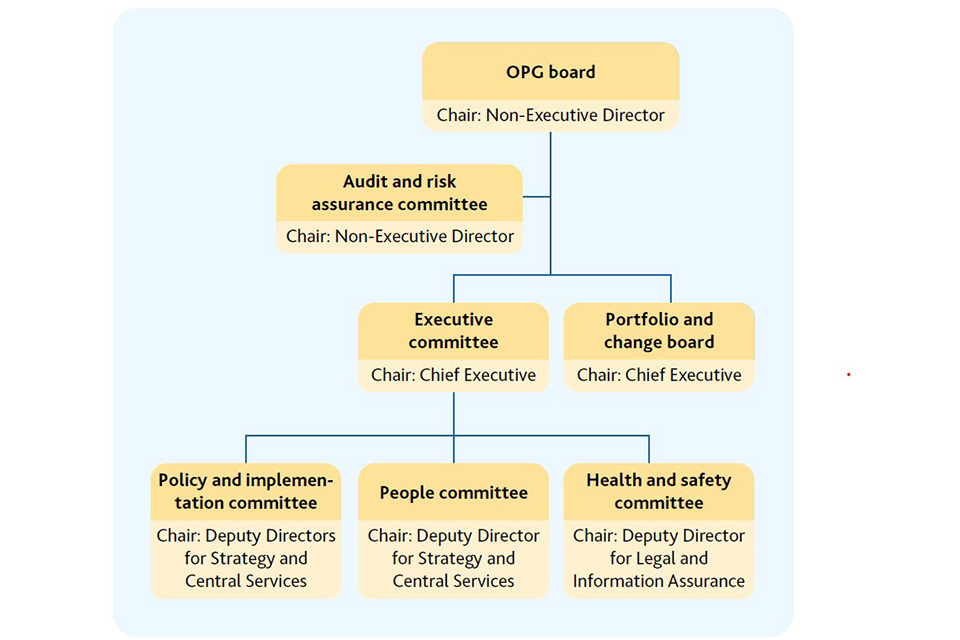
OPG board: Provides strategic leadership and direction supporting the delivery of objectives within the business plan.
Executive committee: Reports to the Chief Executive. Ensures effective management and control of finance, performance, risk, workforce, HR, complaints, business delivery, leadership and celebrating success.
Audit and risk assurance committee: Gives an independent view to the Chief Executive of OPG’s governance, risk management controls and assurance.
Portfolio and change board: Reports to the executive committee and board. Responsible for monitoring progress of OPG’s transformation programme and projects within its remit, reviews and acts on risks and issues that may compromise timely delivery and benefit realisation.
Health and safety committee: Supports the Chief Executive in her overall responsibility for organisational compliance with the Health and Safety at Work Act 1974 and ensuring OPG is a safe and healthy place to work.
Policy and implementation committee: Provides a coordinated decision-making forum for OPG in relation to policy, within the levels of decision-making agreed by the executive committee.
People committee: Coordinates the people-related activity to support OPG’s transformation programme and projects.
What the OPG board does
The OPG board supports the executive committee in developing and implementing OPG’s strategic objectives and business plans. The board does this by providing oversight, scrutiny, and challenge to OPG’s performance, whilst overseeing operations and managing risk via the audit and risk assurance committee. The board is also responsible for approving OPG’s Governance Framework, to ensure that the planning, performance, and financial management of OPG is carried out efficiently, effectively, and with openness and transparency.
Chair:
Amy Holmes, Public Guardian and Chief Executive (until 5 January 2025)
Alison Sansome, Non-Executive Board Member (from 6 January 2025)
Effectiveness and main successes
In addition to receiving finance, performance and risk papers at each meeting, the board:
-
continued to take a data-led approach to improve OPG’s customer service by reviewing customer survey information regularly
-
continued to provide the strategic direction on OPG’s main change initiatives
-
approved an action plan to eliminate bullying, harassment, and discrimination in the agency
-
considered all steps that OPG could take to improve performance including measures that resulted in the clearance of the backlog of LPA applications
-
approved new KPIs for all main operational activities
-
approved actions being taken to improve customer Contact Centre performance
-
ran valuable workshops to discuss improvements to OPG’s approach to risk management and to prepare for the implementation of MLPA
-
approved the OPG Fees strategy
Our sub-committees and independent advisory committee
The board has two sub-committees: the executive committee and the portfolio and change board. The audit and risk assurance committee is an independent advisory committee to the board.
The executive committee
This committee focuses primarily on the day-to-day operational delivery of OPG’s business, including finance, performance, risk, workforce, change and planning, complaints, HR (attendance management and recruitment), business delivery, leadership, employee engagement and celebrating successes.
Chair: Amy Holmes, Public Guardian and Chief Executive
A range of important issues were considered during the year. The committee regularly reviewed the demand trajectory, income modelling, and recovery plan to improve projected cost recovery. As a result, full cost-recovery was achieved during this financial year, the LPAs backlog was cleared, and LPA clearance times were back in target.
The committee also:
-
completed ‘deep dive’ sessions into each strategic risk to assess the adequacy of controls and actions in managing and/or reducing risk to align with the risk appetite
-
oversaw the work of OPG including processing more LPA applications than in any previous year
-
oversaw steps to improve customer service, for example, investing in our contact centres
-
challenged and agreed annual expenditure budgets in its capacity as the investment committee
-
approved new policies and changes to policies resulting from MLPA
Portfolio and change board
The portfolio and change board brings together key stakeholders from across OPG and our partners to ensure the portfolio of change programmes in OPG is delivered successfully. This committee also has a delegated governance structure below it to ensure delivery of the portfolio of projects. Further detail on these projects can be found in the Transformation section.
Chair: Amy Holmes, Public Guardian and Chief Executive
A number of important issues were considered during the year. The committee:
-
progressed work on Modernising Lasting Powers of Attorney (MLPA) including supporting work with MoJ to achieve implementation of the Powers of Attorney Act 2023
-
provided oversight on the implementation of a new Contact Centre platform to improve customer service
-
improved the Portfolio Dashboard by adjusting project milestones and including the impact on time, cost, and quality
-
undertook assurance reviews of portfolio projects
-
provided oversight on changes to supervision billing resulting in significant cost savings.
Audit and risk assurance committee
The committee manages and advises on how improvements may be facilitated and monitors progress on management’s responses to risks identified. The committee also approves the work of both internal and external audits, assesses if accounting policies are correct and applied appropriately to OPG’s transactions, and provides recommendations to the Accounting Officer on all matters the committee considers appropriate.
Chair: Martyn Burke, Non-Executive Board Member
In addition to receiving counter-fraud, physical security, and information assurance reports at each meeting, the board provided assurance to the Public Guardian and OPG Board in management of the risk framework, specific risks, and their mitigating actions. It reviewed the strategic risk register at every meeting, with deep dives into specific strategic risks. It signed off the 2023 to 2024 annual report and accounts, allowing them to be laid before Parliament as required by the Mental Capacity Act 2005.
Effectiveness reviews
Effectiveness reviews were completed for all committees in OPG formal governance structures this same year. Following review of feedback from members of the committees via targeted surveys, the Board was assured that the committees are operating effectively. The Board reported that it receives appropriate and accurate information regarding OPG’s delivery and financial performance. It concluded that it is given enough information to make effective decisions and to provide direction and guidance to OPG.
Where feedback identified potential improvements, action has commenced and will continue to be progressed during 2025. The Board has agreed that OPG will adopt a strategic approach to this work, so improvements are applied consistently across all the committees, and promote a greater understanding of governance in OPG.
Terms of reference
The terms of reference for OPG’s board and committees are in line with the:
-
‘Guidance on board effectiveness’ (2018) prepared by the Financial Reporting Council
-
‘Good governance standard for public services’ (2004) prepared by the Chartered Institute of Public Finance and Accountancy and the Office for Public Management Ltd.
OPG Board/Committee Attendance Table 2024 to 2025
| OPG Board | Executive Committee |
Audit, Risk and Assurance Committee |
Portfolio and Change Board |
|||||
| No. of meetings attended |
No. of eligible meetings |
No. of meetings attended |
No. of eligible meetings |
No. of meetings attended |
No. of eligible meetings |
No. of meetings attended |
No. of eligible meetings |
|
| Public Guardian and Chief Executive | ||||||||
| Amy Holmes | 6 | 6 | 10 | 12 | 4 | 4 | 10 | 12 |
| Deputy Director of Legal and Information Assurance | ||||||||
| Peter Boyce | 6 | 6 | 12 | 12 | 3 | 4 | 11 | 12 |
| Deputy Director, Strategy and Corporate Services (Job share) | ||||||||
| Ruth Duffin | 6 | 6 | 12 | 12 | 3 | 4 | 11 | 12 |
| Emma Sharp (until September 2024) | 3 | 3 | 3 | 5 | - | - | 5 | 5 |
| Amy Shaw (from October 2024) | 3 | 3 | 6 | 6 | 2 | 2 | 6 | 6 |
| Chief Operating Officer | ||||||||
| Julie Lindsay | 5 | 6 | 11 | 12 | - | - | 11 | 12 |
| Director of Finance | ||||||||
| Caroline Patterson (until 7th March 2025) | 3 | 6 | - | - | 4 | 4 | - | - |
| Adrian Hannell (from 10th March 2025) | 1 | 1 | - | - | - | - | - | - |
| Senior Finance Business Partner | ||||||||
| Louisa Harrison | 5 | 6 | 12 | 12 | 4 | 4 | 10 | 12 |
| Non-Executive Board Member, OPG Board Chair | ||||||||
| Alison Sansome (from 6 January 2025) | 2 | 2 | - | - | - | - | - | - |
| Non-Executive Board Member, OPG Audit, Risk & Assurance Committee Chair | ||||||||
| Martyn Burke | 6 | 6 | - | - | 4 | 4 | - | - |
| Non-Executive Board Member | ||||||||
| Greig Early | 6 | 6 | - | - | 4 | 4 | 12 | 12 |
| Karin Woodley (until 30 September 2024) | 2 | 3 | - | - | 2 | 2 | - | - |
| Veronika Neyer (until 1 October 2024) | 3 | 3 | - | - | 0 | 2 | - | - |
| Independent Member of OPG ARAC | ||||||||
| Emir Feisal | - | - | - | - | 2 | 4 | - | - |
Internal audit
One of the Public Guardian’s roles is to establish and maintain arrangements for the provision of internal audit services from the Government Internal Audit Agency (GIAA). These are in accordance with the objectives and standards for internal audit set out in HM Treasury’s ‘Public sector internal audit standards’. This enables an independent and objective evaluation on management performance in the delivery of effective arrangements for governance, risk management and internal controls.
MoJ receives copies of OPG’s annual internal audit plans and annual final opinion report. MoJ and the Cabinet Office are notified of any fraud or irregularity within the definition set out by HM Treasury.
GIAA carried out six audits on behalf of OPG during 2024 to 2025. Completed internal audit assignments can be rated as either substantial, moderate, limited, or unsatisfactory. These ratings are defined by GIAA as follows:
-
Substantial: The framework of governance, risk management and control is adequate and effective.
-
Moderate: Some improvements are required to enhance the adequacy and effectiveness of the framework of governance, risk management and control.
-
Limited: There are significant weaknesses in the framework of governance, risk management and control such that it could be or could become inadequate and ineffective.
-
Unsatisfactory: There are fundamental weaknesses in the framework of governance, risk management and control such that it is inadequate and ineffective or is likely to fail.
The audits that were undertaken received the following ratings:
| Audit title | Rating |
| 2022 People Survey | Moderate |
| Information Security | Moderate |
| Legal Case Management Solution | Moderate |
| Strategic Workforce Planning | Moderate |
| Counter Fraud | Limited |
| Investigations and LPA Abuse | Moderate |
Risk management, control and assurance
OPG maintains a consistent approach to the management of risk. Risk management is used to alert us to actual threats or emerging issues likely to impact the achievement of our objectives.
The risk appetite of OPG is shaped by the statutory duties of the Public Guardian. The main risks considered over the year are detailed in the next section.
Our assurance team has delivered improvements in areas including risk management and fraud detection. For example, further improvements have been made to our strategic risk register, including a more rigorous approach to assessing likelihood and impact scores in line with best practice guidance from MoJ. In line with cross-government plans to develop counter-fraud functions, we have worked to enhance OPG’s fraud detection capability, with delivery progressing well on an agreed action plan with the Public Sector Fraud Authority, including the launch of OPG’s Counter-Fraud Strategy and Policy & Response documents.
In their annual final opinion report for OPG covering 2024 to 2025, the GIAA has given OPG a ‘Moderate’ annual opinion. A moderate opinion is defined as ‘some improvements are required to enhance the adequacy and effectiveness of the framework of governance, risk management and control’.
The GIAA found that OPG has a generally sound control framework in place, which is reflected in the results of the audits as outlined in the above table. To improve, we will focus on maintaining up-to-date documentation of policies and guidance, and we will build further on the substantial work already undertaken to deliver a consistent customer experience.
Key risks
During 2024 to 2025, OPG agreed that our current strategic risks remained appropriate for inclusion on the corporate risk register. The register is scrutinised by OPG executives who perform a monthly deep dive on a specific risk, to challenge risk owners on the management of controls and assess any wider implications associated with the risk. The audit and risk assurance committee provides further challenge on a quarterly basis which involves a full review of the current risk position.
The key risks that have been managed this year are not new and include the following:
Risk: Failure to deliver the expected level or service to customers and partners in receipt of OPG services up to and throughout the Modernising LPA services launch
Risk appetite:
Cautious
Key impacts:
Increase in customer complaints.
Increase in call centre traffic.
Customer dissatisfaction.
Increased vulnerability for customers.
Adverse publicity.
Greater ministerial and public scrutiny.
Risk mitigation:
Recruitment of additional operational staff, including new investigators.
Demand forecasting.
Performance monitoring.
Disaster recovery plans.
Focusing on communication with customers.
Impact of mitigation
LPA backlog fully recovered and back in target from November 2024.
Customers are better informed about what to expect when applying to register an LPA.
OPG workforce planning can be informed by forecasting.
Risk: Failure to achieve future financial stability of OPG
Risk appetite
Minimalist
Key impacts
Reduced ability to deal with seasonal fluctuations.
Need for increased resources.
Reduced available staff.
Overly optimistic forecasts (spending more than expenditure forecast).
Overspending/under-recovery.
Reduced income.
Risk mitigation
Annual budget setting process.
Quarterly demand meetings.
Income forecast sign off.
Bi-annual finance challenge meetings.
Timetable of deep dives into the financial information.
Finance risk and opportunities register.
Effective debt collection activity.
Recruitment controls.
Strategic workforce plan.
Impact of mitigation
Cost recovery of 104.3% achieved for 2024 to 2025.
Risk: Inability to effectively deliver transformation across OPG to ensure we meet our strategic priorities
Risk appetite
Cautious
Key impacts
Inability to drive efficiency and deliver transformation benefits.
Risk to financial sustainability of OPG.
Proposed benefits and delivery of current transformation portfolio will not enable the delivery of the future operating model.
Workforce that is disengaged and cannot associate a clear path from their work and their contribution to delivery of transformation.
Risk mitigation
Ensure modelling reflects future demand accurately in order to drive transformation, change and BAU activities.
Large scale transformation/change training to prepare staff within the organisation.
Effective, consistent and continuous communications and engagement to break down silos and detailed engagement plan to support engagement approach.
Better assurance and challenge of projects by PMO, effective portfolio management and alignment of transformation portfolio will improve reporting and decision making.
Refreshed business plan.
Change roadmap developed.
Future strategy completed.
Ongoing review and visibility of critical products that support successful transformation.
Impact of mitigation
Senior leaders are well informed to make decisions with detailed reporting and regular oversight of project delivery.
Effective management, project governance and delivery of projects within the portfolio.
The operational readiness of OPG for delivery of transformation is ensured.
Risk: Incomplete and inaccurate data which doesn’t support evidence-based decision making and organisational efficiencies
Risk appetite
Cautious
Key impacts
Process and change inefficiencies.
Excessive manual checks, duplication and waste.
Inconsistent reporting meaning performance issues are not identified.
Reputational damage.
Non-compliance to MoJ and external reporting requirements.
Risk mitigation
Regular collaboration with Digital and IA teams regarding data strategy and policies.
Increased use of MoJ Analytical platform to manage OPG data.
OPG demand forecasting working group in place.
Performance management framework and performance working group in place.
Data team sits on portfolio project boards to align future data needs for prioritised projects.
Impact of mitigation
Consistent performance metrics in place which are underpinned by robust data.
Future data requirements for OPG are better understood.
Progress made in having a single source of truth for OPG data in the MoJ Analytical Platform.
Risk: Fraudulent staff activity leading to financial loss and reputational damage
Risk appetite
Cautious
Key impacts
Financial loss to OPG/MoJ.
Reputational damage both with staff and customers.
Unknown fraud risk/landscape.
Non-compliance with government functional standards.
Risk mitigation
Publication of Counter-fraud policy & response plan and strategy to raise awareness of the potential of staff fraud.
Clear route for staff to report fraud through dedicated email address in OPG and Whistleblowing process through MoJ’s mandatory counter fraud e-learning.
Compliance with functional standards for counter-fraud.
Clear information on OPG intranet page.
Awareness campaigns on Counter-fraud through L&D, Intranet and engagement sessions.
Programme of Fraud Risk Assessments agreed to ensure that high-risk business areas are reviewed.
Impact of mitigation
Well informed staff who have the required training and are following policies.
Staff are easily able to report suspected fraud.
Increased understanding of OPG fraud landscape.
Risk: OPG does not have a suitable physical estate to support its workforce and deliver its business due to inefficient management of its future estate needs
Risk appetite
Cautious
Key impacts
Inability to provide safe and productive working environment.
Injury and increased absence levels.
Unbudgeted costs arising from business requests for change to building requirements and estates repairs.
Desk and working space inadequate for staff requiring access to offices, leading to inefficient working practices.
Risk mitigation
Expert support from MoJ Property & Government Property Agency.
Early engagement with Operations to map out requirements for future estate.
Performance reviews with GPA established bi-annually to monitor service delivery and hold to account.
Formal project established to deliver future estate.
Impact of mitigation
OPG has a workplace that allows it to undertake its work in a safe environment.
OPG has sufficient space available for the staff necessary to deliver its business.
OPG is planning for the future via the estates strategy and engagement with key stakeholders.
Risk management
OPG reports risks at a strategic level. Risk management aligns with our organisational objectives and links into the principles set out in HM Government’s Orange Book (‘Management of Risk – Principles and Concepts’).
The strategic risk register is reported and discussed monthly with OPG’s executive committee in order to provide assurance to the Public Guardian on the mitigation and control of risks. The risk and assurance team capture updates from risk owners from across the organisation. The risk team hold the risk owners to account where necessary and use risk knowledge and experience to support OPG with advice and guidance around risk control, to make sure risk is managed well in OPG.
OPG representatives also discuss risk management at regular monthly meetings with the wider MoJ Risk Business Partners and quarterly at the MoJ risk advisory group, chaired by MoJ Risk Centre of Excellence. These forums have representatives from across MoJ, including arm’s length bodies, and meet to discuss best practice and changes in practice or procedure, as well as to collaborate.
We continue to report risks into MoJ’s executive committee on a quarterly basis as part of the wider risk management framework of the department. Executive committee support for the longer-term change programme is important in mitigating these risks.
The key risks that have been reported during the year are:
-
the impact of the LPA backlog on customer service and finance
-
the risk to effective OPG decision making caused by incomplete or inaccurate data
-
the risk to future financial sustainability of OPG caused by inflationary pressures which have not been reflected in a fee increase and further efficiencies not possible to the current operating framework
-
the failure to deliver on our strategic priorities due to our inability to deliver the transformation portfolio effectively.
-
the risk of OPG not having a suitable estate in place to deliver business operations effectively
OPG encourages innovation and has a balanced approach to risk. For example, it has a greater risk tolerance for advancing digital capabilities to improve OPG products, but a lower one in areas such as ensuring concerns are assessed and investigated to support safeguarding of vulnerable persons and their assets.
OPG governance and assurance framework
The OPG board is involved in setting the strategic direction and framework for operations and is responsible for ensuring high standards of corporate governance at all times. It sets the risk appetite for the agency and ensures that there is an appropriate control framework in place that provides assurance on risk assessments.
Board committees and sub-committees
Audit and risk assurance committee: Provides advice and assurance to the board on risk, control and governance.
Portfolio and change board: Has the oversight and scrutiny of risks specific to projects and programmes.
Executive committee: Day-to-day responsibility for monitoring of risk.
Health and safety committee: Oversight and scrutiny of risks in relation to health and safety.
OPG risk forum: Considers the strategic risks and the risks that are below that level and also facilitates learning on risk across the agency.
Risk owners and sponsors: Responsible for ensuring strategic risks are understood appropriately, actively managed, reported and monitored.
MoJ risk advisory group: Looks at risks across MoJ, agencies and arm’s length bodies, and ensures shared risks are reported as one and that agency risks can be escalated as necessary.
Government Internal Audit Agency internal audits: Internal audits reflect and take place in the areas of highest strategic risk and provide additional oversight and insight.
Functional reform
Corporate and professional functions are provided to OPG by MoJ and include: analytical services, commercial, communications, counter fraud, debt, digital, finance, grants, people, project delivery, property and security.
Government functions have been working together to set and embed the use of functional standards. Functional standards exist to create a coherent, effective and mutually understood way of doing business within central government organisations. These standards are mandated for use across central government and provide a stable basis for assurance, risk management and capability improvement. Throughout 2024 to 2025, the functions’ understanding of the requirements of their cross-government functional standards has matured. All functions are currently participating in an ongoing programme of continuous improvement and engagement.
Whistleblowing reports
Whistleblowing relates to the internal or external disclosure of information to expose past, present or potential wrongdoing in an organisation. If an individual is asked to do something, or is aware of the actions of others, which they consider to be fundamentally wrong, illegal, or has the potential to endanger others or breach the values of the Civil Service Code, they should raise a whistleblowing concern. The process for raising a whistleblowing concern is publicised internally to staff in OPG, with a dedicated intranet page with a link to the MoJ whistleblowing policy and guidance.
We have an independent nominated officer whose role is to provide support and advice to staff about how to raise a concern. The Civil Service Integrity Hotline is also available to staff to contact if they do not feel comfortable raising a concern with management. Any concerns or suspicions about fraudulent activity can also be reported directly and anonymously to MoJ’s Counter Fraud Centre of Expertise. A number of internal communication messages were published during the year to raise awareness with our staff of whistleblowing, fraud and security and the appropriate reporting processes.
There was one whistleblowing report for OPG in 2024 to 2025 which found no evidence of wrongdoing after an investigation.
Business Appointment Rules
Civil servants, at all levels, are subject to rules on accepting outside appointments after leaving the Civil Service. The purpose of the Business Appointment Rules is to avoid:
-
the risk that an employer might gain an improper advantage by appointing a former official who holds information about its competitors, or about impending government policy
-
any suspicion that an appointment might be a reward for past favours
-
the risk of a former official improperly exploiting privileged access to contacts in government
-
unfair questioning or criticism of the integrity of former civil servants
Full details on the Business Appointment Rules, when they apply and the application process can be accessed by all OPG staff via the MoJ intranet. During 2024 to 2025, no applications were received from OPG employees in relation to these rules. Regular reminders are provided to senior leaders within OPG to ensure compliance with the rules.
Business continuity
Over the past year, we completed a review of all business impact assessments and business continuity plans to align with current OPG organisational structure and critical activities. We also refreshed our Incident Management Plan, testing these in a tabletop exercise with senior staff. In the next financial year, we will seek to further increase awareness of OPG’s business continuity plans and run additional scenario training for staff. These steps will support OPG’s incident management response to be effective.
Counter fraud
Significant work took place in 2024 to 2025 to progress and mature OPG’s counter fraud approach. OPG published its Counter Fraud, Bribery and Corruption Strategy and a Counter Fraud Policy and Response Plan in November 2024. These documents are aligned with MoJ’s counter fraud policy and the Public Sector Fraud Authority (PSFA) continuous improvement assessment framework. OPG also has an action plan for delivery of the Government Counter Fraud Functional Standards that is regularly monitored and reported on.
There was a focus on further increasing fraud awareness among staff, with the creation of a dedicated counter fraud intranet page, L&D resources and the delivery of fraud awareness workshops. To continue to develop its counter fraud maturity, OPG commissioned the GIAA to provide assurance over the adequacy of arrangements to support management and awareness of fraud within OPG. Implementation of recommendations will progress into next year.
OPG also commenced delivery of a suite of Fraud Risk Assessments across priority business areas. Considered an essential element of an effective counter fraud response, a Fraud Risk Assessment is a process aimed at identifying and understanding an organisation’s vulnerabilities to fraud. These assessments will continue into 2025 to 2026 and will inform the development of an Enterprise Fraud Risk Assessment.
Supplier compliance
OPG follows the MoJ acquisition model for the procurement of goods and services where we utilise MoJ contracts via existing Crown Commercial Services frameworks that are already in place. Operational contract managers are identified throughout OPG to manage those contracts and suppliers on a day-to-day basis. On MoJ and cross government contracts, OPG operational contract managers provide information on supplier performance to central contract managers.
Health and safety
OPG acknowledges its legal responsibilities in relation to the health, safety and welfare of its employees and for all people using its premises. We comply with the Health and Safety at Work Act 1974 and all other relevant regulations and legislation as appropriate.
OPG health and safety policies are reviewed annually or when changes occur. We have in place a health and safety strategy that is aligned with our business objectives and is developed to enhance occupational health and safety, as well as fire safety. A health and safety risk register is approved by the OPG duty holder and is informed by local risk assessment. This register is maintained and reviewed at the quarterly health and safety committee meeting, shared with MoJ’s fire, health and safety committee and is published on our intranet.
Our Birmingham and Nottingham offices are managed by one health and safety team. Both sites present their own challenges, but through effective training, communication, adherence to legislation and proactive engagement, the team can manage and resolve issues as they arise.
Over the past year, we have continued to provide support to our staff in their place of work, whether at home or in the office. During this reporting period we have completed 765 display screen equipment assessments for staff, as well as a total of 292 health and safety inductions for staff across our Birmingham and Nottingham offices. We have also developed and deployed new IT tools to manage DSE and other risk assessments to improve record keeping and streamline management of outstanding actions.
During 2024 to 2025, across both offices, we experienced 19 accidents, 32 incidents (of which 20 were general health incidents), and 7 near-misses. These figures are an overall decrease from 2023 to 2024, when we recorded 14 accidents, 68 incidents (of which 41 were general health incidents), and 6 near misses. No reports needed to be made to the Health and Safety Executive under the Reporting of Injuries, Diseases and Dangerous Occurrences Regulations.
OPG is committed to continuous improvement of health and safety. Throughout the year, we continued to monitor and review the number of emergency responders we have in place to ensure sufficient cover in all OPG sites. We planned and organised training for fire wardens, incident control officers, evacuation chair operators and first aiders. This year the health and safety team worked with the learning and development team to obtain recognised qualifications for additional first aiders (30 staff) and provided evacuation chair training for 13 staff members.
Accounting Officer’s conclusion
As Accounting Officer of OPG, I have responsibility for reviewing the effectiveness of OPG’s system of internal control, including the risk management framework. My review is informed by the work of the internal auditors and the executive managers within OPG. They are responsible for the development and maintenance of the internal control framework and appropriately responding to comments made by the external auditors in their management letter and other reports. The system of internal control has been in place, with minor modifications, for the year 2024 to 2025, and up to the date of approval of the annual report and accounts.
In their annual report, our internal auditors have given an overall assurance level of ‘moderate’, which means that some improvements are required to enhance the adequacy and effectiveness of the framework of governance, risk management and control. I have been advised on the implications of the results of my review by the board and the audit and risk assurance committee. I am satisfied that a plan to address weaknesses in the system of internal control and ensure continuous improvement of the system is in place. I am also satisfied that all material risks have been identified and that those risks are being properly managed through our risk register.
Ruth Duffin
Public Guardian and Chief Executive (Interim)
11 July 2025
Remuneration and staff report
This report summarises OPG’s policy on remuneration of executive board members and non-executive directors. It also provides details of actual costs and contractual arrangements. The remuneration and staff report has been prepared in accordance with the requirements of the Financial Reporting Manual as issued by HM Treasury.
Remuneration policy – senior civil servants
The remuneration of senior civil servants (SCS) is set by the Prime Minister following independent advice from the Review Body on Senior Salaries.
In reaching its recommendations, the Review Body on Senior Salaries has regard to the following considerations:
- the need to recruit, retain and motivate suitably able and qualified people to exercise their different responsibilities
- regional and local variations in labour markets and their effects on the recruitment and retention of staff
- government policies for improving the public services, including the requirement on departments to meet the output targets for the delivery of departmental services
- the funds available to departments as set out in the government’s departmental expenditure limits
- the government’s inflation target
The Review Body on Senior Salaries takes account of the evidence it receives about wider economic considerations and the affordability of its recommendations
Remuneration policy – non-senior civil servants
Remuneration packages fall under the schemes operated by MoJ and follow Government policy guidelines for public sector pay. Performance is recognised through MoJ Performance Management and Reward and Recognition Policies. Staff at all grades are eligible for in-year reward which is used to recognise staff in a timely way throughout the financial year.
Service contracts
The Constitutional Reform and Governance Act 2010 requires Civil Service appointments to be made on merit on the basis of fair and open competition.
Unless otherwise stated below, the officials covered by this report hold appointments which are open-ended. Early termination, other than for misconduct, would result in the individual receiving compensation as set out in the Civil Service Compensation Scheme.
Remuneration of senior management (subject to audit)
2024-2025
| Name and role | Salary | Bonuses | Taxable benefits (nearest £100) | Pension related benefits (nearest £1,000) | Severance payments | Total |
|---|---|---|---|---|---|---|
| Amy Holmes – Chief Executive and Public Guardian[footnote 1] | 120,000-125,000 | 5,000-10,000 | not applicable | 76 | not applicable | 200,000-205,000 |
| Julie Lindsay - Chief Operating Officer | 85,000-90,000 | 5,000-10,000 | not applicable | 63 | not applicable | 155,000-160,000 |
| Ruth Duffin - Deputy Director of Strategy and Central Services | 85,000-90,000 | 5,000-10,000 | not applicable | 34 | not applicable | 130,000-135,000 |
| Emma Sharp - Deputy Director of Strategy and Central Services[footnote 2] | 35,000-40,000 FYE 85,000-90,000 | 0-5,000 | not applicable | 15 | not applicable | 55,000-60,000 |
| Amy Shaw - Deputy Director of Strategy and Central Services[footnote 3] | 40,000-45,000 FYE 85,000-90,000 | not applicable | not applicable | 13 | not applicable | 55,000-60,000 |
| Peter Boyce - Deputy Director of Legal and Information Assurance[footnote 4] | 85,000-90,000 | not applicable | not applicable | 34 | not applicable | 120,000-125,000 |
| Caroline Patterson - Finance Director, Operations[footnote 5] | 115,000-120,000 FYE 120,000-125,000 | 10,000-15,000 | not applicable | 69 | not applicable | 195,000-200,000 |
| Adrian Hannell - Finance Director, Operations[footnote 6] | 5,000-10,000 FYE 125,000-130,000 | not applicable | not applicable | 3 | not applicable | 10,000-15,000 |
2023-2024
| Name and role | Salary | Bonuses | Taxable benefits (nearest £100) | Pension related benefits (nearest £1,000) | Severance payments | Total |
|---|---|---|---|---|---|---|
| Amy Holmes – Chief Executive and Public Guardian[footnote 1] | 120,000-125,000 | 5,000-10,000 | not applicable | 76,000 | not applicable | 200,000-205,000 |
| Julie Lindsay - Chief Operating Officer | 85,000-90,000 | 5,000-10,000 | not applicable | 63,000 | not applicable | 155,000-160,000 |
| Ruth Duffin - Deputy Director of Strategy and Central Services | 85,000-90,000 | 5,000-10,001 | not applicable | 34,000 | not applicable | 130,000-135,000 |
| Emma Sharp - Deputy Director of Strategy and Central Services[footnote 2] | 35,000-40,000 FYE 80,000-85,000 | 0-5,000 | not applicable | 15,000 | not applicable | 55,000-60,000 |
| Amy Shaw - Deputy Director of Strategy and Central Services[footnote 3] | 35,000-40,000 FYE 80,000-85,000 | not applicable | not applicable | 13,000 | not applicable | 55,000-60,000 |
| Peter Boyce - Deputy Director of Legal and Information Assurance[footnote 4] | 85,000-90,000 | not applicable | not applicable | 34,000 | not applicable | 120,000-125,000 |
| Caroline Patterson - Finance Director, Operations[footnote 5] | 115,000-120,000 FYE 120,000-125,000 | 10,000-15,000 | not applicable | 69,000 | not applicable | 195,000-200,000 |
| Adrian Hannell - Finance Director, Operations[footnote 6] | 5,000-10,000 FYE 125,000-130,000 | not applicable | not applicable | 3,000 | not applicable | 10,000-15,000 |
Remuneration of non-executive board members
2024-2025
| Name | Fees | Taxable benefits (to nearest £100) |
|---|---|---|
| Martyn Burke | 5,000-10,000 | not applicable |
| Jackie Craisatti[footnote 7] | not applicable | not applicable |
| Alison Sansome[footnote 8] | 0-5,000 FYE 10,000-15,000 | not applicable |
| Karin Woodley[footnote 9] | 0-5,000 FYE 10,000-15,000 | not applicable |
| Greig Early[footnote 10] | 10,000-15,000 | not applicable |
| Emir Feisal[footnote 11] | 0-5,000 FYE 0-5,000 | not applicable |
| Veronika Neyer[footnote 12] | 0-5,000 FYE 10,000-15,000 | 300 |
2023-2024
| Name | Fees | Taxable benefits (to nearest £100) |
|---|---|---|
| Martyn Burke | 5,000-10,000 | not applicable |
| Jackie Craisatti[footnote 7] | 0-5,000 | not applicable |
| Alison Sansome[footnote 8] | 0-5,000 | 200 |
| Karin Woodley[footnote 9] | 5,000-10,000 | 100 |
| Greig Early[footnote 10] | not applicable | 100 |
| Emir Feisal[footnote 11] | not applicable | not applicable |
| Veronika Neyer[footnote 12] | not applicable | not applicable |
None of the non-executive board members have pension entitlements with the department or receive bonuses.
Salary
Salary includes gross salary, overtime, and any other allowance to the extent that it is subject to UK taxation.
Bonuses
Bonuses are subject to in-year performance, following Cabinet Office guidance. The policy for non-consolidated performance related pay remains that such payments should be restricted to the top 25% of performers.
The bonuses reported in 2024 to 2025 relate to performance in both 2023 to 2024 and 2024 to 2025, and the comparative bonuses reported for 2023 to 2024 relate to performance in 2022 to 2023.
Benefits in kind
The monetary value of benefits in kind covers any benefits provided by the Department and treated by HM Revenue and Customs as a taxable emolument.
Pension benefits
The value of pension benefits accrued during the year is calculated as (the real increase in pension multiplied by 20) plus (the real increase in any lump sum) less (the contributions made by the individual). The real increases exclude increases due to inflation or any increase or decreases due to a transfer of pension rights.
Pension benefits (subject to audit)
Pensions figures are calculated by MyCSP, the pensions administrator, rather than by OPG.
Pension benefits of senior management team
| Name and role | Accrued pension and related lump sum at pension age as at 31 March 2025 | Real increase in pension and related lump sum at pension age | CETV at 31 March 2025 | CETV at 31 March 2024 | Real increase/ (decrease) in CETV | |
|---|---|---|---|---|---|---|
| Amy Holmes – Chief Executive and Public Guardian | Pension 35,000-40,000 Lump sum 90,000-95,000 | Pension 0-2,500 Lump sum nil | 742,000 | 656,000 | 52,000 | |
| Julie Lindsay – Chief Operating Officer | Pension 50,000-55,000 Lump sum 95,000-100,000 | Pension 2,500-5,000 Lump sum 2,500-5,000 | 1,128,000 | 1,016,000 | 57,000 | |
| Ruth Duffin – Deputy Director of Strategy and Central Services | Pension 20,000-25,000 Lump sum nil | Pension 0-2,500 Lump sum nil | 243,000 | 202,000 | 16,000 | |
| Emma Sharp – Deputy Director of Strategy and Central Services | Pension 15,000-20,000 Lump sum nil | Pension 0-2,500 Lump sum nil | 175,000 | 159,000 | 7,000 | |
| Amy Shaw – Deputy Director of Strategy and Central Services | Pension 30,000-35,000 Lump sum nil | Pension 0-2,500 Lump sum nil | 479,000 | 467,000 | 6,000 | |
| Peter Boyce – Deputy Director of Legal and Information Assurance | Pension 0-5,000 Lump sum nil | Pension 0-2,500 Lump sum nil | 27,000 | 2,000 | 19,000 | |
| Caroline Patterson – Finance Director, Operations | Pension 25,000-30,000 Lump sum of 60,000-65,000 | Pension 0-2,500 Lump sum nil | 513,000 | 442,000 | 44,000 | |
| Adrian Hannell – Finance Director, Operations | Pension 25,000-30,000 Lump sum nil | Pension 0-2,500 Lump sum nil | 383,000 | 381,000 | 2,000 |
Civil Service Pensions
www.civilservicepensionscheme.org.uk
Pension benefits are provided through the Civil Service pension arrangements. Before 1 April 2015, the only scheme was the Principal Civil Service Pension Scheme (PCSPS), which is divided into a few different sections – classic, premium, and classic plus provide benefits on a final salary basis, whilst nuvos provides benefits on a career average basis. From 1 April 2015 a new pension scheme for civil servants was introduced – the Civil Servants and Others Pension Scheme or alpha, which provides benefits on a career average basis. All newly appointed civil servants, and the majority of those already in service, joined the new scheme.
The PCSPS and alpha are unfunded statutory schemes. Employees and employers make contributions (employee contributions range between 4.6% and 8.05%, depending on salary). The balance of the cost of benefits in payment is met by monies voted by Parliament each year. Pensions in payment are increased annually in line with the Pensions Increase legislation. Instead of the defined benefit arrangements, employees may opt for a defined contribution pension with an employer contribution, the partnership pension account.
In alpha, pension builds up at a rate of 2.32% of pensionable earnings each year, and the total amount accrued is adjusted annually in line with a rate set by HM Treasury. Members may opt to give up (commute) pension for a lump sum up to the limits set by the Finance Act 2004. All members who switched to alpha from the PCSPS had their PCSPS benefits ‘banked’, with those with earlier benefits in one of the final salary sections of the PCSPS having those benefits based on their final salary when they leave alpha.
The accrued pensions shown in this report are the pension the member is entitled to receive when they reach normal pension age, or immediately on ceasing to be an active member of the scheme if they are already at or over normal pension age. Normal pension age is 60 for members of classic, premium, and classic plus, 65 for members of nuvos, and the higher of 65 or State Pension Age for members of alpha. The pension figures in this report show pension earned in PCSPS or alpha – as appropriate. Where a member has benefits in both the PCSPS and alpha, the figures show the combined value of their benefits in the two schemes but note that the constituent parts of that pension may be payable from different ages.
When the Government introduced new public service pension schemes in 2015, there were transitional arrangements which treated existing scheme members differently based on their age. Older members of the PCSPS remained in that scheme, rather than moving to alpha. In 2018, the Court of Appeal found that the transitional arrangements in the public service pension schemes unlawfully discriminated against younger members (the “McCloud judgment”).
As a result, steps are being taken to remedy those 2015 reforms, making the pension scheme provisions fair to all members. The Public Service Pensions Remedy[footnote 13] is made up of two parts. The first part closed the PCSPS on 31 March 2022, with all active members becoming members of alpha from 1 April 2022. The second part removes the age discrimination for the remedy period, between 1 April 2015 and 31 March 2022, by moving the membership of eligible members during this period back into the PCSPS on 1 October 2023.
The accrued pension benefits, Cash Equivalent Transfer Value and single total figure of remuneration reported for any individual affected by the Public Service Pensions Remedy have been calculated based on their inclusion in the PCSPS for the period between 1 April 2015 and 31 March 2022, following the McCloud judgment. The Public Service Pensions Remedy applies to individuals that were members, or eligible to be members, of a public service pension scheme on 31 March 2012 and were members of a public service pension scheme between 1 April 2015 and 31 March 2022. The basis for the calculation reflects the legal position that impacted members have been rolled back into the PCSPS for the remedy period and that this will apply unless the member actively exercises their entitlement on retirement to decide instead to receive benefits calculated under the terms of the alpha scheme for the period from 1 April 2015 to 31 March 2022.
The partnership pension account is an occupational defined contribution pension arrangement which is part of the Legal & General Master trust. The employer makes a basic contribution of between 8% and 14.75% (depending on the age of the member). The employee does not have to contribute but, where they do make contributions, the employer will match these up to a limit of 3% of pensionable salary (in addition to the employer’s basic contribution). Employers also contribute a further 0.5% of pensionable salary to cover the cost of centrally provided risk benefit cover (death in service and ill health retirement).
Further details about the Civil Service pension arrangements can be found at the website www.civilservicepensionscheme.org.uk
Cash equivalent transfer values
A Cash Equivalent Transfer Value (CETV) is the actuarially assessed capitalised value of the pension scheme benefits accrued by a member at a particular point in time. The benefits valued are the member’s accrued benefits and any contingent spouse’s pension payable from the scheme. A CETV is a payment made by a pension scheme or arrangement to secure pension benefits in another pension scheme or arrangement when the member leaves a scheme and chooses to transfer the benefits accrued in their former scheme. The pension figures shown relate to the benefits that the individual has accrued as a consequence of their total membership of the pension scheme, not just their service in a senior capacity to which disclosure applies.
The figures include the value of any pension benefit in another scheme or arrangement which the member has transferred to the Civil Service pension arrangements. They also include any additional pension benefit accrued to the member as a result of their buying additional pension benefits at their own cost. CETVs are worked out in accordance with The Occupational Pension Schemes (Transfer Values) (Amendment) Regulations 2008 and do not take account of any actual or potential reduction to benefits resulting from Lifetime Allowance Tax which may be due when pension benefits are taken.
Real increase in CETV
This reflects the increase in CETV that is funded by the employer. It does not include the increase in accrued pension due to inflation, contributions paid by the employee (including the value of any benefits transferred from another pension scheme or arrangement) and uses common market valuation factors for the start and end of the period.
Public service pension remedy
Any members affected by the Public Service Pensions Remedy are reported in the legacy scheme in 2023 to 2024 and in 2024 to 2025.
Fair play disclosures (subject to audit)
Reporting bodies are required to disclose the relationship between the remuneration of the highest-paid executive in their organisation and the lower quartile, median and upper quartile remuneration of the organisation’s workforce.
Fair pay bandings and ratios
| Bandings | 2024 to 2025 | 2023 to 2024 |
|---|---|---|
| Highest paid executive remuneration | 125,000-130,000 | 115,000-120,000 |
| Lowest paid staff member remuneration | 20,000-25,000 | 20,000-25,000 |
| Lower quartile salary | 24,202 | 22,940 |
| Lower quartile total remuneration | 24,202 | 22,940 |
| Median quartile salary | 24,202 | 22,940 |
| Median quartile total remuneration | 26,687 | 25,017 |
| Upper quartile salary | 28,681 | 27,250 |
| Upper quartile total remuneration | 30,008 | 28,613 |
| Ratios | 2024 to 2025 | 2023 to 2024 |
|---|---|---|
| Lower quartile | 5.3:1 | 5.6:1 |
| Median quartile | 4.8:1 | 5.1:1 |
| Upper quartile | 4.2:1 | 4.5:1 |
In 2024 to 2025 and 2023 to 2024 no employee received remuneration exceeding that of the highest paid executive.
Total remuneration includes salary, overtime payments, non-consolidated performance‑related pay and benefits in kind. It does not include severance payments, employer pension contributions and the cash equivalent transfer value of pensions.
The lower quartile salary and median quartile salary are the same, as OPG has a significant number of staff receiving the same salary.
Pay ratios have decreased due to a reduction in the bonus paid to the highest paid director.
Annual percentage change in total remuneration and bonuses
| Total remuneration (%) | Bonuses (%) | |
|---|---|---|
| Staff average | 5.1 | 4.1 |
| Highest paid director | 5.0 | (31.8) |
In 2020 to 2021, following approval from Cabinet Office and HM Treasury, a three year pay deal was implemented for MoJ including OPG employees. The three-year pay deal ran from 1 August 2020 until 31 July 2023. In 2023 to 2024, a one year pay award was agreed, from 1 August 2023 to 31 July 2024. Additionally, across the Civil Service staff below Senior Civil Service grades received a non-consolidated payment of £1,500. In 2024 to 2025, a one year pay award was agreed, from 1 August 2024 to 31 July 2025.
Staff report
Staff costs and numbers (subject to audit)
Costs
| Permanently employed staff (2024 to 2025) | Others (2024 to 2025) | Total (2024 to 2025) | Total (2023 to 2024) | |
|---|---|---|---|---|
| Salaries and wages | 52,057,000 | 7,997,000 | 60,054,000 | 55,210,000 |
| Social security costs | 4,844,000 | not applicable | 4,844,000 | 4,599,000 |
| Pension costs | 12,986,000 | not applicable | 12,986,000 | 10,567,000 |
| Gross costs | 69,887,000 | 7,997,000 | 77,884,000 | 70,376,000 |
Civil Service and other exit packages
Redundancy and other departure costs are paid in accordance with the provisions of the Civil Service Compensation Scheme, a statutory scheme made under the Superannuation Act 1972. Exit costs are accounted for in full in the year the exit package is confirmed. Where the Department has agreed early retirements, the additional costs are met by the Department and not by the Principal Civil Service Pension Scheme. Ill-health retirement costs are met by the pension scheme and are not included in the tables above.
During 2024 to 2025 there were no exit packages paid (2023 to 2024: one), as disclosed in the Remuneration of executive board members table. During 2024 to 2025, there was one ill-health retirement (2023 to 2024: nil). The total additional accrued pension liability will be £0.006 million.
Off-payroll engagements and consultancy costs
During 2024 to 2025, OPG reviewed off-payroll engagements where we are required to consider intermediaries, legislation (IR35) using HMRC’s guidance and on-line status indicator. We have advised any contracting body of the outcome of the status determinations so that, where appropriate, tax deductions are made at source from payments made in respect of the engagement with OPG.
During 2024 to 2025 £0.191 million was incurred for consultancy costs (2023 to 2024: £0.618 million). The majority of spend in 2024 to 2025 related to the OPG transformation programme, and the Modernising Lasting Powers of Attorney programme.
Staff numbers
The average number of full-time equivalent staff employed during the year was as follows:
| 2024 to 2025 | 2023 to 2024 | |
|---|---|---|
| Permanently employed staff | 1,702 | 1,629 |
| Others | 210 | 177 |
| Total | 1,912 | 1,806 |
Staff composition
Staff headcount, excluding SCS staff, at the end of the year was as follows:
| 31 March 2025 | 31 March 2024 | |
|---|---|---|
| Male | 784 | 789 |
| Female | 1,037 | 1,037 |
| Total | 1,821 | 1,826 |
Senior civil servants (SCS)
During the year we had five roles at SCS grade:
-
SCS2 (chief executive)
-
SCS1 (chief operating officer)
-
SCS1 (two full-time job-share deputy directors for strategy and central services)
-
SCS1 (deputy director for legal and information assurance)
As of 31 March 2025, the above five staff comprised four females and one male.
Non-executive board members
As at 31 March 2025, OPG had four non-executive board members (one being the board chair) comprised of two females and two males. OPG also had a non-executive independent member who sits on the Audit and Risk Assurance Committee who is male.
Sickness absence
The average number of working days lost this year was 10.3 days (2023 to 2024: 8.6 working days).
Staff turnover
In 2024 to 2025, staff turnover was 8.5% (2023 to 2024: 10.2%). OPG continues to monitor turnover rates and support initiatives to maintain a healthy level of turnover. The annual Civil Service People Survey, coupled with other research, helps us to understand our people’s experience of working in OPG and take appropriate action to improve effectiveness, including where turnover becomes problematic.
Staff engagement
Our 74% response rate to the People Survey gives a good representation of the staff experience at OPG. Our engagement score was 64%, the same as during 2023 to 2024. Of our nine core engagement themes, we increased our scores on eight themes, and remained static on the remaining ninth theme on which we already had a high score.
Staff policies applied during the year
OPG complies with the MoJ disability policy in relation to the recruitment, training and development of staff with disabilities. We recruit, train and develop people on the basis of their skills, aptitude and ability to do the job. As part of MoJ, we operate according to a range of human resource policies, procedures and practices, which include:
-
flexible working
-
bullying and harassment
-
mediation
-
recruitment and selection
-
equality and diversity
-
managing attendance (we have a number of staff with a disability where reasonable adjustments have been agreed to enable them to carry out their duties)
-
performance management
-
training
Trade union facility time
Number of employees who were relevant union officials during 2024 to 2025: 8
How many employees who were relevant union officials during the relevant period spent (a) 0%, (b)1-50%, (c) 51-99% or (d) 100% of their working hours on facility time: (a)1, (b)7
Percentage of the total pay bill spent on facility time: 0.02% spent of facility
Time spent on paid trade union activities as a percentage of total paid facility time hours: 0%
Ruth Duffin
Public Guardian and Chief Executive (Interim)
11 July 2025
Parliamentary accountability and audit report
The purpose of the parliamentary accountability and audit report is to meet Parliamentary accountability and audit requirements.
Parliamentary supply
OPG is funded by MoJ from its parliamentary supply, and by income derived from fees and charges from external customers.
In common with other government agencies future funding has to be approved by our sponsor department, MoJ, and by Parliament. Approval has already been given for 2025 to 2026 and there is no reason to question OPG’s future funding. Financial statements have therefore been prepared on a going concern basis for financial reporting and asset valuation purposes.
Regularity of expenditure (subject to audit)
There are no regularity issues to report.
Fees and charges (subject to audit)
The fee for registering a Power of Attorney is £82.00. This is an enhanced fee under section 180 of the Anti-Social Behaviour, Crime and Policing Act 2014, which permits the Lord Chancellor, with the consent of HM Treasury, to prescribe a fee that exceeds the cost of providing that service. The enhanced fee is used to cover the costs of exemption and remission of fees and to subsidise the operating costs of delivering supervision and other services.
The full cost of providing the agency’s services and the fees charged in relation to this is given in the table below.
| Gross income | Full cost | Unit cost | Over charge / (Cross subsidy) | |
|---|---|---|---|---|
|
(£000) |
(£000) |
£ |
(£000) |
|
| LPAs | 113,434 | 88,092 | 63 | 25,342 |
| EPAs | 401 | 890 | 63 | (489) |
| Supervision of deputies | 10,669 | 24,787 | 408 | (14,118) |
| Appointment of deputies | 886 | 4,374 | 429 | (3,488) |
| Office copies | 629 | 1,059 | 39 | (430) |
Fees remitted (subject to audit)
103,333 cases were remitted or exempted. The total value was £8.471 million (2023 to 2024: 106,661 cases – £8.279 million as described in Note 2). Fee waivers are not included in these numbers.
Cost recovery
We achieved a cost recovery position of 104.3%, a decrease from 106.9% last year. This is within the 5% tolerance and is outlined in Note 4 of the financial statements. An over-recovery was achieved for the second consecutive year after under-recovering for three consecutive years prior to this.
Losses and special payments (subject to audit)
| 2024 to 2025 |
2023 to 2024) |
|
|---|---|---|
| Volume | Volume | |
| Special payments | 40 | 51 |
| Fee waivers | 5790 | 7249 |
| Write offs | 7147 | 8036 |
| Ex gratia payments | 304 | 327 |
| Total | 13,281 | 1,5663 |
| 2024 to 2025 |
2023 to 2024) |
|
|---|---|---|
| Cost (£000) | Cost (£000) | |
| Special payments | 5 | 4 |
| Fee waivers | 731 | 910 |
| Write offs | 674 | 1,049 |
| Ex gratia payments | 3 | 7 |
| Total | 1,413 | 1,970 |
Ruth Duffin
Public Guardian and Chief Executive (Interim)
11 July 2025
The certificate and report of the Comptroller and Auditor General to the House of Commons
Opinion on financial statements
I certify that I have audited the financial statements of the Office of the Public Guardian for the year ended 31 March 2025 under the Government Resources and Accounts Act 2000.
The financial statements comprise the Office of the Public Guardian’s
-
Statement of Financial Position as at 31 March 2025;
-
Statement of Comprehensive Net Income, Statement of Cash Flows and Statement of Changes in Taxpayers’ Equity for the year then ended; and
-
the related notes including the significant accounting policies.
The financial reporting framework that has been applied in the preparation of the financial statements is applicable law and UK adopted International Accounting Standards.
In my opinion, the financial statements:
-
give a true and fair view of the state of the Office of the Public Guardian’s affairs as at 31 March 2025 and its net income for the year then ended; and
-
have been properly prepared in accordance with the Government Resources and Accounts Act 2000 and HM Treasury directions issued thereunder.
Opinion on regularity
In my opinion, in all material respects, the income and expenditure recorded in the financial statements have been applied to the purposes intended by Parliament and the financial transactions recorded in the financial statements conform to the authorities which govern them.
Basis for opinions
I conducted my audit in accordance with International Standards on Auditing (UK) (ISAs UK), applicable law and Practice Note 10 Audit of Financial Statements and Regularity of Public Sector Bodies in the United Kingdom (2024). My responsibilities under those standards are further described in the Auditor’s responsibilities for the audit of the financial statements section of my certificate.
Those standards require me and my staff to comply with the Financial Reporting Council’s Revised Ethical Standard 2019. I am independent of the Office of the Public Guardian in accordance with the ethical requirements that are relevant to my audit of the financial statements in the UK. My staff and I have fulfilled our other ethical responsibilities in accordance with these requirements.
I believe that the audit evidence I have obtained is sufficient and appropriate to provide a basis for my opinion.
Conclusions relating to going concern
In auditing the financial statements, I have concluded that the Office of the Public Guardian’s use of the going concern basis of accounting in the preparation of the financial statements is appropriate.
Based on the work I have performed, I have not identified any material uncertainties relating to events or conditions that, individually or collectively, may cast significant doubt on the Office of the Public Guardian’s ability to continue as a going concern for a period of at least twelve months from when the financial statements are authorised for issue.
My responsibilities and the responsibilities of the Accounting Officer with respect to going concern are described in the relevant sections of this certificate.
The going concern basis of accounting for the Office of the Public Guardian is adopted in consideration of the requirements set out in HM Treasury’s Government Financial Reporting Manual, which requires entities to adopt the going concern basis of accounting in the preparation of the financial statements where it is anticipated that the services which they provide will continue into the future.
Other information
The other information comprises information included in the Annual Report, but does not include the financial statements and my auditor’s certificate and report thereon. The Accounting Officer is responsible for the other information.
My opinion on the financial statements does not cover the other information and, except to the extent otherwise explicitly stated in my certificate, I do not express any form of assurance conclusion thereon. My responsibility is to read the other information and, in doing so, consider whether the other information is materially inconsistent with the financial statements or my knowledge obtained in the audit, or otherwise appears to be materially misstated.
If I identify such material inconsistencies or apparent material misstatements, I am required to determine whether this gives rise to a material misstatement in the financial statements themselves. If, based on the work I have performed, I conclude that there is a material misstatement of this other information, I am required to report that fact.
I have nothing to report in this regard.
Opinion on other matters
In my opinion the part of the Remuneration and Staff Report to be audited has been properly prepared in accordance with HM Treasury directions issued under the Government Resources and Accounts Act 2000.
In my opinion, based on the work undertaken in the course of the audit:
-
the parts of the Accountability Report subject to audit have been properly prepared in accordance with HM Treasury directions issued under the Government Resources and Accounts Act 2000;
-
the information given in the Performance and Accountability Reports for the financial year for which the financial statements are prepared is consistent with the financial statements and is in accordance with the applicable legal requirements.
Matters on which I report by exception
In the light of the knowledge and understanding of the Office of the Public Guardian and its environment obtained in the course of the audit, I have not identified material misstatements in the Performance and Accountability Report.
I have nothing to report in respect of the following matters which I report to you if, in my opinion:
-
adequate accounting records have not been kept by the Office of the Public Guardian or returns adequate for my audit have not been received from branches not visited by my staff; or
-
I have not received all of the information and explanations I require for my audit; or
-
the financial statements and the parts of the Accountability Report subject to audit are not in agreement with the accounting records and returns; or
-
certain disclosures of remuneration specified by HM Treasury’s Government Financial Reporting Manual have not been made or parts of the Remuneration and Staff Report to be audited is not in agreement with the accounting records and returns; or
-
the Governance Statement does not reflect compliance with HM Treasury’s guidance.
Responsibilities of the Accounting Officer for the financial statements
As explained more fully in the Statement of Accounting Officer’s Responsibilities, the Accounting Officer is responsible for:
-
maintaining proper accounting records;
-
providing the C&AG with access to all information of which management is aware that is relevant to the preparation of the financial statements such as records, documentation and other matters;
-
providing the C&AG with additional information and explanations needed for his audit;
-
providing the C&AG with unrestricted access to persons within the Office of the Public Guardian from whom the auditor determines it necessary to obtain audit evidence;
-
ensuring such internal controls are in place as deemed necessary to enable the preparation of financial statements to be free from material misstatement, whether due to fraud or error;
-
preparing financial statements which give a true and fair view and are in accordance with HM Treasury directions issued under the Government Resources and Accounts Act 2000;
-
preparing the annual report, which includes the Remuneration and Staff Report, in accordance with HM Treasury directions issued under the Government Resources and Accounts Act 2000; and
-
assessing the Office of the Public Guardian’s ability to continue as a going concern, disclosing, as applicable, matters related to going concern and using the going concern basis of accounting unless the Accounting Officer anticipates that the services provided by the Office of the Public Guardian will not continue to be provided in the future.
Auditor’s responsibilities for the audit of the financial statements
Our responsibility is to audit, certify and report on the financial statements in accordance with the Government Resources and Accounts Act 2000.
My objectives are to obtain reasonable assurance about whether the financial statements as a whole are free from material misstatement, whether due to fraud or error, and to issue a certificate that includes my opinion. Reasonable assurance is a high level of assurance but is not a guarantee that an audit conducted in accordance with ISAs (UK) will always detect a material misstatement when it exists. Misstatements can arise from fraud or error and are considered material if, individually or in the aggregate, they could reasonably be expected to influence the economic decisions of users taken on the basis of these financial statements.
Extent to which the audit was considered capable of detecting non-compliance with laws and regulations including fraud
I design procedures in line with my responsibilities, outlined above, to detect material misstatements in respect of non-compliance with laws and regulations, including fraud. The extent to which my procedures are capable of detecting non-compliance with laws and regulations, including fraud is detailed below.
Identifying and assessing potential risks related to non-compliance with laws and regulations, including fraud
In identifying and assessing risks of material misstatement in respect of non-compliance with laws and regulations, including fraud, I:
-
considered the nature of the sector, control environment and operational performance including the design of the Office of the Public Guardian’s accounting policies, key performance indicators and performance incentives.
-
inquired of management, the Office of the Public Guardian’s head of internal audit and those charged with governance, including obtaining and reviewing supporting documentation relating to the Office of the Public Guardian’s policies and procedures on:
-
identifying, evaluating and complying with laws and regulations;
-
detecting and responding to the risks of fraud; and
-
the internal controls established to mitigate risks related to fraud or non-compliance with laws and regulations including the Office of the Public Guardian’s controls relating to the Office of the Public Guardian’s compliance with the Government Resources and Accounts Act 2000 and Managing Public Money;
-
-
inquired of management, Office of the Public Guardian’s head of internal audit and those charged with governance whether:
-
they were aware of any instances of non-compliance with laws and regulations;
-
they had knowledge of any actual, suspected, or alleged fraud;
-
-
discussed with the engagement team including IT specialists regarding how and where fraud might occur in the financial statements and any potential indicators of fraud.
As a result of these procedures, I considered the opportunities and incentives that may exist within the Office of the Public Guardian for fraud and identified the greatest potential for fraud in the following areas: revenue recognition, posting of unusual journals, complex transactions and bias in management estimates. In common with all audits under ISAs (UK), I am required to perform specific procedures to respond to the risk of management override.
I obtained an understanding of the Office of the Public Guardian’s framework of authority and other legal and regulatory frameworks in which the Office of the Public Guardian operates. I focused on those laws and regulations that had a direct effect on material amounts and disclosures in the financial statements or that had a fundamental effect on the operations of the Office of the Public Guardian. The key laws and regulations we considered in this context included Government Resources and Accounts Act 2000, Managing Public Money, Supply and Appropriation (Main Estimates) Act 2023, employment law, pensions legislation and tax legislation, data protection laws and the Mental Capacity Act.
I considered risk assessment procedures performed relating to fraud, non-compliance with laws and regulations and regularity.
Audit response to identified risk
To respond to the identified risks resulting from the above procedures:
-
I reviewed the financial statement disclosures and testing to supporting documentation to assess compliance with provisions of relevant laws and regulations described above as having direct effect on the financial statements;
-
I enquired of management, the Audit and Risk Committee and legal counsel concerning actual and potential litigation and claims;
-
I reviewed minutes of meetings of those charged with governance and the Board and internal audit reports;
-
I addressed the risk of fraud through management override of controls by testing the appropriateness of journal entries and other adjustments; assessing whether the judgements on estimates are indicative of a potential bias; and evaluating the business rationale of any significant transactions that are unusual or outside the normal course of business.
I communicated relevant identified laws and regulations and potential risks of fraud to all engagement team members and remained alert to any indications of fraud or non-compliance with laws and regulations throughout the audit.
A further description of my responsibilities for the audit of the financial statements is located on the Financial Reporting Council’s website at: www.frc.org.uk/auditorsresponsibilities. This description forms part of my certificate.
Other auditor’s responsibilities
I am required to obtain sufficient appropriate audit evidence to give reasonable assurance that the expenditure and income recorded in the financial statements have been applied to the purposes intended by Parliament and the financial transactions recorded in the financial statements conform to the authorities which govern them.
I communicate with those charged with governance regarding, among other matters, the planned scope and timing of the audit and significant audit findings, including any significant deficiencies in internal control I identify during my audit.
Report
I have no observations to make on these financial statements.
Gareth Davies
Comptroller and Auditor General
14 July 2025
National Audit Office
157-197 Buckingham Palace Road
Victoria
London
SW1W 9SP
Financial statements
Statement of comprehensive net income for the year ended 31 March 2025
| 2024 to 2025 | 2023 to 2024 | |||
| Note | £000 | £000 | ||
| Revenue from contracts with customers | 2 | (126,221) | (115,046) | |
| Total operating income | (126,221) | (115,046) | ||
| Staff costs | 3 | 77,884 | 70,376 | |
| Other operating costs | 3 | 36,281 | 30,806 | |
| Depreciation, amortisation and impairment charges | 3 | 6,909 | 6,457 | |
| Total operating expenditure | 121,074 | 107,639 | ||
| Net operating surplus | (5,147) | (7,407) | ||
| Other comprehensive expenditure | ||||
| Net gain on revaluation of intangibles | 5 | - | (87) | |
| Net gain on revaluation of property, plant and equipment | 6 | (21) | (58) | |
| Total comprehensive net income | (5,168) | (7,552) |
All income and expenditure are derived from continuing operations.
The notes in the financial statements section form part of these financial statements.
Statement of financial position at 31 March 2025
| 31 March 2025 | 31 March 2024 | ||
| Note | £000 | £000 | |
| Non-current assets | |||
| Intangible assets | 5 | 5,626 | 8,163 |
| Property, plant and equipment | 6 | 1,792 | 2,453 |
| Right-of-use assets | 7 | 3,026 | 6,113 |
| Total non-current assets | 10,444 | 16,729 | |
| Current assets | |||
| Trade and other receivables | 9 | 12,868 | 12,584 |
| Cash and cash equivalents | 10 | 13,024 | 8,889 |
| Total current assets | 25,892 | 21,473 | |
| Total assets | 36,336 | 38,202 | |
| Current liabilities | |||
| Trade and other payables | 11 | (33,620) | (44,578) |
| Other financial liabilities | 12 | (2,648) | (2,973) |
| Provisions | 13 | (3,588) | |
| Total current liabilities | (39,856) | (47,551) | |
| Total assets less current liabilities | (3,520) | (9,349) | |
| Non-current liabilities | |||
| Other financial liabilities | 12 | - | (2,144) |
| Provisions | 13 | - | (3,400) |
| Total non-current liabilities | - | (5,544) | |
| Total assets less liabilities | (3,520) | (14,893) |
| 31 March 2025 |
31 March 2024 |
||
| Note | £000 | £000 | |
| Taxpayers’ equity | |||
| General fund | (3,797) | (15,338) | |
| Revaluation reserve | 277 | 445 | |
| Total taxpayers’ equity | (3,520) | (14,893) |
The notes in the Financial statements section form part of these financial statements.
Ruth Duffin
Public Guardian and Chief Executive (Interim)
Office of the Public Guardian
11 July 2025
Statement of cash flows for the year ended 31 March 2025
| 2024 to 2025 |
2023 to 2024 |
||
| Note | £000 | £000 | |
| Cash flows from operating activities | |||
| Net operating surplus | 5,147 | 7,407 | |
| Adjustments for notional and non-cash transactions | 3 | 22,198 | 17,876 |
| Decrease/(increase) in trade and other receivables | 9 | 264 | (749) |
| Intra-departmental balances settled via general reserves | 8,864 | 6,048 | |
| (Decrease)/increase in trade and other payables | 11 | (10,950) | 3,137 |
| Decrease in other financial liabilities | 12 | (2,469) | (1,793) |
| Less movement in lease liabilities not passing through the Statement of comprehensive net (income)/expenditure |
7 | 2,469 | 1,793 |
| Net cash inflow from operating activities | 25,523 | 33,719 | |
| Cash flows from investing activities | |||
| Purchase of property, plant and equipment | 6 | 84 | (364) |
| Decrease in capital accruals | 11 | (8) | (7) |
| Net cash inflow/(outflow) from investing activities | 76 | (371) | |
| Cash flows from financing activities | |||
| Surrender of surplus cash to MoJ | (19,000) | (36,000) | |
| Repayments of principal on leases | 7 | (2,464) | (2,567) |
| Net cash outflow used in financing activities | (21,464) | (38,567) | |
| Net increase/(decrease) in cash and cash equivalents in year | 10 | 4,135 | (5,219) |
| Cash and cash equivalents at the beginning of the year | 10 | 8,889 | 14,108 |
| Cash and cash equivalents at the end of the year | 10 | 13,024 | 8,889 |
The notes in the Financial statements section form part of these financial statements.
Statement of changes in taxpayers’ equity for the year ended 31 March 2025
| General Fund |
Revaluation Reserve |
Total | ||
| Note | £000 | £000 | £000 | |
| Balance at 1 April 2024 | (15,338) | 445 | (14,893) | |
| Net operating surplus for the year | 5,147 | - | 5,147 | |
| Surrender of surplus cash to MoJ | (19,000) | - | (19,000) | |
| Non-cash adjustments | ||||
| Notional recharge from MoJ | 3 | 15,753 | - | 15,753 |
| Notional external audit fee | 3 | 84 | - | 84 |
| Intra-departmental balances settled via general reserves | 8,864 | - | 8,864 | |
| Asset transfer from MoJ | 5 | 504 | - | 504 |
| Net gain on revaluation of Intangible assets | 5 | - | - | - |
| Property, plant and equipment | 6 | - | 21 | 21 |
| Revaluation transfer | 189 | (189) | - | |
| Balance at 31 March 2025 | (3,797) | 277 | (3,520) |
| General Fund Restated |
Revaluation Reserve | Total Restated | ||
| Note | £000 | £000 | £000 | |
| Balance at 1 April 2023 | (7,420) | 437 | (6,983) | |
| Net operating surplus for the year | 7,407 | - | 7,407 | |
| Surrender of surplus cash to MoJ | (36,000) | - | (36,000) | |
| Non-cash adjustments | ||||
| Notional recharge from MoJ | 3 | 12,071 | - | 12,071 |
| Notional external audit fee | 3 | 81 | - | 81 |
| Intra-departmental balances settled via general reserves | 6,048 | - | 6,048 | |
| Asset transfer from MoJ | 5 | 2,338 | - | 2,338 |
| Net gain on revaluation of Intangible assets | 5 | - | 87 | 87 |
| Property, plant and equipment | 6 | - | 58 | 58 |
| Revaluation transfer | 137 | (137) | - | |
| Balance at 31 March 2024 | (15,338) | 445 | (14,893) |
The notes in the Financial statements section form part of these financial statements.
Notes to the financial statements for the year ended 31 March 2025
Statement of accounting policies
These financial statements have been prepared in accordance with the 2024 to 2025 Government Financial Reporting Manual (FReM) issued by HM Treasury. The accounting policies contained in the FReM apply International Financial Reporting Standards (IFRS) as adapted or interpreted for the public sector context. Where a choice of accounting policy is permitted by the FReM, OPG selects the policy which best presents a true and fair view. OPG’s accounting policies have been applied consistently in dealing with items considered material in relation to the accounts.
Basis of preparation
The financial statements are presented in pounds sterling rounded to the nearest thousand (£000) unless otherwise stated. These accounts have been prepared under the historical cost convention, other than the revaluation of assets.
The financial statements, together with the notes in the Financial statements section, have been prepared on an accrual basis in accordance with the accounts direction issued under the Government Resources and Accounts Act 2000.
OPG is primarily funded from fees and charges from external customers, but also receives funding for capital investment from MoJ, from its parliamentary supply, and, if necessary, funding to meet any deficit generated. It has therefore been considered appropriate to adopt the going concern basis for the preparation of these financial statements.
Critical accounting judgements and key sources of estimation uncertainty
In application of the accounting policies, which are described below, OPG are required to make judgements, estimates and assumptions about the carrying amounts of assets and liabilities that are not readily apparent from other sources, and to disclose material judgements here.
Key sources of estimation uncertainty
OPG consider that no material estimates have been made during the production of the financial statements.
Critical accounting judgements
The following are significant judgements used in the production of the financial statements.
OPG recognises an expected credit loss in respect of trade receivables and contract assets. Details of the estimation technique and impairment percentages applied, and a sensitivity analysis, are provided in Note 9, Trade and other receivables.
OPG also provides for likely future successful applications for remission and exemption of fees charged, based on historic levels of remissions and exemptions. Further details are provided in Note 9, Trade and other receivables.
Changes in accounting policies and disclosures
New and amended standards adopted
The 2025-26 FreM withdraws the option to remeasure intangible assets using the revaluation model from 1st April 2025. With permission from HM Treasury, all MoJ entities are adopting this adaptation of IAS 38 early. This change is applied prospectively with carrying values at the transition date of 1st April 2024 now considered historical cost. Intangible assets have not been revalued in the 2024-25 year.
New standards, amendments and interpretations issued but not effective for the financial year beginning 1 April 2024 and not early adopted IFRS 17 Insurance Contracts is being applied in the FReM from 1 April 2025, with a transition date of 1 April 2024.
OPG has assessed the estimated impact of IFRS 17 on its financial statements through a review of contracts, provisions, contingent assets and liabilities, and has concluded that implementation of IFRS 17 will not have a material impact on its financial statements for 2025 to 2026.
Amendment due to non-publication of Office for National Statistics (ONS) Producer Price Indices
In March 2025 the ONS announced a pause in publication of this Producer Price Index (PPI) data used to revalue non-land and building assets following the identification of historical errors. No PPI data is available for 2025 and in light of the uncertainty regarding historical indices, no indexation has been applied to any non-land and building assets in 2024 to 2025. It is possible that the historical errors in the ONS data could translate into errors in the carrying values of the assets brought forward at 1st April 2024; however, a sensitivity analysis has been conducted to demonstrate that it is very unlikely that these could have resulted in a material error. We have maintained all 2023-2024 figures as published as we do not have details of the level of error involved and are therefore unable to calculate a restated figure.
Funding
OPG activities are primarily paid for through fees and charges from external customers, but OPG may also receive funding for capital investment from MoJ and, if necessary, funding to meet any deficit generated.
As agreed with HM Treasury and in accordance with its budget delegation from MoJ, OPG has a financial objective of achieving within 5% of full cost recovery. Performance against this objective is detailed in Note 4, Cost recovery. Where OPG generates a cash surplus, this is surrendered to MoJ. Funding transfers to and from MoJ are recognised in the general fund and under ‘financing’ in the statement of cash flows.
Segmental reporting
OPG has one reportable operating segment under IFRS 8. It therefore does not prepare a detailed segmental analysis.
Income
Revenue from contracts with customers comprises fees for services which are set based on an OPG full cost recovery basis. Fee income consists of amounts for services rendered from power of attorney, supervision, and copies of power of attorney certificates. Income is recognised in accordance with IFRS 15 Revenue from Contracts with Customers.
Lasting and enduring powers of attorney
Power of attorney fees are payable upon receipt of the application but, in accordance with IFRS 15, income arising therefrom is not recognised until the point of completion of the service provided, either at the registration of the power of attorney or if processing actions conclude prior to registration. Where customers pay power of attorney fees online before submitting their application, these funds are also held in contract liabilities. If an online application is not received after the customer has paid, the amount paid is refunded.
Supervision of deputies
Supervision income is recognised daily for all active cases. Supervision income is invoiced on an annual cycle up to the date that supervision of a case terminates, calculated on a pro rata basis.
Income is recognised as a contract asset. A bad debt provision is calculated, based on the expected credit loss model, and is netted off contract assets, either when fees are invoiced for or as they accrue.
Exemptions and remissions
Fee income is recognised net of fee remissions and exemptions. The remissions scheme is prescribed in the Office of the Public Guardian (Fees, etc) Regulations 2007 approved by Parliament and remitted fees are not collected by OPG.
An application for a fee exemption or remission must be made with the initial power of attorney registration application or, for supervision fees, submitted within six months of the fee demand date.
In those cases where an application for an exemption or remission is not made on receipt of the fee demand there is a limitation that a completed exemption or remission application must be received within six months of the invoice being raised.
Where a fee has been paid and a subsequent exemption or remission is agreed, a refund is issued.
Employee benefits
OPG accrues for the expected cost of the annual leave entitlement of its employees in accordance with IAS 19 Employee Benefits. OPG also accrues for performance bonuses awarded but not yet paid.
Pensions
The Principal Civil Service Pension Scheme (PCSPS) is an unfunded defined benefit scheme of which OPG is unable to recognise its share of underlying assets and liabilities. In accordance with the FReM, OPG accounts for this as a defined contribution scheme. OPG recognises contributions payable to defined contribution schemes as an expense in the year in which it is incurred, and the legal or constructive obligation is limited to the amount that it agrees to contribute to the fund.
Notional recharges
The notional recharge from MoJ represents OPG’s usage of corporate services.
The notional audit fee represents the cost of the annual external audit performed by the National Audit Office on behalf of the Comptroller and Auditor General.
Accounting for value added tax
Irrecoverable VAT is charged to the relevant expenditure category or, if appropriate, capitalised with additions to non-current assets. Income and expenditure are otherwise shown net of VAT.
Assets under construction
Assets under construction are valued at historical cost within property, plant and equipment and intangible assets as appropriate, and are not depreciated or amortised.
Intangible assets
Initial recognition
Development costs that are directly attributable to the design and testing of identifiable and unique software products, such as external contractor costs and relevant employee costs, are recognised as intangible assets in accordance with IAS 38 ‘Intangible Assets’ as adapted by the FReM. Early adoption of the FReM 2025-2026 IAS 38 adaption has been incorporated, removing the revaluation model with effect from 1st April 2024. Other expenditure that does not meet this criteria is recognised as an expense as incurred.
Internally developed software is managed by MoJ’s Digital team. Until complete, the costs sit within MoJ’s accounts. Once complete, the assets are transferred to OPG and recognised in OPG’s accounts. OPG’s capitalisation threshold for software projects is £10,000 (including irrecoverable VAT).
Subsequent valuation
Until 31 March 2024, intangible assets were subsequently revalued using indices as an estimate of the current value of these assets and amortised over the useful life of the asset as estimated by the asset owners. From 1 April 2024, all MOJ group entities have been granted permission by HM Treasury to withdraw the revaluation model for intangible assets, see 1.c Changes in Accounting Policies and Disclosures. The carrying values at the transition date of 1 April 2024 are considered historical cost.
Amortisation
The useful lives of internally developed software range from two to seven years. In accordance with IAS 38 Intangible Assets, OPG reviews the economic useful lives of its intangible assets each financial year, and assesses for impairment.
Amortisation is charged on a straight-line basis at rates calculated to write off the value of the assets, less estimated residual value, over the asset’s useful economic life.
Property, plant and equipment
Initial recognition
Property, plant and equipment assets costing more than the capitalisation threshold of £10,000 (including irrecoverable VAT) are treated as capital assets. Where an item costs less than the capitalisation threshold but forms part of an asset or grouped asset, whose total value is greater than the capitalisation level, the item is treated as a capital asset.
Subsequent valuation
Subsequent to initial recognition, all assets other than assets under construction have historically been stated at current value in existing use and revalued at each reporting date, using the PPI prepared by the ONS. In March 2025, the ONS announced a pause in publication of this data following identification of historical errors; therefore, no PPI data is available for 2025 and no indexation has been applied to non-land and building assets in 2024 to 2025. Prior years’ revaluations have been immaterial, both in-year and cumulatively, and the effect of pausing revaluation for 2024 to 2025 is also immaterial.
Depreciation
Depreciation is charged on a straight-line basis at rates calculated to write off the value of the assets, less estimated residual value apportioned evenly over their estimated useful lives.
Estimated useful assets lives are within the following ranges:
- leasehold improvements – remaining lease period
- furniture and fittings – 10 years
- plant and equipment – 5 to 7 years
- information technology – 3 to 7 years
The useful lives of assets and asset categories are reviewed annually.
Leases
Scope and exclusions – OPG as lessee
In accordance with IFRS 16 Leases, contracts, or parts of contracts, that convey the right to control the use of an asset for a period of time are accounted for as leases.
Contracts for services are evaluated to determine whether they convey the right to control the use of an identified asset, incorporating both the right to obtain substantially all the economic benefits from the asset and to direct its use. If so, the relevant part of the contract is treated as a lease.
As adapted by the FReM, IFRS 16 has been applied to leases with nil or nominal (that is, significantly below market value) consideration and arrangements for accommodation between government departments.
When making the above assessments, OPG excludes two types of leases. Firstly, those relating to low value items, which it considers as those where the underlying asset would have a cost of less than £10,000 when new, provided those items are not highly dependent on or integrated with other items. Secondly, contracts whose term (comprising the non-cancellable period together with any extension options OPG is reasonably certain to exercise and any termination options OPG is reasonably certain not to exercise) is less than twelve months.
Initial recognition – OPG as lessee
At the commencement of a lease OPG recognises a right-of-use asset and a lease liability.
The lease liability is measured at the value of the remaining lease payments, discounted either by the interest rate implicit in the lease, or where this is not readily determinable, OPG’s incremental rate of borrowing. This rate is advised annually by HM Treasury and is applied to leases that commence or are remeasured in that year. OPG transitioned to IFRS16 in 2021 to 2022, and the leases capitalised were discounted at the HM Treasury 2021 rate of 0.91%.
Where the lease includes extension or termination options, the lease payments will be for the non-cancellable period together with any extension or termination options OPG is reasonably certain to exercise/not exercise.
The measurement of lease payments excludes any VAT payable, and irrecoverable VAT is expensed at the point it falls due in line with IFRIC 21 Levies. Where the Government Property Agency passes on the cost of VAT payable to a head landlord, but has not opted to tax the property, the VAT cost passed on is not expensed, it is included in the lease liability and right-of-use asset value.
The right-of-use asset is measured at the value of the lease liability, adjusted for: any lease payments made before the commencement date; any lease incentives received; any incremental costs of obtaining the lease; and any costs of removing the asset and restoring the site at the end of the lease.
Subsequent measurement – OPG as lessee
The lease liability will be adjusted for the accrual of interest, repayments, reassessments and modifications. Reassessments are reappraisals of the probability of the options given by the existing lease contract.
After initial recognition, the right-of-use assets are measured using the fair value model. OPG considers that the cost model (measurement by reference to the lease liability) is a reasonable proxy for fair value, in the case of non-property leases, and for property leases of less than five years or with regular rent reviews. For other leases, the asset will be carried at a revalued amount.
The value of the asset will be adjusted for subsequent amortisation and impairment, and for reassessments and modifications of the lease liability as described above. Where the amount of a reduction to the asset exceeds the carrying value of the asset, the excess amount is recognised in expenditure.
Expenditure for each financial year includes interest on the lease liability and a straight-line amortisation charge on the right-of-use asset over the life of the lease, together with any impairment of the right-of-use asset and any change in variable lease payments.
Estimates and judgements
OPG has determined lease terms by assessing the level of certainty as to whether termination or extension options will be exercised.
OPG has determined that the cost model is a reasonable proxy for fair value, because the rents payable are aligned to open market rates.
Financial instruments
IFRS 7 Financial Instruments: Disclosures requires disclosure of the role that financial instruments have had during the year in creating or changing risk an entity faces in carrying out its business. This is set out in Note 8 of these financial statements.
Cash and cash equivalents
Cash and cash equivalents comprise bank balances held with commercial banks including those administered through the Government Banking Service.
Provisions
Provisions reflect the best estimate of the expenditure required to settle the obligation. OPG’s estimated provisions cashflows are not discounted, as the effect is not material.
Income
| 2024 to 2025 |
2023 to 2024 |
|
| £000 | £000 | |
| Gross fee income | ||
| Lasting powers of attorney | 120,002 | 109,390 |
| Enduring powers of attorney | 405 | 462 |
| Supervision of deputies | 13,096 | 12,495 |
| Appointment of deputies | 1,090 | 1,193 |
| Other | 830 | 695 |
| 135,423 | 124,235 | |
| Remissions and exemptions | ||
| Lasting powers of attorney | (5,837) | (5,924) |
| Enduring powers of attorney | (4) | (5) |
| Supervision of deputies | (2,427) | (2,148) |
| Appointment of deputies | (203) | (202) |
| Discretionary fee waivers | (731) | (910) |
| (9,202) | (9,189) | |
| Total | 126,221 | 115,046 |
Staff and other costs
| 2024 to 2025 |
2023 to 2024 |
|||
| £000 | £000 | |||
| Staff costs Wages and salaries | 60,054 | 55,210 | ||
| Social security costs | 4,844 | 4,599 | ||
| Other pension costs | 12,986 | 10,567 | ||
| 77,884 | 70,376 | |||
| Other operating costs | ||||
| Visitor services | 2,843 | 2,362 | ||
| Postage | 9,299 | 7,571 | ||
| Shared services | 1,715 | 1,646 | ||
| Accommodation, maintenance and utilities | 3,180 | 3,419 | ||
| Lease interest | 47 | 60 | ||
| Office consumables | 390 | 218 | ||
| Professional services | 828 | 811 | ||
| Training and other staff related costs | 346 | 371 | ||
| Travel, subsistence and hospitality | 207 | 139 | ||
| Write off of trade and other uncollectable receivables | 671 | 1,049 | ||
| Other costs | 1,466 | 1,741 | ||
| Non-cash costs | ||||
| Notional recharge from the MoJ | 15,753 | 12,071 | ||
| Notional external audit fee | 84 | 81 | ||
| Decrease in bad debt provision | (548) | (498) | ||
| Movement in provision for legal costs | - | (235) | ||
| 36,281 | 30,806 | |||
| Depreciation, amortisation and impairment charges | ||||
| Amortisation of intangibles | 2,537 | 2,832 | ||
| Depreciation of property, plant and equipment | 1,102 | 766 | ||
| Depreciation of right-of-use assets | 3,270 | 2,859 | ||
| 6,909 | 6,457 | |||
| Total | 121,074 | 107,639 |
Cost recovery
OPG is required, in accordance with Managing Public Money, to disclose results for the areas of its activities undertaken throughout the financial year, where fees and charges were made. For details about OPG fees and subsidies available to customers please visit: www.gov.uk/government/organisations/office-of-the-public-guardian
A subsidy is provided to ensure clients are not denied access to services through the inability to afford the requisite fees.
| 2024 to 2025 |
2023 to 2024 |
|
| £000 | £000 | |
| Income | (126,221) | (115,046) |
| Expenditure | 121,074 | 107,639 |
| Net operating surplus | (5,147) | (7,407) |
| % | % | |
| Cost recovery | 104.3 | 106.9 |
| Inside/(outside) 5% tolerance | 0.7 | (1.9) |
Section 180 of the Anti-Social Behaviour, Crime and Policing Act 2014 permits the Lord Chancellor, with the consent of HM Treasury, to prescribe a fee that exceeds the cost of providing that service. Since April 2017, OPG has used this power to charge an enhanced fee for power of attorney registration to cover the costs of exemption and remission of fees and to subsidise the operating costs of delivering supervision services.
Further information on performance against the cost recovery target (as agreed with HM Treasury and in accordance with the budget delegation from MoJ) is given in the parliamentary accountability and audit report in the Corporate governance section.
Intangible assets
| Software | Assets under construction |
Total | |
| £000 | £000 | £000 | |
| Cost or valuation | |||
| At 1 April 2024 | 22,247 | - | 22,247 |
| Transfer from MoJ | - | - | - |
| Reclassifications | - | - | - |
| Disposals | - | - | - |
| Revaluation | - | - | - |
| At 31 March 2025 | 22,247 | - | 22,247 |
| Amortisation | |||
| At 1 April 2024 | 14,084 | - | 14,084 |
| Charged in year | 2,537 | - | 2,537 |
| Disposals | - | - | - |
| Revaluation | - | - | - |
| At 31 March 2025 | 16,621 | - | 16,621 |
| Net book value at 31 March 2025 | 5,626 | - | 5,626 |
| Software | Assets under construction |
Total | |
| £000 | £000 | £000 | |
| At 1 April 2023 | 19,693 | - | 19,693 |
| Transfer from MoJ | - | 2,338 | 2,338 |
| Reclassifications | 2,338 | (2,338) | - |
| Disposals | (31) | - | (31) |
| Revaluation | 247 | - | 247 |
| At 31 March 2024 | 22,247 | - | 22,247 |
| Amortisation | |||
| At 1 April 2023 | 11,123 | - | 11,123 |
| Charged in year | 2,832 | - | 2,832 |
| Disposals | (31) | - | (31) |
| Revaluation | 160 | - | 160 |
| At 31 March 2024 | 14,084 | - | 14,084 |
| Net book value at 31 March 2024 | 8,163 | - | 8,163 |
Property, plant and equipment
| Leasehold improvements |
IT equipment |
Furniture, fittings and equipment |
Assets under construction |
Total | |
| £000 | £000 | £000 | £000 | £000 | |
| Cost or valuation | |||||
| At 1 April 2024 | 1,684 | 1,333 | 1,019 | 409 | 4,445 |
| Additions | - | - | - | (84) | (84) |
| Reclassifications | 157 | 504 | 168 | (829) | |
| Transfers from MoJ | - | - | - | 504 | 504 |
| Revaluation | (885) | - | - | - | (885) |
| At 31 March 2025 | 956 | 1,837 | 1,187 | - | 3,980 |
| Depreciation | |||||
| At 1 April 2024 | 1 | 1,272 | 719 | - | 1,992 |
| Charged in year | 906 | 43 | 153 | - | 1,102 |
| Disposals | - | - | - | - | - |
| Revaluation | (906) | - | - | - | (906) |
| At 31 March 2025 | 1 | 1,315 | 872 | - | 2,188 |
| Net book value at31 March 2025 | 955 | 522 | 315 | - | 1,792 |
All property, plant and equipment are owned by OPG, rather than being leased.
| Leasehold improvements |
IT equipment |
Furniture, fittings and equipment |
Assets under construction |
Total | |
| £000 | £000 | £000 | £000 | £000 | |
| Cost or valuation | |||||
| At 1 April 2023 | 2,394 | 1,426 | 918 | - | 4,738 |
| Additions | - | (45) | - | 409 | 364 |
| Reclassifications | - | (65) | 65 | - | - |
| Revaluation | (710) | 17 | 36 | - | (657) |
| At 31 March 2024 | 1,684 | 1,333 | 1,019 | 409 | 4,445 |
| Depreciation | |||||
| At 1 April 2023 | 154 | 1,223 | 564 | - | 1,941 |
| Charged in year | 604 | 33 | 129 | - | 766 |
| Disposals | - | - | - | - | - |
| Revaluation | (757) | 16 | 26 | - | (715) |
| At 31 March 2024 | 1 | 1,272 | 719 | - | 1,992 |
| Net book value at 31 March 2024 | 1,683 | 61 | 300 | 409 | 2,453 |
Leases
Right-of-use assets
| 2024 to 2025 |
2023 to 2024 |
|
| £000 | £000 | |
| Cost or valuation | ||
| At 1 April | 12,378 | 10,591 |
| Additions/remeasurements | 183 | 1,787 |
| At 31 March | 12,561 | 12,378 |
| Depreciation At 1 April | 6,265 | 3,406 |
| Charged in year | 3,270 | 2,859 |
| At 31 March | 9,535 | 6,265 |
| Net book value at 31 March | 3,026 | 6,113 |
OPG’s right-of-use assets are leases on offices in Nottingham and Birmingham.
| Lease liabilities | ||
| 31 March 2025 |
31 March 2024 |
|
| £000 | £000 | |
| Not later than one year | 2,659 | 3,014 |
| Later than one year and not later than five years | - | 2,152 |
| Gross liabilities | 2,659 | 5,166 |
| Less interest element | (11) | (49) |
| Present value of obligations | 2,648 | 5,117 |
An analysis of discounted cashflows relating to lease liabilities, between current and non-current, is presented in Note 12. Amounts recognised in the Statement of comprehensive net (income)/expenditure
| 2024 to 2025 |
2023 to 2024 |
|
| £000 | £000 | |
| Amortisation | 3,270 | 2,859 |
| Interest expense | 47 | 60 |
| Total | 3,317 | 2,919 |
| Amounts recognised in the Statement of cash flows | ||
| Repayment of principal on leases | 2,464 | 2,567 |
| Interest expense within operating cost | 47 | 60 |
| Total | 2,511 | 2,627 |
Financial instruments
IFRS 7 Financial Instruments: Requires disclosure of the role that financial instruments have had during the year in creating or changing risk an entity faces in carrying out its business.
As the cash requirements of OPG are met through the Estimate process, financial instruments play a more limited role in creating and managing risk than would apply to a non-public sector body.
Receivables are valued under the expected credit loss model set out in IFRS 9. Receivables are recognised at lifetime loss and impairment (stage three under IFRS 9). The estimation technique applied in valuing receivables is set out in Note 9, accompanied by a sensitivity analysis.
All cash is held with the Government Banking Service. Where OPG generates excess cash, this is surrendered to MoJ during the year. The carrying value of financial assets and liabilities, excluding receivables and payables with MoJ is as follows:
| 31 March 2025 |
31 March 2024 |
|
| £000 | £000 | |
| Cash and cash equivalents – GBS | 13,024 | 8,889 |
| Trade and other receivables | 12,274 | 12,033 |
| Trade and other payables | (31,340) | (41,472) |
| Other financial liabilities | (2,648) | (5,117) |
| Total | (8,690) | (25,667) |
Included within trade and other payables is £21.677 million of contract liabilities, representing power of attorney income that has been deferred as OPG has not yet processed the related applications (31 March 2024: £31.015 million).
Trade and other receivables
| 31 March 2025 |
31 March 2024 |
|
| £000 | £000 | |
| Trade receivables | 3,378 | 4,212 |
| Contract assets | 12,313 | 11,649 |
| Impairment for bad and doubtful debt | (3,928) | (4,830) |
| 11,763 | 11,031 | |
| VAT receivable | 227 | 182 |
| Staff receivables | 278 | 402 |
| Amount due from MoJ | 594 | 551 |
| Amounts due from other government departments | 6 | 112 |
| Prepayments | - | 306 |
| Total | 12,868 | 12,584 |
All OPG’s receivables are collectable within one year. The impairment for bad and doubtful debt is comprised as follows:
| 31 March 2025 |
31 March 2024 |
|
| £000 | £000 | |
| Bad and doubtful debts | 3,282 | 3,830 |
| Fee cancellations provision | - | 29 |
| Remissions and exemptions provision | 646 | 971 |
| Total | 3,928 | 4,830 |
The movement in the remissions and exemptions provision is charged against income. Impairment of bad and doubtful debts
The estimation of the provision for bad and doubtful debt involves:
- aging debts based on the earliest invoice which the customer has not paid
- grouping debts based as the case’s status as ‘live’ or ‘terminated’
- impairing debt groupings by percentages reflecting past activity and expectations of future debt collection performance
The debt age groupings and impairment percentages applied at 31 March 2025 and 31 March 2024 are as follows:
| More than three years 2024 to 2025 (2023 to 2024) | Between two and three years 2024 to 2025 (2023 to 2024) | Between one and two years 2024 to 2025 (2023 to 2024) | Less than one year 2024 to 2025 (2023 to 2024) | ||
| % | % | % | % | ||
| Live cases | |||||
| Lay | 60 (65) | 25 (25) | 25 (25) | 7.5 (7.5) | |
| Professional | 50 (50) | 10 (10) | 10 (10) | 5 (5) | |
| Public body | 60 (65) | 30 (30) | 30 (30) | 12.5 (12.5) | |
| Terminated cases | |||||
| 31 March 2025 | 90 (90) | 80 (80) | 80 (80) | 70 (70) |
These groupings and percentages are reviewed annually. The percentages applied are based on the data available and management’s knowledge of the customer base. Analysis of collection rates in 2024 to 2025 indicated that the impairment rates for cases more than three years old should be revised downwards. Assessing future expected credit losses requires the application of estimation techniques and management judgement: actual credit losses may not be the same as the provision made.
A sensitivity analysis has been conducted, showing the following possible impacts of an increase/(decrease) in the impairment percentages:
| Increase/(decrease) in impairment percentage | -10%* | -5% | +5% | +10% |
| Increase/(decrease) in provision | £m | £m | £m | £m |
| Live cases | (0.9) | (0.6) | 0.6 | 1.2 |
| Terminated cases | (0.2) | (0.1) | 0.1 | 0.2 |
| Total | (1.1) | (0.7) | 0.7 | 1.4 |
*Live cases for lay and professional deputies under one year are provided against at less than 10%. This calculation assumes they are not provided for.
Exemptions and remissions provision
Applications for remissions and exemptions will be received and granted for some of the fees for which OPG has invoiced or accrued. Therefore, a provision is recognised within receivables based on past levels of remissions and exemptions granted. Historic volumes of remissions and exemptions are assumed to be representative of future volumes.
Cash and cash equivalents
| 2024 to 2025 |
2023 to 2024 |
|
| £000 | £000 | |
| At 1 April | 8,889 | 14,108 |
| Net change in balance | 4,135 | (5,219) |
| At 31 March | 13,024 | 8,889 |
All OPG cash is held with the Government Banking Service.
Trade and other payables
| 31 March 2025 |
31 March 2024 |
|
| £000 | £000 | |
| Trade payables | 55 | 925 |
| Taxation and social security payable | 964 | 993 |
| Amount due to MoJ | 2,280 | 3,106 |
| Other payables | 1,958 | 1,771 |
| Accruals | 6,686 | 6,768 |
| Contract liabilities | 21,677 | 31,015 |
| Total | 33,620 | 44,578 |
All OPG’s payables fall due within one year.
Contract liability movements throughout the year were as follows:
| 2024 to 2025 |
2023 to 2024 |
|
| £000 | £000 | |
| At 1 April | 31,015 | 31,858 |
| Power of attorney income recognised in year | (114,566) | (103,923) |
| Power of attorney income deferred | 105,228 | 103,080 |
| At 31 March | 21,677 | 31,015 |
Other financial liabilities
| 31 March 2025 |
31 March 2024 |
|
| £000 | £000 | |
| Lease liabilities – current | 2,648 | 2,973 |
| Lease liabilities – non-current | - | 2,144 |
| Total | 2,648 | 5,117 |
Further information on lease liabilities and the related right-of-use assets is provided in Note 7.
Provisions
| Dilapidations | Other | Total | |
| £000 | £000 | £000 | |
| At 1 April 2024 | 3,400 | - | 3,400 |
| Provided in year | 203 | - | 203 |
| Reversed unused | (15) | - | (15) |
| At 31 March 2025 | 3,588 | - | 3,588 |
| At 1 April 2023 | 2,387 | 235 | 2,622 |
| Provided in year | 1,013 | - | 1,013 |
| Reversed unused | - | (235) | (235) |
| At 31 March 2024 | 3,400 | - | 3,400 |
The expected timings of cash flows are as follows:
| Dilapidations | Other | Total | |
| £000 | £000 | £000 | |
| Not later than one year | 3,588 | - | 3,588 |
| Between one and five years | - | - | - |
| At 31 March 2025 | 3,588 | - | 3,588 |
| Not later than one year | - | - | - |
| Between one and five years | 3,400 | - | 3,400 |
| At 31 March 2024 | 3,400 | - | 3,400 |
Dilapidations
The dilapidations provision relates to the estimated costs of dilapidations on OPG’s offices in Nottingham and Birmingham at the end of their lease terms.
Commitments
At 31 March 2025, OPG had no material commitments under other non-cancellable contracts (31 March 2024: nil).
Contingent assets and liabilities
At 31 March 2025, OPG had contingent liabilities relating to employment tribunal claims at various stages, with a maximum potential liability estimated at £323,000 (31 March 2024: £235,000). At 31 March 2025, OPG had no contingent assets (31 March 2024: nil)
Related party transactions
OPG is an executive agency of MoJ. MoJ is regarded as a related party. During the period OPG had various material transactions with MoJ. The MoJ recharge disclosed in Note 3 is an apportionment of overheads including HR, finance, IT and estates to all MoJ departments and agencies on a notional basis.
OPG also had transactions with other government departments and entities.
None of the members of the board of OPG, key managerial staff, or other related parties have undertaken any transactions with OPG during the financial year.
Events after the reporting period
In accordance with the requirements of IAS 10 Events After the Reporting Period, events are considered up to the date on which the financial statements are authorised for issue, which is interpreted as the date of the Certificate and Report of the Comptroller and Auditor General.
There are no subsequent events to report.
Restatement of Statement of cash flows and Statement of changes in taxpayers’ equity
As explained in note 1.1, where OPG generates a cash surplus, this is surrendered to MoJ. Funding transfers to and from MoJ are recognised in the general fund and under ‘financing’ in the statement of cash flows. In 2023-24 and prior years, the ‘surrender of surplus cash to MoJ’ in both the statement of cash flows and the statement of changes in taxpayers’ equity has been disclosed net of settlement of amounts due to MoJ in respect of goods and services provided by MoJ and recharged to OPG. For 2024-25 the cash surrendered to MoJ is now correctly shown gross, and the settlement of amounts due to MoJ is also shown gross. Comparatives for 2023-24 have been restated as follows:
| Published | Change | Restated | |
| £000 | £000 | £000 | |
| Statement of cash flows | |||
| Intra-departmental balances settled via general reserves | - | 6,048 | 6,048 |
| Surrender of surplus cash to MoJ | (29,952) | (6,048) | (36,000) |
| Statement of changes in taxpayers’ equity | |||
| Intra-departmental balances settled via general reserves | - | 6,048 | 6,048 |
| Surrender of surplus cash to MoJ | (29,952) | (6,048) | (36,000) |
Annex
Performance targets
Impact indicator: average actual clearance time for powers of attorney The target average actual clearance time is 40 working days.
Purpose
This indicator calculates the average number of working days taken to register and dispatch all powers of attorney in a given reporting period. This is the time taken between the date of application receipt and the date of dispatch.
Calculation method
Of all powers of attorney with a date of dispatch within a reporting period, the number of working days (excluding bank holidays and weekends) between the ‘date of dispatch’ and the ‘date of receipt’ are summed and then averaged between the number of applications.
‘Date of receipt’ is the day the application is received by OPG, supported by a valid payment received or, alternatively, the date of decision for a successful remission or exemption application. This is the point OPG begins processing the application.
‘Date of dispatch’ is the date the registered power of attorney is dispatched as the last part of the application process, which then shows an application as registered within our internal case management systems.
Data source
OPG’s internal case management systems.
Achieved to 31 March 2025
Average actual clearance time of 49 working days (for LPAs and EPAs) against a target of 40 working days.
Customer service indicator: customer contact centre
a) The target for calls to our customer contact centre is for 90% to be answered within 5 minutes of being queued
b) The target for calls to our customer contact centre relating to Safeguarding Vulnerable Adults is for 95% to be answered within 3 minutes of being queued
Purpose
This indicator measures timely and accurate support and guidance for all of OPG’s services, and signposting to CoP services where appropriate.
This indicator measures timely and accurate support and guidance for enquiries relating to the Safeguarding of Vulnerable Adults.
Calculation method
Number of calls routed to Contact Centre agents answered within five minutes (excluding the Safeguarding Line) divided by the number of those calls received. Calls that are re-directed out of scope are deducted from the total calls to avoid double counting, as these are reported separately where required.
Number of calls to our Safeguarding Vulnerable Adults line answered within 3 minutes, divided by the total number of calls received that line.
Data source
OPG’s telephony data management system.
Achieved to 31 March 2025
Percentage of calls answered within five minutes was 57% against target of 90%.
Percentage of calls answered within 3 minutes, was 99% against our target of 95%.
Impact indicator: OPG digital customer satisfaction surveys
The target percentage of customers ‘very satisfied’ or ‘fairly satisfied’ with OPG digital services is 80%.
Purpose
This impact indicator helps to ensure we are developing our digital services to meet our customers’ needs.
Calculation method
Number of customers who are ‘very’ or ‘fairly satisfied’ with digital services divided by number of survey responses received answering this question.
Data source
LPA digital tool customer satisfaction survey.
Achieved to 31 March 2025
Customer satisfaction survey score at year end was 85% for our ‘use an LPA’ service, 87% for our ‘make an LPA’ service, and 80% for our ‘complete a deputy report’ service.
Customer service indicator: OPG customer satisfaction survey – power of attorney services
The target percentage of customers ‘very satisfied’ or ‘fairly satisfied’ with power of attorney services is 80%.
Purpose
This indicator helps us to understand our customers’ needs and identify trends so we can continually improve services.
Calculation method
Number responding ‘very’ or ‘fairly satisfied’ divided by number of survey responses.
Data source
LPA customer satisfaction surveys.
Achieved to 31 March 2025
Customer satisfaction survey score at year end was 84%.
Customer service indicator: OPG customer satisfaction survey – deputyship services
The target percentage of customers ‘very satisfied’ or ‘fairly satisfied’ with deputyship services is 80%.
Purpose
This indicator helps us to understand our customers’ needs and identify trends so we can continually improve services.
Calculation method
Number responding ‘very’ or ‘fairly satisfied’ divided by number of survey responses.
Data source
Deputyship customer satisfaction surveys.
Achieved to 31 March 2025
Customer satisfaction survey score at year end was 74%.
Impact indicator: supervising deputies
a) The target average time to obtain annual reports is within 40 working days.
b) The target average time to review annual reports is within 15 working days.
c) The target for annual reports outstanding for over 98 calendar days is 4.5% or less.
Purpose
These indicators help us to ensure that we provide proportional and appropriate support for all deputies.
Calculation method
a) The average number of working days between the ‘due date’ of the report (40 working days after the anniversary of the court order) and the date which the report was received in OPG.
b) The average number of working days between the date an annual report is received and the date it was reviewed.
c) The percentage of active deputyship cases with at least one annual report outstanding for over 98 calendar days.
Data source
OPG’s internal case management systems.
Achieved to 31 March 2025
a) Average time to obtain annual reports was 33 working days.
b) All annual reports were reviewed within 15 working days, at an average of 11 working days.
c) 1.88% of annual reports were outstanding over 98 calendar days.
Impact indicator: safeguarding and investigations
a) The target is to risk assess 95% of raised safeguarding concerns within two working days.
b) The target is for 95% of safeguarding risk assessments to reach final outcome within five working days.
c) The target is to conclude all investigations within 70 working days.
d) The target is average time taken to implement OPG-owned actions within Public Guardian recommendations, where court action has been deemed necessary
e) The target is average time taken to implement OPG-owned actions within Public Guardian recommendations, where court action has not been deemed necessary within 25 working days.
Purpose
These indicators centre on OPG’s responsibility to safeguard vulnerable adults.
(a) and (b) OPG will carry out a risk assessment process to determine:
i) whether the Public Guardian has jurisdiction to investigate concerns and, if not, signpost the concern to the relevant agency
ii) whether the vulnerable person is at immediate risk in terms of their personal welfare, finance or property, and what immediate action is required
iii) whether the concern can be investigated over a longer period
c) An investigation is classed as concluded if:
i) a formal written report is signed off by the Public Guardian
ii) approval of a court application is agreed (where this pre-dates a Public Guardian report)
iii) a compliance manager agrees to conclude an investigation as a report to the Public Guardian is deemed unnecessary
iv) the client dies (where the compliance manager judges sufficient work had been done on the case to merit classification)
(d) and (e) A recommendation is classed as concluded if:
i) an application is made to the CoP, where this was as a result of a recommendation approved by the Public Guardian
ii) a case is approved for closure where:
- court action is not deemed necessary
- the investigator shares the outcome of the investigation and any further requirements to the attorney or deputy – this will not include any subsequent monitoring of the case
- the deputy makes an application to the CoP
Calculation method
a) Two working days starting from the date that the concern is received by OPG. Day one is the working day the concern is received.
b) Five working days starting from the date that the concern is received by OPG. Day one is the working day the concern is received.
c) The 70-working-day period starts the date that the concern leading to an investigation is received by OPG.
d) The 35-working-day period starts from the date the Public Guardian approves the report. Day one is the day the report is approved.
e) The 25-working-day period starts from the date the Public Guardian approves the report. Day one is the day the report is approved.
Data source
All complaints and concerns are risk assessed and the Public Guardian’s jurisdiction is considered.
Referrals are recorded and include:
- date of concern received by OPG
- date of concern received by investigations team
- risk assessment date
- risk assessment time
- investigation completion date
- outcome of application to the CoP period (working days)
- investigation (pre-report) time period
- investigation (post-report) time period
- recommendations closure approvals date
Achieved to 31 March 2025
a) 98% of concerns were risk assessed within two working days.
b) 96% of concerns reached final outcome within five working days.
c) Average time to conclude investigations was 138 working days.
d) Average time to conclude all recommendations where court action has been deemed necessary was 45.7 working days.
e) Average time to conclude all recommendations where court action has not been deemed necessary was 10 working days.
Customer service indicator: complaints
The target is to respond to 90% of all customer complaints within 10 working days of receipt.
Purpose
This indicator plays an important part in helping OPG understand to what extent we are achieving our customers’ expectations.
Calculation method
Every month the Tier 2 complaints manager collates the number of complaints that were due in the month (‘total with target in month’) and the number of complaints that were completed in target (‘total responded to in target’).
The indicator is calculated with the help of the following formula:
Complaints completed in target/complaints due x 100.
Data source
Management information from each individual business area.
Achieved to 31 March 2025
90% of complaints were responded to within 10 working days of receipt.
Customer service indicator: LPA applications completed online
The target is 30% of customers choosing to complete their LPA applications using the online service.
Purpose
This indicator plays an important part in helping OPG to improve the digital tools to make it easier for users to access our online services.
Calculation method
Percentage of digital intake:Number of online LPAs received in the reporting period/total number of applications received in the reporting period x 100.
Data source
OPG’s internal case management systems.
Achieved to 31 March 2025
37.7% of LPA applications were completed using online services.
People indicator: Staff engagement
a) The target is to achieve a staff engagement score at 62%.
b) The target for the percentage of staff who have experienced bullying or harassment at work is 0%, to reflect our zero tolerance policy to bullying and harassment in the workplace.
c) The target for the percentage of staff who have experienced discrimination at work is 0%, to reflect our zero tolerance policy for discrimination in the workplace.
Purpose
These indicators help us to create a great place to work and to support a zero-tolerance approach against bullying, harassment and discrimination in the workplace.
Calculation method
a) Each of the five engagement questions in the survey are weighted with a score from 100 to 0 dependant on their response. The resulting scores are added together and divided by 5 (the number of questions) to create the engagement index score.
b) This indicator is calculated by dividing number of respondents declaring experience of bullying and/or harassment by total respondents.
c) This indicator is calculated by dividing number of respondents declaring experience of discrimination by total respondents.
Data source
Annual people survey and smart survey.
Achieved to 31 March 2025
a) Staff engagement score was 64%.
b) 9% of staff experienced bullying and harassment.
c) 9% of staff experienced discrimination.
People Indicator: workforce data
a) The target staff turnover is 10% or less.
b) The target is to achieve a score of 7.5 working days or lower lost to sickness absence.
Purpose
These indicators help to assist our decision makers to ensure that OPG is sufficiently resourced, which will enable OPG to achieve its business plan objectives, carry out its vision and strive to live up to the OPG values in everything we do.
Calculation method
a) The indicator is calculated by dividing total number of leavers in a 12-month rolling period by average total staff headcount over a 12-month rolling period.
b) The indicator is calculated by dividing total working days lost in period by staff years in period.
Data source
The data is provided by the MoJ analytical services team, who download the data from SOP, MoJ’s HR case management system.
Achieved to 31 March 2025
a) Staff turnover was 8.5%
b) Average working days lost was 10.2 working days.
People indicator: average time to recruit
The aim is 52 working days.
Purpose
This indicator helps to assist our decision makers to ensure that OPG is sufficiently resourced, which will enable OPG to achieve its business plan objectives, carry out its vision and strive to live up to the OPG values in everything we do.
Calculation method
The total working days to hire are calculated by counting the number of working days between the ‘vacancy advertised’ date and the contract start date for each new starter in the reporting period and then adding together. A mean average calculation will be run on the above figure. This will provide us with the average time to recruit (working days).
Data source
The MoJ recruitment case management system.
As of December 2024
Average time to recruit is 43 working days from the last reported data available.
Glossary
Attorney
The person chosen to act for someone else on an EPA or an LPA.
Best interests
Any decisions made, or actions taken, on behalf of someone who has lost mental capacity must be in their best interests. There are standard steps to follow when deciding on someone’s best interests. These are set out in section 2 of the Mental Capacity Act code of practice.
Deputy
Lay, professional individuals or public authorities (such as solicitors or local authorities) who have been appointed by the Court of Protection (CoP) to make decisions on behalf of people lacking capacity.
Donor
Someone who has created either an EPA or an LPA. They are referred to as donors because they have donated certain decision-making powers to someone else.
Enduring power of attorney (EPA)
Replaced by LPAs in October 2007. Like an LPA, it is a legal document used to appoint someone to make decisions on your behalf should you lose mental capacity.
EPAs signed and dated before 1 October 2007 are still valid and can be registered with OPG when the donor starts to lose, or has lost, mental capacity.
Investigations
OPG can carry out an investigation into the actions of a deputy, a registered attorney, or someone authorised by the CoP to perform a transaction for someone who lacks capacity, and report to the Public Guardian or CoP. The recommendations in the investigation report are then considered by the Public Guardian, who takes overall responsibility for ensuring that they are in the best interests of the donor or client, and then signs off on the report. This is a vital part of OPG’s role to support the safeguarding of adults at risk.
Lasting power of attorney (LPA)
A legal document which is used to appoint someone to make decisions on your behalf. There are two types of LPA:
- health and welfare
- property and financial affairs
Both types of LPA must be registered with OPG before they can be used.
Mental capacity
The ability to make a specific decision at the time that it needs to be made. You can find a legal definition of mental capacity in section 2 of the Mental Capacity Act.
P
Persons who are the subject of proceedings in the CoP, and/or in relation to where there are arrangements for decisions about their personal welfare or property and affairs to be made by others – whether through an LPA or EPA, or under a deputyship order.
User
Anyone who makes use of OPG services. This could be donors, attorneys, deputies, persons subject to deputyship orders, partners or intermediaries. It also covers staff using OPG’s systems.
-
From 17 March 2025, Amy Holmes took over as MoJ Interim Director General, Service Transformation Group. She remained as Chief Executive and Public Guardian until 31 March 2025 ↩ ↩2
-
Appointed on 18 September 2023 until 11 September 2024. Full time job share with Ruth Duffin. ↩ ↩2
-
Appointed on 8 October 2024. Full time job share with Ruth Duffin. ↩ ↩2
-
Deputy Director of Legal and Information Assurance from 4 March 2024. ↩ ↩2
-
Finance Director, Operations, from 17 June 2023 until 9 March 2025. Caroline Patterson is an MOJ employee, and her salary is paid by MOJ. ↩ ↩2
-
Finance Director, Operations, from 10 March 2025. Adrian Hannell is an MOJ employee, and his salary is paid by MOJ. ↩ ↩2
-
Resigned 30 September 2023 and was reappointed on 6 January 2025. ↩ ↩2
-
Appointed 1 November 2023. Fees for November 2023 to March 2024 paid in 2024-25. ↩ ↩2
-
Appointed 15 April 2024 as a non-executive independent member of ARAC. ↩ ↩2
-
www.gov.uk/government/collections/how-the-public-service-pension-remedy-affects-your-pension ↩