Ofsted: gender pay gap report and data 2025
Published 20 January 2026
Applies to England

© Crown copyright 2026
This publication is licensed under the terms of the Open Government Licence v3.0 except where otherwise stated. To view this licence, visit nationalarchives.gov.uk/doc/open-government-licence/version/3 or write to the Information Policy Team, The National Archives, Kew, London TW9 4DU, or email: psi@nationalarchives.gov.uk.
Where we have identified any third party copyright information you will need to obtain permission from the copyright holders concerned.
This publication is available at https://www.gov.uk/government/publications/ofsted-gender-pay-gap-report-and-data-2025/ofsted-gender-pay-gap-report-and-data-2025
Foreword
Ofsted aims to improve lives by raising standards in education and children’s social care. Our work contributes to building a highly educated, productive and safe society in which children and young people can succeed, whatever their background.
As an organisation that holds others to account, it is important that we too are accountable and are open to challenge and scrutiny. Reporting on the gender pay gap shows how well we achieve gender equality in our pay structure.
This report provides information on the gender pay gap for the year 2024–25, with data to 31 March 2025 and comparable information for the previous 3 years.
We are confident that our policies and initiatives promote equal opportunities for all our workforce and ensure that both sexes can progress in their careers.
I look forward to reporting again next year.
I confirm that the data reported here is accurate and has been calculated according to the requirements of the Equality Act 2010.
Sir Martyn Oliver
His Majesty’s Chief Inspector
Introduction
The gender pay gap is the difference in the average earnings between all men and women in an organisation. It is different to equal pay, which is about the difference in actual earnings of men and women doing equal work (or work of equal value).
Since April 2017, employers with 250 or more employees have been required to publish information on their gender pay gap. The pay gap must be reported on in 6 different ways:
- the mean gender pay gap
- the median gender pay gap
- the mean bonus gender pay gap
- the median bonus gender pay gap
- the proportion of men and women who received bonuses
- the proportion of men and women according to quartile pay bands
The mean gender pay gap is the difference between the mean hourly rate of pay of male full-pay relevant employees and that of female full-pay relevant employees.[footnote 1]
The median gender pay gap is the difference between the median hourly rate of pay of male full-pay relevant employees and that of female full-pay relevant employees.
Ofsted’s gender profile
The percentage of female staff in Ofsted has increased slightly to 69% (from 68% in 2023–24). This continues to be higher than the Civil Service average of 55%, and the UK average of 51%.
Our spot-rate pay model, where a single salary is set for each grade (excluding Senior Civil Service (SCS)), supports equal pay for equal work. By not having pay ranges, we avoid the pay inequality that can arise from the ability to negotiate salaries or from linking pay to length of service (see Annex A) for our grading structure. SCS salaries operate within pay bands, following the central SCS pay guidance.
Ofsted’s gender pay gap
| 2025 | 2024 | 2023 | 2022 | |
|---|---|---|---|---|
| Mean gender pay gap | 4.4% in favour of men | 5.8% in favour of men | 5% in favour of men | 3.6% in favour of men |
| Median gender pay gap | 7.8% in favour of men | 0% favouring neither men nor women | 0% favouring neither men nor women | 1.1% in favour of women |
| Proportion receiving bonus | Men: 65.9% Women: 70.6% |
Men: 46.5% Women: 39.7% |
Men: 74% Women: 74% |
Men: 97% Women: 98% |
| Mean bonus gender pay gap | 3.2% in favour of men (an average of £8.64) | 53.9% in favour of men (an average of £136) | 7.5% in favour of men (an average of £16.30) | 7.5% in favour of men (an average of £47) |
| Median bonus gender pay gap | 0% favouring neither men nor women | 0% favouring neither men nor women | 0% favouring neither men nor women | 9.3% in favour of men (an average of £50) |
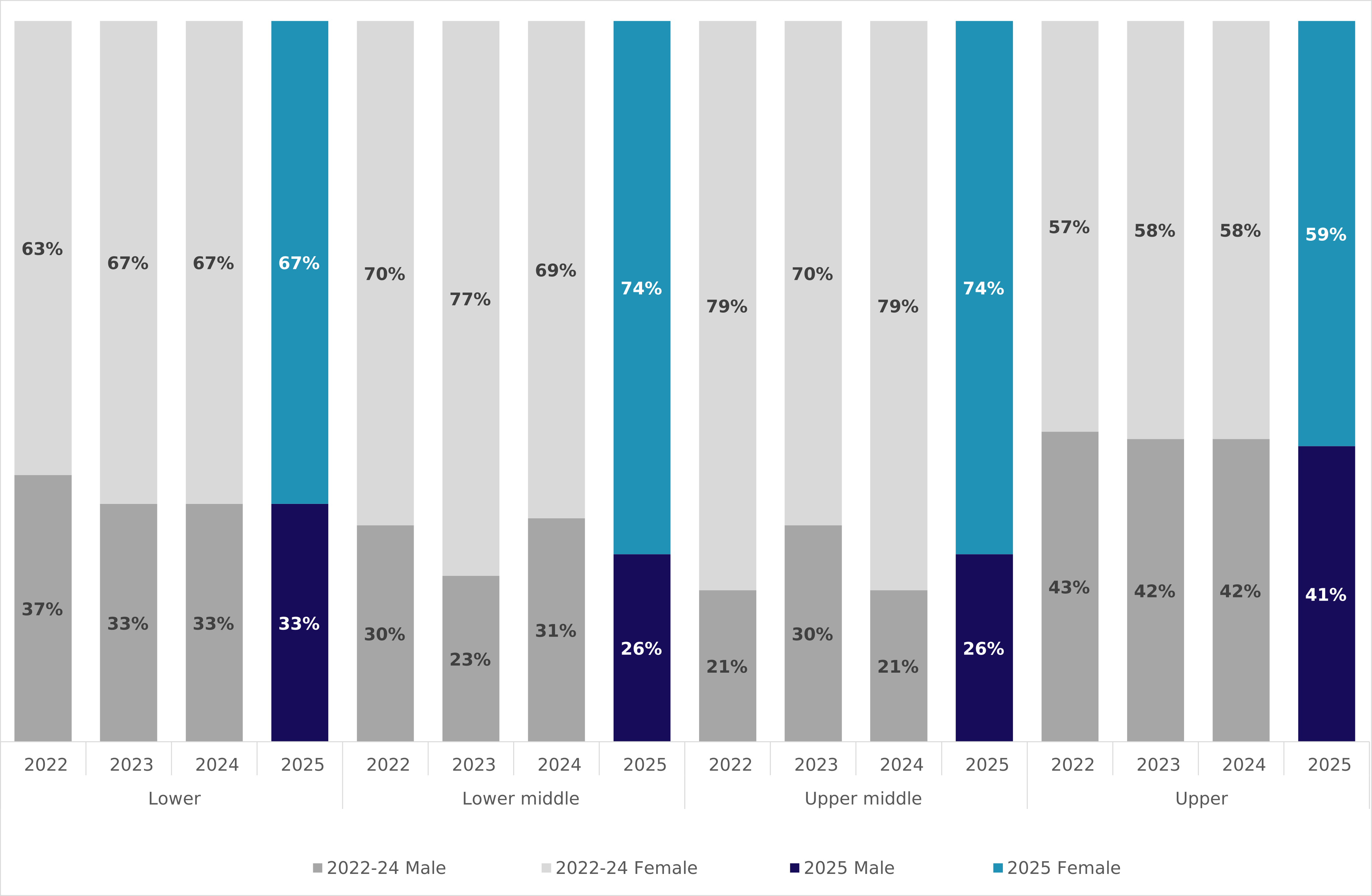
Figure 1: Proportions of men and women in each pay quartile 2022–25, as at 31 March 2025
View data in an accessible table format.
Analysis of gender pay gap data
Gender pay gaps
Our mean gender pay gap has decreased by 1.4 percentage points from last year and remains below the Civil Service average of 6.9%. In contrast, the median gender pay gap has increased from 0% last year and is higher than the Civil Service average of 6.9%. This is because of the way bonuses have been awarded throughout 2024–25.
The mean pay gap is 4.4% favouring men. The average pay difference between men and women is £1.40 per hour. We believe the pay gap is due to higher proportions of men in more senior grades, particularly SCS grades. SCS staff are paid the highest salaries and operate within pay bands, rather than spot rates. Employees in SCS grades are 52% male, reduced from 58% last year, which partly explains the decrease in the mean gender pay gap.
The median pay gap is 7.8% favouring men. We believe this is due to variations in the use of bonuses this year, particularly a £500 flat-rate bonus awarded to some social care employees.
Bonus gender pay gaps
Our median bonus pay gap remains at 0%. Our mean bonus pay gap has decreased significantly from last year and is below the Civil Service average of 22.5%. It is 3.2% in favour of men, with an average difference of £8.64 per award. However, women were more likely to receive a bonus than men by 4.7 percentage points.
There are several reasons why the mean bonus pay gap was smaller than in previous years:
- In previous years, most bonuses were awarded through individual nominations from our non-SCS in-year reward schemes, rather than as a flat rate. In 2024–25, Ofsted offered a flat-rate end-of-year award to staff in some social care grades, resulting in a more even distribution.
- Due to affordability pressures, in 2024–25 the budget for in-year reward schemes for non-SCS staff was low. This led to a low volume of awards and a preference for using our voucher award scheme, which has fixed values of £25, £50 or £100, promoting consistency.
- SCS awards were more evenly distributed this year, compared to previous years. This helps to explain the reduction in the mean bonus pay gap compared to last year.
Actions to address the gender pay gap
We are committed to taking the following actions in 2025–26:
- launching our new approach to equality, diversity and inclusion (EDI), to bring all EDI activities together into one plan and monitor progress
- continuously monitoring and analysing in-year reward schemes, including mid-year if data allows, and reporting on this to our senior leaders
- taking action to reduce variance across business areas and grades by promoting best practice
- promoting career pathways for progression by introducing a mentoring package and an internship programme, as well as a broader approach to shadowing
- training leaders and line managers to ensure high standards and an inclusive work environment
Annex A: Ofsted’s grading structures
Administrative, professional and technical (APT) grading structure
| Senior Civil Service (SCS) grade equivalent | Grade |
|---|---|
| SCS | SCS |
| Civil Service grade equivalent | Grade |
|---|---|
| Grade 6 | Principal Officer |
| Grade 7 | Band A |
| Senior Executive Officer (SEO) | B1 |
| Higher Executive Officer (HEO) | B2 |
| Executive Officer (EO) | B3 |
| Administrative Officer (AO) | C1 |
Inspector grading structure
| Civil Service grade equivalent | Grade |
|---|---|
| Grade 6 | Senior His Majesty’s Inspector (HMI) |
| Grade 6 | Specialist Adviser |
| Grade 7 | HMI |
| Grade 7 | Regulatory Inspection Manager |
| SEO | B1 Inspector |
Annex B: data table for Figure 1
Proportions of men and women in each pay quartile 2022–25, as of 31 March 2025
| Lower pay quartile – % male | Lower pay quartile – % female | |
|---|---|---|
| 2022 | 37 | 63 |
| 2023 | 33 | 67 |
| 2024 | 33 | 67 |
| 2025 | 33 | 67 |
| Lower middle pay quartile – % male | Lower middle pay quartile – % female | |
|---|---|---|
| 2022 | 30 | 70 |
| 2023 | 23 | 77 |
| 2024 | 31 | 69 |
| 2025 | 26 | 74 |
| Upper middle pay quartile – % male | Upper middle pay quartile – % female | |
|---|---|---|
| 2022 | 21 | 79 |
| 2023 | 30 | 70 |
| 2024 | 21 | 79 |
| 2025 | 26 | 74 |
| Upper pay quartile – % male | Upper pay quartile – % female | |
|---|---|---|
| 2022 | 43 | 57 |
| 2023 | 42 | 58 |
| 2024 | 42 | 58 |
| 2025 | 41 | 59 |
See Figure 1.
-
‘Full-pay relevant employee’ means a relevant employee who, during the relevant pay period, was not being paid at a reduced rate or nil as a result of being on leave, according to the Equality Act 2010 (Gender Pay Gap Information) Regulations 2017. Throughout this report, references to employees or gender profile includes full-pay relevant employees only. The ‘relevant pay period’, in relation to the relevant employee, means (a) the period in respect of which the relevant employer pays the employee basic pay, whether weekly, fortnightly or monthly, or any other period, or (b) if the relevant employer does not pay the employee basic pay, the period in respect of which the employer most frequently pays the employee one of the elements of ordinary pay mentioned in regulation 3(1) (b) to (e) in the Equality Act 2010 (Gender Pay Gap Information) Regulations 2017. ↩