NDA Business Plan 2026 to 2029
Published 16 March 2026

© Crown copyright 2026
This publication is licensed under the terms of the Open Government Licence v3.0 except where otherwise stated. To view this licence, visit nationalarchives.gov.uk/doc/open-government-licence/version/3 or write to the Information Policy Team, The National Archives, Kew, London TW9 4DU, or email: psi@nationalarchives.gov.uk.
Where we have identified any third party copyright information you will need to obtain permission from the copyright holders concerned.
This publication is available at https://www.gov.uk/government/publications/nuclear-decommissioning-authority-group-business-plan-2026-to-2029/nda-business-plan-2026-to-2029
1. Response to the consultation
Introduction
In December 2025 we published our draft Business Plan for the period 2026-2029. Our consultation on the Plan ran for eight weeks, from 8 December 2025 to 2 February 2026. We are conscious that the timing of our Business Plan consultation may have caused difficulties for some stakeholders wishing to respond but would highlight that we are constrained by the time required for consultation, review and the necessary approvals process. We will continue to review and improve the consultation process within the current constraints and the latest government guidance.
Consultees were able to respond by email or post with the consultation running in accordance with the criteria set out in the Cabinet Office’s consultation principles guidelines: www.gov.uk/government/publications/consultation-principles-guidance
Our findings
We received seven formal responses from a range of individuals, local authorities and stakeholder groups. A summary of the general points raised is provided below. We have considered the feedback and made changes to amend the draft document where we have deemed it appropriate. Where stakeholders have requested a level of detail that is not appropriate for this document, we will follow up with further engagement through our stakeholder engagement team. If respondents feel that their feedback has not been adequately addressed, please email businessplanning@nda.gov.uk
Activities and requests for more information on targets
Several respondents asked for more detailed targets and metrics to be included in the Plan. The purpose of the Business Plan is to provide a summary of activities and expected progress for our 17* nuclear sites over the next three years, in line with the funding agreed with HM Treasury and the Department for Energy Security and Net Zero. Detailed targets, budgets and deliverables are developed through operating company plans, which are subject to appropriate governance and consolidated at a group level for performance monitoring and reporting.
In parallel, the NDA group is progressing its group strategic planning work, which is intended to strengthen the alignment between site‑level plans, group priorities and long‑term mission delivery. As this work matures, it will support the development of more robust, consistent and meaningful targets and milestones across the group, while recognising the 2025 Spending Review settlement and the inherent uncertainty of long‑term decommissioning.
We also continue to improve how we tell our story and how our mission flows into delivery on the ground. Our four driving themes and 47 outcomes are set out on pages 23–30 and are supported by our critical enablers. Progress against these is reported through our annual Mission Progress Report and our Annual Report and Accounts, which also report performance against the key activities in this Business Plan. Both reports can be found on our website.
Funding
A few respondents asked for a more detailed split in expenditure. The intent of including expenditure figures is to outline planned allocations of available funding. The NDA operates a portfolio funding approach across the group and retains flexibility in final allocations through the year. This allows us to focus on our highest hazards and high-risk areas, while maximising value for money. This means that it is not always appropriate to provide a more detailed split of the expenditure.
Socio-economics
There was continued interest in the NDA’s work in this area, reflecting the importance communities place on sustained engagement and long‑term socio‑economic support. In 2024 we published a new Social Impact and Communities Strategy, developed collaboratively with representatives from our communities, which sets out our approach to socio‑economics and brings together the improvements and enhancements made over recent years.
The NDA group has grant‑giving powers, administered in collaboration with our operating companies, to support projects in communities near to our sites. We will continue to work in partnership with others to maximise the impact of this funding. Further information on our grant programme is available on our website.
Stakeholder engagement
Several respondents emphasised the importance of maintaining and strengthening engagement with stakeholders, particularly local authorities and site stakeholder groups. There were also requests for earlier, more structured engagement to better align site‑level activities with local strategies and supply chains.
We recognise the importance of strong and effective engagement and will continue to engage openly and transparently with stakeholders to support meaningful dialogue and maintain the confidence and trust needed to deliver our mission.
Other minor changes
Some respondents asked us to include more detailed information in the Business Plan on a variety of other topics. In many cases this information is available on our website and in these instances, we have included relevant signposts through the Plan and on the useful links and documents section. These include our revised group Strategy and the Social Impact and Communities Strategy. Minor errors and inconsistencies have also been addressed as part of finalising the Plan.
2. Preface
The NDA group is responsible for one of the most important environmental programmes in the world; protecting people and the planet. We are a government-funded body responsible for safely and securely decommissioning the UK’s former nuclear sites and overcoming the challenges of managing and disposing of nuclear waste. With a workforce of 19,000* staff across our estate, our employees make up one of the most knowledgeable and experienced nuclear workforces in the world.
How we go about our work is very important to us and we are committed to delivering our mission safely, sustainably and responsibly, with care for communities and the environment, ensuring our actions and decisions continue to deliver a positive and long-lasting legacy for future generations.
Engaging openly and transparently on our work is important to us. This Business Plan is one of several publications which we create and consult on every year. In line with Energy Act 2004 requirements, it sets out the activities that will take place over the next three years to advance our important clean-up and decommissioning work and operate our facilities safely and securely. It shows anticipated funding for the NDA group for 2026/29. We show how the activities are helping to deliver our mission by aligning them to the 47 strategic outcomes set out in our Strategy and Mission Progress Report. We also include key work across a range of critical enablers vital to delivering the mission.
3. How we communicate our strategy and report progress
NDA Strategy
Twelve-week public consultation every five years. Describes how we will deliver our mission, ensuring that the UK’s nuclear legacy sites are decommissioned and cleaned up safely, securely, cost-effectively, and in ways that protect people and the environment.
This is an Energy Act (2004) requirement, covering 100+ years. The document is published every five years.
Mission Progress Report
Provides our stakeholders with a clear and concise story of NDA mission progress since 2005, that demonstrates delivery of our strategic themes and outcomes as explained in our Strategy.
This covers 100+ years, and is published every year.
NDA Business Plan
Annual public consultation. The document describes key activities across the group over the next three years that align to our strategic outcomes and details the funding available for the next year.
This is an Energy Act (2004) requirement, covering three years (the first year in more detail). The document is published annually.
NDA Annual Report and Accounts
Describes achievements and spending. Reports against Business Plan activities and contains an overall progress update against the mission.
This covers the previous financial year, and is published annually.
4. A message from our Chief Executive David Peattie
Welcome to the NDA’s Business Plan for 2026–2029, setting out the NDA group’s key activities and funding for the next three years.
Delivering our nationally important mission
Last year was a special year for us as we marked the 20th anniversary of the NDA. I was filled with immense pride and gratitude as we looked back on two decades of one of the most important environmental programmes in the world. Our mission remains clear; to safely, securely and cost effectively decommission the UK’s nuclear legacy.
Over the twenty years, our work has remained nationally important and highly complex and there is still much more to be done.
The latest iteration of our strategy sets a clear, ambitious and credible path for the next phase of our work. Our strategic principles remain firm; we’ll always put the mission first, make decisions based on the best available waste treatment and disposal options, act proportionately and make best use of our people and capabilities to maximise delivery. Safety and security are fundamental to our mission. We continue to invest in additional cyber capability, including the new Group Cyber Collaboration Centre facility, which we’ve made available across the NDA group, enhancing our collective ability to successfully defend against cyber threats.
This year, we received an increased government settlement covering a longer period, giving us more certainty in our planning however requiring some difficult prioritisation judgements. In delivering our important work, we are particularly mindful of the pressures of the public purse, which means it is even more important to work effectively and efficiently as a group. Over the coming years, we’re committed to making efficiencies in our running costs, maximising funding for frontline mission delivery.
As part of our agreed funding, the NDA group has been allocated £154 million by government to develop specialised capabilities to enable disposal of the UK’s plutonium stocks, which are housed at Sellafield. This will help drive forward important national policy, build cutting edge facilities and grow world-leading expertise and capability in plutonium immobilisation, providing a safe, secure and permanent solution for the nation.
Over the next three years, our relentless focus on high hazard reduction will include key operational milestones at Sellafield and Nuclear Restoration Services (NRS) sites. NRS will start work to reduce the height of two reactor buildings at its Trawsfynydd site, in North Wales. This will not only advance our mission but also create first-of-its-kind opportunities for Wales, showcasing innovation and leadership in nuclear decommissioning. Elsewhere in the group, Nuclear Waste Services (NWS) is leading work to deliver a Geological Disposal Facility (GDF), a permanent solution for the most hazardous radioactive waste. In line with UK and Welsh Government policy, a GDF will be built where there is both a suitable site and a willing community. NWS continues to work with two communities in Cumbria, engaging openly and undertaking studies and investigations to assess their potential suitability.
Creating great places to work
The NDA group’s highly skilled workforce drives our mission forward, and developing the next generation of talent is vital to our continued success. I was thrilled to welcome over 80 graduates to the NDA group this year and see the launch of the NDA group’s first young person’s network, our sixth group employee network.
Creating an inclusive work environment is at the heart of our culture, supported by our group diversity and inclusion strategy and wellbeing framework. I was pleased this year to see the NDA achieving Disability Confident Level 3 status. This makes us a disability confident leader in the government scheme, aimed at helping organisations to attract, recruit, retain and develop disabled people.
Being trusted to do more
Our mission is growing, with preparations underway for EDF Energy to transfer seven Advanced Gas-cooled Reactor (AGR) stations to us, for decommissioning by NRS. This will see the number of NDA sites increase from 17 to 24, with Hunterston B being the first AGR station to transfer, in April 2026. This is our first significant new mission since the NDA’s creation. Arrangements are also progressing to potentially transfer the Ministry of Defence’s Vulcan site, which sits adjacent to Dounreay, to the NDA for decommissioning.
We have unique expertise, resources and assets and we are continually exploring how we best utilise these to support government’s wider energy security ambitions and low carbon energy generation. That includes identifying land not required for our mission, which could be freed up for other uses, to deliver benefits to the local community and wider economy. Government recently asked us, along with Cumberland Council, to explore clean energy development in Cumbria, supporting new jobs as part of government’s plan for change. The land at Moorside, sitting adjacent to the Sellafield site, presents opportunities for a diverse portfolio of clean energy projects, including nuclear and other new technologies.
Looking forward
This plan sets out a challenging programme to deliver our mission, create great places to work and be trusted to do more. It is shaped by our history and lessons of the past, and the opportunities of the future.
Looking ahead, I’ve informed the NDA Chair and Board of my intention to continue to serve the NDA group as its CEO until March 2027. By then, I’ll have had the privilege of leading the NDA group for a decade, an incredible milestone that feels like the right moment to pass over the group’s leadership baton.
I’m proud of what our 19,000 employees do every day, and grateful for the support of stakeholders, partners and the supply chain as we take forward such an important mission on behalf of the nation.
David Peattie FRGng FNucl, NDA Group Chief Executive Officer
5. The NDA and our mission
We’re responsible for keeping the UK’s former nuclear sites and facilities, once at the heart of supporting national defence and generating nuclear power for electricity, safe and secure as we decommission them and overcome the challenges of managing nuclear waste. It’s one of the most important environmental programmes in the world; protecting people and the planet.
We employ 19,000 employees across our estate (pre-transfer of the first AGR station) and around 40,000 indirectly; a skilled group workforce, supported by a large supply chain. We work hard on behalf of the UK, using innovation and technology to overcome the challenges of identifying and removing nuclear waste from ageing facilities, so we can store it safely and permanently dispose of it. The work is complex and challenging.
Dealing with all the waste, dismantling hundreds of buildings and facilities, and building a GDF, to dispose of the most hazardous radioactive waste, will take decades. However, by investing today in the challenges left over from the UK’s proud nuclear history, we can remove the burden for future generations and deliver social and environmental benefits through our jobs, knowledge, skills, technology and social investment. We also have a role in assuring decommissioning plans for new nuclear.
Our team is working with partners in research and industry to drive innovation, using cutting-edge technology to reduce hazards and risks, so that over time the sites can be used again for other worthwhile purposes.
Open and transparent engagement is a critical enabler to the successful delivery of our mission and we could not make progress without the support and confidence of our stakeholders. Key partners include government entities, employees, trade unions, commercial partners, customers, local communities, councils, non-governmental organisations (NGOs), and international organisations.
Our history
The UK is a pioneer of nuclear technologies, which have been part of our lives since the 1950s. Our sites and facilities have been at the heart of delivering nuclear benefits for the UK, including national defence programmes and supplying safe, low-carbon power to UK homes, businesses, schools and hospitals, for decades.
Unlike modern day equivalents, our old nuclear plants and facilities weren’t designed to manage the nuclear waste they created, or for decommissioning. There are limited historical records on what, or how much, nuclear waste was left on some of the sites during their working lives.
Generating nuclear power today will not leave future generations with the challenges we’re trying to overcome. Nuclear waste produced today is carefully managed, and following in the footsteps of other countries, a GDF will provide a safe way of disposing of the most hazardous radioactive waste, permanently in England and Wales. Scotland has a distinct policy for higher activity radioactive waste which sets out a near site, near surface approach.
Aiming for the highest standards
How we go about our work is very important and we must deliver results safely, responsibly, and sustainably. Our commitment to creating environmental and social benefits builds on our long history of providing value for the UK and we want to ensure that our actions and decisions continue to have a lasting, positive impact.
For more information on how we assess investment decisions, see the NDA value framework.
Trusted to do more
Our work is expanding, reflecting the position we hold within the UK nuclear industry and the trust placed in the NDA to both deliver complex programmes and provide strategic advice to the UK and devolved governments.
We have been asked to use our specialist expertise and skills to decommission newer reactors as they reach the end of their power-generating lives. Arrangements have been agreed by the UK Government, Scottish Government and EDF Energy for the NDA group to decommission Britain’s seven AGR stations.
The AGRs will reach the end of their operational lives over the next 10 years and, after defueling, with the fuel being transferred to Sellafield for interim storage, will transfer to NRS for decommissioning. Hunterston B will be the first station to transition to the NDA group estate in 2026.
Alongside this, we are providing strategic advice on wider government priorities, including working with Great British Energy - Nuclear and on international engagement. We also continue to work with the MOD to maximise opportunities across the civil and defence enterprise, playing a critical role in the management of the MOD’s nuclear liabilities. For example, approval has been provided by the MOD and the Department for Energy Security and Net Zero (DESNZ) to start work on the potential transfer of Vulcan to the NDA.
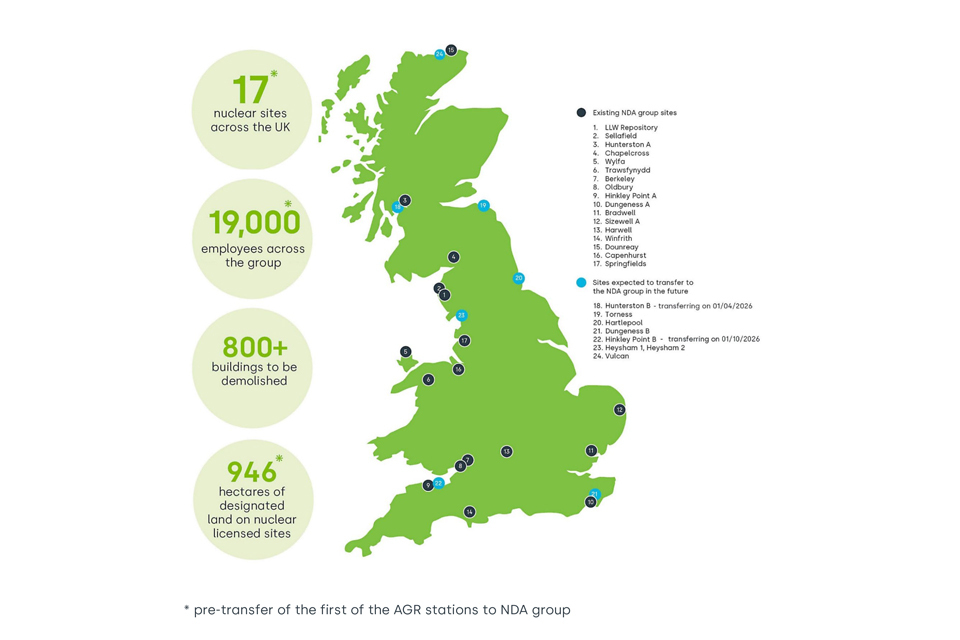
Map of NDA group sites across the UK
6. The NDA group
Our group is made up of the Nuclear Decommissioning Authority (NDA) and four key component parts: Sellafield, Nuclear Restoration Services, Nuclear Waste Services and Nuclear Transport Solutions.
The NDA is an executive non-departmental public body, created through the Energy Act 2004, sponsored and funded by DESNZ. UK Government Investments (UKGI) also provides strategic oversight of corporate governance and performance. We are accountable to UK Government and Scottish Government for delivery of our mission through our subsidiary companies.
Sellafield is responsible for decommissioning the UK’s most complex and challenging nuclear site. The site houses around 85 per cent of all the UK’s nuclear waste, on an area of less than two square miles. The Sellafield workforce is taking waste out of some of the earliest buildings on the site, looking after fuel so that nuclear power stations can continue to operate, and repackaging the country’s stockpile of nuclear materials. Today, great steps are being taken towards creating a clean and sustainable future.
Nuclear Restoration Services (NRS) is responsible for safely decommissioning the first generation of nuclear and research sites across the UK. It brings together Dounreay and the sites previously branded as Magnox, as part of our work to simplify the way the NDA group is structured, taking opportunities to get best value from working together as one team. NRS also operates a hydro-electric plant and is preparing to welcome the seven AGRs, currently managed by EDF Energy, for decommissioning, as well as other future missions.
Nuclear Waste Services (NWS) is the UK’s leading nuclear waste management organisation, focused on managing the UK’s nuclear waste, safely and securely, for generations to come. Its work includes the programme to deliver a GDF, operating the Low-Level Waste Repository site in Cumbria and overseeing the NDA group’s Integrated Waste Management Programme.
Nuclear Transport Solutions (NTS) is our leading global provider of safe, secure and reliable nuclear transport solutions. It uses its specialist transport and logistics expertise to support our nuclear decommissioning mission and help customers and partners around the world solve their own complex challenges.
7. Our funding
We are publicly funded by DESNZ. Our total planned expenditure is voted upon annually by Parliament in line with the Spending Review.
Funding framework
UK Government has shown continued support for the NDA mission over recent years with increased grant funding offsetting the decline in commercial revenue. Spending Reviews 2024 and 2025 set capital funding to 2029/30, resource funding to 2028/29, and included challenging efficiency commitments for the NDA group, recognising current fiscal and economic contexts.
Expenditure incurred on decommissioning the seven AGR stations which will transfer to the NDA over the coming years will be funded by the Nuclear Liabilities Fund (NLF) and not by government grant funding. As such, both this expenditure and related funding are excluded from the tables presented on the following page. We continue to work closely with EDF Energy and the NLF Trustees to ensure smooth and efficient transfers of the incoming AGR sites in 2026 and beyond.
Commercial income
We maximise revenue from our existing assets and operations to help fund decommissioning and clean-up work, in order to reduce the level of public funding needed to deliver the scope of our plans and the NDA mission. Our commercial operations are primarily managing spent fuel and nuclear materials with additional opportunities including the provision of transportation services.
Prioritisation and allocation of funding
Within affordability constraints, we will seek to maintain progress and maximise value for money through effectively implementing our strategy. This means focusing on reducing our highest hazards and risks, while ensuring that our high standards of safety, security and environmental protection for site operations are maintained.
Planned income and expenditure in 2026/27
This Business Plan sets out our anticipated income and expenditure for the three years to 2028/29, in line with our recent Spending Review settlement. The NDA retains the right to reallocate funding within agreed totals in order to meet prioritised programme needs.
Our total planned expenditure for 2026/27 is £4.124 billion, of which £3.550 billion will be funded by UK Government and £0.574 billion from commercially generated net revenue. Planned expenditure for on-site programmes will be £3.838 billion, while non-site expenditure is expected to be £0.286 billion. This non-site expenditure includes skills development, socio-economic, research and development, insurance and pension costs and the NDA operating costs as detailed below.
Planned income and expenditure summary 2026/27
| Operating Company / Site (£m) | Operations A (£m) | Projects B (£m) | Running costs and management C (£m) | 2026/27 Plan Total (A+B+C) (£m) | 2025/26 Plan Total (£m) |
|---|---|---|---|---|---|
| Sellafield Ltd | 1,752 | 783 | 296 | 2,831 | 2,805 |
| Nuclear Restoration Services | 310 | 214 | 250 | 774 | 761 |
| Nuclear Waste Services | 34 | 99 | 42 | 175 | 216 |
| Springfields | 4 | 13 | 12 | 29 | 36 |
| Capenhurst | 5 | 19 | 4 | 28 | 26 |
| Non-site expenditure | 19 | 23 | 245 | 287 | 186 |
| TOTAL | 2,124 | 1,151 | 849 | 4,124 | 4,030 |
| Net income | 574 | 725 | |||
| Net (grant funded) | 3,550 | 3,305 |
Notes:
- NDA reserves the right to reallocate funding to meet prioritised programme needs. As such, final Annual Site Funding Limits issued in March 2026 may be adjusted to reflect efficiency, performance and portfolio pressures.
- The classification of costs in the above table has been amended to align with NDA group reporting arrangements.
Summary of NDA funding 2026/27 onwards
| NDA funding | 2026/27 (£m) | 2027/28 (£m) | 2028/29 (£m) |
|---|---|---|---|
| Net income | 574 | 618 | 841 |
| Government grant funding | 3,550 | 3,575 | 3,394 |
| Expenditure | 4,124 | 4,193 | 4,235 |
| Net | |||
| Memo: Expected expenditure on AGRs* funded by NLF | 55 | Tbc | Tbc |
*Indicative expenditure in respect of Hunterston B only. The level of expected expenditure for Hinkley Point B is subject to further work following completion of the Site-Specific Decommissioning Plan
2026/27 breakdown of non-site expenditure
| Non-site expenditure | 2026/27 Plan (£m) | 2025/26 Plan (£m) |
|---|---|---|
| NDA operating costs | 32 | 32 |
| Critical enablers | 72 | 82 |
| Estate Insurance | 10 | 11 |
| Other central spend * | 172 | 64 |
| Total | 286 | 189 |
*2026/27 figure includes costs awaiting allocation
2026/27 breakdown of planned income by category
| Income source | 2026/27 Plan* | 2025/26 Plan (£m) |
|---|---|---|
| Reprocessing and fuel management services | 582 | 697 |
| NDA-NTS transport | 69 | 61 |
| NDA-generated revenue | 26 | 60 |
| Intra-site services | 41 | 41 |
| Total income | 718 | 859 |
| Less direct costs of sale ** | (144) | (134) |
| Net income | 574 | 725 |
*Income figures presented are aligned to our Spending Review 2025 settlement but the timing of the income recognition in respect of some elements may be subject to change
**Costs directly incurred in the generation of the above income:
| Direct costs of sale | 2026/27 Plan (£m) | 2025/26 Plan (£m) |
|---|---|---|
| NTS transport contracts | 69 | 61 |
| Other NDA commercial costs | 54 | 51 |
| NWS pass-through costs | 18 | 19 |
| Energy trading costs | 3 | 3 |
| Total costs of sale | 144 | 134 |
8. Sustainability in the NDA group
The NDA group is committed to creating environmental and social benefits for the UK and ensure that we have a lasting, positive impact. We support government aspirations to be carbon net zero and see sustainability as a much broader commitment aligned with the United Nations sustainable development goals.
The UK and devolved governments’ policy for managing radioactive substances and nuclear decommissioning (May 2024) mandates that sustainability is hardwired into our thinking and decommissioning plans. The NDA group’s sustainability strategy defines how sustainability is applied to our activities, and our sustainability report sets out the progress, opportunities and challenges.
Our definition of sustainability
To create value through nuclear decommissioning - at pace, affordably, with participation and creatively.
- At pace: Keep safety and security paramount, optimise progress in decommissioning
- Affordably: Consider the long-term value for money alongside short-term financing, optimising investment decisions
- With participation: Seek and support the opinions, plans and aspirations of our workforce, communities and stakeholders
- Creatively: Decommission our nuclear sites, enhancing the environment and achieving carbon net zero
The United Nations’ sustainable development goals are a blueprint for peace and prosperity, now and into the future. We are committed to delivering our mission in line with the goals.
Sustainability integration and commitment
Sustainability is a core principle of our strategy, ensuring that decisions bring benefits to society and enhance mission delivery. The Energy Act 2004 sets out the functions of the NDA, which directly align to 11 of the 17 sustainable development goals. This reflects the NDA group’s sustainability vision to transform nuclear legacies into opportunities for local, regional and national sustainable development.
We have undertaken a double materiality assessment to identify the sustainability topics that matter most; those which maximise positive societal impact and enhance mission delivery and therefore deliver value for money and promote shared prosperity for our stakeholders.
Sustainability is a key priority across the NDA group, with lots of topics linking back to our driving themes and critical enablers. You can see examples of the progress we’re making in the case studies on pages 35-40, which also highlight the goals they support; showing how sustainability runs through everything we do.
9. Our strategic approach and themes
Our strategic themes
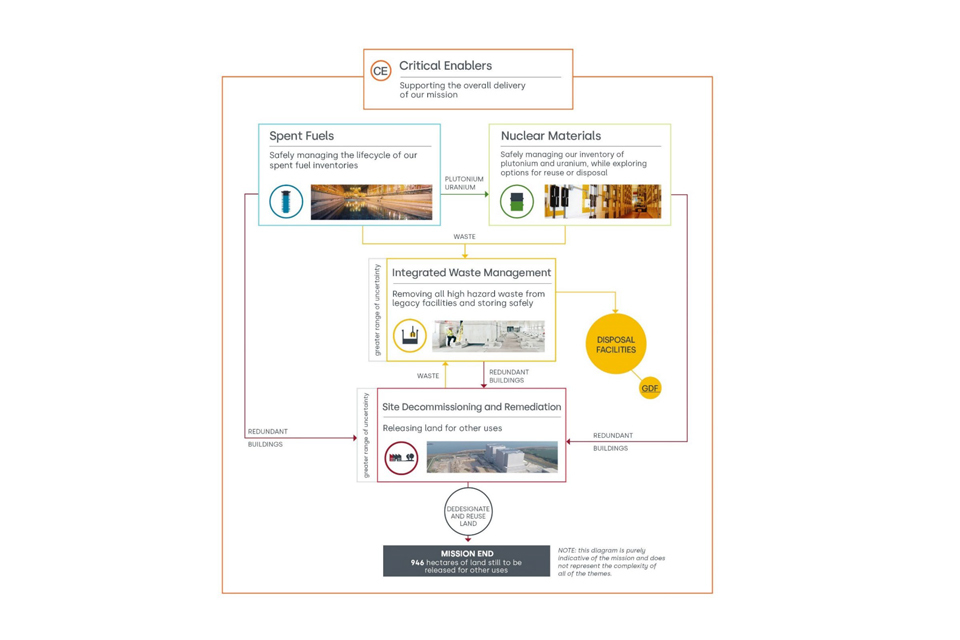
We organise our activities into five strategic themes that support mission delivery. This structure helps us focus on key priorities, understand how different parts of our work are connected, and communicate clearly with our stakeholders.
The first four themes relate directly to decommissioning work and are known as driving themes: spent fuels, nuclear materials, integrated waste management and site decommissioning and remediation.
The fifth theme, critical enablers, describes the important activities needed to support the delivery of our mission. The diagram below demonstrates how the themes interact.
Integration of our strategies
Our most urgent tasks are dealing with the highest-hazard materials, spent fuel, nuclear materials and highly radioactive wastes. Only once the inventory has been removed and either securely stored or disposed of, can the redundant nuclear facilities be dismantled and demolished.
Strategic themes diagram
10. Our themes and strategic outcomes
Across our four driving themes, we break our mission down into 47 strategic outcomes. These outcomes represent the significant pieces of work that must be achieved to deliver our mission. In our latest Strategy we updated some of these outcomes to ensure they continue to reflect our current priorities and approach.
We’re building a clearer picture of what’s already been achieved across our 47 outcomes and what still needs to be done. The end dates shown in the tables on pages 27-30 represent the latest emerging information and are subject to change as our plans evolve.
Spent Fuels
We’re responsible for managing several types of spent nuclear fuel, which fall into three main categories: magnox, oxide and exotic. Once spent fuel is removed from a reactor, it is stored in a pond or dry store until it can be dispatched to Sellafield. To learn more about the different types of spent fuel we manage, see NDA group Strategy 2026, pages 50-59.
Our strategy is to consolidate all the spent fuels we own or are contracted to manage in interim store at Sellafield pending a future decision on whether to classify them as waste for disposal in a GDF. For planning purposes, we assume that all the remaining spent fuels will be disposed of in a GDF.
Our spent fuel work is separated into 15 strategic outcomes that we must deliver, outlined on page 27.
Nuclear Materials
Our strategy is to support operating companies to safely and securely store the inventory of uranics and plutonium currently stored on some of our sites. These nuclear materials are by-products from different phases of the fuel cycle, either manufacturing or reprocessing.
All nuclear materials must be managed safely and securely, by either converting them into new fuel or immobilising and storing them until a permanent UK disposal facility is available.
All of our plutonium is stored at Sellafield. Although uranium is located at a number of our sites, we are continuing to consolidate it at sites best suited to its management. To learn more about the types of nuclear materials we manage, see NDA group Strategy 2026, pages 60-67.
Our nuclear materials work is separated into 10 strategic outcomes that we must deliver, outlined on page 28.
Integrated Waste Management
Our strategy considers how we manage all forms of waste arising from operating and decommissioning our sites, including waste retrieved from legacy facilities.
Managing the large quantities of radioactive waste from electricity generation, research, the early defence programme and decommissioning is one of our biggest challenges. Some of this radioactive waste is in a raw (untreated) form, some has been treated and is being interim stored and, in the case of low-level waste, some has already been permanently disposed of.
Our highest priority is the retrieval, treatment, and interim storage of waste from Sellafield’s four legacy ponds and silos, which contain some of the UK’s most complex and hazardous materials. For more detail on the types of waste we manage, see NDA group Strategy 2026, pages 68-80.
Our integrated waste management work is separated into 14 strategic outcomes that we must deliver, outlined on page 29.
Site Decommissioning and Remediation
Our approach to decommissioning redundant facilities and managing land quality ensures that each site can be safely prepared and released for its next planned use.
After the buildings on our sites have been decommissioned, decontaminated and dismantled, the land will be cleaned up to allow it to be released for other uses. At that point, ownership would transfer to the new user of the land.
We’re currently assessing alternatives for the final stages of decommissioning that could lead to earlier release of land, continued employment and opportunities to reuse it.
Our site decommissioning and remediation work is separated into eight strategic outcomes that we must deliver, outlined on page 30.
For more detail on how we plan to safely dismantle redundant facilities and restore land for future use, see NDA group Strategy 2026, pages 34-48.
Critical Enablers
Our fifth strategic theme, critical enablers, covers the important activities needed to support the overall delivery of our mission. See pages 32-33 for more detail.
11. Work featuring in 2026 - 2029
The next few pages present in more detail examples of the important work that will either be completed or advanced in the next three years. These near-term activities are mapped against our strategic themes and specifically to the 47 outcomes that make up our mission. All dates reflect the latest information and are subject to change.
The case studies also show how our work is contributing to the United Nations’ sustainable development goals, which are a blueprint for peace and prosperity, now and into the future. Much of our work can be related to one or more of the goals, and we are continuing to work to maximise these outcomes.
Our 47 outcomes cover all our strategic themes except ‘critical enablers’. As the data range matures over the next 120+ years, along with the reduction of uncertainty of the inventory, progression in the lifecycle and strategy development, it may well be subject to change.
The dates for each strategic outcome contained within this plan are correct up to 31 March 2025.
For more information see NDA Mission Progress Report 2025.
Spent fuels
| SPENT MAGNOX FUEL | End date |
|---|---|
| 1 - All sites defueled | COMPLETED |
| 2 - All legacy Magnox fuel retrieved | 2045 |
| 3 - All Magnox fuel reprocessing completed | COMPLETED |
| 4 - All remaining Magnox fuel in interim storage | 2045 |
| 5 - All remaining Magnox fuel disposed | 2125 |
| SPENT OXIDE FUEL | End date |
|---|---|
| 6 - All EDFE oxide fuel received | 2033 |
| 7 - All legacy fuel received | COMPLETED |
| 8 - All oxide fuel reprocessing completed | COMPLETED |
| 9 - All remaining oxide fuel in interim storage | 2033 |
| 10 - All remaining oxide fuel disposed | 2125 |
| SPENT EXOTIC FUEL | End date |
|---|---|
| 11 - All exotic fuel defueled | 2028 |
| 12 - All exotic fuel consolidated | 2044 |
| 13 - All exotic fuel reprocessing completed | COMPLETED |
| 14 - All remaining exotic fuel in interim storage | 2044 |
| 15 - All remaining exotic fuel disposed | 2125 |
| PLUTONIUM | End date |
|---|---|
| 16 - All plutonium produced | COMPLETED |
| 17 - All plutonium consolidated | COMPLETED |
| 18 - All cans not suitable for extended storage repackaged* | 2060 |
| 19 - All plutonium in interim storage | 2060 |
| 20 - All plutonium put beyond reach and then disposed* | 2120 |
| URANIUM | End date |
|---|---|
| 21 - All uranium produced | COMPLETED |
| 22 - All uranium consolidated | 2028 |
| 23 - All uranium treated | 2055 |
| 24 - All uranium in interim storage | 2055 |
| 25 - All uranium reused or disposed | 2120 |
*On 24 January 2025 the UK Government announced a policy decision to immobilise the UK’s inventory of civil separated plutonium at Sellafield. We are working with Sellafield Ltd, NWS and our delivery partners to implement this policy. As such, the following strategic objectives have been updated in the latest Strategy.
| LOW LEVEL WASTE | End date |
|---|---|
| 26 - All LLW produced | 2127 |
| 27 - All LLW treated - to enable diversion or reuse | 2127 |
| 28 - All waste suitable for disposal in NDA facilities | 2127 |
| 29 - All waste suitable for permitted landfill disposed | 2127 |
| INTERMEDIATE LEVEL WASTE | End date |
|---|---|
| 30 - All ILW produced | 2120 |
| 31 - All legacy waste retrieved | 2059 |
| 32 - All ILW treated | 2120 |
| 33 - All ILW in interim storage | 2120 |
| 34 - All ILW disposed | 2379 |
| HIGH LEVEL WASTE | End date |
|---|---|
| 35 - All HLW produced | 2039 |
| 36 - All HLW treated | 2039 |
| 37 - All HLW in interim storage | 2039 |
| 38 - All overseas HLW exported | 2031 |
| 39 - All HLW disposed | 2104 |
| OPERATIONAL AND PLANNED | End date |
|---|---|
| 40 - All planned new buildings operational | 2101 |
| 41 - All buildings primary function completed | 2127 |
| DECOMMISSIONING AND DEMOLITION | End date |
|---|---|
| 42 - All buildings decommissioned | 2131 |
| 43 - All buildings demolished or reused | 2133 |
| SITES | End date |
|---|---|
| 44 - All land delicensed or relicensed | 2135 |
| 45 - All land in end state - all planned physical work complete | 2134 |
| 46 - All land demonstrated as suitable for reuse | 2135 |
| 47 - All land de-designated or reused | 2380 |
12. Roadmap to mission delivery
Our latest roadmap for mission delivery presents the major milestones for our driving themes: site decommissioning and remediation, integrated waste management, spent fuel and nuclear materials management. These milestones align with the delivery objectives of our operating companies, aiming to reduce the UK’s nuclear liabilities safely, securely and in ways that benefit society.
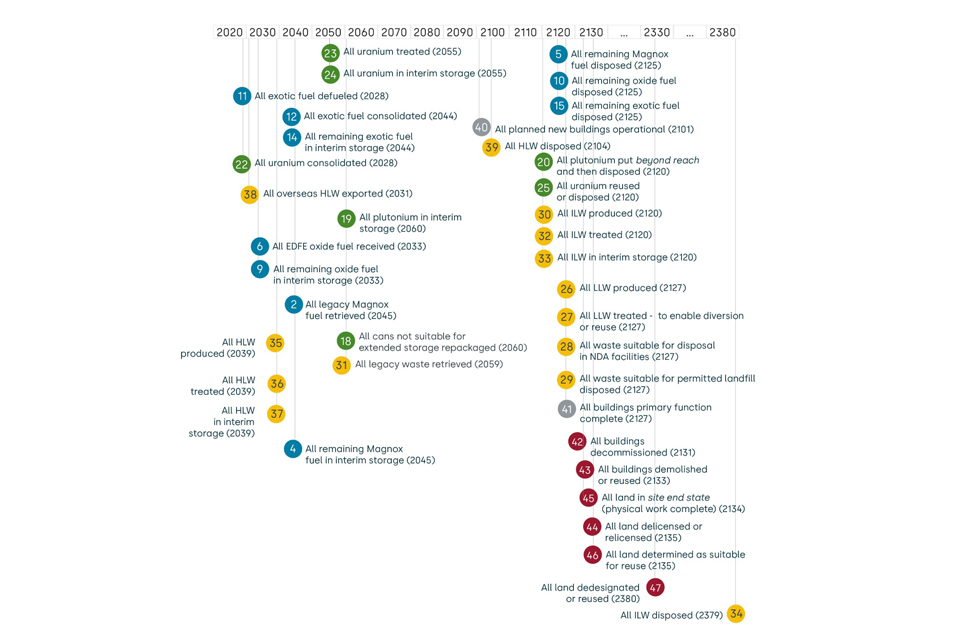
NDA group progress roadmap
The dates for each strategic outcome above are correct up to 31 March 2025. For more information see NDA Mission Progress Report 2025.
Critical enablers
Our fifth strategic theme, critical enablers (CE), covers the important activities needed to support the overall delivery of our mission.
Several of our critical enabler strategies respond to our highest group strategic risks and therefore require group focus and attention. These include health, safety and wellbeing, asset management and continuous improvement, security and resilience, cyber security, commercial and supply chain, and people.
During the revision of our latest Strategy, we updated some critical enablers and identified new ones. These changes are highlighted in the diagram below. Sustainability is now hardwired into all our strategic thinking. For more information see pages 21-22.
Together, our set of critical enablers give us the tools and stability to progress our strategic themes and stay focussed on delivering value to the taxpayer.
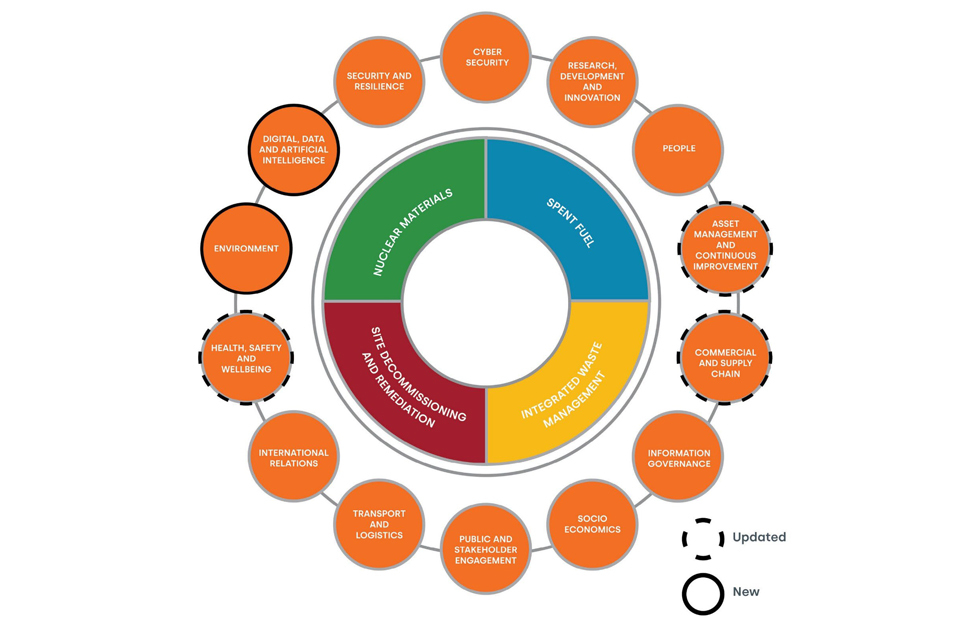
Critical enablers diagram
Critical enabler objectives
-
CE1 - Health, safety and wellbeing To deliver our mission, while improving health, safety and wellbeing management across the NDA group.
-
CE2 - Environment To protect and enhance the environment now and for the future, while maximising the environmental benefits of delivering the NDA’s mission.
-
CE3 - Security and resilience To provide proportionate security and resilience solutions throughout the decommissioning lifecycle.
-
CE4 - Cyber security Proactively deter, detect, defend against, recover from and be resilient to current and evolving cyber threats.
-
CE5 - Research, development and innovation To transform and accelerate the delivery of our mission through research, development and innovation.
-
CE6 - People To ensure we have the right talent, skills and culture to safely and efficiently deliver our mission.
-
CE7 - Asset management and continuous improvement To optimise mission performance across the NDA group by embedding robust asset management and continuous improvement capabilities.
-
CE8 - Commercial and supply chain To provide commercial excellence now and in the future through collaboration as One NDA, to deliver our collective mission.
-
CE9 - Information governance To effectively manage and reuse knowledge and information assets in a compliant and secure manner to support NDA group mission delivery.
-
CE10 - Socio-economics To support sustainable local economies for communities living near NDA sites and, where possible, contribute to regional economic growth.
-
CE11 - Digital data and artificial intelligence To empower our people to transform the delivery of our mission through the right digital and data tools, skills and culture.
-
CE12 - Public and stakeholder engagement To build a better understanding of our mission among the public and our stakeholders, and maintain their support, confidence and trust.
-
CE13 - Transport and logistics To ensure the effective, safe and secure transportation of materials to enable the successful delivery of the NDA mission.
-
CE14 - International relations To engage and collaborate effectively with international partners to facilitate delivery of the NDA group’s strategic objectives.
To find out more about our critical enablers please see our group Strategy 2026.
13. Case Studies
Case Study - Decommissioning project to help local regeneration
One of the most significant and complex decommissioning projects in the NDA group’s portfolio is going to be taking place over the course of this Business Plan period.
One of the most significant and complex decommissioning projects in the NDA group’s portfolio is going to be taking place over the course of this Business Plan period.
The two reactor buildings at Trawsfynydd, Gwynedd in North Wales, will be reduced in height. Now over 60 years old, they have experienced structural wear due to prolonged exposure to the elements.
The project began in autumn 2025 and will reshape the site’s iconic skyline through the partial removal of the upper sections of both reactor buildings, lowering them from approximately 54m to 25m. This will be the most dramatic visual transformation the region has seen in decades.
Extensive enabling work has already been completed, including the installation of new internal roofs at a lower level, major de-planting of the primary boiler sections, and rerouting of electrical supplies - all designed to prepare the buildings for safe and efficient demolition.
The programme is expected to take around four years. However, it forms part of a broader vision to transform the site, unlocking future opportunities for growth, innovation, and sustainable development.
Last year, NRS appointed Costain as the principal contractor to reduce the height of the two reactor buildings. Valued up to £70 million, this transformative project represents a major milestone in the region’s regeneration. At its peak, Costain is expected to employ more than 100 people to deliver the programme, creating opportunities to boost regional skills development and make a lasting contribution to the local economy.
Reduction of the reactor buildings will not only advance our mission but also create first-of-its-kind opportunities for Wales, showcasing innovation and leadership in nuclear decommissioning.
The Trawsfynydd reactor buildings, originally designed by renowned architect Sir Basil Spence, were a bold statement of mid-20th-century industrial design. Their striking silhouette has long been a landmark in the region. This new chapter honours that legacy while embracing a future defined by delivery, transformation, and innovation.
Case Study - Deploying innovative technology to manage radioactive waste
Robotic and AI technologies have the potential to transform the way we deliver our mission, improving safety and sustainability, and reducing costs.
Here we showcase how the research, development and innovation critical enabler is accelerating the deployment of cutting-edge robotic technologies across the NDA group to deliver complex decommissioning tasks through a project called Auto-SAS.
Auto-SAS is a group-wide technology demonstrator project to autonomously sort through waste and attribute to the correct waste routes. Manual segregation of radioactive waste is complex and hazardous due to the nature of the material, so caution is exercised, and where waste is mixed it’s currently all categorised as intermediate level waste or plutonium contaminated material rather than being sorted by type or radioactivity.
Using robotics provides the ability to categorise the waste more accurately, avoiding more costly waste routes when they aren’t required, while also removing people from hazardous environments and giving them the opportunity to develop new skills. This project, delivered group-wide, will be a trailblazer for autonomous working across the group.
In June 2025, the NDA announced a pioneering partnership which will see AtkinsRéalis and Createc, known as ARCTEC, working together on this project. They will take learning from the solutions they developed in an earlier innovation competition to develop a system which will be deployed on the NRS Oldbury, former nuclear site.
The NDA has committed to invest up to £9.5m in the project over four years, which is a collaboration with NRS, Sellafield and NWS.
Progress on the project so far is that CO2 tanks on the Oldbury site have been decommissioned to enable space for the demonstration and the contractor has started developing the technical system.
The project is being undertaken in two phases which will run throughout the term of this Business Plan. Phase 1 runs from June 2025 to August 2027 and will see a prototype design being developed and taken through to being fully operational in an inactive environment. Phase 2 will deliver an active demonstration of the system at Oldbury.
This is a hugely exciting project for the NDA group and has the potential to save hundreds of millions of pounds in waste storage and disposal costs.
Our ambition is to use what we learn here to benefit multiple sites in the NDA group and potentially beyond.
Case Study - Plutonium immobilisation progress
A long-term solution for the UK’s plutonium inventory is essential to dealing with the UK’s nuclear legacy and leaving the environment safer for future generations.
In 2025, the UK Government decided to immobilise the UK-owned civil separated plutonium inventory at Sellafield to put it beyond reach. We are working to implement this policy.
While work continues on long-term immobilisation of the material, we will ensure its continued safe and secure storage. Given its age and condition, some plutonium will need to be repackaged and, in some cases, treated so that it can be safely stored until it is immobilised.
A major new facility known as the Sellafield Product and Residue Store Retreatment Plant (SRP) is being built at Sellafield to do this and is expected to be operational by the end of the decade. A new analytical laboratory is proposed to be built within an existing facility to test some materials processed in SRP and confirm they have been stabilised for storage. Operating these new facilities will require a highly skilled workforce which we are developing.
For a small part of the plutonium inventory that we refer to as residues, we have decided to encapsulate some material in a cement-based matrix suitable for storage and disposal in a GDF. Towards the end of 2025, Sellafield safely processed a can of plutonium residue into a stable waste form for the very first time. This achievement marks the start of the programme to process around 400 cans of the residue.
We have been carrying out technology development work to select a preferred process to immobilise the bulk of the plutonium. This technology development work involves a significant investment in research and development capability at Sellafield Ltd, UK National Nuclear Laboratory and the supply chain companies.
A new industrial-scale manufacturing facility will be required based on the technology chosen. Over the next several years we will be taking the first steps in preparing to build this facility including identifying a suitable site at Sellafield. Towards the end of the decade, and following government approval, we expect to begin delivery of a major build programme at Sellafield to deliver the immobilisation capability.
Case Study - Continuous improvement - bringing time and money back to the business
We are responsible for managing all assets across our estate throughout their entire lifecycle, from new developments to those that have reached the end of their use and need to be safely demolished.
Through group-wide learning and embedding continuous improvement principles, we are enhancing reliability, reducing risks and demonstrating value for money. This approach helps us to:
- Build capability across the group
- Improve the visibility of how our plants and facilities perform
- Highlight gaps and solve problems through local teams
- Deliver better outcomes in safety, quality, cost, delivery and people measures
This year, we’ve successfully designed and implemented the first integrated Circular Economy Framework (CEF), where products and materials are kept in circulation where possible, through processes like maintenance, reuse, refurbishment, remanufacture, recycling, and composting, to create a more sustainable system.
The CEF focusses on assets, facilities, equipment, and sites across the organisation. It’s an initiative that aims to enhance mission delivery performance while improving cost efficiency and affordability.
We’re currently in phase one of a three-phase project; CEF is establishing an intense baseline assessment of circular economy practices across all NRS sites and facilities to inform future optimisation of circular economy across the wider NDA group.
Phases two and three will focus on embedding circular economy practices through targeted workshops, continuous improvement tools and cross-group knowledge sharing, then measure the benefits in time and cost savings. The results will be shared across the NDA group, government, and industry to accelerate decommissioning, improve sustainability and enable replication in sectors like new nuclear and defence.
The framework aligns with multiple UN Sustainable Development Goals by prioritising waste reduction and maximising resource reuse in various areas. These are:
-
SDG 4 - Educating sites and functions on how integrated circular economy can aid environmental and economic performance.
-
SDG 6 - Reusing water and brown water sources within facilities.
-
SDG 7 - Promoting circular economy in our energy sources can reduce greenhouse gas emissions and fossil fuels consumption.
-
SDG 8 - Circular economy can drive innovation, create new business opportunities and therefore jobs.
-
SDG 12 - Integrated circular economy in all phases of an asset life cycle can reduce waste and promote resource efficiency.
Case Study - NDA group collaborative approach bringing value for money
In today’s dynamic and competitive marketplace, our commercial function plays a key role in enabling cost-effective mission delivery. They are part of assuring £2.3 billion supply chain spend, representing approximately 58% of the £4 billion total group expenditure.
One of our key strategy developments is to encourage the operation of an NDA group commercial function. This includes collaborative procurements on behalf of multiple entities.
We are now starting to see the benefits that these joint procurements can bring. One such example is the contract for managed print services. In 2023, each operating company within the NDA group had its own managed print services contract. Most of these were due to expire in early 2024, with the NDA’s own contract finishing in 2023. This was an opportunity to undertake a group approach to the re-procurement, considering the entire group rather than the geographical landscape of the existing contracts. It also allowed the NDA to test a value for money approach through economies of scale as opposed to individual contracts.
Managed print services include the provision of multifunctional devices, non-network printers, the Sellafield Ltd print room, scanning devices, and associated software and technical support. The preferred option to deliver service continuity was a collaborative procurement led by the NDA using the CCS Manage Print Framework. Given the uncertainty in demand for printing services following Covid-19 and potential new ways of working, the procurement needed to provide the vehicle for obtaining the devices but not constrain the volumetrics for the NDA group’s future decisions.
Most of the managed print spend (>89%) is on the leasing/purchasing of equipment and software licences, consumables specific to the Sellafield Ltd print room and staff costs. The ‘per click’ printing costs represents c.11% of the total spend.
The benefits of the managed print procurement were to:
- Minimise any cost increases in the unit rates costs of providing the services.
- Improved management information and reporting (therefore visibility and service optimisation) and supplier relationship management. This includes provision of enhanced information around carbon and environmental performance.
- Consistency of service provision, therefore enabling alignment prior to the next managed print contract solution which will deliver further innovation and reduce costs.
- End user efficiency through providing an easy to use, reliable printing service.
- Setting the foundation for any longer-term contract post this one for larger and longer-term benefits realisation.
- Target a reduction / efficiency of 10% around the number of devices on the estate
A 10% reduction in the number of devices was achieved very early on in the contract lifecycle and the group has had a positive experience with moving towards a single supplier. The anticipated savings over the course of the five-year contract are expected to exceed £11 million.
This contract now allows for additional benefits with regards to movement of people across the group as well as exposing the group to opportunities surrounding technological enhancements such as cloud printing in the future.
Over the course of the Business Plan period, there will be numerous other collaborative procurements including such topics as business travel, company credit cards, laboratory consumables and records management.
14. NDA group key activities
The NDA group’s key activities for the next three years are set out on the following pages. Where an activity is expected to complete within the three‑year Business Plan period, this is clearly stated. Activities that represent longer‑term programmes of work, or are enduring in nature, are expected to continue beyond this period. These activities are shown in the ‘later years’ column and will be reflected in future Business Plans.
All key activities are mapped against our strategic themes and specifically our 47 strategic outcomes that make up our mission. All activities and dates represent the latest emerging information and are subject to change.
Sellafield Ltd
Sellafield Ltd is an NDA subsidiary, responsible for delivering the NDA mission, through operating and decommissioning Europe’s largest and most complex nuclear site. This includes cleaning up nuclear facilities and safeguarding nuclear fuel, materials and waste - creating a clean and safe environment for future generations.
The portfolio of work is balanced around the following priorities:
- Receipt, dismantling and long-term storage of spent AGR fuel, to support EDF Energy’s electricity generating capacity.
- The vitrification of highly active liquid waste resulting from the delivery of the UK policy on reprocessing.
- Ongoing management of the UK stockpile of civil special nuclear materials (SNM).
- The retrieval and safe storage of legacy wastes created during the operation of the site over the last 70 years as it delivered on a number of UK national priority missions.
- Making progress on the decommissioning and remediation of redundant facilities which have completed their operational lifecycle.
Highlights 2026 - 2029
- Continue to receive and dismantle AGR fuel from EDF Energy
- Progress analytical services capability
- Continued roll out of asset management plans and continuous improvements
- Sustained retrievals from the legacy ponds and silos
- Continued focus on supporting a low carbon future
Further information
- Site in Cumbria
- 276 hectares
- 0 hectares dedesignated (all 276 hectares remain covered by the nuclear site license)
- Planned expenditure for 2026/27: £2,831 million
Site progress (expected and achieved)
- All buildings decommissioned - TBD*
- All land remediated - 2125
- All land dedesignated - 2125
*‘TBD’ shown when the date for completing the strategic outcome is not sufficiently clear for a specific date to be given at this time.
| Key activities | Timescale | Strategic outcome/critical enabler |
|---|---|---|
| Spent fuels | ||
| Spent Magnox fuel | ||
| Continue to interim store in the Fuel Handling Plant (FHP) remnant Magnox fuel and fuels recovered from the First-Generation Magnox Storage Pond (FGMSP) | Later years | 4 |
| Continue to retrieve fuels from the First-Generation Magnox Storage Pond (FGMSP) | Later years | 2 |
| Spent oxide fuel | ||
| Enhance the capacity to receive/manage and interim store AGR spent fuel from EDF Energy to support bulk defueling | Later years | 6, 9 |
| Spent exotic fuel | ||
| Prepare for the receipt and management of future Dounreay Fast Reactor (DFR) fuel | 2027/28 | 12, 14 |
| Nuclear materials | ||
| Plutonium | ||
| Continue the safe and secure storage of plutonium by developing the capability to repack plutonium in line with UK policy | Later years | 18, 19 |
| Continue Post Operational Clean Out (POCO)/ Initial Decommissioning activities on key facilities | Later years | 42 |
| Continue to support NDA Immobilisation Programme stand-up, including delivery of the early ‘residues to waste’ opportunity | Later years | 20 |
| Uranium | ||
| Support consolidated storage and potential transfer / export (commercial plans) of Sellafield Uranics | Later years | 22, 24 |
| Integrated waste management | ||
| Low Level Waste | ||
| Continue to generate savings and preserve capacity at the Low-Level Waste Repository (LLWR) by enhancing capability to divert waste from LLWR and into the supply chain | Later years | 27 |
| Intermediate Level Waste | ||
| Support risk reduction from Legacy Ponds through continued removal of fuel and waste from the facilities | Later years | 31 |
| Magnox Swarf Storage Silo (MSSS): Continue retrievals from MSSS, Progress the capability required for bulk retrievals, Delivery of tasks within the MSSS containment response plan to address the original building leak | Later years | 31 |
| Continue retrievals from Pile Fuel Cladding Silo (PFCS) | Later years | 31 |
| Support the NDA’s strategy by continuing the programmes to receive and treat waste materials from Harwell and AWE Aldermaston | Later years | 32 |
| Support future waste treatment through implementing the capability to actively demonstrate characterisation, size reduction and decommissioning | Later years | 32 |
| Support risk reduction by developing additional capability for treatment of intermediate level liquid wastes (Site Ion Exchange Effluent Plant (SIXEP) Continuity Plant (SCP)) | Later years | 32 |
| Continue to support industry and health care in the management of used radioactive sources | Later years | 32 |
| Ensure continued storage capacity in the SIXEP facility, including the identification of alternatives to additional storage such as treatment | Later years | 33 |
| Complete studies on retrieval and treatment of SIXEP stored ILW at enterprise and programme level | Later years | 33 |
| High Level Waste | ||
| Continue the programme to repatriate overseas-owned vitrified waste to its country of origin | Later years | 38 |
| Support risk reduction through the continued vitrification of highly active liquor | Later years | 36 |
| Site Decommissioning and Remediation | ||
| Decommissioning and demolition | ||
| Continue Post Operational Clean Out activities on key facilities | Later years | 42 |
| Continue to progress the Low Active Effluent Treatment Plant Retrieval Project to enable bulk flocculant removal | Later years | 42 |
| Continued delivery of priority Alpha Decommissioning scope | Later years | 42 |
| Continue progress of legacy hazard removal and demolition | Later years | 43 |
| Sites | ||
| Continue to progress Calder land clearance to support SCP and the SIXEP Waste Management Plant | 2027/28 | 47 |
| Progress new site-wide end state assumptions | Later years | 45 |
| Critical Enablers | ||
| Lead and manage the development of robotics and Artificial Intelligence across the NDA group to improve safer operations and increase performance and effectiveness | Later years | CE5, CE11 |
| Progress the transformation of project delivery on site and continue to embed the benefits of the Programme and Project Partnership | Later years | - |
| Continue the programme to ensure the analytical services capability is available to support the mission | Later years | - |
Nuclear Restoration Services
Nuclear Restoration Services (NRS) was launched in October 2023 as the new brand for Magnox Ltd and is structured into three delivery business units - NRS AGR Paired Sites, NRS Solo Sites and NRS Dounreay.
NRS is responsible for the safe delivery of value- for-money decommissioning and restoration of nuclear sites ensuring all our futures are safe, secure and sustainable.
NRS is responsible for decommissioning, restoring, and remediating:
- the ten former-Magnox sites;
- the former research sites at Harwell and Winfrith;
- Dounreay, in the north of Scotland;
- AGR sites Hunterston B and Hinkley Point B, due to transfer to NRS during 2026/27; and
- Maentwrog, a hydro-electric power station in Wales.
On transfer to NRS, the AGR sites will be funded separately through the Nuclear Liabilities Fund (NLF). The programme of AGR sites being handed to NRS once defueled will continue into the 2030s.
The original strategy for the sites was to remediate the hazard to implement a low-cost care and maintenance period from the 2030s. Following the quiescence period, the final structures would be removed. We now have greater experience, better understanding, and up-to-date knowledge.
Site Specific Strategies (SSS) have been developed which consider all contributing factors for that site as well as the strategic and funding pressures on the NRS portfolio. This will support the Rolling Programme of Decommissioning (RPD) strategy, which approaches decommissioning in a phased way and aims to reduce the overall cost, duration, and consistency of the mission, enabling further beneficial re-use of some of our land for other purposes.
We endeavour to support economic growth and job creation by continuing to drive progress against a short-term plan with clear milestones. Each site will also have long-term options identified and decision points on both the decommissioning strategy and the end state. This will allow us to consider opportunities for more innovative approaches, based on the technology and external factors of the time, and provide a basis for ongoing engagement and consultation on our strategies for site decommissioning.
To recognise the uncertainties in the long term, we have chosen to set out approximate dates that our best estimates of the earliest available options encompass, rather than setting out specific dates for our milestones. The current best estimates for end state dates have been included in this Plan and reflect the work done to date on near-term and medium-term plans. These estimates are subject to change as we develop our plans and take account of contributing factors including HMG priorities, funding and approvals.
- Planned expenditure for 2026/27: £774 million (excluding expected expenditure on AGRs which will be funded by the NLF)
| Key activities | Timescale | Strategic outcome/critical enabler |
|---|---|---|
| Nuclear Materials | ||
| Uranium | ||
| Continue the programme for the transfer of nuclear materials including regulatory permissioning | 2027/28 | 22 |
| Integrated Waste Management | ||
| Low Level Waste | ||
| Delivery of the Magnox elements of the estate-wide LLW Management Plan including diversion to alternative treatment including development of updated Integrated Waste Strategy | Later years | 26 to 29 |
| Intermediate Level Waste | ||
| Progress activities to retrieve, treat and store ILW | Later years | 30 to 33 |
| Progress design and build of ILW retrieval plant | Later years | 30 |
| Continue to pursue opportunities to consolidate NRS ILW to interim stores | Layer years | 33 |
| Site Decommissioning and Remediation | ||
| Decommissioning and demolition | ||
| Continue estate decommissioning and demolition activities in line with individual site plans | Later years | 42, 43 |
| Continue reactor decommissioning | Later years | 42 |
| Continue to manage and remove asbestos | Later years | 42 |
| Continue development of site-specific strategies as part of a rolling programme of decommissioning | Later years | 42 |
| Dedesignate or reuse | ||
| Continue working with regulators to ensure appropriately proportionate management arrangements and permissioning for interim states and interim end states are determined and agreed | Later years | 44, 45 |
| Development of interim state approaches, utilising revised management arrangements | Later years | 44 |
| Monitoring of management and maintenance arrangements for sites in care and maintenance | Later years | 44 |
| Progress land quality activities to support sustainability for reuse | Later years | 44, 46 |
| Progress land dedesignation and release to support reuse | Later years | 47 |
| Provision to support nuclear new build | Later years | 47 |
| Critical enablers | ||
| Support Government in activities to deliver preparations for decommissioning the advanced gas-cooled reactor fleet as they reach a fuel free state | Later years | - |
| Continue the Dounreay delivery business and Sites delivery business integration | 2026/27 | - |
Berkeley
Further information:
- Site in Gloucestershire
- 27 hectares
- 11 hectares dedesignated (16 hectares remain covered by the nuclear site license)
Site progress (expected and achieved):
- Free from spent fuels: ACHIEVED
- Free from nuclear materials: ACHIEVED
- All radioactive waste disposed: TBD
- All land in end state - all planned and physical work complete: c.2060s*
*This is our best estimate of the earliest date to achieve milestones and is based on a number of dependencies, assumptions, risks and exclusions.
| Key activities | Timescale | Strategic outcomes/critical enabler |
|---|---|---|
| Integrated Waste Management | ||
| Continue to progress activities to retrieve, treat, and store ILW wastes | Later years | 30 to 33 |
Bradwell (in care and maintenance)
Further information:
- Site in Essex
- 20 hectares
- 0 hectares dedesignated (All 20 hectares remain covered by the nuclear site license)
Site progress (expected and achieved):
- Free from spent fuels: ACHIEVED
- Free from nuclear materials: ACHIEVED
- All radioactive waste disposed: TBD
- All land in end state - all planned and physical work complete: c.2080s*
*This is our best estimate of the earliest date to achieve milestones and is based on a number of dependencies, assumptions, risks and exclusions.
| Key activities | Timescale | Strategic outcomes/critical enabler |
|---|---|---|
| Site Decommissioning and Remediation | ||
| Dedesignate and reuse | ||
| Ongoing management of site during care and maintenance period | Later years | 44 |
Chapelcross
Further information:
- Site in Dumfries and Galloway
- 96 hectares
- 0 hectares dedesignated (All 96 hectares remain covered by the nuclear site license)
Site progress (expected and achieved):
- Free from spent fuels: ACHIEVED
- Free from nuclear materials: ACHIEVED
- All radioactive waste disposed: TBD
- All land in end state - all planned and physical work complete: c.2060s*
*This is our best estimate of the earliest date to achieve milestones and is based on a number of dependencies, assumptions, risks and exclusions.
| Key activities | Timescale | Strategic outcomes/critical enabler |
|---|---|---|
| Integrated Waste Management | ||
| Intermediate Level Waste | ||
| Continue to progress activities to retrieve, treat, and store ILW | Later years | 30, 32, 33 |
| Continue to progress activities - Sludge and Sand Fill house and West Waste Transfer ILW retrieval plant | Later years | 27, 30, 32, 33 |
| Site Decommissioning and Remediation | ||
| Decommissioning and Demolition | ||
| Progress preparations for pond draining and stabilisation including waste retrievals | Later years | 42 |
| Progress preparations to deplant and demolish old admin building | Later years | 42, 43 |
Dounreay
Further information:
- Site in Caithness
- 60 hectares
- 0 hectares dedesignated (All 60 hectares remain covered by the nuclear site license)
Site progress (expected and achieved):
- Free from spent fuels: TBD
- Free from nuclear materials: TBD
- All radioactive waste disposed: TBD
- All buildings decommissioned or relicensed: TBD
- All land demonstrated as suitable for reuse: TBD
- All land dedesignated or reused: TBD
The Dounreay Lifetime Plan is currently under review and so TBD is shown until dates are known upon approval of the new plan.
| Key activities | Timescale | Strategic outcomes/critical enabler |
|---|---|---|
| Spent Fuels | ||
| Spent Exotic Fuel | ||
| Dounreay Fast Reactor (DFR) - complete removal of in reactor DFR breeder fuel and transfer to interim storage | 2027/28 | 11 |
| DFR - progress transport of fry breeder shipments to Sellafield | Later years | 12 |
| Nuclear Materials | ||
| Uranium | ||
| Fuel Cycle Area (FCA) - disposal of all identified waste material | 2028/29 | 12 |
| Integrated Waste Management | ||
| Low Level Waste | ||
| Services - continue transfer of LLW to LLW storage facility | 2027/28 | 27 |
| Intermediate Level Waste | ||
| Balance of Site – ILW Stores active commissioning and handover to Operations | 2027/28 | 40 |
| Services – Prototype Fast Reactor (PFR) raffinate immobilisation progressed | 2028/29 | 32 |
| Site Decommissioning and Remediation | ||
| Decommissioning and Demolition | ||
| PFR - reactor vessel residual sodium treatment facility Full Business Case | 2028/29 | 42 |
| PFR - completion of ventilation system replacement | 2027/28 | 42 |
| FCA - D1203 Uranium Reprocessing Facility ventilation replacement and decommissioning complete | 2027/28 | 42 |
| FCA - D1217 Post Irradiation Examination Facility decommissioned | Later years | 42 |
| Shaft and silo works complete | 2028/29 | 42 |
| Dedesignate or reuse | ||
| NDA and regulatory permissioning in support of the interim end state definition and arrangements for Dounreay Later years | 44 | |
| Low Level Waste Pits - finalise inventory report | 2028/29 | 44 |
Dungeness A
Further information:
- Site in Kent
- 20 hectares
- 0 hectares dedesignated (All 20 hectares remain covered by the nuclear site license)
Site progress (expected and achieved):
- Free from spent fuels: ACHIEVED
- Free from nuclear materials: ACHIEVED
- All radioactive waste disposed: TBD
- All land in end state - all planned physical work complete: c.2060s*
*This is our best estimate of the earliest date to achieve milestones and is based on a number of dependences, assumptions, risks and exclusions.
| Key activities | Timescale | Strategic outcomes/critical enabler |
|---|---|---|
| Integrated Waste Management | ||
| Intermediate Level Waste | ||
| Continue to progress activities to retrieve, treat and store ILW wastes | 2028/29 | 30, 32, 33 |
| Continue to progress design and build of ILW retrieval plant | 2026/27 | 30 |
| Continue to progress activities supporting consolidated ILW storage | 2028/29 | 30 |
| Site Decommissioning and Remediation | ||
| Decommissioning and demolition | ||
| Prepare and progress the demolition of the boilers and associated buildings | Later years | 43 |
Harwell
Further information:
- Site in Oxfordshire
- 107 hectares
- 23 hectares dedesignated (84 hectares remain covered by the nuclear site license)
Site progress (expected and achieved):
- Free from spent fuels: ACHIEVED
- Free from nuclear materials: 2027
- All radioactive waste disposed: TBD
- All land in end state - all planned physical work complete: c.2050s*
*This is our best estimate of the earliest date to achieve milestones and is based on a number of dependences, assumptions, risks and exclusions.
| Key activities | Timescale | Strategic outcomes/critical enabler |
|---|---|---|
| Nuclear Materials | ||
| Uranium | ||
| Continue the programme for the transfer of nuclear materials | 2027/28 | 22 |
| Integrated Waste Management | ||
| Intermediate Level Waste | ||
| Continue to progress activities to retrieve, treat and store ILW | Later years | 30, 32, 33 |
| Site Decommissioning and Remediation | ||
| Decommissioning and demolition | ||
| Continue decommissioning, demolition, land remediation, and reinstatement | Later years | 42, 43, 46 |
| Delicensing of Liquid Effluent Treatment Plant (LETP) | 2027/28 | 44 |
| Continue development of POCO equipment | 2028/29 | 42 |
| Continue B462 tube store retrieval and POCO | Later years | 42 |
| Dedesignate or Reuse | ||
| Continue incremental release of land to the Harwell campus through targeted demolitions, remediation and clearance of land tracts | Later years | 42, 43, 47 |
Hinkley Point A
Further information:
- Site in Somerset
- 19 hectares
- 0 hectares dedesignated (All 19 hectares remain covered by the nuclear site license)
Site progress (expected and achieved):
- Free from spent fuels: ACHIEVED
- Free from nuclear materials: ACHIEVED
- All radioactive waste disposed: TBD
- All land in end state - all planned physical work complete: c.2060s*
*This is our best estimate of the earliest date to achieve milestones and is based on a number of dependences, assumptions, risks and exclusions.
| Key activities | Timescale | Strategic outcomes/critical enabler |
|---|---|---|
| Integrated Waste Management | ||
| Intermediate Level Waste | ||
| Continue to progress activities to retrieve, treat and store ILW | Later years | 30, 32, 33 |
| Continue to progress design and build of ILW retrieval plant | Later years | 30 |
| Site Decommissioning and Remediation | ||
| Decommissioning and demolition | ||
| Continue to progress the deplanting of the reactor building | Later years | 42 |
| Continue ponds deplanting | Later years | 42 |
Hinkley Point B
AGR site due to transfer to NDA / NRS 1st October 2026, to be funded from the Nuclear Liabilities Fund.
Further information:
- Site in Somerset
- Approx 40 hectares
- 0 hectares dedesignated (All 40 hectares remain covered by the nuclear site license)
Site progress (expected and achieved):
- Free from spent fuels: ACHIEVED
- Free from nuclear materials: ACHIEVED
- All radioactive waste disposed: TBD
- All land in end state - all planned physical work complete: TBD
| Key activities | Timescale | Strategic outcomes/critical enabler |
|---|---|---|
| Integrated Waste Management | ||
| Intermediate Level Waste | ||
| TBD** | ||
| Site Decommissioning and Remediation | ||
| Decommissioning and demolition | ||
| TBD |
**The planned activities for Hinkley Point B are expected to be similar to those of Hunterston B shown above, but are yet to be confirmed following completion of the Site-Specific Decommissioning Plan.
Hunterston A
Further information:
- Site in Ayrshire
- 15 hectares
- 0 hectares dedesignated (All 15 hectares remain covered by the nuclear site license)
Site progress (expected and achieved):
- Free from spent fuels: ACHIEVED
- Free from nuclear materials: ACHIEVED
- All radioactive waste disposed: TBD
- All land in end state - all planned physical work complete: c.2050s*
*This is our best estimate of the earliest date to achieve milestones and is based on a number of dependences, assumptions, risks and exclusions.
| Key activities | Timescale | Strategic outcomes/critical enabler |
|---|---|---|
| Integrated Waste Management | ||
| Intermediate Level Waste | ||
| Continue to progress activities to retrieve, treat and store ILW | Later years | 30, 32, 33 |
| Commissioning of the solid ILW encapsulation plant | 2027/28 | 32 |
| Site Decommissioning and Remediation | ||
| Decommissioning and demolition | ||
| Continue the decommissioning of the Active Effluent Treatment facilities | Later years | 42 |
| Continue progress of the deplanting of the reactor building | Later years | 42 |
| Continue to progress the deplanting of the cooling pond | Later years | 42 |
Hunterston B
AGR site due to transfer to NDA / NRS 1st April 2026, to be funded from the Nuclear Liabilities Fund.
Further information:
- Site in Ayrshire
- Approx 30 hectares
- 0 hectares dedesignated (All 30 hectares remain covered by the nuclear site license)
Site progress (expected and achieved):
- Free from spent fuels: ACHIEVED
- Free from nuclear materials: ACHIEVED
- All radioactive waste disposed: TBD
- All land in end state - all planned physical work complete: TBD
| Key activities | Timescale | Strategic outcomes/critical enabler |
|---|---|---|
| Integrated Waste Management | ||
| Intermediate Level Waste | ||
| Commence optimisation and characterisation of ILW waste streams | Later years | 32, 33 |
| Commence design and build of Safestore | Later years | 33 |
| Site Decommissioning and Remediation | ||
| Decommissioning and demolition | ||
| Progress build of new electrical overlay system | Later years | 40 |
| Continue to progress build and commissioning of the ALternative Active Effluent Discharge Line | 2027/28 | 40 |
| Commence enablers for pond drain and deplant | Later years | 42 |
| Commence enabling work for deplant of Circulator Hall | Later years | 42 |
| Commence enablers work for turbine hall decommissioning | Later years | 42 |
Oldbury
Further information:
- Site in Gloucestershire
- 47 hectares
- 32 hectares dedesignated (All 15 hectares remain covered by the nuclear site license)
Site progress (expected and achieved):
- Free from spent fuels: ACHIEVED
- Free from nuclear materials: ACHIEVED
- All radioactive waste disposed: TBD
- All land in end state - all planned physical work complete: c.2080s*
*This is our best estimate of the earliest date to achieve milestones and is based on a number of dependences, assumptions, risks and exclusions
| Key activities | Timescale | Strategic outcomes/critical enabler |
|---|---|---|
| Integrated Waste Management | ||
| Intermediate Level Waste | ||
| Continue to progress activities supporting consolidated ILW storage | Later years | 33 |
| Progress the design and build of ILW retrieval plant | Later years | 30 |
| Continue to progress activities to retrieve, treat and store ILW (at Berkeley) | Later years | 30, 32, 33 |
| Site Decommissioning and Remediation | ||
| Decommissioning and demolition | ||
| Continue to progress the decommissioning of the pond facilities | Later years | 42 |
| Commence and progress the asbestos removal, deplant and demolition of the turbine hall | Later years | 42 |
Sizewell A
Further information:
- Site in Suffolk
- 14 hectares
- 1 hectare dedesignated (13 hectares remain covered by the nuclear site license)
Site progress (expected and achieved):
- Free from spent fuels: ACHIEVED
- Free from nuclear materials: ACHIEVED
- All radioactive waste disposed: TBD
- All land in end state - all planned physical work complete: c.2070s*
*This is our best estimate of the earliest date to achieve milestones and is based on a number of dependences, assumptions, risks and exclusions
| Key activities | Timescale | Strategic outcomes/critical enabler |
|---|---|---|
| Integrated Waste Management | ||
| Intermediate Level Waste | ||
| Continue to progress activities supporting consolidated ILW storage | Later years | 33 |
| Commence design and build of ILW retrieval plant | Later years | 30 |
| Site Decommissioning and Remediation | ||
| Decommissioning and demolition | ||
| Commence and progress the decommissioning of the Active Effluent Treatment facilities | Later years | 42 |
Trawsfynydd
Further information:
- Site in Gwynedd
- 15 hectares
- 0 hectares dedesignated (All 15 hectares remain covered by the nuclear site license)
Site progress (expected and achieved):
- Free from spent fuels: ACHIEVED
- Free from nuclear materials: ACHIEVED
- All radioactive waste disposed: TBD
- All land in end state - all planned physical work complete: c.2050s*
*This is our best estimate of the earliest date to achieve milestones and is based on a number of dependences, assumptions, risks and exclusions
| Key activities | Timescale | Strategic outcomes/critical enabler |
|---|---|---|
| Site Decommissioning and Remediation | ||
| Decommissioning and demolition | ||
| Commence, prepare and progress reactor building height reduction | Later years | 42 |
| Continue deplanting, decommissioning and demolition of the ponds complex facility | 42 | |
| Progress completion of scheme design for reactor dismantling | 2026/27 | 42, 43 |
Winfrith
Further information:
- Site in Dorset
- 81 hectares
- 10 hectares dedesignated (71 hectares remain covered by the nuclear site license)
Site progress (expected and achieved):
- Free from spent fuels: ACHIEVED
- Free from nuclear materials: ACHIEVED
- All radioactive waste disposed: TBD
- All land in end state - all planned physical work complete: c.2036*
*This is our best estimate of the earliest date to achieve milestones and is based on a number of dependences, assumptions, risks and exclusions
| Key activities | Timescale | Strategic outcomes/critical enabler |
|---|---|---|
| Site Decommissioning and Remediation | ||
| Decommissioning and demolition | ||
| Continue DRAGON reactor decommissioning, including the completion of the construction and installation of the core segmentation equipment | Later years | 42 |
| Continue SGHWR decommissioning, including the completion of the construction and installation of the core segmentation equipment | Later years | 42 |
| Continue land remediation activities and end state development | Later years | 46 |
| Continue with Active Liquid Effluent System (ALES) decommissioning programme | Later years | 42 |
Wylfa
Further information:
- Site in Anglesey
- 21 hectares
- 0 hectares dedesignated (All 21 hectares remain covered by the nuclear site license)
Site progress (expected and achieved):
- Free from spent fuels: ACHIEVED
- Free from nuclear materials: ACHIEVED
- All radioactive waste disposed: TBD
- All land in end state - all planned physical work complete: c.2080s*
*This is our best estimate of the earliest date to achieve milestones and is based on a number of dependences, assumptions, risks and exclusions
| Key activities | Timescale | Strategic outcomes/critical enabler |
|---|---|---|
| Integrated Waste Management | ||
| Intermediate Level Waste | ||
| Continue to progress design and build of ILW retrieval plant | Later years | 30 |
| Site Decommissioning and Remediation | ||
| Decommissioning and demolition | ||
| Commence and progress the isolation, asbestos removal, deplant and demolition of the turbine hall | Later years | 42 |
| Continue deplanting, decommissioning and demolition of the ponds complex facility | 42 | |
| Progress and complete the decontamination of Dry Store Cell 4 | Later years | 42 |
Nuclear Waste Services
Nuclear Waste Services’ (NWS) vision is vitally important to the UK today and for future generations. It’s here to make nuclear waste permanently safe, sooner.
The creation of NWS in January 2022 brought together the expertise of Low-Level Waste Repository Ltd (LLWR), Radioactive Waste Management (RWM), and the NDA group’s Integrated Waste Management Programme (IWMP). With a view of the full waste management cycle, its skilled workforce is focussed on supporting our customers in managing and disposing of nuclear waste safely, securely and sustainably.
Our strategic objectives are:
Right Waste Form, in the Right Package, in the Right Facility We are enabling waste prevention, recycling, and the minimising of overall volumes, ensuring that the waste hierarchy is applied throughout the radioactive waste management lifecycle.
Accelerate Decommissioning by Innovation We will work with waste producers to overcome a range of waste challenges and to capitalise on opportunities.
Value for the UK We will deliver cost effective waste treatment and disposal facilities for the UK’s radioactive waste.
Further information:
- Site in Cumbria
- 100 hectares
- 0 hectares dedesignated (All 100 hectares remain covered by the nuclear site license)
Site progress (expected and achieved):
- All buildings decommissioned: TBD
- All land remediated: TBD
- All land dedesignated: 2135*
‘TBD’ is shown when the date for completing the strategic outcome is not sufficiently clear for a specific date to be given at this time.
*Indicates activities related to specific work at NWS Low Level waste Repository Site
| Key activities | Timescale | Strategic outcomes/critical enabler |
|---|---|---|
| Integrated Waste Management | ||
| Intermediate Level Waste | ||
| Work with consigning site license companies (SLCs) to improve waste forecast and inventory and continue segregated waste, treatment and disposal services | Later years | 29 to 39 |
| Manage and operate LLWR site safely to provide an effective UK disposal service* | Later years | 24 to 30, 34 |
| Seek response from DESNZ Secretary of State to recommendation regarding GDF programme and, as appropriate, mature preparations to support its development | 2028/29 | 5, 10, 15, 20, 25, 34, 39 |
| Deliver LLWR site Environmental Safety Case* | 2026/27 | 34, 39, 41 |
| Site Decommissioning and Remediation | ||
| Decommissioning and demolition | ||
| Complete installation of the Interim Trench Cap at the LLWR site* | 2028/29 | 42 to 47 |
| Critical Enablers | ||
| Progress major civils procurement for the capping of Vault 8 and the Northern Trenches* | 2028/29 | - |
- Indicates activities related to specific work at NWS Low Level Waste Repository site
Nuclear Transport Solutions
Nuclear Transport Solutions (NTS) is a centre of excellence and a strategic UK capability for the transport of radioactive and other critical materials.
Delivering our mission relies on being able to transport radioactive materials and other freight safely and sustainably. NTS supports this by transporting spent nuclear fuel from UK power stations to Sellafield, returning reprocessed products to customers overseas, and providing packaging and licensing solutions to the NDA group.
NTS is supporting UK Government plans to expand nuclear power by developing the key technologies, capabilities and assets required to transport High-Assay Low-Enriched Uranium (HALEU) fuel; the specialist fuel required to power the next generation of nuclear reactors.
NTS also generates revenue through commercial transport and logistics opportunities in the UK and overseas – offsetting the cost of delivering decommissioning and clean-up work at the UK’s oldest nuclear sites. NTS operates Direct Rail Services (DRS) and Pacific Nuclear Transport Ltd (PNTL) to deliver rail and shipping services for customers, building on decades of experience of providing safe, secure and reliable transport solutions.
Planned expenditure for 2026/27: £123 million
| Key activities | Timescale | Strategic outcomes/critical enabler |
|---|---|---|
| Spent Fuels | ||
| Spent Oxide Fuel | ||
| Support AGR fuel movements by rail for EDF Energy from stations to Sellafield, including preparations for the AGR defueling programme | Later years | 6 |
| ** Nuclear Materials** | ||
| Plutonium and Uranium | ||
| Support national nuclear material rail movements from Harwell to Dounreay | Later years | 2 |
| Integrated Waste Management | ||
| High Level Waste | ||
| Continue to deliver important international transports of vitrified HLW and conditioned ILW | Later years | 34, 38 |
| Critical Enablers | ||
| Maintain and operate a fleet of specialist transport assets which meet the highest standards of quality, safety and security in support of NDA operations | Later years | CE13 |
| Support the discharge of NDA obligations through the provision of the MOD of nuclear rail transportation | Later years | CE13 |
| Continue to deliver the NDA’s contractual obligations for transport of mixed oxide (MOX) fuel to Japan | Later years | CE13 |
Nuclear Decommissioning Authority
The NDA is a non‑departmental public body sponsored by the UK Government, responsible for overseeing the safe, secure and cost‑effective decommissioning and remediation of the UK’s civil nuclear legacy.
The NDA sets the strategic direction for the NDA group, allocates funding, and provides assurance and oversight to ensure delivery of its mission in line with government policy and regulatory requirements.
Planned expenditure for 2026/27: £32 million
| Key activities | Timescale | Strategic outcomes/critical enabler |
|---|---|---|
| Spent Fuels | ||
| Spent Oxide Fuel | ||
| Continue to work with EDF Energy and our subsidiaries on the integrated and collaborative delivery programme for the safe and cost-effective defueling of AGR power stations, the AGR Operating Programme | Later years | 6, 9 |
| Spent Exotic Fuel | ||
| Provide support to the MOD fuel storage and analysis programme | Later years | 14 |
| ** Nuclear Materials** | ||
| Plutonium | ||
| Implement government policy to put the UK’s plutonium beyond reach through immobilisation including a major R&D programme with suppliers | Later years | 20 |
| Integrated Waste Management | ||
| Make more use of a risk-informed approach to waste management and to seek solutions that help to optimise the lifecycle of both radioactive and non-radioactive wastes | 2027/28 | 26 to 39 |
| Work with group businesses to explore alternative disposal options for lower hazard ILW | 2027/28 | 34, 39 |
| Site Decommissioning and Remediation | ||
| Decommissioning and demolition | ||
| Work with our operating companies to support the continued optimisation of our strategies for decommissioning and clean-up, embedding a rolling programme of decommissioning across NRS reactor sites and planning for the integration of AGRs | Later years | 42 to 46 |
| Dedesignate or reuse | ||
| Work with government, regulators and our operating companies to support continued development of more proportionate regulatory arrangements for final stage decommissioning and clean-up and the timely delivery of these | Later years | 45 to 47 |
| Continue to lead the NDA group Remediation Forum, helping embed approaches to the determination and delivery of site end states across our sites, and sharing our learning through the wider Nuclear Industry Group on Land Quality | Later years | 45 |
| Review opportunities available under our Group Operating Framework to make better use of our land, across the NDA-owned estate, to support delivery of our decommissioning and clean-up mission and also ensuring we deliver relevant long-term controls and stewardship of our sites | Later years | 46, 47 |
| Critical Enablers | ||
| Collaborate on the evolution of the NDA group Digital Data and AI Strategy and lead on the development of a Data Target Operating Model | Later years | CE11 |
| Lead a cross-group team to improve NDA group planning capability in order to fully leverage the benefits of the new group structure | 2026/27 | - |
| Actively participate in supporting the government’s clean energy imperative and provide support on nuclear new-build decommissioning plans | Later years | - |
Springfields
Springfields is a nuclear fuel manufacturing site and is located near Preston in Lancashire.
The site is operated by Springfields Fuels Limited (SFL) and is used to manufacture a range of fuel products for UK and international customers, the processing of historic uranic residues and decommissioning of redundant facilities.
From April 2010, the NDA permanently transferred ownership of the company to Westinghouse Electric including the ability to invest for the future under the terms of a new 150-year lease. SFL is contracted to provide decommissioning and clean-up services to the NDA to address historic liabilities.
Further information:
- Site in Lancashire
- 81 hectares
- 0 hectares dedesignated (All 81 hectares remain covered by the nuclear site license)
Planned expenditure for 2026/27: £29 million
| Key activities | Timescale | Strategic outcomes/critical enabler |
|---|---|---|
| Nuclear Materials | ||
| Uranium | ||
| Continue to appropriately manage, care and maintain NDA stock of uranic materials | Later years | 24, 25 |
| Site Decommissioning and Remediation | ||
| Decommissioning and demolition | ||
| Continue decommissioning of the Magnox Island | 2026/27 | 42, 43 |
Capenhurst
The Capenhurst site is located near Ellesmere Port in Cheshire and is operated on the NDA’s behalf by Urenco Nuclear Stewardship (UNS).
In 2012, the site was transferred to URENCO, owners of the adjacent licensed site, and was amalgamated into a single nuclear licensed site. As part of this transfer, URENCO established UNS, formerly known as Capenhurst Nuclear Services (CNS), to provide management of uranic materials and carry out remediation work on behalf of the NDA.
UNS manages a large proportion of the NDA’s uranic inventory and provides broader decommissioning and demolition works for redundant facilities, in order to reduce liability and optimise space utilisation on site.
Further information:
- Site in Cheshire
- 30 hectares
- 17 hectares dedesignated (13 hectares remain covered by the nuclear site license)
Planned expenditure for 2026/27: £28 million
| Key activities | Timescale | Strategic outcomes/critical enabler |
|---|---|---|
| Nuclear Materials | ||
| Plutonium | ||
| Continue the safe storage and management of uranic materials, including management of uranium hexafluoride tails prior to processing through the Tails Management Facility | Later years | 22 to 25 |
| Site Decommissioning and Remediation | ||
| Decommissioning and demolition | ||
| Continue decommissioning of key facilities | 2026/27 | 41, 42, 43, 47 |
NDA Archives Ltd
NDA Archives is an NDA subsidiary, responsible for Nucleus (the Nuclear and Caithness Archives) and related operational and programme activities across the NDA group. NDA Archives Limited services are currently operated by a commercial partner as a centre of excellence, providing shared services covering records management, archive management, digitisation, digital preservation and heritage management.
| Key activities | Timescale |
|---|---|
| Critical Enablers | |
| Development and delivery of Heritage Roadmap aligning with Heritage Strategy and meeting statutory obligations where required | Later years |
| Development of accommodation options, including strategies/proposals for dealing with increased capacity needs at Nucleus, potential commercial opportunities, and the NDA group’s material and samples management and storage requirements | Later years |
| Nucleus archive operations continual improvement programme | Later years |
| Sellafield off-site legacy records programme | Later years |
| Capenhurst and Springfields legacy records programme | Later years |
NDA Properties Ltd
NDA Properties Ltd is an NDA subsidiary, holding and managing the majority of the non-nuclear property assets within the NDA group.
| Key activities | Timescale |
|---|---|
| Critical Enablers | |
| Effective and efficient management and assurance of retained landholding consisting of 1,106 hectares across 87 properties | Later years |
| Review and deliver progressive environmental stewardship across the portfolio estate. Identify beneficial projects and collaborate in delivering these for community or environmental gain. Support NDA work on nature recovery plans and biodiversity net gain initiatives | Later years |
| Proactively dispose/release surplus assets no longer required by the NDA group or wider parts of government, including those that have high socio-economic value | Later years |
| To engage and collaborate with NDA group and stakeholders to target carbon reduction opportunities to support achieving carbon net zero objectives | Later years |
Rutherford Indemnity Limited
Rutherford Indemnity Limited provides insurance cover for the NDA group. The company is a wholly- owned subsidiary, managed for the NDA by Marsh Management Services Guernsey Limited, and has no direct employees.
| Key activities | Timescale |
|---|---|
| Critical Enablers | |
| Provide optimal insurance coverage to the NDA to support its NDA group-wide insurance programme, exploiting opportunities to reduce overall cost of insurance risk and offering insurance solutions (including support for claims handling enhancements) to meet the evolving needs of the group | Later years |
| Continue to deliver the target return on the investment portfolio, protecting Rutherford’s ability to offer insurance on a cost-effective basis, maintaining liquidity in order to be able to respond promptly to a major loss | Later years |
| If requested, offer a proportion of Rutherford’s assets to support infrastructure investment within the NDA group | Later years |
| Maintain capability for payment of dividends to the shareholder | Later years |
Energus
Energus is an NDA subsidiary offering conference and events facilities and a range of training, education and business support services geared to providing and enhancing skills within both the local and national nuclear workforce.
| Key activities | Timescale |
|---|---|
| Critical Enablers | |
| Continue to work closely with the NDA and stakeholders across the nuclear sector to upskill and develop the workforce of today and tomorrow | Later years |
| Continue to manage and facilitate a range of training opportunities for the NDA group and wider nuclear sector, including: Nuclear graduates, NDA group Graduate Programme, Functional programmes for both graduates and apprentices including cyber security, finance, audit and risk, radiation protection, commercial, business and civil engineering, Support for the National Nuclear Skills Plan, Work in partnership with key stakeholders such as NCfN, NSAN, NIA, ONR | Later years |
| Provide a range of managed services within the people and skills arena including recruitment programmes, work experience and STEM engagement – supporting the NDA group and nuclear sector commitment to equality, diversity and inclusion and achieving greater levels of social value and socio-economic benefit to our communities and broader stakeholders | Later years |
| Provide a high-quality training environment for all Sellafield apprentices, working with a range of education partners and suppliers | Later years |
| Continue to be a Cumbrian venue of choice for events, conferences and delivery of training and education | Later years |
15. Glossary
AGR – Advanced Gas-Cooled Reactor
ALES – Active Liquid Effluent System
BEP0 – British Experimental Pile Zero reactor
CE – Critical Enabler
DESNZ – Department for Energy Security and Net Zero
DFR – Dounreay Fast Reactor
DRS – Direct Rail Services Limited
FCA – Fuel Cycle Area
FHP – Fuel Handling Plant
GDF – Geological Disposal Facility
HALEU – High-Assay Low-Enriched Uranium
HLW – High Level Waste
ILW – Intermediate Level Waste
LETP – Liquid Effluent Treatment Plant
LLW – Low Level Waste
LLWR – Low Level Waste Repository
MOD – Ministry of Defence
MOX – Mixed Oxide Fuel
MSSS – Magnox Swarf Storage Silo
NDA – Nuclear Decommissioning Authority
NGO – Non-Government Organisation
NLF – Nuclear Liabilities Fund
NRS – Nuclear Restoration Services
NTS – Nuclear Transport Solutions
NWS – Nuclear Waste Services
POCO – Post Operational Clean Out
PFCS – Pile Fuel Cladding Silo
PFR – Prototype Fast Reactor
PFSP – Pile Fuel Storage Pond
PNTL – Pacific Nuclear Transport Limited
PPP – Programme and Project Partnership
SCP – SIXEP Continuity Plant
SDG – United Nations Sustainable Development Goals
SIXEP – Site Ion Exchange Effluent Plant
SFL – Springfields Fuels Limited
SLC – Site Licence Company
SNM – Special nuclear materials
SR24/25 – Spending Review 2024 / 2025
SWM – SIXEP Waste Management Plant
YPN – Young Persons Network