NDA Direct Research Portfolio annual report 2023 to 2024
Updated 12 August 2026

© Crown copyright 2026
This publication is licensed under the terms of the Open Government Licence v3.0 except where otherwise stated. To view this licence, visit nationalarchives.gov.uk/doc/open-government-licence/version/3 or write to the Information Policy Team, The National Archives, Kew, London TW9 4DU, or email: psi@nationalarchives.gov.uk.
Where we have identified any third party copyright information you will need to obtain permission from the copyright holders concerned.
This publication is available at https://www.gov.uk/government/publications/nda-direct-research-portfolio-drp-annual-reports/nda-direct-research-portfolio-annual-report-2023-to-2024
Introduction
The Nuclear Decommissioning Authority (NDA) is responsible for cleaning up the legacy from the UK’s pioneering post-war nuclear programme.
From the late 1940s, the country’s smartest scientists and engineers led the world with ground-breaking nuclear discoveries. The result was a diverse range of experimental facilities and early nuclear power stations, designed initially for the UK’s defences but later to provide electricity for its citizens.
The work spanned multiple locations across the UK and included:
- Dozens of prototype reactors
- 11 nuclear power stations
- Scores of research labs
- Fuel-manufacturing and enrichment facilities
- Spent fuel reprocessing plants
Many of the designs were unique, producing radioactive wastes and spent fuel that no-one had ever dealt with before. Structures, pipework, container vessels and land became contaminated and were mostly left for a future generation to clean up.
Many years later, NDA is dismantling this historical legacy across 17 sites, demolishing structures, and preparing sites for future uses. The mission will stretch for another 100-plus years and cost more than £100 billion.
Dealing with such a range of complexities and uncertainties requires fundamental science, innovative thinking, and novel engineering. Progress depends on clearly understanding the problems, finding solutions, and ensuring the cost for taxpayers remains acceptable. Research & Development (R&D) is therefore an essential part of the decommissioning programme. The aim is to solve the challenging technical problems more effectively, more efficiently, more safely and, where possible, for lower cost.
A total of approximately £96 million was spent on R&D during 2023 to 2024 by the NDA group.
The bulk of this forms part of the budget allocated to our subsidiary organisations and is aimed at addressing specific on-site challenges identified during decommissioning activities. The work is carried out by the subsidiary organisations and through contracts awarded to their supply chain.
Separately, NDA also retains a strategic portfolio to commission projects directly, particularly in areas with potential to have an impact across several sites, or to develop our overall strategy. This kind of research may help shape and develop our strategy, encourage early innovation, or maintain key technical skills.
About the DRP
The Direct Research Portfolio (DRP) is a key component of NDA’s R&D programme.
The DRP is made up of projects that:
- Inform Strategy: Help shape and underpin NDA’s overall Strategy
- Maintain Skills: Develop vital technical expertise for the future
- Deliver Innovation: Deliver new products and processes across multiple sites
DRP projects are aligned against NDA’s four driving strategic themes:
- Integrated waste management
- Site decommissioning and remediation
- Spent fuel management
- Nuclear materials
DRP projects are commissioned through a series of framework contracts that run for four years. The current contracts, awarded from 2020-2024, involve three frameworks and cover research into the following areas:
- University Interactions (UI)
- Integrated Waste Management (IWM) & Site Decommissioning and Remediation (SDR)
- Spent fuel (SF) & Nuclear Materials (NM)
Twelve successful consortia are involved, six of which are led by Small and Medium-sized Enterprises (SMEs), comprising over 60 organisations ranging from UK universities and research bodies to global corporations and small businesses.
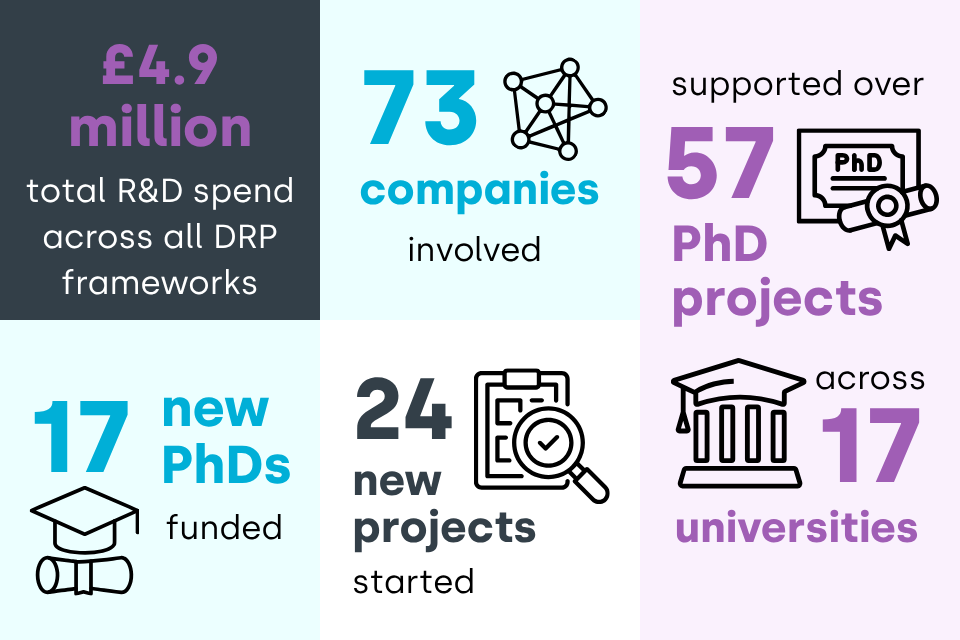
This report outlines several of the projects and key themes funded through the DRP during the financial year 2023 to 2024, for which the total investment was £4.9 million. Some projects are ongoing from earlier contracts, but all have potential for a significant impact across the group.
Further information on the NDA’s R&D programme can be found in our NDA Areas of Research Interest and Research, Development, and Innovation publications.
2023 to 2024 spending breakdown
| Framework Contract | 2023 to 2024 Spend |
|---|---|
| University Interactions | 2.5 million |
| Integrated Waste Management & Site Decommissioning and Remediation | 1.2. million |
| Spent Fuel & Nuclear Materials | 1.2 million |
DRP Spend
A total of £4.9 million was spent during 2023 to 2024 across all DRP frameworks.
New DRP projects started in 2023 to 2024 by NDA R&D driver

Venn diagram showing 24 new DRP projects started in financial year 2023–2024, categorised by NDA R&D Driver: Inform Strategy, Deliver Innovation, and Maintain Key Skills. Eight projects related only to Inform Strategy, two only to Deliver Innovation, and six only to Maintain Key Skills. Two projects related to both Inform Strategy and Deliver Innovation, and six projects related to both Inform Strategy and Maintain Key Skills.
University Interactions
University Interactions Framework Contractors**
| Lead Organisation | Consortia |
|---|---|
| UKNNL | Frazer-Nash Consulting Ltd, Arup, and National Physical Laboratory |
Key Statistics
During the financial year 2023 to 2024 we:
- funded 17 new PhDs
- awarded 6 PhDs
- retained 50% of 23/24 PhD graduates in decommissioning workforce
New PhDs funded in 2023 to 2024
| PhD Title | University | Drivers | Strategic Theme |
|---|---|---|---|
| Waste-cement interactions in future encapsulants to ensure security of supply and capability | University of Sheffield | Maintain Skills | IWM |
| Probing the effects of radiation damage in candidate Pu ceramic wasteforms | University of Sheffield | Maintain Skills | NM |
| Disposal MOX for Immobilisation of the UK’s Plutonium Inventory: A Study of the effect of Manufacturing Route on Its Microstructure and Subsequent Performance under Geological Disposal Conditions | Lancaster University | Maintain Skills | NM |
| Low-carbon cement for waste encapsulation and storage | University of Strathclyde | Maintain Skills | IWM |
| Development of a mechanistic model for He release from PuO2 powders | Lancaster University | Maintain Skills | NM |
| In-situ analysis and discrimination of insoluble beta-emitting activity for contaminated land and effluent characterisation | Lancaster University | Maintain Skills | SDR |
| Atomic scale modelling of the corrosion of sensitised AGR fuel cladding | Imperial College London | Maintain Skills | SF |
| Automated Beta-emitting Radioisotope Identification and Monitoring in Boreholes | Lancaster University | Maintain Skills | SDR |
| In-situ management of nuclear site contaminants: harnessing electrokinetic approaches | University of Southampton | Maintain Skills | SDR |
| Linking historic, contemporary, and future inspection data for improved asset monitoring | University of Liverpool | Maintain Skills | SDR |
| Novel in situ electrochemical approaches applied to the redox behaviour of key radionuclides (U, Tc) under conditions relevant to the NDA estate | University of Manchester | Maintain Skills | SDR |
| Radionuclide fate in on-site disposal of activation product contaminated wastes | University of Manchester | Maintain Skills | SDR/IWM |
| Understanding clays and filler loadings in Portland-limestone calcined clay cement (LC3) encapsulants to establish near and medium-term security of supply and capability | University of Sheffield | Maintain Skills | IWM |
| Building resilience to coastal flooding resulting from climatic changes: the application to decommissioning NDA assets | Liverpool John Moores University | Maintain Skills | SDR/IWM |
| Wireless Powered LoRa Through-Wall Indoor Nuclear (LoRa-TWIN) Monitoring in Decommissioning Environments | Queen Mary University of London | Maintain Skills | SDR |
| Irradiated Sensitised Cladding: Mitigation of Intergranular Stress Corrosion Cracking from Laser Shock Peening | Coventry University | Maintain Skills | SF |
| Combined grouting and mechanochemical treatment for safe asbestos decommissioning and disposal | University of Strathclyde | Maintain Skills | IWM |
Case Study: Supporting Subject Matter Experts of the Future
Challenge: Decommissioning the UK’s civil nuclear legacy is a complex, multi-generational undertaking. It requires a sustained pipeline of skilled professionals, from those delivering safe day-to-day operations on our sites to those planning for impacts over decades, centuries, and even millennia. Ensuring that today’s decisions support the long-term wellbeing of future communities is critical.
Solution: Support researchers to develop as technical specialists and future leaders within NDA group, our supply chain or academia, where they can educate and inspire subsequent generations in the challenges of nuclear decommissioning.
Benefits: Strengthens delivery of NDA mission priorities by developing and sustaining a highly skilled and knowledgeable workforce. Builds long-term capability across the wider nuclear sector and supply chain. Enhances the academic community’s understanding of decommissioning, enabling informed advocacy and engagement with the public.
Status: Ongoing
R&D Driver: Maintain skills
Research Organisations: Various universities
Our Subject Matter Experts across the NDA group and within our supply chain play a key role in all parts of our mission. We need people with a wide range of high-level skills such as modelling the surface chemistry of plutonium, development of improved decommissioning technologies, Life Cycle Assessment (LCA) modelling of nuclear decommissioning, and understanding the socio-economic impact of decommissioning around our sites. Without these skills, we will not be able to do decommissioning faster, safer and more efficiently. Postgraduate research in our national universities is a cornerstone in the development of the decommissioning Subject Matter Expert community.
Researchers we support during their academic work often go on to become specialists and leaders within our programmes. Others move into key roles across our supply chain, directly supporting work on our sites, while some remain in academia to teach and inspire the next generation on decommissioning challenges.
We also involve our own staff in setting research topics and supporting students throughout their projects. This helps our people stay up to date with the latest thinking and ensures knowledge is shared quickly and effectively.
Thomas Bainbridge and Applying PhD Insights to Industry Practice:
Thomas Bainbridge, former NDA-sponsored PhD student, utilised the knowledge and skills gained from his PhD to further his nuclear career at Sellafield Ltd, supporting delivery of the NDA mission. Thomas conducted research from 2019 to 2022 as part of the collaborative research consortium, Transformative Science and Engineering for Nuclear Decommissioning (TRANSCEND). His PhD focused on investigating the vacuum drying of spent fuel from Advanced Gas-cooled Reactors (AGRs).
Thomas is now working in Spent Fuel Services at Sellafield Ltd.
During my PhD, while learning a lot on the technical side about topics such as corrosion and vacuum drying, it is primarily the soft skills that I developed the most. These include the technical writing and communication skills which are used extensively in my job owing to the need to present my work to committees.
I was fortunate to have ample opportunities to present at events such as the Nuclear Waste and Decommissioning Research Forum (NWDRF), TRANSCEND meetings and conferences such as Waste Management Symposia in the USA. These events gave me opportunities to make connections within the industry and improve my presentation and communication skills.
Integrated Waste Management (IWM) & Site Decommissioning and Remediation (SDR)
IMW and SDR Framework Contractors
| Lead Organisation | Consortia |
|---|---|
| DBD | AECOM, Amentum, Westinghouse (WEC), United Kingdom Atomic Energy Authority (UKAEA) and University of Sheffield including Nuclear AMRC (UoS) |
| Eden NE Nuclear and Environment Ltd | Cyclife EDF, Gardiner & Theobald, Golder Associates (UK) Ltd, Hydrock Consultants Ltd, Integrated Decision Management (IDM) and University of Bristol and WSP UK Ltd |
| Galson Sciences Ltd | National Nuclear Laboratory, Frazer-Nash Consulting Ltd, Amphos 21, Lucideon, Mott MacDonald Ltd, Resolve Robotics Ltd, VTT Technical Research Centre of Finland, Orano, Veolia and Universities of Bristol, Lancaster and Sheffield |
| Jacobs | Andra, CL:AIRE, British Geographical Survey, NPL, AFRY, Arup, Brenk Systemplanung, Costain, Thornton Thomasetti, Urenco, Croft, Cogentus, Decision Analysis Services, Longenecker and Associates, MCM, Imperial College London and Universities of Birmingham, Bristol and Manchester |
| NSG Environmental Ltd | Abbott Risk Consulting, KDC, Quintessa Ltd, RPS Consulting Services Ltd, SOCOTEC UK Ltd, The University of Sheffield including Nuclear AMRC (UoS) and Veolia Nuclear Solutions, Lucideon, Mirion Technologies, STERIS and The University of Manchester |
| Nuvia | TÜV UK (TÜV NORD), CIEMAT, Createc, Cognition Land and Water, Lucideon, NucAdvisor and Empresarios Agrupados |
IWM and SDR projects funded* in 2023 to 2024
| Project Name | Lead Organisation | R&D Driver |
|---|---|---|
| NDA Sustainability Research Needs Road mapping - workshop facilitation and roadmap production | Jacobs | Inform Strategy |
| Optimisation of Future Waste Stores in the NDA Estate to Maximise Benefit | Eden NE | Inform Strategy, Deliver Innovation |
| COVID and Economic Impacts on Behaviours related to Safety | Eden NE | Inform Strategy |
| 5-Year Review of Direct Research Portfolio Outputs and Generation of Case Studies | Jacobs | Inform Strategy, Maintaining Key Skills |
| Potential Nuclear Applications for Metal-organic Frameworks | Eden NE | Deliver Innovation |
| Sustainable Management of Soil Community of Practice | CIRIA | Inform Strategy |
| Development of Realtime characterisation of Asbestos utilising non-contact methods | Galson Sciences | Deliver Innovation |
| Reviewing UK Academic Expertise in Wigner Energy | Jacobs | Inform Strategy, Maintaining Key Skills |
| CL:AIRE Membership 2024 | CL:AIRE | Inform Strategy |
| Assets Decarbonisation through reuse of key materials | CIRIA | Inform Strategy |
| Degradation mechanisms of materials used to package Higher Activity Wastes (HAW) | Jacobs | Inform Strategy |
| Stores R&D Knowledge Management: Review of Available R&D Information & R&D Collation Plan | Jacobs | Inform Strategy, Deliver Innovation |
| Good Practice Guidance for the Assessment, Monitoring, and Mitigation of Dust Related Impacts During Brownfield Construction and Decommissioning Activities | Eden NE | Inform Strategy, Deliver Innovation |
| Technical Investigations of the Near-Surface Disposal of Higher Activity Wastes from Sites in Scotland | Eden NE | Inform Strategy |
| Briefing Notes on Emerging Issues in Land Quality Management for the Nuclear Industry | Eden NE | Maintain Key Skills |
| Cementitious Materials for Waste Encapsulation –Mitigation for Evolving Powder Supplies | Galson Sciences | Inform Strategy |
*This list includes both new projects and multi-year projects.
Case Study: Covid and Economic Impacts on Behaviours Related to Safety
Challenge: Align NDA safety initiatives with wider industry to reduce siloed working and ensure best practice, particularly learning after times of uncertainty.
Solution: Support research to better understand behaviours that may be contributing to an observed increase in conventional safety injury rates in some parts of the nuclear sector post-COVID.
Benefits: Identified areas of future research to help guide the NDA’s future safety-related R&D; provided suggestions for site initiatives to help identify and mitigate safety concerns; and highlighted the importance of existing initiatives. Also, promoted opportunities to work with other industries on safety.
R&D Driver: Inform Strategy
Research Organisations: Eden Nuclear and Environment (NE)
Several parts of the NDA estate have seen increases in their conventional safety injury rates, most notably for the Total Recordable Incident Rate (TRIR) and RIDDOR (Reporting of Injuries, Diseases and Dangerous Occurrences Regulations) reportable injuries. These rates have shown increasing trends during the period following the UK COVID lockdowns and other major social and economic events.
To generate an understanding of the potential causes of increased conventional safety injury rates and inform safety initiatives across the NDA group, the NDA funded a research project led by Eden NE. Eden NE studied available research and data pertaining to behavioural indicators that may be relevant to the increase, including changing working practices (home-working) and increased economic pressures on individuals and companies.
Through developing and testing a number of hypotheses, the researchers identified key priorities to guide the NDA’s future R&D work. They also proposed site-level initiatives to better understand the causes of rising injury rates and to support more consistent reporting standards.
The work highlighted several important factors for improving safety, including staff wellbeing, visible management support, psychological safety, and the effective use of safety signage in the workplace. It also identified opportunities to collaborate with other industries to strengthen safety performance.
For example, the NDA now works with Step Change in Safety, an organisation that brings together the energy industry to reduce incidents and injuries through strong leadership, collaboration, and workforce engagement.
Case Study: Guiding the Future of NDA Waste Stores
Challenge: The NDA is committed to a waste informed decommissioning-strategy. This means that we consider the availability of waste routes, now and into the future, including the role of safe interim storage of some unconditioned wastes. Specifically, we need new stores that provide efficient and effective interim storage
Solution: Undertake a research exercise to identify opportunities for improving the delivery of stores and maximising the value they provide for the NDA and for society.
Benefits: Informed future work and strategic development that will potentially realise the opportunities. Provided information to help update NDA Industry Guidance where relevant to incorporate the opportunities into best practice.
R&D Driver: Inform Strategy, Maintain Key Skills, Deliver Innovation
Research Organisations: Eden Nuclear and Environment (NE)
To deliver our mission priorities and adopt a waste-informed approach to decommissioning, we will require new stores to provide interim storage for future radioactive waste. There are currently more than 25 such stores in the UK, over 20 of which are designed to hold waste packaged with a Letter of Compliance for geological disposal. At least six additional stores are being designed or constructed, and further capacity is expected to be needed.
However, developing and operating these stores involves significant costs across their full lifecycle—including planning, design, construction, commissioning, operation and eventual decommissioning. Understanding and managing these costs is essential to ensure that stores are delivered efficiently and provide maximum value to the NDA and wider society.
To support this, the NDA commissioned Eden NE to identify opportunities to improve the design, delivery and value of future stores.
During the study, Eden NE engaged with a range of subject matter experts—including store designers, operators, the Nuclear Waste Services Package Assurance Team, and regulators. They also reviewed emerging technologies, captured learning from international experience, and explored sustainability approaches used both within and outside the nuclear sector.
Based on this evidence, Eden NE identified opportunities to enhance the value of future stores. These findings were tested with stakeholders and shaped into a set of recommended next steps.
We are now taking forward this work by integrating the findings into our approach to future stores. This includes informing further investigation, supporting strategic development (including consideration of value for money), and contributing to the development of NDA industry guidance and best practice.
Spent Fuel (SF) and Nuclear Materials (NM)
SF and NM Framework Contractors
| Lead Organisation | Consortia |
|---|---|
| DBD | AECOM, Amentum, Westinghouse (WEC), United Kingdom Atomic Energy Authority (UKAEA) and University of Sheffield including Nuclear AMRC (UoS) |
| Eden NE Nuclear and Environment Ltd | Integrated Decision Management (IDM), NSG-Environmental Ltd, Nuclear-21, TÜV UK (TÜV NORD) and University of Bristol |
| Jacobs | Andra, Pacific Northwest National Laboratory, British Geographical Survey, NPL, Arup, Brenk Systemplanung, Thornton Thomasetti, Urenco, Studsvik, Croft, StrataG, GRI Ltd, Decision Analysis Services, Longenecker and Associates, Thor Energy, Loughborough Materials, Integrity Corrosion Consulting, Gary Was Consulting, Nigel Donaldson Consulting, Imperial College London and Universities of Birmingham, Bristol, Cambridge, Manchester, Oxford and Sheffield |
| NNL | Frazer-Nash Consultancy Ltd, Galson Sciences Ltd and GRI Ltd |
| Orano | EDF Energy, Cavendish Nuclear, Lucideon, Galson Sciences Ltd, University of Manchester and University of Sheffield |
SF and NM projects funded* in 2023 to 2024
| Project Name | Lead Organisation | R&D Driver |
|---|---|---|
| Inactive Trials of Flash Sintering on Simulated Plutonium Wasteforms | Jacobs | Inform Strategy |
| Post Storage Examination Work following Fuel Receipt | NNL | Inform Strategy, Maintain Skills |
| In-active Trials of the Fabrication & Leach Testing of Simulated Plutonium Wasteforms incorporating Neutron Poisons. | Jacobs | Inform Strategy, Maintain Skills |
| Active electrochemical measurements to support long-term storage of AGR Fuel | NNL | Inform Strategy, Maintain Skills |
| DOE-NDA Filling System Demonstrator Collaboration | NNL | Inform Strategy, Deliver Innovation |
| Developing a Disposal MOX Product and Process – Uranium Active Pellet Trials | Orano | Inform Strategy |
| Investigation of options for replacement of NDA SED scores including the ability to include security considerations | Eden NE | Inform Strategy |
| A review of available technologies to harness unexploited energy from NDA Group radioactive inventories and stores | Orano | Inform Strategy, Maintain Skills, Deliver Innovation |
| Assessment of the Potential of High Temperature Gas Reactors for a Plutonium Disposition Programme | Jacobs | Inform Strategy |
| Evaluation of new surrogate for AGR cladding corrosion studies – Irradiated AGR guide tubes | NNL | Inform Strategy |
| Determining Key Physical Parameters of Zirconolite and Pyrochlore using Experimental and Computational techniques | Jacobs | Inform Strategy, Maintain Skills |
| Initial Exploration of Bespoke AGR Fuel Drying Processes | NNL | Inform Strategy |
| Dose Rates from UK Spent Fuel Stocks | NNL | Inform Strategy |
| The Use of Computer Modelling to Understand and Predict Helium Behaviour in Nuclear Materials | Eden NE | Inform Strategy |
| Literature Review of the Spectral Emissions of Special Nuclear Material | Eden NE | Inform Strategy |
| Inactive trials to explore the impact of the slotted can geometry on the development of a fuel drying capability | Jacobs | Inform Strategy, Maintain Skills |
| Availability of Uranium to Support UK Plutonium Disposition | Eden NE | Inform Strategy |
| Potential Nuclear Applications of Metal Organic Frameworks | Eden NE | Deliver Innovation |
| Review of emerging market technologies for monitoring spent fuel ponds | Jacobs | Inform Strategy, Deliver Innovation |
| Review of current state of the art on spent fuel dry storage systems implementation | Jacobs | Inform Strategy, Maintain Skills |
*This list includes both new projects and multi-year projects.
Case Study: Dose Rates from UK Spent Fuel Stocks
Challenge: Underpin our strategic approach and planning for the long-term interim storage of NDA spent nuclear fuel.
Solution: Model the NDA inventory of spent fuel and predict dose rates during interim storage. Dose reduction curves over time were developed for a range of fuel types within the NDA inventory, capturing variations in fuel type, burnup, and enrichment. This approach ensured the modelling was representative of the majority of intact fuel currently held by the NDA, while also accounting for potential future fuel arisings.
Benefits: The dataset developed through this project provides a comprehensive and representative sample of both current and potential future intact spent fuel across the NDA estate. It enables estimation of expected dose rates for a wide range of fuel types, supporting the development and delivery of the NDA’s spent fuel strategy. The dataset also establishes a consistent reference point for assessing the self-protection characteristics of spent fuel over extended timescales, including projections up to 250 years.
R&D Driver:Inform Strategy
Research Organisation: National Nuclear Laboratories (NNL)
Through decades of nuclear power development and operation in the UK, a significant inventory of spent reactor fuel has accumulated, largely within the NDA estate. This includes fuel from power generation (Pressurised Water Reactors (PWR), AGR and Magnox), as well as experimental fuels and material from research reactors such as the Prototype Fast Reactor at Dounreay.
To better understand this inventory, the NDA commissioned the National Nuclear Laboratory (NNL) to review UK fuel stocks and define the range of fuel types held. This work considered variations in fuel design, burnup, enrichment, and the origin of uranium and plutonium fissile material. From this, 100 representative combinations of fuel type, burnup, and enrichment were defined, providing a dataset that captures the majority of intact fuel currently held by the NDA and potential future arisings. This dataset underpins the estimation of dose rates across the NDA estate.
The modelling approach comprised three stages. First, neutron transport simulations were used to generate burnup-dependent cross-section libraries for the fuel types, where these were not already available. Second, these data were used within fuel depletion models to simulate irradiation and generate detailed nuclide inventories for each fuel type over a cooling period of up to 250 years. Finally, the resulting nuclide inventories were used as inputs to Monte Carlo radiation transport simulations to calculate unshielded dose rates at 1 metre. This enabled dose rate curves to be generated for each fuel configuration over the full cooling period.
The results show that dose rates are initially dominated by short-lived isotopes, but this effect decreases significantly after approximately 10 years of cooling. Beyond this point, Caesium-137 becomes the primary contributor to dose rate, remaining dominant throughout the 250-year period. Burnup was identified as the key variable influencing dose rate, while enrichment and the origin of fissile material were found to have a comparatively minor impact.
Overall, the dataset provides a robust and representative basis for assessing dose rates across the NDA’s spent fuel inventory. It supports future security assessments and establishes a consistent reference point for evaluating the self-protection characteristics of spent fuel over long timescales, extending to 250 years.
Case Study: Technologies for Harnessing Unexploited Energy from Radioactive Inventories and Stores
Challenge: Developing our understanding of whether the decay heat generated by spent fuel and nuclear materials stored at Sellafield could be feasibly harnessed as a usable energy source.
Solution: A technology‑scoping study, conducted by ORANO, using the GOLDFIRE AI tool to identify and assess suitable heat‑recovery technologies, including the Organic Rankine Cycle, heat pipe exchange systems, and heat pumps.
Benefits: Enabled evaluation and further exploration into viable, mature heat‑pump‑based approach to repurposing decay heat for space heating at Sellafield, offering potential economic savings and reduced carbon emissions in support of our long‑term sustainability goals.
R&D Drivers: Inform Strategy, Maintain Skills, Deliver Innovation
Research Organisations: Orano
The UK’s accumulated inventory of spent fuel and nuclear materials is primarily stored at Sellafield, either in dry storage cells or in spent fuel ponds. This material generates heat through radioactive decay. The NDA sought to assess whether this heat could be recovered and used as a viable energy source.
To support this, the NDA commissioned Orano to carry out a study using an AI-powered knowledge discovery platform to review both internal and external research and identify potential technologies. A range of options was identified and assessed for suitability. The three most promising were the Organic Rankine Cycle (TRL 5), heat pipe exchange (TRL 6), and heat pump systems (TRL 7).
The relatively mature technology readiness level of heat pump systems suggests that decay heat from spent fuel ponds could be utilised at Sellafield. The study found that, for the Sellafield application, the Thorp Receipt and Storage Pond would be the most suitable option for energy recovery, with potential annual savings of approximately £30k and 290 tonnes of CO₂ if heat recovery were installed. However, given the high cost of retrofitting the storage pond facility, and the potential dose implications of doing so while it was loaded, the benefits were not sufficient to justify retrofitting the pond.
Overall, the study identified a potential opportunity for energy recovery from spent fuel ponds but concluded that further investment is not justified at this time. However, future technical developments in this field may warrant a review of this decision.
Case Study: Potential Nuclear Applications for Metal-Organic Frameworks
Challenge: Identify the potential impact of emerging technologies on delivery of the NDA’s mission.
Solution: Early research into the potential use of Metal-Organic Frameworks (MOFs) and Covalent Organic Frameworks (COFs) to support the NDA mission.
Benefits: This work increased awareness across the NDA group of MOFs and COFs, and their potential applications, particularly within the nuclear environment. It also established a foundation for future research, including opportunities within the NDA’s University Interactions R&D portfolio, international collaborations, and further evaluation of these materials as part of wider R&D and innovation activities.
R&D Driver(s): Deliver Innovation
Research Organisations: Eden Nuclear and Environment (Eden NE)
Metal–organic frameworks (MOFs) are an emerging class of materials that have attracted significant interest due to their potential industrial applications. They consist of metal ions linked by organic molecules to form highly porous structures. This architecture enables MOFs to act as “hosts” that can absorb external (“guest”) ions and molecules, making them promising candidates for applications such as carbon capture, hydrogen storage, water purification, and catalysis. Covalent organic frameworks (COFs) are a closely related class of materials with similar potential.
Through the Direct Research Portfolio (DRP), the NDA supported early-stage research to explore how MOFs and COFs could contribute to its mission. In particular, these materials may be applicable to the adsorption and separation of radioactive metal ions and gases. Such processes are central to waste treatment, filtration, and effluent management activities carried out across the NDA estate.
Eden NE produced a comprehensive literature review of MOFs and COFs. This review highlighted existing research, including work undertaken by the NDA and UK universities, and identified key challenges associated with material fabrication and large-scale production. It also emphasised the need for computational approaches to support material screening and performance prediction.
The study identified a series of illustrative use cases relevant to NDA priorities, spanning both spent fuel and nuclear materials, and integrated waste management and site decommissioning. These examples were assessed to be at approximately Technology Readiness Level (TRL) 3, indicating that further research and development would be required before deployment in operational settings.
Overall, MOFs and COFs offer significant potential for nuclear applications. Their ability to be designed and synthesised for selective targeting and sequestration of radionuclides in both liquid and gaseous media could enable more effective separation or immobilisation of difficult-to-isolate isotopes. Further work in this area will help shape the NDA’s University Interactions R&D portfolio, support international collaboration, and inform future innovation activities.