National Security and Investment Act 2021 Annual Report 2025-26 (HTML)
Published 14 July 2026

© Crown copyright 2026
This publication is licensed under the terms of the Open Government Licence v3.0 except where otherwise stated. To view this licence, visit nationalarchives.gov.uk/doc/open-government-licence/version/3 or write to the Information Policy Team, The National Archives, Kew, London TW9 4DU, or email: psi@nationalarchives.gov.uk.
Where we have identified any third party copyright information you will need to obtain permission from the copyright holders concerned.
This publication is available at https://www.gov.uk/government/publications/national-security-and-investment-act-2021-annual-report-2025-26/national-security-and-investment-act-2021-annual-report-2025-26-html
Foreword by the Chancellor of the Duchy of Lancaster
Inward investment is essential for driving growth in our economy. The vast majority of inward investment poses no threat to our national security, however, there is a minority which does. Keeping the British people safe is the first duty of government. So, in the minority of cases where there is a risk, the UK’s national security must come first.
The National Security and Investment Act is designed to do just that – support global investment into the UK while safeguarding the most sensitive areas of the economy in a secure, predictable and proportionate way. It provides the government with the oversight and powers to intervene where acquisitions could undermine our national security.
Many of the sectors that are subject to mandatory notification are both important domains of strategic competition and high-growth areas of the economy. That is why the Act is so important.
This report sets out how it was applied in the last financial year. There was a 15% increase in notifications under the Act compared to 2024/25, and 46% more compared to 2023/24. This led to a small increase in the time taken to accept notifications, and the Government is taking steps to reduce this.
The Government took all decisions on whether to call-in or clear notified acquisitions within the review period’s statutory 30 working days. Most businesses in the UK had no interaction with this screening process, nor had any need to. Of the 1,220 notifications reviewed, 95.6% were notified that no further action would be taken and 4.4% were called in. Of the nine final orders made, eight allowed the acquisitions to proceed under certain conditions and only one blocked the acquisition from proceeding.
The Government is adapting NSI legislation to make sure it remains as relevant as possible in our fast-changing world and increasingly interconnected economy. Forthcoming legislation will exempt certain acquisitions from mandatory notification, update the scope of the notifiable sectors and improve the forms that businesses use to notify acquisitions, providing businesses with the clarity and reassurance they need to thrive in the UK while keeping our country safe.
Executive Summary
1. This report is a statutory requirement, laid before Parliament under Section 61 of the National Security and Investment Act 2021 (“the NSI Act”). It covers the year from 1 April 2025 to 31 March 2026 (“the reporting period”), containing all the information that is required by the NSI Act and additional information to aid understanding and transparency.
2. The Government is committed to ensuring the NSI Act protects our national security, and does so as effectively, efficiently, and transparently as possible - giving investors the certainty they need to support growth across the UK.
Overview of this report’s content
3. In this report, the term ‘the Government’ refers to the decision-maker. The Investment Security Unit (ISU) administers the operation of the NSI Act.
4. This is the fifth annual report on the operation of the NSI Act and the fourth to cover an entire financial year. The report includes year-on-year comparisons with the previous reporting period and an accompanying spreadsheet containing all data published since the commencement of the NSI Act. Comparisons are made throughout the report using data included in this report and data published in the previous reporting period. Some figures from the previous reporting period have been revised for improved accuracy. The revised figures can be found in the accompanying spreadsheet.
5. The NSI Act requires each annual report to contain specific details on the operation of the NSI Act. This report contains information and comparisons that go beyond the statutory minimum.
6. Annex D contains a diagram which illustrates the progress of acquisitions reviewed throughout the reporting period. This includes transactions where the review began in the previous reporting period, and transactions where the review will continue into the next reporting period.
Notifications Received
7. In the reporting period the ISU received 1,324 notifications[footnote 1], an increase from 1,143 notifications received in the previous reporting period. Of the 1,324 notifications received, 1,135 were mandatory notifications, 147 were voluntary notifications, and 42 were retrospective validation applications[footnote 2].
8. The Government accepted 1,242 notifications (an increase from 1,110 in the previous reporting period) and rejected 37 notifications during the reporting period (the same number as the previous reporting period). The 1,242 accepted notifications comprised 1,075 mandatory notifications, 124 voluntary notifications, and 43 retrospective validation applications.
Call-in notices, withdrawals, final notifications, and final orders
9. During the reporting period, the Government reviewed 1,220 notified acquisitions, an increase from 1,079 notified acquisitions reviewed in the previous reporting period. Of the 1,220 notified acquisitions reviewed, 4.4% (54) were issued with a call-in notice[footnote 3] and 95.6% (1,166) were notified that no further action would be taken. This is consistent with the previous reporting period, during which 4.5% of notified acquisitions were issued with a call-in notice and 95.5% were notified that no further action would be taken.
10. In addition to the 54 notified acquisitions called in during the reporting period, six non-notified acquisitions[footnote 4] were issued with a call-in notice. Therefore, the Government issued a total of 60 call-in notices in the reporting period, an increase from 56 in the previous reporting period.
11. Of the 60 call-in notices issued during the reporting period, 42 related to a mandatory notification, 11 related to a voluntary notification, one related to a retrospective notification, and six were in relation to non-notified acquisitions.
12. The Government issued 44 final notifications[footnote 5] (which includes four withdrawn notifications) and issued nine final orders[footnote 6],[footnote 7], varied[footnote 8] three final orders and revoked[footnote 9] two final orders during the reporting period. For comparison, the Government issued 35 final notifications and 17 final orders, varied three final orders and revoked three final orders during the previous reporting period.
13. Of the 44 final notifications, 28 were following a mandatory notification, 13 were following a voluntary notification, and three were related to non-notified acquisitions. No final notifications were issued in connection with a retrospective validation application.
14. There were four instances where parties withdrew from a called-in acquisition, a decrease from five in the previous reporting period. Of the four withdrawals, two were following a mandatory notification, and two were following a voluntary notification.
15. Of the nine final orders made, three were following a mandatory notification, one was following a voluntary notification, two were following a retrospective validation application and three involved a non-notified acquisition.
Notifications and acquisitions, by area of the economy
Note 1: Acquisitions can be associated with more than one area of the economy. Therefore the number of notifications, call-in notices, final notifications, withdrawals, and final orders made, broken down by area of the economy may add up to more than the total number of notifications, call-in notices, final notifications, withdrawals, and final orders.
16. In the reporting period, the largest proportion of notifications either accepted or rejected was associated with the Defence area of the economy (58%), followed by Military and Dual-Use (23%) and Critical Suppliers to Government (20%). For comparison, the largest proportion of notifications either accepted or rejected in the previous reporting period was associated with the Defence area of the economy (56%).
17. Of the 60 acquisitions called in, the largest proportion was associated with the Defence area of the economy (47%), followed by Critical Suppliers to Government (33%) and Military and Dual-Use (33%). For comparison, the largest proportion of acquisitions called in during the previous reporting period was associated with the Defence area of the economy (36%).
18. Of the 44 final notifications issued during the reporting period, the largest proportion was associated with acquisitions in the Defence area of the economy (50%), followed by Critical Suppliers to Government (30%) and Military and Dual-Use (27%) and Data Infrastructure (27%). For comparison, the largest proportion of final notifications issued in the previous reporting period was associated with acquisitions in the Defence area of the economy (37%).
19. Of the four occasions on which parties withdrew from a called-in acquisition, the Academic Research & Development in Higher Education, Advanced Materials, and Defence areas of the economy were associated with two withdrawals each.
20. Of the nine final orders made during the reporting period, the largest number was associated with acquisitions in the Advanced Materials area of the economy (five final orders), followed by Data Infrastructure (three final orders) and Military and Dual-Use (two final orders). For comparison, the largest number of final orders made in the previous reporting period was associated with acquisitions in the Defence area of the economy (nine final orders).
Notifications and acquisitions, by origin of investment
Note 2: Acquisitions can be associated with more than one origin of investment as an acquisition can involve multiple acquirers, and acquirers can be associated with multiple origin of investments. Therefore the number of notifications, call-in notices, final notifications, withdrawals, and final orders made, broken down by origin of investment, may add up to more than the total number of notifications, call-in notices, final notifications, withdrawals, and final orders.
21. In the reporting period, the largest proportion of accepted notifications involved acquirers associated with the United Kingdom (72%), followed by acquirers associated with the United States of America (28%), acquirers associated with France (6%) and acquirers associated with Luxembourg (6%). For comparison, the largest proportion of accepted notifications in the previous reporting period involved acquirers associated with the United Kingdom (65%).
22. Of the 60 acquisitions called in, the largest proportion involved acquirers associated with the United Kingdom (52%), followed by acquirers associated with China (30%) and acquirers associated with the United States of America (23%). For comparison, the largest proportion of called-in acquisitions in the previous reporting period involved acquirers associated with the United Kingdom (48%).
23. Of the 44 final notifications issued, the largest proportion involved acquirers associated with the United Kingdom (57%), followed by acquirers associated with China (32%) and acquirers associated with the United States of America (25%). For comparison, the largest proportion of final notifications issued in the previous reporting period involved acquirers associated with the United Kingdom (34%).
24. Of the four acquisitions withdrawn after call-in, acquirers associated with the United Kingdom were associated with two withdrawals, and acquirers associated with China, Turkey, United Arab Emirates, and the United States of America were associated with one withdrawal each.
25. Of the nine final orders made, the largest number involved acquirers associated with the United Kingdom (five final orders), followed by acquirers associated with China (three final orders) and acquirers associated with Germany and the United States of America (two final orders each). For comparison, the largest number of final orders in the previous reporting period involved acquirers associated with the United Kingdom (11 final orders) and China (seven final orders).
Notifications and acquisitions, by the time taken
Note 3: The counting of statutory working days in the assessment period[footnote 10] is paused if transaction parties are asked to respond to an information notice[footnote 11] or an attendance notice[footnote 12]. The use of an information notice does not affect the number of working days during the review period[footnote 13]. All counts of case timings exclude days which are bank holidays in any part of the United Kingdom.
All average timings presented in the executive summary use median values, as this is less affected by outliers (large or small numbers) than the mean values.
26. In the reporting period, it took on average 11 working days from receipt of a mandatory notification to acceptance, 13 days for voluntary notifications, and 10 days for retrospective validations. In comparison, the previous reporting period saw an average of 7 working days from receipt of a mandatory notification to acceptance, 8 days for voluntary notifications, and 6 days for retrospective validations.
27. In the reporting period, it took on average 15 working days from receipt of a mandatory notification to giving written reasons for a decision to reject that notification, 14 days for voluntary notifications. In comparison, the previous reporting period saw an average of 22 working days from receipt of a mandatory notification to rejection, and 16 days for voluntary notifications.
28. The Government took all decisions on whether to call-in or clear notified acquisitions within the review period’s statutory 30 working days. For notifications that were called in, it took on average 29 statutory working days to issue a call-in notice once a mandatory notification was accepted and 30 once a voluntary notification was accepted. For comparison, it took on average 29 statutory working days to issue a call-in notice after accepting a mandatory or a voluntary notification in the previous reporting period.
29. The additional period was used 18 times, a decrease from 21 times in the previous reporting period. Of the 18 times the additional period was used, 10 were related to mandatory notifications, two were related to voluntary notifications, two were related to retrospective validations applications, and four were related to non-notified acquisitions.
30. Use of the voluntary period was agreed three times, an increase from two times in the previous reporting period. Of the three times the voluntary period was agreed, one was related to a mandatory notification, one was related to a voluntary notification and one to a non-notified acquisition.
31. Of the 44 final notifications issued, five used the additional period and one used the voluntary period. Of the nine final orders made this reporting period, seven used the additional period and the voluntary period was agreed for one.
32. On average, it took 24 statutory working days or 47 calendar working days to issue a final notification from the point an acquisition was called in during the assessment period. In the previous reporting period, the average number of statutory working days between calling in an acquisition and issuing a final notification was 24 statutory days or 40 calendar working days.
33. On average, it took 69 statutory working days or 97 calendar working days to make a final order from the point an acquisition was called in. For comparison, it took an average of 70 statutory working days or 100 calendar working days to make a final order from the point an acquisition was called in during the previous reporting period. Due to the small number of final orders, no conclusions should be drawn regarding trends in the time taken between calling in an acquisition and making a final order.
Enforcement and assistance
34. No financial assistance was given during the reporting period. No penalties were issued, nor any criminal prosecutions concluded. Where offences were identified but the decision was made not to impose a penalty, parties were required to provide reassurance to the Government that steps had been taken to prevent any recurrence. During the reporting period, the Government identified 42 potential offences of completing a notifiable acquisition without approval for which parties were required to provide reassurance that steps had been taken to prevent any recurrence.
Further information
35. The Government has published extensive guidance on gov.uk which provides further details on the operation of the NSI Act, including the process for submitting notifications.
SECTION ONE: Notifications
1. This section contains information about the notifications that the Government received during the reporting period. Notifications by area of the economy can be found on page 20, and notifications by origin of investment are on page 24.
2. Notifications are the means by which parties give notice to the Government about acquisitions that meet the legal tests set out in the NSI Act. The vast majority of activity in the UK economy in any given year will not need to be notified to the Government.
3. Parties to acquisitions can make three types of notification under the NSI Act:
a. Mandatory notifications are those received in relation to ‘notifiable acquisitions’, which are certain acquisitions of entities carrying out certain activities in the 17 sensitive areas of the UK economy specified in the Notifiable Acquisition (Specification of Qualifying Entities) Regulations 2021.
b. Voluntary notifications are those received in relation to acquisitions of entities which are not covered by mandatory notification requirements, and of assets. Parties may submit notifications voluntarily to achieve business certainty.
c. Retrospective validation applications are applications for notifiable acquisitions to be recognised retrospectively as being valid in law after they have been completed without approval.
4. In this report, “notifications” refers collectively to mandatory notifications, voluntary notifications, and retrospective validation applications.
Notifications received
5. Once a notification is received, the Government must either accept the notification (meaning it can be reviewed) or reject the notification. Reasons for rejecting a notification are outlined in Figure 5 on page 14.
Table 1
| ID | Information | Number |
|---|---|---|
| A | The total number of notifications received | 1,324 |
| B | The number of mandatory notifications received | 1,135 |
| C | The number of voluntary notifications received | 147 |
| D | The number of retrospective validation applications received | 42 |
Figure 1 - Notifications received by notification type and month (FY 2025/26)
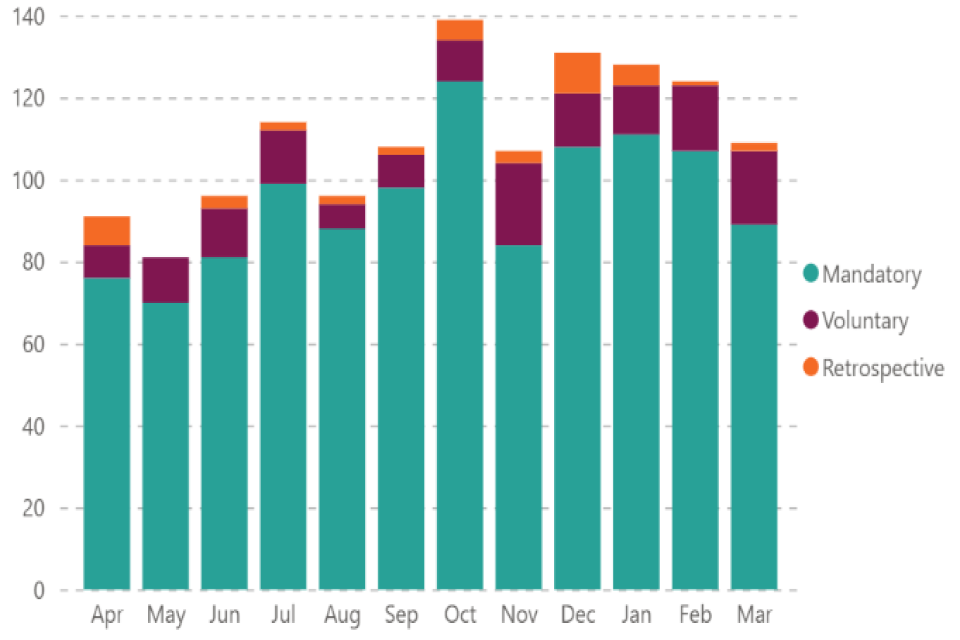
6. Figure 1 presents the total number of notifications received, broken down by notification type in each month of the reporting period, which totalled 1,324 over the reporting period. This is an increase from 1,143 notifications received in the previous reporting period. The most notifications (139) were received in October 2025, and the fewest (81) were received in May 2025. More than seven times as many mandatory notifications were received as voluntary notifications.
Notifications accepted or rejected
7. This section includes notifications accepted or rejected in the reporting period. Notifications received towards the end of a reporting period may be accepted or rejected after the reporting period closes. Additionally, notifications accepted or rejected in a reporting period might have been received in a previous reporting period. As a result, there may be discrepancies between the total number of notifications received and the total number of notifications accepted and rejected within the reporting period.
Table 2
| ID | Information | Number |
|---|---|---|
| E | The total number of notifications accepted or rejected | 1,279 |
| F | The total number of notifications accepted | 1,242 |
| G | The total number of notifications rejected | 37 |
| H | The number of mandatory notifications accepted | 1,075 |
| I | The number of mandatory notifications rejected | 21 |
| J | The number of voluntary notifications accepted | 124 |
| K | The number of voluntary notifications rejected | 15 |
| L | The number of retrospective validation applications accepted | 43 |
| M | The number of retrospective validation applications rejected | 1 |
| N | The number of notifications pending acceptance or rejection at the end of the reporting period | 78 |
Figure 2 - Notifications accepted and rejected by month (FY 2025/26)
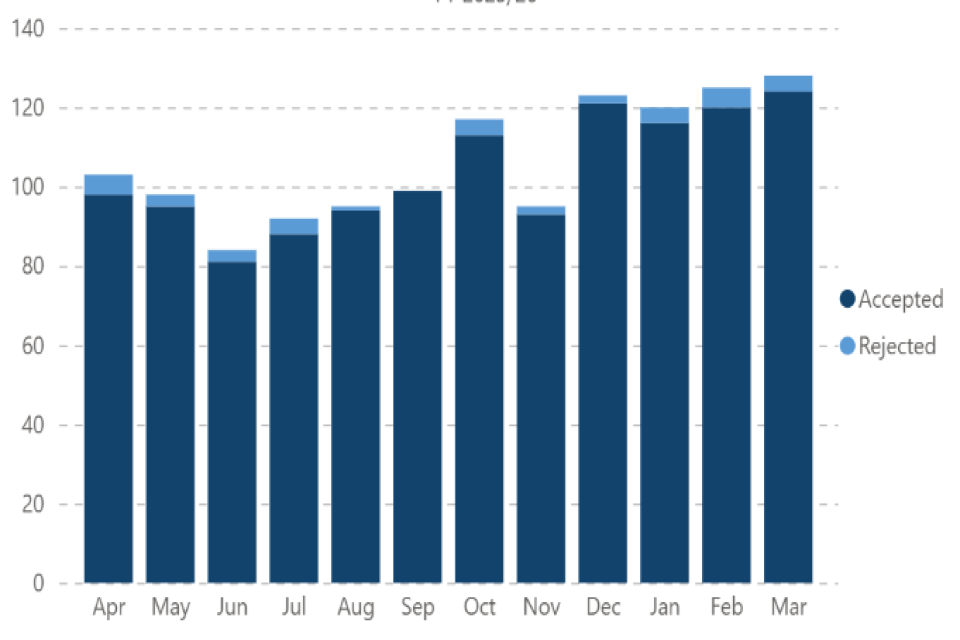
8. Figure 2 presents the number of notifications that were accepted or rejected during each month of the reporting period. The large majority of notifications received were accepted (97%), with only a small minority being rejected (3%). Figure 5 provides a detailed breakdown of the reasons why the Government has rejected notifications.
9. The total number of accepted notifications has increased from 1,110 in the previous reporting period to 1,242. The total number of notifications rejected has remained unchanged at 37.
Figure 3 - Notifications accepted, by notification type and month (FY 2025/26)
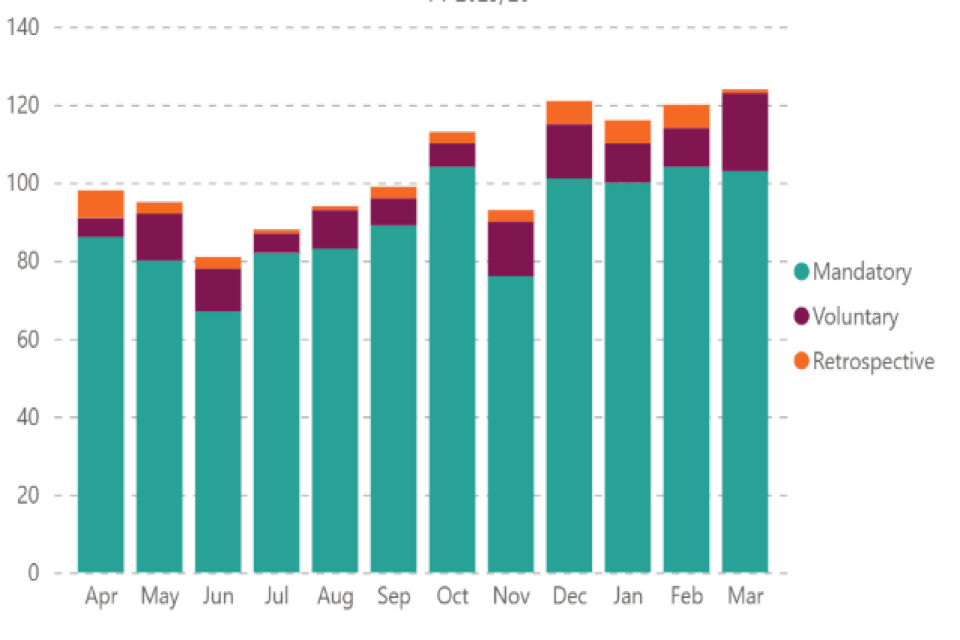
10. Figure 3 presents the number of notifications accepted broken down by notification type in each month of the reporting period. The chart illustrates that June 2025 had the lowest number of notifications accepted (81), while March 2026 had the largest number of accepted notifications (124).
Figure 4 - Notifications rejected, by notification type and month (FY 2025/26)
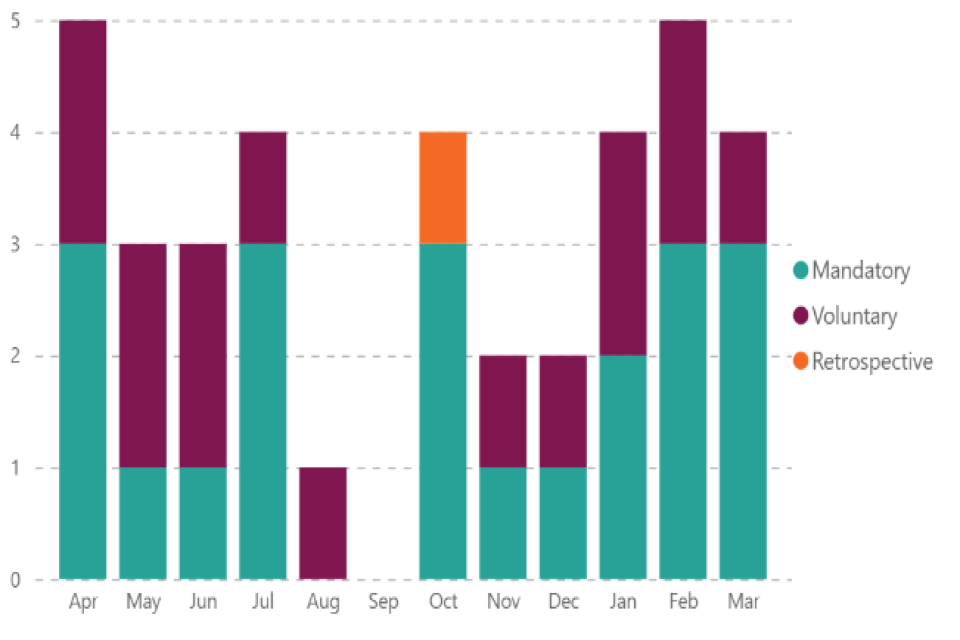
11. Figure 4 presents the number of rejected notifications broken down by notification type, in each month of the reporting period. The largest proportion of rejected notifications were mandatory with 21 (57%), followed by 15 voluntary notifications (40%), and a retrospective validation application (3%).
Figure 5 - Notifications rejected, by the reason why they were rejected (FY 2025/26)
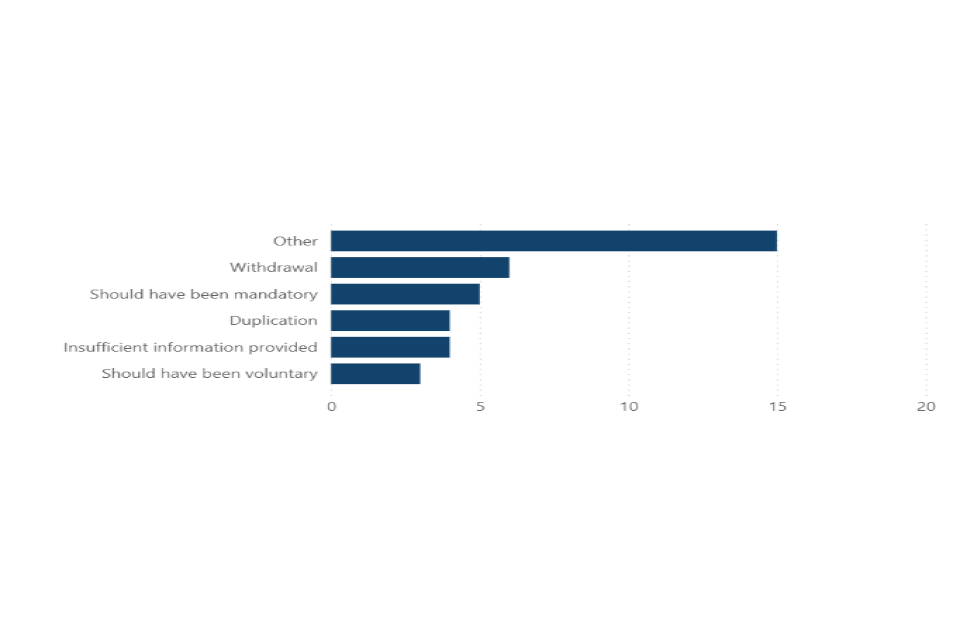
12. Figure 5 presents a breakdown of the reasons why the Government has rejected a notification. The most common reason for rejecting a notification was that the acquisition was withdrawn (six notifications rejected out of 37 in total). When the Government rejects a notification, officials contact parties to explain why the notification was rejected.
SECTION TWO: Call-in notices
1. This section contains information about notified and non-notified acquisitions that have been reviewed during the reporting period. This is different to the number of notifications that have been received and accepted or rejected because not all acquisitions called in were notified, and because the Government may have received or accepted a notification in a previous reporting period but reviewed the notification in the reporting period.
2. The Government can only call in an acquisition for further scrutiny if it reasonably suspects a qualifying acquisition may give rise to a risk to national security. Call-in notices may be issued concerning any qualifying acquisition, whether or not it has been notified.
3. The number of call-in notices issued by area of the economy can be found on page 21, and the number of call-in notices issued by origin of investment can be found on page 25.
Notifications reviewed & call-in notices issued
Table 3
| ID | Information | Number |
|---|---|---|
| A | The total number of notified acquisitions reviewed | 1,220 |
| B | The number of acquisitions reviewed following a mandatory notification | 1,054 |
| C | The number of acquisitions reviewed following a voluntary notification | 115 |
| D | The number of acquisitions reviewed following a retrospective validation application | 51 |
| E | The total number of call-in notices issued | 60 |
| F | The number of call-in notices issued following a mandatory notification | 42 |
| G | The number of call-in notices issued following a voluntary notification | 11 |
| H | The number of call-in notices issued following a retrospective validation application | 1 |
| I | The number of call-in notices issued for non-notified acquisitions | 6 |
4. Table 3 shows that the total number of notified acquisitions reviewed was 1,220. This is an increase from 1,079 acquisitions reviewed in the previous reporting period.
5. Of the 1,220 notified acquisitions reviewed, 95.6% (1,166) were cleared to proceed within the review period. This is broadly consistent with the previous reporting period (95.5%).
6. Of the 1,220 notified acquisitions reviewed, 4.4% (54) were issued a call-in notice. This is broadly consistent with the 4.5% (49) notified acquisitions issued with a call-in notice during the previous reporting period.
7. Six non-notified acquisitions reviewed by the Government in the reporting period were issued with a call-in notice, giving a total of 60 call-in notices. This is an increase from the 56 call-in notices issued during the previous reporting period.
Figure 6 - Call-in notices, by notification type and month (FY 2026/26)
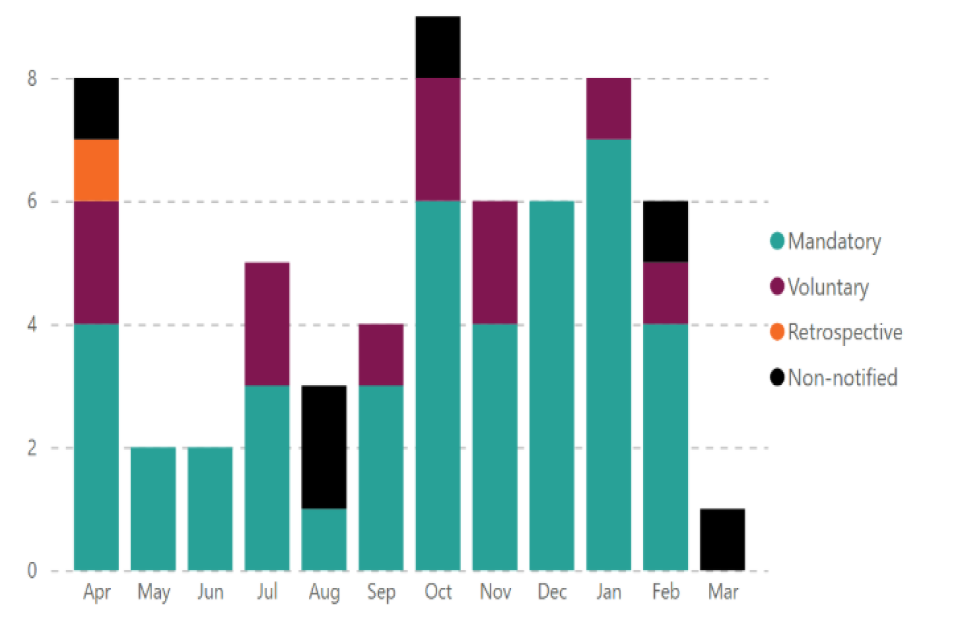
8. Figure 6 presents the number of call-in notices broken down by notification type in each month of the reporting period. The chart illustrates that the largest proportion of call-in notices issued was following a mandatory notification (70%). This is followed by voluntary notifications (18%), non-notified acquisitions (10%), and retrospective validations (2%).
SECTION THREE: Final notifications
1. This section contains information about the final notifications the Government issued during the reporting period. The number of final notifications issued by area of the economy can be found on page 22, and the number of final notifications issued by origin of investment can be found on page 26.
2. Following a call-in and subsequent assessment period, the Government may clear an acquisition with no further action by issuing a final notification. In these circumstances, the Government cannot take any further action unless it was given materially false or misleading information.
3. The number of call-in notices issued in the reporting period is different to the total number of final notifications and final orders notices issued in the reporting period. This is because some of the acquisitions called in during this period will not receive a final decision until the next reporting period and because some final orders and final notifications issued in the reporting period relate to acquisitions called in during the previous reporting period.
Final notifications issued
Table 4
| ID | Information | Number |
|---|---|---|
| A | The total number of final notifications issued | 44 |
| B | The number of final notifications issued following a mandatory notification | 28 |
| C | The number of final notifications issued following a voluntary notification | 13 |
| D | The number of final notifications issued following a retrospective validation application | 0 |
| E | The number of final notifications issued for non-notified acquisitions | 3 |
4. In the reporting period, the Government assessed 53 called-in acquisitions to make a decision whether to give a final notification (44) or make a final order (nine). This is an increase from 52 in the previous reporting period. Of the 53 called-in acquisitions on which the Government made a decision, 83% (44) were cleared, resulting in a final notification.
Withdrawals from a called-in acquisition
5. Parties may withdraw from acquisitions at any time. Where parties withdraw from an acquisition that has been called in, the Government issues a final notification to end the assessment period.
6. The total number of final notifications issued (presented above) includes the total number of withdrawals from a called-in acquisition.
Table 5
| ID | Information | Number |
|---|---|---|
| F | The total number of withdrawals from a called-in acquisition | 4 |
| G | The number of withdrawals from a called-in acquisition following a mandatory notification | 2 |
| H | The number of withdrawals from a called-in acquisition following a voluntary notification | 2 |
| I | The number of withdrawals from a called-in acquisition following a retrospective validation application | 0 |
| J | The number of withdrawals from a called-in acquisition for non-notified acquisitions | 0 |
7. The total number of withdrawals post call-in has decreased to four, compared to five in the previous reporting period.
SECTION FOUR: Final orders
1. This section contains information about the final orders the Government issued during the reporting period. The number of final orders made by area of the economy can be found on page 23, and the number of final orders made by origin of investment can be found on page 27.
2. The Government may make a final order to mitigate risks to national security arising from an acquisition. This may include imposing certain conditions, preventing an acquisition from taking place or requiring an acquirer to unwind the acquisition.
3. Some final orders made in the reporting period may relate to acquisitions that were called in during the previous reporting period, and some acquisitions called in during the reporting period had not reached a conclusion by the end of the reporting period.
Final orders made
Table 6
| ID | Information | Number |
|---|---|---|
| A | The total number of final orders made | 9 |
| B | The number of final orders made following a mandatory notification | 3 |
| C | The number of final orders made following a voluntary notification | 1 |
| D | The number of final orders made following a retrospective validation application | 2 |
| E | The number of final orders made for non-notified acquisitions | 3 |
| F | The number of acquisitions blocked or subject to an order to unwind the acquisition | 1 |
4. In the reporting period, the Government assessed 53 called-in acquisitions to make a decision whether to issue a final notification or make a final order. Of these, nine[footnote 14] (17%) resulted in a final order. This is a decrease from 17 final orders made in the previous reporting period. One acquisition was blocked.
Table 7
| ID | Information | Number |
|---|---|---|
| G | The number of final orders varied | 3 |
| H | The number of final orders revoked | 2 |
5. The Government must keep each final order under review and may vary or revoke them. A person required to comply with a final order may request that the Government vary or revoke an order but the Government is not required to consider such a request if there has been no material change in circumstances since the final order was issued or last varied or the last request for variation was received. During the reporting period, three final orders were varied and two were revoked.
6. Further information on final orders is published on gov.uk.
SECTION FIVE: Areas of the economy
1. This section breaks down the number of accepted or rejected notifications, call-in notices, final notifications issued, withdrawals from a called-in acquisition and final orders made by area of the economy.
2. Acquisitions can be associated with more than one area of the economy. The percentages in the charts in this section therefore add up to more than 100%. Notifications may also appear more than once, as a notification can be rejected and then resubmitted and accepted. The charts which display information on acquisitions that were called in include notified acquisitions and non-notified acquisitions
Notifications accepted or rejected, by area of the economy
3. Notifications are associated with areas of the economy when they are accepted or rejected, based on information provided by parties in their notifications. Figure 7 therefore only includes data on the notifications that were accepted or rejected within the reporting period[footnote 15], not all notifications that were received in the reporting period.
Figure 7 - Notifications accepted and rejected, by notification type and area of the economy
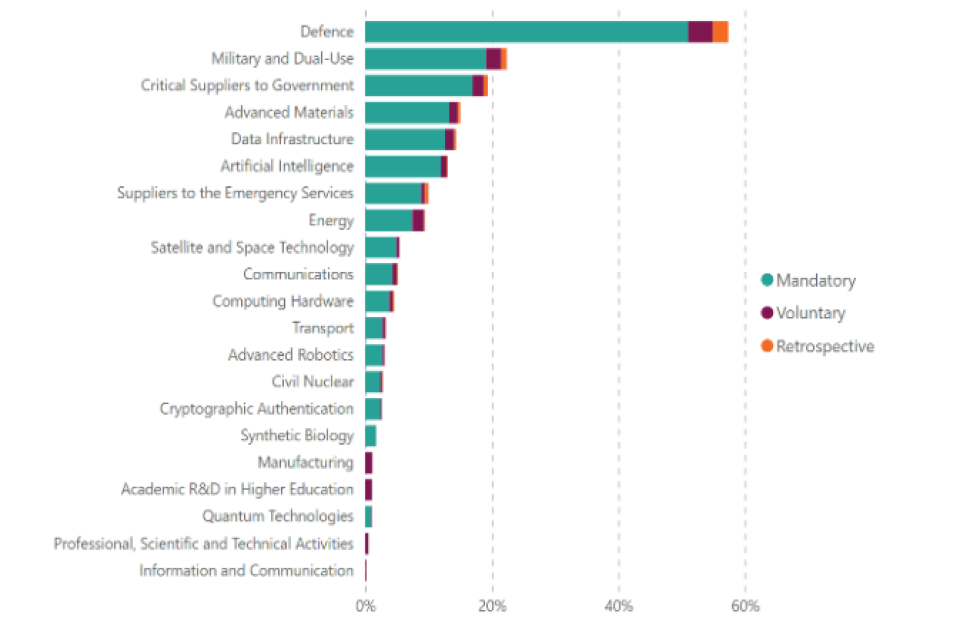
4. Figure 7 presents notifications accepted or rejected during the reporting period, broken down by area of the economy. The chart shows that the largest proportion was associated with the Defence area of the economy (58%), followed by Military and Dual-Use (23%) and Critical Suppliers to Government (20%).
5. For comparison, the largest proportion of notifications either accepted or rejected in the previous reporting period was associated with the Defence area of the economy (56%).
6. Accepted and rejected notifications were associated with 32 areas of the economy, including all 17 areas of the economy subject to a mandatory notification.
Call-in notices issued, by area of the economy
Figure 8 - Call-in notices issues, by area of the economy (FY 2025/26)
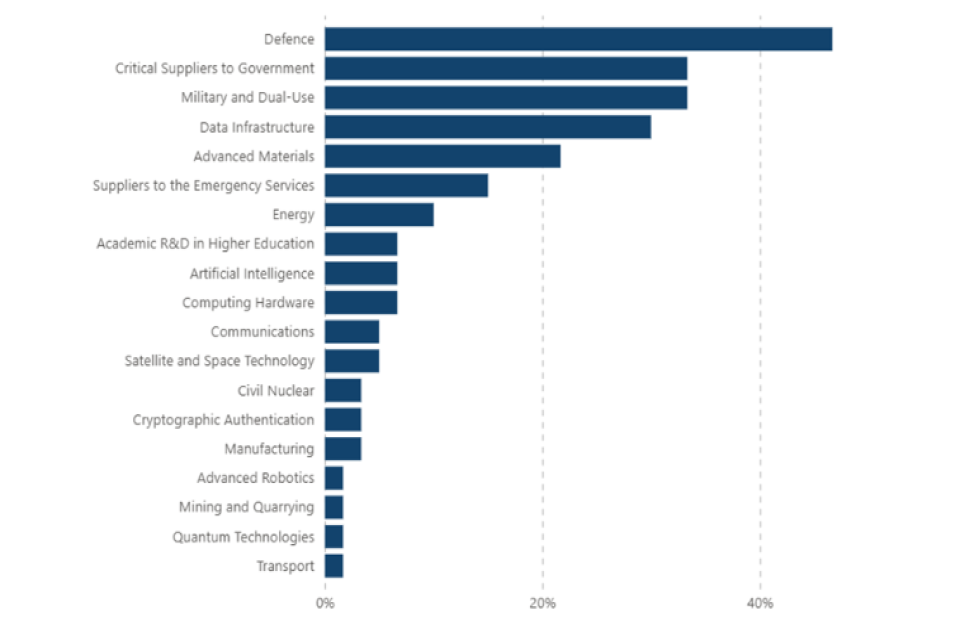
7. Figure 8 presents the 60 call-in notices issued during the reporting period, broken down by area of the economy. The chart shows that the largest proportion was associated with the Defence area of the economy (47%), followed by Critical Suppliers to Government (33%) and Military and Dual-Use (33%). It is important to note that this means that 47% of called-in acquisitions were associated with Defence, not that 47% of Defence acquisitions were called in.
8. For comparison, the largest proportion of call-in notices issued during the previous reporting period was associated with the Defence area of the economy (36%).
9. Call-in notices were issued in connection with acquisitions in 16 of the 17 areas of the economy subject to mandatory notification, as well as a small number of other areas of the economy such as Academic Research & Development in Higher Education, and Manufacturing. No call-in notices were associated with the Synthetic Biology area of the economy.
Final notifications issued, by area of the economy
Figure 9 - Final notifications issued by area of the economy (FY 2025/26)
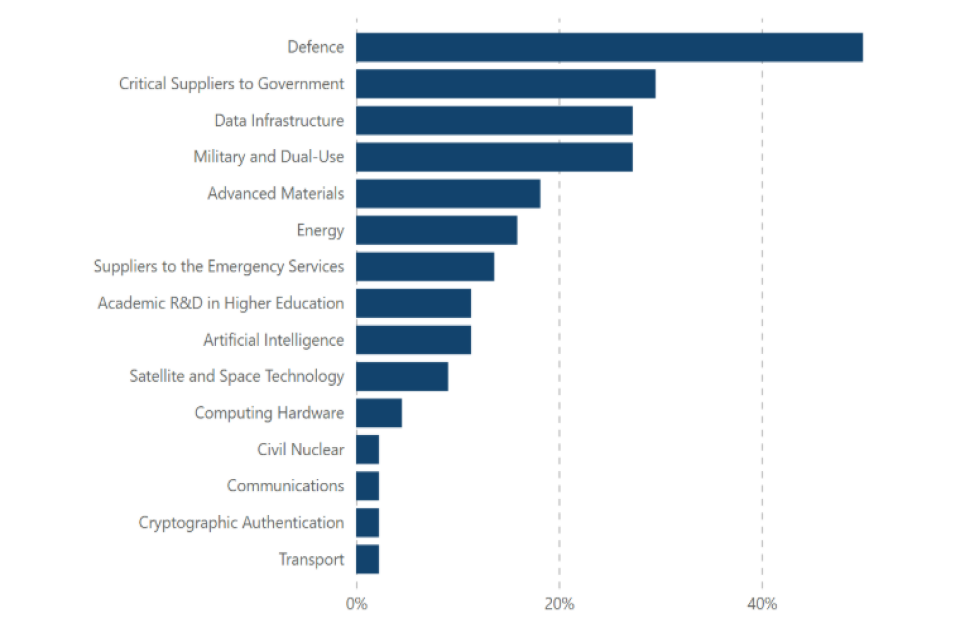
10. Figure 9 presents the 44 final notifications issued during the reporting period, broken down by area of the economy. The chart shows that the largest proportion was associated with acquisitions in the Defence area of the economy (50%), followed by Critical Suppliers to Government (30%), Military and Dual-Use (27%) and Data Infrastructure (27%). For comparison, the largest proportion of final notifications issued in the previous reporting period was associated with acquisitions in the Defence (37%) area of the economy.
Withdrawals from a called-in acquisition, by area of the economy
Figure 10 - Withdrawals from a called in acquisition, by area of the economy (FY 2025/26)
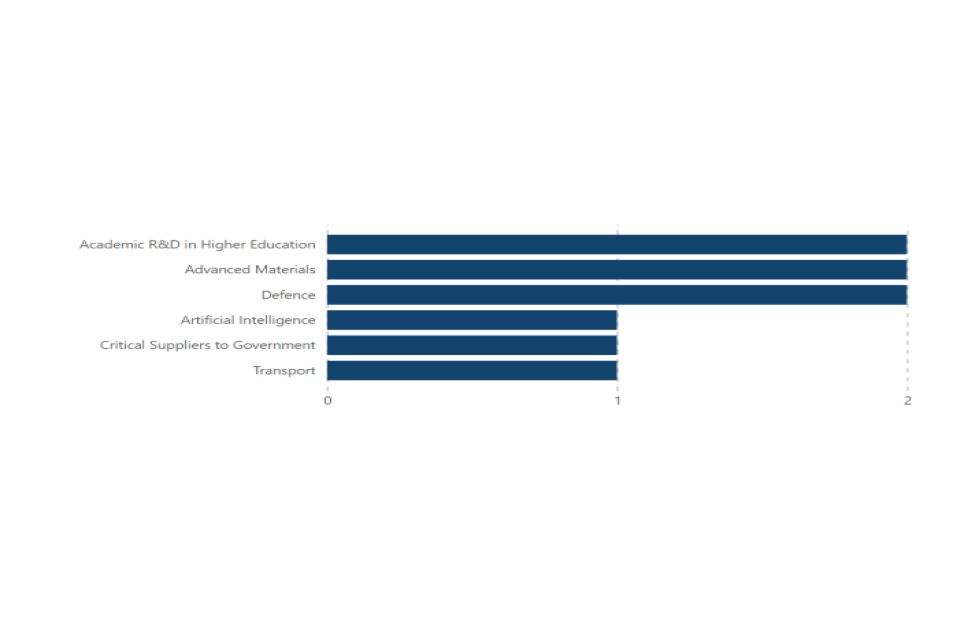
11. Figure 10 presents the four withdrawals from a called-in acquisition during the reporting period, broken down by area of the economy. The chart shows that the Academic Research & Development in Higher Education, Advanced Materials, and Defence areas of the economy were associated with two withdrawals each. Acquisitions can be associated with more than one area of the economy.
Final orders made, by area of the economy
Figure 11 - Final orders made by area of the economy (FY 2025/26)
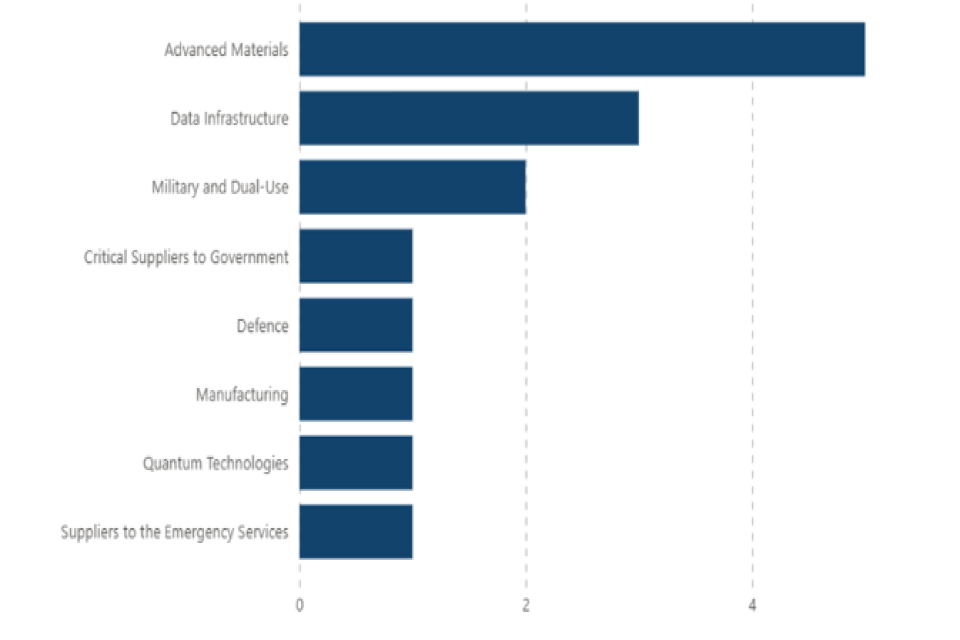
12. Figure 11 presents the nine final orders made during the reporting period, broken down by area of the economy. The chart shows that the largest number was associated with acquisitions in the Advanced Materials area of the economy (five final orders), followed by Data Infrastructure (three final orders) and Military and Dual-Use (two final orders).
13. For comparison, the largest number of final orders made in the previous reporting period was associated with acquisitions in the Defence area of the economy (nine final orders).
14. Final orders were issued in connection with acquisitions in seven of the 17 areas of the economy subject to a mandatory notification, as well as in Manufacturing.
SECTION SIX: Origin of investment
1. This section breaks down the number of accepted notifications, call-in notices issued, final notifications issued, withdrawals from a called-in acquisition and final orders made by origin of investment.
2. For the purposes of these statistics, the origin of investment includes several factors such as the location of the immediate acquirer’s headquarters or the headquarters of its ultimate beneficial owner. The NSI Act applies to all acquirers, regardless of origin of investment.
3. Acquirers can be associated with more than one origin of investment, and there can be more than one acquirer per acquisition, so one acquisition may be associated with multiple origins of investment. The percentages in the charts can therefore add up to more than 100%. The charts which display information on acquisitions that were called in include notified acquisitions and non-notified acquisitions.
Notifications accepted, by origin of investment
Figure 12 - Notifications accepted, by notification type and origin of investment (FY 2025/26)
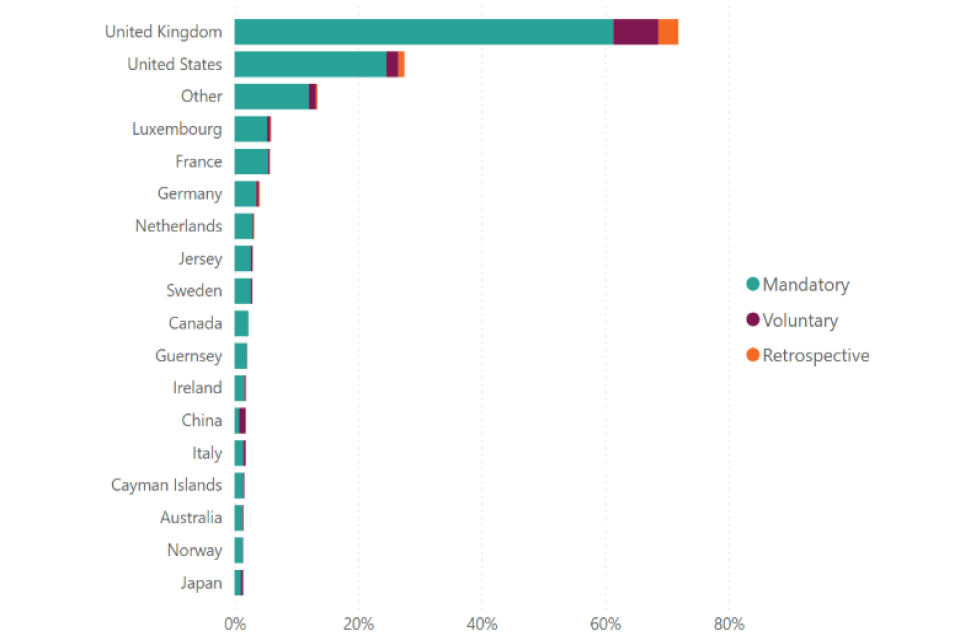
4. Figure 12 presents notifications accepted during the reporting period, broken down by origin of investment. The chart shows that the largest proportion involved acquirers associated with the United Kingdom (72%), followed by acquirers associated with the United States of America (28%), acquirers associated with France (6%) and acquirers associated with Luxembourg (6%). 13% of notifications accepted involved acquirers associated with Others. The origins of investment included in the ‘Other’ category are listed in Annex C. Acquirers associated with the United Kingdom were also involved in the largest proportion of accepted notifications in the previous reporting period (65%).
Call-in notices issued, by origin of investment
Figure 13 - Call-pin notices issued, by origin of investment (FY 2025/26)
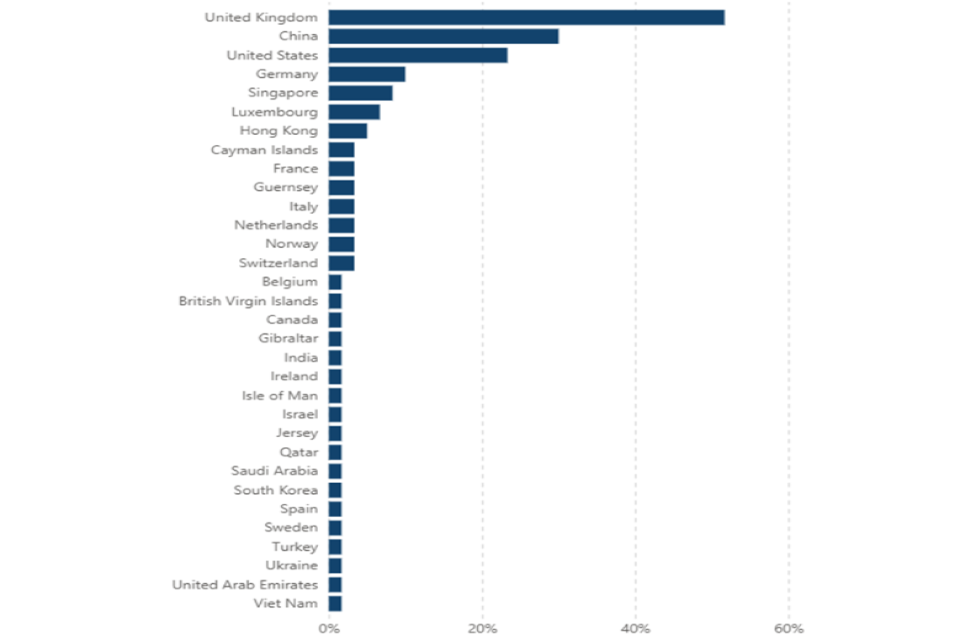
5. Figure 13 presents the 60 call-in notices issued during the reporting period, broken down by origin of investment. The chart shows that the largest proportion involved acquirers associated with the United Kingdom (52%), followed by acquirers associated with China (30%) and acquirers associated with the United States of America (23%). It is important to note that 52% of called-in acquisitions were associated with the United Kingdom, not that 52% of reviewed acquisitions associated with the United Kingdom were called in.
6. For comparison, the largest proportion of called-in acquisitions in the previous reporting period involved acquirers associated with the United Kingdom (48%).
Final notifications issued, by origin of investment
Figure 14 - Final notifications issued by origin of investment (FY 2025/26)
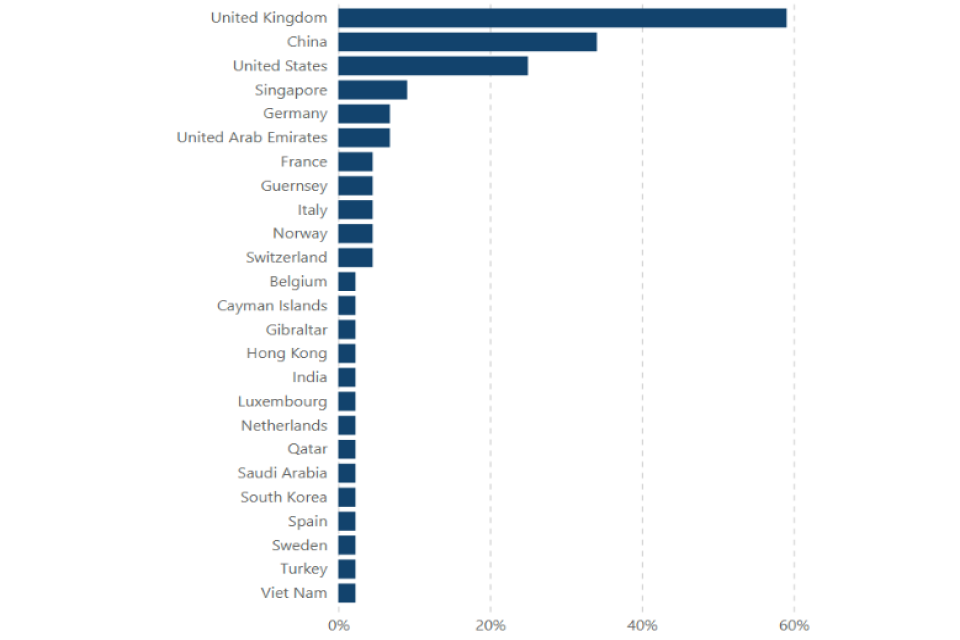
7. Figure 14 presents the 44 final notifications issued during the reporting period, broken down by origin of investment. The chart shows that the largest proportion involved acquirers associated with the United Kingdom (57%), followed by acquirers associated with China (32%) and acquirers associated with the United States of America (25%).
8. For comparison, the largest proportion of final notifications issued in the previous reporting period involved acquirers associated with the United Kingdom (34%).
Withdrawals from a called-in acquisition, by origin of investment
Figure 15 - Withdrawals from a called in acquisition, by origin of investment (FY 2025/26)
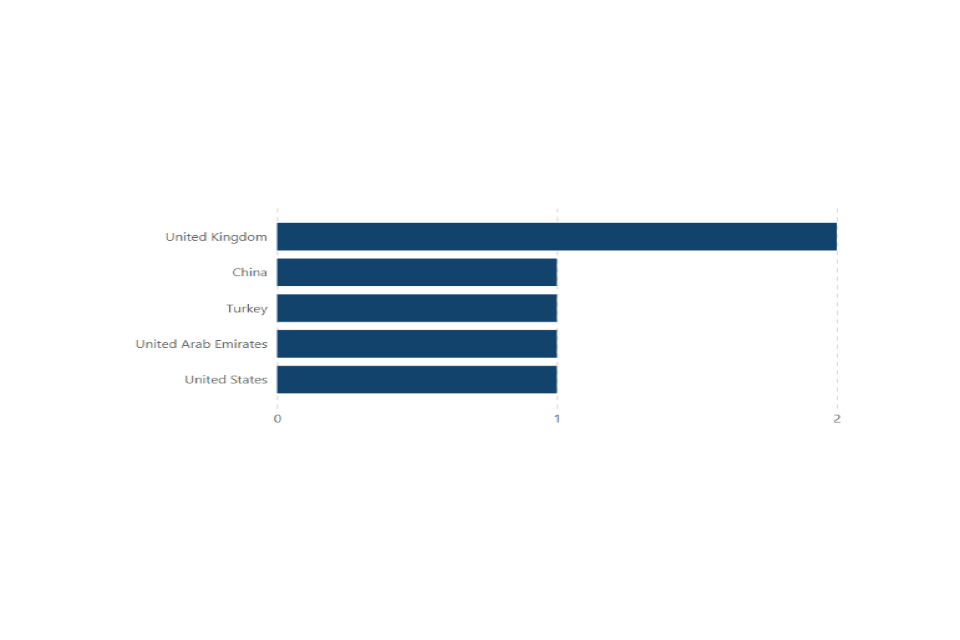
9. Figure 15 presents the four withdrawals from a called-in acquisition during the reporting period, broken down by origin of investment. The chart shows acquirers associated with the United Kingdom were associated with two withdrawals, and acquirers associated with China, Turkey, United Arab Emirates, and the United States of America were associated with one withdrawal each. Acquirers can be associated with more than one origin of investment.
Final orders made, by origin of investment
Figure 16 - Final orders made by origin of investment (FY 2025/26)
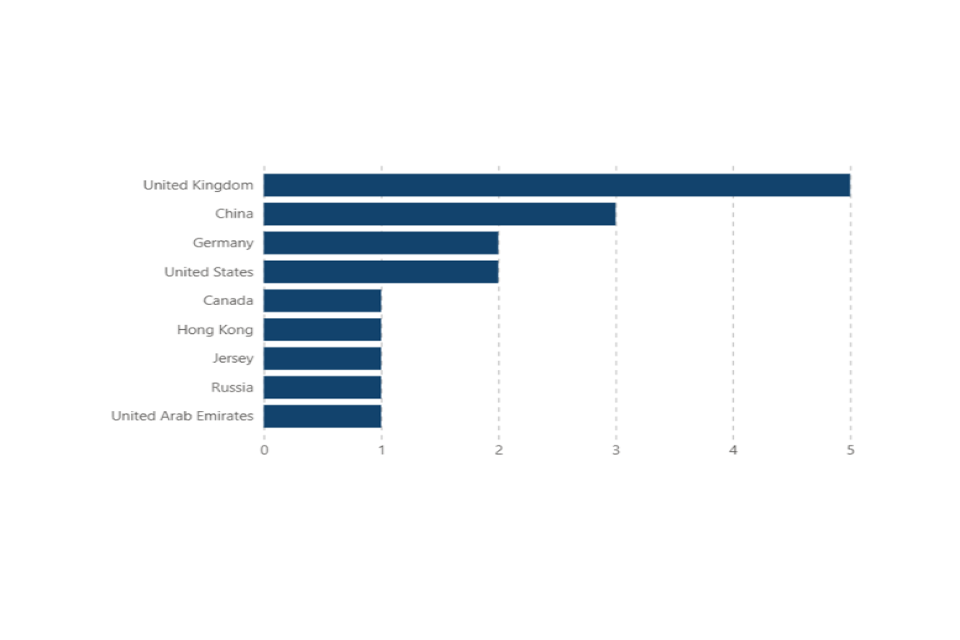
10. Figure 16 presents the nine final orders made during the reporting period, broken down by origin of investment. The chart shows that the largest number involved acquirers associated with the United Kingdom (five final orders), followed by acquirers associated with China (three final orders) and acquirers associated with Germany and the United States of America (two final orders each).
11. For comparison, the largest number of final orders in the previous reporting period involved acquirers associated with the United Kingdom (11 final orders).
SECTION SEVEN: Time taken to screen acquisitions
1. This section sets out the time taken to accept or reject notifications, call in acquisitions, issue final notifications and final orders, and the number of acquisitions for which the Government used the additional period and voluntary period.
2. When a notification has been submitted, the Government must accept or reject the notification. If the Government decides to accept the notification, it has 30 statutory working days to decide whether to call in the acquisition for a more detailed assessment or to clear it. This is known as the “review period”.
3. If an acquisition is called in, the Government then has 30 statutory working days to undertake a more detailed assessment of national security risk (the “initial period”). If required, it can extend this period by 45 statutory working days (the “additional period”), and the Government and the acquirer can mutually agree to further voluntary extensions (the “voluntary period”).
4. Some of the tables below describe the time taken in “statutory working days” and “calendar working days”. The counting of statutory working days in the assessment period is paused if transaction parties are asked to respond to an information notice or an attendance notice. The use of an information notice does not affect the number of working days during the review period. All counts of case timings exclude days which are bank holidays in any part of the United Kingdom.
Calendar working days to accept or reject a notification
Table 8
| ID | Information | Median working days | Mean working days |
|---|---|---|---|
| The average number of calendar working days from receipt of a… | |||
| A | …mandatory notification to notification of a decision to accept that notification | 11 | 10 |
| B | …mandatory notification to giving written reasons for a decision to reject that notification | 15 | 21 |
| C | …voluntary notification to notification of a decision to accept that notification | 13 | 14 |
| D | …voluntary notification to giving written reasons for a decision to reject that notification | 14 | 21 |
| E | … retrospective validation application to giving reasons for a decision to accept that application | 10 | 10 |
| F | … retrospective validation application to giving reasons for a decision to reject that application | [c][footnote 16] | [c][footnote 16] |
5. Table 8 shows the number of calendar working days it took the Government to accept or reject notifications, and the methodology for calculating the time to accept or reject a notification has changed[footnote 17]. The statutory screening period starts from when a notification has been accepted and activates the review period.
6. On average it took 11 calendar working days (median) to accept a mandatory notification and 13 calendar working days (median) to accept a voluntary notification. For comparison, in the previous reporting period it took on average seven calendar working days (median) to accept a mandatory notification and eight calendar working days (median) to accept a voluntary notification.
7. On average it took 15 calendar working days (median) to reject a mandatory notification and 14 calendar working days (median) to reject a voluntary notification. For comparison, in the previous reporting period it took on average 22 calendar working days (median) to reject a mandatory notification and 14 calendar working days (median) to reject a voluntary notification.
Statutory working days to call in notifications
Table 9
| ID | Information | Median working days | Mean working days |
|---|---|---|---|
| The average number of statutory working days to decide to call in… | |||
| G | … a mandatory notification once accepted | 29 | 28 |
| H | … a voluntary notification once accepted | 30 | 29 |
8. On average it took 29 statutory working days (median) to decide to call in a mandatory once accepted, and 30 statutory working days (median) to decide to call in a voluntary notification once accepted. Timings are excluded for retrospective validations, due to the small number of acquisitions (one). For comparison, in the previous reporting period, on average it took 29 statutory working days (median) to decide to call in both a mandatory notification and a voluntary notification, once accepted.
Called-in acquisitions that used the additional and voluntary period
9. Tables 10, 11 and 12 show how many additional period notices and voluntary period notices were issued for called-in acquisitions. The full lifecycle of an acquisition may cover more than one reporting period. This means that the use of the additional and voluntary periods may be in a different reporting period to the decision to call in that acquisition, or the decision to issue a final notification or a final order in relation to that acquisition.
Table 10
| ID | Information | Number |
|---|---|---|
| I | The number of times an additional period notice was issued in the reporting period for acquisitions that were called in during this or a previous reporting period | 18 |
| J | The number of times an additional period notice was issued in the reporting period for acquisitions that were called in during this or a previous reporting period following a mandatory notification | 10 |
| K | The number of times an additional period notice was issued in the reporting period for acquisitions that were called in during this or a previous reporting period following a voluntary notification | 2 |
| L | The number of times an additional period notice was issued in the reporting period for acquisitions that were called in during this or a previous reporting period following a retrospective validation application | 2 |
| M | The number of times an additional period notice was issued in the reporting period for acquisitions that were called in during this or a previous reporting period for non-notified acquisitions | 4 |
10. Table 10 shows that 18 called-in acquisitions went to the additional period during the reporting period, of which 10 originated from mandatory notifications, four from non-notified acquisitions, two from voluntary notifications and two from retrospective validation applications. For comparison, the total number of called-in acquisitions that went to the additional period in the previous reporting period was 21.
Table 11
| ID | Information | Number |
|---|---|---|
| N | The number of times a voluntary period notice was agreed in the reporting period for acquisitions that were called in during this or a previous reporting period | 3 |
| O | The number of times a voluntary period notice was agreed in the reporting period for acquisitions that were called in during this or a previous reporting period following a mandatory notification | 1 |
| P | The number of times a voluntary period notice was agreed in the reporting period for acquisitions that were called in during this or a previous reporting period following a voluntary notification | 1 |
| Q | The number of times a voluntary period notice was agreed in the reporting period for acquisitions that were called in during this or a previous reporting period following a retrospective validation application | 0 |
| R | The number of times a voluntary period notice was agreed that were called in during this or a previous reporting period for non-notified acquisitions | 1 |
11. Table 11 shows that the voluntary period was agreed for three called-in acquisitions, of which one originated from a mandatory notification, one originated from a voluntary notification, and one originated from a non-notified acquisition. None of these acquisitions originated from a retrospective validation application. For comparison, the voluntary period was agreed for two called-in acquisitions in the previous reporting period.
Table 12
| ID | Information | Number |
|---|---|---|
| S | The number of times the additional period was used for acquisitions that were called in during this or a previous reporting period and subsequently issued a final notification in the reporting period | 5 |
| T | The number of times the voluntary period was agreed for acquisitions that were called in during this or a previous reporting period and subsequently issued a final notification in the reporting period | 1 |
| U | The number of times the additional period was used for acquisitions that were called in during this or a previous reporting period in relation to which a final order was subsequently made | 7 |
| V | The number of times the voluntary period was agreed for acquisitions that were called in during this or a previous reporting period in relation to which a final order was subsequently made | 1 |
12. Table 12 shows how many times the additional period had been used and the voluntary period had been agreed for acquisitions that received final orders or final notifications in the reporting period.
13. The additional period was used five times in relation to acquisitions which were subsequently issued a final notification in the reporting period. For comparison, the additional period was used five times in relation to acquisitions which were subsequently issued a final notification in the previous reporting period. The voluntary period was agreed once in relation to acquisitions that were subsequently issued a final notification, compared to the previous reporting period where no voluntary periods were agreed.
14. The additional period was used seven times for acquisitions in relation to which a final order was subsequently made. For comparison, the additional period was used 17 times for acquisitions in relation to which a final order was subsequently made in the previous reporting period. Meanwhile, the voluntary period was agreed for one acquisition in relation to which a final order was subsequently made, the same as in the previous reporting period.
Calendar and statutory working days to issue a final notification
15. Table 13 provides the average number of calendar and statutory working days taken to issue a final notification for notified acquisitions which were called in during this or a previous reporting period. These statistics cover acquisitions for which the Government received and accepted the notification and called in the acquisition during this or a previous reporting period, then subsequently issued a final notification in the reporting period.
Table 13
| ID | Information | Statutory working days - Median | Statutory working days - Mean | Calendar working days - Median | Calendar working days - Mean |
|---|---|---|---|---|---|
| The average number of days between… | |||||
| W | … receiving a notification and issuing a final notification | 60 | 64 | 83 | 94 |
| X | … accepting a notification and issuing a final notification | 52 | 54 | 73 | 84 |
| Y | … calling in a notified acquisition and issuing a final notification | 24 | 26 | 44 | 56 |
16. In the reporting period, it took on average 60 statutory working days or 83 calendar working days (median) and 64 statutory working days or 94 calendar working days (mean) between receiving a notification and issuing a final notification.
17. Table 14 provides the average number of statutory and calendar working days taken to issue a final notification for all acquisitions (notified and non-notified).
Table 14
| ID | Information | Statutory working days - Median | Statutory working days - Mean | Calendar working days - Median | Calendar working days - Mean |
|---|---|---|---|---|---|
| Z | The average number of days between calling in a notified or a non-notified acquisition and issuing a final notification | 24 | 27 | 47 | 58 |
18. In the reporting period, it took on average 24 statutory working days or 47 calendar working days (median) and 27 statutory working days or 58 calendar working days (mean) between calling in an acquisition (including non-notified acquisitions) and issuing a final notification. In comparison, in the previous reporting period it took on average 24 statutory working days or 40 calendar working days (median) and 24 statutory working days or 44 calendar working days (mean) between calling in an acquisition and issuing a final notification.
Calendar and statutory working days to make a final order
19. Table 15 provides the average number of statutory and calendar working days taken to make a final order for notified acquisitions. These statistics cover acquisitions for which the Government received and accepted the notification and called in the acquisition during this or a previous reporting period, then subsequently issued a final order in the reporting period.
Table 15
| ID | Information | Statutory working days - Median | Statutory working days - Mean | Calendar working days - Median | Calendar working days - Mean |
|---|---|---|---|---|---|
| The average number of days between… | |||||
| AA | … receiving a notification and making a final order | 99 | 85 | 122 | 127 |
| AB | … accepting a notification and making a final order | 97 | 82 | 117 | 123 |
| AC | … calling in a notified acquisition and making a final order | 69 | 54 | 90 | 96 |
20. In the reporting period, it took on average 99 statutory working days or 122 calendar working days (median) and 85 statutory working days or 127 calendar working days (mean) between receiving a notification and making a final order.
21. Table 16 provides the average number of statutory working days to make a final order for all acquisitions (notified and non-notified).
Table 16
| ID | Information | Statutory working days - Median | Statutory working days - Mean | Calendar working days - Median | Calendar working days - Mean |
|---|---|---|---|---|---|
| AD | The average number of days between calling in a notified or a non-notified acquisition and making a final order | 69 | 59 | 97 | 101 |
22. In the reporting period, it took on average 69 statutory working days or 97 calendar working days (median) and 59 statutory working days or 101 calendar working days (mean) between calling in an acquisition (including non-notified acquisitions) and making a final order. In comparison, in the previous reporting period it took on average 70 statutory working days or 100 calendar working days (median) and 69 statutory working days or 110 calendar working days (mean) between calling in an acquisition and making a final order. Due to the small number of final orders, no conclusions should be drawn regarding trends in the time taken between calling in an acquisition and making a final order.
SECTION EIGHT: Financial assistance
1. The Government may give financial assistance to or in respect of an entity as a consequence of making a final order. This may be any form of financial assistance (actual or contingent) including loans, guarantees or indemnities. Such assistance must be made with the consent of HM Treasury.
2. No financial assistance has been given during the reporting period. There are therefore no liabilities in respect of financial assistance.
SECTION NINE: Appeals, Compliance, and Enforcement
1. The NSI Act specifies that offences may be committed in respect of:
a. completing a notifiable acquisition without approval;
b. failing to comply with an interim or final order;
c. failing to comply with an information notice or attendance notice, and various associated offences; and,
d. using or disclosing information in contravention of the NSI Act’s provisions regarding the disclosure of information.
2. For the reporting period the Government did not issue any penalties, and consequently, there were no appeals against penalties or costs. There were no criminal prosecutions concluded during this time period.
3. During the reporting period, the Government identified 42 potential offences of completing a notifiable acquisition without approval. Penalties were not imposed in these cases but parties were required to provide reassurance to the Government that steps had been taken to prevent any future non-compliance.
Contacting the Investment Security Unit
1. You can contact the Investment Security Unit (ISU) through its mailbox at investment.screening@cabinetoffice.gov.uk with any questions regarding the operation of the NSI Act or this publication. 2. Please visit National Security and Investment Act for full details of the operation of the NSI Act, including comprehensive guidance.
Annex A: Summary of statistics and figures in this report
1. The following tables summarise the statistics and figures contained in this report. The accompanying spreadsheet containing all the data published since commencement of the NSI Act can be found on gov.uk.
2. The table below summarises the statistics in the reporting period (1 April 2025 - 31 March 2026).
STATISTICS INCLUDED IN THIS REPORT
SECTION ONE: Notifications
| ID | Information | Number |
|---|---|---|
| A | The total number of notifications received | 1,324 |
| B | The number of mandatory notifications received | 1,135 |
| C | The number of voluntary notifications received | 147 |
| D | The number of retrospective validation applications received | 42 |
| E | The total number of notifications accepted or rejected | 1,279 |
| F | The total number of notifications accepted | 1,242 |
| G | The total number of notifications rejected | 37 |
| H | The number of mandatory notifications accepted | 1,075 |
| I | The number of mandatory notifications rejected | 21 |
| J | The number of voluntary notifications accepted | 124 |
| K | The number of voluntary notifications rejected | 15 |
| L | The number of retrospective validation applications accepted | 43 |
| M | The number of retrospective validation applications rejected | 1 |
| N | The number of notifications pending acceptance and rejection at the end of the reporting period | 78 |
SECTION TWO: Call-in notices
| ID | Information | Number |
|---|---|---|
| A | The total number of notified acquisitions reviewed | 1,220 |
| B | The number of acquisitions reviewed following a mandatory notification | 1,054 |
| C | The number of acquisitions reviewed following a voluntary notification | 115 |
| D | The number of acquisitions reviewed following a retrospective validation application | 51 |
| E | The total number of call-in notices issued | 60 |
| F | The number of call-in notices issued following a mandatory notification | 42 |
| G | The number of call-in notices issued following a voluntary notification | 11 |
| H | The number of call-in notices issued following a retrospective validation application | 1 |
| I | The number of call-in notices issued for non-notified acquisitions | 6 |
SECTION THREE: Final notifications
| ID | Information | Number |
|---|---|---|
| A | The total number of final notifications issued | 44 |
| B | The number of final notifications issued following a mandatory notification | 28 |
| C | The number of final notifications issued following a voluntary notification | 13 |
| D | The number of final notifications issued following a retrospective validation application | 0 |
| E | The number of final notifications issued for non-notified acquisitions | 3 |
| F | The total number of withdrawals from a called-in acquisition | 4 |
| G | The number of withdrawals from a called-in acquisition following a mandatory notification | 2 |
| H | The number of withdrawals from a called-in acquisition following a voluntary notification | 2 |
| I | The number of withdrawals from a called-in acquisition following a retrospective validation application | 0 |
| J | The number of withdrawals from a called-in acquisition for non-notified acquisitions | 0 |
SECTION FOUR: Final orders
| ID | Information | Number |
|---|---|---|
| A | The number of final orders made | 9 |
| B | The number of final orders made following a mandatory notification | 3 |
| C | The number of final orders made following a voluntary notification | 1 |
| D | The number of final orders made following a retrospective validation application | 2 |
| E | The number of final orders made for non-notified acquisitions | 3 |
| F | The number of acquisitions blocked or subject to an order to unwind the acquisition | 1 |
| G | The number of final orders varied | 3 |
| H | The number of final orders revoked | 2 |
SECTION SEVEN: Time taken
| ID | Information | Number | Number |
|---|---|---|---|
| A | The average number of calendar working days from receipt of a mandatory notification to notification of a decision to accept that notification | Median 11 |
Mean 10 |
| B | The average number of calendar working days from receipt of a mandatory notification to giving written reasons for a decision to reject that notification | Median 15 |
Mean 21 |
| C | The average number of calendar working days from receipt of a voluntary notification to notification of a decision to accept that notification | Median 13 |
Mean 14 |
| D | The average number of calendar working days from receipt of a voluntary notification to giving written reasons for a decision to reject that notification | Median 14 |
Mean 21 |
| E | The average number of calendar working days from receipt of a retrospective validation application to notification of a decision to accept that application | Median 10 |
Mean 10 |
| F | The average number of calendar working days from receipt of a retrospective validation application to giving written reasons for a decision to reject that application | Median [c][footnote 18] |
Mean [c][footnote 18] |
| G | The average number of statutory working days to decide to call in a mandatory notification once accepted | Median 29 |
Mean 28 |
| H | The average number of statutory working days to decide to call in a voluntary notification once accepted | Median 30 |
Mean 29 |
| I | The total number of times an additional period notice was issued in the reporting period for acquisitions that were called in during this or a previous reporting period | 18 | |
| J | The number of times an additional period notice was issued in the reporting period for acquisitions that were called in during this or a previous reporting period following a mandatory notification | 10 | |
| K | The number of times an additional period notice was issued in the reporting period for acquisitions that were called in during this or a previous reporting period following a voluntary notification | 2 | |
| L | The number of times an additional period notice was issued in the reporting period for acquisitions that were called in during this or a previous reporting period following a retrospective validation application | 2 | |
| M | The number of times an additional period notice was issued in the reporting period for acquisitions that were called in during this or a previous reporting period for non-notified acquisitions | 4 | |
| N | The total number of times a voluntary period notice was agreed in the reporting period for acquisitions that were called in during this or a previous reporting period | 3 | |
| O | The number of times a voluntary period notice was agreed in the reporting period for acquisitions that were called in during this or a previous reporting period following a mandatory notification | 1 | |
| P | The number of times a voluntary period notice was agreed in the reporting period for acquisitions that were called in during this or a previous reporting period following a voluntary notification | 1 | |
| Q | The number of times a voluntary period notice was agreed in the reporting period for acquisitions that were called in during this or a previous reporting period following a retrospective validation application | 0 | |
| R | The number of times a voluntary period notice was agreed in the reporting period for acquisitions that were called in during this or a previous reporting period for non-notified acquisitions | 1 | |
| S | The number of times the additional period was issued for acquisitions that were called in during this or a previous reporting period and subsequently issued a final notification in the reporting period | 5 | |
| T | The number of times the voluntary period was agreed for acquisitions that were called in during this or a previous reporting period and subsequently issued a final notification in the reporting period | 1 | |
| U | The number of times the additional period was issued for acquisitions that were called in during this or a previous reporting period and subsequently issued a final order in the reporting period | 7 | |
| V | The number of times the voluntary period was agreed for acquisitions that were called in during this or a previous reporting period and subsequently issued a final order in the reporting period | 1 | |
| W | The average number of statutory working days between receiving a notification and issuing a final notification | Median 60 |
Mean 64 |
| The average number of calendar working days between receiving a notification and issuing a final notification | Median 83 |
Mean 94 |
|
| X | The average number of statutory working days between accepting a notification and issuing a final notification | Median 52 |
Mean 54 |
| The average number of calendar working days between accepting a notification and issuing a final notification | Median 73 |
Mean 84 |
|
| Y | The average number of statutory working days between calling in a notified acquisition and issuing a final notification | Median 24 |
Mean 26 |
| The average number of calendar working days between calling in a notified acquisition and issuing a final notification | Median 44 |
Mean 56 |
|
| Z | The average number of statutory working days between calling in a notified or non-notified acquisition and issuing a final notification | Median 24 |
Mean 27 |
| The average number of calendar working days between calling in a notified or non-notified acquisition and issuing a final notification | Median 47 |
Mean 58 |
|
| AA | The average number of statutory working days between receiving a notification and making a final order | Median 99 |
Mean 85 |
| The average number of calendar working days between receiving a notification and making a final order | Median 122 |
Mean 127 |
|
| AB | The average number of statutory working days between accepting a notification and making a final order | Median 97 |
Mean 82 |
| The average number of calendar working days between accepting a notification and making a final order | Median 117 |
Mean 123 |
|
| AC | The average number of statutory working days between calling in a notified acquisition and making a final order | Median 69 |
Mean 54 |
| The average number of calendar working days between calling in a notified acquisition and making a final order | Median 90 |
Mean 96 |
|
| AD | The average number of statutory working days between calling in a notified or non-notified acquisition and making a final order | Median 69 |
Mean 59 |
| The average number of calendar working days between calling in a notified or non-notified acquisition and making a final order | Median 97 |
Mean 101 |
FIGURES INCLUDED IN THIS REPORT
Section One: Notifications
| Information | Figure |
|---|---|
| The number of notifications received, by notification type and month | Fig 1 |
| The number of notifications accepted or rejected, by month | Fig 2 |
| The number of notifications accepted, by notification type and month | Fig 3 |
| The number of notifications rejected, by notification type and month | Fig 4 |
| The number of notifications rejected, by the reason why they were rejected | Fig 5 |
Section Two: Call-in notices
| Information | Figure |
|---|---|
| The number of call-in notices issued, by notification type and month | Fig 6 |
Section Five: Areas of the economy
| Information | Figure |
|---|---|
| The breakdown of notifications accepted or rejected, by notification type and area of the economy | Fig 7 |
| The breakdown of call-in notices issued, by area of the economy | Fig 8 |
| The breakdown of final notifications issued, by area of the economy | Fig 9 |
| The number of withdrawals from a called-in acquisition, by area of the economy | Fig 10 |
| The number of final orders made, by area of the economy | Fig 11 |
Section Six: Origin of Investment
| Information | Figure |
|---|---|
| The breakdown of notifications accepted, by notification type and origin of investment | Fig 12 |
| The breakdown of call-in notices issued, by origin of investment | Fig 13 |
| The breakdown of final notifications issued, by origin of investment | Fig 14 |
| The number of withdrawals from a called-in acquisition, by origin of investment | Fig 15 |
| The number of final orders made, by origin of investment | Fig 16 |
Annex B: Information contained in this report
1. The NSI Act 2021 specifies information that must be included in each Annual Report. The Government includes additional information to assist stakeholders in their understanding of the operation of the NSI Act and to maintain high standards of transparency.
STATUTORY INFORMATION INCLUDED IN THIS REPORT
| Information | Page number |
|---|---|
| The number of mandatory notifications accepted | 12 |
| The number of mandatory notifications rejected | 12 |
| The number of voluntary notifications accepted | 12 |
| The number of voluntary notifications rejected | 12 |
| The total number of call-in notices issued | 15 |
| The total number of final notifications issued | 17 |
| The number of final orders made | 19 |
| The number of final orders varied | 19 |
| The number of final orders revoked | 19 |
| The breakdown of notifications accepted or rejected, by notification type and area of the economy | 20 |
| The breakdown of call-in notices issued, by area of the economy | 21 |
| The average number of calendar working days from receipt of a mandatory notification to notification of a decision to accept that notification | 28 |
| The average number of calendar working days from receipt of a mandatory notification to giving written reasons for a decision to reject that notification | 28 |
| The average number of calendar working days from receipt of a voluntary notification to notification of a decision to accept that notification | 28 |
| The average number of calendar working days from receipt of a voluntary notification to giving written reasons for a decision to reject that notification | 28 |
| The expenditure incurred by the Government in giving (or in connection with giving) financial assistance falling within Section 30 | 34 |
| The amount of the actual or contingent liabilities of the Government at the end of the relevant period in respect of such financial assistance | 34 |
ADDITIONAL INFORMATION INCLUDED FROM PREVIOUS REPORTS
| Information | Page number |
|---|---|
| The total number of notifications received | 10 |
| The number of mandatory notifications received | 10 |
| The number of voluntary notifications received | 10 |
| The number of retrospective validation applications received | 10 |
| The number of notifications received, by notification type and month | 11 |
| The total number of notifications accepted or rejected | 12 |
| The total number of notifications accepted | 12 |
| The total number of notifications rejected | 12 |
| The number of retrospective validation applications accepted | 12 |
| The number of retrospective validation applications rejected | 12 |
| The number of notifications pending acceptance or rejection at the end of the reporting period | 12 |
| The number of notifications accepted or rejected, by month | 12 |
| The number of notifications accepted, by notification type and month | 13 |
| The number of notifications rejected, by notification type and month | 13 |
| The number of notifications rejected, by the reason why they were rejected | 14 |
| The total number of notified acquisitions reviewed | 15 |
| The number of acquisitions reviewed following a mandatory notification | 15 |
| The number of acquisitions reviewed following a voluntary notification | 15 |
| The number of acquisitions reviewed following a retrospective validation application | 15 |
| The number of call-in notices issued following a mandatory notification | 15 |
| The number of call-in notices issued following a voluntary notification | 15 |
| The number of call-in notices issued following a retrospective validation application | 15 |
| The number of call-in notices issued for non-notified acquisitions | 15 |
| The number of call-in notices issued, by notification type and month | 16 |
| The number of final notifications issued following a mandatory notification | 17 |
| The number of final notifications issued following a voluntary notification | 17 |
| The number of final notifications issued following a retrospective validation application | 17 |
| The number of final notifications issued for non-notified acquisitions | 17 |
| The total number of withdrawals from a called in acquisition | 18 |
| The number of withdrawals from a called in acquisition following a mandatory notification | 18 |
| The number of withdrawals from a called in acquisition following a voluntary notification | 18 |
| The number of withdrawals from a called in acquisition following a retrospective validation application | 18 |
| The number of withdrawals from a called in acquisition for non-notified acquisitions | 18 |
| The number of final orders made following a mandatory notification | 19 |
| The number of final orders made following a voluntary notification | 19 |
| The number of final orders made following a retrospective validation application | 19 |
| The number of final orders made for non-notified acquisitions | 19 |
| The number of acquisitions blocked or subject to an order to unwind the acquisition | 19 |
| The breakdown of final notifications issued, by area of the economy | 22 |
| The number of withdrawals from a called in acquisition, by area of the economy | 22 |
| The number of final orders made, by area of the economy | 23 |
| The breakdown of notifications accepted, by notification type and origin of investment | 24 |
| The breakdown of call-in notices issued, by origin of investment | 25 |
| The breakdown of final notifications issued, by origin of investment | 26 |
| The number of withdrawals from a called in acquisition, by origin of investment | 27 |
| The number of final orders made, by origin of investment | 27 |
| The average number of calendar working days from receipt of a retrospective validation application to giving reasons for a decision to accept that application | 28 |
| The average number of calendar working days from receipt of a retrospective validation application to giving reasons for a decision to reject that application | 28 |
| The average number of statutory working days to decide to call in a mandatory notification once accepted | 29 |
| The average number of statutory working days to decide to call in a voluntary notification once accepted | 29 |
| The total number of times an additional period notice was issued in this reporting period for acquisitions that were called in during this or a previous reporting period | 30 |
| The number of times an additional period notice was issued in this reporting period for acquisitions that were called in during this or a previous reporting period following a mandatory notification | 30 |
| The number of times an additional period notice was issued in this reporting period for acquisitions that were called in during this or a previous reporting period following a voluntary notification | 30 |
| The number of times an additional period notice was issued in this reporting period for acquisitions that were called in during this or a previous reporting period following a retrospective validation application | 30 |
| The number of times an additional period notice was issued in this reporting period for acquisitions that were called in during this or a previous reporting period for non-notified acquisitions | 30 |
| The total number of times a voluntary period notice was agreed in this reporting period for acquisitions that were called in during this or a previous reporting period | 30 |
| The number of times a voluntary period notice was agreed in this reporting period for acquisitions that were called in during this or a previous reporting period following a mandatory notification | 30 |
| The number of times a voluntary period notice was agreed in this reporting period for acquisitions that were called in during this or a previous reporting period following a voluntary notification | 30 |
| The number of times a voluntary period notice was agreed in this reporting period for acquisitions that were called in during this or a previous reporting period following a retrospective validation application | 30 |
| The number of times a voluntary period notice was agreed in this reporting period for acquisitions that were called in during this or a previous reporting period for non-notified acquisitions | 30 |
| The number of times the additional period was issued for acquisitions that were called in during this or a previous reporting period and subsequently issued a final notification in this reporting period | 32 |
| The number of times the voluntary period was agreed for acquisitions that were called in during this or a previous reporting period and subsequently issued a final notification in this reporting period | 31 |
| The number of times the additional period was used for acquisitions that were called in during this or a previous reporting period in relation to which a final order was subsequently made | 31 |
| The number of times the voluntary period was agreed for acquisitions that were called in during this or a previous reporting period in relation to which a final order was subsequently made | 31 |
| The average number of statutory working days between receiving a notification and issuing a final notification | 32 |
| The average number of calendar working days between receiving a notification and issuing a final notification | 32 |
| The average number of statutory working days between accepting a notification and issuing a final notification | 32 |
| The average number of calendar working days between accepting a notification and issuing a final notification | 32 |
| The average number of statutory working days between calling in a notified acquisition and issuing a final notification | 32 |
| The average number of calendar working days between calling in a notified acquisition and issuing a final notification | 32 |
| The average number of statutory working days between calling in a notified or non-notified acquisition and issuing a final notification | 32 |
| The average number of calendar working days between calling in a notified or non-notified acquisition and issuing a final notification | 32 |
| The average number of statutory working days between receiving a notification and making a final order | 33 |
| The average number of calendar working days between receiving a notification and making a final order | 33 |
| The average number of statutory working days between accepting a notification and making a final order | 33 |
| The average number of calendar working days between accepting a notification and making a final order | 33 |
| The average number of statutory working days between calling in a notified acquisition and making a final order | 33 |
| The average number of calendar working days between calling in a notified acquisition and making a final order | 33 |
| The average number of statutory working days between calling in a notified or non-notified acquisition and making a final order | 33 |
| The average number of calendar working days between calling in a notified or non-notified acquisition and making a final order | 33 |
| The number of offences of completing a notifiable acquisition without approval | 35 |
Annex C: Origins of investment within ‘Other’ in charts
Several origins of investment featured in fewer than 10 notifications. In the charts in this Annual Report, these are combined into the ‘Other’ category. The origins of investment included in this category are:
| Austria | Mauritius |
| Barbados | Mexico |
| Belgium | Nigeria |
| Bermuda | Oman |
| British Virgin Islands | Pakistan |
| Bulgaria | Poland |
| Croatia | Portugal |
| Curaçao | Qatar |
| Cyprus | Saudi Arabia |
| Czech Republic | Singapore |
| Denmark | Slovakia |
| Estonia | South Africa |
| Finland | South Korea |
| Gibraltar | Spain |
| Greece | Switzerland |
| Hong Kong | Taiwan |
| India | Turkey |
| Isle of Man | Ukraine |
| Israel | United Arab Emirates |
| Liechtenstein | Venezuela |
Annex D: Sankey diagram
The Sankey diagram shows the progress of acquisitions through the different stages, from submitting a notification to communicating a final decision, under the NSI Act during the reporting period. [footnote 19]
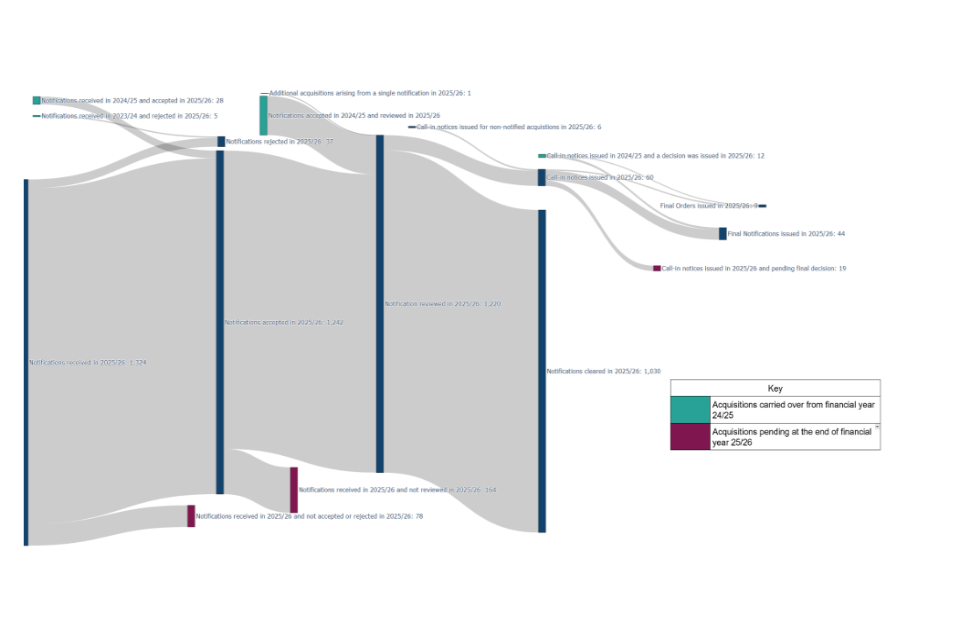
Annex E: Time taken to accept or reject a notification
1. The average time taken is now based on notifications accepted or rejected during the reporting period. In previous Annual Reports, average time taken has been calculated based on notifications submitted during the reporting period. This has been updated for consistency with the approach to other statistics in the annual report. To provide continuity during this transition, statistics for both approaches are presented in this annex, allowing for comparison. Future Annual Reports will only present timings based on notifications accepted or rejected during the reporting period.
2. The table below presents both approaches to the average time taken to accept or reject notifications in 2025/26. Comparative statistics for previous reporting periods is presented in tab 1(a) of the accompanying spreadsheet.
| ID | Information | Notifications accepted or rejected in 2025/26 (New approach) - Median working days | Notifications accepted or rejected in 2025/26 (New approach) - Mean working days | Notifications submitted in 2025/26 (Previous approach) - Median working days | Notifications submitted in 2025/26 (Previous approach) - Mean working days |
|---|---|---|---|---|---|
| The average number of calendar working days from receipt of a… | |||||
| A | …mandatory notification to notification of a decision to accept that notification | 11 | 10 | 11 | 11 |
| B | …mandatory notification to giving written reasons for a decision to reject that notification | 15 | 21 | 15 | 18 |
| C | …voluntary notification to notification of a decision to accept that notification | 13 | 14 | 13 | 14 |
| D | …voluntary notification to giving written reasons for a decision to reject that notification | 14 | 21 | 15 | 23 |
| E | … retrospective validation application to giving reasons for a decision to accept that application | 10 | 10 | 11 | 10 |
| F | … retrospective validation application to giving reasons for a decision to reject that application | [c][footnote 20] | [c][footnote 20] | [c][footnote 20] | [c][footnote 20] |
-
Notifications are when parties give notice to the Government about certain acquisitions that meet the legal tests set out in the NSI Act. ↩
-
Retrospective validation application is a form of notifiable acquisition to be recognised retrospectively as being valid in law after having been completed without approval. ↩
-
A call-in notice is issued when the Government calls in an acquisition for further scrutiny if it reasonably suspects that a qualifying acquisition may give rise to a risk to national security. ↩
-
A non-notified acquisition is when the Investment Security Unit identifies qualifying acquisitions through market monitoring which haven’t been notified to the Government and which it believes meets the legal tests set out in the Act. ↩
-
A final notification is issued in relation to a call-in notice before the end of the assessment period when no further action is to be taken. ↩
-
A final order is a legal binding document imposing conditions on an acquisition to mitigate national security risks. ↩
-
In one instance, final orders associated with two related call-in notices were contained within the same document and presented in a single public notice. ↩
-
A varied final order is a modification of a final order that changes the terms or conditions imposed on an acquisition. ↩
-
A revoked final order is the cancellation of a final order imposed on an acquisition. ↩
-
The assessment period begins on the day on which the acquirer is notified that the acquisition has been called in. It ends on the day that the decision to issue a final notification or a final order is communicated to the acquirer. ↩
-
If the government requires further information it may issue an information notice, which requires parties to provide information to support the Secretary of State’s consideration. ↩
-
The government may need to hear from people involved in the acquisition to inform its decision making. This will be required through an attendance notice, setting out the time and place of the meeting, and the purpose of the meeting. ↩
-
The review period begins on the day that a notification is accepted and can last up to 30 working days. ↩
-
In one instance, final orders associated with two related call-in notices were contained within the same document and presented in a single public notice. ↩
-
Areas of the economy representing less than 1% are excluded from the chart. Data on all areas of the economy is available in the accompanying spreadsheet to the report. ↩
-
The average number of working days to reject a retrospective validation application is suppressed, because only one retrospective validation application was rejected during this reporting period. This prevents the disclosure of potentially identifiable data. ↩ ↩2
-
Average time taken is now based on notifications accepted or rejected during the reporting period. In previous Annual Reports, average time taken has been calculated based on notifications submitted during the reporting period. A comparison of these approaches is available in Annex E. ↩
-
The average number of calendar working days from receipt of a retrospective validation application to giving reasons for a decision to reject that application is not presented because only one retrospective validation application was rejected during this reporting period. ↩ ↩2
-
The Sankey diagram includes the following additional statistics: Notifications received in AR24/25 and rejected in AR25/26: five, notifications received in AR24/25 and accepted in AR25/26: 28, notifications pending review in AR25/26: 164, additional acquisitions reviewed arising from single notifications in AR25/26: one. ↩
-
The average number of calendar working days from receipt of a retrospective validation application to giving reasons for a decision to reject that application is not presented because only one retrospective validation application was rejected during this reporting period. ↩ ↩2 ↩3 ↩4