Payments Vision Delivery Committee update: Roles and Responsibilities in the future Retail Payments Ecosystem
Updated 2 July 2026

© Crown copyright 2026
This publication is licensed under the terms of the Open Government Licence v3.0 except where otherwise stated. To view this licence, visit nationalarchives.gov.uk/doc/open-government-licence/version/3 or write to the Information Policy Team, The National Archives, Kew, London TW9 4DU, or email: psi@nationalarchives.gov.uk.
Where we have identified any third party copyright information you will need to obtain permission from the copyright holders concerned.
This publication is available at https://www.gov.uk/government/publications/national-payments-vision/payments-vision-delivery-committee-update-roles-and-responsibilities-in-the-future-retail-payments-ecosystem
1. Introduction
The National Payments Vision (the Vision) outlined the Government’s ambition for a trusted, world-leading payments ecosystem, delivered on next-generation technology, where consumers and businesses have a choice of payment methods to meet their needs. Payments infrastructure plays a vital role in enabling this Vision – acting as a foundation to achieve a payments ecosystem that is innovative, competitive and secure.
Following publication of the Payments Vision Delivery Committee’s Strategy for Future Retail Payments Infrastructure (PVDC Strategy) in November 2025, HM Treasury (HMT), Bank of England, Financial Conduct Authority and Payment Systems Regulator (“the UK authorities”) are progressing coordinated work to guide delivery of next generation retail payments infrastructure.
In this update, PVDC sets out cross‑ HMT and authority thinking to guide engagement with stakeholders in the payment ecosystem on future roles, responsibilities and interactions with respect to the future core infrastructure.
This document sits alongside the Retail Payments Infrastructure Board’s (RPIB) Consultation on the Design of the Future Retail Payments Infrastructure (RPIB Consultation)[footnote 1], reflecting the close relationship between:
- the role the core infrastructure will play; and
- the wider payments ecosystem it supports.
To achieve the Vision, and to allow innovation and competition to develop across a trusted, world-class payments ecosystem in the UK, the development of both must go hand in hand.
This document focuses on the future retail payments ecosystem built around the next generation core infrastructure and the payment journeys, schemes and arrangements that sit around it. It recognises that the wider ecosystem also includes cards and emerging forms of digital money that may not interact with the core infrastructure. It also recognises that the ecosystem will continue to evolve, including through developments such as open banking and new forms of digital money, and that not all future roles, interactions and dependencies can be known at this stage. These areas may therefore require further thinking as the ecosystem develops.
This publication builds on the engagement undertaken through the work of the RPIB over the past nine months. It is intended to complement the RPIB Consultation by setting out ecosystem‑level considerations that are relevant to the development of the core infrastructure.
The design and delivery of the core infrastructure provides an opportunity to ensure the wider ecosystem supports competition and innovation, effective governance, sustainable commercial viability, fair access, greater interoperability, and appropriate consumer protection. Alongside delivering the next generation core infrastructure, achieving the Vision will require coherent approaches across these areas, as well as the effective management of risks (including fraud and wider financial crime), within the relevant regulatory remits.
In this context, the document provides a broader framework to support engagement on the issues that sit alongside, and interact with, the design of the core infrastructure. While it is not a statement of policy or regulatory guidance and does not prejudge future work by HMT and the UK authorities, it is intended to inform responses to the RPIB Consultation and support continued dialogue between HMT, the UK authorities and stakeholders as work progresses on both infrastructure design and the delivery of the PVDC Strategy’s outcomes (see Table 1 below).
Table 1. PVDC outcomes and illustrative ecosystem enablers
| PVDC outcome | Illustrative examples of ecosystem enablers |
|---|---|
| Outcome 1: Consumers and businesses have a greater choice of innovative and cost-effective payment options that meet their needs | Relevant enablers include the rules, standards and arrangements that support competition and innovation in payments, products, services and journeys, alongside broad participation, scale and universal or interoperable acceptance arrangements such as a universal point-of-sale kernel or QR standards.[footnote 2] |
| Outcome 2: Payments operate seamlessly as part of a diverse multi-money ecosystem, with interoperability between new and existing forms of digital money | Key enablers include common technical standards, scheme rules and arrangements that support the transfer and exchange of liabilities, and settlement arrangements that support safe and reliable interoperability across different forms of money. |
| Outcome 3: Consumers and businesses can trust that their payments are protected from fraud and wider financial crime | Important enablers include consumer protection, dispute resolution and redress mechanisms, underpinned by legislation, regulations, scheme rules, standards and controls intended to reduce fraud, money laundering and wider financial crime across the ecosystem. |
| Outcome 4: Participant firms have fair, transparent and non-discriminatory access to the infrastructure – maximising competition and scope for innovation across the payments ecosystem | Relevant enablers include fair and inclusive access models supported by scheme rules, standards, governance and commercial or other arrangements that enable broad participation, effective competition and innovation. |
| Outcome 5: The payments ecosystem is operationally and financially resilient | Key enablers include resilience, governance and risk management, alongside a sustainable financial model that supports continuity, long-term investment and system stability. |
A central objective of this publication is to guide engagement with stakeholders in the payments ecosystem on future roles, responsibilities and interactions across this ecosystem, including in relation to:
- the core infrastructure – the single core clearing and messaging layer, the design of which is being consulted on by RPIB.
- the core infrastructure scheme – a common set of contractual arrangements, governing how participants interact with, and use, the core infrastructure.
- the core infrastructure scheme operator – the entity responsible for developing and maintaining the core infrastructure scheme.
- payment products – meaning the user-facing propositions and related services offered to consumers. Examples include user facing features of Direct Debits (e.g., setting up a direct debit, locking funds for direct debit) or account-to-account payments at point of sale (A2A at PoS).
- product level arrangements – where a payment product is offered by multiple payment service providers, common arrangements would be needed to ensure payments work reliably, consistently, and at scale (for example Direct Debits – to ensure consistent payment journeys regardless of who you bank with). This could be enabled through a product scheme.
- end users and market participants – including consumers, merchants, financial institutions, payment service providers and others that use, provide or support payment services.
The core infrastructure scheme is key to enabling both infrastructure and products to achieve national scale and succeed in a complex ecosystem of diverse participants.
To ensure interoperability as set out in the PVDC Strategy and explained below, participants would be expected to adhere to the core infrastructure scheme and where relevant, product level arrangements.
The rest of this document covers:
- the role of the core infrastructure scheme and its operator;
- the role of product level arrangements;
- commercial sustainability for innovation; and
- consumer protection, fraud, and wider financial crime.
2. The role of the core infrastructure scheme and operator
The core infrastructure, being designed by the RPIB, will provide the shared messaging and clearing capability that underpins retail payment journeys across the ecosystem. Subject to the RPIB Consultation, it could also include other ecosystem-enabling utility services such as directories, confirmation of payee identity and alias services.
The RPIB is consulting on the high‑level design of the core infrastructure, with a view to ensuring that it can support interoperability across multiple forms of private money (alongside other PVDC outcomes). The core infrastructure, together with its scheme, would support this by enabling the transfer and exchange of liabilities between regulated private money issuers.
As is the case today for systemic retail payment systems, to ensure monetary and financial stability, the final settlement for payments between customers of different money issuers would ultimately be in central bank money at the Bank of England. Settlement in central bank money remains fundamental to monetary and financial stability because it provides the ultimate risk-free asset that anchors trust, stability and resilience.
Given the role of the core infrastructure as a shared utility for the ecosystem, this is expected to be delivered by centralised operating model, supporting consistent standards, coordination and system‑wide resilience.
The core infrastructure scheme would be managed by a single operator, which develops and maintains a single scheme.
The core infrastructure scheme would include rules and standards relating to participation,[footnote 3] access, common technical standards, settlement arrangements, resilience, risk management, conduct and governance.[footnote 4] The rules and standards captured by the core infrastructure scheme should support effective consumer protection and prevention of financial crime, as part of a wider set of protections and mitigants across the ecosystem. As is the case today, membership of the scheme and access to the core infrastructure would be subject to participants meeting these standards.
The core infrastructure scheme operator would also need governance arrangements designed to support an appropriate degree of independence, help avoid conflicts of interest, promote outcomes in the best interests of the ecosystem and end users, including where those interests differ from those of individual members, and maintain confidence among participants, end users and the UK authorities.
Accordingly, the operator of the core infrastructure scheme would be a critical actor in the overall ecosystem. It would provide a common utility service to the overall market. It would operate the core infrastructure in a fair and inclusive way, ensuring that the core infrastructure acts as a platform for innovation and competition. It would generate and retain sufficient financial surplus to ensure resilience and support long-term investment in the interests of the ecosystem. It may also provide other services at different points throughout the ecosystem and could include product level arrangements for core payment journeys (see below).
The core infrastructure will continue to be regulated by the PSR (FCA in future) and the Bank of England. Given its central importance, UK authorities expect the operator of the core infrastructure scheme to fall within relevant regulatory frameworks for systemically important payment systems and financial market infrastructure. This may include, where appropriate, recognition or designation under existing regimes administered by the Bank and the PSR/FCA.[footnote 5] Any such regulatory status, including the application of specific regimes (for example, those applicable to recognised and/or designated payment system), will be determined in accordance with the relevant statutory and regulatory processes.
Competitive products and services used by end users would continue to be provided and operated by a broader set of organisations.
3. The role of the product level arrangements
While the core infrastructure scheme operator provides a common utility service to the overall market, the ecosystem’s payment journeys and related services would be delivered on top of the core infrastructure.
Where a payment product is offered by multiple payment service providers, common product level arrangements may be needed to ensure payments work reliably, consistently, and at scale.
Product level arrangements govern how a payment works for its end users. They comprise the rules, standards and operational processes that support the delivery of specific payment journeys, products or services at scale across the ecosystem. They provide a common framework through which participants deliver a payment product or service consistently in practice, including how participants interact, how payments are initiated, processed and managed, and how risks, such as fraud and disputes, and incentives are managed. This typically includes payment initiation, consumer protection, dispute resolution, liability frameworks, commercial models and applicable regulatory requirements. Such product level arrangements could be delivered by a product scheme.
Multiple product level arrangements will coexist, including existing arrangements supporting familiar payment journeys – such as batch payments, open-banking initiated or other instant payments and cheques – as well as new product level arrangements developed to support emerging payment journeys, for example, account-to-account payments at the point of sale. New products and services are likely to enter the market; others will adapt or exit over time.
The emergence of different product level arrangements will ultimately be shaped by wider trends and events, including industry innovation, end-user needs and adoption, and competition. Some product level arrangements may, for example, be part of payment systems or interface bodies (e.g. under the Data Use and Access Act) within the relevant statutory frameworks.
The development of product level arrangements should support innovation and enable different participants to design and deliver payment journeys and related services, that benefit end users and market participants using the shared capabilities provided by the Core Infrastructure. Over time, this is the part of the ecosystem where greater competition will emerge, alongside critical payment journeys that will need to achieve scale, interoperability and widespread adoption. Any risks to critical payment journeys associated with fragmentation could be considered alongside the potential benefits of competition (in line with the PVDC Strategy).
Recognising the potential role of competition, it will be important not to unduly constrain the market structures that can support the successful establishment of product level arrangements.
The PVDC Strategy set out that a wide range of products, services and payment functionalities (including the user journeys discussed in the RPIB Consultation) will be important to advancing our core public policy objectives and UK growth and competitiveness. These could include:
- functionalities that exist today e.g. batch and instant payments currently under Bacs and the Faster Payment System;
- account to account payments, including for in store point of sale and e-commerce;
- programmable payments, including those that rely on tokenisation;
- cross-border payments achieved through interlinking with other jurisdictions’ fast payment systems; and
- other functionalities such as agentic, micro and deferred payments.
In some cases, product level arrangements will require a degree of coordination and common standards to achieve interoperability, broad acceptance and user confidence, without prescribing commercial outcomes or limiting innovation.[footnote 6] For certain payment journeys to achieve national scale and widespread adoption, there will need to be product level arrangements that supports broad participation across the ecosystem and enables alignment on key features or requirements where necessary. In certain cases, such as account-to-account payments at the point of sale, success will depend on the relevant product level arrangement working with other actors in the ecosystem, for example to achieve:
- consistent branding and user experience where appropriate.
- universal and/or interoperable acceptance arrangements, including potentially a universal kernel for the point of sale, or QR standards; and
- appropriate standards to protect consumers and markets from fraud, money laundering and wider financial crime, enable appropriate dispute resolution and redress, support financial and operational resilience, and other conduct risks, as well as facilitating inclusion and good outcomes for customers with vulnerable characteristics.
The design, governance and regulatory treatment of product level arrangements, including how responsibilities are allocated and how standards are developed, will be informed by further engagement and work by the UK authorities, and are not prescribed in this document.
This document aims to set out the functional role of product level arrangements to enable discussion without prescribing specific market structures, access models or commercial arrangements, all of which will require further analysis, including their impact on different types of participants.
4. Commercial sustainability for innovation
To achieve the effective interplay between competition, innovation, security, resilience, open access and interoperability that together create the conditions for achieving the PVDC Strategy, commercial sustainability across each layer of the ecosystem, will be key.
To ensure that the vibrant ecosystem which the PVDC Strategy has articulated is sustainable in the long term, important commercial relationships will include those which develop between:
- the core infrastructure scheme and its operator.
- the product level arrangements and their providers.
- the participants in the core infrastructure and product level arrangements.
The core infrastructure would be run as a utility service which is also part of the UK’s critical national infrastructure. Accordingly, its financial model, or that of its scheme, should reflect that role, including the need to balance cost recovery, resilience and long-term investment objectives.
The core infrastructure scheme operator’s revenue would likely be generated from fees paid for membership of, and participation in, the core infrastructure scheme. Fees could come from both product level arrangements and core infrastructure participants. Fair pricing, alongside open access, can promote competition across different types of participants. However, any approach to pricing and cost recovery will require further assessment and development, including of its impact on different types of participants. The core infrastructure scheme operator should seek to use any surplus it makes to support the infrastructure’s resilience, maintenance, renewal, including innovation for additional payment journeys, and long-term investment, supporting a healthy ecosystem.
As noted above, payment journeys delivered through product level arrangements are likely to develop in a more competitive context, with different participants designing and offering services that meet the needs of different consumers, businesses and merchants. This will involve a range of commercial approaches, reflecting differences in business models, risk profiles and use cases.
Product level arrangements may be able to generate revenue from their participants in different ways, consistent with fair and effective competition. That revenue could, for example, be:
- used to cover the costs of access to the core infrastructure, including through paying fees to the core infrastructure scheme;
- reinvested into the product to support its development and further innovation;
- distributed in accordance with the product level arrangement’s commercial model, including where appropriate to support further investment in payments innovation; or
- applied in other ways consistent with the product level arrangement’s commercial model.
The commercial models of the core infrastructure scheme and product level arrangements will have an impact on the fees and charges across the ecosystem. In general, commercial arrangements across the ecosystem should support outcomes that are fair, transparent and sustainable, and that enable effective competition while supporting innovation and broad participation.
They should also be consistent with wider objectives relating to:
- fair and non‑discriminatory access;
- the effective management of risks, including fraud, money laundering and wider financial crime;
- the continued resilience and integrity of the payments ecosystem; and
- supporting inclusion and good outcomes for customers with vulnerable characteristics.
5. Consumer protection, fraud, and wider financial crime
Consumer protection is an essential feature of the ecosystem. End users must be able to trust the payments ecosystem and have access to effective dispute resolution and redress mechanisms when things go wrong.
There is an opportunity for the core infrastructure to support appropriate protections, including dispute resolution and redress mechanisms. The infrastructure will need to enable compliance with protections which are set out in regulation, as well as in scheme rules. This includes considering interactions with emerging technologies and innovations, such as programmable payments and agentic AI payments, and any associated new rules or regulations.
The core infrastructure scheme should support an appropriate minimum level of consumer protection across the board, as well as enabling higher levels of protection to be built in different areas and layers depending on the needs of product level arrangements, end users and the level of risk associated.
Product level arrangements may provide enhanced levels of consumer protection depending on the nature of the payment journey and the risk of harm to consumers and markets associated with it. Product level arrangements will be subject to relevant regulatory requirements and need to operate within the regulatory framework.
Protection against financial crime, including money laundering, fraud, sanctions evasion and terrorist financing, is critical to ensuring market integrity. The core infrastructure scheme should be compliant with regulatory requirements and seek to design-out financial crime, including fraud and money laundering as far as possible, including through supporting data sharing and reporting. Again, the core infrastructure scheme may need to support higher levels of fraud and financial crime protections depending on the needs of product-level arrangements and end users, and the level of risk.
6. Illustrative diagram of roles and responsibilities
Figure 1 outlines how the roles and responsibilities described in this document interact with each other. In doing so, Figure 1 is purely illustrative and intended to stimulate discussion rather than prescribe specific numbers of participants and product level arrangements.
Figure 1: Illustrative ecosystem arrangements
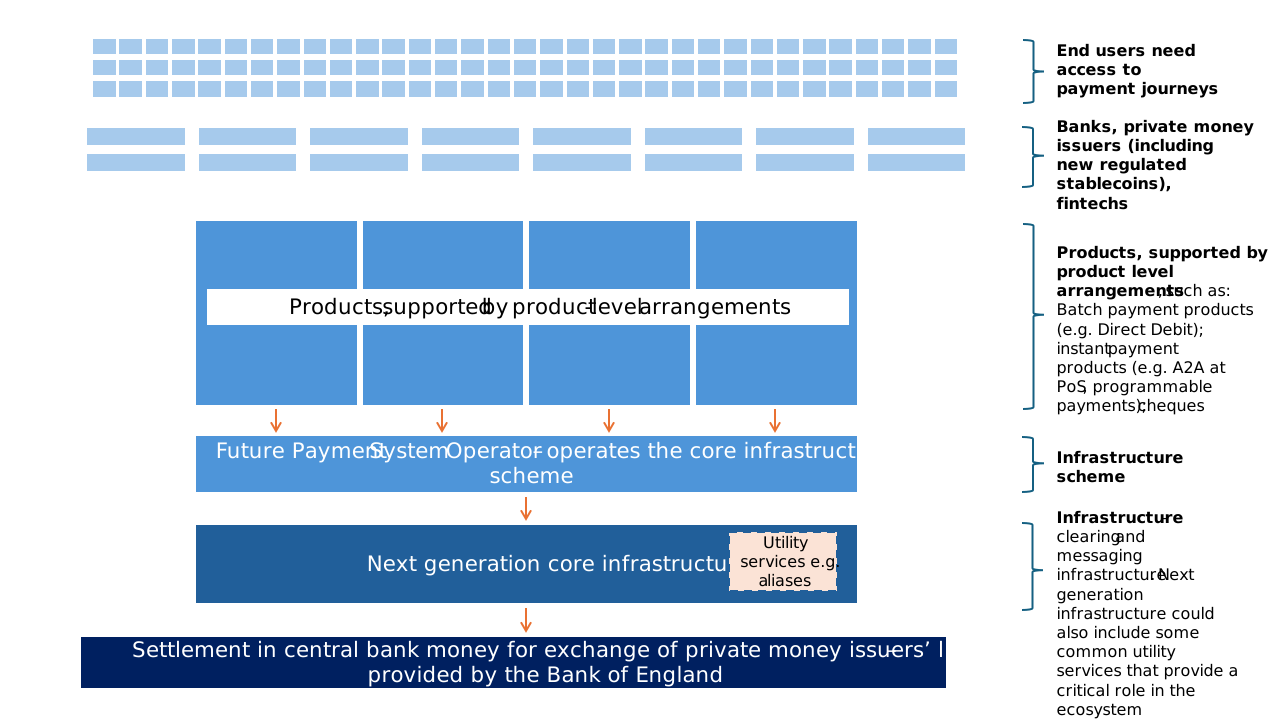
As RPIB and Delivery Company take forward work on the design and delivery of the core infrastructure, the PVDC will continue to engage across the payments ecosystem on the issues outlined in this document.
7. Glossary of terms
Common standards: Shared technical, operational and service requirements that enable participants in the payments ecosystem to interact consistently and interoperable. These can include standards for messaging and data, participant interactions, timing and service levels, security and fraud controls, and other requirements needed to support safe, efficient and reliable payments across the ecosystem, for example agreed approaches to using ISO 20022 message formats, or requirements for participants to respond to payment requests within defined timeframes.
Core infrastructure: The core infrastructure, or next generation core infrastructure, is the UK’s new retail payments infrastructure for clearing and messaging technology systems that support the exchange of payment information and the determination of inter-participant obligations prior to settlement. Subject to the RPIB Consultation, the Core Infrastructure could also include other ecosystem-critical utility services, such as directories, digital identity and alias services.
Core infrastructure scheme: A scheme governing the shared core infrastructure, including common standards, rules and coordination across participants.
Designation: The process by which HM Treasury determines that a payment system is to be designated for regulation by the Payment Systems Regulator (PSR) under Part 5 of the Financial Services (Banking Reform) Act 2013.
Infrastructures: the technologies and systems that enable the transfer and exchange of liabilities when a payment is made, including clearing and messaging functions; and settlement. They provide the technical foundations through which payments flow.
Interface body: A term used in the Data Use and Access Act 2025 to capture, among other things, a body that sets or maintains standards or other arrangements for the purposes of enabling a person to access account data and/or functionality on behalf of a customer.
Product level arrangements: A set of rules and standards for a specific payment product or payment journey, defining how that use case operates in practice across multiple payment service providers and enabling competition at the product layer. Examples include payment initiation, consumer protection, dispute resolution, liability, merchant acceptance and fee structures.
Payment product: A user-facing payment use case (e.g. account-to-account retail or point-of-sale payments), forming part of the competitive product layer. For example, a Bacs Direct Debit.
Payment service provider (PSP): Defined in the Payments Services Regulations 2017. An entity that provides payment services to end users or other participants, subject to applicable regulatory requirements. For example, e-money firms and payment institutions.
Payment system: Defined under the Financial Services (Banking Reform) Act 2013 and the Banking Act 2009. A system, arrangement, or proposed arrangement, designed to facilitate or control the transfer of money between participants (such as individuals, businesses, and financial institutions) or digital settlement assets. This does not include arrangements for the physical movement of cash.
Payment system operator (PSO): An entity responsible for managing or operating a payment system. A payment system may be recognised for regulation by the Bank of England and/or designated for regulation by the Payment Systems Regulator by HMT.
Recognition: The process by which HM Treasury determines a payment system is systemically important in the UK and is subject to the Bank of England’s regulation under the powers in Part 5 of the Banking Act 2009.
Scheme: a common framework through which participants adhere to consistent rules and operating arrangements – maintaining the integrity of the ecosystem and supporting the viability of payments at scale.
-
RPIB consultation on the Design of the Future Retail Payments Infrastructure ↩
-
Kernel refers to a secure, scheme-specific software module in a payment terminal that manages the interaction with a customer’s payment method (such as a card or an NFC tap) during a transaction ↩
-
As is the case today, there would likely be different options for how entities could access the core infrastructure ↩
-
Examples of these technical standards may include ISO 37003 (Fraud Control Management), ISO 37013 (AML Management), and X9 standards for data protection and secure cryptography. ↩
-
See glossary for further explanation of the terms “Designation” and “Recognition” ↩
-
Examples of common standards could include minimum protections, liability clarity, common principles for refunds and disputes ↩