
National Monitoring Plan for POAO: Data Analysis Report 2022-23 - Introduction
Published 14 March 2024
Applies to England, Northern Ireland and Wales

© Crown copyright 2024
This publication is licensed under the terms of the Open Government Licence v3.0 except where otherwise stated. To view this licence, visit nationalarchives.gov.uk/doc/open-government-licence/version/3 or write to the Information Policy Team, The National Archives, Kew, London TW9 4DU, or email: psi@nationalarchives.gov.uk.
Where we have identified any third party copyright information you will need to obtain permission from the copyright holders concerned.
This publication is available at https://www.gov.uk/government/publications/national-monitoring-plan-for-poao-data-analysis-report-2022-23/national-monitoring-plan-for-poao-data-analysis-report-2022-23-introduction
National Monitoring Plan (NMP) data for products of animal origin (POAO) has been sourced from the Import of Products, Animals, Food and Feed System (Opens in a new window) (IPAFFS), GB’s replacement for the EU’s TRACES system (Opens in a new window).
NMP samples have been identified where the ‘random’ button has been selected on the ‘checks’ tab, as advised by the Food Standards Agency’s (FSA) Trade Facilitation Unit. To be aware that not all random samples recorded on IPAFFS are necessarily taken for the NMP, for example those testing for speciation or authenticity are not normally included here. As a result, extracting the NMP data from IPAFFS has necessitated a certain amount of data cleansing.
1. Overview of sampling carried out
During this period, a total of 2,212 samples were identified as being taken under the POAO NMP. These were against the following hazard categories:
- Veterinary residues
- Microbiological
- Heavy metals
- Chemical contaminants
- Biotoxins
There is also a summary for NMP sampling of dog or cat food and for other product types not for human consumption also classed as pet food. Otherwise, feed for animals destined for the food chain is not included in the NMP.
1.1 Figure 1 - Samples taken by hazard
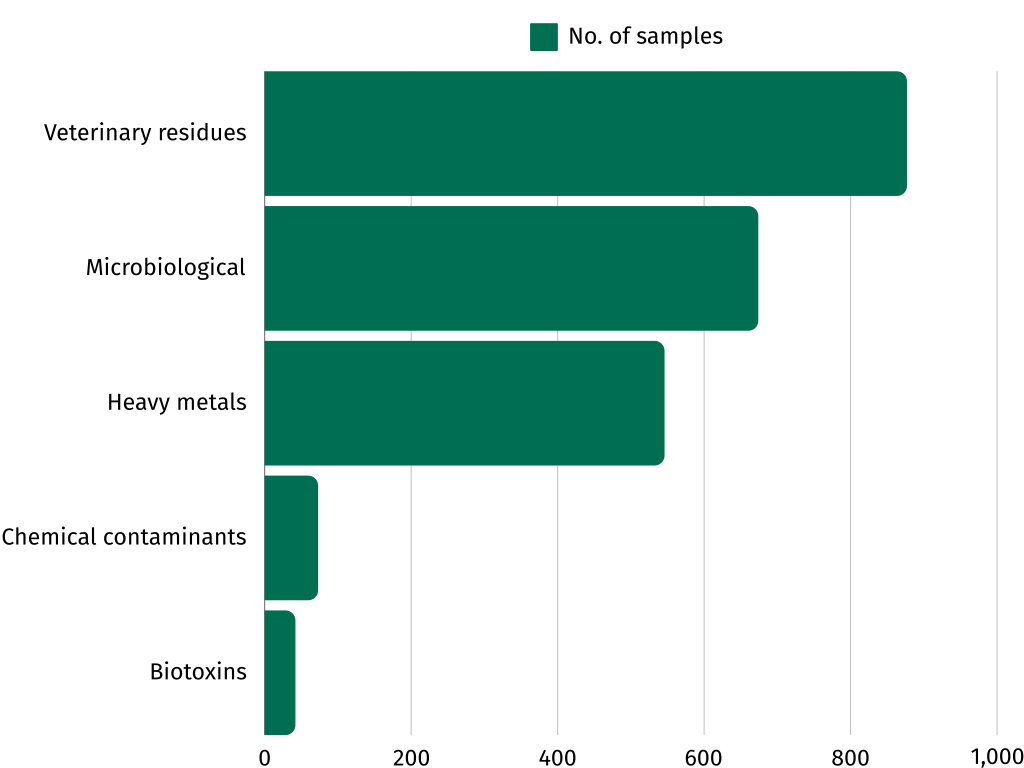
Samples taken by hazard and percentages of total
| Hazard | Number of samples | Percentage |
|---|---|---|
| Veterinary residues | 877 | 40 |
| Microbiological | 674 | 30 |
| Heavy metals | 546 | 25 |
| Chemical contaminants | 73 | 3 |
| Biotoxins | 42 | 2 |
| Total | 2,212 | 100% |
As we can see in figure 1, the majority of the samples taken were for veterinary residues (877 or 40%), followed by microbiological hazards (674 or 30%); heavy metals (546 or 25%); chemical contaminants (73 or 3%) and biotoxins (42 or 2%). These ratios closely match those in the same categories in the previous twelve-months reporting period, except for veterinary residues where sampling has decreased by 10%, and heavy metals where sampling has doubled. The total amount of sampling (2,212 samples) is an increase compared with the previous period (1,254 samples), possibly to do with continued increased activity since the decline of the Covid-19 pandemic.
As figure 2 shows, consignments from 42 countries were sampled, most frequently from India (304 or 14%), Thailand (289 or 13%), China (281 or 13%), Vietnam (211 or 10%), Sri Lanka (149 or 7%), New Zealand (98 or 4%), Brazil (92 or 4%), Myanmar (88 or 4%) and Pakistan (82 or 4%).
1.2 Figure 2 - Percentage of samples taken by country of origin
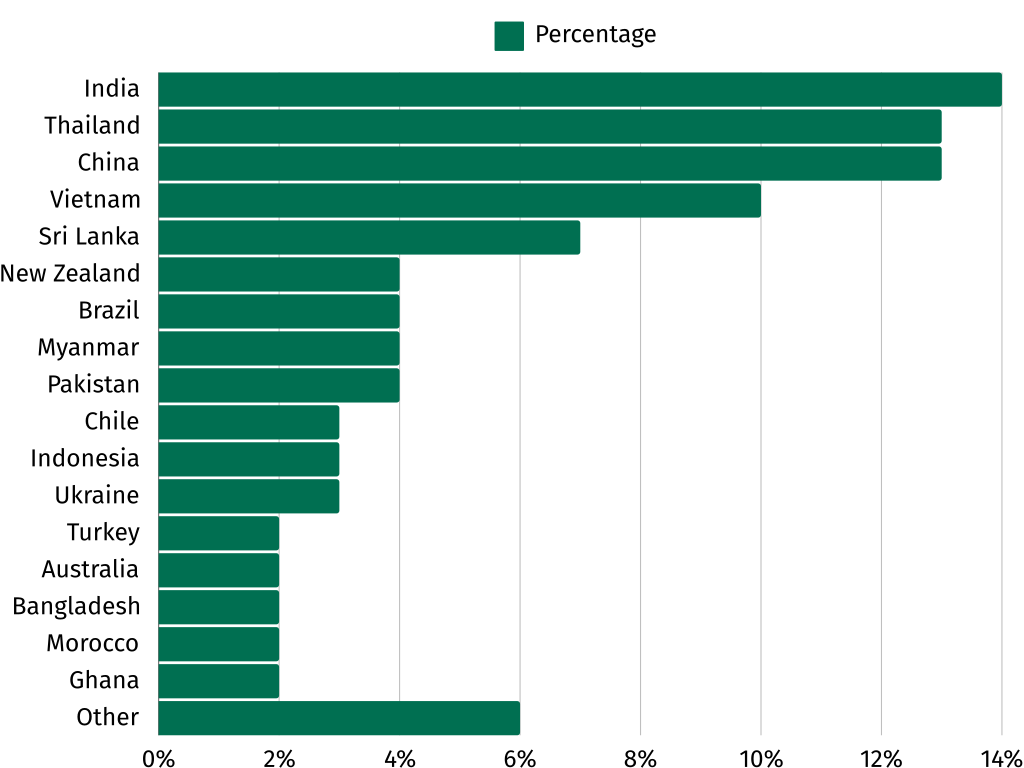
Percentage of samples taken by country of origin
| Country of origin | Number of samples | Percentage |
|---|---|---|
| India | 304 | 14% |
| Thailand | 289 | 13% |
| China | 281 | 13% |
| Vietnam | 211 | 10% |
| Sri Lanka | 149 | 7% |
| New Zealand | 98 | 4% |
| Brazil | 92 | 4% |
| Myanmar | 88 | 4% |
| Pakistan | 82 | 4% |
| Chile | 76 | 3% |
| Indonesia | 64 | 3% |
| Ukraine | 64 | 3% |
| Turkey | 54 | 2% |
| Australia | 53 | 2% |
| Bangladesh | 49 | 2% |
| Morocco | 48 | 2% |
| Ghana | 35 | 2% |
| Falklands Islands* | 20 | 1% |
| Serbia* | 19 | 1% |
| Argentina* | 14 | 1% |
| Ecuador* | 14 | 1% |
| United States* | 13 | 1% |
| Seychelles* | 12 | 1% |
| South Korea* | 11 | 0% |
| Macedonia* | 8 | 0% |
| Papua New Guinea* | 8 | 0% |
| South Africa* | 7 | 0% |
| Israel* | 6 | 0% |
| Peru* | 6 | 0% |
| Philippines* | 5 | 0% |
| Mauritius* | 4 | 0% |
| Mexico* | 4 | 0% |
| Paraguay* | 4 | 0% |
| Taiwan* | 4 | 0% |
| Canada* | 3 | 0% |
| Nicaragua* | 3 | 0% |
| Uruguay* | 3 | 0% |
| Colombia* | 2 | 0% |
| Namibia* | 2 | 0% |
| Honduras* | 1 | 0% |
| Maldives* | 1 | 0% |
| Venezuela* | 1 | 0% |
| Total | 2212 | 100% |
Please note, countries that have been sampled at less than 2% are classed together as ‘other’ in the figure 2 chart.
Samples were taken from 17 product categories. During this period, fish accounted for 617 samples, with 462 for poultry and 427 for crustaceans. Compared with the previous period, in 2021-22 there was higher sampling of fish (330 samples) and crustaceans (199 samples), while poultry sampling remained largely unchanged.
1.3 Figure 3 - Samples taken by product category and percentage of total

Samples taken by product category & percentage of total
| Country of origin | Number of samples | Percentage |
|---|---|---|
| Fish | 617 | 28% |
| Poultry | 462 | 21% |
| Crustaceans | 427 | 19% |
| Bovine | 102 | 5% |
| Gelatin | 102 | 5% |
| Ovine | 102 | 5% |
| Pet food | 85 | 4% |
| Honey | 71 | 3% |
| Milk & milk products | 68 | 3% |
| Shellfish | 66 | 3% |
| Molluscs | 40 | 2% |
| Eggs | 36 | 2% |
| Others | 34 | 2% |
| Total | 2,212 | 100% |
Of the samples taken, a total of forty-three were found to be non-compliant (1.9% compared to 0.6% in the previous period). There were non-compliances in the following hazard categories: chemical contaminants, heavy metals, microbiological and veterinary residues, compared with eight non-compliances in the previous period.
1.4 Figure 4 - Non-compliances by country of origin, product and hazard
| Country | Product type | Product category | Hazard category | Hazard | Non-compliances |
|---|---|---|---|---|---|
| Australia | Ovis aries | Ovine | Microbiological | Eschericia coli | 4 |
| Bangladesh | Scylla serrata | Crustaceans | Veterinary residues | Pesticide residues | 1 |
| Chile | Pesca | Pet food | Microbiological | Enterobacteriaceae | 1 |
| China | Invertebrata | Pet food | Microbiological | Enterobacteriaceae | 2 |
| Ghana | Clupea harengus Clarias spp, Otra pesca, Sphyraena barracuda, Tilapia spp | Fish | Chemical Contaminants | Benzo-a-pyrene | 6 |
| India | Nemipterus spp | Fish | Microbiological | Eschericia coli | 1 |
| India | Nemipterus spp | Fish | Microbiological | Staphylococcus coagulase + | 1 |
| New Zealand | Ovis aries | Ovine | Microbiological | Eschericia coli (STEC) | 2 |
| Pakistan | Pesca (dried fish maws for manufacture of isinglass) | Fish | Microbiological | Salmonella spp. | 1 |
| Thailand | Octopus dollfusi | Molluscs | Heavy metals | Cadmium Cd | 1 |
| Thailand | Dog or cat food | Pet food | Microbiological | Enterobacteriaceae | 1 |
| Ukraine | Aves | Poultry | Microbiological | Salmonella spp. | 2 |
| Vietnam | Penaeus vannamei | Crustaceans | Microbiological | Aerobic colony count at 30 ºC for 48h | 1 |
| Vietnam | Penaeus vannamei | Crustaceans | Microbiological | Coagulase Positive Staphylococci | 1 |
| Vietnam | Penaeus vannamei | Crustaceans | Microbiological | Enterobacteriaceae | 1 |
| Vietnam | Penaeus vannamei | Crustaceans | Microbiological | Escherichia coli | 1 |
| Vietnam | Penaeus vannamei | Crustaceans | Microbiological | Listeria monocytogenes | 1 |
| Vietnam | Penaeus vannamei | Crustaceans | Microbiological | Listeria species (total) | 1 |
| Vietnam | Penaeus vannamei | Crustaceans | Microbiological | Salmonella species | 1 |
| Vietnam | Penaeus vannamei | Crustaceans | Microbiological | Vibrio species | 1 |
| Vietnam | Clarias gariepinus Pangasius hypophthalmus, Barbonymus spp, Corica soborna, Eleotris melanosome, Channa striata | Fish | Veterinary residues | Antibacterials | 6 |
| Vietnam | Otra crustacea | Crustaceans | Veterinary residues | Antibacterials | 1 |
| Vietnam | Clarias macrocephalus | Fish | Veterinary residues | Malachite green | 1 |
| Vietnam | Clarias macrocephalus | Fish | Veterinary residues | Malachite green-Leuco | 1 |
| Vietnam | Penaeus vannamei, Penaeus Litopenaeus vannamei, Litopenaeus vannamei | Crustaceans | Veterinary residues | Other pharmacologically active substances | 3 |
2. Sampling for veterinary residues
There were 877 samples from 28 countries taken and checked for the presence of veterinary residues. There were thirteen non-compliant results for Antibacterials, Malachite green, Malachite green-Leuco, Other pharmacologically active substances, and Pesticide residues from Bangladesh and Vietnam.
The greatest number of veterinary residue samples were taken from China (153 or 17%), followed by India (120 or 14%), Vietnam (120 or 14%), Thailand (78 or 9%), and Brazil (73 or 8%). Countries marked with an asterisk on the table are shown together as ‘other’ on the graph chart.
2.1 Figure 5 - Samples taken by country of origin and percentage of total

Figure 5 - Samples taken by country of origin and percentage of total
| Country of origin | Number of samples | Percentage |
|---|---|---|
| China | 153 | 17% |
| India | 120 | 14% |
| Vietnam | 120 | 14% |
| Thailand | 78 | 9% |
| Brazil | 73 | 8% |
| New Zealand | 54 | 6% |
| Turkey | 47 | 5% |
| Ukraine | 45 | 5% |
| Australia | 40 | 5% |
| Myanmar | 32 | 4% |
| Bangladesh | 29 | 3% |
| Chile | 21 | 2% |
| Falkland Islands | 20 | 2% |
| United States* | 9 | - |
| Israel* | 6 | - |
| Ecuador* | 5 | - |
| Mexico* | 4 | - |
| Philippines* | 3 | - |
| Nicaragua* | 3 | - |
| Canada* | 3 | - |
| Uruguay* | 2 | - |
| Namibia* | 2 | - |
| Sri Lanka* | 2 | - |
| Morocco* | 2 | - |
| Indonesia* | 1 | - |
| Venezuela* | 1 | - |
| Pakistan* | 1 | - |
| Honduras* | 1 | - |
| Total | 877 | 100% |
Of the samples tested for veterinary residues, the highest numbers were for nitrofurans (124), chloramphenicol (123) followed by tetracyclines (96), avermectins (58), coccidiostats (49), macrolides (43) and antibacterials (42).
2.2 Figure 6 - Samples tested for veterinary residues
A table of two columns and 50 rows
| Substance | Number of samples |
|---|---|
| Nitrofurans | 124 |
| Chloramphenicol | 123 |
| Tetracyclines | 96 |
| Avermectins | 58 |
| Coccidiostats | 49 |
| Macrolides | 43 |
| Antibacterials | 42 |
| Other Pharmacologically Active Substances | 37 |
| Sulfonamides | 37 |
| Benzimidazoles | 27 |
| Quinolones | 27 |
| Dyes | 23 |
| Beta-lactamics | 22 |
| Pesticides residues | 20 |
| Anticoccidials including nitroimidazoles | 19 |
| Nitromidazoles (group) | 18 |
| Phenicoles | 17 |
| Streptomycin | 12 |
| Beta-agonists (screening multisubstances) | 6 |
| Doxycyclin | 6 |
| Oxytetracyclin | 6 |
| Sulfamides/Sulfonamidess | 6 |
| AMOZ | 5 |
| AOZ | 5 |
| Chlortetracyclin | 4 |
| Moxidectin | 4 |
| Sulphadimidine | 4 |
| Trimethoprim | 4 |
| Malachite Green | 3 |
| Aminoglycoside/Aminoside | 2 |
| Diclazuril | 2 |
| Epi-Chlortetracycline | 2 |
| Erythromycin | 2 |
| Lasalocid | 2 |
| Neomycin | 2 |
| Nicarbazin | 2 |
| Quinolones/Fluoroquinolones | 2 |
| Trenbolone | 2 |
| Tylosin | 2 |
| Zeranol (Alpha-Zearalanol) | 2 |
| Abamectin (Avermectin B1) | 1 |
| Anthelmintics | 1 |
| Cephalosporins | 1 |
| Cupper Cu | 1 |
| Malachite Green-Leuco | 1 |
| Organochlorine compounds inc PCBs | 1 |
| Penicillins (group) | 1 |
| Steroids | 1 |
| Total | 877 |
3. Sampling for microbiological contamination
There were 674 samples from 23 countries taken and checked for the presence of microbiological contamination. There were twenty three non-compliant results identified: one each for Aerobic colony count at 30 ºC for 48h, Coagulase Positive Staphylococci, 5 each for Enterobacteriaceae & Eschericia coli, 3 for Eschericia coli (STEC), one each for Listeria monocytogenes, Listeria species (total), Salmonella species, 3 for Salmonella spp., one for Staphylococcus coagulase + and one for Vibrio species, all from Australia, Chile, China, India, New Zealand, Pakistan, Thailand, Ukraine and Vietnam.
The greatest number of microbiological samples were taken from Thailand (192 or 28%), China (114 or 17%), Vietnam (69 or 10%), Indonesia (57 or 8%), Chile (45 or 7%), India (38 or 6%), New Zealand (28 or 4%), Ukraine (10 or 3%) Serbia (19 or 3%), Brazil (17 or 3%), Bangladesh (16 or 2%), Myanmar (16 or 2%) and Australia (13 or 2%). Countries marked with an asterisk in the table are shown together as ‘other’ on the chart.
3.1 Figure 7 - Samples taken by country of origin and percentages of total

Figure 7 - Samples taken by country of origin and percentages of total
| Country of origin | Number of samples | Percentage |
|---|---|---|
| Thailand | 192 | 28 |
| China | 114 | 17 |
| Vietnam | 69 | 10 |
| Indonesia | 57 | 8 |
| Chile | 45 | 7 |
| India | 38 | 6 |
| New Zealand | 27 | 4 |
| Ukraine | 19 | 3 |
| Serbia | 19 | 3 |
| Brazil | 17 | 3 |
| Bangladesh | 16 | 2 |
| Myanmar | 16 | 2 |
| Australia | 13 | 2 |
| South Korea* | 9 | - |
| Macedonia* | 8 | - |
| United States* | 3 | - |
| Turkey* | 3 | - |
| Colombia* | 2 | - |
| Paraguay* | 2 | - |
| South Africa* | 2 | - |
| Pakistan* | 1 | - |
| Morocco* | 1 | - |
| Uruguay* | 1 | - |
| Total | 674 | 100% |
Of the samples tested for microbiological contamination, the highest numbers were for Salmonella (122), followed by Enterobacteriaceae (106), Listeria monocytogenes (68), Eschericia coli (67), aerobic microorganisms 30°C (40), Staphylococcus aureus (32) and Clostridium perfringens (26).
3.2 Figure 8 - Samples tested for microbiological contamination
| Hazard | Number of samples |
|---|---|
| Salmonella spp. | 122 |
| Enterobacteriaceae | 106 |
| Listeria monocytogenes | 68 |
| Eschericia coli | 67 |
| Aerobic microorganisms 30°C | 40 |
| Staphylococcus aureus | 32 |
| Clostridium perfringens | 26 |
| Listeria spp (excl L. monocytogenes) | 24 |
| Aerobic colony count at 30 ºC for 48h | 23 |
| Listeria species (total) | 22 |
| Salmonella species | 20 |
| Vibrio species | 19 |
| Coagulase Positive Staphylococci | 17 |
| Campylobacter (C.jejuni, C.coli) | 13 |
| Campylobacter spp (excl C. jejuni and C.coli) | 8 |
| Eschericia coli (STEC) | 8 |
| Staphylococci | 8 |
| E. coli | 6 |
| Listeria spp | 6 |
| Salmonella | 6 |
| Staphylococcus coagulase + | 6 |
| AHD | 5 |
| Vibrio parahaemolyticus | 5 |
| Vibrio | 4 |
| ACC’s | 2 |
| Coagulase Positive | 2 |
| Listeria species | 2 |
| Vibrio vulnificus | 2 |
| ß-Glucuronidase Positive Escherichia coli | 2 |
| Bacillus cereus | 1 |
| Staphylococcal enterotoxins | 1 |
| Sterility | 1 |
| Total | 674 |
4. Sampling for heavy metals
There were 546 samples from 22 countries taken and checked for the presence of heavy metals. There was one non-compliant sample for Cadmium Cd from Thailand.
The greatest number of heavy metal samples were taken from India (137 or 25%), followed by Sri Lanka (129 or 24%), Pakistan (66 or 12%), Morocco (40 or 7%) and Myanmar (40 or 7%). Countries marked with an asterisk in the table are shown together as ‘other’ on the chart.
4.1 Figure 9 - Samples taken by country of origin and percentage of total

Figure 9 - Samples taken by country of origin and percentage of total
| Country of origin | Number of samples | Percentage |
|---|---|---|
| India | 137 | 25% |
| Sri Lanka | 129 | 24% |
| Pakistan | 66 | 12% |
| Morocco | 40 | 7% |
| Myanmar | 40 | 7% |
| Ghana | 16 | 3% |
| Argentina | 14 | 3% |
| New Zealand | 14 | 3% |
| Thailand | 14 | 3% |
| Vietnam | 12 | 2% |
| Chile* | 8 | - |
| China* | 8 | - |
| Ecuador* | 8 | - |
| Seychelles* | 8 | - |
| Papua New Guinea* | 7 | - |
| Bangladesh* | 4 | - |
| Indonesia* | 4 | - |
| Peru* | 4 | - |
| South Africa* | 4 | - |
| Taiwan* | 4 | - |
| Turkey* | 4 | - |
| Brazil* | 1 | - |
| Total | 546 | 100% |
Of the samples tested for heavy metals, the highest numbers were for cadmium Cd (178) followed by mercury Hg (144), lead Pb (120) and arsenic As (72).
4.2 Figure 10 - Samples tested for heavy metals
| Hazard | Number of samples |
|---|---|
| Cadmium Cd | 178 |
| Mercury Hg | 144 |
| Lead Pb | 120 |
| Arsenic As | 72 |
| Zinc Zn | 12 |
| Chromium Cr | 11 |
| Copper Cu | 8 |
| Tin for canned products | 1 |
| Total | 546 |
5. Sampling for chemical contaminants
There were 73 samples from 11 countries taken and checked for the presence of chemical contaminants. There were six non-compliant samples for Benzo-a-pyrene from Ghana.
The greatest number of chemical contaminant samples were taken from Ghana (19 or 26%) followed by Pakistan (14 or 19%) and Sri Lanka (13 or 18%).
5.1 Figure 11 - Samples taken by country of origin and percentage of total

Figure 11 - Samples taken by country of origin and percentage of total
| Country of origin | Number of samples | Percentage |
|---|---|---|
| Ghana | 19 | 26% |
| Pakistan | 14 | 19% |
| Sri Lanka | 13 | 18% |
| India | 9 | 12% |
| Vietnam | 6 | 8% |
| China | 4 | 5% |
| New Zealand | 3 | 4% |
| Paraguay | 2 | 3% |
| Brazil | 1 | - |
| Maldives | 1 | - |
| South Africa | 1 | - |
| Total | 73 | 100% |
Of the samples tested for chemical contaminants, the highest numbers were for dioxins (21), followed by benzo-a-pyrene (15), and sulphur dioxide (SO2) (10).
5.2 Figure 12 - Samples tested for chemical contaminants
| Hazard | Number of samples |
|---|---|
| Dioxins | 21 |
| Benzo-a-pyrene | 15 |
| Sulphur dioxide (SO2) | 10 |
| Hydrogen peroxide (H2O2) | 8 |
| Bisphenol A | 5 |
| SEM (semicarbazide) | 5 |
| Chlorate and Perchlorate | 4 |
| PCB sum | 3 |
| Polyphosphates STPP (E452) | 2 |
| Total | 73 |
6. Sampling for biotoxins
There were 42 samples from 15 countries taken and checked for the presence of biotoxins. There were no non-compliant samples.
The greatest number of biotoxin samples were taken from Morocco (5 or 12%), Sri Lanka (5 or 12%) and Thailand (5 or 12%).
6.1 Figure 13 - Samples taken by country of origin and percentage of total

Figure 13 - Samples taken by country of origin and percentage of total
| Country of origin | Number of samples | Percentage |
|---|---|---|
| Morocco | 5 | 12% |
| Sri Lanka | 5 | 12% |
| Thailand | 5 | 12% |
| Mauritius | 4 | 10% |
| Seychelles | 4 | 10% |
| Vietnam | 4 | 10% |
| Chile | 2 | 5% |
| China | 2 | 5% |
| Indonesia | 2 | 5% |
| Peru | 2 | 5% |
| Philippines | 2 | 5% |
| South Korea | 2 | 5% |
| Ecuador | 1 | 2% |
| Papua New Guinea | 1 | 2% |
| United States | 1 | 2% |
| Total | 42 |
7. Sampling of pet food
There were 87 samples from 8 countries taken and checked for Enterobacteriaceae and Salmonella spp.
There were four non-compliant results for Enterobacteriaceae from China (2), Thailand (1) and Chile (1). The greatest number pet food samples was taken from China (52 or 60%) and Chile (18 or 21%).
7.1 Figure 14 - Samples taken by country of origin and percentage of total
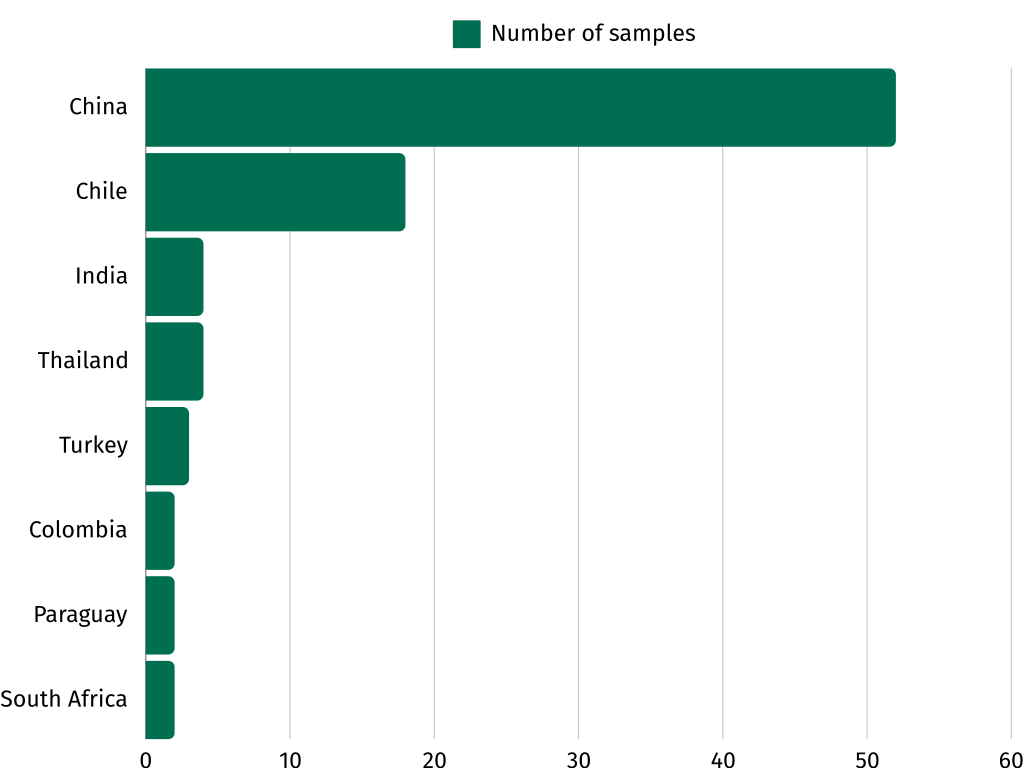
Figure 14 - Samples taken by country of origin and percentage of total
| Country of origin | Number of samples | Percentage |
|---|---|---|
| China | 52 | 60% |
| Chile | 18 | 21% |
| India | 4 | 5% |
| Thailand | 4 | 5% |
| Turkey | 3 | 3% |
| Colombia | 2 | 2% |
| Paraguay | 2 | 2% |
| South Africa | 2 | 2% |
| Total | 87 | 100% |
Of the samples of dog or cat food tested, the highest number of tests was for Salmonella spp (45).
7.2 Figure 15 - Samples of pet food tested
| Hazard | Number of samples |
|---|---|
| Salmonella spp. | 45 |
| Enterobacteriaceae | 42 |
| Total | 87 |