National Data Library Report
Published 15 April 2026

© Crown copyright 2026
This publication is licensed under the terms of the Open Government Licence v3.0 except where otherwise stated. To view this licence, visit nationalarchives.gov.uk/doc/open-government-licence/version/3 or write to the Information Policy Team, The National Archives, Kew, London TW9 4DU, or email: psi@nationalarchives.gov.uk.
Where we have identified any third party copyright information you will need to obtain permission from the copyright holders concerned.
This publication is available at https://www.gov.uk/government/publications/national-data-library-report-research-into-public-attitudes-towards-government-data-sharing/national-data-library-report
Executive summary
The Department for Science, Innovation and Technology (DSIT) commissioned Ipsos UK to provide qualitative research to inform the discovery phase of the development of the National Data Library (NDL). To understand the general public’s initial perceptions and their level of support for the NDL, Ipsos conducted ten online focus groups, alongside ten depth interviews between 11 February and 5 March 2025.
Communicating the National Data Library
-
Transparency was seen as paramount for building trust and acceptance of the NDL. Participants strongly desired clear communication about who could have access to what data and for what purposes. They felt the public should be engaged in ongoing consultations to address concerns. While participants wanted transparency, they cautioned against information overload which could disengage the public.
-
Demonstrating tangible, personal benefits was seen as key to securing public support. Participants emphasised the importance of communicating how the NDL will positively impact their individual lives, not just society at large. Those in devolved nations also wanted clear communication about plans explaining how any benefits reached beyond England.
-
Opinions diverged on the ideal frequency of NDL progress updates, ranging from communication at key milestones to more regular updates to build trust.
-
Particular attention should be paid to engaging groups who may need additional support, such as older people, those who are digitally excluded, and schoolchildren. Participants emphasised the importance of building understanding among these audiences due to their vulnerabilities, with targeted engagement strategies and tailored materials.
-
In particular, digitally excluded participants strongly emphasised the need to have information about the NDL in physical spaces. They often suggested partnering with trusted public service broadcasters to communicate about the NDL through news segments and documentaries.
General attitudes towards government data sharing
-
There was recognition of the potential benefit to improve public services in connection with cross-government data sharing. However, participants often struggled to spontaneously identify any further benefits. Benefits were also often outweighed by concerns about data privacy and misuse.
-
Lack of trust and scepticism towards the government underpinned participants’ perceptions of government data sharing and use. Participants felt uninformed about the legalities and mechanisms of government data sharing, feeling they had little control.
-
There was a widespread assumption the government already collects and shares vast amounts of data, despite the reality being more limited.
-
Awareness and attitudes were shaped by personal experiences including professional familiarity with data sharing (and associated regulations) and interactions with public services, especially in relation to health or welfare.
-
Demographic factors also had an influence. Participants from higher social grades tended to be more inquisitive about the extent of government data sharing, whereas digitally excluded groups drew more on direct experiences of fragmented public services and had limited awareness of current data sharing practices.
Reactions to the National Data Library
-
Initial associations with the term “National Data Library” evoked concerns about a central repository of data with public access, shaping participants’ scepticism towards the initiative. The use of the word “library” significantly influenced these concerns.
-
Limited information and detail about the NDL meant attitudes were heavily influenced by broader views on government data sharing, public service experiences, and technological engagement.
-
Despite recognising potential public service improvements from data sharing facilitated via the NDL, participants often defaulted to questioning whether the government has undisclosed intentions.
-
Providing information about the NDL’s proposed design as an access facilitator rather than a centralised repository helped alleviate some concerns. However, misconceptions persisted about it being a central store of data, with participants often returning to this perception of the NDL despite being told otherwise.
-
Participants’ professional exposure to data sharing and technology strongly influenced their ability to understand the NDL’s potential benefits and applications. This was the case across all social grades and region.
Rules and governance for the NDL
-
Participants often suggested rules for the NDL spontaneously which were in line with their understanding of general data sharing. Their suggestions overlapped with the proposed rules for the NDL, apart from the Trusted Research Environment which participants were less familiar with. Hearing that the NDL would strictly adhere to legal requirements and GDPR was also reassuring.
-
There was a desire for greater clarity about the governance of the NDL. Participants felt the purpose of facilitating data sharing via the NDL should be in the public interest, and they sought rules about who could have access and for what purpose especially if this involved bodies outside of the public sector.
-
There was a preference for the NDL to primarily grant access to anonymised or aggregate data to reduce the potential for harm and ensure qualified and authorised access only.
-
Participants wanted the public to have influence over how the NDL would be managed, the mechanisms in place to do this and any subsequent instances of data sharing. This included opportunities to give their consent to opt-in or out.
Introduction
Background to the research
The Department for Science, Innovation and Technology (DSIT) commissioned Ipsos UK to provide qualitative research to inform the discovery phase of the development of the National Data Library (NDL). In the future, it could help to make public data more accessible to a range of different users such as analysts, researchers, innovators, and policy makers.
The purpose of this research was to understand the level of public support for the government creating the NDL, alongside public perceptions of the potential challenges and opportunities of the platform. To that end, the research explored:
- Baseline levels of trust that the UK public has towards the government’s use of data, and data sharing across government, private companies, academia and NGOs.
- Values and priorities that the public hold regarding the government’s use of data, and how these values can be communicated and embedded into the NDL.
- The public’s concerns on this topic, and the greatest risks to trust for the NDL project.
- Potential interventions, policies and processes to mitigate concerns about the NDL.
To achieve this, Ipsos conducted ten online focus groups, alongside ten depth interviews between 11 February and 5 March 2025. As the NDL is currently in development, participants were provided with a suggested proposition of how the NDL could function and discussed a series of hypothetical scenarios. These were designed to support discussions and do not reflect current UK government policy.
How to read this report
This report details key findings from across the research. Qualitative research is illustrative, exploratory and based on participants’ perceptions. It is not meant to provide statistically representative or quantifiable measures of views. When reading this report, please note:
- We refer to ‘participants’ throughout and provide evidence through anonymised verbatim comments. These should not be interpreted as defining the views of all participants but have been selected to provide insight into the views expressed at a particular point in time.
- Quotations have been attributed to individuals identified by key characteristics including socio-economic grade, nation, and digital exclusion (where relevant).
Participants’ perceptions may not always be based on factual information or may not account for any regulations already in place. It is important to include these perceptions in the way that participants expressed them, as they demonstrate the concerns, expectations and areas of confusion for the public.
General attitudes towards government data sharing
This chapter provides an explanation of the underpinning beliefs that shaped attitudes, alongside participants’ spontaneous views and comfort levels towards current government use, collection and sharing of data.
Chapter findings:
- Lack of trust and scepticism towards the government underpinned participants’ perceptions of government data sharing and use.
- Participants felt uninformed about the legalities and mechanisms of government data sharing, feeling as though they had little control. Providing accessible information in plain language about sharing practices, governance frameworks, and safeguards may help to alleviate concerns.
- There was a widespread assumption that the government already collects and shares vast amounts of data, despite the reality being more limited. This misalignment highlights the need for greater public understanding to help build trust in the NDL.
- Participants easily recognised the potential benefit to improve public services in connection with cross-government data sharing. However, they often struggled to spontaneously identify any further benefits. Benefits were also often outweighed by concerns about data privacy and misuse.
- Awareness and attitudes were influenced by personal experiences including professional familiarity with data sharing (and associated regulations) and interactions with public services, especially in relation to health or welfare.
- Demographic factors also had an influence. Participants from higher social grades tended to be more inquisitive about the extent of government data sharing, whereas digitally excluded groups drew more on direct experiences of fragmented public services and had limited awareness of current data sharing practices.
Views on current government data use
High distrust in the UK government and concerns about data sharing shaped perceptions.
This research was conducted at a time when there is a complex relationship between the public’s distrust in government, frustration with current public service delivery and anxieties about new technologies and infrastructure. Previous quantitative research has shown the public are unsure about the extent to which they are comfortable with their data being shared within government, with 35% saying they would support data sharing between departments where it will lead to improvements or efficiencies, but a similar proportion (39%) oppose data sharing within government, no matter the benefit.[footnote 1]
This is coupled with current low levels of trust in decisionmakers, as seen in Ipsos UK’s most recent Veracity Index, where politicians and Government ministers were the 2 least trusted professions in Britain.[footnote 2] This lack of trust often framed participants’ discussions around government use of public data.
There was a common assumption that government data collection and sharing is happening on a large scale.
Participants consistently believed that personal data is being shared on a large scale across society. This was accompanied by the feeling of a lack of control over where and who their personal data ends up with. There was a general awareness of personal data being collected online, with reference to targeted advertising and digital footprints. These shaped overall perceptions of government data sharing.
Participants often expressed distrust and scepticism towards government data sharing, and the level of data that the government collected about people in their everyday lives. There was a general sense of unease about what exactly the government had data on.
“I think they know absolutely everything about us.” – England, ABC1
“I’d say they have too much information.” – Northern Ireland, C2DE
Government data collection was understood to be extensive and varied, both at an individual and wider societal level. Participants believed this included collecting population statistics and personal information, such as contact details, demographics, employment history, financial information and health data. There was a commonly held view that this data had been collected across their lifetime through interactions with public services and, in more recent years, online activity. This included data linked to apps, online shopping or social media accounts that they believed the government could have access to.
“I think they hold a lot of data across all services. From loyalty cards to public bodies. They could probably work out a full profile, what you do in a day, they could tell everything. “ – Scotland, C2DE
Participants generally believed the government collected a similar amount of data about businesses, from information shared via Companies House and tax forms. This was an area participants were often less familiar with compared to individual level data and found it difficult to articulate what the benefits of collecting data on businesses could be.
Views on current cross-government data sharing
There was an expectation that data sharing is already happening between government departments and public services.
This was demonstrated through a small number of cases based on participants’ personal experiences. For example, one participant shared how government data sharing had been beneficial to them when Student Finance had issued a refund on their loan. They believed this was due to HMRC sharing data about their earnings with the Student Loans Company.
“I’m not too bothered about that and them letting me know I’m due that refund. It works in my favour so I’m happy for that information to be shared because it’s my information.” – England, ABC1
Participants in Welsh focus groups in particular, were more comfortable than other regions with government data sharing, often feeling that any information held about them by public services would be based on information they had personally shared (e.g., information shared at a GP appointment). They believed it would be beneficial for other departments to have access to this information and therefore welcomed greater data sharing.
Participants often spontaneously recognised the potential benefits of greater cross-government data sharing related to their medical records being accessible across different healthcare settings. There was high awareness of medical records as a form of personal data held by public services, and an understanding of the debates around sharing healthcare data. Although this was recognised as a sensitive form of personal data, this was outweighed by the potential benefits to individuals from increased data sharing. For example, easy access to health data in an emergency, more streamlined services between GP and hospital settings and not having to repeat information about yourself to different professionals. In this way, sharing health data was a tangible example of public service data sharing that participants recognised as having clear benefits.
However, participants also described experiences which they felt highlighted the risks of government data sharing. For example, a participant who was unable to work recalled how HMRC had misidentified them as an employed individual, which consequently led to their welfare benefits being stopped. This led to greater hesitation towards government data sharing in general.
“It [benefits being stopped] proved to me that the tax office, the benefits office and the local council are kind of all there together… What worried me was what the tax office done because they totally mucked it all up.” - Wales, C2DE, digitally excluded
In some instances, higher social grade participants suggested that data sharing might not be as widespread as first assumed. They mentioned government departments having siloed systems that do not allow for cross-service sharing.
“I think it could be limited, they’ll have their own systems. I don’t think data sharing is quite as easy and straightforward between departments. I don’t think day to day sharing is as joined up as we think.” – Scotland, ABC1
However, despite the general expectation that government and public services share large amounts of data, participants described personal experiences where they felt data sharing was not being done.
“I had moved to a new doctor surgery, and they had none of my medical information. My whole history of my medical notes had all been lost. The doctors didn’t know nothing about me.” – England, C2DE, digitally excluded
For those who had moved around the UK, this was especially irritating, due to a lack of data sharing across the devolved nations.
“I moved back in with my parents after university, and I had a nightmare with getting them to send doctors records over… With the NHS and health being devolved in Wales, I found that was really bad and they didn’t share enough information with each other.” – Wales, C2DE
Participants were unsure about how government data sharing is carried out, impacting their trust in the current practices.
Participants mentioned general ideas about data sharing “systems” and “databases” but ultimately were unsure of how this occurs. They expressed that whilst they hoped the government did not share data with outside organisations, particularly with private companies, they thought it was likely the government did so.
The exact legalities with which data sharing took place were not well understood, although participants generally (but not always) assumed it was happening in accordance with the law. In some instances, participants questioned whether the government is sharing data responsibly. This was linked to participants’ feeling of being uninformed about current data sharing and wider distrust in government. This made them question the reasons behind a perceived lack of transparency, feeling that they personally did not understand what current practice looks like.
“If they were being responsible, they would be more upfront… The fact that I don’t know, and I imagine not a lot of people do know… would hint towards there being something hidden in the background.” – Wales, C2DE, digitally excluded
“I think it’s [data sharing] happening, whether it’s happening responsibly we’ll never know.” – Scotland, ABC1
Focus group participants were surprised to hear the government and public services currently share very little data, whereas digitally excluded participants were often not.
On hearing about the limited extent of current data sharing in government, focus group participants often felt this did not align with their perceptions. They believed the government was collecting data about them on a large scale, and they did not understand the purpose of this if not to share information across departments. There was also a sense of disappointment among focus group participants on hearing about the limited extent of current data sharing across government where they felt it could bring benefits to their experiences of public services. Participants in Northern Ireland especially felt that the government was missing key opportunities to utilise data sharing in relation to crime as a way to protect the public.
“They require so much information. From driving licence, to tax, with health, for it not to be shared, I’m surprised it’s not shared.” – Northern Ireland, C2DE
In some instances, participants continued to believe the government shares vast amounts of data, even when told this was not the case, suggesting the engrained nature of these beliefs. This often related to participants’ lack of trust in the government, and in some cases their generalised perceptions of how data sharing occurs. Participants grouped together government data sharing with data sharing via social media and advertising which they saw as pervasive.
“Well, I’d like proof of that [that the government share very little data], to be honest. Saying it’s one thing, isn’t it?” – England, C2DE, digitally excluded
“I find that hard to believe… Sometimes you might get a letter through the post addressed to you, and you think, ‘How do they know my name?’ – England, C2DE
Comparatively, digitally excluded participants were often less surprised to hear that the government currently shares very little data, despite initially believing that data sharing is happening at a high level. This was often linked to personal or second-hand experiences of public services not being effectively joined up (e.g. social services and the criminal justice system, or public transport and local councils).
“It doesn’t surprise me to be honest…I think our government has spent a very, very little amount of money on technology and infrastructure historically.” – England, ABC1, digitally excluded
Perceived benefits and risks of cross government data sharing
Participants spontaneously recognised that increased data sharing could lead to more efficient public services, but enthusiasm for these benefits was curbed due to concerns about data security and misuse.
Key benefits identified spontaneously included:
- Improved public services: A highly attractive benefit was the potential to join up public services, especially in the health and social care sector. For example, GPs, hospitals and specialists all having access to the same information about patients. It was thought this could provide more efficient and streamlined delivery of care. In some cases, particularly for those digitally excluded, participants struggled to spontaneously identify any further benefits to increased government data sharing.
-
Reduction in repeated data entry: Participants saw being able to update all government departments at once about life changes as a potential benefit. For example, they discussed experiences of going through a family bereavement and the difficulty of needing to repeat this to multiple public services.
-
Improved infrastructure: Participants thought data sharing could lead to an increased use of population statistics to target gaps in infrastructure where there is greatest demand, such as increased public transport or housing.
-
Combatting crime: Participants suggested that greater data sharing and linkage could increase public safety by better identifying criminals, such as via improved fraud detection, or allowing for more streamlined background and DBS checks for employers.
This was balanced against a series of potential risks spontaneously identified by participants:
-
Data breaches: The risk of data breaches or hacks compromising personal information was a key concern, with worries about where and with whom personal data could end up.
-
Lack of control: Participants described their inability to stop unwanted data sharing, which raised concerns about misuse if sensitive information were to fall into the “wrong hands.”
-
Loss of privacy: There was a general concern over data sharing resulting in a loss of privacy and discomfort over the potential for this to increase government knowledge about people’s personal lives. This included concerns about the “over-surveillance” of innocent people that could potentially result in individuals being unjustly scrutinised.
-
Inaccurate personal data: Concerns arose for Scottish and Northern Irish participants that government data may unknowingly be incorrect and sharing this could lead to agencies accessing misleading information. They felt this had the potential to harm individuals, such as receiving a poor credit rating from a bank.
-
Increase in fraud: Lower social grade participants showed concern over data sharing leading to individuals being increasingly targeted by fraudulent or scam communications (e.g. scam text messages or letters through doors). Participants were generally concerned about “vulnerable” individuals being personally targeted.
Reactions to the National Data Library
This chapter describes participants’ reactions to the NDL. It sets out their initial views on hearing the term “National Data Library”, followed by more considered reflections based on information shared about its scope and purpose. The section also describes participants’ perceptions towards the potential benefits and risks of the NDL.
Chapter findings
- Initial associations with the term “National Data Library” evoked concerns about a central repository of data with public access, shaping participants’ scepticism towards the initiative. The use of the word “library” significantly influenced these concerns.
- Limited awareness of the NDL meant attitudes were heavily influenced by broader views on government data sharing, public service experiences, and technological engagement. This suggests that clear communications on what the NDL is (or is not) may be valuable for combatting misperceptions.
- Despite recognising potential public service improvements from data sharing facilitated via the NDL, participants often defaulted to questioning the government’s true intentions.
- The gap between spontaneous perceptions of the NDL’s purpose and the government’s stated intentions highlighted the need to emphasise the public benefit case, demonstrate tangible individual value through examples and transparently address concerns.
- Providing information about the NDL’s proposed design as an access facilitator rather than a centralised repository helped alleviate some concerns. However, misconceptions persisted about it being a central store of data, with participants often returning to this perception of the NDL despite being told otherwise. This suggests the name “National Data Library” may anchor views, meaning that sustained and memorable efforts to combat misperceptions are likely to be needed.
- Participants’ professional exposure to data sharing and technology strongly influenced their ability to understand the NDL’s potential benefits and applications. This was the case for both social grades and region. Tailoring communications to different levels of data literacy and technical understanding will be important in communicating the NDL.
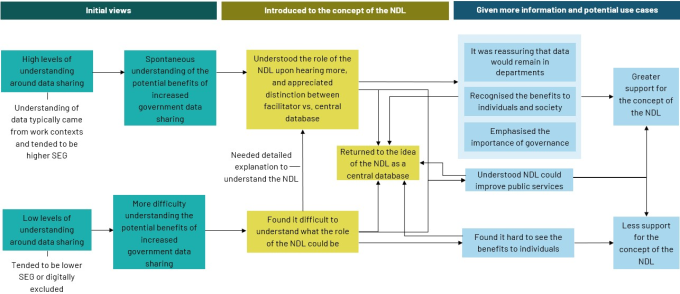
Figure 1.1 below outlines the different pathways participants generally took as they moved through discussions, being introduced to new information over the course of the session. It illustrates how initial understandings of data sharing went on to influence participants’ perceptions of the NDL, and returning to the idea of the NDL as a central data base was a key sticking point for some. This occurred at 2 points for participants: firstly, when the concept of the NDL was introduced, and secondly after they were given more information about the NDL and understood the benefits of the platform.
Figure 1.1: Progress map of participants’ understanding and acceptance of the NDL
Spontaneous views towards the NDL
Awareness of the NDL as a concept was very limited, with spontaneous reactions broadly in line with those expressed about wider government data sharing.
In a very small number of cases, participants were aware of the term NDL, and the concept of wider cross-government data sharing, having heard about it being carried out in other countries such as the US and Australia.
However, more broadly, participants were unaware of the concept. Distrust of the government, experiences with public services and prior engagement with technology continued to influence participants’ views, leading to initial feelings of hesitation.
“The government have got a lot of bad press… the pure fact that they want to roll out something else makes you go, ‘here we go, what damage will that do?’” – England, C2DE
Participants expressed concern over the term “National Data Library”, envisaging it as a central digital data repository where all government data about citizens would be held and linked between departments.
The word “library” was particularly influential in shaping participants’ initial perceptions as they felt this implied an open-access space. This raised concerns about the security of the data held, and that it could be easy to access or hack with all government data held in one place.
“The term ‘library’ puts me off, that’s open and accessible to the public and everyone. Who is going to be accessing this and for what? That puts me off instantly.” - England, ABC1
“A hacker’s dream.” - Wales, ABC1
This also raised spontaneous concerns that the NDL would be accessible to the public drawing a comparison with a library. This worried participants who thought it could involve access to sensitive data such as financial information, contact details, or data about children.
“At a library you can pick up any book you want so can you access anyone’s data. I don’t think that’s good at all.” – England C2DE
However, in some instances, particularly in Scottish focus groups, participants acknowledged that the term “library” highlighted the benefit of people across government having a specific place to access and share public sector data. They felt this could make their jobs more efficient.
The term “National Data Library” also prompted associations with the broader technological landscape. This included associations with Cloud storage and new ways of holding national population data.
“When we think library, we think of a place with physical books, but this is a virtual iCloud and the servers are somewhere in a desert on a hard drive. It’s now a virtual library and it could contain anything about someone as it doesn’t have to be physically there.” – England, ABC1
“It sounds like a more modernised version of the census.” – Wales, C2DE
Among digitally excluded participants, the term “library” was linked with technology companies but also that of an online encyclopaedia.
“The first thing that comes to mind when you said that was Google. I imagine it being like Google.” - England, C2DE, digitally excluded
In some cases, participants withheld their initial reactions to the term “National Data Library”. They wanted to know what type of data would be included before making a judgement.
“It depends on what data they want to store in this library. My response would be why do you want all of this information?” – Wales, C2DE
Participants generally assumed the purpose of the NDL would be to improve public services by making data sharing easier. However, in some cases participants questioned if this was the government’s true intention.
Participants spontaneously recognised the potential for increased, easier and more effective data sharing across government to deliver better public services and infrastructure. The same benefits were also mentioned spontaneously by participants when speaking about their general attitudes towards cross-government data sharing (see page 11).
“So that every government department has access to all the data, so from the environment agency and DEFRA, HMRC can see the data they have about canals and biodiversity.” England, C2DE
In some instances, participants expressed alarm that the NDL, as they envisaged it, was the government’s attempt at exerting more control and surveillance over citizens. There were perceptions that the NDL could be an all-encompassing database of the UK population’s data which could be used to track individuals in their day-to-day- lives. They felt it was important for citizens to have the right to lead a private life if they desired.
“It’s a bit of a dystopian thing; they have got absolute complete control over you. Is it stripping us of more freedoms?” – Wales, C2DE
“Sounds like an invasion of privacy… tracked and monitored and drained out of whatever money we can be drained out of.” – England, ABC1
““They’ll [the government] say it’s to improve public services. That’s how they’ll sell it to us.” – England, C2DE
Participants were also concerned, particularly in Scotland and Northern Ireland, that the purpose of the NDL may be to provide a way for the government to collect and share more public data without having to adhere to existing data protection laws and GDPR legislation. This reflected the distrust of government seen throughout discussions.
“Initially I thought, ‘Is this just a way to get rid of some of these problems with the law as it’s so restrictive’, to free it up and make it easier to access data. It’s an easier way to have a middleman run by the government to get that data out. I thought, ‘I’m not sure about that’.” – Scotland, ABC1
Reactions to the proposed NDL concept
Providing more information about the proposals for the NDL improved participants’ perceptions and comfort with the concept.
Participants were provided with further information about what a “National Data Library” could involve, including how the NDL could work and its potential benefits.[footnote 3] It was explained how:
“The NDL could act as a catalogue for data sources held across Government, helping to connect ‘authorised requesters’ with the organisations that hold the information. Each organisation could securely manage their own information and agree the terms of access in a data sharing agreement. The focus would be on improving access to existing data, not on collecting more data.”
The proposition of the NDL acting as a facilitator to access already existing public data rather than a central repository that stores and collects data, was key to reducing participants’ concerns. This alleviated worries about a central data store being vulnerable to cyberattacks, as data would remain hosted across different government departments.
“It [the NDL] sounds safer now you’ve put it [the proposed concept] in front of us. Generally working in an organisation that big, having certain access would be beneficial. Seeing what it intends to do and what it won’t do is obviously good, it’s going to be individual databases.” – Northern Ireland, ABC1
“At first we thought it was a library of all the data but it’s a bit more appealing knowing you have to request it and it’s not a free for all. This makes it better.” – England, C2DE
However, the concept of the NDL supporting organisations in discovering data sets and reaching data sharing agreements was not always easy for participants to grasp. It often took time and discussion to explain the role of the NDL before participants fully understood the idea. In addition, participants sometimes returned quickly to the idea that the NDL would be a central repository that stores and collects data. This influenced how they visualised the NDL platform and the extent to which they could trust it.
Participant understanding of the NDL was often impacted by how much they engaged with technology in a professional capacity. Those with more in-depth knowledge of data sharing found it easier to grasp the idea of the NDL as a facilitator, compared to those without a baseline understanding who often found the concept confusing.
Proposals for controlled and authorised access to the NDL, along with a legitimate purpose for the benefit of the public reassured participants.
Information about the legal frameworks, including GDPR, that would govern any resulting data sharing facilitated through the NDL increased perceptions that it would be managed responsibly. This eased concerns that the NDL was being set up as a way for the government to share public data without adhering to existing data protection laws.
“That makes it sound a lot better than ‘public data library’ because I think everyone thought you could just choose someone and go on all of your details.” - Wales, ABC1
“It would still have to be governed by existing laws and GDPR. That’s a comfort… If they’re tightly controlled… it could be a good thing, things could be more seamless.” – Scotland, ABC1
However, in some instances, the proposed purpose of the NDL caused confusion amongst participants and strengthened the feeling that the term “National Data Library” is not appropriate.
Even though participants were informed that government departments share very little data currently, there was some confusion over the purpose and the usefulness of the NDL as a platform. This was based on participants’ underlying feeling that cross-government data sharing was already happening on a large scale.
Participants believed the term “National Data Library” was not the correct label for the platform. They felt this did not accurately describe its function, as it suggested a central data storage platform rather than a facilitator of data access between departments and organisations.
“I feel a ‘National Data Library’, the name doesn’t seem to fit with its purpose.” – England, ABC1
In some instances, whilst participants felt that increased data sharing via the NDL would be beneficial, they were doubtful that the government would be able to deliver it effectively. This was often linked to participants’ beliefs that the government had a ‘track record’ of pledging new initiatives but not delivering on them for the public.
“Well, it sounds all good and rosy, but it’s not really believable to be honest with you.” – Wales, ABC1, digitally excluded
Those who were digitally excluded often found the concept of the NDL difficult to grasp. They required further explanation about how the NDL might work and what data sharing was before feeling able to comment on the proposals.
“I don’t really know what the library thing is…I don’t really have an opinion on it.” – England, C2DE, digitally excluded
Potential benefits of the NDL
Participants recognised the potential benefits of the NDL were important.
The NDL was presented to participants as having the potential to grow the economy, improve public services and help deliver mission-led initiatives, all of which were received positively. Hearing tangible and real-life potential applications of the NDL helped participants to recognise the possible benefits. Without these examples, participants struggled to identify how the NDL could be used. This meant that those working in a professional capacity with data often found it easier to envisage how the platform may or may not be beneficial.
Throughout discussions, higher social grade participants and those who had worked in the public sector, frequently had more experience and understanding of data sharing via their jobs. For example, drawing on their experience as police officers, nurses, lecturers, or previous government work. This often led to a greater understanding of the potential benefits, and increased support for the NDL overall.
Participants identified potential improvements to public services as the main benefit of the NDL, in line with their beliefs about wider cross-government data sharing.
It was thought that increased data sharing could enable innovation and research within government departments, which could lead to better, more targeted policymaking and interventions for areas or citizens in need. Examples mentioned included government analysts studying areas with poor education levels, or population figures to increase the amount of public transport made available in a local area.
“I think it can be beneficial in some areas for places that don’t have good transport. City buses don’t come out to us even though it’s a busy place, so something like that might make the government think ‘we need to extend’.” – Northern Ireland, ABC1
“Analysing that kind of thing [areas with low education levels] could channel funds to relevant areas and fund awareness campaigns.” – Wales, C2DE
There was also some acknowledgement of the potential for government to sell anonymised data to generate revenue for public spending. Participants suggested this could be fed back into improving public services or funding the development of the NDL itself.
The potential benefit to increase innovation and grow the economy became clearer to participants once the NDL was explained.
There was enthusiasm across the regions at the potential for the platform to create more job opportunities in the UK, especially in the technology sector which was seen as needing to grow. Participants felt this could particularly benefit young people who are struggling to find employment.
“It [the NDL] could help with jobs as well. Any areas that need help with employment or training or youths who are out of work. More training into areas.” – England, ABC1
In Northern Ireland, participants also discussed how the NDL could be used as a database to help people find jobs. For example, by giving access to recruitment agencies, or participants being able to upload information voluntarily to help with these purposes.
“I think it could be good for recruiting people, even for jobs. You can have the criteria for the qualifications they need. That would be good. I can’t see many more benefits to it.” – Northern Ireland, C2DE
There were instances where participants believed the NDL could help innovation within government. It was thought the NDL could modernise its data management system by providing a more up-to-date resource compared to tools currently in place. For example, the information collected from the ten-year census sometimes felt outdated and therefore at times resulted in inaccurate data being used. Participants expressed that it was important for the UK to improve its data sharing infrastructure so that we do not “fall behind” other countries.
“I think having a more modernised version [of the census] that would be really useful. I don’t think it would be such a negative thing or dystopian. It could be good for research.” – Wales, C2DE
“We can’t keep living in the stone age and technology is moving fast, so I get things need to change. I’m not too intimidated by it.” - Wales, ABC1
There were also mentions of the NDL being used as a tool to help law enforcement better detect cybercrime, or to reduce benefit fraud.
For example, one participant suggested the NDL could allow for easier identification of people who may be claiming benefits but are not eligible if it facilitated a data sharing arrangement between HMRC and DWP. This could enable discrepancies to be more easily pinpointed and therefore save taxpayer money.
“It could help eliminate cybercrime and track criminals a bit better. It does have some positives.” – England, ABC1
“The only thing that popped in my mind that could benefit us normal taxpayers is if someone that is claiming all the benefits under the sun and they go on holiday multiple times a year, then it flags up where the money is coming from. We all know it happens and maybe they could be taken off of the benefits and then there is more money going to the NHS and whatnot.” – England, ABC1
Participants in devolved nations were concerned that their regions would not receive the benefits of the NDL, which limited their enthusiasm and commitment.
This was a particular concern for participants in Northern Ireland and Wales, who thought it was likely that any benefits such as job opportunities or improved public services, would be directed towards England. This was seen as unfair, and participants questioned why their data should contribute to the NDL if they do not gain access to any of the potential benefits.
“Will we get a slice of that if companies are setting up in the UK? Where do we fit in that? It’s not a good idea if it’s central. If it’s only for England or England and Wales, why should we be part of giving information to that.” – Northern Ireland, C2DE
Similarly, participants felt that, as their personal data was facilitating the NDL, the platform should benefit them as an individual, not just wider society.
Participants suggested that as compensation for their data being used, the NDL should be built in a way that is useful to them personally. One idea was for the NDL to help provide access to personal records, or to help complete administrative tasks, e.g. renewing a passport or driving licence. This view was in direct conflict with participants’ concern about the NDL being a central data repository, although at this point in the discussion they understood the NDL would not hold data in this way.
“If you go into the government website, for your passport, driving licence, it makes the process easier. It can access your pension, child maintenance. It all ties in one.” – Scotland, C2DE
“As long as there is direct benefit for me, but if there’s not then why would they be giving my money to charity or a marketing company, unless I’m being benefited I don’t think people will get behind it.” - Northern Ireland, ABC1
Concerns about the NDL
Participants wanted greater clarity about the scope and breadth of the NDL, given their concerns about government data sharing in general.
Key to this was concern over who would have access to the data via data sharing agreements facilitated by the NDL. Participants wanted to be made aware of the specificities of this such as what departments, services, and job roles could access data via the platform.
“My first question is who has access.” – England, ABC1
“It’s about who has access… You can’t live without giving away information now. If they keep that under control, it’s not the worst thing in the world.” – Scotland, C2DE
Participants also felt there was a need to set clear limit on the purpose of the NDL. This was underscored by participants’ high level of distrust in the government, and their strong feeling that the main purpose of NDL had to be for public benefit, rather than profit.
“I would be relatively accepting of a database-like type of thing, but they would have to be really transparent about the purpose, and what exactly it’s going to inform and how it will drive social change.” – Wales, C2DE
Participants also expressed concern that there was a lack of clarity about the different forms of data that would be included in the NDL which heightened their apprehension. Data could come in the form of anonymised and de-identified, aggregate data, non-personal and personal data. Throughout discussions, participants struggled to understand the nuances between the forms of data the NDL could facilitate the sharing of and felt this needed to be made clearer for them to have trust in the system.
Although participants expressed support for the purpose of the NDL, they were concerned about any subsequent data sharing, primarily through hacking or data leaks.
Participants’ focus frequently returned to concerns about the security of their personal data and what this would mean for their privacy as an individual. Cyber security was a key issue, and there was a lack of trust in the government’s ability to securely store data.
“If it [the NDL] gets hacked, whoever gets my data has access to my life.” – England, C2DE
In some cases, these concerns were linked to participants returning to the idea of the NDL being a central data repository, and that public data would be vulnerable by being kept “all in one place”. There was a general sense amongst participants that cyber-attacks to the NDL were inevitable, via government systems directly, linkages through government apps, or third party hackers. Participants often relayed recent news stories about cyber-attacks such as NHS trusts being hacked as proof of this.
“They talk about cyber-attacks from Russia and China, what if they suddenly get all our information? There’s hackers in this country and they go on about cyber-attacks, if all our information is there for the taking it could be a national disaster.” – England, ABC1
“I think it sounds good in hindsight but the potential flaws of it being hacked worry me. I can see the logistics for social care, healthcare, accessing information. I’d worry about systems being hacked and information being shared with the wrong people.” – England, C2DE
In some cases, current data protection laws were not seen as stringent enough, given participants’ perceptions of the high level of cybercrime. It was thought that if the NDL was developed, the UK might need to introduce stronger data protection laws.
“Even under the Data Protection Act, I know things have been breached and people have got access to information they shouldn’t.” – Northern Ireland, C2DE
“My greatest concern would be security. Would it have better security than what’s [already] in place?” – Wales, C2DE
Participants worried that introducing the NDL could exacerbate already existing concerns about the increasing use of technology in daily life.
Throughout discussions, participants were shown examples of how the NDL could facilitate data sharing. One example involved educational data being shared with technology companies to create AI tools to help with marking and generating feedback for students. This raised several concerns for participants, including that marking and feedback could lose the “human touch” through a less tailored approach. There were also concerns this could lead to the replacement of essential human jobs (e.g. teachers) by AI.
“I really don’t like this…Okay for kids but then again, parents are trying to get their kids away from technology…There would be no teacher. You wouldn’t have teachers. Its jobs put away. I don’t think that would be good. I don’t want that for the kids.” – Northern Ireland, C2DE
Participants also expressed concern that these use-cases of the NDL could exacerbate already existing inequalities. For example, in relation to education, wealthier schools or local areas could have better access to the resources needed to benefit from data sharing and AI education tools.
“The demographics, it could create unequal outcomes. If you have a school in the lower area, they’re not going to reap the benefits. It’s not fair that some can and some can’t. Every child should have the best possible upbringing and education. It would be unfair that not everyone can access the tool.” – England, ABC1
Rules and governance for the NDL
While there was acceptance for the NDL facilitating greater access to government data, participants wanted strong governance and safeguards in place. They outlined key areas for this to be implemented which are described in this chapter.
Chapter findings
- Participants often suggested rules for the NDL spontaneously which were in line with their understanding of general data sharing. These overlapped with the proposed rules for the NDL, apart from the Trusted Research Environment which participants were less familiar with. Hearing that the NDL would strictly adhere to legal requirements and GDPR was also reassuring to participants.
- There was desire for greater clarity about the governance of the NDL. Participants felt the purpose of facilitating data sharing via the NDL should be in the public interest, and they sought rules about who could have access and for what purpose especially if this involved bodies outside of the public sector.
- There was a preference for the NDL to primarily grant access to anonymised or aggregate data to reduce the potential for harm and ensure qualified and authorised access only.
- Transparency about how the NDL would be managed was seen as key to implementing trustworthy safeguards. However, this did not reduce overall distrust of the government’s ability to manage the NDL responsibly. As such, developing, implementing, and communicating a comprehensive governance framework to the public should be a top priority for the NDL.
- This could include prioritising the use of anonymised and aggregate data wherever possible, and reserving access to personal data for the most critical and tightly controlled purposes.
- Finding ways to give the public a stake in the NDL’s governance is also likely to help support its legitimacy. Establishing inclusive oversight bodies, consent management tools, and data subject access request processes should be embedded in the NDL’s design from the start. However, balancing public expectations for personal agency with the realities of designing a workable governance framework may require careful navigation and communication.
Purpose of data
Participants wanted robust protections and governance in place to manage greater access to government data. This underpinned how acceptable they felt the NDL would be.
The purpose behind accessing data was the key driver of acceptability, with participants often returning to the idea of access only being granted for “legitimate purposes” throughout discussions.
“There has to be a reason why they want to check your data. There needs to be a genuine reason.” – Northern Ireland, C2DE
“I think they have to go through a whole checklist of reasoning. Like how police have to go for a warrant to search a property. They can’t just have all our data, there has to be a valid reason to delve into [personal data]. You can’t just give it out willy nilly.” – England, ABC1
Given their concerns about the security of their personal information, participants wanted the NDL to ensure data is being shared for the benefit of the public, such as for the improvement of public services. They felt that data being accessed with the intention of doing public good was a more trustworthy cause, and that their data was more likely to be protected and used responsibly.
This desire for data to only be accessed for public benefit was linked to participants’ feeling that they, as an individual or wider society, should be compensated for their personal data being used.
“I think it’s probably a fine line that needs to be tread to ensure that people aren’t accessing more than they need to… it’s making sure what it is that’s being looked at is being looked at for a legitimate purpose and not any more than is necessary.” – Northern Ireland, C2DE
“If I can see a direct benefit to myself or where I live or the public, I don’t see a problem.” – Wales, ABC1
Who has access to data
The type of organisation seeking access to data was used to infer whether their purpose was “legitimate” or not.
Because of this, participants were much more comfortable with access being restricted to public bodies. Throughout discussions, the government and public services were viewed as more trustworthy than other types of organisations, and more likely to want to access data to directly benefit the public. This was in contrast to private companies, which participants associated with profit-making activities compared to the perceived function of the government for the public good.
“Only government bodies and organisations within that [should have access]. I don’t think it should be any organisation.” – Wales, ABC1
“Is it private or part of government doing good for everybody? You’ve heard about a private company putting a form up and selling it. People like that shouldn’t have access. It’s [the NDL] for the good of the general public and to help government bodies.” – Scotland, ABC1
“The government is ultimately responsible at the ballot box, so I feel like they have more of an incentive to be protective of my data.” - England, C2DE
Consequently, there was significant opposition and wariness to private companies being allowed access to data via the NDL.
This was driven by an assumption that private companies were more likely to misuse personal data for profit such as selling personal data on to other companies. This contrasted with participants’ strongly held view that data access should be allowed for the public good.
“People shouldn’t be making profit or money by selling your data. That’s getting out of hand these days.” – Wales, C2DE
“It [the NDL] needs to help the person on the street. The only benefit can’t be just to make the company more money. That is just harvesting your data for their profits. I would be much happier if it was funnelled into urban planning and prove it doesn’t go into just companies.” – England, ABC1
In a small number of cases, participants recognised that there may be potential benefits for the UK economy from giving access to private companies. However, this was often outweighed by participants’ belief that private companies in general are not trustworthy when holding public data. They felt that companies were also less accountable to the public than government departments and services. This was a consistently held concern, emphasising the need for transparency of how the NDL will be manged.
“Public companies are generally more trustworthy; they’ve not got sale goals. Their pure objective isn’t just making money. At least the government helps with things like infrastructure and towns. I would be more open to that.” - England, ABC1
“No… it’s for government only… Private [companies]… they can cheat you, they don’t care. They just want to make money; they don’t care what happens to you.” – Northern Ireland, C2DE, digitally excluded
Participants, particularly those who are digitally excluded, felt that sharing data with international companies or foreign organisations should also not be allowed. Although participants were slightly more comfortable with data being shared with organisations based in the EU.
Sharing personal data with researchers, universities and NGOs was largely seen as acceptable although the purpose was not always clear to participants.
Participants were slightly less supportive of sharing data with academics and NGOs compared with government departments, but they were still tentatively open to this if the purpose benefitted the public and scope was clear. There was a perception that academics and NGOs were less likely to misuse data than private companies, though participants still wanted to limit access to pre-approved projects.
“I wouldn’t be opposed to charities, same as universities. They can’t use it in a malicious way. Whereas commercial business can do that.” – England, ABC1
“What data? What information? [shared with universities] Is it just a blanked-out name with an age or date of birth or is it your full details? That’s where the concern is.” – England, C2DE
Participants wanted to see rules in place to ensure qualified and authorised access.
The need for standards and accreditation for all organisations and individuals accessing the NDL was emphasised, regardless of their type or size. Participants suggested that organisations and individuals should be vetted as part of the NDL process.
“Vetting, you don’t want everyone to access it across the board. You may want individuals vetted and their rights of access to be they submit an access request so it’s traceable and trackable.” – Scotland, ABC1
Participants also thought that different organisations, and job roles, should have varied levels of access depending on the type and sensitivity of the data, with only highly qualified analysts getting access to data. It was also emphasised that there should be an ability to trace data requests and breaches to ensure transparency.
“Who’s actually qualified to analyse the data? Make sure that they are qualified to analyse it.” – England, C2DE
“I think ‘approved’ person makes a difference. These are people who have been vetted. I’d feel more comfortable with that. It’s someone who has been through the rigmarole.” – Scotland, C2DE
A Trusted Research Environment (TRE), where data could only be accessed in a controlled setting, was seen as reassuring and important for preventing data misuse, although participants did raise concerns about people accessing data via a TRE whilst working remotely. Participants were worried particularly that screenshots of personal data could be taken and shared, although this would not be possible in a trusted research environment.
“That [Trusted Research Environment] would be better than giving it away. They’re still retaining the ownership of the data. You’re just allowing it to be viewed.” – Scotland, ABC1
Types and formats of data
There was a preference for the NDL to primarily grant access to anonymised or aggregate data to reduce the potential for harm.
This reflected concerns about participants’ data being linked with their personal information, making them potentially identifiable via the NDL. They believed only using anonymised or aggregate data would serve as a safeguard, preventing their data being misused or their privacy being invaded. This addressed concerns expressed about data sharing described in Chapter 2 above, including the tracking of their everyday lives.
This preference was supported by other safeguards for how the data should be managed.
While participants felt using non-identifiable data increased its security, there was low trust in the government’s ability to ensure data would be truly anonymised. In response, participants sought safeguards to make them feel less vulnerable to data breaches where their personal data might be involved. For example, they thought there should be limitations on the length of time data is retained and set restrictions on when it needs to be deleted (if relevant). Participants who dealt with data in a professional setting often used retention and deletion processes as a frame of reference.
“Could it [the data] be destroyed once it’s used for what it’s used for?” – England, ABC1
“Maybe [it should be] that people only have access to shared data for the time it takes them to complete the project.” – England, C2DE
Another suggested safeguard was limiting the types of personal data that could be included in the NDL and sectioning off sensitive data for government only or pre-approved uses. This was thought to help mitigate excessive access to data and reduce the impact of any potential data breaches.
Processes for accessing data
Participants felt strongly that the NDL needed to have the correct processes in place to limit any potential damage that could result from inappropriate organisations having access to data.
Regular audits and compliance checks were seen as necessary to ensure secure access systems are maintained by organisations accessing data facilitated via the NDL. Participants wanted this to be applied across the government but particularly for other outside organisations. It was suggested that an independent regulatory body should be established to ensure compliance, with the task of overseeing data handling practices and ensuring adherence to legal frameworks and agreements.
“Maybe a regulatory board that makes sure all the things are practised that legal frameworks are followed, some regulatory body that ensures and forces all of that on them.” – England, C2DE
“I’d want to see the analysts audited by an external group.” – Northern Ireland, C2DE
Management and control of personal data
Participants thought that the public, not just the government, should have oversight of the NDL and any subsequent data sharing.
The ability for individuals to opt-out of personal data sharing was a common suggestion. This reflected how participants’ comfort for data sharing was dependent on what type of data is being shared and with whom. They felt that some form of opt-in/out system would allow the public to ensure that their data is being used for what they see as the correct purpose.
However, while this was the case, participants generally did not recognise the practical or logistical implications of opting in or out of data sharing, for either them or the government. Their focus remained on maintaining their privacy or the accuracy of their personal data, with limited consideration of how this might be done. This was closely linked to their perceptions of current government data sharing described in Chapter 2 above.
In some cases, participants did recognise the administrative burden of involving the public with managing personal data. This was observed in relation to gaining consent for all instances of data sharing which participants understood may be difficult in practice.
“If you had an opt in and opt out to give consent to your data. Once you know the policy or research it’s needed for and you can see if you’re happy to give my data and what data to give.” – England, ABC1
“Maybe we should be able to opt in before it’s shared, so you can say yes. I might say yes to one but no to another.” – England, C2DE
The ability to opt-in or out of data sharing was also linked to the principle of consent for participants, especially in relation to their own personal data. Participants felt that they should have the right to determine and control who has access to their data, including the ability to change their mind over time.
“Most people want to feel in control of their lives, and if we’re not sharing information willingly we’re not in control.” – Wales, C2DE
“It links into consent. If you consent to your data being accessed and you think that’s okay, that’s your decision.” – Northern Ireland, ABC1
There was also a desire for individuals to have the right to access and review their own data to ensure accuracy. This was often more important to participants during discussions than the privacy of their data, although this was also a key consideration. Participants worried that the NDL may facilitate the sharing of inaccurate data, which could lead to negative impacts. As such, they wanted to feel reassured that data was correct, even if this meant the choice to take on additional responsibilities for checking data themselves.
Participants’ lack of knowledge about general data management also impacted their ability to see other solutions to maintaining accurate data. For example, one participant recalled how they had been backlisted from a company after their old address had been used instead of their current one, based on the person who had moved into their old property’s behaviour. The participant felt if they had been able to update their information, this would not have happened.
“We need to make sure the data is accurate. Often, you’ll login to public sector systems and spelling or your address is different. Like flats, 02 comes up as G2. You want your data to be the same across any system you’re trying to access… It can go wrong easily if tiny details are wrong.” – Scotland, ABC1
Communicating the National Data Library
This chapter outlines participants’ priorities and expectations for how the NDL should be communicated to the public, including how participants would explain the NDL to others, and the level of detail participants think is necessary to share about the platform.
Chapter findings
- Transparency was seen as paramount for building trust and acceptance of the NDL. Participants strongly desired clear communication about who could have access to what data and for what purposes, and felt the public should be engaged in ongoing consultations to address public concerns.
- While participants wanted transparency, they cautioned against information overload which could disengage the public. Helpful communications should lead with concise, plain-language explanations focused on public benefits to build understanding. While separate technical information should be available for those seeking additional detail.
- Demonstrating tangible, personal benefits was seen as key to securing public support. Participants emphasised the importance of communicating how the NDL will positively impact their individual lives, not just society at large. Participants in devolved nations also wanted clear communication about plans to ensure any benefits of the NDL will reach beyond England.
- Opinions diverged on the ideal frequency of NDL progress updates. While some prefer communication at key milestones, others want regular updates to build trust. More frequent, opt-in/out channels could be offered for those desiring ongoing engagement, without overwhelming the wider public.
- Particular attention should be paid to engaging groups who may need additional support, such as older people, those who are digitally excluded, and schoolchildren. Participants emphasised the importance of building understanding among these audiences due to their vulnerabilities, with targeted engagement strategies and tailored materials.
- Digitally excluded participants particularly emphasised the need to have information about the NDL in physical spaces. They often suggested partnering with trusted public service broadcasters to communicate about the NDL through news segments and documentaries.
Participants emphasised the importance of transparent communication as key to the public trusting and accepting the NDL.
There was a strong desire amongst participants to be consulted and involved as the NDL progresses to build trust.
Participants also agreed that any initial communication about the NDL should outline the parameters of data use and access via the NDL, specifically referencing who will have access to specific data, and for what purposes.
“It should be made clear exactly what services would have access to your personal information… That needs to be made clear. What are the regulations that will be in place to decide who can’t have access.” – Wales, ABC1
“Very [important]. We need to know what’s happening to our data…What’s being shared and to whom.” – England, C2DE
“[Involvement in future decisions about NDL could involve] Things like this [focus groups], consultations, white paper, talking with local government, national government, things like that.” – England, C2DE
Participants often felt that they were entitled to this information on the basis that the NDL could support access to data about them as individuals. It was suggested that it was in the government’s best interest to be as transparent as possible. They felt otherwise the public could assume the government is using the NDL for use cases participants generally did not agree with, e.g. data sharing for profit.
“I think unless the government is as transparent and as detailed with the information as possible, then people will suspect that they’re doing something nefarious and that they have a hidden agenda.” – Wales, ABC1, digitally excluded
Participants felt that communication to the public should focus on basic explanations of the NDL, providing a clear way to look up more detailed information.
It was thought that too much information could complicate messaging and disengage the public from the purpose of the NDL. Participants suggested that communications should focus on illustrating the NDL as a platform that could be used to enable easier data sharing and access for government and public services. This was seen as an effective way to build public acceptance.
“What is it and who it’s for and how it will benefit people. You have to put it in a way people will understand. Some people won’t get the idea much.” – Northern Ireland, C2DE
“They [the public] need to be aware of it because if they don’t know what it’s for, like I said before, people just think people loading data on you is a bad thing. So, people need to be educated about why this is happening and why it needs to happen.” – Wales, C2DE, digitally excluded
Participants argued that messaging should emphasise the tangible benefits of the NDL, so the public could weigh these against any privacy concerns to reach an informed decision. They often expressed the importance of communicating how the NDL will benefit them individually, rather than just benefiting wider society. Participants in devolved nations stressed the importance of communicating how any benefits of the NDL such as job opportunities will reach them.
Opinion was split on how often the public should be updated about the NDL.
Those who preferred communication at key milestones felt that frequent updates would be difficult to achieve logistically, inefficient and needless for the government. Instead, they should focus on sharing communications when important decisions had been made.
“I wouldn’t say step by step [updates]. It would take an awful lot of work to get step by step in there, wouldn’t it?” – Wales, C2DE, digitally excluded
“I don’t think there is much point going to everyone in the public until it’s further along…I’d say it’s got to be more developed before you’d announce it.” – Scotland, ABC1
In contrast, participants who expressed desire for more frequent updates felt this was key to building trust and to prove the government is not hiding any developments or use-cases.
“Well, whenever a change takes place, I should be informed. Immediately.” – Scotland, C2DE, digitally excluded
“I think it [communication] should be frequent enough, so people are able to build trust.” – England, C2DE
Primary school age children, and people with lower digital engagement were highlighted as key groups to inform about the NDL.
Participants felt that it was important to educate and inform children and young people about the NDL so that future generations can grow up with a better understanding of data sharing and will be able to further develop the NDL platform when they are older.
“To really push this forward then data sharing and protection of data should be shared in schools… So if we are going to implement this hub then we should start teaching primary school children about data and data sharing.” – England, ABC1
Informing older people about the NDL was also important as participants perceived them as less “digitally minded”. They felt a concerted effort should be made to make this group aware of data sharing and the NDL. There were also suggestions that the government should ensure other vulnerable individuals like children and those with disabilities, who may need extra support to understand what the NDL is, are also a priority.
“The older people, because the younger people are growing up with it now, they kind of know all about this.” – Wales, C2DE, digitally excluded
However, views were underpinned by a general feeling that everyone should be informed about the NDL, regardless of age or technological ability. This was on the basis that the NDL could facilitate access to data about all people.
“It’s our personal information so everybody has the right to know.” – England, C2DE
There was consensus that information about the NDL should be made available in both online and physical spaces.
Participants felt that having information available across a range of physical and different online platforms was essential to keeping the public informed. It was thought that communicating to older generations should focus on more traditional media outlets, such as billboards or TV news channels, whereas communication to younger cohorts needed to be done via social media and other online spaces.
“Just everywhere. Particularly on TV, big public announcements. Adverts, in the news, BBC. Not just swept under the carpet.” – England, ABC1
Having information available in physical spaces (e.g. doctor’s lounges, community centres, bus stops) was of particular importance to digitally excluded participants. However, they acknowledged that only a limited amount of information could be shared in public spaces so this could be supplemented by news segments and documentaries on TV.
Participants often acknowledged that they themselves were unlikely to seek out and engage with further information about the NDL. But there was agreement that more in-depth information should be available on a website (e.g., gov.uk) if an individual would like to know more about the platform and the legalities around it.
”I think that’s exactly what’s needed. There is information available if you want to go deeper into it.” – Scotland, ABC1
“I think most people would think it’s boring. But for people who are data-conscious it’s good to give them a choice.” – England ABC1
Participants felt generally that public service broadcasters (e.g., BBC and ITV) would be trustworthy sources to hear about the NDL, particularly via their news or documentary programmes. However, participants also wanted to hear about the NDL from official government sources, via adverts on TV and social media or letters sent to households.
Conclusions
Overall, on hearing the proposals for the NDL, participants were generally open to the idea of a platform that could facilitate greater data sharing across government. There was a strong emphasis on the purpose of this being for the public good, with the benefits distributed equitably across UK society. For this to be acceptable, participants wanted strong safeguards and governance such as:
- Limits on who has access to the NDL, including restricting this to public or non-profit organisations and qualified analysts.
- Accreditation processes for organisations and individuals using the NDL, or gaining subsequent data access, as well as regular audits and compliance checks.
- Focusing on granting access to anonymised or aggregate data, limiting the amount of personally identifiable data involved.
- The ability for individuals to give consent via opting-in or out of their data being accessed through the NDL and the right to access and review data to ensure its accuracy.
Throughout discussions, transparency was a key theme, with participants wanting to know more about the specifics of how the NDL could work and what this could mean for them. They emphasised the importance of communicating developments to the public, ensuring everyone has access to information about upcoming plans and how their data may be used.
The research also highlighted the need to combat potential misconceptions that may arise on hearing about the NDL, including:
- The potential for the use of “library” in the name of the NDL to suggest an open access platform or centralised database.
- The challenge of communicating the distinction between the NDL as facilitating access to data, rather than sharing or collecting additional data, linked to common misconceptions about the extent of current data sharing across government.
- The tendency for participants to revert to thinking about the NDL as a central repository of data, and the need to combat this with awareness raising about government data use.
- Misunderstandings about the extent of access that could be granted, such as assumptions all government employees or private companies would have unfettered access to personal data.
- The challenge of explaining and engaging the public on the NDL without relying on overly technical language, instead bringing the abstract concept to life.
These misconceptions and lack of understanding shaped participants’ baseline opinions and assumptions of the NDL. This suggests there may be value in involving the public in shaping the future design of the NDL, informing decisions around key trade-offs (e.g. decisions around the ability to opt-in or out of data sharing) and helping to identify approaches for building public legitimacy.
Annex
Methodology
The research took a qualitative approach to understand the nuances in participant perspectives and the reasons why individual participants held their views. Ipsos carried out ten online focus groups which lasted 2 hours each, across each nation in the UK, with 4 focus groups in England and 2 focus groups per remaining nation. The groups were held online to allow a diverse range of participants from different places to take part.
The focus group setting meant there was sufficient time to capture spontaneous opinions before moving participants towards more considered and informed views, having learned more about the purpose and structure of the National Data Library (NDL). The focus group discussion meant moderators could fully probe participants and explore whether their opinions varied with different contextual factors and allowed them to consider trade-offs (e.g. any concerns vs. benefits of data sharing). These discussions were enabled by showing participants a range of stimulus material that are displayed later in the annex.
Ipsos also carried out ten supplementary depth interviews lasting 45 minutes each via telephone with digitally excluded individuals. This was to ensure that the perspectives of those with less technological knowledge were captured. Interviews used a tailored version of the focus group discussion guide.
Fieldwork took place between 11th February and 5th March 2025 and involved a total of 79 participants (69 focus group and 10 depth interview participants).
Sample breakdown
The main sampling criterion for the depth interviews was digital exclusion. Focus groups were split by socio-economic grade as the main sampling criterion, with each nation having separate groups of ABC1 and C2DE. This criterion was chosen on the basis that this may influence perceptions of trust towards the NDL as well as experiences of public services and engagement with technology.
Alongside standard demographics, Ipsos also sampled to include a spread of views on attitudes towards data sharing and public service delivery. Focus group participants were sampled according to 6 attitudinal segments, taken from DSIT’s Public Attitudes Tracker Survey[footnote 4] to ensure participants held a range of views towards trust in organisations, awareness of how different organisations collect and use data and confidence using technology.
The table below provides a full demographic breakdown of the final sample:
Table 1.1: Demographic breakdown of final sample, by focus group and depth interviews
| Demographic categories | Demographic | Total focus group sample | Total interview sample | Total combined sample |
|---|---|---|---|---|
| Age | 18-30 | 22 | 0 | 22 |
| Age | 31-54 | 30 | 2 | 32 |
| Age | 55-75+ | 17 | 8 | 25 |
| SEG | ABC1 | 35 | 1 | 36 |
| SEG | C2DE | 34 | 9 | 43 |
| Urban/rural | Urban | 49 | n/a | 49 |
| Urban/rural | Rural | 21 | n/a | 21 |
| Gender | Male | 33 | 6 | 39 |
| Gender | Female | 36 | 4 | 40 |
| Ethnicity | Non ethnic minority | 55 | 8 | 61 |
| Ethnic minority | 14 | 2 | 16 | |
| DSIT data segments | Enthusiastic tech pro | 14 | n/a | 14 |
| DSIT data segments | More confident digital users | 14 | n/a | 14 |
| DSIT data segments | Less confident digital users | 7 | n/a | 7 |
| DSIT data segments | Distrusting data sceptics | 19 | n/a | 19 |
| DSIT data segments | Sceptical data pros | 14 | n/a | 14 |
| DSIT data segments | Does not fit into segment | 1 | n/a | 1 |
| Attitudes towards data sharing | Public services should share data | 30 | 2 | 32 |
| Attitudes towards data sharing | It is more important to protect people’s personal data | 37 | 7 | 44 |
| Attitudes towards data sharing | Neither | 2 | 1 | 3 |
| Public service delivery | Exceeds expectations | 7 | 0 | 7 |
| Public service delivery | In line with expectations | 13 | 0 | 13 |
| Public service delivery | Falls short of expectations | 48 | 8 | 56 |
| Public service delivery | Have no expectations | 1 | 2 | 3 |
| Awareness of government data sharing | Always/Sometimes | 42 | 5 | 47 |
| Awareness of government data sharing | Hardly ever/never | 17 | 3 | 20 |
| Total participants | no data | 69 | 10 | 79 |
Hypothetical scenarios
Participants were presented with a range of hypothetical written scenarios to discuss during the groups. These scenarios were developed by the research team alongside DSIT to stimulate discussions around potential use-cases of the NDL. Participants were reminded throughout discussions that the scenarios were purely hypothetical and were developed for illustrative purposes only and were not intended to represent or predict any real-life scenarios.
| Scenario | Description |
|---|---|
| 1. NDL allows government to license access of UK maps to private technology companies | The National Data Library could support the creation of a data sharing agreement that allows the Government to license very detailed maps of towns and cities to technology companies, granted under a tailored licensing agreement. This could help to drive more investment in technology in the UK. |
| 2. NDL allows for the creation of a cross-government data linkage system | The National Data Library could support the creation of a data sharing agreement that creates a data linkage system, where anonymised, person-level data, such as social security and health data, from across government departments is linked together to create a catalogue of data. All qualified government analysts would now have access to this data for statistical research and policy making. |
| 3. NDL allows a data sharing agreement between the government and private education technology companies | The National Data Library could support the creation of a data sharing agreement that provides a way for the Government to share data with technology companies. For example, this could allow them to create AI tools that could help with marking and generating feedback for individual students quickly. This could mean teachers can spend more time on delivering lessons instead of marking. |
Research materials
Focus group discussion guide
DSIT – RTA Unit: Attitudes to a National Data Library: focus group discussion guide
Research Objectives
The aim of this research is to gain a deeper understanding of the level of support for the government creating a National Data Library (NDL), alongside perceptions of the potential challenges and opportunities facing the platform.
This discussion guide is designed to understand how the value of data sharing (through the NDL) can be best communicated to the public. Specifically, we want to:
- Understand the baseline levels of trust that the UK public has towards a) the government’s use of data b) data sharing across government as well as private companies, academia and NGOs, and c) several hypothetical NDL projects (TBC);
- Explore values (i.e., ethical principles) and priorities that the public hold regarding the government’s use of data, and how these values can be operationalised or communicated;
- Understand the public’s greatest concerns on this topic, and thus the greatest risks to trust, and the NDL project;
Investigate the potential interventions, policies and processes to mitigate concerns about the NDL, focusing on those with the biggest impact.
Notes:
Focus groups will be carried out via Zoom. Each group will last up to 2 hours and each participant is being provided with a thank you of £70.
This topic guide is intended to guide the discussion. It will be used to ensure the topics are covered with participants but not all questions will necessarily be asked, or the exact wording used. The order of some questions may also differ as the moderator will be led by participants, ensuring that the conversation reflects participant views and experiences.
Timings are provided but are for guidance only.
Topic guide flow
The topic guide has the following section. Suggested timings are provided but please tailor to each session.
| Section | Focus groups timings |
|---|---|
| Introduction | 5 mins |
| General Attitudes Towards Government Data Sharing | 15 mins |
| Reactions to National Data Library Concept | 20 mins |
| Understanding the limitations and values of the National Data Library | 50 mins |
| Communicating Value & Addressing Concerns | 15 mins |
| Wrap up | 10 mins |
Stimulus
Discussion guide
Questions
1. Introduction
- This section is to ensure informed consent is gained, explain the purpose of the research and to warm participants up to taking part in the research
- Please note that all participants have been provided with an information sheet and privacy policy outlining how their data will be used and their rights. Please confirm receipt of this
Timings
- 6 to 6.05pm
- 5 minutes
Introduction
- Moderator to introduce self, any tech support (who will be on hand for first 15 minutes) and any observers/note takers.
- I work for an organisation called Ipsos, a global independent research organisation.
- We are carrying out this research on behalf of the Department for Science, Innovation and Technology (DSIT). DSIT helps ensure that new and existing technologies are safely developed and deployed across the UK and drive forward a modern digital government for the benefit of its citizens.
- We have been asked by DSIT to carry out a research project exploring people’s understanding of and attitudes towards the government creating a data sharing initiative.
- This will not be a technical conversation so there are no right or wrong answers! DSIT are interested to hear your thoughts and views which will help inform their future work.
Confidentiality and MRS guidelines:
- Explain that the session will be audio recorded, this will be securely held and deleted at the end of the research.
- Explain that personal information, e.g. full name, email etc. will not be shared with DSIT.
- Written report - may use quotes but participants will remain anonymous.
- Do you have any questions about the research?
- Can I check that you are happy to participate and for me to begin recording this session? [confirm consent]
Housekeeping: [slide 2 and 3]
- Important that everyone gets a chance to speak.
- Please can everyone turn their mobile phones on silent and turn off any additional screens not needed for this discussion.
- There will be a lot to cover so we may need to move people on and to allow others to speak. This is not personal, but only to ensure we fit everything and everyone in.
- Please try not to talk over each other if possible.
- Disagreements are fine but please respect each other’s opinions.
- During introductions please just use first name.
We will start with a quick icebreaker / participant introductions.
- What your name is
- Whereabouts you live
- One word to describe how you feel about technology in general
2. General Attitudes Towards Data Sharing
- Exploring general attitudes and comfort levels towards current government use and sharing of data
- Understand levels of trust towards intra-governmental data sharing and with other organisations
Timings
- 6.05 to 6.30pm
- 15 minutes
We would like to begin by talking about how you feel towards the ways public services manage, share and access data. This includes central government but also public services such the NHS, the police, social services, job centres, schools etc.
Remind participants this is not a technical conversation.
Note for moderator: we are interested in government collected data including that from hmrc, dwp and other large government departments such as education, health less so.
What kinds of data do you think the government and public services hold?
- About you?
- About businesses?
- About wider society?
In what ways do you think the government and public services share this data at the moment?
- How do you feel about this?
For this discussion, when we say “data sharing” we mean the process of disclosing data to third parties outside of the organisation that is holding the data. Any data sharing must be subject to legal safeguards.
Please remember that data comes in many different forms. It is just information used to understand something or to make decisions. This includes numerical data, text data, images and video data, or biometric data like fingerprints. So when we say ‘data’ we mean information about work history, earnings, benefits, health, school grades, tax returns, contact with police, or traffic data for example.
To what extent do you think data is shared or accessed between government departments and public services currently?
- What makes you think that?
- What about outside of government and public services?
- Do you think data sharing is being carried out in a responsible way?
- Do you have any experience of your data being shared or accessed across public services? How did you feel about this?
- Were there any times when you felt it might have been helpful for your data to have been shared between public services (but wasn’t)? Could you share an example and the impact it had on you?
What might some of the benefits to this be? What about some of the risks?
The Office for Statistics Regulation recently found that “despite welcome pockets of innovation, there continues to be a failure to deliver on data sharing and linkage across government, alongside many persisting barriers to progress.”
Currently, government and public services share very little data between their departments and external organisations. How do you feel about that?
- Are you surprised to hear this?
- Why do you think this might be?
How would you feel if the government and public services could access more data held across different parts of the public sector?
[If needed: For example between different government departments like HMRC (who hold financial data such as tax returns) and the Department of Health, or different public sector organisations like schools and the Department for Culture, Media and Sport.]
How would you feel if the government and public services shared data with other organisations? For example:
- Private companies
- Academic institutions or universities
-
NGOs
Probe A-C:
- What are your main concerns about this? Why is this?
- Do you see any benefits for society? For you? Why?
- Probe on different types of organisations e.g.
- Does the type of private company make a difference to how you feel? E.g. technology company, healthcare company, insurance company etc.
- Does where the company/ organisation is based make a difference to how you feel? E.g. based in the UK, EU, global?
3. Reactions to National Data Library Concept
- This section is to gather people’s spontaneous and prompted views and awareness about the NDL
- Understand people’s expectations and values around data sharing, data use and access to it through the NDL
Timings
- 6.30 to 7pm
- 20 minutes
In order to increase the amount and ease of data sharing across government, and with other organisations, the government is planning to establish a National Data Library. The government is still working out the details of how this will work in practice and is keen to hear your views.
When you hear the term “National Data Library”, what comes to mind? How do you imagine it?
- Have you heard of this term before? Where did you hear it?
- What kind of data do you think it could contain?
- Who would you expect to have access to the library?
What do you think the purpose of a National Data Library could be?
- How would a data library be useful? Thinking back to some of the experiences we spoke about earlier, how could the national data library help?
- What data would need to be shared to make that happen, and with who?
What kinds of questions would you have about a National Data Library?
- Does the idea raise any concerns?
- What about benefits?
- For society? For you personally?
Moderator to explain current NDL proposition [show slides 4 to 8]:
We would like to show you what the proposed National Data Library might look like.
- Initial reactions?
- Do you have any questions?
How do you feel about the proposed National Data Library?
- Probe: Excited, nervous, unsure, curious, hopeful?
- For what reasons? What excites or concerns you?
What do you think about the purpose of the National Data Library: to improve access to public sector data for a wide range of users?
- How does it compare with what you thought the National Data Library should be used for? Why is this?
- Does it feel appropriate to share data for this purpose?
Who do you think should have access to the National Data Library? For what reasons?
-
Probe: government departments, public bodies, businesses, researchers, charities, citizens.
- When should they be allowed to access it? Under what circumstances?
- What protections should be in place for these other organisations to have access?
- What might the benefits be to the government sharing data or giving access to data to outside organisations?
Are there any organisations, or types of organisations, you think the National Data Library should not be available to? For what reasons?
- What is your biggest concern about this?
What types of data would you want to see listed in a National Data Library? For what reasons? [If needed, refer back to personal examples shared earlier]
- Probe: employment, educational, health; individual, organisation or location-based
-
What kinds of data would you not want to see included? Why?
- Probe: types of data that feel too sensitive to share? What impact would this have?
How would you feel about the National Data Library being used to source data with information about you included?
- What, if anything, would you want to be in place to reassure you? If what ways, if at all, is this different to how you feel about the government holding your personal information at the moment? For what reasons?
What do you think the potential benefits of a National Data Library could be?
- Who do you think could benefit?
- Probe: To you, to certain groups, to certain organisations, to government, to wide society?
Do you foresee any potential challenges or risks?
Probe: what about…
- Increased access to data by more individuals within government / different external organisations
- This could lead to increased risk of data misuse / increased risks related to data security
- Potential for policy decisions to be made on inaccurate or biased data
- Lack of transparency around how public data is being used causing public concerns or impacting public trust
[Key question] How do you think these concerns could be addressed by the NDL?
- What kind of rules or guidelines would you want in place? Probe:
- Transparency about the rules?
- Access requirements to the NDL: who has access, for how long, for what purpose?
- Access requirements to the data source: who has access, for how long, for what purpose?
- Rules around the types of data included
Break ( 5 minutes) 7 to 7.05pm
4. Understanding the limitations and values of the National Data Library
- Testing reactions to hypothetical use-case scenarios to explore concerns about the National Data Library
Timings
- 7.05 to 7.45pm
- 40 minutes
We have developed a few hypothetical scenarios on how the National Data Library could be used. We would like to get your thoughts on these so please be as open and honest as you like. As a reminder, these are completely hypothetical and have been designed to support our discussions.
To help us talk about these scenarios and the different types of data that could be shared, we would like to go through a few explanations. Show slide on “types of data that can be shared” (slide 10)
Only explain definitions, no need to go through examples.
Show slide with scenario 1 (slide 11 and 12)
Scenario 1: The National Data Library could support the creation of a data sharing agreement that allows the Government to license very detailed maps of towns and cities to technology companies, granted under a tailored licensing agreement. This could help to drive more investment in technology in the UK.
- What are your initial thoughts on this example?
- How do you feel about the purpose of the data sharing?
- How do you feel about who has access to the data?
- Any concerns? Most concerning?
- Can you see any benefits or risks to this?
- How do you feel about the National Data Library helping provide access to geographic data in this way?
- How important do you think it would be to have rules in place for this example? What might they be?
- probe on:
- Transparency: who has access, why they have access, who granted the access
- Access (incl. duration) and security of the data
- probe on:
- To what extent do you feel these rules would be implemented in a responsible way?
Another type of geospatial data that could be shared is location data, from devices like mobile phones, but instead of showing a specific person’s movements, the data could show the average foot traffic on a particular street at a certain time.
- How do you feel about this?
- To what extent do you feel this approach protects individual privacy?
- What protections or rules would you want to have in place to reassure you data is being handled and used responsibly?
- How would you want this to be communicated with the public?
- Would you feel differently if the data allowed you to see individual movements? What about if this could be tracked over time?
- How would you feel if the data was being shared with another type of organisation? What types of organisations would you be more or less comfortable having access to this type of data?
- How would you feel if the data was only shared across government? What potential risks or benefits could this bring?
Here are some potential rules for how the data accessed through the National Data Library could be governed… (slide13)
- Do these rules make you feel any differently about the National Data Library?
- What role would you want the National Data Library to have in setting the rules for any future data sharing?
- Which one(s) do you feel are the most important? Why?
- Why one(s) feel the least important? Why?
Show slide on benefits and risks of scenario 1 (slide 14)
- Initial thoughts? How does this match up with the benefits and risks you identified earlier?
- Do you think the potential benefits outweigh the potential risks? In what way?
- Any concerns?
- Are there any rules that would reassure you that this situation would be handled responsibly? [Refer back to slide 13 if needed]
show slide with scenario 2 (slide 16 and 17)
Scenario 3: The National Data Library could support the creation of a data sharing agreement that creates a data linkage system, where anonymised, person-level data from government departments is linked to create a catalogue of data. All qualified government analysts would now have access to this data for statistical research and policy making.
- What are your initial thoughts on this example?
- How do you feel about the purpose of a data linkage system?
- How do you feel about who has access to the data?
- Any concerns? Most concerning?
- Can you see any benefits or risks to this?
- How do you feel about the National Data Library helping provide access to data in this way?
- How important do you think it would be to have rules in place for this example of data sharing? What might they be?
- probe on:
- Transparency: who has access, why they have access, who granted the access
- probe on:
- To what extent do you feel these rules would be implemented in a responsible way?
In this example, the data is anonymised. This means it does not contain any personal information that could be identified with an individual.
- Does this make a difference to how you feel about this example? In what way?
- How would you feel if the data was not anonymised but included personal information?
- How would you want this to be communicated with the public?
Only qualified government analysts have access to this data.
- How would you feel if the data accessible by another type of organisation? What types of organisations would you be more or less comfortable having access to this type of data?
- What if academics or research institutions had access to this data?
- What protections or rules would you want to have in place to reassure you data is being handled and used responsibly?
- One option could be to only allow access to the data through a Trusted Research Environment. These are highly secure computing environments that provide remote access to data for approved research.
- To what extent would this reassure you that data is being handled in a responsible way?
- [If needed refer to slide 13 for other options]
Show slide on benefits and risks of scenario 2 (slide 18)
- Initial thoughts? How does this match up with the benefits and risks you identified earlier?
- Do you think the potential benefits outweigh the potential risks? In what way?
- Any concerns?
- Are there any rules that would reassure you that this situation would be handled responsibly?
Show slide with scenario 3 (slide 20 and 21)
Scenario 4: The National Data Library could support the creation of a data sharing agreement that provides a way for the Government to share data with technology companies. For example, this could allow them to create AI tools that could help with marking and generating feedback for individual students quickly. This could mean teachers can spend more time on delivering lessons instead of marking.
- What are your initial thoughts on this example?
- How do you feel about the purpose of the data sharing?
- How do you feel about who has access to the data?
- Any concerns? Most concerning?
- Can you see any benefits or risks to this?
- How do you feel about the National Data Library helping provide access to educational data in this way?
- How important do you think it would be to have rules in place for this example of data sharing? What might they be?
- Probe on:
- Transparency: who has access, why they have access, who granted the access
- Probe on:
- To what extent do you feel these rules would be implemented in a responsible way?
In this example, educational data could be shared with large private sector organisations and small or medium enterprises or start-ups. This could include non-identifiable data generated from students like essays or homework, linked to some information about the pupil such as their age, gender or whether they have special educational needs and disabilities.
- What do you think about this? Does the size of the or organisation make a difference?
- How would you feel if the data was being shared with another type of organisation? What types of organisations would you be more or less comfortable having access to this type of data? E.g. probe on private sector vs. charities
- What difference does it make that the purpose of data sharing is to improve educational outcomes? For what reasons?
- Would you feel differently about personal data (like individual age, gender or disability) being shared compared with other educational information like a syllabus? For what reasons?
- What protections or rules would you want to have in place to reassure you data is being handled and used responsibly?
- How would you want this to be communicated with the public?
Show slide on benefits and risks of scenario 3 (slide 22)
- Initial thoughts? How does this match up with the benefits and risks you identified earlier?
- Do you think the potential benefits outweigh the potential risks? In what way?
- Any concerns?
- Are there any rules that would reassure you that this situation would be handled responsibly?
Overall, how do you feel about a National Data Library?
- What would make you more or less likely to trust a National Data Library?
- What else would you want to be in place?
Is there anything that would reassure you that a national data library is being designed in a responsible way?
- Probe of importance of: transparency, public engagement, security.
How, if at all, would you want the public involved in future decisions about a National Data Library?
- Any other suggestions for building public confidence
- Thank participants and next steps
5. Communicating Value and Addressing Concerns
- Exploring how the National Data Library can be communicated to the public i.e., understanding key concerns, benefits, factors that impact the extent to which people trust how the NDL is being used
- Explore potential measures to reduce concerns about the NDL, focusing on those with the biggest impact.
Timings
- 7.45 to 8pm
- 15 minutes
Moderator show stimulus on NDL proposition again as a reminder (slide 5)
How would you explain the National Data Library to other people?
- What would be most important to know?
How important is it for the public to understand what the National Data Library does?
- How much detail should be shared with the public? What effect will this have?
- Probe: who data is shared with, how the data is used, security measures, purpose of NDL.
How frequently do you think the public should be updated on the National Data Library?
- Probe: Would you want to hear about concrete milestones/achievements only, or would you prefer to hear frequently about the step-by-step progress being made?
Are there any groups of people you feel it would be important to inform?
- What would the key points to communicate to them be? Why would this be important?
Where would you like to see this information?
- Probe: social media, the news, websites, radio/television, in doctors’ lounges, community centres, libraries, bus stops
- Do any sources feel more or less trustworthy than others? Why?
Overall, what would you want a National Data Library to prioritise in the future?
What makes this important to you?
6. Wrap-up
- Gather any final thoughts, thank participants
Timings
- 7.50 to 8pm
- 10 minutes
If you have any questions or need to get in contact with Ipsos about this research, please contact Charlotte Duffy. Details for how to contact Charlotte will be on the information sheet about this research.
Depth interviews discussion guide
DSIT – RTA Unit: Attitudes to a National Data Library: depth discussion guide
Research objectives
The aim of this research is to gain a deeper understanding of the level of support for the government creating a National Data Library (NDL), alongside perceptions of the potential challenges and opportunities facing the platform.
This discussion guide is designed to understand how the value of data sharing (through the NDL) can be best communicated to the public. Specifically, we want to:
- Understand the baseline levels of trust that the UK public has towards a) the government’s use of data b) data sharing across government as well as private companies, academia and NGOs, and c) several hypothetical NDL projects (TBC);
- Explore values (i.e., ethical principles) and priorities that the public hold regarding the government’s use of data, and how these values can be operationalised or communicated;
- Understand the public’s greatest concerns on this topic, and thus the greatest risks to trust, and the NDL project;
- Investigate the potential interventions, policies and processes to mitigate concerns about the NDL, focusing on those with the biggest impact.
Interviewer notes:
- Interviews will be carried out over telephone.
- Interviews are 45mins in duration and each participant will receive a £50 incentive for taking part.
- Please take note of any instances where participants talk about experiences or views of those digitally excluded as a collective.
- This guide is intended to guide the discussion. It will be used to ensure the topics are covered with participants but not all questions will necessarily be asked, apart from “key questions” where indicated. The order of some questions may also differ as the interviewer will be led by participants, ensuring that the conversation reflects participant views and experiences.
Timings are provided but are for guidance only.
Discussion guide flow
The guide has the following section. Suggested timings are provided but please tailor to each session.
| Section | Focus groups timings |
|---|---|
| Introduction | 5 mins |
| General Attitudes Towards Government Data Sharing | 10 mins |
| Reactions to National Data Library Concept | 15 mins |
| Understanding the limitations and values of the National Data Library | 5 mins |
| Communicating Value & Addressing Concerns | 8 mins |
| Wrap up | 2 mins |
Discussion Guide
Questions
7. Introduction
- This section is to ensure informed consent is gained, explain the purpose of the research and to warm participants up to taking part in the research.
- Please note that all participants have been provided with an information sheet and privacy policy outlining how their data will be used and their rights. Please confirm receipt of this.
Timings
- 5 minutes
Introduction
- Interviewer to introduce self.
- I work for an organisation called Ipsos, a global independent research organisation.
- We are carrying out this research on behalf of the Department for Science, Innovation and Technology (DSIT). DSIT helps ensure that new and existing technologies are safely developed and deployed across the UK and drive forward a modern digital government for the benefit of its citizens.
- We have been asked by DSIT to carry out a research project exploring people’s understanding of and attitudes towards the government creating a data sharing initiative.
- This will not be a technical conversation so there are no right or wrong answers! DSIT are interested to hear your thoughts and views which will help inform their future work.
Confidentiality and MRS guidelines:
- Explain that the session will be audio recorded, this will be securely held and deleted at the end of the research.
- Explain that personal information, e.g. full name, email etc. will not be shared with DSIT.
- Written report - may use quotes but participants will remain anonymous.
- Do you have any questions about the research?
- Can I check that you are happy to participate and for me to begin recording this session? [confirm consent]
- Interviewer: please state for the recording that there are 2 people speaking
Housekeeping:
- There will be a lot to cover so we may need to move on at times to allow us to cover everything. This is just to ensure we fit everything in.
8. General Attitudes Towards Data Sharing
- Exploring general attitudes and comfort levels towards current government use and sharing of data
- Understand levels of trust towards intra-governmental data sharing and with other organisations
Timings
- 10 minutes
I would like to begin by talking about how you feel towards the ways public services manage, share and access data. This includes central government but also public services such the NHS, the police, social services, job centres, schools etc.
Remind participants this is not a technical conversation. Note for interviewer: we are interested in government collected data including that from HMRC, DWP and other large government departments such as education, health less so.
[key question] What kinds of data do you think the government and public services hold?
- About you?
- About businesses?
- About wider society?
[key question] In what ways do you think the government and public services share this data at the moment?
- How do you feel about this?
For this discussion, please remember that data comes in many different forms. It is just information used to understand something or to make decisions. This includes numerical data, text data, images and video data, or biometric data like fingerprints. So when we say ‘data’ we mean information about work history, earnings, benefits, health, school grades, tax returns, contact with police, or traffic data for example.
[Moderator note: please refer back to these categories if useful throughout the discussion to make it more tangible for digitally excluded groups]
To what extent do you think data is shared or accessed between government departments and public services currently?
- What makes you think that?
- What about outside of government and public services?
- Do you think data sharing is being carried out in a responsible way?
- Do you have any experience of your data being shared or accessed across public services? How did you feel about this?
- Were there any times when you felt it might have been helpful for your data to have been shared between public services (but wasn’t)? Could you share an example and the impact it had on you?
What might some of the benefits to this be? What about some of the risks?
Interviewer: Please reassure participant that it is fine if they do not have answer here. Tie back to examples given by participants earlier if needed.
Currently, government and public services share very little data between their departments and external organisations. How do you feel about that?
- Are you surprised to hear this?
- Why do you think this might be?
How would you feel if the government and public services could access more data held across different parts of the public sector?
[If needed: For example between different government departments like HMRC (who hold financial data such as tax returns) and the Department of Health, or different public sector organisations like schools and the Department for Culture, Media and Sport.]
How would you feel if the government and public services shared data with other organisations? For example:
- a) Academic institutions or universities
- b) NGOs
- c) Private companies
Probe A-C:
- What are your main concerns about this? Why is this?
- Do you see any benefits for society? For you? Why?
-
Probe on different types of organisations e.g.
- Does the type of private company make a difference to how you feel? E.g. technology company, healthcare company, insurance company etc.
- Does where the company/ organisation is based make a difference to how you feel? E.g. based in the UK, EU, global?
9. Reactions to National Data Library Concept
- This section is to gather the participants’ spontaneous and prompted views and awareness about the NDL
- Understand participants’ expectations and values around data sharing, data use and access to it through the NDL
Timings
- 15 minutes
In order to increase the amount and ease of data sharing across government, and with other organisations, the government is planning to establish a National Data Library. The government is still working out the details of how this will work in practice and is keen to hear your views.
Currently, the National Data Library would be an online directory to source these different types of data which different government departments would hold. Each department would grant access to different users of these data, such as other government departments, businesses, charities, the public and researchers, with the appropriate security and safeguarding measures in place.
[Key question] When you hear the term “National Data Library”, what comes to mind? How do you imagine it?
- Have you heard of this term before? Where did you hear it?
- What kind of data do you think it could contain?
- Who would you expect to have access to the library?
[Key question] What kinds of questions would you have about a National Data Library?
- Does the idea raise any concerns?
- What about benefits?
- For society? For you personally?
Interviewer read out purpose of the NDL:
The National Data Library has the potential to transform public services and drive cutting-edge innovation as well as increase economic growth. The Library could also improve access to public sector data for a wide range of users such as public bodies, business, researchers, charities and citizens.
interviewer: please use slides 4-6 in stimulus if needed for additional detail.
[Key question] How do you feel about the proposed purpose of the National Data Library: to improve access to public sector data for a wide range of users?
- Probe: Excited, nervous, unsure, curious, hopeful?
- For what reasons? What excites or concerns you?
- Does it feel appropriate to share data for this purpose?
Like a modern digital library, the National Data Library would connect different organisations, who would each securely manage their own information, allowing them to collaborate. It acts as a facilitator, guiding users to the right place and making interactions smoother, without taking control of the data itself. Who do you think should have access to the National Data Library? For what reasons?
- Probe: government departments, public bodies, businesses, researchers, charities, citizens.
Are there any organisations, or types of organisations, you think the National Data Library should not be available to? For what reasons?
- What is your biggest concern about this?
[Key question] How would you feel about the National Data Library being used to source data with information about you included?
- What, if anything, would you want to be in place to reassure you?
How do you feel about data with no personal information being accessed by organisations outside the government via the National Data Library?
For example, statistics and research findings not associated with an individual’s personal details. By personal information we mean their age, gender, where they live, employment, tax or health details. Other organisations outside the government could include NGOs, academia and private sector companies.
- To what extent does this feel appropriate/ethical?
- Any benefits or drawbacks?
- What concerns you most?
In what ways, if at all, is this different to how you feel about data linked with personal information being accessed by other organisations?
- What concerns would you have, if any?
- What might the benefits to this be?
Based on what we have spoken about the National Data Library so far, can you see any potential benefits of it might be?
Remind participants there are no right or wrong answers
- Who do you think could benefit?
- Probe: To you, to certain groups, to certain organisations, to government, to wide society?
Do any potential challenges or risks come to mind?
Probe: what about…
- Security of the data
- Potential risk of inappropriate use of the data
- Quality of the data e.g., accuracy of it
- Government or other organisations not being transparent about the who they are sharing data with or which data
- How long data is kept for by the government or other organisations, and so increasing the risk that there may be a security breach or misuse of the data
[Key question] What kind of rules or guidelines would you want in place to help avoid these challenges or risks?
Remind participants there are no right or wrong answers
Probe:
- Transparency about the rules?
- Access requirements: who has access, for how long, for what purpose?
- Rules around the types of data included
Is there anything that would reassure you that a national data library is being designed in a responsible way?
- Probe of importance of: transparency, public engagement, security.
[Key question] How, if at all, would you want the public involved in future decisions about a National Data Library?
- Any other suggestions for building public confidence
10. Communicating Value and Addressing Concerns
- Exploring how the National Data Library can be communicated to the public i.e., understanding key concerns, benefits, factors that impact the extent to which people trust how the NDL is being used
- Explore potential measures to reduce concerns about the NDL, focusing on those with the biggest impact.
Timings
- 8 minutes
We now want to talk about how the government should tell people about the National Data Library.
[key question] How important is it for the public to understand what the National Data Library does?
- How much detail should be shared with the public? What effect will this have?
- Probe: who data is shared with, how the data is used, security measures, purpose of NDL.
[key question] How frequently do you think the public should be updated on the National Data Library?
- Probe: Would you want to hear about concrete milestones/achievements only, or would you prefer to hear frequently about the step-by-step progress being made?
[key question] Are there any groups of people you feel it would be important to inform?
- What would the key points to communicate to them be? Why would this be important?
Where would you like to see information about the National Data Library?
- PROBE: in doctors lounges, community centres, libraries, bus stops, the news, radio/television, websites, social media
- What about for the priority groups you mentioned above?
- Do any sources feel more or less trustworthy than others? Why?
11. Wrap-up
- Gather any final thoughts, thank participants
Timings
- 2 minutes
[key question] Overall, how do you feel about a National Data Library?
- What would make you more or less likely to trust a National Data Library?
- What else would you want to be in place?
Thank participants
If you have any questions or need to get in contact with Ipsos about this research, please contact Charlotte Duffy. Details for how to contact Charlotte will be on the information sheet about this research.
-
Ipsos, Understanding Society 2021 – A Great British Recovery? Base: 1,000 UK working age adults, interviewed online between July and September 2020.This research can be accessed here ↩
-
Politicians and government ministers trusted by 11% and 15% of the public respectively, compared to top ranking professions nurses (94%) and engineers (90%). Ipsos Veracity Index 2024. Base: 1,015 British adults aged 16+, interviewed via telephone. Fieldwork dates: 9-15th October 2024. This research can be accessed here ↩
-
See annexe for the materials about the NDL shown to participants. ↩
-
Department for Science, Innovation and Technology’s Public Attitudes to data and AI tracker survey. Information about this survey can be accessed here ↩