MOJ annual report and accounts 2025-26: Accountability
Updated 27 November 2026

© Crown copyright 2026
This publication is licensed under the terms of the Open Government Licence v3.0 except where otherwise stated. To view this licence, visit nationalarchives.gov.uk/doc/open-government-licence/version/3 or write to the Information Policy Team, The National Archives, Kew, London TW9 4DU, or email: psi@nationalarchives.gov.uk.
Where we have identified any third party copyright information you will need to obtain permission from the copyright holders concerned.
This publication is available at https://www.gov.uk/government/publications/ministry-of-justice-annual-report-and-accounts-2025-to-2026/moj-annual-report-and-accounts-2025-26-accountability
Corporate governance report
The purpose of the corporate governance report is to explain the composition and organisation of the department’s governance structures and how these arrangements have supported the achievement of its objectives during 2025-26.
Directors’ report
The table below sets out names and titles of all ministers and members of the Departmental Board who have had responsibility for the department during the current financial year.
Departmental Board, Audit and Risk Assurance Committee, and Nominations Committee member attendance from 1 April 2025 to 31 March 2026
Meetings attended per member of those eligible to attend
| Departmental Board | Audit and Risk Assurance Committee | Nominations Committee | |
|---|---|---|---|
| Ministers | |||
| The Rt Hon David Lammy MP, Lord Chancellor and Secretary of State for Justice (from 6 September 2025) | 0/0 | - | - |
| The Rt Hon Shabana Mahmood, Lord Chancellor and Secretary of State for Justice (from 5 July 2024 to 5 September 2025) | 1/1 | - | - |
| Lord James Timpson OBE, Minister of State for Justice (from 5 July 2024) | 1/1 | - | - |
| Alex Davies-Jones MP, Parliamentary Under Secretary of State for Justice (from 9 July 2024) | 1/1 | - | - |
| Lord Ponsonby of Shulbrede, Parliamentary Under Secretary of State for Justice (from 9 July 2024) | 1/1 | - | - |
| Sir Nic Dakin MP, Parliamentary Under Secretary of State for Justice (from 23 July 2024) | 1/1 | - | - |
| Sarah Sackman KC MP, Minister of State for Justice (from 2 December 2024) | 1/1 | - | - |
| Jake Richards MP, Parliamentary Under Secretary of State for Justice (from 8 September 2025) | 0/0 | - | - |
| Baroness Levitt, Parliamentary Under Secretary of State and Lords Minister (from 6 September 2025) | 0/0 | - | - |
| Executive management | |||
| Dr Jo Farrar CB OBE, Permanent Secretary (from 1 July 2025) | 0/0 | 4/6 | 1/1 |
| Dame Antonia Romeo DCB, Permanent Secretary[footnote 1] | 0/0 | - | |
| Amy Rees, Director General, Chief Executive, HMPPS (to 13 April 2025) and Interim Permanent Secretary (from 14 April 2025 to 30 June 2025) | 1/1 | 1/3 | - |
| Nick Goodwin, Chief Executive, HMCTS | 1/1 | - | - |
| Jerome Glass, Director General, Policy Group – Courts and Access to Justice[footnote 2] | 0/0 | - | - |
| James McEwen, Chief Operating Officer (to 12 October 2025), Director General and Chief Executive Officer, HMPPS (from 13 October 2025) | 1/1 | 3/5 | - |
| Ross Gribbin, Director General, Policy – Prisons, Offenders and International Justice (from 16 November 2023 to 9 December 2025) | 1/1 | - | - |
| Megan Lee-Devlin, Director General, Service Delivery Transformation (to 28 September 2025) and Director General, Justice Services and Transformation (from 29 September 2025) | 0/0 | - | - |
| Amy Holmes, Interim Director General, Service Delivery Transformation (from 17 March 2025 to 28 September 2025) and Interim Chief Operating Officer (from 13 October 2025 to 31 March 2026) | 1/1 | 5/5 | - |
| Gemma Hewison, Interim Director General, Policy – Courts and Access to Justice (from 16 June 2025 to 30 November 2025) | 1/1 | ||
| Phil Copple, Interim Chief Executive, HMPPS (from 14 April 2025 to 12 October 2025) | 1/1 | ||
| Emma Churchill, Director General, Policy – Courts, Access to Justice, International Justice and Legal (from 1 December 2025) | 0/0 | ||
| Mark Adam, Director General, People and Capability (from 8 August 2025) | 0/0 | - | 1/1 |
| Non-executive or independent members | |||
| Mark Rawlinson, Lead Non-Executive Member (to 3 March 2026) | 1/1 | - | 1/1 |
| Paul Smith, Non-Executive Member and Chair of Audit and Risk Assurance Committee | 1/1 | 9/9 | - |
| Mark Beaton, Non-Executive Member | 1/1 | - | - |
| Jennifer Rademaker, Non-Executive Member | 1/1 | 9/9 | 1/1 |
| Jonathan Spence, Non-Executive Member (from 21 August 2023 to 31 December 2025) | 1/1 | 4/7 | - |
| Andrew Robb, Non-Executive Member | 1/1 | - | - |
| Nicky Wilden, Independent Member of Audit and Risk Assurance Committee | - | 8/9 | - |
| Jonathan Flory, Independent Member of Audit and Risk Assurance Committee | - | 8/9 | - |
| Eleanor Fairford, Independent Member of Audit and Risk Assurance Committee (from 1 July 2025) | - | 6/7 |
Managing conflicts of interest
Members of the department’s governance forums are asked to declare any interest that could give rise to a conflict of interest. Declarations are documented alongside any agreed actions to manage the risk of conflicts of interest.
Any significant interest held by management, where there is a link with the department, is included in Note 26 on related party transactions. The list of ministers’ interests can be found at: www.gov.uk/government/publications/list-of-ministers-interests
Our executive and non-executive register of interest can be found at: www.gov.uk/government/publications/ministry-of-justice-register-of-board-members-interests/ministry-of-justice-register-of-board-members-interests
Personal data-related incidents
MoJ handles millions of records containing personal data and takes all incidents seriously. The following table provides a summary report of personal data-related incidents reported to the Information Commissioner’s Office (ICO) in 2025-26. MoJ has seen a rise in the number of reportable incidents from five in 2024-25 to seven in 2025-26.
MoJ has an extensive data protection training programme for staff, which includes e-learning modules, on-demand videos, guidance documents and face-to-face training to help staff understand the importance of safeguarding the personal data they are processing. All staff are required to undertake mandatory data protection training on joining the department and yearly thereafter. They are also required to undertake annual training on good security measures, in line with the Security Functional Standard, and completion is monitored centrally. Staff are supported to use good security practices through local information assurance networks. Adherence is monitored through a network of trained security and data protection practitioners.
Table 1: Personal data incidents reported to the ICO
| Date incident reported | Nature of incident | Nature of data involved | Number of people potentially affected | Notification status |
|---|---|---|---|---|
| 10 April 2025 | Inappropriate access of case files by a member of staff | Name, address, date of birth and case evidence | 1 | Case closed by the ICO with no further action (28 July 2025) |
| 16 April 2025 | Unauthorised recording of CCTV footage inside a prison | Unredacted visual and audio data | 14 | Case closed by the ICO with no further action (1 October 2025) |
| 17 April 2025 | The confidential address of an appellant in a social security and child support case disclosed to other party | Name, address and contact details | 3 | Case closed by the ICO with no further action (22 April 2025) |
| 28 April 2025 | A criminal cyber-attack on online digital services | Name, address, personal identifiers, case reference number, contact details, financial data, criminal offence, sentence and employment data[footnote 3] | Undecided [footnote 4] |
Case under review by the ICO |
| 10 October 2025 | The confidential addresses of appellants added to restraining orders and disclosed to respondents | Name and address | 73 | Case closed by the ICO with no further action (4 December 2025) |
| 16 March 2026 | The confidential address of adoptive parents disclosed to birth parent | Name and address | 3 | Case closed by the ICO with no further action (19 March 2026) |
| 26 March 2026 | The confidential address of the respondent in a private family law case disclosed to the applicant | Name and address | 4 | Case under review by the ICO |
MoJ continues to monitor and assess its personal data risks to identify and address any weaknesses and ensure continuous improvements. For further information on see Security and information.
Complaints to the Parliamentary and Health Service Ombudsman
The Parliamentary and Health Service Ombudsman addresses complaints made by members of the public, brought to its attention by MPs, where there has been alleged maladministration by government departments and other bodies in their jurisdiction. The department’s performance for the year 2025-26 is shown below. The Ombudsman’s annual analysis of the complaints it has received for each government department can be found at: www.ombudsman.org.uk
| Number of complaints accepted for investigation | Number of completed investigations | Investigations upheld or partly upheld | Investigations not upheld | Investigations resolved without a finding or discontinued | |||
|---|---|---|---|---|---|---|---|
| Number | % | Number | % | Number | % | ||
| 8 | 6 | 4 | 67% | 2 | 33% | 0 | 0% |
| Complied with | Not complied with | Total | |||||
| The number of Ombudsman recommendations | 8 | 0 | 8 |
The completed Ombudsman investigations refer to complaints made in relation to HMCTS, the probation service and Cafcass. Where complaints are upheld or partly upheld, we review the case to ensure any learning is identified and improvements made.
Statement of Accounting Officer’s responsibilities
Under the Government Resources and Accounts Act 2000, HM Treasury has directed MoJ to prepare, for each financial year, consolidated resource accounts. These must set out the resources acquired, held or disposed of by the department during the year, and the uses of those resources. The scope of the accounts must cover the department, including its executive agencies and sponsored arm’s length public bodies that are designated by order made under the Government Resources and Accounts Act 2000 by Statutory Instrument 2024 No. 295. These public bodies are together known as the ‘departmental group’, consisting of the department and sponsored bodies listed at Note 28 to the accounts. The accounts are prepared on an accruals basis and must give a true and fair view of the state of affairs of the department and the departmental group and of the income and expenditure, Statement of Financial Position, and cash flows of the departmental group for the financial year.
In preparing the accounts, the Accounting Officer of the department is required to comply with the requirements of the Government Financial Reporting Manual, and in particular to:
-
observe the Accounts Direction issued by HM Treasury, including the relevant accounting and disclosure requirements, and apply suitable accounting policies on a consistent basis
-
ensure that the department has appropriate and reliable systems and procedures in place to carry out the consolidation process
-
make judgements and estimates on a reasonable basis, including those judgements involved in consolidating the accounting information provided by non-departmental and other arm’s length bodies
-
state whether applicable accounting standards as set out in the Government Financial Reporting Manual have been followed, and disclose and explain any material departures in the accounts
-
prepare the accounts on a going concern basis
-
confirm that the annual report and accounts as a whole are fair, balanced and understandable, and take personal responsibility for the annual report and accounts and the judgements required for determining that they are fair, balanced and understandable
HM Treasury has appointed me as the Permanent Secretary and Principal Accounting Officer of MoJ.
As the Principal Accounting Officer of the department, I have appointed the chief executives or equivalents of the department’s sponsored arm’s length bodies as accounting officers of those bodies. I am responsible for ensuring that appropriate systems and controls are in place to ensure that any grants that the department makes to its sponsored bodies are applied for the purposes intended, and that such expenditure and the other income and expenditure of the sponsored bodies are properly accounted for, for the purposes of consolidation within the resource accounts. Under their terms of appointment, the accounting officers of the sponsored bodies are accountable for the use, including the regularity and propriety, of the grants received and the other income and expenditure of the sponsored bodies.
My responsibilities as Accounting Officer, including responsibility for the propriety and regularity of public finances for which I am answerable, for keeping proper records and for safeguarding the assets of the department, non-departmental body or other arm’s length body for which the Accounting Officer is responsible, are set out in Managing Public Money published by HM Treasury.
As the Principal Accounting Officer, I have taken all the steps that I ought to have taken to make myself aware of any relevant audit information and to establish that MoJ’s auditors are aware of that information. So far as I am aware, there is no relevant audit information of which the auditors are unaware.
The annual report and accounts as a whole are fair, balanced and understandable and I take personal responsibility for the annual report and accounts and the judgements required for determining that they are fair, balanced and understandable.
Accounting Officer System Statement
The Accounting Officer System Statement provides Parliament with a single statement setting out all of the accountability relationships and processes within the department, making clear who is accountable for what, from the Principal Accounting Officer down. It ensures accountability for all of the public money and other public resources which fall within the Accounting Officer’s responsibilities.
The department’s Accounting Officer System Statement is available at: www.gov.uk/government/collections/accounting-officer-system-statements
Governance statement
This governance statement sets out the main features of the governance, risk management and internal control frameworks for 2025-26 through to the date of approval of the annual report and accounts. In accordance with the requirements outlined in Managing Public Money, the Government Financial Reporting Manual, Corporate Governance Code and related guidance, it outlines how the department is directed and controlled, how governance issues are managed, and the steps teams are taking to continuously improve and strengthen associated frameworks. The governance statement should be considered in conjunction with the Accounting Officer System Statement which describes the component parts of our system of internal control, including delegated authorities.
The department’s governance structures
MoJ maintains governance arrangements to support the delivery of departmental priorities and outcomes. The governance framework:
-
ensures compliance with HM Treasury’s Corporate Governance Code for Central Government Departments and the principles and concepts within the Orange Book
-
establishes a system of checks and balances, which provides assurance to the Departmental Board and Accounting Officer that the department is being governed effectively
-
provides leadership and direction, including a clear vision of what the department is trying to achieve
-
brings relevant capabilities, experience and insights together to provide rigorous scrutiny of the efficiency and effectiveness of performance
-
promotes transparency and accountability, which maintains the trust and confidence of stakeholders through clear, complete and accurate reporting on what is being achieved and to what standards
MoJ’s governance arrangements have been structured with the aim of ensuring we have complete, timely and insightful information flows to direct and manage the department’s delivery and allocation of resources.
Governance framework arrangements
MoJ’s governance framework is centred on a formal structure of boards and committees, designed to provide timely, comprehensive and high-quality information to support effective oversight, informed decision-making, and the delivery of departmental objectives and resources in a transparent and accountable manner.
In 2025-26, we focused on strengthening our governance arrangements.
In April 2026, a new second Permanent Secretary was appointed to support the Permanent Secretary in leading the department, with delegated responsibility for the Chief Operating Officer Group and cross-criminal justice system alignment.
To support senior leaders and non-executive directors appointed during 2025-26, we strengthened our executive onboarding. This included introducing enhanced guidance and tailored briefings on governance, assurance and organisational oversight. In parallel, we developed guidance for MoJ staff to clarify how and when to engage effectively with non-executive directors. We also delivered targeted briefings to help new members of the senior leadership team discharge their duties effectively.
To further enhance the effectiveness of committees, we have developed a series of committee induction packs for Executive Committee sub-committees. These packs are designed to equip both new and existing members with the knowledge and tools required to operate effectively.
During the year, a review of delegated authority from the Executive Committee to its four sub-committees was completed. This sought to clarify and strengthen existing arrangements and, where appropriate, extend delegated responsibilities. The work was supported by a refreshed rolling committee effectiveness evaluation programme, introducing a consistent reporting methodology that enhances insight and enables meaningful comparison across committees. In 2025-26, we completed reviews for the Finance, Performance and Risk Committee, the People Business Committee and the Investment Committee. The Portfolio Committee review is in progress.
As part of this approach, we have piloted member commitment letters within the People Business Committee. These letters establish expectations in relation to accountability, responsibilities and levels of commitment, with the aim of empowering members and enhancing overall committee effectiveness.
More broadly, to enhance governance capability across the department, we have developed a suite of good practice guidance. These resources support MoJ staff in considering governance frameworks and arrangements, covering areas such as fostering effective committee culture, facilitating productive meetings, and clarifying the roles and responsibilities of chairs and members.
Separately, the Capacity Options Taskforce, established in 2023-24 to strengthen oversight of immediate prison capacity challenges, transitioned in January 2026 into the Strategic Capacity Forum, retaining the same core function. It continued to play a central role during 2025-26, co-ordinating the flow of capacity forecast information and supporting supply and demand decision-making across the department, while reporting to the Executive Committee and ministers.
During 2025-26, the department received updated departmental delegations from HM Treasury under Project RESET, a programme aimed at reducing bureaucracy and increasing efficiency. These are effective from 1 April 2026. We also worked to prepare for the implementation of new delegations, balancing reducing administrative burdens with increasing efficiency of decision-making.
Board and corporate committee information
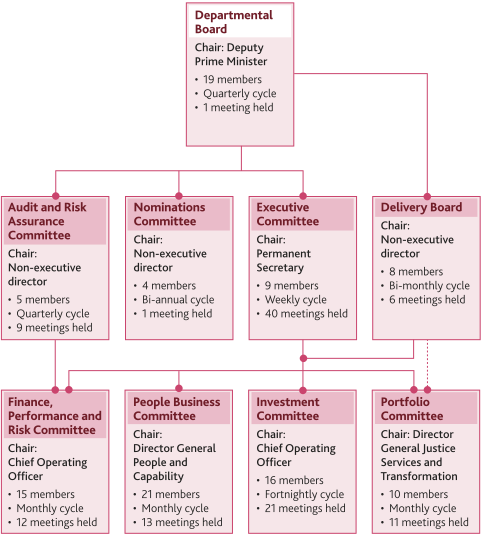
A diagram setting out the MoJ’s board and corporate committee information.
The Departmental Board is chaired by the Deputy Prime Minister. It has 19 members, a quarterly cycle and there was 1 meeting held.
The Departmental Board is supported by three committees. The Audit and Risk Assurance Committee is chaired by a non-executive director. It has 5 members, a quarterly cycle and there were 9 meetings held. The Nominations Committee is chaired by a non-executive director. It has 4 members, a bi-annual cycle and there was 1 meeting held. The Executive Committee is chaired by the Permanent Secretary. It has 9 members, a weekly cycle and there were 40 meetings held. There is also the Delivery Board, which is chaired by a non-executive director. It has 8 members, a bi-monthly cycle and there were 6 meetings held.
The Executive Committee is supported by four committees. The Finance, Performance and Risk Committee is chaired by the Chief Operating Officer. It has 15 members, a monthly cycle and there were 12 meetings held. The People Business Committee is chaired by the Director General People and Capability. It has 21 members, a monthly cycle and there were 13 meetings held. The Investment Committee is chaired by the Chief Operating Officer. It has 16 members, a fortnightly cycle and there were 21 meetings held. Finally, the Portfolio Committee is chaired by the Director General Justice Services and Transformation. It has 10 members, a monthly cycle and there were 11 meetings held.
The Departmental Board secretariat team supports the MoJ Departmental Board and its sub-committees to ensure the department runs effectively, manages risk and delivers its objectives.
MoJ committees
Departmental Board[footnote 5]
The Departmental Board forms the collective strategic and operational leadership of the department. It brings together the ministerial and Civil Service leaders with senior non-executives from outside government. It is responsible for setting strategic direction, including reviewing delivery against the business plan.
In-year activities included:
-
providing oversight of the department’s transformation agenda, including the Target Operating Model and delivery of a unified transformation plan
-
overseeing business continuity arrangements and improvement of management information to support effective board‑level decision‑making
-
considering significant operational and system change, including probation digitalisation
-
providing assurance on board‑level key performance indicators and the robustness of underlying performance measures, including Crown Court productivity data
-
reviewing the department’s response to the criminal cyber-attack against LAA’s digital systems, including operational impacts and associated risks, in the context of wider system pressures
Audit and Risk Assurance Committee
The Audit and Risk Assurance Committee advises on the effectiveness of governance, risk management and internal controls. It fulfils this role by assessing the completeness of the assurances required to support the Departmental Board and Accounting Officer, and by evaluating the reliability and integrity of those assurances.
In-year activities included:
-
providing oversight of audit, assurance and internal control arrangements, including engagement with the Government Internal Audit Agency and the National Audit Office
-
overseeing the department’s approach to risk management and governance, including contributing to the governance statement and annual report and accounts
-
reviewing the departmental risk profile and management of principal and operational risks, including cyber security, criminal justice system capacity, fire safety and other high impact risks
-
scrutinising accounting estimates and judgements, key performance indicator assurance, and the effectiveness of counter fraud, bribery, corruption and whistleblowing arrangements
-
considering sustainability and climate-related issues, assurance over public bodies, and selected deep dive reviews on areas such as evidence and insight and workforce capability
Nominations Committee
The Nominations Committee provides assurance on senior executive appointments within the department. This includes succession planning, talent management and pay strategy.
In-year activities included:
-
appraisal of directors general and discussion and advice in relation to performance assessment
-
succession planning
-
talent strategy
Executive Committee
The Executive Committee ensures that the department is fully aligned with the strategic direction set by the Deputy Prime Minister and Secretary of State, maintains and directs the capability to deliver, oversees the delivery of outcomes, and prioritises and allocates departmental resources.
In-year activities included:
-
providing collective leadership and oversight of delivery of ministerial priorities and the department’s strategic objectives
-
considering organisational performance and financial position to support effective delivery across the department
-
overseeing the department’s approach to principal and emerging risks and consideration of external developments
-
providing direction on major policy, operational and transformation matters, including the Sentencing Act 2026 and the Courts and Tribunals Bill 2026
-
discussing people priorities, including workforce strategy, pay decisions, and wider organisational capability and planning to support delivery
-
maintaining oversight of the department’s change portfolio and major programmes, including regular portfolio updates, transformation strategy discussions, and monitoring of delivery risks and benefits
Delivery Board
The Delivery Board provides assurance to the Principal Accounting Officer and the Departmental Board on the delivery of the department’s strategy, delivery plan and Government Major Projects Portfolio, ensuring that plans are well evidenced and strategic benefits are on track.
In-year activities included:
-
providing oversight of portfolio-level delivery performance through regular reporting, including delivery confidence and forecasting accuracy
-
scrutinising the performance of major programmes and priority delivery issues through targeted deep dive discussions, including significant delivery portfolios and programmes such as the Rehabilitation Directorate portfolio, courts reform closure activity, MoJ Synergy, and the Property Transformation Programme
The Delivery Board was adopted into the department’s corporate governance framework in 2021. As a result of ongoing reviews of governance arrangements to ensure they remain proportionate and fit for purpose, the Delivery Board was dissolved at the end of March 2026. This decision recognises the overall strength and maturity of the assurance mechanisms supporting change delivery.
Finance, Performance and Risk Committee
The Finance, Performance and Risk Committee provides strategic oversight and integrated assurance across departmental financial management, performance and risk. It oversees the performance framework, management of principal and secondary risks, and compliance with functional standards and other government, legal or professional requirements.
In-year activities included:
-
providing oversight of in‑year and strategic financial management, including Spending Review implications and efficiency delivery
-
considering risk reporting, planning and performance information to support effective oversight and decision‑making
-
overseeing the interface with internal audit and assurance on key controls and management information
-
reviewing climate and sustainability issues, service transformation and arrangements for public bodies oversight
-
delivering targeted risk deep dive assessments, encompassing disaster recovery and business continuity, commercial market resilience and technology risk
-
handling reporting and escalation from sub-committees, including the Information and Security Risk Board and the Business Continuity and Resilience Board
People Business Committee
The People Business Committee provides strategic oversight, assurance, challenge and decision-making on people-related matters.
In-year activities included:
-
providing assurance on the effectiveness of workforce and people arrangements supporting delivery of departmental objectives
-
scrutinising workforce planning, recruitment and succession (including the Voluntary Exit Scheme), and compliance with key people controls
-
monitoring people-related risks, including diversity and inclusion, leadership capability, worker protection and grievance handling
-
considering the people impacts of major change and transformation programmes, including MoJ Synergy
Investment Committee
The Investment Committee makes investment decisions on the Executive Committee’s behalf. It ensures that portfolio projects remain strategically aligned, affordable and deliverable from inception through to implementation, and that investments deliver value for money, meet regularity and propriety considerations, and are affordable and sustainable.
In-year activities included:
-
providing oversight of investment decision‑making across major change and capital programmes, including approval of business cases, re‑baselining, gated releases and tolerance management
-
overseeing investments across the justice system, including prison supply and capacity, new prisons and houseblocks, private finance initiative (PFI) prison expiry and transfer, and electronic monitoring
-
considering significant digital, technology and reform investments, including Evolve, MoJ Synergy, HMCTS reform‑related investment and property transformation
-
monitoring the balance of risk across the investment portfolio, including regular updates on prison supply, rehabilitation and probation services, education, and the secure estate
-
taking decisions on investment across major change and capital programmes, including approving business cases, setting tolerances, agreeing gated releases and re-baselining where required
-
scrutinising significant investment proposals, including digital, technology and reform programmes to inform funding and delivery decisions
Portfolio Committee
The Portfolio Committee provides oversight of our major change portfolio. It ensures the portfolio is strategically aligned, affordable and deliverable, and project leaders comply with project delivery standards. It also advises on the deployment of expert resources.
In-year activities included:
-
providing strategic oversight of the overall investment portfolio, ensuring alignment with ministerial priorities and departmental objectives
-
overseeing the balance and sequencing of investment across the justice system, including prison capacity, estate expansion, electronic monitoring and wider system reform
-
considering major programmes collectively to assess interdependencies, cumulative impacts and trade-offs across the system
-
monitoring portfolio-wide delivery risks and pressures, including across prison supply, probation and rehabilitation services, education, and the secure estate, to support early identification of issues and inform reprioritisation
Further details and membership of these forums can be found at: www.gov.uk/government/organisations/ministry-of-justice/about/our-governance
HM Treasury corporate governance code compliance
As part of the preparation of this report, the department considered its compliance with the HM Treasury Corporate Governance Code for Central Government Departments. This year there were two departures from the code recommendations.
-
The code stipulates that the Departmental Board meet on at least a quarterly basis. Due to the change in Secretary of State and competing priorities, only one meeting was held this financial year. While this is below the frequency expected, the board’s supporting governance structures, including the Executive Committee and the Audit and Risk Assurance Committee, met at or above their expected frequencies. The establishment of the Justice Performance Board during 2025-26 introduced an additional senior forum, bringing together ministers and officials to review and scrutinise departmental performance. Looking ahead, the Departmental Board is scheduled to meet on three occasions during 2026-27.
-
A formal Departmental Board effectiveness evaluation was not undertaken during 2025-26, reflecting both the limited frequency of board meetings and significant changes to its membership over the year. Led by the department’s lead non-executive director, an informal review will take place before the end of 2026, ahead of a formal external evaluation in early 2027 once a regular meeting frequency has been re-established.
Management of outside interests
The Civil Service Code, underpinned by the Constitutional Reform and Governance Act 2010, requires all civil servants to act with integrity, including identifying and managing outside interests.
The MoJ Declaration and Management of Outside Interests Policy, aligned with Cabinet Office guidance, requires declaration of actual, potential or perceived conflicts of interest.[footnote 6] Individuals are responsible for declaring relevant interests, with failure to do so potentially leading to disciplinary action. Where conflicts arise, they must be promptly managed or removed in line with the Civil Service Code.
During 2025-26, the Government Internal Audit Agency reviewed the effectiveness of these arrangements and made recommendations to strengthen controls. An action plan is underway. MoJ is also contributing to Cabinet Office-led work following a National Audit Office review on conflicts of interest, and will take further action as required.[footnote 7]
MoJ maintains a central register of interests for all senior civil servants, covering financial interests, secondary employment and other relevant declarations. Senior civil servants must confirm annually that their declarations are complete and up to date, including nil returns where appropriate, and details of their secondary paid employment are published in line with transparency requirements.[footnote 8] Heads of business areas must ensure appropriate arrangements are in place to record declarations for all other staff. Ministerial and board member interests are published on GOV.UK.[footnote 9][footnote 10]
In line with the current Declaration of Interests Policy for special advisers, all special advisers have declared any relevant interests or confirmed they do not consider they have any relevant interests. The Permanent Secretary has considered these returns and there are no relevant interests to be published.
Business appointment rules
The business appointment rules set out the process for approval when any employee, including civil servants and special advisers, wishes to leave the department to accept a role outside of the Civil Service. The rules apply for up to two years after leaving, and are designed to mitigate:
-
any suspicion that an appointment might be a reward for past favours
-
the risk that an employer might gain an improper advantage by appointing a former official
-
the risk of a former official improperly exploiting privileged access to contacts in government
MoJ operates a defined process for considering applications for employees at SCS2 and below. Applications for director general level (SCS3) and above are managed in liaison with the Civil Service Commission, which determines the outcome and any associated conditions.
To support compliance, MoJ’s People and Capability Group continues to:
-
ensure that our employment contracts refer to the business appointment rules so that colleagues are aware of their obligations in this area from the outset
-
ensure that colleagues across the business are regularly reminded of the business appointment rules and of their obligations in this area
-
ensure that the business appointment rules form part of the leavers’ process
During 2025-26, there were 51 SCS exits from the department. Nine business appointment rule applications were considered:
-
two at SCS3 (director general)
-
one at SCS1 (deputy director)
-
two at Grade 6
-
four below Grade 7
No applications were deemed unsuitable and no breaches of the rules were identified. All applications below SCS2 were approved with conditions, except for two at delegated grades where no conditions were applied.
In line with transparency requirements, the department publishes advice on business appointment rule applications for senior staff, including special advisers, on GOV.UK.[footnote 11] The Civil Service Commission publishes its advice for SCS3 and above on its website.[footnote 12]
Whistleblowing
The department’s whistleblowing policy provides clear and effective routes for individuals to raise concerns in a supportive and confidential environment. The 2025 People Survey results provide evidence that the department’s whistleblowing arrangements are effective. Awareness of how to raise a concern under the Civil Service Code increased to 72%, up four percentage points from 2024, while 70% of staff who responded were confident that concerns raised would be investigated properly. These results demonstrate growing awareness of reporting routes and confidence in MoJ’s processes for handling concerns.
The department strengthened its arrangements and promoted awareness of reporting routes through internal communications, awareness sessions, participation in the cross-government ‘Speak Up’ campaign, and engagement from the director general-level whistleblowing champion.
A network of 13 nominated officers continued to provide an independent and confidential route for raising concerns, offering impartial advice and support. Nominated officers received training on the Public Interest Disclosure Act and met regularly to share insight and good practice.
MoJ contributes to cross-government activity to improve whistleblowing arrangements and the experience of whistleblowers. A whistleblower experience survey has been introduced to inform continuous improvement, with findings shared with the Cabinet Office to support wider learning.
The department reports annually to the Cabinet Office on whistleblowing activity. In 2025-26, MoJ (including its executive agencies) reported 22 closed cases.
Significant control issues
As part of the arrangements for identifying and assessing significant control issues across MoJ and its executive agencies, agencies are requested to share details of any risks or issues disclosed within their governance statements with the MoJ Corporate Governance Centre of Expertise. These submissions are reviewed, and those assessed as significant are incorporated into this governance statement. For 2025-26, no material issues were identified for inclusion.
Throughout 2025-26, appropriate governance arrangements remained in place to manage and mitigate control challenges and emerging issues. The department recognises that it does not currently operate a single overarching assurance framework. However, this does not represent an absence of assurance. A range of established assurance activities and mechanisms operate across the organisation, including management oversight, second-line review and challenge, internal audit, external scrutiny and formal governance reporting. While the absence of an overarching framework limits the department’s ability to systematically assess the completeness, co-ordination and adequacy of assurance coverage across its principal risks and key controls, the existing arrangements provide important compensating assurance.
The department is committed to developing and implementing such a framework in the coming year to strengthen oversight and effective governance, with plans already underway.
Enterprise risk management arrangements
Risk management is integral to MoJ’s governance and leadership, underpinning how the organisation is directed, managed and controlled. The risk management framework is considered robust in relation to the identification, assessment, ownership, monitoring and escalation of principal and emerging risks. The framework supports effective planning, prioritisation and delivery of outcomes, while strengthening the ability to respond agilely to challenges, in compliance with the Orange Book: Management of Risk – Principles and Concepts and the Corporate Governance Code.
Responsibilities for the management of areas of risk are devolved through the organisational structure, defined roles and responsibilities, and delegated authorities. Responsibility for the effective operation of the risk framework is delegated to the Chief Operating Officer who is supported by the Chief Risk Officer.
The Chief Risk Officer actively engages with the department’s governance arrangements, with responsibilities including:
-
setting the framework and guidance in accordance with the principles in the Orange Book
-
assessing Orange Book compliance, reviewing effectiveness and driving continuous improvement in risk maturity
-
supporting the Executive Committee, the Audit and Risk Assurance Committee and the Departmental Board in understanding the risk landscape and assessing the department’s risk appetite to inform decision-making
During 2025-26 we took steps to evolve and improve our risk management approach, including:
-
refining the principal risk approach, enabling the Executive Committee to focus on key risks while maintaining organisation-wide assurance
-
implementing principal risk reviews by the Finance, Performance and Risk Committee and the Executive Committee, with quarterly reporting to the Audit and Risk Assurance Committee
-
quarterly oversight of the full MoJ risk landscape to identify, assess and escalate emerging risks
-
assessing risks embedded across investment decisions and the lifecycle of projects, programmes and commercial relationships, including alignment with external threats
-
strengthening risk capability through training, maturity assessments (National Audit Office tool) and close alignment of strategy, finance, planning and risk to inform allocations and Spending Review decisions
Business continuity and organisational resilience
This year, the Departmental Operations Centre delivered a programme of exercises aligned to national security risk assessment scenarios, providing assurance over co-ordination and escalation arrangements, identifying cross-cutting dependencies, and informing improvements to local and corporate plans.
We strengthened business continuity assurance arrangements through enhanced self-assessments, targeted challenge and deep dive reviews of organisational arrangements. We monitored resulting improvement actions through governance processes.
The department also published its Corporate Crisis Management Strategy in 2025-26, clarifying escalation, co-ordination and decision-making arrangements. We established a crisis response surge pool to provide trained volunteers that can quickly be called on for additional resource in major crises, strengthening departmental resilience. Staff and senior leaders expected to lead crisis responses continue to be supported by training and development.
Oversight continued through the director-led Business Continuity and Resilience Governance Board. Collectively, these activities strengthened organisational resilience and provided greater assurance over the department’s ability to respond to, and recover from, disruptive events.
Corporate fire, health and safety
The department continued to strengthen arrangements for managing compliance with fire safety and health and safety legislation during 2025-26. This was supported by clear governance, director-level accountability and oversight through audits, inspections, performance reporting and a structured assurance process.
During 2025-26, we strengthened controls through improvements to governance arrangements and increased audit and assurance activity. This included 26 workplace inspections and targeted audits of business areas and specialist functions, alongside continued alignment with ISO 45001 principles. Findings from these activities have supported compliance monitoring, identified improvement opportunities, and strengthened the consistency and maturity of risk management across the department. A follow-up review by the Government Internal Audit Agency provided a ‘substantial’ assurance rating for the corporate fire, health and safety function.
The mid-year assurance process indicated that the majority of public bodies are progressing towards full compliance, although some variation in maturity remains. Improvement activity has focused on strengthening assurance requirements, improving reporting consistency and providing targeted support where gaps have been identified. Lessons from incidents continue to inform improvements to the control environment.
Overall, these arrangements have strengthened oversight of fire, health and safety risks across the department and improved the visibility of areas requiring further action. Continued assurance and improvement activity will support greater consistency and compliance across the portfolio.
Internal control framework
The Principal Accounting Officer is responsible for maintaining an effective system of internal control across the department, its executive agencies and other public bodies. This is supported by a framework of delegated authorities monitored through our governance and risk management frameworks, to ensure effective stewardship of public resources and compliance with statutory and regulatory requirements.
The department continues to embed and apply government functional standards, which provide a stable basis for assurance, risk management and capability development, supporting value for money for the taxpayer. We monitor compliance through assessments, assurance processes and oversight by departmental governance committees, with targeted improvement activity undertaken where gaps are identified. We will undertake a programme of work to strengthen our understanding of second-line assurance across our functional landscape in the coming year.
During 2025-26, the department began a programme to modernise its approach to policy and operating procedure management. This aims to strengthen ownership and accountability, improve accessibility, and ensure that policies and procedures remain current, consistent and subject to regular review.
In addition to the improvements identified, we are exploring options to improve overall co-ordination of second-line assurance activities throughout the department to better inform the Principal Accounting Officer where internal control gaps exist.
Finance
The Principal Accounting Officer establishes plans to use resources affordably and sustainably within agreed limits. Financial authority is delegated to commit resources and incur expenditure, ensuring compliance with financial controls, including those mandated by HM Treasury and the Cabinet Office, as set out in our spending control framework.
These controls are designed to ensure that the department and its public bodies operate effectively and to the high standard of probity expected. Each budget holder is required to check expenditure to ensure that all transactions are legitimate and in line with anticipated spend, retaining records of all approvals with supporting documents. Identified anomalies are investigated and addressed through established control processes, with corrective or disciplinary action taken where appropriate.
Commercial
During 2025-26, the Commercial Function continued to improve governance, assurance and contract management arrangements in support of the Commercial Strategy 2025 to 2028.
We introduced a revised governance process for procurements valued above £10 million, providing proportionate oversight while maintaining appropriate assurance. We also reviewed commercial assurance boards to align with a comprehensive commercial assurance framework and HM Treasury guidance, clarifying decision-making responsibilities and strengthening oversight of commercial and contract management activity. In addition, we revised delegated authority arrangements for the execution of deeds to improve efficiency while maintaining compliance with legal and governance requirements.
The function also continued to strengthen supplier resilience arrangements, building on lessons learned from supplier failures in previous years. We introduced improved market management practices and contingency planning arrangements across commercial portfolios to support operational resilience and continuity of service delivery.
Collectively, these activities strengthened assurance over commercial decision-making, contract management and supplier resilience. In addition, the Commercial Optimisation Project launched in 2025-26, designed to improve the efficiency and overall performance of commercial operations across MoJ. Delivery of project-led improvements will start in 2026-27.
Projects and programmes
The department’s projects and programmes are led by a senior responsible owner who is accountable for delivery, governance and the achievement of agreed outcomes.
MoJ projects are managed in accordance with the Government Functional Standard for Project Delivery, the government project delivery framework and other applicable functional standards. Integrated assurance and approval plans are maintained for all major projects and programmes and are subject to independent quality assurance through the National Infrastructure and Service Transformation Authority (for major projects and programmes on the Government Major Projects Portfolio).
The department maintains a structured approach to project and programme assurance through functional standard compliance assessments, gateway reviews, keyholder reviews and a proportionate ‘three lines of defence’ model. These arrangements provide assurance that projects and programmes are subject to appropriate scrutiny and challenge throughout their lifecycle, enabling the Project Delivery Function to assess compliance and identify which elements require further enhancement.
Enhanced portfolio reporting provided deeper insights into portfolio management at the Portfolio Committee. This improved visibility of delivery performance, risks and dependencies, enabling more effective oversight and challenge by senior governance bodies.
In 2026-27, the department will continue to focus on project delivery fundamentals, including planning, risk management and benefits realisation, to improve delivery confidence across the portfolio.
People
During 2025-26, we undertook a comprehensive review of the People and Capability Group’s governance and ways of working, ensuring stronger alignment with wider departmental governance. This focused on streamlining processes, strengthening oversight and improving efficiency. It has enabled senior leaders to focus on decision-making at the appropriate level, strengthen risk assessment, improve tracking against key performance indicators, ensure escalation occurs at the right level, and maintain a clear, up-to-date view of workforce risks.
Property
During 2025-26, we continued to strengthen and mature governance arrangements for the management of MoJ’s estate, building on improvements made in recent years to support effective oversight, risk management and decision-making across the property portfolio.
The MoJ Property Board remained the principal governance forum for estate management, providing strategic oversight of risks, investment decisions and delivery priorities. The board continued to support timely decision-making and effective co-ordination across the department and its agencies.
Governance arrangements between HMPPS and the Property Directorate were further strengthened through clearer accountabilities, revised functional partnership agreements and improved information flows. These changes provided greater clarity over decision-making responsibilities, escalation routes and performance oversight.
Risk management arrangements continued to mature through closer collaboration with HMPPS and strengthened oversight of shared operational risks. Key risks were identified, assessed and monitored through established governance processes, with appropriate controls and escalation mechanisms in place.
During the year, we refreshed the Strategic Asset Management Plan to reflect departmental priorities and the Government Property Strategy. Work also continued to review the strategic estate to support longer-term affordability and alignment with Spending Review settlements.
We developed a Target Operating Model to support the future delivery of property services, including workforce planning and organisational design. This will inform the phased implementation of efficiency and capability improvements over the coming years.
Internal audit and assurance activity undertaken during the year, including follow-up reviews of statutory compliance and fire, health and safety arrangements, demonstrated continued progress in strengthening the control environment. These findings were supported by routine compliance monitoring and assurance activity across the estate.
Collectively, these arrangements improved governance and oversight of operational risks, providing assurance that property services are being managed effectively in accordance with statutory and departmental requirements.
Climate change and sustainability
In 2025-26, MoJ continued to maintain robust oversight of climate-related, environment and sustainability issues. The Permanent Secretary is accountable for the delivery of improvements, in line with the government’s GGCs.[footnote 13]
Climate and sustainability risks are now treated as a thematic risk across the MoJ group, with agencies managing them either as a principal risk or as a significant component of broader principal and functional risks. This change aligns with the adoption of a group-wide aggregated approach to principal risk reporting, replacing the previous risk category structure. The Departmental Board receives an annual report on performance and risks and MoJ’s Audit and Risk Committee receives biannual reports.
The Chief Operating Officer continued to oversee strategic climate and sustainability activity, hold ownership of the thematic risk and chair the MoJ Senior Sustainability Board, which consists of appropriate SCS representatives from agencies and functions. The board received performance updates from across the departmental group regarding the delivery of the GGCs and management of risks. On a quarterly basis, the board reported to the Finance, Performance and Risk Committee, which escalated issues to the Executive Committee as required.
The Chief Sustainability Officer and Climate Change and Sustainability Unit continued to provide functional leadership, expertise and co-ordinated climate and sustainability activity across the departmental group. Looking ahead to 2026-27, we will be reviewing our thematic risk in line with the changing risk landscape, our improved risk understanding, and anticipated new government resilience and efficiency targets. Once in place, we will develop environmental action plans aligned with the revised targets, making clear our funded improvements, and supported by clear responsibilities and accountabilities.
Security and information
The Security and Information Directorate provides functional leadership and assurance across security, information management and data protection. It supports compliance with government security standards and relevant legislative requirements, including the Data Protection Act 2018 and the Public Records Acts 1958 and 1967.
During 2025-26, security, information and data protection risks continued to be overseen through the Information and Security Risk Board, supported by specialist working groups covering personnel, physical and information security, and data protection. The board met quarterly to monitor risk, review assurance activity and oversee delivery of improvement actions.
Security and information risks continued to be reported through departmental governance structures, including the Executive Committee and the Audit and Risk Assurance Committee.
Given the complexity of the department’s technology estate, cyber security remained a key area of focus. This year, the Security and Information Directorate continued to support LAA’s response to the criminal cyber-attack against its digital systems. This included providing advice to support decisions about recovery of services and risk acceptance and remediation priorities, while delivery accountability remained with system and business owners. We have incorporated learning from incidents into updated guidance, response arrangements and cyber incident simulation exercises.
Progress continued against the MoJ Cyber Security Strategy, strengthening cyber resilience and the control environment including the introduction of a supplier security framework and expanded use of GovAssure assessments. We embedded security expertise and provider assurance within major programmes and operational services, and incorporated lessons identified from security incidents into improvement activity.
The department continued to work towards compliance with the government security framework, supported by annual security health check assessments and participation in cross-government security networks. These arrangements provided a structured approach to monitoring progress and identifying areas requiring further improvement.
More broadly, the department continued to strengthen arrangements in response to the evolving threat landscape. We are working towards compliance with the expanded requirements in the updated physical security standard. In partnership with national security bodies, nearly half of site assessments are complete, including 11 this year, with ongoing work to assess HQ sites and drive improvements through targeted action and performance tracking. Our programme of site assessments, awareness activity and engagement with government security partners supported the maintenance of appropriate security measures for staff, ministers and departmental assets.
The department is also implementing the updated personnel standard, which was rescoped to encompass the end-to-end employment process, with a focus on insider risk. Compliance has improved through the establishment of an insider risk programme team, publication of an insider risk strategy and personnel security policy, and the introduction of online behaviour monitoring. We are actively planning work to achieve improvements year on year. This includes:
-
rolling out insider risk awareness modules department-wide to embed insider risk awareness into onboarding and annual training
-
introducing quarterly reporting on behavioural indicators to measure behavioural risk reduction and policy adherence
-
reviewing and updating personnel security policy based on feedback and the threat landscape
During the year, responsibility for national security vetting transferred in-house, providing greater visibility of vetting risks and strengthening departmental oversight of personnel security arrangements.
Collectively, these activities strengthened the security and information control environment, improved risk ownership and assurance coverage, and provided greater confidence in the department’s ability to identify, manage and respond to security, information and data protection risks.
Data
During 2025-26, Justice Data strengthened governance, accountability and organisational alignment to support departmental priorities and improve the quality and accessibility of data services. This included work supporting the Independent Sentencing Review and the initiation of Justice ID, developed as part of the response to the Independent Review into Releases in Error. In parallel, accountability for data quality has improved through the ongoing implementation of internal audit recommendations.
The Digital and Data Delivery Board strengthens governance through the provision of strategic oversight, assurance and direction across the justice, digital, data and science portfolio, acting as the principal forum for significant digital and data issues.
Three improvement programmes transitioned into business-as-usual operations, embedding accountability for delivery and supporting the sustainability of key services. We further developed data quality reporting to identify critical data assets and prioritise improvement activity.
While progress has been made, data quality remains a significant risk in some operational areas and continues to be subject to ongoing management attention and oversight.
Analysis
The Analysis Function and Justice Data continued to provide analytical and evidence-based support to departmental policy, operational delivery and strategic decision-making throughout 2025-26.
Analytical resources were aligned and allocated to departmental priorities, including sentencing and criminal court reform and the Independent Review into Releases in Error, while continuing to provide core analytical products, data services and evidence to support decision-making across the department. Embedded analytical teams within policy and operational areas continued to support the effective integration of evidence into policy development and delivery.
Demand for analytical and data expertise remained high during the year, creating capacity pressures in some areas. These pressures were managed through prioritisation processes and the continued use of flexible resourcing arrangements, enabling resources to be deployed rapidly to emerging priorities.
Strengthening analytical quality assurance remained an area of focus. Work continued to develop a department-wide analytical quality assurance framework, providing greater clarity over roles and responsibilities and promoting consistent standards across analytical professions. This will improve the reliability, transparency and robustness of evidence used to inform departmental decision-making.
We further strengthened research and evaluation governance arrangements to support effective prioritisation of analytical activity and ensure resources remained aligned to departmental objectives. Established governance processes continued to support the identification of evidence gaps, oversight of commissioned research and evaluation activity, and compliance with appropriate methodological and ethical standards.
Collectively, these arrangements provided assurance over the quality, governance and effective use of analytical evidence across the department, supporting informed decision-making and continuous improvement.
Justice Digital
During 2025-26, Justice Digital continued to strengthen governance, assurance and compliance arrangements across the function.
We introduced a new end-to-end assurance model and enhanced technology governance process, providing clearer routes for investment approval, more proportionate assurance, and better oversight of digital and technology delivery. These arrangements strengthened accountability, supported value for money and improved the quality of information available for decision-making.
We made further progress through the Strengthening Digital and Data Programme, including the establishment of joint governance forums with agencies, improvements to financial management arrangements and clarification of governance responsibilities across the function. The implementation of a portfolio management tool has improved visibility of delivery, risk and performance information and supported more evidence-based decision-making.
Annual assurance and continuous improvement assessments identified areas requiring further development, including data governance, business continuity, accessibility, training and evidence-based assurance. Improvement plans are in place to address these areas and strengthen consistency of reporting and control effectiveness.
While governance arrangements continue to mature, further work is planned to simplify governance structures, strengthen accountability and improve assurance processes. Overall, the arrangements provide increased assurance over digital investment, delivery and risk management.
Counter fraud
The department remains committed to preventing, detecting and responding to fraud, bribery and corruption, working collaboratively across MoJ and the wider government counter fraud community. The Director General of the Service Transformation Group remained the department’s accountable board member for counter fraud, providing strategic leadership and assurance to the Principal Accounting Officer. The ministerial sponsor for counter fraud provided ministerial oversight.
The MoJ Counter Fraud Sub-Committee, comprising representatives from executive agencies and key departmental functions, continued to oversee counter fraud activity across the department. The committee monitored delivery of counter fraud priorities, reviewed emerging risks and provided oversight of improvement activity.
Fraud risk continued to be considered at the earliest stages of policy development, investment decisions and programme delivery. Initial fraud impact assessments were completed for new spending initiatives and programmes, including those required by the Public Sector Fraud Authority. Counter fraud considerations also remained embedded within the department’s investment and assurance processes, with more detailed fraud risk assessments undertaken where required.
During the year, the department reviewed its enterprise fraud risk assessment to reflect emerging risks, including those associated with new technologies and AI. A new Counter Fraud Strategy for 2026 to 2030 set out the department’s approach to strengthening fraud controls, improving compliance with functional standards and increasing data-led detection and prevention activity.
Delivery of the strategy will be supported through annual action plans, performance measures and maturity assessments, with progress subject to regular oversight by the Counter Fraud Sub‑Committee and engagement with the Public Sector Fraud Authority.
Collectively, these arrangements provided assurance that fraud, bribery and corruption risks are being actively identified, managed and monitored across the department.
Grants
Each grant programme is overseen by a senior officer accountable for the delivery of its objectives and compliance with the Government Grants Functional Standard. During 2025-26, the Grants Centre of Expertise continued to provide professional support, guidance and oversight, strengthening governance and assurance across the department’s grant portfolio.
All grants are supported by a grant agreement, and have a senior officer responsible, who ensures that grants are afforded the appropriate level of scrutiny, all the functional standards are adhered to, and grant funding is administered effectively. The terms of the grant agreements allow for identification of underperformance or other issues by senior officers responsible and grant managers who will discuss these with the grant recipients. The Accounting Officer relies on senior officers responsible to provide structured monitoring of data, performance and delivery of outcomes, and to identify risks at individual grant scheme or award level.
The Grants Challenge and Assurance Panel, chaired by the senior officer responsible for the department’s grants, continued to provide independent scrutiny and assurance over grant funding arrangements and value for money. During 2025-26, the panel provided oversight of £256 million in grant expenditure, reviewing both new and existing grant schemes to ensure consistency, proportionality and compliance with functional requirements. The panel provided challenge and advice to grant sponsors on grant design, delivery arrangements, risk management and expected outcomes, supporting effective decision-making and the appropriate use of public funds.
Mechanisms such as the Grants Challenge and Assurance Panel use information provided by grants teams to challenge and assure design, the delivery model and expected outcomes, covering propriety, regularity and value for money.
Compliance with the Government Grants Functional Standard continued to be externally validated through the biennial grants continuous improvement assessment. The most recent assessment, completed in 2024, rated the department as ‘best’ with a compliance score of 93.5%. During 2025-26, all recommendations arising from the assessment were implemented and closed.
These arrangements provided assurance that grant funding was subject to appropriate oversight, effective challenge and robust governance, supporting value for money and the achievement of intended outcomes.
Grants case studies are highlighted in the performance section.
Senior sponsorship of public bodies
During 2025-26, assurance over the governance, performance and financial management of public bodies continued to be provided through the Public Bodies Centre of Expertise, supporting consistent oversight across the portfolio. In March 2026, we appointed a Director of Public Bodies and Public Appointments, strengthening senior leadership oversight.
The department’s sponsorship arrangements remained aligned to the Cabinet Office Sponsorship Code and were supported by a risk-based and proportionate approach to oversight, including annual partnership assessments, regular performance reviews and reporting through departmental governance structures.
The department continued to support reforms intended to strengthen the effectiveness, accountability and agility of public bodies. This included progressing a number of targeted reviews and continuing to update framework documents in line with government guidance. The Public Bodies Centre of Expertise also supported ministerial public appointments processes and continued work to improve the timeliness, diversity and effectiveness of appointments across the portfolio.
These arrangements provided proportionate oversight of governance, performance, financial management and risk across the public bodies landscape and continue to be reviewed to ensure they remain effective and aligned to departmental priorities.
Ministerial directions
There were no ministerial directions in 2025-26 to Dr Jo Farrar CB OBE in her capacity as Principal Accounting Officer.
Review of effectiveness
As Principal Accounting Officer, I am responsible for ensuring the effectiveness of the department’s governance structures, risk management and internal control framework. This assurance is informed by:
-
the audit opinion and insights provided by internal audit on the adequacy and effectiveness of the department’s framework for governance, risk management and internal control
-
the findings of the National Audit Office, including its financial audit of the department and its public bodies and its value for money report on the economy, efficiency and effectiveness of public expenditure
-
the views of the Audit and Risk Assurance Committee on the design and operation of the department’s governance, risk management and internal control arrangements
-
assurance and oversight provided by the National Infrastructure and Service Transformation Authority in respect of the department’s projects within the Government Major Projects Portfolio
-
information from the department’s public bodies on organisational performance and the effectiveness of their relevant boards
-
feedback from senior managers with delegated responsibilities regarding stewardship of resources, management of risks, compliance with standards, and delivery against in-year budgets and targets
As Principal Accounting Officer, I am responsible for ensuring effective processes are in place to identify, monitor and report governance issues through the year. In discharging this responsibility, I draw assurance from the department’s board and committee structures, as well as from assurance and audit processes. I also rely on the assurance provided by agency chief executives and directors general operating under delegated authority, as set out in the Accounting Officer System Statement.[footnote 14]
In preparing the department’s governance statement, I have taken account of the outcomes of the annual assurance processes, including:
-
completion of director assurance statements across MoJ HQ, reviewed and countersigned by the relevant directors general, assessing compliance with departmental policies and guidance
-
a control maturity assessment evaluating the effectiveness of functional governance and compliance controls, and identifying areas for improvement
-
committee effectiveness reviews to ensure effective governance and oversight arrangements remain in place
-
review of material issues from executive agencies and other public bodies, assessed for materiality at MoJ level, providing an overview of compliance for their organisation
Government Internal Audit Agency
A key source of independent assurance is the internal audit function, which provides me and the Audit and Risk Assurance Committee with clear insight into issues identified through its work.
The scope of internal audit assurance aligns with my responsibilities as Principal Accounting Officer, covering the core department and the public bodies within the departmental group. Arrangements ensure I am promptly informed of any significant issues indicating ineffective risk management. I am also assured that internal audit operates in accordance with public sector internal audit standards.
For 2025-26, the MoJ Group Chief Internal Auditor has provided a ‘limited’ annual opinion on the department’s framework of governance, risk management and control. This is defined as: “There are significant weaknesses in the framework of governance, risk management and control such that it could be or could become inadequate and ineffective.”
In the previous year, the MoJ Group Chief Auditor provided a ‘moderate’ opinion, noting a downward direction of travel towards ‘limited’. Challenges identified at the time, which included a high level of risk exposure, constrained resources and significant demand pressures, have largely persisted into 2025-26.
The opinion was driven principally by an increase in the number of individual reviews receiving ‘limited’ assurance opinions. The Government Internal Audit Agency identified several recurring themes from 2024-25 requiring continued improvement, including fragmented assurance activity and weaknesses in second-line assurance, limitations in data quality and management information, and insufficient clarity of ownership and accountability across the control environment.
The overall opinion is further informed by annual assurance opinions across MoJ’s public bodies. Notably, the two largest public bodies, HMPPS and HMCTS, have both received ‘limited’ opinions, primarily driven by an increase in individual reviews resulting in ‘limited’ assurance opinions.
Despite these challenges, the MoJ Group Chief Internal Auditor highlighted areas of strong performance across many of the department’s public bodies, alongside continued progress in driving positive change within our operating environment. In particular, where internal audit is embedded within governance structures, there is evidence of increasing maturity and effectiveness.
A strong co-ordinated response to emerging, in-year, cross-departmental challenges was also observed, exemplified by the LAA cyber-attack.
Overall, the Government Internal Audit Agency has confirmed that the department continues to operate governance structures aligned with Cabinet Office requirements. Its risk management framework provides a solid foundation for understanding the department’s risk profile, with arrangements continuing to evolve and strengthen over time.
While this position is well understood, the ongoing challenge is to ensure that identified controls are operating effectively, or that additional action or investment is undertaken to bring risks into tolerance, supported by a credible delivery plan. The department is committed to prioritising sustained action and targeted investment to strengthen the wider control and assurance environment. Initial improvement activity has focused on:
-
improving audit owner engagement and preparedness, alongside stronger oversight of audit actions
-
initiating a functional assurance review to establish a comprehensive view of assurance arrangements across MoJ
-
mobilising a central Assurance Centre of Expertise to strengthen oversight and co-ordination of MoJ’s control and assurance environment
We are also supporting efforts to deliver similar improvements across the executive agencies, particularly HMPPS and HMCTS.
While their work has highlighted evidence of embedded assurance processes in some areas of the department, they highlight the need for effective and consistent ‘second line of defence’ reporting, underpinned by robust data. Enhancements in this area will better equip senior leaders to assess control effectiveness and inform decisions on investment and risk appetite.
In terms of control and compliance, the work undertaken by the Government Internal Audit Agency recognises progress made by the department in embedding government functional standards. However, further work is required to establish a shared understanding between functions and service users regarding delivery expectations and service provision. This work is underway within the department.
External audit
The National Audit Office scrutinises public spending on behalf of Parliament, auditing financial statements to hold government to account and improve public services.
The notional cost of the statutory audit for the core department was £778,820 (2024-25: £789,400), which also includes the statutory external audit of the consolidated accounts, the Office of the Accountant General and the Judicial Pension Scheme. The total cost of statutory external audits across the departmental group was £3,148,288, of which £689,468 was cash and £2,458,820 was notional cost (2024-25: £2,971,400 comprising £639,500 cash and £2,331,900 notional cost). The notional external audit cost includes the cost of the HMCTS Trust Statement which is not consolidated as part of these accounts.
Independent oversight of assurance arrangements
The department is subject to independent oversight in several areas. This oversight included:
-
National Audit Office reports (including value for money) and the audit report for the annual report and accounts
-
National Infrastructure and Service Transformation Authority reviews
-
feedback from the Major Projects Review Group
-
Cabinet Office and HM Treasury representation on programme boards
-
HM Chief Inspector of Prisons publications and annual report
-
HM Chief Inspector of Probation publications and annual report
-
regular Independent Monitoring Board reports
-
Ofsted reports
-
Public Accounts Committee
Conclusion
I have considered the evidence provided regarding the production of the governance statement and the independent advice and assurance provided by the Audit and Risk Assurance Committee. I conclude that the department has satisfactory governance and risk management systems in place with the necessary policies and procedures to support MoJ in delivering its statutory duties and to meet the aims and objectives set by ministers, while safeguarding the public funds and assets for which I am responsible. While the fundamental arrangements remain sound, I recognise that further co-ordinated work is required to strengthen effectiveness and ensure they operate consistently to an acceptable standard across MoJ. To address this, we have put in place a programme of improvement to enhance the effectiveness of our governance, risk management and assurance arrangements and support their consistent operation across MoJ group.
Dr Jo Farrar CB OBE
Permanent Secretary and Principal Accounting Officer
11 November 2026
Remuneration and staff report
The remuneration and staff report summarises the department’s policy on remuneration of ministers, executive board members, non-executive board members and staff. It also provides details of actual costs and contractual arrangements.
The remuneration and staff report has been prepared in accordance with the requirements of the Government Financial Reporting Manual as issued by HM Treasury.
Remuneration policy
The remuneration of senior civil servants is set by the Prime Minister following independent advice from the Review Body on Senior Salaries.[footnote 15] The Review Body on Senior Salaries also advises the Prime Minister from time to time on:
-
the pay and pensions of MPs and their allowances
-
peers’ allowances
-
the pay, pensions and allowances of ministers and others whose pay is determined by the Ministerial and Other Salaries Act 1975 (as amended)
In reaching its recommendations, the Review Body on Senior Salaries has regard to the following considerations:
-
the need to recruit, retain and motivate suitably able and qualified people to exercise their different responsibilities
-
regional and local variations in labour markets and their effects on the recruitment and retention of staff
-
government policies for improving the public services, including the requirement on departments to meet the output targets for the delivery of departmental services
-
the funds available to departments as set out in the government’s DEL
-
the government’s inflation target
The Review Body on Senior Salaries takes account of the evidence it receives about wider economic considerations and the affordability of its recommendations.
Board members and senior civil servants’ remuneration
The salaries of MoJ Departmental Board members (excluding the ministerial and non-executive members) are determined in line with the Cabinet Office SCS reward policy. Non-consolidated performance-related payments for senior civil servants are determined by the Executive Committee (SCS pay band 1 and 2) and the Nominations Committee (SCS pay band 3).
Service contracts
The Constitutional Reform and Governance Act 2010 requires Civil Service appointments to be made on merit on the basis of fair and open competition. The Recruitment Principles published by the Civil Service Commission specify the circumstances when appointments may be made otherwise.
Unless otherwise stated below, the officials covered by this report hold appointments which are open-ended. Early termination, other than for misconduct, would result in the individual receiving compensation as set out in the Civil Service Compensation Scheme.
Further information about the work of the Civil Service Commission can be found at: www.civilservicecommission.org.uk
Remuneration and pension entitlement
The following sections provide details of the remuneration and pension interests of the ministers and most senior management (such as Departmental Board members) of the department.
Remuneration: salary and payments in kind (audited)
| Remuneration | 2025‑26 | 2024‑25 | ||||||||
|---|---|---|---|---|---|---|---|---|---|---|
| Total amount of salary and fees | All taxable benefits (nearest £100) | Pension-related benefits (nearest £1,000)[footnote 16] | Severance payments | Total (nearest £1,000) | Total amount of salary and fees | All taxable benefits (nearest £100) | Pension-related benefits (nearest £1,000) | Severance payments | Total (nearest £1,000) | |
| Ministers [footnote 17] [footnote 18] |
£ | £ | £ | £ | £ | £ | £ | £ | £ | £ |
| The Rt Hon David Lammy MP, Lord Chancellor and Secretary of State for Justice (from 6 September 2025)[footnote 19] | 33,753 (FYE 67,505)[footnote 20] | 3,000 | 10,000 | - | 47,000 | - | - | - | - | - |
| The Rt Hon Shabana Mahmood MP, Lord Chancellor and Secretary of State for Justice (from 5 July 2024 to 5 September 2025)[footnote 21] | 33,753 (FYE 67,505) | - | 7,000 | - | 41,000 | 49,721 (FYE 67,205) | - | 13,000 | - | 62,000 |
| Lord Timpson OBE, Minister of State for Justice (from 5 July 2024) | - | - | - | - | - | - | - | - | - | - |
| Alex Davies-Jones MP, Parliamentary Under Secretary of State for Justice (from 9 July 2024) | 22,375 | - | 6,000 | - | 28,000 | 16,300 (FYE 22,375) | - | 4,000 | - | 21,000 |
| Lord Ponsonby of Shulbrede, Parliamentary Under Secretary of State for Justice (from 9 July 2024 to 6 September 2025)[footnote 22] | - | - | - | - | - | - | - | - | - | - |
| Sir Nic Dakin MP, Parliamentary Under Secretary of State for Justice (from 23 July 2024 to 7 September 2025) | - | - | - | - | - | - | - | - | - | - |
| Sarah Sackman KC MP, Minister of State for Justice (from 2 December 2024) | 31,680 | - | 8,000 | - | 40,000 | 10,475 (FYE 31,680) | - | 3,000 | - | 13,000 |
| Jake Richards MP, Parliamentary Under Secretary of State for Justice (from 8 September 2025) | - | - | - | - | - | - | - | - | - | - |
| Baroness Levitt KC, Parliamentary Under Secretary of State and Lords Minister (from 6 September 2025) | - | - | - | - | - | - | - | - | - | - |
| Heidi Alexander MP, Minister of State for Justice (from 8 July 2024 to 28 November 2024) | - | - | - | - | - | 12,604 (FYE 31,680) | - | 3,000 | - | 16,000 |
| The Rt Hon Alex Chalk KC MP, Lord Chancellor and Secretary of State for Justice (from 21 April 2023 to 5 July 2024) | - | - | - | - | - | 17,784 (FYE 67,505) | - | 4,000 | 16,876 | 39,000 |
| Mike Freer MP, Parliamentary Under Secretary of State for Justice (from 20 September 2022 to 5 July 2024) | - | - | - | - | - | 5,894 (FYE 22,375) | - | 1,000 | 5,593 | 13,000 |
| The Rt Hon Edward Argar MP, Minister of State for Justice (from 27 October 2022 to 5 July 2024) | - | - | - | - | - | 8,346 (FYE 31,680) | - | 2,000 | 7,920 | 18,000 |
| Gareth Bacon MP, Parliamentary Under Secretary of State for Justice (from 13 November 2023 to 5 July 2024) | - | - | - | - | - | 5,894 (FYE 22,375) | - | 1,000 | 5,593 | 13,000 |
Remuneration: salary and payments in kind (audited)
| Remuneration | 2025‑26 | 2024‑25 | ||||||||
|---|---|---|---|---|---|---|---|---|---|---|
| Total amount of salary and fees | All taxable benefits (nearest £100) | Bonuses paid [footnote 23] |
Pension-related benefits (nearest £1,000)[footnote 24][footnote 25] | Total | Total amount of salary and fees | All taxable benefits (nearest £100) | Bonuses paid | Pension-related benefits (nearest £1,000) | Total | |
| Senior managers | £000 | £000 | £000 | £000 | £000 | £000 | £000 | £000 | £000 | £000 |
| Dr Jo Farrar CB OBE, Permanent Secretary (from 1 July 2025)[footnote 26] | 145-150 (FYE 195-200) | - | - | 23 | 170-175 | - | - | - | - | - |
| Dame Antonia Romeo DCB, Permanent Secretary (to 13 April 2025) | 5-10 (FYE 200-205) | - | - | 6 | 10-15 | 205-210 | - | 0 | 63 | 270-275 |
| Amy Rees, Director General, Chief Executive, HMPPS (to 13 April 2025) and Interim Permanent Secretary (from 14 April 2025 to 30 June 2025)[footnote 26] | 45-50 (FYE 185-190) | 14.2 | 10-15 | 6 | 80-85 | 175-180 | 40.2 | 15-20 | 25 | 260-265 |
| Nick Goodwin, Chief Executive, HMCTS[footnote 27] | 155-160 | - | 5-10 | 82 | 240-245 | 145-150 | - | 0-5 | 85 | 230-235 |
| James McEwen, Chief Operating Officer (to 12 October 2025), Director General and Chief Executive Officer, HMPPS (from 13 October 2025) | 175-180 | - | 5-10 | 75 | 255-260 | 165-170 | - | 10-15 | 141 | 320-325 |
| Mark Adam, Director General, People and Capability (from 8 August 2025) | 110-115 (FYE 170-175) | - | 5-10 | 77 | 190-195 | - | - | - | - | - |
| Amy Holmes, Interim Director General, Service Delivery Transformation (from 17 March 2025 to 28 September 2025) and Interim Chief Operating Officer (from 13 October 2025 to 31 March 2026)[footnote 28] | 135-140 (FYE 140-145) | - | 15-20 | 134 | 285-290 | 5-10 (FYE 125-130) | - | - | 5 | 10-15 |
| Gemma Hewison, Interim Director General, Policy – Courts and Access to Justice (from 16 June 2025 to 30 November 2025) | 60-65 (FYE 135-140) | - | 25 | 85-90 | - | - | - | - | - | |
| Megan Lee-Devlin, Director General, Service Delivery Transformation (to 28 September 2025) and Director General, Justice Services and Transformation (from 29 September 2025)[footnote 29] | 185-190 | - | 5-10 | 73 | 265-270 | 185-190[footnote 30] | - | 0-5 | 69 | 255-260 |
| Ross Gribbin, Director General, Policy – Prisons, Offenders and International Justice (from 16 November 2023 to 9 December 2025) | 105-110 (FYE 150-155) | - | 10-15 | 52 | 170-175 | 145-150 | - | 15-20 | 112 | 270-275 |
| Jerome Glass, Director General, Policy Group – Courts and Access to Justice (to 15 June 2025) | 30-35 (FYE 150-155) | - | 5-10 | 14 | 50-55 | 145-150 | - | 10-15 | 87 | 245-250 |
| Richard Price, Director General, Performance, Strategy and Analysis (to 31 October 2024) | - | - | - | - | 85-90 (FYE 145-150) | - | - | 81 | 165-170 | |
| Emma Churchill, Director General, Policy – Courts, Access to Justice, International Justice and Legal (from 1 December 2025) | 50-55 (FYE 150-155) | - | - | 17 | 65-70 | - | - | - | - | - |
| Phil Copple, Interim Chief Executive, HMPPS (from 14 April 2025 to 12 October 2025) | 90-95 (FYE 180-185) | - | - | 31 | 120-125 | - | - | - | - | - |
Remuneration: salary and payments in kind (audited)
| 2025‑26 | 2024‑25 | |||||
|---|---|---|---|---|---|---|
| Fees (excluding performance-related remuneration) | All taxable benefits (nearest £100) | Bonuses paid | Fees (excluding performance-related remuneration) | All taxable benefits (nearest £100) | Bonuses paid | |
| Non‑executive board members[footnote 31] | £000 | £000 | £000 | £000 | £000 | £000 |
| Mark Rawlinson, Lead Non‑Executive Member (to 3 March 2026)[footnote 32] | 15-20 (FYE 20-25) | - | - | 20-25 | - | - |
| Paul Smith, Non-Executive Member and Chair of Audit and Risk Assurance Committee (to 31 March 2026)[footnote 33] | 20-25 | - | - | 20-25 | - | - |
| Mark Beaton, Non-Executive Member (to 31 March 2026) | 10-15 | 1.9 | - | 10-15 | 6.0 | - |
| Jennifer Rademaker, Non‑Executive Member | 10-15 | - | - | 10-15 | - | - |
| Jonathan Spence, Non-Executive Member (from 21 August 2023 to 31 December 2025) | 10-15 (FYE 10-15) | 0.8 | - | 10-15 | 2.4 | - |
| Andrew Robb, Non-Executive Member | 10-15 | - | - | 10-15 | - | - |
Salary
‘Salary’ includes:
-
gross salary
-
overtime
-
reserved rights to London weighting or London allowances
-
recruitment and retention allowances
-
private office allowances
-
any other allowance to the extent that it is subject to UK taxation
This report is based on accrued payments made by the department and therefore recorded in these accounts. In respect of ministers in the House of Commons, departments bear only the cost of the additional ministerial remuneration. The salary for their services as an MP (£93,094 from 1 April 2025) and various allowances to which they are entitled are borne centrally.
Ministers in the House of Lords do not receive a salary but rather an additional remuneration, which cannot be quantified separately from their ministerial salaries. This total remuneration, as well as the allowances to which they are entitled, is paid by the department and is therefore shown in full in the figures above.
Benefits in kind
Taxable benefits include all benefits in kind and taxable cash benefits. The monetary value of benefits in kind covers any benefits provided by the department and treated by HM Revenue and Customs as a taxable emolument. Benefits recognised relate to travel and subsistence.
Bonuses
Bonuses are based on performance levels attained and are made as part of the appraisal process. Bonuses relate to the performance in the year in which they become payable to the individual. Permanent Secretary bonuses are determined by the Permanent Secretary Remuneration Committee within Cabinet Office.
Bonuses for SCS pay band 3 are determined by the Permanent Secretary, as advised by the Nominations Committee which includes the lead non-executive board member and the Chief People Officer. The bonuses reported in 2025-26 relate to performance in 2025-26 and 2024-25. The comparative bonuses reported for 2024-25 relate to performance in 2024-25 and 2023-24.
Pension entitlements: ministerial pensions (audited)
| Accrued pension at age 65 as at 31 March 2026 | Real increase in pension at age 65 | CETV at 31 March 2026 | CETV at 31 March 2025 [footnote 34] |
Real increase/ (decrease) in CETV | |
|---|---|---|---|---|---|
| Ministers [footnote 35] [footnote 36] |
£000 | £000 | £000 | £000 | £000 |
| The Rt Hon David Lammy MP, Lord Chancellor and Secretary of State for Justice (from 6 September 2025) | 10-15 | 0-2.5 | 224 | 208 | 7 |
| The Rt Hon Shabana Mahmood MP, Lord Chancellor and Secretary of State for Justice (from 5 July 2024 to 5 September 2025) | 0-5 | 0-2.5 | 19 | 12 | 3 |
| Lord Timpson OBE, Minister of State for Justice (from 5 July 2024) | - | - | - | - | - |
| Alex Davies-Jones MP, Parliamentary Under Secretary of State for Justice (from 9 July 2024) | 0-5 | 0-2.5 | 9 | 4 | 2 |
| Lord Ponsonby of Shulbrede, Parliamentary Under Secretary of State for Justice (from 9 July 2024 to 6 September 2025) | - | - | - | - | |
| Sir Nic Dakin MP, Parliamentary Under Secretary of State for Justice (from 23 July 2024 to 7 September 2025) | - | - | - | - | - |
| Sarah Sackman KC MP, Minister of State for Justice (from 2 December 2024) | 0-5 | 0-2.5 | 16 | 8 | 4 |
| Jake Richards MP, Parliamentary Under Secretary of State for Justice (from 8 September 2025) | - | - | - | - | - |
| Baroness Levitt KC, Parliamentary Under Secretary of State and Lords Minister (from 6 September 2025) | - | - | - | - | - |
| Heidi Alexander MP, Minister of State for Justice (from 8 July 2024 to 28 November 2024) | - | - | - | 4 | - |
| The Rt Hon Alex Chalk KC MP, Lord Chancellor and Secretary of State for Justice (from 21 April 2023 to 5 July 2024) | - | - | - | 49 | - |
| Mike Freer MP, Parliamentary Under Secretary of State for Justice (from 20 September 2022 to 5 July 2024) | - | - | - | 56 | - |
| The Rt Hon Edward Argar MP, Minister of State for Justice (from 27 October 2022 to 5 July 2024) | - | - | - | 51 | - |
| Gareth Bacon MP, Parliamentary Under Secretary of State for Justice (from 13 November 2023 to 5 July 2024) | - | - | - | 4 | - |
Ministerial pension benefits
Pension benefits for ministers are provided by the Parliamentary Contributory Pension Fund. The scheme is made under statute and the rules are set out in the Ministers’ Etc. Pension Scheme 2015.[footnote 37] Those ministers who are MPs may also accrue an MP’s pension under the Parliamentary Contributory Pension Fund (details of which are not included in this report).
Benefits for ministers are payable from state pension age under the 2015 scheme. Pensions are revalued annually in line with pensions increase legislation both before and after retirement. The contribution rate from May 2015 is 11.1% and the accrual rate is 1.775% of pensionable earnings.
The figure shown for pension value includes the total pension payable to the member under both the pre- and post-2015 ministerial pension schemes.
Cash equivalent transfer value
This is the actuarially assessed capitalised value of the pension scheme benefits accrued by a member at a particular point in time. The benefits valued are the member’s accrued benefits and any contingent spouse’s pension payable from the scheme. A cash equivalent transfer value (CETV) is a payment made by a pension scheme, or arrangement to secure pension benefits in another pension scheme, or arrangement when the member leaves a scheme and chooses to transfer the pension benefits they have accrued in their former scheme.
The pension figures shown relate to the benefits that the individual has accrued as a consequence of their total ministerial service, not just their current appointment as a minister. CETVs are calculated in accordance with the Occupational Pension Schemes (Transfer Values) (Amendment) Regulations 2008 and do not take account of any actual or potential reduction to benefits resulting from Lifetime Allowance Tax which may be due when pension benefits are taken.
Real increase in value of the CETV
This is the element of the increase in accrued pension funded by the Exchequer. It excludes increases due to inflation and contributions paid by the minister. It is worked out using common market valuation factors for the start and end of the period.
Civil Service pensions (audited)
| Accrued pension and related lump sum at pension age as at 31 March 2026 | Real increase in pension and related lump sum at pension age | CETV at 31 March 2026 | CETV at 31 March 2025 | Real increase/ (decrease) in CETV | Employer partnership pension account at 31 March 2026 | |
|---|---|---|---|---|---|---|
| Senior managers [footnote 38] |
£000 | £000 | £000 | £000 | £000 | £100 |
| Dr Jo Farrar CB OBE, Permanent Secretary (from 1 July 2025)[footnote 39] | - | - | - | - | - | 22,700 |
| Dame Antonia Romeo DCB, Permanent Secretary (to 13 April 2025) | 65-70 plus a lump sum of 145-150 | 0-2.5 plus a lump sum of 0 | 1,314 | 1,310 | 3 | - |
| Amy Rees, Director General, Chief Executive, HMPPS (to 13 April 2025) and Interim Permanent Secretary (from 14 April 2025 to 30 June 2025)[footnote 39] | - | - | - | - | - | 6,400 |
| Nick Goodwin, Chief Executive, HMCTS[footnote 40] | 55-60 plus a lump sum of 120-125 | 2.5-5 plus a lump sum of 2.5-5 | 1,119 | 998 | 59 | - |
| James McEwen, Chief Operating Officer (to 12 October 2025), Director General and Chief Executive Officer, HMPPS (from 13 October 2025) | 70-75 | 2.5-5 | 1,208 | 1,094 | 44 | - |
| Mark Adam, Director General, People and Capability (from 8 August 2025) | 30-35 | 2.5-5 | 460 | 387 | 52 | - |
| Amy Holmes, Interim Director General, Service Delivery Transformation (from 17 March 2025 to 28 September 2025) and Interim Chief Operating Officer (from 13 October 2025)[footnote 41] | 45-50 plus a lump sum of 105-110 | 5-7.5 plus a lump sum of 10-12.5 | 902 | 745 | 105 | - |
| Gemma Hewison, Interim Director General, Policy – Courts and Access to Justice (from 16 June 2025 to 30 November 2025) | 30-35 | 0-2.5 | 382 | 363 | 14 | - |
| Megan Lee-Devlin, Director General, Service Delivery Transformation (to 28 September 2025) and Director General, Justice Services and Transformation (from 29 September 2025) | 20-25 | 2.5-5 | 214 | 162[footnote 42] | 32 | - |
| Ross Gribbin, Director General, Policy – Prisons, Offenders and International Justice (to 9 December 2025) | 45-50 | 2.5-5 | 767 | 698 | 32 | - |
| Jerome Glass, Director General, Policy Group – Courts and Access to Justice (to 15 June 2025) | 50-55 | 0-2.5 | 878 | 863 | 7 | - |
| Richard Price, Director General, Performance, Strategy and Analysis (to 31 October 2024) | - | - | - | 1,460 | - | - |
| Emma Churchill, Director General, Policy – Courts, Access to Justice, International Justice and Legal (from 1 December 2025) | 60-65 plus a lump sum of 140-145 | 0-2.5 plus a lump sum of 0 | 1,236 | 1,208 | 11 | - |
| Phil Copple, Interim Chief Executive, HMPPS (from 14 April 2025 to 12 October 2025) | 85-90 plus a lump sum of 210-215 | 0-2.5 plus a lump sum of 0 | 1,954 | 1,861 | 21 | - |
Civil Service pensions
Pension benefits are provided through the Civil Service pension arrangements and are administered by Capita. Before 1 April 2015, the only scheme was the Principal Civil Service Pension Scheme (PCSPS), which is divided into a few different sections. Classic, premium and classic plus provide benefits on a final salary basis, while nuvos provides benefits on a career average basis. From 1 April 2015, a new pension scheme for civil servants was introduced – the Civil Servants and Others Pension Scheme or alpha, which provides benefits on a career average basis. All newly appointed civil servants, and the majority of those already in service, joined the new scheme.
The PCSPS and alpha are unfunded statutory schemes. Employees and employers make contributions (employee contributions range between 4.6% and 8.05%, depending on salary). The balance of the cost of benefits in payment is met by monies voted by Parliament each year. Pensions in payment are increased annually in line with the pensions increase legislation. Instead of the defined benefit arrangements, employees may opt for a defined contribution pension with an employer contribution, which is the partnership pension account.
In alpha, pension builds up at a rate of 2.32% of pensionable earnings each year, and the total amount accrued is adjusted annually in line with a rate set by HM Treasury. Members may opt to give up (commute) pension for a lump sum up to the limits set by the Finance Act 2004. All members who switched to alpha from the PCSPS had their PCSPS benefits ‘banked’, with those with earlier benefits in one of the final salary sections of the PCSPS having those benefits based on their final salary when they leave alpha.
The accrued pensions shown in this report are the pension the member is entitled to receive when they reach normal pension age, or immediately on ceasing to be an active member of the scheme if they are already at or over normal pension age. Normal pension age is 60 for members of classic, premium and classic plus, 65 for members of nuvos, and the higher of 65 or state pension age for members of alpha. The pension figures in this report show pension earned in the PCSPS or alpha, as appropriate. Where a member has benefits in both the PCSPS and alpha, the figures show the combined value of their benefits in the two schemes but note that the constituent parts of that pension may be payable from different ages.
When the government introduced new public service pension schemes in 2015, there were transitional arrangements which treated existing scheme members differently based on their age. Older members of the PCSPS remained in that scheme, rather than moving to alpha. In 2018, the Court of Appeal found that the transitional arrangements in the public service pension schemes unlawfully discriminated against younger members (the McCloud judgement).
As a result, steps are being taken to remedy those 2015 reforms, making the pension scheme provisions fair to all members. The Public Service Pensions Remedy is made up of two parts.[footnote 43] The first part closed the PCSPS on 31 March 2022, with all active members becoming members of alpha from 1 April 2022. The second part removes the age discrimination for the remedy period, between 1 April 2015 and 31 March 2022, by moving the membership of eligible members during this period back into the PCSPS on 1 October 2023. This is known as ‘rollback’. From July 2025, eligible members who opted out between 12 March 2012 and 28 February 2022 were able to apply to buy back pension service for the remedy period (1 April 2015 to 31 March 2022), in line with Capita guidance, Employer Pension Notice 738 (EPN 738).[footnote 44] Any approved buy back will be processed by Capita and reflected in future benefit statements.
The accrued pension benefits, CETV and single total figure of remuneration reported for any individual affected by the Public Service Pensions Remedy have been calculated based on their inclusion in the PCSPS for the period between 1 April 2015 and 31 March 2022, following the McCloud judgement. The Public Service Pensions Remedy applies to individuals who were members, or eligible to be members, of a public service pension scheme on 31 March 2012 and were members of a public service pension scheme between 1 April 2015 and 31 March 2022. The basis for the calculation reflects the legal position that impacted members have been rolled back into the PCSPS for the remedy period and that this will apply unless the member actively exercises their entitlement on retirement to decide instead to receive benefits calculated under the terms of the alpha scheme for the period from 1 April 2015 to 31 March 2022.
The partnership pension account is an occupational defined contribution pension arrangement which is part of the Legal and General Mastertrust. The employer makes a basic contribution of between 8% and 14.75% (depending on the age of the member). The employee does not have to contribute but, where they do make contributions, the employer will match these up to a limit of 3% of pensionable salary (in addition to the employer’s basic contribution). Employers also contribute a further 0.5% of pensionable salary to cover the cost of centrally provided risk benefit cover (death in service and ill health retirement).
Further details about the Civil Service pension arrangements can be found at the website www.civilservicepensionscheme.org.uk
Fair pay disclosure
This section has been subject to audit.
Reporting bodies are required to disclose the relationship between the remuneration of the highest paid director in their organisation and the median remuneration of the organisation’s workforce.
The banded remuneration of the highest paid director in MoJ in 2025-26 was £210,000 to £215,000 (2024-25: £235,000 to £240,000). This was 5.7 times (2024-25: 6.9) the median remuneration of the workforce, which was £36,960 (2024-25: £34,649).
In 2025-26, 17 (2024-25: 12) employees, with their pay annualised, received remuneration in excess of the highest paid director. These were agency staff who worked for a part of the reporting year. In line with fair pay disclosure guidance, remuneration for agency workers has been annualised to arrive at the figures disclosed and does not reflect actual remuneration payments made to agency staff in 2025-26.
Of the 17 agency workers, eight (2024-25: 10) worked less than 30 days in the year, and two (2024-25: one) received actual compensation in excess of the highest paid director. Remuneration ranged from £20,000 to £25,000, to £345,000 to £350,000 (2024-25: £20,000 to £25,000, to £310,000 to £315,000).
No permanent staff received remuneration in excess of the highest paid director.
Total remuneration includes salary, non-consolidated performance-related pay and benefits in kind. It does not include severance payments, employer pension contributions and the CETV of pensions.
Table 1: Annual percentage change in remuneration of highest paid director and staff
| 2025-26 | 2024-25 | |||
|---|---|---|---|---|
| Salary | Bonus payments | Salary | Bonus payments | |
| Staff average | 6% | 26% | 6% | -7% |
| Highest paid director | 6% | -29% | 6% | 6% |
The highest paid director received an increase in base pay due to a change in roles during the year. The highest paid director received a bonus of £12,500 in 2025-26 and a bonus of £17,500 in 2024-25. In the financial year 2023-24, the highest paid director received a bonus of £16,500.
Table 2: Ratio between the highest paid director’s total remuneration and the pay and benefits of employees in the lower quartile, median and upper quartile
| Lower quartile | Median | Upper quartile | |
|---|---|---|---|
| 2025-26 | 7.1:1 | 5.7:1 | 4.7:1 |
| 2024-25 | 8.5:1 | 6.9:1 | 5.7:1 |
The ratio between the highest paid director’s remuneration and the staff lower, median and upper quartile decreased due to lower benefits in kind and bonuses in 2025-26 for the highest paid director.
The pay ratios are consistent with the pay and reward policies for the organisation as a whole.
Table 3: Lower quartile, median and upper quartile remuneration for staff
| Lower quartile | Median | Upper quartile | ||||
|---|---|---|---|---|---|---|
| 2025‑26 | 2024‑25 | 2025‑26 | 2024‑25 | 2025‑26 | 2024‑25 | |
| Salary | 29,611 | 27,840 | 36,027 | 34,345 | 44,493 | 41,781 |
| Total remuneration | 29,846 | 27,986 | 36,960 | 34,649 | 45,464 | 42,000 |
The compensation for loss of office
This section has been subject to audit.
No minister received compensation for loss of office in 2025-26.
Staff numbers and composition
This section has been subject to audit.
Staff costs
Departmental group
| 2025-26 | 2024-25 | ||||
|---|---|---|---|---|---|
| Permanently employed staff [footnote 45] |
Other | Ministers [footnote 46] |
Total | Total | |
| £000 | £000 | £000 | £000 | £000 | |
| Wages and salaries | 3,911,114 | 239,618 | 343 | 4,151,075 | 3,913,286 |
| Social security costs[footnote 47] | 534,908 | 2,664 | 48 | 537,620 | 403,089 |
| Other pension costs | 903,120 | 75 | - | 903,195 | 894,131 |
| Sub-total | 5,349,142 | 242,357 | 391 | 5,591,890 | 5,210,506 |
| Early departure costs | 32,089 | - | - | 32,089 | 32,690 |
| Early departure provisions | 738 | - | - | 738 | (32) |
| Add inward secondments | 5,241 | 2,907 | - | 8,148 | 7,695 |
| Less recoveries in respect of outward secondments | (11,422) | - | - | (11,422) | (12,556) |
| Total net costs | 5,375,788 | 245,264 | 391 | 5,621,443 | 5,238,303 |
| Of which: | |||||
| Core department and agencies | 5,116,399 | 197,858 | 391 | 5,314,648 | 4,955,266 |
| Non‑departmental public bodies | 259,389 | 47,406 | - | 306,795 | 283,037 |
| 5,375,788 | 245,264 | 391 | 5,621,443 | 5,238,303 |
During 2025-26, £29 million of staff costs (2024‑25: £18.1 million) have been capitalised.
Under the Ministerial and Other Salaries Act 1975, the salary and social security costs of the Lord Chancellor, included under ‘Ministers’ above, are paid from the Consolidated Fund. In 2025-26, the Lord Chancellor’s full-year equivalent salary was £67,505 (2024-25: £67,505) and the associated combined social security costs were £8,060 (2024-25: £8,060). No severance payments were made to ministers in 2025-26 (2024-25: four payments of £35,982).
Special advisers are temporary civil servants. In order to improve efficiency, the administration of staff costs for all special advisers across government was moved to the Cabinet Office in July 2019, with corresponding budget cover transfers. Therefore, special adviser costs are now reported in the Cabinet Office annual report and accounts. Special advisers remain employed by the respective departments of their appointing minister.
In line with the Constitutional Reform and Governance Act 2010 and the model contract for special advisers, a special adviser’s appointment automatically ends when their appointing minister leaves office. Special advisers are not entitled to a notice period but receive contractual termination benefits to compensate for this. Termination benefits are based on length of service and capped at six months’ salary.
If a special adviser returns to work for the government following the receipt of a severance payment, the payment is required to be repaid, less a deduction in lieu of wages for the period until their return. Termination costs for special advisers are reported in the Cabinet Office annual report and accounts.
The PCSPS and the Civil Servants and Others Pension Scheme (known as alpha) are unfunded multi-employer defined benefit schemes where the department is unable to identify its share of the underlying assets and liabilities. The scheme actuary valued the scheme as at 31 March 2024. Details can be found in the accounts of the Cabinet Office: Civil Superannuation on GOV.UK.
For 2025-26, employer contributions of £780.8 million were payable to the PCSPS (2024-25: £743.2 million) at a single rate of 28.97% (2024‑25: 28.97%) of pensionable earnings. The scheme actuary reviews employer contributions approximately every four years following a full scheme valuation. The contribution rates are set to meet the cost of the benefits accruing during 2025-26 to be paid when the member retires and not the benefits paid during this period to existing pensioners.
Employer pension contributions equivalent to 0.5% (2024-25: 0.5%) of pensionable pay were payable to the PCSPS to cover the cost of the future provision of lump sum benefits on death in service and ill health retirement of employees in the PCSPS.
Past employees of the probation trusts, and Local Government Pension Scheme probation staff who transferred to community rehabilitation companies and HMPPS’ National Probation Service, are covered by the provisions of the Local Government Pension Scheme via one pension fund, Greater Manchester Pension Fund, administered by Tameside Metropolitan Borough Council. For the year to 31 March 2026, HMPPS paid employer contributions of £200.9 million to the Greater Manchester Pension Fund, relating to current probation staff, at 26.5% (2024-25: £192.9 million at 26.5%).
Employees of Cafcass are members of the Local Government Pension Scheme through the West Yorkshire Pension Fund. This financial year, employer contributions of £18.0 million were payable at a rate of 18.1% (2024-25: £17.5 million at a rate of 18.6%).
Employees can opt to open a partnership pension account, which is a stakeholder pension with an employer contribution. Employer contributions to partnership pension accounts were £2.3 million (2024-25: £2.2 million) and were paid to one or more of the three appointed stakeholder pension providers. Employer contributions, which are age-related, ranged from 8% to 14.75% (2024-25: 8% to 14.75%) of pensionable pay. Employers also match employee contributions up to 3% of pensionable pay.
The NEST Defined Contribution Scheme is offered to individuals working in HMPPS who are not civil servants and therefore not eligible to join the Civil Service Pension Scheme or the Local Government Pension Scheme. For the year to 31 March 2026, employer contributions of £0.03 million were paid (2024-25: £0.03 million).
In addition, other pension costs include Greater Manchester Pension Fund pension cost recharge adjustments of £97.4 million (2024‑25: £64.8 million), West Yorkshire Pension Fund pension cost recharge adjustments of £6.0 million (2024‑25: £1.3 million), and other pension scheme costs of £4.0 million (2024‑25: £3.3 million) for some of the department’s arm’s length bodies. For further details on employer pension contributions and contribution rates for the Legal Services Commission, Cafcass and probation pension schemes, refer to Note 24.
51 employees (2024-25: 24 employees) retired early on ill health grounds. The total additional accrued pension liabilities in the year were £383,000 (2024-25: £123,000).
Judicial costs
Departmental group
| 2025‑26 | 2024‑25 | ||||
|---|---|---|---|---|---|
| Senior judicial salaries | Other judicial salaries | Fee-paid judiciary | Total | Total | |
| £000 | £000 | £000 | £000 | £000 | |
| Wages and salaries | 180,053 | 137,179 | 174,177 | 491,409 | 467,554 |
| Social security costs | 26,987 | 20,524 | 23,095 | 70,606 | 57,771 |
| Other pension costs | 111,653 | 85,484 | 80,757 | 277,894 | 262,519 |
| Total net costs | 318,693 | 243,187 | 278,029 | 839,909 | 787,844 |
The Judicial Pension Scheme is an unfunded multi‑employer defined benefit scheme which prepares its own accounts, but for which the department (through HMCTS) is unable to identify its share of the liabilities. Details of the most recent full valuation as at March 2020 are available in the Judicial Pension Scheme annual report and accounts 2025-26.
Judicial pensions are paid out of the Consolidated Fund where the judicial office holder’s salary was paid from that fund, or the Judicial Pension Scheme where the salary has been paid from the department’s Supply Estimate. Contributions to the Judicial Pension Scheme have been made at a rate of 62.55%.
The benefits payable are governed by the provisions of either:
-
the Judicial Pensions Regulations 2022 (for all judicial office holders appointed from 1 April 2022)
-
the Judicial Pensions Regulations 2015 (for judicial office holders appointed between 1 April 2015 and 31 March 2022 and existing judicial office holders who are not in scope of the McCloud remedy)
-
the Judicial Pensions Act 1981 or the Judicial Pensions and Retirement Act 1993 (for those remaining in these schemes due to the McCloud options choice made)
-
the Judicial Pensions Regulations 2017 (for eligible fee-paid judges with reckonable service up to 31 March 2015)
The Judicial Pensions Regulations 2022 replaced the legacy schemes for judicial office holders appointed from 1 April 2022. The department makes employer contributions to the Judicial Pension Scheme in respect of this scheme as service is incurred.
Staff numbers
Departmental group
The average number of full-time equivalent people employed during the year was as follows.
| 2025‑26 | 2024‑25 | |||||
|---|---|---|---|---|---|---|
| Permanently employed staff [footnote 48] |
Other | Ministers | Special advisers | Total | Total | |
| MoJ HQ and associated offices | ||||||
| MoJ HQ and associated offices | 7,751 | 230 | 4 | 3 | 7,988 | 8,215 |
| Agencies | ||||||
| HMCTS | 14,542 | 1,832 | - | - | 16,374 | 16,282 |
| OPG | 1,692 | 236 | - | - | 1,928 | 1,912 |
| HMPPS | 64,496 | 887 | 1 | 1 | 65,385 | 65,783 |
| LAA | 1,243 | 7 | - | - | 1,250 | 1,207 |
| CICA | 328 | 1 | - | - | 329 | 302 |
| Non-departmental bodies | ||||||
| Non-departmental public bodies | 4,498 | 556 | - | - | 5,054 | 4,945 |
| Capital projects | ||||||
| Staff engaged in capital projects | 337 | 106 | - | - | 443 | 350 |
| Total | 94,887 | 3,855 | 5 | 4 | 98,751 | 98,996 |
| Of which: | ||||||
| Core departments and agencies | 90,389 | 3,299 | 5 | 4 | 93,697 | 94,051 |
| Non-departmental public bodies | 4,498 | 556 | - | - | 5,054 | 4,945 |
| Total | 94,887 | 3,855 | 5 | 4 | 98,751 | 98,996 |
Average number of full-time equivalent staff employed in the year
| MoJ HQ* (9%) | 8,431 |
| HMCTS (17%) | 16,374 |
| HMPPS (66%) | 65,385 |
| Legal Aid Agency (1%) | 1,250 |
| Other departmental agencies (2%) | 2,257 |
| Non-departmental public bodies (5%) | 5,054 |
*Includes staff engaged in capital projects
Average number of full-time equivalent judiciary in post in the year
| 2025‑26 | 2024‑25 | ||||
|---|---|---|---|---|---|
| Senior judicial salaried | Other judicial salaried | Fee-paid judiciary | Total | Total | |
| Core department and agencies | 1,010 | 955 | 1,140 | 3,105 | 3,087 |
| Total | 1,010 | 955 | 1,140 | 3,105 | 3,087 |
The judiciary is independent. Their payroll costs disclosed within HMCTS are met either directly from the Consolidated Fund in the case of senior judiciary, or by the department for other judiciary. All costs are included within these accounts to ensure that the full cost is disclosed.
Civil Service and other compensation schemes – exit packages
This section has been subject to audit.
| 2025-26 | 2024-25 | |||||
|---|---|---|---|---|---|---|
| Compulsory redundancies | Other compensated departures | Total exit packages | Compulsory redundancies | Other compensated departures | Total exit packages | |
| Exit package cost band | Number | Number | Total number | Number | Number | Total number |
| Less than £10,000 | - | 202 | 202 | - | 214 | 214 |
| £10,000-£25,000 | 1 | 128 | 129 | - | 114 | 114 |
| £25,001-£50,000 | - | 133 | 133 | - | 99 | 99 |
| £50,001-£100,000 | - | 277 | 277 | - | 316 | 316 |
| £100,001-£150,000 | - | 30 | 30 | - | 39 | 39 |
| £150,001-£200,000 | - | 4 | 4 | - | 3 | 3 |
| £200,001-£250,000 | - | 6 | 6 | - | 1 | 1 |
| £250,001-£300,000 | - | - | - | - | - | - |
| £300,001-£350,000 | - | - | - | - | - | - |
| Total number of exit packages by type | 1 | 780 | 781 | ‑ | 786 | 786 |
| Of which: | ||||||
| Core department and agencies | 1 | 760 | 761 | - | 786 | 786 |
| Non-departmental public bodies | - | 20 | 20 | |||
| Total cost of exit packages by type (£000) | 16 | 33,378 | 33,394 | - | 34,674 | 34,674 |
| Of which: | ||||||
| Core department and agencies | 16 | 33,075 | 33,091 | - | 34,674 | 34,674 |
| Non-departmental public bodies | - | 303 | 303 | - | - | - |
Redundancy and other departure costs have been paid in accordance with the provisions of the Civil Service Compensation Scheme, a statutory scheme made under the Superannuation Act 1972. Exit costs are accounted for in accordance with International Accounting Standard (IAS) 19 Employee Benefits within the financial statements. The table above discloses exit packages in the year the exit package is confirmed. Where the department has agreed early retirements, the additional costs are met by the department and not by the PCSPS. Ill health retirement costs are met by the pension scheme and are not included in the table above.
In 2025-26, the figures include costs for HMPPS staff members leaving under a voluntary departure scheme. Voluntary departure schemes also ran in 2024-25 and are included in the comparative figures in the table above.
Also included in the table above within ‘other departures agreed’ are efficiency departure exit packages. Efficiency departures are authorised in the interests of the continued efficiency of the service and the wellbeing of the individual, under section 6.3 of the Civil Service Management Code.
Spend on consultancy and temporary staff
| 2025‑26 | 2024‑25 | |||||||
|---|---|---|---|---|---|---|---|---|
| Core department | Agencies | Non-departmental public bodies | Total | Core department | Agencies | Non-departmental public bodies | Total | |
| £000 | £000 | £000 | £000 | £000 | £000 | £000 | £000 | |
| Consultancy | 3,349 | 1,537 | 271 | 5,157 | 11,452 | 1,865 | 151 | 13,468 |
| Temporary staff | 50,456 | 149,182 | 31,207 | 230,845 | 72,050 | 126,549 | 18,388 | 216,987 |
| Total | 53,805 | 150,719 | 31,478 | 236,002 | 83,502 | 128,414 | 18,539 | 230,455 |
Total contingent labour costs increased by £13.9 million (6.4%). There were reductions in agency full-time equivalent staff in MoJ HQ, as posts were filled permanently, but these were mostly offset by increases due to operational need in HMCTS.
Consultancy costs reduced by £8.3 million (62%) in 2025-26. In 2024-25, MoJ used the services of consultants to support major change programmes including Synergy shared services programme deliverables, the Property Transformation Programme and the initial phase of the Tech Value for Money Project. In 2025-26, MoJ used the services of consultants to support the delivery of several initiatives including the Enable Programme, Justice Digital Optimisation Review and LAA cyber security support.
Our staff
Recruitment
The department is committed to ensuring all appointments are conducted in line with the Civil Service Recruitment Principles which require appointments to be made on merit and on the basis of fair and open competition. The department has received an improved audit rating from the Civil Service Commission on review of recruitment compliance, and a continuous improvement plan is in place to strengthen existing processes.
A programme of transformation is underway to deliver more for less, with a specific focus on how recruitment is conducted across MoJ. Digital enhancements to the recruitment platform aim to improve the vacancy manager and candidate experience.
In November 2025, MoJ implemented a renewed approach enabling internal job applicants for time-bound roles to be routinely appointed as a detached duty, rather than a fixed-term appointment or loan arrangement. This multi-functional approach, led by resourcing, reduced departmental risks around tax liabilities, payroll inaccuracies, redeployment numbers and governance around internal moves.
The department has a clear focus on continuous improvements to ensure we strengthen our inclusive recruitment practices to attract and retain the best talent to deliver a world-class justice system. A review of our guides which support our commitment as a Disability Confident employer is underway to ensure fair outcomes and provide vacancy managers with the tools to respond to changes in candidate behaviour. We have committed to upskilling vacancy managers and recruitment teams by delivering training on making fair and effective decisions in recruitment, in addition to our training on the Civil Service Commissioner’s Recruitment Principles, and right to work and visa sponsorship.
In December 2025, MoJ relaunched the Advance into Justice Scheme, providing a bespoke recruitment pathway for armed forces veterans, service leavers, reservists and spouses, tapping into a further resource pool for HMPPS operational roles. Roles are advertised nationally and tailored communications have been integrated into the applicant tracking system to aid candidate retention within the recruitment process. The MoJ resourcing team attend regular armed forces careers fairs to promote the opportunities that the scheme presents to the armed forces and highlight the unique benefit of allowing a 12-month start date deferral.
The department has also broadened the life chance recruitment offering through the Going Forward into Employment pathways. MoJ now offers opportunities for care leavers, carers and autistic people, in addition to the existing groups of prison leavers, veterans and military spouses.
Employment of people with disabilities
MoJ continues to be an accredited Disability Confident Leader, demonstrating our commitment to attracting, recruiting, developing and retaining disabled people and those with long-term conditions. As part of that commitment, the department continues to ensure its processes, policies and organisational culture promote disability inclusion with leadership from a board-level disability champion, SCS disability leads and staff networks. During 2025-26, we engaged staff to review our workplace adjustment policy.
The new applicant tracking system continues to support a fair, effective and efficient process to manage reasonable adjustment requests. Further work is being done to support the onboarding of successful applicants whose reasonable adjustments may extend beyond the recruitment process. We continue to work closely with occupational psychologists and experts in equality law to ensure our practices are aligned to new legislative requirements.
Inclusion and employee experience
MoJ is committed to building a representative workforce and an inclusive culture that supports people to perform and thrive. Our approach aligns with cross‑government priorities and ensures that inclusion and employee experience are embedded in how we work.
We aim to attract, retain and develop people from a wide range of backgrounds, drawing on insight into the experiences that matter most to colleagues. This helps us create the conditions for effective performance and fair treatment across the department. Expectations of leadership roles are clearly articulated: senior champions provide challenge and advocacy, line managers foster inclusive team cultures, and all staff are expected to uphold our values and contribute to a respectful workplace.
MoJ’s person-centred approach to wellbeing means that each employee is treated as an individual with their own unique package of needs. In the last year, in response to demand from employees, we have set up a new men’s mental health group called Man-KIND. It focuses on improving men’s wellbeing by sharing information, updates and resources, and raising awareness of the internal and external support available. In response to our wellbeing survey that shows money worries are one of our people’s greatest challenges, in January 2025 we began a financial wellbeing awareness campaign. Eight bi‑weekly updates were issued, each focused on a specific theme, with the aim to build knowledge, increase confidence and ensure colleagues felt supported in accessing the help available. Through this co-ordinated approach, we continue to strengthen our culture and support organisational effectiveness in delivering justice outcomes for the public.
MoJ has undertaken a review of its people policies to ensure alignment with the Worker Protection Act, refreshed its guidance on domestic abuse and launched the Bright Sky app across the whole organisation, to support those impacted by domestic abuse (the first government department to do so).
MoJ continues to lead on delivering cross‑government social mobility initiatives, including the Catapult mentoring and sponsorship scheme (around 17,000 participants) and the Schools Programme (500 events delivered in this financial year), supported by over 3,800 volunteer ambassadors across government.
We externally publish the MoJ group gender pay gap and report annually, including our voluntary action plan to close the gap. Women continue to be well represented in our organisation, including in the most senior grades and in the upper hourly pay quartile. However, women remain over-represented in the two lower hourly pay quartiles.
In 2025, the mean gender pay gap was 6.1% (an increase of 0.4 percentage points from 2024) and the median gender pay gap was 8% (an increase of three percentage points from 2024).[footnote 49] Allowances for shift working in the prison service continue to be a crucial factor producing a gender pay gap for the MoJ group. The gender bonus gap figures for 2024-25 are negative, indicating a slightly higher bonus payment for female staff, although a small variation in distribution could produce no gap.
We monitor the impact of our employee policies and procedures via the effective use of equalities data. Staff diversity information is published in the departmental core diversity statistics section of this report, and MoJ staff diversity data can be found in the Civil Service statistics tables.
At the end of March 2026, women made up 50% of the department’s SCS, and female representation across all grades is 58%. Between March 2025 and March 2026, self-reporting rates (previously referred to as declaration rates) rose for disability (from 81% to 82%), religion (from 78% to 79%) and sexual orientation (from 79% to 80%). Ethnicity remained the same at 85%.
At the end of March 2026, of those staff who reported their ethnicity, 20% of staff (19% at March 2025) and 9% of SCS (9% at March 2025) were from ethnic minority backgrounds. Of those staff who reported their disability status, 18% of staff (18% at March 2025) and 14% of SCS (14% at March 2025) indicated that they have a disability.
At the end of March 2026, the self-reporting rate for staff carers was 68%. Of those staff who reported their carer status, 17% of staff indicated that they are carers.
Case study:
MoJ accredited as a Carer Confident, Level 3 Ambassador Employer
In February 2026, MoJ was awarded the highest level of Carer Confident accreditation. In 2023, MoJ was awarded Level 2 Carer Confident, and we used this as a springboard to identify any gaps in carer support and to make improvements. Achieving this accreditation was a collective effort across MoJ and its agencies, and places MoJ as only the second department to achieve Ambassador status. MoJ was assessed on five main criteria: preparation, policy and guidance, practice, peer support and promoting support, and carers’ experiences.
This accreditation recognises MoJ’s commitment to helping our colleagues who are carers to combine work and care, building an inclusive workplace where carers are recognised, respected and supported. MoJ demonstrated how we creatively used a multi-pronged approach to encourage carers to identify themselves and come forward for support. This approach has provided more accurate data to help us to improve carer support. The different initiatives we use to ensure managers are not just aware of carers’ needs, but also have practical tools to support carers more effectively, were highlighted as impressive. We provided a dedicated managers section on the carer support intranet page and delivered tailored sessions to help managers understand their role in the carers passport.
As part of that commitment, MoJ continues to build a carer-inclusive culture with leadership from a board-level carers champion, SCS carers champions and a carers network. As well as reflecting on the progress we have made over the last three years, MoJ will now consolidate and embed the carer support we offer to further build a carer-inclusive workplace.
Achieving Ambassador status heightens our reputation as a leading employer in supporting carers, helps to attract the growing number of carers to MoJ, and retains carers in our workforce by providing the right support that is easily accessible.
Modern slavery
MoJ’s commitment to tackling modern slavery in its supply chains is set out in the UK government’s Group Modern Slavery Statement 2022. The Commercial Directorate continues to embed the identification and management of modern slavery risks across procurement and contract management, in line with Procurement Policy Note (PPN) 009.
Updated in 2025 to reflect the Procurement Act 2023 and Procurement Regulations 2024, PPN 009 continues to underpin MoJ commercial activity. Modern slavery risk is considered across new procurements and existing contracts, supported by proportionate risk assessment and due diligence tools that enhance supply chain visibility and support effective risk management.
Sickness absence data
Across the department (including its executive agencies), the number of average working days lost in the last 12 months was 11 at the end of March 2026, compared to 10.7 at the end of March 2025.
This reflects the operational and non-operational functions across the organisation. Mental ill health and musculoskeletal conditions continue to be key drivers of absence across the department.
The department continues to actively support colleagues who are absent due to ill health through a range of interventions. This includes access to occupational health services and the Employee Assistance Programme for both employees and managers, providing tailored advice alongside regular communication and wellbeing‑focused support.
Supporting our people remains a priority for MoJ. A range of short-term and long-term measures are in place to help reduce absence, including reflective practice sessions, trauma risk management and ongoing occupational health support.
Number of average working days lost at 31 March each year
| 2022 | 12.2 |
| 2023 | 11.2 |
| 2024 | 10 |
| 2025 | 10.7 |
| 2026 | 11 |
Employment and occupation trade union relationships
MoJ (excluding HMPPS) recognises four trade unions – PCS (Public and Commercial Services Union), FDA (formerly the First Division Association), Prospect and GMB (formerly the General, Municipal and Boilermakers’ Union). GMB is recognised for LAA only for HEO and below.
Union relationships remain relatively constructive at a national level and are a key component in ensuring meaningful engagement and operational delivery. The focus this year has been continuing the dialogue on the union priorities for pay, harmonisation of people policies and managing the people impact of the Spending Review.
HMPPS currently recognises 10 trade unions. For prisons, the Youth Custody Service and HQ, these are the POA, PGA and NTUS (PCS, UNITE, FDA, PROSPECT and GMB). For probation (and some HQ roles), they are NAPO, GMB SCOOP and Unison.
Engagement this financial year has focused on reducing prison and probation capacity pressures, including resetting probation (and prison) work to support progress towards more community-based sentencing under the Sentencing Act 2026. Safety, security, decency, rehabilitation, workplace culture (Rademaker recommendations) and pay have also been key areas of engagement.
Constructive trade union relationships and effective consultation remain critical to supporting the delivery of operational and reform priorities, supported by HMPPS’ established engagement frameworks.
Health and safety at work
All MoJ staff are provided with the protections set out in the Health and Safety at Work etc. Act 1974. Work activities are subject to risk assessment processes to identify and control potential hazards.
The department has strengthened health and safety governance, including enhanced senior leadership oversight and accountability. This supports a culture of continuous improvement and ensures effective management of risks in line with statutory requirements and best practice.
Staff engagement
The 2025 Civil Service People Survey was completed by 42,307 employees (42%), a decrease of two percentage points from 2024 (44%). The HMPPS response rate remains low (34%), a reduction from 2024’s response rate (38%). CICA also saw a decrease in response rate, down 10 percentage points to 59%.
The Employee Engagement Index score has remained at 61% since 2023. Areas that saw no changes from last year are: organisational objectives and purpose (83%), my manager (73%), inclusion and fair treatment (75%), and resources and workload (72%).
MoJ scores decreased by one percentage point in both my work (78%) and my team (77%), while learning and development was down by two percentage points (54%) compared to 2024.
Pay and benefits remains the lowest-scoring theme at 34%, though it has increased by two percentage points.
We are committed to acting on the survey results. As in 2024, 32% of colleagues believe action was taken last year, and 42% believe action will be taken this year.
Staff turnover
Across MoJ HQ and operational agencies, departmental turnover rates have fallen. Attrition drivers are monitored at the business group level, with HR teams implementing interventions when needed. The pay and reward team is also working to maintain competitive pay to address areas with higher turnover.
HMPPS continued to see a sustained reduction in leaver rates through 2025-26, with the overall leaver rate reducing from March 2025 to March 2026.
HMPPS addresses retention through an evidence‑led, co-ordinated approach set out in the Employee Experience and Retention Framework. This uses data, research and insight to identify drivers of attrition, target interventions and embed retention as a core workforce priority aligned to the People Strategy. It is supported by a retention toolkit and structured exit interviews, alongside formal oversight including deep dives at high‑attrition sites and national co-ordination through the Retention Delivery Committee.
Staff turnover
| 2025-26 | 2024-25 | |||
|---|---|---|---|---|
| Turnover | Departmental turnover [footnote 50] |
Turnover | Departmental turnover | |
| MoJ HQ | 5.4% | 9.8% | 6.0% | 10.1% |
| HMPPS | 8.6% | 9.2% | 10.3% [footnote 51] |
11% [footnote 51] |
| HMCTS | 8.5% | 10.1% | 9.2% | 11.1% |
| OPG | 4.9% | 7.3% | 5.9% | 8.5% |
| LAA | 4.3% | 6.0% | 6.5% | 8.5% |
| CICA | 5.9% | 7.3% | 5.5% | 8.6% |
Workforce composition[footnote 52]
The number of staff split between male and female as at 31 March 2026 is as follows.
| 2025-26 | 2024-25 | |||
|---|---|---|---|---|
| Male | Female | Male | Female | |
| Directors[footnote 53] | 5 | 4 | 7 | 4 |
| SCS staff only[footnote 54] | 160 | 157 | 157 | 163 |
| Non-SCS staff | 40,847 | 56,402 | 40,685 | 55,842 |
Number of SCS staff by band
| Headcount as at 31‑March 2026 | Headcount as at 31‑March 2025 | |
|---|---|---|
| Grade and salary band | ||
| Permanent Secretary £185,000 - £204,999 | 1 | 2 |
| SCS3 £130,000 - £194,999 | 7 | 11 |
| SCS2 £95,000 - £164,999 | 69 | 62 |
| SCS1 £75,000 - £119,999 | 240 | 245 |
| Total | 317 | 320 |
Departmental core diversity statistics: payroll staff in post on 31 March 2026
Gender
| Female | 58% |
| Male | 42% |
Ethnicity
| Ethnic minorities (excluding white minorities) | 20% |
| White | 80% |
Disability
| Declared disabled | 18% |
| Declared not disabled | 82% |
Full/part time
| Part time | 17% |
| Full time | 83% |
These statistics provide a snapshot of the department’s workforce. Further detail on MoJ workforce diversity can be found within the Civil Service statistics for 2025.[footnote 55]
Off-payroll engagements
During 2025-26, MoJ reviewed off-payroll engagements where we are required to consider intermediaries (IR35) legislation using HM Revenue and Customs’ guidance and online status indicator. We have advised our contracting body of the outcome of the status determinations so that, where appropriate, tax deductions are made at source from payments made in respect of the engagement with MoJ.
Highly paid off-payroll worker engagements as at 31 March 2026, earning £245 per day or greater
| MoJ | HMPPS | HMCTS | LAA | OPG | CICA | Cafcass | OLC | Parole Board | CCRC | JAC | LSB | OSPT | YJB | Oasis Restore Trust | GFSL | IMA | Grand total | |
|---|---|---|---|---|---|---|---|---|---|---|---|---|---|---|---|---|---|---|
| Number of existing engagements as of 31 March 2026 | 328 | 8 | 23 | 1 | 0 | 0 | 11 | 0 | 0 | 0 | 1 | 0 | 1 | 0 | 2 | 8 | 0 | 383 |
| Of which: | ||||||||||||||||||
| Number that have existed for less than one year at time of reporting | 173 | 5 | 20 | 0 | 0 | 0 | 3 | 0 | 0 | 0 | 1 | 0 | 0 | 0 | 0 | 0 | 0 | 202 |
| Number that have existed for between one and two years at time of reporting | 99 | 0 | 1 | 0 | 0 | 0 | 1 | 0 | 0 | 0 | 0 | 1 | 0 | 1 | 2 | 0 | 105 | |
| Number that have existed for between two and three years at time of reporting | 29 | 1 | 1 | 0 | 0 | 0 | 1 | 0 | 0 | 0 | 0 | 0 | 0 | 0 | 1 | 2 | 0 | 35 |
| Number that have existed for between three and four years at time of reporting | 16 | 1 | 0 | 0 | 0 | 0 | 2 | 0 | 0 | 0 | 0 | 0 | 0 | 0 | 0 | 0 | 0 | 19 |
| Number that have existed for four or more years at time of reporting | 11 | 1 | 1 | 1 | 0 | 0 | 4 | 0 | 0 | 0 | 0 | 0 | 0 | 0 | 0 | 4 | 0 | 22 |
All highly paid off-payroll workers engaged at any point during the year ended 31 March 2026, earning £245 per day or greater
| HQ | HMPPS | HMCTS | LAA | OPG | CICA | Cafcass | OLC | Parole Board | CCRC | JAC | LSB | OSPT | YJB | Oasis Restore Trust | GFSL | IMA | Total | |
|---|---|---|---|---|---|---|---|---|---|---|---|---|---|---|---|---|---|---|
| (a) Number of temporary off-payroll workers engaged during the year ended 31 March 2026 | 740 | 12 | 38 | 1 | 1 | 0 | 15 | 0 | 0 | 0 | 1 | 0 | 1 | 0 | 2 | 17 | 0 | 828 |
| Of which: | ||||||||||||||||||
| (b) Not subject to off‑payroll legislation | 722 | 9 | 37 | 1 | 1 | 0 | 0 | 0 | 0 | 0 | 0 | 0 | 0 | 0 | 2 | 0 | 0 | 772 |
| (c) Subject to off-payroll legislation and determined as in-scope of IR35 | 14 | 0 | 1 | 0 | 0 | 0 | 5 | 0 | 0 | 0 | 1 | 0 | 1 | 0 | 0 | 17 | 0 | 39 |
| (d) Subject to off-payroll legislation and determined as out-of-scope of IR35 | 4 | 3 | 0 | 0 | 0 | 0 | 10 | 0 | 0 | 0 | 0 | 0 | 0 | 0 | 0 | 0 | 0 | 17 |
| (e) Number of engagements reassessed for compliance or assurance purposes during the year | 56 | 1 | 6 | 0 | 0 | 0 | 0 | 0 | 0 | 0 | 0 | 0 | 0 | 0 | 2 | 0 | 0 | 65 |
| (f) Of which: Number of engagements that saw a change to IR35 status following review | 3 | 0 | 0 | 0 | 0 | 0 | 0 | 0 | 0 | 0 | 0 | 0 | 0 | 0 | 0 | 0 | 0 | 3 |
For any off-payroll engagements of board members, and/or senior officials with significant financial responsibility, between 1 April 2025 and 31 March 2026
| HQ | HMPPS | HMCTS | LAA | OPG | CICA | Cafcass | OLC | Parole Board | CCRC | JAC | LSB | YJB | GFSL | IMA | Oasis Restore Trust | Total | |
|---|---|---|---|---|---|---|---|---|---|---|---|---|---|---|---|---|---|
| Number of off-payroll engagements of board members, and/or senior officials with significant financial responsibility, during the financial year. | 0 | 0 | 0 | 0 | 0 | 0 | 0 | 0 | 0 | 0 | 0 | 0 | 0 | 0 | 0 | 1 | 1 |
| Total number of individuals on payroll and off payroll that have been deemed ‘board members and/or senior officials with significant financial responsibility’ during the financial year. This figure should include both on-payroll and off‑payroll engagements. | 19 | 14 | 8 | 7 | 14 | 4 | 15 | 4 | 12 | 15 | 12 | 15 | 20 | 12 | 12 | 16 | 199 |
Details of the exceptional circumstances that led to the above off-payroll engagements and the duration of the engagement are as follows: Oasis Restore Trust – A Chief Finance Officer was appointed in April 2024 and is supporting the project mobilisation team through the secure schools full business case and mobilisation phase. A permanent successor will be appointed once this phase is complete.
Parliamentary accountability
This section has been subject to audit.
Statement of Outturn against Parliamentary Supply
In addition to the primary statements prepared under International Financial Reporting Standards (IFRS), the Government Financial Reporting Manual requires the department to prepare a Statement of Outturn against Parliamentary Supply (SOPS) and supporting notes.
The SOPS and related notes are subject to audit, as detailed in the certificate and report of the Comptroller and Auditor General to the House of Commons.
The SOPS is a key accountability statement that shows an entity’s spend against its Supply Estimate. Supply is the monetary provision (for resource and capital purposes) and cash (drawn primarily from the Consolidated Fund) that Parliament gives statutory authority for entities to utilise. The Supply Estimate details supply and is voted on by Parliament at the start of the financial year. If an entity exceeds the limits set by its Supply Estimate, called control limits, their accounts will receive a qualified opinion.
The format of the SOPS mirrors the Supply Estimate, published on www.gov.uk/government/publications/supplementary-estimates-2025-26, to enable comparability between what Parliament approves and the final outturn.
The SOPS contains a summary table, detailing performance against the control limits that Parliament has voted on, cash spent (budgets are compiled on an accruals basis, so outturn will not match exactly to cash spent) and administration.
The supporting notes detail:
-
outturn by estimate line, providing a more detailed breakdown (SOPS 1)
-
a reconciliation of outturn to net operating expenditure in the Consolidated Statement of Comprehensive Net Expenditure (CSoCNE), to tie the SOPS to the financial statements (SOPS 2)
-
a reconciliation of outturn to net cash requirement (SOPS 3)
-
an analysis of income payable to the Consolidated Fund (SOPS 4)
The SOPS and Estimates are compiled against the budgeting framework, which is similar to, but different from, IFRS. An understanding of the budgeting framework and an explanation of key terms is provided below. Further information on the Public Spending Framework and the reasons why budgeting rules are different to IFRS can also be found in chapter 1 of the Consolidated Budgeting Guidance, available on GOV.UK.
The SOPS provides a detailed view of financial performance, in a form that is voted on and recognised by Parliament. The financial review in the performance report, provides a summarised discussion of outturn against estimate and functions as an introduction to the SOPS disclosures.
MoJ operates within a financial framework set by HM Treasury, which categorises public spending into two principal types.
Departmental expenditure limits (DEL)
DEL budgets are set for each department over a multi-year period at Spending Reviews, with adjustments each year as set out in the Estimates voted by Parliament. They cover relatively predictable and controllable spending areas, and are split further into:
Resource DEL (RDEL)
Estimate: £12,961 million
Outturn: £12,799 million
Of which: Administration
Estimate: £613 million
Outturn: £573 million
This includes day-to-day operational costs, such as staff salaries, legal aid payments, running costs of courts and tribunals, and the maintenance of the prison and courts estate. RDEL costs are split between administration costs (general support costs) and programme costs (direct frontline delivery costs and support costs directly associated with frontline service delivery).
Capital DEL (CDEL)
Estimate: £2,303 million
Outturn: £2,222 million
This includes long-term investment in infrastructure and assets, including the construction of prisons, refurbishment of court buildings, and investment in digital transformation and IT systems.
Annually managed expenditure (AME)
AME budgets are used for spending that is more volatile, demand-led, or otherwise difficult to forecast accurately. In MoJ, they mainly allow for non-cash items such as revaluation of assets and provisions for future costs. These are split further into:
Resource AME (RAME)
Estimate: £806 million
Outturn: £163 million
This includes the accounting cost of annually revaluing our property assets, along with provisions for potential future costs such as legal liabilities, which can fluctuate significantly from year to year.
Capital AME (CAME)
Estimate: £20 million
Outturn: £0
In MoJ this is used exclusively for provisions relating to leased assets.
This framework ensures that the department can plan and manage its resources effectively and efficiently, while maintaining flexibility to respond to changing demands and financial pressures.
Summary of resource and capital outturn 2025-26
| 2025‑26 | 2024‑25 | |||||||||
|---|---|---|---|---|---|---|---|---|---|---|
| Outturn | Estimate | Outturn vs estimate, saving/(excess) | Outturn | |||||||
| Voted | Non-voted | Total | Voted | Non-voted | Total | Voted | Total | Total | ||
| Note | £000 | £000 | £000 | £000 | £000 | £000 | £000 | £000 | £000 | |
| Departmental expenditure limit (DEL) | ||||||||||
| Resource | SOPS 1.1 | 12,612,934 | 186,003 | 12,798,937 | 12,770,746 | 190,277 | 12,961,023 | 157,812 | 162,086 | 12,042,929 |
| Capital | SOPS 1.2 | 2,222,460 | - | 2,222,460 | 2,303,342 | - | 2,303,342 | 80,882 | 80,882 | 1,540,379 |
| Total DEL | 14,835,394 | 186,003 | 15,021,397 | 15,074,088 | 190,277 | 15,264,365 | 238,694 | 242,968 | 13,583,308 | |
| Annually managed expenditure (AME) | ||||||||||
| Resource | SOPS 1.1 | 162,656 | - | 162,656 | 806,084 | - | 806,084 | 643,428 | 643,428 | 296,861 |
| Capital | SOPS 1.2 | (411) | - | (411) | 19,500 | - | 19,500 | 19,911 | 19,911 | (930) |
| Total AME | 162,245 | - | 162,245 | 825,584 | - | 825,584 | 663,339 | 663,339 | 295,931 | |
| Total budget | 14,997,639 | 186,003 | 15,183,642 | 15,899,672 | 190,277 | 16,089,949 | 902,033 | 906,307 | 13,879,239 | |
| Non-budget expenditure | ||||||||||
| Non-budget | - | - | - | - | - | - | - | - | - | |
| Non-budget expenditure | - | - | - | - | - | - | - | - | - | |
| Total resource | SOPS 1.1 | 12,775,590 | 186,003 | 12,961,593 | 13,576,830 | 190,277 | 13,767,107 | 801,240 | 805,514 | 12,339,790 |
| Total capital | SOPS 1.2 | 2,222,049 | - | 2,222,049 | 2,322,842 | - | 2,322,842 | 100,793 | 100,793 | 1,539,449 |
| Total non-budget | - | - | - | - | - | - | - | - | - | |
| Total budget and non-budget expenditure | 14,997,639 | 186,003 | 15,183,642 | 15,899,672 | 190,277 | 16,089,949 | 902,033 | 906,307 | 13,879,239 |
Figures in the areas outlined in bold lines are voted totals subject to parliamentary control. Refer to the Supply Estimates Manual, available on GOV.UK, for detail on the control limits voted by Parliament.
Net cash requirement 2025‑26
| 2025-26 | 2024-25 | ||||
|---|---|---|---|---|---|
| Outturn | Estimate | Outturn vs estimate, saving/(excess) | Outturn total | ||
| Item | Note | £000 | £000 | £000 | £000 |
| Net cash requirement | Annex A, SOPS 3 | 13,867,549 | 14,398,158 | 530,609 | 12,519,599 |
Administration costs 2025‑26
| 2025-26 | 2024-25 | ||||
|---|---|---|---|---|---|
| Outturn | Estimate | Outturn vs estimate, saving/(excess) | Outturn total | ||
| Type of spend | SOPS Note | £000 | £000 | £000 | £000 |
| Administration costs | 1.1 | 573,021 | 613,271 | 40,250 | 549,552 |
Figures in the areas outlined in bold are voted totals subject to parliamentary control. In addition, although not a separate voted limit, any breach of the administration budget will result in an excess vote.
Due to their size, the variances in estimate to outturn of RDEL and AME have been explained below.
In 2025-26, the RDEL budget for day-to-day spending was £12,961 million (2024-25: £12,212 million) and the final outturn was £12,799 million (2024-25: £12,043 million). The RDEL underspend was due primarily to lower than planned non-cash depreciation charges.
AME is demand-led spending, where budgets are not fixed in advance. Expenditure in AME is generally less predictable and controllable than expenditure in DEL so large variances are not unusual. AME covers costs such as property impairments, movements in provisions and legal aid work in progress. In 2025-26, the department budgeted for £826 million (2024-25: £833 million) of AME and the final outturn was £163 million (2024-25: £296 million).
SOPS Notes 3 and 4 in Annex A form part of the SOPS. These notes are subject to audit.
Notes to the Statement of Outturn against Parliamentary Supply 2025-26
SOPS 1. Outturn detail, by estimate line
SOPS 1.1 Analysis of resource outturn by estimate line
| Resource outturn | Estimate | Outturn | |||||||||||
|---|---|---|---|---|---|---|---|---|---|---|---|---|---|
| Administration | Programme | ||||||||||||
| Gross | Income | Net | Gross | Income | Net | Total | Total | Virements | Total including virements | Outturn vs estimate saving/ (excess) | 2024-25 outturn total | ||
| £000 | £000 | £000 | £000 | £000 | £000 | £000 | £000 | £000 | £000 | £000 | £000 | ||
| Spending in DEL voted expenditure | |||||||||||||
| A | Policy, corporate services and associated offices | 531,599 | (38,597) | 493,002 | 1,949,978 | (1,357,557) | 592,421 | 1,085,423 | 1,296,830 | (174,141) | 1,122,689 | 37,266 | 1,020,248 |
| B | HM Prison and Probation Service | 14,368 | (4) | 14,364 | 6,326,873 | (287,902) | 6,038,971 | 6,053,335 | 6,159,911 | (12,131) | 6,147,780 | 94,445 | 5,676,010 |
| C | HM Courts and Tribunals Service | 29,064 | - | 29,064 | 2,603,500 | (67,614) | 2,535,886 | 2,564,950 | 2,567,060 | 3,617 | 2,570,677 | 5,727 | 2,396,747 |
| D | Legal Aid Agency | 19,208 | 53 | 19,261 | 2,393,500 | (37,594) | 2,355,906 | 2,375,167 | 2,197,837 | 178,541 | 2,376,378 | 1,211 | 2,279,185 |
| E | Criminal Injuries Compensation Authority | 2,182 | (926) | 1,256 | 199,329 | (20,642) | 178,687 | 179,943 | 181,842 | 494 | 182,336 | 2,393 | 163,344 |
| F | Office of the Public Guardian | 105 | - | 105 | 109,311 | (128,484) | (19,173) | (19,068) | (5,362) | 105 | (5,257) | 13,811 | (20,352) |
| G | Children and Family Court Advisory and Support Service (net) | 5,699 | - | 5,699 | 161,802 | - | 161,802 | 167,501 | 166,897 | 938 | 167,835 | 334 | 156,994 |
| H | Criminal Cases Review Commission (net) | 1,023 | - | 1,023 | 8,943 | - | 8,943 | 9,966 | 10,107 | 191 | 10,298 | 332 | 9,362 |
| I | Judicial Appointments Commission (net) | 770 | - | 770 | 9,885 | - | 9,885 | 10,655 | 11,046 | - | 11,046 | 391 | 9,659 |
| J | Legal Services Board (net) | - | - | - | 5,693 | - | 5,693 | 5,693 | 5,715 | - | 5,715 | 22 | 5,220 |
| K | Office for Legal Complaints (net) | - | - | - | 19,488 | - | 19,488 | 19,488 | 20,001 | - | 20,001 | 513 | 17,447 |
| L | Parole Board (net) | 2,244 | - | 2,244 | 31,438 | - | 31,438 | 33,682 | 33,342 | 886 | 34,228 | 546 | 31,782 |
| M | Youth Justice Board (net) | 3,359 | - | 3,359 | 103,190 | - | 103,190 | 106,549 | 106,695 | - | 106,695 | 146 | 103,925 |
| N | Gov Facility Services Limited (net) | - | - | - | 221 | - | 221 | 221 | 1 | 220 | 221 | - | 508 |
| O | Independent Monitoring Authority (net) | 2,874 | - | 2,874 | 2,484 | - | 2,484 | 5,358 | 6,033 | - | 6,033 | 675 | 5,077 |
| P | Oasis Restore Trust (net) | - | - | - | 14,071 | - | 14,071 | 14,071 | 12,791 | 1,280 | 14,071 | - | 12,275 |
| Total voted expenditure in DEL | 612,495 | (39,474) | 573,021 | 13,939,706 | (1,899,793) | 12,039,913 | 12,612,934 | 12,770,746 | - | 12,770,746 | 157,812 | 11,867,431 | |
| Non-voted expenditure | |||||||||||||
| Q | Higher judiciary judicial salaries | 77 | - | 77 | 211,349 | - | 211,349 | 211,426 | 215,993 | - | 215,993 | 4,567 | 198,362 |
| R | Levy income – Legal Services Board and Office for Legal Complaints (CFER)[footnote 56] | - | - | - | - | (25,423) | (25,423) | (25,423) | (25,716) | - | (25,716) | (293) | (22,864) |
| Total non-voted expenditure in DEL | 77 | - | 77 | 211,349 | (25,423) | 185,926 | 186,003 | 190,277 | - | 190,277 | 4,274 | 175,498 | |
| Total RDEL spending | 612,572 | (39,474) | 573,098 | 14,151,055 | (1,925,216) | 12,225,839 | 12,798,937 | 12,961,023 | - | 12,961,023 | 162,086 | 12,042,929 |
| Resource outturn | Estimate | Outturn | |||||||||||
|---|---|---|---|---|---|---|---|---|---|---|---|---|---|
| Administration | Programme | ||||||||||||
| Gross | Income | Net | Gross | Income | Net | Total | Total | Virements | Total including virements | Outturn vs estimate saving/ (excess) | 2024-25 outturn total | ||
| £000 | £000 | £000 | £000 | £000 | £000 | £000 | £000 | £000 | £000 | £000 | £000 | ||
| Spending in AME voted expenditure | |||||||||||||
| S | Policy, corporate services and associated offices | - | - | - | (36,215) | - | (36,215) | (36,215) | 342,685 | (660) | 342,025 | 378,240 | 117,403 |
| T | HM Prison and Probation Service | - | - | - | (35,584) | - | (35,584) | (35,584) | 45,000 | - | 45,000 | 80,584 | (21,909) |
| U | HM Courts and Tribunals Service | - | - | - | 129,955 | - | 129,955 | 129,955 | 135,400 | - | 135,400 | 5,445 | 2,789 |
| V | Legal Aid Agency | - | - | - | 43,157 | - | 43,157 | 43,157 | 178,400 | - | 178,400 | 135,243 | 87,403 |
| W | Criminal Injuries Compensation Authority | - | - | - | 67,147 | - | 67,147 | 67,147 | 78,210 | - | 78,210 | 11,063 | 114,236 |
| X | Office of the Public Guardian | - | - | - | (160) | - | (160) | (160) | 1 | - | 1 | 161 | (548) |
| Y | Children and Family Court Advisory and Support Service (net) | - | - | - | (5,939) | - | (5,939) | (5,939) | 26,000 | - | 26,000 | 31,939 | (1,678) |
| Z | Criminal Cases Review Commission (net) | - | - | - | 214 | - | 214 | 214 | 300 | - | 300 | 86 | (762) |
| AA | Judicial Appointments Commission (net) | - | - | - | 36 | - | 36 | 36 | 1 | 35 | 36 | - | (10) |
| AB | Legal Services Board (net) | - | - | - | (24) | - | (24) | (24) | 1 | - | 1 | 25 | - |
| AC | Office for Legal Complaints (net) | - | - | - | 266 | - | 266 | 266 | 1 | 265 | 266 | - | 197 |
| AD | Parole Board (net) | - | - | - | 441 | - | 441 | 441 | 81 | 360 | 441 | - | 248 |
| AE | Youth Justice Board (net) | - | - | - | - | - | - | - | 1 | - | 1 | 1 | - |
| AF | Gov Facility Services Limited (net) | - | - | - | (186) | - | (186) | (186) | 1 | - | 1 | 187 | (508) |
| AG | Independent Monitoring Authority (net) | - | - | - | - | - | - | - | 1 | - | 1 | 1 | - |
| AH | Oasis Restore Trust (net) | - | - | - | (452) | - | (452) | (452) | 1 | - | 1 | 453 | - |
| Total RAME spending | - | - | - | 162,656 | - | 162,656 | 162,656 | 806,084 | - | 806,084 | 643,428 | 296,861 | |
| Total resource | 612,572 | (39,474) | 573,098 | 14,313,711 | (1,925,216) | 12,388,495 | 12,961,593 | 13,767,107 | - | 13,767,107 | 805,514 | 12,339,790 |
SOPS 1.2 Analysis of capital outturn by estimate line
| Capital outturn | Estimate | Outturn | |||||||
|---|---|---|---|---|---|---|---|---|---|
| Gross | Income | Net total | Total | Virements | Total including virements | Outturn vs estimate saving/(excess) | 2024-25 Prior year outturn total | ||
| £000 | £000 | £000 | £000 | £000 | £000 | £000 | £000 | ||
| Spending in DEL voted expenditure | |||||||||
| A | Policy, corporate services and associated offices | 485,412 | 1 | 485,413 | 488,829 | (3,416) | 485,413 | - | 363,724 |
| B | HM Prison and Probation Service | 1,496,076 | (3,525) | 1,492,551 | 1,565,700 | (5,121) | 1,560,579 | 68,028 | 999,118 |
| C | HM Courts and Tribunals Service | 234,495 | (6,584) | 227,911 | 238,020 | - | 238,020 | 10,109 | 166,742 |
| D | Legal Aid Agency | 482 | (34) | 448 | 1,200 | - | 1,200 | 752 | (32) |
| E | Criminal Injuries Compensation Authority | 79 | (118) | (39) | 100 | - | 100 | 139 | 62 |
| F | Office of the Public Guardian | 7,878 | - | 7,878 | 100 | 7,778 | 7,878 | - | (89) |
| G | Children and Family Court Advisory and Support Service (net) | 5,244 | - | 5,244 | 4,500 | 744 | 5,244 | - | 3,147 |
| H | Criminal Cases Review Commission (net) | 129 | - | 129 | 217 | - | 217 | 88 | 416 |
| I | Judicial Appointments Commission (net) | - | - | - | - | - | - | - | - |
| J | Legal Services Board (net) | 14 | - | 14 | 274 | - | 274 | 260 | 31 |
| K | Office for Legal Complaints (net) | 515 | - | 515 | 500 | 15 | 515 | - | 2,405 |
| L | Parole Board (net) | 492 | - | 492 | 500 | - | 500 | 8 | 500 |
| M | Youth Justice Board (net) | 484 | - | 484 | 600 | - | 600 | 116 | 1,104 |
| N | Gov Facility Services Limited (net) | - | - | - | 1 | - | 1 | 1 | 1,850 |
| O | Independent Monitoring Authority (net) | - | - | - | 1 | - | 1 | 1 | 216 |
| P | Oasis Restore Trust (net) | 1,420 | - | 1,420 | 2,800 | - | 2,800 | 1,380 | 1,185 |
| Total CDEL spending | 2,232,720 | (10,260) | 2,222,460 | 2,303,342 | - | 2,303,342 | 80,882 | 1,540,379 | |
| Spending in AME voted expenditure | |||||||||
| S | Policy, corporate services and associated offices | 1,254 | - | 1,254 | 14,585 | (154) | 14,431 | 13,177 | (854) |
| T | HM Prison and Probation Service | (1) | - | (1) | 1 | - | 1 | 2 | - |
| U | HM Courts and Tribunals Service | 49 | - | 49 | 4,500 | - | 4,500 | 4,451 | (364) |
| V | Legal Aid Agency | 229 | - | 229 | 105 | 124 | 229 | - | - |
| W | Criminal Injuries Compensation Authority | (789) | - | (789) | 1 | - | 1 | 790 | (213) |
| X | Office of the Public Guardian | (1,201) | - | (1,201) | 1 | - | 1 | 1,202 | 188 |
| Y | Children and Family Court Advisory and Support Service (net) | 17 | - | 17 | 300 | - | 300 | 283 | 50 |
| Z | Criminal Cases Review Commission (net) | - | - | - | 1 | - | 1 | 1 | - |
| AA | Judicial Appointments Commission (net) | - | - | - | - | - | - | - | - |
| AB | Legal Services Board (net) | - | - | - | 1 | - | 1 | 1 | - |
| AC | Office for Legal Complaints (net) | 31 | - | 31 | 1 | 30 | 31 | - | 238 |
| AD | Parole Board (net) | - | - | - | - | - | - | - | - |
| AE | Youth Justice Board (net) | - | - | - | 1 | - | 1 | 1 | - |
| AF | Gov Facility Services Limited (net) | - | - | - | 1 | - | 1 | 1 | - |
| AG | Independent Monitoring Authority for the Citizens’ Rights Agreements (net) | - | - | - | 1 | - | 1 | 1 | - |
| AH | Oasis Restore Trust (net) | - | - | - | 1 | - | 1 | 1 | 25 |
| Total CAME spending | (411) | - | (411) | 19,500 | - | 19,500 | 19,911 | (930) | |
| Total capital | 2,232,309 | (10,260) | 2,222,049 | 2,322,842 | - | 2,322,842 | 100,793 | 1,539,449 |
The total estimate columns include virements. Virements are the reallocation of provision in the Supply Estimate that do not require parliamentary authority (because Parliament does not vote to that level of detail and delegates to HM Treasury). Further information on virements is provided in the Supply Estimates Manual, available on GOV.UK.
The outturn vs estimate column is based on the total including virements. The estimate total before virements have been made is included so that users can compare the value to the estimates laid before Parliament.
SOPS 2 Reconciliation of outturn to net operating expenditure
| 2025-26 Outturn total | 2024‑25 Outturn total | ||
|---|---|---|---|
| Note | £000 | £000 | |
| Total resource outturn in SOPS | |||
| Budget DEL | SOPS 1.1 | 12,798,937 | 12,042,929 |
| Budget AME | SOPS 1.1 | 162,656 | 296,861 |
| Non-budget | - | - | |
| Total | 12,961,593 | 12,339,790 | |
| Add: | |||
| Capital grants (net of EU contributions) | (6,140) | (3,787) | |
| Research costs classified as capital under ESA 10 | 8,369 | 19,578 | |
| Other costs and income transferred to capital | (751) | (226) | |
| Total | 1,478 | 15,565 | |
| Less: | |||
| RDEL PFI adjustments | 4,940 | 1,625 | |
| Other adjustments | (516) | (5,099) | |
| Total | 4,424 | (3,474) | |
| Net operating expenditure in CSoCNE | CSoCNE | 12,967,495 | 12,351,881 |
Outturn and the estimates are compiled against the budgeting framework, which is similar to, but different from, IFRS. This reconciliation therefore bridges the resource outturn to net operating expenditure, linking the SOPS to the financial statements.
Capital grants and research costs are budgeted for as CDEL but accounted for as spend on the face of the CSoCNE, and therefore function as a reconciling item between resource and net operating expenditure. The depreciation on certain PFI contract assets is accounted for as spend in the CSoCNE but is non-budget spend and therefore does not appear in the SOPS. SOPS 3 and SOPS 4 notes can be found in Annex A.
Regularity of expenditure
This section has been subject to audit.
Losses and special payments
Losses statement
| 2025-26 | 2024-25 | |||
|---|---|---|---|---|
|
Values |
Core department and agencies | Departmental group |
Core department and agencies | Departmental group |
| £000 | £000 | £000 | £000 | |
| Cash losses | 903 | 903 | 273 | 273 |
| Claims abandoned | 2 | 2 | 53 | 53 |
| Administrative write-offs | 22,571 | 22,577 | 19,848 | 20,129 |
| Fruitless payments | 3,824 | 3,824 | 104 | 104 |
| Store losses | 307 | 307 | 2,481 | 2,481 |
| Constructive losses | 38,510 | 38,510 | 47,995 | 47,995 |
| Total value of losses | 66,117 | 66,123 | 70,754 | 71,035 |
| 2025-26 | 2024-25 | |||
|---|---|---|---|---|
|
Numbers |
Core department and agencies |
Departmental group |
Core department and agencies |
Departmental group |
| Cash losses | 894 | 894 | 632 | 632 |
| Claims abandoned | 19 | 19 | 14 | 14 |
| Administrative write-offs | 42,440 | 42,443 | 10,536 | 10,541 |
| Fruitless payments | 7 | 7 | 6 | 6 |
| Store losses | 190 | 190 | 11,035 | 11,035 |
| Constructive losses | 21 | 21 | 8 | 8 |
| Total value of losses | 43,571 | 43,574 | 22,231 | 22,236 |
In 2025-26, there were 15 losses (2024-25: 17) over £300,000 as follows.
During 2025-26, HMPPS recognised constructive losses arising from the prison capacity programme of £23,949,121. These include expected further costs associated with projects disclosed in the prior year’s losses statement. The losses primarily arose from the write-off of construction costs incurred on projects at existing prison sites that were subsequently descoped. As part of delivering 20,000 additional prison places, the portfolio is kept under continuous review to ensure investment remains focused on the most deliverable and value-for-money projects. During the year, HMPPS also undertook an affordability review of the overall programme, which informed decisions on the composition of the portfolio.
In HMPPS, a constructive loss of £4,816,604 arose from the discontinuation of development of the resettlement passport’s digital tools following internal review of the projects.
HMPPS recognised a constructive loss of £2,521,700 relating to temporary prison accommodation units purchased in 2020 whose installation was significantly delayed. Changes in the intervening period meant the design was no longer fit for its intended purpose.
HMPPS recognised fruitless payments totalling £1,263,288 for utility infrastructure works supporting prison expansion, where recovery is not possible following contractor insolvency.
Following the criminal cyber-attack on the LAA systems, HMCTS temporarily lost use of a system used to check the accuracy of a ‘Help with Fees’ claim. During the downtime, HMCTS employed a contingency process which potentially resulted in a small number of applications being incorrectly approved. The estimated loss of fee income to HMCTS is £363,000.
HMCTS took the decision to deprioritise planned improvement and remediation works at one court site, resulting in a constructive loss of £626,002.
HMCTS assessed that further recovery action on a number of debts is not appropriate. The total amount written off as part of this exercise is £1,242,790.
In 2024-25, HMCTS disclosed the discontinuation of a video hearings project due to unresolved technical issues. In 2025-26, HMCTS is recognising a fruitless payment of £2,557,000 in respect of exiting the contract for this project early.
Following a decision by the government not to implement the Nationality and Borders Act 2022 in full, HMCTS has impaired £4,401,887 of digital capital expenditure in relation to work undertaken to prepare for its implementation.
Constructive losses include the impairment of digital assets in LAA that were made obsolete following the criminal cyber-attack on its digital assets. Four of those assets each have a value of over £300,000, those being: application programming interface development (£538,600), Corporate Information System development (£394,810), evidence migration (£377,160) and integrations (£364,541).
Special payments
| 2025-26 | 2024-25 | |||
|---|---|---|---|---|
| Values | Core department and agencies | Departmental group | Core department and agencies | Departmental group |
| £000 | £000 | £000 | £000 | |
| Compensation payments | 29,887 | 31,025 | 31,775 | 32,758 |
| Ex gratia | 1,609 | 1,624 | 2,544 | 2,576 |
| Extra-contractual payments | 8 | 8 | 7 | 7 |
| Extra-statutory and extra-regulatory payments | - | - | 5 | 5 |
| Special severance payments | 31 | 31 | - | - |
| Total value of special payments | 31,535 | 32,688 | 34,331 | 35,346 |
| 2025-26 | 2024-25 | |||
|---|---|---|---|---|
| Numbers | Core department and agencies | Departmental group |
Core department and agencies | Departmental group |
| Compensation payments | 7,924 | 8,211 | 6,660 | 6,974 |
| Ex gratia | 2,299 | 2,313 | 2,736 | 2,742 |
| Extra-contractual payments | 150 | 150 | 139 | 139 |
| Extra-statutory and extra-regulatory payments | - | - | 40 | 40 |
| Special severance payments | 50 | 50 | - | - |
| Total value of special payments | 10,423 | 10,724 | 9,575 | 9,895 |
In 2025-26, there were 13 (2024-25: 14) special payments over £300,000.
HMPPS made 11 special payments over £300,000 (2024-25: 12).
-
Five compensation payments were made to operational members of HMPPS staff: £821,045, £408,653 (in addition to £17,000 payments disclosed in previous financial years), £449,785 (in addition to £405 payments disclosed in previous financial years), £363,281 (in addition to £29,250 payments disclosed in previous financial years), and £315,000 (in addition to £130,000 payments disclosed in previous financial years).
-
Three payments were made to prisoners: £3,405,637 (in addition to £455,000 payments disclosed in previous financial years), £678,546 (in addition to £5,943,353 payments disclosed in previous financial years), and £438,000.
-
Three payments were made to third parties: £690,600 (in addition to £4,400 payments disclosed in previous financial years), £396,979 and £318,750.
A significant periodic payment order was granted in-year which will be made annually for the remainder of the claimant’s life. The first of these payments is included in the disclosures above.
In MoJ HQ, a compensation payment of £321,772 was made after MoJ lost a case at the European Court of Human Rights following a breach of Article 10 of the convention (right to freedom of expression).
In MoJ HQ, an interim compensation payment of £500,000 was made in relation to a miscarriage of justice case under section 133 of the Criminal Justice Act 1988.
Charitable donations
HMCTS made charitable donations totalling £10,000 in 2025-26 (2024-25: £25,000).
Publicity and advertising
The department spent £18,601,638 on publicity and advertising in 2025-26 (2024-25: £8,975,058) relating to prison officer recruitment and media costs associated with a large-scale national advertising campaign.
Gifts and hospitality
Details of gifts, hospitality, travel and meetings of the department’s ministers, directors general, Permanent Secretary and special advisers can be found at: www.gov.uk/government/collections/moj-gifts-hospitality-travel-and-meetings
Fees and charges
This section has been subject to audit.
MoJ is required, in accordance with HM Treasury’s Managing Public Money, to disclose results for the areas of its activities where fees and charges are levied. The analysis provided below is for fees and charges purposes and is not intended to meet the requirements of IFRS 8 Operating Segments.
| 2025-26 | 2024-25 | |||||
|---|---|---|---|---|---|---|
| Gross income net of remissions | Full cost | Surplus/ (deficit) | Fee recovery actual | Fee recovery target | Fee recovery actual | |
| £000 | £000 | £000 | % | % | % | |
| Office of the Accountant General | 8,223 | 8,223 | - | 100% | 100% | 100% |
| Official Solicitor and Public Trustee | ||||||
| Litigation | 854 | 10,153 | (9,299) | 8% | N/A | 14% |
| Trust and estates | 1,040 | 402 | 638 | 259% | N/A | 283% |
| HMCTS | ||||||
| Family | 235,716 | 547,935 | (312,219) | 43% | 100% | 63% |
| Civil | 621,354 | 721,002 | (99,648) | 86% | 100% | 86% |
| Asylum and immigration | 9,861 | 190,314 | (180,453) | 5% | N/A | 5% |
| Other fee generating tribunals | 1,518 | 45,302 | (43,784) | 3% | N/A | 6% |
| Non-fee generating tribunals | - | 542,980 | (542,980) | - | N/A | |
| Office of the Public Guardian | 128,293 | 124,020 | 4,273 | 103% | 100% | 104% |
| Legal Services Board | 5,671 | 5,671 | - | 100% | 100% | 100% |
| Office for Legal Complaints | 19,754 | 19,754 | - | 100% | 100% | 100% |
| HMCTS – other fee refunds | (82) | - | (82) | - | - | - |
| Total | 1,032,202 | 2,215,756 | (1,183,554) |
Fee-charging segments
| Operating segment | Details |
|---|---|
| Office of the Accountant General (OAG) | OAG invests money on behalf of its clients in the court funds investment account, which earns interest at the Bank of England base rate, or in the equity index tracker fund for long-term investments. Clients do not pay fees for investment services, but the operational costs of OAG are paid out of the surplus interest earned on their funds. OAG is therefore intended to run at nil net cost to the department’s vote and in terms of the principles of cost recovery should be 100% self-funding. |
| Official Solicitor and the Public Trustee (OSPT) | The Official Solicitor’s civil, family and Court of Protection litigation services continue to be largely publicly funded due to the nature of the cases dealt with, but where appropriate, alternative funding arrangements (such as conditional fee agreements) are also entered into. In some classes of Court of Protection case, where appropriate to do so, the Official Solicitor charges clients at full cost for services provided. OSPT charges for their work in administering trusts and estates. The fee income associated with Public Trustee trusts and estates cases is governed by a fees order, and the Official Solicitor’s trusts and estates work is charged for on an hourly rate basis. The Public Trustee also processes ‘title on death’ applications under the Law of Property Act. The budget allocation to OSPT covers the cost of the Lord Chancellor’s Reciprocal Enforcement of Maintenance Orders Unit and the International Child Abduction and Contact Unit. This service is publicly funded in full. |
| HM Courts and Tribunals Service (HMCTS) | HMCTS collects and reports on fee charges that have been set by MoJ policy and which appear in statutory instrument fees orders. Section 180 of the Anti-social Behaviour, Crime and Policing Act 2014 gives the Lord Chancellor, with the consent of HM Treasury, the statutory power to set certain court and tribunal fees above cost recovery levels. The income generated must be reinvested back into HMCTS. Government introduced enhanced fee charging for money claims on 9 March 2015, and further enhanced fees including divorce, civil and some tribunals in March, April and July 2016. The system of ‘Help with Fees’ (fee remissions) exists to ensure that individuals are not denied access to the courts if they genuinely cannot afford the fee. Only the civil and tribunal businesses have systems for charging fees. HMCTS reports on both the civil and tribunal fee-charging business segments. Civil business contains two business streams: family (including probate and Court of Protection) and civil (including civil business in the county court, higher courts and magistrates’ courts). Tribunal business contains two business streams: immigration and asylum, and other fee-charging special tribunals (including lands, residential property, gambling and gender recognition). Further detail on current fees orders can be found within the HMCTS annual report and accounts. |
| Office of the Public Guardian (OPG) | The Mental Capacity Act 2005 provides for fees to be charged for proceedings brought in relation to the functions carried out by the Public Guardian. The levels of charges are contained in two statutory instruments as well as the Lasting Powers of Attorney, Enduring Powers of Attorney, Public Guardian Regulations 2007 and the Public Guardian (Fees etc.) Regulations 2007. |
| Legal Services Board (LSB) and Office for Legal Complaints (OLC) | LSB and OLC income relates to levies receipted from approved regulators. This income is surrendered to the Consolidated Fund in line with the Legal Services Act 2007. In return, LSB and OLC receive grant-in-aid funding from the department equal to the income surrendered. |
Remote contingent liabilities
This section has been subject to audit.
As required by Managing Public Money, in addition to contingent liabilities disclosed in accordance with IAS 37 in Note 25 to the accounts, HMPPS discloses, for parliamentary reporting and accountability purposes, certain statutory and non-statutory contingent liabilities where the likelihood of transfer of economic benefit is remote.
Heathrow Airport Holdings Limited indemnity: Assurance has been given to Heathrow Airport Holdings Limited and other third parties (such as airlines) which may be affected by the operations of HMPPS. The likelihood of a liability arising from these contingencies is considered to be remote.
The assurance covers the following amounts:
-
up to £50 million for damage or injury per incident to third parties caused airside in the event of negligence of HMPPS
-
up to £250 million for damage or injury to third parties per incident in the event of negligence by HMPPS while on board an aeroplane
-
personal accident and/or sickness for HMPPS staff while on escorting duties
Privately managed prisons: HMPPS would be liable as underwriter of last resort to meet certain losses incurred by the privately managed prisons.
CICA: On occasion, compensation cases at appeal stage and under the jurisdiction of the First-tier Tribunal – Criminal Injuries Compensation may proceed to judicial review. These cases are not included within the provision due to the fact that a possible obligation exists which will only be confirmed by the occurrence or non-occurrence of one or more uncertain future events not wholly within the control of CICA.
Dr Jo Farrar CB OBE
Permanent Secretary and Principal Accounting Officer
11 November 2026
The certificate and report of the Comptroller and Auditor General to the House of Commons
Opinion on financial statements
I certify that I have audited the financial statements of the Ministry of Justice and of its departmental group for the year ended 31 March 2026 under the Government Resources and Accounts Act 2000. The department comprises the core department and its agencies. The departmental group consists of the department and the bodies designated for inclusion under the Government Resources and Accounts Act 2000 (Estimates and Accounts) Order 2025. The financial statements comprise: the department’s and the departmental group’s:
-
Consolidated Statement of Financial Position as at 31 March 2026;
-
Consolidated Statement of Comprehensive Net Expenditure, Consolidated Statement of Cash Flows and Consolidated Statement of Changes in Taxpayers’ Equity for the year then ended; and
-
the related notes including the significant accounting policies.
The financial reporting framework that has been applied in the preparation of the group financial statements is applicable law and UK adopted international accounting standards.
In my opinion, the financial statements:
-
give a true and fair view of the state of the department and the departmental group’s affairs as at 31 March 2026 and their net expenditure for the year then ended; and
-
have been properly prepared in accordance with the Government Resources and Accounts Act 2000 and HM Treasury directions issued thereunder.
Opinion on regularity
In my opinion, in all material respects:
-
the Statement of Outturn against Parliamentary Supply properly presents the outturn against voted Parliamentary control totals for the year ended 31 March 2026 and shows that those totals have not been exceeded; and
-
the income and expenditure recorded in the financial statements have been applied to the purposes intended by Parliament and the financial transactions recorded in the financial statements conform to the authorities which govern them.
Basis for opinions
I conducted my audit in accordance with International Standards on Auditing (UK) (ISAs UK), applicable law and Practice Note 10 Audit of Financial Statements and Regularity of Public Sector Bodies in the United Kingdom (2024). My responsibilities under those standards are further described in the Auditor’s responsibilities for the audit of the financial statements section of my certificate.
Those standards require me and my staff to comply with the Financial Reporting Council’s Revised Ethical Standard 2024. I am independent of the department and its group in accordance with the ethical requirements that are relevant to my audit of the financial statements in the UK. My staff and I have fulfilled our other ethical responsibilities in accordance with these requirements.
I believe that the audit evidence I have obtained is sufficient and appropriate to provide a basis for my opinion.
The framework of authorities described in the table below has been considered in the context of my opinion on regularity.
| Framework of authorities | |
|---|---|
| Authorising legislation | Government Resources and Accounts Act 2000 |
| Parliamentary authorities | Supply and Appropriations Act |
| HM Treasury and related authorities | Managing Public Money |
Conclusions relating to going concern
In auditing the financial statements, I have concluded that the department and its group’s use of the going concern basis of accounting in the preparation of the financial statements is appropriate.
Based on the work I have performed, I have not identified any material uncertainties relating to events or conditions that, individually or collectively, may cast significant doubt on the department or its group’s ability to continue as a going concern for a period of at least twelve months from when the financial statements are authorised for issue.
My responsibilities and the responsibilities of the Accounting Officer with respect to going concern are described in the relevant sections of this certificate.
The going concern basis of accounting for the department and its group is adopted in consideration of the requirements set out in HM Treasury’s Government Financial Reporting Manual, which requires entities to adopt the going concern basis of accounting in the preparation of the financial statements where it is anticipated that the services which they provide will continue into the future.
Overview of my audit approach
Key audit matters
Key audit matters are those matters that, in my professional judgment, were of most significance in the audit of the financial statements of the current period and include the most significant assessed risks of material misstatement (whether or not due to fraud) identified by the auditor, including those which had the greatest effect on: the overall audit strategy; the allocation of resources in the audit; and directing the efforts of the engagement team.
These matters were addressed in the context of the audit of the financial statements as a whole, and in forming my opinion thereon. I do not provide a separate opinion on these matters.
This is not a complete list of all risks identified through the course of my audit but only those areas that had the greatest effect on my overall audit strategy, allocation of resources and direction of effort. I have not, for example, included information relating to the work I have performed on the presumed risk of management override of controls; fraud in revenue recognition; the valuation of net receivables; the valuation of lease liabilities and the valuation of legal provisions relating to judicial claims, where my work has not identified any matters to report.
The key audit matters were discussed with the Audit and Risk Assurance Committee. Their report on matters that they considered to be significant to the financial statements is set out in the MoJ committees section.
In this year’s report the following changes to the risks identified have been made compared to my prior year report:
-
there is a new key audit matter related to cyber related legal claims at the Legal Aid Agency;
-
the key audit matter identified in the prior year relating to the cyber incident at the Legal Aid Agency, which focused on the risks related to manipulation of underlying systems data, is no longer a key audit matter. However, the impact of the cyber incident is reflected in other key audit matters relating to the Legal Aid Agency; and
-
the key audit matter relating to assets under construction only applies to the prison and probation estate in the current year, but included the courts estate in the previous year.
Valuation of property
Description of risk
The group owns significant property valued at £13.8 billion (2024-25: £13.2 billion). This includes the prison and probation estate valued at £10.0 billion (2024-25: £9.5 billion) and courts estate valued at £3.7 billion (2024-25: £3.6 billion). 91% (2024-25: 92%) of the group’s estate is considered specialised and is valued on a depreciated replacement cost basis.
The valuation of this property requires significant judgement and estimation by management and its external valuers, the Valuation Office Agency (VOA). Inaccuracies in inputs or unreasonable assumptions used in these valuations (namely in respect of determining the modern equivalent asset; the level of obsolescence; and the gross internal area) could result in a material misstatement of the financial statements.
How the scope of my audit responded to the risk
In response to the risk over the valuation of property, I:
-
assessed the design and implementation of the group’s processes and controls around the valuation of properties;
-
evaluated the competence of the group’s external valuers, the VOA, which included consideration of its qualifications and expertise;
-
engaged auditor’s experts who reviewed and challenged the valuation approach and assumptions for a sample of properties. Using the work of the auditor’s expert, I reviewed the key inputs adopted by the VOA in its valuation calculations and confirmed that the valuation methodology used is consistent with the RICS Valuation Standards and the Government Financial Reporting Manual;
-
assessed management’s response to the 2025-26 FReM valuation changes, including management’s indexation calculations for properties not subject to physical valuation, the judgement not to apply an index to land assets, and the adequacy of management’s impairment review;
-
reviewed capital expenditure to identify the completeness of changes to properties. Drawing on this review, I sampled a selection of changes to the gross internal areas used in valuations, conducting site visits where necessary; and
-
assessed the adequacy of the disclosures of estimates and valuation assumptions in Note 1.7 that were made in accordance with IFRS 13 – Fair Value Measurement.
Key observations
I considered the inputs, assumptions and methods used by the department to value the property estate to be appropriate. I did not identify material misstatements as a result of the work I have performed.
Assets under construction
Description of risk
Assets under construction are material to the departmental group. Across the group during the year, there were additions of £1.9 billion (2024-25: £1.3 billion); transfers to live assets of £0.8 billion (2024-25: £1.2 billion) and a year-end balance of unfinished projects valued at £3.2 billion (2024-25: £2.1 billion). The key audit matter relates to the prison and probation estate’s additions of £1.8 billion (2024-25: £1.2 billion); transfers to live assets of £0.6 billion (2024-25: £1.0 billion) and a year-end balance of unfinished projects valued at £3.1 billion (2024-25: £1.9 billion).
There is a risk that expenditure is capitalised as AUC where it does not meet the criteria for recognition as an asset under the applicable accounting standards. There is also a risk that projects classified as assets under construction at year‑end have gone live and therefore require valuation at depreciated replacement cost rather than at cost, which generally leads to differences in carrying value. This was an area where I found errors in the prior year.
How the scope of my audit responded to the risk
In response to the risk over assets under construction, I:
-
assessed the design and implementation of the group’s processes and controls over assets under construction;
-
tested a sample of in year capital additions, to ensure that they met the requirements for capitalisation under International Accounting Standards;
-
reviewed a sample of assets reclassified from assets under construction to live, to ensure that assets had become operational before the end of the reporting period. I also considered the value of these assets to ensure that they were properly reflected in the financial statements; and
-
tested a sample of ongoing assets under construction projects to confirm that these projects remained live and to determine whether any needed to be impaired. This included reviewing £23.9 million of prison projects which were cancelled in the year and therefore disclosed as a constructive the loss in the Losses and special payments section.
Key observations
I considered the outcomes of the substantive procedures performed in response to this risk to be satisfactory. I did not identify material misstatements as a result of the work I have performed.
Legal Aid Agency: Work in progress provision
Description of risk
The provision for unbilled work completed by legal aid providers is highly material to the financial statements at £0.97 billion (2024-25: £1.01 billion). This liability is calculated based on different models for each legal aid stream. The underlying models and methodology used for these provisions are complex and based on assumptions about the operation of the legal aid sector and courts. These provisions have a degree of estimation uncertainty, with a range of reasonable outcomes greater than my materiality for the financial statements. Case management systems were compromised by the cyber-attack and remained offline for a significant proportion of the year creating a backlog of provider claims and significant gaps in data. This situation has created barriers to applying the established methodology for estimating the liability and, therefore, management have made several modifications to models.
The financial statements (Note 19) disclose the sensitivity estimated by the group.
How the scope of my audit responded to the risk
In respect of the legal aid work in progress provisions, I:
-
assessed the design and implementation of the group’s processes and controls over the work in progress provision;
-
reviewed the key assumptions which are applied within the underlying models and assessed whether these are reasonable and complete;
-
reviewed the alternative methodologies explored by management, when responding to the cyber-attack, to confirm whether this was sufficient and whether the most appropriate methodology was selected;
-
understood and challenged the changes in assumptions from the prior year and assessed whether the assumptions are reasonable considering the outcome compared to the prior year estimate;
-
tested the completeness and accuracy of the data inputs, drawing upon the work of IT audit specialists;
-
tested the logical integrity of the models including independently recalculating the output, using modelling experts; and
-
reviewed the adequacy of the disclosures including the sensitivity analysis in Note 19 of the financial statements.
Key observations
I considered the outcomes of the substantive procedures performed in response to this risk to be satisfactory. I did not identify material misstatements as a result of the work I have performed.
Legal Aid Agency: Cyber related legal claims
Description of risk
Management have recognised a provision and an unquantified contingent liability in 2025-2026 for legal claims relating to the cyber-attack identified in April 2025. The overall liability is potentially material, and there is high estimation uncertainty associated with these balances, given the stage of the litigation. There is also a chance that a material element of the contingent liability will crystallise and be recognised within the provision balance in future financial years.
Management have also made judgements around the extent of the liability that could be reliably estimated and disclosed this as a provision in the financial statements in line with accounting standards (Notes 1b, 19 and 25).
How the scope of my audit responded to the risk
In response to this risk, I:
-
reviewed and challenged management’s judgements in respect of their proposed approach for accounting for cyber related legal claims;
-
assessed the design and implementation of the group’s processes and controls over the cyber related legal claims;
-
tested the assumptions, underlying data and techniques employed in deriving the estimate;
-
reviewed and challenged the work of management’s experts that underpinned the provision including the potential ranges for settlement;
-
used an auditor’s expert to challenge management’s judgment that no provision exists for claims which have not yet been received, as they cannot be reliably measured; and
-
reviewed and challenged the estimation uncertainty disclosures relating to the liabilities.
Key observations
I considered the outcomes of the substantive procedures performed in response to this risk to be satisfactory. I did not identify material misstatements as a result of the work I have performed.
Criminal injury tariff scheme provision
Description of risk
The group recognises a provision of £433 million (2024-25: £365 million) for compensation claims under the 2012 Criminal Injuries Compensation scheme. The provision includes all cases known and received by the group but have not yet been processed through to award. To determine the expected level of award, management use historic case data and overlay assumptions around how future cases will be resolved differently compared to historic cases.
Due to the complexity of the model; the high levels of estimation uncertainty; and a trend of increasing caseload and increasing average case values, I consider the valuation of the provision could result in material misstatement in the group financial statements.
How the scope of my audit responded to the risk
In response to this risk, I:
-
considered the design and implementation of key controls around the estimate and modelling process;
-
assessed changes to the model and process for 2025-26;
-
assessed the work of auditor’s experts used to test and validate model inputs, including SQL reports run from the Case Management System, which form the basis of the model calculation;
-
reviewed and recalculated the provision estimate;
-
documented our assessment and challenge of key model assumptions for reasonableness and best practice; and
-
reviewed model disclosures, including those around the sensitivity of the estimate.
Key observations
I considered the outcomes of the substantive procedures performed in response to this risk to be satisfactory. I did not identify material misstatements as a result of the work I have performed.
Valuation of defined benefit pension schemes
Description of risk
The departmental group has material gross defined benefit pension liabilities including HMPPS’s share of the Greater Manchester Pension Fund (GMPF) of £4.6 billion (2024-25: £4.2 billion); and Cafcass’s share of the West Yorkshire Pension Fund (WYPF) of £649 million (2024-25: £614 million). The net liability of HMPPS’s share of GMPF is £23.9 million (2024-25: £472.2 million); and Cafcass’s share of WYPF is £nil (2024-25: £17.4 million). These net balances are derived from highly material asset and liability balances as set out in Note 24.
Significant estimates are made in determining the key assumptions used in valuing the group’s gross defined benefit pension scheme obligations. When making these assumptions management take independent actuarial advice relating to their appropriateness.
A small change in assumptions and estimates can have a material financial impact on the group’s gross defined benefit pension obligations.
The most significant assumptions are discount rate, inflation rate and mortality/life expectancy. As part of my risk assessment, I determined that the gross defined benefit pension scheme obligations have a degree of estimation uncertainty, with a potential range of reasonable outcomes greater than my materiality for the financial statements, which is why I considered it a key audit matter.
In addition to the pension obligations, the departmental group has rights over £7.6 billion (2024-25: £6.9 billion) of investment assets. 29% or £2.2 billion of these assets are hard to value, where assumptions and judgments are required when determining their fair value. The remaining elements of the asset balances are easier to value. However, given the overall value of the assets, the level of error identified in prior years in initial data received from the pension funds and the element of hard to value assets, I consider pension asset valuation to be a key audit matter.
How the scope of my audit responded to the risk
In response to this risk, I:
-
assessed the design and implementation of the group’s processes and controls over the schemes;
-
challenged, with the support of actuarial specialists, the key assumptions applied, being the discount rate, inflation rate and mortality/ life expectancy against externally derived data in the context of market practice and the macroeconomic uncertainties;
-
engaged actuarial specialists to review the roll‑forward methodology used to assess the pension scheme liabilities, and provide assurance over the triennial funding valuation, including testing of member data;
-
considered the adequacy of the group’s disclosures in respect of the sensitivity of the deficit to these assumptions (note 24); and
-
reviewed assurances about the procedures performed by the auditors of the two funds related to the valuation and existence of fund assets. The scheme auditors undertook procedures to assess whether the methodology and assumptions used in valuing these assets were reasonable. I reviewed the results of the procedures carried out by the scheme auditors to assess if they were sufficient for the purposes of my audit. I also considered the work performed by the auditors over benefits paid; contributions received and membership data which all feed into the calculation of the pension obligation.
Key observations
I considered the outcomes of the substantive procedures performed in response to this risk to be satisfactory. I did not identify material misstatements in the valuation of defined benefit pension net liability as a result of the work I have performed.
Application of materiality
Materiality
I applied the concept of materiality in both planning and performing my audit, and in evaluating the effect of misstatements on my audit and on the financial statements. This approach recognises that financial statements are rarely absolutely correct, and that an audit is designed to provide reasonable, rather than absolute, assurance that the financial statements are free from material misstatement or irregularity. A matter is material if its omission or misstatement would, in the judgement of the auditor, reasonably influence the decisions of users of the financial statements.
Based on my professional judgement, I determined overall materiality for the department and its group’s financial statements as a whole as follows:
| Departmental group | Department parent | |
|---|---|---|
| Materiality | £175 million (2024-25: 170 million) | £139 million (2024-25: 136 million) |
| Basis for determining overall account materiality | 1% of non-current assets (2024-25: 1% of non-current assets) | 0.8% of non-current assets (2024-25: 0.8% of non‑current assets) |
| Rationale for the benchmark applied | Non-current assets are the largest item in both the departmental group and parent Statements of Financial Position. Significant public benefit is derived from the prison and courts estate, driving user interest in the extent and condition of those assets. We have set materiality at 1% for the group and 0.8% for the parent based on our risk assessment and the composition of the group. |
|
| Taxpayer backed financial activity where an additional level of materiality has been applied | £145 million (2024-25: £135 million) | £115 million (2024-25: 108 million) |
| Basis for determining residual account materiality | 1% (2024-25: 1%) of gross expenditure excluding depreciation and impairment but including capital additions. | 0.8% (2024-25: 0.8%) of gross expenditure excluding depreciation and impairment but including capital additions. |
| Rationale for the benchmark applied | This threshold is set to reflect the sensitivity of financial statement users to transactions and balances reflecting taxpayer-backed financial activity. Capital additions are included since these form part of total managed expenditure voted by Parliament, and depreciation is excluded to avoid double-counting. |
Performance materiality
I set performance materiality at a level lower than materiality to reduce the probability that, in aggregate, uncorrected and undetected misstatements exceed the materiality of the financial statements as a whole. Group performance materiality was set at 73% of group materiality for the 2025-26 audit (2024-25: 70%). In determining performance materiality, I have also considered the uncorrected misstatements identified in the previous period.
Other materiality considerations
Apart from matters that are material by value (quantitative materiality), there are certain matters that are material by their very nature and would influence the decisions of users if not corrected. Such an example is any errors reported in the related parties note in the financial statements. Assessment of such matters needs to have regard to the nature of the misstatement and the applicable legal and reporting framework, as well as the size of the misstatement.
I applied the same concept of materiality to my audit of regularity. In planning and performing my audit work to support my opinion on regularity and in evaluating the impact of any irregular transactions, I considered both quantitative and qualitative aspects that would reasonably influence the decisions of users of the financial statements.
Error reporting threshold
I agreed with the Audit and Risk Assurance Committee that I would report to it all uncorrected misstatements identified through my audit in excess of £300,000, as well as differences below this threshold that in my view warranted reporting on qualitative grounds. I also report to the Audit and Risk Assurance Committee on disclosure matters that I identified when assessing the overall presentation of the financial statements.
Total unadjusted audit differences reported to the Audit and Risk Assurance Committee have increased net assets by £11.2 million.
Audit scope
The scope of my group audit was determined by obtaining an understanding of the department and its group’s environment, including group‑wide controls, and assessing the risks of material misstatement at the group level.
The departmental group comprises the core department and the 14 entities within its boundary and has total group assets of £20.4 billion and total group operating expenditure of £14.8 billion. The group’s largest components comprise the core department, HMCTS, HMPPS and LAA, which make up 99% of gross assets and 95% of gross expenditure. In line with ISA (UK) 600 Audits of Group Finance Statements (Including the Work of Component Auditors), I assessed my approach to the audit of the Ministry of Justice group considering the risks of material misstatement given the size, estimation, and/or complexity of various classes of transactions, account balances and disclosures within the departmental group financial statements. I used this risk assessment to determine the audit procedures I require to be performed under my direction, supervision and review, whether those classes of transactions, account balances and disclosures arise within the department itself or in its components.
Based on my risk assessment, I included in the scope of my audit various classes of transactions, account balances and disclosures arising from the departmental group, HMPPS, HMCTS, LAA, CICA, OPG, Cafcass, GFSL and YJB. My audit included coverage of 99% of departmental group assets and 99% of departmental group expenditure through the work performed directly as a group auditor and work performed by the component auditors.
I also reviewed the Statement of Parliamentary Supply, which includes figures derived from the group financial statements. I obtained assurance over the classification of items within this statement and confirmed that these had been properly disclosed and classified. I also tested reconciling items.
Other information
The other information comprises the information included in the Annual Report, but does not include the financial statements and my auditor’s certificate and report thereon. The Accounting Officer is responsible for the other information.
My opinion on the financial statements does not cover the other information and, except to the extent otherwise explicitly stated in my certificate, I do not express any form of assurance conclusion thereon.
My responsibility is to read the other information and, in doing so, consider whether the other information is materially inconsistent with the financial statements or my knowledge obtained in the audit or otherwise appears to be materially misstated.
If I identify such material inconsistencies or apparent material misstatements, I am required to determine whether this gives rise to a material misstatement in the financial statements themselves. If, based on the work I have performed, I conclude that there is a material misstatement of this other information, I am required to report that fact.
I have nothing to report in this regard.
Opinion on other matters
In my opinion the part of the Remuneration and Staff Report to be audited has been properly prepared in accordance with HM Treasury directions issued under the Government Resources and Accounts Act 2000.
In my opinion, based on the work undertaken in the course of the audit:
-
the parts of the Accountability Report subject to audit have been properly prepared in accordance with HM Treasury directions issued under the Government Resources and Accounts Act 2000;
-
the information given in the Performance and Accountability Reports for the financial year for which the financial statements are prepared is consistent with the financial statements and is in accordance with the applicable legal requirements.
Matters on which I report by exception
In the light of the knowledge and understanding of the department and its group and their environment obtained in the course of the audit, I have not identified material misstatements in the Performance and Accountability Report.
I have nothing to report in respect of the following matters which I report to you if, in my opinion:
-
Adequate accounting records have not been kept by the department and its group or returns adequate for my audit have not been received from branches not visited by my staff; or
-
I have not received all of the information and explanations I require for my audit; or
-
the financial statements and the parts of the Accountability Report subject to audit are not in agreement with the accounting records and returns; or
-
certain disclosures of remuneration specified by HM Treasury’s Government Financial Reporting Manual have not been made or parts of the Remuneration and Staff Report to be audited is not in agreement with the accounting records and returns; or
-
the Governance Statement does not reflect compliance with HM Treasury’s guidance.
Responsibilities of the Accounting Officer for the financial statements
As explained more fully in the Statement of Accounting Officer’s Responsibilities, the Accounting Officer is responsible for:
-
maintaining proper accounting records;
-
providing the C&AG with access to all information of which management is aware that is relevant to the preparation of the financial statements such as records, documentation and other matters;
-
providing the C&AG with additional information and explanations needed for his audit;
-
providing the C&AG with unrestricted access to persons within the department and its group from whom the auditor determines it necessary to obtain audit evidence;
-
ensuring such internal controls are in place as deemed necessary to enable the preparation of financial statements to be free from material misstatement, whether due to fraud or error;
-
preparing financial statements which give a true and fair view and are in accordance with HM Treasury directions issued under the Government Resources and Accounts Act 2000;
-
preparing the annual report, which includes the Remuneration and Staff Report, in accordance with HM Treasury directions issued under the Government Resources and Accounts Act 2000; and
-
assessing the department and its group’s ability to continue as a going concern, disclosing, as applicable, matters related to going concern and using the going concern basis of accounting unless the Accounting Officer anticipates that the services provided by the department and its group will not continue to be provided in the future.
Auditor’s responsibilities for the audit of the financial statements
My responsibility is to audit, certify and report on the financial statements in accordance with the Government Resources and Accounts Act 2000.
My objectives are to obtain reasonable assurance about whether the financial statements as a whole are free from material misstatement, whether due to fraud or error, and to issue a certificate that includes my opinion. Reasonable assurance is a high level of assurance but is not a guarantee that an audit conducted in accordance with ISAs (UK) will always detect a material misstatement when it exists. Misstatements can arise from fraud or error and are considered material if, individually or in the aggregate, they could reasonably be expected to influence the economic decisions of users taken on the basis of these financial statements.
Extent to which the audit was considered capable of detecting non‑compliance with laws and regulations including fraud
I design procedures in line with my responsibilities, outlined above, to detect material misstatements in respect of non-compliance with laws and regulations, including fraud. The extent to which my procedures are capable of detecting non‑compliance with laws and regulations, including fraud is detailed below.
Identifying and assessing potential risks related to non-compliance with laws and regulations, including fraud
In identifying and assessing risks of material misstatement in respect of non-compliance with laws and regulations, including fraud, I:
-
considered the nature of the sector, control environment and operational performance including the design of the department and its group’s accounting policies;
-
inquired of management, the department’s head of internal audit and those charged with governance, including obtaining and reviewing supporting documentation relating to the department and its group’s policies and procedures on:
-
identifying, evaluating and complying with laws and regulations;
-
detecting and responding to the risks of fraud; and
-
the internal controls established to mitigate risks related to fraud or non-compliance with laws and regulations including the department and its group’s controls relating to the department’s compliance with the Government Resources and Accounts Act 2000, Managing Public Money and the Supply and Appropriation (Main Estimates) Act 2025.
-
-
inquired of management, the department’s head of internal audit and those charged with governance whether:
-
they were aware of any instances of non-compliance with laws and regulations;
-
they had knowledge of any actual, suspected, or alleged fraud,
-
-
discussed with the engagement team including relevant component audit teams and the relevant internal and external specialists, including modelling experts and property valuation experts regarding how and where fraud might occur in the financial statements and any potential indicators of fraud.
As a result of these procedures, I considered the opportunities and incentives that may exist within the department and its group for fraud and identified the greatest potential for fraud in the following areas: revenue recognition, posting of unusual journals, complex transactions and bias in management estimates. In common with all audits under ISAs (UK), I am required to perform specific procedures to respond to the risk of management override.
I obtained an understanding of the department and group’s framework of authority and other legal and regulatory frameworks in which the department and group operates. I focused on those laws and regulations that had a direct effect on material amounts and disclosures in the financial statements or that had a fundamental effect on the operations of the department and its group. The key laws and regulations I considered in this context included the Government Resources and Accounts Act 2000, Managing Public Money, Supply and Appropriation (Main Estimates) Act 2025, employment law, pensions and tax legislation, and legislation setting out fees, charges and compensation in relation to legal aid, courts and tribunals and criminal injuries compensation.
Audit response to identified risk
To respond to the identified risks resulting from the above procedures:
-
I reviewed the financial statement disclosures and testing to supporting documentation to assess compliance with provisions of relevant laws and regulations described above as having direct effect on the financial statements;
-
I enquired of management, the Audit and Risk Assurance Committee and in-house legal counsel concerning actual and potential litigation and claims;
-
I reviewed minutes of meetings of those charged with governance and the Departmental Board and internal audit reports; and
-
I addressed the risk of fraud through management override of controls by testing the appropriateness of journal entries and other adjustments; assessing whether the judgements on estimates are indicative of a potential bias; and evaluating the business rationale of any significant transactions that are unusual or outside the normal course of business.
I communicated relevant identified laws and regulations and potential risks of fraud to all engagement team members including internal and external specialists and relevant component audit teams and remained alert to any indications of fraud or non-compliance with laws and regulations throughout the audit.
A further description of my responsibilities for the audit of the financial statements is located on the Financial Reporting Council’s website at: www.frc.org.uk/auditorsresponsibilities. This description forms part of my certificate.
Other auditor’s responsibilities
I am required to obtain appropriate evidence sufficient to give reasonable assurance that the Statement of Outturn against Parliamentary Supply properly presents the outturn against voted Parliamentary control totals and that those totals have not been exceeded. The voted Parliamentary control totals are departmental Expenditure Limits (Resource and Capital), Annually Managed Expenditure (Resource and Capital), Non-Budget (Resource) and Net Cash Requirement.
I am required to obtain sufficient appropriate audit evidence to give reasonable assurance that the expenditure and income recorded in the financial statements have been applied to the purposes intended by Parliament and the financial transactions recorded in the financial statements conform to the authorities which govern them.
I communicate with those charged with governance regarding, among other matters, the planned scope and timing of the audit and significant audit findings, including any significant deficiencies in internal control I identify during my audit.
Report
I have no observations to make on these financial statements.
Gareth Davies
Comptroller and Auditor General
12 November 2026
National Audit Office
157-197 Buckingham Palace Road
Victoria
London
SW1W 9SP
-
Dame Antonia Romeo DCB left the department on 11 April 2025 to join the Home Office. ↩
-
Jerome Glass left the department on 13 June 2025 to join the Home Office. ↩
-
This information should not be read as meaning that every individual who accessed legal aid had all, or any, of the information listed exfiltrated. The information affected, if any, varies between individuals. ↩
-
The exfiltrated records contain overlapping populations, meaning a consolidated count overstates the number of impacted individuals. Work continues to refine our understanding of those impacted. MoJ has provided the necessary detail to the ICO and continues to work closely with them. ↩
-
Further information on the Departmental Board’s governance arrangements and related corporate governance disclosures is provided in the HM Treasury corporate governance code compliance section. ↩
-
Cabinet Office (2024): Declaration and management of outside interests in the Civil Service. Available at: www.gov.uk/government/publications/declaration-and-management-of-outside-interests-in-the-civil-service/declaration-and-management-of-outside-interests-in-the-civil-service ↩
-
National Audit Office (2024): Managing conflicts of interest: value for money. Available at: www.nao.org.uk/reports/managing-conflicts-of-interest ↩
-
Ministry of Justice (2024): Ministry of Justice senior civil servant secondary paid employment. Available at: www.gov.uk/government/publications/ministry-of-justice-register-of-senior-civil-servant-secondary-paid-employment ↩
-
Independent Adviser on Ministerial Standards (2026): List of ministers’ interests. Available at: www.gov.uk/government/publications/list-of-ministers-interests ↩
-
Ministry of Justice (2026): Ministry of Justice register of board members’ interests. Available at: www.gov.uk/government/publications/ministry-of-justice-register-of-board-members-interests ↩
-
Ministry of Justice (2026): MoJ business appointment rules. Available at: www.gov.uk/government/publications/moj-business-appointment-rules ↩
-
Civil Service Commission: Business appointment rules. Available at: www.civilservicecommission.independent.gov.uk/business-appointment-rules ↩
-
Cabinet Office and Department for Environment, Food and Rural Affairs (2025), Greening Government Commitments. Available at: www.gov.uk/government/collections/greening-government-commitments ↩
-
HM Treasury (2026), Accounting Officer System Statements. Available at: [www.gov.uk/government/collections/accounting-officer-system-statements](https://www.gov.uk/government/collections/accounting-officer-system-statements ↩
-
Review Body on Senior Salaries: www.gov.uk/government/organisations/review-body-on-senior-salaries ↩
-
The value of pension benefits accrued during the year is calculated as (the real increase in pension multiplied by 20) less (the contributions made by the individual). The real increase excludes increases due to inflation or any increase or decrease due to a transfer of pension rights. ↩
-
When a minister moves from one department to another, the exporting department pays their salary at the current rate of pay until the end of the month of departure, and the importing department pays in the following month at the appropriate salary plus any arrears. ↩
-
Lord Ponsonby of Shulbrede, Sir Nic Dakin MP and Jake Richards MP are paid by another government department. Lord Timpson OBE and Baroness Levitt KC served as unpaid ministers. ↩
-
The Rt Hon David Lammy MP’s start date was 6 September 2025, but the department began paying his salary from 1 October 2025. ↩
-
FYE: full-year equivalent. ↩
-
The Rt Hon Shabana Mahmood’s last day as Lord Chancellor and Secretary of State for Justice was 5 September 2025, but her salary was paid by the department until the end of September 2025. ↩
-
Lord Ponsonby of Shulbrede, Sir Nic Dakin MP and Jake Richards MP are paid by another government department. Lord Timpson OBE and Baroness Levitt KC served as unpaid ministers. ↩
-
Bonus figures include performance-related pay relating to the performance in the previous financial year, which was paid out in the current financial year. ↩
-
The value of pension benefits accrued during the year is calculated as (the real increase in pension multiplied by 20) plus (the real increase in any lump sum) less (the contributions made by the individual). The real increases exclude increases due to inflation or any increase or decrease due to a transfer of pension rights. ↩
-
The pension benefits of any members affected by the Public Service Pensions Remedy which were reported in 2022-23 on the basis of alpha membership for the period between 1 April 2015 and 31 March 2022 are reported in 2025-26 on the basis of Principal Civil Service Pension Scheme membership for the same period. ↩
-
Jo Farrar and Amy Rees are members of the partnership pension scheme and as such did not accrue Principal Civil Service Pension Scheme benefits. The employer contributions to their partnership pension accounts are included in the ‘Pension-related benefits’ column of this table and the cash equivalent transfer value (CETV) table. ↩ ↩2
-
Nick Goodwin is remunerated by HMCTS. His remuneration is also published in the HMCTS annual report and accounts for the financial year ending 31 March 2026. ↩
-
During 2025-26, Amy Holmes was on the Departmental Board for two separate periods in two different roles. The remuneration for both these periods has been added together to arrive at total salary and bonuses. Pension CETV is as at 31 March 2026. ↩
-
Megan Lee-Devlin was on an approved period of paid leave from 17 March 2025 to 28 September 2025. Amy Holmes served in the role on an interim basis during this period. ↩
-
The 2024-25 comparative figure has been restated from £175,000-£180,000 to £185,000-£190,000 to include remuneration received while on paid leave. ↩
-
Information disclosed relates to the period in which the individuals were in post as non-executive board members. None of the non-executive board members have pension entitlements with the department. ↩
-
Mark Rawlinson left his role as Lead Non-Executive Member on the Departmental Board on 3 March 2026. Rob Whiteman was appointed as Lead Non-Executive Member on the Departmental Board on 5 May 2026. ↩
-
Paul Smith left his role as Chair of the Audit and Risk Assurance Committee on 31 March 2026. Gurpreet Dehal was appointed as non-executive board member and Chair of the Audit and Risk Assurance Committee on 1 April 2026. ↩
-
The ‘CETV at 31 March 2025’ figure may differ to the figure used for the end date in the previous year’s published accounts. This is due to a change in the factors used in part of the calculation since the previous figures were run. ↩
-
These ministers were not paid by MoJ during the reporting year. Lord Timpson OBE and Baroness Levitt KC served as an unpaid ministers. Therefore, they received no pension benefits from MoJ. Lord Ponsonby of Shulbrede, Sir Nic Dakin MP and Jake Richards MP were paid by another government department. ↩
-
Information disclosed relates to the full year, whereas dates included relate to the period in which the individuals were in post as ministers. ↩
-
Parliamentary Contributory Pension Fund: https://mypcpfpension.co.uk/wp-content/uploads/2019/09/ministerial-pension-scheme-rules.pdf ↩
-
Any members affected by the Public Service Pensions Remedy were reported in the 2015 scheme for the period between 1 April 2015 and 31 March 2022 in 2023-24, but from 2024-25, they are reported in the legacy scheme for the same period. ↩
-
Dr Jo Farrar and Amy Rees are members of the partnership pension scheme and as such did not accrue Principal Civil Service Pension Scheme benefits. The employer contributions to their partnership pension accounts are included in the ‘Pension-related benefits’ column of this table and the CETV table. ↩ ↩2
-
Nick Goodwin is remunerated by HMCTS. His remuneration is also published in the HMCTS annual report and accounts for the financial year ending 31 March 2026. ↩
-
The pension disclosures are a combination of the two periods in which Amy Holmes held roles on the Departmental Board during the reporting year: as Interim Director General, Service Delivery and Transformation, from 1 April 2025 to 28 September 2025, and Interim Chief Operating Officer, from 13 October 2025 to 31 March 2026. ↩
-
Megan Lee-Devlin’s 2024-25 CETV comparative figure has been restated from £160,000 to £162,000 to include the CETV for the period on paid leave. ↩
-
HM Revenue and Customs (2025), How the Pubic Service Pensions Remedy affects your pension. Available at: www.gov.uk/government/collections/how-the-public-service-pension-remedy-affects-your-pension ↩
-
Civil Service Pensions (2025), EPN738 – Contingent decisions for members applying to buy back service from 1 April 2025 to 31 March 2022. Available at: www.civilservicepensionscheme.org.uk/employerhub/kbarticle/?id=KA-01227 ↩
-
Includes staff on permanent and fixed-term contracts. ↩
-
Ministers’ costs include costs of Scotland Office ministers and staff which are recovered as secondment income. ↩
-
The apprenticeship levy, implemented across England on 6 April 2017, is an employment tax of 0.5% of the annual pay bill and these costs are included within social security costs. The reduction in the employers’ national insurance secondary threshold combined with a rate increase, and the annual pay award, has significantly increased employers’ national insurance costs year on year. ↩
-
Includes staff on permanent and fixed-term contracts. Data for agencies is taken from agency published accounts. ↩
-
The latest published data is from 31 March 2025, in the MoJ gender pay gap report 2025. Available at: www.gov.uk/government/publications/ministry-of-justice-gender-pay-gap-report-2025/ministry-of-justice-gender-pay-gap-report-2025#executive-summary ↩
-
Transfers of staff within the Civil Service are included in ‘Departmental turnover’ and excluded from ‘Turnover’. ↩
-
Due to data revisions captured after publication, turnover and departmental turnover figures were updated from 10.1% and 10.8% to 10.3% and 11% respectively for the previous financial year. ↩ ↩2
-
The data represents the department and executive agencies (HMPPS, HMCTS, LAA, OPG and CICA). Disability and ethnicity percentages are calculated based on all staff who have provided information on their ethnicity or disability status. ↩
-
Members of the Executive Committee. ↩
-
Based on headcount for the department and its executive agencies (excluding non-departmental public bodies) at 31 March 2026. The number of staff reported in the Staff numbers section represents the average number of full-time equivalent staff over the year. ↩
-
Cabinet Office, Civil Service statistics. Available at: www.gov.uk/government/collections/civil-service-statistics ↩
-
CFER: Consolidated Fund extra receipts. ↩