Marine protected areas (MPA) Environment Act target delivery plan
Published 1 December 2025
Applies to England

© Crown copyright 2025
This publication is licensed under the terms of the Open Government Licence v3.0 except where otherwise stated. To view this licence, visit nationalarchives.gov.uk/doc/open-government-licence/version/3 or write to the Information Policy Team, The National Archives, Kew, London TW9 4DU, or email: psi@nationalarchives.gov.uk.
Where we have identified any third party copyright information you will need to obtain permission from the copyright holders concerned.
This publication is available at https://www.gov.uk/government/publications/marine-protected-areas-mpa-environment-act-target-delivery-plan/marine-protected-areas-mpa-environment-act-target-delivery-plan
Statutory Environment Act target
- at least 70% of protected features in MPAs to be in favourable condition by 2042, with the remainder in recovering condition
Interim target
- at least 49% of MPA protected features to be in favourable condition and at least 46% in recovering condition, by December 2030
Rationale for the interim target: why and how it will progress delivery of the Environment Act target
The interim target uses the same metric as the long-term statutory MPA target (percentage of designated features in favourable and recovering condition) and tracks progress towards it. The removal of pressures via delivery measures in this plan should support protected features in achieving their conservation objectives. Features are in recovering condition when measures necessary to manage or remove all relevant impacts have been implemented. This enables recovery, allowing features to achieve favourable condition over time.
Based on assessments by Natural England (NE) and the Joint Nature Conservation Committee (JNCC), achieving 49% of features in favourable condition by 2030 is considered ambitious but achievable. However, we recognise risks to the recovery element of the target from unavoidable impacts of offshore wind developments (that have passed the Habitats Regulations or Marine Conservation Zone derogations tests) or from unforeseen accidents. To account for such pressures, we are allowing for up to 5% of features to be in neither favourable nor recovering condition. This provides a buffer to accommodate both known and anticipated impacts from clean energy development, and potential unforeseen events, without compromising overall target delivery. This approach allows us to set a stretching and realistic target that aligns with the government’s wider ambition for economic growth and clean energy commitments.
Delivery measures
A range of regulators are responsible for managing environmentally damaging activities within and around the vicinity of MPAs. These include the Marine Management Organisation (MMO), Inshore Fisheries and Conservation Authorities (IFCAs) and local authorities through the existing marine licensing regimes, byelaws or voluntary measures.
NE and JNCC provide scientific advice to support appropriate management measures for inshore and offshore MPAs. The delivery levers and enablers for the achievement of the interim and statutory MPA targets are set out in Table 1 below.
Table 1. Summary of delivery measures and supporting evidence to deliver the MPA targets
| Delivery measure | Description | Estimated contribution to the interim targets | Evidence of impact | Responsible | Status |
|---|---|---|---|---|---|
| Offshore fishing byelaw programme | Protect MPAs by implementing offshore MPA fisheries byelaws by the end of 2026. | High | Stages 1 to 4 of MMOs offshore fishing byelaw programme are fundamental to removing damaging fishing pressures that hinder feature recovery and achievement of the target. | MMO | In delivery |
| Management of non-licensable activities (NLA) | Protect MPAs from damaging NLA activities (often recreational) by implementing management measures by the end 2030. | Medium | The management of non-licensable activities will work with other delivery mechanisms to increase the number of features in recovering and favourable condition. | MMO | In delivery |
| IFCA management measures | Protect MPAs by implementing inshore fisheries management measures by the end of 2028. | Medium | The management of inshore fishing activities is vital for the delivery of the MPA target to remove damaging fishing activities which hinder feature recovery. | IFCAs | In delivery |
| Condition Target assessment and reporting tool (CTRT) | CTRT to be operational by 2028. | Medium-high | CTRT will contribute significantly to understanding the achievement of the interim target by tracking progress. | NE, JNCC | In development |
Key milestones
Key milestones for 2026 include:
- protect MPAs by implementing offshore MPA fisheries management byelaws
Key milestones for 2028 include:
- protect MPAs by implementing inshore MPA fisheries management measures
- MPA CTRT to be operational
Key milestones for 2030 include:
- all NLA to be managed within MPAs
Illustrative trajectory
Figure 1 shows the status of features in MPAs, with 44% in favourable condition. It also illustrates the interim target of 49% by December 2030 (shown in dark blue) and the statutory target of 70% by 2042 (shown in turquoise).
The 44% figure is the baseline. However, there will be no update on whether the percentage of features in favourable condition is increasing or decreasing until the next assessment in 2030. This is because marine species and habitats can have extremely slow recovery rates and a higher assessment frequency is unlikely to show significant change. The assessment used to establish the baseline includes 178 MPAs.
To model the recovery trajectory, JNCC and NE assessed the sensitivity and resilience of designated features – how they respond to and recover from pressures caused by human activities. These assessments informed a predictive timeframe for when features are likely to return to favourable condition after pressures are removed.
By combining this recovery potential with the current condition of features, JNCC and NE have estimated how many features could reach favourable condition within each recovery timeframe (up to 25 years), assuming management is in place by 2030.
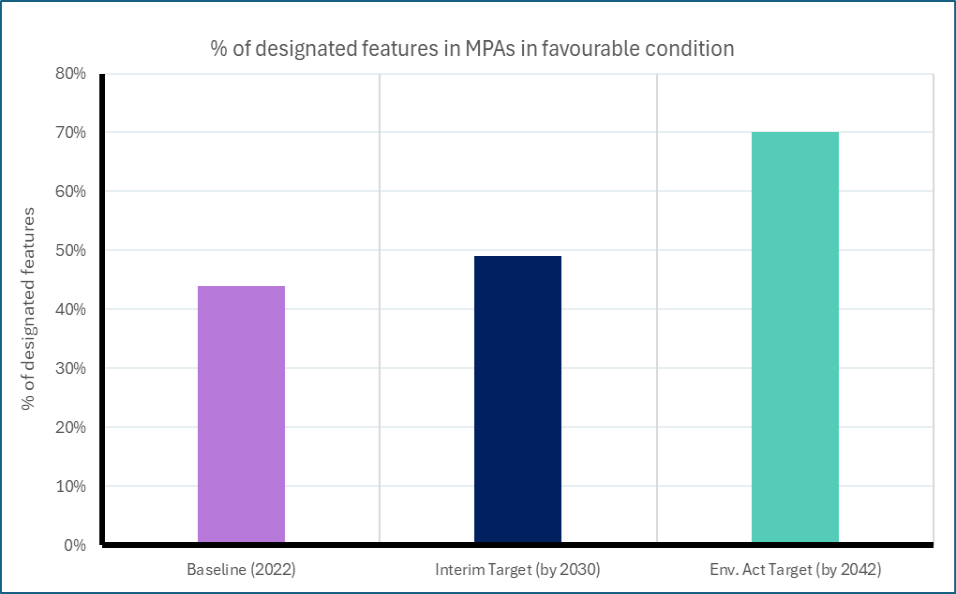
Figure 1. Baseline (2022) and projected percentages of designated features in marine protected areas (MPAs) in favourable condition by interim and statutory target dates
The bar chart (Figure 1) shows the current (Baseline (2022)) and projected percentages of designated features in MPAs in favourable condition by interim and statutory target dates. The illustrated trajectory is considered achievable, provided all management measures are in place by 2030.
Monitoring and evaluation summary
Statutory Nature Conservation Bodies (SNCBs) (NE and the JNCC) assess the condition of features designated within MPAs using direct survey data, or vulnerability assessments. These assessments estimate feature condition by considering the pressures from human activities and the sensitivity of each feature. Both approaches will be used to assess progress towards the interim and statutory target. In addition to condition assessments, we will report on the number of management measures implemented each year.
SNCBs conduct annual monitoring in partnership with the Centre for Environment, Fisheries and Aquaculture Science (Cefas) and Defra. Due to limited resources, only some MPAs are surveyed directly each year, typically 1 to 3 sites, and a combination of inshore and offshore sites. Sites are chosen for how well they represent a range of features across the English MPA network or where there are evidence gaps and may change over time based on evidence needs.
Survey data are typically analysed and reported within a year, but there have been historical delays in some reporting and publication. However, the data from these surveys can be used to inform condition assessment prior to formal publication. The development of the CTRT and wider MPA condition reporting programme will ensure feature condition across all English MPAs is updated ahead of the 2030 interim target. This will give early indication of progress.
The SNCBs have also modelled recovery timeframes for MPA features based on their resilience to human pressures. These timeframes range from 2 to 25 years. Provided appropriate management measures are in place, all features not permanently damaged are expected to achieve recovering or favourable condition over time.
We will publish full assessments in 2030 to inform the interim target, and every 5 years subsequently. These assessments will cover all 178 MPAs and over 1,000 designated features.