Local Growth Fund (Scotland) Prospectus
Published 23 March 2026
Applies to Scotland

© Crown copyright 2026
This publication is licensed under the terms of the Open Government Licence v3.0 except where otherwise stated. To view this licence, visit nationalarchives.gov.uk/doc/open-government-licence/version/3 or write to the Information Policy Team, The National Archives, Kew, London TW9 4DU, or email: psi@nationalarchives.gov.uk.
Where we have identified any third party copyright information you will need to obtain permission from the copyright holders concerned.
This publication is available at https://www.gov.uk/government/publications/local-growth-fund-scotland-prospectus/local-growth-fund-scotland-prospectus
1. Foreword by the Parliamentary Under Secretary of State for Scotland

Parliamentary Under Secretary of State for Scotland, Kirsty McNeill MP
This UK Government was elected with a clear mandate to deliver a decade of national renewal, with our core mission being to kickstart economic growth and improve living standards for working people.
Scotland possesses immense economic potential. From leading the UK’s clean energy transition to driving global competitiveness in advanced manufacturing, life sciences, and financial services, our regions have unique and world-class strengths to build upon.
However, we also know that over the last decade, Scotland’s economy and people’s living standards have underperformed compared to the UK as a whole, and there remain deep disparities in wealth and opportunity between different local areas.
To close these gaps and build a fairer, more productive society, we must empower local leaders to seize the opportunities of their regional strengths and address the specific barriers holding their communities back.
That is why I am delighted to introduce the Local Growth Fund (Scotland) Prospectus.
Over the next three years, the UK Government will invest £140 million across five Regional Partnerships:
- Glasgow City
- Edinburgh & South East Scotland
- Tay Cities
- Ayrshire
- Forth Valley
This fund is deliberately designed to provide strategic, flexible investment. The focus of this Prospectus is to set out how the UK Government will empower regional leaders, businesses, educational institutions, and the third sector to come together and design targeted 3-Year Investment Plans. We are asking regions to focus on three interconnected priorities:
- enabling local growth infrastructure;
- supporting local businesses to innovate and grow; and
- delivering the skills and employment support required for the industries of the future.
Crucially, this fund is strictly targeted at improving Real Disposable Household Income (RDHI) per capita, ensuring that our investment supports growth in the areas that fall below the Scottish national average.
The Local Growth Fund (LGF) does not sit in isolation. It is a vital pillar of this government’s wider commitment to Scottish communities. Alongside our new, hyper-local Pride in Place Programme, our City Region and Growth Deals, and our Growth Mission Fund, as well as our wider Industrial Strategy investments (such as Investment Zones and Green Freeports) , the UK Government (UKG) is backing local and regional projects in Scotland with more than £2 billion of targeted, long-term investment.
Kirsty McNeill MP
Parliamentary Under Secretary of State for Scotland
2. Economic Overview of Scotland
The performance of the Scottish economy underpins living standards by determining the amount of money in people’s pockets. While economic performance across the regions of Scotland varies, each region has its own unique strengths to build on. That is why policy interventions targeted at boosting wealth creation and fostering local and regional growth are essential to building a fairer, more equal society.
Over the last decade, Scotland’s economy and people’s living standards have underperformed the UK as a whole. This is reflected in Scotland’s GDP per capita which has yet to recover to pre-pandemic levels, while the UK as a whole recovered in 2024. The gap between the Scottish and the UK averages for RDHI per capita worsened between 2014-2018, and this gap has remained steady but persistent in recent years (2019-2023).
Furthermore, within Scotland there are high levels of disparity in RDHI per capita across local areas, and economic activity is highly concentrated in the city regions of Edinburgh and Glasgow - which also contain some of the greatest disparities in living standards and economic performance.
To close these gaps in both national and regional economic performance the UKG must support and empower local leaders to both seize the opportunities of their regional strengths and to address the issues highlighted by businesses and potential investors.
The sectoral and industrial composition of regional economies varies significantly across Scotland but there are clear opportunities to make high-impact investments to support economic growth in each region in the coming years, for example:
- Scotland is at the heart of the UK’s energy transition - providing a once-in-a generation opportunity to build on world class skills and industrial infrastructure in oil and gas to accelerate growth in the Clean Energy Industries of the future.
- Scotland is globally competitive in Defence and Advanced Manufacturing – where Glasgow builds everything from the Cityclass Type 26 frigate to precision engineered small satellites
- Edinburgh has the largest Financial Services sector in the UK outside London. The capital is also a leading centre for the Creative Industries and home to the world’s largest performing arts festival
- Dundee thrives as a global video games hub and rapidly growing Life Sciences cluster.
- Scotland’s elite universities are driving innovation across Quantum, Clean Energy Industries, Life Sciences and many other areas.
- There are strong clusters of Professional and Business Services, which the UKG will help grow through a new PBS skills hub in the Central Belt.
At the same time each region faces its own set of challenges that range from managing industrial transitions, to tech adoption and innovation readiness, as well as skills gaps, physical and digital infrastructure needs, and support for business scaleups.
By offering flexible investment for local leaders to target where it can have the greatest impact, the UKG will help to unlock growth, boost productivity, and improve access to higher paying jobs in new and expanding industries.
3. Strategic Outcomes
The LGF in Scotland supports the UKG Growth Mission to improve living standards (measured by RDHI per capita) for working people by investing in economic growth in the Scottish regions that contain the areas with the lowest living standards. It will provide strategic flexible investment to drive economic growth and build fairer and more productive regional economies.
The programme will support regional interventions that can create growth by supporting agglomeration benefits, addressing barriers such as skills shortages, and attracting private investors.
By backing the economic strategies of RPs, this investment will work alongside other reserved and devolved investments to support regional skills, employability and business support services; as well as deliver essential enabling infrastructure such as commercial centres, housing, digital connectivity, or integrated transport.
LGF investment is complementary to other UKG place-based investment programmes such as:
- Investment Zone support for high growth sectors outlined in the Industrial Strategy;
- integrating the regional partnership working established by the City Region and Growth Deals;
- building stronger local innovation ecosystems with the Local Innovation Partnerships Fund;
- delivering key capital projects alongside the Growth Mission Fund;
- developing investable propositions to secure private finance and support from the National Wealth Fund.
In parallel, the UKG’s targeted Pride in Place Strategy and wider community regeneration funding is providing additional support to those communities that are most in-need, in order to fund services and activities that will support more people to access more opportunities.
The LGF is also expected to complement the Scottish Government’s (SG) plans for supporting regional economic growth, including:
- National Strategy for Economic Transformation approach to boosting productivity;
- Community Wealth Building;
- expanding the strategic capacities and role of Scottish Regions;
- Infrastructure Delivery Pipeline support for housing, digital networks, energy systems, and growth of high value sectors.
4. Place Selection and Targeting
The LGF (Scotland) place selection and allocation methodology note sets out the methodology used to allocate £140 million over three years (2026/27 - 2028/29) across five RPs in Scotland.
Funding is being delivered through the highest level of local governance to enable strategic decision-making across interconnected ecosystems of firms, institutions, supply chains, and labour markets. RPs are collaborations between local government, the private sector, education and skills providers, enterprise and skills agencies and the third sector to deliver economic prosperity across Scotland’s regions. RPs are used to reflect functional economic areas (FEAs) with sufficient scale to support agglomeration benefits.
The targeted approach to allocating funding to RPs, which contain the areas with the lowest living standards (RDHI per capita), is essential to achieving the intensity of funding required for the intended policy objective of improving living standards for working people within the constraint of the overall funding envelope. RDHI per capita varies more significantly between local authorities than RPs and so is most suited to identifying the places most in need of investment to improve living standards.
5. Proposed Investment
The LGF will support five Scottish RPs to boost living standards for working people through economic growth by focusing on three interconnected themes:
- Enabling Local Growth Infrastructure: expanding labour market reach and enabling agglomeration benefits across functional economic areas.
- Support for Business: strengthening regional clusters and increasing innovation and investment to drive firm-level competitiveness and sectoral growth.
- Skills and employment support: providing the human capital aligned to priority sectors and emerging technologies.
The high-level logic model (below) frames the fund’s aims around intermediate and long-term impacts. This model is a guide, not prescription, and RPs should integrate other funding streams and tailor interventions to local contexts.
Figure 1: High-level logic model for Local Growth Fund (Scotland)
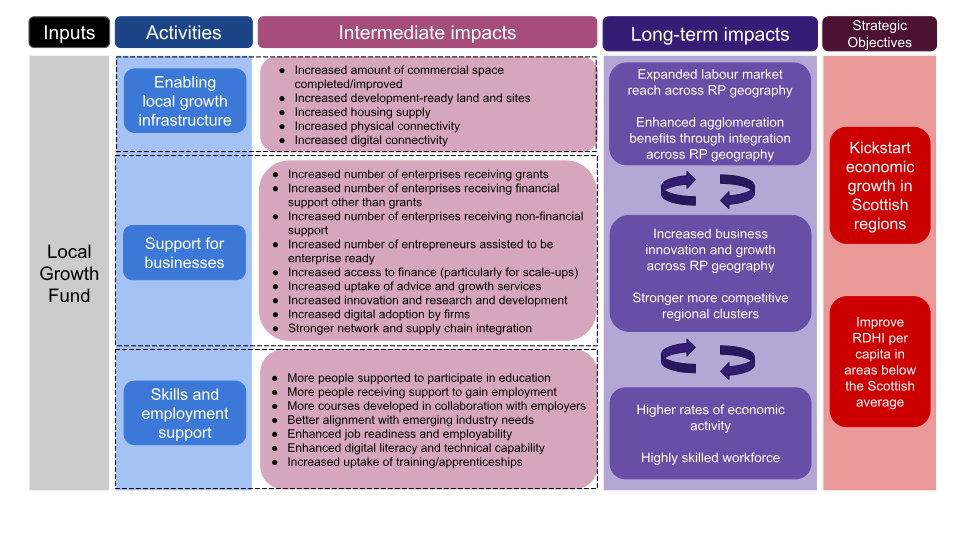
Input
- Local Growth Fund
Activities
- Enabling local growth infrastructure
- Support for businesses
- Skills and employment support
Intermediate Impacts
Infrastructure impacts:
- Increased amount of commercial space completed/improved
- Increased development-ready land and sites
- Increased housing supply
- Increased physical connectivity
- Increased digital connectivity
Business impacts:
- Increased number of enterprises receiving grants
- Increased number of enterprises receiving financial support other than grants
- Increased number of enterprises receiving non-financial support
- Increased number of entrepreneurs assisted to be enterprise ready
- Increased access to finance (particularly for scale-ups)
- Increased uptake of advice and growth services
- Increased innovation and research and development
- Increased digital adoption by firms
- Stronger network and supply chain integration
Skills impacts:
- More people supported to participate in education
- More people receiving support to gain employment
- More courses developed in collaboration with employers
- Better alignment with emerging industry needs
- Enhanced job readiness and employability
- Enhanced digital literacy and technical capability
- Increased uptake of training/apprenticeships
Long term Impacts
- Expanded labour market reach across RP geography
- Enhanced agglomeration benefits through integration across RP geography
- Increased business innovation and growth across RP geography
- Stronger more competitive regional clusters
- Higher rates of economic activity
- Highly skilled workforce
Vision
- Kickstarting economic growth within regions.
- Improve living standards (Real Disposable Household Income per capita) for working people in areas below the Scottish average.
LGF funded activities and outputs will differ between places and should be developed by local leaders in line with their relevant regional economic strategies. For this reason, RPs do not need to pursue all the illustrated outcomes and are encouraged to make place-informed prioritisation across the outcomes.
RPs should align LGF-funded activities with the UK Industrial Strategy, including support for the 8 growth-driving sectors and associated clusters within their region, as well as to relevant SG policies such as: Scotland’s National Strategy for Economic Transformation, Infrastructure Delivery Pipeline, and Community Wealth Building Act.
RPs can use LGF funding to identify and support the most suitable interventions for creating economic growth under the three broad themes outlined above, within the following three overarching spending parameters:
Regionality
LGF funded activities are required to align with regional economic strategies that deliver regional outputs and outcomes (i.e. not be restricted in impact to a single local authority area). To support greater regional integration and efficiencies, wherever possible LGF funded activities should be managed, monitored and evaluated by shared regional resources - such as a regional project management office, regional intelligence hub and other shared services.
LGF resource (RDEL) funding may be used for the provision of interventions by individual local authorities in financial year (FY) 2026-27. This flexibility is in recognition that RPs may need time to establish appropriate regional delivery structures and strategies for interventions that are currently managed separately by individual local authorities (e.g. skills or employability services). To utilise this flexibility for FY 2026-27, the 3-year LGF Investment Plans submitted by the RP must demonstrate a credible transition to using LGF funding for interventions that support regional outputs and outcomes by year 2 and year 3 of the LGF (FY 2027-28 and FY 2028-29). Any allocation of funding to individual local authorities in FY 2026-27 should be agreed by the relevant RP governance structures, while the Lead Local Authority (LLA) for the RP will remain the accountable body for all LGF funding in the region.
Further, recognising some RPs have more established partnership working arrangements than others, LGF funding can also be used to support the creation and transition to regional delivery structures that are needed to identify, develop and deliver interventions (e.g. regional project management offices, intelligence hubs, and other shared services) as well as for the administration, monitoring and evaluation of LGF funded projects. The UKG is not setting a formal limit on the percentage of LGF funding that can be used for supporting regional capability. However, proportionality of proposed administrative spend in the context of a RP’s wider spending plans will be considered. In this context, RPs are also required to set out how any regional capability supported by LGF funding will be sustainable beyond the end of the programme.
Additionality
Outputs and outcomes from LGF funded activities must represent additionality compared to the counterfactual (i.e. if there were no LGF funding the outputs or outcomes from an intervention/activity would be less). Where RPs intend to use LGF to support existing projects and interventions they are required to set out how the LGF is being used to expand, extend or improve the activity - along with the associated expected increases in outputs and outcomes.
Inclusivity
RPs will be required to demonstrate in their Investment Plans and Delivery Reports how the areas of the region that are below the Scottish national average RDHI per capita are benefitting from interventions.
6. Delivery Model
The LGF will use the financial assistance powers in the UK Internal Market Act 2020 to deliver funding to places in Scotland. In addition to the SG’s existing powers, this allows the UKG to complement and strengthen the support given to regional economic development in Scotland.
RPs are responsible for developing a 3-year LGF Investment Plan for approval by the UKG (SO and MHCLG), and for delivery of the LGF thereafter.
Each RP will be required to nominate a Lead Local Authority (LLA) that will receive the region’s LGF allocation to manage, including assessing and approving project business cases, processing payments, day-to-day monitoring, and project evaluation. Should RPs be put on statutory footing as delivery bodies by the SG, then the UKG will review the suitability of making payments to such statutory bodies in place of a LLA.
The LLA for the RP will be the Accountable Body with legal responsibility for the management and reporting of the LGF for the region. These responsibilities will be formalised by an MoU between MHCLG and the LLA in each RP.
Where specific local authorities or other delivery bodies within the RP take lead responsibility for delivering a particular intervention or policy for the wider region, lead authorities can allocate a proportion of the LGF budget to them for this purpose.
The LLA for each RP will have flexibility over how they deliver the LGF. They may wish to use a mix of competitions for grant funding (which is the default approach set out in Cabinet Office Grants Standards), procurement, commissioning or deliver some activity through in-house teams.
7. Governance
This information should be used alongside the published guidance for the LGF in Scotland, Wales and Northern Ireland.
Where they already exist, RPs should use governance structures such as partnership boards and working groups for consultation and advisory functions, and/or joint committee(s) for executive decision making.
Where RP governance structures are not present the Scotland Office (SO) will work with the constituent local authorities in the region and other regional institutions (such as the chambers of commerce, colleges, universities, and enterprise agencies) to convene a suitable decision making forum for the governance of the LGF until formal RP governance structures have been agreed and set up.
7.1 Annual Funding release
To secure the release of their LGF allocation for FY 2026-27, RPs are required to submit a 3-year Investment Plan for approval by the UKG (SO and MHCLG) by 29th May 2026. These Investment Plans must include:
- Details of regional partnership working and stakeholder engagement in line with the requirements for ‘regional decision making’ and ‘stakeholder engagement’ outlined below.
- Thematic level spending splits for all 3 years and forecasted thematic level outputs and outcomes - drawing on the LGF outputs and outcomes indicators, and in line with the requirements set out in ‘Section 5: Proposed Investment’ of this prospectus.
- Information on how areas of the region that are below the Scottish average RDHI per capita will be included in outcomes.
- Details of LLA assurance processes, risk management, and controls in line with the ‘LLA responsibilities’ outlined below.
- Any costs for developing regional capability and structures that are needed to identify, develop and deliver interventions, as well as for the administration, monitoring and evaluation of LGF funded projects.
- Summary project-level information (see ‘Section 9: Monitoring and Evaluation’ of this prospectus).
MHCLG and SO will review and sign-off on all RP 3-year LGF Investment Plans before the release of Year 1 funds to RPs.
MHCLG and the SO will review and sign-off the RP Annual Reports against Investment Plans prior to the release of funding for subsequent financial years.
At the end of each financial year, an Annual Review process will take place considering delivery performance, including spend and underspends, and the impact on deliverables, governance and assurance matters, allocations and any specific delivery challenges or opportunities. Payments for 2027-28 and 2028-29 will be made following the outcome of the Annual Review process. ‘Section 9: Monitoring and Evaluation’ of this prospectus describes the bi-annual reporting requirements.
Any underspends reported at the end of the programme period in March 2029 will be returned to the UK Government.
7.2 Eligible costs
Match funding is not required. LLAs are encouraged to consider match funding from the private, public and third sectors to maximise the value for money and impact of the Fund. A lack of access to match funding should not be a barrier to receiving funding.
LLAs may use part of their Local Growth Fund allocation to administer the fund including costs for developing regional capability and structures (such as shared services) that are needed to identify, develop and deliver interventions, as well as for the administration, monitoring and evaluation of LGF funded projects. This should be the minimum actual cost required.
LLAs should define capital costs in line with their standard accounting practice.
The following costs are not eligible for support:
- paid for lobbying, entertaining, petitioning or challenging decisions, which means using the Fund to lobby (via an external firm or in-house staff) in order to undertake activities intended to influence or attempt to influence Parliament, government or political activity including the receipt of funding; or attempting to influence legislative or regulatory action
- payments for activities of a party political or exclusively religious nature
- VAT reclaimable from HMRC. Irrecoverable VAT is an eligible cost under the Local Growth Fund in Scotland, Wales & Northern Ireland
- gifts, or payments for gifts or donations
- statutory fines, criminal fines or penalties
- payments for works or activities which the lead local authority, project deliverer, end beneficiary, or any member of their partnership has a statutory duty to undertake, or that are fully funded by other sources
- contingencies and contingent liabilities
- dividends
- bad debts, costs resulting from the deferral of payments to creditors, or winding up a company
- expenses in respect of litigation, unfair dismissal or other compensation
- costs incurred by individuals in setting up and contributing towards private pension schemes
With the exception of the costs listed in above, all other costs are considered to be eligible for Local Growth Fund support in Scotland, providing they are necessary to deliver activity that is within the scope of the relevant RP Investment Plan and the objectives of the Local Growth Fund.
In line with the government’s commitment to reducing the use of consultancy, LLAs should limit use of procured support and aim to deliver using ‘in house’ resources. LLAs should also consider how to ensure funding is going into the local economy, by considering how procurement processes are accessible to small and medium-sized local businesses.
7.3 Capital assets
If the Local Growth Fund is used to develop, create, purchase or improve capital assets, in particular but not exclusively land and property, appropriate controls and monitoring arrangements that ensure the asset is used for the purpose for which funding was awarded for a reasonable period should be put in place. Controls and monitoring should allow for recovery of funding from the recipient if assets are sold or cease to be used for purposes for which funding was provided, in full or in part.
7.4 Management of in-year changes to Investment Plans
Investment Plans will set out the activities to be funded with the LLA able to respond to changes in the operating environment over the period to 31 March 2029. This means that financial forecasts are indicative and can be changed as plans are refined and delivery progresses.
Changes will be routinely captured in the regular monitoring, reporting and engagement mechanisms set out in ‘Section 9: Monitoring and Evaluation’ of this prospectus. So Investment Plans can be responsive to need, changes that fall beneath the following thresholds do not require prior approval by the UKG.
- A material change to what is delivered is a single or cumulative reprofiling of funding from one Local Growth Fund theme that changes the total planned spend in a theme by 30% or more. Changes will be benchmarked against the initial forecast provided in the agreed Investment Plans. The impact of any changes on Fund metrics will need to be considered. Where a material change has already been made, that will provide the benchmark.
- Any novel or contentious reprofiling that changes the total planned spend in a theme by between 15% and 30% will also require approval by the UKG via regular discussions or annual review.
If the thresholds above are crossed, requests for such material changes should be submitted to both localgrowth@ukgovscotland.gov.uk and LGFSWNI@communities.gov.uk
7.5 Regional decision making
RPs can determine the most appropriate scale and delivery body for each intervention, however, all LGF Investment Plan spending decisions must be made through joint decision-making via regional governance structures, and may not be delegated to individual local authorities.
7.6 Lead Local Authority (LLA) responsibilities
LLAs are responsible for ensuring the fulfilment of legal duties including, but not limited to: equality duties; environment; accessibility and transparency commitments, as well as compliance with subsidy control and managing public money requirements. LLAs will also be responsible for ensuring project selection and contracting processes have mechanisms to recover funding where beneficiaries do not comply with fund parameters, UK law or any local requirements.
LGF Investment Plans are required to set out the LLAs assurance processes for these duties. Further details on LLA responsibilities for risk management are set out in ‘Section 10: Risk Management’ of this prospectus.
7.7 Stakeholder engagement requirements
RPs are expected to work closely with the SG and its relevant agencies in the planning and delivery of LGF funded interventions.
RPs are also expected to work closely with other relevant UKG departments - e.g. with Department for Work and Pensions on employment interventions to ensure alignment with mainstream employment provision, or with Department for Business and Trade on business support for exporting.
To ensure that the needs of places and sectors within each RP are considered in the development of spending plans and as part of ongoing delivery of LGF Investment Plans, RPs must engage with their constituent authorities, delivery bodies and other local partners such as:
- chambers of commerce and other key business representative bodies;
- colleges and other key training providers;
- universities and other key research institutions;
- community, voluntary and third sector representative bodies.
RPs are also required to regularly consult, engage and update MPs and MSPs on the delivery of LGF investment plans - noting that RPs are not bound by MP or MSP preferences.
8. Branding and Publicity
Branding and publicity play a key role in ensuring effective promotion and acknowledgement of the wider UKG agenda. Publicity and branding requirements must be followed for all UKG-funded projects.
The requirements cover several areas including logo use, production of plaques, print and digital materials (including video case studies and other filming for project updates and promotional purposes) and also co-branding. For more information, see: Funded by UK Government Branding Manual.
The SO is the relevant department for all invitations to events, announcements, and inclusion of Ministerial quotes on media materials for supported projects.
SO communications should be consulted on planned announcements and Ministers should be invited to any events marking key milestones or the formal completion of any LGF-funded infrastructure projects with no less than 6 weeks notice.
9. Monitoring and Evaluation
This information should be used alongside the published guidance for the LGF in Scotland, Wales and Northern Ireland.
9.1 Monitoring
All LLAs are required, at minimum, to monitor spend, outputs and outcomes against agreed indicators set out in the published LGF guidance and submit this information to the UKG via MHCLG. Only a selection of outputs and outcomes for the LGF may be relevant to each Investment Plan:
The below summarises the LGF Scotland Monitoring Framework at a high level.
9.2 Biannual Delivery Reports
Twice a year, in May and November, LLAs will be asked to share a progress report with the UK Government (using an online tool). The reporting schedule is as follows:
| Reporting Periods | Reporting Commissioned | Reporting Due Date | Information Type |
| 1 April to 30 September 2026 | 5 October 2026 | 2 November 2026 | 6-monthly |
| 1 October to 31 March 2027 | 5 April 2027 | 3 May 2027 | 6-monthly and annual review |
| 1 April to 30 September 2027 | 4 October 2027 | 1 November 2027 | 6-monthly |
| 1 October to 31 March 2028 | 3 April 2028 | 1 May 2028 | 6-monthly and annual review |
| 1 April to 30 September 2028 | 2 October 2028 | 6 November 2028 | 6-monthly |
| 1 October to 31 March 2029 | 2 April 2029 | 7 May 2029 | Final report |
This bi-annual reporting will include information covering:
- a summary of progress on the implementation of the Local Growth Fund
- actual spend across the three Local Growth Fund themes in the reporting period, based on spend incurred by organisations delivering Fund activities
- actual metrics achieved across the three Local Growth Fund themes
- committed spend across the three Local Growth Fund themes
- spend, outputs and outcome forecasts for the current financial year across the three Local Growth Fund themes
- spend and output and outcome forecast for the full period of the fund across the three Local Growth Fund themes.
The data provided to the UKG will be used:
- for oversight of the progress of the Local Growth Fund. This will enable MHCLG to undertake its responsibility to the UK Parliament.
- to inform relevant UKG Ministers and departments, where appropriate, on the delivery and impact of the Local Growth Fund on shared policy areas.
- to support evaluation.
9.3 Summary project level information
In addition, so that the UKG can understand how and where the funding is used, LLAs will also be asked to make available summary information on each of the funded projects. This will comprise of:
- Name of Project
- LGF Theme (which of the 3 themes the project primarily aligns to)
- Project Description – a brief description of the project (max 10 words), for example: Local Business Development Grants.
- New or pre-LGF Project – is this a continuation of an existing project with LGF funding, or a new project?
- Location – Project Postcode or Project Delivery Postcode (if applicable).
- Local Authority Areas that will benefit
- Delivery Lead – name of the organisation delivering project
- Type of Organisation delivering project – for example, VSO, Private Sector etc
- Status – that is, Planned, Live, Finished (completed), Closed (stopped early)
- Reason for closure – if project has closed early rather than being successfully completed
- Estimated budget – LGF budget, Primary & Secondary non LGF funding sources, Total Budget (from all sources)
The chief financial officer or equivalent (or an appointed deputy) for each delivery body will be required to certify reports to confirm their accuracy.
9.4 Quarterly Check-Ins
In addition to formal bi-annual reporting, the UKG (SO and MHCLG) will set up quarterly official-level check-ins meetings with RPs to discuss delivery progress, issues and any in-year Investment Plan changes (see ‘Section 7: Governance’ of this prospectus for more detail on the in-year change control process).
Wherever possible we will aim for these check-ins to align with existing governance and reporting cycles of other UKG programmes being delivered in the region.
SG officials will also be invited to attend these quarterly check-ins. We will confirm wider membership requirements alongside the running of these meetings with RPs in due course.
9.5 Locally-led process evaluations
All LLAs are advised to carry out process evaluation of significant projects, if they deem necessary, to demonstrate the effectiveness of delivery of the interventions pursued. This can help contribute towards local accountability and provide learning on what worked in terms of delivery.
9.6 Locally-led causal impact evaluations
To build evidence bases on what works for local interventions, LLAs are also encouraged to conduct their own causal quantitative impact evaluations for certain projects, where feasible.
For each RP this should be proportionate to their allocations and Investment Plans. For example, the benefits and opportunities of undertaking causal impact evaluations are expected to be greater for RPs with larger funding allocations. Moreover, a LLA may prioritise causal impact evaluations for specific particular projects, especially if impact evaluations on other projects are unlikely to provide meaningful results.
The proportion of LGF funding allocated for monitoring and evaluation should also be set out in the Investment Plan.
9.7 Programme Evaluation
MHCLG will be responsible for monitoring LGF outputs and outcomes at programme level. The SO and MHCLG will jointly review the RP-level delivery reports and project evaluations to evaluate overall LGF programme impact in Scotland, which will be aligned with MHCLG’s evaluation of the LGF programme in other parts of the UK. RPs are expected to engage in mutual sharing of good practice with the UKG and other bodies as appropriate (e.g. other RPs, and regional authorities in other parts of the UK).
10. Risk Management
This information should be used alongside the published guidance for the LGF in Scotland, Wales and Northern Ireland.
LGF Investment Plans will be required to set out the LLAs risk management and assurance processes.
10.1 Fraud Risk Assessment (FRA)
LLAs are responsible for managing fraud risk and ensuring the following minimum standards are met:
- following Grants Functional Standards on Fraud Risk Assessment (FRA)
- undertaking FRAs at an appropriate level to each individual project dependent on risk
- ensuring that Local Growth Fund expenditure is undertaken in accordance with an effective fraud prevention policy and procedure.
10.2 Due diligence
LLAs are responsible for undertaking proportional due diligence on third parties receiving Local Growth Fund allocations and meeting the following minimum standards:
- following Grants Functional Standards on due diligence
- undertaking due diligence at an appropriate level to each individual project dependent on risk
- ensuring that due diligence is undertaken in accordance with effective rules and procedures.
10.3 Subsidy control
Delivery bodies must ensure that the Local Growth Fund is delivered within the requirements of the Subsidy Control Act 2022 and report any relevant subsidies.
UK subsidy control guidance has been issued for public authorities to help them interpret the UK’s international obligations on subsidy control. The guidance also applies to non-public organisations involved in the delivery of Local Growth Fund, in particular projects that provide grants to businesses.
10.4 Procurement
When LLAs procure activities with Local Growth Fund in Scotland, they must follow:
- the LLAs’ local grant and contract rules, processes or procedures
- the Procurement Regulations 2024.
Where other contracting bodies procure activities with Local Growth Fund money, the delivery bodies must make sure they follow the Procurement Regulations 2024.
Where non-contracting authorities undertake procurements using Local Growth Fund money, LLAs should determine appropriate procurement thresholds and requirements that ensure fraud risk is minimised, and value for money has been obtained.
10.5 Equalities
LLAs and any other public bodies engaged in the delivery of, or receipt of, the Local Growth Fund, must meet their statutory equality duty. Delivery bodies may ask non-public end recipients of funding to carry out activities or collect data that support the public sector/statutory equality duty.
10.6 Data protection
LLAs and any other organisations engaged in the delivery of, or receipt of, the Local Growth Fund in Scotland must comply with relevant Data Protection legislation.
11. Contacts
Regional partners should contact the Scotland Office if you have any questions regarding the Local Growth Fund Prospectus. Email our team at localgrowth@ukgovscotland.gov.uk.
Media queries should be directed to: pressoffice@ukgovscotland.gov.uk